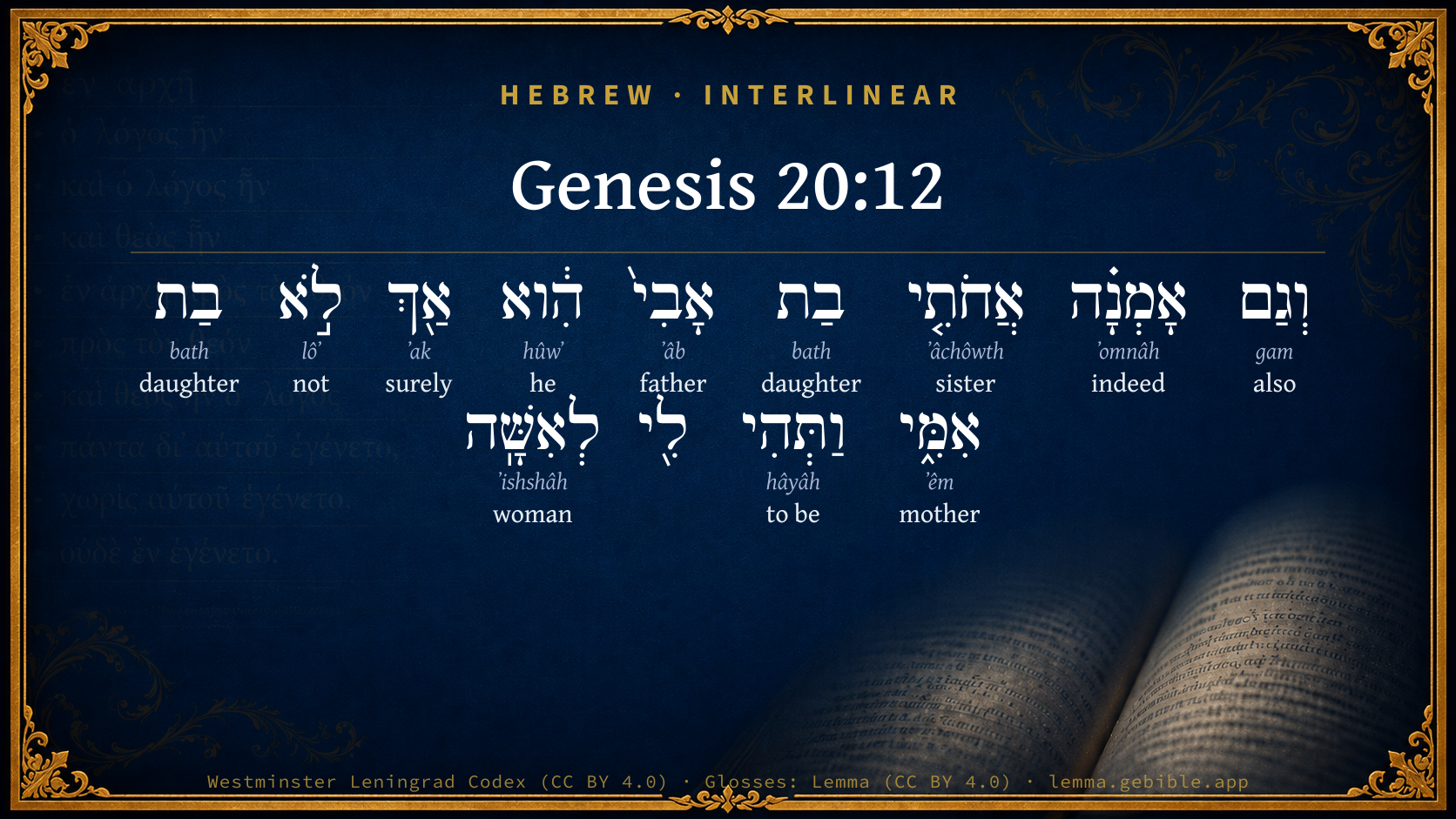
Genesis 20:12

Hebrew (Westminster Leningrad Codex) Genesis 20:12 appears in the Hebrew Old Testament. The text above is from the Westminster Leningrad Codex. Each word links to its Strong’s number, a concise gloss, and parsing drawn from the Open Scriptures Hebrew Bible morphology. Click any word for its full Brown-Driver-Briggs (BDB) entry.
Download image
Cite this verse

Genesis 20:12 (World English Bible). Public Domain. Lemma interlinear Bible study tool, https://lemma.gebible.app/v/genesis/20/12.

Show BibTeX & RIS
BibTeX
RIS
English Translation
Moreover she is indeed my sister, the daughter of my father, but not the daughter of my mother; and she became my wife.
World English Bible · Public Domain
Highlights
  • 1 first appearance in the Hebrew Bible
Full analysis ↓
Download a study sheet

One document with this verse’s original text, its word-by-word gloss line, the meaning frame, cross-references with their text, attributed commentary, and full source and license credits — printable, and it pastes into notes with its structure intact.

This verse Autodidact and up

Study sheet (.html) Plain text (.txt)

A passage Seminary Student

Up to 50 verses in one chapter. A passage sheet keeps up to 6 commentary sources and 12 cross-references per verse, in the order this page ranks them, and says so on the sheet whenever that leaves anything out. Ask for a single verse and you get the Autodidact verse sheet above.

Everything on this page stays free to read, with no account — the sheet is a download of what is already on screen, not access to it.

Want to remove ads? Support Godless Engineer
Compare translations 3

The same verse in 3 English versions, stacked beneath the original-language interlinear above. Click any original word for its lexicon entry.

Each is an independent rendering of the whole verse — the interlinear is not word-aligned to these translations.

Highlighted words mark where these versions differ — a whole-verse word diff, not a word-by-word alignment.

  • World English Bible Public Domain
    Moreover she is indeed my sister, the daughter of my father, but not the daughter of my mother; and she became my wife.
  • King James Version Public Domain
    And yet indeed she is my sister; she is the daughter of my father, but not the daughter of my mother; and she became my wife.
  • unfoldingWord Literal Text CC BY-SA 4.0
    And also she truly my sister, the daughter of my father but not the daughter of my mother, and she became my wife.

unfoldingWord Literal Text — © unfoldingWord, licensed CC BY-SA 4.0. Word-aligned USFM3 via Door43 (git.door43.org/unfoldingWord/en_ult).

Versions to compare (up to 4)

3 of 4 selected

Show all 18 translations

Every available English version of this verse, each an independent rendering of the whole verse.

  • World English Bible Public Domain
    Moreover she is indeed my sister, the daughter of my father, but not the daughter of my mother; and she became my wife.
  • Berean Standard Bible Public Domain
    Besides, she really is my sister, the daughter of my father—though not the daughter of my mother—and she became my wife.
  • Majority Standard Bible Public Domain
    Besides, she really is my sister, the daughter of my father—though not the daughter of my mother—and she became my wife.
  • King James Version Public Domain
    And yet indeed she is my sister; she is the daughter of my father, but not the daughter of my mother; and she became my wife.
  • American Standard Version (1901) Public Domain
    And moreover she is indeed my sister, the daughter of my father, but not the daughter of my mother; and she became my wife:
  • Revised Version (1885) Public Domain
    And moreover she is indeed my sister, the daughter of my father, but not the daughter of my mother; and she became my wife:
  • Geneva Bible (1599) Public Domain
    Yet in very deede she is my sister: for she is the daughter of my father, but not the daughter of my mother, and she is my wife.
  • Douay-Rheims (1899) Public Domain
    Howbeit, otherwise also she is truly my sister, the daughter of my father, and not the daughter of my mother, and I took her to wife.
  • Young's Literal Translation Public Domain
    and also, truly she is my sister, daughter of my father, only not daughter of my mother, and she becometh my wife;
  • Literal Standard Version CC BY-SA 4.0
    and also, she is truly my sister, daughter of my father, only not daughter of my mother, and she becomes my wife;
  • Unlocked Literal Bible CC BY-SA 4.0
    Besides, she is indeed my sister, the daughter of my father, but not the daughter of my mother; and she became my wife.
  • unfoldingWord Literal Text CC BY-SA 4.0
    And also she truly my sister, the daughter of my father but not the daughter of my mother, and she became my wife.
  • Darby Bible Public Domain
    But she is also truly my sister, the daughter of my father, but not the daughter of my mother; and she became my wife.
  • World Messianic Bible Public Domain
    Besides, she is indeed my sister, the daughter of my father, but not the daughter of my mother; and she became my wife.
  • Webster's Bible Public Domain
    And yet indeed she is my sister: she is the daughter of my father, but not the daughter of my mother; and she became my wife.
  • Free Bible Version CC BY-SA 4.0
    “Anyway, she really is my sister, the daughter of my father but not my mother, and I married her.
  • Bible in Basic English Public Domain
    And, in fact, she is my sister, the daughter of my father, but not the daughter of my mother; and she became my wife:
  • JPS Tanakh (1917) Public Domain
    And moreover she is indeed my sister, the daughter of my father, but not the daughter of my mother; and so she became my wife.

Literal Standard Version (2020), Covenant Press — licensed CC BY-SA 4.0. Text via the HelloAO Bible API (eBible.org). Unlocked Literal Bible (unfoldingWord) — licensed CC BY-SA 4.0. Text via the HelloAO Bible API (eBible.org). unfoldingWord Literal Text — © unfoldingWord, licensed CC BY-SA 4.0. Word-aligned USFM3 via Door43 (git.door43.org/unfoldingWord/en_ult). Free Bible Version, Dr. Jonathan Gallagher — licensed CC BY-SA 4.0. Text via the HelloAO Bible API (eBible.org).

Word by word

More ways to search: Search by grammar → Find every occurrence → Compare this word →

Practice this passage: Drill this verse → Learn its vocabulary →

אָמְנָ֗ה
ʼomnâh
H546
“indeed”
Adverb
Part of Speech
Adverb
Full BDB Definition

Origin: feminine form of H544 (in its usual sense)

TWOT: 116g

verily, truly, indeed
  1. וְגַם gam H1571 “and · also” Conjunction + Particle, Accusative
  2. אֲחֹתִ֤י ʼâchôwth H269 “sister · my” Noun, Common, Feminine, Singular, Construct + Suffix, Personal, 1st Person, Common, Singular
  3. בַת bath H1323 “daughter of” Noun, Common, Feminine, Singular, Construct
  4. אָבִי֙ ʼâb H1 “father · my” Noun, Common, Masculine, Singular, Construct + Suffix, Personal, 1st Person, Common, Singular
  5. הִ֔וא hûwʼ H1931 “he” Pronoun, Personal, 3rd Person, Feminine, Singular
  6. אַ֖ךְ ʼak H389 “surely” Particle, Accusative
  7. לֹ֣א lôʼ H3808 “not” Particle, Negative
  8. בַת bath H1323 “daughter of” Noun, Common, Feminine, Singular, Construct
  9. אִמִּ֑י ʼêm H517 “mother · my” Noun, Common, Feminine, Singular, Construct + Suffix, Personal, 1st Person, Common, Singular
  10. וַתְּהִי hâyâh H1961 “and · to be” Conjunction + Verb, Qal, Sequential Imperfect, 3rd Person, Feminine, Singular
  11. לְאִשָּֽׁה ʼishshâh H802 “to/for · woman” Preposition + Noun, Common, Feminine, Singular, Absolute

About this verse

These counts appear in no published source. They are computed here, from the morphology-tagged text and Lemma’s own curated glosses. What Lemma adds →

13
words
11
distinct lemmas
Pentateuch
section

Notable vocabulary

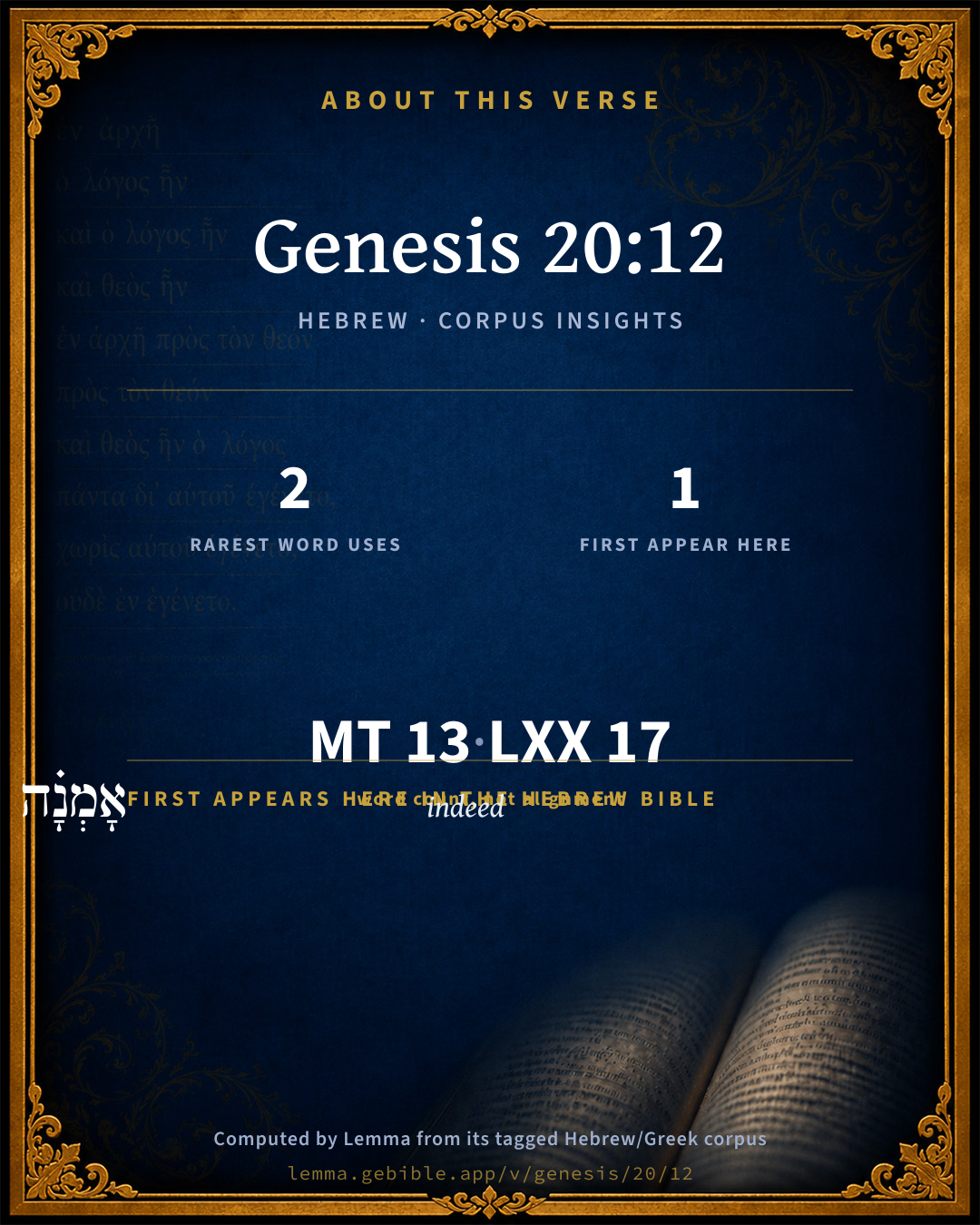
The rarest word here is אָמְנָ֗ה indeed H546 — appearing just 2 times in the whole Hebrew Bible.

First appearance in Scripture

This word makes its first canonical appearance in the Hebrew Bible here:

  • אָמְנָ֗ה indeed H546

Shared distinctive vocabulary

אָמְנָ֗ה indeed H546 occurs in 2 verses of the Hebrew Bible. Also found in:

Grammatical profile

  • 1 verb
  • 6 nouns
  • 1 pronoun
  • 1 preposition
  • 1 adverb
  • 3 particles

Verb forms

  • וַתְּהִי Qal · Sequential Imperfect

Repetition

A word recurs within this verse — often emphatic in Hebrew:

  • בַת daughter H1323 ×2

Hebrew & Septuagint length

In English translation the verse runs 23 words from the Hebrew and 19 from the Septuagint (LXX English) — closely comparable.

A rough comparison of the two English renderings, which tokenize alike — not a word-level alignment.

Word counts can differ between the Hebrew and the Greek without any difference in meaning — e.g. the Hebrew direct-object marker אֵת has no separate Greek word, and Greek often adds the article ὁ.

In the original languages it is 13 Hebrew tokens and 17 Greek tokens — but the two are counted differently (Hebrew bundles its prefixes and suffixes into one token; the Greek is in lemma form), so that isn’t a like-for-like length.

Cross-references

3

Topical passages linked to Genesis 20:12 in the Treasury of Scripture Knowledge — connected by theme and wording, ordered by reader-vote popularity; previews shown in the World English Bible.

  • Genesis 11:29 Abram and Nahor took wives. The name of Abram's wife was Sarai, and the name of Nahor's wife, Milcah, the daughter of Haran who was also the father of Iscah.
  • Genesis 12:13 Please say that you are my sister, that it may be well with me for your sake, and that my soul may live because of you."
  • 1 Thessalonians 5:22 Abstain from every form of evil.

Cross-references courtesy of OpenBible.info (CC BY 4.0).

Hebrew and Greek witnesses Masoretic Hebrew ↔ Greek Septuagint

The same verse in the two great witnesses to the Old Testament, shown verse-for-verse.

These are two independent witnesses, not word-aligned to each other, and the Septuagint is shown in lemma (dictionary) form.

Hebrew Genesis 20:12 Masoretic · Westminster Leningrad Codex

וְגַם אָמְנָ֗ה אֲחֹתִ֤י בַת אָבִי֙ הִ֔וא אַ֖ךְ לֹ֣א בַת אִמִּ֑י וַתְּהִי לִ֖י לְאִשָּֽׁה

Moreover she is indeed my sister, the daughter of my father, but not the daughter of my mother; and she became my wife.

World English Bible · Public Domain

Greek LXX Genesis 20:12 Septuagint · lemma form

καί γάρ ἀληθῶς ἀδελφή ἐγώ εἰμί ἐκ πατήρ ἀλλά οὐ ἐκ μήτηρ γίγνομαι δέ ἐγώ εἰς γυνή

For truly she is my sister by my father, but not by my mother, and she became my wife.

LXX2012 (modern English Septuagint) · Public Domain

Hebrew: Westminster Leningrad Codex (CC BY 4.0). Greek: Septuagint (public domain); English from LXX2012 (modern English Septuagint) (Public Domain). How the Septuagint differs from the Hebrew →

Targum (Aramaic paraphrase)

2

The Targum is the ancient Jewish Aramaic paraphrase of the Hebrew Scriptures — an interpretive translation, not the Hebrew text itself. Onkelos (literal) and Pseudo-Jonathan (expansive) render the Torah, and Jonathan the Prophets. Coverage is partial: where no permissively-licensed English translation exists for a verse, only the Aramaic is shown. This is verse-level text, not a word-by-word alignment to the Hebrew.

  1. Targum Onkelos Torah (Genesis–Deuteronomy)
    וּבְרַם בְּקוּשְׁטָא אֲחָתִי בַּת אַבָּא הִיא בְּרַם לָא בַת אִמִּי וַהֲוַת לִי לְאִנְתּוּ

    (no public-domain English translation for this verse)

    Targum Onkelos — Aramaic: “Onkelos Genesis” (public domain); “Onkelos Exodus” (public domain); “Onkelos Leviticus” (public domain); “Onkelos Numbers” (public domain); “Onkelos Deuteronomy” (public domain). English: “Sefaria Community Translation” (CC0 1.0 (public-domain dedication)); “J.W. Etheridge. The Targums of Onkelos and Jonathan Ben Uzziel on the Pentateuch. London: Longmans, Green, 1862” (public domain). Text via Sefaria.

  2. Targum Pseudo-Jonathan Torah (Genesis–Deuteronomy)
    וּבְרַם בְּקוּשְׁטָא אַחְתִי בְּרַת אָחָא דְאִיבָא הִיא בְּרַם לָא מִגְנִיסַת אִימָא וַהֲוַת לִי לְאִנְתּוּ

    But in truth she is my sister, the daughter of my father's brother, but not of the kindred of my mother; and she became my wife.

    Targum Pseudo-Jonathan — Aramaic: “Targum Jonathan on Genesis” (public domain); “Targum Jonathan on Exodus” (public domain); “Targum Jonathan on Leviticus” (public domain); “Targum Jonathan on Numbers” (public domain); “Targum Jonathan on Deuteronomy” (public domain). English: “The Targum of Jonathan ben Uzziel, trans. J. W. Etheridge, London, 1862” (public domain). Text via Sefaria.

Commentary

Notes on Genesis 20:12 from classic Christian and Jewish commentators (each source and its license shown beneath its notes). The classic Christian expositions comment on the surrounding passage and are grouped to its opening verse, so a note may address several verses; the Jewish commentaries on the Tanakh (Rashi and others) are per-verse, so they appear only where the commentator wrote on this verse.

Lemma curates 59 commentaries, every one of them public domain or Creative Commons licensed, each selected and text-cleaned for this edition rather than reprinted as found. About our sources →

Trapp's Complete Commentary

John Trapp

Gen 20:12 And yet indeed [she is] my sister; she [is] the daughter of my father, but not the daughter of my mother; and she became my wife.

Ver. 12. And yet indeed.] {See Trapp on "Gen 11:29"}

John Trapp, A Commentary or Exposition upon All the Books of the Old and New Testament (1647–1656) — public domain. Text from a community e-Sword module.

Geneva Bible (1599)

Geneva Bible translators

By sister, he meaneth his cousin germaine, and by daughter, Abraham’s niece, Gen. 11:29, for so the Hebrews use these words.

Geneva Bible (1599) marginal notes — public domain. Text via Bolls.life.

Jamieson, Fausset & Brown

Robert Jamieson, A. R. Fausset & David Brown

yet indeed she is my sister--(See on Gen 11:31). What a poor defense Abraham made. The statement absolved him from the charge of direct and absolute falsehood, but he had told a moral untruth because there was an intention to deceive (compare Gen 12:11-13). "Honesty is always the best policy." Abraham's life would have been as well protected without the fraud as with it: and what shame to himself, what distrust to God, what dishonor to religion might have been prevented! "Let us speak truth every man to his neighbor" [Zac 8:16; Eph 4:25].

Next: Genesis Chapter 21

Jamieson, Fausset & Brown — Commentary Critical and Explanatory on the Whole Bible (1871) — public domain (CC PDM 1.0). Text via the HelloAO Bible API.

Adam Clarke's Commentary

Verse 12. She is my sister] I have not told a lie; I have suppressed only a part of the truth. In this place it may be proper to ask, What is a lie? It is any action done or word spoken, whether true or false in itself, which the doer or speaker wishes the observer or hearer to take in a contrary sense to that which he knows to be true. It is, in a word, any action done or speech delivered with the intention to deceive, though both may be absolutely true and right in themselves. See Clarke on Ge 12:13.

The daughter of my father, but not - of my mother] Ebn Batrick, in his annals, among other ancient traditions has preserved the following: "Terah first married Yona, by whom he had Abraham; afterwards he married Tehevita, by whom he had Sarah." Thus she was the sister of Abraham, being the daughter of the same father by a different mother.

Adam Clarke's Commentary on the Bible (1810–1826) — public domain. Text from a community e-Sword/MySword module.

John Calvin's Commentaries

12. And yet indeed she is my sister. Some suppose Sarah to have been Abraham’s own sister, yet not by the same mothers but born from a second wife. As, however, the name sister has a wider signification among the Hebrews, I willingly adopt a different conjecture; namely, that she was his sister in the second degree; thus it will be true that they had a common father, that is, a grandfather, from whom they had descended by brothers. Moreover, Abraham extenuates his offense, and draws a distinction between his silence and a direct falsehood; and certainly he professed with truth, that he was the brother of Sarah. Indeed it appears that he feigned nothing in words which differed from the facts themselves; yet when all things have been sifted, his defense proves to be either frivolous, or, at least, too feeble. For since he had purposely used the name of sister as a pretext, lest men should have some suspicion of his marriage; he sophistically afforded them an occasion of falling into error. Wherefore, although he did not lie in words, yet with respect to the matter of fact, his dissimulation was a lie, by implication. He had, however, no other intention than to declare that he had not dealt fraudulently with Abimelech; but that, in an affair of great anxiety, he had caught at an indirect method of escape from death, by the pretext of his previous relationship to his wife.

John Calvin's Commentaries (1540-1563) — public domain. Text from the Calvin Translation Society English edition (1840s-50s) via the Christian Classics Ethereal Library (ccel.org). Calvin's coverage is partial (roughly two-thirds of the Bible); uncommented books and verses are honest gaps, never fabricated. The 19th-century editor's footnotes and remarks are omitted so the notes are faithfully Calvin's own voice.

Ellicott's Commentary for English Readers

(12) Not the daughter of my mother.—This disproves the notion that Sarah was the same as Iscah (Gen_11:29); for as Iscah was Terah’s granddaughter, the distinction between the identity of the father and the diversity of the mother would in her case be unmeaning. Sarah was apparently Abraham’s half-sister, being Terah’s daughter by another wife; and we gather from her calling her child Sarai—that is, princely (see Gen_17:15)—that she was not a concubine, but belonged to some noble race.

A Bible Commentary for English Readers, edited by Charles John Ellicott (1878–1897) — public domain. Text from a community e-Sword module.

The Cambridge Bible for Schools and Colleges

gen. ed. J. J. S. Perowne

12. she is indeed my sister] See Gen_11:29, Gen_12:19. The marriage with a half-sister was evidently permitted in David’s time (cf. 2Sa_13:13); and it was practised in the days of Ezekiel (Eze_22:11), though forbidden by the laws of Lev_18:9; Lev_18:9; Lev_18:11; Lev_20:17; Deu_27:22. It is said to have been permitted in Phoenicia and Egypt.

Abraham’s excuse is based upon a half truth. Sarah may have been truly his sister; but this statement was no moral justification for his suppression of the fact that she was his wife. The further excuse in Gen_20:13, that as he travelled about he always practised this mental reservation concerning Sarah, scarcely adds dignity to his line of defence.

The Cambridge Bible for Schools and Colleges (gen. ed. J. J. S. Perowne; Cambridge University Press, 1878–1918) — public domain. Text from a community e-Sword module.

John Gill's Exposition

And yet indeed she is my sister,.... In the same sense as Lot was his brother; for she was sister to Lot, and both were the children of Haran, the brother of Abraham:

she is the daughter of my father, but not the daughter of my mother; she was the daughter of his father, being his granddaughter, grandchildren are sometimes called children, but not the daughter or granddaughter of Abraham's mother; Terah having had two wives, by the one he had Haran, the father of Sarah, and by the other Abraham. According to the Arabic writers (f), Abraham and Sarah were the immediate children of Terah, but by two mothers:"the mother of Abraham (they say) died, whose name was Juna, and Terah married another wife, whose name was Lahazib, some say Tahuitha, who bore him Sarah, afterwards married to Abraham; hence Abraham said, she is my sister on my father's side, but not on my mother's side:"

and she became my wife; as in those times it was judged lawful, and so it has been accounted lawful in many nations to marry sisters on the father's side, when those on the mother's were prohibited (g).

(f) Elmacinus, p. 51. Patricides, p. 17. apud Hottinger. Smegma Oriental. p. 281. (g) Vid. Philo. de Special. Leg. p. 779. Clement. Alex. Stromat. l. 2. p. 421.

John Gill's Exposition of the Whole Bible (1746–1763) — public domain (CC PDM 1.0). Text via the HelloAO Bible API.

Haydock's Catholic Bible Commentary

My sister, or niece, according to those who say she was daughter of Aran, who thus must have had a different mother from Abraham; (Menochius) or, as we rather think, Sara was truly his half-sister, born of Thare by another wife. His adding truly, seems to restrain it to this sense; and we know that in those countries, marriages of such near relations were allowed, though not when both had the same parents. Why should we not, therefore, believe Abraham, who certainly knew the real state of the question, and who would not tell a lie, rather than seek for improbable and far-fetched solutions? Said, who lived eight hundred years ago, mentions the name of Jona, Abraham’s mother, as well as that of Tehevita, who bore Sara to Thare. The Hebrews, in general, give this explanation. (Calmet) --- By calling Sara his sister without any addition, Abraham intended that the people should conclude he was not married; therefore he did not say she was his half-sister, as this would have frustrated his design, if, as Clement of Alexandria, asserts, such might and did marry under the law of nature. (Haydock) --- Philo observes, the Athenian legislator, Solon, sanctioned the same practice, which was followed also by the Phœnicians. (Calmet)

George Leo Haydock (1774–1849), Haydock's Catholic Family Bible and Commentary, 1859 edition — public domain. Excludes Psalms (Douay-Rheims chapter numbering differs from Protestant) and Deuterocanonical books (Catholic canon only).

Matthew Poole's English Annotations

She is my sister, my near kinswoman; even as Lot upon the same account is called Abraham’s brother, Gen 13:8.

She is the daughter of my father, i.e. the granddaughter; for grandchildren are commonly called the sons and daughters of their grandparents, as Gen 31:28; Exo 2:18. And besides, her father Haran dying before her grandfather, she was left more immediately under his care and education, and therefore was more peculiarly reputed Terah’s daughter, and Abraham’s sister. See Gen 11:29.

But not the daughter of my mother, because Haran was Abraham’s brother only by the father’s side; for Terah had Haran by another wife.

How could Abraham marry one so near of kin to him?

Answ. There were larger allowances for marriages in those times, as it was convenient there should be; neither had God as yet given those prohibitions, Lev 18:1-30. Besides, among all nations, the mother’s side was more regarded than the father’s in all prohibitions of marriage.

Matthew Poole's English Annotations on the Holy Bible (1683–1685) — public domain. Text from a community e-Sword/MySword module.

Whedon's Commentary on the Bible

Daniel D. Whedon

12. Daughter of my father — “Sarah’s name does not occur in the genealogies, and we do not know anything of her birth but that which is here stated. Such marriages, though forbidden afterwards, (Lev_18:9; Lev_18:11; Lev_20:17; Deu_27:22,) may not have been esteemed unlawful in patriarchal times, and they were common among the heathen nations of antiquity. Many Jewish and Christian interpreters, however, think that daughter here means granddaughter, and that Sarah was the same as Iscah, the sister of Lot, (Gen_11:29,) who is called the brother of Abraham in Gen_14:16.” — Speaker’s Commentary.

Daniel D. Whedon (gen. ed.), Commentary on the Old and New Testaments (1874–1909) — public domain. Text from a community e-Sword module.

The Pulpit Commentary

And yet indeed she is my sister. This was the second of the patriarch"s extenuating pleas, that he had not exactly lied, having uttered at least a half truth. She is the daughter of my father (Temh), But not the daughter of my mother. That Sarah was the grand-daughter of Terah, i.e. the daughter of Haran, and sister of Lot, in other words, Iscah, has been maintained (Josephus, Augustine, Jerome, Jonathan). That she was Terah"s niece, being a brother"s daughter adopted by him, has received some support (Calvin); but there seems no reason for departing from the statement of the text, that she was her husband"s half-sister, i.e. Terah"s daughter by another wife than Abraham"s mother (Rosenm Kalisch, Keil, Knobel). And she became my wife.

The Pulpit Commentary (1880–1919), ed. H.D.M. Spence-Jones & Joseph S. Exell — public domain. Text from a community e-Sword module.

Rashi

Rabbi Shlomo Yitzchaki (Rashi)

אחותי בת אבי היא SHE IS MY SISTER, THE DAUGHTER OF MY FATHER — And the daughter of the same father is permitted to be married to a descendant of Noah, for the paternal relationship is not taken into consideration in the case of the marriages between idolators (i.e. the “Sons of Noah”). He answered them in this way in order to bear out his former statement that she was his sister. If, however, you ask, “But was she not his brother’s daughter? (see chapter 11:29, and so she was granddaughter of Terah, Abraham’s father), then I reply, one’s children’s children are considered as one’s own children. Thus, too, did he say to Lot, (13:8) “For we are brethren” (although the relationship was that of uncle and nephew, as here it was that of uncle and niece).

אך לא בת אמי BUT NOT THE DAUGHTER OF MY MOTHER — For Haran (her father was born of a different mother than Abraham (Bava Kamma 92a).

Rashi on the Tanakh — English translations: “The Judaica Press complete Tanach with Rashi, translated by A. J. Rosenberg” (CC BY 4.0); “Pentateuch with Rashi's commentary by M. Rosenbaum and A.M. Silbermann, 1929-1934” (public domain); “The Metsudah Tanach series, Lakewood, N.J” (CC BY 4.0); and “The Book of Joshua, Metsudah Publications, 1997” (CC BY 4.0). Text via Sefaria.

Ramban (Nachmanides)

Rabbi Moshe ben Nachman (Ramban / Nachmanides)

AND YET SHE IS MY SISTER, THE DAUGHTER OF MY FATHER. I know not the sense of this apology. Even if it were true that she was his sister and his wife, nevertheless when they wanted to take her as a wife and he told them, She is my sister, in order to lead them astray, he already committed a sin towards them by bringing upon them a great sin, and it no longer mattered at all whether the thing was true or false!Perhaps it was because Abimelech said, What sawest thou, that thou hast done this thing? meaning “What sin or wickedness have you seen in me that caused you to do this out of fear? I have never attempted to take women away from their husbands.” Then Abraham answered: “I did not know you, but I thought, perhaps the fear of G-d is not in this place, for in most places in the world there is no fear of G-d. Therefore, from the time I left my country and aimlessly wandered among the nations not knowing to which place we would come, I made this condition with her that she say thus in all places. For the matter is true, and I thought that by doing this, human life would be saved. I did not begin this practice upon entering your country for I did not see that you had committed any sin.” And yet she is my sister, the daughter of my father. This expression represents a different argument. Abraham said: “According to my custom, I said so for it is true, and I further thought that in case they will want her they will ask me if she is also my wife. Since your servants took her and they did not ask me any questions, I said, ‘The fear of G-d is also not in this place’ and I remained quiet.”It is possible that he established this condition with her when they came to Egypt even though he said that he did it when G-d caused me to wander from my father’s house. It may be that he again warned her there in Egypt at the time of the event, as I have explained. Rabbi Abraham ibn Ezra’s opinion is that all these words were to put off Abimelech.

Ramban (Nachmanides) on the Tanakh — English translation: “Commentary on the Torah by Ramban (Nachmanides). Translated and annotated by Charles B. Chavel. New York, Shilo Pub. House, 1971-1976” (CC BY 4.0). Text via Sefaria.

Radak

Rabbi David Kimhi (Radak)

וגם אמנה, besides she is indeed my sister. The expression אמנה is equivalent to באמת, “in truth.” The word occurs in the same sense in Joshua 7,20 אמנה חטאתי, where Achan admits having stolen from the booty of Jericho. The word אמנם or אמנה both mean basically the same. Avraham in effect told Avimelech: “even though I did not protest the violence committed against Sarah this does not make me a liar, as she is indeed my sister, being the daughter of my brother, Legally, nieces are just as children as grandchildren are considered as legally equivalent to children.” (compare Rashi.

אך לא בת אמי, seeing Avraham’s brother Haran had been born to his father Terach by another wife than his mother. Furthermore, seeing that Avimelech was certainly unaware of this, it would have been quite in order for Avraham to marry Sarah even if she had been the granddaughter of Terach from the same wife as the one who had born Avraham. Our sages, taking their cue from what Avraham said here, state that a paternal sister is not of the same category as a maternal sister, only the latter being considered as full a sister. (Sanhedrin 58). According to this, Avraham would have been entitled to marry a first generation paternal sister, not only a second generation paternal sister such as Sarah. He would not have been allowed to marry a first generation maternal sister, however.

Radak on the Tanakh — English translations: “Sefaria Community Translation” (CC0 1.0 (public-domain dedication)); “Eliyahu Munk, HaChut Hameshulash” (CC BY 4.0); “Rabbi Mike Feuer, Jerusalem Anthology” (CC BY 4.0); and “R. David Kimhi on the first book of Psalms, Translated by R.G. Finch, London, 1919” (public domain). Text via Sefaria.

Lesson kit

Teaching starters — assembled from the data on this page, not authored interpretation. Every prompt links to the verse data it draws on. Edit before teaching.

Genesis, in the Pentateuch, opens this verse with 13 words (11 distinct Hebrew lemmas). Its most distinctive word is ʼomnâh (“indeed”). A historical commentator’s framing appears above. Read the whole chapter for the surrounding context.

Discussion questions

  1. What does “indeed” (ʼomnâh) contribute to the verse as a whole?
  2. This is the first place “indeed” appears in Scripture (first appears here). What does its debut here establish?
  3. How does Joshua 7:20, which shares the word «indeed», read alongside this verse?
  4. What does the repetition of “daughter” (2× in this one verse) do in this verse?
  5. The translations on this page render this verse differently — a whole-verse word diff, not a word-by-word alignment. What might account for the different wordings?
  6. «וַתְּהִי» is a Qal Sequential Imperfect verb. How does that grammatical form shape the action described?
  7. Compare how Trapp's Complete Commentary and Geneva Bible (1599) read this verse. Where do they agree or differ?

Things to notice

Reading settings

Reading text

Shown beneath each verse's original-language words.

Old Testament
Old Testament edition

Read the OT as the Masoretic Hebrew (MT) or the Greek Septuagint (LXX).

English shown for the Greek Septuagint (in the Hebrew ↔ Greek comparison).

Comparing translations? Open the Compare panel on any verse page to stack up to four side by side.