Genesis 19:35

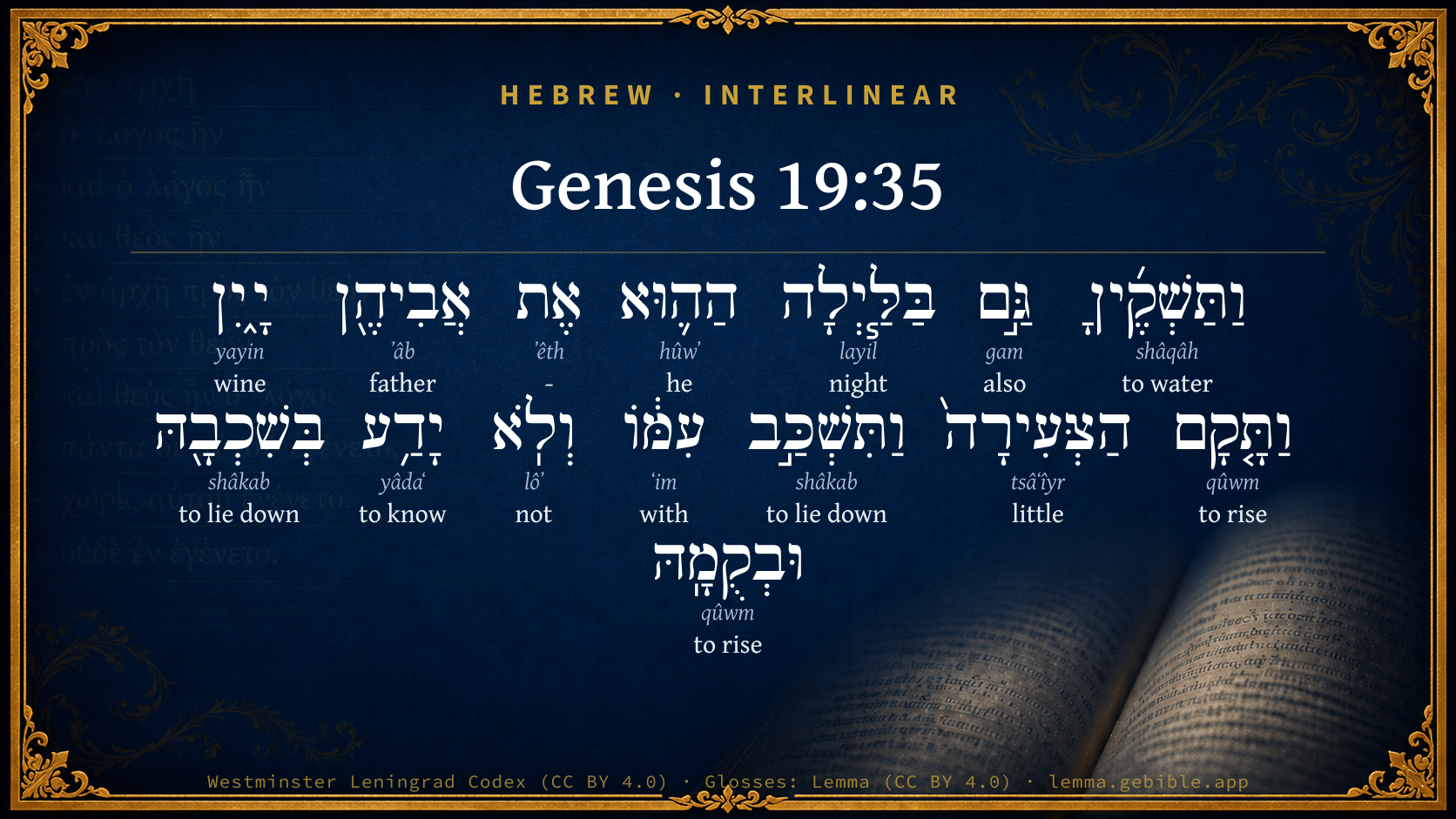
Hebrew (Westminster Leningrad Codex) Genesis 19:35 appears in the Hebrew Old Testament. The text above is from the Westminster Leningrad Codex. Each word links to its Strong’s number, a concise gloss, and parsing drawn from the Open Scriptures Hebrew Bible morphology. Click any word for its full Brown-Driver-Briggs (BDB) entry.
Download image
Cite this verse

Genesis 19:35 (World English Bible). Public Domain. Lemma interlinear Bible study tool, https://lemma.gebible.app/v/genesis/19/35.

Show BibTeX & RIS
BibTeX
RIS
English Translation
They made their father drink wine that night also. The younger arose, and lay with him. He didn't know when she lay down, nor when she arose.
World English Bible · Public Domain
Download a study sheet

One document with this verse’s original text, its word-by-word gloss line, the meaning frame, cross-references with their text, attributed commentary, and full source and license credits — printable, and it pastes into notes with its structure intact.

This verse Autodidact and up

Study sheet (.html) Plain text (.txt)

A passage Seminary Student

Up to 50 verses in one chapter. A passage sheet keeps up to 6 commentary sources and 12 cross-references per verse, in the order this page ranks them, and says so on the sheet whenever that leaves anything out. Ask for a single verse and you get the Autodidact verse sheet above.

Everything on this page stays free to read, with no account — the sheet is a download of what is already on screen, not access to it.

Want to remove ads? Support Godless Engineer
Compare translations 3

The same verse in 3 English versions, stacked beneath the original-language interlinear above. Click any original word for its lexicon entry.

Each is an independent rendering of the whole verse — the interlinear is not word-aligned to these translations.

Highlighted words mark where these versions differ — a whole-verse word diff, not a word-by-word alignment.

  • World English Bible Public Domain
    They made their father drink wine that night also. The younger arose, and lay with him. He didn't know when she lay down, nor when she arose.
  • King James Version Public Domain
    And they made their father drink wine that night also: and the younger arose, and lay with him; and he perceived not when she lay down, nor when she arose.
  • unfoldingWord Literal Text CC BY-SA 4.0
    So on that night also they got their father to drink wine. Then the younger went and lay with him, but he did not know when she lay down or when she got up.

unfoldingWord Literal Text — © unfoldingWord, licensed CC BY-SA 4.0. Word-aligned USFM3 via Door43 (git.door43.org/unfoldingWord/en_ult).

Versions to compare (up to 4)

3 of 4 selected

Show all 18 translations

Every available English version of this verse, each an independent rendering of the whole verse.

  • World English Bible Public Domain
    They made their father drink wine that night also. The younger arose, and lay with him. He didn't know when she lay down, nor when she arose.
  • Berean Standard Bible Public Domain
    So again that night they got their father drunk with wine, and the younger daughter went in and slept with him; he was not aware when she lay down or when she got up.
  • Majority Standard Bible Public Domain
    So again that night they got their father drunk with wine, and the younger daughter went in and slept with him; he was not aware when she lay down or when she got up.
  • King James Version Public Domain
    And they made their father drink wine that night also: and the younger arose, and lay with him; and he perceived not when she lay down, nor when she arose.
  • American Standard Version (1901) Public Domain
    And they made their father drink wine that night also: and the younger arose, and lay with him; and he knew not when she lay down, nor when she arose.
  • Revised Version (1885) Public Domain
    And they made their father drink wine that night also: and the younger arose, and lay with him; and he knew not when she lay down, nor when she arose.
  • Geneva Bible (1599) Public Domain
    So they made their father drinke wine that night also, and the yonger arose, and lay with him, but he perceiued not, when she lay downe, neither when she rose vp.
  • Douay-Rheims (1899) Public Domain
    They made their father drink wine that night also, and the younger daughter went in, and lay with him: and neither then did he perceive when she lay down, nor when she rose up.
  • Young's Literal Translation Public Domain
    And they cause their father to drink wine on that night also, and the younger riseth and lieth with him, and he hath not known in her lying down, or in her rising up.
  • Literal Standard Version CC BY-SA 4.0
    And they cause their father to drink wine on that night also, and the younger rises and lies with him, and he has not known in her lying down or in her rising up.
  • Unlocked Literal Bible CC BY-SA 4.0
    So they made their father drink wine that night also, and the younger went and slept with him. He did not know when she lay down, nor when she arose.
  • unfoldingWord Literal Text CC BY-SA 4.0
    So on that night also they got their father to drink wine. Then the younger went and lay with him, but he did not know when she lay down or when she got up.
  • Darby Bible Public Domain
    And they gave their father wine to drink that night also. And the younger arose, and lay with him; and he did not know of her lying down, nor of her rising.
  • World Messianic Bible Public Domain
    They made their father drink wine that night also. The younger went and lay with him. He didn’t know when she lay down, nor when she got up.
  • Webster's Bible Public Domain
    And they made their father drink wine that night also: and the younger arose and lay with him; and he perceived not when she lay down, nor when she arose.
  • Free Bible Version CC BY-SA 4.0
    So once again that night they got their father drunk with wine and the younger daughter went and slept with him, and he didn't notice when she lay down or when she got up.
  • Bible in Basic English Public Domain
    And that night again they made their father take much wine; and the younger daughter went into his bed; and he had no knowledge of when she went in or when she went away.
  • JPS Tanakh (1917) Public Domain
    And they made their father drink wine that night also. And the younger arose, and lay with him; and he knew not when she lay down, nor when she arose.

Literal Standard Version (2020), Covenant Press — licensed CC BY-SA 4.0. Text via the HelloAO Bible API (eBible.org). Unlocked Literal Bible (unfoldingWord) — licensed CC BY-SA 4.0. Text via the HelloAO Bible API (eBible.org). unfoldingWord Literal Text — © unfoldingWord, licensed CC BY-SA 4.0. Word-aligned USFM3 via Door43 (git.door43.org/unfoldingWord/en_ult). Free Bible Version, Dr. Jonathan Gallagher — licensed CC BY-SA 4.0. Text via the HelloAO Bible API (eBible.org).

Word by word

More ways to search: Search by grammar → Find every occurrence → Compare this word →

Practice this passage: Drill this verse → Learn its vocabulary →

הַצְּעִירָה֙
tsâʻîyr
H6810
“the · little”
Particle, Definite Article + Adjective, Adjective, Feminine, Singular, Absolute
Part of Speech
Particle + Adjective
Type
Adjective
Gender
Feminine
Number
Singular
State
Absolute
Full BDB Definition

Origin: from H6819

TWOT: 1948a

little, insignificant, young - little, insignificant - insignificant, mean - young, younger, youngest
  1. וַתַּשְׁקֶ֜יןָ shâqâh H8248 “and · to water” Conjunction + Verb, Hiphil, Sequential Imperfect, 3rd Person, Feminine, Plural
  2. גַּ֣ם gam H1571 “also” Particle, Accusative
  3. בַּלַּ֧יְלָה layil H3915 “in/at the · night” Preposition, Determined + Noun, Common, Masculine, Singular, Absolute
  4. הַה֛וּא hûwʼ H1931 “the · he” Particle, Definite Article + Pronoun, Personal, 3rd Person, Masculine, Singular
  5. אֶת ʼêth H853 “-” Particle, Direct Object
  6. אֲבִיהֶ֖ן ʼâb H1 “father · their” Noun, Common, Masculine, Singular, Construct + Suffix, Personal, 3rd Person, Feminine, Plural
  7. יָ֑יִן yayin H3196 “wine” Noun, Common, Masculine, Singular, Absolute
  8. וַתָּ֤קָם qûwm H6965 “and · to rise” Conjunction + Verb, Qal, Sequential Imperfect, 3rd Person, Feminine, Singular
  9. וַתִּשְׁכַּ֣ב shâkab H7901 “and · to lie down” Conjunction + Verb, Qal, Sequential Imperfect, 3rd Person, Feminine, Singular
  10. עִמּ֔וֹ ʻim H5973 “with · him” Preposition + Suffix, Personal, 3rd Person, Masculine, Singular
  11. וְלֹֽא lôʼ H3808 “and · not” Conjunction + Particle, Negative
  12. יָדַ֥ע yâdaʻ H3045 “to know” Verb, Qal, Perfect, 3rd Person, Masculine, Singular
  13. בְּשִׁכְבָ֖הּ shâkab H7901 “in/at · to lie down · her” Preposition + Verb, Qal, Infinitive Construct + Suffix, Personal, 3rd Person, Feminine, Singular
  14. וּבְקֻמָֽהּ qûwm H6965 “and · in/at · to rise · her” Conjunction + Preposition + Verb, Qal, Infinitive Construct + Suffix, Personal, 3rd Person, Feminine, Singular

About this verse

These counts appear in no published source. They are computed here, from the morphology-tagged text and Lemma’s own curated glosses. What Lemma adds →

15
words
13
distinct lemmas
Pentateuch
section

Notable vocabulary

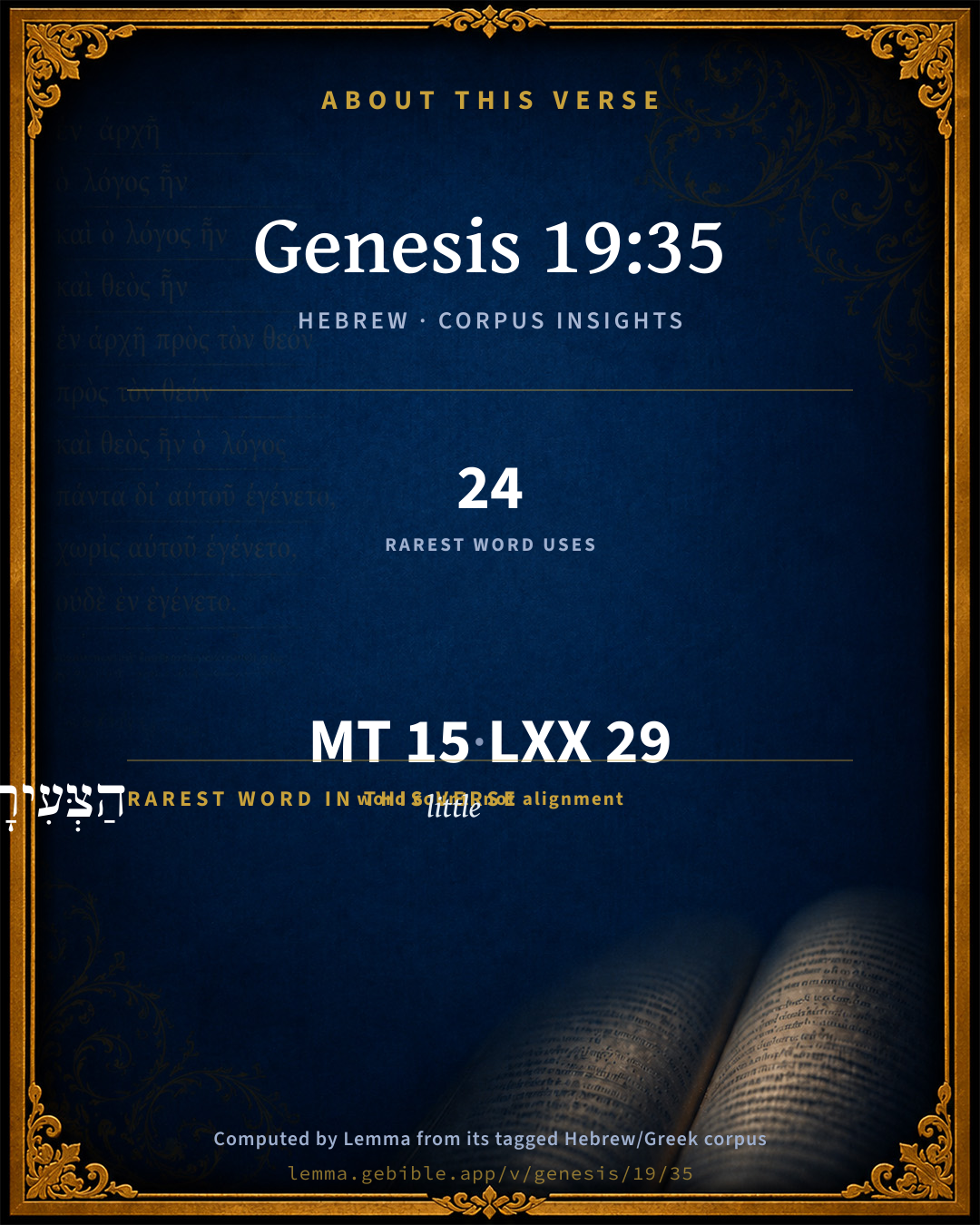
The rarest word here is הַצְּעִירָה֙ little H6810 — appearing just 24 times in the whole Hebrew Bible.

Shared distinctive vocabulary

הַצְּעִירָה֙ little H6810 occurs in 22 verses of the Hebrew Bible. Also found in:

Grammatical profile

  • 6 verbs
  • 3 nouns
  • 1 adjective
  • 1 pronoun
  • 1 preposition
  • 3 particles

Verb forms

  • וַתַּשְׁקֶ֜יןָ Hiphil · Sequential Imperfect
  • וַתָּ֤קָם Qal · Sequential Imperfect
  • וַתִּשְׁכַּ֣ב Qal · Sequential Imperfect
  • יָדַ֥ע Qal · Perfect
  • בְּשִׁכְבָ֖הּ Qal · Infinitive Construct
  • וּבְקֻמָֽהּ Qal · Infinitive Construct

Repetition

Words recur within this verse — often emphatic in Hebrew:

  • וַתָּ֤קָם to rise H6965 ×2
  • וַתִּשְׁכַּ֣ב to lie down H7901 ×2

Hebrew & Septuagint length

In English translation the verse runs 27 words from the Hebrew and 32 from the Septuagint (LXX English) — closely comparable.

A rough comparison of the two English renderings, which tokenize alike — not a word-level alignment.

Word counts can differ between the Hebrew and the Greek without any difference in meaning — e.g. the Hebrew direct-object marker אֵת has no separate Greek word, and Greek often adds the article ὁ.

In the original languages it is 15 Hebrew tokens and 29 Greek tokens — but the two are counted differently (Hebrew bundles its prefixes and suffixes into one token; the Greek is in lemma form), so that isn’t a like-for-like length.

Cross-references

6

Topical passages linked to Genesis 19:35 in the Treasury of Scripture Knowledge — connected by theme and wording, ordered by reader-vote popularity; previews shown in the World English Bible.

  • Psalms 8:4 What is man, that you think of him? The son of man, that you care for him?
  • Proverbs 24:16 For a righteous man falls seven times, and rises up again; But the wicked are overthrown by calamity.
  • Ecclesiastes 7:26 I find more bitter than death the woman whose heart is snares and traps, whose hands are chains. Whoever pleases God shall escape from her; but the sinner will be ensnared by her.
  • Luke 21:34 "So be careful, or your hearts will be loaded down with carousing, drunkenness, and cares of this life, and that day will come on you suddenly.
  • 1 Corinthians 10:11–12 Now all these things happened to them by way of example, and they were written for our admonition, on whom the ends of the ages have come.
  • 1 Peter 4:7 But the end of all things is near. Therefore be of sound mind, self-controlled, and sober in prayer.

Cross-references courtesy of OpenBible.info (CC BY 4.0).

Hebrew and Greek witnesses Masoretic Hebrew ↔ Greek Septuagint

The same verse in the two great witnesses to the Old Testament, shown verse-for-verse.

These are two independent witnesses, not word-aligned to each other, and the Septuagint is shown in lemma (dictionary) form.

Hebrew Genesis 19:35 Masoretic · Westminster Leningrad Codex

וַתַּשְׁקֶ֜יןָ גַּ֣ם בַּלַּ֧יְלָה הַה֛וּא אֶת אֲבִיהֶ֖ן יָ֑יִן וַתָּ֤קָם הַצְּעִירָה֙ וַתִּשְׁכַּ֣ב עִמּ֔וֹ וְלֹֽא יָדַ֥ע בְּשִׁכְבָ֖הּ וּבְקֻמָֽהּ

They made their father drink wine that night also. The younger arose, and lay with him. He didn't know when she lay down, nor when she arose.

World English Bible · Public Domain

Greek LXX Genesis 19:35 Septuagint · lemma form

ποτίζω δέ καί ἐν ὁ νύξ ἐκεῖνος ὁ πατήρ αὐτός οἶνος καί εἰςἔρχομαι ὁ νέος κοιμάω μετά ὁ πατήρ αὐτός καί οὐ οἶδα ἐν ὁ κοιμάω αὐτός καί ἀναἵστημι

So they made their father drink wine in that night also, and the younger went in and slept with her father, and he knew not when he slept, nor when he arose.

LXX2012 (modern English Septuagint) · Public Domain

Hebrew: Westminster Leningrad Codex (CC BY 4.0). Greek: Septuagint (public domain); English from LXX2012 (modern English Septuagint) (Public Domain). How the Septuagint differs from the Hebrew →

Targum (Aramaic paraphrase)

2

The Targum is the ancient Jewish Aramaic paraphrase of the Hebrew Scriptures — an interpretive translation, not the Hebrew text itself. Onkelos (literal) and Pseudo-Jonathan (expansive) render the Torah, and Jonathan the Prophets. Coverage is partial: where no permissively-licensed English translation exists for a verse, only the Aramaic is shown. This is verse-level text, not a word-by-word alignment to the Hebrew.

  1. Targum Onkelos Torah (Genesis–Deuteronomy)
    וְאַשְׁקִיאָה אַף בְּלֵילְיָא הַהוּא יָת אֲבוּהֶן חַמְרָא וְקָמַת זְעֶרְתָּא וּשְׁכִיבַת עִמֵּהּ וְלָא יְדַע בְּמִשְׁכְּבַהּ וּבְקִימַהּ

    (no public-domain English translation for this verse)

    Targum Onkelos — Aramaic: “Onkelos Genesis” (public domain); “Onkelos Exodus” (public domain); “Onkelos Leviticus” (public domain); “Onkelos Numbers” (public domain); “Onkelos Deuteronomy” (public domain). English: “Sefaria Community Translation” (CC0 1.0 (public-domain dedication)); “J.W. Etheridge. The Targums of Onkelos and Jonathan Ben Uzziel on the Pentateuch. London: Longmans, Green, 1862” (public domain). Text via Sefaria.

  2. Targum Pseudo-Jonathan Torah (Genesis–Deuteronomy)
    וְאַשְׁקִיאָן אוּף בְּלֵילָא הַהוּא יַת אֲבוּהוֹן חֲמַר וְרַוֵי וְקָמַת זְעֵירְתָּא וְשַׁמִישַׁת עִמֵיהּ וְלָא יָדַע בְּמִשְׁכְּבָהּ וְלָא בְּמִקְמָהּ

    And they made their father drink wine that night also, and he was drunk, and the younger arose, and lay with him; and he knew not in her lying down nor in her rising up.

    Targum Pseudo-Jonathan — Aramaic: “Targum Jonathan on Genesis” (public domain); “Targum Jonathan on Exodus” (public domain); “Targum Jonathan on Leviticus” (public domain); “Targum Jonathan on Numbers” (public domain); “Targum Jonathan on Deuteronomy” (public domain). English: “The Targum of Jonathan ben Uzziel, trans. J. W. Etheridge, London, 1862” (public domain). Text via Sefaria.

Commentary

Notes on Genesis 19:35 from classic Christian and Jewish commentators (each source and its license shown beneath its notes). The classic Christian expositions comment on the surrounding passage and are grouped to its opening verse, so a note may address several verses; the Jewish commentaries on the Tanakh (Rashi and others) are per-verse, so they appear only where the commentator wrote on this verse.

Lemma curates 59 commentaries, every one of them public domain or Creative Commons licensed, each selected and text-cleaned for this edition rather than reprinted as found. About our sources →

Trapp's Complete Commentary

John Trapp

Gen 19:35 And they made their father drink wine that night also: and the younger arose, and lay with him; and he perceived not when she lay down, nor when she arose.

Ver. 35. And they made, &c.] Decepit ebrietas Lotum, quem Sodoma non decepit , saith Origen. Well might Athenaeus call drunkenness the metropolis of mischief, {a}

{a} Mητροπολιν παντων δεινων.

John Trapp, A Commentary or Exposition upon All the Books of the Old and New Testament (1647–1656) — public domain. Text from a community e-Sword module.

John Calvin's Commentaries

35. And the younger arose, and lay with him. This place teaches us how dangerous it is, to fall in the snares of satan. For, who once is caught therein, involves himself deeper and deeper in it. It is sure that Lot has been a modest man, but either, that the daughters have overtaken him while he was overcome with sadness, or that he allured by any other means to excessive drinking, once being decayed to excessiveness, he is again deceived the next day. We must therefore diligently resist the first beginning, for it is nearly impossible that they, who are once stupefied through its sweetness, totally lose themselves in the vices. Therefore, men ought to be on their guard against stimulus to evil, as deadly evils; and men ought to fear each flattering temptation as something poisonous. And this circumstance deserves attention, that Lot, among the Sodomites by the accumulation of crimes which nearly defiled heaven and earth, was chaste and clean, like an angel.

Whence did he keep such a cleanness in Sodom, else then through the knowledge of the evil, that surrounded him, which made him worried and careful? Presently, being safe on the mountain, satan besieges him with new pitfalls. Through this example, the Spirit admonishes us to watchfulness, that, when we think the least about it, an invisible enemy stretches snared for us. Likewise has Moses told earlier that Adam was deceived in Paradise. When we take care for ourselves, that will that watchfulness make us being on our guard against all guiles of our enemy. For there is nobody who not carries with him thousands of temptation to his own deceit.

John Calvin's Commentaries (1540-1563) — public domain. Text from the Calvin Translation Society English edition (1840s-50s) via the Christian Classics Ethereal Library (ccel.org). Calvin's coverage is partial (roughly two-thirds of the Bible); uncommented books and verses are honest gaps, never fabricated. The 19th-century editor's footnotes and remarks are omitted so the notes are faithfully Calvin's own voice.

John Gill's Exposition

Thus were both the daughters of Lot with child by their father. We learn from hence what the best of men are when left to themselves; a good man, a righteous Lot, is guilty of crimes the most shocking; he exposed the chastity of his daughters to the men of Sodom, and now his daughters attacked him, and succeeded, being both with child by him; and this brought about by excessive drinking, a sin which often leads on to the foulest crimes, and therefore to be carefully avoided; these sins Lot fell into when as it were alone, on a mountain, in a cave, none but his family with him, and these only his two daughters; he that had stood his ground in the midst of Sodom, notwithstanding all the excesses of that place, the impurities in it, and the temptations that every day offered, now falls when seemingly out of the way of all: these sins and failings of good men are recorded for our admonition and caution, that we may shun all appearance of evil, and be careful lest we fall, and neither be presumptuous not self-confident, see Co1 10:12.

.

Genesis 19:37

gen 19:37

gen 19:37

gen 19:37And the firstborn bare a son, and called his name Moab,.... As if it was "Meab", from the father, as Aben Ezra, and so Josephus, that is, which she had by her father; and she was so far from being ashamed that it might be known in time to come, she gave him this name. Hillerus (w) makes it to be a compound of and and to signify "going into", or "lying with a father", which still more notoriously points to her own action. Drusius has another derivation of the word, at least proposes it, and renders it "aqua patris"; "mo" in the Egyptian language signifying "water", which is sometimes used for seed, see Isa 48:1,

the same is the father of the Moabites unto this day; a people that lived on the borders of the land of Canaan, often troublesome to the Israelites, and frequently spoken of in the Old Testament.

(w) Onomastic. Sacr. p. 414.

John Gill's Exposition of the Whole Bible (1746–1763) — public domain (CC PDM 1.0). Text via the HelloAO Bible API.

Haydock's Catholic Bible Commentary

Rose up; being oppressed with grief and wine, which would not excuse him from sin, particularly this second time. (Menochius)

George Leo Haydock (1774–1849), Haydock's Catholic Family Bible and Commentary, 1859 edition — public domain. Excludes Psalms (Douay-Rheims chapter numbering differs from Protestant) and Deuterocanonical books (Catholic canon only).

The Pulpit Commentary

And they made their father drink wine that night also. The facility with which Lot allowed himself to be inebriated by his daughters Clericus regards as a sign that before this the old man had been accustomed to over-indulgence in wine. The inference, however, of Kalisch, that because "Lot"s excess in the enjoyment of wine is no more blamed than it was in Noah," "the narrative exempts him from all serious reproach," can scarcely be admitted. And the younger arose, and lay with him (following the bad example of her sister); and he perceived not when she lay down, nor when she arose (vide supra, Ver. 33).

The Pulpit Commentary (1880–1919), ed. H.D.M. Spence-Jones & Joseph S. Exell — public domain. Text from a community e-Sword module.

Radak

Rabbi David Kimhi (Radak)

ותשקן..ובקמה, this time with the letter ו in the word ובקמה missing.

Radak on the Tanakh — English translations: “Sefaria Community Translation” (CC0 1.0 (public-domain dedication)); “Eliyahu Munk, HaChut Hameshulash” (CC BY 4.0); “Rabbi Mike Feuer, Jerusalem Anthology” (CC BY 4.0); and “R. David Kimhi on the first book of Psalms, Translated by R.G. Finch, London, 1919” (public domain). Text via Sefaria.

Lesson kit

Teaching starters — assembled from the data on this page, not authored interpretation. Every prompt links to the verse data it draws on. Edit before teaching.

Genesis, in the Pentateuch, opens this verse with 15 words (13 distinct Hebrew lemmas). Its most distinctive word is tsâʻîyr (“little”). A historical commentator’s framing appears above. Read the whole chapter for the surrounding context.

Discussion questions

  1. How does “little” (tsâʻîyr) shape what this verse is saying?
  2. Genesis 19:31 shares the word «little» with this verse. How do the two illuminate each other?
  3. “to rise” occurs 2× in this one verse. What is the effect of the repetition?
  4. These translations render this verse differently; the difference is in the English rendering, not the original. What questions does that raise?
  5. The verb «וַתַּשְׁקֶ֜יןָ» is Hiphil Sequential Imperfect. How does its form color the action?
  6. Reading how Trapp's Complete Commentary and John Calvin's Commentaries read this verse, where do the two commentators agree and where do they part?

Things to notice

Reading settings

Reading text

Shown beneath each verse's original-language words.

Old Testament
Old Testament edition

Read the OT as the Masoretic Hebrew (MT) or the Greek Septuagint (LXX).

English shown for the Greek Septuagint (in the Hebrew ↔ Greek comparison).

Comparing translations? Open the Compare panel on any verse page to stack up to four side by side.