
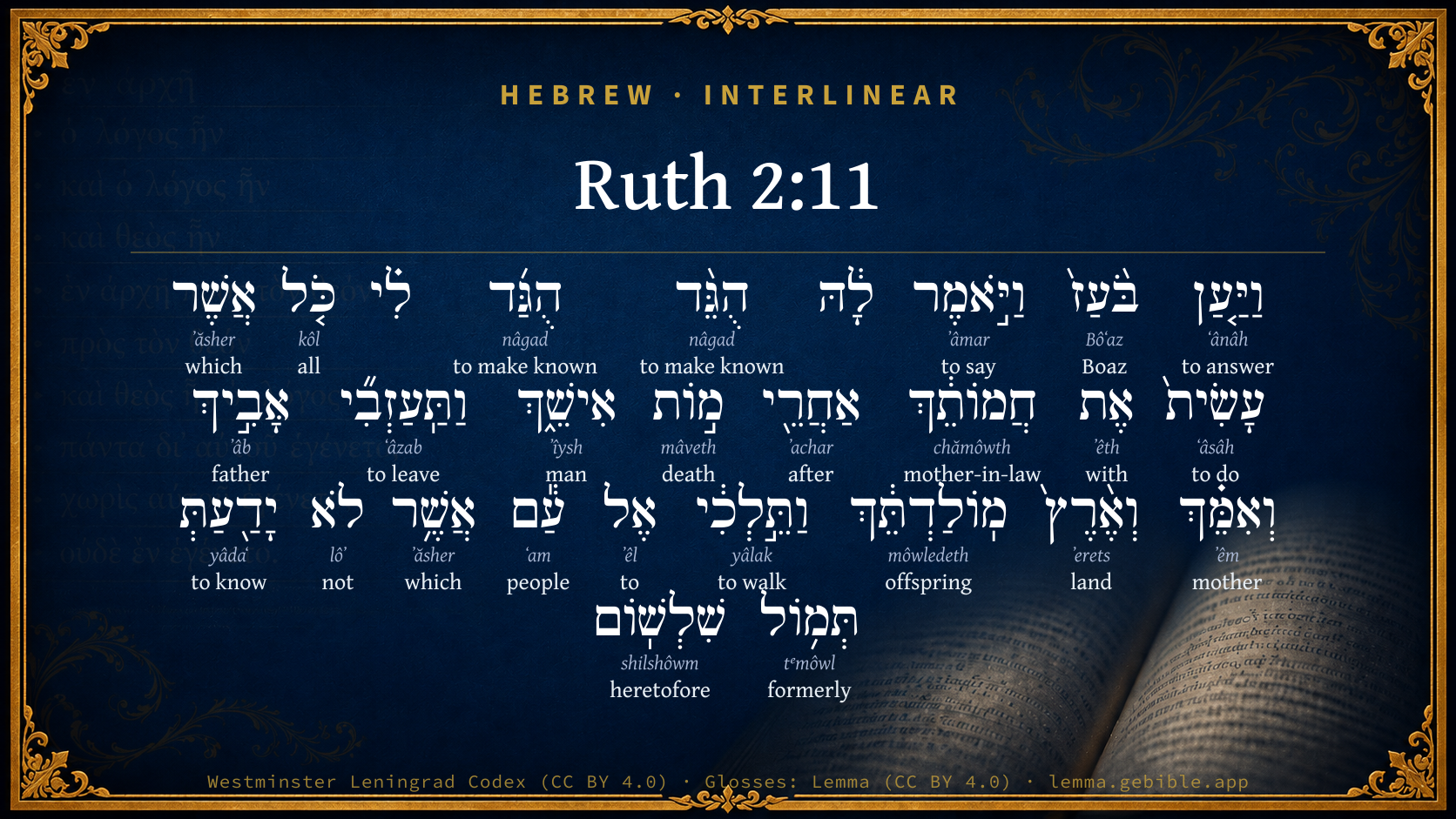
Ruth 2:11

Hebrew (Westminster Leningrad Codex) Ruth 2:11 appears in the Hebrew Old Testament. The text above is from the Westminster Leningrad Codex. Each word links to its Strong’s number, a concise gloss, and parsing drawn from the Open Scriptures Hebrew Bible morphology. Click any word for its full Brown-Driver-Briggs (BDB) entry.
Download image
Cite this verse

Ruth 2:11 (World English Bible). Public Domain. Lemma interlinear Bible study tool, https://lemma.gebible.app/v/ruth/2/11.

Show BibTeX & RIS
BibTeX
RIS
English Translation
Boaz answered her, It has fully been shown me, all that you have done to your mother-in-law since the death of your husband; and how you have left your father and your mother, and the land of your birth, and have come to a people that you didn't know before.
World English Bible · Public Domain
Download a study sheet

One document with this verse’s original text, its word-by-word gloss line, the meaning frame, cross-references with their text, attributed commentary, and full source and license credits — printable, and it pastes into notes with its structure intact.

This verse Autodidact and up

Study sheet (.html) Plain text (.txt)

A passage Seminary Student

Up to 50 verses in one chapter. A passage sheet keeps up to 6 commentary sources and 12 cross-references per verse, in the order this page ranks them, and says so on the sheet whenever that leaves anything out. Ask for a single verse and you get the Autodidact verse sheet above.

Everything on this page stays free to read, with no account — the sheet is a download of what is already on screen, not access to it.

Want to remove ads? Support Godless Engineer
Compare translations 3

The same verse in 3 English versions, stacked beneath the original-language interlinear above. Click any original word for its lexicon entry.

Each is an independent rendering of the whole verse — the interlinear is not word-aligned to these translations.

Highlighted words mark where these versions differ — a whole-verse word diff, not a word-by-word alignment.

  • World English Bible Public Domain
    Boaz answered her, It has fully been shown me, all that you have done to your mother-in-law since the death of your husband; and how you have left your father and your mother, and the land of your birth, and have come to a people that you didn't know before.
  • King James Version Public Domain
    And Boaz answered and said unto her, It hath fully been showed me, all that thou hast done unto thy mother in law since the death of thine husband: and how thou hast left thy father and thy mother, and the land of thy nativity, and art come unto a people which thou knewest not heretofore.
  • unfoldingWord Literal Text CC BY-SA 4.0
    Then Boaz answered and said to her, “It has been fully reported to me everything that you have done with your mother-in-law after the death of your husband. You left your father and your mother and the land of your birth, and you came to a people whom you did not know the day before yesterday.

unfoldingWord Literal Text — © unfoldingWord, licensed CC BY-SA 4.0. Word-aligned USFM3 via Door43 (git.door43.org/unfoldingWord/en_ult).

Versions to compare (up to 4)

3 of 4 selected

Show all 18 translations

Every available English version of this verse, each an independent rendering of the whole verse.

  • World English Bible Public Domain
    Boaz answered her, It has fully been shown me, all that you have done to your mother-in-law since the death of your husband; and how you have left your father and your mother, and the land of your birth, and have come to a people that you didn't know before.
  • Berean Standard Bible Public Domain
    Boaz replied, “I have been made fully aware of all you have done for your mother-in-law since the death of your husband, how you left your father and mother and the land of your birth, and how you came to a people you did not know before.
  • Majority Standard Bible Public Domain
    Boaz replied, “I have been made fully aware of all you have done for your mother-in-law since the death of your husband, how you left your father and mother and the land of your birth, and how you came to a people you did not know before.
  • King James Version Public Domain
    And Boaz answered and said unto her, It hath fully been showed me, all that thou hast done unto thy mother in law since the death of thine husband: and how thou hast left thy father and thy mother, and the land of thy nativity, and art come unto a people which thou knewest not heretofore.
  • American Standard Version (1901) Public Domain
    And Boaz answered and said unto her, It hath fully been showed me, all that thou hast done unto thy mother-in-law since the death of thy husband; and how thou hast left thy father and thy mother, and the land of thy nativity, and art come unto a people that thou knewest not heretofore.
  • Revised Version (1885) Public Domain
    And Boaz answered and said unto her, It hath fully been shewed me, all that thou hast done unto thy mother in law since the death of thine husband: and how thou hast left thy father and thy mother, and the land of thy nativity, and art come unto a people which thou knewest not heretofore.
  • Geneva Bible (1599) Public Domain
    And Boaz answered, and said vnto her, All is told and shewed me that thou hast done vnto thy mother in lawe, since the death of thine husband, and how thou hast left thy father and thy mother, and ye land where thou wast borne, and art come vnto a people which thou knewest not in time past.
  • Douay-Rheims (1899) Public Domain
    And he answered her: All hath been told me, that thou hast done to thy mother in law after the death of thy husband: and how thou hast left thy parents, and the land wherein thou wast born, and art come to a people which thou knewest not heretofore.
  • Young's Literal Translation Public Domain
    And Boaz answereth and saith to her, `It hath thoroughly been declared to me all that thou hast done with thy mother-in-law, after the death of thy husband, and thou dost leave thy father, and thy mother, and the land of thy birth, and dost come in unto a people which thou hast not known heretofore.
  • Literal Standard Version CC BY-SA 4.0
    And Boaz answers and says to her, “It has been thoroughly declared to me all that you have done with your mother-in-law, after the death of your husband, and you leave your father, and your mother, and the land of your birth, and come to a people which you have not known before.
  • Unlocked Literal Bible CC BY-SA 4.0
    Boaz answered and said to her, “It has been reported to me, all that you have done since the death of your husband. You have left your father, mother, and the land of your birth to follow your mother-in-law and to come to a people you do not know.
  • unfoldingWord Literal Text CC BY-SA 4.0
    Then Boaz answered and said to her, “It has been fully reported to me everything that you have done with your mother-in-law after the death of your husband. You left your father and your mother and the land of your birth, and you came to a people whom you did not know the day before yesterday.
  • Darby Bible Public Domain
    And Boaz answered and said to her, It has fully been shewn me, all that thou hast done to thy mother-in-law since the death of thy husband; and how thou hast left thy father and thy mother, and the land of thy nativity, and art come to a people that thou hast not known heretofore.
  • World Messianic Bible Public Domain
    Boaz answered her, “I have been told all about what you have done for your mother-in-law since the death of your husband, and how you have left your father, your mother, and the land of your birth, and have come to a people that you didn’t know before.
  • Webster's Bible Public Domain
    And Boaz answered and said to her, It hath fully been shown to me, all that thou hast done to thy mother-in-law since the death of thy husband: and how thou hast left thy father and thy mother, and the land of thy nativity, and hast come to a people which thou knewest not heretofore.
  • Free Bible Version CC BY-SA 4.0
    “I've heard about all you've done for your mother-in-law since your husband died,” Boaz replied. “And also how you left your father and mother, and the land of your birth, to come and live among people you didn't know.
  • Bible in Basic English Public Domain
    And Boaz answering said to her, I have had news of everything you have done for your mother-in-law after the death of your husband; how you went away from your father and mother and the land of your birth, and came to a people who are strange to you.
  • JPS Tanakh (1917) Public Domain
    And Boaz answered and said unto her: 'It hath fully been told me, all that thou hast done unto thy mother-in-law since the death of thy husband; and how thou hast left thy father and thy mother, and the land of thy nativity, and art come unto a people that thou knewest not heretofore.

Literal Standard Version (2020), Covenant Press — licensed CC BY-SA 4.0. Text via the HelloAO Bible API (eBible.org). Unlocked Literal Bible (unfoldingWord) — licensed CC BY-SA 4.0. Text via the HelloAO Bible API (eBible.org). unfoldingWord Literal Text — © unfoldingWord, licensed CC BY-SA 4.0. Word-aligned USFM3 via Door43 (git.door43.org/unfoldingWord/en_ult). Free Bible Version, Dr. Jonathan Gallagher — licensed CC BY-SA 4.0. Text via the HelloAO Bible API (eBible.org).

Word by word

More ways to search: Search by grammar → Find every occurrence → Compare this word →

Practice this passage: Drill this verse → Learn its vocabulary →

חֲמוֹתֵ֔ךְ
chămôwth
H2545
“mother-in-law · your”
Noun, Common, Feminine, Singular, Construct + Suffix, Personal, 2nd Person, Feminine, Singular
Part of Speech
Noun
Type
Common
Gender
Feminine
Number
Singular
State
Construct
Full BDB Definition

Origin: from H2524

TWOT: 674b

mother-in-law, husband's mother
  1. וַיַּ֤עַן ʻânâh H6030 “and · to answer” Conjunction + Verb, Qal, Sequential Imperfect, 3rd Person, Masculine, Singular
  2. בֹּ֨עַז֙ Bôʻaz H1162 “Boaz” Noun, Proper
  3. וַיֹּ֣אמֶר ʼâmar H559 “and · to say” Conjunction + Verb, Qal, Sequential Imperfect, 3rd Person, Masculine, Singular
  4. הֻגֵּ֨ד nâgad H5046 “to make known” Verb, Hophal, Infinitive Absolute
  5. הֻגַּ֜ד nâgad H5046 “to make known” Verb, Hophal, Perfect, 3rd Person, Masculine, Singular
  6. כֹּ֤ל kôl H3605 “all” Noun, Common, Masculine, Singular, Absolute
  7. אֲשֶׁר ʼăsher H834 “which” Particle, Relative
  8. עָשִׂית֙ ʻâsâh H6213 “to do” Verb, Qal, Perfect, 2nd Person, Feminine, Singular
  9. אֶת ʼêth H854 “with” Preposition
  10. אַחֲרֵ֖י ʼachar H310 “after” Preposition
  11. מ֣וֹת mâveth H4194 “death of” Noun, Common, Masculine, Singular, Construct
  12. אִישֵׁ֑ךְ ʼîysh H376 “man · your” Noun, Common, Masculine, Singular, Construct + Suffix, Personal, 2nd Person, Feminine, Singular
  13. וַתַּֽעַזְבִ֞י ʻâzab H5800 “and · to leave” Conjunction + Verb, Qal, Sequential Imperfect, 2nd Person, Feminine, Singular
  14. אָּבִ֣יךְ ʼâb H1 “father · your” Noun, Common, Masculine, Singular, Construct + Suffix, Personal, 2nd Person, Feminine, Singular
  15. וְאִמֵּ֗ךְ ʼêm H517 “and · mother · your” Conjunction + Noun, Common, Feminine, Singular, Construct + Suffix, Personal, 2nd Person, Feminine, Singular
  16. וְאֶ֨רֶץ֙ ʼerets H776 “and · land of” Conjunction + Noun, Common, Both, Singular, Construct
  17. מֽוֹלַדְתֵּ֔ךְ môwledeth H4138 “offspring · your” Noun, Common, Feminine, Singular, Construct + Suffix, Personal, 2nd Person, Feminine, Singular
  18. וַתֵּ֣לְכִ֔י yâlak H3212 “and · to walk” Conjunction + Verb, Qal, Sequential Imperfect, 2nd Person, Feminine, Singular
  19. אֶל ʼêl H413 “to” Preposition
  20. עַ֕ם ʻam H5971 “people” Noun, Common, Masculine, Singular, Absolute
  21. אֲשֶׁ֥ר ʼăsher H834 “which” Particle, Relative
  22. לֹא lôʼ H3808 “not” Particle, Negative
  23. יָדַ֖עַתְּ yâdaʻ H3045 “to know” Verb, Qal, Perfect, 2nd Person, Feminine, Singular
  24. תְּמ֥וֹל tᵉmôwl H8543 “formerly” Adverb
  25. שִׁלְשֽׁוֹם shilshôwm H8032 “heretofore” Noun, Common, Masculine, Singular, Absolute

About this verse

These counts appear in no published source. They are computed here, from the morphology-tagged text and Lemma’s own curated glosses. What Lemma adds →

28
words
24
distinct lemmas
Historical
section

Notable vocabulary

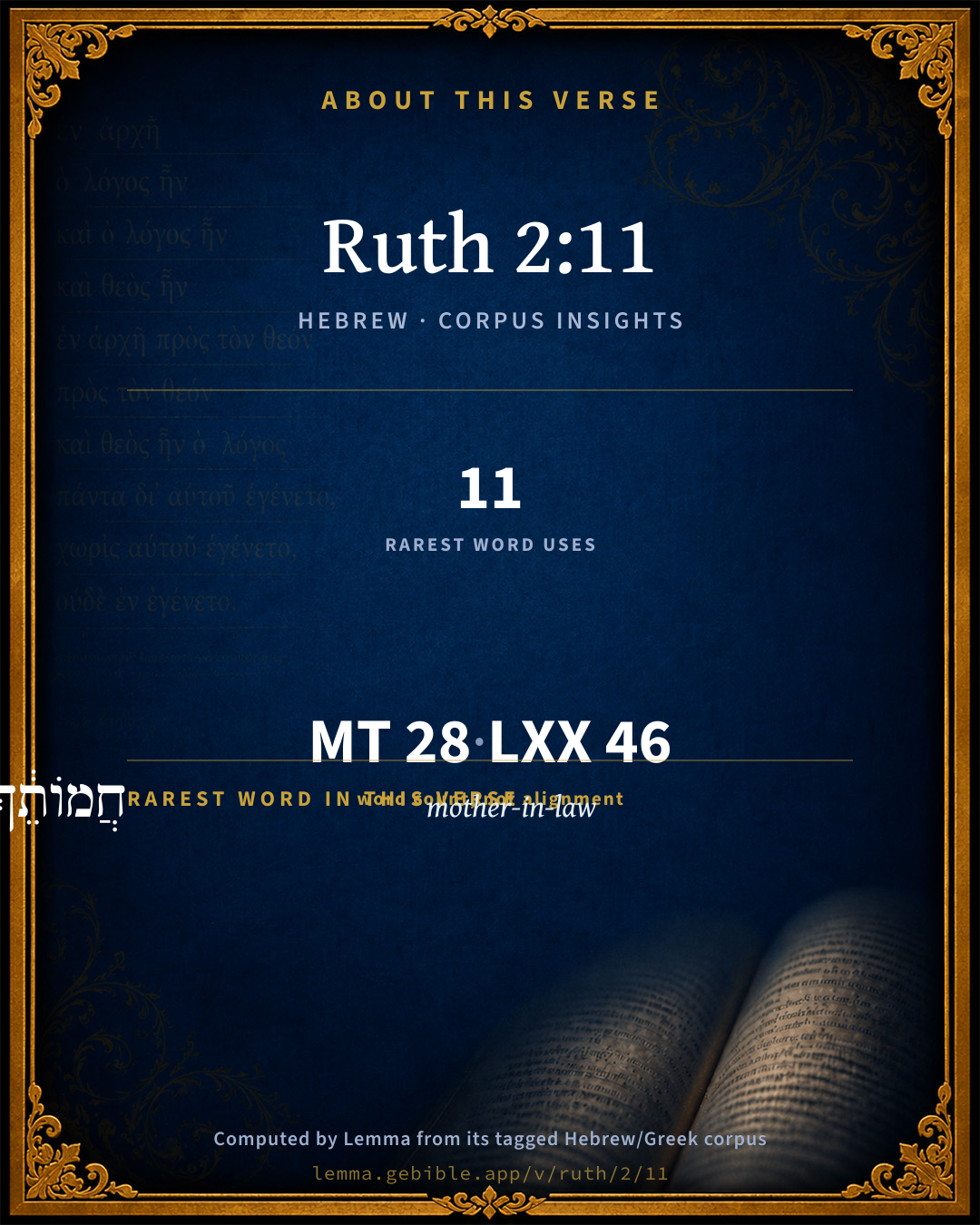
The rarest word here is חֲמוֹתֵ֔ךְ mother-in-law H2545 — appearing just 11 times in the whole Hebrew Bible.

Shared distinctive vocabulary

חֲמוֹתֵ֔ךְ mother-in-law H2545 occurs in 10 verses of the Hebrew Bible. Also found in:

Grammatical profile

  • 8 verbs
  • 11 nouns
  • 5 prepositions
  • 1 adverb
  • 3 particles

Verb forms

  • וַיַּ֤עַן Qal · Sequential Imperfect
  • וַיֹּ֣אמֶר Qal · Sequential Imperfect
  • הֻגֵּ֨ד Hophal · Infinitive Absolute
  • הֻגַּ֜ד Hophal · Perfect
  • עָשִׂית֙ Qal · Perfect
  • וַתַּֽעַזְבִ֞י Qal · Sequential Imperfect
  • וַתֵּ֣לְכִ֔י Qal · Sequential Imperfect
  • יָדַ֖עַתְּ Qal · Perfect

Repetition

Words recur within this verse — often emphatic in Hebrew:

  • הֻגֵּ֨ד to make known H5046 ×2
  • אֲשֶׁר which H834 ×2

Hebrew & Septuagint length

In English translation the verse runs 50 words from the Hebrew and 52 from the Septuagint (LXX English) — closely comparable.

A rough comparison of the two English renderings, which tokenize alike — not a word-level alignment.

Word counts can differ between the Hebrew and the Greek without any difference in meaning — e.g. the Hebrew direct-object marker אֵת has no separate Greek word, and Greek often adds the article ὁ.

In the original languages it is 28 Hebrew tokens and 46 Greek tokens — but the two are counted differently (Hebrew bundles its prefixes and suffixes into one token; the Greek is in lemma form), so that isn’t a like-for-like length.

Cross-references

10

Topical passages linked to Ruth 2:11 in the Treasury of Scripture Knowledge — connected by theme and wording, ordered by reader-vote popularity; previews shown in the World English Bible.

  • Luke 14:33 So therefore whoever of you who doesn't renounce all that he has, he can't be my disciple.
  • Luke 18:29–30 He said to them, "Most assuredly I tell you, there is no one who has left house, or wife, or brothers, or parents, or children, for the Kingdom of God's sake,
  • Ruth 1:14–22 They lifted up their voice, and wept again: and Orpah kissed her mother-in-law, but Ruth joined with her.
  • Psalms 37:5–6 Commit your way to Yahweh. Trust also in him, and he will do this:
  • Psalms 45:10 Listen, daughter, consider, and turn your ear. Forget your own people, and also your father's house.
  • Luke 5:11 When they had brought their boats to land, they left everything, and followed him.
  • Ruth 1:11 Naomi said, Turn again, my daughters: why will you go with me? have I yet sons in my womb, that they may be your husbands?
  • Luke 5:23 Which is easier to say, 'Your sins are forgiven you;' or to say, 'Arise and walk?'
  • Hebrews 11:8–9 By faith, Abraham, when he was called, obeyed to go out to the place which he was to receive for an inheritance. He went out, not knowing where he went.
  • Hebrews 11:24–26 By faith, Moses, when he had grown up, refused to be called the son of Pharaoh's daughter,

Cross-references courtesy of OpenBible.info (CC BY 4.0).

Hebrew and Greek witnesses Masoretic Hebrew ↔ Greek Septuagint

The same verse in the two great witnesses to the Old Testament, shown verse-for-verse.

These are two independent witnesses, not word-aligned to each other, and the Septuagint is shown in lemma (dictionary) form.

Hebrew Ruth 2:11 Masoretic · Westminster Leningrad Codex

וַיַּ֤עַן בֹּ֨עַז֙ וַיֹּ֣אמֶר לָ֔הּ הֻגֵּ֨ד הֻגַּ֜ד לִ֗י כֹּ֤ל אֲשֶׁר עָשִׂית֙ אֶת חֲמוֹתֵ֔ךְ אַחֲרֵ֖י מ֣וֹת אִישֵׁ֑ךְ וַתַּֽעַזְבִ֞י אָּבִ֣יךְ וְאִמֵּ֗ךְ וְאֶ֨רֶץ֙ מֽוֹלַדְתֵּ֔ךְ וַתֵּ֣לְכִ֔י אֶל עַ֕ם אֲשֶׁ֥ר לֹא יָדַ֖עַתְּ תְּמ֥וֹל שִׁלְשֽׁוֹם

Boaz answered her, It has fully been shown me, all that you have done to your mother-in-law since the death of your husband; and how you have left your father and your mother, and the land of your birth, and have come to a people that you didn't know before.

World English Bible · Public Domain

Greek LXX Ruth 2:11 Septuagint · lemma form

καί ἀποκρίνω βοος καί εἶπον αὐτός ἀπαγγελία ἀποἀγγέλλω ἐγώ ὅσος ποιέω μετά ὁ πενθερά σύ μετά ὁ ἀποθνήσκω ὁ ἀνήρ σύ καί πῶς καταλείπω ὁ πατήρ σύ καί ὁ μήτηρ σύ καί ὁ γῆ γένεσις σύ καί πορεύομαι πρός λαός ὅς οὐ οἶδα ἐχθές καί τρίτος

And Booz answered and said to her, It has fully been told me how you have dealt with your mother-in-law after the death of your husband; and how you did leave your father and your mother, and the land of your birth, and came to a people whom you knew not before.

LXX2012 (modern English Septuagint) · Public Domain

Hebrew: Westminster Leningrad Codex (CC BY 4.0). Greek: Septuagint (public domain); English from LXX2012 (modern English Septuagint) (Public Domain). How the Septuagint differs from the Hebrew →

Commentary

Notes on Ruth 2:11 from classic Christian and Jewish commentators (each source and its license shown beneath its notes). The classic Christian expositions comment on the surrounding passage and are grouped to its opening verse, so a note may address several verses; the Jewish commentaries on the Tanakh (Rashi and others) are per-verse, so they appear only where the commentator wrote on this verse.

Lemma curates 59 commentaries, every one of them public domain or Creative Commons licensed, each selected and text-cleaned for this edition rather than reprinted as found. About our sources →

Trapp's Complete Commentary

John Trapp

Rth 2:11 And Boaz answered and said unto her, It hath fully been shewed me, all that thou hast done unto thy mother in law since the death of thine husband: and [how] thou hast left thy father and thy mother, and the land of thy nativity, and art come unto a people which thou knewest not heretofore.

Ver. 11. It hath fully been showed me.] Her faith to God and love to her mother-in-law was much noted and noticed. See 1Th 1:8. Fame {a} followeth virtue, as the shadow doth the body, at the heels. "Since thou hast been precious in my sight, thou hast been honourable." {Isa 43:4} By faith those "elders obtained a good report," {Heb 11:2} as Abel, who, "being dead, yet speaketh," or, is spoken of, as some render it, {Heb 11:4} and as Abraham, who forsook all, and followed God into a strange country; so did this daughter of Abraham, and was famous for it, yea, renowned. See Psa 37:6; Psa 112:6.

All that thou hast done unto thy mother-ln-law.] A sure sign of thy true love to thy late husband, and how greatly thou prizest holiness in his mother, a happy instrument of thy conversion. Ruth was lovely, and therefore loved: Ut ameris amabilis esto.

{a} "If there be any virtue, if any praise." - Php 4:8.

John Trapp, A Commentary or Exposition upon All the Books of the Old and New Testament (1647–1656) — public domain. Text from a community e-Sword module.

The Biblical Illustrator

Joseph S. Exell

Rth_2:11

It hath fully been shewed me, all that thou hast done unto thy mother-in-law.

The praise of virtue

I. that virtue shall not want trumpeters to sound out her praises to the full (Psa_37:6).

II. that well-doing procureth favour to the poor, though strangers, at the hands of the virtuous; for this was the cause of Boazs love to Ruth, as here he acknowledgeth; and this is true godliness, to love others for their goodness. (R. Bernard.)

The gracious approbation

Ruth begins now to reap the abundant harvest which is growing for her in the Divine purposes of mercy--a harvest of which Boazs fields are only a part, and of which indeed all that Boaz possessed was but a feeble illustration. She had been faithful in that which appeared to be the least, and now she was to be rewarded with that which seemed to be much. We have first to remark upon the gracious approbation which Boaz bestows upon her whole history, though he knew not her personally. It is thus you may often think yourself unknown, and unobserved in your efforts to do right in your different relations of life, when there are many eyes upon you, watching your character, and many ears may be listening to what the Lord has enabled you thus to do for Him. Give yourself no concern about this. God, your guardian and protector, will see that you have all the reputation and recompense which is good for you. Ruth supposed herself concealed in the field of Boaz. But he declares to her that her faithfulness to Naomi had been fully related to him, and he knew her well. Thus the Saviour recounts to His people, and for them, the acts of their life which have manifested their love to Him. Nothing that you do is worthy the Saviours notice. But nothing that you really do for Him will be unnoticed by Him. You will never be rewarded for your works. But you will be judged by your works. They are the proofs of your faith, as the fruits on the tree are the evidences of its character and its worth. Certainly there is nothing on earth so blessed and so precious as the approbation of our Divine Master, speaking in our own hearts, of the service we have feebly but sincerely tried to render to Him. But Boaz not only expresses approbation, he also speaks of recompense to Ruth. She shall not be unrewarded. Naomi may not be able to do anything for her. But Naomi has other paymasters in the Lords employ beside herself. Our acts of benevolence and love for Christs sake can never go without their result of blessing even in this life. The merciful man doeth good to his own soul. We comfort the needy and the sorrowing, and we are thus preparing comforters for ourselves in the persons of others whom the Lord will raise up to minister to our wants. We aid the children of the poor, and we are laying up a heritage for our children in the kindness of others whom we know not. But apart from this result of recompense, there is also our own happiness in the work itself. It is more blessed, that is, it is happier, a happier state and habit of mind, a happier condition of feeling and thought, to give than to receive. Whatever we do in kindness to others for Christs sake He returns to us in our own secret personal enjoyments. He ministers to us a peace and blessedness in the work which is our inward possession, and which comes to us without any reference to outward results. But Boaz prays for more than recompense: A full reward be given thee, etc. For full rewards in any course of human life we must look beyond the present state of being. The Saviour says of the objects of beneficent action, They cannot recompense thee, but thou shalt be recompensed in the resurrection of the just. Whatever results come now from any of the acts of life, they are extremely partial. The final results are yet to be revealed. The abundant harvest is to be gathered hereafter. But it will be surely gathered. The Saviour shall Himself minister to those who have been faithful to Him here, an abundant recompense, a full reward. But while the Saviour thus animates and encourages His disciples with the blessed hope before them, see how the answer of Ruth to Boaz illustrates their self-renouncing mind. The more generously a noble mind is dealt with, the more humble and unassuming does it become. This is eminently the case with the children of God when their Divine Redeemer comforts and blesses them. Never do they feel so perfectly unworthy as when He pours the special ministration of the oil of gladness into their souls. But all this only increases their sense of their own unworthiness of such mercy. And their cry and prayer is, that they may still find favour in His sight--that He would look upon them with eyes of mercy, and think of them according to His own grace and not according to their merits. Boazs gracious provisions for the lonely stranger crown and close this instructive interview. Was any conduct of man ever more delicate, dignified, or beautiful? But it is only a feeble illustration of the riches of a Saviours grace. (S. H. Tyng, D. D.)

The Biblical Illustrator, edited by Joseph S. Exell (c. 1880s–1900s) — public domain. Text from a community e-Sword module.

Ellicott's Commentary for English Readers

(11) Heretofore.—The curious Hebrew phrase thus rendered is literally, yesterday and the day before.

A Bible Commentary for English Readers, edited by Charles John Ellicott (1878–1897) — public domain. Text from a community e-Sword module.

The Cambridge Bible for Schools and Colleges

gen. ed. J. J. S. Perowne

11. Ruth’s uncommon devotion, which induced her to leave her native land and the natural guardians of her widowhood, is one of the main features of the story.

The Cambridge Bible for Schools and Colleges (gen. ed. J. J. S. Perowne; Cambridge University Press, 1878–1918) — public domain. Text from a community e-Sword module.

John Gill's Exposition

And Boaz answered and said unto her,.... Alshech thinks, that he lift up his voice that all that stood by might hear:

it hath fully been showed me; either by Naomi, or rather by some persons of Boaz's Naomi and reacquaintance, that had conversed with Naomi and related to Boaz what passed between them, by which he was fully informed of the following things mentioned by him; though the above writer supposes, that it was showed him by the Holy Ghost:

all that thou hast done to thy mother in law since the death of thine husband; how that, instead of going home to her father and mother, she continued with her; how tenderly she used her; what strong expressions of love she had made unto her; what care she had taken of her, and how she had fed and nourished her, as the Targum, and now was gleaning for her support, as well as her own:

and how thou hast left thy father and mother; in a literal sense, to go along with her mother-in-law, to assist her in her journey, and see her safe to the end of it: and in a figurative sense her idol gods, as in Jer 2:27 so the Midrash (y):

and the land of thy nativity; the land of Moab, where she was born, and where her kindred, relations, and friends lived, dear and engaging to her:

and art come unto a people which thou knewest not heretofore; but by hearsay, and what she learned of them from her husband and mother-in-law, even the people of Israel; to whom she was come to be a proselyte, and dwell among them, as the Targum.

(y) Midrash Ruth, fol. 32. 3.

John Gill's Exposition of the Whole Bible (1746–1763) — public domain (CC PDM 1.0). Text via the HelloAO Bible API.

Haydock's Catholic Bible Commentary

Heretofore, to embrace the same religion. (Menochius)

George Leo Haydock (1774–1849), Haydock's Catholic Family Bible and Commentary, 1859 edition — public domain. Excludes Psalms (Douay-Rheims chapter numbering differs from Protestant) and Deuterocanonical books (Catholic canon only).

Matthew Poole's English Annotations

Which thou knewest not; of whom thou hadst no experience; for otherwise in general she could not be ignorant of this people.

Matthew Poole's English Annotations on the Holy Bible (1683–1685) — public domain. Text from a community e-Sword/MySword module.

Whedon's Commentary on the Bible

Daniel D. Whedon

11. It hath fully been showed me — The story of Ruth’s bereavement, and of her sacrifices for and attachment to Naomi, had become a topic of conversation among the families of Beth-lehem, and touched a tender chord of sympathy in all who heard it.

Thou hast left thy father… mother… land — Far back in the dark age of the Judges the Moabitish ancestress of the Messiah bears one of the heaviest crosses of the Gospel age. Surely she showed herself worthy of New Testament discipleship, and for her recompense has already received in sacred history a hundredfold reward. Compare Mat_10:37; Mat_19:29.

Daniel D. Whedon (gen. ed.), Commentary on the Old and New Testaments (1874–1909) — public domain. Text from a community e-Sword module.

The Pulpit Commentary

Boaz"s interest and admiration grew. And Boaz answered and said to her, It has been fully showed to me, all that thou hast done toward thy mother-in-law since the death of thy husband: and that thou hast left thy father and thy mother, and the land of thy nativity, and hast come to a people whom heretofore thou knewest not. When Boaz says, "It has been fully showed to me," he probably refers to the information which he had received from his overseer. The expression rendered "fully showed" is a fine specimen of a very antique idiom, showed-showed (dGhu dGehu). "Toward thy mother-in-law." The preposition which we render "toward" is literally "with," which, indeed, when laid side by side with the Hebrew preposition, looks as if it were organically identical. (tae = eth. Compare the old Hebrew etha with the Sanscrit itah. See Raabe"s "Glossar"). The expression which we render "heretofore" is literally "yesterday and the day before," a very primitive way of representing time past. It must have been like balm to the anxious heart of Ruth to hear from the lips of such a man as Boaz so hearty a "well-done." "Ruth," says the venerable Lawson, "showed no disposition to praise herself. She did not claim a right to glean from what she had done for Naomi, but wondered that such kindness should be showed by Boaz to her who was a stranger, and she hears the voice of praise from the mouth of one whoso commendations were a very great honor. No saying was oftener in the mouth of Jesus than this, He that exalteth himself shall be abased, and he that humbleth himself shall be exalted."

The Pulpit Commentary (1880–1919), ed. H.D.M. Spence-Jones & Joseph S. Exell — public domain. Text from a community e-Sword module.

Keil & Delitzsch

C. F. Keil & F. Delitzsch

Boaz replied, "Everything has been told me that thou hast done to (את, prep. as in Zac 7:9; Sa2 16:17) thy mother-in-law since the death of thy husband, that thou hast left thy father and thy mother, and thy kindred, and hast come to a people that thou knewest not heretofore" (hast therefore done what God commanded Abraham to do, Gen 12:1). "The Lord recompense thy work, and let thy reward be perfect (recalling Gen 15:1) from the Lord the God of Israel, to whom thou hast come to seek refuge under His wings!" For this figurative expression, which is derived from Deu 32:11, compare Psa 91:4; Psa 36:8; Psa 57:2. In these words of Boaz we see the genuine piety of a true Israelite.

Keil & Delitzsch — Biblical Commentary on the Old Testament (1861–1891) — public domain (CC PDM 1.0). Text via the HelloAO Bible API. (Old Testament only.)

Ibn Ezra

Rabbi Abraham ibn Ezra

It has been fully related to me. An action where the agent is not specified.

Whom thou knewest not. To dwell among them.

Ibn Ezra on the Tanakh — English translations: “Sefaria Community Translation” (CC0 1.0 (public-domain dedication)); “Yalkut, Sifsei Chachomim Chumash, Metsudah Publications, 2009” (CC BY 4.0); and “Commentary of Ibn Ezra on Isaiah - trans. by M. Friedlander, 1873” (public domain). Text via Sefaria.

Lesson kit

Teaching starters — assembled from the data on this page, not authored interpretation. Every prompt links to the verse data it draws on. Edit before teaching.

Ruth, in the Historical, opens this verse with 28 words (24 distinct Hebrew lemmas). Its most distinctive word is chămôwth (“mother-in-law”). A historical commentator’s framing appears above. Read the whole chapter for the surrounding context.

Discussion questions

  1. What does “mother-in-law” (chămôwth) contribute to the verse as a whole?
  2. How does Ruth 1:14, which shares the word «mother-in-law», read alongside this verse?
  3. What does the repetition of “to make known” (2× in this one verse) do in this verse?
  4. These translations render this verse differently; the difference is in the English rendering, not the original. What questions does that raise?
  5. «וַיַּ֤עַן» is a Qal Sequential Imperfect verb. How does that grammatical form shape the action described?
  6. Compare how Trapp's Complete Commentary and The Biblical Illustrator read this verse. Where do they agree or differ?

Things to notice

Reading settings

Reading text

Shown beneath each verse's original-language words.

Old Testament
Old Testament edition

Read the OT as the Masoretic Hebrew (MT) or the Greek Septuagint (LXX).

English shown for the Greek Septuagint (in the Hebrew ↔ Greek comparison).

Comparing translations? Open the Compare panel on any verse page to stack up to four side by side.