
Genesis 37:12

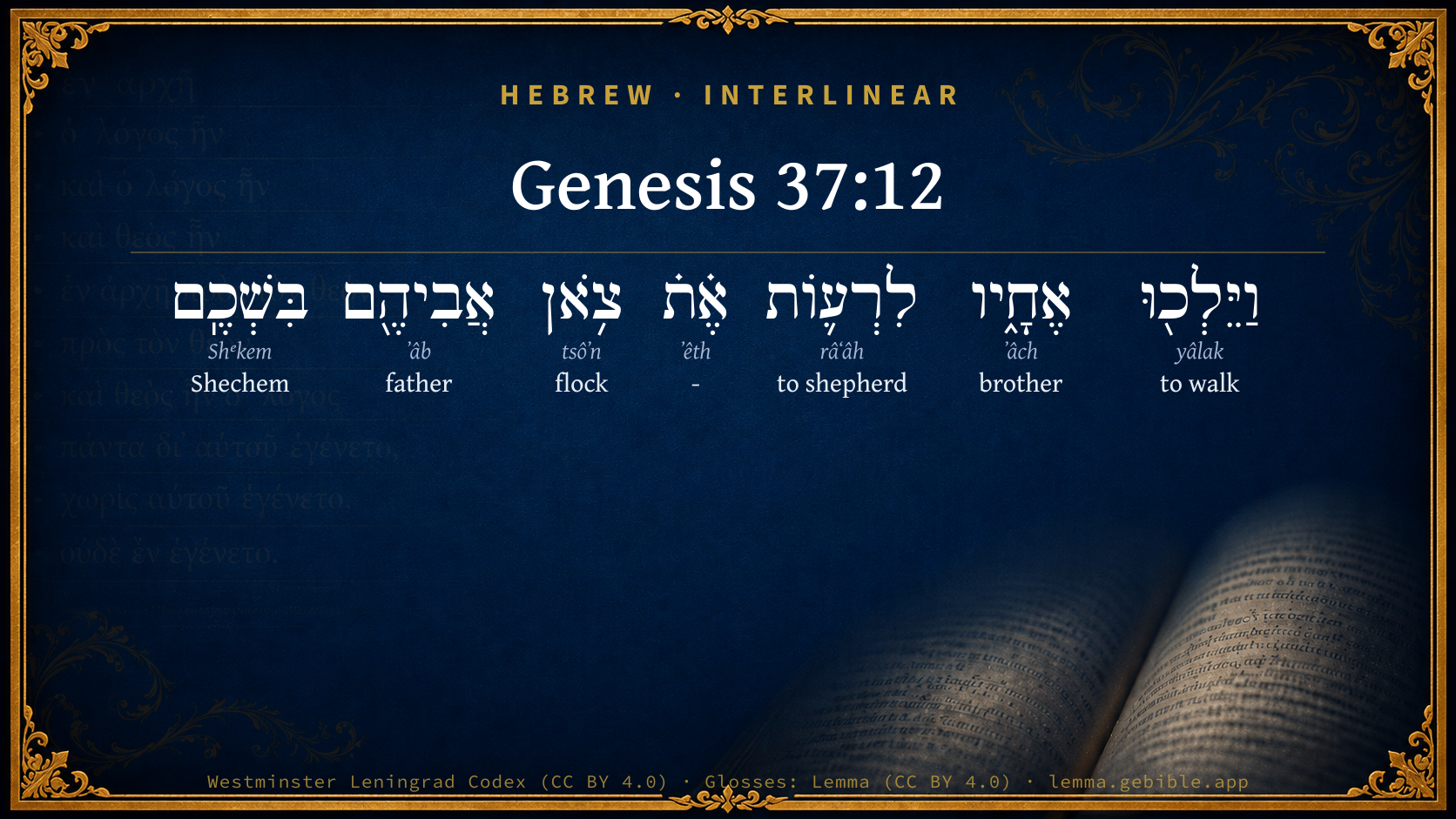
Hebrew (Westminster Leningrad Codex) Genesis 37:12 appears in the Hebrew Old Testament. The text above is from the Westminster Leningrad Codex. Each word links to its Strong’s number, a concise gloss, and parsing drawn from the Open Scriptures Hebrew Bible morphology. Click any word for its full Brown-Driver-Briggs (BDB) entry.
Download image
Cite this verse

Genesis 37:12 (World English Bible). Public Domain. Lemma interlinear Bible study tool, https://lemma.gebible.app/v/genesis/37/12.

Show BibTeX & RIS
BibTeX
RIS
English Translation
His brothers went to feed their father's flock in Shechem.
World English Bible · Public Domain
Download a study sheet

One document with this verse’s original text, its word-by-word gloss line, the meaning frame, cross-references with their text, attributed commentary, and full source and license credits — printable, and it pastes into notes with its structure intact.

This verse Autodidact and up

Study sheet (.html) Plain text (.txt)

A passage Seminary Student

Up to 50 verses in one chapter. A passage sheet keeps up to 6 commentary sources and 12 cross-references per verse, in the order this page ranks them, and says so on the sheet whenever that leaves anything out. Ask for a single verse and you get the Autodidact verse sheet above.

Everything on this page stays free to read, with no account — the sheet is a download of what is already on screen, not access to it.

Want to remove ads? Support Godless Engineer
Compare translations 3

The same verse in 3 English versions, stacked beneath the original-language interlinear above. Click any original word for its lexicon entry.

Each is an independent rendering of the whole verse — the interlinear is not word-aligned to these translations.

Highlighted words mark where these versions differ — a whole-verse word diff, not a word-by-word alignment.

  • World English Bible Public Domain
    His brothers went to feed their father's flock in Shechem.
  • King James Version Public Domain
    And his brethren went to feed their father's flock in Shechem.
  • unfoldingWord Literal Text CC BY-SA 4.0
    Then his brothers went to shepherd the flock of their father near Shechem.

unfoldingWord Literal Text — © unfoldingWord, licensed CC BY-SA 4.0. Word-aligned USFM3 via Door43 (git.door43.org/unfoldingWord/en_ult).

Versions to compare (up to 4)

3 of 4 selected

Show all 18 translations

Every available English version of this verse, each an independent rendering of the whole verse.

  • World English Bible Public Domain
    His brothers went to feed their father's flock in Shechem.
  • Berean Standard Bible Public Domain
    Some time later, Joseph’s brothers had gone to pasture their father’s flocks near Shechem.
  • Majority Standard Bible Public Domain
    Some time later, Joseph’s brothers had gone to pasture their father’s flocks near Shechem.
  • King James Version Public Domain
    And his brethren went to feed their father's flock in Shechem.
  • American Standard Version (1901) Public Domain
    And his brethren went to feed their father's flock in Shechem.
  • Revised Version (1885) Public Domain
    And his brethren went to feed their father’s flock in Shechem.
  • Geneva Bible (1599) Public Domain
    Then his brethren went to keepe their fathers sheepe in Shechem.
  • Douay-Rheims (1899) Public Domain
    And when his brethren abode in Sichem feeding their father's docks,
  • Young's Literal Translation Public Domain
    And his brethren go to feed the flock of their father in Shechem,
  • Literal Standard Version CC BY-SA 4.0
    And his brothers go to feed the flock of their father in Shechem,
  • Unlocked Literal Bible CC BY-SA 4.0
    His brothers went to tend their father's flock in Shechem.
  • unfoldingWord Literal Text CC BY-SA 4.0
    Then his brothers went to shepherd the flock of their father near Shechem.
  • Darby Bible Public Domain
    And his brethren went to feed their father's flock at Shechem.
  • World Messianic Bible Public Domain
    His brothers went to feed their father’s flock in Shechem.
  • Webster's Bible Public Domain
    And his brethren went to feed their father's flock in Shechem.
  • Free Bible Version CC BY-SA 4.0
    One day Joseph's brothers took their father's flocks to graze near Shechem.
  • Bible in Basic English Public Domain
    Now his brothers went to keep watch over their father's flock in Shechem.
  • JPS Tanakh (1917) Public Domain
    And his brethren went to feed their father's flock in Shechem.

Literal Standard Version (2020), Covenant Press — licensed CC BY-SA 4.0. Text via the HelloAO Bible API (eBible.org). Unlocked Literal Bible (unfoldingWord) — licensed CC BY-SA 4.0. Text via the HelloAO Bible API (eBible.org). unfoldingWord Literal Text — © unfoldingWord, licensed CC BY-SA 4.0. Word-aligned USFM3 via Door43 (git.door43.org/unfoldingWord/en_ult). Free Bible Version, Dr. Jonathan Gallagher — licensed CC BY-SA 4.0. Text via the HelloAO Bible API (eBible.org).

Word by word

More ways to search: Search by grammar → Find every occurrence → Compare this word →

Practice this passage: Drill this verse → Learn its vocabulary →

About this verse

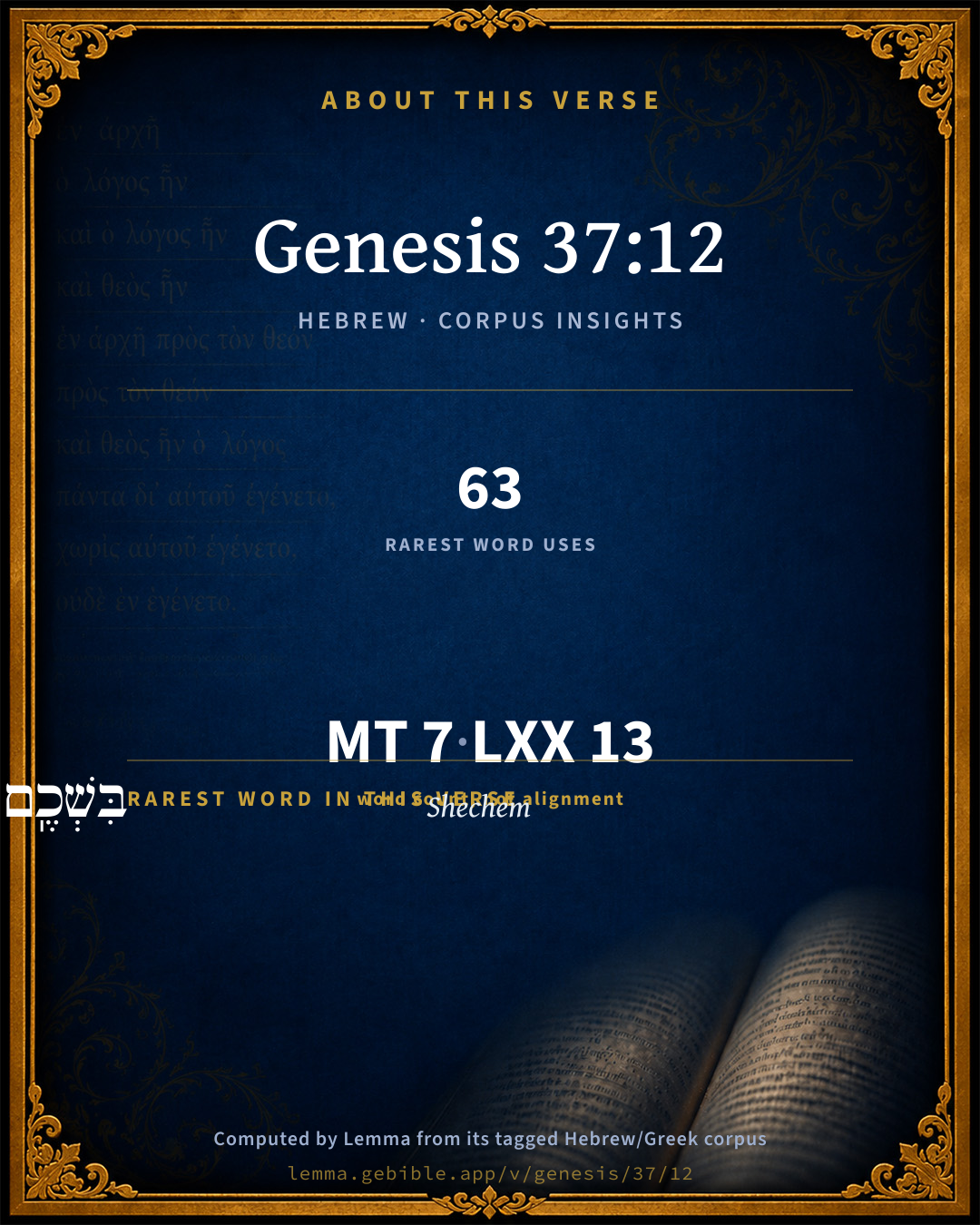
These counts appear in no published source. They are computed here, from the morphology-tagged text and Lemma’s own curated glosses. What Lemma adds →

7
words
7
distinct lemmas
Pentateuch
section

Grammatical profile

  • 2 verbs
  • 4 nouns
  • 1 particle

Verb forms

  • וַיֵּלְכ֖וּ Qal · Sequential Imperfect
  • לִרְע֛וֹת Qal · Infinitive Construct

Hebrew & Septuagint length

In English translation the verse runs 10 words from the Hebrew and 13 from the Septuagint (LXX English) — closely comparable.

A rough comparison of the two English renderings, which tokenize alike — not a word-level alignment.

Word counts can differ between the Hebrew and the Greek without any difference in meaning — e.g. the Hebrew direct-object marker אֵת has no separate Greek word, and Greek often adds the article ὁ.

In the original languages it is 7 Hebrew tokens and 13 Greek tokens — but the two are counted differently (Hebrew bundles its prefixes and suffixes into one token; the Greek is in lemma form), so that isn’t a like-for-like length.

Cross-references

3

Topical passages linked to Genesis 37:12 in the Treasury of Scripture Knowledge — connected by theme and wording, ordered by reader-vote popularity; previews shown in the World English Bible.

  • Genesis 33:18 Jacob came in peace to the city of Shechem, which is in the land of Canaan, when he came from Paddan Aram; and encamped before the city.
  • Genesis 34:25–31 It happened on the third day, when they were sore, that two of Jacob's sons, Simeon and Levi, Dinah's brothers, each took his sword, came upon the unsuspecting city, and killed all the males.
  • Genesis 37:1 Jacob lived in the land of his father's travels, in the land of Canaan.

Cross-references courtesy of OpenBible.info (CC BY 4.0).

Hebrew and Greek witnesses Masoretic Hebrew ↔ Greek Septuagint

The same verse in the two great witnesses to the Old Testament, shown verse-for-verse.

These are two independent witnesses, not word-aligned to each other, and the Septuagint is shown in lemma (dictionary) form.

Hebrew Genesis 37:12 Masoretic · Westminster Leningrad Codex

וַיֵּלְכ֖וּ אֶחָ֑יו לִרְע֛וֹת אֶׄתׄ צֹ֥אן אֲבִיהֶ֖ם בִּשְׁכֶֽם

His brothers went to feed their father's flock in Shechem.

World English Bible · Public Domain

Greek LXX Genesis 37:12 Septuagint · lemma form

πορεύομαι δέ ὁ ἀδελφός αὐτός βόσκω ὁ πρόβατον ὁ πατήρ αὐτός εἰς συχεμ

And his brethren went to feed the sheep of their father to Sychem.

LXX2012 (modern English Septuagint) · Public Domain

On this verse, Joseph Benson's Commentary discusses the Septuagint’s reading. Read the note in Commentary ↓

Hebrew: Westminster Leningrad Codex (CC BY 4.0). Greek: Septuagint (public domain); English from LXX2012 (modern English Septuagint) (Public Domain). How the Septuagint differs from the Hebrew →

Targum (Aramaic paraphrase)

2

The Targum is the ancient Jewish Aramaic paraphrase of the Hebrew Scriptures — an interpretive translation, not the Hebrew text itself. Onkelos (literal) and Pseudo-Jonathan (expansive) render the Torah, and Jonathan the Prophets. Coverage is partial: where no permissively-licensed English translation exists for a verse, only the Aramaic is shown. This is verse-level text, not a word-by-word alignment to the Hebrew.

  1. Targum Onkelos Torah (Genesis–Deuteronomy)
    וַאֲזָלוּ אֲחוֹהִי לְמִרְעֵי יָת עָנָא דַאֲבוּהוֹן בִּשְׁכֶם

    (no public-domain English translation for this verse)

    Targum Onkelos — Aramaic: “Onkelos Genesis” (public domain); “Onkelos Exodus” (public domain); “Onkelos Leviticus” (public domain); “Onkelos Numbers” (public domain); “Onkelos Deuteronomy” (public domain). English: “Sefaria Community Translation” (CC0 1.0 (public-domain dedication)); “J.W. Etheridge. The Targums of Onkelos and Jonathan Ben Uzziel on the Pentateuch. London: Longmans, Green, 1862” (public domain). Text via Sefaria.

  2. Targum Pseudo-Jonathan Torah (Genesis–Deuteronomy)
    וַאֲזָלוּ אָחוֹי לְמִרְעֵי יַת עָנָא דַאֲבוּהוֹן בִּשְׁכֶם

    And his brothers went to feed their father's flock in Shekem.

    Targum Pseudo-Jonathan — Aramaic: “Targum Jonathan on Genesis” (public domain); “Targum Jonathan on Exodus” (public domain); “Targum Jonathan on Leviticus” (public domain); “Targum Jonathan on Numbers” (public domain); “Targum Jonathan on Deuteronomy” (public domain). English: “The Targum of Jonathan ben Uzziel, trans. J. W. Etheridge, London, 1862” (public domain). Text via Sefaria.

Commentary

Notes on Genesis 37:12 from classic Christian and Jewish commentators (each source and its license shown beneath its notes). The classic Christian expositions comment on the surrounding passage and are grouped to its opening verse, so a note may address several verses; the Jewish commentaries on the Tanakh (Rashi and others) are per-verse, so they appear only where the commentator wrote on this verse.

Lemma curates 59 commentaries, every one of them public domain or Creative Commons licensed, each selected and text-cleaned for this edition rather than reprinted as found. About our sources →

Trapp's Complete Commentary

John Trapp

Gen 37:12 And his brethren went to feed their father’s flock in Shechem.

Ver. 12. In Shechem.] Sixty miles from Hebron, where Jacob now dwelt.

John Trapp, A Commentary or Exposition upon All the Books of the Old and New Testament (1647–1656) — public domain. Text from a community e-Sword module.

The Biblical Illustrator

Joseph S. Exell

Gen_37:12-17

His brethren went to feed their fathers flock

Joseph leaves his father to seek his brethren

Do you discover in this any type of the Redeemer?

Does it remind you of one who left a far better home, and descended from the bosom of a far more illustrious father, to travel through this wilderness world in quest of his wicked and wandering brethren? Brethren, there is a closer analogy between the two cases than appears at first sight. It was at his fathers command that Joseph abandoned the comforts of his fathers home and became a wanderer in search of his brethren; and it was equally at the command of His Father that Jesus came down from His eternal home in the bosom of the Father, to seek and to save our fallen race. We sadly overlook this in our theology. The Lord Jesus, then, did not come into our world unsent. He was the Messenger of the Covenant, the Sent of the Father. He did not come to do His own will, but the will of Him that sent Him. The obedience of Jesus to His Father, however, infinitely surpasses the obedience of Joseph. Joseph might have anticipated danger, but he could not certainly know that his brethren would treat him roughly and cruelly. Jesus came into the world, having a perfect knowledge of every indignity that awaited Him. Imagine yourselves each a beloved Joseph sent forth by a fond father to your brethren with a message of peace and love; speak to your fellow sinners in this way--talk to them of the glories of your Fathers home--point them to an everlasting resting-place in a Saviours arms--entreat them no longer to wander in the wilderness. (E. Dalton.)

The Biblical Illustrator, edited by Joseph S. Exell (c. 1880s–1900s) — public domain. Text from a community e-Sword module.

Joseph Benson's Commentary

Gen 37:12. To feed in Shechem — In the parts adjoining to Shechem, probably in the lands Jacob had purchased there. After the cruel and barbarous massacre which Jacob’s sons had been guilty of toward the Shechemites, it is a wonder they should venture to seek pasture for their flocks in that neighbourhood; but it is no wonder that their father should be anxious for their safety. It must be observed, however, as the LXX. make a difference in the spelling of the name of that place where they had so lately robbed and murdered the people, and this where they were now feeding their flocks, some suppose that this was not the same Shechem, but another at some considerable distance from it. Be this as it will, as either place was at least forty, if not sixty miles from Hebron, if Jacob had any idea of the envy and malice which actuated his other sons against Joseph, it is not to be supposed that he would have sent him among them, and have thus put his life in their hands. The providence of God, however, was in the whole affair, for his own glory, and the preservation of the lives of many.

Joseph Benson's Commentary on the Old and New Testaments (1811–1818) — public domain. Text from a community e-Sword module.

Whedon's Commentary on the Bible

Daniel D. Whedon

JOSEPH SOLD INTO EGYPT, Gen_37:12-36.

13. Thy brethren… in Shechem — Jacob owned a tract of land near this city, which he purchased of the prince of that country. See Gen_33:19. The number and extent of their flocks made it necessary for the sons of Jacob to be much scattered abroad in order to find pasturage. Probably on their removal from Shechem, (Gen_35:1,) they left some of their flocks there, and in view of the desperate acts of Simeon and Levi (Gen_34:25) Jacob may now have feared for his sons at Shechem: and been anxious to hear from them.

Daniel D. Whedon (gen. ed.), Commentary on the Old and New Testaments (1874–1909) — public domain. Text from a community e-Sword module.

The Pulpit Commentary

CHAPTER 37:12-25

And his brethren went to feed their father"s flock in Shechemi.e. the modern Nablous, in the plain of Muknah, which belonged to Jacob partly by purchase and partly by conquest. (vide Gen_33:19 Gen_34:27) Shechem was at a considerable distance from the vale of Hebron, where the patriarchal family at this time resided.

Vers. 12-25.

Joseph among his brethren at Dothan.

I THE FRIENDLY MISSION.

1. Its local destination. This was Shechem, at a distance of sixty miles from Hebron, where Jacob had previously resided for a number of years and acquired a small estate, (Gen_33:18, Gen_33:19) where Jacob"s sons had committed, a few years before, the terrible atrocity which made the name of Israel stink throughout the land; (Gen_34:26-30) and where now Joseph"s brethren were shepherding their flocks, having gone thither either on account of the excellent pasture, or in order to be beyond the reach of Joseph and his tale-bearing, or perhaps with a mind to keep an eye on their father"s estate.

1. Its kindly intention. Joseph was dispatched to this important sheep-station in the north to require after the welfare of his brethren. That Jacob should have sent a son so tender and beloved on a journey so arduous and an errand so fraught with danger to himself, considering the well-known hostility of his brethren towards him, if a proof of Jacob"s want of consideration, was also a mark of his parental solicitude for his sons" behavior, as well as a sign of his apprehensions for their safety, venturing, as they had, to revisit the scene of their former crimes, and perhaps it may be added, an indication of his desire to effect a reconciliation between Joseph and his brethren.

3 Its cheerful susception. Though realizing better than his father did the perilous character of the enterprise, in consequence of knowing more exactly than his father the depth of malignant feeling entertained towards him by his brethren, Joseph did not hesitate to comply with his father"s instructions, but, making nothing of the long journey, and keeping silent as to the risks of increased hatred, if nothing more, which he must have known that mission would entail upon him, cheerfully replied, Here am I What a bright example of true filial piety and obedience!

4 Its successful completion. Arriving at Shechem, he first failed to find his brethren, and then lost his way, but ultimately, on being directed by a stranger, discovered them at Dothan. The perseverance of Joseph in carrying through his father"s commission may be profitably studied, as a pattern to all to whom any sort of work, but more especially Christian work, is entrusted.

II THE DIABOLICAL CONSPIRACY.

1. Its innocent occasion the approach of Joseph in his long-sleeved and long-skirted tunic. Like a gunpowder train that has been carefully prepared, and only wants the application of a spark to produce an explosion, the brethren of Joseph were only needing some trifling incident to elicit all the fratricidal hate which was already growing in their bosoms, and that incident was supplied by the sight of the coat of ends. It was a striking illustration of how great results frequently proceed from apparently insignificant causes. (Jam_3:4, Jam_3:5)

2. Its murderous character. It aimed at the destruction of Joseph"s life. With unexampled unanimity, not a voice was raised against the proposal (perhaps made by Simeon) to kill him and cast his lifeless body into a pit. The proposal of Reuben must have been understood by the others as only a more excruciatingly cruel way of inflicting death, viz., by starvation. See here in Jacob"s family a development of the same spirit of murder as existed in Adam"s. Like Cain, the sons of Jacob were of that wicked one, and slew (in intention at least) their brother, and for the same reason. (1Jn_3:12)

3. Its impious design to spoil his dreams. From this it is evident that they regarded his dreams as a Heaven-sent prognostication of his future greatness; else, if they regarded them as purely boyish fancies, why should they have felt annoyed at what was so evidently groundless? Hence, in seeking to prevent the realization of his dreams they were actually fighting against God. But it is just precisely in proportion as wicked men see God"s hand in any prophecy or program that they take measures to insure its defeat (cf. 1Sa_19:1; 2Ki_6:14)

4. Its ruthless execution. They took him and cast him into a pit. The crime was perpetrated

(1) with insolent humiliation they stripped the poor lad of his pretty coat;

(2) with violent brutality they cast him into the pit; Jeremiah was let down by cords; (Jer_38:6)

(3) with relentless cruelty they heeded not his outcries and entreaties; (Gen_42:21, Gen_42:22) and

(4) with exquisite cold-bloodedness having dispatched their infernal business, with infinite nonchalance the ruffians sat down to eat bread, to regale their appetites after a good day"s work.

III THE ATTEMPTED RESCUE. The stratagem of Reuben was

1. Mercifully designed. Reuben, in some respects not a person to be greatly admired, weak and vacillating in his character, and easily drawn aside by stronger natures into sinful courses, appears in this matter to have been the only one of Joseph"s brethren in whom the natural affections of a brother were not completely overborne. Though he wanted the courage to resist his stronger-minded brothers, he seems to have conceived the purpose of saving, if he could, the life of Joseph. So far the stratagem was good, only it was

1. Timidly planned. The narrative would almost seem to convey that Reuben in the first onset of his opposition to his brother"s nefarious intentions had succeeded in wresting Joseph from their hands. Had he at that moment asserted himself with vigor and boldness, as became the firstborn of the house, he might have saved Joseph altogether. But, alas, true to his feeble and pusillanimous character, he allowed himself to be overcome by the clamors of his fiercer-natured brethren, and only proposed that instead of imbruing their hands in Joseph"s blood they should inflict on him the horrors of starvation. In making such a proposal of course Reuben hoped to be able to effect his deliverance, in which he might have succeeded, had he acted with promptitude and decision. But instead his stratagem was

2. Weakly carried through. Where Reuben was when his brethren were comforting their hearts with a dinner after Joseph"s consignment to the cistern, and concocting the matter of his sale, the narrative does not say; but most likely he was by himself, deliberating, and resolving, and hesitating, and delaying, instead of acting. Hence his stratagem was

3. Completely defeated. By the time he had got his mind made up to act it was too late. When he returned to the pit Joseph was gone, and, like many another procrastinator, he could only bemoan his own folly.

The Pulpit Commentary (1880–1919), ed. H.D.M. Spence-Jones & Joseph S. Exell — public domain. Text from a community e-Sword module.

Tyndale Open Study Notes

Tyndale Open Resources

37:12-13 It was foolish for Jacob to send Joseph on such a mission, knowing how the brothers felt about him. Joseph obeyed his father by going to find his brothers despite their hatred for him.

Tyndale Open Study Notes — © Tyndale Open Resources, licensed CC BY-SA 4.0. Text via the HelloAO Bible API.

Matthew Henry's Commentary

Here is, I. The kind visit which Joseph, in obedience to his father's command, made to his brethren, who were feeding the flock at Shechem, many miles off. Some suggest that they went thither on purpose, expecting that Joseph would be sent to see them, and that then they should have an opportunity to do him a mischief. However, Joseph and his father had both of them more of the innocence of the dove than of the wisdom of the serpent, else he had never come thus into the hands of those that hated him: but God designed it all for good. See in Joseph an instance, 1. Of dutifulness to his father. Though he was his father's darling, yet he was made, and was willing to be, his father's servant. How readily does he wait his father's orders! Here I am, Gen 37:13. Note, Those children that are best beloved by their parents should be most obedient to their parents; and then their love is well-bestowed and well-returned. 2. Of kindness to his brethren. Though he knew they hated him and envied him, yet he made no objections against his father's commands, either from the distance of the place or the danger of the journey, but cheerfully embraced the opportunity of showing his respect to his brethren. Note, It is a very good lesson, though it is learnt with difficulty and rarely practised, to love those that hate us; if our relations do not their duty to us, yet we must not be wanting in our duty to them. This is thank-worthy. Joseph was sent by his father to Shechem, to see whether his brethren were well there, and whether the country had not risen upon them and destroyed them, in revenge of their barbarous murder of the Shechemites some years before. But Joseph, not finding them there, went to Dothan, which showed that he undertook this journey, not only in obedience to his father (for then he might have returned when he missed them at Shechem, having done what his father told him), but out of love to his brethren, and therefore he sought diligently till he found them. Thus, let brotherly love continue, and let us give proofs of it.

II. The bloody and malicious plot of his brethren against him, who rendered good for evil, and, for his love, were his adversaries. Observe, 1. How deliberate they were in the contrivance of this mischief: when they saw him afar off, they conspired against him, Gen 37:18. It was not in a heat, or upon a sudden provocation, that they thought to slay him, but from malice prepense, and in cold blood. Note, Whosoever hateth his brother is a murderer; for he will be one if he have an opportunity, Jo1 3:15. Malice is a most mischievous thing, and is in danger of making bloody work where it is harboured and indulged. The more there is of a project and contrivance in a sin the worse it is; it is bad to do evil, but worse to devise it. 2. How cruel they were in their design; nothing less than his blood would satisfy them: Come, and let us slay him, Gen 37:20. Note, The old enmity hunts for the precious life. It is the blood-thirsty that hate the upright (Pro 29:10), and it is the blood of the saints that the harlot is drunk with. 3. How scornfully they reproached him for his dreams (Gen 37:19): This dreamer cometh; and (Gen 37:20), We shall see what will become of his dreams. This shows what it was that fretted and enraged them. They could not endure to think of doing homage to him; this was what they were plotting to prevent by the murder of him. Note, Men that fret and rage at God's counsels are impiously aiming to defeat them; but they imagine a vain thing, Psa 2:1-3. God's counsels will stand. 4. How they agreed to keep one another's counsel, and to cover the murder with a lie: We will say, Some evil beast hath devoured him; whereas in thus consulting to devour him they proved themselves worse than the most evil beasts; for evil beasts prey not on those of their own kind, but they were tearing a piece of themselves.

III. Reuben's project to deliver him, Gen 37:21, Gen 37:22. Note, God can raise up friends for his people, even among their enemies; for he has all hearts in his hands. Reuben, of all the brothers, had most reason to be jealous of Joseph, for he was the first-born, and so entitled to those distinguishing favours which Jacob was conferring on Joseph; yet he proves his best friend. Reuben's temper seems to have been soft and effeminate, which had betrayed him to the sin of uncleanness; while the temper of the next two brothers, Simeon and Levi, was fierce, which betrayed them to the sin of murder, a sin which Reuben startled at the thought of. Note, Our natural constitution should be guarded against those sins to which it is most inclinable, and improved (as Reuben's here) against those sins to which it is most averse. Reuben made a proposal which they thought would effectually answer their intention of destroying Joseph, and yet which he designed should answer his intention of rescuing Joseph out of their hands and restoring him to his father, probably hoping thereby to recover his father's favour, which he had lately lost; but God overruled all to serve his own purpose of making Joseph an instrument to save much people alive. Joseph was here a type of Christ. Though he was the beloved Son of his Father, and hated by a wicked world, yet the Father sent him out of his bosom to visit us in great humility and love. He came from heaven to earth, to seek and save us; yet then malicious plots were laid against him. He came to his own, and his own not only received him not, but consulted against him: This is the heir, come let us kill him; Crucify him, crucify him. This he submitted to, in pursuance of his design to redeem and save us.

Matthew Henry's Commentary on the Whole Bible (1708–1710) — public domain (CC PDM 1.0). Text via the HelloAO Bible API.

Jamieson, Fausset & Brown

Robert Jamieson, A. R. Fausset & David Brown

his brethren went to feed their father's flock in Shechem--The vale of Shechem was, from the earliest mention of Canaan, blest with extraordinary abundance of water. Therefore did the sons of Jacob go from Hebron to this place, though it must have cost them near twenty hours' travelling--that is, at the shepherd rate, a little more than fifty miles. But the herbage there was so rich and nutritious that they thought it well worth the pains of so long a journey, to the neglect of the grazing district of Hebron [VAN DE VELDE].

Jamieson, Fausset & Brown — Commentary Critical and Explanatory on the Whole Bible (1871) — public domain (CC PDM 1.0). Text via the HelloAO Bible API.

John Calvin's Commentaries

12. And his brethren went. Before Moses treats of the horrible design of fratricide, he describes the journey of Joseph, and amplifies, by many circumstances, the atrocity of the crime. Their brother approaches them in the discharge of a duty, to make a fraternal inquiry after their state. He comes by the command of his father; and obeys it without reluctance, as appears from his answer. He searches them out anxiously; and though they had changed their place, he spares neither labor nor trouble till he finds them. Therefore their cruelty was something more than madness, seeing they did not shrink with horror from contriving the death of a brother so pious and humane. We now see that Moses does not relate, without a purpose, that a man met Joseph in his wanderings, and told him that his brethren had departed to Dothan. For the greater was his diligence in his indefatigable pursuit, so much the less excusable were they by whom such an unworthy recompense was repaid.

John Calvin's Commentaries (1540-1563) — public domain. Text from the Calvin Translation Society English edition (1840s-50s) via the Christian Classics Ethereal Library (ccel.org). Calvin's coverage is partial (roughly two-thirds of the Bible); uncommented books and verses are honest gaps, never fabricated. The 19th-century editor's footnotes and remarks are omitted so the notes are faithfully Calvin's own voice.

Ellicott's Commentary for English Readers

(12) Shechem.—Jacob’s sons seem to have retained Shechem, by right of their high-handed proceedings. related in Gen_34:27-29. By seizing the “tafs” of the Shechemites, Simeon and Levi must have added. large numbers of grown men to the roll of their retainers; and after accustoming them to their service. they would have become powerful enough to resist any attacks of the natives. (See Gen_34:29, and Note on Gen_17:13). But it gives us a great idea of Jacob’s wealth and power, that while dwelling a little to the north of Hebron, he should send part of his. cattle so far away as to Shechem, a distance of sixty miles.

A Bible Commentary for English Readers, edited by Charles John Ellicott (1878–1897) — public domain. Text from a community e-Sword module.

The Cambridge Bible for Schools and Colleges

gen. ed. J. J. S. Perowne

12–17 (J). Joseph’s Mission to his Brethren in Shechem

12. in Shechem] The region of Shechem was famous for its fertility and pasturage. The fact that Jacob’s brethren selected it for pasturing their flocks, indicates that the Dinah narrative, recorded in chap. 34, belongs to a separate group of Israelite tradition. Clearly Dinah, if we may judge from Gen_30:21-24, was of the same age as Joseph. Joseph in the present chapter (cf. Gen_37:2) Isaiah 17 years old, while Dinah, to judge from Gen_34:1, must have been not less than 15; accordingly the events of that chapter would have been of quite recent occurrence. Evidently the present J narrative is independent of them.

Seeing that Jacob, according to Gen_37:14, was residing in Hebron, Shechem and Dothan would be a very great distance away from the patriarch’s residence. Apparently the writer assumes that the whole country was open grazing ground.

The Cambridge Bible for Schools and Colleges (gen. ed. J. J. S. Perowne; Cambridge University Press, 1878–1918) — public domain. Text from a community e-Sword module.

John Gill's Exposition

And Israel said unto Joseph,.... After his brethren had been gone some time to Shechem:

do not thy brethren feed the flock in Shechem? this question is put, not as ignorant of it, or doubting about it, but to put Joseph in mind of it, and in order to what follows:

come, and I will send thee unto them; which is pretty much he should, considering the length of the way, sixty miles, the dangerous place in which they were feeding their flocks, and especially seeing his brethren envied and hated him; but Jacob might think that by this time things had wore off of their minds; and it is certain he had no suspicion of their hatred rising so high as to attempt his life; and it is plain he had none concerning them, when his coat was brought to him, but believed it was wild beasts that had devoured him:

and he said unto him, here am I; showing his readiness to obey his father, and go on this errand, though it was a long journey, and he to go it alone, and his brethren also bore no good will to him.

John Gill's Exposition of the Whole Bible (1746–1763) — public domain (CC PDM 1.0). Text via the HelloAO Bible API.

Matthew Poole's English Annotations

In the parts adjoining to Shechem, in the lands which he had purchased there, Gen 33:19. Let none think strange that he should send his sheep so far from him, both because that land was his own, and because his sheep being exceeding numerous, and he but a stranger in the land, was likely to be exposed to many such inconveniences. Compare Gen 30:36. One may rather wonder that he durst venture his sons and his cattle there, where that barbarous massacre had been committed, Gen 34:25. But those pastures being his own, and convenient for his use, he did commit himself and them to that same good Providence which watched over him then and ever since, and still kept up that terror which then he sent upon them. Besides Jacob’s sons and servants made a considerable company, and the men of Shechem being universally slain, others were not very forward to revenge their quarrel, where there was any hazard to themselves in such an enterprise.

Matthew Poole's English Annotations on the Holy Bible (1683–1685) — public domain. Text from a community e-Sword/MySword module.

Keil & Delitzsch

C. F. Keil & F. Delitzsch

In a short time the hatred of Joseph's brethren grew into a crime. On one occasion, when they were feeding their flock at a distance from Hebron, in the neighbourhood of Shechem (Nablus, in the plain of Mukhnah), and Joseph who was sent thither by Jacob to inquire as to the welfare (shalom, valetudo) of the brethren and their flocks, followed them to Dothain or Dothan, a place 12 Roman miles to the north of Samaria (Sebaste), towards the plain of Jezreel, they formed the malicious resolution to put him, "this dreamer," to death, and throw him into one of the pits, i.e., cisterns, and then to tell (his father) that a wild beast had slain him, and so to bring his dreams to nought.

Keil & Delitzsch — Biblical Commentary on the Old Testament (1861–1891) — public domain (CC PDM 1.0). Text via the HelloAO Bible API. (Old Testament only.)

Kretzmann's Popular Commentary

Paul E. Kretzmann

Joseph Sent to Shechem

v. 12. And his brethren went to feed their father’s flock in Shechem. In taking care of the immense herds and flocks of their father, they were obliged to roam far and wide over the country, Shechem being one of their stations.

v. 13. And Israel said unto Joseph, Do not thy brethren feed the flock in Shechem? Come, and I will send thee unto them. And he said to him, Here am I. It may be that Jacob was filled with anxiety on account of the fact that his sons had so boldly returned to the scene of the recent slaughter.

v. 14. And he said to him, Go, I pray thee, see whether it be well with thy brethren and well with the flocks; and bring me word again. To inform himself of the well-being of his brothers and of that of the flocks, that was the errand of Joseph, and it speaks well for his obedience that he offered no objection, but declared his willingness at once. So he sent him out of the vale of Hebron, and he came to Shechem, which was about two days’ journey from Hebron.

v. 15. And a certain man found him, and, behold, he was wandering in the field, having missed the right road. And them an asked him, saying, What seekest thou?

v. 16. And he said, I seek my brethren; tell me, I pray thee, where they feed their flocks. If Joseph had not lost his way, he would have gotten his information at Shechem; as it is, he is obliged to appeal to the stranger.

v. 17. And the man said, They are departed hence; for I heard them say, Let us go to Dothan, which is a town about fourteen miles north of Shechem, toward the Plain of Jezreel. And Joseph went after his brethren, and found them in Dothan, that is, at Dothan, near the town, where there was good pasture for their cattle. If Joseph left the neighborhood of Shechem on the morning of the third day, he may have reached Dothan about noon.

v. 18. And when they saw him a far off, even before he came near unto them, they conspired against him to slay him. They recognized Joseph even from a distance by the hated coat which he wore, and it was the sentiment of the majority that this would be a fine opportunity to get rid of him. It was a plan conceived in falsehood and deceit, and, to all intents and purposes, it made them murderers before God.

v. 19. And they said one to an other, Behold, this dreamer cometh, literally, This master of dreams is coming.

v. 20. Come now, therefore, and let us slay him, and cast him in to some pit, and we will say, Some evil beast hath devoured him; and we shall see what will become of his dreams. The cold-blooded manner of their planning shows the intensity of their hatred: to kill Joseph first, and then to remove all evidence of their crime by throwing his body in some cistern in the wilderness. Their words indicate, nevertheless, that they could not throw off a feeling of apprehension as to the outcome, should the dreams of Joseph be fulfilled.

v. 21. And Reuben heard it, and he delivered him out of their hands, and said, Let us not kill him.

v. 22. And Reuben said unto them, Shed no blood, but cast him in to this pit that is in the wilderness, and lay no hand upon him; that he might rid him out of their hands, to deliver him to his father again. Reuben here almost redeems himself for the crime which he committed against his father. For although he, for the sake of the success of his plan, had to express himself in such a way as to lead his brothers to infer that he was willing to let Joseph die in the cistern, it was the only way to gain their consent. He hoped to find ways and means afterwards of saving Joseph’s life, and of restoring him to his father. If Reuben had not yet fully repented of his great sin and was still morally weak, he at least showed evidence of a change.

Paul E. Kretzmann, Popular Commentary of the Bible (1921–1924) — public domain. Text from a community e-Sword module.

unfoldingWord translationNotes

Door43 World Missions Community

Are not your brothers tending the flock in Shechem?

Israel uses a question to begin a conversation. This can be written as a statement. AT: "You brothers are tending the flock in Shechem." (See: Rhetorical Question)

Come

Here it is implied that Israel is asking Joseph to prepare himself to leave and go see his brothers. AT: "Get ready" (See: Assumed Knowledge and Implicit Information)

I am ready

He is ready to leave. "I am ready to go" (See: Assumed Knowledge and Implicit Information)

He said to him

"Israel said to Joseph"

bring me word

Israel wants Joseph to come back and tell him about how his brother and flocks are doing. AT: "come tell me what you find out" or "give me a report" (See: Idiom)

out of the Valley

"from the Valley"

translationWords

flocks

Shechem

Jacob

Joseph (OT)

word

Hebron

unfoldingWord translationNotes — © Distant Shores Media and the Door43 World Missions Community, licensed CC BY-SA 4.0. Source: git.door43.org/Door43/en_tn.

Rashi

Rabbi Shlomo Yitzchaki (Rashi)

לרעות את צאן TO FEED THE FLOCK — The word את has dots above it, to denote that they went only to feed themselves (Genesis Rabbah 84:13).

Rashi on the Tanakh — English translations: “The Judaica Press complete Tanach with Rashi, translated by A. J. Rosenberg” (CC BY 4.0); “Pentateuch with Rashi's commentary by M. Rosenbaum and A.M. Silbermann, 1929-1934” (public domain); “The Metsudah Tanach series, Lakewood, N.J” (CC BY 4.0); and “The Book of Joshua, Metsudah Publications, 1997” (CC BY 4.0). Text via Sefaria.

Radak

Rabbi David Kimhi (Radak)

וילכו אחיו לרעות צאן, there are dots above the letters of the word את. The sages in Bereshit Rabbah 84,13 suggest that the Torah meant that the brothers were tending themselves, i.e. they distanced themselves from their father in order to escape supervision and to follow their personal inclinations in matters of food and drink and to do in Shechem whatever they felt like doing. They were not afraid at all of the inhabitants of that city whose male population they had killed only a year or two earlier. They had complete confidence in G’d‘s protection. The Canaanite population in the region lived in awe of the sons of Yaakov. They had been afraid of them already at the time when they executed the male population of Schechem for being accessories to the rape of Dinah.

Radak on the Tanakh — English translations: “Sefaria Community Translation” (CC0 1.0 (public-domain dedication)); “Eliyahu Munk, HaChut Hameshulash” (CC BY 4.0); “Rabbi Mike Feuer, Jerusalem Anthology” (CC BY 4.0); and “R. David Kimhi on the first book of Psalms, Translated by R.G. Finch, London, 1919” (public domain). Text via Sefaria.

Lesson kit

Teaching starters — assembled from the data on this page, not authored interpretation. Every prompt links to the verse data it draws on. Edit before teaching.

Genesis, in the Pentateuch, opens this verse with 7 words (7 distinct Hebrew lemmas). Its most distinctive word is Shᵉkem (“Shechem”). A historical commentator’s framing appears above. Read the whole chapter for the surrounding context.

Discussion questions

  1. How does “Shechem” (Shᵉkem) shape what this verse is saying?
  2. How does Genesis 33:18, which shares this passage’s theme, read alongside this verse?
  3. These translations render this verse differently. What is at stake in choosing one wording over another?
  4. «וַיֵּלְכ֖וּ» is a Qal Sequential Imperfect verb. How does that grammatical form shape the action described?
  5. Compare how Trapp's Complete Commentary and The Biblical Illustrator read this verse. Where do they agree or differ?

Things to notice

Reading settings

Reading text

Shown beneath each verse's original-language words.

Old Testament
Old Testament edition

Read the OT as the Masoretic Hebrew (MT) or the Greek Septuagint (LXX).

English shown for the Greek Septuagint (in the Hebrew ↔ Greek comparison).

Comparing translations? Open the Compare panel on any verse page to stack up to four side by side.