Genesis 26:15

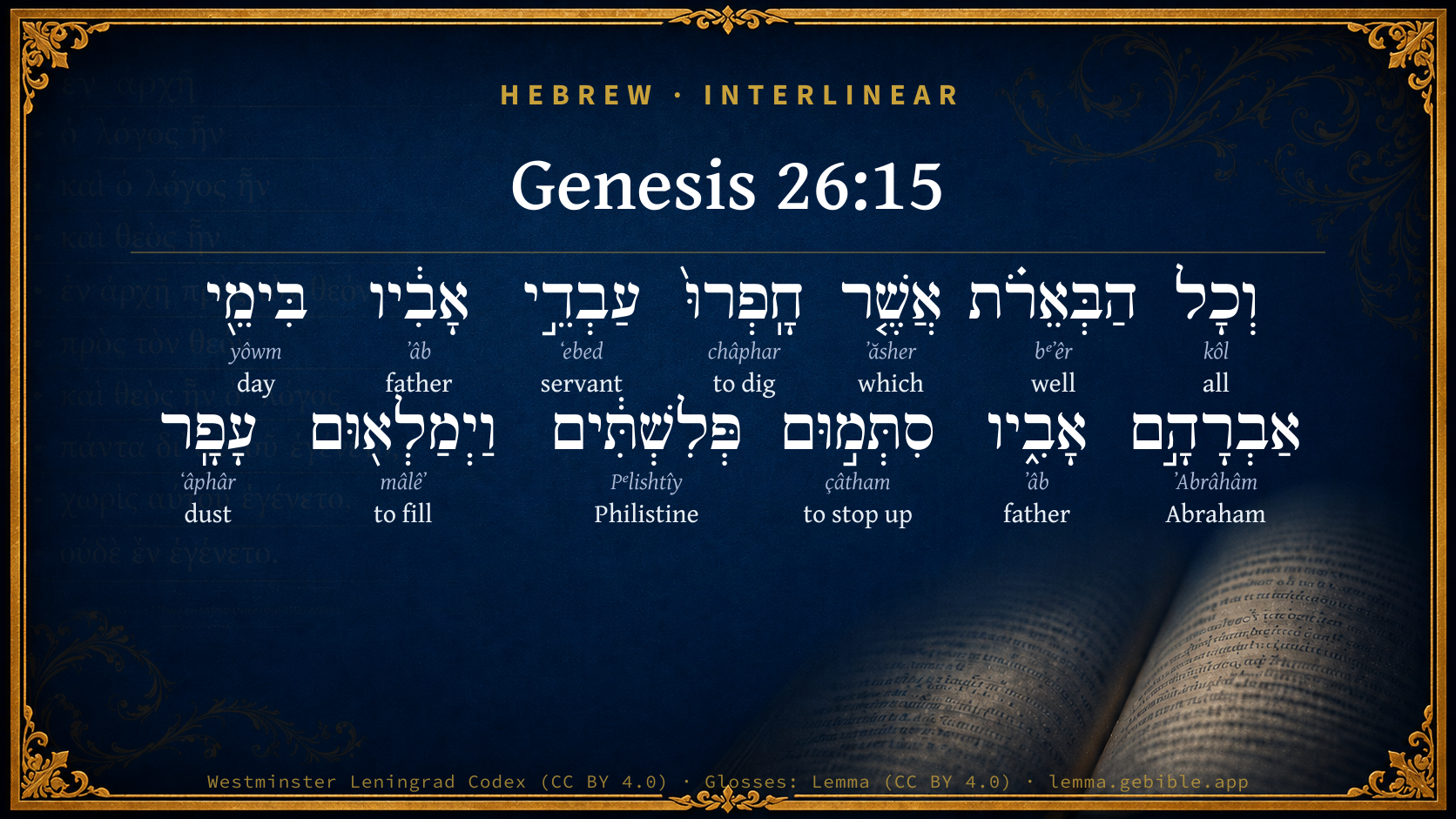
Hebrew (Westminster Leningrad Codex) Genesis 26:15 appears in the Hebrew Old Testament. The text above is from the Westminster Leningrad Codex. Each word links to its Strong’s number, a concise gloss, and parsing drawn from the Open Scriptures Hebrew Bible morphology. Click any word for its full Brown-Driver-Briggs (BDB) entry.
Download image
Cite this verse

Genesis 26:15 (World English Bible). Public Domain. Lemma interlinear Bible study tool, https://lemma.gebible.app/v/genesis/26/15.

Show BibTeX & RIS
BibTeX
RIS
English Translation
Now all the wells which his father's servants had dug in the days of Abraham his father, the Philistines had stopped, and filled with earth.
World English Bible · Public Domain
Highlights
  • 1 first appearance in the Hebrew Bible
Full analysis ↓
Download a study sheet

One document with this verse’s original text, its word-by-word gloss line, the meaning frame, cross-references with their text, attributed commentary, and full source and license credits — printable, and it pastes into notes with its structure intact.

This verse Autodidact and up

Study sheet (.html) Plain text (.txt)

A passage Seminary Student

Up to 50 verses in one chapter. A passage sheet keeps up to 6 commentary sources and 12 cross-references per verse, in the order this page ranks them, and says so on the sheet whenever that leaves anything out. Ask for a single verse and you get the Autodidact verse sheet above.

Everything on this page stays free to read, with no account — the sheet is a download of what is already on screen, not access to it.

Want to remove ads? Support Godless Engineer
Compare translations 3

The same verse in 3 English versions, stacked beneath the original-language interlinear above. Click any original word for its lexicon entry.

Each is an independent rendering of the whole verse — the interlinear is not word-aligned to these translations.

Highlighted words mark where these versions differ — a whole-verse word diff, not a word-by-word alignment.

  • World English Bible Public Domain
    Now all the wells which his father's servants had dug in the days of Abraham his father, the Philistines had stopped, and filled with earth.
  • King James Version Public Domain
    For all the wells which his father's servants had digged in the days of Abraham his father, the Philistines had stopped them, and filled them with earth.
  • unfoldingWord Literal Text CC BY-SA 4.0
    and the Philistines stopped up all the wells that the servants of his father had dug in the days of Abraham his father and filled them with dirt.

unfoldingWord Literal Text — © unfoldingWord, licensed CC BY-SA 4.0. Word-aligned USFM3 via Door43 (git.door43.org/unfoldingWord/en_ult).

Versions to compare (up to 4)

3 of 4 selected

Show all 18 translations

Every available English version of this verse, each an independent rendering of the whole verse.

  • World English Bible Public Domain
    Now all the wells which his father's servants had dug in the days of Abraham his father, the Philistines had stopped, and filled with earth.
  • Berean Standard Bible Public Domain
    So the Philistines took dirt and stopped up all the wells that his father’s servants had dug in the days of his father Abraham.
  • Majority Standard Bible Public Domain
    So the Philistines took dirt and stopped up all the wells that his father’s servants had dug in the days of his father Abraham.
  • King James Version Public Domain
    For all the wells which his father's servants had digged in the days of Abraham his father, the Philistines had stopped them, and filled them with earth.
  • American Standard Version (1901) Public Domain
    Now all the wells which his father's servants had digged in the days of Abraham his father, the Philistines had stopped, and filled with earth.
  • Revised Version (1885) Public Domain
    Now all the wells which his father’s servants had digged in the days of Abraham his father, the Philistines had stopped them, and filled them with earth.
  • Geneva Bible (1599) Public Domain
    In so much that the Philistims stopped and filled vp with earth all the welles, which his fathers seruantes digged in his father Abrahams time.
  • Douay-Rheims (1899) Public Domain
    Stopped up at that time all the wells, that the servants of his father Abraham had digged, filling them up with earth:
  • Young's Literal Translation Public Domain
    and all the wells which his father's servants digged in the days of Abraham his father, the Philistines have stopped them, and fill them with dust.
  • Literal Standard Version CC BY-SA 4.0
    and all the wells which his father’s servants dug in the days of his father Abraham, the Philistines have stopped them, and fill them with dust.
  • Unlocked Literal Bible CC BY-SA 4.0
    Now all the wells that his father's servants had dug in the days of Abraham his father, the Philistines stopped them up by filling them with earth.
  • unfoldingWord Literal Text CC BY-SA 4.0
    and the Philistines stopped up all the wells that the servants of his father had dug in the days of Abraham his father and filled them with dirt.
  • Darby Bible Public Domain
    And all the wells that his father's servants had dug in the days of Abraham his father, the Philistines stopped them and filled them with earth.
  • World Messianic Bible Public Domain
    Now all the wells which his father’s servants had dug in the days of Abraham his father, the Philistines had stopped, and filled with earth.
  • Webster's Bible Public Domain
    For all the wells which his father's servants had digged in the days of Abraham his father, the Philistines had stopped them, and filled them with earth.
  • Free Bible Version CC BY-SA 4.0
    So the Philistines used dirt to block up all the wells his father Abraham's servants had dug.
  • Bible in Basic English Public Domain
    Now all the water-holes, which his father's servants had made in the days of Abraham, had been stopped up with earth by the Philistines.
  • JPS Tanakh (1917) Public Domain
    Now all the wells which his father's servants had digged in the days of Abraham his father, the Philistines had stopped them, and filled them with earth.

Literal Standard Version (2020), Covenant Press — licensed CC BY-SA 4.0. Text via the HelloAO Bible API (eBible.org). Unlocked Literal Bible (unfoldingWord) — licensed CC BY-SA 4.0. Text via the HelloAO Bible API (eBible.org). unfoldingWord Literal Text — © unfoldingWord, licensed CC BY-SA 4.0. Word-aligned USFM3 via Door43 (git.door43.org/unfoldingWord/en_ult). Free Bible Version, Dr. Jonathan Gallagher — licensed CC BY-SA 4.0. Text via the HelloAO Bible API (eBible.org).

Word by word

More ways to search: Search by grammar → Find every occurrence → Compare this word →

Practice this passage: Drill this verse → Learn its vocabulary →

סִתְּמ֣וּם
çâtham
H5640
“to stop up · them”
Verb, Piel, Perfect, 3rd Person, Common, Plural + Suffix, Personal, 3rd Person, Masculine, Plural
Part of Speech
Verb
Stem
Piel
Form
Perfect
Person
3rd Person
Gender
Common
Number
Plural
Full BDB Definition

Origin: a primitive root

TWOT: 1550

to stop up, shut up, keep close - (Qal) - to stop up - to shut up, keep close - secret (participle) - (Niphal) to be stopped up - (Piel) to stop up
  1. וְכָל kôl H3605 “and · all of” Conjunction + Noun, Common, Masculine, Singular, Construct
  2. הַבְּאֵרֹ֗ת bᵉʼêr H875 “the · wells” Particle, Definite Article + Noun, Common, Feminine, Plural, Absolute
  3. אֲשֶׁ֤ר ʼăsher H834 “which” Particle, Relative
  4. חָֽפְרוּ֙ châphar H2658 “to dig” Verb, Qal, Perfect, 3rd Person, Common, Plural
  5. עַבְדֵ֣י ʻebed H5650 “servants of” Noun, Common, Masculine, Plural, Construct
  6. אָבִ֔יו ʼâb H1 “father · his” Noun, Common, Masculine, Singular, Construct + Suffix, Personal, 3rd Person, Masculine, Singular
  7. בִּימֵ֖י yôwm H3117 “in/at · days of” Preposition + Noun, Common, Masculine, Plural, Construct
  8. אַבְרָהָ֣ם ʼAbrâhâm H85 “Abraham” Noun, Proper
  9. אָבִ֑יו ʼâb H1 “father · his” Noun, Common, Masculine, Singular, Construct + Suffix, Personal, 3rd Person, Masculine, Singular
  10. פְּלִשְׁתִּ֔ים Pᵉlishtîy H6430 “Philistines” Noun, Gentilic, Masculine, Plural, Absolute
  11. וַיְמַלְא֖וּם mâlêʼ H4390 “and · to fill · them” Conjunction + Verb, Piel, Sequential Imperfect, 3rd Person, Masculine, Plural + Suffix, Personal, 3rd Person, Masculine, Plural
  12. עָפָֽר ʻâphâr H6083 “dust” Noun, Common, Masculine, Singular, Absolute

About this verse

These counts appear in no published source. They are computed here, from the morphology-tagged text and Lemma’s own curated glosses. What Lemma adds →

13
words
12
distinct lemmas
Pentateuch
section

Notable vocabulary

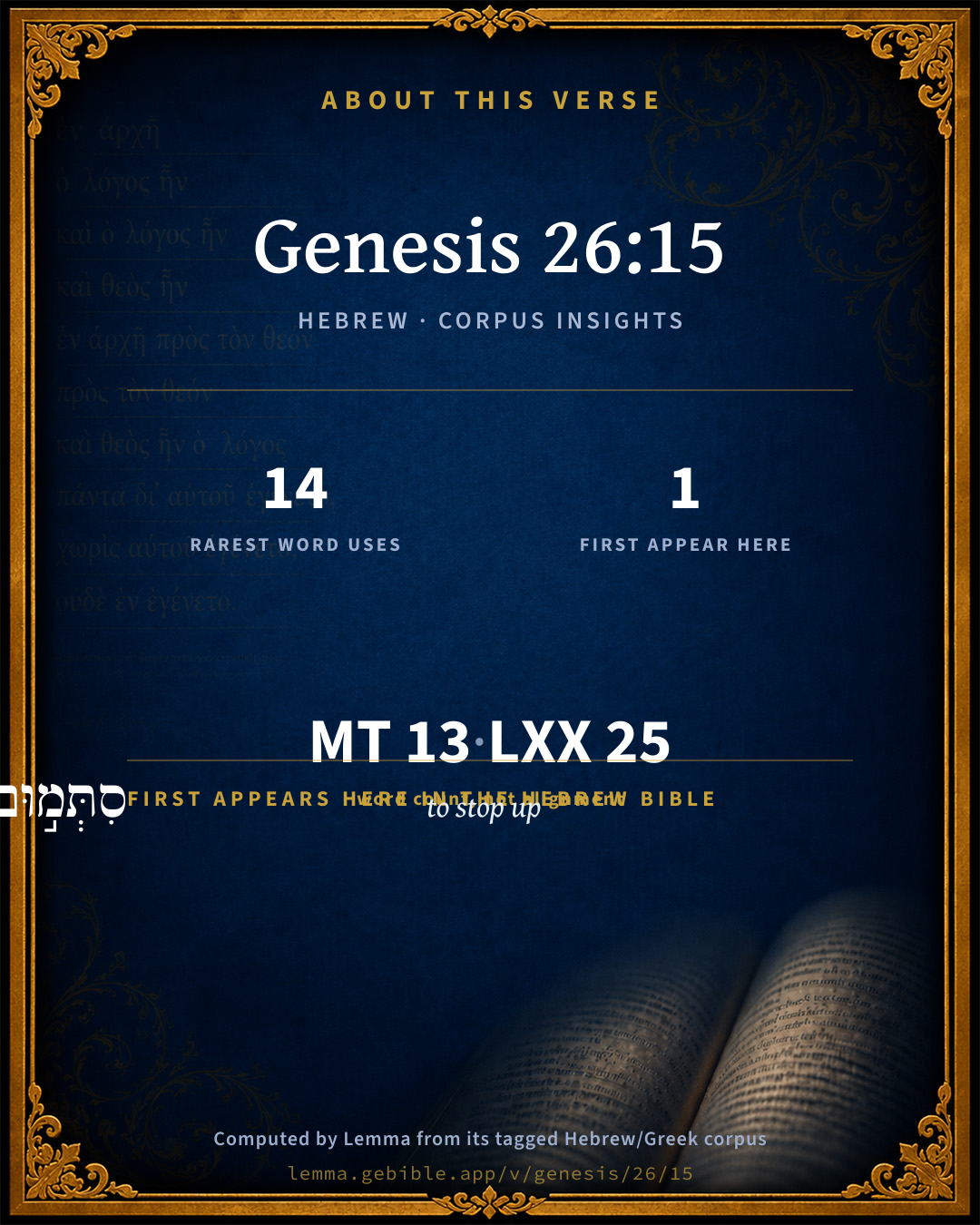
The rarest word here is סִתְּמ֣וּם to stop up H5640 — appearing just 14 times in the whole Hebrew Bible.

First appearance in Scripture

This word makes its first canonical appearance in the Hebrew Bible here:

  • סִתְּמ֣וּם to stop up H5640

Shared distinctive vocabulary

סִתְּמ֣וּם to stop up H5640 occurs in 14 verses of the Hebrew Bible. Also found in:

Grammatical profile

  • 3 verbs
  • 9 nouns
  • 1 particle

Verb forms

  • חָֽפְרוּ֙ Qal · Perfect
  • סִתְּמ֣וּם Piel · Perfect
  • וַיְמַלְא֖וּם Piel · Sequential Imperfect

Repetition

A word recurs within this verse — often emphatic in Hebrew:

  • אָבִ֔יו father H1 ×2

Hebrew & Septuagint length

In English translation the verse runs 25 words from the Hebrew and 27 from the Septuagint (LXX English) — closely comparable.

A rough comparison of the two English renderings, which tokenize alike — not a word-level alignment.

Word counts can differ between the Hebrew and the Greek without any difference in meaning — e.g. the Hebrew direct-object marker אֵת has no separate Greek word, and Greek often adds the article ὁ.

In the original languages it is 13 Hebrew tokens and 25 Greek tokens — but the two are counted differently (Hebrew bundles its prefixes and suffixes into one token; the Greek is in lemma form), so that isn’t a like-for-like length.

Cross-references

2

Topical passages linked to Genesis 26:15 in the Treasury of Scripture Knowledge — connected by theme and wording, ordered by reader-vote popularity; previews shown in the World English Bible.

  • Genesis 21:30 He said, "You shall take these seven ewe lambs from my hand, that it may be a witness to me, that I have dug this well."
  • Genesis 21:25 Abraham complained to Abimelech because of a water well, which Abimelech's servants had violently taken away.

Cross-references courtesy of OpenBible.info (CC BY 4.0).

Hebrew and Greek witnesses Masoretic Hebrew ↔ Greek Septuagint

The same verse in the two great witnesses to the Old Testament, shown verse-for-verse.

These are two independent witnesses, not word-aligned to each other, and the Septuagint is shown in lemma (dictionary) form.

Hebrew Genesis 26:15 Masoretic · Westminster Leningrad Codex

וְכָל הַבְּאֵרֹ֗ת אֲשֶׁ֤ר חָֽפְרוּ֙ עַבְדֵ֣י אָבִ֔יו בִּימֵ֖י אַבְרָהָ֣ם אָבִ֑יו סִתְּמ֣וּם פְּלִשְׁתִּ֔ים וַיְמַלְא֖וּם עָפָֽר

Now all the wells which his father's servants had dug in the days of Abraham his father, the Philistines had stopped, and filled with earth.

World English Bible · Public Domain

Greek LXX Genesis 26:15 Septuagint · lemma form

καί πᾶς ὁ φρέαρ ὅς ὀρύσσω ὁ παῖς ὁ πατήρ αὐτός ἐν ὁ χρόνος ὁ πατήρ αὐτός ἐνφράσσω αὐτός ὁ φυλιστιιμ καί πίμπλημι αὐτός γῆ

And all the wells which the servants of his father had dug in the time of his father, the Phylistines stopped them, and filled them with earth.

LXX2012 (modern English Septuagint) · Public Domain

Hebrew: Westminster Leningrad Codex (CC BY 4.0). Greek: Septuagint (public domain); English from LXX2012 (modern English Septuagint) (Public Domain). How the Septuagint differs from the Hebrew →

Targum (Aramaic paraphrase)

2

The Targum is the ancient Jewish Aramaic paraphrase of the Hebrew Scriptures — an interpretive translation, not the Hebrew text itself. Onkelos (literal) and Pseudo-Jonathan (expansive) render the Torah, and Jonathan the Prophets. Coverage is partial: where no permissively-licensed English translation exists for a verse, only the Aramaic is shown. This is verse-level text, not a word-by-word alignment to the Hebrew.

  1. Targum Onkelos Torah (Genesis–Deuteronomy)
    וְכָל בֵּירִין דִּי חֲפָרוּ עַבְדֵי אֲבוּהִי בְּיוֹמֵי אַבְרָהָם אֲבוּהִי טַמּוֹנוּן פְּלִשְׁתָּאֵי וּמְלוֹנוּן עַפְרָא

    (no public-domain English translation for this verse)

    Targum Onkelos — Aramaic: “Onkelos Genesis” (public domain); “Onkelos Exodus” (public domain); “Onkelos Leviticus” (public domain); “Onkelos Numbers” (public domain); “Onkelos Deuteronomy” (public domain). English: “Sefaria Community Translation” (CC0 1.0 (public-domain dedication)); “J.W. Etheridge. The Targums of Onkelos and Jonathan Ben Uzziel on the Pentateuch. London: Longmans, Green, 1862” (public domain). Text via Sefaria.

  2. Targum Pseudo-Jonathan Torah (Genesis–Deuteronomy)
    וְכָל בֵּירִין דַחֲפָרוּ עַבְדֵי אָבוֹי בְּיוֹמֵי אַבְרָהָם אָבוֹי טְמוּנִינוּן פְּלִשְׁתָּאֵי וּמְלוֹנוּן עַפְרָא

    And all the wells which the servants of his father had digged in the days of Abraham his father, the Philistaee stopped up and filled with earth.

    Targum Pseudo-Jonathan — Aramaic: “Targum Jonathan on Genesis” (public domain); “Targum Jonathan on Exodus” (public domain); “Targum Jonathan on Leviticus” (public domain); “Targum Jonathan on Numbers” (public domain); “Targum Jonathan on Deuteronomy” (public domain). English: “The Targum of Jonathan ben Uzziel, trans. J. W. Etheridge, London, 1862” (public domain). Text via Sefaria.

Commentary

Notes on Genesis 26:15 from classic Christian and Jewish commentators (each source and its license shown beneath its notes). The classic Christian expositions comment on the surrounding passage and are grouped to its opening verse, so a note may address several verses; the Jewish commentaries on the Tanakh (Rashi and others) are per-verse, so they appear only where the commentator wrote on this verse.

Lemma curates 59 commentaries, every one of them public domain or Creative Commons licensed, each selected and text-cleaned for this edition rather than reprinted as found. About our sources →

Trapp's Complete Commentary

John Trapp

Gen 26:15 For all the wells which his father’s servants had digged in the days of Abraham his father, the Philistines had stopped them, and filled them with earth.

Ver. 15. The Philistines had stopped them.] They deprived themselves of the benefit of those wells, so that Isaac might not water at them. Envy doth nothing with reason. It is vitium diabolicum, saith Augustine. {a} The devil, of pure spite, hinders men from heaven: he rageth and rangeth, roaring up and down, "seeking whom to devour"; and not caring to be doubly damned himself, so that others may not be saved. We should be so far from envying at the happiness of others, that we should rejoice in it. This were to be as the angels of God; and the contrary, is to be like the devils of hell, as Saul was, who, because he could not see David’s heart, fed upon his own. Envy devours itself, as the worm doth the nut out of which it grows.

{a} Aug. in Ps. cxxxix.

John Trapp, A Commentary or Exposition upon All the Books of the Old and New Testament (1647–1656) — public domain. Text from a community e-Sword module.

Jamieson, Fausset & Brown

Robert Jamieson, A. R. Fausset & David Brown

all the wells which his father's servants had digged . . . the Philistines had stopped, &c.--The same base stratagem for annoying those against whom they have taken an umbrage is practiced still by choking the wells with sand or stones, or defiling them with putrid carcases.

Jamieson, Fausset & Brown — Commentary Critical and Explanatory on the Whole Bible (1871) — public domain (CC PDM 1.0). Text via the HelloAO Bible API.

Adam Clarke's Commentary

Verse 15. For all the wells - the Philistines had stopped them] In such countries a good well was a great acquisition; and hence in predatory wars it was usual for either party to fill the wells with earth or sand, in order to distress the enemy. The filling up the wells in this case was a most unprincipled transaction, as they had pledged themselves to Abraham, by a solemn oath, not to injure each other in this or any other respect. See Ge 21:25-31.

Adam Clarke's Commentary on the Bible (1810–1826) — public domain. Text from a community e-Sword/MySword module.

Ellicott's Commentary for English Readers

(15) The wells.—In the East the digger of a well is regarded as a public benefactor; but the Philistines stopped those that Abraham had digged, probably because they regarded his possession of them, though confirmed by the covenant between him and Abimelech (Gen_21:32), as an intrusion upon their rights as the people of the country, Envious, too, at the rapid increase of an alien’s wealth, they determined to drive Isaac away; and for this no expedient would be more effectual than the preventing him from procuring water for his cattle. Following upon this came an express command of the king to depart, which Isaac obeyed; for he had sought refuge there because of the famine, and had no right to continue at Gerar, if the people refused their hospitality.

A Bible Commentary for English Readers, edited by Charles John Ellicott (1878–1897) — public domain. Text from a community e-Sword module.

The Cambridge Bible for Schools and Colleges

gen. ed. J. J. S. Perowne

15. his father’s servants] Cf. Gen_21:25.

had stopped them] Wells were of priceless value to large owners of cattle and sheep. The “Philistines” adopted the most malignant method of spiting the Hebrews, and of rendering their continued sojourn in the land impossible. See 2Ki_3:25.

The Cambridge Bible for Schools and Colleges (gen. ed. J. J. S. Perowne; Cambridge University Press, 1878–1918) — public domain. Text from a community e-Sword module.

John Gill's Exposition

And Abimelech said unto Isaac, go from us,.... Which was either said by way of advice, consulting Isaac's good, and the peace of his own kingdom; or else by way of command, enjoining him to depart, having a secret envy to him himself, or at least was jealous of his growing power and wealth:

for thou art much mightier than we; in riches or goods, as the Targum of Jonathan adds; or in number; his family being greatly increased, his servants numerous, many being born of them in his house; Abraham had three hundred and eighteen trained servants in his house, Gen 14:14; how many Isaac had is not certain; they must be a large number for Abimelech to fear anything from them. Some choose to interpret the words, thou hast increased, or thou hast got much from us, and by us; and therefore it is high time for thee to be gone from us.

John Gill's Exposition of the Whole Bible (1746–1763) — public domain (CC PDM 1.0). Text via the HelloAO Bible API.

Whedon's Commentary on the Bible

Daniel D. Whedon

15. Wells… filled — The wells dug by Abraham gave Isaac a sort of title to the land, and filling them up was equivalent to a declaration of war. Comp. 2Ki_3:25; Isa_15:6.

Daniel D. Whedon (gen. ed.), Commentary on the Old and New Testaments (1874–1909) — public domain. Text from a community e-Sword module.

The Pulpit Commentary

For all the wells which his father"s servants had digged in the days of Abraham his father, (vide Gen_21:30) the philistines had stopped them, and filled them with earth. This act, commonly regarded as legitimate in ancient warfare, was practically to Isaac an act of expulsion, it being impossible for flocks and herds to exist without access to water supplies. It was probably, as the text indicates, the outcome of envy, rather than inspired by fear that Isaac in digging and possessing wells was tacitly claiming the ownership of the land.

The Pulpit Commentary (1880–1919), ed. H.D.M. Spence-Jones & Joseph S. Exell — public domain. Text from a community e-Sword module.

unfoldingWord translationNotes

Door43 World Missions Community

Now

Here this word does not mean "at this moment." It is indicating where the action in the story begins. It can be translated with the connecting word "So" to show that this is a result of what happened in Genesis 26:12-13. (See: Connecting Words)

in the days of Abraham his father

The phrase "in the days of" stands for a person's lifetime. AT: "when Abraham, his father, was living" or "during his father Abraham's lifetime"

Abimelech said

Possible meanings are 1) this is another action to force Isaac and his people to leave. AT: "Then Abimelech said" or "Finally Abimelech said" or 2) Abimelech made this decision because he saw that his people were jealous and acting in a hostile way towards Isaac. AT: "Therefore Abimelech said" (See: Connecting Words)

much mightier than we

"much stronger than we are"

So Isaac departed

Only Isaac is mentioned because he is the leader, but his family and servants went with him. AT: "So Isaac and his household left" (See: Assumed Knowledge and Implicit Information)

translationWords

cistern

ancestor

servant

Philistines

unfoldingWord translationNotes — © Distant Shores Media and the Door43 World Missions Community, licensed CC BY-SA 4.0. Source: git.door43.org/Door43/en_tn.

Rashi

Rabbi Shlomo Yitzchaki (Rashi)

סתמום פלשתים THE PHILISTINES STOPPED THEM, saying, “They may become a source of danger to us because of marauding troops that may invade us” (i.e.,they may invade our country to obtain possession of the wells, or if they invade us for any other reason they will be able to find a supply of water). (Tosafot Sotah 10.) The rendering of the Targum טמונין means “stopping up” and we find it in the language of the Talmud (Pesachim 42a) “Chokes up (מטמטם) the heart”.

Rashi on the Tanakh — English translations: “The Judaica Press complete Tanach with Rashi, translated by A. J. Rosenberg” (CC BY 4.0); “Pentateuch with Rashi's commentary by M. Rosenbaum and A.M. Silbermann, 1929-1934” (public domain); “The Metsudah Tanach series, Lakewood, N.J” (CC BY 4.0); and “The Book of Joshua, Metsudah Publications, 1997” (CC BY 4.0). Text via Sefaria.

Sforno

Rabbi Ovadia Sforno

The Philistines plugged them. Since the king had forbidden them to harm Yitzchok physically, they gave vent to their jealousy by plugging up the wells.

Sforno on the Tanakh — English translation: “Yalkut, Sifsei Chachomim Chumash, Metsudah Publications, 2009” (CC BY 4.0). Text via Sefaria.

Radak

Rabbi David Kimhi (Radak)

וכל הבארות, after Avraham had died the local populace was no longer afraid of Yitzchok. Also, the Avimelech with whom Avraham had made the pact and who had restored the wells to Avraham had died in the interval. Why then did the Philistines stop up the wells instead of using them for their own flocks? They were afraid that in the event that when Yitzchok would grow up he would be as powerful a figure as his father he would appropriate these wells. Therefore, they reasoned the only way to deny him these wells is by also denying them to themselves. Therefore they closed them up so that no one supposedly would be able to locate them.

Radak on the Tanakh — English translations: “Sefaria Community Translation” (CC0 1.0 (public-domain dedication)); “Eliyahu Munk, HaChut Hameshulash” (CC BY 4.0); “Rabbi Mike Feuer, Jerusalem Anthology” (CC BY 4.0); and “R. David Kimhi on the first book of Psalms, Translated by R.G. Finch, London, 1919” (public domain). Text via Sefaria.

Lesson kit

Teaching starters — assembled from the data on this page, not authored interpretation. Every prompt links to the verse data it draws on. Edit before teaching.

Genesis, in the Pentateuch, opens this verse with 13 words (12 distinct Hebrew lemmas). Its most distinctive word is çâtham (“to stop up”). A historical commentator’s framing appears above. Read the whole chapter for the surrounding context.

Discussion questions

  1. How does “to stop up” (çâtham) shape what this verse is saying?
  2. The word “to stop up” first appears here in Scripture. What is being introduced at this debut?
  3. Genesis 26:18 shares the word «to stop up» with this verse. How do the two illuminate each other?
  4. “father” occurs 2× in this one verse. What is the effect of the repetition?
  5. These translations render this verse differently; the difference is in the English rendering, not the original. What questions does that raise?
  6. The verb «חָֽפְרוּ֙» is Qal Perfect. How does its form color the action?
  7. Reading how Trapp's Complete Commentary and Jamieson, Fausset & Brown read this verse, where do the two commentators agree and where do they part?

Things to notice

Reading settings

Reading text

Shown beneath each verse's original-language words.

Old Testament
Old Testament edition

Read the OT as the Masoretic Hebrew (MT) or the Greek Septuagint (LXX).

English shown for the Greek Septuagint (in the Hebrew ↔ Greek comparison).

Comparing translations? Open the Compare panel on any verse page to stack up to four side by side.