
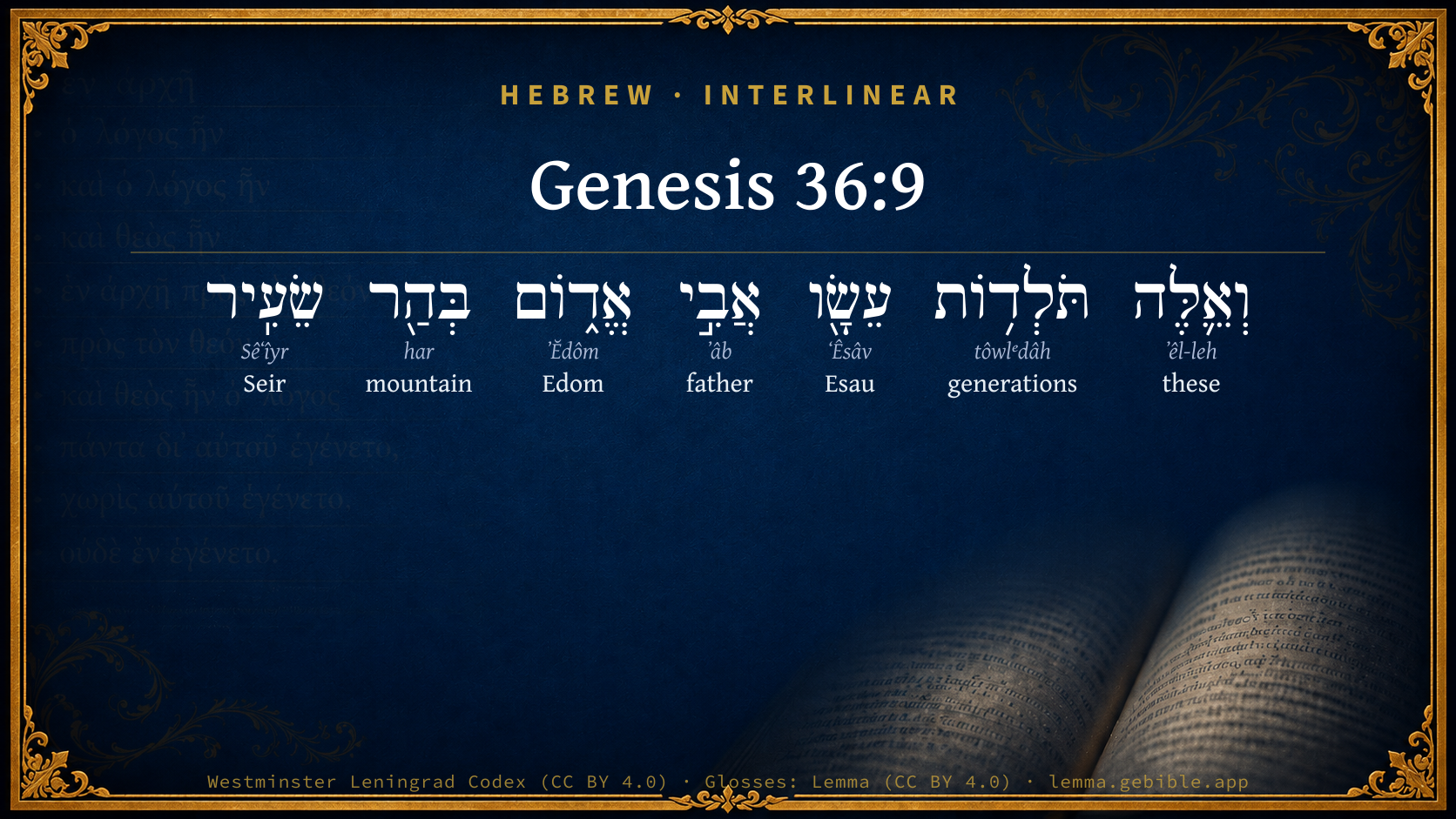
Genesis 36:9

Hebrew (Westminster Leningrad Codex) Genesis 36:9 appears in the Hebrew Old Testament. The text above is from the Westminster Leningrad Codex. Each word links to its Strong’s number, a concise gloss, and parsing drawn from the Open Scriptures Hebrew Bible morphology. Click any word for its full Brown-Driver-Briggs (BDB) entry.
Download image
Cite this verse

Genesis 36:9 (World English Bible). Public Domain. Lemma interlinear Bible study tool, https://lemma.gebible.app/v/genesis/36/9.

Show BibTeX & RIS
BibTeX
RIS
English Translation
This is the history of the generations of Esau the father of the Edomites in the hill country of Seir:
World English Bible · Public Domain
Download a study sheet

One document with this verse’s original text, its word-by-word gloss line, the meaning frame, cross-references with their text, attributed commentary, and full source and license credits — printable, and it pastes into notes with its structure intact.

This verse Autodidact and up

Study sheet (.html) Plain text (.txt)

A passage Seminary Student

Up to 50 verses in one chapter. A passage sheet keeps up to 6 commentary sources and 12 cross-references per verse, in the order this page ranks them, and says so on the sheet whenever that leaves anything out. Ask for a single verse and you get the Autodidact verse sheet above.

Everything on this page stays free to read, with no account — the sheet is a download of what is already on screen, not access to it.

Want to remove ads? Support Godless Engineer
Compare translations 3

The same verse in 3 English versions, stacked beneath the original-language interlinear above. Click any original word for its lexicon entry.

Each is an independent rendering of the whole verse — the interlinear is not word-aligned to these translations.

Highlighted words mark where these versions differ — a whole-verse word diff, not a word-by-word alignment.

  • World English Bible Public Domain
    This is the history of the generations of Esau the father of the Edomites in the hill country of Seir:
  • King James Version Public Domain
    And these are the generations of Esau the father of the Edomites in mount Seir:
  • unfoldingWord Literal Text CC BY-SA 4.0
    Now these the generations of Esau, the father of the Edomites in the mountains of Seir.

unfoldingWord Literal Text — © unfoldingWord, licensed CC BY-SA 4.0. Word-aligned USFM3 via Door43 (git.door43.org/unfoldingWord/en_ult).

Versions to compare (up to 4)

3 of 4 selected

Show all 18 translations

Every available English version of this verse, each an independent rendering of the whole verse.

  • World English Bible Public Domain
    This is the history of the generations of Esau the father of the Edomites in the hill country of Seir:
  • Berean Standard Bible Public Domain
    This is the account of Esau, the father of the Edomites, in the area of Mount Seir.
  • Majority Standard Bible Public Domain
    This is the account of Esau, the father of the Edomites, in the area of Mount Seir.
  • King James Version Public Domain
    And these are the generations of Esau the father of the Edomites in mount Seir:
  • American Standard Version (1901) Public Domain
    And these are the generations of Esau the father of the Edomites in mount Seir:
  • Revised Version (1885) Public Domain
    And these are the generations of Esau the father of the Edomites in mount Seir:
  • Geneva Bible (1599) Public Domain
    So these are the generations of Esau father of Edom in mount Seir.
  • Douay-Rheims (1899) Public Domain
    And these are the generations of Esau the father of Edom in mount Seir,
  • Young's Literal Translation Public Domain
    And these `are' births of Esau, father of Edom, in mount Seir.
  • Literal Standard Version CC BY-SA 4.0
    And these [are] the generations of Esau, father of Edom, in Mount Seir.
  • Unlocked Literal Bible CC BY-SA 4.0
    These were the descendants of Esau, the ancestor of the Edomites in the hill country of Seir.
  • unfoldingWord Literal Text CC BY-SA 4.0
    Now these the generations of Esau, the father of the Edomites in the mountains of Seir.
  • Darby Bible Public Domain
    And these are the generations of Esau, the father of Edom, in mount Seir.
  • World Messianic Bible Public Domain
    This is the history of the generations of Esau the father of the Edomites in the hill country of Seir:
  • Webster's Bible Public Domain
    And these are the generations of Esau the father of the Edomites, in mount Seir:
  • Free Bible Version CC BY-SA 4.0
    The following is the genealogy of Esau, father of the Edomites, who lived in the hill country of Seir:
  • Bible in Basic English Public Domain
    And these are the generations of Esau, the father of the Edomites in the hill-country of Seir:
  • JPS Tanakh (1917) Public Domain
    And these are the generations of Esau the father of a the Edomites in the mountain-land of Seir.

Literal Standard Version (2020), Covenant Press — licensed CC BY-SA 4.0. Text via the HelloAO Bible API (eBible.org). Unlocked Literal Bible (unfoldingWord) — licensed CC BY-SA 4.0. Text via the HelloAO Bible API (eBible.org). unfoldingWord Literal Text — © unfoldingWord, licensed CC BY-SA 4.0. Word-aligned USFM3 via Door43 (git.door43.org/unfoldingWord/en_ult). Free Bible Version, Dr. Jonathan Gallagher — licensed CC BY-SA 4.0. Text via the HelloAO Bible API (eBible.org).

Word by word

More ways to search: Search by grammar → Find every occurrence → Compare this word →

Practice this passage: Drill this verse → Learn its vocabulary →

About this verse

These counts appear in no published source. They are computed here, from the morphology-tagged text and Lemma’s own curated glosses. What Lemma adds →

7
words
7
distinct lemmas
Pentateuch
section

Shared distinctive vocabulary

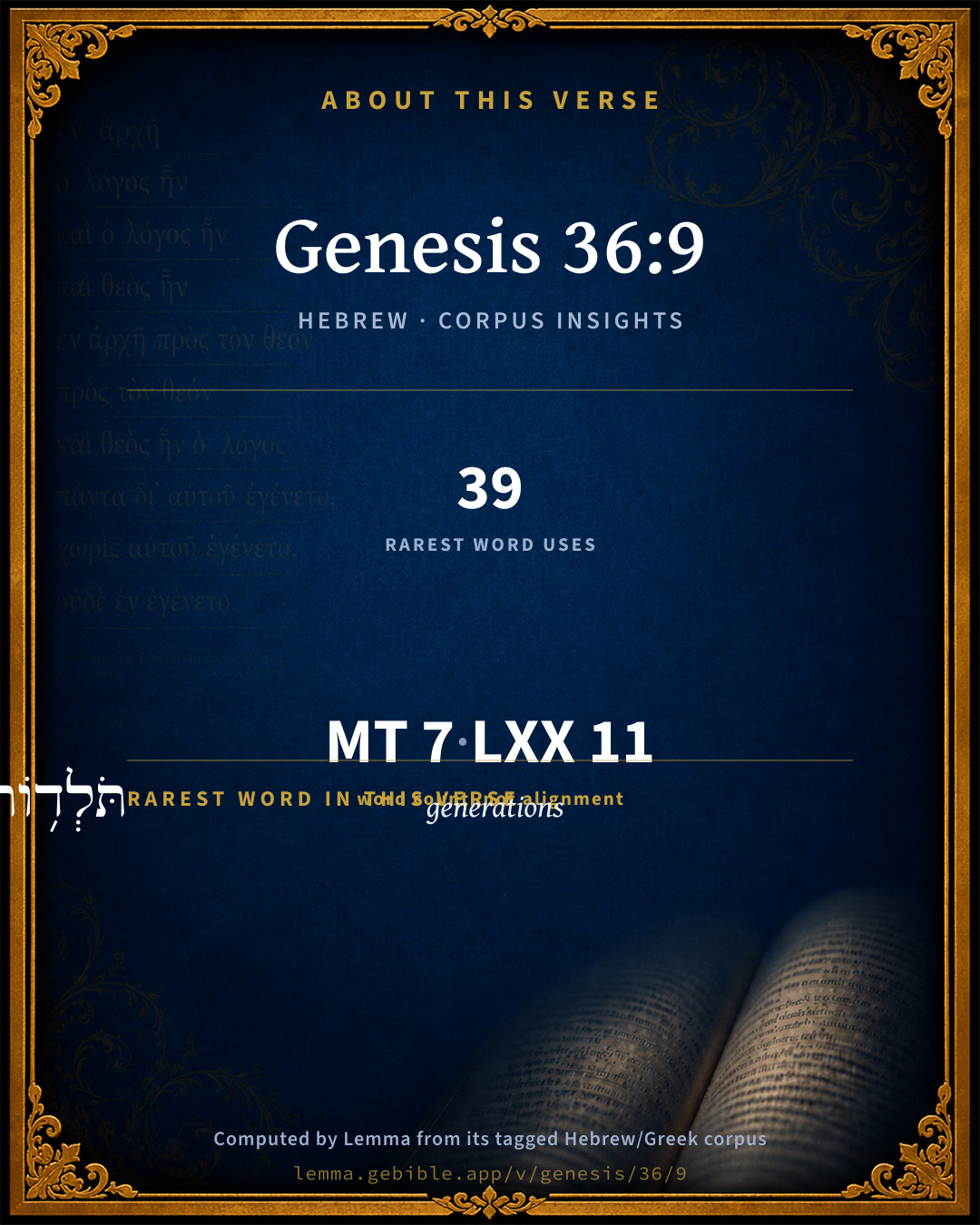
תֹּלְד֥וֹת generations H8435 occurs in 39 verses of the Hebrew Bible. Also found in:

Grammatical profile

  • 6 nouns
  • 1 pronoun

Hebrew & Septuagint length

In English translation the verse runs 20 words from the Hebrew and 15 from the Septuagint (LXX English) — closely comparable.

A rough comparison of the two English renderings, which tokenize alike — not a word-level alignment.

Word counts can differ between the Hebrew and the Greek without any difference in meaning — e.g. the Hebrew direct-object marker אֵת has no separate Greek word, and Greek often adds the article ὁ.

In the original languages it is 7 Hebrew tokens and 11 Greek tokens — but the two are counted differently (Hebrew bundles its prefixes and suffixes into one token; the Greek is in lemma form), so that isn’t a like-for-like length.

Cross-references

1

Topical passages linked to Genesis 36:9 in the Treasury of Scripture Knowledge — connected by theme and wording, ordered by reader-vote popularity; previews shown in the World English Bible.

  • Genesis 19:37 The firstborn bore a son, and named him Moab. The same is the father of the Moabites to this day.

Cross-references courtesy of OpenBible.info (CC BY 4.0).

Hebrew and Greek witnesses Masoretic Hebrew ↔ Greek Septuagint

The same verse in the two great witnesses to the Old Testament, shown verse-for-verse.

These are two independent witnesses, not word-aligned to each other, and the Septuagint is shown in lemma (dictionary) form.

Hebrew Genesis 36:9 Masoretic · Westminster Leningrad Codex

וְאֵ֛לֶּה תֹּלְד֥וֹת עֵשָׂ֖ו אֲבִ֣י אֱד֑וֹם בְּהַ֖ר שֵׂעִֽיר

This is the history of the generations of Esau the father of the Edomites in the hill country of Seir:

World English Bible · Public Domain

Greek LXX Genesis 36:9 Septuagint · lemma form

οὗτος δέ ὁ γένεσις ησαυ πατήρ εδωμ ἐν ὁ ὄρος σηιρ

And these are the generations of Esau, the father of Edom in the mount Seir.

LXX2012 (modern English Septuagint) · Public Domain

Hebrew: Westminster Leningrad Codex (CC BY 4.0). Greek: Septuagint (public domain); English from LXX2012 (modern English Septuagint) (Public Domain). How the Septuagint differs from the Hebrew →

Targum (Aramaic paraphrase)

2

The Targum is the ancient Jewish Aramaic paraphrase of the Hebrew Scriptures — an interpretive translation, not the Hebrew text itself. Onkelos (literal) and Pseudo-Jonathan (expansive) render the Torah, and Jonathan the Prophets. Coverage is partial: where no permissively-licensed English translation exists for a verse, only the Aramaic is shown. This is verse-level text, not a word-by-word alignment to the Hebrew.

  1. Targum Onkelos Torah (Genesis–Deuteronomy)
    וְאִלֵּין תּוּלְדַת עֵשָׂו אֲבוּהוֹן דֶאֱדוֹמָאֵי בְּטוּרָא דְשֵׂעִיר

    (no public-domain English translation for this verse)

    Targum Onkelos — Aramaic: “Onkelos Genesis” (public domain); “Onkelos Exodus” (public domain); “Onkelos Leviticus” (public domain); “Onkelos Numbers” (public domain); “Onkelos Deuteronomy” (public domain). English: “Sefaria Community Translation” (CC0 1.0 (public-domain dedication)); “J.W. Etheridge. The Targums of Onkelos and Jonathan Ben Uzziel on the Pentateuch. London: Longmans, Green, 1862” (public domain). Text via Sefaria.

  2. Targum Pseudo-Jonathan Torah (Genesis–Deuteronomy)
    וְאִלֵין יִיחוּסִין דְעֵשָו רַבָּא דֶאֱדוֹמָאֵי דְבֵית מְדוֹרְהוֹן בְּטַוָור גַבְלָא

    And these are the kindreds of Esau the prince of the Edomites, the place of whose dwelling was in the mountain. of Gabal.

    Targum Pseudo-Jonathan — Aramaic: “Targum Jonathan on Genesis” (public domain); “Targum Jonathan on Exodus” (public domain); “Targum Jonathan on Leviticus” (public domain); “Targum Jonathan on Numbers” (public domain); “Targum Jonathan on Deuteronomy” (public domain). English: “The Targum of Jonathan ben Uzziel, trans. J. W. Etheridge, London, 1862” (public domain). Text via Sefaria.

Commentary

Notes on Genesis 36:9 from classic Christian and Jewish commentators (each source and its license shown beneath its notes). The classic Christian expositions comment on the surrounding passage and are grouped to its opening verse, so a note may address several verses; the Jewish commentaries on the Tanakh (Rashi and others) are per-verse, so they appear only where the commentator wrote on this verse.

Lemma curates 59 commentaries, every one of them public domain or Creative Commons licensed, each selected and text-cleaned for this edition rather than reprinted as found. About our sources →

Tyndale Open Study Notes

Tyndale Open Resources

36:9-43 This passage begins a second account of Esau’s descendants (36:1); it traces the family to subsequent generations and alliances.

36:9-14 The descendants of Esau’s five sons are named.

Tyndale Open Study Notes — © Tyndale Open Resources, licensed CC BY-SA 4.0. Text via the HelloAO Bible API.

unfoldingWord translationNotes

Door43 World Missions Community

These were the descendants of Esau

This sentence introduces the account of Esau's descendants in Genesis 36:9-43. AT: "This is an account of the descendants of Esau" (See: Assumed Knowledge and Implicit Information)

in the hill country of Seir

This means that they lived in the hill country of Seir. The full meaning of this may be made explicit. AT: "who lived in the hill country of Seir" (See: Assumed Knowledge and Implicit Information)

Eliphaz ... Reuel

These are names of Esau's sons. See how you translated these names in Genesis 36:4. (See: How to Translate Names)

Adah ... Basemath

These are names of Esau's wives. See how you translated these names in Genesis 36:2-3. (See: How to Translate Names)

Teman, Omar, Zepho, Gatam, and Kenaz ... Amalek

These are names of the sons of Eliphaz. (See: How to Translate Names)

Timna

This is the name of Eliphaz's concubine. (See: How to Translate Names)

translationWords

descend

Esau

Edom

concubine

unfoldingWord translationNotes — © Distant Shores Media and the Door43 World Missions Community, licensed CC BY-SA 4.0. Source: git.door43.org/Door43/en_tn.

Geneva Bible (1599)

Geneva Bible translators

Or, the edomites.

Geneva Bible (1599) marginal notes — public domain. Text via Bolls.life.

Matthew Henry's Commentary

Observe here, 1. That only the names of Esau's sons and grandsons are recorded, only their names, not their history; for it is the church that Moses preserves the records of, not the record of those that are without. Those elders that lived by faith alone obtained a good report. It is Sion that produces men of renown, not Seir, Psa 87:5. Nor does the genealogy go any further than the third and fourth generation; the very names of all after are buried in oblivion. It is only the pedigree of the Israelites, who were to be the heirs of Canaan, and of whom were to come the promised seed, and the holy seed, that is drawn out to any length, as far as there was occasion for it, even of all the tribes till Canaan was divided among them, and of the royal line till Christ came. 2. That these sons and grandsons of Esau are called dukes, Gen 36:15-19. Probably they were military commanders, dukes, or captains, that had soldiers under them; for Esau and his family lived by the sword, Gen 27:40. Note, Titles of honour have been more ancient out of the church than in it. Esau's sons were dukes when Jacob's sons were but plain shepherds, Gen 47:3. This is not a reason why such titles should not be used among Christians; but it is a reason why men should not overvalue themselves, or others, for the sake of them. There is an honour that comes from God, and a name in his house that is infinitely more valuable. Edomites may be dukes with men, but Israelites indeed are made to our God kings and priests. 3. We may suppose those dukes had numerous families of children and servants that were their dukedoms. God promised to multiply Jacob, and to enrich him; yet Esau increases, and is enriched first. Note, It is no new thing for the men of this world to be full of children, and to have their bellies too filled with hidden treasures, Psa 17:14. God's promise to Jacob began to work late, but the effect of it remained longer, and it had its complete accomplishment in the spiritual Israel.

Matthew Henry's Commentary on the Whole Bible (1708–1710) — public domain (CC PDM 1.0). Text via the HelloAO Bible API.

John Calvin's Commentaries

9. And these are the generations of Esau, the father of the Edomites Though Esau had two names, yet in this place the second name refers to his posterity, who are called Idumeans. For, to make it appear what God had bestowed upon him for the sake of his father Isaac, Moses expressly calls him the father of a celebrated and famous people. And certainly, it served this purpose not a little, to trace the effect and fulfillment of the prophecy in the progeny of Esau. For if the promise of God so mightily flourished towards a stranger, how much more powerfully would it put itself forth towards the children, to whom pertaineth the adoption, and consequently the inheritance of grace? Esau was an obscure man, and a sojourner in that country: whence therefore is it, that suddenly rulers should spring from him, and a great body of people should flourish, unless because the benediction which proceeded from the mouth of Isaac, was confirmed by the result? For Esau did not reign in this desert without opposition; since a people of no ignoble name previously inhabited Mount Seir. On this account Moses relates that the men who had before inhabited that land were mighty: so that it would not have been easy for a stranger to acquire such power as Esau possessed, if he had not been divinely assisted.

John Calvin's Commentaries (1540-1563) — public domain. Text from the Calvin Translation Society English edition (1840s-50s) via the Christian Classics Ethereal Library (ccel.org). Calvin's coverage is partial (roughly two-thirds of the Bible); uncommented books and verses are honest gaps, never fabricated. The 19th-century editor's footnotes and remarks are omitted so the notes are faithfully Calvin's own voice.

Ellicott's Commentary for English Readers

(9) The father of the Edomites.—Heb., the father of Edom. He was himself the man Edom, but the word here means the country of which he was the colonizer.

A Bible Commentary for English Readers, edited by Charles John Ellicott (1878–1897) — public domain. Text from a community e-Sword module.

The Cambridge Bible for Schools and Colleges

gen. ed. J. J. S. Perowne

9. the Edomites] Heb. Edom, as in Gen_36:43 : cf. 1Sa_14:47.

9–14. The “sons” of Esau by Adah, Basemath, and Oholibamah must be regarded as the names of clans, and, like the sons of Ishmael and Israel, are 12 in number (Amalek, the son of Esau’s concubine, Timna, is excluded from this list of twelve).

The Cambridge Bible for Schools and Colleges (gen. ed. J. J. S. Perowne; Cambridge University Press, 1878–1918) — public domain. Text from a community e-Sword module.

John Gill's Exposition

These are the names of Esau's sons,.... In this and some following verses, an account is given of the sons of Esau, which agrees with what is before observed, and of his sons' sons:

Eliphaz the son of Adah the wife of Esau: who seems to be his first wife, and this his first son:

Reuel the son of Bashemath and wife of Esau; his second son by another wife, a daughter of Ishmael, Gen 36:3.

John Gill's Exposition of the Whole Bible (1746–1763) — public domain (CC PDM 1.0). Text via the HelloAO Bible API.

Haydock's Catholic Bible Commentary

Of Edom, or of all the nations who inhabited Idumea, sprung from Esau’s grand-children. (Calmet)

George Leo Haydock (1774–1849), Haydock's Catholic Family Bible and Commentary, 1859 edition — public domain. Excludes Psalms (Douay-Rheims chapter numbering differs from Protestant) and Deuterocanonical books (Catholic canon only).

The Pulpit Commentary

And these are the generations of Esau repetition of this clause shows that it does not necessarily indicate diversity of authorship, or a very distinct piece of composition" (Murphy)the father of the Edomites ( i.e. the founder of the Edomitish nation) in mount Seir.

The Pulpit Commentary (1880–1919), ed. H.D.M. Spence-Jones & Joseph S. Exell — public domain. Text from a community e-Sword module.

Keil & Delitzsch

C. F. Keil & F. Delitzsch

(cf. Ch1 1:36-37). Esau's Sons and Grandsons as Fathers of Tribes. - Through them he became the father of Edom, i.e., the founder of the Edomitish nation on the mountains of Seir. Mouth Seir is the mountainous region between the Dead Sea and the Elanitic Gulf, the northern half of which is called Jebl (Γεβαλήνη) by the Arabs, the southern half, Sherah (Rob. Pal. ii. 552). - In the case of two of the wives of Esau, who bore only one son each, the tribes were founded not by the sons, but by the grandsons; but in that of Aholibamah the three sons were the founders. Among the sons of Eliphaz we find Amalek, whose mother was Timna, the concubine of Eliphaz. He was the ancestor of the Amalekites, who attacked the Israelites at Horeb as they came out of Egypt under Moses (Exo 17:8.), and not merely of a mixed tribe of Amalekites and Edomites, belonging to the supposed aboriginal Amalekite nation. For the Arabic legend of Amlik as an aboriginal tribe of Arabia is far too recent, confused, and contradictory to counterbalance the clear testimony of the record before us. The allusion to the fields of the Amalekites in Gen 14:7 does not imply that the tribe was in existence in Abraham's time, nor does the expression "first of the nations," in the saying of Balaam (Num 24:20), represent Amalek as the aboriginal or oldest tribe, but simply as the first heathen tribe by which Israel was attacked. The Old Testament says nothing of any fusion of Edomites or Horites with Amalekites, nor does it mention a double Amalek (cf. Hengstenberg, Dissertations 2, 247ff., and Kurtz, History i. 122, 3, ii. 240ff.).

(Note: The occurrence of "Timna and Amalek" in Ch1 1:36, as coordinate with the sons of Eliphaz, is simply a more concise form of saying "and from Timna, Amalek.")

If there had been an Amalek previous to Edom, with the important part which they took in opposition to Israel even in the time of Moses, the book of Genesis would not have omitted to give their pedigree in the list of the nations. At a very early period the Amalekites separated from the other tribes of Edom and formed an independent people, having their headquarters in the southern part of the mountains of Judah, as far as Kadesh (Gen 14:7; Num 13:29; Num 14:43, Num 14:45), but, like the Bedouins, spreading themselves as a nomad tribe over the whole of the northern portion of Arabia Petraea, from Havilah to Shur on the border of Egypt (Sa1 15:3, Sa1 15:7; Sa1 27:8); whilst one branch penetrated into the heart of Canaan, so that a range of hills, in what was afterwards the inheritance of Ephraim, bore the name of mountains of the Amalekites (Jdg 12:15, cf. Gen 5:14). Those who settled in Arabia seem also to have separated in the course of time into several branches, so that Amalekite hordes invaded the land of Israel in connection sometimes with the Midianites and the sons of the East (the Arabs, Jdg 6:3; Jdg 7:12), and at other times with the Ammonites (Jdg 3:13). After they had been defeated by Saul (Sa1 14:48; Sa1 15:2.), and frequently chastised by David (Sa1 27:8; Sa1 30:1.; Sa2 8:12), the remnant of them was exterminated under Hezekiah by the Simeonites on the mountains of Seir (Ch1 4:42-43).

Keil & Delitzsch — Biblical Commentary on the Old Testament (1861–1891) — public domain (CC PDM 1.0). Text via the HelloAO Bible API. (Old Testament only.)

Kretzmann's Popular Commentary

Paul E. Kretzmann

Esau’s Sons and Grandsons

v. 9. And these are the generations of Esau, the father of the Edomites in Mount Seir:

v. 10. These are the names of Esau’s sons: Eliphaz, the son of Adah, the wife of Esau; Reuel, the son of Bashemath, the wife of Esau.

v. 11. And the sons of Eliphaz were Teman, Omar, Zepho (or Zephi, 1Ch 1:36),and Gatam, and Kenaz.

v. 12. And Timna was concubine to Eliphaz, Esau’s son, having probably been adopted for that purpose by Adah;and she bare to Eliphaz Amalek; these were the sons of Adah, Esau’s wife. If this is the Amalek that was the ancestor of the Amalekites who afterward were such bitter enemies of the children of Israel, it was probably due to the fact that Amalek separated himself from his brethren at an early date and grew into an independent people, his descendants occupying the country immediately south of Canaan and spreading from there to the very boundaries of the Promised Land.

v. 13. And these are the sons of Reuel: Nahath, and Zerah, Shammah, and Mizzah; these were the sons of Bashemath, Esau’s wife.

v. 14. And these were the sons of Aholibamah, the daughter of Anah, the daughter of Zibeon, Esau’s wife; and she bare to Esau Jeush, and Jaalam, and Korah. In the case of Aholibamah, therefore, the sons, in the case of the other wives, the grandsons perpetuated the name of Edom and were considered the fathers of the tribes. The sons of Eliphaz continued the Canaanitic line, those of Reuel the Ishmaelitic, and the three sons of Aholibamah the Horite line.

Paul E. Kretzmann, Popular Commentary of the Bible (1921–1924) — public domain. Text from a community e-Sword module.

Rashi

Rabbi Shlomo Yitzchaki (Rashi)

ואלה AND THESE — are the generations that his sons begat after he went to Seir.

Rashi on the Tanakh — English translations: “The Judaica Press complete Tanach with Rashi, translated by A. J. Rosenberg” (CC BY 4.0); “Pentateuch with Rashi's commentary by M. Rosenbaum and A.M. Silbermann, 1929-1934” (public domain); “The Metsudah Tanach series, Lakewood, N.J” (CC BY 4.0); and “The Book of Joshua, Metsudah Publications, 1997” (CC BY 4.0). Text via Sefaria.

Ramban (Nachmanides)

Rabbi Moshe ben Nachman (Ramban / Nachmanides)

AND THESE ARE THE GENERATIONS OF ESAU THE FATHER OF EDOM. Scripture comes to mention the generations which his children begot after they went with him to Se’ir for Esau did not beget there. Thus Scripture begins from him by saying that he had already begotten Eliphaz and Re’uel, and they begot these children in the land of Se’ir. It also mentions together with them the children of Oholibamah, who were born in the land of Canaan, even though it does not mention any children that were born to them in the land of Se’ir, so that they be counted together with their brothers, the sons of Esau, mentioned in the beginning of the section. It is also mentioned because they became chieftains in Se’ir since Scripture mentions all their chieftains.

Ramban (Nachmanides) on the Tanakh — English translation: “Commentary on the Torah by Ramban (Nachmanides). Translated and annotated by Charles B. Chavel. New York, Shilo Pub. House, 1971-1976” (CC BY 4.0). Text via Sefaria.

Radak

Rabbi David Kimhi (Radak)

ואלה תולדות, now the Torah lists the descendants that were born to him while he lived in Mount Seir.

Radak on the Tanakh — English translations: “Sefaria Community Translation” (CC0 1.0 (public-domain dedication)); “Eliyahu Munk, HaChut Hameshulash” (CC BY 4.0); “Rabbi Mike Feuer, Jerusalem Anthology” (CC BY 4.0); and “R. David Kimhi on the first book of Psalms, Translated by R.G. Finch, London, 1919” (public domain). Text via Sefaria.

Lesson kit

Teaching starters — assembled from the data on this page, not authored interpretation. Every prompt links to the verse data it draws on. Edit before teaching.

Genesis, in the Pentateuch, opens this verse with 7 words (7 distinct Hebrew lemmas). Its most distinctive word is tôwlᵉdâh (“generations”). A historical commentator’s framing appears above. Read the whole chapter for the surrounding context.

Discussion questions

  1. How does “generations” (tôwlᵉdâh) shape what this verse is saying?
  2. Genesis 2:4 shares the word «generations» with this verse. How do the two illuminate each other?
  3. These translations render this verse differently; the difference is in the English rendering, not the original. What questions does that raise?
  4. Reading how Tyndale Open Study Notes and unfoldingWord translationNotes read this verse, where do the two commentators agree and where do they part?

Things to notice

Reading settings

Reading text

Shown beneath each verse's original-language words.

Old Testament
Old Testament edition

Read the OT as the Masoretic Hebrew (MT) or the Greek Septuagint (LXX).

English shown for the Greek Septuagint (in the Hebrew ↔ Greek comparison).

Comparing translations? Open the Compare panel on any verse page to stack up to four side by side.