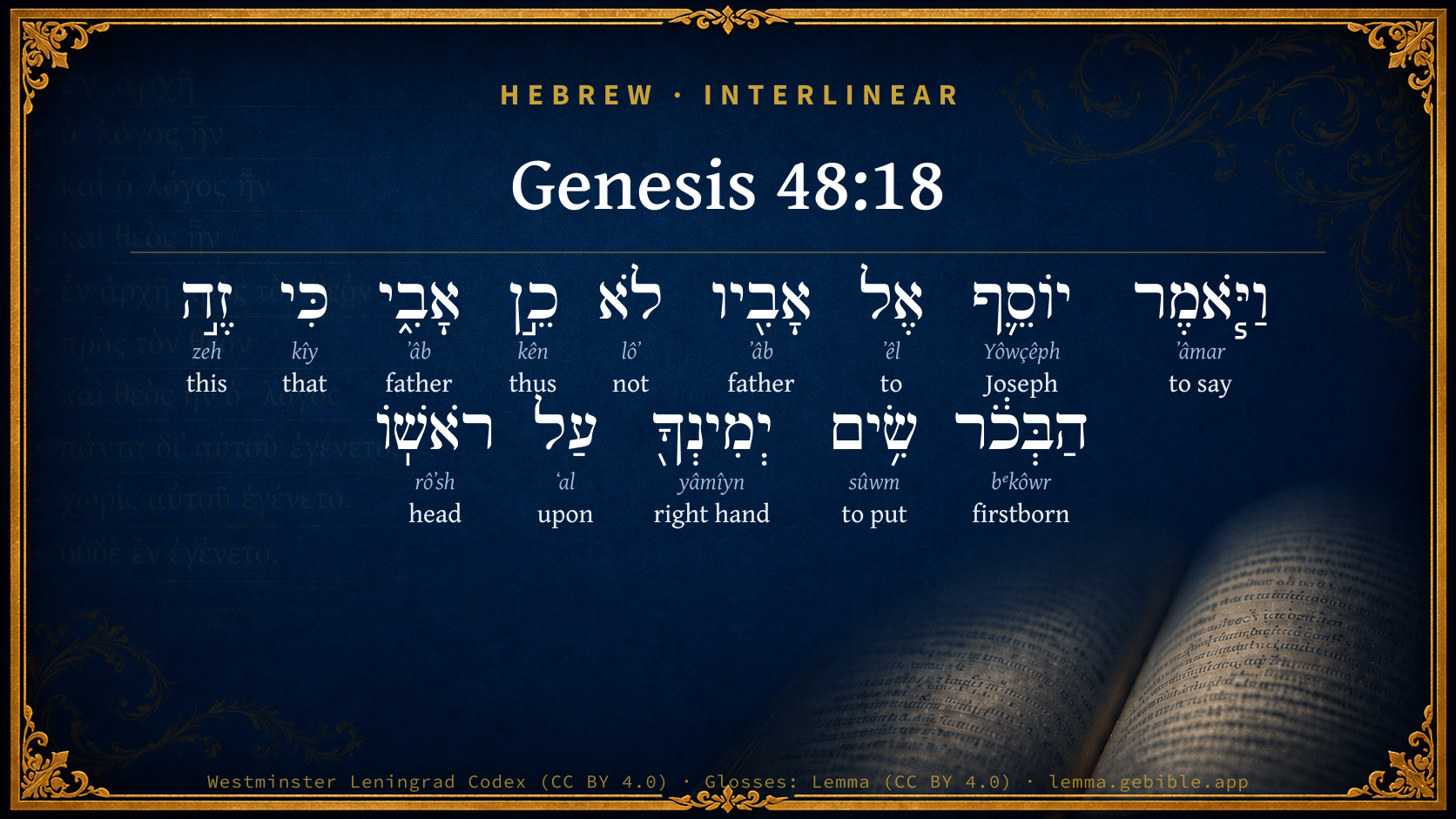
Genesis 48:18

Hebrew (Westminster Leningrad Codex) Genesis 48:18 appears in the Hebrew Old Testament. The text above is from the Westminster Leningrad Codex. Each word links to its Strong’s number, a concise gloss, and parsing drawn from the Open Scriptures Hebrew Bible morphology. Click any word for its full Brown-Driver-Briggs (BDB) entry.
Download image
Cite this verse

Genesis 48:18 (World English Bible). Public Domain. Lemma interlinear Bible study tool, https://lemma.gebible.app/v/genesis/48/18.

Show BibTeX & RIS
BibTeX
RIS
English Translation
Joseph said to his father, "Not so, my father; for this is the firstborn; put your right hand on his head."
World English Bible · Public Domain
Download a study sheet

One document with this verse’s original text, its word-by-word gloss line, the meaning frame, cross-references with their text, attributed commentary, and full source and license credits — printable, and it pastes into notes with its structure intact.

This verse Autodidact and up

Study sheet (.html) Plain text (.txt)

A passage Seminary Student

Up to 50 verses in one chapter. A passage sheet keeps up to 6 commentary sources and 12 cross-references per verse, in the order this page ranks them, and says so on the sheet whenever that leaves anything out. Ask for a single verse and you get the Autodidact verse sheet above.

Everything on this page stays free to read, with no account — the sheet is a download of what is already on screen, not access to it.

Want to remove ads? Support Godless Engineer
Compare translations 3

The same verse in 3 English versions, stacked beneath the original-language interlinear above. Click any original word for its lexicon entry.

Each is an independent rendering of the whole verse — the interlinear is not word-aligned to these translations.

Highlighted words mark where these versions differ — a whole-verse word diff, not a word-by-word alignment.

  • World English Bible Public Domain
    Joseph said to his father, "Not so, my father; for this is the firstborn; put your right hand on his head."
  • King James Version Public Domain
    And Joseph said unto his father, Not so, my father: for this is the firstborn; put thy right hand upon his head.
  • unfoldingWord Literal Text CC BY-SA 4.0
    And Joseph said to his father, “Not so, my father, because that the firstborn son. Put your right hand on his head.”

unfoldingWord Literal Text — © unfoldingWord, licensed CC BY-SA 4.0. Word-aligned USFM3 via Door43 (git.door43.org/unfoldingWord/en_ult).

Versions to compare (up to 4)

3 of 4 selected

Show all 18 translations

Every available English version of this verse, each an independent rendering of the whole verse.

  • World English Bible Public Domain
    Joseph said to his father, "Not so, my father; for this is the firstborn; put your right hand on his head."
  • Berean Standard Bible Public Domain
    “Not so, my father!” Joseph said. “This one is the firstborn; put your right hand on his head.”
  • Majority Standard Bible Public Domain
    “Not so, my father!” Joseph said. “This one is the firstborn; put your right hand on his head.”
  • King James Version Public Domain
    And Joseph said unto his father, Not so, my father: for this is the firstborn; put thy right hand upon his head.
  • American Standard Version (1901) Public Domain
    And Joseph said unto his father, Not so, my father; for this is the first-born; put thy right hand upon his head.
  • Revised Version (1885) Public Domain
    And Joseph said unto his father, Not so, my father: for this is the firstborn; put thy right hand upon his head.
  • Geneva Bible (1599) Public Domain
    And Ioseph sayde vnto his father, Not so, my father, for this is the eldest: put thy right hand vpon his head.
  • Douay-Rheims (1899) Public Domain
    And he said to his father: It should not be so, my father: for this is the first- born, put thy right hand upon his head.
  • Young's Literal Translation Public Domain
    and Joseph saith unto his father, `Not so, my father, for this `is' the first-born; set thy right hand on his head.'
  • Literal Standard Version CC BY-SA 4.0
    and Joseph says to his father, “Not so, my father, for this [is] the firstborn; set your right hand on his head.”
  • Unlocked Literal Bible CC BY-SA 4.0
    Joseph said to his father, “Not so, my father; for this is the firstborn. Put your right hand upon his head.”
  • unfoldingWord Literal Text CC BY-SA 4.0
    And Joseph said to his father, “Not so, my father, because that the firstborn son. Put your right hand on his head.”
  • Darby Bible Public Domain
    And Joseph said to his father, Not so, my father, for this is the firstborn: put thy right hand on his head.
  • World Messianic Bible Public Domain
    Joseph said to his father, “Not so, my father, for this is the firstborn. Put your right hand on his head.”
  • Webster's Bible Public Domain
    And Joseph said to his father, Not so, my father; for this is the first-born; put thy right hand upon his head.
  • Free Bible Version CC BY-SA 4.0
    “Not like that, father, this is the firstborn; put your right hand on his head,” Joseph told him.
  • Bible in Basic English Public Domain
    And Joseph said to his father, Not so, my father, for this is the older; put your right hand on his head.
  • JPS Tanakh (1917) Public Domain
    And Joseph said unto his father: 'Not so, my father, for this is the first-born; put thy right hand upon his head.'

Literal Standard Version (2020), Covenant Press — licensed CC BY-SA 4.0. Text via the HelloAO Bible API (eBible.org). Unlocked Literal Bible (unfoldingWord) — licensed CC BY-SA 4.0. Text via the HelloAO Bible API (eBible.org). unfoldingWord Literal Text — © unfoldingWord, licensed CC BY-SA 4.0. Word-aligned USFM3 via Door43 (git.door43.org/unfoldingWord/en_ult). Free Bible Version, Dr. Jonathan Gallagher — licensed CC BY-SA 4.0. Text via the HelloAO Bible API (eBible.org).

Word by word

More ways to search: Search by grammar → Find every occurrence → Compare this word →

Practice this passage: Drill this verse → Learn its vocabulary →

הַבְּכֹ֔ר
bᵉkôwr
H1060
“the · firstborn”
Particle, Definite Article + Noun, Common, Masculine, Singular, Absolute
Part of Speech
Particle + Noun
Type
Common
Gender
Masculine
Number
Singular
State
Absolute
Full BDB Definition

Origin: from H1069

TWOT: 244a

firstborn, firstling - of men and women - of animals - noun of relation (figuratively)
  1. וַיֹּ֧אמֶר ʼâmar H559 “and · to say” Conjunction + Verb, Qal, Sequential Imperfect, 3rd Person, Masculine, Singular
  2. יוֹסֵ֛ף Yôwçêph H3130 “Joseph” Noun, Proper
  3. אֶל ʼêl H413 “to” Preposition
  4. אָבִ֖יו ʼâb H1 “father · his” Noun, Common, Masculine, Singular, Construct + Suffix, Personal, 3rd Person, Masculine, Singular
  5. לֹא lôʼ H3808 “not” Particle, Negative
  6. כֵ֣ן kên H3651 “thus” Adverb
  7. אָבִ֑י ʼâb H1 “father · my” Noun, Common, Masculine, Singular, Construct + Suffix, Personal, 1st Person, Common, Singular
  8. כִּי kîy H3588 “that” Conjunction
  9. זֶ֣ה zeh H2088 “this” Pronoun, Demonstrative, Masculine, Singular
  10. שִׂ֥ים sûwm H7760 “put” Verb, Qal, Imperative, 2nd Person, Masculine, Singular
  11. יְמִינְךָ֖ yâmîyn H3225 “right hand · your” Noun, Common, Feminine, Singular, Construct + Suffix, Personal, 2nd Person, Masculine, Singular
  12. עַל ʻal H5921 “upon” Preposition
  13. רֹאשֽׁוֹ rôʼsh H7218 “head · his” Noun, Common, Masculine, Singular, Construct + Suffix, Personal, 3rd Person, Masculine, Singular

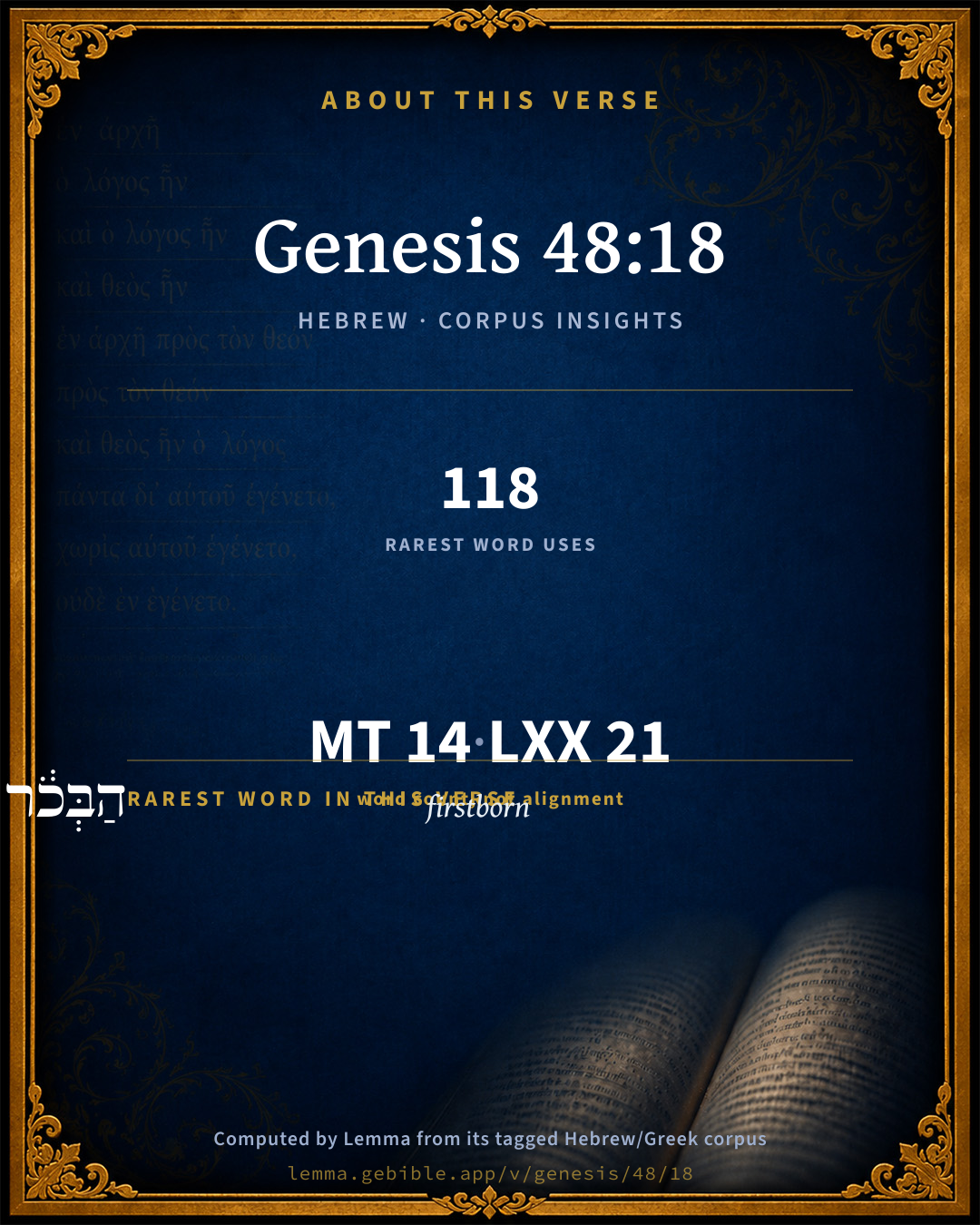
About this verse

These counts appear in no published source. They are computed here, from the morphology-tagged text and Lemma’s own curated glosses. What Lemma adds →

14
words
13
distinct lemmas
Pentateuch
section

Grammatical profile

  • 2 verbs
  • 6 nouns
  • 1 pronoun
  • 2 prepositions
  • 1 conjunction
  • 1 adverb
  • 1 particle

Verb forms

  • וַיֹּ֧אמֶר Qal · Sequential Imperfect
  • שִׂ֥ים Qal · Imperative

Repetition

A word recurs within this verse — often emphatic in Hebrew:

  • אָבִ֖יו father H1 ×2

Hebrew & Septuagint length

In English translation the verse runs 21 words from the Hebrew and 20 from the Septuagint (LXX English) — closely comparable.

A rough comparison of the two English renderings, which tokenize alike — not a word-level alignment.

Word counts can differ between the Hebrew and the Greek without any difference in meaning — e.g. the Hebrew direct-object marker אֵת has no separate Greek word, and Greek often adds the article ὁ.

In the original languages it is 14 Hebrew tokens and 21 Greek tokens — but the two are counted differently (Hebrew bundles its prefixes and suffixes into one token; the Greek is in lemma form), so that isn’t a like-for-like length.

Cross-references

9

Topical passages linked to Genesis 48:18 in the Treasury of Scripture Knowledge — connected by theme and wording, ordered by reader-vote popularity; previews shown in the World English Bible.

  • Genesis 19:18 Lot said to them, "Oh, not so, my lord.
  • Genesis 27:15 Rebekah took the good clothes of Esau, her elder son, which were with her in the house, and put them on Jacob, her younger son.
  • Genesis 29:26 Laban said, "It is not done so in our place, to give the younger before the first born.
  • Genesis 43:33 They sat before him, the firstborn according to his birthright, and the youngest according to his youth, and the men marveled one with another.
  • Genesis 49:3 "Reuben, you are my firstborn, my might, and the beginning of my strength; The pre-eminence of dignity, and the pre-eminence of power.
  • Exodus 10:11 Not so! Go now you who are men, and serve Yahweh; for that is what you desire!" They were driven out from Pharaoh's presence.
  • Matthew 25:9 But the wise answered, saying, 'What if there isn't enough for us and you? You go rather to those who sell, and buy for yourselves.'
  • Acts 10:14 But Peter said, "Not so, Lord; for I have never eaten anything that is common or unclean."
  • Acts 11:8 But I said, 'Not so, Lord, for nothing unholy or unclean has ever entered into my mouth.'

Cross-references courtesy of OpenBible.info (CC BY 4.0).

Hebrew and Greek witnesses Masoretic Hebrew ↔ Greek Septuagint

The same verse in the two great witnesses to the Old Testament, shown verse-for-verse.

These are two independent witnesses, not word-aligned to each other, and the Septuagint is shown in lemma (dictionary) form.

Hebrew Genesis 48:18 Masoretic · Westminster Leningrad Codex

וַיֹּ֧אמֶר יוֹסֵ֛ף אֶל אָבִ֖יו לֹא כֵ֣ן אָבִ֑י כִּי זֶ֣ה הַבְּכֹ֔ר שִׂ֥ים יְמִינְךָ֖ עַל רֹאשֽׁוֹ

Joseph said to his father, "Not so, my father; for this is the firstborn; put your right hand on his head."

World English Bible · Public Domain

Greek LXX Genesis 48:18 Septuagint · lemma form

εἶπον δέ ιωσηφ ὁ πατήρ αὐτός οὐ οὕτως πατήρ οὗτος γάρ ὁ πρωτότοκος πείθω ὁ δεξιός σύ ἐπί ὁ κεφαλή αὐτός

And Joseph said to his father, Not so, father; for this is the firstborn; lay your right-hand upon his head.

LXX2012 (modern English Septuagint) · Public Domain

Hebrew: Westminster Leningrad Codex (CC BY 4.0). Greek: Septuagint (public domain); English from LXX2012 (modern English Septuagint) (Public Domain). How the Septuagint differs from the Hebrew →

Targum (Aramaic paraphrase)

2

The Targum is the ancient Jewish Aramaic paraphrase of the Hebrew Scriptures — an interpretive translation, not the Hebrew text itself. Onkelos (literal) and Pseudo-Jonathan (expansive) render the Torah, and Jonathan the Prophets. Coverage is partial: where no permissively-licensed English translation exists for a verse, only the Aramaic is shown. This is verse-level text, not a word-by-word alignment to the Hebrew.

  1. Targum Onkelos Torah (Genesis–Deuteronomy)
    וַאֲמַר יוֹסֵף לְאָבוּהִי לָא כֵן אַבָּא אֲרֵי דֵין בּוּכְרָא שַׁו יְמִינָךְ עַל רֵישֵׁהּ

    (no public-domain English translation for this verse)

    Targum Onkelos — Aramaic: “Onkelos Genesis” (public domain); “Onkelos Exodus” (public domain); “Onkelos Leviticus” (public domain); “Onkelos Numbers” (public domain); “Onkelos Deuteronomy” (public domain). English: “Sefaria Community Translation” (CC0 1.0 (public-domain dedication)); “J.W. Etheridge. The Targums of Onkelos and Jonathan Ben Uzziel on the Pentateuch. London: Longmans, Green, 1862” (public domain). Text via Sefaria.

  2. Targum Pseudo-Jonathan Torah (Genesis–Deuteronomy)
    וַאֲמַר יוֹסֵף לְאָבוּי לָא כְדֵין אַבָּא אֲרוּם דֵין בּוּכְרָא שַׁוִי יַד יְמִינָךְ עַל רֵישֵׁיהּ

    And Joseph said to his father, Not so, my father, for this is the firstborn; lay thy right hand on his head.

    Targum Pseudo-Jonathan — Aramaic: “Targum Jonathan on Genesis” (public domain); “Targum Jonathan on Exodus” (public domain); “Targum Jonathan on Leviticus” (public domain); “Targum Jonathan on Numbers” (public domain); “Targum Jonathan on Deuteronomy” (public domain). English: “The Targum of Jonathan ben Uzziel, trans. J. W. Etheridge, London, 1862” (public domain). Text via Sefaria.

Commentary

Notes on Genesis 48:18 from classic Christian and Jewish commentators (each source and its license shown beneath its notes). The classic Christian expositions comment on the surrounding passage and are grouped to its opening verse, so a note may address several verses; the Jewish commentaries on the Tanakh (Rashi and others) are per-verse, so they appear only where the commentator wrote on this verse.

Lemma curates 59 commentaries, every one of them public domain or Creative Commons licensed, each selected and text-cleaned for this edition rather than reprinted as found. About our sources →

Trapp's Complete Commentary

John Trapp

Gen 48:18 And Joseph said unto his father, Not so, my father: for this [is] the firstborn; put thy right hand upon his head.

Ver. 18. Not so, my father, &c.] Here are a couple of holy prophets differing in their judgments; yet not about the substance of the blessing, but the circumstance of it. Wonder not though such things still fall out in the true Church, and the doctors be likewise divided in points less material, and that touch not the foundation. Luther interprets those words of Christ, "This is my body," synecdochically; Calvin, metonymically. Hence the Jesuits straight cry out: The Spirit of God dissents not from itself; but these interpretations dissent one from another, therefore they are not of the Spirit. {a} Now it were easy to stop their foul mouths, by telling them of their own far worse differences. But is it not a doleful thing that we should, with those birds, aqnoscere in nostris vulneribus nostras pennas? "Brother goeth to law with brother, and that before infidels." {1Co 6:6} This is the devil’s malice, to sow tares, &c. Christ came to destroy his works; yet never were so many possessed as about that time.

{a} See The Peace of Rome.

John Trapp, A Commentary or Exposition upon All the Books of the Old and New Testament (1647–1656) — public domain. Text from a community e-Sword module.

Adam Clarke's Commentary

Verse 18. Joseph said - Not so, my father] Joseph supposed that his father had made a mistake in laying his right hand on the head of the youngest, because the right hand was considered as the most noble, and the instrument of conveying the highest dignities, and thus it has ever been considered among all nations, though the reason of it is not particularly obvious. Even in the heavens the right hand of God is the place of the most exalted dignity. It has been observed that Joseph spoke here as he was moved by natural affection, and that Jacob acted as he was influenced by the Holy Spirit.

Adam Clarke's Commentary on the Bible (1810–1826) — public domain. Text from a community e-Sword/MySword module.

John Gill's Exposition

And Joseph said unto his father, not so, my father,.... It is not right, it should not so be, that the right hand should be put on the youngest, and the left hand on the eldest:

for this is the firstborn; directing him to Manasseh, and seeking to guide his hand towards him:

put thy right hand upon his head; Joseph was for proceeding according to the order of birthright, but Jacob was directed by a spirit of prophecy, as follows.

John Gill's Exposition of the Whole Bible (1746–1763) — public domain (CC PDM 1.0). Text via the HelloAO Bible API.

The Pulpit Commentary

And Joseph said unto his father, Not so, my father: for this is the firstborn; put thy right hand upon his head. "From Joseph"s behavior we cannot certainly infer that, like Isaac, he loved the firstborn better than the youngest; but he was sorry that an honor was not given to the eldest which he would naturally expect, and bestowed on the youngest, who did not expect it, and who would not have been hurt by the want of it" (Lawson).

The Pulpit Commentary (1880–1919), ed. H.D.M. Spence-Jones & Joseph S. Exell — public domain. Text from a community e-Sword module.

Lesson kit

Teaching starters — assembled from the data on this page, not authored interpretation. Every prompt links to the verse data it draws on. Edit before teaching.

Genesis, in the Pentateuch, opens this verse with 14 words (13 distinct Hebrew lemmas). Its most distinctive word is bᵉkôwr (“firstborn”). A historical commentator’s framing appears above. Read the whole chapter for the surrounding context.

Discussion questions

  1. How does “firstborn” (bᵉkôwr) shape what this verse is saying?
  2. How does Genesis 19:18, which shares this passage’s theme, read alongside this verse?
  3. What does the repetition of “father” (2× in this one verse) do in this verse?
  4. These translations render this verse differently; the difference is in the English rendering, not the original. What questions does that raise?
  5. «וַיֹּ֧אמֶר» is a Qal Sequential Imperfect verb. How does that grammatical form shape the action described?
  6. Compare how Trapp's Complete Commentary and Adam Clarke's Commentary read this verse. Where do they agree or differ?

Things to notice

Reading settings

Reading text

Shown beneath each verse's original-language words.

Old Testament
Old Testament edition

Read the OT as the Masoretic Hebrew (MT) or the Greek Septuagint (LXX).

English shown for the Greek Septuagint (in the Hebrew ↔ Greek comparison).

Comparing translations? Open the Compare panel on any verse page to stack up to four side by side.