
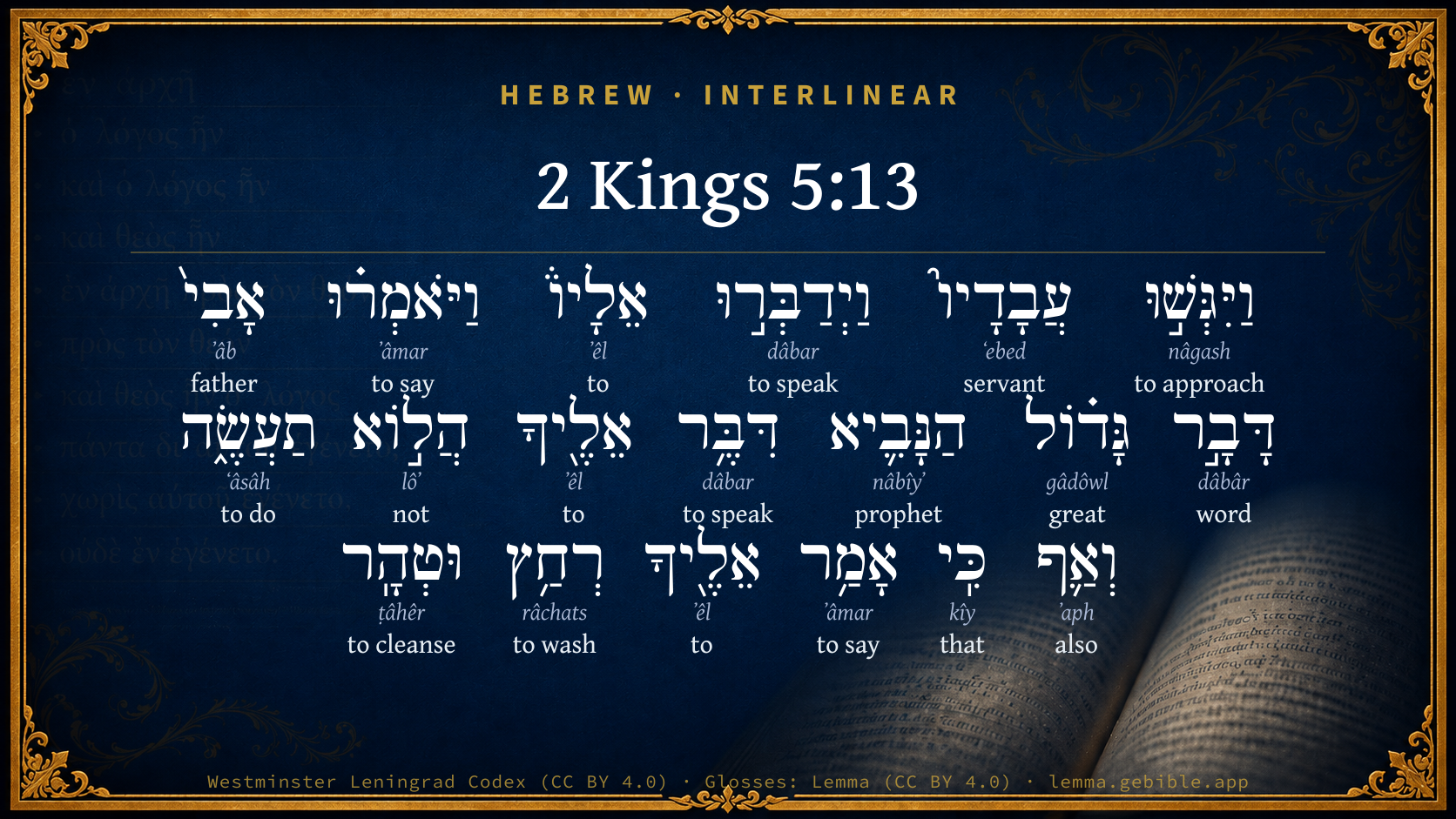
2 Kings 5:13

Hebrew (Westminster Leningrad Codex) 2 Kings 5:13 appears in the Hebrew Old Testament. The text above is from the Westminster Leningrad Codex. Each word links to its Strong’s number, a concise gloss, and parsing drawn from the Open Scriptures Hebrew Bible morphology. Click any word for its full Brown-Driver-Briggs (BDB) entry.
Download image
Cite this verse

2 Kings 5:13 (World English Bible). Public Domain. Lemma interlinear Bible study tool, https://lemma.gebible.app/v/2-kings/5/13.

Show BibTeX & RIS
BibTeX
RIS
English Translation
His servants came near, and spoke to him, and said, My father, if the prophet had bid you do some great thing, wouldn't you have done it? how much rather then, when he says to you, Wash, and be clean?
World English Bible · Public Domain
Download a study sheet

One document with this verse’s original text, its word-by-word gloss line, the meaning frame, cross-references with their text, attributed commentary, and full source and license credits — printable, and it pastes into notes with its structure intact.

This verse Autodidact and up

Study sheet (.html) Plain text (.txt)

A passage Seminary Student

Up to 50 verses in one chapter. A passage sheet keeps up to 6 commentary sources and 12 cross-references per verse, in the order this page ranks them, and says so on the sheet whenever that leaves anything out. Ask for a single verse and you get the Autodidact verse sheet above.

Everything on this page stays free to read, with no account — the sheet is a download of what is already on screen, not access to it.

Want to remove ads? Support Godless Engineer
Compare translations 3

The same verse in 3 English versions, stacked beneath the original-language interlinear above. Click any original word for its lexicon entry.

Each is an independent rendering of the whole verse — the interlinear is not word-aligned to these translations.

Highlighted words mark where these versions differ — a whole-verse word diff, not a word-by-word alignment.

  • World English Bible Public Domain
    His servants came near, and spoke to him, and said, My father, if the prophet had bid you do some great thing, wouldn't you have done it? how much rather then, when he says to you, Wash, and be clean?
  • King James Version Public Domain
    And his servants came near, and spake unto him, and said, My father, if the prophet had bid thee do some great thing, wouldest thou not have done it? how much rather then, when he saith to thee, Wash, and be clean?
  • unfoldingWord Literal Text CC BY-SA 4.0
    But his servants approached, and they spoke to him and said, “My father, the prophet had spoken a great matter to you, would you not have done? Then how much more when he has said to you, ‘Wash and be clean’?”

unfoldingWord Literal Text — © unfoldingWord, licensed CC BY-SA 4.0. Word-aligned USFM3 via Door43 (git.door43.org/unfoldingWord/en_ult).

Versions to compare (up to 4)

3 of 4 selected

Show all 18 translations

Every available English version of this verse, each an independent rendering of the whole verse.

  • World English Bible Public Domain
    His servants came near, and spoke to him, and said, My father, if the prophet had bid you do some great thing, wouldn't you have done it? how much rather then, when he says to you, Wash, and be clean?
  • Berean Standard Bible Public Domain
    Naaman’s servants, however, approached him and said, “My father, if the prophet had told you to do some great thing, would you not have done it? How much more, then, when he tells you, ‘Wash and be cleansed’?”
  • Majority Standard Bible Public Domain
    Naaman’s servants, however, approached him and said, “My father, if the prophet had told you to do some great thing, would you not have done it? How much more, then, when he tells you, ‘Wash and be cleansed’?”
  • King James Version Public Domain
    And his servants came near, and spake unto him, and said, My father, if the prophet had bid thee do some great thing, wouldest thou not have done it? how much rather then, when he saith to thee, Wash, and be clean?
  • American Standard Version (1901) Public Domain
    And his servants came near, and spake unto him, and said, My father, if the prophet had bid thee do some great thing, wouldest thou not have done it? how much rather then, when he saith to thee, Wash, and be clean?
  • Revised Version (1885) Public Domain
    And his servants came near, and spake unto him, and said, My father, if the prophet had bid thee do some great thing, wouldest thou not have done it? how much rather then, when he saith to thee, Wash, and be clean?
  • Geneva Bible (1599) Public Domain
    But his seruants came, and spake vnto him, and sayd, Father, if the Prophet had commanded thee a great thing, wouldest thou not haue done it? howe much rather then, when hee sayth to thee, Wash and be cleane?
  • Douay-Rheims (1899) Public Domain
    His servants came to him, and said to him: Father, if the prophet had bid thee do some great thing, surely thou shouldst have done it: how much rather what he now hath said to thee: Wash, and thou shalt he clean?
  • Young's Literal Translation Public Domain
    And his servants come nigh, and speak unto him, and say, `My father, a great thing had the prophet spoken unto thee -- dost thou not do `it'? and surely, when he hath said unto thee, Wash, and be clean.'
  • Literal Standard Version CC BY-SA 4.0
    And his servants come near, and speak to him, and say, “My father, the prophet had spoken a great thing to you—do you not do [it]? And surely, when he has said to you, Wash, and be clean.”
  • Unlocked Literal Bible CC BY-SA 4.0
    Then Naaman's servants came near and spoke to him, “My father, if the prophet had commanded you do some difficult thing, would you not have done it? How much rather then, when he says to you to simply, 'Dip yourself and be clean?'”
  • unfoldingWord Literal Text CC BY-SA 4.0
    But his servants approached, and they spoke to him and said, “My father, the prophet had spoken a great matter to you, would you not have done? Then how much more when he has said to you, ‘Wash and be clean’?”
  • Darby Bible Public Domain
    And his servants drew near, and spoke to him and said, My father, [if] the prophet had bidden thee [do some] great thing, wouldest thou not have done it? how much rather then, when he says to thee, Wash and be clean?
  • World Messianic Bible Public Domain
    His servants came near and spoke to him, and said, “My father, if the prophet had asked you do some great thing, wouldn’t you have done it? How much rather then, when he says to you, ‘Wash, and be clean’?”
  • Webster's Bible Public Domain
    And his servants came near, and spoke to him, and said, My father, if the prophet had bid thee do some great thing, wouldst thou not have done it? how much rather then, when he saith to thee, Wash, and be clean?
  • Free Bible Version CC BY-SA 4.0
    But Naaman's officials went to him and said, “Sir, if the prophet had told you that you had to do something extraordinary, wouldn't you have done it? How much easier is it to do what he says, ‘Wash and you'll be healed’?”
  • Bible in Basic English Public Domain
    Then his servants came to him and said, If the prophet had given you orders to do some great thing, would you not have done it? how much more then, when he says to you, Be washed and become clean?
  • JPS Tanakh (1917) Public Domain
    And his servants came near, and spoke unto him, and said: 'My father, if the prophet had bid thee do some great thing, wouldest thou not have done it? how much rather then, when he saith to thee: Wash, and be clean?'

Literal Standard Version (2020), Covenant Press — licensed CC BY-SA 4.0. Text via the HelloAO Bible API (eBible.org). Unlocked Literal Bible (unfoldingWord) — licensed CC BY-SA 4.0. Text via the HelloAO Bible API (eBible.org). unfoldingWord Literal Text — © unfoldingWord, licensed CC BY-SA 4.0. Word-aligned USFM3 via Door43 (git.door43.org/unfoldingWord/en_ult). Free Bible Version, Dr. Jonathan Gallagher — licensed CC BY-SA 4.0. Text via the HelloAO Bible API (eBible.org).

Word by word

More ways to search: Search by grammar → Find every occurrence → Compare this word →

Practice this passage: Drill this verse → Learn its vocabulary →

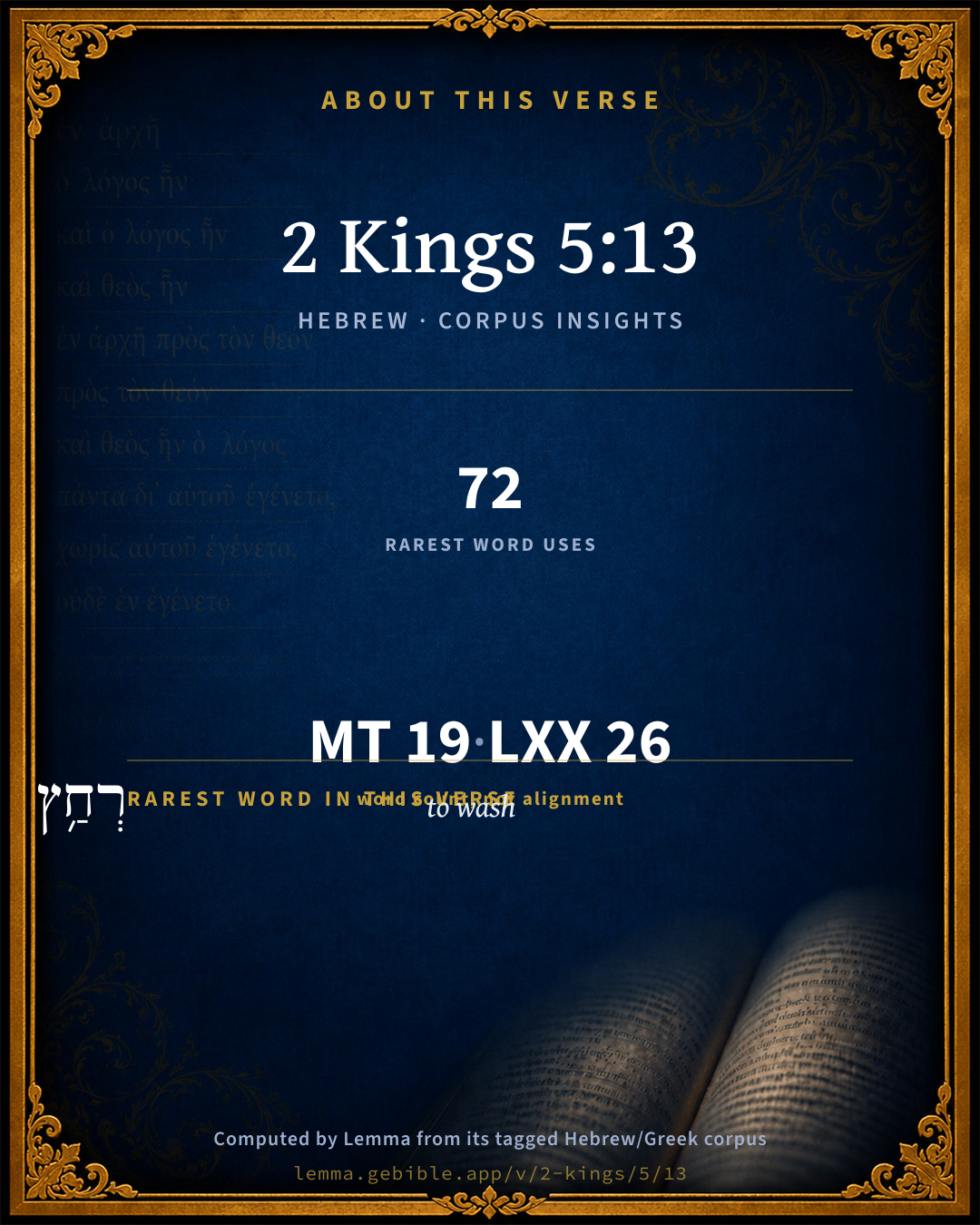
רְחַ֥ץ
râchats
H7364
“wash”
Verb, Qal, Imperative, 2nd Person, Masculine, Singular
Part of Speech
Verb
Stem
Qal
Form
Imperative
Person
2nd Person
Gender
Masculine
Number
Singular
Full BDB Definition

Origin: a primitive root

TWOT: 2150

to wash, wash off, wash away, bathe - (Qal) - to wash, wash off, wash away - to wash, bathe (oneself) - (Pual) to be washed - (Hithpael) to wash oneself
  1. וַיִּגְּשׁ֣וּ nâgash H5066 “and · to approach” Conjunction + Verb, Qal, Sequential Imperfect, 3rd Person, Masculine, Plural
  2. עֲבָדָיו֮ ʻebed H5650 “servants · his” Noun, Common, Masculine, Plural, Construct + Suffix, Personal, 3rd Person, Masculine, Singular
  3. וַיְדַבְּר֣וּ dâbar H1696 “and · to speak” Conjunction + Verb, Piel, Sequential Imperfect, 3rd Person, Masculine, Plural
  4. אֵלָיו֒ ʼêl H413 “to · him” Preposition + Suffix, Personal, 3rd Person, Masculine, Singular
  5. וַיֹּאמְר֗וּ ʼâmar H559 “and · to say” Conjunction + Verb, Qal, Sequential Imperfect, 3rd Person, Masculine, Plural
  6. אָבִי֙ ʼâb H1 “father” Particle, Exhortation
  7. דָּבָ֣ר dâbâr H1697 “word” Noun, Common, Masculine, Singular, Absolute
  8. גָּד֗וֹל gâdôwl H1419 “great” Adjective, Adjective, Masculine, Singular, Absolute
  9. הַנָּבִ֛יא nâbîyʼ H5030 “the · prophet” Particle, Definite Article + Noun, Common, Masculine, Singular, Absolute
  10. דִּבֶּ֥ר dâbar H1696 “to speak” Verb, Piel, Perfect, 3rd Person, Masculine, Singular
  11. אֵלֶ֖יךָ ʼêl H413 “to · you” Preposition + Suffix, Personal, 2nd Person, Masculine, Singular
  12. הֲל֣וֹא lôʼ H3808 “not” Particle, Interrogative + Particle, Negative
  13. תַעֲשֶׂ֑ה ʻâsâh H6213 “to do” Verb, Qal, Imperfect, 2nd Person, Masculine, Singular
  14. וְאַ֛ף ʼaph H637 “and · also” Conjunction + Adverb
  15. כִּֽי kîy H3588 “that” Conjunction
  16. אָמַ֥ר ʼâmar H559 “to say” Verb, Qal, Perfect, 3rd Person, Masculine, Singular
  17. אֵלֶ֖יךָ ʼêl H413 “to · you” Preposition + Suffix, Personal, 2nd Person, Masculine, Singular
  18. וּטְהָֽר ṭâhêr H2891 “and · cleanse” Conjunction + Verb, Qal, Imperative, 2nd Person, Masculine, Singular

About this verse

These counts appear in no published source. They are computed here, from the morphology-tagged text and Lemma’s own curated glosses. What Lemma adds →

19
words
15
distinct lemmas
Historical
section

Grammatical profile

  • 8 verbs
  • 3 nouns
  • 1 adjective
  • 3 prepositions
  • 1 conjunction
  • 1 adverb
  • 2 particles

Verb forms

  • וַיִּגְּשׁ֣וּ Qal · Sequential Imperfect
  • וַיְדַבְּר֣וּ Piel · Sequential Imperfect
  • וַיֹּאמְר֗וּ Qal · Sequential Imperfect
  • דִּבֶּ֥ר Piel · Perfect
  • תַעֲשֶׂ֑ה Qal · Imperfect
  • אָמַ֥ר Qal · Perfect
  • רְחַ֥ץ Qal · Imperative
  • וּטְהָֽר Qal · Imperative

Repetition

Words recur within this verse — often emphatic in Hebrew:

  • וַיְדַבְּר֣וּ to speak H1696 ×2
  • וַיֹּאמְר֗וּ to say H559 ×2
  • אֵלָיו֒ to H413 ×3

Hebrew & Septuagint length

In English translation the verse runs 40 words from the Hebrew and 35 from the Septuagint (LXX English) — closely comparable.

A rough comparison of the two English renderings, which tokenize alike — not a word-level alignment.

Word counts can differ between the Hebrew and the Greek without any difference in meaning — e.g. the Hebrew direct-object marker אֵת has no separate Greek word, and Greek often adds the article ὁ.

In the original languages it is 19 Hebrew tokens and 26 Greek tokens — but the two are counted differently (Hebrew bundles its prefixes and suffixes into one token; the Greek is in lemma form), so that isn’t a like-for-like length.

Cross-references

27

Topical passages linked to 2 Kings 5:13 in the Treasury of Scripture Knowledge — connected by theme and wording, ordered by reader-vote popularity; previews shown in the World English Bible.

  • 2 Kings 6:21 The king of Israel said to Elisha, when he saw them, My father, shall I strike them? shall I strike them?
  • 2 Kings 2:12 Elisha saw it, and he cried, My father, my father, the chariots of Israel and the horsemen of it! He saw him no more: and he took hold of his own clothes, and tore them in two pieces.
  • 2 Kings 13:14 Now Elisha was fallen sick of his sickness of which he died: and Joash the king of Israel came down to him, and wept over him, and said, My father, my father, the chariots of Israel and the horsemen of it!
  • Revelation 7:14 I told him, "My lord, you know." He said to me, "These are those who came out of the great tribulation. They washed their robes, and made them white in the Lamb's blood.
  • Job 32:8–9 But there is a spirit in man, And the breath of the Almighty gives them understanding.
  • Jeremiah 38:7–10 Now when Ebedmelech the Ethiopian, a eunuch, who was in the king's house, heard that they had put Jeremiah in the dungeon (the king then sitting in the gate of Benjamin),
  • 1 Peter 3:21 This is a symbol of baptism, which now saves you-- not the putting away of the filth of the flesh, but the answer of a good conscience toward God, through the resurrection of Jesus Christ,
  • Acts 22:16 Now why do you wait? Arise, be baptized, and wash away your sins, calling on the name of the Lord.'
  • Ephesians 5:26–27 that he might sanctify it, having cleansed it by the washing of water with the word,
  • Titus 3:5 not by works of righteousness, which we did ourselves, but according to his mercy, he saved us, through the washing of regeneration and renewing by the Holy Spirit,
  • Hebrews 10:22 let's draw near with a true heart in fullness of faith, having our hearts sprinkled from an evil conscience, and having our body washed with pure water,
  • 1 Samuel 25:14–17 But one of the young men told Abigail, Nabal's wife, saying, Behold, David sent messengers out of the wilderness to Greet our master; and he railed at them.
  • 1 Kings 20:23 The servants of the king of Syria said to him, Their god is a god of the hills; therefore they were stronger than we: but let us fight against them in the plain, and surely we shall be stronger than they.
  • 1 Kings 20:31 His servants said to him, See now, we have heard that the kings of the house of Israel are merciful kings: let us, we pray you, put sackcloth on our loins, and ropes on our heads, and go out to the king of Israel: peradventure he will save your life.
  • 2 Kings 5:3 She said to her mistress, Would that my lord were with the prophet who is in Samaria! then would he recover him of his leprosy.
  • 2 Kings 5:10 Elisha sent a messenger to him, saying, Go and wash in the Jordan seven times, and your flesh shall come again to you, and you shall be clean.
  • 2 Kings 8:9 So Hazael went to meet him, and took a present with him, even of every good thing of Damascus, forty camels' burden, and came and stood before him, and said, Your son Benhadad king of Syria has sent me to you, saying, Shall I recover of this sickness?
  • Psalms 51:2 Wash me thoroughly from my iniquity. Cleanse me from my sin.
  • Psalms 51:7 Purify me with hyssop, and I will be clean. Wash me, and I will be whiter than snow.
  • Isaiah 1:16 Wash yourselves, make yourself clean. Put away the evil of your doings from before my eyes; Cease to do evil.
  • Malachi 1:6 "A son honors his father, and a servant his master. If I am a father, then where is my honor? And if I am a master, where is the respect due me? Says Yahweh of Hosts to you, priests, who despise my name. You say, 'How have we despised your name?'
  • Matthew 23:9 Call no man on the earth your father, for one is your Father, he who is in heaven.
  • John 13:8 Peter said to him, "You will never wash my feet!" Jesus answered him, "If I don't wash you, you have no part with me."
  • 1 Corinthians 1:21 For seeing that in the wisdom of God, the world through its wisdom didn't know God, it was God's good pleasure through the foolishness of the preaching to save those who believe.
  • 1 Corinthians 1:27 but God chose the foolish things of the world that he might put to shame those who are wise. God chose the weak things of the world, that he might put to shame the things that are strong;
  • 1 Corinthians 4:15 For though you have ten thousand tutors in Christ, yet not many fathers. For in Christ Jesus, I became your father through the Gospel.
  • Genesis 41:43 and he made him to ride in the second chariot which he had. They cried before him, "Bow the knee!" He set him over all the land of Egypt.

Cross-references courtesy of OpenBible.info (CC BY 4.0).

Hebrew and Greek witnesses Masoretic Hebrew ↔ Greek Septuagint

The same verse in the two great witnesses to the Old Testament, shown verse-for-verse.

These are two independent witnesses, not word-aligned to each other, and the Septuagint is shown in lemma (dictionary) form.

Hebrew 2 Kings 5:13 Masoretic · Westminster Leningrad Codex

וַיִּגְּשׁ֣וּ עֲבָדָיו֮ וַיְדַבְּר֣וּ אֵלָיו֒ וַיֹּאמְר֗וּ אָבִי֙ דָּבָ֣ר גָּד֗וֹל הַנָּבִ֛יא דִּבֶּ֥ר אֵלֶ֖יךָ הֲל֣וֹא תַעֲשֶׂ֑ה וְאַ֛ף כִּֽי אָמַ֥ר אֵלֶ֖יךָ רְחַ֥ץ וּטְהָֽר

His servants came near, and spoke to him, and said, My father, if the prophet had bid you do some great thing, wouldn't you have done it? how much rather then, when he says to you, Wash, and be clean?

World English Bible · Public Domain

Greek LXX 2 Kings 5:13 Septuagint · lemma form

καί ἐγγίζω ὁ παῖς αὐτός καί λαλέω πρός αὐτός μέγας λόγος λαλέω ὁ προφήτης πρός σύ οὐ ποιέω καί ὅτι εἶπον πρός σύ λούω καί καθαρίζω

And his servants came near and said to him, Suppose the prophet had spoken a great thing to you, would you not perform it? yet he has but said to you, Wash, and be cleansed.

LXX2012 (modern English Septuagint) · Public Domain

On this verse, The Pulpit Commentary discusses the Septuagint’s reading. Read the note in Commentary ↓

Hebrew: Westminster Leningrad Codex (CC BY 4.0). Greek: Septuagint (public domain); English from LXX2012 (modern English Septuagint) (Public Domain). How the Septuagint differs from the Hebrew →

Targum (Aramaic paraphrase)

1

The Targum is the ancient Jewish Aramaic paraphrase of the Hebrew Scriptures — an interpretive translation, not the Hebrew text itself. Onkelos (literal) and Pseudo-Jonathan (expansive) render the Torah, and Jonathan the Prophets. Coverage is partial: where no permissively-licensed English translation exists for a verse, only the Aramaic is shown. This is verse-level text, not a word-by-word alignment to the Hebrew.

  1. Targum Jonathan Prophets (Joshua–Malachi)
    וּקְרִיבוּ עַבְדוֹהִי וּמַלִילוּ עִמֵיהּ וַאֲמַרוּ מָרִי אִלוּ פִּתְגָמָא רַבָּא נְבִיָא מַלֵיל עִמָךְ הֲלָא תַעְבֵּיד וְאַף אֱלָהֵין דַאֲמַר לָךְ טְבוֹל וְאִתַּסֵי:

    (no public-domain English translation for this verse)

    Targum Jonathan — Aramaic: “Mikraot Gedolot” (public domain). English: “Sefaria Community Translation” (CC0 1.0 (public-domain dedication)); “London "Chaldee Paraphrase," 1871” (public domain). Text via Sefaria.

Commentary

Notes on 2 Kings 5:13 from classic Christian and Jewish commentators (each source and its license shown beneath its notes). The classic Christian expositions comment on the surrounding passage and are grouped to its opening verse, so a note may address several verses; the Jewish commentaries on the Tanakh (Rashi and others) are per-verse, so they appear only where the commentator wrote on this verse.

Lemma curates 59 commentaries, every one of them public domain or Creative Commons licensed, each selected and text-cleaned for this edition rather than reprinted as found. About our sources →

Trapp's Complete Commentary

John Trapp

2Ki 5:13 And his servants came near, and spake unto him, and said, My father, [if] the prophet had bid thee [do some] great thing, wouldest thou not have done [it]? how much rather then, when he saith to thee, Wash, and be clean?

Ver. 13. And his servants came near, &c.] These were faithful servants indeed; not such Aiones and Negones as great men are now-a-days set up with, that - right or wrong - will say as they say, soothing them up in their sinful practices. It is a great happiness for a man to be attended with wise and faithful followers. Many a one hath had better counsel from his heels than from his elbows.

John Trapp, A Commentary or Exposition upon All the Books of the Old and New Testament (1647–1656) — public domain. Text from a community e-Sword module.

The Biblical Illustrator

Joseph S. Exell

2Ki_5:13

And his servants came near, and spake unto him.

Naaman, a type of the world

The Syrian Naaman, whose story is contained in the chapter from which our text is taken, was a type of the world. As race answereth to face in water, so the heart of man to man; and we cannot read this story without discovering in it the history of ourselves. It needs no argument to convince men that they are sinners, They all acknowledge it--at times with sorrow and grief. They feel the corruption of their own hearts, how incapable they are to live up to their own standard, much more to attain perfection. While they think they are still masters, they have became slaves, and sin holds them in an inexorable grasp; its chains are iron. You have all seen such a man, perhaps the intemperate, striving with tears and sighs against the evil that beggars his family and ruins himself, and alas! how often striving in vain. Then perhaps, when you have found how vain is human help, when you have learned by painful experience how true is that Scripture doctrine of man s inability to reform and save himself, you take up your Bible or you go to church, with the inquiry in your heart, if not on your lips, what must I do to be saved? Go, wash in Jordan seven times, is the reply you hear. Repent of your sins, and believe in the Lord Jesus Christ; use the means of grace God has placed in your hands, the sacraments and ordinances of the Church. Like Naaman, you are wroth, and go away. You thought surely the prophet would come out to you. You expected, or at least you wished, some miraculous call--that there might be some wonderful interposition of Providence on your behalf; that, like St. Paul, you might see a light from heaven or hear a voice; that, like Cornelius, you might see a vision, or, like the wife of Pilate, dream a dream. So doing, you would give the true reason of your present refusal and delay. You would answer the question of Naamans servants My father, if the prophet had bid thee do some great thing, wouldest thou not have done it? Simply to wash and be clean, simply to repent and believe, to seek grace in the waters of baptism, or in the broken body and shed blood of their dying Lord, or in the laying on of hands, gives them no credit. It adds nothing to their glory; it undervalues, as they think, the Abana and Pharpar of their love. It mortifies their vanity and humbles their pride; for it shows them that, so long as they refuse to look at the brazen serpent or to step into the troubled pool, so long they are not only wretched, but helpless; so long must they be content to move on, great men and honourable it may be, but lepers still. It takes away all pretence for human merit; it is mercy and grace, and not a deserved gift. It robs the rivers of Damascus of their pretended virtue, and remits the world to that fountain in which alone Judah and Jerusalem may wash; which, taking its rise in the blood of the Cross, has extended its cleansing streams into all lands. It is offered freely and without price, and men refuse to purchase; it is the gift of grace, and they will not accept it. What we need is to realise the nature of our own hearts, and to feel that God resisteth the proud, and giveth grace to the humble, that obedience is better than sacrifice, and that the humble and contrite spirit is with God of greater price than the rivers of Damascus, or all that the wit of man can devise. (G. F. Cushman, D. D.)

Relation between master and servants

Naaman must have been a considerate master, and his servants must have been reliable men, or that sensible and timely remonstrance of theirs would have been impossible. It implied friendly relations on both sides. Among the ruins of ancient Rome was discovered not long since a broken urn containing some half-burned bones. They were really the ashes of one who, as appeared from the inscription on the tablet, had belonged to the Imperial Household, and whose virtues as a faithful, honest, and devoted servant the emperor himself had taken means to record. Near the grey metropolis of the North is a cemetery, where can be seen a monumental stone, erected by the late Queen Victoria to the memory of an attached and honoured domestic. The gifted John Ruskin once wrote: There is no surer test of the quality of a nation than the quality of its servants

The Biblical Illustrator, edited by Joseph S. Exell (c. 1880s–1900s) — public domain. Text from a community e-Sword module.

Joseph Benson's Commentary

2Ki 5:13. His servants came near–Though at other times they kept their distance, and now saw him in a passion, yet knowing him to be a man that would hear reason at any time, and from any one, they drew near, and made bold to argue the matter with him. Happy they who have such servants as these, who both had the courage to speak the truth, and prudence to order their speech with skill, submission, and reverence. My father — Or, our father; a title of honour in that country, and a name by which they called their lords, as kings are called the fathers of their people. They use it to show their reverence and affection for him. If the prophet had bid thee do some great thing — Had ordered thee into a tedious course of physic, or enjoined thee to submit to some painful operation, suppose blistering, or cupping, or salivating, wouldst thou not have done it? No doubt thou wouldst. And wilt thou not submit to so easy a method as this, Wash and be clean? It appears they had conceived a great opinion of the prophet, having probably heard more of him from the common people, whom they had conversed with, than Naaman had from the king and courtiers.

Joseph Benson's Commentary on the Old and New Testaments (1811–1818) — public domain. Text from a community e-Sword module.

Tyndale Open Study Notes

Tyndale Open Resources

5:13-14 Naaman swallowed his pride. He did as the man of God had instructed him and experienced God’s healing power. Obedience to God brings God’s blessings and purity (Ps 119:9-11).

Tyndale Open Study Notes — © Tyndale Open Resources, licensed CC BY-SA 4.0. Text via the HelloAO Bible API.

Geneva Bible (1599)

Geneva Bible translators

This declareth that servants ought to reverence and love their masters as children their fathers, and likewise masters toward their servants, must be affectioned as toward their children.

Geneva Bible (1599) marginal notes — public domain. Text via Bolls.life.

Adam Clarke's Commentary

Verse 13. My father] A title of the highest respect and affection.

Had bid thee do some great thing] If the prophet had appointed thee to do something very difficult in itself, and very expensive to thee, wouldst thou not have done it? With much greater reason shouldst thou do what will occupy little time, be no expense, and is easy to be performed.

Adam Clarke's Commentary on the Bible (1810–1826) — public domain. Text from a community e-Sword/MySword module.

Ellicott's Commentary for English Readers

(13) Came near.—Comp. Gen_18:23.

My father.—A title implying at once respect and affection. (Comp. 1Sa_24:11; 2Ki_6:21.) Perhaps, however, the word is a corruption of ’im (“if”), which is otherwise not expressed in the Hebrew.

Great thing.—Emphatic in the Hebrew.

Wouldest thou not have done?—Or,wouldest thou not do?

He saith.—He hath said.

Be clean?—i.e., thou shalt be clean: a common Hebrew idiom.

A Bible Commentary for English Readers, edited by Charles John Ellicott (1878–1897) — public domain. Text from a community e-Sword module.

The Cambridge Bible for Schools and Colleges

gen. ed. J. J. S. Perowne

13. his servants came near] As the chief ministers of the king are called ‘servants’ though they probably are of distinguished rank; so the servants of Naaman were probably persons nearly his equals in everything except reputation, and so they could come and speak freely to him, without fear of giving offence.

My father] One of them of course was spokesman for the rest. There is no other instance where servants address their master in such terms. Elisha’s exclamation when Elijah was taken away from him does not come into comparison. Joseph says (Gen_45:8) that God has made him a father to Pharaoh, but this is not quite the same sort of relationship. The word however, which because it is unusual some have endeavoured to explain as a corruption, indicates the affectionate relations which existed between Naaman and those about him, and prepares us for his ready listening to their persuasion.

some great thing] They are thinking perhaps of some deed of prowess, befitting the ‘mighty man of valour’, or some fatiguing journey by way of pilgrimage.

The Cambridge Bible for Schools and Colleges (gen. ed. J. J. S. Perowne; Cambridge University Press, 1878–1918) — public domain. Text from a community e-Sword module.

John Gill's Exposition

And his servant came near, and spake unto him, and said, my father,.... Or my lord, as the Targum; this being not a familiar and affectionate expression, but a term of honour, reverence, and submission:

if the prophet had bid thee do some great thing, wouldest thou not have done it? something that was hard and difficult to done, or painful to bear, to go through some severe operation, or disagreeable course of physic:

how much rather then when he saith to thee, wash, and be clean? which is so easy to be done; though Abarbinel observes it may be interpreted, the prophet has bid thee do a great thing, and which is wonderful; for though he has said, wash and be clean, consider it a great thing, and which is a wonderful mystery, and therefore do not despise his cure.

John Gill's Exposition of the Whole Bible (1746–1763) — public domain (CC PDM 1.0). Text via the HelloAO Bible API.

Haydock's Catholic Bible Commentary

Father; a title given to masters, kings, &c. The Romans senators were styled, "conscript fathers;" and Homer calls kings "the fathers and shepherds of the people." See Genesis xlv. 8. (Calmet) --- Masters may often derive benefit from the observations of their servants, as Naaman did repeatedly, ver. 2. This may serve to correct their pride. (Haydock) --- Clean. The patient ought not to prescribe rules to his physician. (Menochius) --- How justly might these words be addressed to delicate penitents! (Haydock)

George Leo Haydock (1774–1849), Haydock's Catholic Family Bible and Commentary, 1859 edition — public domain. Excludes Psalms (Douay-Rheims chapter numbering differs from Protestant) and Deuterocanonical books (Catholic canon only).

Matthew Poole's English Annotations

My father; or, our father; so they call him, both to show their reverence and affection to him, and to mitigate his exasperated mind.

Matthew Poole's English Annotations on the Holy Bible (1683–1685) — public domain. Text from a community e-Sword/MySword module.

Whedon's Commentary on the Bible

Daniel D. Whedon

13. My father — A form of address peculiar to an intimate and confidential servant, who might have great power over his master.

Daniel D. Whedon (gen. ed.), Commentary on the Old and New Testaments (1874–1909) — public domain. Text from a community e-Sword module.

The Pulpit Commentary

And his servants came near, and spake unto him, and said, My father. Naaman"s attendants did not share his indignation, or, if they did, since servants in the East are apt to be jealous of their masters" honor, had their feelings more under control; and they therefore inter-feted with mild words, anxious to pacify him, and persuade him to follow the prophet"s advice. "My father" is a deferential and, at the same time, an affectionate address, not unnatural in the mouth of a confidential servant. (2Ki_2:12) There is thus no need of any alteration of the text, such as Ewald (wOl for ybia) or Thenius ( for ybia) proposes. It must be admitted, however, that the LXX seem to have had wOl in their copies. If the prophet had bid thee do some great thing set thee," i.e. , "some difficult taskwouldest thou not have done it? how much rather then, shouldest thou perform his behest when he saith to thee, Wash, and be clean? The reasoning was unanswerable, and took effect. Naaman was persuaded.

The Pulpit Commentary (1880–1919), ed. H.D.M. Spence-Jones & Joseph S. Exell — public domain. Text from a community e-Sword module.

John Wesley's Explanatory Notes

My father - Or, our father. So they call him, to shew their reverence and affection to him.

John Wesley, Explanatory Notes Upon the Whole Bible (1754–1765) — public domain. Text via the GEBible commentary corpus.

unfoldingWord translationNotes

Door43 World Missions Community

My father

The servants were showing respect to Naaman by addressing him as "my father" or "sir."

would you not have done it?

The servant uses this question to carefully rebuke Naaman. AT: "you surely would have done it!" (See: Rhetorical Question)

How much rather then

The servant is comparing how much more willing Naaman should be to obey a simple command since he is willing to obey a difficult one. AT: "How much more willing you should be to obey" or "Should you not be even more willing to obey" (See: Ellipsis)

How much rather then, when he says to you to simply, 'Dip yourself and be clean?

The servant uses this rhetorical question to emphasize to Naaman that he should obey Elisha's command. This question can be written as statement. AT: "You should be even more willing to obey when he says to you simply, 'Dip yourself and be clean.'" (See: Rhetorical Question)

the man of God

"Elisha, the man of God"

His flesh was restored again like the flesh of a little child

This speaks how smooth Namaan's skin is after he is healed by comparing it to the skin of a young child. AT: "His flesh was restored again and was as soft as the flesh of a young child" or "His skin was well again and was smooth like a young child's skin" (See: Simile)

His flesh

"His skin"

he was healed

This can be stated in active form. AT: "his leprosy was gone" (See: Active or Passive)

translationWords

servant

command

Jordan River

obey

unfoldingWord translationNotes — © Distant Shores Media and the Door43 World Missions Community, licensed CC BY-SA 4.0. Source: git.door43.org/Door43/en_tn.

Rashi

Rabbi Shlomo Yitzchaki (Rashi)

“My father [master].” אָבִי [lit., my father, means] the same as אֲדוֹנִי [=my master].

Would you not do it? Wouldn’t you do it, even if he told you to do something requiring exertion?

Certainly since. By a fortiori conclusion, for he said to you [to do] an easy thing, “immerse yourself and become clean.”

Rashi on the Tanakh — English translations: “The Judaica Press complete Tanach with Rashi, translated by A. J. Rosenberg” (CC BY 4.0); “Pentateuch with Rashi's commentary by M. Rosenbaum and A.M. Silbermann, 1929-1934” (public domain); “The Metsudah Tanach series, Lakewood, N.J” (CC BY 4.0); and “The Book of Joshua, Metsudah Publications, 1997” (CC BY 4.0). Text via Sefaria.

Lesson kit

Teaching starters — assembled from the data on this page, not authored interpretation. Every prompt links to the verse data it draws on. Edit before teaching.

2 Kings, in the Historical, opens this verse with 19 words (15 distinct Hebrew lemmas). Its most distinctive word is râchats (“to wash”). A historical commentator’s framing appears above. Read the whole chapter for the surrounding context.

Discussion questions

  1. What does “to wash” (râchats) contribute to the verse as a whole?
  2. How does 2 Kings 6:21, which shares this passage’s theme, read alongside this verse?
  3. What does the repetition of “to speak” (2× in this one verse) do in this verse?
  4. The translations on this page render this verse differently — a whole-verse word diff, not a word-by-word alignment. What might account for the different wordings?
  5. «וַיִּגְּשׁ֣וּ» is a Qal Sequential Imperfect verb. How does that grammatical form shape the action described?
  6. Compare how Trapp's Complete Commentary and The Biblical Illustrator read this verse. Where do they agree or differ?

Things to notice

Reading settings

Reading text

Shown beneath each verse's original-language words.

Old Testament
Old Testament edition

Read the OT as the Masoretic Hebrew (MT) or the Greek Septuagint (LXX).

English shown for the Greek Septuagint (in the Hebrew ↔ Greek comparison).

Comparing translations? Open the Compare panel on any verse page to stack up to four side by side.