Genesis 37:4

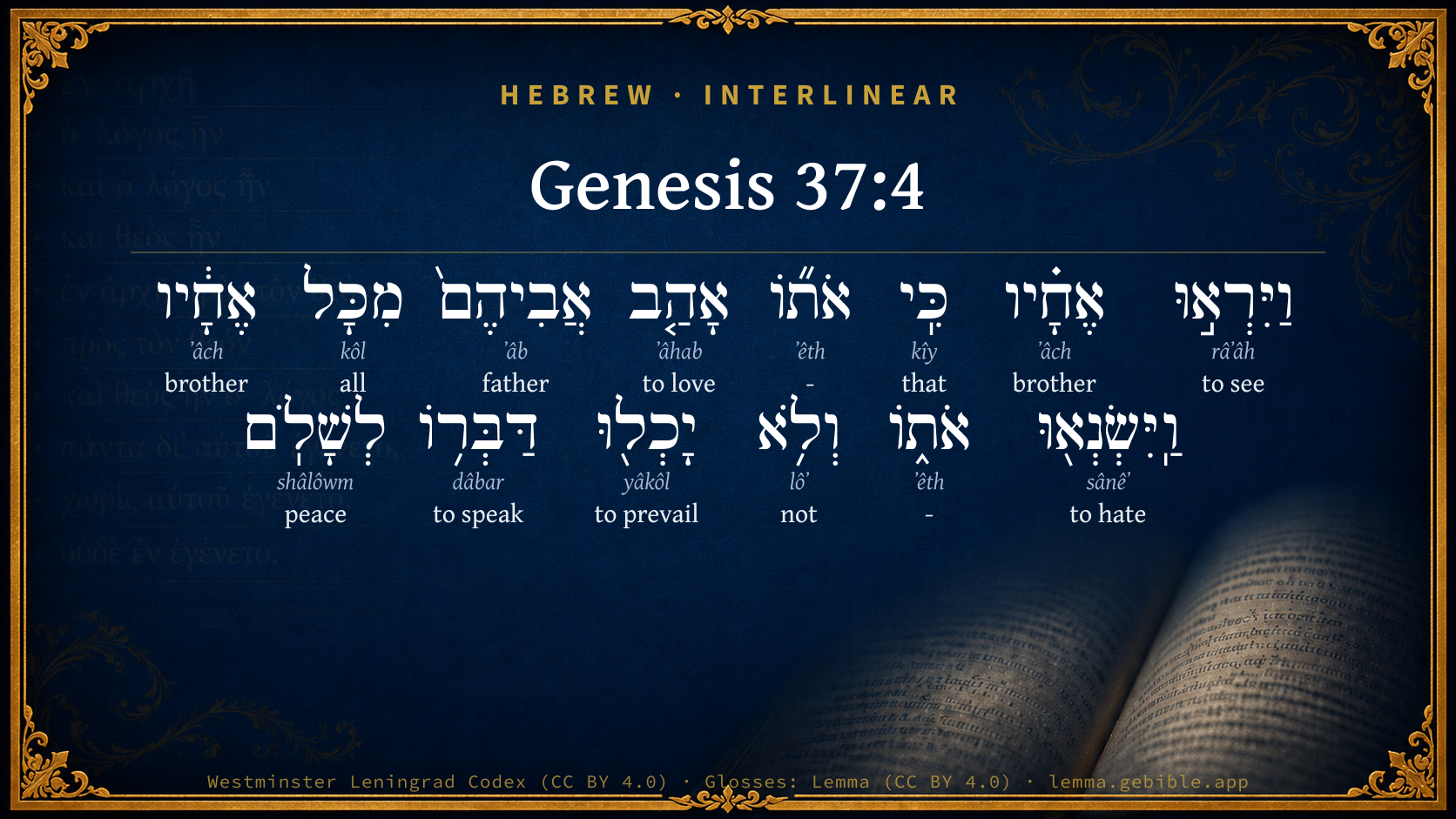
Hebrew (Westminster Leningrad Codex) Genesis 37:4 appears in the Hebrew Old Testament. The text above is from the Westminster Leningrad Codex. Each word links to its Strong’s number, a concise gloss, and parsing drawn from the Open Scriptures Hebrew Bible morphology. Click any word for its full Brown-Driver-Briggs (BDB) entry.
Download image
Cite this verse

Genesis 37:4 (World English Bible). Public Domain. Lemma interlinear Bible study tool, https://lemma.gebible.app/v/genesis/37/4.

Show BibTeX & RIS
BibTeX
RIS
English Translation
His brothers saw that their father loved him more than all his brothers, and they hated him, and couldn't speak peaceably to him.
World English Bible · Public Domain
Download a study sheet

One document with this verse’s original text, its word-by-word gloss line, the meaning frame, cross-references with their text, attributed commentary, and full source and license credits — printable, and it pastes into notes with its structure intact.

This verse Autodidact and up

Study sheet (.html) Plain text (.txt)

A passage Seminary Student

Up to 50 verses in one chapter. A passage sheet keeps up to 6 commentary sources and 12 cross-references per verse, in the order this page ranks them, and says so on the sheet whenever that leaves anything out. Ask for a single verse and you get the Autodidact verse sheet above.

Everything on this page stays free to read, with no account — the sheet is a download of what is already on screen, not access to it.

Want to remove ads? Support Godless Engineer
Compare translations 3

The same verse in 3 English versions, stacked beneath the original-language interlinear above. Click any original word for its lexicon entry.

Each is an independent rendering of the whole verse — the interlinear is not word-aligned to these translations.

Highlighted words mark where these versions differ — a whole-verse word diff, not a word-by-word alignment.

  • World English Bible Public Domain
    His brothers saw that their father loved him more than all his brothers, and they hated him, and couldn't speak peaceably to him.
  • King James Version Public Domain
    And when his brethren saw that their father loved him more than all his brethren, they hated him, and could not speak peaceably unto him.
  • unfoldingWord Literal Text CC BY-SA 4.0
    And his brothers saw that their father loved him more than all of his brothers, so they hated him and were not able to speak to him peaceably.

unfoldingWord Literal Text — © unfoldingWord, licensed CC BY-SA 4.0. Word-aligned USFM3 via Door43 (git.door43.org/unfoldingWord/en_ult).

Versions to compare (up to 4)

3 of 4 selected

Show all 18 translations

Every available English version of this verse, each an independent rendering of the whole verse.

  • World English Bible Public Domain
    His brothers saw that their father loved him more than all his brothers, and they hated him, and couldn't speak peaceably to him.
  • Berean Standard Bible Public Domain
    When Joseph’s brothers saw that their father loved him more than any of them, they hated him and could not speak a kind word to him.
  • Majority Standard Bible Public Domain
    When Joseph’s brothers saw that their father loved him more than any of them, they hated him and could not speak a kind word to him.
  • King James Version Public Domain
    And when his brethren saw that their father loved him more than all his brethren, they hated him, and could not speak peaceably unto him.
  • American Standard Version (1901) Public Domain
    And his brethren saw that their father loved him more than all his brethren; and they hated him, and could not speak peaceably unto him.
  • Revised Version (1885) Public Domain
    And his brethren saw that their father loved him more than all his brethren; and they hated him, and could not speak peaceably unto him.
  • Geneva Bible (1599) Public Domain
    So when his brethren sawe that their father loued him more then all his brethren, then they hated him, and could not speake peaceably vnto him.
  • Douay-Rheims (1899) Public Domain
    And his brethren seeing that he was loved by his father, more than all his sons, hated him, and could not speak peaceably to him.
  • Young's Literal Translation Public Domain
    and his brethren see that their father hath loved him more than any of his brethren, and they hate him, and have not been able to speak `to' him peaceably.
  • Literal Standard Version CC BY-SA 4.0
    and his brothers see that their father has loved him more than any of his brothers, and they hate him, and have not been able to speak [to] him peaceably.
  • Unlocked Literal Bible CC BY-SA 4.0
    His brothers saw that their father loved him more than all his brothers. They hated him and would not speak kindly to him.
  • unfoldingWord Literal Text CC BY-SA 4.0
    And his brothers saw that their father loved him more than all of his brothers, so they hated him and were not able to speak to him peaceably.
  • Darby Bible Public Domain
    And his brethren saw that their father loved him more than all his brethren, and they hated him, and could not greet him with friendliness.
  • World Messianic Bible Public Domain
    His brothers saw that their father loved him more than all his brothers, and they hated him, and couldn’t speak peaceably to him.
  • Webster's Bible Public Domain
    And when his brethren saw that their father loved him more than all his brethren, they hated him, and could not speak peaceably to him.
  • Free Bible Version CC BY-SA 4.0
    When his brothers noticed that their father loved him more than any of them, they hated him and had nothing good to say about him.
  • Bible in Basic English Public Domain
    And because his brothers saw that Joseph was dearer to his father than all the others, they were full of hate for him, and would not say a kind word to him.
  • JPS Tanakh (1917) Public Domain
    And when his brethren saw that their father loved him more than all his brethren, they hated him, and could not speak peaceably unto him.

Literal Standard Version (2020), Covenant Press — licensed CC BY-SA 4.0. Text via the HelloAO Bible API (eBible.org). Unlocked Literal Bible (unfoldingWord) — licensed CC BY-SA 4.0. Text via the HelloAO Bible API (eBible.org). unfoldingWord Literal Text — © unfoldingWord, licensed CC BY-SA 4.0. Word-aligned USFM3 via Door43 (git.door43.org/unfoldingWord/en_ult). Free Bible Version, Dr. Jonathan Gallagher — licensed CC BY-SA 4.0. Text via the HelloAO Bible API (eBible.org).

Word by word

More ways to search: Search by grammar → Find every occurrence → Compare this word →

Practice this passage: Drill this verse → Learn its vocabulary →

וַֽיִּשְׂנְא֖וּ
sânêʼ
H8130
“and · to hate”
Conjunction + Verb, Qal, Sequential Imperfect, 3rd Person, Masculine, Plural
Part of Speech
Conjunction + Verb
Stem
Qal
Form
Sequential Imperfect
Person
3rd Person
Gender
Masculine
Number
Plural
Full BDB Definition

Origin: a primitive root

TWOT: 2272

to hate, be hateful - (Qal) to hate - of man - of God - hater, one hating, enemy (participle) (substantive) - (Niphal) to be hated - (Piel) hater (participle) - of persons, nations, God, wisdom
  1. וַיִּרְא֣וּ râʼâh H7200 “and · to see” Conjunction + Verb, Qal, Sequential Imperfect, 3rd Person, Masculine, Plural
  2. אֶחָ֗יו ʼâch H251 “brothers · his” Noun, Common, Masculine, Plural, Construct + Suffix, Personal, 3rd Person, Masculine, Singular
  3. כִּֽי kîy H3588 “that” Conjunction
  4. אֹת֞וֹ ʼêth H853 “- · him” Particle, Direct Object + Suffix, Personal, 3rd Person, Masculine, Singular
  5. אָהַ֤ב ʼâhab H157 “to love” Verb, Qal, Perfect, 3rd Person, Masculine, Singular
  6. אֲבִיהֶם֙ ʼâb H1 “father · their” Noun, Common, Masculine, Singular, Construct + Suffix, Personal, 3rd Person, Masculine, Plural
  7. מִכָּל kôl H3605 “from · all of” Preposition + Noun, Common, Masculine, Singular, Construct
  8. אֶחָ֔יו ʼâch H251 “brothers · his” Noun, Common, Masculine, Plural, Construct + Suffix, Personal, 3rd Person, Masculine, Singular
  9. אֹת֑וֹ ʼêth H853 “- · him” Particle, Direct Object + Suffix, Personal, 3rd Person, Masculine, Singular
  10. וְלֹ֥א lôʼ H3808 “and · not” Conjunction + Particle, Negative
  11. יָכְל֖וּ yâkôl H3201 “to prevail” Verb, Qal, Perfect, 3rd Person, Common, Plural
  12. דַּבְּר֥וֹ dâbar H1696 “to speak · him” Verb, Piel, Infinitive Construct + Suffix, Personal, 3rd Person, Masculine, Singular
  13. לְשָׁלֹֽם shâlôwm H7965 “to/for · peace” Preposition + Noun, Common, Masculine, Singular, Absolute

About this verse

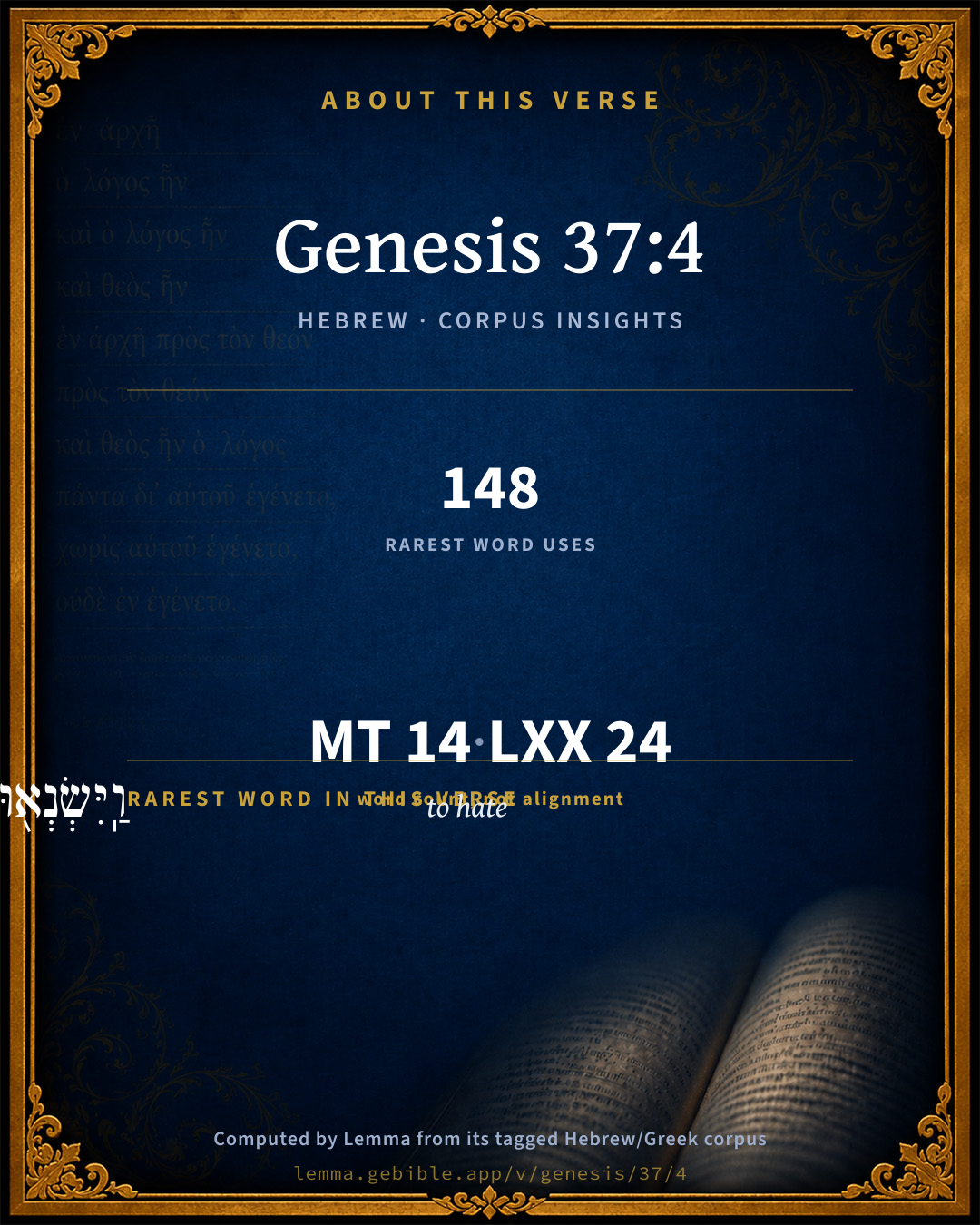
These counts appear in no published source. They are computed here, from the morphology-tagged text and Lemma’s own curated glosses. What Lemma adds →

14
words
12
distinct lemmas
Pentateuch
section

Grammatical profile

  • 5 verbs
  • 5 nouns
  • 1 conjunction
  • 3 particles

Verb forms

  • וַיִּרְא֣וּ Qal · Sequential Imperfect
  • אָהַ֤ב Qal · Perfect
  • וַֽיִּשְׂנְא֖וּ Qal · Sequential Imperfect
  • יָכְל֖וּ Qal · Perfect
  • דַּבְּר֥וֹ Piel · Infinitive Construct

Repetition

A word recurs within this verse — often emphatic in Hebrew:

  • אֶחָ֗יו brother H251 ×2

Hebrew & Septuagint length

In English translation the verse runs 23 words from the Hebrew and 25 from the Septuagint (LXX English) — closely comparable.

A rough comparison of the two English renderings, which tokenize alike — not a word-level alignment.

Word counts can differ between the Hebrew and the Greek without any difference in meaning — e.g. the Hebrew direct-object marker אֵת has no separate Greek word, and Greek often adds the article ὁ.

In the original languages it is 14 Hebrew tokens and 24 Greek tokens — but the two are counted differently (Hebrew bundles its prefixes and suffixes into one token; the Greek is in lemma form), so that isn’t a like-for-like length.

Cross-references

17

Topical passages linked to Genesis 37:4 in the Treasury of Scripture Knowledge — connected by theme and wording, ordered by reader-vote popularity; previews shown in the World English Bible.

  • Genesis 27:41 Esau hated Jacob because of the blessing with which his father blessed him. Esau said in his heart, "The days of mourning for my father are at hand. Then I will kill my brother Jacob."
  • 1 John 3:12 unlike Cain, who was of the evil one, and killed his brother. Why did he kill him? Because his works were evil, and his brother's righteous.
  • 1 John 4:20 If a man says, "I love God," and hates his brother, he is a liar; for he who doesn't love his brother whom he has seen, how can he love God whom he has not seen?
  • Psalms 69:4 Those who hate me without a cause are more than the hairs of my head. Those who want to cut me off, being my enemies wrongfully, are mighty. I have to restore what I didn't take away.
  • 1 John 2:11 But he who hates his brother is in the darkness, and walks in the darkness, and doesn't know where he is going, because the darkness has blinded his eyes.
  • Genesis 4:5 but he didn't respect Cain and his offering. Cain was very angry, and the expression on his face fell.
  • Genesis 37:5 Joseph dreamed a dream, and he told it to his brothers, and they hated him all the more.
  • 1 Samuel 17:28 Eliab his eldest brother heard when he spoke to the men; and Eliab's anger was kindled against David, and he said, Why are you come down? and with whom have you left those few sheep in the wilderness? I know your pride, and the naughtiness of your heart; for you have come down that you might see the battle.
  • John 15:18–19 If the world hates you, you know that it has hated me before it hated you.
  • Genesis 37:11 His brothers envied him; but his father kept this saying in mind.
  • Genesis 37:18–24 They saw him afar off, and before he came near to them, they conspired against him to kill him.
  • Genesis 49:23 The archers have sorely grieved him, Shot at him, and persecute him:
  • 1 Samuel 16:12–13 He sent, and brought him in. Now he was ruddy, and withal of a beautiful face, and goodly to look on. Yahweh said, Arise, anoint him; for this is he.
  • Psalms 38:19 But my enemies are vigorous and many. Those who hate me without reason are numerous.
  • Titus 3:3 For we were also once foolish, disobedient, deceived, serving various lusts and pleasures, living in malice and envy, hateful, and hating one another.
  • John 7:3–5 His brothers therefore said to him, "Depart from here, and go into Judea, that your disciples also may see your works which you do.
  • 1 John 3:10 In this the children of God are revealed, and the children of the devil. Whoever doesn't do righteousness is not of God, neither is he who doesn't love his brother.

Cross-references courtesy of OpenBible.info (CC BY 4.0).

Hebrew and Greek witnesses Masoretic Hebrew ↔ Greek Septuagint

The same verse in the two great witnesses to the Old Testament, shown verse-for-verse.

These are two independent witnesses, not word-aligned to each other, and the Septuagint is shown in lemma (dictionary) form.

Hebrew Genesis 37:4 Masoretic · Westminster Leningrad Codex

וַיִּרְא֣וּ אֶחָ֗יו כִּֽי אֹת֞וֹ אָהַ֤ב אֲבִיהֶם֙ מִכָּל אֶחָ֔יו וַֽיִּשְׂנְא֖וּ אֹת֑וֹ וְלֹ֥א יָכְל֖וּ דַּבְּר֥וֹ לְשָׁלֹֽם

His brothers saw that their father loved him more than all his brothers, and they hated him, and couldn't speak peaceably to him.

World English Bible · Public Domain

Greek LXX Genesis 37:4 Septuagint · lemma form

ὁράω δέ ὁ ἀδελφός αὐτός ὅτι αὐτός ὁ πατήρ φιλέω ἐκ πᾶς ὁ υἱός αὐτός μισέω αὐτός καί οὐ δύναμαι λαλέω αὐτός οὐδείς εἰρηνικός

And his brethren having seen that his father loved him more than all his sons, hated him, and could not speak anything peaceful to him.

LXX2012 (modern English Septuagint) · Public Domain

Hebrew: Westminster Leningrad Codex (CC BY 4.0). Greek: Septuagint (public domain); English from LXX2012 (modern English Septuagint) (Public Domain). How the Septuagint differs from the Hebrew →

Targum (Aramaic paraphrase)

2

The Targum is the ancient Jewish Aramaic paraphrase of the Hebrew Scriptures — an interpretive translation, not the Hebrew text itself. Onkelos (literal) and Pseudo-Jonathan (expansive) render the Torah, and Jonathan the Prophets. Coverage is partial: where no permissively-licensed English translation exists for a verse, only the Aramaic is shown. This is verse-level text, not a word-by-word alignment to the Hebrew.

  1. Targum Onkelos Torah (Genesis–Deuteronomy)
    וַחֲזוֹ אֲחוֹהִי אֲרֵי יָתֵהּ רְחֵם אֲבוּהוֹן מִכָּל אֲחוֹהִי וּסְנוֹ יָתֵהּ וְלָא צָבָן לְמַלָּלָא עִמֵּהּ לִשְׁלָם

    (no public-domain English translation for this verse)

    Targum Onkelos — Aramaic: “Onkelos Genesis” (public domain); “Onkelos Exodus” (public domain); “Onkelos Leviticus” (public domain); “Onkelos Numbers” (public domain); “Onkelos Deuteronomy” (public domain). English: “Sefaria Community Translation” (CC0 1.0 (public-domain dedication)); “J.W. Etheridge. The Targums of Onkelos and Jonathan Ben Uzziel on the Pentateuch. London: Longmans, Green, 1862” (public domain). Text via Sefaria.

  2. Targum Pseudo-Jonathan Torah (Genesis–Deuteronomy)
    וְחָמוּן אָחוּי אֲרוּם יָתֵיהּ רְחַם אֲבוּהוֹן מִכָּל אָחוֹי וְנָטְרוּ לֵיהּ בָּבִי וְלָא צָבָן לְמַלָלָא עִמֵיהּ שְׁלָם

    And his brothers saw that their father loved him more than all his brethren, and they cherished enmity against him, and were unwilling to speak peacefully with him.

    Targum Pseudo-Jonathan — Aramaic: “Targum Jonathan on Genesis” (public domain); “Targum Jonathan on Exodus” (public domain); “Targum Jonathan on Leviticus” (public domain); “Targum Jonathan on Numbers” (public domain); “Targum Jonathan on Deuteronomy” (public domain). English: “The Targum of Jonathan ben Uzziel, trans. J. W. Etheridge, London, 1862” (public domain). Text via Sefaria.

Commentary

Notes on Genesis 37:4 from classic Christian and Jewish commentators (each source and its license shown beneath its notes). The classic Christian expositions comment on the surrounding passage and are grouped to its opening verse, so a note may address several verses; the Jewish commentaries on the Tanakh (Rashi and others) are per-verse, so they appear only where the commentator wrote on this verse.

Lemma curates 59 commentaries, every one of them public domain or Creative Commons licensed, each selected and text-cleaned for this edition rather than reprinted as found. About our sources →

Trapp's Complete Commentary

John Trapp

Gen 37:4 And when his brethren saw that their father loved him more than all his brethren, they hated him, and could not speak peaceably unto him.

Ver. 4. They hated him.] 1. There is a passion of hatred: this is a kind of averseness, and rising of the heart against a man, when one seeth him; so that he cannot away with him, nor speak to him, nor look courteously or peaceably upon him; but one’s countenance falls whea he sees him, and he oven turns away, and, by his good will, would have nothing to do with him. 2. There is a habit of hatred: when the soul is so soured with this leaven, so settled in this alienation and estrangement, that it grows to wish, and desire, and seek his hurt. And this is one difference between hatred and envy: whom men hate, they will harm; but sometimes men’s gifts are envied, against whom no hurt is intended.

John Trapp, A Commentary or Exposition upon All the Books of the Old and New Testament (1647–1656) — public domain. Text from a community e-Sword module.

The Biblical Illustrator

Joseph S. Exell

Gen_37:4

They hated him

Lessons

1.

Choice respects to any, from parents, above all others, usually make such favourites to be envied.

2. Flesh and blood usually hate that which grace affects and loves.

3. Sin, and envy specially, put men out of a capacity of doing duty to relations.

4. Where hearts are full of hatred, mouths speak not peace but bitterness and scorning. (G. Hughes, B. D.)

Causes of envy

Notice now what are the three things for which we are prone to envy others.

1. Their privileges. Joseph was envied because his father favoured him. Asaph was envious at the foolish, when he saw the prosperity of the wicked (Psa_73:3). Against this David warns us--Fret not thyself because of evil doers--Fret not thyself because of him who prospereth in his way (Psa_37:1-7).

2. Their prospects. Joseph was envied because of the destiny foreshadowed by his dreams. Walter Scott envied his school-fellow the prize he seemed certain to win. This again, how common I Many a boy stands aloof from his comrades, and joins little and without heart in their sports, because he has fixed his hopes--his ambition if you will--on some object to be gained. Now the others will not envy him in the sense of wishing to be as he is; but they resent his presuming to have objects higher than theirs.

3. Their piety. Joseph was envied because he held aloof from his brothers sins. It is not so now? (E. Stock.)

Envy

The happiness of other men is poison to the envious man. The odious passion of envy torments and destroys ones self, while it seeks the ruin of its object. Beware of envy; you know not to what it tends. Beware of all its fruits; you will find them to be deadly, when they have time and opportunity to ripen. Josephs brethren did not proceed to extremes of cruelty when they were first seized with this baleful passion. They could not speak peaceably to him, but they entertained no thoughts of killing him, till their envy had by indulgence acquired a greater degree of strength. Their lust conceived and brought forth sin; and when their sin was finished, it brought forth death to Joseph in their intentions. They contracted the guilt of his blood, although they did not shed it. They were chargeable with intended murder in the sight of men, when they cast Joseph into the pit; but in the sight of God they were chargeable with this crime as soon as they began to hate Joseph; for he that hateth his brother in his heart is a murderer. (G. Lawson, D. D.)

The baleful nature of envy

Wrath is cruel, and anger is outrageous; but who is able to stand before envy? (Pro_27:4). Even a brother is sometimes exposed to its influence. Like the wild tornado which, as it sweeps along, destroys the loveliest flowers, and leaves the garden desolate as the wilderness, it has cut down many a youth of promise, and turned many a peaceful home into a scene of sadness and distress. We may say of it as Seneca says of anger, to which it is intimately allied: that it is a vice decidedly against nature; for it divides instead of joining, and in some measure frustrates the end of Providence in human society. One man was born to help another; envy makes us destroy one another. Nature unites, envy separates; the one is beneficial, the other mischievous; the one succours even strangers, the other destroys the most intimate friends; the one ventures all to save another, the other ruins himself to undo another. (Thornley Smith)

Envy hateful

When Sir Walter Scott was a boy at school, his efforts to gain a prize seemed all to no purpose, on account of the superior memory of one of his companions, who never failed to say his lessons perfectly. Walter did well, but now and then he would make a slip. In vain he strove to be first; he was always second, but could not oust his schoolfellow from the top place. One day, watching his rival repeating a long task without mistake or hesitation, Walter noticed that his fingers were perpetually fidgeting a particular button on his waistcoat. A thought struck the envious lad. Could it be? He would see. An opportunity soon occurred, and he cut off that button from that waistcoat while its owner was asleep. Next day the class stood up. Number one began, and as the first words left his lips, his fingers might be seen feeling for the familiar button. They felt for it in vain; and the hapless boy stopped, then stammered, then stopped again, and broke down altogether. Utterly unconscious of the cause, he racked his memory in despairing amazement, but he could not remember a line, and Walter stepped to the top of the class. Not a very serious trick, many boys will say. I choose it on this very account, as an illustration of what envy will lead to. Our object in this lesson should be to show envy at work in ordinary daily life, working all manner of mischief, just because its wickedness is not appreciated. An illustration of some murderer, whose crime was instigated by envy, would not answer our purpose. Our Sunday scholars would condemn the sin with horror, utterly failing to see the less glaring, but in Gods sight not less hateful, fault of their own hearts and tongues and lives. Our illustrations should be such as will enable us effectively to say, like Nathan, Thou art the man! Mutato nomine, de te fabula narratur. But it is not enough to show the hideousness of envy. We must show the beauty of the charity which envieth not. Thus: What should Walter Scott have done? Let the button alone? Yes; hut more than that. He should have honoured his companion, and rejoiced in his success. Ah, that is hard! (E. Stock.)

Envy soon finds an opportunity

When envy has fully formed its purpose of cruelty, it very speedily sees and seizes an opportunity for carrying it through. The great dramatist, indeed, has represented one of the most unscrupulous of his characters as excusing himself after this fashion: How oft the sight of means to do ill deeds makes ill deeds done; but then it is only the envious and malicious man who is on the outlook for means to do ill deeds, and therefore it is to him only that the perception of them offers a temptation. If King John had not been wishing to make away with Arthur, the presence of Hubert would not have suggested to him that he had found a fit instrument to do what he desired. Just as love keens the vision to such a degree that it sees ways of service that are invisible to others, so hate quickens the perception, and finds an occasion for its gratification in things that would have passed unnoticed by others. The brothers of Joseph, therefore, being filled with envy towards him, soon had an opportunity of working their will upon him, and they seized it with an eagerness which showed how intensely they hated him. (W. M. Taylor, D. D.)

The Biblical Illustrator, edited by Joseph S. Exell (c. 1880s–1900s) — public domain. Text from a community e-Sword module.

Tyndale Open Study Notes

Tyndale Open Resources

37:4 Jacob’s favoritism toward Joseph inflamed his other sons’ hatred of their brother. Just as Isaac’s and Rebekah’s favoritism had separated their family, Jacob’s favoritism would separate him from his son Joseph.

Tyndale Open Study Notes — © Tyndale Open Resources, licensed CC BY-SA 4.0. Text via the HelloAO Bible API.

Jamieson, Fausset & Brown

Robert Jamieson, A. R. Fausset & David Brown

could not speak peaceably unto him--did not say "peace be to thee" [Gen 43:23, &c.], the usual expression of good wishes among friends and acquaintances. It is deemed a sacred duty to give all this form of salutation; and the withholding of it is an unmistakable sign of dislike or secret hostility. The habitual refusal of Joseph's brethren, therefore, to meet him with "the salaam," showed how ill-disposed they were towards him. It is very natural in parents to love the youngest, and feel partial to those who excel in talents or amiableness. But in a family constituted as Jacob's--many children by different mothers--he showed great and criminal indiscretion.

Jamieson, Fausset & Brown — Commentary Critical and Explanatory on the Whole Bible (1871) — public domain (CC PDM 1.0). Text via the HelloAO Bible API.

Adam Clarke's Commentary

Verse 4. And could not speak peaceably unto him.] Does not this imply, in our use of the term, that they were continually quarrelling with him? but this is no meaning of the original: ולא יכלו דברו לשלם velo yachelu dabbero leshalom, they could not speak peace to him, i. e., they would not accost him in a friendly manner. They would not even wish him well. The eastern method of salutation is, Peace be to thee! שלום לך shalom lecha, among the Hebrews, and [Arabic] salam, peace, or [Arabic] salam kebibi, peace to thee my friend, among the Arabs. Now as peace among those nations comprehends all kinds of blessings spiritual and temporal, so they are careful not to say it to those whom they do not cordially wish well. It is not an unusual thing for an Arab or a Turk to hesitate to return the salam, if given by a Christian, or by one of whom he has not a favourable opinion: and this, in their own country, may be ever considered as a mark of hostility; not only as a proof that they do not wish you well, but that if they have an opportunity they will do you an injury. This was precisely the case with respect to Joseph's brethren: they would not give him the salam, and therefore felt themselves at liberty to take the first opportunity to injure him.

Adam Clarke's Commentary on the Bible (1810–1826) — public domain. Text from a community e-Sword/MySword module.

John Gill's Exposition

And when his brethren saw that their father loved him more than all his brethren,.... Which they perceived by various things in his behaviour to him, by his words, his looks, his gestures, and particularly by the coat he had made him, which distinguished him from the rest:

they hated him, and could not speak peaceably unto him; they not only inwardly hated him, but they could not conceal their hatred, but betrayed it by their speech unto him; they could not speak to him on any occasion, but in a cross, surly, ill natured manner; they could not salute him, or give him the common salutation, Peace be to thee, as Aben Ezra suggests.

John Gill's Exposition of the Whole Bible (1746–1763) — public domain (CC PDM 1.0). Text via the HelloAO Bible API.

Haydock's Catholic Bible Commentary

Could not, through envy, which caused them to notice every little distinction shewn to Joseph. They perceived he was the most beloved. His accusing them, and insinuating by his mysterious dreams that he would be their lord, heightened their rage. (Haydock)

George Leo Haydock (1774–1849), Haydock's Catholic Family Bible and Commentary, 1859 edition — public domain. Excludes Psalms (Douay-Rheims chapter numbering differs from Protestant) and Deuterocanonical books (Catholic canon only).

Matthew Poole's English Annotations

Their hatred was so deep and keen, that they could not smother it, as for their own interest they should have done, but discovered it by their churlish words and carriages to him.

Matthew Poole's English Annotations on the Holy Bible (1683–1685) — public domain. Text from a community e-Sword/MySword module.

Whedon's Commentary on the Bible

Daniel D. Whedon

4. Could not speak peaceably — “Hebrews, could not bid peace to him; could not greet him with the ordinary salutation, ‘Shalom,’ ‘Peace be unto thee.’ It may be that Joseph was unwise and unkind to accept this distinction, and to report to his father evil rumours concerning his brethren; but we are hardly to expect that he, a child, would set up his judgment against that of his father, and he everywhere appears as a frank and guileless child.” — Newhall.

Daniel D. Whedon (gen. ed.), Commentary on the Old and New Testaments (1874–1909) — public domain. Text from a community e-Sword module.

The Pulpit Commentary

And when (literally, and) his brethren saw that their father loved him more than all his brethren, they (literally, and they) hated him, as Esau hated Jacob (Gen_27:41; cf. Gen_49:23) and could not speak peaceably unto him literally, they were not able to speak of him for peace, L e. they could not address him in such a way as to wish him well; they could not offer him the customary salutation of Shalom, or Peace.

The Pulpit Commentary (1880–1919), ed. H.D.M. Spence-Jones & Joseph S. Exell — public domain. Text from a community e-Sword module.

Rashi

Rabbi Shlomo Yitzchaki (Rashi)

ולא יכלו דברו לשלום AND THEY COULD NOT SPEAK PEACEABLY TO HIM — from what is stated to their discredit we may infer something to their credit: they did not speak one thing with their mouth having another thing quite different in their hearts (Genesis Rabbah 84:9).

דברו means TO SPEAK TO HIM.

Rashi on the Tanakh — English translations: “The Judaica Press complete Tanach with Rashi, translated by A. J. Rosenberg” (CC BY 4.0); “Pentateuch with Rashi's commentary by M. Rosenbaum and A.M. Silbermann, 1929-1934” (public domain); “The Metsudah Tanach series, Lakewood, N.J” (CC BY 4.0); and “The Book of Joshua, Metsudah Publications, 1997” (CC BY 4.0). Text via Sefaria.

Radak

Rabbi David Kimhi (Radak)

ולא יכלו דברו לשלום, any conversation with Joseph did not revolve around peacefully discussed matters of common interest, but concerned only matters of dispute between them.

Radak on the Tanakh — English translations: “Sefaria Community Translation” (CC0 1.0 (public-domain dedication)); “Eliyahu Munk, HaChut Hameshulash” (CC BY 4.0); “Rabbi Mike Feuer, Jerusalem Anthology” (CC BY 4.0); and “R. David Kimhi on the first book of Psalms, Translated by R.G. Finch, London, 1919” (public domain). Text via Sefaria.

Lesson kit

Teaching starters — assembled from the data on this page, not authored interpretation. Every prompt links to the verse data it draws on. Edit before teaching.

Genesis, in the Pentateuch, opens this verse with 14 words (12 distinct Hebrew lemmas). Its most distinctive word is sânêʼ (“to hate”). A historical commentator’s framing appears above. Read the whole chapter for the surrounding context.

Discussion questions

  1. What does “to hate” (sânêʼ) contribute to the verse as a whole?
  2. Genesis 27:41 shares this passage’s theme. How do the two illuminate each other?
  3. “brother” occurs 2× in this one verse. What is the effect of the repetition?
  4. The translations on this page render this verse differently — a whole-verse word diff, not a word-by-word alignment. What might account for the different wordings?
  5. The verb «וַיִּרְא֣וּ» is Qal Sequential Imperfect. How does its form color the action?
  6. Reading how Trapp's Complete Commentary and The Biblical Illustrator read this verse, where do the two commentators agree and where do they part?

Things to notice

Reading settings

Reading text

Shown beneath each verse's original-language words.

Old Testament
Old Testament edition

Read the OT as the Masoretic Hebrew (MT) or the Greek Septuagint (LXX).

English shown for the Greek Septuagint (in the Hebrew ↔ Greek comparison).

Comparing translations? Open the Compare panel on any verse page to stack up to four side by side.