
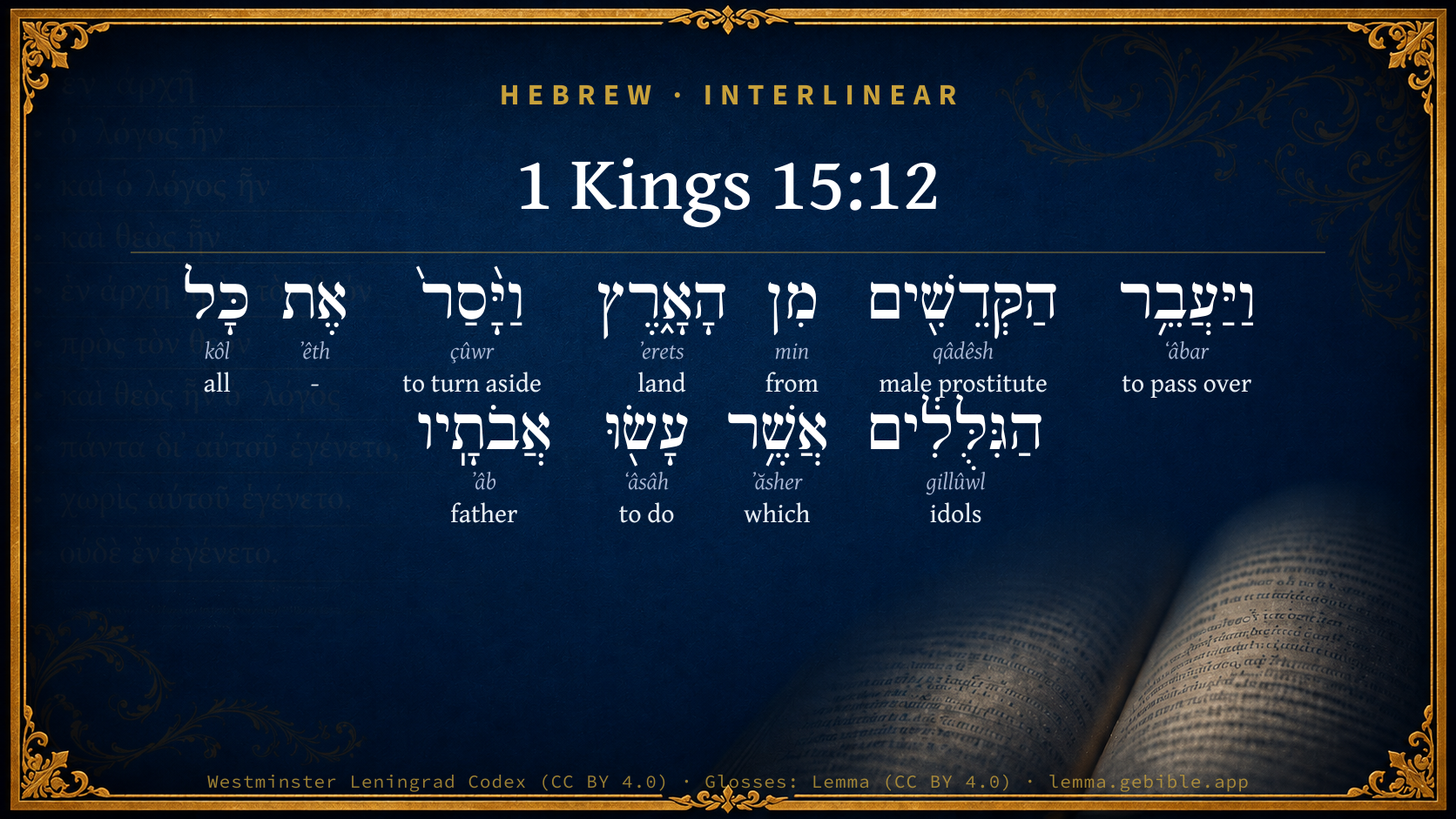
1 Kings 15:12

Hebrew (Westminster Leningrad Codex) 1 Kings 15:12 appears in the Hebrew Old Testament. The text above is from the Westminster Leningrad Codex. Each word links to its Strong’s number, a concise gloss, and parsing drawn from the Open Scriptures Hebrew Bible morphology. Click any word for its full Brown-Driver-Briggs (BDB) entry.
Download image
Cite this verse

1 Kings 15:12 (World English Bible). Public Domain. Lemma interlinear Bible study tool, https://lemma.gebible.app/v/1-kings/15/12.

Show BibTeX & RIS
BibTeX
RIS
English Translation
He put away the sodomites out of the land, and removed all the idols that his fathers had made.
World English Bible · Public Domain
Download a study sheet

One document with this verse’s original text, its word-by-word gloss line, the meaning frame, cross-references with their text, attributed commentary, and full source and license credits — printable, and it pastes into notes with its structure intact.

This verse Autodidact and up

Study sheet (.html) Plain text (.txt)

A passage Seminary Student

Up to 50 verses in one chapter. A passage sheet keeps up to 6 commentary sources and 12 cross-references per verse, in the order this page ranks them, and says so on the sheet whenever that leaves anything out. Ask for a single verse and you get the Autodidact verse sheet above.

Everything on this page stays free to read, with no account — the sheet is a download of what is already on screen, not access to it.

Want to remove ads? Support Godless Engineer
Compare translations 3

The same verse in 3 English versions, stacked beneath the original-language interlinear above. Click any original word for its lexicon entry.

Each is an independent rendering of the whole verse — the interlinear is not word-aligned to these translations.

Highlighted words mark where these versions differ — a whole-verse word diff, not a word-by-word alignment.

  • World English Bible Public Domain
    He put away the sodomites out of the land, and removed all the idols that his fathers had made.
  • King James Version Public Domain
    And he took away the sodomites out of the land, and removed all the idols that his fathers had made.
  • unfoldingWord Literal Text CC BY-SA 4.0
    And he made the cultic prostitutes pass over from the land, and he removed all of the idols that his fathers had made.

unfoldingWord Literal Text — © unfoldingWord, licensed CC BY-SA 4.0. Word-aligned USFM3 via Door43 (git.door43.org/unfoldingWord/en_ult).

Versions to compare (up to 4)

3 of 4 selected

Show all 18 translations

Every available English version of this verse, each an independent rendering of the whole verse.

  • World English Bible Public Domain
    He put away the sodomites out of the land, and removed all the idols that his fathers had made.
  • Berean Standard Bible Public Domain
    He banished the male shrine prostitutes from the land and removed all the idols that his fathers had made.
  • Majority Standard Bible Public Domain
    He banished the male shrine prostitutes from the land and removed all the idols that his fathers had made.
  • King James Version Public Domain
    And he took away the sodomites out of the land, and removed all the idols that his fathers had made.
  • American Standard Version (1901) Public Domain
    And he put away the sodomites out of the land, and removed all the idols that his fathers had made.
  • Revised Version (1885) Public Domain
    And he put away the sodomites out of the land, and removed all the idols that his fathers had made.
  • Geneva Bible (1599) Public Domain
    And he tooke away the Sodomites out of the lande, and put away all the idoles that his fathers had made.
  • Douay-Rheims (1899) Public Domain
    And he took away the effeminate out of the land, and he removed all the filth of the idols, which his fathers had made.
  • Young's Literal Translation Public Domain
    and removeth the whoremongers out of the land, and turneth aside all the idols that his fathers made;
  • Literal Standard Version CC BY-SA 4.0
    and removes the whoremongers out of the land, and turns aside all the idols that his fathers made;
  • Unlocked Literal Bible CC BY-SA 4.0
    He expelled the cultic prostitutes from the land and removed all the idols that his ancestors had made.
  • unfoldingWord Literal Text CC BY-SA 4.0
    And he made the cultic prostitutes pass over from the land, and he removed all of the idols that his fathers had made.
  • Darby Bible Public Domain
    And he put away the sodomites out of the land, and removed all the idols that his father had made.
  • World Messianic Bible Public Domain
    He put away the sodomites out of the land, and removed all the idols that his fathers had made.
  • Webster's Bible Public Domain
    And he banished the sodomites from the land, and removed all the idols that his fathers had made.
  • Free Bible Version CC BY-SA 4.0
    He expelled the cult prostitutes from the land and got rid of all of the idols that his forefathers had made.
  • Bible in Basic English Public Domain
    Those used for sex purposes in the worship of the gods he sent out of the country, and he took away all the images which his fathers had made.
  • JPS Tanakh (1917) Public Domain
    And he put away the sodomites out of the land, and removed all the idols that his fathers had made.

Literal Standard Version (2020), Covenant Press — licensed CC BY-SA 4.0. Text via the HelloAO Bible API (eBible.org). Unlocked Literal Bible (unfoldingWord) — licensed CC BY-SA 4.0. Text via the HelloAO Bible API (eBible.org). unfoldingWord Literal Text — © unfoldingWord, licensed CC BY-SA 4.0. Word-aligned USFM3 via Door43 (git.door43.org/unfoldingWord/en_ult). Free Bible Version, Dr. Jonathan Gallagher — licensed CC BY-SA 4.0. Text via the HelloAO Bible API (eBible.org).

Word by word

More ways to search: Search by grammar → Find every occurrence → Compare this word →

Practice this passage: Drill this verse → Learn its vocabulary →

הַקְּדֵשִׁ֖ים
qâdêsh
H6945
“the · male prostitute”
Particle, Definite Article + Adjective, Adjective, Masculine, Plural, Absolute
Part of Speech
Particle + Adjective
Type
Adjective
Gender
Masculine
Number
Plural
State
Absolute
Full BDB Definition

Origin: from H6942

TWOT: 1990c

male temple prostitute
  1. וַיַּעֲבֵ֥ר ʻâbar H5674 “and · to pass over” Conjunction + Verb, Hiphil, Sequential Imperfect, 3rd Person, Masculine, Singular
  2. מִן min H4480 “from” Preposition
  3. הָאָ֑רֶץ ʼerets H776 “the · land” Particle, Definite Article + Noun, Common, Both, Singular, Absolute
  4. וַיָּ֨סַר֙ çûwr H5493 “and · to turn aside” Conjunction + Verb, Hiphil, Sequential Imperfect, 3rd Person, Masculine, Singular
  5. אֶת ʼêth H853 “-” Particle, Direct Object
  6. כָּל kôl H3605 “all of” Noun, Common, Masculine, Singular, Construct
  7. הַגִּלֻּלִ֔ים gillûwl H1544 “the · idols” Particle, Definite Article + Noun, Common, Masculine, Plural, Absolute
  8. אֲשֶׁ֥ר ʼăsher H834 “which” Particle, Relative
  9. עָשׂ֖וּ ʻâsâh H6213 “to do” Verb, Qal, Perfect, 3rd Person, Common, Plural
  10. אֲבֹתָֽיו ʼâb H1 “fathers · his” Noun, Common, Masculine, Plural, Construct + Suffix, Personal, 3rd Person, Masculine, Singular

About this verse

These counts appear in no published source. They are computed here, from the morphology-tagged text and Lemma’s own curated glosses. What Lemma adds →

11
words
11
distinct lemmas
Historical
section

Notable vocabulary

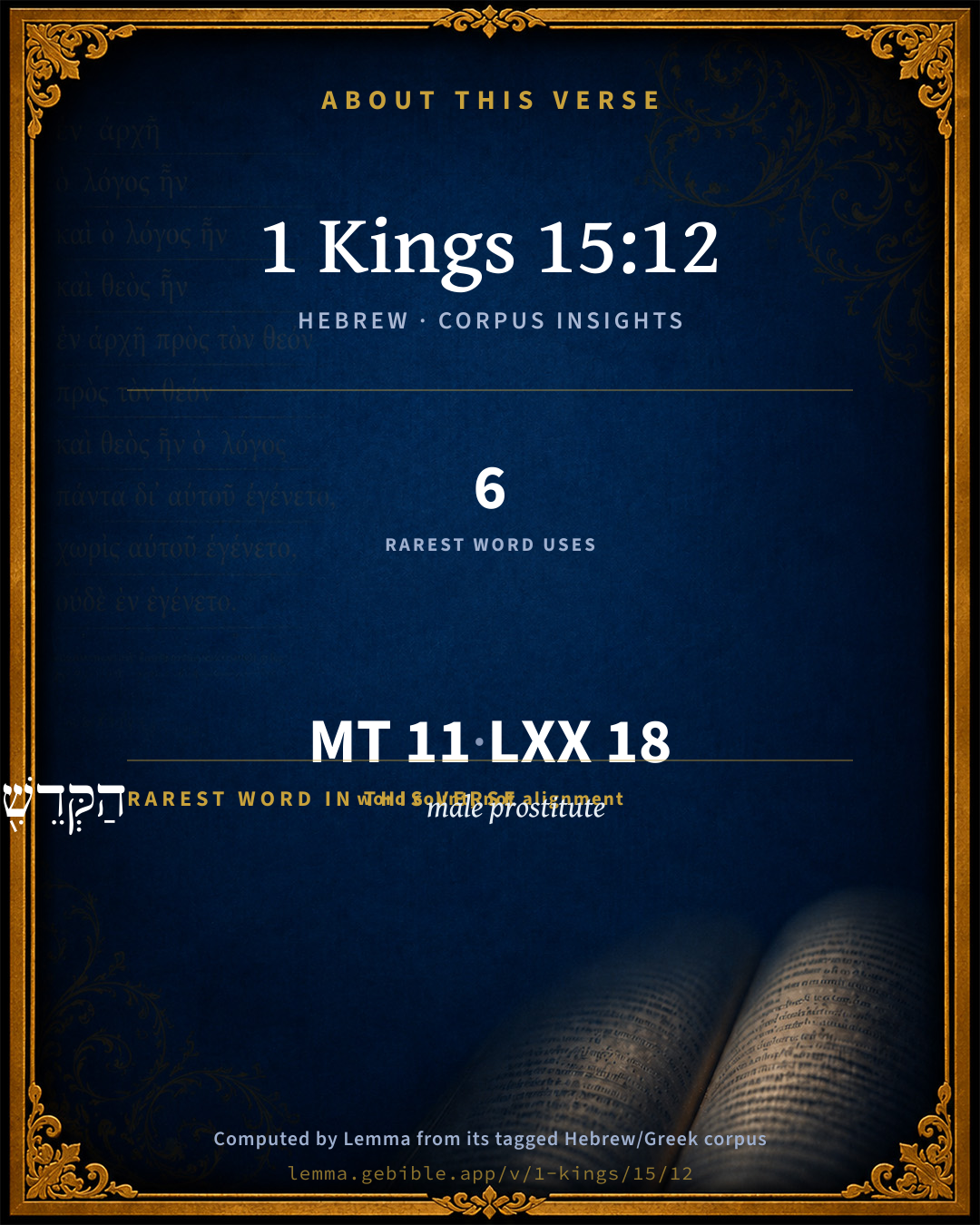
The rarest word here is הַקְּדֵשִׁ֖ים male prostitute H6945 — appearing just 6 times in the whole Hebrew Bible.

Shared distinctive vocabulary

הַקְּדֵשִׁ֖ים male prostitute H6945 occurs in 6 verses of the Hebrew Bible. Also found in:

Grammatical profile

  • 3 verbs
  • 4 nouns
  • 1 adjective
  • 1 preposition
  • 2 particles

Verb forms

  • וַיַּעֲבֵ֥ר Hiphil · Sequential Imperfect
  • וַיָּ֨סַר֙ Hiphil · Sequential Imperfect
  • עָשׂ֖וּ Qal · Perfect

Hebrew & Septuagint length

In English translation the verse runs 19 words from the Hebrew and 20 from the Septuagint (LXX English) — closely comparable.

A rough comparison of the two English renderings, which tokenize alike — not a word-level alignment.

Word counts can differ between the Hebrew and the Greek without any difference in meaning — e.g. the Hebrew direct-object marker אֵת has no separate Greek word, and Greek often adds the article ὁ.

In the original languages it is 11 Hebrew tokens and 18 Greek tokens — but the two are counted differently (Hebrew bundles its prefixes and suffixes into one token; the Greek is in lemma form), so that isn’t a like-for-like length.

Cross-references

10

Topical passages linked to 1 Kings 15:12 in the Treasury of Scripture Knowledge — connected by theme and wording, ordered by reader-vote popularity; previews shown in the World English Bible.

  • 1 Kings 22:46 The remnant of the sodomites, that remained in the days of his father Asa, he put away out of the land.
  • 1 Kings 14:23–24 For they also built them high places, and pillars, and Asherim, on every high hill, and under every green tree;
  • 1 Kings 11:7–8 Then did Solomon build a high place for Chemosh the abomination of Moab, on the mountain that is before Jerusalem, and for Molech the abomination of the children of Ammon.
  • 2 Chronicles 14:2–5 Asa did that which was good and right in the eyes of Yahweh his God:
  • Romans 1:26–27 For this reason, God gave them up to vile passions. For their women changed the natural function into that which is against nature.
  • 1 Peter 1:18 knowing that you were redeemed, not with corruptible things, with silver or gold, from the useless way of life handed down from your fathers,
  • Jude 1:7 Even as Sodom and Gomorrah, and the cities around them, having, in the same way as these, given themselves over to sexual immorality and gone after strange flesh, are set forth as an example, suffering the punishment of eternal fire.
  • 1 Kings 15:3 He walked in all the sins of his father, which he had done before him; and his heart was not perfect with Yahweh his God, as the heart of David his father.
  • Ezekiel 20:18–19 I said to their children in the wilderness, Don't you walk in the statutes of your fathers, neither observe their ordinances, nor defile yourselves with their idols.
  • Zechariah 1:2–6 "Yahweh was very displeased with your fathers.

Cross-references courtesy of OpenBible.info (CC BY 4.0).

Hebrew and Greek witnesses Masoretic Hebrew ↔ Greek Septuagint

The same verse in the two great witnesses to the Old Testament, shown verse-for-verse.

These are two independent witnesses, not word-aligned to each other, and the Septuagint is shown in lemma (dictionary) form.

Hebrew 1 Kings 15:12 Masoretic · Westminster Leningrad Codex

וַיַּעֲבֵ֥ר הַקְּדֵשִׁ֖ים מִן הָאָ֑רֶץ וַיָּ֨סַר֙ אֶת כָּל הַגִּלֻּלִ֔ים אֲשֶׁ֥ר עָשׂ֖וּ אֲבֹתָֽיו

He put away the sodomites out of the land, and removed all the idols that his fathers had made.

World English Bible · Public Domain

Greek LXX 1 Kings 15:12 Septuagint · lemma form

καί ἀποαἱρέω ὁ τελετή ἀπό ὁ γῆ καί ἐκ ἀποστέλλω πᾶς ὁ ἐπιτήδευμα ὅς ποιέω ὁ πατήρ αὐτός

And he removed the sodomites out of the land, and abolished all the practices which his fathers had kept up.

LXX2012 (modern English Septuagint) · Public Domain

Hebrew: Westminster Leningrad Codex (CC BY 4.0). Greek: Septuagint (public domain); English from LXX2012 (modern English Septuagint) (Public Domain). How the Septuagint differs from the Hebrew →

Targum (Aramaic paraphrase)

1

The Targum is the ancient Jewish Aramaic paraphrase of the Hebrew Scriptures — an interpretive translation, not the Hebrew text itself. Onkelos (literal) and Pseudo-Jonathan (expansive) render the Torah, and Jonathan the Prophets. Coverage is partial: where no permissively-licensed English translation exists for a verse, only the Aramaic is shown. This is verse-level text, not a word-by-word alignment to the Hebrew.

  1. Targum Jonathan Prophets (Joshua–Malachi)
    וּפַלֵי נַפְקַת בָּרָא מִן אַרְעָא וְאַעְדֵי יַת כָּל טַעֲוָתָא דַעֲבַדוּ אֲבָהָתוֹהִי:

    (no public-domain English translation for this verse)

    Targum Jonathan — Aramaic: “Mikraot Gedolot” (public domain). English: “Sefaria Community Translation” (CC0 1.0 (public-domain dedication)); “London "Chaldee Paraphrase," 1871” (public domain). Text via Sefaria.

Commentary

Notes on 1 Kings 15:12 from classic Christian and Jewish commentators (each source and its license shown beneath its notes). The classic Christian expositions comment on the surrounding passage and are grouped to its opening verse, so a note may address several verses; the Jewish commentaries on the Tanakh (Rashi and others) are per-verse, so they appear only where the commentator wrote on this verse.

Lemma curates 59 commentaries, every one of them public domain or Creative Commons licensed, each selected and text-cleaned for this edition rather than reprinted as found. About our sources →

Trapp's Complete Commentary

John Trapp

1Ki 15:12 And he took away the sodomites out of the land, and removed all the idols that his fathers had made.

Ver. 12. And he took away the sodomites.] See 1Ki 14:24. How far from this zeal of good Asa was Pope Sixtus Quartus, qui lupanar utriusque Veneris Romae condidit, et tribus mensibus anni calidioribus, Iunio, Iulio, et Augusto, toti familiae Cardinalis Sanctae Luciae masculam venerem permisit cum Apostilla, Fiat ut petitur. {a} The Papists themselves write {b} with detestation, that in Rome a Jewish maid might not be admitted into the stews of whoredom, unless she would be first baptized.

All the idols.] The dirty idols, the dunghill deities: {c} so called here, because of the stench wherewith they offend Almighty God.

{a} Corn. Agrippa.

{b} Espencaeus

{c} Deos stercores

John Trapp, A Commentary or Exposition upon All the Books of the Old and New Testament (1647–1656) — public domain. Text from a community e-Sword module.

Joseph Benson's Commentary

1Ki 15:12. He took away the sodomites — All whom he could find out; but some escaped his observation, as appears from 1Ki 22:46. And removed all the idols his father had made — If his father had made them, he had the more need to remove them, that he might cut off the entail of the curse.

Joseph Benson's Commentary on the Old and New Testaments (1811–1818) — public domain. Text from a community e-Sword module.

Adam Clarke's Commentary

Verse 12. The sodomites] הקדשים hakkedeshim; literally, the holy or consecrated ones. See on 1Kg 14:24.

Adam Clarke's Commentary on the Bible (1810–1826) — public domain. Text from a community e-Sword/MySword module.

The Cambridge Bible for Schools and Colleges

gen. ed. J. J. S. Perowne

12. and he took (R.V. put) away] The same word is so rendered in 2Ch_15:8, of these very reforms. Literally it means ‘caused to pass by.’

idols that his fathers had made] Not only those in Judah and Benjamin, but also those that were set up in the hill country of Ephraim, in the cities which Abijam had taken from Jeroboam.

The Cambridge Bible for Schools and Colleges (gen. ed. J. J. S. Perowne; Cambridge University Press, 1878–1918) — public domain. Text from a community e-Sword module.

John Gill's Exposition

And there was war between Asa and Baasha king of Israel all their days: That is as long as they lived together; for Baasha died many years before Asa, and this must be reckoned from the time the war began between them. Baasha did not begin his reign until the third year of Asa, Kg1 15:25 and in the first ten years of Asa's reign the land was quiet and free from war, Ch2 14:1 of which there must be seven in the reign of Baasha, who is here made mention of out of course, for Nadab reigned before him, Kg1 15:25, the reason of which Abarbinel thinks is, that the historian, having given an account of the good deeds of Asa, relates his failings before he proceeds to the other part of his history.

, the reason of which Abarbinel thinks is, that the historian, having given an account of the good deeds of Asa, relates his failings before he proceeds to the other part of his history.

1 Kings 15:17

kg1 15:17

kg1 15:17

kg1 15:17And Baasha king of Israel went up against Judah,.... Which, in Ch2 16:1 is said to be in the thirty sixth year of Asa's reign, or rather of his kingdom; for it can never mean the year of his reign, for Baasha was dead many years before that, since his reign began in the third of Asa, and he reigned but twenty four years, and therefore must die in the twenty seventh of Asa; but it is to be understood of the kingdom of Judah, when it was divided from Israel; from that time to this were thirty six years, seventeen under Rehoboam, three under Abijam, so that this year must be the sixteenth of Asa; thus it is calculated in the Jewish chronology (u), and which is followed by many of the best of our chronologers:

and built Ramah; a city in the tribe of Benjamin, Jos 18:25, but taken by the king of Israel, which he rebuilt or fortified:

that he might not suffer any to go out or come in to Asa king of Judah; that his people might not go to and from Jerusalem, and worship at the temple there; this garrison lying on the borders of both kingdoms, he thought hereby to cut off all communication between them.

(u) Seder Olam Rabba, c. 16.

John Gill's Exposition of the Whole Bible (1746–1763) — public domain (CC PDM 1.0). Text via the HelloAO Bible API.

Haydock's Catholic Bible Commentary

Effeminate. See chap. xiv. 24. Yet his zeal could not entirely eradicate this evil. There was room for the exertions of his son Josaphat, chap. xxii. 47. (Calmet) --- The king punished with death such as he could discover. (Haydock)

George Leo Haydock (1774–1849), Haydock's Catholic Family Bible and Commentary, 1859 edition — public domain. Excludes Psalms (Douay-Rheims chapter numbering differs from Protestant) and Deuterocanonical books (Catholic canon only).

Matthew Poole's English Annotations

The Sodomites, of whom see 1Ki 14:24, not all of them, but those whom he could find out; but some escaped his observation and censure, as appears from 1Ki 22:46.

Matthew Poole's English Annotations on the Holy Bible (1683–1685) — public domain. Text from a community e-Sword/MySword module.

Whedon's Commentary on the Bible

Daniel D. Whedon

12. Sodomites — See note on 1Ki_14:24.

Daniel D. Whedon (gen. ed.), Commentary on the Old and New Testaments (1874–1909) — public domain. Text from a community e-Sword module.

The Pulpit Commentary

And he took away the Sodomites see on 1Ki_14:24, Rom_1:23-27. It appears from 1Ki_22:46 that this abomination was not wholly suppressed out of the land, and removed all the idols from llG volvit A term of contempt (see Deu_29:17, where it is coupled with "abominations; Eze_23:37) but whether the word is to be interpreted by llGe a ball of dung, in which case these idols (Dei stereorei) would have a designation like Beelzebul ("the lord of dung"), or with lG a heap of stones, (Gen_31:46, Gen_31:48) Dei lapidei, is uncertain. Keil would translate logs, Gesenius trunks, stocks, which from being rolled might well bear this name that his fathers had made.

The Pulpit Commentary (1880–1919), ed. H.D.M. Spence-Jones & Joseph S. Exell — public domain. Text from a community e-Sword module.

John Wesley's Explanatory Notes

Sodomites - All whom he could find out; but some escaped his observation, as appears from chap. xxii, 46. Idols, &c. - And if his father had made them, he had the more need to remove them, that he might cut off the entail of the curse.

John Wesley, Explanatory Notes Upon the Whole Bible (1754–1765) — public domain. Text via the GEBible commentary corpus.

unfoldingWord translationNotes

Door43 World Missions Community

the cultic prostitutes

This probably refers to prostitutes who were associated with idol worship and who were all men. AT: "religious prostitutes" or "the prostitutes who worked for idols" or "male prostitutes"

Asa cut down the disgusting figure

Since Asa was king, he may have told his officials to cut down the figure. AT: "Asa caused the disgusting figure to be cut down" or "Asa made them cut down the disgusting figure" (See: Metonymy)

translationWords

prostitute

false god

queen

image

Asherah

unfoldingWord translationNotes — © Distant Shores Media and the Door43 World Missions Community, licensed CC BY-SA 4.0. Source: git.door43.org/Door43/en_tn.

Rashi

Rabbi Shlomo Yitzchaki (Rashi)

And he rid [the land] of prostitutes. [Targum] Yonoson rendered, “and he abolished the prostitutes.”

Rashi on the Tanakh — English translations: “The Judaica Press complete Tanach with Rashi, translated by A. J. Rosenberg” (CC BY 4.0); “Pentateuch with Rashi's commentary by M. Rosenbaum and A.M. Silbermann, 1929-1934” (public domain); “The Metsudah Tanach series, Lakewood, N.J” (CC BY 4.0); and “The Book of Joshua, Metsudah Publications, 1997” (CC BY 4.0). Text via Sefaria.

Lesson kit

Teaching starters — assembled from the data on this page, not authored interpretation. Every prompt links to the verse data it draws on. Edit before teaching.

1 Kings, in the Historical, opens this verse with 11 words (11 distinct Hebrew lemmas). Its most distinctive word is qâdêsh (“male prostitute”). A historical commentator’s framing appears above. Read the whole chapter for the surrounding context.

Discussion questions

  1. The word qâdêsh carries the sense “male prostitute.” How does it shape the verse?
  2. Deuteronomy 23:17 shares the word «male prostitute» with this verse. How do the two illuminate each other?
  3. These translations render this verse differently. What is at stake in choosing one wording over another?
  4. The verb «וַיַּעֲבֵ֥ר» is Hiphil Sequential Imperfect. How does its form color the action?
  5. Reading how Trapp's Complete Commentary and Joseph Benson's Commentary read this verse, where do the two commentators agree and where do they part?

Things to notice

Reading settings

Reading text

Shown beneath each verse's original-language words.

Old Testament
Old Testament edition

Read the OT as the Masoretic Hebrew (MT) or the Greek Septuagint (LXX).

English shown for the Greek Septuagint (in the Hebrew ↔ Greek comparison).

Comparing translations? Open the Compare panel on any verse page to stack up to four side by side.