
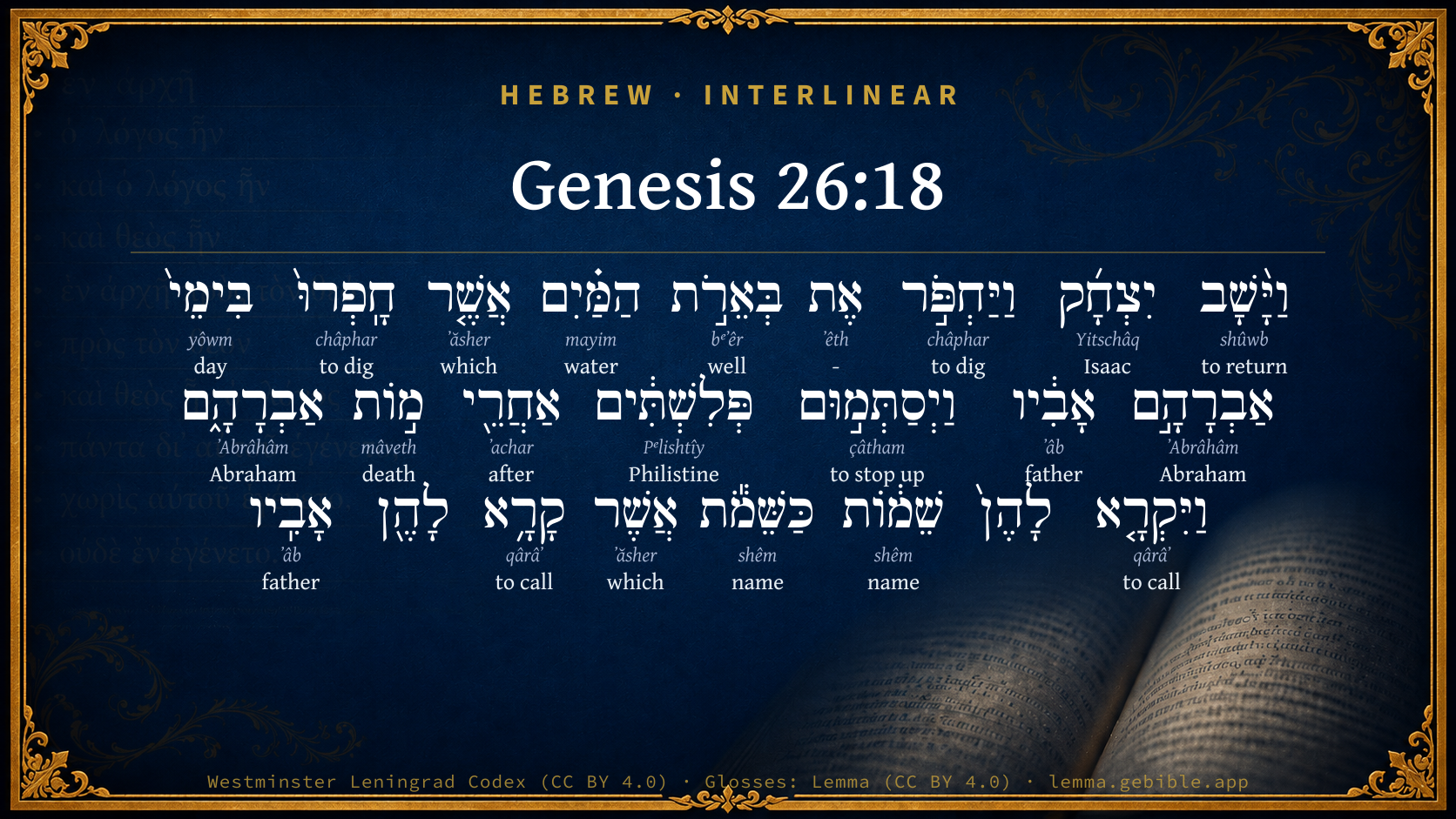
Genesis 26:18

Hebrew (Westminster Leningrad Codex) Genesis 26:18 appears in the Hebrew Old Testament. The text above is from the Westminster Leningrad Codex. Each word links to its Strong’s number, a concise gloss, and parsing drawn from the Open Scriptures Hebrew Bible morphology. Click any word for its full Brown-Driver-Briggs (BDB) entry.
Download image
Cite this verse

Genesis 26:18 (World English Bible). Public Domain. Lemma interlinear Bible study tool, https://lemma.gebible.app/v/genesis/26/18.

Show BibTeX & RIS
BibTeX
RIS
English Translation
Isaac dug again the wells of water, which they had dug in the days of Abraham his father. For the Philistines had stopped them after the death of Abraham. He called their names after the names by which his father had called them.
World English Bible · Public Domain
Download a study sheet

One document with this verse’s original text, its word-by-word gloss line, the meaning frame, cross-references with their text, attributed commentary, and full source and license credits — printable, and it pastes into notes with its structure intact.

This verse Autodidact and up

Study sheet (.html) Plain text (.txt)

A passage Seminary Student

Up to 50 verses in one chapter. A passage sheet keeps up to 6 commentary sources and 12 cross-references per verse, in the order this page ranks them, and says so on the sheet whenever that leaves anything out. Ask for a single verse and you get the Autodidact verse sheet above.

Everything on this page stays free to read, with no account — the sheet is a download of what is already on screen, not access to it.

Want to remove ads? Support Godless Engineer
Compare translations 3

The same verse in 3 English versions, stacked beneath the original-language interlinear above. Click any original word for its lexicon entry.

Each is an independent rendering of the whole verse — the interlinear is not word-aligned to these translations.

Highlighted words mark where these versions differ — a whole-verse word diff, not a word-by-word alignment.

  • World English Bible Public Domain
    Isaac dug again the wells of water, which they had dug in the days of Abraham his father. For the Philistines had stopped them after the death of Abraham. He called their names after the names by which his father had called them.
  • King James Version Public Domain
    And Isaac digged again the wells of water, which they had digged in the days of Abraham his father; for the Philistines had stopped them after the death of Abraham: and he called their names after the names by which his father had called them.
  • unfoldingWord Literal Text CC BY-SA 4.0
    Then Isaac returned and dug out the water wells that they had dug in the days of Abraham his father and the Philistines had stopped up after the death of Abraham, and he called them names like the names that his father had called them.

unfoldingWord Literal Text — © unfoldingWord, licensed CC BY-SA 4.0. Word-aligned USFM3 via Door43 (git.door43.org/unfoldingWord/en_ult).

Versions to compare (up to 4)

3 of 4 selected

Show all 18 translations

Every available English version of this verse, each an independent rendering of the whole verse.

  • World English Bible Public Domain
    Isaac dug again the wells of water, which they had dug in the days of Abraham his father. For the Philistines had stopped them after the death of Abraham. He called their names after the names by which his father had called them.
  • Berean Standard Bible Public Domain
    Isaac reopened the wells that had been dug in the days of his father Abraham, which the Philistines had stopped up after Abraham died. And he gave these wells the same names his father had given them.
  • Majority Standard Bible Public Domain
    Isaac reopened the wells that had been dug in the days of his father Abraham, which the Philistines had stopped up after Abraham died. And he gave these wells the same names his father had given them.
  • King James Version Public Domain
    And Isaac digged again the wells of water, which they had digged in the days of Abraham his father; for the Philistines had stopped them after the death of Abraham: and he called their names after the names by which his father had called them.
  • American Standard Version (1901) Public Domain
    And Isaac digged again the wells of water, which they had digged in the days of Abraham his father. For the Philistines had stopped them after the death of Abraham. And he called their names after the names by which his father had called them.
  • Revised Version (1885) Public Domain
    And Isaac digged again the wells of water, which they had digged in the days of Abraham his father; for the Philistines had stopped them after the death of Abraham: and he called their names after the names by which his father had called them.
  • Geneva Bible (1599) Public Domain
    And Izhak returning, digged the welles of water, which they had digged in the dayes of Abraham his father: for the Philistims had stopped them after the death of Abraham, and hee gaue them the same names, which his father gaue them.
  • Douay-Rheims (1899) Public Domain
    And he digged again other wells, which the servants of his father Abraham had digged, and which, after his death, the Palestines had of old stopped up: and he called them by the same names by which his father before had called them.
  • Young's Literal Translation Public Domain
    and Isaac turneth back, and diggeth the wells of water which they digged in the days of Abraham his father, which the Philistines do stop after the death of Abraham, and he calleth to them names according to the names which his father called them.
  • Literal Standard Version CC BY-SA 4.0
    and Isaac turns back, and digs the wells of water which they dug in the days of his father Abraham, which the Philistines have stopped after the death of Abraham, and he calls to them names according to the names which his father called them.
  • Unlocked Literal Bible CC BY-SA 4.0
    Once again Isaac dug out the wells of water, which they had dug in the days of Abraham his father. The Philistines had stopped them up after Abraham's death. Isaac called the wells by the same names that his father had called them.
  • unfoldingWord Literal Text CC BY-SA 4.0
    Then Isaac returned and dug out the water wells that they had dug in the days of Abraham his father and the Philistines had stopped up after the death of Abraham, and he called them names like the names that his father had called them.
  • Darby Bible Public Domain
    And Isaac dug again the wells of water that they had dug in the days of Abraham his father, and that the Philistines had stopped after the death of Abraham; and he called their names after the names by which his father had called them.
  • World Messianic Bible Public Domain
    Isaac dug again the wells of water, which they had dug in the days of Abraham his father, for the Philistines had stopped them after the death of Abraham. He called their names after the names by which his father had called them.
  • Webster's Bible Public Domain
    And Isaac digged again the wells of water which they had digged in the days of Abraham his father; for the Philistines had stopped them after the death of Abraham: and he called their names after the names by which his father had called them.
  • Free Bible Version CC BY-SA 4.0
    He unblocked the wells that had been dug in his father Abraham's time—the ones the Philistines had blocked after the death of Abraham. He gave them the same names his father had.
  • Bible in Basic English Public Domain
    And he made again the water-holes which had been made in the days of Abraham his father, and which had been stopped up by the Philistines; and he gave them the names which his father had given them.
  • JPS Tanakh (1917) Public Domain
    And Isaac digged again the wells of water, which they had digged in the days of Abraham his father; for the Philistines had stopped them after the death of Abraham; and he called their names after the names by which his father had called them.

Literal Standard Version (2020), Covenant Press — licensed CC BY-SA 4.0. Text via the HelloAO Bible API (eBible.org). Unlocked Literal Bible (unfoldingWord) — licensed CC BY-SA 4.0. Text via the HelloAO Bible API (eBible.org). unfoldingWord Literal Text — © unfoldingWord, licensed CC BY-SA 4.0. Word-aligned USFM3 via Door43 (git.door43.org/unfoldingWord/en_ult). Free Bible Version, Dr. Jonathan Gallagher — licensed CC BY-SA 4.0. Text via the HelloAO Bible API (eBible.org).

Word by word

More ways to search: Search by grammar → Find every occurrence → Compare this word →

Practice this passage: Drill this verse → Learn its vocabulary →

וַיְסַתְּמ֣וּם
çâtham
H5640
“and · to stop up · them”
Conjunction + Verb, Piel, Sequential Imperfect, 3rd Person, Masculine, Plural + Suffix, Personal, 3rd Person, Masculine, Plural
Part of Speech
Conjunction + Verb
Stem
Piel
Form
Sequential Imperfect
Person
3rd Person
Gender
Masculine
Number
Plural
Full BDB Definition

Origin: a primitive root

TWOT: 1550

to stop up, shut up, keep close - (Qal) - to stop up - to shut up, keep close - secret (participle) - (Niphal) to be stopped up - (Piel) to stop up
  1. וַיָּ֨שָׁב shûwb H7725 “and · to return” Conjunction + Verb, Qal, Sequential Imperfect, 3rd Person, Masculine, Singular
  2. יִצְחָ֜ק Yitschâq H3327 “Isaac” Noun, Proper
  3. וַיַּחְפֹּ֣ר châphar H2658 “and · to dig” Conjunction + Verb, Qal, Sequential Imperfect, 3rd Person, Masculine, Singular
  4. אֶת ʼêth H853 “-” Particle, Direct Object
  5. בְּאֵרֹ֣ת bᵉʼêr H875 “wells of” Noun, Common, Feminine, Plural, Construct
  6. הַמַּ֗יִם mayim H4325 “the · water(s)” Particle, Definite Article + Noun, Common, Masculine, Plural, Absolute
  7. אֲשֶׁ֤ר ʼăsher H834 “which” Particle, Relative
  8. חָֽפְרוּ֙ châphar H2658 “to dig” Verb, Qal, Perfect, 3rd Person, Common, Plural
  9. בִּימֵי֙ yôwm H3117 “in/at · days of” Preposition + Noun, Common, Masculine, Plural, Construct
  10. אַבְרָהָ֣ם ʼAbrâhâm H85 “Abraham” Noun, Proper
  11. אָבִ֔יו ʼâb H1 “father · his” Noun, Common, Masculine, Singular, Construct + Suffix, Personal, 3rd Person, Masculine, Singular
  12. פְּלִשְׁתִּ֔ים Pᵉlishtîy H6430 “Philistines” Noun, Gentilic, Masculine, Plural, Absolute
  13. אַחֲרֵ֖י ʼachar H310 “after” Preposition
  14. מ֣וֹת mâveth H4194 “death of” Noun, Common, Masculine, Singular, Construct
  15. אַבְרָהָ֑ם ʼAbrâhâm H85 “Abraham” Noun, Proper
  16. וַיִּקְרָ֤א qârâʼ H7121 “and · to call” Conjunction + Verb, Qal, Sequential Imperfect, 3rd Person, Masculine, Singular
  17. שֵׁמ֔וֹת shêm H8034 “names” Noun, Common, Masculine, Plural, Absolute
  18. כַּשֵּׁמֹ֕ת shêm H8034 “like/as the · names” Preposition, Determined + Noun, Common, Masculine, Plural, Absolute
  19. אֲשֶׁר ʼăsher H834 “which” Particle, Relative
  20. קָרָ֥א qârâʼ H7121 “to call” Verb, Qal, Perfect, 3rd Person, Masculine, Singular
  21. אָבִֽיו ʼâb H1 “father · his” Noun, Common, Masculine, Singular, Construct + Suffix, Personal, 3rd Person, Masculine, Singular

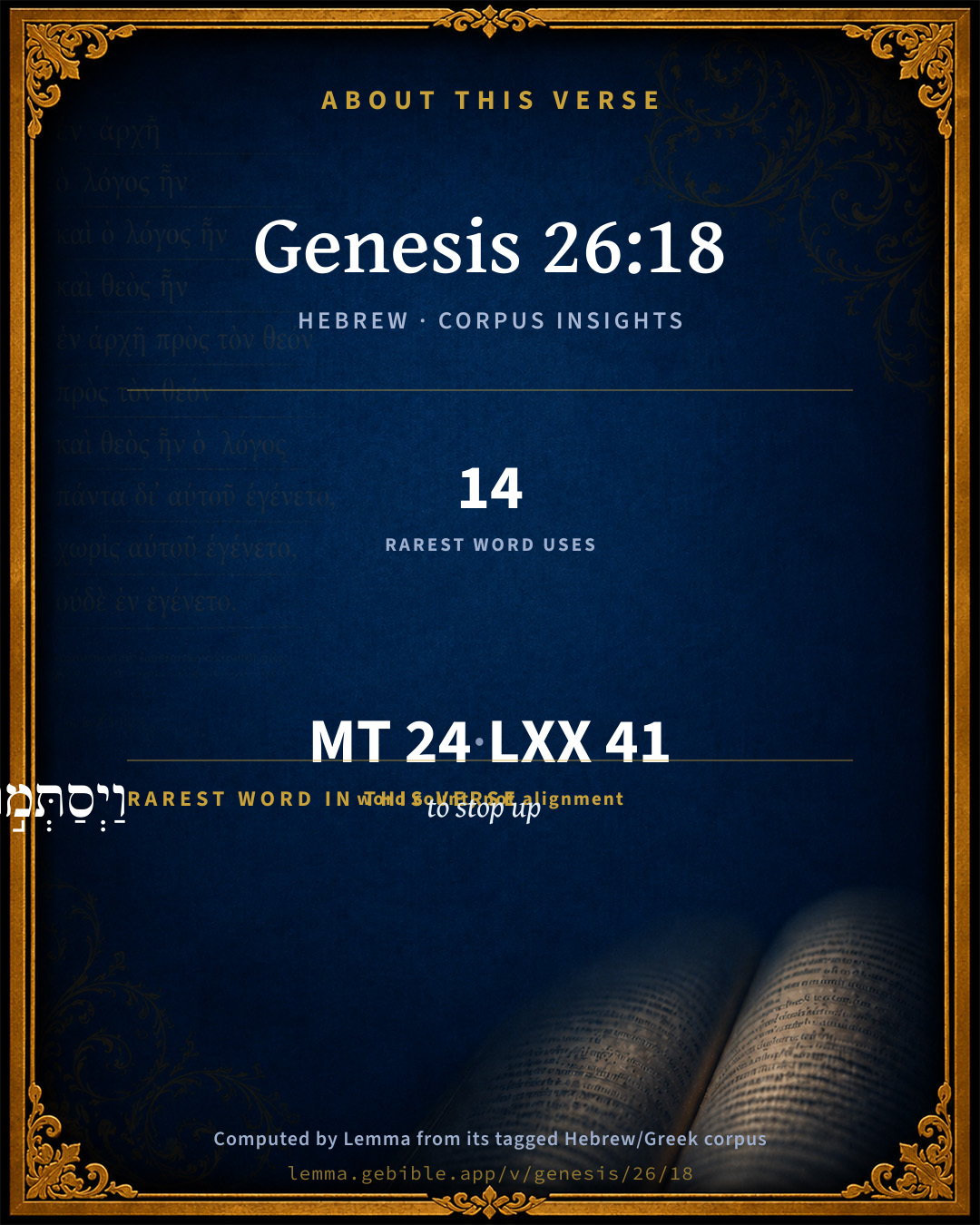
About this verse

These counts appear in no published source. They are computed here, from the morphology-tagged text and Lemma’s own curated glosses. What Lemma adds →

24
words
16
distinct lemmas
Pentateuch
section

Notable vocabulary

The rarest word here is וַיְסַתְּמ֣וּם to stop up H5640 — appearing just 14 times in the whole Hebrew Bible.

Shared distinctive vocabulary

וַיְסַתְּמ֣וּם to stop up H5640 occurs in 14 verses of the Hebrew Bible. Also found in:

Grammatical profile

  • 6 verbs
  • 12 nouns
  • 3 prepositions
  • 3 particles

Verb forms

  • וַיָּ֨שָׁב Qal · Sequential Imperfect
  • וַיַּחְפֹּ֣ר Qal · Sequential Imperfect
  • חָֽפְרוּ֙ Qal · Perfect
  • וַיְסַתְּמ֣וּם Piel · Sequential Imperfect
  • וַיִּקְרָ֤א Qal · Sequential Imperfect
  • קָרָ֥א Qal · Perfect

Repetition

Words recur within this verse — often emphatic in Hebrew:

  • וַיַּחְפֹּ֣ר to dig H2658 ×2
  • אַבְרָהָ֣ם Abraham H85 ×2
  • אָבִ֔יו father H1 ×2
  • וַיִּקְרָ֤א to call H7121 ×2
  • שֵׁמ֔וֹת name H8034 ×2
  • אֲשֶׁ֤ר which H834 ×2

Hebrew & Septuagint length

In English translation the verse runs 43 words from the Hebrew and 45 from the Septuagint (LXX English) — closely comparable.

A rough comparison of the two English renderings, which tokenize alike — not a word-level alignment.

Word counts can differ between the Hebrew and the Greek without any difference in meaning — e.g. the Hebrew direct-object marker אֵת has no separate Greek word, and Greek often adds the article ὁ.

In the original languages it is 24 Hebrew tokens and 41 Greek tokens — but the two are counted differently (Hebrew bundles its prefixes and suffixes into one token; the Greek is in lemma form), so that isn’t a like-for-like length.

Cross-references

5

Topical passages linked to Genesis 26:18 in the Treasury of Scripture Knowledge — connected by theme and wording, ordered by reader-vote popularity; previews shown in the World English Bible.

  • Zechariah 13:2 It will come to pass in that day, says Yahweh of Hosts, that I will cut off the names of the idols out of the land, and they will no more be remembered; and also I will cause the prophets and the spirit of impurity to pass out of the land.
  • Genesis 21:31 Therefore he called that place Beersheba, because they both swore there.
  • Numbers 32:38 and Nebo, and Baal Meon, (their names being changed), and Sibmah: and they gave other names to the cities which they built.
  • Psalms 16:4 Their sorrows shall be multiplied who give gifts to another god. Their drink-offerings of blood I will not offer, Nor take their names on my lips.
  • Hosea 2:17 For I will take away the names of the Baals out of her mouth, And they will no more be mentioned by their name.

Cross-references courtesy of OpenBible.info (CC BY 4.0).

Hebrew and Greek witnesses Masoretic Hebrew ↔ Greek Septuagint

The same verse in the two great witnesses to the Old Testament, shown verse-for-verse.

These are two independent witnesses, not word-aligned to each other, and the Septuagint is shown in lemma (dictionary) form.

Hebrew Genesis 26:18 Masoretic · Westminster Leningrad Codex

וַיָּ֨שָׁב יִצְחָ֜ק וַיַּחְפֹּ֣ר אֶת בְּאֵרֹ֣ת הַמַּ֗יִם אֲשֶׁ֤ר חָֽפְרוּ֙ בִּימֵי֙ אַבְרָהָ֣ם אָבִ֔יו וַיְסַתְּמ֣וּם פְּלִשְׁתִּ֔ים אַחֲרֵ֖י מ֣וֹת אַבְרָהָ֑ם וַיִּקְרָ֤א לָהֶן֙ שֵׁמ֔וֹת כַּשֵּׁמֹ֕ת אֲשֶׁר קָרָ֥א לָהֶ֖ן אָבִֽיו

Isaac dug again the wells of water, which they had dug in the days of Abraham his father. For the Philistines had stopped them after the death of Abraham. He called their names after the names by which his father had called them.

World English Bible · Public Domain

Greek LXX Genesis 26:18 Septuagint · lemma form

καί πάλιν ισαακ ὀρύσσω ὁ φρέαρ ὁ ὕδωρ ὅς ὀρύσσω ὁ παῖς αβρααμ ὁ πατήρ αὐτός καί ἐνφράσσω αὐτός ὁ φυλιστιιμ μετά ὁ ἀποθνήσκω αβρααμ ὁ πατήρ αὐτός καί ἐπιὀνομάζω αὐτός ὄνομα κατά ὁ ὄνομα ὅς ἐπιὀνομάζω αβρααμ ὁ πατήρ αὐτός

And Isaac dug again the wells of water, which the servants of his father Abraam had dug, and the Phylistines had stopped them, after the death of his father Abraam; and he gave them names, according to the names by which his father named them.

LXX2012 (modern English Septuagint) · Public Domain

On this verse, Adam Clarke's Commentary discusses the Septuagint’s reading. Read the note in Commentary ↓

Hebrew: Westminster Leningrad Codex (CC BY 4.0). Greek: Septuagint (public domain); English from LXX2012 (modern English Septuagint) (Public Domain). How the Septuagint differs from the Hebrew →

Targum (Aramaic paraphrase)

2

The Targum is the ancient Jewish Aramaic paraphrase of the Hebrew Scriptures — an interpretive translation, not the Hebrew text itself. Onkelos (literal) and Pseudo-Jonathan (expansive) render the Torah, and Jonathan the Prophets. Coverage is partial: where no permissively-licensed English translation exists for a verse, only the Aramaic is shown. This is verse-level text, not a word-by-word alignment to the Hebrew.

  1. Targum Onkelos Torah (Genesis–Deuteronomy)
    וְתָב יִצְחָק וְחָפַר יָת בֵּירֵי דְמַיָּא דִּי חֲפָרוּ בְּיוֹמֵי אַבְרָהָם אֲבוּהִי וְטַּמּוֹנוּן פְּלִשְׁתָּאֵי בָּתַר דְּמִית אַבְרָהָם וּקְרָא לְהֵן שְׁמָהָן כִּשְׁמָהָן דִּי הֲוָה קָרֵי לְהֵן אֲבוּהִי

    (no public-domain English translation for this verse)

    Targum Onkelos — Aramaic: “Onkelos Genesis” (public domain); “Onkelos Exodus” (public domain); “Onkelos Leviticus” (public domain); “Onkelos Numbers” (public domain); “Onkelos Deuteronomy” (public domain). English: “Sefaria Community Translation” (CC0 1.0 (public-domain dedication)); “J.W. Etheridge. The Targums of Onkelos and Jonathan Ben Uzziel on the Pentateuch. London: Longmans, Green, 1862” (public domain). Text via Sefaria.

  2. Targum Pseudo-Jonathan Torah (Genesis–Deuteronomy)
    וְתַב יִצְחָק וַחֲפַר יַת בֵּירִין דְמוֹי דִי חֲפָרוּ עַבְדֵי אָבוֹי בְּיוֹמֵי אַבְרָהָם אָבוֹי וּטְמוּנִינוּן פְּלִשְׁתָּאֵי בָּתַר דְמִית אַבְרָהָם וּקְרָא לְהוֹן שְׁמָהָן הֵי כִּשְׁמָהָן דִי הֲוָה קָרֵי לְהוֹן אָבוֹי

    And Izhak digged again the wells of water which the servants of his father had digged in the days of Abraham his father, and which the Philistaee had stopped after Abraham was dead; and he called them by the names his father had called them.

    Targum Pseudo-Jonathan — Aramaic: “Targum Jonathan on Genesis” (public domain); “Targum Jonathan on Exodus” (public domain); “Targum Jonathan on Leviticus” (public domain); “Targum Jonathan on Numbers” (public domain); “Targum Jonathan on Deuteronomy” (public domain). English: “The Targum of Jonathan ben Uzziel, trans. J. W. Etheridge, London, 1862” (public domain). Text via Sefaria.

Commentary

Notes on Genesis 26:18 from classic Christian and Jewish commentators (each source and its license shown beneath its notes). The classic Christian expositions comment on the surrounding passage and are grouped to its opening verse, so a note may address several verses; the Jewish commentaries on the Tanakh (Rashi and others) are per-verse, so they appear only where the commentator wrote on this verse.

Lemma curates 59 commentaries, every one of them public domain or Creative Commons licensed, each selected and text-cleaned for this edition rather than reprinted as found. About our sources →

Trapp's Complete Commentary

John Trapp

Gen 26:18 And Isaac digged again the wells of water, which they had digged in the days of Abraham his father; for the Philistines had stopped them after the death of Abraham: and he called their names after the names by which his father had called them.

Ver. 18. Isaac digged again the wells, &c.] Both for more certainty to find water - a scarce commodity in those hot countries; and because the labour was the easier, and his fight the better, since they had once been his father’s.

John Trapp, A Commentary or Exposition upon All the Books of the Old and New Testament (1647–1656) — public domain. Text from a community e-Sword module.

Jamieson, Fausset & Brown

Robert Jamieson, A. R. Fausset & David Brown

Isaac digged again the wells of water--The naming of wells by Abraham, and the hereditary right of his family to the property, the change of the names by the Philistines to obliterate the traces of their origin, the restoration of the names by Isaac, and the contests between the respective shepherds to the exclusive possession of the water, are circumstances that occur among the natives in those regions as frequently in the present day as in the time of Isaac.

Jamieson, Fausset & Brown — Commentary Critical and Explanatory on the Whole Bible (1871) — public domain (CC PDM 1.0). Text via the HelloAO Bible API.

Adam Clarke's Commentary

Verse 18. In the days of Abraham] Instead of בימי bimey, in the days, Houbigant contends we should read עבדי abdey, servants. Isaac digged again the wells which the servants of Abraham his father had digged. This reading is supported by the Samaritan, Septuagint, Syriac, and Vulgate; and it is probably the true one.

Adam Clarke's Commentary on the Bible (1810–1826) — public domain. Text from a community e-Sword/MySword module.

John Calvin's Commentaries

18. And Isaac digged again the wells of water. First, we see that the holy man was so hated by his neighbors, as to be under the necessity of seeking a retreat for himself which was destitute of water; and no habitation is so troublesome and inconvenient for the ordinary purposes of life as that which suffers from scarcity of water. Besides, the abundance of his cattle and the multitude of his servants — who were like a little army — rendered a supply of water very necessary; whence we learn that he was brought into severe straits. But that this last necessity did not instigate him to seek revenge, is a proof of singular forbearance; for we know that lighter injuries will often rack the patience even of humane and moderate men. If any one should object to this view, that he was deficient in strength; I grant, indeed, that he was not able to undertake a regular war; but as his father Abraham had armed four hundred servants, he also certainly had a large troop of domestics, who could easily have repelled any force brought against him by his neighbors. But the hope which he had entertained when he settled in the valley of Gerar, was again suddenly cut off. He knew that his father Abraham had there used wells which were his own, and which he had himself discovered; and although they had been stopped up, yet they were well known to have sufficient springs of water to prevent the labor of digging them again from being misspent. Moreover, the fact that the wells had been obstructed ever since the departure of Abraham, shows how little respect the inhabitants had for their guest; for although their own country would have been benefited by these wells, they chose rather to deprive themselves of this advantage than to have Abraham for a neighbor; for, in order that such a convenience might not attract him to the place, they, by stopping up the wells, did, in a certain sense, intercept his way. It was a custom among the ancients, if they wished to involve any one in ruin, and to cut him off from the society of men, to interdict him from water, and from fire: thus the Philistine, for the purpose of removing Abraham from their vicinity, deprive him of the element of water.

He called their names. He did not give new names to the wells, but restored those which had been assigned them by his father Abraham, that, by this memorial, the ancient possession of them might be renewed. But subsequent violence compelled him to change their names, that at least he might, by some monument, make manifest the injury which had been done by the Philistines, and reprove them on account of it: for whereas he calls one well strife, or contention, another hostility, he denies that the inhabitants possessed that by right, or by any honest title, which they had seized upon as enemies or robbers. Meanwhile, it is right to consider, that in the midst of these strifes he had a contest not less severe with thirst and deficiency of water, whereby the Philistines attempted to destroy him; such is the scope of the history. First, Moses, according to his manner, briefly runs through the summary of the affair: namely, that Isaac intended to apply again to his own purpose the wells which his father had previously found, and to acquire, in the way of recovery, the lost possession of them. He then prosecutes the subject more diffusely, stating that, when he attempted the work, he was unjustly defrauded of his labor; and whereas, in digging the third well, he gives thanks to God, and calls it Room, because, by the favor of God, a more copious supply is now afforded him, he furnishes an example of invincible patience. Therefore, however severely he may have been harassed, yet when, after he had been freed from these troubles, he so placidly returns thanks to God, and celebrates his goodness, he shows that in the midst of trials he has retained a composed and tranquil mind.

John Calvin's Commentaries (1540-1563) — public domain. Text from the Calvin Translation Society English edition (1840s-50s) via the Christian Classics Ethereal Library (ccel.org). Calvin's coverage is partial (roughly two-thirds of the Bible); uncommented books and verses are honest gaps, never fabricated. The 19th-century editor's footnotes and remarks are omitted so the notes are faithfully Calvin's own voice.

Ellicott's Commentary for English Readers

(18-22) Isaac digged again the wells . . . —This activity of Isaac called forth anew the opposition of the Philistines, His first well was in the wady of Gerar, and was the more valuable because it was not the mere remains of the water of the torrent, but was fed by a spring, as we learn from its being called “a well of living water.” But though Isaac had a right to these wells by reason of the old covenant between his father and the king, yet when his claim was resisted he abandoned the well, but in token of displeasure called it Esek, contention. When compelled to resign his next well he called it by a harsher name—Sitnah, enmity; for their opposition was developing into bitter persecution. And now, wearied with the strife, he withdrew far away, and the Philistines, having gained their end, followed him no farther. In quiet, therefore, he again dug a well, and called it Rehoboth, wide open spaces. It has been identified with one in the wady Ruhaibeh now stopped up, but originally twelve feet in diameter and cased with hewn stone. It lies to the south of Beer-sheba, at a distance of 8⅓ leagues, and about forty miles; away from Gerar.

A Bible Commentary for English Readers, edited by Charles John Ellicott (1878–1897) — public domain. Text from a community e-Sword module.

The Cambridge Bible for Schools and Colleges

gen. ed. J. J. S. Perowne

18–22 (J). Isaac’s Wells

18. in the days of Abraham] Instead of “in the days,” Sam., LXX, and Lat. read “the servants,” i.e. “which the servants of Abraham his father had digged.”

The Cambridge Bible for Schools and Colleges (gen. ed. J. J. S. Perowne; Cambridge University Press, 1878–1918) — public domain. Text from a community e-Sword module.

John Gill's Exposition

And Isaac's servants digged in the valley,.... In the valley of Gerar, as the Septuagint version expresses it:

and found there a well of springing water; or "living water" (l), which continually flows, as Aben Ezra rightly interprets it: hence this phrase is used of the perpetual and ever living graces of the Spirit of God, Joh 4:10.

(l) "aquarum viventium", Pagninus, Montanus, Drusius.

John Gill's Exposition of the Whole Bible (1746–1763) — public domain (CC PDM 1.0). Text via the HelloAO Bible API.

Haydock's Catholic Bible Commentary

Servants. So the Septuagint and Syriac versions, and the Samaritan copy against the Hebrew, in the days, which is incorrect. (Kennicott)

George Leo Haydock (1774–1849), Haydock's Catholic Family Bible and Commentary, 1859 edition — public domain. Excludes Psalms (Douay-Rheims chapter numbering differs from Protestant) and Deuterocanonical books (Catholic canon only).

Matthew Poole's English Annotations

Though there might be a brook there, probably it was but little, and soon dried up.

And Isaac digged those rather than new ones, partly to keep up his father’s memory, and partly because he had most right to them, and others less cause of quarrel with him about them.

Matthew Poole's English Annotations on the Holy Bible (1683–1685) — public domain. Text from a community e-Sword/MySword module.

Whedon's Commentary on the Bible

Daniel D. Whedon

18. Digged again the wells — Abraham’s long residence (comp. 21:34) in the districts of Gerar and Beer-sheba had left its traces in many a valley, and after his death the Philistines seem to have hastened to obliterate the witnesses of their treaty with him. Hence the repetition of oaths, treaties, and names like Beer-sheba. Gen_26:33.

Daniel D. Whedon (gen. ed.), Commentary on the Old and New Testaments (1874–1909) — public domain. Text from a community e-Sword module.

The Pulpit Commentary

And Isaac digged again literally, returned and digged, i.e. re-dug (cf. 2Ki_20:5) the wells of water, which they (the servants of Abraham) had digged in the days Of Abraham his father; from which it appears that Abraham had digged other wells besides that of Beersheba (Gen_21:31) for the Philistines had stopped them after the death of Abraham: which was a violation of the league into which Abimelech had entered with the patriarch (vide Gen_21:23) and he called their names after the names by which his father had called them and with which Isaac was sufficiently acquainted.

The Pulpit Commentary (1880–1919), ed. H.D.M. Spence-Jones & Joseph S. Exell — public domain. Text from a community e-Sword module.

Keil & Delitzsch

C. F. Keil & F. Delitzsch

Reopening and Discovery of Wells. - In this valley Isaac dug open the old wells which had existed from Abraham's time, and gave them the old names. His people also dug three new wells. But Abimelech's people raised a contest about two of these; and for this reason Isaac called them Esek and Sitnah, strife and opposition. The third there was no dispute about; and it received in consequence the name Rehoboth, "breadths," for Isaac said, "Yea now (כּי־עתּה, as in Gen 29:32, etc.) Jehovah has provided for us a broad space, that we may be fruitful (multiply) in the land." This well was probably not in the land of Gerar, as Isaac had removed thence, but in the Wady Ruhaibeh, the name of which is suggestive of Rehoboth, which stands at the point where the two roads from Gaza and Hebron meet, about 3 hours to the south of Elusa, 8 1/3 to the south of Beersheba, and where there are extensive ruins of the city of the same name upon the heights, also the remains of wells (Robinson, Pal. i. 289ff.; Strauss, Sinai and Golgotha); where too the name Sitnah seems to have been retained in the Wady Shutein, with ruins on the northern hills between Ruhaibeh and Khulasa (Elusa).

Keil & Delitzsch — Biblical Commentary on the Old Testament (1861–1891) — public domain (CC PDM 1.0). Text via the HelloAO Bible API. (Old Testament only.)

unfoldingWord translationNotes

Door43 World Missions Community

Isaac dug out

Here "Isaac" stands for Isaac and his servants. AT: "Isaac and his servants dug out" (See: Synecdoche)

which they had dug

"which Abraham's servants had dug"

in the days of Abraham his father

"during his father Abraham's lifetime" or "when Abraham, his father, was living"

The Philistines had stopped them up

This was the reason that Isaac dug them out. Possible ways to translate this are: 1) Since this happened first, this sentence can come before the sentence about Isaac digging them out, as in the UDB. or 2) This sentence can start with "Isaac did this because the Philistines had stopped them up." (See: Order of Events)

had stopped them up

"had filled them with earth"

translationWords

cistern

Abraham

unfoldingWord translationNotes — © Distant Shores Media and the Door43 World Missions Community, licensed CC BY-SA 4.0. Source: git.door43.org/Door43/en_tn.

Rashi

Rabbi Shlomo Yitzchaki (Rashi)

וישב ויחפר AND ISAAC DIGGED AGAIN — those wells which they had dug in the days of his father Abraham and which the Philistines had stopped up before Isaac left Gerar he once again dug.

Rashi on the Tanakh — English translations: “The Judaica Press complete Tanach with Rashi, translated by A. J. Rosenberg” (CC BY 4.0); “Pentateuch with Rashi's commentary by M. Rosenbaum and A.M. Silbermann, 1929-1934” (public domain); “The Metsudah Tanach series, Lakewood, N.J” (CC BY 4.0); and “The Book of Joshua, Metsudah Publications, 1997” (CC BY 4.0). Text via Sefaria.

Radak

Rabbi David Kimhi (Radak)

וישב יצחק...אשר חפרו, the servants of his father.

כשמות, with the same names in order to maintain unbroken continuity of ownership.

Radak on the Tanakh — English translations: “Sefaria Community Translation” (CC0 1.0 (public-domain dedication)); “Eliyahu Munk, HaChut Hameshulash” (CC BY 4.0); “Rabbi Mike Feuer, Jerusalem Anthology” (CC BY 4.0); and “R. David Kimhi on the first book of Psalms, Translated by R.G. Finch, London, 1919” (public domain). Text via Sefaria.

Lesson kit

Teaching starters — assembled from the data on this page, not authored interpretation. Every prompt links to the verse data it draws on. Edit before teaching.

Genesis, in the Pentateuch, opens this verse with 24 words (16 distinct Hebrew lemmas). Its most distinctive word is çâtham (“to stop up”). A historical commentator’s framing appears above. Read the whole chapter for the surrounding context.

Discussion questions

  1. The word çâtham carries the sense “to stop up.” How does it shape the verse?
  2. How does Genesis 26:15, which shares the word «to stop up», read alongside this verse?
  3. What does the repetition of “to dig” (2× in this one verse) do in this verse?
  4. These translations render this verse differently; the difference is in the English rendering, not the original. What questions does that raise?
  5. «וַיָּ֨שָׁב» is a Qal Sequential Imperfect verb. How does that grammatical form shape the action described?
  6. Compare how Trapp's Complete Commentary and Jamieson, Fausset & Brown read this verse. Where do they agree or differ?

Things to notice

Reading settings

Reading text

Shown beneath each verse's original-language words.

Old Testament
Old Testament edition

Read the OT as the Masoretic Hebrew (MT) or the Greek Septuagint (LXX).

English shown for the Greek Septuagint (in the Hebrew ↔ Greek comparison).

Comparing translations? Open the Compare panel on any verse page to stack up to four side by side.