
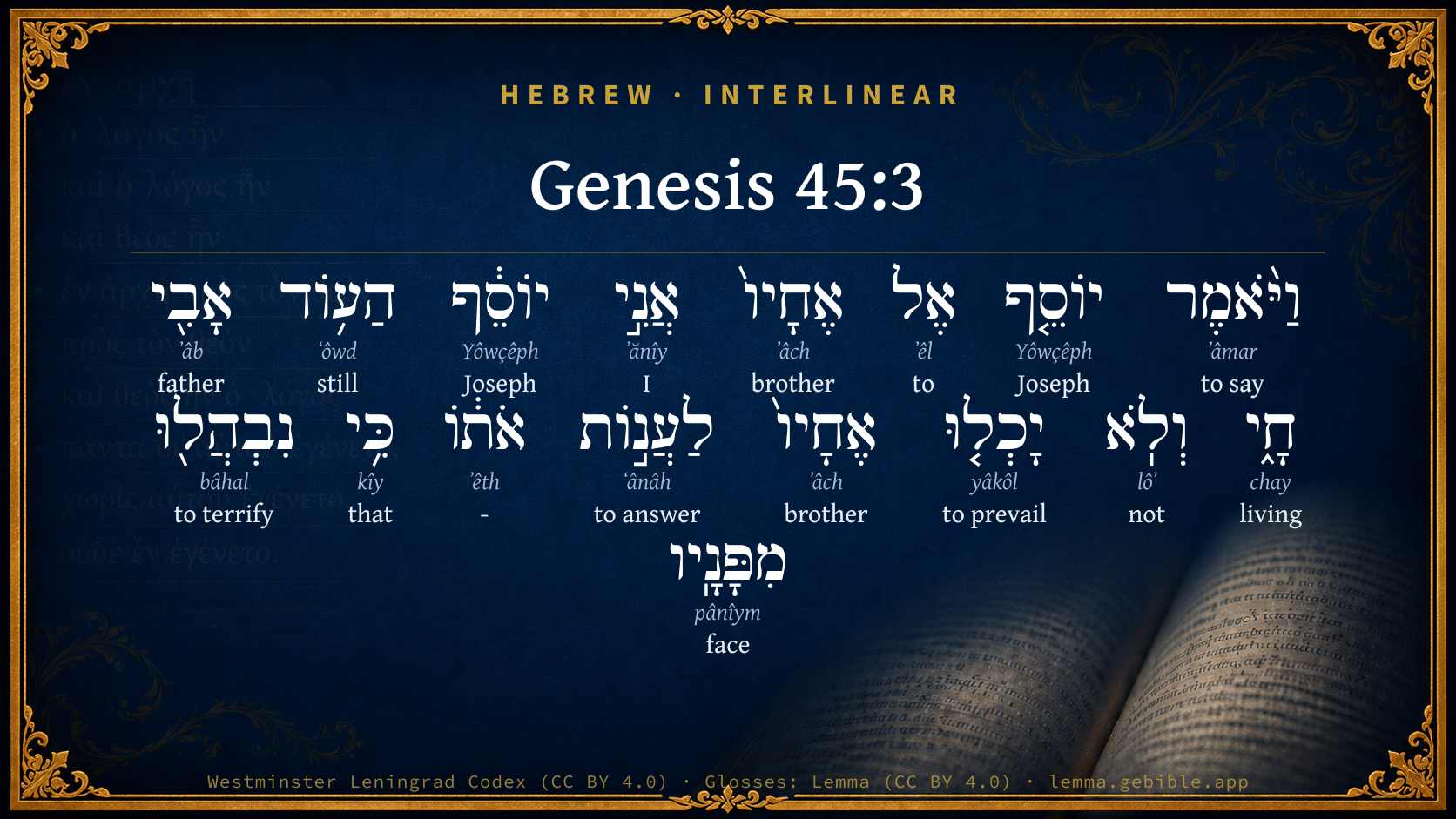
Genesis 45:3

Hebrew (Westminster Leningrad Codex) Genesis 45:3 appears in the Hebrew Old Testament. The text above is from the Westminster Leningrad Codex. Each word links to its Strong’s number, a concise gloss, and parsing drawn from the Open Scriptures Hebrew Bible morphology. Click any word for its full Brown-Driver-Briggs (BDB) entry.
Download image
Cite this verse

Genesis 45:3 (World English Bible). Public Domain. Lemma interlinear Bible study tool, https://lemma.gebible.app/v/genesis/45/3.

Show BibTeX & RIS
BibTeX
RIS
English Translation
Joseph said to his brothers, "I am Joseph! Does my father still live?" His brothers couldn't answer him; for they were terrified at his presence.
World English Bible · Public Domain
Highlights
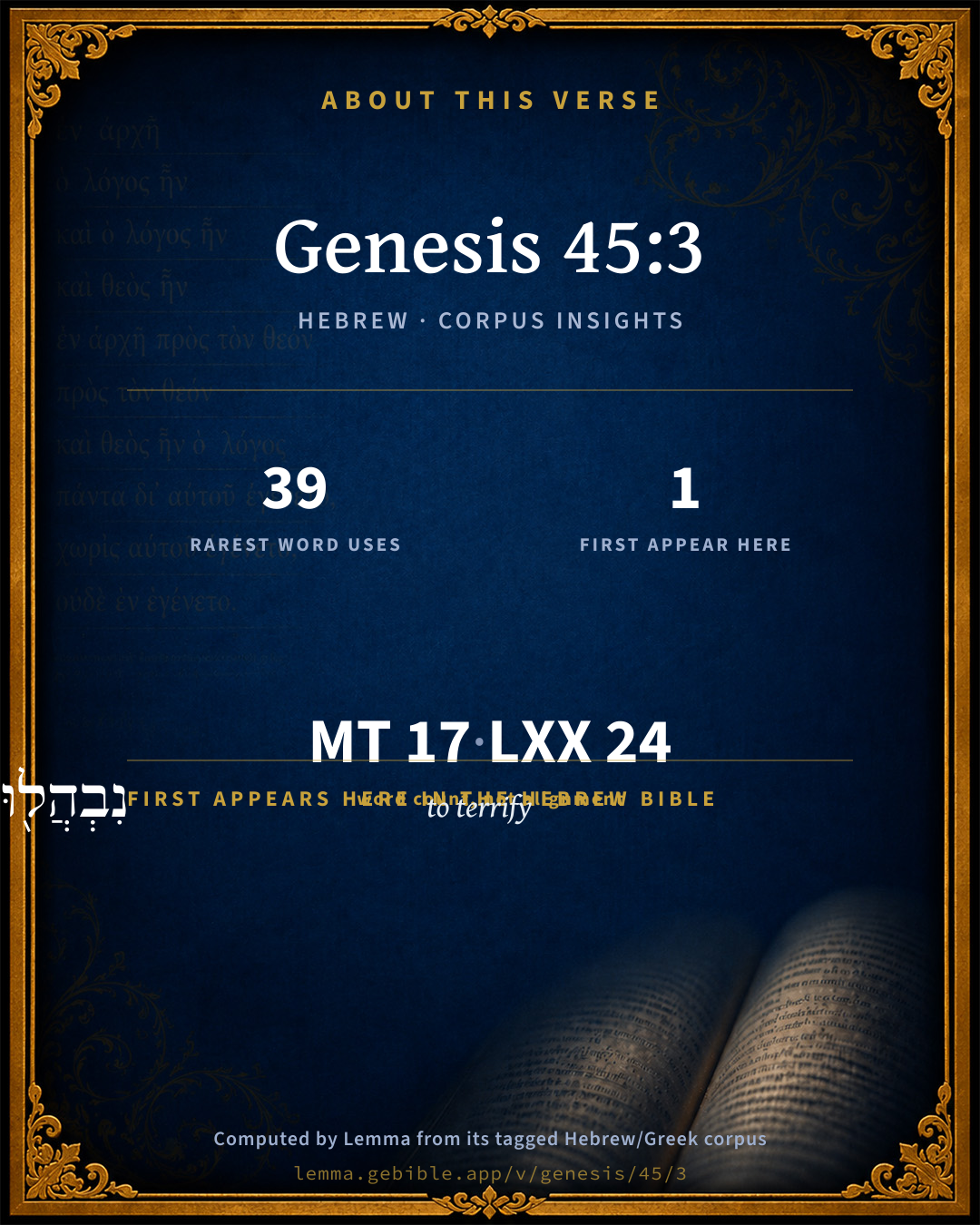
  • 1 first appearance in the Hebrew Bible
Full analysis ↓
Download a study sheet

One document with this verse’s original text, its word-by-word gloss line, the meaning frame, cross-references with their text, attributed commentary, and full source and license credits — printable, and it pastes into notes with its structure intact.

This verse Autodidact and up

Study sheet (.html) Plain text (.txt)

A passage Seminary Student

Up to 50 verses in one chapter. A passage sheet keeps up to 6 commentary sources and 12 cross-references per verse, in the order this page ranks them, and says so on the sheet whenever that leaves anything out. Ask for a single verse and you get the Autodidact verse sheet above.

Everything on this page stays free to read, with no account — the sheet is a download of what is already on screen, not access to it.

Want to remove ads? Support Godless Engineer
Compare translations 3

The same verse in 3 English versions, stacked beneath the original-language interlinear above. Click any original word for its lexicon entry.

Each is an independent rendering of the whole verse — the interlinear is not word-aligned to these translations.

Highlighted words mark where these versions differ — a whole-verse word diff, not a word-by-word alignment.

  • World English Bible Public Domain
    Joseph said to his brothers, "I am Joseph! Does my father still live?" His brothers couldn't answer him; for they were terrified at his presence.
  • King James Version Public Domain
    And Joseph said unto his brethren, I am Joseph; doth my father yet live? And his brethren could not answer him; for they were troubled at his presence.
  • unfoldingWord Literal Text CC BY-SA 4.0
    Then Joseph said to his brothers, “I Joseph! Is my father still alive?” But his brothers were not able to answer him, because they were terrified at his presence.

unfoldingWord Literal Text — © unfoldingWord, licensed CC BY-SA 4.0. Word-aligned USFM3 via Door43 (git.door43.org/unfoldingWord/en_ult).

Versions to compare (up to 4)

3 of 4 selected

Show all 18 translations

Every available English version of this verse, each an independent rendering of the whole verse.

  • World English Bible Public Domain
    Joseph said to his brothers, "I am Joseph! Does my father still live?" His brothers couldn't answer him; for they were terrified at his presence.
  • Berean Standard Bible Public Domain
    Joseph said to his brothers, “I am Joseph! Is my father still alive?” But they were unable to answer him, because they were terrified in his presence.
  • Majority Standard Bible Public Domain
    Joseph said to his brothers, “I am Joseph! Is my father still alive?” But they were unable to answer him, because they were terrified in his presence.
  • King James Version Public Domain
    And Joseph said unto his brethren, I am Joseph; doth my father yet live? And his brethren could not answer him; for they were troubled at his presence.
  • American Standard Version (1901) Public Domain
    And Joseph said unto his brethren, I am Joseph; doth my father yet live? And his brethren could not answer him; for they were troubled at his presence.
  • Revised Version (1885) Public Domain
    And Joseph said unto his brethren, I am Joseph; doth my father yet live? And his brethren could not answer him; for they were troubled at his presence.
  • Geneva Bible (1599) Public Domain
    Then Ioseph sayde to his brethren, I am Ioseph: doeth my father yet liue? But his brethren coulde not answere him, for they were astonished at his presence.
  • Douay-Rheims (1899) Public Domain
    And he said to his brethren: I am Joseph: is my father yet living? His brethren could no answer him, being struck with exceeding great fear.
  • Young's Literal Translation Public Domain
    And Joseph saith unto his brethren, `I `am' Joseph, is my father yet alive?' and his brethren have not been able to answer him, for they have been troubled at his presence.
  • Literal Standard Version CC BY-SA 4.0
    And Joseph says to his brothers, “I [am] Joseph, is my father yet alive?” And his brothers have not been able to answer him, for they have been troubled at his presence.
  • Unlocked Literal Bible CC BY-SA 4.0
    Joseph said to his brothers, “I am Joseph. Is my father still alive?” His brothers could not answer him, for they were shocked in his presence.
  • unfoldingWord Literal Text CC BY-SA 4.0
    Then Joseph said to his brothers, “I Joseph! Is my father still alive?” But his brothers were not able to answer him, because they were terrified at his presence.
  • Darby Bible Public Domain
    And Joseph said to his brethren, I am Joseph. Does my father yet live? And his brethren could not answer him, for they were troubled at his presence.
  • World Messianic Bible Public Domain
    Joseph said to his brothers, “I am Joseph! Does my father still live?” His brothers couldn’t answer him; for they were terrified at his presence.
  • Webster's Bible Public Domain
    And Joseph said to his brethren, I am Joseph; doth my father yet live? And his brethren could not answer him; for they were troubled at his presence.
  • Free Bible Version CC BY-SA 4.0
    “I'm Joseph!” he announced to his brothers. “Is my father still alive?” They couldn't answer him as they were so surprised to see him face to face.
  • Bible in Basic English Public Domain
    And Joseph said to his brothers, I am Joseph: is my father still living? But his brothers were not able to give him an answer for they were troubled before him.
  • JPS Tanakh (1917) Public Domain
    And Joseph said unto his brethren: 'I am Joseph; doth my father yet live?' And his brethren could not answer him; for they were affrighted at his presence.

Literal Standard Version (2020), Covenant Press — licensed CC BY-SA 4.0. Text via the HelloAO Bible API (eBible.org). Unlocked Literal Bible (unfoldingWord) — licensed CC BY-SA 4.0. Text via the HelloAO Bible API (eBible.org). unfoldingWord Literal Text — © unfoldingWord, licensed CC BY-SA 4.0. Word-aligned USFM3 via Door43 (git.door43.org/unfoldingWord/en_ult). Free Bible Version, Dr. Jonathan Gallagher — licensed CC BY-SA 4.0. Text via the HelloAO Bible API (eBible.org).

Word by word

More ways to search: Search by grammar → Find every occurrence → Compare this word →

Practice this passage: Drill this verse → Learn its vocabulary →

נִבְהֲל֖וּ
bâhal
H926
“to terrify”
Verb, Niphal, Perfect, 3rd Person, Common, Plural
Part of Speech
Verb
Stem
Niphal
Form
Perfect
Person
3rd Person
Gender
Common
Number
Plural
Full BDB Definition

Origin: a primitive root

TWOT: 207

to disturb, alarm, terrify, hurry, be disturbed, be anxious, be afraid, be hurried, be nervous - (Niphal) - to be disturbed, dismayed, terrified, anxious - to be in haste, be hasty - (Piel) - to make haste, act hastily, be hurried, be hastened - to dismay, terrify - (Pual) - to hasten - hastened, hastily gained (participle) - (Hiphil) - to hasten, hurry, make haste - to dismay, terrify
  1. וַיֹּ֨אמֶר ʼâmar H559 “and · to say” Conjunction + Verb, Qal, Sequential Imperfect, 3rd Person, Masculine, Singular
  2. יוֹסֵ֤ף Yôwçêph H3130 “Joseph” Noun, Proper
  3. אֶל ʼêl H413 “to” Preposition
  4. אֶחָיו֙ ʼâch H251 “brothers · his” Noun, Common, Masculine, Plural, Construct + Suffix, Personal, 3rd Person, Masculine, Singular
  5. אֲנִ֣י ʼănîy H589 “I” Pronoun, Personal, 1st Person, Common, Singular
  6. יוֹסֵ֔ף Yôwçêph H3130 “Joseph” Noun, Proper
  7. הַע֥וֹד ʻôwd H5750 “still” Particle, Interrogative + Adverb
  8. אָבִ֖י ʼâb H1 “father · my” Noun, Common, Masculine, Singular, Construct + Suffix, Personal, 1st Person, Common, Singular
  9. חָ֑י chay H2416 “living” Adjective, Adjective, Masculine, Singular, Absolute
  10. וְלֹֽא lôʼ H3808 “and · not” Conjunction + Particle, Negative
  11. יָכְל֤וּ yâkôl H3201 “to prevail” Verb, Qal, Perfect, 3rd Person, Common, Plural
  12. אֶחָיו֙ ʼâch H251 “brothers · his” Noun, Common, Masculine, Plural, Construct + Suffix, Personal, 3rd Person, Masculine, Singular
  13. לַעֲנ֣וֹת ʻânâh H6030 “to answer” Preposition + Verb, Qal, Infinitive Construct
  14. אֹת֔וֹ ʼêth H853 “- · him” Particle, Direct Object + Suffix, Personal, 3rd Person, Masculine, Singular
  15. כִּ֥י kîy H3588 “that” Conjunction
  16. מִפָּנָֽיו pânîym H6440 “from · face(s) · his” Preposition + Noun, Common, Both, Plural, Construct + Suffix, Personal, 3rd Person, Masculine, Singular

About this verse

These counts appear in no published source. They are computed here, from the morphology-tagged text and Lemma’s own curated glosses. What Lemma adds →

17
words
15
distinct lemmas
Pentateuch
section

First appearance in Scripture

This word makes its first canonical appearance in the Hebrew Bible here:

  • נִבְהֲל֖וּ to terrify H926

Shared distinctive vocabulary

נִבְהֲל֖וּ to terrify H926 occurs in 39 verses of the Hebrew Bible. Also found in:

Grammatical profile

  • 4 verbs
  • 6 nouns
  • 1 adjective
  • 1 pronoun
  • 1 preposition
  • 1 conjunction
  • 1 adverb
  • 2 particles

Verb forms

  • וַיֹּ֨אמֶר Qal · Sequential Imperfect
  • יָכְל֤וּ Qal · Perfect
  • לַעֲנ֣וֹת Qal · Infinitive Construct
  • נִבְהֲל֖וּ Niphal · Perfect

Repetition

Words recur within this verse — often emphatic in Hebrew:

  • יוֹסֵ֤ף Joseph H3130 ×2
  • אֶחָיו֙ brother H251 ×2

Hebrew & Septuagint length

In English translation the verse runs 25 words from the Hebrew and 25 from the Septuagint (LXX English) — the same length.

A rough comparison of the two English renderings, which tokenize alike — not a word-level alignment.

Word counts can differ between the Hebrew and the Greek without any difference in meaning — e.g. the Hebrew direct-object marker אֵת has no separate Greek word, and Greek often adds the article ὁ.

In the original languages it is 17 Hebrew tokens and 24 Greek tokens — but the two are counted differently (Hebrew bundles its prefixes and suffixes into one token; the Greek is in lemma form), so that isn’t a like-for-like length.

Cross-references

10

Topical passages linked to Genesis 45:3 in the Treasury of Scripture Knowledge — connected by theme and wording, ordered by reader-vote popularity; previews shown in the World English Bible.

  • Acts 7:13 On the second time Joseph was made known to his brothers, and Joseph's race was revealed to Pharaoh.
  • Acts 9:5 He said, "Who are you, Lord?" The Lord said, "I am Jesus, whom you are persecuting.
  • Zechariah 12:10 I will pour on the house of David, and on the inhabitants of Jerusalem, the spirit of grace and of supplication; and they will look to me whom they have pierced; and they shall mourn for him, as one mourns for his only son, and will grieve bitterly for him, as one grieves for his firstborn.
  • Job 4:5 But now it is come to you, and you faint; It touches you, and you are troubled.
  • Job 23:15 Therefore I am terrified at his presence. When I consider, I am afraid of him.
  • Matthew 14:26–27 When the disciples saw him walking on the sea, they were troubled, saying, "It's a ghost!" and they cried out for fear.
  • Mark 6:50 for they all saw him, and were troubled. But he immediately spoke with them, and said to them, "Cheer up! It is I! Don't be afraid."
  • Luke 5:8 But Simon Peter, when he saw it, fell down at Jesus' knees, saying, "Depart from me, for I am a sinful man, Lord."
  • Luke 24:37–38 But they were terrified and filled with fear, and supposed that they had seen a spirit.
  • Revelation 1:7 Behold, he is coming with the clouds, and every eye will see him, including those who pierced him. All the tribes of the earth will mourn over him. Even so, Amen.

Cross-references courtesy of OpenBible.info (CC BY 4.0).

Hebrew and Greek witnesses Masoretic Hebrew ↔ Greek Septuagint

The same verse in the two great witnesses to the Old Testament, shown verse-for-verse.

These are two independent witnesses, not word-aligned to each other, and the Septuagint is shown in lemma (dictionary) form.

Hebrew Genesis 45:3 Masoretic · Westminster Leningrad Codex

וַיֹּ֨אמֶר יוֹסֵ֤ף אֶל אֶחָיו֙ אֲנִ֣י יוֹסֵ֔ף הַע֥וֹד אָבִ֖י חָ֑י וְלֹֽא יָכְל֤וּ אֶחָיו֙ לַעֲנ֣וֹת אֹת֔וֹ כִּ֥י נִבְהֲל֖וּ מִפָּנָֽיו

Joseph said to his brothers, "I am Joseph! Does my father still live?" His brothers couldn't answer him; for they were terrified at his presence.

World English Bible · Public Domain

Greek LXX Genesis 45:3 Septuagint · lemma form

εἶπον δέ ιωσηφ πρός ὁ ἀδελφός αὐτός ἐγώ εἰμί ιωσηφ ἔτι ὁ πατήρ ἐγώ ζάω καί οὐ δύναμαι ὁ ἀδελφός ἀποκρίνω αὐτός ταράσσω γάρ

And Joseph said to his brethren, I am Joseph; does my father yet live? And his brethren could not answer him, for they were troubled.

LXX2012 (modern English Septuagint) · Public Domain

Hebrew: Westminster Leningrad Codex (CC BY 4.0). Greek: Septuagint (public domain); English from LXX2012 (modern English Septuagint) (Public Domain). How the Septuagint differs from the Hebrew →

Targum (Aramaic paraphrase)

2

The Targum is the ancient Jewish Aramaic paraphrase of the Hebrew Scriptures — an interpretive translation, not the Hebrew text itself. Onkelos (literal) and Pseudo-Jonathan (expansive) render the Torah, and Jonathan the Prophets. Coverage is partial: where no permissively-licensed English translation exists for a verse, only the Aramaic is shown. This is verse-level text, not a word-by-word alignment to the Hebrew.

  1. Targum Onkelos Torah (Genesis–Deuteronomy)
    וַאֲמַר יוֹסֵף לַאֲחוֹהִי אֲנָא יוֹסֵף הַעַד כְּעַן אַבָּא קַיָּם וְלָא יָכִילוּ אֲחוֹהִי לַאֲתָבָא יָתֵהּ פִּתְגָּם ארֵי אִתְבְּהִילוּ מִן קֳדָמוֹהִי

    (no public-domain English translation for this verse)

    Targum Onkelos — Aramaic: “Onkelos Genesis” (public domain); “Onkelos Exodus” (public domain); “Onkelos Leviticus” (public domain); “Onkelos Numbers” (public domain); “Onkelos Deuteronomy” (public domain). English: “Sefaria Community Translation” (CC0 1.0 (public-domain dedication)); “J.W. Etheridge. The Targums of Onkelos and Jonathan Ben Uzziel on the Pentateuch. London: Longmans, Green, 1862” (public domain). Text via Sefaria.

  2. Targum Pseudo-Jonathan Torah (Genesis–Deuteronomy)
    וַאֲמַר יוֹסֵף לְאָחוֹי אֲנָא הוּא יוֹסֵף הַעוֹד כְּדוֹן אַבָּא קַיֵים וְלָא יָכִילוּ אָחוֹי לְאַתָבָא לֵיהּ פִּתְגַם אֲרוּם אִתְבְּהִילוּ מִן קֳדָמוֹי

    And Joseph said to his brothers, I am Joseph! Is my father yet alive? But his brothers could not answer him a word; for they were troubled before him.

    Targum Pseudo-Jonathan — Aramaic: “Targum Jonathan on Genesis” (public domain); “Targum Jonathan on Exodus” (public domain); “Targum Jonathan on Leviticus” (public domain); “Targum Jonathan on Numbers” (public domain); “Targum Jonathan on Deuteronomy” (public domain). English: “The Targum of Jonathan ben Uzziel, trans. J. W. Etheridge, London, 1862” (public domain). Text via Sefaria.

Commentary

Notes on Genesis 45:3 from classic Christian and Jewish commentators (each source and its license shown beneath its notes). The classic Christian expositions comment on the surrounding passage and are grouped to its opening verse, so a note may address several verses; the Jewish commentaries on the Tanakh (Rashi and others) are per-verse, so they appear only where the commentator wrote on this verse.

Lemma curates 59 commentaries, every one of them public domain or Creative Commons licensed, each selected and text-cleaned for this edition rather than reprinted as found. About our sources →

Trapp's Complete Commentary

John Trapp

Gen 45:3 And Joseph said unto his brethren, I [am] Joseph; doth my father yet live? And his brethren could not answer him; for they were troubled at his presence.

Ver. 3. I am Joseph.] What a word was that! At the hearing thereof, what a strange conflict of contrary passions fell out in the hearts of the patriarchs! Wonder, doubt, reverence, fear, hope, guiltiness, joy, grief, struck them at once. Shall it not be so with the Jews at their glorious conversion, when they shall hear, "I am Jesus of Nazareth, whom ye have persecuted and pierced?" {Zec 12:10 Rev 1:7} {See Trapp on "Gen 38:27"}

John Trapp, A Commentary or Exposition upon All the Books of the Old and New Testament (1647–1656) — public domain. Text from a community e-Sword module.

Joseph Benson's Commentary

Gen 45:3. I am Joseph — Doubtless he had all along been addressed and spoken of by his Egyptian name, Zaphnath-paaneah, or by his titles of office: so that, although in the narrative he is named Joseph, it is probable his brethren had never heard him called by that name by any person in Egypt. Doth my father yet live? — A most natural inquiry this, after he had informed them who he was, and evidently suggested by his love to his father, respecting whose welfare he was anxious to have full information; and it comes in here with great beauty, and by a most easy transition. But who can describe what his brethren now felt? The historian does not attempt to describe it: he only informs us, They could not answer him: for they were troubled at his presence — From a sudden and deep sense of their guilt, and their just fear of some dreadful punishment. Therefore, to encourage them and alleviate their sorrow, he calls them kindly and familiarly to him: Come near to me, I pray you — Thus, when Christ manifests himself to his people, he encourages them to draw near to him with a true heart — Perhaps being about to speak of their selling of him, he would not speak aloud, lest the Egyptians should overhear, and it should make the Hebrews to be yet more an abomination to them; therefore he would have them come near, that he might whisper with them, which, now the tide of his passion was a little over, he was able to do, whereas, at first, he could not but cry out.

Joseph Benson's Commentary on the Old and New Testaments (1811–1818) — public domain. Text from a community e-Sword module.

Tyndale Open Study Notes

Tyndale Open Resources

45:3 The brothers were stunned at the news, unable to speak from amazement and fear (45:5; cp. 50:15).

Tyndale Open Study Notes — © Tyndale Open Resources, licensed CC BY-SA 4.0. Text via the HelloAO Bible API.

Jamieson, Fausset & Brown

Robert Jamieson, A. R. Fausset & David Brown

I am Joseph--or, "terrified at his presence." The emotions that now rose in his breast as well as that of his brethren--and chased each other in rapid succession--were many and violent. He was agitated by sympathy and joy; they were astonished, confounded, terrified; and betrayed their terror, by shrinking as far as they could from his presence. So "troubled" were they, that he had to repeat his announcement of himself; and what kind, affectionate terms he did use. He spoke of their having sold him--not to wound their feelings, but to convince them of his identity; and then, to reassure their minds, he traced the agency of an overruling Providence, in his exile and present honor [Gen 35:5-7]. Not that he wished them to roll the responsibility of their crime on God; no, his only object was to encourage their confidence and induce them to trust in the plans he had formed for the future comfort of their father and themselves.

Jamieson, Fausset & Brown — Commentary Critical and Explanatory on the Whole Bible (1871) — public domain (CC PDM 1.0). Text via the HelloAO Bible API.

Adam Clarke's Commentary

Verse 3. I am Joseph] Mr. Pope supposed that the discovery of Ulysses to his son Telemachus bears some resemblance to Joseph's discovery of himself to his brethren. The passage may be seen in Homer, Odyss. l. xvi., ver. 186-218.

A few lines from Cowper's translation will show much of the spirit of the original, and also a considerable analogy between the two scenes: -

"I am thy father, for whose sake thou lead'st

A life of wo by violence oppress'd.

So saying, he kiss'd his son; while from his cheeks

Tears trickled, tears till then perforce restrain'd.

Then threw Telemachus

His arms around his father's neck, and wept.

Pangs of soft sorrow, not to be suppress'd,

Seized both. So they, their cheeks with big round drops of wo

Bedewing, stood."

Adam Clarke's Commentary on the Bible (1810–1826) — public domain. Text from a community e-Sword/MySword module.

John Calvin's Commentaries

3. I am Joseph. Although he had given them the clearest token of his mildness and his love, yet, when he told them his name, they were terrified, as if he had thundered against them: for while they revolve in their minds what they have deserved, the power of Joseph seems so formidable to them, that they anticipate nothing for themselves but death. When, however, he sees them overcome with fear, he utters no reproach, but only labors to calm their perturbation. Nay, he continues gently to soothe them, until he has rendered them composed and cheerful. By this example we are taught to take heed lest sadness should overwhelm those who are truly and seriously humbled under a sense of shame. So long as the offender is deaf to reproofs, or securely flatters himself, or wickedly and obstinately repels admonitions, or excuses himself by hypocrisy, greater severity is to be used towards him. But rigor should have its bounds, and as soon as the offender lies prostrate, and trembles under the sense of his sin, let that moderation immediately follow which may raise him who is cast down, by the hope of pardon. Therefore, in order that our severity may be rightly and duly attempered, we must cultivate this inward affection of Joseph, which will show itself at the proper time.

John Calvin's Commentaries (1540-1563) — public domain. Text from the Calvin Translation Society English edition (1840s-50s) via the Christian Classics Ethereal Library (ccel.org). Calvin's coverage is partial (roughly two-thirds of the Bible); uncommented books and verses are honest gaps, never fabricated. The 19th-century editor's footnotes and remarks are omitted so the notes are faithfully Calvin's own voice.

The Cambridge Bible for Schools and Colleges

gen. ed. J. J. S. Perowne

3. doth my father yet live?] This question has seemed to some a strange one after the interviews which Joseph has already had (Gen_43:27-28). But the thought of his father is uppermost in his mind, and in the agitation of the moment the turn which he gives to this first question seems to imply a desire to forget the last occasion on which they had met as brothers. He does not wait for an answer, or expect one.

they were troubled, &c.] Cf. Gen_50:15-21. No wonder that confusion and consternation made them speechless.

The Cambridge Bible for Schools and Colleges (gen. ed. J. J. S. Perowne; Cambridge University Press, 1878–1918) — public domain. Text from a community e-Sword module.

John Gill's Exposition

And Joseph said unto his brethren, I am Joseph,.... As soon as he could compose himself a little, and utter his words, the first thing he said was, that he was Joseph; that was his right name, his Hebrew name; though he was called by the Egyptians Zaphnathpaaneah, and by which name Joseph's brethren only knew him, if they knew his name at all; and it must be very startling to them to bear this sound, and to be told by himself that that was his name; and which was not all he meant and they understood, but that he was Joseph their brother as afterwards expressed:

doth my father yet live? this he knew before, for they had told him he was alive; wherefore he puts this question not through ignorance, or as doubting but to express his affliction for his father, and his joy that he was alive:

and his brethren could not answer him; they were so surprised and astonished; they were like men thunderstruck, they were not able to utter a word for awhile:

for they were troubled at his presence; the sin of selling him came fresh into their minds, the guilt of it pressed their consciences, and the circumstances that Joseph was in filled them with fear that he would avenge himself on them.

John Gill's Exposition of the Whole Bible (1746–1763) — public domain (CC PDM 1.0). Text via the HelloAO Bible API.

Matthew Poole's English Annotations

He repeats his former question, Gen 43:27, either because he questioned the truth of their former relation, or would be further satisfied in it, it being usual with men to ask over and over again what they long to know; or because he now desired a more particular relation of his father’s condition, and how he did bear up under all his calamities.

They were troubled at his presence, from a sudden and deep sense of their horrid guilt, and their just fear of some dreadful punishment.

Matthew Poole's English Annotations on the Holy Bible (1683–1685) — public domain. Text from a community e-Sword/MySword module.

Whedon's Commentary on the Bible

Daniel D. Whedon

3. Doth my father yet live — In the warmth and fulness of his emotion he seems yet to betray a suspicion of the report of his brethren. This throws light on the undue severity with which he has treated them all along. First he feared that Benjamin was not; and now he even intimates a doubt whether, after all their protestations, his father is still alive. Accordingly, his brethren could not answer him — The sudden revelation; the deep insinuation; the shock of mingled surprise and alarm rendered them speechless.

They were troubled — Terrified; filled with amazement and trepidation (נבהלו) at his presence, or, from his presence, (מפניו;) as if they shrunk backward, away from before his face.

Daniel D. Whedon (gen. ed.), Commentary on the Old and New Testaments (1874–1909) — public domain. Text from a community e-Sword module.

The Pulpit Commentary

And Joseph said unto his brethren, I am Joseph. The effect of this announcement can be better imagined than described. Hitherto he had been known to his brethren as Zaphnath-paaneah. Now the voice and the appearance of their long-lost brother would rush upon their minds at the first sound of the familiar name, and fill them with apprehension. Probably Joseph"s discernment of this in their countenances was the reason why he asked so abruptly after Jacob. Doth my father yet live? It is not now "the old man of whom ye spake" (Gen_43:27) for whom Joseph inquires, but his own beloved and revered parent father." "Before it was a question of courtesy, but now of love" (Alford). And his brethren could not answer him; for they were troubled (or cast into a trepidation, hence terrified) at his presenceliterally, before his face.

Not only did his present greatness overawe them, but the recollection of their former crimes against him filled them with alarm.

HOMILIES BY J.F. MONTGOMERY

Ver. 3.

The great announcement.

Not a stranger, but a brother. Yet they were slow to receive comfort from it. The fact beyond all expectation; the suspicion of the unknown ruler attaching itself to the newly-found brother; the remembrance of their own former cruelty; the doubt whether indeed the past were forgiven, combined to make them "troubled at his presence." Akin to this is the slowness with which the great revelation of the gospel is received, our adoption as sons (Gal_4:5) through our brotherhood with Christ; members of Christ, and thus children of God. Not the doctrine, for we are familiar with its terms, but the practical reception of it. The gospel preached is "goodwill to men;" the foundation on which it rests is the work whereby the eternal Son became our brother and representative. (2Co_5:14) The means of appropriation, belief that God has indeed done this thing for us. (Mat_11:28) Yet even to those who are longing for peace and salvation the message often seems to bring no real comfort. The truth of the doctrine is admitted, but Jesus is not recognized as a personal, present Savior. There is a feeling that something not declared lies behind; that there is some unexplained "if," some condition to be fulfilled, some part of the work to be done, ere it can be safe to trust. Conscious of sin, they do not fully receive the offer as made to them such as they are. The fact is, men often want to begin at the wrong end; to make some worthy offering to God ere they have it to give (cf. 1Ch_29:14; 1Co_4:7) want to gather fruit ere the tree is planted; to build a spiritual house ere the foundation is laid.

I GOD"S OFFER PRECEDES FAITH. The gospel proclaims a fact Christ crucified for us, the fulfillment of Isa_53:5. Its primary message is not of something to follow our faith, but of that on which our faith rests. The "foundation" of spiritual life is not our belief but Christ"s. (1Co_3:11) But in practice many seem to regard the right to trust in Christ"s work as depending on their being in a fitting state of mind. And thus their mind is turned away from Christ to their own state. (Mat_14:30) No doubt there must be a conviction of need ere the Savior can e welcomed. (Mat_9:12) But the evidence of that conviction is not our feelings but laying our burden upon the Lord.

II GOD"S OFFER MUST BE RECEIVED BY FAITH that is, it must be accepted as it is made; not something else put in its place. God"s message is, Trust in Christ. To do this is to exercise faith. But the answer often is, I must first see whether I have faith. It is as if when our Lord bade the impotent arise, he had answered, I must first feel that I have the power. Faith depends not on accurate knowledge. The gospel is for the ignorant; and what it claims is that we receive it according to the measure of our knowledge, guided by those means of instruction which we possess.

III GOD"S OFFER IS TO MAKE US WHAT WE OUGHT TO BE. Christ accepted, trusted, is made unto us wisdom, &c.. ; (1Co_1:30) Faith leads to more communion with Christ. The Bible becomes a living voice instead of a dead letter. Channels of knowledge are opened, and daily increasing powers are given where the will is to be really Christ"s. M. (Joh_6:68)

The Pulpit Commentary (1880–1919), ed. H.D.M. Spence-Jones & Joseph S. Exell — public domain. Text from a community e-Sword module.

John Wesley's Explanatory Notes

He abruptly tells them; I am Joseph - They knew him only by his Egyptian name, Zaphnath-paaneah, his Hebrew name being lost and forgot in Egypt; but now he teaches them to call him by that, I am Joseph: nay, that they might not suspect it was another of the same name, he explains himself. I am Joseph your brother. This would both humble them yet more for their sin in selling him, and encourage them to hope for kind treatment. This word, at first, startled Joseph's brethren, they started back through fear, or at least stood still astonished: but Joseph called kindly and familiarly to them. Come near, I pray you. Thus, when Christ manifests himself to his people he encourages them to draw near to him with a true heart. Perhaps being about to speak of their selling of him, he would not speak aloud, lest the Egyptians should overhear, and it should make the Hebrews to be yet more an abomination to them; therefore he would have them come near, that he might whisper with them, which, now the tide of his passion was a little over, he was able to do, whereas, at first, he could not but cry out.

John Wesley, Explanatory Notes Upon the Whole Bible (1754–1765) — public domain. Text via the GEBible commentary corpus.

Rashi

Rabbi Shlomo Yitzchaki (Rashi)

נבהלו מפניו [FOR] THEY WERE AMAZED AT HIS PRESENCE — out of shame.

Rashi on the Tanakh — English translations: “The Judaica Press complete Tanach with Rashi, translated by A. J. Rosenberg” (CC BY 4.0); “Pentateuch with Rashi's commentary by M. Rosenbaum and A.M. Silbermann, 1929-1934” (public domain); “The Metsudah Tanach series, Lakewood, N.J” (CC BY 4.0); and “The Book of Joshua, Metsudah Publications, 1997” (CC BY 4.0). Text via Sefaria.

Radak

Rabbi David Kimhi (Radak)

ויאמר, After Joseph had finished weeping he told his brothers אני יוסף.

They were dumbfounded, remembering that they had sold him and now being utterly ashamed, unable to face him.

Radak on the Tanakh — English translations: “Sefaria Community Translation” (CC0 1.0 (public-domain dedication)); “Eliyahu Munk, HaChut Hameshulash” (CC BY 4.0); “Rabbi Mike Feuer, Jerusalem Anthology” (CC BY 4.0); and “R. David Kimhi on the first book of Psalms, Translated by R.G. Finch, London, 1919” (public domain). Text via Sefaria.

Lesson kit

Teaching starters — assembled from the data on this page, not authored interpretation. Every prompt links to the verse data it draws on. Edit before teaching.

Genesis, in the Pentateuch, opens this verse with 17 words (15 distinct Hebrew lemmas). Its most distinctive word is bâhal (“to terrify”). A historical commentator’s framing appears above. Read the whole chapter for the surrounding context.

Discussion questions

  1. What does “to terrify” (bâhal) contribute to the verse as a whole?
  2. The word “to terrify” first appears here in Scripture. What is being introduced at this debut?
  3. Exodus 15:15 shares the word «to terrify» with this verse. How do the two illuminate each other?
  4. “Joseph” occurs 2× in this one verse. What is the effect of the repetition?
  5. The translations on this page render this verse differently — a whole-verse word diff, not a word-by-word alignment. What might account for the different wordings?
  6. The verb «וַיֹּ֨אמֶר» is Qal Sequential Imperfect. How does its form color the action?
  7. Reading how Trapp's Complete Commentary and Joseph Benson's Commentary read this verse, where do the two commentators agree and where do they part?

Things to notice

Reading settings

Reading text

Shown beneath each verse's original-language words.

Old Testament
Old Testament edition

Read the OT as the Masoretic Hebrew (MT) or the Greek Septuagint (LXX).

English shown for the Greek Septuagint (in the Hebrew ↔ Greek comparison).

Comparing translations? Open the Compare panel on any verse page to stack up to four side by side.