
Exodus 6:25

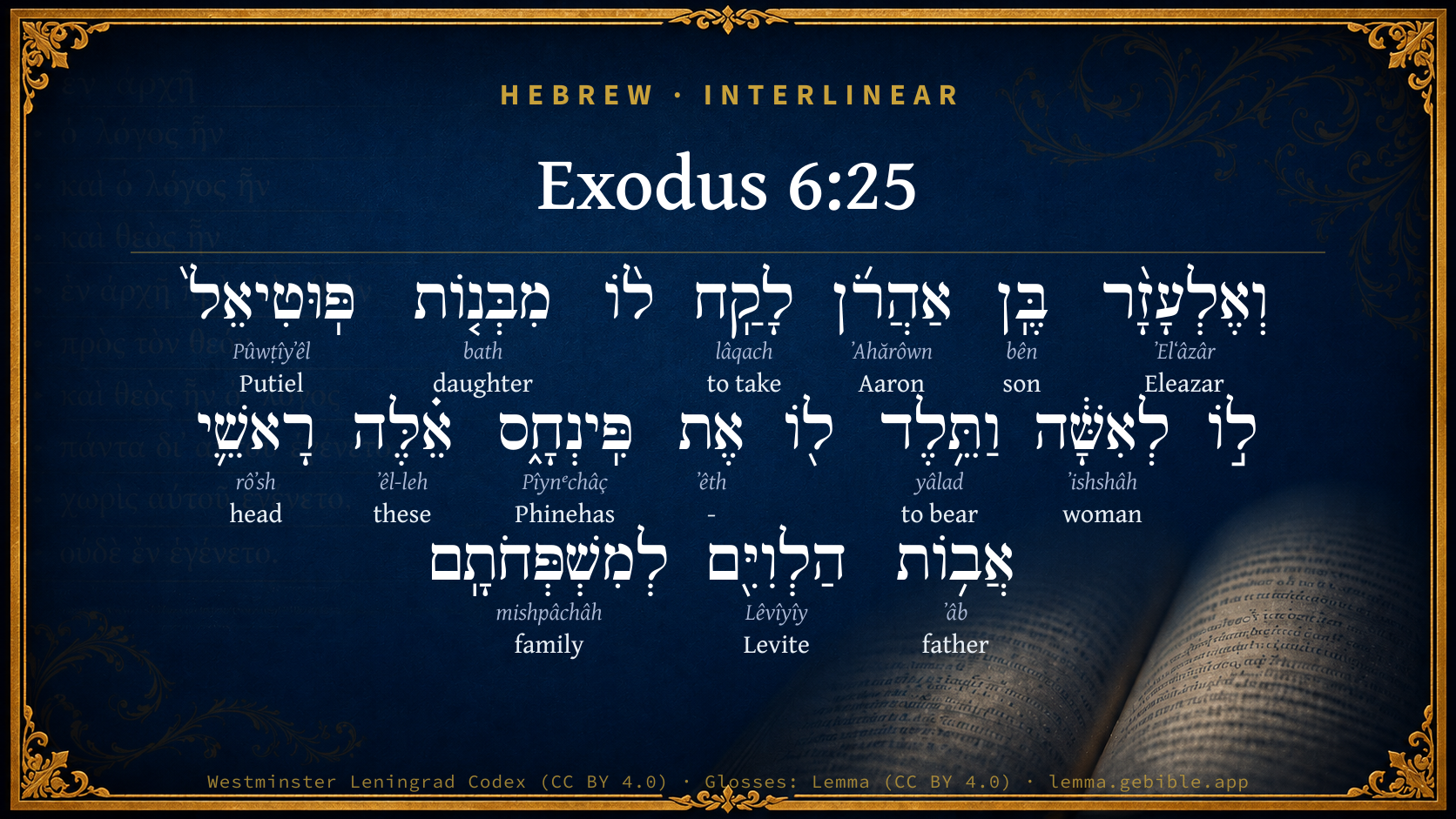
Hebrew (Westminster Leningrad Codex) Exodus 6:25 appears in the Hebrew Old Testament. The text above is from the Westminster Leningrad Codex. Each word links to its Strong’s number, a concise gloss, and parsing drawn from the Open Scriptures Hebrew Bible morphology. Click any word for its full Brown-Driver-Briggs (BDB) entry.
Download image
Cite this verse

Exodus 6:25 (World English Bible). Public Domain. Lemma interlinear Bible study tool, https://lemma.gebible.app/v/exodus/6/25.

Show BibTeX & RIS
BibTeX
RIS
English Translation
Eleazar Aaron's son took one of the daughters of Putiel as his wife; and she bore him Phinehas. These are the heads of the fathers' houses of the Levites according to their families.
World English Bible · Public Domain
Highlights
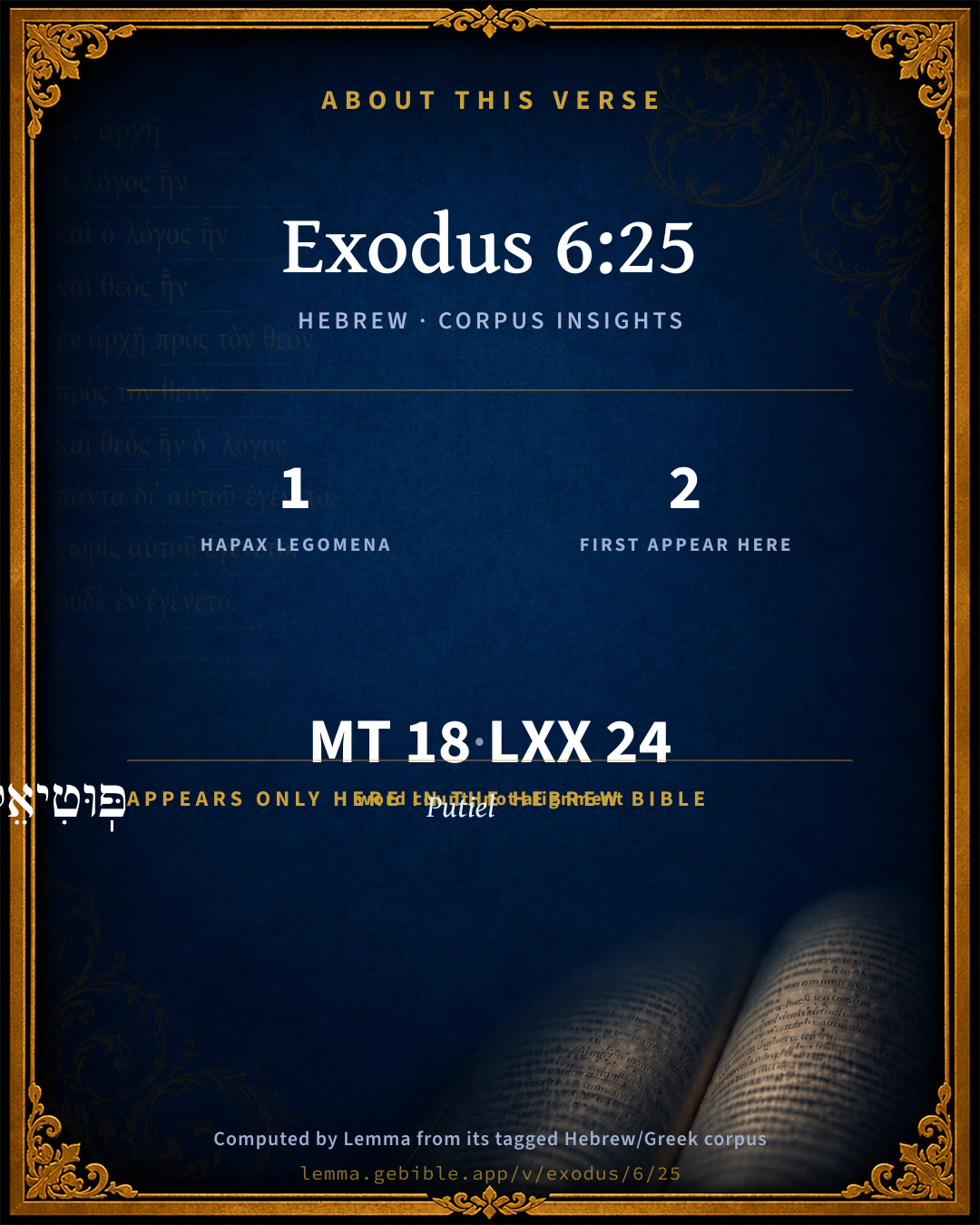
  • 1 hapax legomenon — only here in the Hebrew Bible
  • 2 first appearances in the Hebrew Bible
Full analysis ↓
Download a study sheet

One document with this verse’s original text, its word-by-word gloss line, the meaning frame, cross-references with their text, attributed commentary, and full source and license credits — printable, and it pastes into notes with its structure intact.

This verse Autodidact and up

Study sheet (.html) Plain text (.txt)

A passage Seminary Student

Up to 50 verses in one chapter. A passage sheet keeps up to 6 commentary sources and 12 cross-references per verse, in the order this page ranks them, and says so on the sheet whenever that leaves anything out. Ask for a single verse and you get the Autodidact verse sheet above.

Everything on this page stays free to read, with no account — the sheet is a download of what is already on screen, not access to it.

Want to remove ads? Support Godless Engineer
Compare translations 3

The same verse in 3 English versions, stacked beneath the original-language interlinear above. Click any original word for its lexicon entry.

Each is an independent rendering of the whole verse — the interlinear is not word-aligned to these translations.

Highlighted words mark where these versions differ — a whole-verse word diff, not a word-by-word alignment.

  • World English Bible Public Domain
    Eleazar Aaron's son took one of the daughters of Putiel as his wife; and she bore him Phinehas. These are the heads of the fathers' houses of the Levites according to their families.
  • King James Version Public Domain
    And Eleazar Aaron's son took him one of the daughters of Putiel to wife; and she bare him Phinehas: these are the heads of the fathers of the Levites according to their families.
  • unfoldingWord Literal Text CC BY-SA 4.0
    And Eleazar, son of Aaron took a wife for himself from the daughters of Putiel. And she bore him Phinehas. These were the heads of the fathers of the Levites, according to their clans.

unfoldingWord Literal Text — © unfoldingWord, licensed CC BY-SA 4.0. Word-aligned USFM3 via Door43 (git.door43.org/unfoldingWord/en_ult).

Versions to compare (up to 4)

3 of 4 selected

Show all 18 translations

Every available English version of this verse, each an independent rendering of the whole verse.

  • World English Bible Public Domain
    Eleazar Aaron's son took one of the daughters of Putiel as his wife; and she bore him Phinehas. These are the heads of the fathers' houses of the Levites according to their families.
  • Berean Standard Bible Public Domain
    Aaron’s son Eleazar married one of the daughters of Putiel, and she bore him Phinehas. These were the heads of the Levite families by their clans.
  • Majority Standard Bible Public Domain
    Aaron’s son Eleazar married one of the daughters of Putiel, and she bore him Phinehas. These were the heads of the Levite families by their clans.
  • King James Version Public Domain
    And Eleazar Aaron's son took him one of the daughters of Putiel to wife; and she bare him Phinehas: these are the heads of the fathers of the Levites according to their families.
  • American Standard Version (1901) Public Domain
    And Eleazar Aaron's son took him one of the daughters of Putiel to wife; and she bare him Phinehas. These are the heads of the fathers' `houses' of the Levites according to their families.
  • Revised Version (1885) Public Domain
    And Eleazar Aaron’s son took him one of the daughters of Putiel to wife; and she bare him Phinehas. These are the heads of the fathers’ houses of the Levites according to their families.
  • Geneva Bible (1599) Public Domain
    And Eleazar Aarons sonne tooke him one of the daughters of Putiel to his wife, which bare him Phinehas: these are the principall fathers of the Leuites throughout their families.
  • Douay-Rheims (1899) Public Domain
    But Eleazar the son of Aaron took a wife of the daughters of Phutiel: and she bore him Phinees. These are the heads of the Levitical families by their kindreds.
  • Young's Literal Translation Public Domain
    And Eleazar, Aaron's son, hath taken to him `one' of the daughters of Putiel for a wife to himself, and she beareth to him Phinehas: these `are' heads of the fathers of the Levites, as to their families.
  • Literal Standard Version CC BY-SA 4.0
    And Eleazar, Aaron’s son, has taken to himself [one] of the daughters of Putiel for a wife for himself, and she bears Phinehas to him; these [are] heads of the fathers of the Levites, as to their families.
  • Unlocked Literal Bible CC BY-SA 4.0
    Eleazar, Aaron's son, married one of the daughters of Putiel. She bore him Phinehas. These were the heads of the fathers' houses among the Levites, together with their descendants.
  • unfoldingWord Literal Text CC BY-SA 4.0
    And Eleazar, son of Aaron took a wife for himself from the daughters of Putiel. And she bore him Phinehas. These were the heads of the fathers of the Levites, according to their clans.
  • Darby Bible Public Domain
    And Eleazar Aaron's son took [one] of the daughters of Putiel as wife; and she bore him Phinehas: these are the heads of the fathers of the Levites according to their families.
  • World Messianic Bible Public Domain
    Eleazar Aaron’s son took one of the daughters of Putiel as his wife; and she bore him Phinehas. These are the heads of the fathers’ houses of the Levites according to their families.
  • Webster's Bible Public Domain
    And Eleazar, Aaron's son, took him one of the daughters of Putiel for a wife; and she bore to him Phinehas: these are the heads of the fathers of the Levites, according to their families.
  • Free Bible Version CC BY-SA 4.0
    Eleazar, son of Aaron, married one of the daughters of Putiel, and she had their son Phinehas. These are the ancestors of the Levite families, listed according to their clans. Eleazar son of Aaron married one of the daughters of Putiel, and she gave birth to his son, Phinehas. These are the heads of the Levite families, listed by family.
  • Bible in Basic English Public Domain
    And Eleazar, Aaron's son, took as his wife one of the daughters of Putiel; and she gave birth to Phinehas. These are the heads of the families of the Levites, in the order of their families.
  • JPS Tanakh (1917) Public Domain
    And Eleazar Aaron's son took him one of the daughters of Putiel to wife; and she bore him Phinehas. These are the heads of the fathers' houses of the Levites according to their families.

Literal Standard Version (2020), Covenant Press — licensed CC BY-SA 4.0. Text via the HelloAO Bible API (eBible.org). Unlocked Literal Bible (unfoldingWord) — licensed CC BY-SA 4.0. Text via the HelloAO Bible API (eBible.org). unfoldingWord Literal Text — © unfoldingWord, licensed CC BY-SA 4.0. Word-aligned USFM3 via Door43 (git.door43.org/unfoldingWord/en_ult). Free Bible Version, Dr. Jonathan Gallagher — licensed CC BY-SA 4.0. Text via the HelloAO Bible API (eBible.org).

Word by word

More ways to search: Search by grammar → Find every occurrence → Compare this word →

Practice this passage: Drill this verse → Learn its vocabulary →

פּֽוּטִיאֵל֙
Pûwṭîyʼêl
H6317
“Putiel”
Noun, Proper
Part of Speech
Noun
Type
Proper
Full BDB Definition

Origin: from an unused root (probably meaning to disparage) and H410

TWOT: None

Putiel = "afflicted of God" - father of the wife of Eleazar, the son of Aaron
  1. וְאֶלְעָזָ֨ר ʼElʻâzâr H499 “and · Eleazar” Conjunction + Noun, Proper
  2. בֶּֽן bên H1121 “son of” Noun, Common, Masculine, Singular, Construct
  3. אַהֲרֹ֜ן ʼAhărôwn H175 “Aaron” Noun, Proper
  4. לָקַֽח lâqach H3947 “to take” Verb, Qal, Perfect, 3rd Person, Masculine, Singular
  5. מִבְּנ֤וֹת bath H1323 “from · daughters of” Preposition + Noun, Common, Feminine, Plural, Construct
  6. לְאִשָּׁ֔ה ʼishshâh H802 “to/for · woman” Preposition + Noun, Common, Feminine, Singular, Absolute
  7. וַתֵּ֥לֶד yâlad H3205 “and · to bear” Conjunction + Verb, Qal, Sequential Imperfect, 3rd Person, Feminine, Singular
  8. אֶת ʼêth H853 “-” Particle, Direct Object
  9. פִּֽינְחָ֑ס Pîynᵉchâç H6372 “Phinehas” Noun, Proper
  10. אֵ֗לֶּה ʼêl-leh H428 “these” Pronoun, Demonstrative, Common, Plural
  11. רָאשֵׁ֛י rôʼsh H7218 “heads of” Noun, Common, Masculine, Plural, Construct
  12. אֲב֥וֹת ʼâb H1 “fathers of” Noun, Common, Masculine, Plural, Construct
  13. הַלְוִיִּ֖ם Lêvîyîy H3881 “the · Levites” Particle, Definite Article + Noun, Gentilic, Masculine, Plural, Absolute
  14. לְמִשְׁפְּחֹתָֽם mishpâchâh H4940 “to/for · families · their” Preposition + Noun, Common, Feminine, Plural, Construct + Suffix, Personal, 3rd Person, Masculine, Plural

About this verse

These counts appear in no published source. They are computed here, from the morphology-tagged text and Lemma’s own curated glosses. What Lemma adds →

18
words
15
distinct lemmas
Pentateuch
section

Notable vocabulary

1 hapax legomenon — a word that appears only here in the entire Hebrew Bible:

  • פּֽוּטִיאֵל֙ Putiel H6317

First appearance in Scripture

These words make their first canonical appearance in the Hebrew Bible here:

  • פּֽוּטִיאֵל֙ Putiel H6317
  • פִּֽינְחָ֑ס Phinehas H6372

Shared distinctive vocabulary

פִּֽינְחָ֑ס Phinehas H6372 occurs in 24 verses of the Hebrew Bible. Also found in:

Grammatical profile

  • 2 verbs
  • 11 nouns
  • 1 pronoun
  • 3 prepositions
  • 1 particle

Verb forms

  • לָקַֽח Qal · Perfect
  • וַתֵּ֥לֶד Qal · Sequential Imperfect

Hebrew & Septuagint length

In English translation the verse runs 33 words from the Hebrew and 38 from the Septuagint (LXX English) — closely comparable.

A rough comparison of the two English renderings, which tokenize alike — not a word-level alignment.

Word counts can differ between the Hebrew and the Greek without any difference in meaning — e.g. the Hebrew direct-object marker אֵת has no separate Greek word, and Greek often adds the article ὁ.

In the original languages it is 18 Hebrew tokens and 24 Greek tokens — but the two are counted differently (Hebrew bundles its prefixes and suffixes into one token; the Greek is in lemma form), so that isn’t a like-for-like length.

Cross-references

7

Topical passages linked to Exodus 6:25 in the Treasury of Scripture Knowledge — connected by theme and wording, ordered by reader-vote popularity; previews shown in the World English Bible.

  • Joshua 24:33 Eleazar the son of Aaron died; and they buried him in the hill of Phinehas his son, which was given him in the hill-country of Ephraim.
  • Numbers 25:7–13 When Phinehas, the son of Eleazar, the son of Aaron the priest, saw it, he rose up from the midst of the congregation, and took a spear in his hand;
  • Numbers 31:6 Moses sent them, one thousand of every tribe, to the war, them and Phinehas the son of Eleazar the priest, to the war, with the vessels of the sanctuary and the trumpets for the alarm in his hand.
  • Joshua 22:13 The children of Israel sent to the children of Reuben, and to the children of Gad, and to the half-tribe of Manasseh, into the land of Gilead, Phinehas the son of Eleazar the priest,
  • Joshua 22:31–32 Phinehas the son of Eleazar the priest said to the children of Reuben, and to the children of Gad, and to the children of Manasseh, This day we know that Yahweh is in the midst of us, because you have not committed this trespass against Yahweh: now have you delivered the children of Israel out of the hand of Yahweh.
  • Judges 20:28 and Phinehas, the son of Eleazar, the son of Aaron, stood before it in those days), saying, Shall I yet again go out to battle against the children of Benjamin my brother, or shall I cease? Yahweh said, Go up; for tomorrow I will deliver him into your hand.
  • Psalms 106:30–31 Then Phinehas stood up, and executed judgment, So the plague was stopped.

Cross-references courtesy of OpenBible.info (CC BY 4.0).

Hebrew and Greek witnesses Masoretic Hebrew ↔ Greek Septuagint

The same verse in the two great witnesses to the Old Testament, shown verse-for-verse.

These are two independent witnesses, not word-aligned to each other, and the Septuagint is shown in lemma (dictionary) form.

Hebrew Exodus 6:25 Masoretic · Westminster Leningrad Codex

וְאֶלְעָזָ֨ר בֶּֽן אַהֲרֹ֜ן לָקַֽח ל֨וֹ מִבְּנ֤וֹת פּֽוּטִיאֵל֙ ל֣וֹ לְאִשָּׁ֔ה וַתֵּ֥לֶד ל֖וֹ אֶת פִּֽינְחָ֑ס אֵ֗לֶּה רָאשֵׁ֛י אֲב֥וֹת הַלְוִיִּ֖ם לְמִשְׁפְּחֹתָֽם

Eleazar Aaron's son took one of the daughters of Putiel as his wife; and she bore him Phinehas. These are the heads of the fathers' houses of the Levites according to their families.

World English Bible · Public Domain

Greek LXX Exodus 6:25 Septuagint · lemma form

καί ελεαζαρ ὁ ὁ ααρων λαμβάνω ὁ θυγάτηρ φουτιηλ αὐτός γυνή καί τίκτω αὐτός ὁ φινεες οὗτος ὁ ἀρχή πατριά λευίτης κατά γένεσις αὐτός

And Eleazar the son of Aaron took to himself for a wife one of the daughters of Phutiel, and she bore to him Phinees. These are the heads of the family of the Levites, according to their generations.

LXX2012 (modern English Septuagint) · Public Domain

Hebrew: Westminster Leningrad Codex (CC BY 4.0). Greek: Septuagint (public domain); English from LXX2012 (modern English Septuagint) (Public Domain). How the Septuagint differs from the Hebrew →

Targum (Aramaic paraphrase)

2

The Targum is the ancient Jewish Aramaic paraphrase of the Hebrew Scriptures — an interpretive translation, not the Hebrew text itself. Onkelos (literal) and Pseudo-Jonathan (expansive) render the Torah, and Jonathan the Prophets. Coverage is partial: where no permissively-licensed English translation exists for a verse, only the Aramaic is shown. This is verse-level text, not a word-by-word alignment to the Hebrew.

  1. Targum Onkelos Torah (Genesis–Deuteronomy)
    וְאֶלְעָזָר בַּר אַהֲרֹן נְסִיב לֵהּ מִבְּנַת פּוּטִיאֵל לֵהּ לְאִנְתּוּ וִילִידַת לֵהּ יָת פִּינְחָס אִלֵין רֵישֵׁי אֲבָהַת לֵיוָאֵי לְזַרְעֲיָתְהוֹן:

    (no public-domain English translation for this verse)

    Targum Onkelos — Aramaic: “Onkelos Genesis” (public domain); “Onkelos Exodus” (public domain); “Onkelos Leviticus” (public domain); “Onkelos Numbers” (public domain); “Onkelos Deuteronomy” (public domain). English: “Sefaria Community Translation” (CC0 1.0 (public-domain dedication)); “J.W. Etheridge. The Targums of Onkelos and Jonathan Ben Uzziel on the Pentateuch. London: Longmans, Green, 1862” (public domain). Text via Sefaria.

  2. Targum Pseudo-Jonathan Torah (Genesis–Deuteronomy)
    וְאֶלְעָזָר בַּר אַהֲרן נְסִיב לֵיהּ מִבְּרַתּוֹי דְיִתְרוֹ הוּא פּוּטִיאֵל לֵיהּ לְאִנְתּוּ וִילֵידַת לֵיהּ יַת פִּינְחָס אִלֵין רֵישֵׁי אַבְהַת לֵיוָאֵי ְיִיחוּסֵיהוֹן

    And Elasar bar Aharon took unto him a wife from the daughters of Jethro who is Putiel, and she bare him Phinehas. These are the heads of the fathers of the Levites, according to their generations.

    Targum Pseudo-Jonathan — Aramaic: “Targum Jonathan on Genesis” (public domain); “Targum Jonathan on Exodus” (public domain); “Targum Jonathan on Leviticus” (public domain); “Targum Jonathan on Numbers” (public domain); “Targum Jonathan on Deuteronomy” (public domain). English: “The Targum of Jonathan ben Uzziel, trans. J. W. Etheridge, London, 1862” (public domain). Text via Sefaria.

Commentary

Notes on Exodus 6:25 from classic Christian and Jewish commentators (each source and its license shown beneath its notes). The classic Christian expositions comment on the surrounding passage and are grouped to its opening verse, so a note may address several verses; the Jewish commentaries on the Tanakh (Rashi and others) are per-verse, so they appear only where the commentator wrote on this verse.

Lemma curates 59 commentaries, every one of them public domain or Creative Commons licensed, each selected and text-cleaned for this edition rather than reprinted as found. About our sources →

Trapp's Complete Commentary

John Trapp

Exo 6:25 And Eleazar Aaron’s son took him [one] of the daughters of Putiel to wife; and she bare him Phinehas: these [are] the heads of the fathers of the Levites according to their families.

Ver. 25. These are the heads of the fathers of the Levites.] And particularly of Moses, concerning whose original, heathen writers, but especially Taeitus - whom therefore Tertullian calleth, mendsdorum loquacissimum, a loud and lewd liar - telleth many untruths. This "the Scripture foresaw," as Gal 3:8.

John Trapp, A Commentary or Exposition upon All the Books of the Old and New Testament (1647–1656) — public domain. Text from a community e-Sword module.

Adam Clarke's Commentary

Verse 25. Phinehas] Of the celebrated act of this person, and the most honourable grant made to him and his posterity, see Nu 25:7-13.

Adam Clarke's Commentary on the Bible (1810–1826) — public domain. Text from a community e-Sword/MySword module.

Ellicott's Commentary for English Readers

(25) According to their families.—The genealogy proper here ends. But the author appends to it an emphatic statement that the Moses and Aaron mentioned in it (Exo_6:20; Exo_6:23) are the very Moses and Aaron appointed by God to lead the Israelites out of Egypt—the very Moses and Aaron who delivered God’s message to Pharaoh (Exo_6:26-27).

A Bible Commentary for English Readers, edited by Charles John Ellicott (1878–1897) — public domain. Text from a community e-Sword module.

The Cambridge Bible for Schools and Colleges

gen. ed. J. J. S. Perowne

25. The family of Aaron’s son, Eleazar (v. 23).

Puṭiel] not mentioned elsewhere. Seemingly ‘an Egyptian name, of a type very common from b.c. 1000 onward, but with the Heb. El, “God,” instead of the name of an Egyptian deity, meaning “He whom God gave” ’ (F. Ll. Griffith); cf. Poṭiphar = ‘He whom Ra gave’ (see DB. iv. 22).

Phineḥas] See Num_25:7-13 (P) [cf. Psa_106:30], Exo_31:6; Jos_22:13; Jos_22:30-32; Jos_24:33; Eleazar’s successor in the priesthood, Jdg_20:28. The name, like that of his grandfather, may be of Egyptian origin, and signify ‘the negro’ (i.e. the Ethiopian, Jer_13:23). The name (Pi-neḥas) is very common in Egyptian (EB. iii. 3304).

heads of the fathers] for ‘heads of the fathers’ houses’ (v. 14); so Num_31:26; Num_32:28; Num_36:1, Jos_14:1; Jos_19:51; Jos_21:1 (all P); and frequently in Chr. Ezr. Neh.

The Cambridge Bible for Schools and Colleges (gen. ed. J. J. S. Perowne; Cambridge University Press, 1878–1918) — public domain. Text from a community e-Sword module.

John Gill's Exposition

And it came to pass on the day when the Lord spake unto Moses in the land of Egypt. This verse depends upon the following for the sense of it, which shows what it was the Lord said to Moses in the day he spake to him in Egypt, when he was come thither, which is as follows:

And it came to pass on the day when the Lord spake unto Moses in the land of Egypt. This verse depends upon the following for the sense of it, which shows what it was the Lord said to Moses in the day he spake to him in Egypt, when he was come thither, which is as follows:

Exodus 6:29

exo 6:29

exo 6:29

exo 6:29And the Lord spake unto Moses, saying, I am the Lord,.... See Exo 6:2,

speak thou unto Pharaoh king of Egypt all that I say unto thee; that he let Israel go; and that in case of refusal, that he would punish him and his people with this and the other plague, one after another, and at last slay him and their firstborn.

John Gill's Exposition of the Whole Bible (1746–1763) — public domain (CC PDM 1.0). Text via the HelloAO Bible API.

The Pulpit Commentary

Eleazar took him one of the daughters of Putiel to wife. Putiel is not elsewhere mentioned. The name is thought to be half Egyptian (compare Poti-phar) and to mean "dedicated to God." She bare him Phinehas. This Phinehas became high priest on the death of Eleazar. (Jud_1:20:28) The heads of the fathom i.e. "the patriarchal chiefs."

The Pulpit Commentary (1880–1919), ed. H.D.M. Spence-Jones & Joseph S. Exell — public domain. Text from a community e-Sword module.

Rashi

Rabbi Shlomo Yitzchaki (Rashi)

מבנות פוטיאל ONE OF THE DAUGHTERS OF PUTIEL — of the family of Jethro (cf. Rashi on Exodus 4:18) who used to fatten (פטם) calves for idolatrous sacrifice, and of the family of Joseph who overcame (פטפט, who talked or argued with) his passion (Sotah 43a; Bava Batra 109b).

Rashi on the Tanakh — English translations: “The Judaica Press complete Tanach with Rashi, translated by A. J. Rosenberg” (CC BY 4.0); “Pentateuch with Rashi's commentary by M. Rosenbaum and A.M. Silbermann, 1929-1934” (public domain); “The Metsudah Tanach series, Lakewood, N.J” (CC BY 4.0); and “The Book of Joshua, Metsudah Publications, 1997” (CC BY 4.0). Text via Sefaria.

Lesson kit

Teaching starters — assembled from the data on this page, not authored interpretation. Every prompt links to the verse data it draws on. Edit before teaching.

Exodus, in the Pentateuch, opens this verse with 18 words (15 distinct Hebrew lemmas). Its most distinctive word is Pûwṭîyʼêl (“Putiel”). A historical commentator’s framing appears above. Read the whole chapter for the surrounding context.

Discussion questions

  1. The word Pûwṭîyʼêl carries the sense “Putiel.” How does it shape the verse?
  2. 1 word here appears nowhere else in the Hebrew Bible. Why might the author reach for such rare wording?
  3. 2 words make their first appearance in Scripture here. What does this debut establish?
  4. How does Numbers 25:7, which shares the word «Phinehas», read alongside this verse?
  5. The translations on this page render this verse differently — a whole-verse word diff, not a word-by-word alignment. What might account for the different wordings?
  6. «לָקַֽח» is a Qal Perfect verb. How does that grammatical form shape the action described?
  7. Compare how Trapp's Complete Commentary and Adam Clarke's Commentary read this verse. Where do they agree or differ?

Things to notice

Reading settings

Reading text

Shown beneath each verse's original-language words.

Old Testament
Old Testament edition

Read the OT as the Masoretic Hebrew (MT) or the Greek Septuagint (LXX).

English shown for the Greek Septuagint (in the Hebrew ↔ Greek comparison).

Comparing translations? Open the Compare panel on any verse page to stack up to four side by side.