Genesis 27:22

Hebrew (Westminster Leningrad Codex) Genesis 27:22 appears in the Hebrew Old Testament. The text above is from the Westminster Leningrad Codex. Each word links to its Strong’s number, a concise gloss, and parsing drawn from the Open Scriptures Hebrew Bible morphology. Click any word for its full Brown-Driver-Briggs (BDB) entry.
Download image
Cite this verse

Genesis 27:22 (World English Bible). Public Domain. Lemma interlinear Bible study tool, https://lemma.gebible.app/v/genesis/27/22.

Show BibTeX & RIS
BibTeX
RIS
English Translation
Jacob went near to Isaac his father. He felt him, and said, "The voice is Jacob's voice, but the hands are the hands of Esau."
World English Bible · Public Domain
Download a study sheet

One document with this verse’s original text, its word-by-word gloss line, the meaning frame, cross-references with their text, attributed commentary, and full source and license credits — printable, and it pastes into notes with its structure intact.

This verse Autodidact and up

Study sheet (.html) Plain text (.txt)

A passage Seminary Student

Up to 50 verses in one chapter. A passage sheet keeps up to 6 commentary sources and 12 cross-references per verse, in the order this page ranks them, and says so on the sheet whenever that leaves anything out. Ask for a single verse and you get the Autodidact verse sheet above.

Everything on this page stays free to read, with no account — the sheet is a download of what is already on screen, not access to it.

Want to remove ads? Support Godless Engineer
Compare translations 3

The same verse in 3 English versions, stacked beneath the original-language interlinear above. Click any original word for its lexicon entry.

Each is an independent rendering of the whole verse — the interlinear is not word-aligned to these translations.

Highlighted words mark where these versions differ — a whole-verse word diff, not a word-by-word alignment.

  • World English Bible Public Domain
    Jacob went near to Isaac his father. He felt him, and said, "The voice is Jacob's voice, but the hands are the hands of Esau."
  • King James Version Public Domain
    And Jacob went near unto Isaac his father; and he felt him, and said, The voice is Jacob's voice, but the hands are the hands of Esau.
  • unfoldingWord Literal Text CC BY-SA 4.0
    So Jacob went close to Isaac his father, and he touched him and said, “The voice the voice of Jacob, but the hands the hands of Esau.”

unfoldingWord Literal Text — © unfoldingWord, licensed CC BY-SA 4.0. Word-aligned USFM3 via Door43 (git.door43.org/unfoldingWord/en_ult).

Versions to compare (up to 4)

3 of 4 selected

Show all 18 translations

Every available English version of this verse, each an independent rendering of the whole verse.

  • World English Bible Public Domain
    Jacob went near to Isaac his father. He felt him, and said, "The voice is Jacob's voice, but the hands are the hands of Esau."
  • Berean Standard Bible Public Domain
    So Jacob came close to his father Isaac, who touched him and said, “The voice is the voice of Jacob, but the hands are the hands of Esau.”
  • Majority Standard Bible Public Domain
    So Jacob came close to his father Isaac, who touched him and said, “The voice is the voice of Jacob, but the hands are the hands of Esau.”
  • King James Version Public Domain
    And Jacob went near unto Isaac his father; and he felt him, and said, The voice is Jacob's voice, but the hands are the hands of Esau.
  • American Standard Version (1901) Public Domain
    And Jacob went near unto Isaac his father. And he felt him, and said, The voice is Jacob's voice, but the hands are the hands of Esau.
  • Revised Version (1885) Public Domain
    And Jacob went near unto Isaac his father; and he felt him, and said, The voice is Jacob’s voice, but the hands are the hands of Esau.
  • Geneva Bible (1599) Public Domain
    Then Iaakob came neere to Izhak his father, and he felt him and sayd, The voyce is Iaakobs voyce, but the hands are the hands of Esau.
  • Douay-Rheims (1899) Public Domain
    He came near to his father, and when he had felt him, Isaac said: The voice indeed is the voice of Jacob; but the hands are the hands of Esau.
  • Young's Literal Translation Public Domain
    And Jacob cometh nigh unto Isaac his father, and he feeleth him, and saith, `The voice `is' the voice of Jacob, and the hands hands of Esau.'
  • Literal Standard Version CC BY-SA 4.0
    And Jacob comes near to his father Isaac, and he feels him, and says, “The voice [is] the voice of Jacob, and the hands hands of Esau.”
  • Unlocked Literal Bible CC BY-SA 4.0
    Jacob went over to Isaac his father; and Isaac touched him and said, “The voice is Jacob's voice, but the hands are the hands of Esau.”
  • unfoldingWord Literal Text CC BY-SA 4.0
    So Jacob went close to Isaac his father, and he touched him and said, “The voice the voice of Jacob, but the hands the hands of Esau.”
  • Darby Bible Public Domain
    And Jacob drew near to Isaac his father; and he felt him, and said, The voice is Jacob's voice, but the hands are the hands of Esau.
  • World Messianic Bible Public Domain
    Jacob went near to Isaac his father. He felt him, and said, “The voice is Jacob’s voice, but the hands are the hands of Esau.”
  • Webster's Bible Public Domain
    And Jacob went near to Isaac his father; and he felt him, and said, The voice is Jacob's voice, but the hands are the hands of Esau.
  • Free Bible Version CC BY-SA 4.0
    Jacob went over to his father Isaac, who touched him and said, “It's Jacob's voice but Esau's hands.”
  • Bible in Basic English Public Domain
    And Jacob went near his father Isaac: and he put his hands on him; and he said, The voice is Jacob's voice, but the hands are the hands of Esau.
  • JPS Tanakh (1917) Public Domain
    And Jacob went near unto Isaac his father; and he felt him, and said: 'The voice is the voice of Jacob, but the hands are the hands of Esau.'

Literal Standard Version (2020), Covenant Press — licensed CC BY-SA 4.0. Text via the HelloAO Bible API (eBible.org). Unlocked Literal Bible (unfoldingWord) — licensed CC BY-SA 4.0. Text via the HelloAO Bible API (eBible.org). unfoldingWord Literal Text — © unfoldingWord, licensed CC BY-SA 4.0. Word-aligned USFM3 via Door43 (git.door43.org/unfoldingWord/en_ult). Free Bible Version, Dr. Jonathan Gallagher — licensed CC BY-SA 4.0. Text via the HelloAO Bible API (eBible.org).

Word by word

More ways to search: Search by grammar → Find every occurrence → Compare this word →

Practice this passage: Drill this verse → Learn its vocabulary →

וַיְמֻשֵּׁ֑הוּ
mâshash
H4959
“and · to grope · him”
Conjunction + Verb, Qal, Sequential Imperfect, 3rd Person, Masculine, Singular + Suffix, Personal, 3rd Person, Masculine, Singular
Part of Speech
Conjunction + Verb
Stem
Qal
Form
Sequential Imperfect
Person
3rd Person
Gender
Masculine
Number
Singular
Full BDB Definition

Origin: a primitive root

TWOT: 1262

to feel, grope - (Qal) to feel, grope - (Piel) to feel over or through, grope - to feel through - to grope - (Hiphil) to feel
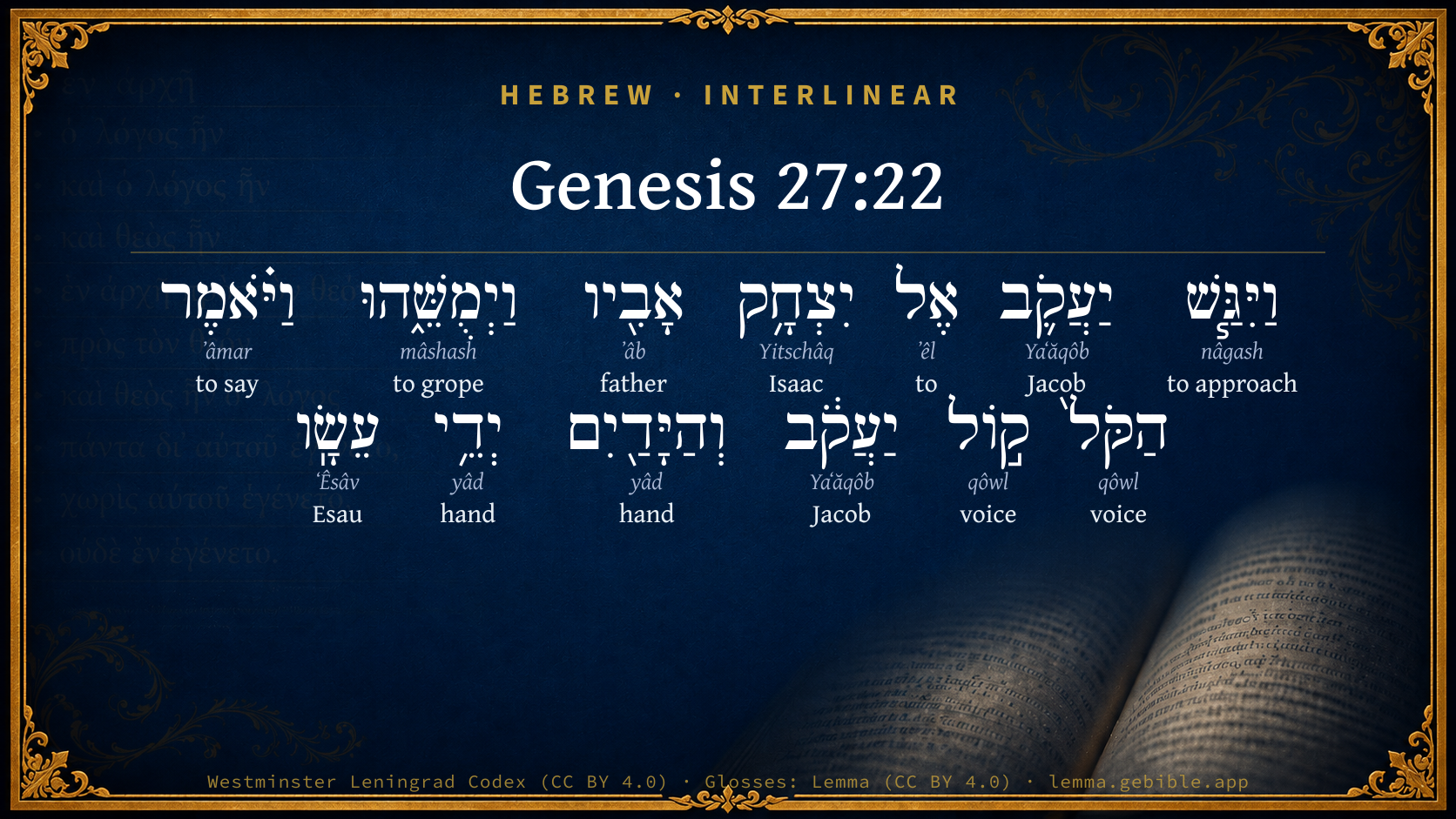
  1. וַיִּגַּ֧שׁ nâgash H5066 “and · to approach” Conjunction + Verb, Qal, Sequential Imperfect, 3rd Person, Masculine, Singular
  2. יַעֲקֹ֛ב Yaʻăqôb H3290 “Jacob” Noun, Proper
  3. אֶל ʼêl H413 “to” Preposition
  4. יִצְחָ֥ק Yitschâq H3327 “Isaac” Noun, Proper
  5. אָבִ֖יו ʼâb H1 “father · his” Noun, Common, Masculine, Singular, Construct + Suffix, Personal, 3rd Person, Masculine, Singular
  6. וַיֹּ֗אמֶר ʼâmar H559 “and · to say” Conjunction + Verb, Qal, Sequential Imperfect, 3rd Person, Masculine, Singular
  7. הַקֹּל֙ qôwl H6963 “the · voice” Particle, Definite Article + Noun, Common, Masculine, Singular, Absolute
  8. ק֣וֹל qôwl H6963 “voice of” Noun, Common, Masculine, Singular, Construct
  9. יַעֲקֹ֔ב Yaʻăqôb H3290 “Jacob” Noun, Proper
  10. וְהַיָּדַ֖יִם yâd H3027 “and · the · hands” Conjunction + Particle, Definite Article + Noun, Common, Both, Dual, Absolute
  11. יְדֵ֥י yâd H3027 “hands of” Noun, Common, Both, Dual, Construct
  12. עֵשָֽׂו ʻÊsâv H6215 “Esau” Noun, Proper

About this verse

These counts appear in no published source. They are computed here, from the morphology-tagged text and Lemma’s own curated glosses. What Lemma adds →

13
words
10
distinct lemmas
Pentateuch
section

Notable vocabulary

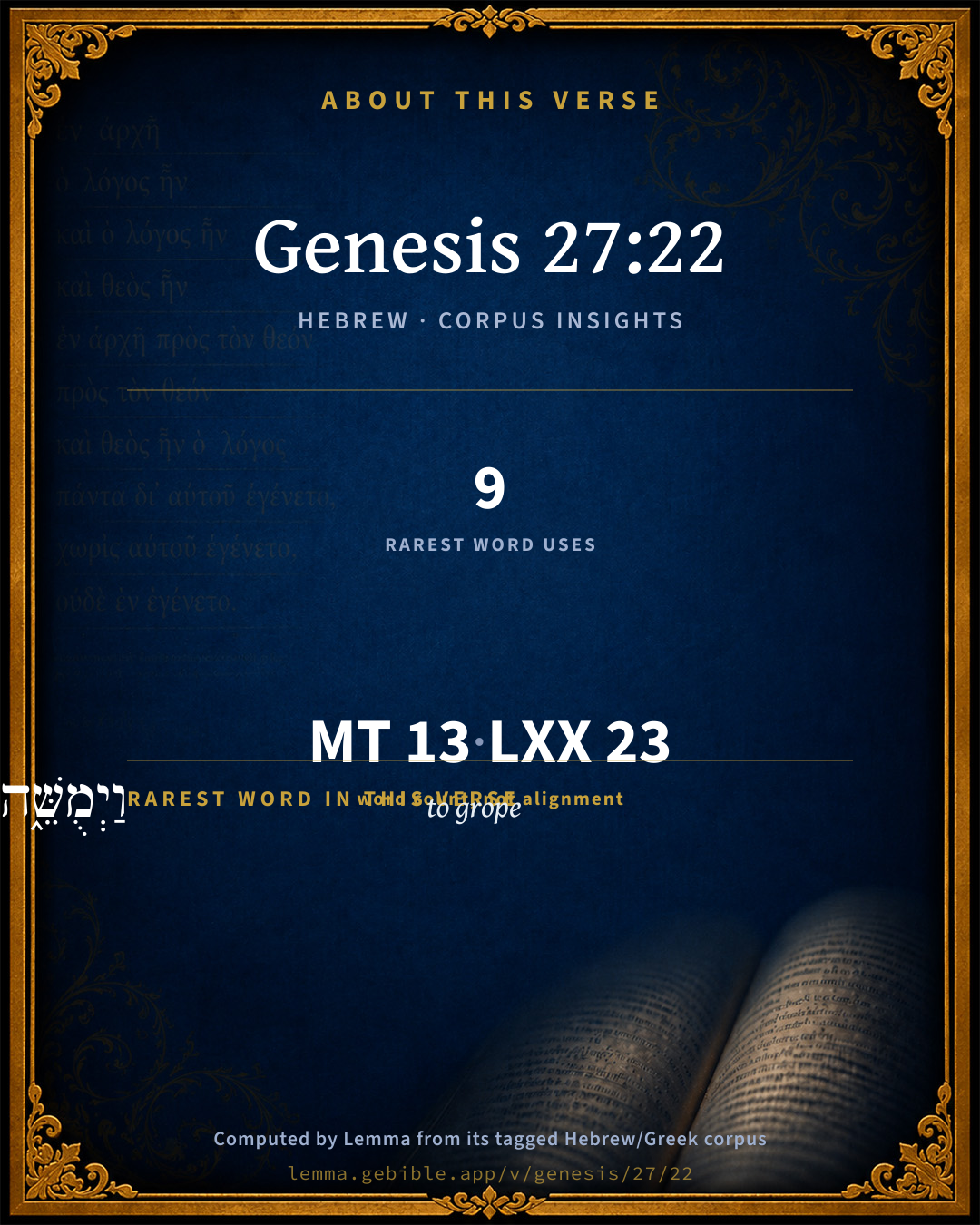
The rarest word here is וַיְמֻשֵּׁ֑הוּ to grope H4959 — appearing just 9 times in the whole Hebrew Bible.

Shared distinctive vocabulary

וַיְמֻשֵּׁ֑הוּ to grope H4959 occurs in 8 verses of the Hebrew Bible. Also found in:

Grammatical profile

  • 3 verbs
  • 9 nouns
  • 1 preposition

Verb forms

  • וַיִּגַּ֧שׁ Qal · Sequential Imperfect
  • וַיְמֻשֵּׁ֑הוּ Qal · Sequential Imperfect
  • וַיֹּ֗אמֶר Qal · Sequential Imperfect

Repetition

Words recur within this verse — often emphatic in Hebrew:

  • יַעֲקֹ֛ב Jacob H3290 ×2
  • הַקֹּל֙ voice H6963 ×2
  • וְהַיָּדַ֖יִם hand H3027 ×2

Hebrew & Septuagint length

In English translation the verse runs 25 words from the Hebrew and 27 from the Septuagint (LXX English) — closely comparable.

A rough comparison of the two English renderings, which tokenize alike — not a word-level alignment.

Word counts can differ between the Hebrew and the Greek without any difference in meaning — e.g. the Hebrew direct-object marker אֵת has no separate Greek word, and Greek often adds the article ὁ.

In the original languages it is 13 Hebrew tokens and 23 Greek tokens — but the two are counted differently (Hebrew bundles its prefixes and suffixes into one token; the Greek is in lemma form), so that isn’t a like-for-like length.

Hebrew and Greek witnesses Masoretic Hebrew ↔ Greek Septuagint

The same verse in the two great witnesses to the Old Testament, shown verse-for-verse.

These are two independent witnesses, not word-aligned to each other, and the Septuagint is shown in lemma (dictionary) form.

Hebrew Genesis 27:22 Masoretic · Westminster Leningrad Codex

וַיִּגַּ֧שׁ יַעֲקֹ֛ב אֶל יִצְחָ֥ק אָבִ֖יו וַיְמֻשֵּׁ֑הוּ וַיֹּ֗אמֶר הַקֹּל֙ ק֣וֹל יַעֲקֹ֔ב וְהַיָּדַ֖יִם יְדֵ֥י עֵשָֽׂו

Jacob went near to Isaac his father. He felt him, and said, "The voice is Jacob's voice, but the hands are the hands of Esau."

World English Bible · Public Domain

Greek LXX Genesis 27:22 Septuagint · lemma form

ἐγγίζω δέ ἰακώβ πρός ισαακ ὁ πατήρ αὐτός καί ψηλαφάω αὐτός καί εἶπον ὁ μέν φωνή φωνή ἰακώβ ὁ δέ χείρ χείρ ησαυ

And Jacob drew near to his father Isaac, and he felt him, and said, The voice is Jacob's voice, but the hands are the hands of Esau.

LXX2012 (modern English Septuagint) · Public Domain

Hebrew: Westminster Leningrad Codex (CC BY 4.0). Greek: Septuagint (public domain); English from LXX2012 (modern English Septuagint) (Public Domain). How the Septuagint differs from the Hebrew →

Targum (Aramaic paraphrase)

2

The Targum is the ancient Jewish Aramaic paraphrase of the Hebrew Scriptures — an interpretive translation, not the Hebrew text itself. Onkelos (literal) and Pseudo-Jonathan (expansive) render the Torah, and Jonathan the Prophets. Coverage is partial: where no permissively-licensed English translation exists for a verse, only the Aramaic is shown. This is verse-level text, not a word-by-word alignment to the Hebrew.

  1. Targum Onkelos Torah (Genesis–Deuteronomy)
    וּקְרֵיב יַעֲקֹב לְוַת יִצְחָק אֲבוּהִי וּמָשְׁיֵהּ וַאֲמַר קָלָא קָלָא דְיַעֲקֹב וִידַיָּא יְדוֹהִי דְעֵשָׂו

    (no public-domain English translation for this verse)

    Targum Onkelos — Aramaic: “Onkelos Genesis” (public domain); “Onkelos Exodus” (public domain); “Onkelos Leviticus” (public domain); “Onkelos Numbers” (public domain); “Onkelos Deuteronomy” (public domain). English: “Sefaria Community Translation” (CC0 1.0 (public-domain dedication)); “J.W. Etheridge. The Targums of Onkelos and Jonathan Ben Uzziel on the Pentateuch. London: Longmans, Green, 1862” (public domain). Text via Sefaria.

  2. Targum Pseudo-Jonathan Torah (Genesis–Deuteronomy)
    וּקְרֵיב יַעֲקב לְוַת יִצְחָק אָבוֹי וְגַשְׁשֵׁיהּ וַאֲמַר קָלָא הָדֵין קָלֵיהּ דְיַעֲקב בְּרַם מַמַשׁ יְדוֹי כִּמֵימַשׁ יְדוֹי דְעֵשָו

    And Jakob drew near to Izhak his father, who touched him, and said, This voice is the voice of Jakob, nevertheless the feeling of the hands is as the feeling of the hands of Esau.

    Targum Pseudo-Jonathan — Aramaic: “Targum Jonathan on Genesis” (public domain); “Targum Jonathan on Exodus” (public domain); “Targum Jonathan on Leviticus” (public domain); “Targum Jonathan on Numbers” (public domain); “Targum Jonathan on Deuteronomy” (public domain). English: “The Targum of Jonathan ben Uzziel, trans. J. W. Etheridge, London, 1862” (public domain). Text via Sefaria.

Commentary

Notes on Genesis 27:22 from classic Christian and Jewish commentators (each source and its license shown beneath its notes). The classic Christian expositions comment on the surrounding passage and are grouped to its opening verse, so a note may address several verses; the Jewish commentaries on the Tanakh (Rashi and others) are per-verse, so they appear only where the commentator wrote on this verse.

Lemma curates 59 commentaries, every one of them public domain or Creative Commons licensed, each selected and text-cleaned for this edition rather than reprinted as found. About our sources →

Trapp's Complete Commentary

John Trapp

Gen 27:22 And Jacob went near unto Isaac his father; and he felt him, and said, The voice [is] Jacob’s voice, but the hands [are] the hands of Esau.

Ver. 22. The voice is Jacob’s voice.] Jacob must name himself Esau, with the voice of Jacob. It is hard, if our tongues do not betray us, in spite of our clothes, as it did the wife of Jeroboam.

John Trapp, A Commentary or Exposition upon All the Books of the Old and New Testament (1647–1656) — public domain. Text from a community e-Sword module.

Geneva Bible (1599)

Geneva Bible translators

This declareth that he suspected something, yet God would not have his decree altered.

Geneva Bible (1599) marginal notes — public domain. Text via Bolls.life.

The Cambridge Bible for Schools and Colleges

gen. ed. J. J. S. Perowne

22. And Jacob went near] Luther says, “Had I been Jacob, I should have dropped the dish.”

The voice is Jacob’s voice] Here is expressed the original source of Isaac’s hesitation. The touch of his arms dispels all doubt; cf. Gen_27:14; Gen_27:16.

The Cambridge Bible for Schools and Colleges (gen. ed. J. J. S. Perowne; Cambridge University Press, 1878–1918) — public domain. Text from a community e-Sword module.

John Gill's Exposition

And Jacob went near unto Isaac his father,.... Boldly and without trembling; which he could the better do, as his father could not see him, and so not capable of discerning any change in his countenance or outward behaviour:

and he felt him; some parts of his body, especially his hands:

and said, the voice is Jacob's voice; very like it, as if it was the same, as indeed it was:

but the hands are the hands of Esau; are like them, being hairy as they; or, as the Targums of Jonathan and Jerusalem,"the feeling of the hands is as the feeling of the hands of Esau;''they feel like them.

John Gill's Exposition of the Whole Bible (1746–1763) — public domain (CC PDM 1.0). Text via the HelloAO Bible API.

Haydock's Catholic Bible Commentary

Of Esau. Thus, too often our voice contradicts our hands or actions! (Haydock)

George Leo Haydock (1774–1849), Haydock's Catholic Family Bible and Commentary, 1859 edition — public domain. Excludes Psalms (Douay-Rheims chapter numbering differs from Protestant) and Deuterocanonical books (Catholic canon only).

Whedon's Commentary on the Bible

Daniel D. Whedon

22. Hands of Esau — Isaac’s words are, literally: The voice is voice of Jacob, and the two hands hands of Esau. The old man is dubious; there is something about it inexplicable. So he proceeds to bless him; not, however, without asking him once more, 24. Art thou my very son Esau — Hebrews, Thou this my son Esau?

With an obduracy and boldness unparalleled the supplanter says, I am.

Daniel D. Whedon (gen. ed.), Commentary on the Old and New Testaments (1874–1909) — public domain. Text from a community e-Sword module.

The Pulpit Commentary

Vers. 22, 23. And Jacob (with a boldness worthy of a better cause) went near unto Isaac his father; and he (i.e. Isaac) felt him (i.e. Jacob), and said, The voice is Jacob"s voice, but (literally, and) the hands are the hands of Esau. And he discerned him not, because his hands were hairy, as his brother Esau"s hands: so he blessed him. Isaac must either have forgotten the heavenly oracle which announced the destinies of his sons at their birth, and distinctly accorded the precedence to Jacob, or he must not have attached the same importance to it as Rebekah, or he may have thought that it did not affect the transmission of the covenant blessing, or that it did not concern his sons no much as their descendants. It is hard to credit that Isaac either did not believe in the Divine announcement which had indicated Jacob as the heir of the promise, or that, believing it, he deliberately allowed paternal partiality to interfere with, and even endeavor to reverse, the will of Heaven.

The Pulpit Commentary (1880–1919), ed. H.D.M. Spence-Jones & Joseph S. Exell — public domain. Text from a community e-Sword module.

unfoldingWord translationNotes

Door43 World Missions Community

Jacob went over to Isaac his father

"Jacob approached Isaac his father"

The voice is Jacob's voice

Here Issac speaks of Jacob's voice as representing Jacob. AT: "You sound like Jacob" (See: Synecdoche)

but the hands are the hands of Esau

Here Issac speaks of Esau's hands as representing Esau. AT: "but your hands feel like Esau's hands" (See: Synecdoche)

translationWords

bless

unfoldingWord translationNotes — © Distant Shores Media and the Door43 World Missions Community, licensed CC BY-SA 4.0. Source: git.door43.org/Door43/en_tn.

Rashi

Rabbi Shlomo Yitzchaki (Rashi)

THE VOICE OF JACOB, because he speaks in an entreating strain —“Arise I pray thee.” Esau, however, spoke in a harsh strain (v. 31) “Let my father arise” (Midrash Tanchuma, Toldot 11).

Rashi on the Tanakh — English translations: “The Judaica Press complete Tanach with Rashi, translated by A. J. Rosenberg” (CC BY 4.0); “Pentateuch with Rashi's commentary by M. Rosenbaum and A.M. Silbermann, 1929-1934” (public domain); “The Metsudah Tanach series, Lakewood, N.J” (CC BY 4.0); and “The Book of Joshua, Metsudah Publications, 1997” (CC BY 4.0). Text via Sefaria.

Radak

Rabbi David Kimhi (Radak)

ויגש...והידים, he did not examine the skin on the (supposed) smooth part of his throat. He relied solely on checking his arms.

Radak on the Tanakh — English translations: “Sefaria Community Translation” (CC0 1.0 (public-domain dedication)); “Eliyahu Munk, HaChut Hameshulash” (CC BY 4.0); “Rabbi Mike Feuer, Jerusalem Anthology” (CC BY 4.0); and “R. David Kimhi on the first book of Psalms, Translated by R.G. Finch, London, 1919” (public domain). Text via Sefaria.

Lesson kit

Teaching starters — assembled from the data on this page, not authored interpretation. Every prompt links to the verse data it draws on. Edit before teaching.

Genesis, in the Pentateuch, opens this verse with 13 words (10 distinct Hebrew lemmas). Its most distinctive word is mâshash (“to grope”). A historical commentator’s framing appears above. Read the whole chapter for the surrounding context.

Discussion questions

  1. What does “to grope” (mâshash) contribute to the verse as a whole?
  2. How does Genesis 27:12, which shares the word «to grope», read alongside this verse?
  3. What does the repetition of “Jacob” (2× in this one verse) do in this verse?
  4. The translations on this page render this verse differently — a whole-verse word diff, not a word-by-word alignment. What might account for the different wordings?
  5. «וַיִּגַּ֧שׁ» is a Qal Sequential Imperfect verb. How does that grammatical form shape the action described?
  6. Compare how Trapp's Complete Commentary and Geneva Bible (1599) read this verse. Where do they agree or differ?

Things to notice

Reading settings

Reading text

Shown beneath each verse's original-language words.

Old Testament
Old Testament edition

Read the OT as the Masoretic Hebrew (MT) or the Greek Septuagint (LXX).

English shown for the Greek Septuagint (in the Hebrew ↔ Greek comparison).

Comparing translations? Open the Compare panel on any verse page to stack up to four side by side.