
Genesis 9:23

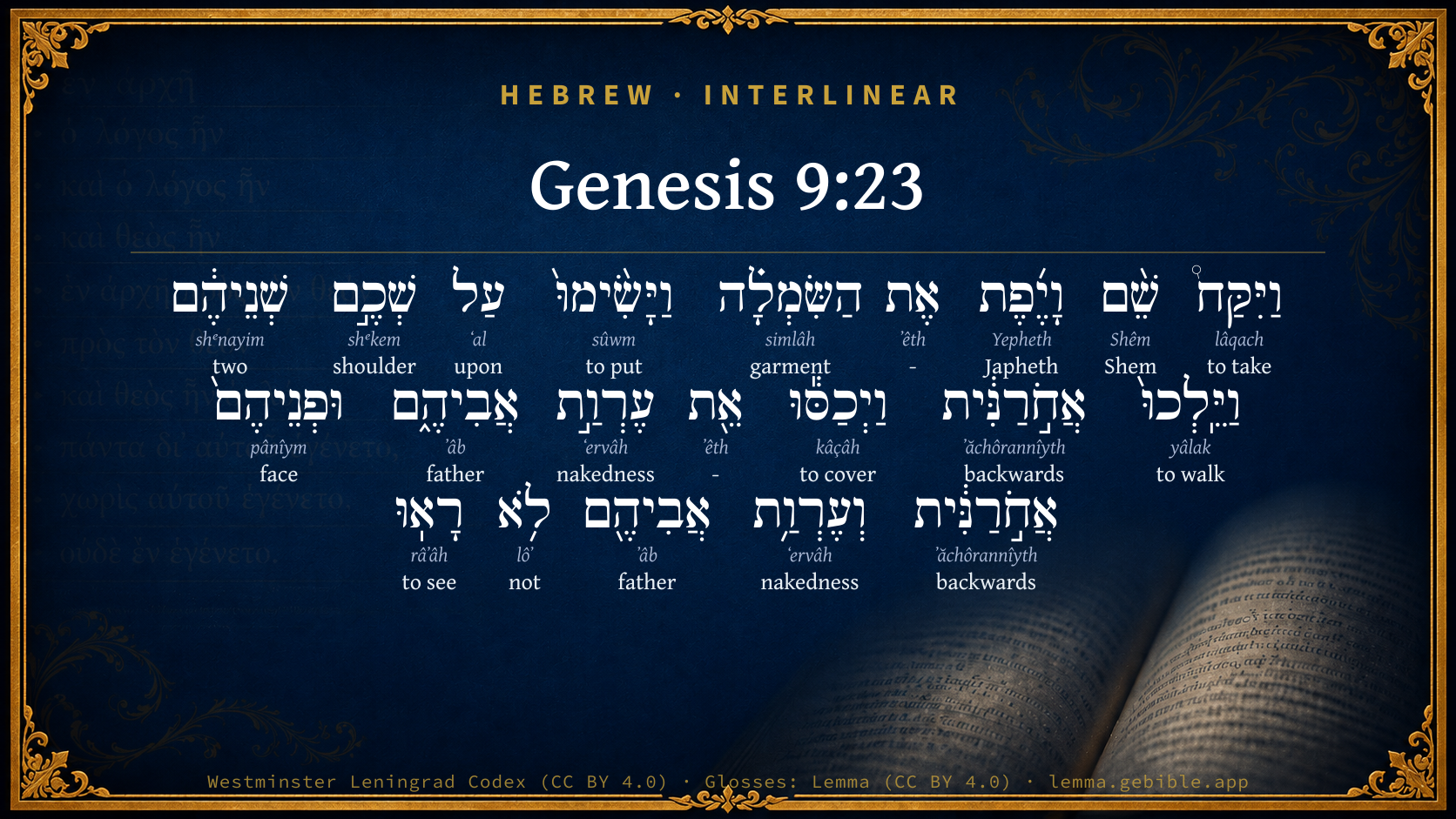
Hebrew (Westminster Leningrad Codex) Genesis 9:23 appears in the Hebrew Old Testament. The text above is from the Westminster Leningrad Codex. Each word links to its Strong’s number, a concise gloss, and parsing drawn from the Open Scriptures Hebrew Bible morphology. Click any word for its full Brown-Driver-Briggs (BDB) entry.
Download image
Cite this verse

Genesis 9:23 (World English Bible). Public Domain. Lemma interlinear Bible study tool, https://lemma.gebible.app/v/genesis/9/23.

Show BibTeX & RIS
BibTeX
RIS
English Translation
Shem and Japheth took a garment, and laid it on both their shoulders, went in backwards, and covered the nakedness of their father. Their faces were backwards, and they didn't see their father's nakedness.
World English Bible · Public Domain
Highlights
  • 3 first appearances in the Hebrew Bible
Full analysis ↓
Download a study sheet

One document with this verse’s original text, its word-by-word gloss line, the meaning frame, cross-references with their text, attributed commentary, and full source and license credits — printable, and it pastes into notes with its structure intact.

This verse Autodidact and up

Study sheet (.html) Plain text (.txt)

A passage Seminary Student

Up to 50 verses in one chapter. A passage sheet keeps up to 6 commentary sources and 12 cross-references per verse, in the order this page ranks them, and says so on the sheet whenever that leaves anything out. Ask for a single verse and you get the Autodidact verse sheet above.

Everything on this page stays free to read, with no account — the sheet is a download of what is already on screen, not access to it.

Want to remove ads? Support Godless Engineer
Compare translations 3

The same verse in 3 English versions, stacked beneath the original-language interlinear above. Click any original word for its lexicon entry.

Each is an independent rendering of the whole verse — the interlinear is not word-aligned to these translations.

Highlighted words mark where these versions differ — a whole-verse word diff, not a word-by-word alignment.

  • World English Bible Public Domain
    Shem and Japheth took a garment, and laid it on both their shoulders, went in backwards, and covered the nakedness of their father. Their faces were backwards, and they didn't see their father's nakedness.
  • King James Version Public Domain
    And Shem and Japheth took a garment, and laid it upon both their shoulders, and went backward, and covered the nakedness of their father; and their faces were backward, and they saw not their father's nakedness.
  • unfoldingWord Literal Text CC BY-SA 4.0
    But Shem and Japheth took a garment, and laid it across the shoulders of the two of them and walked backward and covered the nakedness of their father. And their faces were turned away, so that they did not see the nakedness of their father.

unfoldingWord Literal Text — © unfoldingWord, licensed CC BY-SA 4.0. Word-aligned USFM3 via Door43 (git.door43.org/unfoldingWord/en_ult).

Versions to compare (up to 4)

3 of 4 selected

Show all 18 translations

Every available English version of this verse, each an independent rendering of the whole verse.

  • World English Bible Public Domain
    Shem and Japheth took a garment, and laid it on both their shoulders, went in backwards, and covered the nakedness of their father. Their faces were backwards, and they didn't see their father's nakedness.
  • Berean Standard Bible Public Domain
    Then Shem and Japheth took a garment and placed it across their shoulders, and walking backward, they covered their father’s nakedness. Their faces were turned away so that they did not see their father’s nakedness.
  • Majority Standard Bible Public Domain
    Then Shem and Japheth took a garment and placed it across their shoulders, and walking backward, they covered their father’s nakedness. Their faces were turned away so that they did not see their father’s nakedness.
  • King James Version Public Domain
    And Shem and Japheth took a garment, and laid it upon both their shoulders, and went backward, and covered the nakedness of their father; and their faces were backward, and they saw not their father's nakedness.
  • American Standard Version (1901) Public Domain
    And Shem and Japheth took a garment, and laid it upon both their shoulders, and went backward, and covered the nakedness of their father. And their faces were backward, and they saw not their father's nakedness.
  • Revised Version (1885) Public Domain
    And Shem and Japheth took a garment, and laid it upon both their shoulders, and went backward, and covered the nakedness of their father; and their faces were backward, and they saw not their father’s nakedness.
  • Geneva Bible (1599) Public Domain
    Then tooke Shem and Iapheth a garment, and put it vpon both their shoulders, and went backwarde, and couered the nakednesse of their father with their faces backwarde: so they sawe not their fathers nakednesse.
  • Douay-Rheims (1899) Public Domain
    But Sem and Japheth put a cloak upon their shoulders, and going backward, covered the nakedness of their father: and their faces were turned away, and they saw not their father's nakedness.
  • Young's Literal Translation Public Domain
    And Shem taketh -- Japheth also -- the garment, and they place on the shoulder of them both, and go backward, and cover the nakedness of their father; and their faces `are' backward, and their father's nakedness they have not seen.
  • Literal Standard Version CC BY-SA 4.0
    And Shem takes—Japheth also—the garment, and they place on the shoulder of them both, and go backward, and cover the nakedness of their father; and their faces [are] backward, and their father’s nakedness they have not seen.
  • Unlocked Literal Bible CC BY-SA 4.0
    So Shem and Japheth took a robe and laid it upon both their shoulders, and walked backwards and covered the nakedness of their father. Their faces were turned the other way, so they did not see their father's nakedness.
  • unfoldingWord Literal Text CC BY-SA 4.0
    But Shem and Japheth took a garment, and laid it across the shoulders of the two of them and walked backward and covered the nakedness of their father. And their faces were turned away, so that they did not see the nakedness of their father.
  • Darby Bible Public Domain
    And Shem and Japheth took the upper garment and both laid [it] upon their shoulders, and went backwards, and covered the nakedness of their father. And their faces were turned away, that they saw not their father's nakedness.
  • World Messianic Bible Public Domain
    Shem and Japheth took a garment, and laid it on both their shoulders, went in backwards, and covered the nakedness of their father. Their faces were backwards, and they didn’t see their father’s nakedness.
  • Webster's Bible Public Domain
    And Shem and Japheth took a garment, and laid it upon both their shoulders, and went backward, and covered the nakedness of their father: and their faces were backward, and they saw not their father's nakedness.
  • Free Bible Version CC BY-SA 4.0
    Shem and Japheth picked up a cloak and, holding it over their shoulders, walked in backwards and covered up their father's privates. They made sure to look the other way so they wouldn't see their father's privates.
  • Bible in Basic English Public Domain
    And Shem and Japheth took a robe, and putting it on their backs went in with their faces turned away, and put it over their father so that they might not see him unclothed.
  • JPS Tanakh (1917) Public Domain
    And Shem and Japheth took a garment, and laid it upon both their shoulders, and went backward, and covered the nakedness of their father; and their faces were backward, and they saw not their father's nakedness.

Literal Standard Version (2020), Covenant Press — licensed CC BY-SA 4.0. Text via the HelloAO Bible API (eBible.org). Unlocked Literal Bible (unfoldingWord) — licensed CC BY-SA 4.0. Text via the HelloAO Bible API (eBible.org). unfoldingWord Literal Text — © unfoldingWord, licensed CC BY-SA 4.0. Word-aligned USFM3 via Door43 (git.door43.org/unfoldingWord/en_ult). Free Bible Version, Dr. Jonathan Gallagher — licensed CC BY-SA 4.0. Text via the HelloAO Bible API (eBible.org).

Word by word

More ways to search: Search by grammar → Find every occurrence → Compare this word →

Practice this passage: Drill this verse → Learn its vocabulary →

אֲחֹ֣רַנִּ֔ית
ʼăchôrannîyth
H322
“backwards”
Adverb
Part of Speech
Adverb
Full BDB Definition

Origin: prolonged from H268

TWOT: 68d

backwards, back part, the rear
  1. וַיִּקַּח֩ lâqach H3947 “and · to take” Conjunction + Verb, Qal, Sequential Imperfect, 3rd Person, Masculine, Singular
  2. שֵׁ֨ם Shêm H8035 “Shem” Noun, Proper
  3. וָיֶ֜פֶת Yepheth H3315 “and · Japheth” Conjunction + Noun, Proper
  4. אֶת ʼêth H853 “-” Particle, Direct Object
  5. הַשִּׂמְלָ֗ה simlâh H8071 “the · garment” Particle, Definite Article + Noun, Common, Feminine, Singular, Absolute
  6. וַיָּשִׂ֨ימוּ֙ sûwm H7760 “and · to put” Conjunction + Verb, Qal, Sequential Imperfect, 3rd Person, Masculine, Plural
  7. עַל ʻal H5921 “upon” Preposition
  8. שְׁכֶ֣ם shᵉkem H7926 “shoulder of” Noun, Common, Masculine, Singular, Construct
  9. שְׁנֵיהֶ֔ם shᵉnayim H8147 “two · their” Adjective, Cardinal number, Masculine, Dual, Construct + Suffix, Personal, 3rd Person, Masculine, Plural
  10. וַיֵּֽלְכוּ֙ yâlak H3212 “and · to walk” Conjunction + Verb, Qal, Sequential Imperfect, 3rd Person, Masculine, Plural
  11. וַיְכַסּ֕וּ kâçâh H3680 “and · to cover” Conjunction + Verb, Piel, Sequential Imperfect, 3rd Person, Masculine, Plural
  12. אֵ֖ת ʼêth H853 “-” Particle, Direct Object
  13. עֶרְוַ֣ת ʻervâh H6172 “nakedness of” Noun, Common, Feminine, Singular, Construct
  14. אֲבִיהֶ֑ם ʼâb H1 “father · their” Noun, Common, Masculine, Singular, Construct + Suffix, Personal, 3rd Person, Masculine, Plural
  15. וּפְנֵיהֶם֙ pânîym H6440 “and · face(s) · their” Conjunction + Noun, Common, Both, Plural, Construct + Suffix, Personal, 3rd Person, Masculine, Plural
  16. אֲחֹ֣רַנִּ֔ית ʼăchôrannîyth H322 “backwards” Adverb
  17. וְעֶרְוַ֥ת ʻervâh H6172 “and · nakedness of” Conjunction + Noun, Common, Feminine, Singular, Construct
  18. אֲבִיהֶ֖ם ʼâb H1 “father · their” Noun, Common, Masculine, Singular, Construct + Suffix, Personal, 3rd Person, Masculine, Plural
  19. לֹ֥א lôʼ H3808 “not” Particle, Negative
  20. רָאֽוּ râʼâh H7200 “to see” Verb, Qal, Perfect, 3rd Person, Common, Plural

About this verse

These counts appear in no published source. They are computed here, from the morphology-tagged text and Lemma’s own curated glosses. What Lemma adds →

21
words
17
distinct lemmas
Pentateuch
section

Notable vocabulary

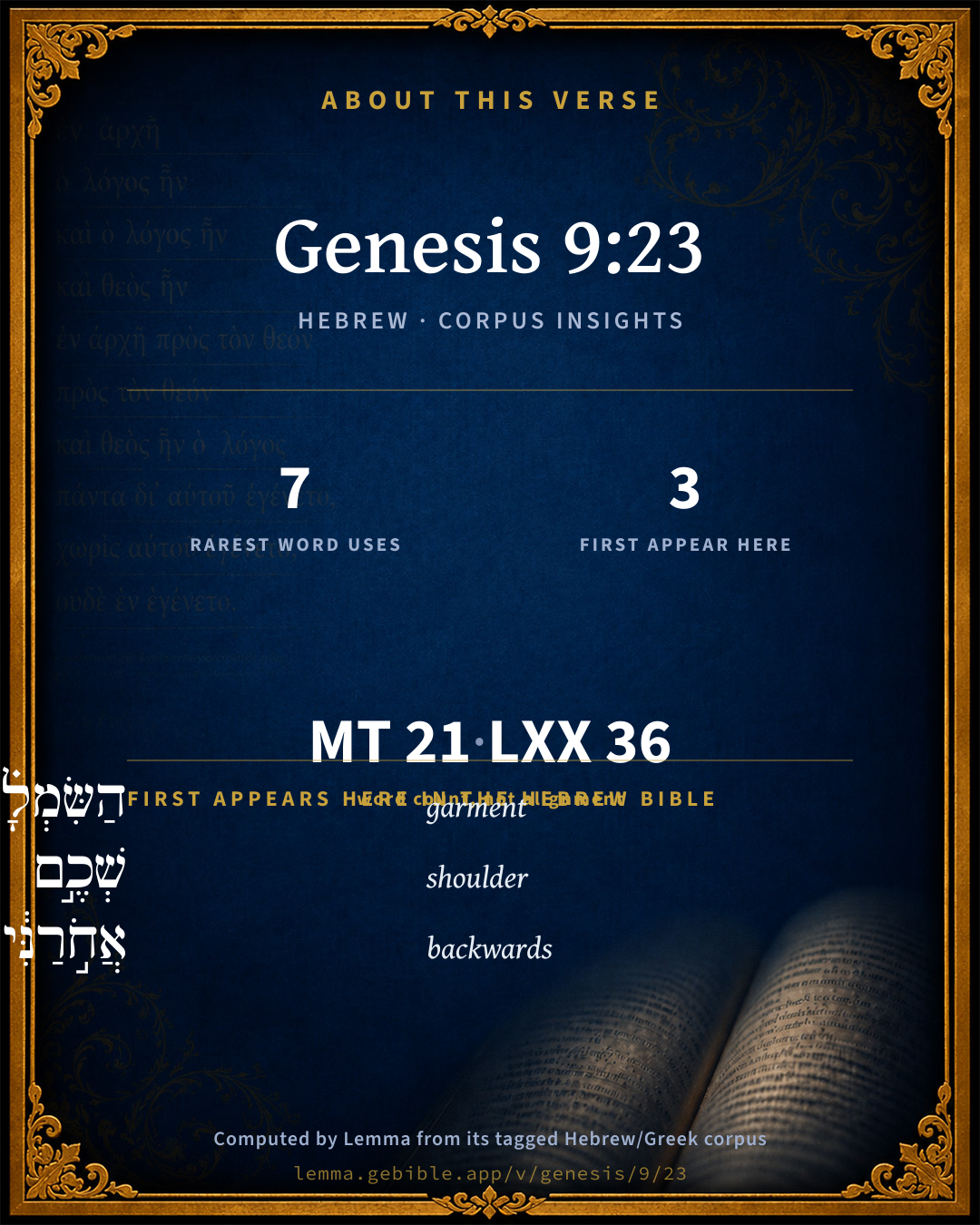
The rarest word here is אֲחֹ֣רַנִּ֔ית backwards H322 — appearing just 7 times in the whole Hebrew Bible.

First appearance in Scripture

These words make their first canonical appearance in the Hebrew Bible here:

  • הַשִּׂמְלָ֗ה garment H8071
  • שְׁכֶ֣ם shoulder H7926
  • אֲחֹ֣רַנִּ֔ית backwards H322

Shared distinctive vocabulary

אֲחֹ֣רַנִּ֔ית backwards H322 occurs in 6 verses of the Hebrew Bible. Also found in:

Grammatical profile

  • 5 verbs
  • 9 nouns
  • 1 adjective
  • 1 preposition
  • 2 adverbs
  • 3 particles

Verb forms

  • וַיִּקַּח֩ Qal · Sequential Imperfect
  • וַיָּשִׂ֨ימוּ֙ Qal · Sequential Imperfect
  • וַיֵּֽלְכוּ֙ Qal · Sequential Imperfect
  • וַיְכַסּ֕וּ Piel · Sequential Imperfect
  • רָאֽוּ Qal · Perfect

Repetition

Words recur within this verse — often emphatic in Hebrew:

  • אֲחֹ֣רַנִּ֔ית backwards H322 ×2
  • עֶרְוַ֣ת nakedness H6172 ×2
  • אֲבִיהֶ֑ם father H1 ×2

Hebrew & Septuagint length

In English translation the verse runs 34 words from the Hebrew and 38 from the Septuagint (LXX English) — closely comparable.

A rough comparison of the two English renderings, which tokenize alike — not a word-level alignment.

Word counts can differ between the Hebrew and the Greek without any difference in meaning — e.g. the Hebrew direct-object marker אֵת has no separate Greek word, and Greek often adds the article ὁ.

In the original languages it is 21 Hebrew tokens and 36 Greek tokens — but the two are counted differently (Hebrew bundles its prefixes and suffixes into one token; the Greek is in lemma form), so that isn’t a like-for-like length.

Cross-references

9

Topical passages linked to Genesis 9:23 in the Treasury of Scripture Knowledge — connected by theme and wording, ordered by reader-vote popularity; previews shown in the World English Bible.

  • Galatians 6:1 Brothers, even if a man is caught in some fault, you who are spiritual must restore such a one in a spirit of gentleness; looking to yourself so that you also aren't tempted.
  • Exodus 20:12 "Honor your father and your mother, that your days may be long in the land which Yahweh your God gives you.
  • Leviticus 19:32 You shall rise up before the gray head, and honor the face of an old man, and you shall fear your God. I am Yahweh.
  • Romans 13:7 Give therefore to everyone what you owe: taxes to whom taxes are due; customs to whom customs; respect to whom respect; honor to whom honor.
  • 1 Timothy 5:1 Don't rebuke an older man, but exhort him as a father; the younger men as brothers;
  • 1 Timothy 5:17 Let the elders who rule well be counted worthy of double honor, especially those who labor in the word and in teaching.
  • 1 Timothy 5:19 Don't receive an accusation against an elder, except at the word of two or three witnesses.
  • 1 Peter 2:17 Honor all men. Love the brotherhood. Fear God. Honor the king.
  • 1 Peter 4:8 And above all things be earnest in your love among yourselves, for love covers a multitude of sins.

Cross-references courtesy of OpenBible.info (CC BY 4.0).

Hebrew and Greek witnesses Masoretic Hebrew ↔ Greek Septuagint

The same verse in the two great witnesses to the Old Testament, shown verse-for-verse.

These are two independent witnesses, not word-aligned to each other, and the Septuagint is shown in lemma (dictionary) form.

Hebrew Genesis 9:23 Masoretic · Westminster Leningrad Codex

וַיִּקַּח֩ שֵׁ֨ם וָיֶ֜פֶת אֶת הַשִּׂמְלָ֗ה וַיָּשִׂ֨ימוּ֙ עַל שְׁכֶ֣ם שְׁנֵיהֶ֔ם וַיֵּֽלְכוּ֙ אֲחֹ֣רַנִּ֔ית וַיְכַסּ֕וּ אֵ֖ת עֶרְוַ֣ת אֲבִיהֶ֑ם וּפְנֵיהֶם֙ אֲחֹ֣רַנִּ֔ית וְעֶרְוַ֥ת אֲבִיהֶ֖ם לֹ֥א רָאֽוּ

Shem and Japheth took a garment, and laid it on both their shoulders, went in backwards, and covered the nakedness of their father. Their faces were backwards, and they didn't see their father's nakedness.

World English Bible · Public Domain

Greek LXX Genesis 9:23 Septuagint · lemma form

καί λαμβάνω σημ καί ιαφεθ ὁ ἱμάτιον ἐπιτίθημι ἐπί ὁ δύο νῶτον αὐτός καί πορεύομαι ὀπισθοφανῶς καί συνκαλύπτω ὁ γύμνωσις ὁ πατήρ αὐτός καί ὁ πρόσωπον αὐτός ὀπισθοφανής καί ὁ γύμνωσις ὁ πατήρ αὐτός οὐ ὁράω

And Sem and Japheth having taken a garment, put it on both their backs and went backwards, and covered the nakedness of their father; and their face was backward, and they saw not the nakedness of their father.

LXX2012 (modern English Septuagint) · Public Domain

On this verse, The Cambridge Bible for Schools and Colleges discusses the Septuagint’s reading. Read the note in Commentary ↓

Hebrew: Westminster Leningrad Codex (CC BY 4.0). Greek: Septuagint (public domain); English from LXX2012 (modern English Septuagint) (Public Domain). How the Septuagint differs from the Hebrew →

Targum (Aramaic paraphrase)

2

The Targum is the ancient Jewish Aramaic paraphrase of the Hebrew Scriptures — an interpretive translation, not the Hebrew text itself. Onkelos (literal) and Pseudo-Jonathan (expansive) render the Torah, and Jonathan the Prophets. Coverage is partial: where no permissively-licensed English translation exists for a verse, only the Aramaic is shown. This is verse-level text, not a word-by-word alignment to the Hebrew.

  1. Targum Onkelos Torah (Genesis–Deuteronomy)
    וּנְסֵיב שֵׁם וָיֶפֶת יָת כְּסוּתָא וְשַׁוִּיוּ עַל כְּתַף תַּרְוֵיהוֹן וַאֲזָלוּ מְחַזְרִין וַחֲפִיאוּ יָת עֶרְיְתָא דַּאֲבוּהוֹן וְאַפֵּיהוֹן מְחַזְרִין וְעֶרְיְתָא דַּאֲבוּהוֹן לָא חֲזוֹ

    And Shem and Yapheth took a mantle, and laid it upon the shoulders of both, and went backward, and covered the nakedness of their father; and their faces were averted, and the nakedness of their father they saw not.

    Targum Onkelos — Aramaic: “Onkelos Genesis” (public domain); “Onkelos Exodus” (public domain); “Onkelos Leviticus” (public domain); “Onkelos Numbers” (public domain); “Onkelos Deuteronomy” (public domain). English: “Sefaria Community Translation” (CC0 1.0 (public-domain dedication)); “J.W. Etheridge. The Targums of Onkelos and Jonathan Ben Uzziel on the Pentateuch. London: Longmans, Green, 1862” (public domain). Text via Sefaria.

  2. Targum Pseudo-Jonathan Torah (Genesis–Deuteronomy)
    וּנְסֵב שֵׁם וְיֶפֶת יַת אִסְטְלָא וְשַׁוִיוּ עַל כְּתַף תַּרְוֵיהוֹן וְאָזְלוּ מְאַחְזַרְיָן וְכַסִיאוּ יַת עִירְיְיתָא דַאֲבוּהוֹן וְאַפֵּיהוֹם מֵאַחְזְרִין וְעֶרְיְתָא דַאֲבוּהוֹן לָא חָמוּן

    And Shem and Japhet took a mantle, and bare it upon the shoulders of each, and went backward, and covered the nakedness of their father; and their faces were turned back, and the nakedness of their father they did not behold.

    Targum Pseudo-Jonathan — Aramaic: “Targum Jonathan on Genesis” (public domain); “Targum Jonathan on Exodus” (public domain); “Targum Jonathan on Leviticus” (public domain); “Targum Jonathan on Numbers” (public domain); “Targum Jonathan on Deuteronomy” (public domain). English: “The Targum of Jonathan ben Uzziel, trans. J. W. Etheridge, London, 1862” (public domain). Text via Sefaria.

Commentary

Notes on Genesis 9:23 from classic Christian and Jewish commentators (each source and its license shown beneath its notes). The classic Christian expositions comment on the surrounding passage and are grouped to its opening verse, so a note may address several verses; the Jewish commentaries on the Tanakh (Rashi and others) are per-verse, so they appear only where the commentator wrote on this verse.

Lemma curates 59 commentaries, every one of them public domain or Creative Commons licensed, each selected and text-cleaned for this edition rather than reprinted as found. About our sources →

Trapp's Complete Commentary

John Trapp

Gen 9:23 And Shem and Japheth took a garment, and laid [it] upon both their shoulders, and went backward, and covered the nakedness of their father; and their faces [were] backward, and they saw not their father’s nakedness.

Ver. 23. And Shem and Japhet took a garment.] Ham had no hand in this good work; which shows what a good one he was, and how far from being of that good emperor’s mind, {a} who said, that if he should find a bishop committing adultery, he would rather cover that unclean act with his imperial cloak, than suffer it to come abroad to the scandal of the weak, and the scorn of the wicked.

{a} Constant. Mag. Theodoret., lib. i. - Eccles. Hist., cap. xi.

John Trapp, A Commentary or Exposition upon All the Books of the Old and New Testament (1647–1656) — public domain. Text from a community e-Sword module.

Joseph Benson's Commentary

Gen 9:23. And Shem and Japheth took a garment, &c. — They not only would not see it themselves, but provided that no one else might see it; herein setting an example of charity with reference to other men’s sin and shame.

Joseph Benson's Commentary on the Old and New Testaments (1811–1818) — public domain. Text from a community e-Sword module.

Adam Clarke's Commentary

Verse 23. See Clarke on Ge 9:22

Adam Clarke's Commentary on the Bible (1810–1826) — public domain. Text from a community e-Sword/MySword module.

John Calvin's Commentaries

23. And Shem and Japheth took a garment. Here the piety, as well as the modesty, of the two brothers is commended; who, in order that the dignity of their father might not be lowered in their esteem, but that they might always cherish and keep entire the reverence which they owed him, turned away their eyes from the sight of his disgrace. And thus they gave proof of the regard they paid to their father’s honor, in supposing that their own eyes would be polluted, if they voluntarily looked upon the nakedness by which he was disgraced. At the same time they also consulted their own modesty. For (as it was said in Genesis 3:1) there is something so unaccountably shameful in the nakedness of man, that scarcely any one dares to look upon himself, even when no witness is present. They also censure the impious rashness of their brother, who had not spared his father. Hence, then, we may learn how acceptable to God is that piety, of which the example here recorded receives a signal encomium of the Spirit. But if piety towards an earthly father was a virtue so excellent, and so worthy of praise; with how much greater devotedness of piety ought the sacred majesty of God to be worshipped? The Papists make themselves ridiculous by desiring to cover the filthiness of their idol, yea, the abominations of their whole impure clergy, with the cloak of Shem and Japheth. I omit to state how great is the difference between the disgrace of Noah and the execrable vileness of so many crimes which contaminate heaven and earth. But it is necessary that Antichrist and his horned bishops, with all that rabble, should prove themselves to be fathers, if they with that any honor should be paid them.

John Calvin's Commentaries (1540-1563) — public domain. Text from the Calvin Translation Society English edition (1840s-50s) via the Christian Classics Ethereal Library (ccel.org). Calvin's coverage is partial (roughly two-thirds of the Bible); uncommented books and verses are honest gaps, never fabricated. The 19th-century editor's footnotes and remarks are omitted so the notes are faithfully Calvin's own voice.

The Cambridge Bible for Schools and Colleges

gen. ed. J. J. S. Perowne

23. a garment] Heb. simlah, LXX ἱμάτιον, Lat. pallium: the large upper garment which was also used as a covering by night, as appears from Exo_22:26; Deu_24:13. The conduct of Shem and Japheth, in its regard for their father’s honour, is contrasted with the levity and want of delicacy displayed by their brother.

The Cambridge Bible for Schools and Colleges (gen. ed. J. J. S. Perowne; Cambridge University Press, 1878–1918) — public domain. Text from a community e-Sword module.

John Gill's Exposition

And Shem and Japheth took a garment,.... Who were the two brothers Ham told what he had seen, and who, no doubt, reproved him for his ill behaviour, and then took a garment, a coat of their own, very probably, some large garment fit for the purpose:

and laid it upon both their shoulders; one part of it on the right shoulder of the one, and the other on the left shoulder of the other:

and went backward, and covered the nakedness of their father; going backward when they came into the tent, and to the place where their father lay, they threw the garment off from their shoulders over him, and so covered him:

and their faces were backward, and they saw not their father's nakedness: which they purposely shunned, for which reason they went backwards, and their faces were backwards to their father; which showed their modesty, and their filial piety and duty, and thus by their actions reproved Ham, as well as doubtless they did by words.

John Gill's Exposition of the Whole Bible (1746–1763) — public domain (CC PDM 1.0). Text via the HelloAO Bible API.

Haydock's Catholic Bible Commentary

Neither ought we to be so quick-sighted in discovering the faults of any: which we often represent as real, when they are only apparent. (Haydock)

George Leo Haydock (1774–1849), Haydock's Catholic Family Bible and Commentary, 1859 edition — public domain. Excludes Psalms (Douay-Rheims chapter numbering differs from Protestant) and Deuterocanonical books (Catholic canon only).

Whedon's Commentary on the Bible

Daniel D. Whedon

23. Took a garment — Hebrews, the garment; that is, the loose mantle with which he would naturally have covered himself on going to sleep. The Mosaic law was specially stringent in enjoining filial reverence, and in prohibiting such moral uncleanness as seems to have given pleasure to Ham. Compare Lev_18:7, etc. Sensuality, with its attendant abominations, were the great sins which brought such terrible judgment upon the Canaanites, so that the land “vomited them out.” Comp. Lev_18:24-28.

Daniel D. Whedon (gen. ed.), Commentary on the Old and New Testaments (1874–1909) — public domain. Text from a community e-Sword module.

The Pulpit Commentary

And Shem and Japheth took a garment. Literally, the robe, i.e. which was at hand (Keil, Lange); the simlah, which was an outer cloak (Deu_10:18; 1Sa_21:10; Isa_3:6, Isa_3:7) in which, at night, persons wrapped themselves. (Deu_22:17) Sometimes the letters are transposed, and the word becomes salmah (cf. Exo_22:8; Mic_2:8) And laid it upon both their shoulders, and went backwards, and covered the nakedness of their father; and their faces were backward, and they saw not the nakedness of their father; thereby evincing "the regard they paid to their father"s honor and their own modesty (Calvin).

The Pulpit Commentary (1880–1919), ed. H.D.M. Spence-Jones & Joseph S. Exell — public domain. Text from a community e-Sword module.

John Wesley's Explanatory Notes

And Shem and Japheth took a garment, and went backward, and covered the nakedness of their father - They not only would not see it themselves, but provided that no one else might see it; herein setting an example of charity, with reference to other men's sin and shame.

John Wesley, Explanatory Notes Upon the Whole Bible (1754–1765) — public domain. Text via the GEBible commentary corpus.

Rashi

Rabbi Shlomo Yitzchaki (Rashi)

ויקח שם ויפת AND SHEM AND JAPHETH TOOK — (literally, “And Shem took and Japheth”) It is not written here ויקחו ‘‘And they took”, but ויקח “And he took”, in order to teach regarding Shem that he devoted himself to this duty with more eagerness than Japheth. Therefore have Shem’s sons received the privilege of wearing the cloak that has fringes, and the sons of Japheth were privileged to receive honorable burial, as it is said, (Ezekiel 39:11) “I will give unto Gog (a descendant of Japheth) a place fit for burial [in Israel]”. But as for Ham who despised his father — of his descendants it is said (Isaiah 20:4) “So shall the king of Assyria lead away the captives of Egypt, and the exiles of Ethiopia (these were peopled by the children of Ham) young and old, naked and barefoot and with buttocks uncovered etc.” (Genesis Rabbah 36:6 and Tanchuma 1:2:15).

ופניהם אחורנית AND THEIR FACES WERE BACKWARD — Wherefore is it written a second time (that they turned themselves backward)? It is to tell us that when they came near to him and it was necessary for them to turn round in order to cover him they kept their faces turned away (Genesis Rabbah 36:6).

Rashi on the Tanakh — English translations: “The Judaica Press complete Tanach with Rashi, translated by A. J. Rosenberg” (CC BY 4.0); “Pentateuch with Rashi's commentary by M. Rosenbaum and A.M. Silbermann, 1929-1934” (public domain); “The Metsudah Tanach series, Lakewood, N.J” (CC BY 4.0); and “The Book of Joshua, Metsudah Publications, 1997” (CC BY 4.0). Text via Sefaria.

Radak

Rabbi David Kimhi (Radak)

ויקח שם ויפת, this formulation is similar to ויבא משה ואהרון in Exodus 6,10, where it describes the promptness and dedication of Moses and Aaron. Here two of the brothers not only covered their father’s private parts, but made sure that he was completely covered.

Radak on the Tanakh — English translations: “Sefaria Community Translation” (CC0 1.0 (public-domain dedication)); “Eliyahu Munk, HaChut Hameshulash” (CC BY 4.0); “Rabbi Mike Feuer, Jerusalem Anthology” (CC BY 4.0); and “R. David Kimhi on the first book of Psalms, Translated by R.G. Finch, London, 1919” (public domain). Text via Sefaria.

Lesson kit

Teaching starters — assembled from the data on this page, not authored interpretation. Every prompt links to the verse data it draws on. Edit before teaching.

Genesis, in the Pentateuch, opens this verse with 21 words (17 distinct Hebrew lemmas). Its most distinctive word is ʼăchôrannîyth (“backwards”). A historical commentator’s framing appears above. Read the whole chapter for the surrounding context.

Discussion questions

  1. The word ʼăchôrannîyth carries the sense “backwards.” How does it shape the verse?
  2. 3 words here appear for the first time in Scripture. What is being introduced at this debut?
  3. 1 Samuel 4:18 shares the word «backwards» with this verse. How do the two illuminate each other?
  4. “backwards” occurs 2× in this one verse. What is the effect of the repetition?
  5. The translations on this page render this verse differently — a whole-verse word diff, not a word-by-word alignment. What might account for the different wordings?
  6. The verb «וַיִּקַּח֩» is Qal Sequential Imperfect. How does its form color the action?
  7. Reading how Trapp's Complete Commentary and Joseph Benson's Commentary read this verse, where do the two commentators agree and where do they part?

Things to notice

Reading settings

Reading text

Shown beneath each verse's original-language words.

Old Testament
Old Testament edition

Read the OT as the Masoretic Hebrew (MT) or the Greek Septuagint (LXX).

English shown for the Greek Septuagint (in the Hebrew ↔ Greek comparison).

Comparing translations? Open the Compare panel on any verse page to stack up to four side by side.