
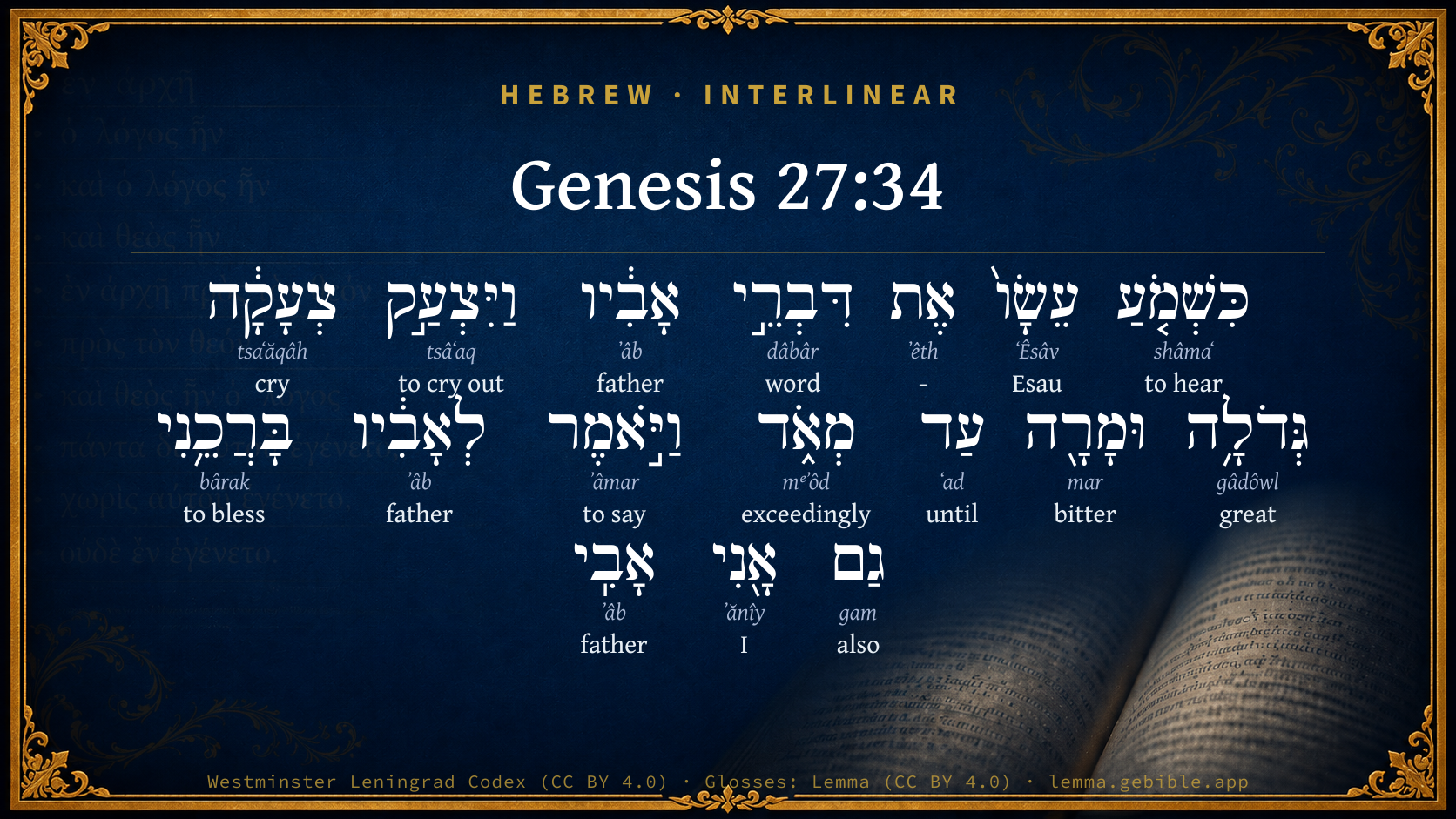
Genesis 27:34

Hebrew (Westminster Leningrad Codex) Genesis 27:34 appears in the Hebrew Old Testament. The text above is from the Westminster Leningrad Codex. Each word links to its Strong’s number, a concise gloss, and parsing drawn from the Open Scriptures Hebrew Bible morphology. Click any word for its full Brown-Driver-Briggs (BDB) entry.
Download image
Cite this verse

Genesis 27:34 (World English Bible). Public Domain. Lemma interlinear Bible study tool, https://lemma.gebible.app/v/genesis/27/34.

Show BibTeX & RIS
BibTeX
RIS
English Translation
When Esau heard the words of his father, he cried with an exceeding great and bitter cry, and said to his father, "Bless me, even me also, my father."
World English Bible · Public Domain
Highlights
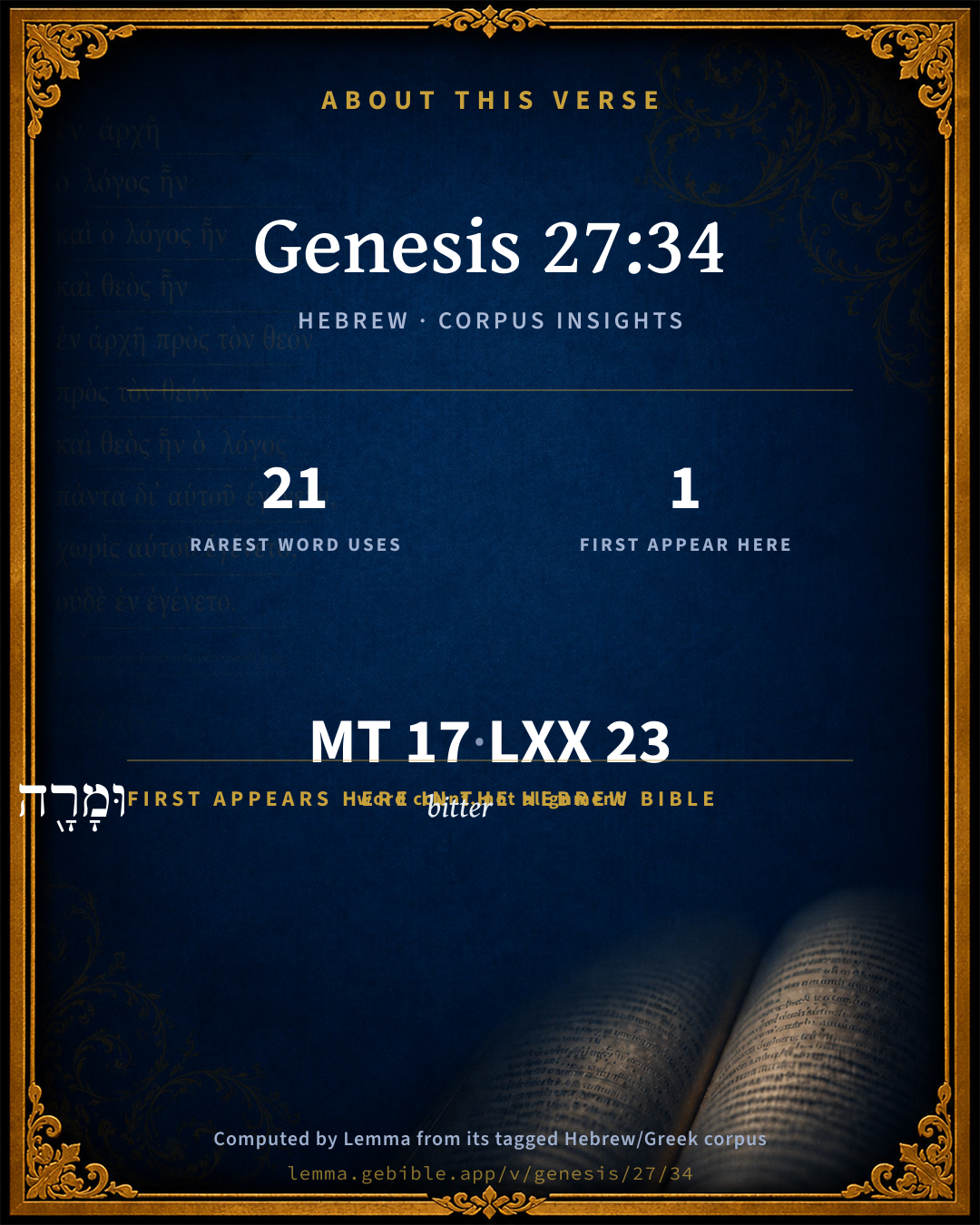
  • 1 first appearance in the Hebrew Bible
Full analysis ↓
Download a study sheet

One document with this verse’s original text, its word-by-word gloss line, the meaning frame, cross-references with their text, attributed commentary, and full source and license credits — printable, and it pastes into notes with its structure intact.

This verse Autodidact and up

Study sheet (.html) Plain text (.txt)

A passage Seminary Student

Up to 50 verses in one chapter. A passage sheet keeps up to 6 commentary sources and 12 cross-references per verse, in the order this page ranks them, and says so on the sheet whenever that leaves anything out. Ask for a single verse and you get the Autodidact verse sheet above.

Everything on this page stays free to read, with no account — the sheet is a download of what is already on screen, not access to it.

Want to remove ads? Support Godless Engineer
Compare translations 3

The same verse in 3 English versions, stacked beneath the original-language interlinear above. Click any original word for its lexicon entry.

Each is an independent rendering of the whole verse — the interlinear is not word-aligned to these translations.

Highlighted words mark where these versions differ — a whole-verse word diff, not a word-by-word alignment.

  • World English Bible Public Domain
    When Esau heard the words of his father, he cried with an exceeding great and bitter cry, and said to his father, "Bless me, even me also, my father."
  • King James Version Public Domain
    And when Esau heard the words of his father, he cried with a great and exceeding bitter cry, and said unto his father, Bless me, even me also, O my father.
  • unfoldingWord Literal Text CC BY-SA 4.0
    When Esau heard the words of his father, then he cried out a great and exceedingly bitter cry and said to his father, “Bless me, me too, my father!”

unfoldingWord Literal Text — © unfoldingWord, licensed CC BY-SA 4.0. Word-aligned USFM3 via Door43 (git.door43.org/unfoldingWord/en_ult).

Versions to compare (up to 4)

3 of 4 selected

Show all 18 translations

Every available English version of this verse, each an independent rendering of the whole verse.

  • World English Bible Public Domain
    When Esau heard the words of his father, he cried with an exceeding great and bitter cry, and said to his father, "Bless me, even me also, my father."
  • Berean Standard Bible Public Domain
    When Esau heard his father’s words, he let out a loud and bitter cry and said to his father, “Bless me too, O my father!”
  • Majority Standard Bible Public Domain
    When Esau heard his father’s words, he let out a loud and bitter cry and said to his father, “Bless me too, O my father!”
  • King James Version Public Domain
    And when Esau heard the words of his father, he cried with a great and exceeding bitter cry, and said unto his father, Bless me, even me also, O my father.
  • American Standard Version (1901) Public Domain
    When Esau heard the words of his father, he cried with an exceeding great and bitter cry, and said unto his father, Bless me, even me also, O my father.
  • Revised Version (1885) Public Domain
    When Esau heard the words of his father, he cried with an exceeding great and bitter cry, and said unto his father, Bless me, even me also, O my father.
  • Geneva Bible (1599) Public Domain
    When Esau heard the wordes of his father, he cryed out with a great crye and bitter, out of measure, and sayde vnto his father, Blesse me, euen me also, my father.
  • Douay-Rheims (1899) Public Domain
    Esau having heard his father's words, roared out with a great cry: and being in a great consternation, said: Bless me also, my father.
  • Young's Literal Translation Public Domain
    When Esau heareth the words of his father, then he crieth a very great and bitter cry, and saith to his father, `Bless me, me also, O my father;'
  • Literal Standard Version CC BY-SA 4.0
    When Esau hears the words of his father, then he cries a very great and bitter cry, and says to his father, “Bless me, me also, O my father”;
  • Unlocked Literal Bible CC BY-SA 4.0
    When Esau heard the words of his father, he cried with a very great and bitter cry, and said to his father, “Bless me, me also, my father.”
  • unfoldingWord Literal Text CC BY-SA 4.0
    When Esau heard the words of his father, then he cried out a great and exceedingly bitter cry and said to his father, “Bless me, me too, my father!”
  • Darby Bible Public Domain
    When Esau heard the words of his father, he cried with a great and exceeding bitter cry, and said to his father, Bless me -- me also, my father!
  • World Messianic Bible Public Domain
    When Esau heard the words of his father, he cried with an exceedingly great and bitter cry, and said to his father, “Bless me, even me also, my father.”
  • Webster's Bible Public Domain
    And when Esau heard the words of his father, he cried with a great and exceedingly bitter cry, and said to his father, Bless me, even me also, O my father.
  • Free Bible Version CC BY-SA 4.0
    When Esau heard his father's words, he cried out in great anger and bitterness, and pleaded with his father, “Please bless me too, my father!”
  • Bible in Basic English Public Domain
    And hearing the words of his father, Esau gave a great and bitter cry, and said to his father, Give a blessing to me, even to me, O my father!
  • JPS Tanakh (1917) Public Domain
    When Esau heard the words of his father, he cried with an exceeding great and bitter cry, and said unto his father: 'Bless me, even me also, O my father.'

Literal Standard Version (2020), Covenant Press — licensed CC BY-SA 4.0. Text via the HelloAO Bible API (eBible.org). Unlocked Literal Bible (unfoldingWord) — licensed CC BY-SA 4.0. Text via the HelloAO Bible API (eBible.org). unfoldingWord Literal Text — © unfoldingWord, licensed CC BY-SA 4.0. Word-aligned USFM3 via Door43 (git.door43.org/unfoldingWord/en_ult). Free Bible Version, Dr. Jonathan Gallagher — licensed CC BY-SA 4.0. Text via the HelloAO Bible API (eBible.org).

Word by word

More ways to search: Search by grammar → Find every occurrence → Compare this word →

Practice this passage: Drill this verse → Learn its vocabulary →

צְעָקָ֔ה
tsaʻăqâh
H6818
“cry”
Noun, Common, Feminine, Singular, Absolute
Part of Speech
Noun
Type
Common
Gender
Feminine
Number
Singular
State
Absolute
Full BDB Definition

Origin: from H6817

TWOT: 1947a

cry, outcry - outcry (against) - cry of distress (especially as heard by God)
  1. כִּשְׁמֹ֤עַ shâmaʻ H8085 “like/as · to hear” Preposition + Verb, Qal, Infinitive Construct
  2. עֵשָׂו֙ ʻÊsâv H6215 “Esau” Noun, Proper
  3. אֶת ʼêth H853 “-” Particle, Direct Object
  4. דִּבְרֵ֣י dâbâr H1697 “words of” Noun, Common, Masculine, Plural, Construct
  5. אָבִ֔יו ʼâb H1 “father · his” Noun, Common, Masculine, Singular, Construct + Suffix, Personal, 3rd Person, Masculine, Singular
  6. וַיִּצְעַ֣ק tsâʻaq H6817 “and · to cry out” Conjunction + Verb, Qal, Sequential Imperfect, 3rd Person, Masculine, Singular
  7. גְּדֹלָ֥ה gâdôwl H1419 “great” Adjective, Adjective, Feminine, Singular, Absolute
  8. וּמָרָ֖ה mar H4751 “and · bitter” Conjunction + Adjective, Adjective, Feminine, Singular, Absolute
  9. עַד ʻad H5704 “until” Preposition
  10. מְאֹ֑ד mᵉʼôd H3966 “exceedingly” Adverb
  11. וַיֹּ֣אמֶר ʼâmar H559 “and · to say” Conjunction + Verb, Qal, Sequential Imperfect, 3rd Person, Masculine, Singular
  12. לְאָבִ֔יו ʼâb H1 “to/for · father · his” Preposition + Noun, Common, Masculine, Singular, Construct + Suffix, Personal, 3rd Person, Masculine, Singular
  13. בָּרֲכֵ֥נִי bârak H1288 “bless · me” Verb, Piel, Imperative, 2nd Person, Masculine, Singular + Suffix, Personal, 1st Person, Common, Singular
  14. גַם gam H1571 “also” Adverb
  15. אָ֖נִי ʼănîy H589 “I” Pronoun, Personal, 1st Person, Common, Singular
  16. אָבִֽי ʼâb H1 “father · my” Noun, Common, Masculine, Singular, Construct + Suffix, Personal, 1st Person, Common, Singular

About this verse

These counts appear in no published source. They are computed here, from the morphology-tagged text and Lemma’s own curated glosses. What Lemma adds →

17
words
15
distinct lemmas
Pentateuch
section

Notable vocabulary

The rarest word here is צְעָקָ֔ה cry H6818 — appearing just 21 times in the whole Hebrew Bible.

First appearance in Scripture

This word makes its first canonical appearance in the Hebrew Bible here:

  • וּמָרָ֖ה bitter H4751

Shared distinctive vocabulary

צְעָקָ֔ה cry H6818 occurs in 20 verses of the Hebrew Bible. Also found in:

Grammatical profile

  • 4 verbs
  • 6 nouns
  • 2 adjectives
  • 1 pronoun
  • 1 preposition
  • 2 adverbs
  • 1 particle

Verb forms

  • כִּשְׁמֹ֤עַ Qal · Infinitive Construct
  • וַיִּצְעַ֣ק Qal · Sequential Imperfect
  • וַיֹּ֣אמֶר Qal · Sequential Imperfect
  • בָּרֲכֵ֥נִי Piel · Imperative

Repetition

A word recurs within this verse — often emphatic in Hebrew:

  • אָבִ֔יו father H1 ×3

Hebrew & Septuagint length

In English translation the verse runs 29 words from the Hebrew and 33 from the Septuagint (LXX English) — closely comparable.

A rough comparison of the two English renderings, which tokenize alike — not a word-level alignment.

Word counts can differ between the Hebrew and the Greek without any difference in meaning — e.g. the Hebrew direct-object marker אֵת has no separate Greek word, and Greek often adds the article ὁ.

In the original languages it is 17 Hebrew tokens and 23 Greek tokens — but the two are counted differently (Hebrew bundles its prefixes and suffixes into one token; the Greek is in lemma form), so that isn’t a like-for-like length.

Cross-references

6

Topical passages linked to Genesis 27:34 in the Treasury of Scripture Knowledge — connected by theme and wording, ordered by reader-vote popularity; previews shown in the World English Bible.

  • Hebrews 12:17 For you know that even when he afterward desired to inherit the blessing, he was rejected, for he found no place for a change of mind though he sought it diligently with tears.
  • Proverbs 1:31 Therefore they will eat of the fruit of their own way, And be filled with their own schemes.
  • 1 Samuel 30:4 Then David and the people who were with him lifted up their voice and wept, until they had no more power to weep.
  • Proverbs 1:24–28 Because I have called, and you have refused; I have stretched out my hand, and no one has paid attention;
  • Proverbs 19:3 The foolishness of man subverts his way; His heart rages against Yahweh.
  • Luke 13:24–28 "Strive to enter in by the narrow door, for many, I tell you, will seek to enter in, and will not be able.

Cross-references courtesy of OpenBible.info (CC BY 4.0).

Hebrew and Greek witnesses Masoretic Hebrew ↔ Greek Septuagint

The same verse in the two great witnesses to the Old Testament, shown verse-for-verse.

These are two independent witnesses, not word-aligned to each other, and the Septuagint is shown in lemma (dictionary) form.

Hebrew Genesis 27:34 Masoretic · Westminster Leningrad Codex

כִּשְׁמֹ֤עַ עֵשָׂו֙ אֶת דִּבְרֵ֣י אָבִ֔יו וַיִּצְעַ֣ק צְעָקָ֔ה גְּדֹלָ֥ה וּמָרָ֖ה עַד מְאֹ֑ד וַיֹּ֣אמֶר לְאָבִ֔יו בָּרֲכֵ֥נִי גַם אָ֖נִי אָבִֽי

When Esau heard the words of his father, he cried with an exceeding great and bitter cry, and said to his father, "Bless me, even me also, my father."

World English Bible · Public Domain

Greek LXX Genesis 27:34 Septuagint · lemma form

γίγνομαι δέ ἡνίκα ἀκούω ησαυ ὁ ῥῆμα ισαακ ὁ πατήρ αὐτός ἀναβοάω φωνή μέγας καί πικρός σφόδρα καί εἶπον εὐλογέω δή καΐἐμός πατήρ

And it came to pass when Esau heard the words of his father Isaac, he cried out with a great and very bitter cry, and said, Bless, I pray you, me also, father.

LXX2012 (modern English Septuagint) · Public Domain

Hebrew: Westminster Leningrad Codex (CC BY 4.0). Greek: Septuagint (public domain); English from LXX2012 (modern English Septuagint) (Public Domain). How the Septuagint differs from the Hebrew →

Targum (Aramaic paraphrase)

2

The Targum is the ancient Jewish Aramaic paraphrase of the Hebrew Scriptures — an interpretive translation, not the Hebrew text itself. Onkelos (literal) and Pseudo-Jonathan (expansive) render the Torah, and Jonathan the Prophets. Coverage is partial: where no permissively-licensed English translation exists for a verse, only the Aramaic is shown. This is verse-level text, not a word-by-word alignment to the Hebrew.

  1. Targum Onkelos Torah (Genesis–Deuteronomy)
    כַּד שְׁמַע עֵשָׂו יָת פִּתְגָּמֵי אֲבוּהִי וּצְוַח צִוְחָא רַבָּא וּמְרִירָא עַד לַחֲדָא וַאֲמַר לַאֲבוּהִי בָּרֵכְנִי אַף אֲנָא (נ''י לִי) אַבָּא

    (no public-domain English translation for this verse)

    Targum Onkelos — Aramaic: “Onkelos Genesis” (public domain); “Onkelos Exodus” (public domain); “Onkelos Leviticus” (public domain); “Onkelos Numbers” (public domain); “Onkelos Deuteronomy” (public domain). English: “Sefaria Community Translation” (CC0 1.0 (public-domain dedication)); “J.W. Etheridge. The Targums of Onkelos and Jonathan Ben Uzziel on the Pentateuch. London: Longmans, Green, 1862” (public domain). Text via Sefaria.

  2. Targum Pseudo-Jonathan Torah (Genesis–Deuteronomy)
    כַּדִי שְׁמַע עֵשָו יַת פִּתְגָמֵי אָבוֹי וְצָוַח צְוַחְתָּא רַבְּתָא וּמְרִירָתָא עַד לַחֲדָא וַאֲמַר לְאָבוֹי בְּרֵיכְנִי אוּף לִי אַבָּא

    When Esau heard the words of his father, he cried with a cry exceeding great and bitter, and said to his father, Bless me, me also, my father! And he said,

    Targum Pseudo-Jonathan — Aramaic: “Targum Jonathan on Genesis” (public domain); “Targum Jonathan on Exodus” (public domain); “Targum Jonathan on Leviticus” (public domain); “Targum Jonathan on Numbers” (public domain); “Targum Jonathan on Deuteronomy” (public domain). English: “The Targum of Jonathan ben Uzziel, trans. J. W. Etheridge, London, 1862” (public domain). Text via Sefaria.

Commentary

Notes on Genesis 27:34 from classic Christian and Jewish commentators (each source and its license shown beneath its notes). The classic Christian expositions comment on the surrounding passage and are grouped to its opening verse, so a note may address several verses; the Jewish commentaries on the Tanakh (Rashi and others) are per-verse, so they appear only where the commentator wrote on this verse.

Lemma curates 59 commentaries, every one of them public domain or Creative Commons licensed, each selected and text-cleaned for this edition rather than reprinted as found. About our sources →

Trapp's Complete Commentary

John Trapp

Gen 27:34 And when Esau heard the words of his father, he cried with a great and exceeding bitter cry, and said unto his father, Bless me, [even] me also, O my father.

Ver. 34. He cried with a great and exceeding bitter cry.] Not for his sin, in selling the birthright; but for his loss, in missing the blessing: {a} though having sold the birthright, he had no right to the blessing. This is the guise of the ungodly. He cries, Perii; not Peccavi. If he "howl upon his bed," {Hos 7:14} it is for corn and oil, as a dog tied up howls for his dinner: it never troubles him, that a good God is offended, which to an honest heart is the prime cause of greatest sorrow.

{a} Non dolet de peccato venditionis, sed de damno perditionis. - Par.

John Trapp, A Commentary or Exposition upon All the Books of the Old and New Testament (1647–1656) — public domain. Text from a community e-Sword module.

Tyndale Open Study Notes

Tyndale Open Resources

27:34-35 Esau was very bitter, and angry enough to kill (27:41).

Tyndale Open Study Notes — © Tyndale Open Resources, licensed CC BY-SA 4.0. Text via the HelloAO Bible API.

John Calvin's Commentaries

34. He cried with a great and exceeding bitter cry. Though Esau persists in imploring the blessing, he yet gives a sign of desperation, which is the reason why he obtains no benefit, because he enters not by the gate of faith. True piety, indeed, draws forth tears and great cries from the children of God; but Esau, trembling and full of fears, breaks out in wailings; afterwards he casts, at a venture, his wish into the air, that he also may receive a blessing. But his blind incredulity is reproved by his own words; for whereas one blessing only had been deposited with his father, he asks that another should be given to him, as if it were in his father’s power indiscriminately to breathe out blessings, independently of the command of God. Here the admonition of the Apostle may suggest itself to our minds,

“that Esau, when he sought again the forfeited blessing with tears and loud lamentations, found no place for repentance,” (Hebrews 12:17;)

for they who neglect to follow God when he calls on them, afterwards call upon him in vain, when he has turned his back. So long as God addresses and invites us, the gate of the kingdom of heaven is in a certain sense open: this opportunity we must use, if we desire to enter, according to the instruction of the Prophet,

“Seek ye the Lord while he may be found; call ye upon him while he is near.” (Isaiah 55:6.)

Of which passage Paul is the interpreter, in defining that to be the acceptable time of the day of salvation in which grace is brought unto us by the gospel. (2 Corinthians 6:2.) They who suffer that time to pass by, may, at length, knock too late, and without profit, because God avenges himself of their idleness. We must therefore fear lest if, with deafened ears, we suffer the voice of God now to pass unheeded by, he should, in turn, become deaf to our cry. But it may be asked, how is this repulse consistent with the promise,

“If the wicked will turn from all his sins that he has committed, and keep all my statutes, and do that which is lawful and right, he shall surely live?” (Ezekiel 18:21.)

Moreover, it may seem at variance with the clemency of God to reject the sighings of those who, being crushed by misery, fly for refuge to his mercy. I answer, that repentance, if it be true and sincere, will never be too late; and the sinner who, from his soul, is displeased with himself, will obtain pardon: but God in this manner punishes the contempt of his grace, because they who obstinately reject it, do not seriously purpose in their mind to return to him. Thus it is that they who are given up to a reprobate mind are never touched with genuine penitence. Hypocrites truly break out into tears, like Esau, but their heart within them will remain closed as with iron bars. Therefore, since Esau rushes forward, destitute of faith and repentance, to ask a blessing, there is no wonder that he should be rejected.

John Calvin's Commentaries (1540-1563) — public domain. Text from the Calvin Translation Society English edition (1840s-50s) via the Christian Classics Ethereal Library (ccel.org). Calvin's coverage is partial (roughly two-thirds of the Bible); uncommented books and verses are honest gaps, never fabricated. The 19th-century editor's footnotes and remarks are omitted so the notes are faithfully Calvin's own voice.

The Cambridge Bible for Schools and Colleges

gen. ed. J. J. S. Perowne

34. an exceeding … cry] These are the words to which reference is made in Heb_12:17. Esau had hoped to win back through his father’s fondness the privileges which he himself had bartered away through his own thoughtless folly. His disappointment is all the greater, because he believed that he was about to recover that which his conscience told him he had already forfeited in an unworthy and trifling spirit.

The Cambridge Bible for Schools and Colleges (gen. ed. J. J. S. Perowne; Cambridge University Press, 1878–1918) — public domain. Text from a community e-Sword module.

John Gill's Exposition

And when Esau heard the words of his father,.... That another person had been before him, and got the blessing; and especially when he heard this ratified, and confirmed, and made irrevocable:

he cried with a great and exceeding bitter cry; as loud as he possibly could, and in as doleful and hideous a manner as can be imagined; according to the Vulgate Latin version, he roared like a lion:

and said unto his father, bless me, even me also, O my father; thou art my father, and I am a child of thine as well as Jacob, show paternal affection to me; give me also a child's blessing, one at least equal to what thou hast given Jacob, if not a greater, as being the firstborn.

John Gill's Exposition of the Whole Bible (1746–1763) — public domain (CC PDM 1.0). Text via the HelloAO Bible API.

Haydock's Catholic Bible Commentary

Roared, through savage fury and envy of his brother. (Eusebius) (Menochius)

George Leo Haydock (1774–1849), Haydock's Catholic Family Bible and Commentary, 1859 edition — public domain. Excludes Psalms (Douay-Rheims chapter numbering differs from Protestant) and Deuterocanonical books (Catholic canon only).

Matthew Poole's English Annotations

He cried with a great and exceeding bitter cry, not for any sense of his former sin, in despising his birthright, but for grief at his great loss therein, because God would not suffer him to be perjured in keeping that birthright blessing which he had sold and sworn away.

Bless me, even me also, O my father, i.e. Thou art my father no less than his, and therefore, as a child, I claim a share in thy blessing.

Matthew Poole's English Annotations on the Holy Bible (1683–1685) — public domain. Text from a community e-Sword/MySword module.

Whedon's Commentary on the Bible

Daniel D. Whedon

34. Esau… cried with a great and exceeding bitter cry — Here comes his penalty and sorrow for his part in the attempt to move against the prophecy and against the spirit of his own oath solemnly made to Jacob — to yield him his birthright. There is something truly touching in his bitter cry, and yet we note that, like all the “profane,” he mourns not his sin or error, but the consequences. “He found no place of repentance,” no possibility or chance of repairing his loss by repentance, “though he sought it carefully with tears.” Heb_12:17.

Daniel D. Whedon (gen. ed.), Commentary on the Old and New Testaments (1874–1909) — public domain. Text from a community e-Sword module.

The Pulpit Commentary

And when Esau heard the words of his father, he cried with a great and exceeding bitter cry literally, he cri ed a cry, great and bitter exceedingly; expressive of the poignant anguish of his soul (Kalisch, Bush), if not also of his rage against his brother (Philo, Eusebius), of his envy of the blessing (Menochius, Lapide), and of the desperation of his spirit (Calvin). Cf.; Heb_12:17and said unto his father, Bless me, even me also, O my father. A proof of Esau"s blind incredulity in imagining it to be within his father"s power to impart benedictions promiscuously without and beyond the Divine sanction (Calvin) a sign that he supposed the theocratic blessing capable of division, and as dependent upon his lamentations and prayers as upon the caprice of his father (Lange); an e vide nce that now at last he had learned in some measure adequately to value" the birthing? (Candlish); but if so it was post horam.

The Pulpit Commentary (1880–1919), ed. H.D.M. Spence-Jones & Joseph S. Exell — public domain. Text from a community e-Sword module.

unfoldingWord translationNotes

Door43 World Missions Community

he cried with a very great and bitter cry

Esau's anguish was similar to the taste of something bitter. AT: "he cried loudly" (See: Metaphor)

has taken away your blessing

This is a figure of speech meaning Jacob took what was Esau's. AT: "I have blessed him instead of you" (See: Metaphor)

translationWords

bless

deceive

unfoldingWord translationNotes — © Distant Shores Media and the Door43 World Missions Community, licensed CC BY-SA 4.0. Source: git.door43.org/Door43/en_tn.

Radak

Rabbi David Kimhi (Radak)

כשמוע...גם אני, “I am also your son, no less than he is.” The letter א in the word אני has the vowel kametz, although it does not signify a comma or something similar, as it is intended to stress the word “I.” We find a similar construction in 31,52 אם אני לא אעבור אליך, where we also would not have expected the kametz instead of the vowel patach. There too, the kametz is used to provide emphasis on the word “I.” Another example of the use of the kametz in the word אני as a means of emphasizing the speaker is Psalms 89,28 אף-אני בכור אתנהו, “I will appoint him firstborn.”

Radak on the Tanakh — English translations: “Sefaria Community Translation” (CC0 1.0 (public-domain dedication)); “Eliyahu Munk, HaChut Hameshulash” (CC BY 4.0); “Rabbi Mike Feuer, Jerusalem Anthology” (CC BY 4.0); and “R. David Kimhi on the first book of Psalms, Translated by R.G. Finch, London, 1919” (public domain). Text via Sefaria.

Lesson kit

Teaching starters — assembled from the data on this page, not authored interpretation. Every prompt links to the verse data it draws on. Edit before teaching.

Genesis, in the Pentateuch, opens this verse with 17 words (15 distinct Hebrew lemmas). Its most distinctive word is tsaʻăqâh (“cry”). A historical commentator’s framing appears above. Read the whole chapter for the surrounding context.

Discussion questions

  1. What does “cry” (tsaʻăqâh) contribute to the verse as a whole?
  2. The word “bitter” first appears here in Scripture. What is being introduced at this debut?
  3. Genesis 18:21 shares the word «cry» with this verse. How do the two illuminate each other?
  4. “father” occurs 3× in this one verse. What is the effect of the repetition?
  5. These translations render this verse differently; the difference is in the English rendering, not the original. What questions does that raise?
  6. The verb «כִּשְׁמֹ֤עַ» is Qal Infinitive Construct. How does its form color the action?
  7. Reading how Trapp's Complete Commentary and Tyndale Open Study Notes read this verse, where do the two commentators agree and where do they part?

Things to notice

Reading settings

Reading text

Shown beneath each verse's original-language words.

Old Testament
Old Testament edition

Read the OT as the Masoretic Hebrew (MT) or the Greek Septuagint (LXX).

English shown for the Greek Septuagint (in the Hebrew ↔ Greek comparison).

Comparing translations? Open the Compare panel on any verse page to stack up to four side by side.