

Genesis 31:19

Hebrew (Westminster Leningrad Codex) Genesis 31:19 appears in the Hebrew Old Testament. The text above is from the Westminster Leningrad Codex. Each word links to its Strong’s number, a concise gloss, and parsing drawn from the Open Scriptures Hebrew Bible morphology. Click any word for its full Brown-Driver-Briggs (BDB) entry.
Download image
Cite this verse

Genesis 31:19 (World English Bible). Public Domain. Lemma interlinear Bible study tool, https://lemma.gebible.app/v/genesis/31/19.

Show BibTeX & RIS
BibTeX
RIS
English Translation
Now Laban had gone to shear his sheep: and Rachel stole the teraphim that were her father's.
World English Bible · Public Domain
Highlights
  • 2 first appearances in the Hebrew Bible
Full analysis ↓
Download a study sheet

One document with this verse’s original text, its word-by-word gloss line, the meaning frame, cross-references with their text, attributed commentary, and full source and license credits — printable, and it pastes into notes with its structure intact.

This verse Autodidact and up

Study sheet (.html) Plain text (.txt)

A passage Seminary Student

Up to 50 verses in one chapter. A passage sheet keeps up to 6 commentary sources and 12 cross-references per verse, in the order this page ranks them, and says so on the sheet whenever that leaves anything out. Ask for a single verse and you get the Autodidact verse sheet above.

Everything on this page stays free to read, with no account — the sheet is a download of what is already on screen, not access to it.

Want to remove ads? Support Godless Engineer
Compare translations 3

The same verse in 3 English versions, stacked beneath the original-language interlinear above. Click any original word for its lexicon entry.

Each is an independent rendering of the whole verse — the interlinear is not word-aligned to these translations.

Highlighted words mark where these versions differ — a whole-verse word diff, not a word-by-word alignment.

  • World English Bible Public Domain
    Now Laban had gone to shear his sheep: and Rachel stole the teraphim that were her father's.
  • King James Version Public Domain
    And Laban went to shear his sheep: and Rachel had stolen the images that were her father's.
  • unfoldingWord Literal Text CC BY-SA 4.0
    Now Laban had gone to shear his sheep, so Rachel stole the idols that to her father,

unfoldingWord Literal Text — © unfoldingWord, licensed CC BY-SA 4.0. Word-aligned USFM3 via Door43 (git.door43.org/unfoldingWord/en_ult).

Versions to compare (up to 4)

3 of 4 selected

Show all 18 translations

Every available English version of this verse, each an independent rendering of the whole verse.

  • World English Bible Public Domain
    Now Laban had gone to shear his sheep: and Rachel stole the teraphim that were her father's.
  • Berean Standard Bible Public Domain
    Now while Laban was out shearing his sheep, Rachel stole her father’s household idols.
  • Majority Standard Bible Public Domain
    Now while Laban was out shearing his sheep, Rachel stole her father’s household idols.
  • King James Version Public Domain
    And Laban went to shear his sheep: and Rachel had stolen the images that were her father's.
  • American Standard Version (1901) Public Domain
    Now Laban was gone to shear his sheep: and Rachel stole the teraphim that were her father's.
  • Revised Version (1885) Public Domain
    Now Laban was gone to shear his sheep: and Rachel stole the teraphim that were her father’s.
  • Geneva Bible (1599) Public Domain
    Whe Laban was gone to shere his sheepe, Then Rahel stole her fathers idoles.
  • Douay-Rheims (1899) Public Domain
    At that time Laban was gone to shear his sheep, and Rachel stole away her father's idols.
  • Young's Literal Translation Public Domain
    And Laban hath gone to shear his flock, and Rachel stealeth the teraphim which her father hath;
  • Literal Standard Version CC BY-SA 4.0
    And Laban has gone to shear his flock, and Rachel steals the teraphim which her father has;
  • Unlocked Literal Bible CC BY-SA 4.0
    When Laban had gone to shear his sheep, Rachel stole her father's household gods.
  • unfoldingWord Literal Text CC BY-SA 4.0
    Now Laban had gone to shear his sheep, so Rachel stole the idols that to her father,
  • Darby Bible Public Domain
    And Laban had gone to shear his sheep. And Rachel stole the teraphim that [belonged] to her father.
  • World Messianic Bible Public Domain
    Now Laban had gone to shear his sheep; and Rachel stole the teraphim that were her father’s.
  • Webster's Bible Public Domain
    And Laban went to shear his sheep; and Rachel had stolen the images that were her father's.
  • Free Bible Version CC BY-SA 4.0
    While Laban was away from home shearing his sheep, Rachel stole the household idols that belonged to her father.
  • Bible in Basic English Public Domain
    Now Laban had gone to see to the cutting of the wool of his sheep; so Rachel secretly took the images of the gods of her father's house.
  • JPS Tanakh (1917) Public Domain
    Now Laban was gone to shear his sheep. And Rachel stole the teraphim that were her father's.

Literal Standard Version (2020), Covenant Press — licensed CC BY-SA 4.0. Text via the HelloAO Bible API (eBible.org). Unlocked Literal Bible (unfoldingWord) — licensed CC BY-SA 4.0. Text via the HelloAO Bible API (eBible.org). unfoldingWord Literal Text — © unfoldingWord, licensed CC BY-SA 4.0. Word-aligned USFM3 via Door43 (git.door43.org/unfoldingWord/en_ult). Free Bible Version, Dr. Jonathan Gallagher — licensed CC BY-SA 4.0. Text via the HelloAO Bible API (eBible.org).

Word by word

More ways to search: Search by grammar → Find every occurrence → Compare this word →

Practice this passage: Drill this verse → Learn its vocabulary →

לִגְזֹ֖ז
gazâz
H1494
“to shear”
Preposition + Verb, Qal, Infinitive Construct
Part of Speech
Preposition + Verb
Stem
Qal
Form
Infinitive Construct
Full BDB Definition

Origin: a primitive root [akin to H1468 ]

TWOT: 336

to shear, mow - (Qal) - to shear - shearer (participle) - (Niphal) to be cut off, be destroyed
  1. וְלָבָ֣ן Lâbân H3837 “and · Laban” Conjunction + Noun, Proper
  2. הָלַ֔ךְ hâlak H1980 “to walk” Verb, Qal, Perfect, 3rd Person, Masculine, Singular
  3. אֶת ʼêth H853 “-” Particle, Direct Object
  4. צֹאנ֑וֹ tsôʼn H6629 “flock · his” Noun, Common, Both, Singular, Construct + Suffix, Personal, 3rd Person, Masculine, Singular
  5. וַתִּגְנֹ֣ב gânab H1589 “and · to steal” Conjunction + Verb, Qal, Sequential Imperfect, 3rd Person, Feminine, Singular
  6. רָחֵ֔ל Râchêl H7354 “Rachel” Noun, Proper
  7. אֶת ʼêth H853 “-” Particle, Direct Object
  8. הַתְּרָפִ֖ים tᵉrâphîym H8655 “the · teraphim” Particle, Definite Article + Noun, Common, Masculine, Plural, Absolute
  9. אֲשֶׁ֥ר ʼăsher H834 “which” Particle, Relative
  10. לְאָבִֽיהָ ʼâb H1 “to/for · father · her” Preposition + Noun, Common, Masculine, Singular, Construct + Suffix, Personal, 3rd Person, Feminine, Singular

About this verse

These counts appear in no published source. They are computed here, from the morphology-tagged text and Lemma’s own curated glosses. What Lemma adds →

11
words
10
distinct lemmas
Pentateuch
section

Notable vocabulary

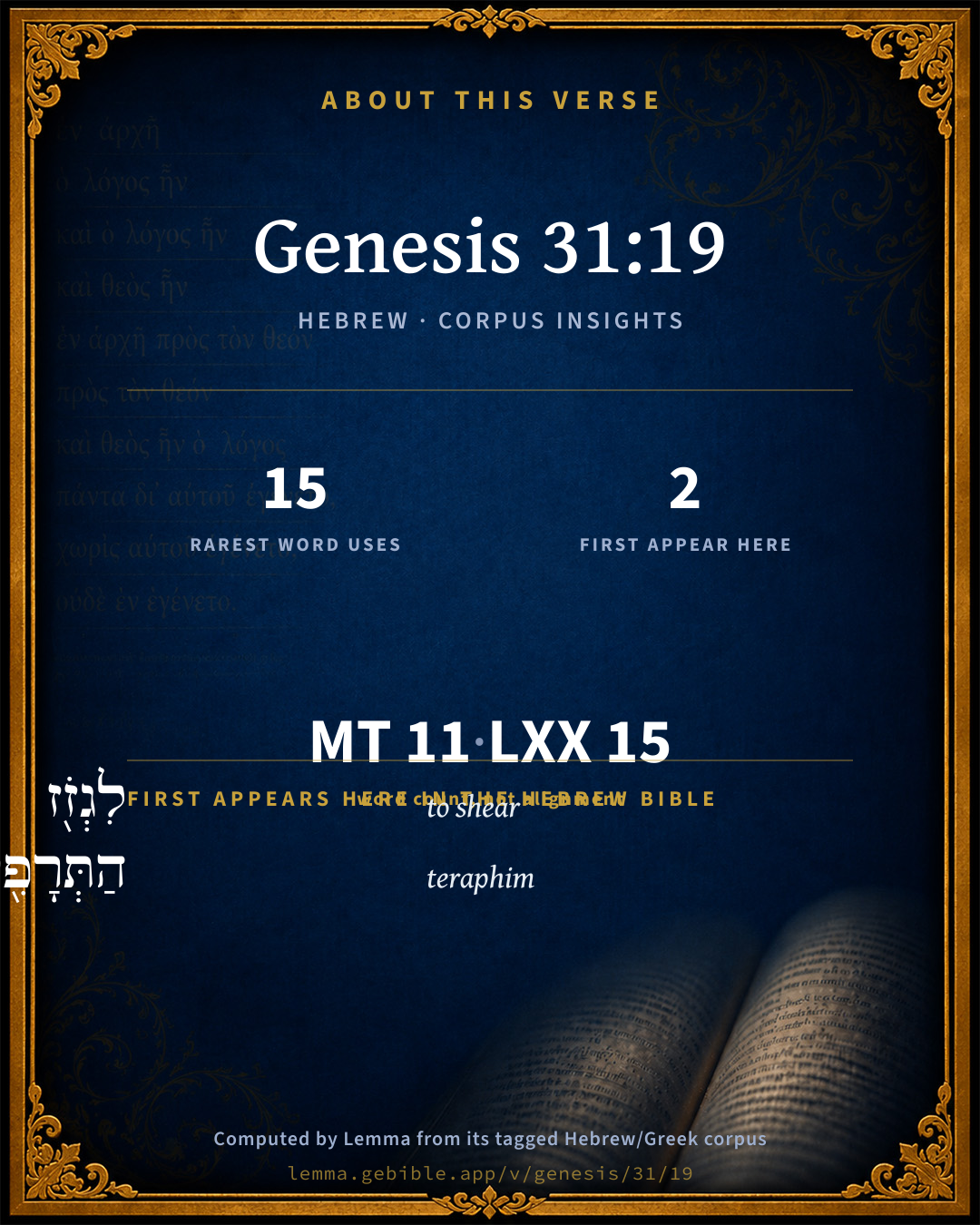
The rarest word here is לִגְזֹ֖ז to shear H1494 — appearing just 15 times in the whole Hebrew Bible.

First appearance in Scripture

These words make their first canonical appearance in the Hebrew Bible here:

  • לִגְזֹ֖ז to shear H1494
  • הַתְּרָפִ֖ים teraphim H8655

Shared distinctive vocabulary

לִגְזֹ֖ז to shear H1494 occurs in 15 verses of the Hebrew Bible. Also found in:

Grammatical profile

  • 3 verbs
  • 5 nouns
  • 3 particles

Verb forms

  • הָלַ֔ךְ Qal · Perfect
  • לִגְזֹ֖ז Qal · Infinitive Construct
  • וַתִּגְנֹ֣ב Qal · Sequential Imperfect

Hebrew & Septuagint length

In English translation the verse runs 17 words from the Hebrew and 13 from the Septuagint (LXX English) — closely comparable.

A rough comparison of the two English renderings, which tokenize alike — not a word-level alignment.

Word counts can differ between the Hebrew and the Greek without any difference in meaning — e.g. the Hebrew direct-object marker אֵת has no separate Greek word, and Greek often adds the article ὁ.

In the original languages it is 11 Hebrew tokens and 15 Greek tokens — but the two are counted differently (Hebrew bundles its prefixes and suffixes into one token; the Greek is in lemma form), so that isn’t a like-for-like length.

Cross-references

11

Topical passages linked to Genesis 31:19 in the Treasury of Scripture Knowledge — connected by theme and wording, ordered by reader-vote popularity; previews shown in the World English Bible.

  • 1 Samuel 19:13 Michal took the teraphim, and laid it in the bed, and put a pillow of goats' [hair] at the head of it, and covered it with the clothes.
  • Genesis 31:30 Now, you want to be gone, because you sore longed after your father's house, but why have you stolen my gods?"
  • Hosea 3:4 For the children of Israel shall abide many days without king, and without prince, and without sacrifice, and without sacred stone, and without ephod or idols.
  • Genesis 35:2 Then Jacob said to his household, and to all who were with him, "Put away the foreign gods that are among you, purify yourselves, change your garments.
  • Ezekiel 21:21 For the king of Babylon stood at the parting of the way, at the head of the two ways, to use divination: he shook the arrows back and forth, he consulted the teraphim, he looked in the liver.
  • Genesis 31:32 With whoever you find your gods, he shall not live. Before our relatives, discern what is yours with me, and take it." For Jacob didn't know that Rachel had stolen them.
  • Genesis 31:34 Now Rachel had taken the teraphim, put them in the camel's saddle, and sat on them. Laban felt about all the tent, but didn't find them.
  • Judges 17:4–5 When he restored the money to his mother, his mother took two hundred [pieces] of silver, and gave them to the founder, who made of it an engraved image and a molten image: and it was in the house of Micah.
  • Judges 18:14–24 Then the five men who went to spy out the country of Laish answered, and said to their brothers, Do you know that there is in these houses an ephod, and teraphim, and an engraved image, and a molten image? now therefore consider what you have to do.
  • Joshua 24:2 Joshua said to all the people, Thus says Yahweh, the God of Israel, Your fathers lived of old time beyond the River, even Terah, the father of Abraham, and the father of Nahor: and they served other gods.
  • Judges 18:31 So they set them up Micah's engraved image which he made, all the time that the house of God was in Shiloh.

Cross-references courtesy of OpenBible.info (CC BY 4.0).

Hebrew and Greek witnesses Masoretic Hebrew ↔ Greek Septuagint

The same verse in the two great witnesses to the Old Testament, shown verse-for-verse.

These are two independent witnesses, not word-aligned to each other, and the Septuagint is shown in lemma (dictionary) form.

Hebrew Genesis 31:19 Masoretic · Westminster Leningrad Codex

וְלָבָ֣ן הָלַ֔ךְ לִגְזֹ֖ז אֶת צֹאנ֑וֹ וַתִּגְנֹ֣ב רָחֵ֔ל אֶת הַתְּרָפִ֖ים אֲשֶׁ֥ר לְאָבִֽיהָ

Now Laban had gone to shear his sheep: and Rachel stole the teraphim that were her father's.

World English Bible · Public Domain

Greek LXX Genesis 31:19 Septuagint · lemma form

λαβαν δέ οἴχομαι κείρω ὁ πρόβατον αὐτός κλέπτω δέ ραχηλ ὁ εἴδωλον ὁ πατήρ αὐτός

And Laban went to shear his sheep; and Rachel stole her father's images.

LXX2012 (modern English Septuagint) · Public Domain

On this verse, The Cambridge Bible for Schools and Colleges discusses the Septuagint’s reading. Read the note in Commentary ↓

Hebrew: Westminster Leningrad Codex (CC BY 4.0). Greek: Septuagint (public domain); English from LXX2012 (modern English Septuagint) (Public Domain). How the Septuagint differs from the Hebrew →

Targum (Aramaic paraphrase)

2

The Targum is the ancient Jewish Aramaic paraphrase of the Hebrew Scriptures — an interpretive translation, not the Hebrew text itself. Onkelos (literal) and Pseudo-Jonathan (expansive) render the Torah, and Jonathan the Prophets. Coverage is partial: where no permissively-licensed English translation exists for a verse, only the Aramaic is shown. This is verse-level text, not a word-by-word alignment to the Hebrew.

  1. Targum Onkelos Torah (Genesis–Deuteronomy)
    וְלָבָן אֲזַל לְמִגַּז יָת עָנֵהּ וּנְסִּבַת רָחֵל יָת צַלְמָנַיָּא דִּי לַאֲבוּהָא

    (no public-domain English translation for this verse)

    Targum Onkelos — Aramaic: “Onkelos Genesis” (public domain); “Onkelos Exodus” (public domain); “Onkelos Leviticus” (public domain); “Onkelos Numbers” (public domain); “Onkelos Deuteronomy” (public domain). English: “Sefaria Community Translation” (CC0 1.0 (public-domain dedication)); “J.W. Etheridge. The Targums of Onkelos and Jonathan Ben Uzziel on the Pentateuch. London: Longmans, Green, 1862” (public domain). Text via Sefaria.

  2. Targum Pseudo-Jonathan Torah (Genesis–Deuteronomy)
    וְלָבָן אָזַל לְמֵיגַז עָנֵיהּ וּגְנֵיבַת רָחֵל יַת צַלְמָנַיָא דַהֲווֹן נַכְסִין גַבְרָא בּוּכְרָא וְחִזְמִין רֵישֵׁיהּ וּמַלְחִין לֵיהּ בְּמִילְחָא וּבוּסְמָנִין וְכָתְבִין קוּסְמִין בְּצִיצָא דְדַהֲבָא וִיהָבִין תְּחוֹת לִשְׁנֵיהּ וּמְקַיְמִין לֵיהּ בְּכוּתְלָא וּמְמַלֵיל עִמְהוֹן וְאִילֵין הֲווֹן דַהֲוָה גָחִין לְהוֹן אָבוּהָא

    And Laban had gone to shear his flock; and Rahel stole the images. For they had slain a man, a firstborn, and had cut off his head; they salted it with salt and balsams, and wrote incantations on a plate of gold, and put it under his tongue, and set it up in the wall, and it spake with them; and unto such their father bowed himself.

    Targum Pseudo-Jonathan — Aramaic: “Targum Jonathan on Genesis” (public domain); “Targum Jonathan on Exodus” (public domain); “Targum Jonathan on Leviticus” (public domain); “Targum Jonathan on Numbers” (public domain); “Targum Jonathan on Deuteronomy” (public domain). English: “The Targum of Jonathan ben Uzziel, trans. J. W. Etheridge, London, 1862” (public domain). Text via Sefaria.

Commentary

Notes on Genesis 31:19 from classic Christian and Jewish commentators (each source and its license shown beneath its notes). The classic Christian expositions comment on the surrounding passage and are grouped to its opening verse, so a note may address several verses; the Jewish commentaries on the Tanakh (Rashi and others) are per-verse, so they appear only where the commentator wrote on this verse.

Lemma curates 59 commentaries, every one of them public domain or Creative Commons licensed, each selected and text-cleaned for this edition rather than reprinted as found. About our sources →

Trapp's Complete Commentary

John Trapp

Gen 31:19 And Laban went to shear his sheep: and Rachel had stolen the images that [were] her father’s.

Ver. 19. Rachel had stolen the images.] She was somewhat tackt {a} with her father’s superstition, though somewhat reclaimed. "Little children, keep yourselves from idols". {1Jn 5:21} Nothing so natural to us as image worship. Nothing so retained by us, when once entertained. After all that airing in the wilderness, Micah’s mother smells of Egypt, and hath her molten and graven gods. {Jdg 17:3} Rachel also had her idols a long time after this. {Gen 35:2; Gen 35:4} The devil is ειδωλοχαρης, saith Synesius; and so he would have us. Fence we therefore ourselves and ours against this abomination: the itch of it, once got, is hardly ever cured and clawed off.

{a} [Touched.]

John Trapp, A Commentary or Exposition upon All the Books of the Old and New Testament (1647–1656) — public domain. Text from a community e-Sword module.

Joseph Benson's Commentary

Gen 31:19. Laban went to shear his sheep — That part of his flock which was in the hands of his sons, three days’ journey off. Now, 1st, It is certain it was lawful for Jacob to leave his service suddenly: it was not only justified by the particular instructions God gave him, but warranted by the fundamental law of self-preservation, which directs us, when we are in danger, to shift for our own safety, as far as we can do it without wronging our consciences. 2d, It was his prudence to steal away unawares to Laban, lest if Laban had known, he should have hindered him, or plundered him. 3d, It was honestly done to take no more than his own with him, the cattle of his getting. He took what Providence gave him, and would not take the repair of his damages into his own hands. Yet Rachel was not so honest as her husband; she stole her father’s images, and carried them away. The Hebrew calls them teraphim. Some think they were only little representations of the ancestors of the family in statue or picture, which Rachel had a particular fondness for, and was desirous to have with her, now she was going into another country. It should rather seem they were images for a religious use, penates, household gods, either worshipped, or consulted as oracles; and we are willing to hope that she took them away, not out of covetousness, much less for her own use, or out of any superstitions fear, lest Laban, by consulting his teraphim, might know which way they were gone; but with a design to convince her father of the folly of his regard to those as gods which could not secure themselves.

Joseph Benson's Commentary on the Old and New Testaments (1811–1818) — public domain. Text from a community e-Sword module.

Tyndale Open Study Notes

Tyndale Open Resources

31:19-20 Rachel stole her father’s household idols: Rachel probably wanted to regain some of the assets Laban had squandered; possibly she also worshiped idols (cp. 35:2-4). To have the idols may have signified claiming the family inheritance, as customs in subsequent periods indicate. Laban apparently felt vulnerable without them. Whatever her reasons, Rachel’s theft almost brought disaster on the fleeing family when Laban caught up with them. • A wordplay shows that Rachel and Jacob were very much alike—Rachel stole (Hebrew wattignob) Laban’s household gods, and Jacob outwitted (Hebrew wayyignob, “stole the heart of, deceived”) Laban.

Tyndale Open Study Notes — © Tyndale Open Resources, licensed CC BY-SA 4.0. Text via the HelloAO Bible API.

Geneva Bible (1599)

Geneva Bible translators

For so the word here signifieth, because Laban calleth them gods, verse 30.

Geneva Bible (1599) marginal notes — public domain. Text via Bolls.life.

Adam Clarke's Commentary

Verse 19. Laban went to shear his sheep] Laban had gone; and this was a favourable time not only to take his images, but to return to Canaan without being perceived.

Rachel had stolen the images] תרפים teraphim. What the teraphim were is utterly unknown. In Ge 31:30 they are termed אלהי elohai, gods; and to some it appears very likely that they were a sort of images devoted to superstitious purposes, not considered as gods, but as representatives of certain Divine attributes, Dr. Shuckford supposes them to be a sort of tiles, on which the names or figures of their ancestors were engraven. Theodoret, in his 89th question, calls them idols; and says that Rachel, who was a type of the true Church, stole them from her father that he might be delivered from idolatry. R. S. Jarchi gives nearly the same reason.

The Targum of Jonathan ben Uzziel gives a strange turn to the whole passage. "And Rachel stole the images of her father: for they had murdered a man, who was a first-born son; and having cut off his head, they embalmed it with salt and spices, and they wrote divinations upon a plate of gold, and put it under his tongue; and placed it against the wall, and it conversed with them, and Laban worshipped it. And Jacob stole the science of Laban the Syrian, that it might not discover his departure."

If the word be derived from רפא rapha, to heal or restore, then the teraphim may be considered as a sort of talismans, kept for the purpose of averting and curing diseases; and probably were kept by Laban for the same purpose that the Romans kept their lares and penates. It is however possible that תרפים teraphim is the same as שרפים seraphim, the ת tau and ש sin being changed, which is very frequent in the Syrian or Chaldee language; and we know that Laban was an Aramean or Syrian. FIRE has been considered from the earliest ages as a symbol of the Deity; and as the word seraphim comes from שרף saraph, to burn, it has been conjectured that the teraphim of Laban were luminous forms, prepared of burnished brass, c., which he might imagine a proper medium of communication between God and his worshippers. Mr. Parkhurst has observed that the teraphim were in use among believers and unbelievers. Among the former, see this chapter for he denies that Laban was an idolater. See also Jdg 17:5; Jdg 18:14, Jdg 18:18, Jdg 18:20; 1Sa 19:13, 1Sa 19:16. Among the latter, see 2Kg 23:24; Eze 21:21; Zec 10:2. Compare 1Sa 15:23, and Hos 3:4. These are all the places in which the original word is found.

The Persian translator seems to have considered these teraphim as tables or instruments that served for purposes of judicial astrology, and hence translates the word [Persian] asterlabha, astrolabes. As the astrolabe was an instrument with which they took the altitude of the pole-star, the sun, &c., it might, in the notion of the Persian translator, imply tables, &c., by which the culminating of particular stars might be determined, and the whole serve for purposes of judicial astrology. Now as many who have professed themselves to be believers in Christianity, have nevertheless addicted themselves to judicial astrology, we might suppose such a thing in this case, and still consider Laban as no idolater. If the Persian translator has not hit on the true meaning, he has formed the most likely conjecture.

Adam Clarke's Commentary on the Bible (1810–1826) — public domain. Text from a community e-Sword/MySword module.

John Calvin's Commentaries

19. And Rachel had stolen. Although the Hebrews sometimes call those images תרפים (teraphim,) which are not set forth as objects of worship: yet since this term is commonly used in an ill sense, I do not doubt that they were the household gods of Laban. Even he himself, shortly afterwards, expressly calls them his gods. It appears hence how great is the propensity of the human mind to idolatry: since in all ages this evil has prevailed; namely, that men seek out for themselves visible representations of God. From the death of Noah not yet two hundred years had elapsed; Shem had departed but a little while before; his teaching, handed down by tradition, ought most of all to have flourished among the posterity of Terah; because the Lord had chosen this family to himself, as the only sanctuary on earth in which he was to be worshipped in purity. The voice of Shem himself was sounding in their ears until the death of Abraham.; yet now, from Terah himself, the common filth of superstition inundated this place, while the patriarch Shem was still living and speaking. And though there is no doubt that he endeavored, with all his power, to bring back his descendants to a right mind, we see what was his success. It is not indeed to be believed, that Bethuel had been entirely ignorant of the call of Abraham; yet neither he, with his family, was, on that account, withdrawn from this vanity. Holy Jacob also had not been silent during twenty years, but had endeavored, by counsel and admonition, to correct these gross vices, but in vain; because superstition, in its violent course, prevailed. Therefore, that idolatry is almost innate in the human mind, the very antiquity of its origin bears witness. And that it is so firmly fixed there as scarcely to be capable of being uprooted, shows its obstinacy. But it is still more absurd, that not even Rachel could be healed of this contagion, in so great a length of time. She had often heard her husband speaking of the true and genuine worship of God: yet she is so addicted to the corruptions which she had imbibed from her childhood, that she is ready to infect the land chosen by God with them. She imagines that, with her husband, she is following God as her leader, and at the same time takes with her the idols by which she would subvert his worship. It is even possible that by the excessive indulgence of his beloved wife, Jacob might give too much encouragement to such superstitions. Wherefore, let pious fathers of families learn to use their utmost diligence that no stain of evil may remain in their wives or children. Some inconsiderately excuse Rachel, on the ground that, by a pious theft, she wished to purge her father’s house from idols. But if this had been her design, why, in crossing the Euphrates, did she not cast away these abominations? Why did she not, after her departure, explain to her husband what she had done? But there is no need of conjecture, since, from the sequel of the history, it is manifest that the house of Jacob was polluted with idols, even to the time of the violation of Dinah. It was not, then, the piety of Rachel, but her insane hankering after superstition which impelled her to the theft: because she thought that God could not be worshipped but through idols; for this is the source of the disease, that since men are carnal, they imagine God to be carnal too.

John Calvin's Commentaries (1540-1563) — public domain. Text from the Calvin Translation Society English edition (1840s-50s) via the Christian Classics Ethereal Library (ccel.org). Calvin's coverage is partial (roughly two-thirds of the Bible); uncommented books and verses are honest gaps, never fabricated. The 19th-century editor's footnotes and remarks are omitted so the notes are faithfully Calvin's own voice.

Ellicott's Commentary for English Readers

(19) Laban went to shear his sheep.—The sheep-shearing was a joyous time, when the hard toil of the shearers was relieved by feasting ( 1Sa_25:8 ). Laban’s flocks, apparently, were also at some distance from Haran, and his sons and men-servants would all be with him, busily occupied in the work. Apparently, too, Laban’s wealth was not seriously diminished, though it had not of late increased; and his repeated change of the hire proves that he was quite able to take care of himself. But why was not Jacob present, as he had chief charge of Laban’s flocks? Possibly, he was expected there, and was missed; but, more probably, as the result of the growing estrangement between them, caused by the too rapid increase of Jacob’s riches, Laban and his sons had gradually taken the management of their flocks into their own hands.

Images.—Heb., teraphim, called Laban’s gods in Gen_31:30, and we find that their worship continued throughout the Old Testament history. Micah sets up teraphim, as well as a molten and a graven image, and an ephod (Jdg_18:17). Though in 1Sa_15:23, where the Authorised Version has idolatry, teraphim are spoken of in strong terms of condemnation, yet Michal possessed them, and placed them in David’s bed. We gather from this that they had a head shaped like that of a man, but, probably, a dwarf trunk, as she seems to have put more than one in the bed to represent David’s body (1Sa_19:13). So, too, here Rachel hides them under the camel’s furniture (Gen_31:34), which proves that they, in this case, were of no great size. In the history of the thorough reformation carried out by King Josiah we find the mention of teraphim among the things put away (2Ki_23:24). We learn, nevertheless, from Zec_10:2, that they were still used for divination; and from Hos_3:4 that both pillars and teraphim had long been objects of ordinary superstition among the ten tribes. As Nebuchadnezzar divines by them (Eze_21:21) they were possibly of Chaldean origin; and, probably, were not so much worshipped as used for consultation. Women seem to have been most given to their service, and probably regarded them as charms, and told fortunes by them; and here Rachel stole them upon the supposition that they would bring prosperity to her and her husband.

A Bible Commentary for English Readers, edited by Charles John Ellicott (1878–1897) — public domain. Text from a community e-Sword module.

The Cambridge Bible for Schools and Colleges

gen. ed. J. J. S. Perowne

19. gone to shear his sheep] Jacob selected, as an opportune moment for flight, Laban’s absence from home and attendance at the important festival of sheep-shearing. Among shepherds this was an occasion of feasting, which lasted several days. Cf. 1Sa_25:2; 1Sa_25:7; 1Sa_25:11; 2Sa_13:23. Jacob, by seizing this opportunity, is able to get clear away, cross the Euphrates, and start homewards.

the teraphim] The teraphim were the household gods, like the Latin Penates, sometimes small in size, as would appear from this verse and Gen_31:30; Gen_31:34; but sometimes, as is to be inferred from 1Sa_19:13, large enough to be shaped like human figures. Their presence in the houses of Israelites was common; cf. Jdg_17:4-5; Hos_3:4. But they seem to have been a source of superstition. The narrative in Gen_35:2, 1Sa_15:23, 2Ki_23:24, shews that their use was opposed to the best spirit of Israelite religion. The versions here render “teraphim” by “idols,” LXX τὰ εἴδωλα, Lat. idola.

The mention of them here and in Gen_35:2-4 seems to connect their use with Aramaean influences. There is no reference to them in the story of Abraham and Isaac. Rachel hopes to bring with her the good genius of her own home.

The Cambridge Bible for Schools and Colleges (gen. ed. J. J. S. Perowne; Cambridge University Press, 1878–1918) — public domain. Text from a community e-Sword module.

John Gill's Exposition

And Jacob stole away unawares to Laban the Syrian,.... Went away without his knowledge, or giving him any notice of it; he was too cunning for Laban the Syrian; notwithstanding his astrology and superstitious arts, which the Syrians are addicted to, he had no foresight of this matter: or he "stole away the heart of Laban" (b), that which his heart was set upon; not his gods, these Rachel stole away; nor his daughters, for whom he does not appear to have had any great affection and respect; but rather the cattle and goods Jacob took with him, which Laban's eye and heart were upon, and hoped to get into his possession by one means, or at one time or another; but the former sense, that he "stole from" his heart (d), or stole away without his knowledge, seems best to agree with what follows:

in that he told him not that he fled; or that he designed to go away, and was about to do it.

(b) "furatus est cor", Tigurine version, Pagninus, Montanus, Munster, Vatablus, Drasius, Cartwright. (d) "Furatus a corde Labanis", Piscator.

John Gill's Exposition of the Whole Bible (1746–1763) — public domain (CC PDM 1.0). Text via the HelloAO Bible API.

Haydock's Catholic Bible Commentary

Her father’s idols. By this it appears that Laban was an idolater: and some of the fathers are of opinion, that Rachel stole away these idols, to withdraw him from idolatry, by removing the occasion of his sin. (Challoner) --- Others think she was herself infected with this superstition, until Jacob entirely banished it from his family in Chanaan, chap. xxxv. 2. (Tirinus) --- The Hebrew Teraphim, is translated images by the Protestants in this place, though it certainly denotes idols. But Osee iii. 4, they leave it untranslated, lest they should be forced to allow that images pertain to religious service, as well as sacrifice, &c., which are mentioned together, (Worthington) though they now indeed have images in the same verse of Osee for what the Vulgate renders altar. These teraphims are consequently taken in a good as well as in a bad sense. They were, perhaps, made of rich metal, and taken by Rachel and Lia to indemnify them for the want of a dowry. This, however, was wrong, and done without the participation of their husband. (Haydock)

George Leo Haydock (1774–1849), Haydock's Catholic Family Bible and Commentary, 1859 edition — public domain. Excludes Psalms (Douay-Rheims chapter numbering differs from Protestant) and Deuterocanonical books (Catholic canon only).

Matthew Poole's English Annotations

Quest. 1. What were those teraphim or images?

Answ. They were images made in the shape of men, 1Sa 19:13,16, which the Gentiles worshipped as subordinate gods, Gen 31:30,32, to which they committed the protection of their families, 1Sa 19:13, which they used to consult about secret or future things, and from which they received answers about them, Eze 21:21; Zec 10:2. Of these see more Jdg 17:5; 18:14,17, &c.; Hos 3:4. And these idols Laban worshipped together with the true God.

Quest. 2. Why did Rachel steal them?

Answ. Partly, lest her father by consulting them should discover their flight, and the course which they took; and partly, because she seemed yet to retain a superstitious conceit of them, as may be gathered from Gen 35:2. Others, because they were pretty and precious things, made of silver and gold, which she took as a part of what was due to her, both as his daughter, and for her husband’s service. Others, that she might remove so great an occasion of her father’s idolatry, and show him the vanity of such gods as might be stolen away.

Matthew Poole's English Annotations on the Holy Bible (1683–1685) — public domain. Text from a community e-Sword/MySword module.

Whedon's Commentary on the Bible

Daniel D. Whedon

19. Laban went to shear his sheep — This afforded an opportunity for Jacob to effect his escape without trouble or excitement, for he feared forcible opposition from Laban. Gen_31:31.

Had stolen — Or, stole. While Laban went to the shearing, she steals.

The images — The teraphim. This word is always used in the plural, and is of uncertain origin. It appears to denote a sort of household gods, (Penates,) common in Syria, and often consulted as domestic oracles. By these probably Laban was wont to divine, (Gen_30:27, note,) and Rachel’s object in taking them was both to prevent their being used by her father to her disadvantage, and also for her own domestic interests. Comp. Jdg_17:5; Eze_21:21; Zec_10:2; and note on Jos_24:14. The teraphim were small images of human form, though sometimes of life size. 1Sa_19:13. They were essentially connected with idolatrous ideas and practices, and seem to have served as a transition from Monotheism unto Polytheism. In some such transition state Laban appears to have been, and from it Rachel was not free. Other members of Jacob’s household also clung to similar superstitions and carried off strange gods with them. Comp. Gen_35:2-4.

Daniel D. Whedon (gen. ed.), Commentary on the Old and New Testaments (1874–1909) — public domain. Text from a community e-Sword module.

The Pulpit Commentary

And Laban went or, Now Laban had gone, probably,to the other station, which was three days journey from Jacob"s flocks (vide Gen_30:36; and cf. Gen_31:22) to shear his sheep. In this work he would probably be detained several days, the time of shearing being commonly regarded as a festal season (cf. Gen_38:12; 1Sa_25:4; 2Sa_13:23) at which friendly entertainments were given. Whether Jacob"s absence from the festivities is to be explained by the dissension existing between him and Laban, which either caused him to be uninvited or led him to decline the invitation (Kurtz), or by the supposition that he had first gone and subsequently left the banquet (Lange), the fact that Laban was so engaged afforded Jacob the opportunity he desired for making his escape. And Rachel had stolen (or, and Rachel stole," availing herself likewise of the opportunity presented by he? father"s absence) the images that were her father"s. The teraphim, from an unused root, taraph, signifying to live comfortably, like the Sanscrit trip, Greek trefein, Arabic tarafa (Gesenius, Furst, sub voces), appear to have been small human figures, (cf. Gen_31:34) though the image in 1Sa_19:13 must have been nearly life-size, or at least a full-sized bust, sometimes made of silver, (Jud_1:17:4) thoughcommonly constructed of wood; (1Sa_19:13-16) they were worshipped as gods, (eijdwla, LXX; vide, Vulgate, cf. Gen_31:30) consulted for oracles (Eze_21:26; Zec_10:2) and believed to be the custodians and promoters of human happiness. Probably (Jud_1:18:24) derived from the Aramaeans (Furst, Kurtz), or the Chaldeans, (Eze_21:21, Kalisch, Wordsworth) the worship of teraphim was subsequently denounced as idolatrous (1Sa_15:23; 2Ki_13:24) Cf. with Rachel"s act that ascribed to Aeneas:

Effigies sacrae divum, Phrygiique Penates, Quos mecum a Troja, mediisque ex ignibus urbis," Extuleram (Virg., "AEn.," 3. 148-150).

Rachel"s motive for abstracting her father"s teraphim has been variously ascribed to a desire to prevent her father from discovering, by inquiring at his gods, the direction of their flight (Aben Ezra, Rosenm to protect herself, in case, of being overtaken, by an appeal to her father s gods (Josephus), to draw her father from the practice of idolatry (Bazil, Gregory, Nazisnzen, Theodoret), to obtain children for herself through their assistance (Lengerke, Gerlach), to preserve a memorial of her ancestors, whose pictures these teraphim were (Lightfoot); but was probably due to avarice, if the images were made of precious metals (Pererius), or to a taint of superstition which still adhered to her otherwise religious nature (Chrysostom, Calvin, "Speaker"s Commentary), causing her to look to these idols for protection (Kalisch, Murphy) or consultation (Wordsworth) on her journey.

HOMILIES BY J.F. MONTGOMERY Ver. 19.

Teraphim.

had stolen the images that were her father"s." This the first direct mention of images in connection with worship, though tradition speaks of Nimrod as an idolater (cf. Jos_14:2) Laban calls them his gods (ver. 30); yet he and his family knew the Lord. His use of them was a corruption of worship.

I THE IMAGES. Teraphim. Had some resemblance to the human form. (1Sa_19:13) Of different sizes and materials. The manner of their use not very clear, but used in some way for worship. Apparently not as intentional rebellion against God. Rather as a help to worship him, but a help chosen in self-will. It was the error forbidden in the second commandment; a departure from the way of Abel, Noah, Abraham; the device of a soul out of harmony with spiritual things, and unable to realize God"s presence in worship (cf. Exo_32:4; Jud_1:8:27 17:3; 1Ki_12:28) We live in midst of things claiming attention. Necessities of life compel it. And the good effect of diligence is quickly felt. This not evil, but becomes a snare unless spiritual life vigorous (Mat_13:22; 1Co_7:29-31) The habit of looking earthward grows. The walk with God becomes less close. Then unreality in worship. Then the attempt by material aids to reconcile worship with an unchanged life. Hence, in the old time, teraphim; in our days, will worship.

II THE EFFECT OF THIS ON THE MORAL CHARACTER AND ON THE SPIRITUAL LIFE; exemplified in Laban. Compare him as presented in Genesis 14. with what he now appears. There he is hospitable, frank, and liberal; here he is sordid, ungenerous, deceitful even to his own nephew. There he acknowledges the Lord as the Guide of actions; (Ge 14) here he speaks of "the God of your father," and of "my gods." The love of wealth had made God no longer first in his thoughts (cf. Psa_10:4; Php_3:19) Thus worship became a thing of times and seasons, a thing separate from daily life, and therefore possessing no influence on daily life. So in the Christian Church great attention to external aids and extravagant symbolism were the resources of a pervading spirit less spiritual than in times before; and these too often were as clouds hiding the face of God.

III RACHEL"S ACT. Stole teraphim. Why? Some have thought to wean her father from them. More probably wished to make use of them. Had not escaped her father"s influence. Hence the want of a submissive spirit. (cf. Gen_30:1 with 1Sa_1:11) The evil spread in Jacob"s household. (Gen_35:2) The necessity for making a stand against it. (Jos_14:2-3)

IV THE LESSON FOR OUR TIMES. The second commandment meets a real danger in every age of leaning upon secondary means in religious service. Teraphim no longer tempt us. But amid whirl of active life, danger of leaning too much on outward impressions for spiritual life; of cultivating the emotions in place of spiritual earnestness (Psa_130:6; Mat_11:12) of putting religious services (1Sa_15:22) or (Mat_7:22) in place of walk with God. Amid much apparent religious activity the striving against self (Luk_9:28) and growth in grace may become languid. M. (1Jn_5:21)

The Pulpit Commentary (1880–1919), ed. H.D.M. Spence-Jones & Joseph S. Exell — public domain. Text from a community e-Sword module.

John Wesley's Explanatory Notes

Laban went to shear his sheep - That part of his flock which was in the hands of his sons, three days journey off. Now, (1.) It is certain it was lawful for Jacob to leave his service suddenly: it was not only justified by the particular instructions God gave him, but warranted by the fundamental law of self- preservation which directs us, when we are in danger, to shift for our own safety, as far as we can do it without wronging our consciences. (2.) It was his prudence to steal away unawares to Laban, lest if Laban had known, he should have hindered him, or plundered him. (3.) It was honestly done to take no more than his own with him, the cattle of his getting. He took what providence gave him, and would not take the repair of his damages into his own hands. Yet Rachel was not so honest as her husband; she stole her father's images, and carried them away. The Hebrew calls them Teraphim. Some think they were only little representations of the ancestors of the family in statue or picture, which Rachel had a particular fondness for, and was desirous to have with her now she was going into another country. It should rather seem they were images for a religious use, penates, household gods, either worshipped, or consulted as oracles; and we are willing to hope, that she took them away, not out of covetousness much less for her own use, or out of any superstitious fear lest Laban, by consulting his teraphim, might know which way they were gone; (Jacob no doubt dwelt with his wives as a man of knowledge, and they were better taught than so) but with a design to convince her father of the folly of his regard to those as gods which could not secure themselves.

John Wesley, Explanatory Notes Upon the Whole Bible (1754–1765) — public domain. Text via the GEBible commentary corpus.

unfoldingWord translationNotes

Door43 World Missions Community

When Laban had gone to shear his sheep

"When Laban had left to cut the wool off of his sheep"

the River

This refers to the Euphrates River.

headed toward

"traveled toward"

the hill country of Gilead

"the mountains of Gilead" or "Mount Gilead"

translationWords

Laban

ewe

Rachel

household

false god

deceive

Aram

Gilead

unfoldingWord translationNotes — © Distant Shores Media and the Door43 World Missions Community, licensed CC BY-SA 4.0. Source: git.door43.org/Door43/en_tn.

Rashi

Rabbi Shlomo Yitzchaki (Rashi)

לגזז את צאנו TO SHEAR HIS FLOCK which he had given into the charge of his sons at a distance of three days’ journey between himself and Jacob.

ותגגב רחל את התרפים AND RACHEL STOLE THE TERAPHIM — her intention was to wean her father from idol-worship (Genesis Rabbah 74:5).

Rashi on the Tanakh — English translations: “The Judaica Press complete Tanach with Rashi, translated by A. J. Rosenberg” (CC BY 4.0); “Pentateuch with Rashi's commentary by M. Rosenbaum and A.M. Silbermann, 1929-1934” (public domain); “The Metsudah Tanach series, Lakewood, N.J” (CC BY 4.0); and “The Book of Joshua, Metsudah Publications, 1997” (CC BY 4.0). Text via Sefaria.

Ramban (Nachmanides)

Rabbi Moshe ben Nachman (Ramban / Nachmanides)

AND RACHEL STOLE THE TERAPHIM. Her intention was to wean her father from idol-worship. This is the language of Rashi.Now it is possible that Laban used the teraphim for idol worship, as he himself said, Why hast thou stolen my gods? But not all teraphim were for the purpose of worship, for how could one find idolatry in the house of our lord David. That which the commentators say seems reasonable, namely, that these are vessels to receive a knowledge of the hours, and they divine with them in order to gain knowledge of future events. The word teraphim is derived from the expressions: ‘rephai’ (weak) handed; ‘nirpim’ (idle) ye are, idle. They are called “teraphim” in order to hint by their name that their words are like a weak prophecy, usually occurring as a prophecy for many days hence and turning out to be false, just as the prophets have said, For the teraphim have spoken vanity. People of little faith set them up for themselves as gods. They do not seek to know by the glorious name of the Eternal, nor do they offer their prayers to Him. Rather, their deeds are guided by divination revealed to them by the teraphim. Thus it is written, And the man Micah had a house of G-d, and he made an ephod, and teraphim, and it is further written there, Ask counsel, we pray thee, of G-d that we may know whether our way which we are going shall be prosperous, 18:5. for they used to ask of the teraphim. Such also was the case in Israel with the ephod, for, having been accustomed to the sacred ephod they made something similar in form, and they would seek guidance of it, believe in its words, and blunder after it. Even in sickness they sought not G-d but only them. This is the meaning of the verse, And Gideon made an ephod thereof, and put it in his city, even in Ophrah; and all Israel went astray after it there; and it became a snare unto Gideon, and to his house, for they turned aside from following the Eternal. Now Laban was a diviner and an enchanter, just as he said, I have divined. His country, too, was ever a land of diviners, as it is written, For they are replenished from the east, and with soothsayers like the Philistines, and Balaam the son of Beor the diviner was from his city. And this is the meaning of, Why hast thou stolen my gods?

Ramban (Nachmanides) on the Tanakh — English translation: “Commentary on the Torah by Ramban (Nachmanides). Translated and annotated by Charles B. Chavel. New York, Shilo Pub. House, 1971-1976” (CC BY 4.0). Text via Sefaria.

Radak

Rabbi David Kimhi (Radak)

ולבן, the place where Lavan sheared his flocks was a distance of three days from where Yaakov tended his flocks as we know from 30,36. This is why Lavan did not hear about Yaakov’s having left until this third day after he had gone. Neither Lavan nor his sons had been home at the at time when Yaakov departed The sons of Lavan had been busy tending their father’s flocks. This is why Rachel took the Teraphim. There was no one at home to stop her from doing this.

והתרפים, they are instruments made of copper used to tell time. It was also to consult them to divine future events, although the information forthcoming often proved false. Zecharyah 10,2 already remarks on the unreliability of Teraphim in this regard. The reason the word is in the plural mode, seeing that we speak about a single object, is because it consisted of multiple layers of tablets. According to Ibn Ezra each tablet had the face of a human being and was presumed to get inspiration from celestial regions. Rachel’s objective in stealing the Teraphim was to deny Lavan knowledge about the route Yaakov had taken when he left. Yaakov had no idea that Rachel had stolen the Teraphim as we have been told explicitly in verse 32. Had he known about it he would have prevented Rachel from carrying out such a theft. He would not even have allowed her to remove anything from her father’s house unless he had given his approval, much less the Teraphim.

Radak on the Tanakh — English translations: “Sefaria Community Translation” (CC0 1.0 (public-domain dedication)); “Eliyahu Munk, HaChut Hameshulash” (CC BY 4.0); “Rabbi Mike Feuer, Jerusalem Anthology” (CC BY 4.0); and “R. David Kimhi on the first book of Psalms, Translated by R.G. Finch, London, 1919” (public domain). Text via Sefaria.

Lesson kit

Teaching starters — assembled from the data on this page, not authored interpretation. Every prompt links to the verse data it draws on. Edit before teaching.

Genesis, in the Pentateuch, opens this verse with 11 words (10 distinct Hebrew lemmas). Its most distinctive word is gazâz (“to shear”). A historical commentator’s framing appears above. Read the whole chapter for the surrounding context.

Discussion questions

  1. What does “to shear” (gazâz) contribute to the verse as a whole?
  2. 2 words here appear for the first time in Scripture. What is being introduced at this debut?
  3. Genesis 38:12 shares the word «to shear» with this verse. How do the two illuminate each other?
  4. These translations render this verse differently. What is at stake in choosing one wording over another?
  5. The verb «הָלַ֔ךְ» is Qal Perfect. How does its form color the action?
  6. Reading how Trapp's Complete Commentary and Joseph Benson's Commentary read this verse, where do the two commentators agree and where do they part?

Things to notice

Reading settings

Reading text

Shown beneath each verse's original-language words.

Old Testament
Old Testament edition

Read the OT as the Masoretic Hebrew (MT) or the Greek Septuagint (LXX).

English shown for the Greek Septuagint (in the Hebrew ↔ Greek comparison).

Comparing translations? Open the Compare panel on any verse page to stack up to four side by side.