
Exodus 3:13

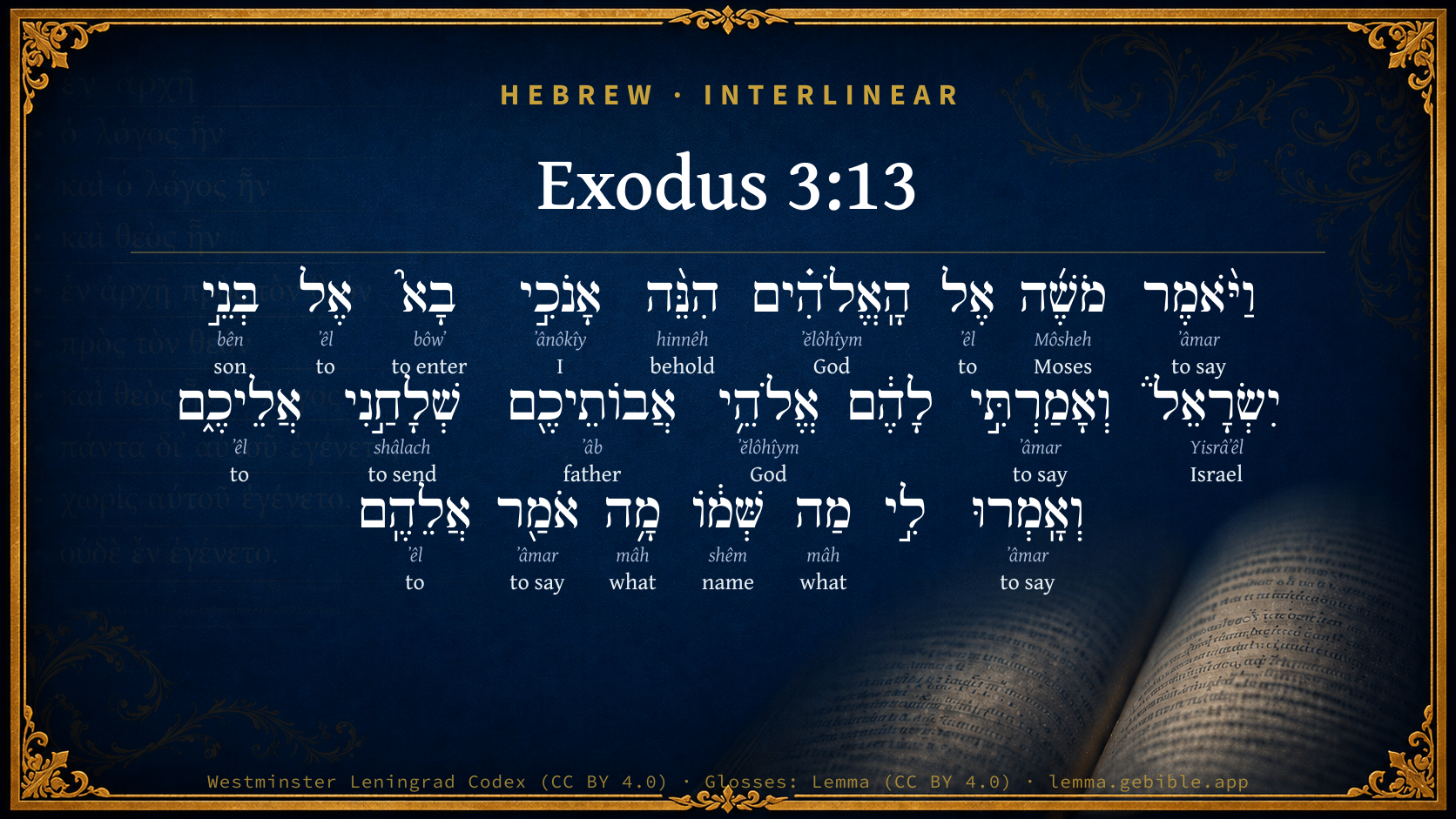
Hebrew (Westminster Leningrad Codex) Exodus 3:13 appears in the Hebrew Old Testament. The text above is from the Westminster Leningrad Codex. Each word links to its Strong’s number, a concise gloss, and parsing drawn from the Open Scriptures Hebrew Bible morphology. Click any word for its full Brown-Driver-Briggs (BDB) entry.
Download image
Cite this verse

Exodus 3:13 (World English Bible). Public Domain. Lemma interlinear Bible study tool, https://lemma.gebible.app/v/exodus/3/13.

Show BibTeX & RIS
BibTeX
RIS
English Translation
Moses said to God, "Behold, when I come to the children of Israel, and tell them, 'The God of your fathers has sent me to you;' and they ask me, 'What is his name?' What should I tell them?"
World English Bible · Public Domain
Download a study sheet

One document with this verse’s original text, its word-by-word gloss line, the meaning frame, cross-references with their text, attributed commentary, and full source and license credits — printable, and it pastes into notes with its structure intact.

This verse Autodidact and up

Study sheet (.html) Plain text (.txt)

A passage Seminary Student

Up to 50 verses in one chapter. A passage sheet keeps up to 6 commentary sources and 12 cross-references per verse, in the order this page ranks them, and says so on the sheet whenever that leaves anything out. Ask for a single verse and you get the Autodidact verse sheet above.

Everything on this page stays free to read, with no account — the sheet is a download of what is already on screen, not access to it.

Want to remove ads? Support Godless Engineer
Compare translations 3

The same verse in 3 English versions, stacked beneath the original-language interlinear above. Click any original word for its lexicon entry.

Each is an independent rendering of the whole verse — the interlinear is not word-aligned to these translations.

Highlighted words mark where these versions differ — a whole-verse word diff, not a word-by-word alignment.

  • World English Bible Public Domain
    Moses said to God, "Behold, when I come to the children of Israel, and tell them, 'The God of your fathers has sent me to you;' and they ask me, 'What is his name?' What should I tell them?"
  • King James Version Public Domain
    And Moses said unto God, Behold, when I come unto the children of Israel, and shall say unto them, The God of your fathers hath sent me unto you; and they shall say to me, What is his name? what shall I say unto them?
  • unfoldingWord Literal Text CC BY-SA 4.0
    And Moses said to God, “Behold, I am about to go to the sons of Israel, and I will say to them, ‘The God of your fathers has sent me to you.’ And they will say to me, ‘What is his name?’ what should I say to them?”

unfoldingWord Literal Text — © unfoldingWord, licensed CC BY-SA 4.0. Word-aligned USFM3 via Door43 (git.door43.org/unfoldingWord/en_ult).

Versions to compare (up to 4)

3 of 4 selected

Show all 18 translations

Every available English version of this verse, each an independent rendering of the whole verse.

  • World English Bible Public Domain
    Moses said to God, "Behold, when I come to the children of Israel, and tell them, 'The God of your fathers has sent me to you;' and they ask me, 'What is his name?' What should I tell them?"
  • Berean Standard Bible Public Domain
    Then Moses asked God, “Suppose I go to the Israelites and say to them, ‘The God of your fathers has sent me to you,’ and they ask me, ‘What is His name?’ What should I tell them?”
  • Majority Standard Bible Public Domain
    Then Moses asked God, “Suppose I go to the Israelites and say to them, ‘The God of your fathers has sent me to you,’ and they ask me, ‘What is His name?’ What should I tell them?”
  • King James Version Public Domain
    And Moses said unto God, Behold, when I come unto the children of Israel, and shall say unto them, The God of your fathers hath sent me unto you; and they shall say to me, What is his name? what shall I say unto them?
  • American Standard Version (1901) Public Domain
    And Moses said unto God, Behold, when I come unto the children of Israel, and shall say unto them, The God of your fathers hath sent me unto you; and they shall say to me, What is his name? What shall I say unto them?
  • Revised Version (1885) Public Domain
    And Moses said unto God, Behold, when I come unto the children of Israel, and shall say unto them, The God of your fathers hath sent me unto you; and they shall say to me, What is his name? what shall I say unto them?
  • Geneva Bible (1599) Public Domain
    Then Moses said vnto God, Behold, when I shall come vnto the children of Israel, and shall say vnto them, The God of your fathers hath sent me vnto you: if they say vnto me, What is his Name? what shall I say vnto them?
  • Douay-Rheims (1899) Public Domain
    Moses said to God: Lo, I shall go to the children of Israel, and say to them: The God of your fathers hath sent me to you. If they should say to me: What is his name? what shall I say to them?
  • Young's Literal Translation Public Domain
    And Moses saith unto God, `Lo, I am coming unto the sons of Israel, and have said to them, The God of your fathers hath sent me unto you, and they have said to me, What `is' His name? what do I say unto them?'
  • Literal Standard Version CC BY-SA 4.0
    And Moses says to God, “Behold, I am coming to the sons of Israel, and have said to them, The God of your fathers has sent me to you, and they have said to me, What [is] His Name? What do I say to them?”
  • Unlocked Literal Bible CC BY-SA 4.0
    Moses said to God, “When I go to the Israelites and tell them, 'The God of your ancestors has sent me to you,' and when they say to me, 'What is his name?' what should I say to them?”
  • unfoldingWord Literal Text CC BY-SA 4.0
    And Moses said to God, “Behold, I am about to go to the sons of Israel, and I will say to them, ‘The God of your fathers has sent me to you.’ And they will say to me, ‘What is his name?’ what should I say to them?”
  • Darby Bible Public Domain
    And Moses said to God, Behold, [when] I come unto the children of Israel, and shall say unto them, The God of your fathers hath sent me unto you; and they shall say, What is his name? what shall I say unto them?
  • World Messianic Bible Public Domain
    Moses said to God, “Behold, when I come to the children of Israel, and tell them, ‘The God of your fathers has sent me to you,’ and they ask me, ‘What is his name?’ what should I tell them?”
  • Webster's Bible Public Domain
    And Moses said to God, Behold, when I come to the children of Israel, and shall say to them, The God of your fathers hath sent me to you; and they shall say to me, What is his name? What shall I say to them?
  • Free Bible Version CC BY-SA 4.0
    Then Moses said to God, “Look! If I were to go to the Israelites and say to them, ‘The God of your fathers has sent me to you,’ and they ask me, ‘What is his name?’ —then what should I tell them?”
  • Bible in Basic English Public Domain
    And Moses said to God, When I come to the children of Israel and say to them, The God of your fathers has sent me to you: and they say to me, What is his name? what am I to say to them?
  • JPS Tanakh (1917) Public Domain
    And Moses said unto God: 'Behold, when I come unto the children of Israel, and shall say unto them: The God of your fathers hath sent me unto you; and they shall say to me: What is His name? what shall I say unto them?'

Literal Standard Version (2020), Covenant Press — licensed CC BY-SA 4.0. Text via the HelloAO Bible API (eBible.org). Unlocked Literal Bible (unfoldingWord) — licensed CC BY-SA 4.0. Text via the HelloAO Bible API (eBible.org). unfoldingWord Literal Text — © unfoldingWord, licensed CC BY-SA 4.0. Word-aligned USFM3 via Door43 (git.door43.org/unfoldingWord/en_ult). Free Bible Version, Dr. Jonathan Gallagher — licensed CC BY-SA 4.0. Text via the HelloAO Bible API (eBible.org).

Word by word

More ways to search: Search by grammar → Find every occurrence → Compare this word →

Practice this passage: Drill this verse → Learn its vocabulary →

אָנֹכִ֣י
ʼânôkîy
H595
“I”
Pronoun, Personal, 1st Person, Common, Singular
Part of Speech
Pronoun
Type
Personal
Person
1st Person
Gender
Common
Number
Singular
Full BDB Definition

Origin: a primitive pronoun

TWOT: 130

I (first person singular)
  1. וַיֹּ֨אמֶר ʼâmar H559 “and · to say” Conjunction + Verb, Qal, Sequential Imperfect, 3rd Person, Masculine, Singular
  2. מֹשֶׁ֜ה Môsheh H4872 “Moses” Noun, Proper
  3. אֶל ʼêl H413 “to” Preposition
  4. הָֽאֱלֹהִ֗ים ʼĕlôhîym H430 “the · God(s)” Particle, Definite Article + Noun, Common, Masculine, Plural, Absolute
  5. הִנֵּ֨ה hinnêh H2009 “behold” Particle, Demonstrative
  6. בָא֮ bôwʼ H935 “entering” Verb, Qal, Participle Active, Masculine, Singular, Absolute
  7. אֶל ʼêl H413 “to” Preposition
  8. בְּנֵ֣י bên H1121 “sons of” Noun, Common, Masculine, Plural, Construct
  9. יִשְׂרָאֵל֒ Yisrâʼêl H3478 “Israel” Noun, Proper
  10. וְאָמַרְתִּ֣י ʼâmar H559 “and · to say” Conjunction + Verb, Qal, Sequential Perfect, 1st Person, Common, Singular
  11. אֱלֹהֵ֥י ʼĕlôhîym H430 “God(s) of” Noun, Common, Masculine, Plural, Construct
  12. אֲבוֹתֵיכֶ֖ם ʼâb H1 “fathers · your” Noun, Common, Masculine, Plural, Construct + Suffix, Personal, 2nd Person, Masculine, Plural
  13. שְׁלָחַ֣נִי shâlach H7971 “to send · me” Verb, Qal, Perfect, 3rd Person, Masculine, Singular + Suffix, Personal, 1st Person, Common, Singular
  14. אֲלֵיכֶ֑ם ʼêl H413 “to · you” Preposition + Suffix, Personal, 2nd Person, Masculine, Plural
  15. וְאָֽמְרוּ ʼâmar H559 “and · to say” Conjunction + Verb, Qal, Sequential Perfect, 3rd Person, Common, Plural
  16. מַה mâh H4100 “what” Particle, Interrogative
  17. שְּׁמ֔וֹ shêm H8034 “name · his” Noun, Common, Masculine, Singular, Construct + Suffix, Personal, 3rd Person, Masculine, Singular
  18. מָ֥ה mâh H4100 “what” Particle, Interrogative
  19. אֹמַ֖ר ʼâmar H559 “to say” Verb, Qal, Imperfect, 1st Person, Common, Singular
  20. אֲלֵהֶֽם ʼêl H413 “to · them” Preposition + Suffix, Personal, 3rd Person, Masculine, Plural

About this verse

These counts appear in no published source. They are computed here, from the morphology-tagged text and Lemma’s own curated glosses. What Lemma adds →

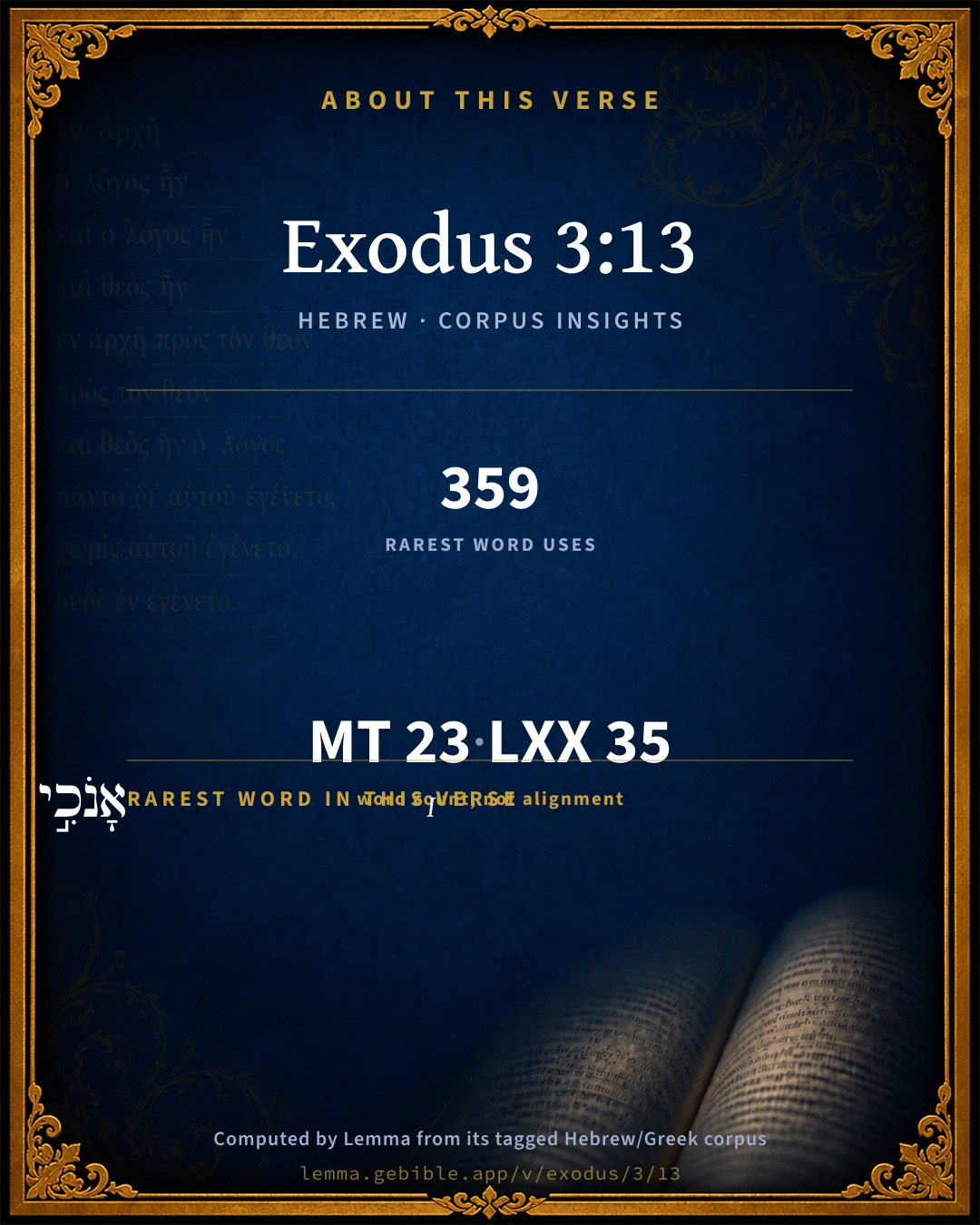
23
words
13
distinct lemmas
Pentateuch
section

Grammatical profile

  • 6 verbs
  • 7 nouns
  • 1 pronoun
  • 6 prepositions
  • 3 particles

Verb forms

  • וַיֹּ֨אמֶר Qal · Sequential Imperfect
  • בָא֮ Qal · Participle Active
  • וְאָמַרְתִּ֣י Qal · Sequential Perfect
  • שְׁלָחַ֣נִי Qal · Perfect
  • וְאָֽמְרוּ Qal · Sequential Perfect
  • אֹמַ֖ר Qal · Imperfect

Repetition

Words recur within this verse — often emphatic in Hebrew:

  • וַיֹּ֨אמֶר to say H559 ×4
  • הָֽאֱלֹהִ֗ים God H430 ×2
  • אֶל to H413 ×4
  • מַה what H4100 ×2

Hebrew & Septuagint length

In English translation the verse runs 39 words from the Hebrew and 45 from the Septuagint (LXX English) — closely comparable.

A rough comparison of the two English renderings, which tokenize alike — not a word-level alignment.

Word counts can differ between the Hebrew and the Greek without any difference in meaning — e.g. the Hebrew direct-object marker אֵת has no separate Greek word, and Greek often adds the article ὁ.

In the original languages it is 23 Hebrew tokens and 35 Greek tokens — but the two are counted differently (Hebrew bundles its prefixes and suffixes into one token; the Greek is in lemma form), so that isn’t a like-for-like length.

Cross-references

11

Topical passages linked to Exodus 3:13 in the Treasury of Scripture Knowledge — connected by theme and wording, ordered by reader-vote popularity; previews shown in the World English Bible.

  • Proverbs 30:4 Who has ascended up into heaven, and descended? Who has gathered the wind in his fists? Who has bound the waters in his garment? Who has established all the ends of the earth? What is his name, and what is his son's name, if you know?
  • Isaiah 9:6 For to us a child is born, to us a son is given; and the government shall be on his shoulder: and his name shall be called Wonderful, Counselor, Mighty God, Everlasting Father, Prince of Peace.
  • Genesis 32:29 Jacob asked him, "Please tell me your name." He said, "Why is it that you ask what my name is?" He blessed him there.
  • Exodus 3:14 God said to Moses, "I AM WHO I AM," and he said, "You shall tell the children of Israel this: "I AM has sent me to you."
  • Isaiah 7:14 Therefore the Lord himself will give you a sign. Behold, the virgin will conceive, and bear a son, and shall call his name Immanuel.
  • Jeremiah 23:6 In his days Judah shall be saved, and Israel shall dwell safely; and this is his name by which he shall be called: Yahweh our righteousness.
  • Matthew 1:21 She shall bring forth a son. You shall call his name Jesus, for it is he who shall save his people from their sins."
  • Exodus 15:3 Yahweh is a man of war. Yahweh is his name.
  • Judges 13:6 Then the woman came and told her husband, saying, A man of God came to me, and his face was like the face of the angel of God, very awesome; and I didn't ask him whence he was, neither did he tell me his name:
  • Judges 13:17 Manoah said to the angel of Yahweh, What is your name, that when your words happen, we may honor you?
  • Matthew 1:23 "Behold, the virgin shall be with child, And shall bring forth a son. They shall call his name Immanuel;" Which is, being interpreted, "God with us."

Cross-references courtesy of OpenBible.info (CC BY 4.0).

Hebrew and Greek witnesses Masoretic Hebrew ↔ Greek Septuagint

The same verse in the two great witnesses to the Old Testament, shown verse-for-verse.

These are two independent witnesses, not word-aligned to each other, and the Septuagint is shown in lemma (dictionary) form.

Hebrew Exodus 3:13 Masoretic · Westminster Leningrad Codex

וַיֹּ֨אמֶר מֹשֶׁ֜ה אֶל הָֽאֱלֹהִ֗ים הִנֵּ֨ה אָנֹכִ֣י בָא֮ אֶל בְּנֵ֣י יִשְׂרָאֵל֒ וְאָמַרְתִּ֣י לָהֶ֔ם אֱלֹהֵ֥י אֲבוֹתֵיכֶ֖ם שְׁלָחַ֣נִי אֲלֵיכֶ֑ם וְאָֽמְרוּ לִ֣י מַה שְּׁמ֔וֹ מָ֥ה אֹמַ֖ר אֲלֵהֶֽם

Moses said to God, "Behold, when I come to the children of Israel, and tell them, 'The God of your fathers has sent me to you;' and they ask me, 'What is his name?' What should I tell them?"

World English Bible · Public Domain

Greek LXX Exodus 3:13 Septuagint · lemma form

καί εἶπον μωυσῆς πρός ὁ θεός ἰδού ἐγώ ἔρχομαι πρός ὁ υἱός ἰσραήλ καί εἶπον πρός αὐτός ὁ θεός ὁ πατήρ σύ ἀποστέλλω ἐγώ πρός σύ ἐρωτάω ἐγώ τίς ὄνομα αὐτός τίς εἶπον πρός αὐτός

And Moses said to God, Behold, I shall go forth to the children of Israel, and shall say to them, The God of our fathers has sent me to you; and they will ask me, What is his name? What shall I say to them?

LXX2012 (modern English Septuagint) · Public Domain

Hebrew: Westminster Leningrad Codex (CC BY 4.0). Greek: Septuagint (public domain); English from LXX2012 (modern English Septuagint) (Public Domain). How the Septuagint differs from the Hebrew →

Targum (Aramaic paraphrase)

2

The Targum is the ancient Jewish Aramaic paraphrase of the Hebrew Scriptures — an interpretive translation, not the Hebrew text itself. Onkelos (literal) and Pseudo-Jonathan (expansive) render the Torah, and Jonathan the Prophets. Coverage is partial: where no permissively-licensed English translation exists for a verse, only the Aramaic is shown. This is verse-level text, not a word-by-word alignment to the Hebrew.

  1. Targum Onkelos Torah (Genesis–Deuteronomy)
    וַאֲמַר משֶׁה קֳדָם יְיָ הָא אֲנָא אָתֵי לְוָת בְּנֵי יִשְׂרָאֵל וְאֵימַר לְהוֹן אֱלָהָא דְאַבְהַתְכוֹן שַׁלְחַנִי לְוָתְכוֹן וְיֵימְרוּן לִי מָא שְׁמֵהּ מָא אֵימַר לְהוֹן:

    (no public-domain English translation for this verse)

    Targum Onkelos — Aramaic: “Onkelos Genesis” (public domain); “Onkelos Exodus” (public domain); “Onkelos Leviticus” (public domain); “Onkelos Numbers” (public domain); “Onkelos Deuteronomy” (public domain). English: “Sefaria Community Translation” (CC0 1.0 (public-domain dedication)); “J.W. Etheridge. The Targums of Onkelos and Jonathan Ben Uzziel on the Pentateuch. London: Longmans, Green, 1862” (public domain). Text via Sefaria.

  2. Targum Pseudo-Jonathan Torah (Genesis–Deuteronomy)
    וַאֲמַר משֶׁה קֳדָם יְיָ אֲנָא אֵזִיל לְוַת בְּנֵי יִשְרָאֵל וְאֵמַר לְהוֹן יְיָ אֱלָהָא דַאֲבָהַתְכוֹן שַׁדְרַנִי לְוַתְכוֹן וְיֵימְרוּן לִי מַה שְׁמֵיהּ מַה אֵימַר לְהוֹן

    And Mosheh said before the Lord, Behold, I will go to the sons of Israel, and say to them, The Lord God of your fathers hath sent me to you: and they will say to me, What is His Name? What shall I say to them?

    Targum Pseudo-Jonathan — Aramaic: “Targum Jonathan on Genesis” (public domain); “Targum Jonathan on Exodus” (public domain); “Targum Jonathan on Leviticus” (public domain); “Targum Jonathan on Numbers” (public domain); “Targum Jonathan on Deuteronomy” (public domain). English: “The Targum of Jonathan ben Uzziel, trans. J. W. Etheridge, London, 1862” (public domain). Text via Sefaria.

Commentary

Notes on Exodus 3:13 from classic Christian and Jewish commentators (each source and its license shown beneath its notes). The classic Christian expositions comment on the surrounding passage and are grouped to its opening verse, so a note may address several verses; the Jewish commentaries on the Tanakh (Rashi and others) are per-verse, so they appear only where the commentator wrote on this verse.

Lemma curates 59 commentaries, every one of them public domain or Creative Commons licensed, each selected and text-cleaned for this edition rather than reprinted as found. About our sources →

Trapp's Complete Commentary

John Trapp

Exo 3:13 And Moses said unto God, Behold, [when] I come unto the children of Israel, and shall say unto them, The God of your fathers hath sent me unto you; and they shall say to me, What [is] his name? what shall I say unto them?

Ver. 13. What is his name?] God is above all name, all notion. When Manoah inquired after his name, "It is wonderful," said he: that is, I am called as I am called, but such is thy weakness that it surpasseth thy conception. {a} Afri vocant Deum ignotum Amon, id est, Hens tu, quis es? {b}

{a} Bede. Victorinus.

{b} Plutarch, De Isid. et Osiride.

John Trapp, A Commentary or Exposition upon All the Books of the Old and New Testament (1647–1656) — public domain. Text from a community e-Sword module.

The Biblical Illustrator

Joseph S. Exell

Exo_3:13

What shall I say unto them?

Ministerial difficulties to be anticipated, and how to overcome them

I. Ministers must anticipate difficulties in the performance of their life-mission.

1. Arising from prejudice in reference to the man.

2. Arising from scepticism in reference to the truth.

3. Arising from lethargy in reference to the mission.

II. To overcome these difficulties ministers must seek direction from God.

1. Divine recognition of ministerial difficulty. He will not reject any who seek His aid.

2. Divine sympathy with ministerial difficulty.

(1) Manifested by the gift of heavenly vision (Exo_3:2).

(2) Manifested by the gift of needful instruction (Exo_3:15-17).

(3) Manifested by the gift of holy companionships (Exo_3:12).

Such a manifestation of Divine sympathy ought to inspire every minister with spirit and fortitude for his work. They that are for him, are more than all that can be against him. (J. S. Exell, M. A.)

Why did Moses ask the name of God?

1.Not to instruct his ignorance. He had not forgotten God in Egypt.

2. Not to gratify his curiosity.

3. But to satisfy Israel.

Error has many gods, he therefore wanted to know how he might prove to the enslaved nation that he came in the name of the True One. (J. S. Exell, M. A.)

Lessons

1. It is good for a minister to know on whose business he is going.

2. Gods answer to one objection oftentimes begets another in His servants.

3. Dissatisfaction of men about Gods instruments is very probable.

4. Gods servants very reasonably expect that He will clear up all doubt as to His name, and their duty. (J. S. Exell, M. A.)

What shalt I say unto them.-a question for the pulpit

I. Shall I say unto them truths that are in harmony with their depraved condition? No; ministers are not to preach doctrines in harmony with the depraved tastes of men--but to awaken them from their sin, by the proclamation of the Divine name and freedom.

II. Shall I give them an argumentative discourse? It would be necessary for Moses to convince the Israelites that he was divinely commissioned--and the chief use that a minister can make of logic is to prove the divinity of his call to the ministry.

III. Shall I give them a sensational discourse? Had Moses done this he might have aroused a wave of feeling, but it would soon have subsided into calm. The freedom of the nation would not have been achieved in this way. The sensational preachers of the world are not doing the most towards the moral freedom of the race.

IV. Shall I say unto them how clever i am? Moses had humbled himself before God. And men humble before God are generally so before their fellows. Ministers should not make a display of their learning-such conduct will never accomplish the freedom of souls.

V. Shall I tell them about the cross of jesus? Yes, replies the penitent sinner; that is what I want. Yes, replies the aged believer; that is the charm of my soul. Preach the Cross as the emancipation of the world. Not ourselves, but Christ Jesus the Lord. (J. S. Exell, M. A.)

What to preach

I remember being asked by the late Dr. McLeod, who was head physician in one of the Government asylums, if I would preach to some of the inmates. What kind of men are they? I inquired. Oh, mostly sailors; and if you accept the invitation to preach to them, you must make up your mind to stand a good knock or two, perhaps even a blow in the face; but if you wish to make friends with them, you must take no notice of it. I am not a bit afraid of them, I replied; if they be sailors I shall speak to them as sailors, and I am sure they will not teach me.. I went and spoke to them. There was no attempt to molest me, but many of the poor fellows came up to me afterwards and thanked me for what I said. Some declared that what they liked about me was that I spoke to them as sailors. No one who had ever spoken to them before had done so. Their former visitors had seemed to believe all that they were told, that they were kings, dukes, and earls, but I had spoken to them as sailors, to their true selves, and though insane, they felt that I was speaking the truth. Similarly we must speak to sinners as being just what they are. (Christian Herald.)

God-directed speaking

A man in America died, who had long been renowned for wickedness. His intellectual abilities were of no mean order; his property was considerable, and he had belonged to a family of good position. By the practice of every kind of dissipation he had achieved an evil notoriety, and gloried in being considered the most fascinating and dangerous roue in the country. This being so, his associates resolved upon giving him a funeral worthy of his reputation. As one means of ensuring this, they invited one of the most eminent Presbyterian ministers in the region to deliver the funeral discourse. To the surprise of many, after some little hesitation, he consented. On the day and at the hour appointed the country church was crowded to overflowing by an assembly composed of the relatives, friends, and companions of the deceased, together with a mixed multitude drawn from far and near by curiosity to hear what such a minister could find to say of such a man. Punctual to the moment, the tall form of the clergyman ascended the pulpit, and the service began. There was first the reading of the Scriptures. Then followed a prayer, subdued and tender, for the family and relatives of the deceased. But the announcement of the text fell upon the assembly like a clap of thunder. It was from Luk_16:23 : And in hell he lifted up his eyes, being in torments. The sermon was a most pungent and powerful exhibition of the character, course, and end of a wicked man. It held the assembly spellbound to the very last word; but there was in it not a single direct allusion to the person whose obsequies they had come there to celebrate. In silence and in deep solemnity the congregation dispersed after the service was finished. Some were indignant, but any attempt to excite odium against the preacher was a failure. It was generally thought that in what he had done he was governed by a sense of duty. He was said to have stated afterwards that when he was invited to preach on that occasion he had determined to decline, but, in answer to prayer, received a message which he believed to be from God--Go--and preach the preaching that I bid thee. (Christian Herald.)

Gods servants report Gods words

Words spoken on your own account, without reference to your Lord, will fall to the ground. When the footman goes to the door to answer a caller, he asks his master what he has to say, and he repeats what his master tells him. You and I are waiting-servants in the house of God, and we are to report what our God would have us speak. The Lord gives the soul-saving message, and clothes it with power: He gives it to a certain order of people, and under certain conditions. (C. H. Spurgeon.)

Moses difficulty

If Moses had been rejected forty years before, what resistance and what objections might he not expect then? And when he should speak to them of the God of their fathers, and should say to them, I have seen Him; He has spoken to me, He has made promises to me, He has sent me to you, would they believe him, would they listen to him, would they understand him? It was thus that the apostles of Jesus Christ, when they went to gather together the people of God amid idolaters, had to encounter two classes of enemies; on the one hand, the emperors of Rome, the rich and powerful priests of the old religions, who had their gods, Jupiter, Mars, Mercury, and many more; on the other hand, the nations whom they were sent to convert: there was the greatest difficulty. Read the Acts of the Apostles, and you will readily perceive that the apostles impediments and persecutions came from the people more than from the emperors and the great men of the world. But do you fully understand the objection that Moses expected from the unbelief of the people? The Israelites had probably become idolaters by living among the Egyptians, who worshipped a great number of gods, each of which had its name, as Ammon, Isis, Osiris, Apis. They shall say to me, What is His name? Is He truly the God of our fathers? Has He said so to thee? We do not see Him; He has forsaken us. (Prof. Gaussen.)

A necessary inquiry

Before going on any of lifes great errands, we should know who has sent us, and what is the business on which we proceed. Inquiries of this kind will lead to a true apprehension of our position, and in not a few cases to a reversion of our daily course. What are you living for? You are hurrying and whirling forward at a tremendous rate, your brain teems upon conceptions, your hand hardly knows a moments rest, you pursue the bubble, you jostle and compete and envy, you flatter and are flattered, you hoard and you dispense. What does it all mean? Who sketched the map by which yon regulate your pilgrimage? What account can you give of yourself to those who ask the name of your guiding spirit? Take the subject in the light of every-day affairs, and the singular absurdity of not knowing on whose business you are engaged will instantly appear. You meet a traveller who is professedly engaged in business; you ask him what is his business, and he cannot answer; you ask him whose interests he represents, and no reply is forthcoming; you ask him whither he is bound, and he returns the inquiry with a look of vacancy;--to what conclusion can you come respecting such a person? You instantly feel that the man is a child, and that the child has gone astray. The same thing holds true in the deeper and vaster concerns of life; and he who is wisely and profoundly anxious to know on what basis he is proceeding in commercial transactions, should look beyond the mere detail, and face the great question--upon what principle is my intellectual, emotional, moral, and spiritual life proceeding? Oh man, be persuaded for a moment to tarry in thy impetuous course, and cross-examine thine own heart! Dont be deluded by the whirl and thunder and tempest of an outer life; mistake not commotion for progress, enthusiasm for regeneration, self-applause for the benediction of heaven! (J. Parker, D. D.)

The Biblical Illustrator, edited by Joseph S. Exell (c. 1880s–1900s) — public domain. Text from a community e-Sword module.

Joseph Benson's Commentary

Exo 3:13. When they shall say, What is his name? what shall I say unto them? — What name shall I use, whereby thou mayest be distinguished from false gods, and thy people may be encouraged to expect deliverance from thee?

Joseph Benson's Commentary on the Old and New Testaments (1811–1818) — public domain. Text from a community e-Sword module.

The Preacher's Complete Homiletical Commentary

Joseph S. Exell (gen. ed.)

ILLUSTRATIONS

Exo_3:14. Tully relateth how Simonides, being asked by Hiero, the king of Sicily, what God was, desired one day to consider of it; and after one day being past, having not yet found it out, desired two days more to consider of it; and, after two days, he desired three; and to conclude, he had at length no other answer to return unto the king but this that the more he thought upon it, the more he might; for the further he waded in the search thereof, the further he was from the finding of it. And thus Plato: “What God is,” saith he, “that I know not; what He is not, that I know.” Most certain it is that God only, in regard of Himself, knows Himself as dwelling in the light inaccessible, whom never man saw neither can see. Here, now, the well is not only deep, but we want a bucket to draw withal. God is infinite and never to be comprehended essentially. Oh, then, that we could so much the more long to enjoy Him, by how much less we are able to apprehend Him [Spencer].

Though the sun is the source and fountain of light, there is little good in gazing at the sun, except to get blinded. No one over saw the better for looking the sun directly in the face. It is a child’s trick, grown up people know better. We use the light which the sun gives, to see by, and to search into all things—the sun excepted. Him we cannot explore, beyond what he reveals of himself in the light and heat which he sheds upon us, and in the colours by which he is reflected from the earth. There is no searching of the sun, our eyes are too weak. How much less can we search the sun’s Creator, before whom the myriads of suns are but as so many cloud bodies! His revelation of Himself in His works and in His word, in His Son and in our souls, is more than enough for us. Persons who dare to go as they say in a directer way to Himself, are like children looking at the sun, who, instead of getting more light and better eyes, get less light and an infatuated eye [J. Pulsford].

Hilary, an ancient Christian writer, says these words charmed him, and gave him a high opinion of Moses, before he became a Christian, there being nothing so proper to describe God by as this name [Orton].

Many heathens, copying from this expression, have inscribed it, or something like it, on their temples. On the Delphic temple was inscribed, according to Plutarch, the Greek word El, which signifies “Thou dost exist.” [Howe].

Who ever conceived a more beautiful illustration of this sublime text than the following by Bishop Beveridge,—“ ‘I am.’ He doth not say, I am their light, their guide, their strength, or tower, but only ‘I am.’ He sets His hand, as it were to a blank, that His people may write under it what they please that is good for them. As if He should say, ‘Are they weak? I am strength. Are they poor? I am all riches. Are they in trouble? I am comfort. Are they sick? I am health. Are they dying? I am life. Have they nothing? I am all things. I am wisdom and power. I am justice and mercy. I am grace and goodness. I am glory, beauty, holiness, eminency, supremacy, perfection, all sufficiency, eternity! Jehovah, I am! Whatever is amiable in itself, or desirable unto them, that I am. Whatever is pure and holy, whatsoever is great and pleasant, whatsoever is good or needful to make men happy,—that I am.’

“When God would teach mankind His name,

He calls Himself the great, ‘I am,’

And leaves a blank; believers may

Supply those things for which they pray.”

Exo_3:17. Like as, if a man were assured there were made for him a great purchase in Spain or Turkey, so, as if he would but come thither, he might enjoy it, he would not forbear to adventure the dangers of the sea, and of his enemies also, if need were, that so he might come to his own; even so, seeing that Christ Jesus hath made a purchase for us in heaven and there is nothing required of us, but that we will come and enjoy it, we ought to refuse no pains or fear in the way, but carefully strive to get in [Cawdray].

CRITICAL NOTES.—

Exo_3:14. I am] That this Divine declaration is an exposition of the meaning of the great and gracious name, JEHOVAH, must be obvious at a glance over the context. From this follows the need of all possible care to understand the exposition itself as it falls from the mouth of God, and is here recorded for our instruction. Let us briefly state the essential points—with all reverence, while yet, as far as possible, with due freedom from the yoke of timid tradition.

(1.) What is the radical meaning of the root ha-yah—the great verb of the sentence? Usage decides that, in the language of Dr. J. W. Donaldson (Heb. Gram. p. 59), ha-yah is essentially a “verb of becoming:” not merely of coming into being, but coming into relationship, i.e. becoming this or that to some one. We may say, in brief, that it primarily means (a) of persons—TO BECOME; (b) of events—TO COME TO PASS; the concordance will prove this. Then

(2.) What is the force of the tense in wh. ha-yah here twice appears? Eh-yeh is the “imperfect” tense of ha-yah; i.e., as that tense is understood by the best Heb. scholars (Ewald. Roediger, Driver, Prof. A. B. Davidson), “imperfect” in the broad sense of the incomplete, the incoming tense—the “incipient” (Murphy) Applied to the verb under consideration, this tense yields the following rendering: “I am becoming,” or, “I will become.” As our future suits well here, let us say, simply, “I will become.” Then the declaration will run: “I will become what I will become.”

(3.) Nothing, surely, cd. exceed the sweetness, the fitness, and the simple grandeur of the clause when thus rendered. (a) It is full of promise: “I will become”—to Israel, disheartened, timid—“what I will become”—all that it is in my heart to become to them, all that they need. Their redemption is in me; and, therefore, out of the fulness of my nature, shall it be unfolded act by act, step by step, stage by stage. Not apart from me can they enjoy it. I must work it out for them—in them—through them: drawing them ever nearer to myself coming ever nearer to them—becoming more and more to them. The promise is unlimited. And, further, though we can scarcely realise its richness without some attempt at paraphrase, yet (b) it is very general, to the verge of vagueness—a vagueness, however, adapted to elicit faith. It seems to say: Trust me; leave the future in my hands: I will become to you more than you can yet know: “I will become what I will become.”

(4.) How does this exposition of the Name prepare us for the Name itself? For we assume the now generally admitted derivation of JEHOVAH (more exactly, YAHWEH) as the third person singular imperfect of ha-wah, an old form = to hah-yah; and thus conclude that the Name literally gathers into itself the force of the previous Divine announcement. In other words, we take YAHWEH to mean: “He who is becoming—purposes to become—will become” = “The Becoming One.” In this way we have first the verb repeated in a clause; then the verb once by itself; lastly the noun, cognate with the verb: “God said unto Moses, Ehyeh asher ehyeh, ‘I will become what I will become.’ ” “Thus shalt thou say unto the children of Israel, Ehyeh, ‘I will become,’ hath sent me unto you.” “And God said moreover unto Moses, Thus shalt thou say unto the children of Israel, Yakweh, The Becoming One, God of your fathers, &c., hath sent me unto you.” Well might the gracious Promiser add: “This is my name for ever, and this is my memorial unto all generations.” Must not that Name relate to us through which God will be remembered by us?

Possibly the evangelical German expositors have not expressed themselves in precisely the above manner in their exegesis of this great matter; but how fully they have led the way to our main conclusions may be seen in the following extracts from Kurtz: “Jehovah is the God of development, who Himself enters into the development, condescends into it, embodies Himself and co-operates in it, in order to conduct it safely to its destined goal.” “Ha-yah is equivalent to φῦναι, γενέσθαι, εἶναι; it indicates concrete, not abstract being—such being as makes its appearance, manifests itself in history, and, so to speak, becomes historical. This meaning comes out more fully and prominently in the imperfect form of the name derived from it. Hence יהוה is God outwardly manifesting Himself, revealing Himself, living, working, and reigning in history, ever unfolding there, more and more, His character and being.” (Hist. O. Cov. I. i. sec. 13.)

It remains only to say that even if Yah-weh be considered as formed in the conjugation Hiphil (as, with this pronunciation. Dr. B. Davies seems to think it must) the substance of the above account will remain untouched. The fullest possible justice would be done to that causative conjugation by rendering the name, “He who brings to pass” = “The Fulfiller.” In point of fact, He BRINGS TO PASS His purposes by Himself BECOMING all that He designs to BECOME. However, Dr. Kalisch considers the name, pronounced YAH-WEH, as formed in Kal; thus, in this matter, fully sustaining our primary explanation.

MAIN HOMILETICS OF THE PARAGRAPH.—Exo_3:13-18

MINISTERIAL DIFFICULTIES TO BE ANTICIPATED—AND HOW TO OVERCOME THEM

I. That ministers must anticipate difficulties in the performance of their life mission. (Exo_3:13.)

1. Arising from prejudice in reference to the man. Moses felt that he would be liable to the prejudice of Israel—through his residence in the palace of Pharaoh, and his supposed connection with a despotic government. He had not shared their bondage—they would prefer one as the leader of their destinies, who had been more thoroughly identified with their condition of woe. Moses anticipates these difficulties, and asks the Lord how he should reply to them. So ministers of the gospel have to combat innumerable prejudices—of truth—education—capricious—weak—hence the difficulty of their work. They must be divinely commissioned to overcome them.

2. Arising from scepticism in reference to the truth. Moses feared that the Israelites would not credit the doctrine of freedom he had to proclaim to them. They would rather remind him of Pharaoh’s army, and the impossibility of their escape. Moses would find great difficulty in getting them to believe in the promise and power of God. So, ministers to-day have a large amount of scepticism to overcome, in relation to the apparent difficulties of the truth they preach. They must exhibit their Divine credentials.

3. Arising from lethargy in reference to the mission. Moses found the Israelites in a state of utter destitution—morally weak—incapable of great effort—almost willing to die, rather than live. He would have great difficulty in awakening them to action, equal to the requirements of the case—and to secure their co-operation. So, it is with ministers of the gospel. They come—preach to men, who are inervated by sin—to arouse them to a sense of their manhood—to seek their co-operation in the mission of freedom they announce. The moral weakness—indolence of men is the greatest difficulty the true minister has to contend with.

II. That to overcome these difficulties, ministers must seek direction from God (Exo_3:13). That God will give this direction is seen from:—

1. The Divine recognition of ministerial difficulty. The Divine Being admitted all that Moses had said about the difficulty of his mission to Israel. No word of reproach was uttered—no rebuke expressed—but directions were given in response thereto. Equally does God recognize the perplexity a, ministerial life—hence He will not reject any who seek His aid.

2. The Devine Sympathy with ministerial difficulty. (i.) Manifested by the gift of heavenly vision (Exo_3:2.) (ii). Manifested by the gift of needful instruction (Exo_3:15-17). (iii). Manifested by the gift of holy companionships (Exo_3:12). Such a manifestation of divine sympathy ought to inspire every minister with spirit and fortitude for his work. They that are for him, are more than all that can be against him.

SUGGESTIVE COMMENTS ON THE VERSES

Exo_3:13. But Moses puts another question; for the human heart is full of questions [C.H.M.]

It is clear that Moses anticipated the greatest difficulties from the degenerate condition of his countrymen.

Why did Moses ask the name of God?—

1. Not to instruct his ignorance. He had not forgotten God in Egypt.

2. Not to gratify his curiosity.

3. But to satisfy Israel. Error has many Gods, he therefore wanted to know how he might prove to the enslaved nation that he came in the name of the true One.

It is good for a minister to know on whose business he is going.

God’s answer to one objection oftentimes begets another in His servants.

Dissatisfaction of men about God’s instruments is very probable.

God’s servants very reasonably expect that He will clear up all doubt as to His name, and their duty.

A QUESTION FOR THE PULPIT

I. “What shall I say unto them?” Shall I say unto them truths that are in harmony with their depraved condition? Moses might have told the Israelites to remain peaceful in their bondage—to make the best of their circumstances—that they were not responsible for their situation—it being the fault of their ancestors for coming to Egypt. He might have told them not to trouble about any effort for freedom—as it would require time—means—armies—beyond their command. And perhaps many of the Israelites—although they would feel the sorrow of of bondage—might think his advice wise. But no; he went to them with the tidings of freedom. The pulpit may take a pattern here, not to preach doctrines in harmony with the depraved tastes of men—but to awaken them from their sin, by the proclamation of the Divine Name and freedom.

II. “What shall I say unto them?” Shall I give them an argumentative discourse? It would be necessary for Moses to convince the Israelites that he was divinely commissioned—and the chief use that a minister can make of logic, is to prove the divinity of his call to the ministry. This once proved to Israel—they will be ready to follow him. So, congregations will hold but little argument with a man whom they feel to be called to free them from the power of sin—they will follow him. His heart speaks to them.

III. “What shall I say unto them?” Shall I give them a sensational discourse? Had Moses gone to the Israelites in this way, I would not have given much for his real success. He might have “got his name up.” He would have attracted a few wearied slaves to himself. He might have aroused a wave of feeling, but it would soon have subsided into calm. The freedom of the nation would not have been achieved in this way. The sensational preachers of the world, are not doing the most towards the moral freedom of the race.

IV. “What shall I say unto them?” Shall I say unto them how clever I am? Moses might have told the Israelites that he had spent so many years in the Egyptian colleges—that he had been brought up in a palace. But he did not. He would never have achieved the freedom of Israel if he had adopted this course. He had humbled himself before God. And men humble before God, are generally so before their fellows. Ministers should not make a display of their learning—such conduct will never accomplish the freedom of souls.

V. “What shall I say unto them?” Shall I tell them about the Cross of Jesus? “Yes;” replies the penitent sinner “that is what I want” “Yes,” replies the-aged believer, “that is the charm of my Soul.” Let ministers preach the Cross as the emancipation of the world. For we preach not ourselves, but Christ Jesus, the Lord.

THE DIVINE NAME

Exo_3:14.

I. As only revealed by the Divine Being Himself. Only God can give a revelation of His name—character—attributes—will. Human reason cannot, by searching, find out God. The human heart may search for God—but unaided, will never find Him. He that dwelleth in the bush—that calleth His servant to arduous toil—must speak—must make himself known—or the world will be eternally ignorant of His name.

II. As only partially understood by the grandest intelleces. Although we have such an abundant revelation of the name of God—how little of it is comprehended by man. It appears to us as the faint glimmering of a light placed in the cottage window on a dark night. God is mystery. Man’s intellect can read the histories of the stars, can trace the wonders of the globe—but, at the threshold of Heaven’s temple, it must bow in reverent acknowledgment of its inability to understand the things presented to its vision.

III. As sufficiently comprehended for the practical service of the Christian life. Moses did not fully understand the meaning of the revelation given to him of God—yet he recognised sufficient for his mission to Israel. He could speak the name of God—and that name, vocal on a human lip, has a power to inspire and free the slave. All ministerial power lay in the utterance and hope of the Divine Name: it touches human hearts—awakens solemn thoughts—and makes men think of destinies. We know enough of God to give strength—responsibility—hope—to our Christian work and life.

God announces Himself:—

1. As personal.

2. As independent.

3. As self-existent.

4. Immutable.

5. What an element of sublimity this imparts to the mission of Christian service.

6. What an inspiration it furnishes for the toils of life.

7. How superior to any gods of the Egyptians.

The true knowledge Of God is the power of deliverance to the enslaved. The revelation that a greater than Pharaoh cared for them was to be the stimulus to snap their fetters and be free. Nothing but a true knowledge of God will ever move men to fight against corrupt principles, vicious practices, evil habits. We are creatures of love and faith, and need something to move our faith into vigorous exercise; we need an unchanging object worthy of our love. “This is life eternal, to know Thee—the only true God, and Jesus Christ, whom Thou hast sent” [Homilist].

God’s reply is at hand to show His name unto those that seek to know it.

Perfect Being—the cause of all other being—is the name of God.

God’s Being, well-known and considered, is enough to answer all objections.

It is good for God’s servants to go out to duty under the protection of His name.

Exo_3:15. God’s will is that He makes revelation to His instruments that they may make them known to the Church.

The first general cognizance of covenant relation to a Church was to the Fathers of Israel.

The relation of God to Fathers is declared for the comfort of children.

That we are commissioned by God is enough for men to know about our mission.

I. An eternal name.

II. An eternal memorial.

Exo_3:16. The wisdom of gathering the few; or the considerateness of the Divine Being in reference to the mission of His servants:—

I. This would be the most effective method of enlightening the mind of the nation in reference to the Divine intention. Moses was to gather the elders of Israel together—not the elders as regards age—but the officers and influential men. The nation was not without these while in Egypt, as would appear from (Exo_5:14.)

1. This afforded Moses a good opportunity for personal explanations. Moses would have greater influence with these few elders than with the nation at large. The respect he had paid in thus calling them to be the first recipients of his message—their intuitive feeling that what he said was true—their superior intelligence—candour—attention—would give him a splendid opportunity for impressing them with the need—reality—success of his mission. Thus a gathering of this kind would admit of explanations so helpful at the commencement of all great enterprises, to remove suspicion and avert peril.

2. It was a good precaution against the ignorance and fanaticism of the common people. The elders would be amongst the most judicious men of the nation—would therefore not only be able to enter into the important matter requiring their attention, but would have influence with their comrades; and hence, if they accepted the proposal of Moses, the nation at large would be more likely to do so. Had he carried the Divine message immediately to the enslaved people—apparently alone—without army—without sceptre—it would have aroused their indignation, their rejection; they would have derided his pretensions—his dream of freedom; they would have regarded him as a fanatic—an impostor. But all this opposition was averted by calling the elders—and making them the medium of appeal to the nation—and his companions in the effort of liberation. The more agencies a man can bring into his life work the better.

II. It would be the most effective method of gaining the sympathy of the nation. Moses was a comparative stranger to the Israelites. The elders were well known to them—were associated with the traditions of their religious life—had shared their persecution—were one with them in all the phases of life. They would, therefore, be far more likely to win the sympathy and help of the Israelites than Moses. He would have to influence them from without, they from within. They can previously educate their thought to the idea of freedom, then the nation will be ready to welcome any Moses who will work it out into history. All great workers should be judicious in their movement.

III. It would thus be the most effective method of working out the Divine project in reference to the nation.

1. How considerate of the Divine Being to give Moses this idea of working. Moses would have spent hours in devising the best method of approaching the Israelites—and after all might have been most injudicious in his arrangements. But there are times when God tells a good man how to do his work—compassionate—helpful—the secret of success. Many men will not listen to the Divine instructions. This is the occasion of the great failure of so much religious energy.

2. How numerous are the agencies put in motion for the performance of Divine projects. God is the source of all commissions for the moral good of man. He calls Moses—tells Moses to call the elders. God empowers His ministers to awaken new instrumentalities for the good of the enslaved world.

3. All great workers may find a pattern here. Not to trust their new and divine enterprises to the tide of popular opinion—storms may gather—may be wrecked. Launch them first on the more tranquil waters of the few—afterwards they will be more likely to weather the national gale. Let men in authority, knowing the influence they possess, take care to welcome all men of heavenly commission, and themselves to set a good example to the public.

This was a greater honour done to the Patriarchs than if God had written their names in the visible heavens, to be lead of all men [Trapp].

The Divine commands require the obedience of all who know the Divine name.

The Divine errands require despatch.

God’s will is that all His servants Should declare His name as their Divine warrant.

Jehovah, the God of Abraham alone can warrant good men in their work.

When God appears it is generally to make known some deliverance for His people. Divine visitations:—

1. Penal.

2. Judicial.

3. Merciful.

An inferior motive for a Religious Life.

Exo_3:17.

I. Some people are religious because they hope thereby to be saved from affliction. “I will bring you out of the affliction of Egypt.”

1. They hope to escape the affliction of a bad name.

2. They hope to escape the affliction of a retributive providence.

3. They hope to escape the affliction of moral banishment from God.

II. Other people are religious because they hope thereby to better their condition, and gain greater enjoyment. “Unto a land flowing with milk and honey:”—

1. Because they imagine religion will free them from slavery.

2. Because they imagine religion will give them an advantage over their enemies.

3. Because they imagine religion will give them rich possession.

III. That while the land flowing with milk and honey may be one motive for a religious life, the superior is love to God and moral freedom.

At God’s own will, He changeth His church from bondage and misery to enlargement and plenty. The resolution of Divine mercy:—

1. Awakens instruments to convey its message.

2. Prepares Churches to welcome its tidings.

3. The giving of a new impulse to history.

The encouragement God gives to Christian workers:—

1. Divine aid in the work,

2. Bright hope in their future.

3. Glad success in their toil.

A happy residence:—

1. A land of plenty.

2. A land of beauty.

3. A land of promise.

4. A land of freedom.

5. A land of rest.

6. A land typical of heaven.

Exo_3:18. “Now let us go, we beseech thee.” We see here the opportunity God gives men to be virtuous. Pharaoh was asked to let Israel go:—

1. That he might have the credit of a good action.

2. That he might take the responsibility of a bad action.

3. That he might render just any calamity that came upon him.

4. That he might shew the real nature of his character.

5. The Divine Being could have wrought the freedom of Israel without the consent of Pharaoh, but He did not, for the foregoing reasons.

“The Lord God of the Hebrews hath met with us.” The Divine wish was the only reason assigned to Pharaoh for the outgoing of Israel.

1. Not the wish of the enslaved nation.

2. Not that his predecessors had murdered their children.

3. Not that he had no right to detain them.

4. The Divine claim must take precedence of any human. “And now let us go, we beseech thee, three days’ journey into the wilderness.” Why are only three days named?—

1. That, if they went further Pharaoh had no right to complain, they not being his subjects.

2. This was all that God revealed unto Pharaoh, reserving His good pleasure till afterwards.

3. That in refusing so small a request, his obstinacy might appear the greater, especially after the service Israel had rendered him.

SACRIFICE IN THE WILDERNESS

I. It would have shewn the willingness of a freed man to worship God anywhere.

In the wilderness—with poor supply of animals for sacrificial purposes. After tired by a three days’ journey, just out from bondage—yet they were to worship God. Cannot we sacrifice to God in the varied scenes of life after the hard toils of the day, especially after freedom from sin?

II. It would have shewn the need of rendering gratitude to God for what would have been a merciful interposition. They would have been away from Pharaoh—slavery behind them; they would have been free—greeted by the joyful appearances of nature. To sacrifice would have been their duty; it is ours.

III. It would have evinced the return of a better manhood. No longer idolaters—they would have sacrificed to the true God. It is God’s work to make men hear and obey the message of salvation He sends to them.

Upon God’s encouragement the instruments and subjects of redemption must move thereunto.

Hearts wrought upon by God not merely hearken, but use means for deliverance.

Under God’s commission His oppressed ones shall face their oppressor.

God’s message must never be withheld from oppressors.

The Lord owns His people under their most despised name, “Hebrews.”

God will have His people use humble address, even to their persecutors.

Liberty is to be sought by the good—

1. It is commanded by God.

2. He raiseth instruments for its accomplishment.

3. No man has a right to enslave them.

4. It is necessary to the duties of our religious life.

God, who can command all from tyrants, is pleased to order His people to beg small things.

Wilderness service is desired by God rather than mixtures with Egypt.

The end of all deliverance to the Church is God’s worship.

Man can largely hinder his neighbour from a convenient worship of God.

The Preacher's Complete Homiletical Commentary (gen. ed. Joseph S. Exell; Funk & Wagnalls, c. 1892) — public domain (pre-1929). A full-Bible homiletical/sermon-outline anthology covering 65 of 66 books (2 John is absent from the source module). Text from a community e-Sword module.

Tyndale Open Study Notes

Tyndale Open Resources

3:13-22 Moses’ second protest was that he had inadequate knowledge. He did not know God’s name. This might mean that God’s personal name had not yet been revealed (see study notes on 6:2-3). It is also possible that Moses meant he did not know the secret, magic formula that a man of power might have been expected to make use of. Interest in such things was common in the ancient Near East. God’s direct response is almost a riddle, but the majority of his answer is a statement of his faithfulness in the past and a demonstration of his knowledge of the future. There is nothing magical about the name Yahweh. Knowledge of secret formulas and magic powers is not the issue; the issue is the character of God and his lordship of history. The reason there is “something about that name” is because of the incomparable character and nature of the one who bears it.

Tyndale Open Study Notes — © Tyndale Open Resources, licensed CC BY-SA 4.0. Text via the HelloAO Bible API.

Adam Clarke's Commentary

Verse 13. They shall say - What is his name?] Does not this suppose that the Israelites had an idolatrous notion even of the Supreme Being? They had probably drank deep into the Egyptian superstitions, and had gods many and lords many; and Moses conjectured that, hearing of a supernatural deliverance, they would inquire who that God was by whom it was to be effected. The reasons given here by the rabbins are too refined for the Israelites at this time. "When God," say they, "judgeth his creatures, he is called אלהים Elohim; when he warreth against the wicked, he is called צבאות Tsebaoth; but when he showeth mercy unto the world, he is called יהוה Yehovah." It is not likely that the Israelites had much knowledge of God or of his ways at the time to which the sacred text refers; it is certain they had no written word. The book of Genesis, if even written, (for some suppose it had been composed by Moses during his residence in Midian,) had not yet been communicated to the people; and being so long without any revelation, and perhaps without even the form of Divine worship, their minds being degraded by the state of bondage in which they had been so long held, and seeing and hearing little in religion but the superstitions of those among whom they sojourned, they could have no distinct notion of the Divine Being. Moses himself might have been in doubt at first on this subject, and he seems to have been greatly on his guard against illusion; hence he asks a variety of questions, and endeavours, by all prudent means, to assure himself of the truth and certainty of the present appearance and commission. He well knew the power of the Egyptian magicians, and he could not tell from these first views whether there might not have been some delusion in this case. God therefore gives him the fullest proof, not only for the satisfaction of the people to whom he was to be sent, but for his own full conviction, that it was the supreme God who now spoke to him.

Adam Clarke's Commentary on the Bible (1810–1826) — public domain. Text from a community e-Sword/MySword module.

Ellicott's Commentary for English Readers

(13) What is his name?—In Egypt, and wherever polytheism prevailed, every god had, as a matter of course, a name. Among the Israelites hitherto God had been known only by titles, as El or Elohim, “the Lofty One; “Shaddai,” the Powerful; “Jahveh, or Jehovah, “the Existent.” These titles were used with some perception of their meaning; no one of them had as yet passed into a proper name. Moses, imagining that the people might have become so far Egyptianised as to be no longer content with this state of things, asks God by what name he shall speak of Him to them. Who shall he say has appeared to him?

A Bible Commentary for English Readers, edited by Charles John Ellicott (1878–1897) — public domain. Text from a community e-Sword module.

The Cambridge Bible for Schools and Colleges

gen. ed. J. J. S. Perowne

13. The God of your fathers] Cf. v. 6. These words shew clearly that, according to the writer, the name Yahweh was not known to the patriarchs: when the Israelites hear of the ‘God of their fathers,’ they do not know what His name is, and ask to have it told them. This agrees with the predominant,—and probably, when the narrative of E was in its original form, with the uniform,—usage of E in Genesis. (In J the name Yahweh (Jehovah) is used consistently from the very beginning of the history, Gen_2:4 b, 5, &c.).

13–15. The name which, if asked, Moses is to give as that of the God who has sent him.

13–22. Moses’ second difficulty: his ignorance of the name of the God who has sent him. In reply, he is told what the name is; and is reassured with regard both to his being listened to by the Israelites (v. 18a), and to his securing ultimately the deliverance of his people (vv. 21–22). In ancient times, every deity had his own personal name; and it was of importance to know what this name was; for only if it were known, could the deity who bore it be approached in prayer and appealed to for help; the name was also often an indication of the nature and character of the deity whom it denoted. Cf. DB. v. 640b; also iv. 604a, v. 181a; and see, for illustrations, L. R. Farnell, The Evolution of Religion (1905), pp. 184–192, Frazer, Golden Bough2, i. 441 ff.

The Cambridge Bible for Schools and Colleges (gen. ed. J. J. S. Perowne; Cambridge University Press, 1878–1918) — public domain. Text from a community e-Sword module.

John Gill's Exposition

And Moses said unto God,.... Having received full satisfaction to his objection, taken from his own unfitness for such a service, and willing to have his way quite clear unto him, and his commission appear firm and valid to his people, he proceeds to observe another difficulty that might possibly arise:

when I come unto the children of Israel: out of Midian into Egypt:

and shall say unto them, the God of your fathers hath sent me unto you; with a message to them to receive him as his ambassador and their deliverer:

and they shall say unto me, what is his name? a question it was probable they would ask, not through ignorance, since in their distress they had called upon the name of the Lord, and cried unto him for help and deliverance; but either to try Moses, and what knowledge he had of God: or there being many names by which he had made himself known; and especially was wont to make use of a new name or title when he made a new appearance, or any eminent discovery of himself, they might be desirous of knowing what was the present name he took:

what shall I say unto them? what name shall I make mention of?

John Gill's Exposition of the Whole Bible (1746–1763) — public domain (CC PDM 1.0). Text via the HelloAO Bible API.

Albert Barnes' Notes on the Bible

What is his name - The meaning of this question is evidently: “By which name shall I tell them that the promise is confirmed?” Each name of the Deity represented some aspect or manifestation of His attributes (compare the introduction to Genesis). What Moses needed was not a new name, but direction to use that name which would bear in itself a pledge of accomplishment. Moses was familiar with the Egyptian habit of choosing from the names of the gods that which bore specially upon the wants and circumstances of their worshippers, and this may have suggested the question which would be the first his own people would expect him to answer.

Albert Barnes' Notes on the Bible (1834–1885) — public domain. Text from a community e-Sword/MySword module.

Haydock's Catholic Bible Commentary

His name. Many of them had embraced idolatry, and had forgotten God. Moses very properly begs to have his extraordinary mission sanctioned by miracles, without which he might well have been rejected, as heretics are. (Haydock)

George Leo Haydock (1774–1849), Haydock's Catholic Family Bible and Commentary, 1859 edition — public domain. Excludes Psalms (Douay-Rheims chapter numbering differs from Protestant) and Deuterocanonical books (Catholic canon only).

Matthew Poole's English Annotations

Since I must go to them in thy name, and thou hast variety of names and glorious titles, and some of them are ascribed to idols, not only by the Egyptians, but by too many of thy own people; what name shall I use, whereby both thou mayest be distinguished from false gods, and thy people may be encouraged to expect deliverance from thee?

Matthew Poole's English Annotations on the Holy Bible (1683–1685) — public domain. Text from a community e-Sword/MySword module.

Whedon's Commentary on the Bible

Daniel D. Whedon

13. His name — Now he desires to look at his commission, and asks, What is His name. With the Hebrews proper names were not simply labels attached to individuals — they were significant — they indicated character. So the change from Jacob to Israel — from Abram to Abraham — indicated change of character and relation. So when Jacob pleaded with the Angel, “Tell me thy name,” he meant “Reveal thy character.” Name is thus constantly used by the Scripture writers to mean a cluster of attributes. To praise God’s name, is to adore the holiness, justice, truth, signified by that name. To profane it, is to slight his character, his person. We pray through Christ’s name; that is, through his character and work as Redeemer. At successive epochs of revelation God has revealed himself by different names to set forth different phases of his glorious character, and he promises to write upon the redeemed at last “his new name,” that is, to show them glories in his character which can never be seen till then. Moses asks, then, in this question, What new phase of God’s character is to be revealed? God replies by unfolding afresh the true significance of a name which had long been known, at least to a few, but whose meaning was now to be stamped anew by wondrous works into the national consciousness.

Daniel D. Whedon (gen. ed.), Commentary on the Old and New Testaments (1874–1909) — public domain. Text from a community e-Sword module.

The Pulpit Commentary

What is his name? It is not at all clear why Moses should suppose that the Israelites would ask him this question, nor does it even appear that they did ask it. Perhaps, however, he thought that, as the Egyptians used the word "god," generically, and had a special name for each particular god as Ammon, Phthah, Ra, Mentu, Her, Osiris, and the like when he told his people of "the God of their fathers," they would conclude that he, too, had a proper name, and would wish to know it. The Egyptians set much store by the names of their gods, which in every ease had a meaning. Ammen was "the concealed (god)," Phthah, "the revealer," Ra,"the swift," etc. Hitherto Israel"s God had had no name that could be called a proper name more than any other. He had been known as "El," "The High;" "Shad-dai," "The Strong;" and "Jehovah," "The Existent;" but these terms had all been felt to be descriptive epithets, and none of them had passed as yet into a proper name. What was done at this time, by the authority of God himself, was to select from among the epithets one to be distinctly a proper name, and at the same time to explain its true meaning as something more than "The Existent as really "The Alone Existent the source of all existence. Henceforth this name, which had previouslybeen but little used and perhaps less understood, predominated over every other, was cherished by the Jews themselves as a sacred treasure, and recognised by those around them as the proper appellation of the one and only God whom the Israelites worshipped. It is found in this sense on the Moabite stone ("Records of the Past," vol. 11., p. 166), in the fragments of Philo-Byblius, and elsewhere.

Vers. 13-15. God"s revelation of himself under the name Jehovah, and the meaning of it.

At first sight the name by which God shall be called may seem unimportant, as it is unimportant whether a man be called Tully or Cicero. But, originally, each name that is given to God is significant; and according as one name or another is commonly used, one idea or another of the Divine nature will be prevalent. Hitherto God had been known mainly to the Semites as El, Eliun, Elohim, "Exalted, Lofty," or Shaddai, "Strong, Powerful." Another name known to them, but rarely used, was JHVH, "Existent." (The vocalisation of the name has been lost, and is uncertain.) God was now asked by Moses under what name he should speak of him to the Israelites, and was bidden to speak of him as JHVH. What, then, was the full meaning of JHVH, and why was it preferred to the other names? Probably as a security against polytheism. When words expressive of such attributes as exaltation, strength, knowledge, goodness, beautifulness, even creative energy, are made into names of God, there is a temptation at once to extend them from the one to the many, from the possessor of the attribute in the highest degree to others who possess it, or are supposed to possess it, in a high degree. Thus all such words come to be used in the plural, and the way is paved for polytheism. But if God is called "the Existent," this danger disappears; for there are but two kinds or degrees of existence, viz., self-existence, and created, dependent existence. "The Existent" must mean "the Serf-Existent," who must necessarily be One. Hence JHVH never had a plural. The only way by which an Israelite could become a polytheist was by deserting Jehovah altogether and turning to Elohim. In vindicating to himself the name Jehovah, "He who exists," or "He who alone exists," God declared himself to be

1. eternal;

1. uncaused;

2. unconditioned

3. independent;

4. self-sufficient.

He placed a gulf, profound not to be bridged between himself and every other being. He indicated that all other gods were unrealities breath, vapour, shadows of shades; that he alone was real, stable, to be trusted; and that in him his worshippers might have "quietness and assurance for ever.

Vers. 13-17. The second difficulty: the God of Abraham, Isaac, and Jacobwhat is his name?

Moses feels that when he goes among his brethren, one of their first questions will be as to the name of this God of Abraham, Isaac, and Jacob. Consider

I HOW IT WAS THAT THE POSSIBILITY OF SUCH A QUESTION WAS SUGGESTED TO HIS MIND. All the deities of the other nations had names, and doubtless the gods of Egypt were well known by name to the Israelites. Part of the glory of each nation came from the fact that it was under the protection and favour of so renowned a being as its God. The feeling of Moses in asking this question may be illustrated from the clamour of the Ephesian mob against Paul. The Ephesians felt that it was a great deal to be able to say that Diana had a special interest in them. And so it seemed to Moses a reversal of the proper order of things to go to his brethren with no more indication of the Being who had sent him, than that he had been historically connected with Abraham, Isaac and Jacob. Moses could not believe that his own people would rest contented with such a representation as this; indeed, we may very reasonably go further, and assume that he himself was anxious to know the name of this unnamed God. He was not yet filled with the light and power of the pure monotheistic conception. Certainly he had just felt what real might there was with the God of his fathers, and probably there was no shadow of doubt in his mind that this God was powerful far beyond any of the rest; but he had yet to learn that he was God alone, and that all other deities, however imposing, were nothing more than the fictions of degraded and wayward imagination. When we bear in mind that Moses was only at the beginning of his personal acquaintance with God, then we shall see that there was nothing wonderful or unreasonable, from the point of his attainments at the time, in asking such a question. Observe also that the very question is a revelation of how ignorant the Israelites were of God.

How clear the proof is that the thought of God, as Jehovah, came down from above, and did not rise out of the corrupted hearts of men. When we have much to do with persons, it is a matter of necessity to have names for them, and if they give us none, we must make them for ourselves. But the Israelites had no transactions with God, save as he came down and pressed his presence upon them; and even then all that they could see was such power as became manifest to the senses. It is very certain that if God had not revealed this name, there was no faculty among the Israelites to invent it.

II THE GIVING OF THE NAME. We must bear in mind the purpose.for which the name was given. The question at once suggests itself Would God have given this name, if he had not been asked? To this perhaps the best answer is that the difficulty out of which the question rose was sure to be felt, even if the question itself was not asked. Some name of the kind assuredly became needed for distinguishing purposes. It was a name as helpful to the people of idolatrous nations as to Israel itself. An Egyptian or a Philistine could say, "The Hebrews call their God Jehovah." What the Israelite understood by the name in itself, is, we may fairly say, a point impossible to settle. The wisdom of God is certainly evident in giving a name which, while it so well served a temporary purpose, remains still to suggest matters which no lapse of time can ever render indifferent. It is vain to discuss the form of the expression, with the aim of tying it down to mean some particular aspect of the Divine nature, to the exclusion of others. Far better is it for Christians to take it and thus, surely, devout Israelites would take it as suggesting all that it is fitted to suggest. There is the name; some will put into it more, and some less, but no one can pretend that he has filled it with the fulness of its import. It would be very helpful for the Israelites always to bear in mind the occurrence of the first person in this great distinguishing name. The God of Abraham, Isaac and Jacob, is one who can say "I" He is not represented by some dumb idol, voiceless save through the traditions of those who worship it. He who says "I am" thus registers in Holy Writ an expression which will have meaning and suggestiveness in every language under heaven. What an intimation is given to us of the permanent value of the expression when we come upon it so suddenly in the discussion between Jesus and the Jews! They had spoken haughtily concerning great names in the past the dead Abraham and the dead prophets; when straightway, as by the breath of his mouth, Jesus shrivels up the glories of all mere mundane history by his declaration, "Before Abraham was, I am." (Joh_8:58) Abraham andall the rest of us have come into existence. But Jesus is one who, even here below, with the knowledge of what happened at Bethlehem, has that in him whereby he can say, "I am.

III THE GIVING OF THIS NAME MADE IT NEEDFUL TO REITERATE AND EMPHASISE THE NAME ALREADY GIVEN. There is nothing to indicate that the name for which Moses asked was to be mentioned to the Israelites unless they applied for it. The real necessity and value of it belonged to the future rather than the present. The name already given was the name of urgent importance for the present need. It could not for a moment sink into the background even before the name "I am." The one thing needful for Israel, at this time, was to get them into the past, and to bring before their minds with all possible freshness and impressiveness, the actions, the purposes and the claims of the God who had dealt with Abraham, Isaac and Jacob. Of what avail is it to know that there is an eternal immutable God, unless we, in our mutability, in our melancholy experiences of time, are brought into helpful connection with him? We may ponder over the name Jehovah without coming to any knowledge of the God of Abraham, Isaac and Jacob; but if we only begin by a devout consideration of the narrative concerning these men, then assuredly we shall come at last to a profitable and comforting knowledge of God. There are many good purposes to be served by studying the differences between created and uncreated existence, and by making ourselves acquainted with those subtle speculations concerning the Divine nature which have fascinated and too often tantalised the greatest intellects among men; and yet all these are as nothing unless from our acquaintance with them we advance, still searching and seeking, to a personal knowledge of the God and Father of our Lord Jesus Christ. It is well to have our minds lifted up to lofty conceptions; it is better still, coming to the Father through Christ, to have our hearts nourished, gladdened and consoled. Y.

Vers. 13-15. The proper Name of God.

is my name for ever," etc.. (Exo_3:15) This incident of the burning bush teems with subjects susceptible of homiletic treatment. We name a few of the more important, which we ourselves do not linger to treat.

1. THE INDESTRUCTIBILITY OF THE CHURCH ver. 2.

2. THE DOCTRINE OF THE ANGEL-GOD. Note in vers. 2-4 that "The Angel of Jehovah," "Jehovah," and "God," are one and the same.

3. THE RESTRICTION OF JUDAISM CONTRASTED WITH THEFREEDOM OF THE GOSPEL: ver. 5. For valuable hints on this, see "Moses the Lawgiver," by Dr. Taylor of New York, pp. 46, 47.

4. THE DOCTRINE OF IMMORTALITY IN THE OLD TESTAMENT: ver. 6, comp. with Mat_22:31, Mat_22:32.

5. SHRINKING AT THE DIVINE CALL. The reluctance of Moses; hisfour reasons incompetence, ver. 11; ignorance of the proper name of God, ver. 13; incredulity of the people, Exo_4:1; want of speaking power, Exo_4:10 and how they were severally overcome.

6. OUR LIFE WORKPreparation for it and possible late discovery of it: ver. 10. It is in connection with the second disability of Moses that the Deity gives his proper name. Note, that whilst Elohim and other names are generic, this name "Jahveh," or more commonly "Jehovah." is the distinctive proper name of God. See Isa_42:8, in Hebrews As a foundation it will be needful to exhibit, in a popular way, the connection between the Hebrew form for "I am" and "Jehovah." See exegesis of vers. 14, 15 above, and also the valuable Dissertation on the Divine Name, by Russell Martineau, M.A., in Ewald"s "History of Israel," Eng. ed. vol. 2:433. The writer of the hymn, "The God of Abraham praise!" speaking of "Jehovah, great I Am," showed that he had perceived the etymological relation. The fundamental idea in the name is that of "Being," but around that idea plays many a prismatic light, something of which will now be exhibited. There are associated with "I am," "I am what I am," "Jahveh," the following ideas:

I EXISTENCE. How calm and solemn is this Divine affirmation in the silence of the desert, as in it God protests against being confounded with

1. Idols. Material or intellectual. Over against the teaching of the atheist positivist, pantheist agnostic, polytheist, God places his I am.

2. Mere phenomena. Who can separate always surely in nature between reality and appearance; or within the realm of mind, between certainty and illusion or delusion? But behind all phenomena is the Existence God.

II ETERNITY. The Existence is absolute, without any limit of time; so much so, that many are anxious to translate "Jahveh," or "Jehovah," everywhere by "The Eternal" See same idea of God in Rev_1:4-8. In opening out the eternity and consequent immutability of God, weexpound it, not metaphysically, but experimentally, that is, in relation to the actual experience of men, who need beyond everything the assurance of an unchanging Saviour and Father to trust, and love, and serve same yesterday, to-day," etc.

III CAUSATIVE ENERGY. "Jahveh," or "Jehovah," is from Hiphil, the causative form of the verb. Carries, then, in itself, not only the meaning "To be," but "To cause to be." The idea is not however merely, having once for all caused existence, but that of constantly creating. Note this mighty causative force operating

1. In nature, which is the momentary work of the ever-present God.

2. In creating a people for his praise, as now about to do in the desert of Sinai.

IV PERSONALITY. The transcendently sublime egoism, "I am!" It is not necessary that we should be able to answer the question, What is a person? to know what personality is, or to be sure that there is personality in God. On this point see Wace"s Boyle Lectures on "Christianity and Morality," p. 62, and, indeed, the whole of lecture 4 on "The Personality of God." "The question of immediate practicalimportance is, not what God"s nature is, but how we may feel towards him, and how we may suppose him to feel towards us. The simple and perfectly intelligible answer given to these questions by the Jews was, that they could feel towards God in a manner similar to that in which they felt towards other beings whom they considered persons, and that he felt similarly towards them." Our true knowledge of personality is quite independent of our ability to define it in words. This meeting of the personality in Moses with the personality in God constituted for Moses a crisis in his history. So is it ever the confronting of my spirit by the Spirit of God is the supreme moment of existence.

V FIDELITY. The words in ver. 14 may be read: "I shall be what I shall be." From future to future the same; not like the gods of the heathen, fitful, capricious. What God was to the fathers, that he will be to children"s children; not a promise broken or a purpose unfulfilled.

VI COVENANTAL GRACE. Evidence that "Jahveh," or "Jehovah," is the covenantal name of God is accumulated in abundance in Smith"s "Bib. Dict." under word "Jehovah," (sect. 5.) p. 957. To the many striking illustrations there, add, that Jesus is equivalent to Joshua Jehovah that saves.

VII MYSTERY. God we may apprehend, never comprehend; touch, as with the finger, never grasp or embrace. "I am what I am." Job_11:7-9; Psa_77:19; Hab_3:4. R.

Observe generally on the name:

1. It was then new: Exo_6:3. Not absolutely new, but practically so.

2. It became sacred. The Jew never pronounced it. This savoured of superstition, and its ill effect is to be seen in the suppression of the name Jehovah, even in our English Bibles, and in the substitution for it of LORD in small capitals. We will enter into their reverence without showing their superstition. "Where the Spirit of the Lord is there is liberty.

3. The name is a root-designation in the revelation of God. Assumed universally in Judaism and Christianity, see Maurice"s "Patriarchs and Lawgivers," pp. 165, 166.

4. The name sets forth objective truth. "This is my name for ever." It is the sign-manual of the Almighty across nature, in providence, on the cross. The name gives us a true idea of the Deity.

5. The name should be subjectively cherished. "This is my memorial to all generations," God"s forget-me-not in the believer"s heart. The name by which he would be remembered. R.

The Pulpit Commentary (1880–1919), ed. H.D.M. Spence-Jones & Joseph S. Exell — public domain. Text from a community e-Sword module.

John Wesley's Explanatory Notes

When they shall say to me, What is his name? What shall I say unto them? - What name shall I use, whereby thou mayest be distinguished from false gods, and thy people may be encouraged to expect deliverance from thee?

John Wesley, Explanatory Notes Upon the Whole Bible (1754–1765) — public domain. Text via the GEBible commentary corpus.

Keil & Delitzsch

C. F. Keil & F. Delitzsch

When Moses had been thus emboldened by the assurance of divine assistance to undertake the mission, he inquired what he was to say, in case the people asked him for the name of the God of their fathers. The supposition that the people might ask the name of their fathers' God is not to be attributed to the fact, that as the Egyptians had separate names for their numerous deities, the Israelites also would want to know the name of their own God. For, apart from the circumstance that the name by which God had revealed Himself to the fathers cannot have vanished entirely from the memory of the people, and more especially of Moses, the mere knowledge of the name would not have been of much use to them. The question, "What is His name?" presupposed that the name expressed the nature and operations of God, and that God would manifest in deeds the nature expressed in His name. God therefore told him His name, or, to speak more correctly, He explained the name יהוה, by which He had made Himself known to Abraham at the making of the covenant (Gen 15:7), in this way, אהיה אשׁר אהיה, "I am that I am," and designated Himself by this name as the absolute God of the fathers, acting with unfettered liberty and self-dependence. This name precluded any comparison between the God of the Israelites and the deities of the Egyptians and other nations, and furnished Moses and his people with strong consolation in their affliction, and a powerful support to their confidence in the realization of His purposes of salvation as made known to the fathers. To establish them in this confidence, God added still further: "This is My name for ever, and My memorial unto all generations;" that is to say, God would even manifest Himself in the nature expressed by the name Jehovah, and by this He would have all generations both know and revere Him. שׁם, the name, expresses the objective manifestation of the divine nature; זבר, memorial, the subjective recognition of that nature on the part of men. דּר דּר, as in Exo 17:16 and Pro 27:24. The repetition of the same word suggests the idea of uninterrupted continuance and boundless duration (Ewald, 313a). The more usual expression is ודר ידר, Deu 32:7; Psa 10:6; Psa 33:11; or דּרים דּר, Psa 72:5; Psa 102:25; Isa 51:8.

Keil & Delitzsch — Biblical Commentary on the Old Testament (1861–1891) — public domain (CC PDM 1.0). Text via the HelloAO Bible API. (Old Testament only.)

unfoldingWord translationNotes

Door43 World Missions Community

God said to Moses, "I AM THAT I AM."

This is God's response to Moses' question about God's name. This can be made explicit. AT: "God said to Moses, 'Tell them that God says his name is, "I AM THAT I AM."'"

I AM THAT I AM

Possible meanings are 1) this whole sentence is God's name or 2) God is not telling his name but something about himself. By saying this, God is teaching that he is eternal; he has always lived and always will live.

I AM

Languages that do not have an equivalent to the verb "am" may need to render this as "I LIVE" or "I EXIST."

translationWords

Moses

God

Israel

Yahweh

Abraham

Isaac

Jacob

generation

unfoldingWord translationNotes — © Distant Shores Media and the Door43 World Missions Community, licensed CC BY-SA 4.0. Source: git.door43.org/Door43/en_tn.

Ramban (Nachmanides)

Rabbi Moshe ben Nachman (Ramban / Nachmanides)

AND THEY SHALL SAY UNTO ME: WHAT IS HIS NAME? WHAT SHALL I SAY UNTO THEM? This verse calls aloud for an explanation. It is incomprehensible that Moses should say, And they shall say unto me: What is His name? meaning that this will be a sign to them to believe in him. The asking for His Name and Moses’ telling it to them are no sign to anyone who did not believe in Moses to begin with. If Israel knew that Name, Moses likewise knew it, and thus his knowledge thereof was equivalent to theirs and it would be no sign or wonder at all. If they had not heard of it previously, what proof would that be that they should believe in his words altogether? And now even after He informed him of the Great Name, Moses still said, But, behold, they will not believe me, 4:1. and then He gave him the various signs!, Verses 2-9.Rabbi Abraham ibn Ezra said that Moses asked which of G-d’s Names he should mention to Israel, for the Name of E-il Sha-dai (G-d Almighty) does not signify the performance of miraculous signs; only the Great Name, [i.e., the Tetragrammaton], indicates that. But this interpretation does not appear correct to me. Moses had not yet been told that He would make great and wondrous signs and portents at the going forth from Egypt. Rather, he was told that He would save them from the hand of the Egyptians and bring them up to the land of Canaan, and for that — to strike at the heart of Pharaoh, as well as to be victorious over the seven nations — the name E-il Sha-dai suffices. Sarah was taken out from Pharaoh’s house with great plagues, and Abraham alone subdued the great kings, 14:14-15. — all with the help of E-il Sha-dai, the Divine Name known to the patriarchs, and so likewise He would do to their descendants. Moreover, Jacob had said, And ‘Elokim’ (G-d) will be with you, and bring you back unto the land of your fathers, and Joseph also said, ‘Elokim’ (G-d) will surely remember you., 50:25. Thus the remembrance is by Elokim!In my opinion, Moses even at that time was already the father of wisdom, great in achievement of the heights of prophecy, and inherent in his question was the request that He inform him Who is sending him, that is to say, by what Divine attribute is he sent to the Israelites, just as Isaiah said, And now the Eternal G-d hath sent me, and His spirit. Thus Moses said: “They will ask me concerning my mission whether it is with the attribute of E-il Sha-dai which stood by the patriarchs, or with the high attribute of mercy with which You will do signs and wonders which will be new phenomena in creation.” [Moses was obliged to ask] this question because He had said to him, I am the G-d of thy father, the G-d of Abraham, and He did not elucidate to him at all any of His sacred Names. Moses then heard that He assured him of the Revelation on Mount Sinai and the Giving of the Torah, and he knew that the Torah would not be given with the Name of E-il Sha-dai mentioned in connection with the patriarchs, but would be given with the Great Name with which the world came into existence. Therefore he asked, What shall I say unto them?Our Rabbis have alluded to this interpretation. Thus they said: “And Moses said unto G-d, Behold, when I come unto the children of Israel.” Rabbi Shimon related in the name of Rabbi Simon that Moses said: ‘I am destined to become the agent between Thee and them when Thou wilt give them the Torah and say unto them, I am the Eternal thy G-d.’ “And I shall say unto them: The G-d of your fathers hath sent me unto you. At that moment, Moses desired to be elucidated concerning his activities, for he feared lest the children of Israel ask him, What is His name? What shall I say unto them? At that moment Moses desired that the Holy One, blessed be He, inform him of the Great Name, [i.e., the Tetragrammaton].” This was the purport of Moses’ question.

And G-d answered him, “‘I WILL BE THAT WHICH I WILL BE. I will be with you in this sorrow, and I will be with you in other sorrows.’ Thereupon Moses said to Him, ‘Master of the universe! Sufficient is the evil in its time, [and why should I mention to them other sorrows in store for them in the future].’ G-d replied to him: ‘You have spoken correctly. Thus shalt thou say unto the children of Israel: I WILL BE hath sent me unto you.’” Thus the language of Rashi quoting the words of our Rabbis. Their intent in this Agadah is as follows: Moses had said before Him, blessed be He. And they shall say unto me: What is His name?, meaning that G-d should tell him the Name which wholly teaches His existence and His providence. The Holy One, blessed be He, answered him: “Why should they ask for My Name? They need no other proof, for I will be with them in all their affliction. They shall call, and I will answer them.” This is the great proof that there is a G-d in Israel near to us whenever we call upon Him, and verily there is a G-d that judgeth in the earth. This is a correct interpretation of this Agadah (homily).In a similar way it is said in a Midrash Agadah: “And what is the meaning of I WILL BE THAT WHICH I WILL BE? ‘As you are with Me, so I am with you. If they open their hands and give charity, I also will open My hand, as it is said, The Eternal will open unto thee His good treasure the heaven to give the rain of thy land in its season. And if they do not open their hands, what is written there? Behold, He withholdeth the waters, and they dry up.’” In a similar vein the Rabbis expounded: “Rabbi Yitzchak said that the Holy One, blessed be He, said to Moses: ‘I am He Who has been, Who is now, and Who will be in the future.’ This is why Eh’yeh is written here three times.” The explanation of Rabbi Yitzchak’s opinion is that since with respect to the Creator, past and future times are conceived completely in terms of the present — for there is no host succeeding host with regards to Him, and nothing of His time has passed — hence all times with reference to Him are called by one name, signifying a Being Whose existence is absolute. Now Onkelos translated the first two names, [i.e. ‘Eh’yeh Asher Eh’yeh’], as “I will be with him that I will be,” but he did not translate the third name Eh’yeh expressed in the verse, Thus shalt thou say unto the children of Israel: ‘Eh’yeh’ hath sent me unto you. It appears that Onkelos’ opinion is that the glorious Name of which He informed Moses was this four-letter Name of which He commanded him, Thus shalt thou say unto the children of Israel: ‘Eh’yeh’ hath sent me unto you. But He first informed him of the purport thereof, for Moses’ request had been to know the ways of G-d through His Name, just as he was once again to request [later on]: Let me know Thy ways, that I may know Thee. And just as He answered him then, And I will proclaim the name of the Eternal before thee, and I will be gracious unto whom I will be gracious, Verse 19. — meaning that with this glorious Name which He will proclaim before him, He will be gracious and will show mercy, and no man can fathom the profundity of His ways — in the same vein He said to him now: “I will be with him that I will be,” meaning, “with My Name that you will tell them, namely, Eh’yeh, with that Name I am gracious and show mercy to man.”And the Gaon Rav Saadia wrote, for Ramban’s extensive use of Arabic. In view then of the fact that Ibn Ezra does not mention this interpretation of Rav Saadia Gaon in his commentary, nor is it found in Saadia’s philosophic work Emunoth Vehadei’oth, it may be assumed that Ramban saw it in the original Arabic. that its explanation is as follows: “[He is the Being] Whose existence has never ceased and will never cease, for He is the first and the last.” The opinion of the Gaon is not far from the opinion of Rabbi Yitzchak, [i.e., that the name Eh’yeh indicates eternity, as explained above].And the Rabbi [Moshe ben Maimon] has said in the Moreh Nebuchim (Guide of the Perplexed) that the meaning of Eh’yeh Asher Eh’yeh is: “He is the existing Being which is the existing Being, that is to say, Whose existence is absolute. The proof which Moses was to give to the elders of Israel consisted in demonstrating that there is a Being of absolute existence, that has never been and never will be without existence.”Now according to these Sages, it is necessary to explain that the Holy One, blessed be He, said to Moses that he should tell them this Name and teach them its import. That is to say, Moses was to inform them of this Name and show the rational proofs by which His eternal being or existence would be firmly established among their wise men. The mere mention of the Divine Name — be it whatever it may —is no proof in itself to eradicate the doctrine of the eternity [of matter] from among them, or the calculated heresy of denying the existence [of the Supreme Being] altogether. But this is not the sense of the verse! Rather, [it clearly implies] that the very mention of the Name to them will be the proof, sign and token on the matter they will have asked of Moses.In my opinion, the elders of Israel never doubted the existence of the Creator, as the Rabbi [Moshe ben Maimon] said — Heaven forbid! But this Name does contain the answer to [Moses’ question of G-d], as we have explained it to you. which stood by the patriarchs, or with the high attribute of mercy with which signs and wonders, new phenomena in creation, will be done to speed their redemption — all as explained above. He informed Moses that he is being sent to them with the attribute of justice, which is within the attribute of mercy, [suggesting that the miracles which will be done on behalf of their deliverance from the bondage will at the same time be acts of judgment against the Egyptians. This is the sense of Eh’yeh Asher Eh’yeh: “I will be in judgment that which I will be in mercy].” And then G-d said to Moses, Thus shalt thou say unto the children of Israel: ‘Eh’yeh’ sent me unto you, thus teaching the unity [of the two attributes, which explains why the Divine Name is not mentioned here twice]. It is for this reason that G-d commanded Moses yet further, Thus shalt thou say unto the children of Israel: The Eternal… hath sent me unto you, for this Name, [i.e., the Tetragrammaton], indicates the attribute of mercy, and thus they will know that He hath caused His glorious arm to go at the right hand of Moses and He will make new signs and wonders in the world. Thus G-d explained to Moses that the Name Eh’yeh which He commanded him to tell the children of Israel corresponds to this Great Name [the Tetragrammaton] and that they are alike in language, [as both signify eternal existence], and in letters, for the two final letters of the first Name [Eh’yeh] constitute the first ones in the Tetragrammaton. And may the Holy One, blessed be He, show us wonders in His Torah.

Ramban (Nachmanides) on the Tanakh — English translation: “Commentary on the Torah by Ramban (Nachmanides). Translated and annotated by Charles B. Chavel. New York, Shilo Pub. House, 1971-1976” (CC BY 4.0). Text via Sefaria.

Lesson kit

Teaching starters — assembled from the data on this page, not authored interpretation. Every prompt links to the verse data it draws on. Edit before teaching.

Exodus, in the Pentateuch, opens this verse with 23 words (13 distinct Hebrew lemmas). Its most distinctive word is ʼânôkîy (“I”). A historical commentator’s framing appears above. Read the whole chapter for the surrounding context.

Discussion questions

  1. What does “I” (ʼânôkîy) contribute to the verse as a whole?
  2. How does Proverbs 30:4, which shares this passage’s theme, read alongside this verse?
  3. What does the repetition of “to say” (4× in this one verse) do in this verse?
  4. These translations render this verse differently; the difference is in the English rendering, not the original. What questions does that raise?
  5. «וַיֹּ֨אמֶר» is a Qal Sequential Imperfect verb. How does that grammatical form shape the action described?
  6. Compare how Trapp's Complete Commentary and The Biblical Illustrator read this verse. Where do they agree or differ?

Things to notice

Reading settings

Reading text

Shown beneath each verse's original-language words.

Old Testament
Old Testament edition

Read the OT as the Masoretic Hebrew (MT) or the Greek Septuagint (LXX).

English shown for the Greek Septuagint (in the Hebrew ↔ Greek comparison).

Comparing translations? Open the Compare panel on any verse page to stack up to four side by side.