
1 Kings 14:22

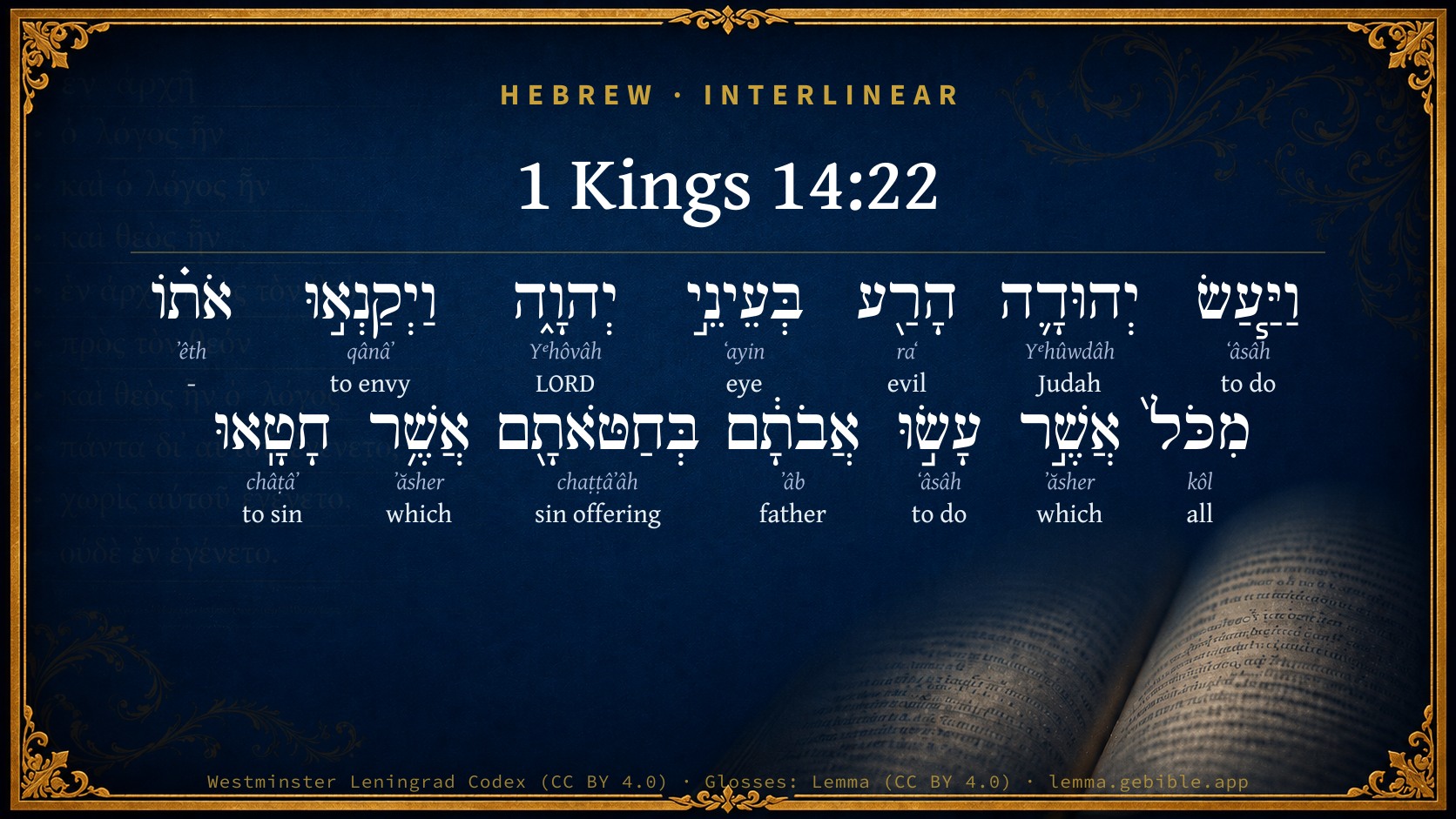
Hebrew (Westminster Leningrad Codex) 1 Kings 14:22 appears in the Hebrew Old Testament. The text above is from the Westminster Leningrad Codex. Each word links to its Strong’s number, a concise gloss, and parsing drawn from the Open Scriptures Hebrew Bible morphology. Click any word for its full Brown-Driver-Briggs (BDB) entry.
Download image
Cite this verse

1 Kings 14:22 (World English Bible). Public Domain. Lemma interlinear Bible study tool, https://lemma.gebible.app/v/1-kings/14/22.

Show BibTeX & RIS
BibTeX
RIS
English Translation
Judah did that which was evil in the sight of Yahweh, and they provoked him to jealousy with their sins which they committed, above all that their fathers had done.
World English Bible · Public Domain
Download a study sheet

One document with this verse’s original text, its word-by-word gloss line, the meaning frame, cross-references with their text, attributed commentary, and full source and license credits — printable, and it pastes into notes with its structure intact.

This verse Autodidact and up

Study sheet (.html) Plain text (.txt)

A passage Seminary Student

Up to 50 verses in one chapter. A passage sheet keeps up to 6 commentary sources and 12 cross-references per verse, in the order this page ranks them, and says so on the sheet whenever that leaves anything out. Ask for a single verse and you get the Autodidact verse sheet above.

Everything on this page stays free to read, with no account — the sheet is a download of what is already on screen, not access to it.

Want to remove ads? Support Godless Engineer
Compare translations 3

The same verse in 3 English versions, stacked beneath the original-language interlinear above. Click any original word for its lexicon entry.

Each is an independent rendering of the whole verse — the interlinear is not word-aligned to these translations.

Highlighted words mark where these versions differ — a whole-verse word diff, not a word-by-word alignment.

  • World English Bible Public Domain
    Judah did that which was evil in the sight of Yahweh, and they provoked him to jealousy with their sins which they committed, above all that their fathers had done.
  • King James Version Public Domain
    And Judah did evil in the sight of the LORD, and they provoked him to jealousy with their sins which they had committed, above all that their fathers had done.
  • unfoldingWord Literal Text CC BY-SA 4.0
    And Judah did evil in the eyes of Yahweh. And they made him jealous more than all that their fathers had done by their sins that they sinned.

unfoldingWord Literal Text — © unfoldingWord, licensed CC BY-SA 4.0. Word-aligned USFM3 via Door43 (git.door43.org/unfoldingWord/en_ult).

Versions to compare (up to 4)

3 of 4 selected

Show all 18 translations

Every available English version of this verse, each an independent rendering of the whole verse.

  • World English Bible Public Domain
    Judah did that which was evil in the sight of Yahweh, and they provoked him to jealousy with their sins which they committed, above all that their fathers had done.
  • Berean Standard Bible Public Domain
    And Judah did evil in the sight of the LORD, and by the sins they committed they provoked Him to jealous anger more than all their fathers had done.
  • Majority Standard Bible Public Domain
    And Judah did evil in the sight of the LORD, and by the sins they committed they provoked Him to jealous anger more than all their fathers had done.
  • King James Version Public Domain
    And Judah did evil in the sight of the LORD, and they provoked him to jealousy with their sins which they had committed, above all that their fathers had done.
  • American Standard Version (1901) Public Domain
    And Judah did that which was evil in the sight of Jehovah, and they provoked him to jealousy with their sins which they committed, above all that their fathers had done.
  • Revised Version (1885) Public Domain
    And Judah did that which was evil in the sight of the LORD; and they provoked him to jealousy with their sins which they committed, above all that their fathers had done.
  • Geneva Bible (1599) Public Domain
    And Iudah wrought wickednesse in the sight of the Lord: and they prouoked him more with their sinnes, which they had committed, then all that which their fathers had done.
  • Douay-Rheims (1899) Public Domain
    And Juda did evil in the sight of the Lord, and provoked him above all that their fathers had done, in their sins which they committed.
  • Young's Literal Translation Public Domain
    And Judah doth the evil thing in the eyes of Jehovah, and they make Him zealous above all that their fathers did by their sins that they have sinned.
  • Literal Standard Version CC BY-SA 4.0
    And Judah does evil in the eyes of YHWH, and they make Him zealous above all that their fathers did by their sins that they have sinned.
  • Unlocked Literal Bible CC BY-SA 4.0
    Judah did what was evil in the sight of Yahweh; they provoked him to jealousy with the sins that they committed, more than everything that their fathers had done.
  • unfoldingWord Literal Text CC BY-SA 4.0
    And Judah did evil in the eyes of Yahweh. And they made him jealous more than all that their fathers had done by their sins that they sinned.
  • Darby Bible Public Domain
    And Judah did evil in the sight of Jehovah, and they provoked him to jealousy with their sins which they committed more than all that their fathers had done.
  • World Messianic Bible Public Domain
    Judah did that which was evil in the LORD’s sight, and they provoked him to jealousy with their sins which they committed, above all that their fathers had done.
  • Webster's Bible Public Domain
    And Judah did evil in the sight of the LORD, and they provoked him to jealousy with their sins which they had committed, above all that their fathers had done.
  • Free Bible Version CC BY-SA 4.0
    Judah did what was evil in the Lord's sight, and because of the sins they committed they made his jealous anger even greater than all their fathers had done.
  • Bible in Basic English Public Domain
    And Judah did evil in the eyes of the Lord, and made him more angry than their fathers had done by their sins.
  • JPS Tanakh (1917) Public Domain
    And Judah did that which was evil in the sight of the LORD; and they moved Him to jealousy with their sins which they committed, above all that their fathers had done.

Literal Standard Version (2020), Covenant Press — licensed CC BY-SA 4.0. Text via the HelloAO Bible API (eBible.org). Unlocked Literal Bible (unfoldingWord) — licensed CC BY-SA 4.0. Text via the HelloAO Bible API (eBible.org). unfoldingWord Literal Text — © unfoldingWord, licensed CC BY-SA 4.0. Word-aligned USFM3 via Door43 (git.door43.org/unfoldingWord/en_ult). Free Bible Version, Dr. Jonathan Gallagher — licensed CC BY-SA 4.0. Text via the HelloAO Bible API (eBible.org).

Word by word

More ways to search: Search by grammar → Find every occurrence → Compare this word →

Practice this passage: Drill this verse → Learn its vocabulary →

וַיְקַנְא֣וּ
qânâʼ
H7065
“and · to envy”
Conjunction + Verb, Piel, Sequential Imperfect, 3rd Person, Masculine, Plural
Part of Speech
Conjunction + Verb
Stem
Piel
Form
Sequential Imperfect
Person
3rd Person
Gender
Masculine
Number
Plural
Full BDB Definition

Origin: a primitive root

TWOT: 2038

to envy, be jealous, be envious, be zealous - (Piel) - to be jealous of - to be envious of - to be zealous for - to excite to jealous anger - (Hiphil) to provoke to jealous anger, cause jealousy
  1. וַיַּ֧עַשׂ ʻâsâh H6213 “and · to do” Conjunction + Verb, Qal, Sequential Imperfect, 3rd Person, Masculine, Singular
  2. יְהוּדָ֛ה Yᵉhûwdâh H3063 “Judah” Noun, Proper
  3. הָרַ֖ע raʻ H7451 “the · evil” Particle, Definite Article + Adjective, Adjective, Masculine, Singular, Absolute
  4. בְּעֵינֵ֣י ʻayin H5869 “in/at · eyes of” Preposition + Noun, Common, Both, Dual, Construct
  5. יְהוָ֑ה Yᵉhôvâh H3068 “LORD” Noun, Proper
  6. אֹת֗וֹ ʼêth H853 “- · him” Particle, Direct Object + Suffix, Personal, 3rd Person, Masculine, Singular
  7. מִכֹּל֙ kôl H3605 “from · all” Preposition + Noun, Common, Masculine, Singular, Absolute
  8. אֲשֶׁ֣ר ʼăsher H834 “which” Particle, Relative
  9. עָשׂ֣וּ ʻâsâh H6213 “to do” Verb, Qal, Perfect, 3rd Person, Common, Plural
  10. אֲבֹתָ֔ם ʼâb H1 “fathers · their” Noun, Common, Masculine, Plural, Construct + Suffix, Personal, 3rd Person, Masculine, Plural
  11. בְּחַטֹּאתָ֖ם chaṭṭâʼâh H2403 “in/at · sin offerings · their” Preposition + Noun, Common, Feminine, Plural, Construct + Suffix, Personal, 3rd Person, Masculine, Plural
  12. אֲשֶׁ֥ר ʼăsher H834 “which” Particle, Relative
  13. חָטָֽאוּ châṭâʼ H2398 “to sin” Verb, Qal, Perfect, 3rd Person, Common, Plural

About this verse

These counts appear in no published source. They are computed here, from the morphology-tagged text and Lemma’s own curated glosses. What Lemma adds →

14
words
12
distinct lemmas
Historical
section

Shared distinctive vocabulary

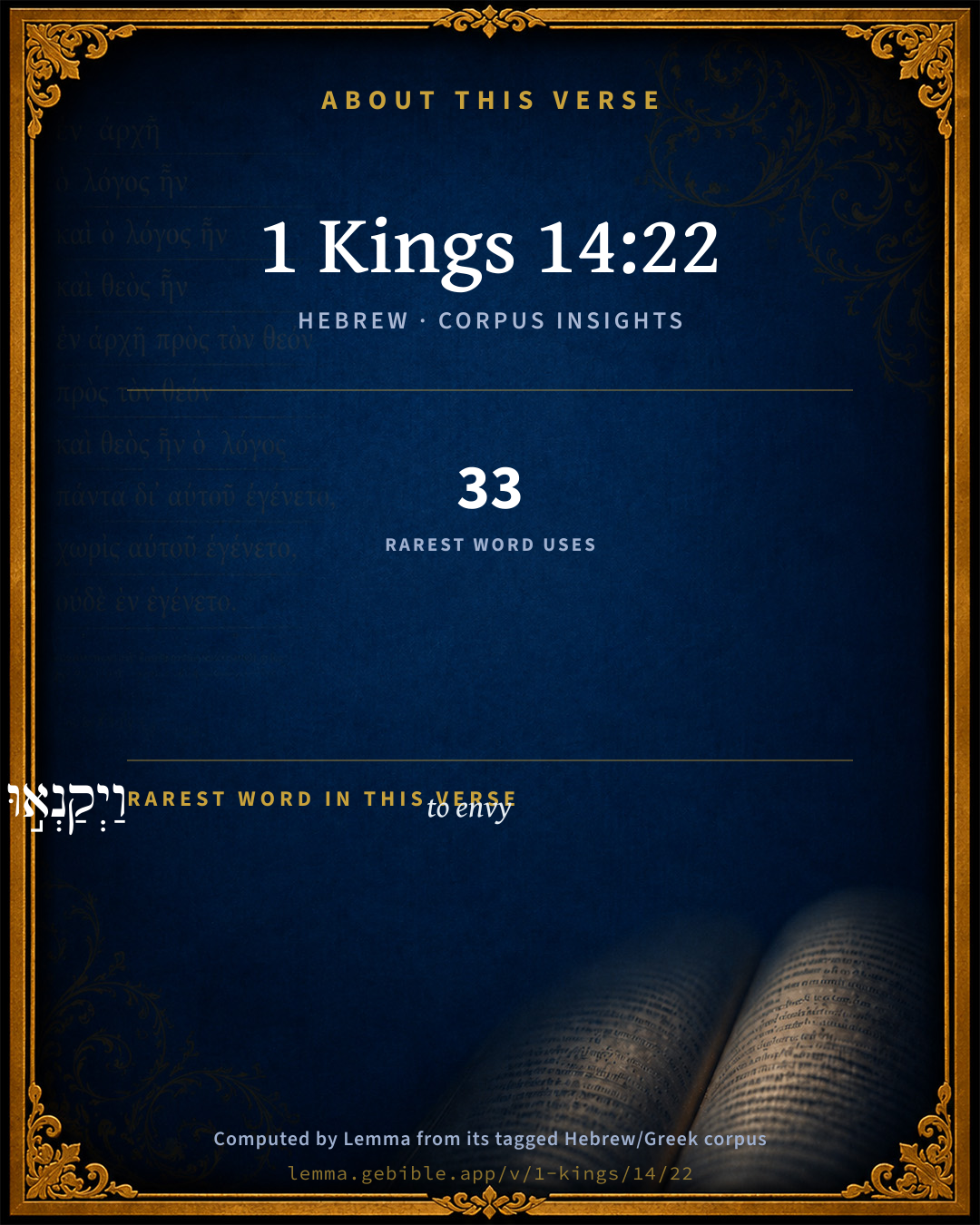
וַיְקַנְא֣וּ to envy H7065 occurs in 28 verses of the Hebrew Bible. Also found in:

Grammatical profile

  • 4 verbs
  • 6 nouns
  • 1 adjective
  • 3 particles

Verb forms

  • וַיַּ֧עַשׂ Qal · Sequential Imperfect
  • וַיְקַנְא֣וּ Piel · Sequential Imperfect
  • עָשׂ֣וּ Qal · Perfect
  • חָטָֽאוּ Qal · Perfect

Repetition

Words recur within this verse — often emphatic in Hebrew:

  • וַיַּ֧עַשׂ to do H6213 ×2
  • אֲשֶׁ֣ר which H834 ×2

Hebrew & Septuagint length

In English translation the verse runs 30 words from the Hebrew and 28 from the Septuagint (LXX English) — closely comparable.

A rough comparison of the two English renderings, which tokenize alike — not a word-level alignment.

Word counts can differ between the Hebrew and the Greek without any difference in meaning — e.g. the Hebrew direct-object marker אֵת has no separate Greek word, and Greek often adds the article ὁ.

Cross-references

17

Topical passages linked to 1 Kings 14:22 in the Treasury of Scripture Knowledge — connected by theme and wording, ordered by reader-vote popularity; previews shown in the World English Bible.

  • 2 Chronicles 12:1 It happened, when the kingdom of Rehoboam was established, and he was strong, that he forsook the law of Yahweh, and all Israel with him.
  • 1 Corinthians 10:22 Or do we provoke the Lord to jealousy? Are we stronger than he?
  • Psalms 78:58 For they provoked him to anger with their high places, And moved him to jealousy with their engraved images.
  • Deuteronomy 4:24 For Yahweh your God is a devouring fire, a jealous God.
  • Deuteronomy 29:28 and Yahweh rooted them out of their land in anger, and in wrath, and in great indignation, and cast them into another land, as at this day.
  • Deuteronomy 32:16–21 They moved him to jealousy with strange [gods]; With abominations provoked they him to anger.
  • Judges 3:7 The children of Israel did that which was evil in the sight of Yahweh, and forgot Yahweh their God, and served the Baals and the Asheroth.
  • Judges 3:12 The children of Israel again did that which was evil in the sight of Yahweh: and Yahweh strengthened Eglon the king of Moab against Israel, because they had done that which was evil in the sight of Yahweh.
  • Judges 4:1 The children of Israel again did that which was evil in the sight of Yahweh, when Ehud was dead.
  • 1 Kings 14:9 but have done evil above all who were before you, and have gone and made you other gods, and molten images, to provoke me to anger, and have cast me behind your back:
  • 1 Kings 16:30 Ahab the son of Omri did that which was evil in the sight of Yahweh above all that were before him.
  • 2 Kings 17:19 Also Judah didn't keep the commandments of Yahweh their God, but walked in the statutes of Israel which they made.
  • 2 Chronicles 12:14 He did that which was evil, because he didn't set his heart to seek Yahweh.
  • Isaiah 65:3–4 a people who provoke me to my face continually, sacrificing in gardens, and burning incense on bricks;
  • 2 Kings 21:11 Because Manasseh king of Judah has done these abominations, and has done wickedly above all that the Amorites did, who were before him, and has made Judah also to sin with his idols;
  • Jeremiah 3:7–11 I said after she had done all these things, She will return to me; but she didn't return: and her treacherous sister Judah saw it.
  • Ezekiel 16:47–48 Yet have you not walked in their ways, nor done after their abominations; but, as [if that were] a very little [thing], you were more corrupt than they in all your ways.

Cross-references courtesy of OpenBible.info (CC BY 4.0).

Hebrew and Greek witnesses Masoretic Hebrew ↔ Greek Septuagint

The same verse in the two great witnesses to the Old Testament, shown verse-for-verse.

These are two independent witnesses, not word-aligned to each other, and the Septuagint is shown in lemma (dictionary) form.

Hebrew 1 Kings 14:22 Masoretic · Westminster Leningrad Codex

וַיַּ֧עַשׂ יְהוּדָ֛ה הָרַ֖ע בְּעֵינֵ֣י יְהוָ֑ה וַיְקַנְא֣וּ אֹת֗וֹ מִכֹּל֙ אֲשֶׁ֣ר עָשׂ֣וּ אֲבֹתָ֔ם בְּחַטֹּאתָ֖ם אֲשֶׁ֥ר חָטָֽאוּ

Judah did that which was evil in the sight of Yahweh, and they provoked him to jealousy with their sins which they committed, above all that their fathers had done.

World English Bible · Public Domain

Greek LXX 1 Kings 14:22 Septuagint · lemma form
And Roboam did evil in the sight of the Lord; and he provoked him in all the things which their fathers did in their sins which they sinned.

LXX2012 (modern English Septuagint) · Public Domain

Hebrew: Westminster Leningrad Codex (CC BY 4.0). Greek: Septuagint (public domain); English from LXX2012 (modern English Septuagint) (Public Domain). How the Septuagint differs from the Hebrew →

Targum (Aramaic paraphrase)

1

The Targum is the ancient Jewish Aramaic paraphrase of the Hebrew Scriptures — an interpretive translation, not the Hebrew text itself. Onkelos (literal) and Pseudo-Jonathan (expansive) render the Torah, and Jonathan the Prophets. Coverage is partial: where no permissively-licensed English translation exists for a verse, only the Aramaic is shown. This is verse-level text, not a word-by-word alignment to the Hebrew.

  1. Targum Jonathan Prophets (Joshua–Malachi)
    וַעֲבַד דְבֵית יְהוּדָה דְבִישׁ קֳדָם יְיָ וְאַרְגִיזוּ קָדָמוֹהִי מִכָּל דַעֲבַדוּ אֲבָהַתְהוֹן בְּחוֹבֵיהוֹן דִי חָבוּ:

    (no public-domain English translation for this verse)

    Targum Jonathan — Aramaic: “Mikraot Gedolot” (public domain). English: “Sefaria Community Translation” (CC0 1.0 (public-domain dedication)); “London "Chaldee Paraphrase," 1871” (public domain). Text via Sefaria.

Commentary

Notes on 1 Kings 14:22 from classic Christian and Jewish commentators (each source and its license shown beneath its notes). The classic Christian expositions comment on the surrounding passage and are grouped to its opening verse, so a note may address several verses; the Jewish commentaries on the Tanakh (Rashi and others) are per-verse, so they appear only where the commentator wrote on this verse.

Lemma curates 59 commentaries, every one of them public domain or Creative Commons licensed, each selected and text-cleaned for this edition rather than reprinted as found. About our sources →

Trapp's Complete Commentary

John Trapp

1Ki 14:22 And Judah did evil in the sight of the LORD, and they provoked him to jealousy with their sins which they had committed, above all that their fathers had done.

Ver. 22. And Judah did evil.] Qualis rex, talis plerunque grex. Howbeit there was a remnant among the twelve tribes, thus generally revolted, that "instantly served God day and night." {Act 26:7} See 1Ki 19:10; 1Ki 19:18.

John Trapp, A Commentary or Exposition upon All the Books of the Old and New Testament (1647–1656) — public domain. Text from a community e-Sword module.

Joseph Benson's Commentary

1Ki 14:22-23. Judah did evil in the sight of the Lord — In contempt and in defiance of him, and the tokens of his special presence. They provoked him to jealousy — By joining other gods together with him, as the adulterous wife provokes her husband by breaking the marriage covenant. They also built them high places — Followed the example of the Israelites, although they were better instructed, had the temple in their kingdom, and liberty of access to it, and the privilege of worshipping God in his own way; together with the counsels, sermons, and examples, of the priests and Levites, and the dreadful example of Israel’s horrid apostacy, to caution and terrify them. High places — Which were unlawful, and now especially when the temple was built, and ready to receive them, and unnecessary, and therefore in building them they expressed a greater contempt of God and his express command. Groves — Not only after the manner of the heathen and Israelites, but against a direct and particular prohibition. Under every green tree — The people were universally corrupted, which is prodigious, all things considered, and is a clear evidence of the greatness and depth of the original corruption of man’s nature.

Joseph Benson's Commentary on the Old and New Testaments (1811–1818) — public domain. Text from a community e-Sword module.

Tyndale Open Study Notes

Tyndale Open Resources

14:22 the people of Judah did what was evil: Although Rehoboam seemed to begin his reign in good spiritual form (2 Chr 11:5-17, 23), he deserted God’s standards (2 Chr 12:1).

Tyndale Open Study Notes — © Tyndale Open Resources, licensed CC BY-SA 4.0. Text via the HelloAO Bible API.

Geneva Bible (1599)

Geneva Bible translators

Or, besides all that their fathers had done by their sins.

Geneva Bible (1599) marginal notes — public domain. Text via Bolls.life.

Ellicott's Commentary for English Readers

(22) Forty and one years old when he began to reign.—It has been noticed that the age of forty-one assigned to Rehoboam at his accession, here and in the Chronicles (both in the Hebrew text and the ancient versions) and in the history of Josephus, presents some difficulty in relation to the youth ascribed to him and his companions at the time of his accession; and, moreover, if only forty years are given to Solomon’s reign, must throw back his birth to a time when his father must have been very young. It has been accordingly proposed to read “twenty-one” (by a slight change of the Hebrew numerals); but the combined authority supporting the present reading is strong, and the difficulties above noted, though real, are not insurmountable.

The city which the Lord did choose.—This emphatic notice is, no doubt, intended to place Jerusalem and its worship in marked contrast with the new capitals and unauthorised sanctuaries which had sprung up. The possession of Jerusalem, with all that was associated with it, was the very life of the little kingdom of Judah, threatened by its more powerful rival and by the neighbouring nations. In Israel one capital succeeded another; Shechem, Tirzah, Samaria, Jezreel, became rival cities. In Judah no city could be for a moment placed on the level of the hallowed city of Jerusalem.

Naamah an Ammonitess.—The reference to the queen-mother is almost invariable in the annals of the kings, marking the importance always attaching to it in Eastern monarchies; but the mention (here and in 1Ki_14:31) of Naamah as an Ammonitess is perhaps significant in relation to the description of the manifold idolatries of Rehoboam. It is curious that the succession should pass without question to the son of another and an earlier wife than Solomon’s chief queen, the daughter of Pharaoh.

(22) Judah did evil.—From the Chronicles (2Ch_11:17) we gather that, as might have been expected, the judgment which had fallen upon the house of David for idolatry, the rallying of the national feeling round the sacredness of the Temple, and the influx from Israel of the priests and Levites, produced a temporary reaction: “for three years they walked in the way of David and Solomon.” With, however, the excitement, and perhaps the sense of danger (2Ch_12:1), this wholesome reaction passed by, and gave way to an extraordinarily reckless plunge into abominations of the worst kind. These are ascribed not, as in the case of Solomon and most other kings, to the action of Rehoboam, but to that of the people at large; for the king himself seems to have been weak, unfit for taking the initiative either in good or evil. The apostasy of Judah was evidently the harvest of the deadly seed sown by the commanding influence of Solomon, under whose idolatry the young men had grown up. It is said to have gone beyond “all that their fathers had done,” even in the darkest periods of the age of the Judges: perhaps on the ground that the sins of a more advanced state of knowledge and civilisation are, both in their guilt and in their subtlety, worse than the sins of a semi-barbarous age.

A Bible Commentary for English Readers, edited by Charles John Ellicott (1878–1897) — public domain. Text from a community e-Sword module.

The Cambridge Bible for Schools and Colleges

gen. ed. J. J. S. Perowne

22. did evil] R.V. did that which was evil. The Hebrew text is better represented by this fuller translation.

provoked him to jealousy] Jehovah had called himself a jealous God, when the Law was given on Sinai (Exo_20:5).

which they had committed] The word ‘had’ is better omitted. The Hebrew has no power of marking such a pluperfect tense in verbal inflexions, and the context must be our guide to such a shade of meaning. Here it is not appropriate for the sins were still continuing. In the previous verse the English pluperfect appears preferable as a translation of the same Hebrew tense for the choice of God had been made long before the days of Rehoboam.

The Cambridge Bible for Schools and Colleges (gen. ed. J. J. S. Perowne; Cambridge University Press, 1878–1918) — public domain. Text from a community e-Sword module.

John Gill's Exposition

For they also built them high places,.... Which, though allowed of, or at least connived at, before the temple was built, and when the tabernacle was unfixed, yet afterwards unlawful; and the tribe of Judah could have no excuse for them, who had the temple in their tribe:

and images; contrary to the express command of God, Exo 20:4,

and groves on every high hill, and under every green tree; that is, set up idols, and temples for idols, amidst groves of trees, and under all green trees; as was the custom of the Heathens, who sacrificed on the heights of hills and tops of mountains, as was particularly the custom of the Persians, as both Herodotus (m) and Xenophon (n) relate; and with the Getae, a people in Thrace, was a mountain they reckoned sacred (o).

(m) Clio, sive, l. 1. c. 131. (n) Cyropaedia, l. 8. c. 45. (o) Strabo Geograph. l. 7. p. 206.

John Gill's Exposition of the Whole Bible (1746–1763) — public domain (CC PDM 1.0). Text via the HelloAO Bible API.

Albert Barnes' Notes on the Bible

This defection of Judah did not take place until Rehoboam’s fourth year (marginal reference).

They provoked him to jealousy - Compare Exo 20:5; and on the force of the metaphor involved in the word, see Exo 34:15 note.

Albert Barnes' Notes on the Bible (1834–1885) — public domain. Text from a community e-Sword/MySword module.

Matthew Poole's English Annotations

Judah did evil, after a little time, 2Ch 11:17.

Matthew Poole's English Annotations on the Holy Bible (1683–1685) — public domain. Text from a community e-Sword/MySword module.

Whedon's Commentary on the Bible

Daniel D. Whedon

22. Provoked him to jealousy — This expression, of frequent occurrence, (see marginal reference,) is a metaphor which views the relation of God and his people as the marriage covenant, in which the people are represented as a faithless wife.

Daniel D. Whedon (gen. ed.), Commentary on the Old and New Testaments (1874–1909) — public domain. Text from a community e-Sword module.

The Pulpit Commentary

And Judah did evil in the sight of the Lord not, however, before the fourth year of Rehoboam"s reign. For the first three Fears the nation remained steadfast in the faith, and the kingdom was greatly strengthened and consolidated. The defection commenced when Rehoboam began to feel himself secure. (2Ch_12:1) It is to be observed, however, that the historian says "Judah" (not Rehoboam) "did evil," etc. It is probable that a considerable section of the people approved of the idolatrous practices introduced in the preceding reign, and that Rehoboam was unable to repress them. It was his misfortune to have to reap the bitter fruits of Solomon"s unfaithfulness, and they provoked him to jealousy Heb. made him jealous. Same word, Exo_20:5 Exo_34:14; Num_5:14. The words of the covenant proclaimed the Lord a," jealous God." This is of course anthropomorphic language. The nation was regarded as the bride of Jehovah, and God is said to be made jealous, because idolatry was unfaithfulness to Him. The worship of Baal and Ashtoreth, it must be remembered, involved unutterable immoralities, hence the special fitness of the word, which is only used of idolatry of one kind or other with their sins which they had committed Heb. sinned above all that their fathers had done.

The Pulpit Commentary (1880–1919), ed. H.D.M. Spence-Jones & Joseph S. Exell — public domain. Text from a community e-Sword module.

John Wesley's Explanatory Notes

In the sight of the Lord - In contempt and defiance of him, and the tokens of his special presence. Jealousy - As the adulterous wife provokes her husband, by breaking the marriage covenant.

John Wesley, Explanatory Notes Upon the Whole Bible (1754–1765) — public domain. Text via the GEBible commentary corpus.

Rashi

Rabbi Shlomo Yitzchaki (Rashi)

And Yehudah did what was evil. And they did not pay attention to this.

And they angered Him. An expression of provocation.

Rashi on the Tanakh — English translations: “The Judaica Press complete Tanach with Rashi, translated by A. J. Rosenberg” (CC BY 4.0); “Pentateuch with Rashi's commentary by M. Rosenbaum and A.M. Silbermann, 1929-1934” (public domain); “The Metsudah Tanach series, Lakewood, N.J” (CC BY 4.0); and “The Book of Joshua, Metsudah Publications, 1997” (CC BY 4.0). Text via Sefaria.

Lesson kit

Teaching starters — assembled from the data on this page, not authored interpretation. Every prompt links to the verse data it draws on. Edit before teaching.

1 Kings, in the Historical, opens this verse with 14 words (12 distinct Hebrew lemmas). Its most distinctive word is qânâʼ (“to envy”). A historical commentator’s framing appears above. Read the whole chapter for the surrounding context.

Discussion questions

  1. The word qânâʼ carries the sense “to envy.” How does it shape the verse?
  2. Genesis 26:14 shares the word «to envy» with this verse. How do the two illuminate each other?
  3. “to do” occurs 2× in this one verse. What is the effect of the repetition?
  4. These translations render this verse differently. What is at stake in choosing one wording over another?
  5. The verb «וַיַּ֧עַשׂ» is Qal Sequential Imperfect. How does its form color the action?
  6. Reading how Trapp's Complete Commentary and Joseph Benson's Commentary read this verse, where do the two commentators agree and where do they part?

Things to notice

Reading settings

Reading text

Shown beneath each verse's original-language words.

Old Testament
Old Testament edition

Read the OT as the Masoretic Hebrew (MT) or the Greek Septuagint (LXX).

English shown for the Greek Septuagint (in the Hebrew ↔ Greek comparison).

Comparing translations? Open the Compare panel on any verse page to stack up to four side by side.