
Genesis 49:29

Hebrew (Westminster Leningrad Codex) Genesis 49:29 appears in the Hebrew Old Testament. The text above is from the Westminster Leningrad Codex. Each word links to its Strong’s number, a concise gloss, and parsing drawn from the Open Scriptures Hebrew Bible morphology. Click any word for its full Brown-Driver-Briggs (BDB) entry.
Download image
Cite this verse

Genesis 49:29 (World English Bible). Public Domain. Lemma interlinear Bible study tool, https://lemma.gebible.app/v/genesis/49/29.

Show BibTeX & RIS
BibTeX
RIS
English Translation
He charged them, and said to them, "I am to be gathered to my people. Bury me with my fathers in the cave that is in the field of Ephron the Hittite,
World English Bible · Public Domain
Download a study sheet

One document with this verse’s original text, its word-by-word gloss line, the meaning frame, cross-references with their text, attributed commentary, and full source and license credits — printable, and it pastes into notes with its structure intact.

This verse Autodidact and up

Study sheet (.html) Plain text (.txt)

A passage Seminary Student

Up to 50 verses in one chapter. A passage sheet keeps up to 6 commentary sources and 12 cross-references per verse, in the order this page ranks them, and says so on the sheet whenever that leaves anything out. Ask for a single verse and you get the Autodidact verse sheet above.

Everything on this page stays free to read, with no account — the sheet is a download of what is already on screen, not access to it.

Want to remove ads? Support Godless Engineer
Compare translations 3

The same verse in 3 English versions, stacked beneath the original-language interlinear above. Click any original word for its lexicon entry.

Each is an independent rendering of the whole verse — the interlinear is not word-aligned to these translations.

Highlighted words mark where these versions differ — a whole-verse word diff, not a word-by-word alignment.

  • World English Bible Public Domain
    He charged them, and said to them, "I am to be gathered to my people. Bury me with my fathers in the cave that is in the field of Ephron the Hittite,
  • King James Version Public Domain
    And he charged them, and said unto them, I am to be gathered unto my people: bury me with my fathers in the cave that is in the field of Ephron the Hittite,
  • unfoldingWord Literal Text CC BY-SA 4.0
    Then he commanded them and said to them, “I am being gathered to my people. Bury me with my fathers in the cave that in the field of Ephron the Hittite,

unfoldingWord Literal Text — © unfoldingWord, licensed CC BY-SA 4.0. Word-aligned USFM3 via Door43 (git.door43.org/unfoldingWord/en_ult).

Versions to compare (up to 4)

3 of 4 selected

Show all 17 translations

Every available English version of this verse, each an independent rendering of the whole verse.

  • World English Bible Public Domain
    He charged them, and said to them, "I am to be gathered to my people. Bury me with my fathers in the cave that is in the field of Ephron the Hittite,
  • Berean Standard Bible Public Domain
    Then Jacob instructed them, “I am about to be gathered to my people. Bury me with my fathers in the cave in the field of Ephron the Hittite.
  • Majority Standard Bible Public Domain
    Then Jacob instructed them, “I am about to be gathered to my people. Bury me with my fathers in the cave in the field of Ephron the Hittite.
  • King James Version Public Domain
    And he charged them, and said unto them, I am to be gathered unto my people: bury me with my fathers in the cave that is in the field of Ephron the Hittite,
  • American Standard Version (1901) Public Domain
    And he charged them, and said unto them, I am to be gathered unto my people: bury me with my fathers in the cave that is in the field of Ephron the Hittite,
  • Revised Version (1885) Public Domain
    And he charged them, and said unto them, I am to be gathered unto my people: bury me with my fathers in the cave that is in the field of Ephron the Hittite,
  • Geneva Bible (1599) Public Domain
    And he charged them and sayd vnto them, I am ready to be gathered vnto my people: burie mee with my fathers in the caue, that is in the fielde of Ephron the Hittite,
  • Young's Literal Translation Public Domain
    And he commandeth them, and saith unto them, `I am being gathered unto my people; bury me by my fathers, at the cave which `is' in the field of Ephron the Hittite;
  • Literal Standard Version CC BY-SA 4.0
    And he commands them and says to them, “I am being gathered to my people; bury me by my fathers, at the cave which [is] in the field of Ephron the Hittite;
  • Unlocked Literal Bible CC BY-SA 4.0
    Then he instructed them and said to them, “I am about to go to my people. Bury me with my forefathers in the cave that is in the field of Ephron the Hittite,
  • unfoldingWord Literal Text CC BY-SA 4.0
    Then he commanded them and said to them, “I am being gathered to my people. Bury me with my fathers in the cave that in the field of Ephron the Hittite,
  • Darby Bible Public Domain
    And he charged them, and said to them, I am gathered to my people: bury me with my fathers in the cave that is in the field of Ephron the Hittite,
  • World Messianic Bible Public Domain
    He instructed them, and said to them, “I am to be gathered to my people. Bury me with my fathers in the cave that is in the field of Ephron the Hittite,
  • Webster's Bible Public Domain
    And he charged them, and said to them, I am to be gathered to my people: bury me with my fathers in the cave that is in the field of Ephron the Hittite.
  • Free Bible Version CC BY-SA 4.0
    Then he gave them the following instructions: “I'm going to die soon. Bury me with my forefathers in the cave in the field of Ephron the Hittite.
  • Bible in Basic English Public Domain
    And he gave orders to them, saying, Put me to rest with my people and with my fathers, in the hollow of the rock in the field of Ephron the Hittite,
  • JPS Tanakh (1917) Public Domain
    And he charged them, and said unto them: 'I am to be gathered unto my people; bury me with my fathers in the cave that is in the field of Ephron the Hittite,

Literal Standard Version (2020), Covenant Press — licensed CC BY-SA 4.0. Text via the HelloAO Bible API (eBible.org). Unlocked Literal Bible (unfoldingWord) — licensed CC BY-SA 4.0. Text via the HelloAO Bible API (eBible.org). unfoldingWord Literal Text — © unfoldingWord, licensed CC BY-SA 4.0. Word-aligned USFM3 via Door43 (git.door43.org/unfoldingWord/en_ult). Free Bible Version, Dr. Jonathan Gallagher — licensed CC BY-SA 4.0. Text via the HelloAO Bible API (eBible.org).

Word by word

More ways to search: Search by grammar → Find every occurrence → Compare this word →

Practice this passage: Drill this verse → Learn its vocabulary →

עֶפְר֥וֹן
ʻEphrôwn
H6085
“Ephron”
Noun, Proper
Part of Speech
Noun
Type
Proper
Full BDB Definition

Origin: from the same as H6081

TWOT: None

Ephron = "fawn-like" - a Hittite, son of Zohar and the one from whom Abraham bought the field and cave of Machpelah (noun proper masculine) - a city on the borders of Benjamin (noun proper locative) - a mountain on the northern border of Judah (noun proper locative)
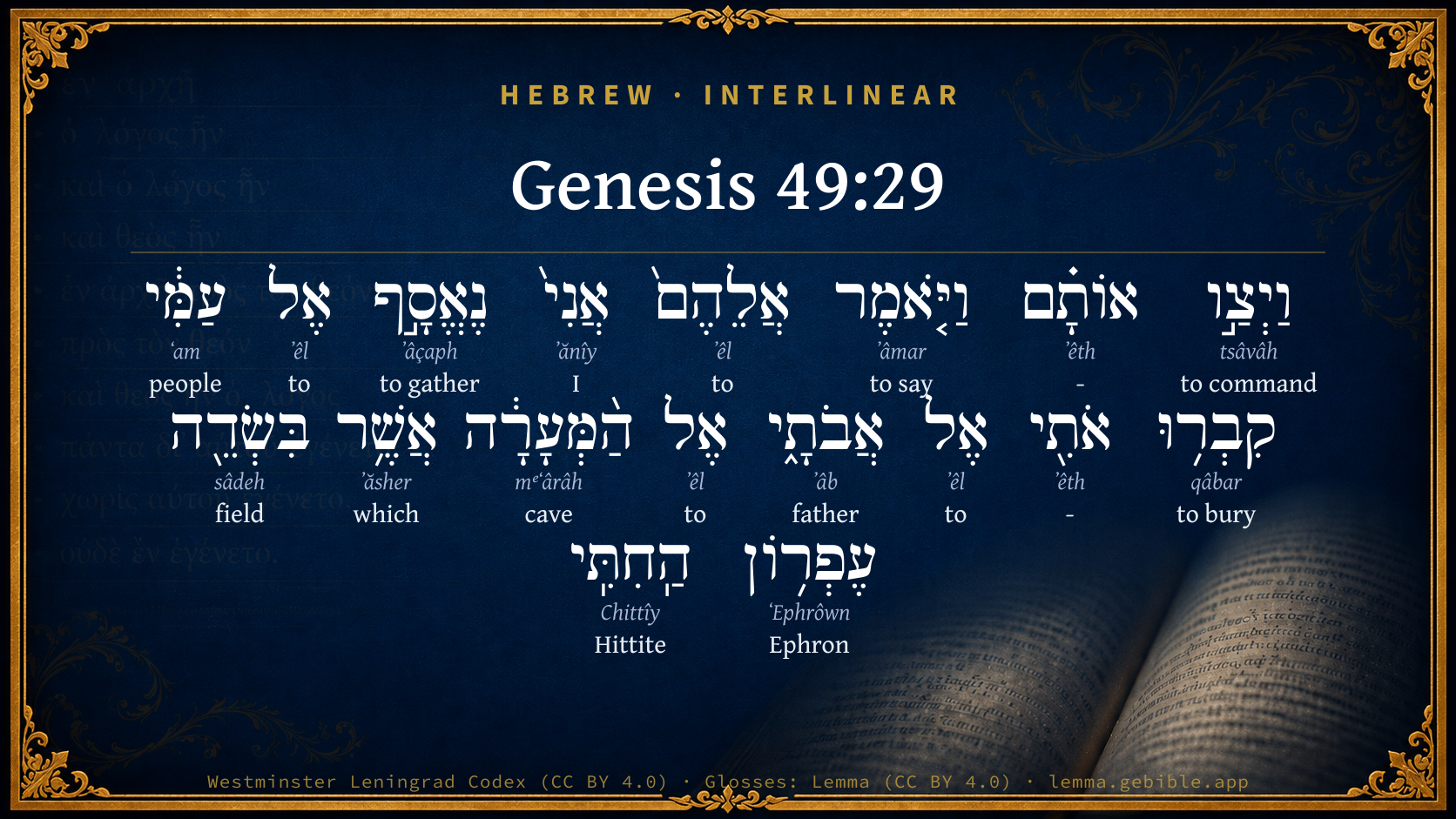
  1. וַיְצַ֣ו tsâvâh H6680 “and · to command” Conjunction + Verb, Piel, Sequential Imperfect, 3rd Person, Masculine, Singular
  2. אוֹתָ֗ם ʼêth H853 “- · them” Particle, Direct Object + Suffix, Personal, 3rd Person, Masculine, Plural
  3. וַיֹּ֤אמֶר ʼâmar H559 “and · to say” Conjunction + Verb, Qal, Sequential Imperfect, 3rd Person, Masculine, Singular
  4. אֲלֵהֶם֙ ʼêl H413 “to · them” Preposition + Suffix, Personal, 3rd Person, Masculine, Plural
  5. אֲנִי֙ ʼănîy H589 “I” Pronoun, Personal, 1st Person, Common, Singular
  6. נֶאֱסָ֣ף ʼâçaph H622 “gathered” Verb, Niphal, Participle Passive, Masculine, Singular, Absolute
  7. אֶל ʼêl H413 “to” Preposition
  8. עַמִּ֔י ʻam H5971 “people · my” Noun, Common, Masculine, Singular, Construct + Suffix, Personal, 1st Person, Common, Singular
  9. קִבְר֥וּ qâbar H6912 “bury” Verb, Qal, Imperative, 2nd Person, Masculine, Plural
  10. אֹתִ֖י ʼêth H853 “- · me” Particle, Direct Object + Suffix, Personal, 1st Person, Common, Singular
  11. אֶל ʼêl H413 “to” Preposition
  12. אֲבֹתָ֑י ʼâb H1 “fathers · my” Noun, Common, Masculine, Plural, Construct + Suffix, Personal, 1st Person, Common, Singular
  13. אֶל ʼêl H413 “to” Preposition
  14. הַ֨מְּעָרָ֔ה mᵉʻârâh H4631 “the · cave” Particle, Definite Article + Noun, Common, Feminine, Singular, Absolute
  15. אֲשֶׁ֥ר ʼăsher H834 “which” Particle, Relative
  16. בִּשְׂדֵ֖ה sâdeh H7704 “in/at · field of” Preposition + Noun, Common, Masculine, Singular, Construct
  17. הַֽחִתִּֽי Chittîy H2850 “the · Hittite” Particle, Definite Article + Noun, Gentilic, Masculine, Singular, Absolute

About this verse

These counts appear in no published source. They are computed here, from the morphology-tagged text and Lemma’s own curated glosses. What Lemma adds →

18
words
14
distinct lemmas
Pentateuch
section

Notable vocabulary

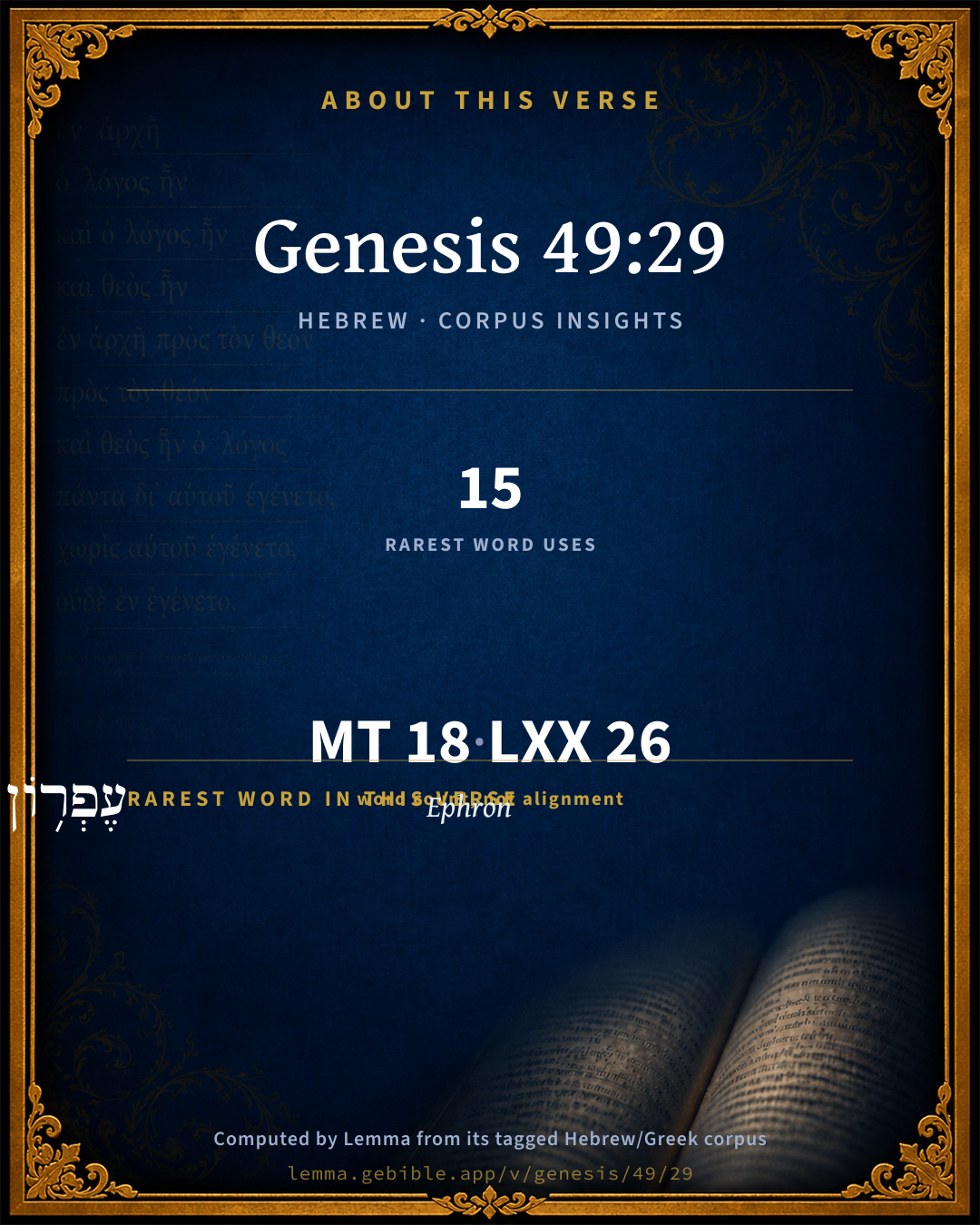
The rarest word here is עֶפְר֥וֹן Ephron H6085 — appearing just 15 times in the whole Hebrew Bible.

Shared distinctive vocabulary

עֶפְר֥וֹן Ephron H6085 occurs in 12 verses of the Hebrew Bible. Also found in:

Grammatical profile

  • 4 verbs
  • 6 nouns
  • 1 pronoun
  • 4 prepositions
  • 3 particles

Verb forms

  • וַיְצַ֣ו Piel · Sequential Imperfect
  • וַיֹּ֤אמֶר Qal · Sequential Imperfect
  • נֶאֱסָ֣ף Niphal · Participle Passive
  • קִבְר֥וּ Qal · Imperative

Repetition

A word recurs within this verse — often emphatic in Hebrew:

  • אֲלֵהֶם֙ to H413 ×4

Hebrew & Septuagint length

In English translation the verse runs 32 words from the Hebrew and 30 from the Septuagint (LXX English) — closely comparable.

A rough comparison of the two English renderings, which tokenize alike — not a word-level alignment.

Word counts can differ between the Hebrew and the Greek without any difference in meaning — e.g. the Hebrew direct-object marker אֵת has no separate Greek word, and Greek often adds the article ὁ.

In the original languages it is 18 Hebrew tokens and 26 Greek tokens — but the two are counted differently (Hebrew bundles its prefixes and suffixes into one token; the Greek is in lemma form), so that isn’t a like-for-like length.

Cross-references

8

Topical passages linked to Genesis 49:29 in the Treasury of Scripture Knowledge — connected by theme and wording, ordered by reader-vote popularity; previews shown in the World English Bible.

  • Genesis 47:30 but when I sleep with my fathers, you shall carry me out of Egypt, and bury me in their burying place." He said, "I will do as you have said."
  • Genesis 50:13 for his sons carried him into the land of Canaan, and buried him in the cave of the field of Machpelah, which Abraham bought with the field, for a possession of a burying-place, from Ephron the Hittite, before Mamre.
  • Genesis 15:15 But you will go to your fathers in peace. You will be buried in a good old age.
  • Genesis 25:8–17 Abraham gave up the spirit, and died in a good old age, an old man, and full of years, and was gathered to his people.
  • 2 Samuel 19:37 Please let your servant turn back again, that I may die in my own city, by the grave of my father and my mother. But behold, your servant Chimham; let him go over with my lord the king; and do to him what shall seem good to you.
  • Genesis 35:29 Isaac gave up the spirit, and died, and was gathered to his people, old and full of days. Esau and Jacob, his sons, buried him.
  • Romans 12:6–21 Having gifts differing according to the grace that was given to us, if prophecy, let us prophesy according to the proportion of our faith;
  • Hebrews 12:23 to the general assembly and assembly of the firstborn who are enrolled in heaven, to God the Judge of all, to the spirits of just men made perfect,

Cross-references courtesy of OpenBible.info (CC BY 4.0).

Hebrew and Greek witnesses Masoretic Hebrew ↔ Greek Septuagint

The same verse in the two great witnesses to the Old Testament, shown verse-for-verse.

These are two independent witnesses, not word-aligned to each other, and the Septuagint is shown in lemma (dictionary) form.

Hebrew Genesis 49:29 Masoretic · Westminster Leningrad Codex

וַיְצַ֣ו אוֹתָ֗ם וַיֹּ֤אמֶר אֲלֵהֶם֙ אֲנִי֙ נֶאֱסָ֣ף אֶל עַמִּ֔י קִבְר֥וּ אֹתִ֖י אֶל אֲבֹתָ֑י אֶל הַ֨מְּעָרָ֔ה אֲשֶׁ֥ר בִּשְׂדֵ֖ה עֶפְר֥וֹן הַֽחִתִּֽי

He charged them, and said to them, "I am to be gathered to my people. Bury me with my fathers in the cave that is in the field of Ephron the Hittite,

World English Bible · Public Domain

Greek LXX Genesis 49:29 Septuagint · lemma form

καί εἶπον αὐτός ἐγώ προςτίθημι πρός ὁ ἐμός λαός θάπτω ἐγώ μετά ὁ πατήρ ἐγώ ἐν ὁ σπήλαιον ὅς εἰμί ἐν ὁ ἀγρός εφρων ὁ χετταῖος

And he said to them, I am added to my people; you⌃ shall bury me with my fathers in the cave, which is in the field of Ephron the Chettite,

LXX2012 (modern English Septuagint) · Public Domain

Hebrew: Westminster Leningrad Codex (CC BY 4.0). Greek: Septuagint (public domain); English from LXX2012 (modern English Septuagint) (Public Domain). How the Septuagint differs from the Hebrew →

Targum (Aramaic paraphrase)

2

The Targum is the ancient Jewish Aramaic paraphrase of the Hebrew Scriptures — an interpretive translation, not the Hebrew text itself. Onkelos (literal) and Pseudo-Jonathan (expansive) render the Torah, and Jonathan the Prophets. Coverage is partial: where no permissively-licensed English translation exists for a verse, only the Aramaic is shown. This is verse-level text, not a word-by-word alignment to the Hebrew.

  1. Targum Onkelos Torah (Genesis–Deuteronomy)
    וּפַקֵד יָתְהוֹן וַאֲמַר לְהוֹן אֲנָא מִתְכְּנֵשׁ לְעַמִּי קְבָרוּ יָתִי לְוַת אֲבָהָתִי בִּמְעַרְתָּא דִי בַחֲקַל עֶפְרוֹן חִתָּאָה

    (no public-domain English translation for this verse)

    Targum Onkelos — Aramaic: “Onkelos Genesis” (public domain); “Onkelos Exodus” (public domain); “Onkelos Leviticus” (public domain); “Onkelos Numbers” (public domain); “Onkelos Deuteronomy” (public domain). English: “Sefaria Community Translation” (CC0 1.0 (public-domain dedication)); “J.W. Etheridge. The Targums of Onkelos and Jonathan Ben Uzziel on the Pentateuch. London: Longmans, Green, 1862” (public domain). Text via Sefaria.

  2. Targum Pseudo-Jonathan Torah (Genesis–Deuteronomy)
    וּפַקֵיד יַתְהוֹן וַאֲמַר לְהוֹן אֲנָא מִתְכְּנִישׁ לְעַמִי קְבָרוּ יָתִי לְוַת אַבְהָתִי לִמְעַרְתָּא דִי בַּחֲקַל עֶפְרוֹן חִתָּאָה

    And he commanded them and said to them, I am to be gathered to my people; bury me with my fathers in the cavern which is in the field of Ephron the Hitah,

    Targum Pseudo-Jonathan — Aramaic: “Targum Jonathan on Genesis” (public domain); “Targum Jonathan on Exodus” (public domain); “Targum Jonathan on Leviticus” (public domain); “Targum Jonathan on Numbers” (public domain); “Targum Jonathan on Deuteronomy” (public domain). English: “The Targum of Jonathan ben Uzziel, trans. J. W. Etheridge, London, 1862” (public domain). Text via Sefaria.

Commentary

Notes on Genesis 49:29 from classic Christian and Jewish commentators (each source and its license shown beneath its notes). The classic Christian expositions comment on the surrounding passage and are grouped to its opening verse, so a note may address several verses; the Jewish commentaries on the Tanakh (Rashi and others) are per-verse, so they appear only where the commentator wrote on this verse.

Lemma curates 59 commentaries, every one of them public domain or Creative Commons licensed, each selected and text-cleaned for this edition rather than reprinted as found. About our sources →

Trapp's Complete Commentary

John Trapp

Gen 49:29 And he charged them, and said unto them, I am to be gathered unto my people: bury me with my fathers in the cave that [is] in the field of Ephron the Hittite,

Ver. 29. I am to be gathered, &c.] That is, I am now going to heaven; whereof being so well assured, what wonder though he were so willing to die? "I know that my Redeemer liveth," saith Job; "I know whom I have trusted," saith Paul. And what shall become of my soul when I die, let him see to it, who laid down his life for it, saith Luther. {a} Death may kill me, but cannot hurt me, said another. {b} This assurance of heaven is, as Mr Latimer calls it, the deserts of the feast of a good conscience. There are other dainty dishes in this feast, but this is the banquet.

{a} Ipse viderit, ubi anima mea mansura sit qui pro ea sic sollicitus fuit, ut vitam pro ea posuerit. - Luth.

{b} Occidere potest, laedere non potest.

John Trapp, A Commentary or Exposition upon All the Books of the Old and New Testament (1647–1656) — public domain. Text from a community e-Sword module.

The Biblical Illustrator

Joseph S. Exell

Gen_49:29

Bury me with my fathers

Love in death

The patriarch Jacob, in his last request, says, Bury me with my fathers; and this feeling has illustration all along the ages in different races and climes.

What is it but the outward symbol of that which is deepest in the heart? What is it but an expression of the preciousness of these earthly relationships? Bury me with my fathers. Of course in the grave, with silence and darkness, there is no device or knowledge. So far as the perishing bodies are concerned, it cannot matter essentially where they repose when the spirit has fled. And yet they are the tenements of thought and will. They are associated with all that is most expressive in our being. With them are grouped the activities, the endearments, the acquirements, the possessions, that make up our estimate of life. When the patriarch said, Bury me with my fathers, he thought of those whom he revered and loved, whose remains were lying in the sepulchre of Machpelah; he thought of the holy friendships that had consecrated and sweetened his years; and those forms of parent and wife and kindred seemed endued with life and feeling in the strong ardour of his soul. He wished to continue the relationship, and would sleep with those from whom he descended and loved. How natural is this sentiment, and how largely is the custom observed throughout the world l When we think of death and our place of burial, it is with thoughts of others who have gone before us. A lonely grave, a burial away from friends and kindred--remote, unvisited, neglected--brings sad thoughts. We cannot help shrinking from the picture that we make of it. To die alone, to be buried by strangers, to lie afar from any dust that once was dear, is not what we would prefer. But there where our ancestors repose, where parents are entombed, where sleeps the companion of our journey, or child, or sister, or brother, or beloved friend--there, too, we would be borne by tender hands, when we can tell none how kind they are. It is the same feeling that prefers those who love us to minister to us in our last hours, and perform the last offices that friendship can render. The human cries out of the darkness of death for the beloved presence, the heart that was true and kind. And if we can feel that when we are gone there will be any to follow us with sorrow to the grave, and there to plant some symbol of affection, and, as the days and years pass, ¢o go aside sometimes and think of us as we were, with our friendship and faith, there comes a grateful emotion. There is something sweetly tranquilizing in the thought that we shall lie down with the family around us, the revered and good who closed their eyes long ago, and those who follow us out of the doors where we followed others who have gone; and that they shall bring the children one by one to sleep by our side. All this is grateful to our thought, I say; and why? What could it mean if the heart did not reach onward to everlasting attachments, to life with the beloved beyond the grave I And oh! how dark would it be, when we come to face the dread necessity of death, were it not for the light that comes from the broken sepulchre of Christi What would be our hope without this victorious and mighty Saviour, who has put death under His feet? Dear friends, here is an assurance, glorious and indubitable, that is given for everlasting comfort and strength. He who consecrated home while on earth, with all that could sanctify and sweeten it, prepares the heavenly home. (H. N. Powers.)

Jacobs dying charge:

I. AN EXPRESSION OF NATURAL FEELING. A natural feeling it is, a strong instinctive impulse of our humanity, this concern about the body, this concern about it to the last, this desire that, when the spirit has fled, it should not be neglected--should not be thrown carelessly into the ground anywhere, but should receive a respectful interment where its mouldering remains may mingle with the dust of our nearest relatives. How instinctive the thought that the dust in the family sepulchre has still some relationship to our material frame I How instinctive the desire that our bodies and those of our beloved friends should take the long, still sleep together I Not less natural is the wish to be remembered--to be remembered in connection with those who have been so near to us in kindred and kindly fellowship. Such feelings, my friends, are not unlawful; but neither are they unprofitable. If they be kept in their own place, if they be cherished in subordination to higher principles, if they be not permitted to overgrow and stifle the desires and expectations of that which is spiritual, they are neither unbecoming nor useless. We are the better of feeling that the body is a part of man, an integral part of our personal identity, and not lost, or unworthy of care, even in its dissolution. We are the better of feeling that beyond death there is still some tie of kindred between our dust and the dust of our beloved relatives, as well as between our souls and their souls. We are the better of feeling the wish to be remembered after we are no more seen in the world--to be remembered in association with those whom we esteem and reverence.

II. In their holier import, the words before us expressed THE PEACE AND FAITH OF THE DYING PATRIARCH. I am to be gathered unto my people--I am being gathered unto my people seems to be the proper force of the expression, pointing rather to a present than to a future event. It was the language of one who felt that the last short journey was already commenced, that his feet were already dipping into the swellings of Jordan. But there was no appearance of alarm, no token of anxiety, no struggling search as if he wanted something to rest upon, or as if the anchor of the soul were not holding firmly. All is quiet, untroubled, and peaceful. Thus he passed down--down into the dark valley--down into the rushing river--as you might speak of going home from your days work at evening. A similar inference may be drawn from the manner in which he conveyed to his sons the charge concerning his burial. Observe his careful, leisurely description of the place to which he referred, and its purchase by his grandfather: Bury me in the cave which is in the field of Ephron the Hittite, &c. That was no hurried glance at a secondary matter, amid the agony of an arduous and uncertain conflict--no snatching of a moment out of engrossing anxieties and apprehensions about his spiritual interests, to indicate his desire regarding the body which was about to be resolved into the dust from which it had been taken. If he had not been at rest in reference to his undying soul, if he bad not felt a quiet, holy confidence that it was safe, would he have been so deliberately careful in describing the situation and the purchase of the sepulchre? Let us not marvel, my friends, that saints about to depart can dwell upon the thought of some earthly and temporal matter; neither should we grieve to hear them then speaking with interest about other things besides the spiritual and heavenly. It may be the very strength and quiet assurance of their hope of immortality that permit them to give some special attention still to the body, or the household, or the world which they are leaving. Whence that peace, that terrorless tranquility of Jacob in the death-hour? Here he made no particular reference to the source of it. This was not necessary. He had indicated, by his religious profession, and by the consistent piety which adorned his life, especially the latter portion of it, that his trust was in the covenant mercy of Jehovah. In the prophetic blessing also, the sound of which had scarcely left the ears of his assembled children, he had spoken of the Shepherd, the Stone of Israel; he had named the Shiloh, to whom the gathering of the nations would be; and had concluded his prediction respecting one of the tribes with these words, I have waited for Thy salvation, O Lord. There was no need of further explanation there was no need for his declaring now that his peace was the fruit of faith, faith in the saving grace of that God who had given him the covenant with its blessings and promises, ratified by sacrifice and predictive of the Messiah. (W. Bruce, D. D.)

The Biblical Illustrator, edited by Joseph S. Exell (c. 1880s–1900s) — public domain. Text from a community e-Sword module.

Joseph Benson's Commentary

Gen 49:29. I am to be gathered unto my people — Though death separate us from our children, and our people in this world, it gathers us to our fathers and to our people in the other world. Perhaps Jacob useth this expression concerning death, as a reason why his sons should bury him in Canaan: For (he saith) I am to be gathered unto my people — My soul must go to the spirits of just men made perfect, and therefore bury me with my fathers — Abraham and Isaac, and their wives.

Joseph Benson's Commentary on the Old and New Testaments (1811–1818) — public domain. Text from a community e-Sword module.

Tyndale Open Study Notes

Tyndale Open Resources

49:29-33 Bury me with my father: This grave in the land of Canaan represented hope for the future (cp. 47:29-30). Others buried at the cave of Machpelah near Hebron were Sarah (23:19), Abraham (25:7-9), Isaac (35:27-29), Rebekah, and Leah.

Tyndale Open Study Notes — © Tyndale Open Resources, licensed CC BY-SA 4.0. Text via the HelloAO Bible API.

Jamieson, Fausset & Brown

Robert Jamieson, A. R. Fausset & David Brown

he charged them--The charge had already been given and solemnly undertaken (Gen 47:31). But in mentioning his wishes now and rehearsing all the circumstances connected with the purchase of Machpelah, he wished to declare, with his latest breath, before all his family, that he died in the same faith as Abraham.

Jamieson, Fausset & Brown — Commentary Critical and Explanatory on the Whole Bible (1871) — public domain (CC PDM 1.0). Text via the HelloAO Bible API.

Adam Clarke's Commentary

Verse 29. Bury me with my fathers, c.] From this it appears that the cave at Machpelah was a common burying-place for Hebrews of distinction and indeed the first public burying-place mentioned in history. From Ge 49:31 we find that Abraham, Sarah, Isaac, Rebekah, and Leah, had been already deposited there, and among them Jacob wished to have his bones laid; and he left his dying charge with his children to bury him in this place, and this they conscientiously performed. See Ge 50:13.

Adam Clarke's Commentary on the Bible (1810–1826) — public domain. Text from a community e-Sword/MySword module.

John Calvin's Commentaries

29. And he charged them. We have seen before, that Jacob especially commanded his son Joseph to take care that his body should be buried in the land of Canaan. Moses now repeats that the same command was given to all his sons, in order that they might go to that country with one consent; and might mutually assist each other in performing this office. We have stated elsewhere why he made such a point of conscience of his sepulture; which we must always remember, lest the example of the holy man should be drawn injudiciously into a precedent for superstition. Truly he did not wish to be carried into the land of Canaan, as if he would be the nearer heaven for being buried there: but that, being dead, he might claim possession of a land which he had held during his life, only by a precarious tenure. Not that any advantage would hence accrue to him privately, seeing he had already fulfilled his course; but because it was profitable that the memory of the promise should be renewed, by this symbol, among his surviving sons, in order that they might aspire to it. Meanwhile, we gather that his mind did not cleave to the earth; because, unless he had been an heir of heaven, he would never have hoped that God, for the sake of one who was dead, would prove so bountiful towards his children. Now, to give the greater weight to his command, Jacob declares that this thing had not come first into his own mind, but that he had been thus taught by his forefathers. Abraham, he says, bought that sepulcher for himself and his family: hitherto, we have sacredly kept the law delivered to us by him. You must therefore take care not to violate it, in order that after my death also, some token of the favor of God may continue with us.

John Calvin's Commentaries (1540-1563) — public domain. Text from the Calvin Translation Society English edition (1840s-50s) via the Christian Classics Ethereal Library (ccel.org). Calvin's coverage is partial (roughly two-thirds of the Bible); uncommented books and verses are honest gaps, never fabricated. The 19th-century editor's footnotes and remarks are omitted so the notes are faithfully Calvin's own voice.

The Cambridge Bible for Schools and Colleges

gen. ed. J. J. S. Perowne

29. gathered unto my people] See note on Gen_25:8 (P).

bury me] Cf. Gen_47:29-31 (J).

The Cambridge Bible for Schools and Colleges (gen. ed. J. J. S. Perowne; Cambridge University Press, 1878–1918) — public domain. Text from a community e-Sword module.

John Gill's Exposition

The purchase of the field, and of the cave that is there, was from the children of Heth. Which is repeated for the certainty of it, and that it might be taken notice of, that both the field and cave were bought by Abraham of Ephron the Hittite, and that the children of Heth were witnesses of the bargain, and of the payment of the money, and by whom the estate was made sure to Abraham; all which might be urged, if any controversy should arise about it; see

Genesis 49:33

John Gill's Exposition of the Whole Bible (1746–1763) — public domain (CC PDM 1.0). Text via the HelloAO Bible API.

Haydock's Catholic Bible Commentary

To be gathered to my people. That is, I am going to die, and so to follow my ancestors that are gone before me, and to join their company in another world. (Challoner) --- Jacob’s life was embittered with many afflictions, which he bore with admirable patience, and thus deserved to be considered as an excellent figure of Jesus Christ. --- The man of sorrows. His faith in the promises of God, made him contemplate the land of Chanaan as his own, and parcel it out among his children. (Calmet)

George Leo Haydock (1774–1849), Haydock's Catholic Family Bible and Commentary, 1859 edition — public domain. Excludes Psalms (Douay-Rheims chapter numbering differs from Protestant) and Deuterocanonical books (Catholic canon only).

Matthew Poole's English Annotations

In Canaan. Whereby he designed to withdraw their minds from Egypt, and fix them upon Canaan.

Matthew Poole's English Annotations on the Holy Bible (1683–1685) — public domain. Text from a community e-Sword/MySword module.

Whedon's Commentary on the Bible

Daniel D. Whedon

29. Bury me with my fathers — The great prophet has spoken his last oracle; his sons have received his dying benedictions; and now his heart turns to his fathers, to whom he is about to be gathered. There is a touching beauty and tenderness in the allusion to Machpelah (on which see notes at Gen_23:9; Gen_23:19) and Mamre — to Abraham and Sarah, and Isaac and Rebekah, and Leah. He would have his body repose along with theirs, as, also, he expected his immortal part would be “gathered unto his people” in Sheol. See on Gen_37:35; Gen_25:8.

Daniel D. Whedon (gen. ed.), Commentary on the Old and New Testaments (1874–1909) — public domain. Text from a community e-Sword module.

The Pulpit Commentary

Vers. 29, 30. And he charged them, and said unto them, I am to be gathered unto my people: (vide on Gen_15:15) bury me with my fathers thus laying on them the injunction he had previously, with the super-added solemnity of an oath, laid on Joseph (Gen_47:29-31) in the cave that is in the field of Ephron the Hittite, in the cave that is in the field of Machpelah, which is before Mature, in the land of Canaan, which Abraham bought with the field of Ephron the Hittite for a possession of a burying-place. (vide Gen_23:16-20) Jacob had learnt from his father and had carefully preserved all the details relating to the purchase of their family sepulcher. There they buried Abraham and Sarah his wife; there they buried Isaac and Rebekah his wife; and there I buried Leah. From this it would appear that Leah had not descended into Egypt.

The Pulpit Commentary (1880–1919), ed. H.D.M. Spence-Jones & Joseph S. Exell — public domain. Text from a community e-Sword module.

John Wesley's Explanatory Notes

I am to be gathered unto my people - Though death separate us from our children, and our people in this world, it gathers us to our fathers, and to our people in the other world. Perhaps Jacob useth this expression concerning death, as a reason why his sons should bury him in Canaan, for (saith he) I am to be gathered unto my people, my soul must be gone to the spirits of just men made perfect, and therefore bury me with my fathers Abraham and Isaac, and their wives.

John Wesley, Explanatory Notes Upon the Whole Bible (1754–1765) — public domain. Text via the GEBible commentary corpus.

Keil & Delitzsch

C. F. Keil & F. Delitzsch

Death of Jacob. - After the blessing, Jacob again expressed to his twelve sons his desire to be buried in the sepulchre of his fathers (Gen 24), where Isaac and Rebekah and his own wife Leah lay by the side of Abraham and Sarah, which Joseph had already promised on oath to perform (Gen 47:29-31). He then drew his feet into the bed to lie down, for he had been sitting upright while blessing his sons, and yielded up the ghost, and was gathered to his people (vid., Gen 25:8). ויּגוע instead of ויּמת indicates that the patriarch departed from this earthly life without a struggle. His age is not given here, because that has already been done at Gen 47:28.

Keil & Delitzsch — Biblical Commentary on the Old Testament (1861–1891) — public domain (CC PDM 1.0). Text via the HelloAO Bible API. (Old Testament only.)

Kretzmann's Popular Commentary

Paul E. Kretzmann

The Death of Jacob

v. 29. And he charged them and said unto them, I am to be gathered unto my people, the time when his soul was to be added to those of his fathers was at hand; bury me with my fathers in the cave that is in the field of Ephron, the Hittite,

v. 30. in the cave that is in the field of Machpelah, which is before Mamre, in the land of Canaan, which Abraham bought with the field of Ephron, the Hittite, for a possession of a burying-place.

v. 31. There they buried Abraham and Sarah, his wife; there they buried Isaac and Rebekah, his wife; and there I buried Leah.

v. 32. The purchase of the field and of the cave that is therein was from the children of Heth. Cf Genesis 23. What Jacob had charged Joseph to do in the event of his death, Gen 47:30-31, he here repeated to all his sons, giving them explicit directions regarding the burial-ground, lest they make any mistake about it or neglect the speedy execution of his dying wish.

v. 33. And when Jacob had made an end of commanding his sons, he gathered up his feet in to the bed, for he had been sitting on his couch, and yielded up the ghost, and was gathered unto his people, the expression which denotes also here the hope of a final glorious resurrection unto eternal life, a resurrection which will surely come to all that have waited for, and believed in, the salvation of the Lord.

Paul E. Kretzmann, Popular Commentary of the Bible (1921–1924) — public domain. Text from a community e-Sword module.

Rashi

Rabbi Shlomo Yitzchaki (Rashi)

נאסף אל עמי [I AM] TO BE GATHERED UNTO MY PEOPLE — The expression נאסף “gathered” is used here because the souls are taken into a place in heaven where they are to be laid by. אסף in the Hebrew language has sometimes the meaning of “bringing something in to a place where it is to be kept” as e.g., (Judges 19:15) “For there was no man that took them into his house (אסף) [to lodge]”; (Deuteronomy 22:2) “then thou shalt bring it home (ואספתו) into thy house”; (Leviticus 23:39) “when you have taken in (באספכם) the fruit of the land” — which means bringing them in to the barn on account of the rain; (Exodus 23:16) “when thou hast taken in (באספך) thy labours”. So, too, the verb אסף used in connection with death always means “bringing in to the place where the souls are to be laid by”.

אל אבתי means with my fathers.

Rashi on the Tanakh — English translations: “The Judaica Press complete Tanach with Rashi, translated by A. J. Rosenberg” (CC BY 4.0); “Pentateuch with Rashi's commentary by M. Rosenbaum and A.M. Silbermann, 1929-1934” (public domain); “The Metsudah Tanach series, Lakewood, N.J” (CC BY 4.0); and “The Book of Joshua, Metsudah Publications, 1997” (CC BY 4.0). Text via Sefaria.

Ramban (Nachmanides)

Rabbi Moshe ben Nachman (Ramban / Nachmanides)

BURY ME ‘EL AVOTHAI.’ With my fathers. This is the language of Rashi. However, Rashi did not explain the expression el hame’arah as meaning ‘with’ the cave. in the second expression could not mean “with,” which confronts us with the difficulty of having the same word assume different meanings in the same verse. Ramban will suggest various ways of resolving this difficulty.It is possible that the expression of this verse is concise [and should be understood as if it said], “Bury me and carry me to my fathers to the cave,” for so Jacob said, And thou shalt carry me out from Egypt, and it further says, And his sons carried him. It is possible that the word el serves here to indicate many meanings: Bury me ‘with’ my fathers, just as in the verse, And thou shalt not take a woman ‘el’ her sister, meaning “with her sister.” El hame’arah means “in the cave,” just as in the verses: ‘Ve’el’ (And in) the ark thou shalt put the testimony that I shall give thee; Behold, he hath hidden himself ‘el’ (among) the baggage. Of similar usage is the expression, And after this, Abraham buried Sarah his wife ‘el’ (in) the cave. Rabbi Abraham ibn Ezra said that the meaning of the expression, Bury me (bury me) is in the plural form. with my fathers, is that the brothers should go with Joseph.Now Jacob really did not need to do that. However, he now commanded all of them to bury him in the cave, just as he had sworn Joseph, because he feared that Pharaoh might not give Joseph permission to leave the land lest he remain in his land [Canaan]. Do you not see that it was necessary for Joseph to plead with the house of Pharaoh that they should request Pharaoh to let him go, and he answered, Go up, and bury thy father, as he made thee swear, Verse 6. as he agreed to it only on account of the oath!

Ramban (Nachmanides) on the Tanakh — English translation: “Commentary on the Torah by Ramban (Nachmanides). Translated and annotated by Charles B. Chavel. New York, Shilo Pub. House, 1971-1976” (CC BY 4.0). Text via Sefaria.

Radak

Rabbi David Kimhi (Radak)

ויצו אותם, after he had completed his blessing, he instructed them that they should bury him in the family plot; even though he had already commanded Joseph concerning this, he also commanded his other sons. He wanted them all to be prompt in carrying out his wishes.

אל אבותי, same as ‘“with” my fathers.’ We find the word אל meaning “with” also in Leviticus 18,17 אשה אל אחותה לא תקח, “you must not marry the wife together with her sister.”

אל המערה, same as במערה, “in the cave.” We have the same construction in Exodus 25,21 ואל הארון תתן את העדות, “you are to place the tablets inside the ark,” not: “you shall give the tablets to the ark.”

Radak on the Tanakh — English translations: “Sefaria Community Translation” (CC0 1.0 (public-domain dedication)); “Eliyahu Munk, HaChut Hameshulash” (CC BY 4.0); “Rabbi Mike Feuer, Jerusalem Anthology” (CC BY 4.0); and “R. David Kimhi on the first book of Psalms, Translated by R.G. Finch, London, 1919” (public domain). Text via Sefaria.

Lesson kit

Teaching starters — assembled from the data on this page, not authored interpretation. Every prompt links to the verse data it draws on. Edit before teaching.

Genesis, in the Pentateuch, opens this verse with 18 words (14 distinct Hebrew lemmas). Its most distinctive word is ʻEphrôwn (“Ephron”). A historical commentator’s framing appears above. Read the whole chapter for the surrounding context.

Discussion questions

  1. The word ʻEphrôwn carries the sense “Ephron.” How does it shape the verse?
  2. Genesis 23:8 shares the word «Ephron» with this verse. How do the two illuminate each other?
  3. “to” occurs 4× in this one verse. What is the effect of the repetition?
  4. These translations render this verse differently; the difference is in the English rendering, not the original. What questions does that raise?
  5. The verb «וַיְצַ֣ו» is Piel Sequential Imperfect. How does its form color the action?
  6. Reading how Trapp's Complete Commentary and The Biblical Illustrator read this verse, where do the two commentators agree and where do they part?

Things to notice

Reading settings

Reading text

Shown beneath each verse's original-language words.

Old Testament
Old Testament edition

Read the OT as the Masoretic Hebrew (MT) or the Greek Septuagint (LXX).

English shown for the Greek Septuagint (in the Hebrew ↔ Greek comparison).

Comparing translations? Open the Compare panel on any verse page to stack up to four side by side.