
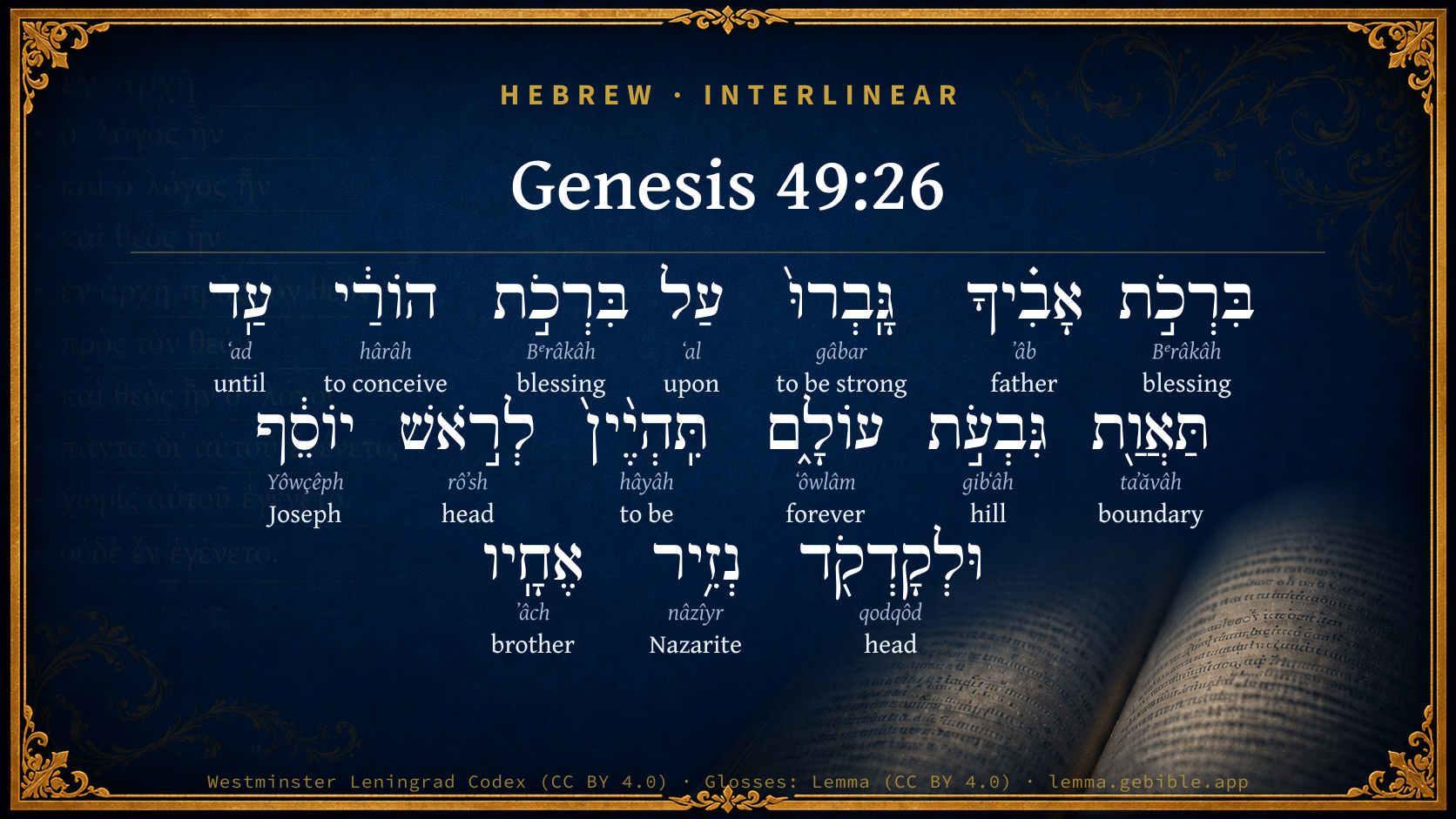
Genesis 49:26

Hebrew (Westminster Leningrad Codex) Genesis 49:26 appears in the Hebrew Old Testament. The text above is from the Westminster Leningrad Codex. Each word links to its Strong’s number, a concise gloss, and parsing drawn from the Open Scriptures Hebrew Bible morphology. Click any word for its full Brown-Driver-Briggs (BDB) entry.
Download image
Cite this verse

Genesis 49:26 (World English Bible). Public Domain. Lemma interlinear Bible study tool, https://lemma.gebible.app/v/genesis/49/26.

Show BibTeX & RIS
BibTeX
RIS
English Translation
The blessings of your father Have prevailed above the blessings of the ancient mountains, Above the bounty of the age-old hills. They will be on the head of Joseph, On the crown of the head of him who is separated from his brothers.
World English Bible · Public Domain
Highlights
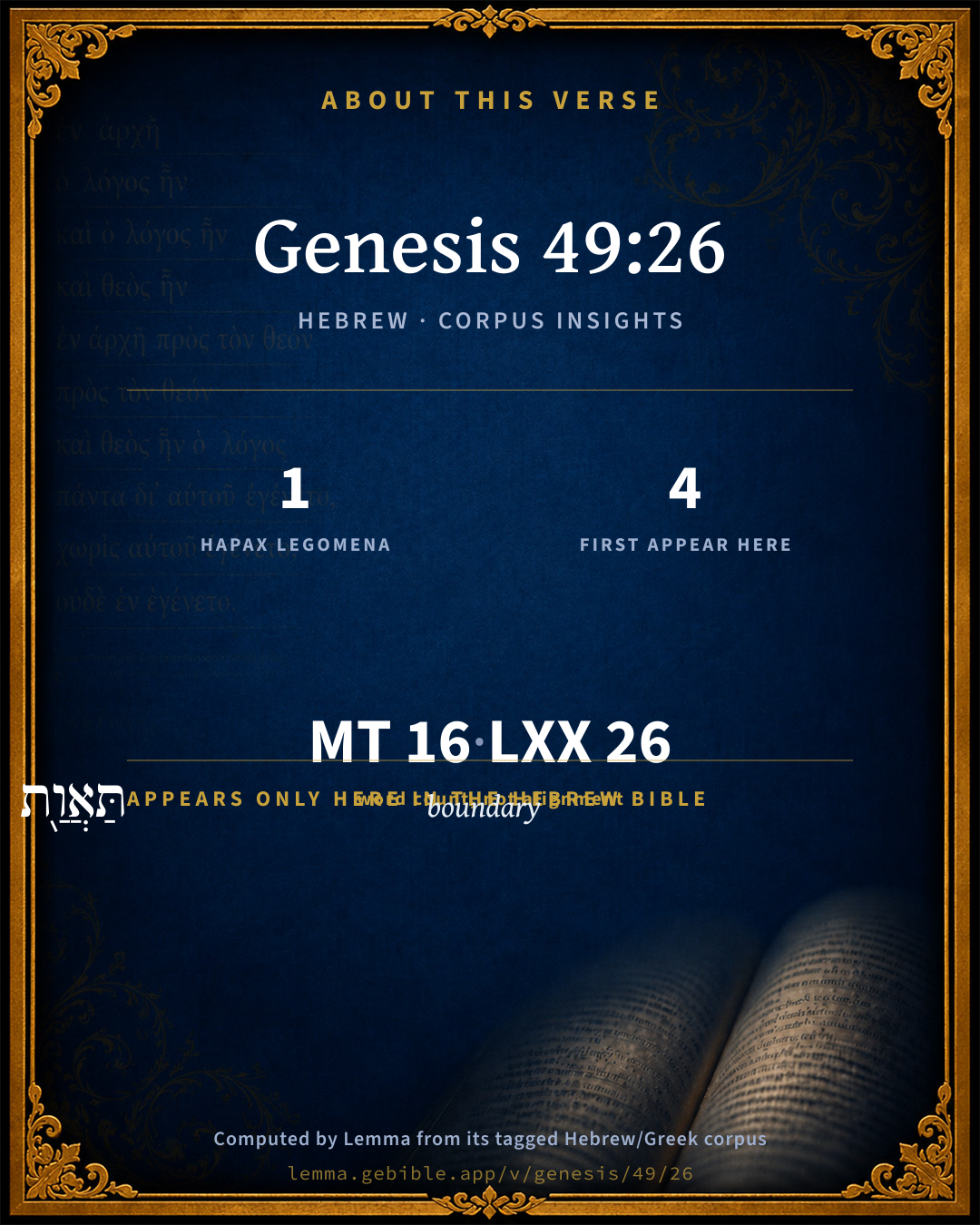
  • 1 hapax legomenon — only here in the Hebrew Bible
  • 4 first appearances in the Hebrew Bible
Full analysis ↓
Download a study sheet

One document with this verse’s original text, its word-by-word gloss line, the meaning frame, cross-references with their text, attributed commentary, and full source and license credits — printable, and it pastes into notes with its structure intact.

This verse Autodidact and up

Study sheet (.html) Plain text (.txt)

A passage Seminary Student

Up to 50 verses in one chapter. A passage sheet keeps up to 6 commentary sources and 12 cross-references per verse, in the order this page ranks them, and says so on the sheet whenever that leaves anything out. Ask for a single verse and you get the Autodidact verse sheet above.

Everything on this page stays free to read, with no account — the sheet is a download of what is already on screen, not access to it.

Want to remove ads? Support Godless Engineer
Compare translations 3

The same verse in 3 English versions, stacked beneath the original-language interlinear above. Click any original word for its lexicon entry.

Each is an independent rendering of the whole verse — the interlinear is not word-aligned to these translations.

Highlighted words mark where these versions differ — a whole-verse word diff, not a word-by-word alignment.

  • World English Bible Public Domain
    The blessings of your father Have prevailed above the blessings of the ancient mountains, Above the bounty of the age-old hills. They will be on the head of Joseph, On the crown of the head of him who is separated from his brothers.
  • King James Version Public Domain
    The blessings of thy father have prevailed above the blessings of my progenitors unto the utmost bound of the everlasting hills: they shall be on the head of Joseph, and on the crown of the head of him that was separate from his brethren.
  • unfoldingWord Literal Text CC BY-SA 4.0
    The blessings of your father have surpassed the blessings of my ancestors, even to the bounties of the eternal hills. May they rest on the head of Joseph, even on the top of the head of the one consecrated from his brothers. ts\*

unfoldingWord Literal Text — © unfoldingWord, licensed CC BY-SA 4.0. Word-aligned USFM3 via Door43 (git.door43.org/unfoldingWord/en_ult).

Versions to compare (up to 4)

3 of 4 selected

Show all 18 translations

Every available English version of this verse, each an independent rendering of the whole verse.

  • World English Bible Public Domain
    The blessings of your father Have prevailed above the blessings of the ancient mountains, Above the bounty of the age-old hills. They will be on the head of Joseph, On the crown of the head of him who is separated from his brothers.
  • Berean Standard Bible Public Domain
    The blessings of your father have surpassed the blessings of the ancient mountains and the bounty of the everlasting hills. May they rest on the head of Joseph, on the brow of the prince of his brothers.
  • Majority Standard Bible Public Domain
    The blessings of your father have surpassed the blessings of the ancient mountains and the bounty of the everlasting hills. May they rest on the head of Joseph, on the brow of the prince of his brothers.
  • King James Version Public Domain
    The blessings of thy father have prevailed above the blessings of my progenitors unto the utmost bound of the everlasting hills: they shall be on the head of Joseph, and on the crown of the head of him that was separate from his brethren.
  • American Standard Version (1901) Public Domain
    The blessings of thy father Have prevailed above the blessings of my progenitors Unto the utmost bound of the everlasting hills: They shall be on the head of Joseph, And on the crown of the head of him that was separate from his brethren.
  • Revised Version (1885) Public Domain
    The blessings of thy father Have prevailed above the blessings of my progenitors Unto the utmost bound of the everlasting hills: They shall be on the head of Joseph, And on the crown of the head of him that was separate from his brethren.
  • Geneva Bible (1599) Public Domain
    The blessings of thy father shalbe stronger then the blessings of mine elders: vnto the ende of the hilles of the worlde they shall be on the head of Ioseph, and on the top of the head of him that was separate from his brethren.
  • Douay-Rheims (1899) Public Domain
    His bow rested upon the strong, and the bands of his arms and his hands were loosed, by the hands of the mighty one of Jacob: thence he came forth a pastor, the stone of Israel.
  • Young's Literal Translation Public Domain
    Thy father's blessings have been mighty Above the blessings of my progenitors, Unto the limit of the heights age-during They are for the head of Joseph, And for the crown of the one Separate `from' his brethren.
  • Literal Standard Version CC BY-SA 4.0
    Your father’s blessings have been mighty || Above the blessings of my progenitors, || To the limit of the perpetual heights || They are for the head of Joseph, || And for the crown of the one || Separate [from] his brothers.
  • Unlocked Literal Bible CC BY-SA 4.0
    The blessings of your father are greater than the blessings of the ancient mountains or the desirable things of the ancient hills. May they be on the head of Joseph, even upon the crown of the head of the prince of his brothers.
  • unfoldingWord Literal Text CC BY-SA 4.0
    The blessings of your father have surpassed the blessings of my ancestors, even to the bounties of the eternal hills. May they rest on the head of Joseph, even on the top of the head of the one consecrated from his brothers. ts\*
  • Darby Bible Public Domain
    The blessings of thy father surpass the blessings of my ancestors, Unto the bounds of the everlasting hills: They shall be on the head of Joseph, And on the crown of the head of him that was separated from his brethren.
  • World Messianic Bible Public Domain
    The blessings of your father have prevailed above the blessings of my ancestors, above the boundaries of the ancient hills. They will be on the head of Joseph, on the crown of the head of him who is separated from his brothers.
  • Webster's Bible Public Domain
    The blessings of thy father have prevailed above the blessings of my progenitors to the utmost bound of the everlasting hills; they shall be on the head of Joseph, and on the crown of the head of him that was separate from his brethren.
  • Free Bible Version CC BY-SA 4.0
    The blessings your father received were greater than the blessings of his forefathers, more than the blessings of the eternal mountains. May they be upon the head of Joseph, on the forehead of the one set apart as a leader from his brothers.
  • Bible in Basic English Public Domain
    Blessings of sons, old and young, to the father: blessings of the oldest mountains and the fruit of the eternal hills: let them come on the head of Joseph, on the crown of him who was separate from his brothers.
  • JPS Tanakh (1917) Public Domain
    The blessings of thy father are mighty beyond the blessings of my progenitors unto the utmost bound of the everlasting hills; they shall be on the head of Joseph, and on the crown of the head of the prince among his brethren.

Literal Standard Version (2020), Covenant Press — licensed CC BY-SA 4.0. Text via the HelloAO Bible API (eBible.org). Unlocked Literal Bible (unfoldingWord) — licensed CC BY-SA 4.0. Text via the HelloAO Bible API (eBible.org). unfoldingWord Literal Text — © unfoldingWord, licensed CC BY-SA 4.0. Word-aligned USFM3 via Door43 (git.door43.org/unfoldingWord/en_ult). Free Bible Version, Dr. Jonathan Gallagher — licensed CC BY-SA 4.0. Text via the HelloAO Bible API (eBible.org).

Word by word

More ways to search: Search by grammar → Find every occurrence → Compare this word →

Practice this passage: Drill this verse → Learn its vocabulary →

תַּאֲוַ֖ת
taʼăvâh
H8379
“boundary of”
Noun, Common, Feminine, Singular, Construct
Part of Speech
Noun
Type
Common
Gender
Feminine
Number
Singular
State
Construct
Full BDB Definition

Origin: from H8376

TWOT: 2496b

boundary, limit - meaning uncertain
  1. בִּרְכֹ֣ת Bᵉrâkâh H1293 “blessings of” Noun, Common, Feminine, Plural, Construct
  2. אָבִ֗יךָ ʼâb H1 “father · your” Noun, Common, Masculine, Singular, Construct + Suffix, Personal, 2nd Person, Masculine, Singular
  3. גָּֽבְרוּ֙ gâbar H1396 “to be strong” Verb, Qal, Perfect, 3rd Person, Common, Plural
  4. עַל ʻal H5921 “upon” Preposition
  5. בִּרְכֹ֣ת Bᵉrâkâh H1293 “blessings of” Noun, Common, Feminine, Plural, Construct
  6. הוֹרַ֔י hârâh H2029 “conceiving · me” Verb, Qal, Participle Active, Masculine, Plural, Construct + Suffix, Personal, 1st Person, Common, Singular
  7. עַֽד ʻad H5704 “until” Preposition
  8. גִּבְעֹ֣ת gibʻâh H1389 “hills of” Noun, Common, Feminine, Plural, Construct
  9. עוֹלָ֑ם ʻôwlâm H5769 “forever” Noun, Common, Masculine, Singular, Absolute
  10. תִּֽהְיֶ֨ין֙ hâyâh H1961 “to be” Verb, Qal, Imperfect, 3rd Person, Feminine, Plural
  11. לְרֹ֣אשׁ rôʼsh H7218 “to/for · head of” Preposition + Noun, Common, Masculine, Singular, Construct
  12. יוֹסֵ֔ף Yôwçêph H3130 “Joseph” Noun, Proper
  13. וּלְקָדְקֹ֖ד qodqôd H6936 “and · to/for · head of” Conjunction + Preposition + Noun, Common, Masculine, Singular, Construct
  14. נְזִ֥יר nâzîyr H5139 “Nazarite of” Noun, Common, Masculine, Singular, Construct
  15. אֶחָֽיו ʼâch H251 “brothers · his” Noun, Common, Masculine, Plural, Construct + Suffix, Personal, 3rd Person, Masculine, Singular

About this verse

These counts appear in no published source. They are computed here, from the morphology-tagged text and Lemma’s own curated glosses. What Lemma adds →

16
words
15
distinct lemmas
Pentateuch
section

Notable vocabulary

1 hapax legomenon — a word that appears only here in the entire Hebrew Bible:

  • תַּאֲוַ֖ת boundary H8379

First appearance in Scripture

These words make their first canonical appearance in the Hebrew Bible here:

  • תַּאֲוַ֖ת boundary H8379
  • גִּבְעֹ֣ת hill H1389
  • וּלְקָדְקֹ֖ד head H6936
  • נְזִ֥יר Nazarite H5139

Shared distinctive vocabulary

וּלְקָדְקֹ֖ד head H6936 occurs in 11 verses of the Hebrew Bible. Also found in:

Grammatical profile

  • 3 verbs
  • 11 nouns
  • 2 prepositions

Verb forms

  • גָּֽבְרוּ֙ Qal · Perfect
  • הוֹרַ֔י Qal · Participle Active
  • תִּֽהְיֶ֨ין֙ Qal · Imperfect

Repetition

A word recurs within this verse — often emphatic in Hebrew:

  • בִּרְכֹ֣ת blessing H1293 ×2

Hebrew & Septuagint length

In English translation the verse runs 43 words from the Hebrew and 46 from the Septuagint (LXX English) — closely comparable.

A rough comparison of the two English renderings, which tokenize alike — not a word-level alignment.

Word counts can differ between the Hebrew and the Greek without any difference in meaning — e.g. the Hebrew direct-object marker אֵת has no separate Greek word, and Greek often adds the article ὁ.

In the original languages it is 16 Hebrew tokens and 26 Greek tokens — but the two are counted differently (Hebrew bundles its prefixes and suffixes into one token; the Greek is in lemma form), so that isn’t a like-for-like length.

Cross-references

16

Topical passages linked to Genesis 49:26 in the Treasury of Scripture Knowledge — connected by theme and wording, ordered by reader-vote popularity; previews shown in the World English Bible.

  • Deuteronomy 33:15–16 For the chief things of the ancient mountains, For the precious things of the everlasting hills,
  • Habakkuk 3:6 He stood, and shook the earth. He looked, and made the nations tremble. The ancient mountains were crumbled. The age-old hills collapsed. His ways are eternal.
  • Genesis 27:27–29 He came near, and kissed him. He smelled the smell of his clothing, and blessed him, and said, "Behold, the smell of my son Is as the smell of a field which Yahweh has blessed.
  • Genesis 27:39–40 Isaac his father answered him, "Behold, of the fatness of the earth will be your dwelling, and of the dew of the sky from above.
  • Genesis 28:3–4 May God Almighty bless you, and make you fruitful, and multiply you, that you may be a company of peoples,
  • Genesis 37:28 Midianites who were merchants passed by, and they drew and lifted up Joseph out of the pit, and sold Joseph to the Ishmaelites for twenty pieces of silver. They brought Joseph into Egypt.
  • Numbers 6:2 "Speak to the children of Israel, and tell them: When either man or woman shall make a special vow, the vow of a Nazirite, to separate himself to Yahweh,
  • Psalms 89:36 His seed will endure forever, His throne like the sun before me.
  • Psalms 105:17–22 He sent a man before them. Joseph was sold for a slave.
  • Psalms 132:18 I will clothe his enemies with shame, But on himself, his crown will be resplendant."
  • Isaiah 54:10 For the mountains may depart, and the hills be removed; but my loving kindness shall not depart from you, neither shall my covenant of peace be removed, says Yahweh who has mercy on you.
  • Isaiah 66:5 Hear the word of Yahweh, you who tremble at his word: Your brothers who hate you, who cast you out for my name's sake, have said, Let Yahweh be glorified, that we may see your joy; but it is those who shall be disappointed.
  • Ezekiel 37:25–26 They shall dwell in the land that I have given to Jacob my servant, in which your fathers lived; and they shall dwell therein, they, and their children, and their children's children, forever: and David my servant shall be their prince for ever.
  • Jonah 2:6 I went down to the bottoms of the mountains. The earth barred me in forever: Yet have you brought up my life from the pit, Yahweh my God.
  • Acts 7:9 "The patriarchs, moved with jealousy against Joseph, sold him into Egypt. God was with him,
  • Ephesians 1:3 Blessed be the God and Father of our Lord Jesus Christ, who has blessed us with every spiritual blessing in the heavenly places in Christ;

Cross-references courtesy of OpenBible.info (CC BY 4.0).

Hebrew and Greek witnesses Masoretic Hebrew ↔ Greek Septuagint

The same verse in the two great witnesses to the Old Testament, shown verse-for-verse.

These are two independent witnesses, not word-aligned to each other, and the Septuagint is shown in lemma (dictionary) form.

Hebrew Genesis 49:26 Masoretic · Westminster Leningrad Codex

בִּרְכֹ֣ת אָבִ֗יךָ גָּֽבְרוּ֙ עַל בִּרְכֹ֣ת הוֹרַ֔י עַֽד תַּאֲוַ֖ת גִּבְעֹ֣ת עוֹלָ֑ם תִּֽהְיֶ֨ין֙ לְרֹ֣אשׁ יוֹסֵ֔ף וּלְקָדְקֹ֖ד נְזִ֥יר אֶחָֽיו

The blessings of your father Have prevailed above the blessings of the ancient mountains, Above the bounty of the age-old hills. They will be on the head of Joseph, On the crown of the head of him who is separated from his brothers.

World English Bible · Public Domain

Greek LXX Genesis 49:26 Septuagint · lemma form

εὐλογία πατήρ σύ καί μήτηρ σύ ὑπεἰσχύω ἐπί εὐλογία ὄρος μόνιμος καί ἐπί εὐλογία θίς ἀέναος εἰμί ἐπί κεφαλή ιωσηφ καί ἐπί κορυφή ὅς ἡγέομαι ἀδελφός

the blessings of your father and your mother—it has prevailed above the blessing of the lasting mountains, and beyond the blessings of the everlasting hills; they shall be upon the head of Joseph, and upon the head of the brothers of whom he took the lead.

LXX2012 (modern English Septuagint) · Public Domain

On this verse, Ellicott's Commentary for English Readers discusses the Septuagint’s reading. Read the note in Commentary ↓

Hebrew: Westminster Leningrad Codex (CC BY 4.0). Greek: Septuagint (public domain); English from LXX2012 (modern English Septuagint) (Public Domain). How the Septuagint differs from the Hebrew →

Targum (Aramaic paraphrase)

2

The Targum is the ancient Jewish Aramaic paraphrase of the Hebrew Scriptures — an interpretive translation, not the Hebrew text itself. Onkelos (literal) and Pseudo-Jonathan (expansive) render the Torah, and Jonathan the Prophets. Coverage is partial: where no permissively-licensed English translation exists for a verse, only the Aramaic is shown. This is verse-level text, not a word-by-word alignment to the Hebrew.

  1. Targum Onkelos Torah (Genesis–Deuteronomy)
    בִּרְכְּתָא דְאָבוּךְ יִתּוֹסְפָן עַל בִּרְכְּתָא דִילִי בָּרִיכוּ אֲבָהָתַי דַחֲמִידוּ לְהֶן רַבְרְבַיָּא דְמִן עָלְמָא יֶהֶוְיַן כָּל אִלֵּין לְרֵישָׁא דְיוֹסֵף וּלְגַבְרָא פָּרִישָׁא דַאֲחוֹהִי

    (no public-domain English translation for this verse)

    Targum Onkelos — Aramaic: “Onkelos Genesis” (public domain); “Onkelos Exodus” (public domain); “Onkelos Leviticus” (public domain); “Onkelos Numbers” (public domain); “Onkelos Deuteronomy” (public domain). English: “Sefaria Community Translation” (CC0 1.0 (public-domain dedication)); “J.W. Etheridge. The Targums of Onkelos and Jonathan Ben Uzziel on the Pentateuch. London: Longmans, Green, 1862” (public domain). Text via Sefaria.

  2. Targum Pseudo-Jonathan Torah (Genesis–Deuteronomy)
    בִּרְכָתָא דְאָבוּךְ יִתּוֹסְפַן עַל בִּרְכָתָא דִבְרִיכַן יָתִי אַבְהָתוֹי אַבְרָהָם וְיִצְחָק דַחֲמִידוּ לְהֵין רַבְרְבָנֵי עַלְמָא יִשְׁמָעֵאל וְעֵשָו וְכָל בְּנָהָא דִקְטוּרָא יִתְכַּנְשַׁן כָּל אִלֵין בִּרְכָתָא וְיִתְעַבְדָן כְּלִיל דִרְבוּ לְרֵישׁ יוֹסֵף וּלְקָדְקָדֵיהּ דְגַבְרָא דַהֲוָה רַב וְשַׁלִיט בְּמִצְרַיִם וְזָהִיר בִּיקָרָא דְאָחוֹי

    The blessings of thy father be added to the blessings wherewith my fathers Abraham and Izhak have blessed me, and which the princes of the world Ishmael and Esau and all the sons of Keturah have desired: let all these blessings be united, and form a diadem of majesty for the head of Joseph, and for the brow of the man who became chief and ruler in Mizraim, and the brightness of the glory of his brethren.

    Targum Pseudo-Jonathan — Aramaic: “Targum Jonathan on Genesis” (public domain); “Targum Jonathan on Exodus” (public domain); “Targum Jonathan on Leviticus” (public domain); “Targum Jonathan on Numbers” (public domain); “Targum Jonathan on Deuteronomy” (public domain). English: “The Targum of Jonathan ben Uzziel, trans. J. W. Etheridge, London, 1862” (public domain). Text via Sefaria.

Commentary

Notes on Genesis 49:26 from classic Christian and Jewish commentators (each source and its license shown beneath its notes). The classic Christian expositions comment on the surrounding passage and are grouped to its opening verse, so a note may address several verses; the Jewish commentaries on the Tanakh (Rashi and others) are per-verse, so they appear only where the commentator wrote on this verse.

Lemma curates 59 commentaries, every one of them public domain or Creative Commons licensed, each selected and text-cleaned for this edition rather than reprinted as found. About our sources →

Trapp's Complete Commentary

John Trapp

Gen 49:26 The blessings of thy father have prevailed above the blessings of my progenitors unto the utmost bound of the everlasting hills: they shall be on the head of Joseph, and on the crown of the head of him that was separate from his brethren.

Ver. 26. Above the blessings of my progenitors.] Chiefly because Jacob pointed them out the particular tribe whereof, and the very time wherein, Shiloh should come. This mystery was made known to the Church, not all at once, but by degrees. Adam was told "the seed of the woman should break," &c.; but whether Jew or Gentile, he heard not a word. Abraham, the Hebrew, long after was certified that "in his seed all nations should be blessed"; but of what tribe Christ should come, till now, the world never heard. After this, David was made to know that Christ should be a male; but that he should be born of a virgin was not known till Isaiah’s time. Thus God crumbles his mercies to mankind; and we have his blessings by retail, saith one, to maintain trading and communion betwixt him and us. So the cloud empties not itself at a sudden burst, but dissolves upon the earth, drop after drop.

Unto the utmost bound of the everlasting hills.] "Spiritual blessings in heavenly things," {Eph 1:3} whereof those temporals afore promised were but types and pledges. Whence David doubts not to argue from temporals to spirituals. {Psa 23:5-6} God in the Church’s infancy fed them and led them along by earthly to heavenly blessing, speaking unto them as they could hear.

John Trapp, A Commentary or Exposition upon All the Books of the Old and New Testament (1647–1656) — public domain. Text from a community e-Sword module.

Tyndale Open Study Notes

Tyndale Open Resources

49:26 Joseph . . . is a prince among his brothers: a reflection of both his character and his position.

Tyndale Open Study Notes — © Tyndale Open Resources, licensed CC BY-SA 4.0. Text via the HelloAO Bible API.

Geneva Bible (1599)

Geneva Bible translators

Inasmuch as he was more near to the accomplishment of the promise, and it had been more often confirmed.

Either in dignity, or when he was sold from his brethren.

Geneva Bible (1599) marginal notes — public domain. Text via Bolls.life.

Adam Clarke's Commentary

Verse 26. The blessing of thy father, c.] The blessings which thy father now prays for and pronounces are neither temporal nor transitory they shall exceed in their duration the eternal mountains, and in their value and spiritual nature all the conveniences, comforts, and delicacies which the everlasting hills can produce. They shall last when the heavens and the earth are no more, and shall extend throughout eternity. They are the blessings which shall be communicated to the world by means of the Messiah.

The Jerusalem Targum paraphrases the place thus: "The blessing of this father shall be added unto the blessings wherewith thy fathers Abraham and Isaac, who are likened to mountains, have blessed thee; and they shall exceed the blessings of the four mothers, Sarah, Rebekah, Rachel, and Leah, who are likened to the hills: all these blessings shall be a crown of magnificence on the head of Joseph, and on the crown of the head of him who was a prince and governor in the land of Egypt."

27. Benjamin is a ravenous wolf: In the morning

he shall devour the prey, And in the evening

he shall divide the spoil.

This tribe is very fitly compared to a ravenous wolf, because of the rude courage and ferocity which they have invariably displayed, particularly in their war with the other tribes, in which they killed more men than the whole of their own numbers amounted to.

"This last tribe," says Dr. Hales, "is compared to a wolf for its ferocious and martial disposition, such as was evinced by their contests with the other tribes, in which, after two victories, they were almost exterminated, Jdg 20:18-48." Its union with the tribe of Judah seems to be intimated in their joint conquests, expressed nearly in the same terms: "Judah went up from the prey;" "Benjamin devoured the prey." Moses in his parallel prophecy, De 33:12, confirms this by signifying that the sanctuary should be fixed in his lot, and that he should continue as long as the existence of the temple itself: -

THE BELOVED OF THE LORD shall dwell with him in safety,

And shall cover him all the day long,

And shall dwell between his shoulders.

De 33:12.

In the morning, c.] These expressions have been variously understood. The sense given above is that in which the principal interpreters agree but Houbigant protests against the prophecy signifying the continuance of this tribe, as the words, "in the morning devouring the prey," and "in the evening dividing the spoil," are supposed to imply; "because," he observes, "after the return from the Babylonish captivity, this tribe is no more mentioned." But this may be accounted for from the circumstance of its being associated with that of Judah, (see 1Kg 12:21-24), after which it is scarcely ever mentioned but in that union. Being thus absorbed in the tribe of Judah, it continued from the morning till the evening of the Jewish dispensation, and consequently till the Lion of the tribe of Judah was seen in the wilderness of Israel.

In the morning, according to Mr. Ainsworth, "signifies the first times; for Ehud of Benjamin was the second judge that saved the Israelites from the hands of the Moabites, Jdg 3:15, c. Saul of Benjamin was the first king of Israel he and his son were great warriors, making a prey of many enemies, 1Sa 11:6-7, 1Sa 11:11; 1Sa 14:13, 1Sa 14:15, 1Sa 14:47-48. And the evening, the latter times; for Mordecai and Esther of Benjamin delivered the Jews from a great destruction, and slew their enemies, Est 8:7, Est 8:9, Est 8:11; Est 9:5-6, Est 9:15-16."

Adam Clarke's Commentary on the Bible (1810–1826) — public domain. Text from a community e-Sword/MySword module.

Ellicott's Commentary for English Readers

(26) The blessings of thy father.—As the passage now stands, it means that the blessings which Jacob bestows upon Joseph are greater than those which he had himself received from his ancestors, Abraham and Isaac. This was scarcely the case, as the chief spiritual blessing was bestowed upon Judah, while for Joseph there was only earthly prosperity. For this reason most modern commentators adopt the reading of the Samaritan Pentateuch, supported by the Samaritan Targum and the LXX., “The blessings of thy father are mightier than the blessings of the ancient mountains, than the desire (or beauty) of the everlasting hills.” Not only is the parallelism of the poetry thus preserved, but the rendering is easy and natural, while the other translation is full of difficulties, especially as to the words, “my progenitors,” and “the utmost bound.” The sense thus given to them cannot be obtained by any ordinary philological process.

Him that was separate from his brethren.—This scarcely gives the force of the verb, which means, set apart, consecrated. Hence the Vulg. renders “Nazarite,” the Hebrew word being nezir. The Syriac and Samaritan Targum translate, “him that is the crown of his brethren;” and the LXX., “him who was the leader of his brethren.” Many see in this an allusion to the sovereignty over the ten tribes being finally attained to by Ephraim, but probably the meaning is that Joseph was the noblest and highest in rank among Jacob’s children.

A Bible Commentary for English Readers, edited by Charles John Ellicott (1878–1897) — public domain. Text from a community e-Sword module.

The Cambridge Bible for Schools and Colleges

gen. ed. J. J. S. Perowne

26. The blessings of thy father] i. e. the blessings invoked by Jacob, thy father, when fulfilled in the greatness and influence of the people that shall spring from thee.

Have prevailed above] i.e. have ranked higher, are of greater excellence, than the material blessings of the fair country assigned to Joseph.

the blessings of my progenitors] Better, as R.V. marg., according to some ancient authorities, the blessings of the ancient mountains, the desire (or desirable things) of the everlasting hills. The rendering of the R.V. text in this difficult passage depends upon a practically impossible translation, i.e. “my progenitors” (Lat. patrum ejus), where the Hebrew literally means “my conceivers.” It is better to follow the rendering in the marg., which requires a very slight change in the text. Instead of “my progenitors,” read “the mountains of”; and, instead of “unto,” read “eternity.” This has the support of LXX, ὀρέων μονίμων; and it is supported also by the parallelism of the clauses. “The everlasting hills,” in the next clause, will then balance “the ancient mountains” of this clause; as is the case in the blessing of Joseph, Deu_33:15, “and for the chief things of the ancient mountains, and for the precious things of the everlasting hills.” Cf. also Hab_3:6.

Unto the utmost bound] A doubtful rendering, required by the translation of the previous word, ‘ad = “unto.” According to the better reading, this word, ‘ad, should be rendered “eternity.” Instead of “bound,” we should render “desire” (which is the ordinary translation of the Heb. word), in the sense of “the desirable things,” thus balancing the words “the blessings” in the previous clause.

They shall be] Better, “may they be,” a prayer, as in the very similar passage in Deu_33:16, with which these two clauses should be compared; “let the blessing come upon the head of Joseph, and upon the crown of the head of him that was separate from his brethren.”

on the head … crown] Words implying a benediction, with the hand resting upon the head.

that was separate from] In Hebrew the Nazir is “one set apart,” or “consecrated,” by a vow, or otherwise, for high duties. Thus Samson was a “Nazirite,” separated to be the champion of his people’s liberties. Perhaps, but not probably, the mention of “the crown of the head” has an allusion to the Naziritic vow. Lat. Nazaraei inter fratres suos. Some connect nazir with nezer = “a diadem,” and render by “prince”; so R.V. marg. that is prince among (cf. LXX ὧν ἡγήσατο ἀδελφῶν), a possible allusion to the Ephraimite kingdom.

The Cambridge Bible for Schools and Colleges (gen. ed. J. J. S. Perowne; Cambridge University Press, 1878–1918) — public domain. Text from a community e-Sword module.

John Gill's Exposition

And he charged them, and said unto them,.... The same charge he had given to Joseph he here renews, and lays it upon his sons, who were everyone of them to go along with Joseph to bury him in Canaan:

I am to be gathered unto my people; the people of God, the spirits of just men made perfect, the souls of all the saints who before this time had departed this life, and were in a state of happiness and bliss; called his people, because he and they were of the same mystical body the church, belonged to the same general assembly, and church of the firstborn; the company of God's elect, who were in the same covenant of grace, and partakers of the same blessings and promises of grace: this shows that the souls of men are immortal; that there is a future state after death, which is a state of happiness, and into which saints immediately enter as soon as they die, and where Jacob expected to be in a short time:

bury me with my fathers; the other part of himself, his body, which should not be gathered to his people, as his soul would be, he orders to be interred with his fathers Abraham and Isaac:

in the cave that is in the field of Ephron the Hittite; which is more particularly described in the following verse, being the place of his father's sepulchre.

John Gill's Exposition of the Whole Bible (1746–1763) — public domain (CC PDM 1.0). Text via the HelloAO Bible API.

Haydock's Catholic Bible Commentary

The blessings of thy father, &c. That is, thy father’s blessings are made more prevalent and effectual in thy regard, by the additional strength they receive from his inheriting the blessings of his progenitors Abraham and Isaac. --- The desire of the everlasting hills, &c. These blessings all looked forward towards Christ, called the desire of the everlasting hills, as being longed for, as it were, by the whole creation. Mystically, the patriarchs and prophets are called the ever-lasting hills, by reason of the eminence of their wisdom and holiness. --- The Nazarite. This word signifies one separated; and agrees to Joseph, as being separated from, and more eminent than, his brethren. As the ancient Nazarites were so called from their being set aside for God, and vowed to him. (Challoner) --- Nazir denotes also one chosen or crowned, and is a title of one of the chief courtiers or ministers of the Persian kings. Such was Joseph. (Calmet) --- These blessings were perhaps forfeited by the misconduct of his posterity, when Jeroboam set up the worship of the golden calves; though probably many would subsist of the tribes of Ephraim and Manasses till the coming of the Messias. (Tirinus)

George Leo Haydock (1774–1849), Haydock's Catholic Family Bible and Commentary, 1859 edition — public domain. Excludes Psalms (Douay-Rheims chapter numbering differs from Protestant) and Deuterocanonical books (Catholic canon only).

Matthew Poole's English Annotations

The blessings which I

thy father have conferred upon thee, are much more considerable than those which I received from my father Isaac, or from my grandfather Abraham This was true,

1. In the extent of the blessings; Ishmael was excluded from Abraham’s blessing, and my brother excluded from Isaac’s blessing, but both Joseph’s children are comprehended in Jacob’s blessing.

2. In the distinctness and clearness of them; for that land of Canaan which was transmitted to Isaac and to Jacob only in the general, was now in some sort particularly distributed to Joseph, and to the rest of his brethren, as afterwards it was by Joshua.

3. In the nearness of the accomplishment. Now there was a more likely prospect of the multiplication of their seed, than there was to Abraham or Isaac; and in not very many years after this they multiplied to astonishment, and drew nearer to the possession of the promised land.

Unto the utmost bound of the everlasting hills: these words seem to note the duration of Joseph’s blessing, that it should continue even to the bounds of the everlasting, or lasting, or ancient hills, i.e. as long as the most solid and stable mountains shall last, i.e. for ever. Perpetuity is described by the continuance of the mountains, as Isa 54:10; or of the sun and moon, as Psa 72:5,7,17; or of the heavens and earth, as Mat 5:18. In the foregoing words of this verse he commends these blessings from their excellency above all former blessings; and here he commends them from their durableness.

They shall be; or, let them be; for this may be a prayer to God that these blessings may be constant and perpetual.

Him that was separate from his brethren; so he was, when he was sold into Egypt, and abode there in the court when his brethren were in Goshen. Or, the crowned of, or among his brethren, i.e. who though he was once scorned and trampled upon by his brethren, yet now is highly honoured and advanced above them. Others, the Nazarite of, or among his brethren; as he may be called either for his purity and sanctity, or for his eminency and dignity. But we must remember that the Nazarites were as yet unknown, being instituted long after this time.

Matthew Poole's English Annotations on the Holy Bible (1683–1685) — public domain. Text from a community e-Sword/MySword module.

Whedon's Commentary on the Bible

Daniel D. Whedon

26. Enduring mountains… everlasting hills — This version adheres strictly to the natural meaning of the words, sustains the parallelism, and seems, therefore, much preferable to the more common reading, blessings of my progenitors unto the bounds of the everlasting hills. To sustain this latter we must derive הורי from הרה, and use it in a sense which has no parallel or support elsewhere in Hebrew; and also use תאוהin a sense which it nowhere else has. The parallel passage (Deu_33:15-16) is also against this interpretation. The blessings of the mountains, and the desire (or desirable things) of the hills, poetically denote all natural beauties, products, health-fulness and defences which one might desire in a pleasant land; and the thought here is, that Jacob’s blessing pronounced on Joseph surpasses all such blessings of the hills.

They shall be for the head — They are destined to the head, or shall come upon the head, of Joseph; allusion to the custom of putting the hand upon one’s head in blessing. The consecrated נזיר, the Nazir, the separated one. From this root we have the word Nazarite, one consecrated and set apart by some sacred vow. Joseph was the separated one among his brothers.

Daniel D. Whedon (gen. ed.), Commentary on the Old and New Testaments (1874–1909) — public domain. Text from a community e-Sword module.

The Pulpit Commentary

The separated one, or Joseph a type of Christ.

Joseph was separated from his brethren

I IN HIS FATHER"S AFFECTIONS. Jacob loved him more than any of his other sons. So was Christ the only-begotten and well-beloved Son of the Father.

II IN HIS PERSONAL CHARACTER. Joseph brought unto Jacob the evil report that he heard circulating about his brethren, thus proving that he had no sympathy with their wicked ways. So Christ was holy, harmless, undefiled, and separate from Sinners.

III IN HIS HEAVENLY COMMUNICATIONS. Joseph was favored above his brethren in being made the recipient of dreams, and the depositary, as it were, of Divine secrets. And Christ received not the Spirit by measure, so that of him it could be said, No man knoweth the Father but the Son.

IV IN HIS EVIL FORTUNES. Joseph was hated, sold, and practically given over to death by his brethren. So was Christ not only despised and rejected by his brethren, but separated from all mankind in the character of his sufferings and death.

V IN HIS FUTURE EXALTATION. Joseph became the governor of Egypt, and the savior of his family. And Christ after his resurrection was exalted to be a Prince, and a Savior for mankind. W.

The Pulpit Commentary (1880–1919), ed. H.D.M. Spence-Jones & Joseph S. Exell — public domain. Text from a community e-Sword module.

unfoldingWord translationNotes

Door43 World Missions Community

General Information:

Jacob continues to bless Joseph and his descendants.

the ancient mountains

The meaning of the original language is not certain. Some Bible translations have "my ancestors" instead of "ancient mountains."

May they be on the head of Joseph

Here "they" refers to the blessings of his father.

upon the crown of the head of the prince of his brothers

Jacob desires for these blessings to be passed on to even the most important of his descendants. AT: "on the head of the most important of Joseph's descendants" (See: Metaphor)

prince of his brothers

"most important of his brothers"

translationWords

bless

crown

prince

unfoldingWord translationNotes — © Distant Shores Media and the Door43 World Missions Community, licensed CC BY-SA 4.0. Source: git.door43.org/Door43/en_tn.

Rashi

Rabbi Shlomo Yitzchaki (Rashi)

'ברכת אביך גברו וגו THE BLESSING OF THY FATHER HAVE PREVAILED etc. — The blessings which the Holy One, blessed be He, bestowed upon me are mighty beyond the blessings wherewith He blessed my progenitors

עד תאות גבעות עולם EVEN TO THE BOUNDARIES OF THE EVERLASTING HILLS — Because my blessings have prevailed, extending to the very ends of the bounds of the everlasting hills, for He gave me a blessing that bursts all bounds, one that has no limits, that reaches even unto the four corners of the world, as it is stated, (Genesis 28:14) “[God said to Jacob] and thou shalt spread abroad to the West and to the East [and to the North and to the South]”, an unqualified promise that was made neither to Abraham nor to Isaac. For to Abraham He said, (Genesis 13:14) “Lift up thine eyes and look northwards etc. … for all the land which thou seest to thee will I give it”, and He showed him only the Land of Israel. To Isaac He said, (Genesis 26:3) “for unto thee and unto thy seed will I give all these lands, and I will establish the oath [which I swore unto Abraham thy father]”. It is to this that Isaiah alludes when he said, (Isaiah 58:14) “And I will feed thee with the heritage of Jacob thy father” (Shabbat 118b), and he did not say, “with the heritage promised to Abraham”.

הורי is from a root meaning to conceive. The singular denotes “my father”, the one who made my mother conceive me. We find a similar use of the verb in (Job 3:3) “A man is causing a woman to conceive (הוֹרָה).”

עד תאות means UNTO THE ENDS — The word is connected with the verbs in (Numbers 36:10) “And ye shall mark out the ends (והתאויתם) for the east border”, and (Numbers 5:8) “you shall mark out the ends (תתאו) unto the entrance of Hamath”.

תאות means in old French émoulis. Thus (i.e. with these words) did Menachem ben Seruk classify it (תאות). Onkelos translates (תאות (גבעת עולם in the sense of desire (תאוה) and longing and takes גבעת as a figurative expression for “the great ones”, like (1 Samuel 2:8) “the pillars of the earth”, meaning the righteous of the earth — viz., he renders it by “the blessings for which the great ones of the earth longed”, referring to the blessings which his mother so much desired that she forced him to take steps to obtain them

תהיין THEY — all — SHALL BE ON THE HEAD OF JOSEPH.

נזיר אחיו means what the Targum has: פרישא דאחוהי. i.e. the one who was separated from his brothers. The word נזיר is of a root signifying separation, as in (Leviticus 22:2) “that they separate themselves (וינזרו) from the holy things of the children of Israel”; (Isaiah 1:4) “they have separated themselves from God (נזרו) turning backward”.

Rashi on the Tanakh — English translations: “The Judaica Press complete Tanach with Rashi, translated by A. J. Rosenberg” (CC BY 4.0); “Pentateuch with Rashi's commentary by M. Rosenbaum and A.M. Silbermann, 1929-1934” (public domain); “The Metsudah Tanach series, Lakewood, N.J” (CC BY 4.0); and “The Book of Joshua, Metsudah Publications, 1997” (CC BY 4.0). Text via Sefaria.

Radak

Rabbi David Kimhi (Radak)

ברכת אביך גברו, although Yaakov uses the past tenses in the word גברו, what he means is the future, that the blessing will prove to be what he says. The anomaly of using the past tense to describe matters that are yet to occur is no anomaly; it occurs again and again in Scripture. The word הורי, normally translated as “my parents,” refer to Avraham and Yitzchok, Yaakov’s father and grandfather respectively, his mentors. The very expression הורה, horeh, and הורה, horah, respectively, apply to father and mother, depending on the vowel under the letterר. This is so as both are involved in bringing about the pregnancy leading to the eventual birth of the child. The father is the active partner, whereas the mother is considered the passive partner seeing that she is the recipient of the male’s sperm.

עד תאות גבעת עולם, these blessings should in turn be transferred to your offspring in an unending chain. We know the word תאוה as describing a limit, boundary, from Numbers 34,10 והתאויתם לכם, “you will draw for yourselves (boundaries).” Yaakov simply means that as long the universe will continue to exist “my blessing to you shall remain in force.” Hills and mountains, as opposed to rivers, are symbols of something that endures. The prophet Isaiah echoes this thought when he said (Isaiah 54,10)כי ההרים ימושו והגבעות תמוטינה “for even if the mountains were to move and the hills to collapse, etc.” [just as the former is unlikely, so G’d’s loyalty shall remain steadfast towards Israel. Ed.]

תהיינה לראש יוסף, in all the blessings which have been mentioned in this chapter Joseph should be the first and principal beneficiary. The words וקדקד נזיר אחיו are again a duplication, repetition, in order to emphasise how strongly Yaakov feels about the matter.

נזיר, an expression applied to leading people as in Nachum 3,17 מנזריך כארבה.”your guards were like locusts.”

Radak on the Tanakh — English translations: “Sefaria Community Translation” (CC0 1.0 (public-domain dedication)); “Eliyahu Munk, HaChut Hameshulash” (CC BY 4.0); “Rabbi Mike Feuer, Jerusalem Anthology” (CC BY 4.0); and “R. David Kimhi on the first book of Psalms, Translated by R.G. Finch, London, 1919” (public domain). Text via Sefaria.

Lesson kit

Teaching starters — assembled from the data on this page, not authored interpretation. Every prompt links to the verse data it draws on. Edit before teaching.

Genesis, in the Pentateuch, opens this verse with 16 words (15 distinct Hebrew lemmas). Its most distinctive word is taʼăvâh (“boundary”). A historical commentator’s framing appears above. Read the whole chapter for the surrounding context.

Discussion questions

  1. How does “boundary” (taʼăvâh) shape what this verse is saying?
  2. 1 word here appears nowhere else in the Hebrew Bible. Why might the author reach for such rare wording?
  3. 4 words make their first appearance in Scripture here. What does this debut establish?
  4. How does Deuteronomy 28:35, which shares the word «head», read alongside this verse?
  5. What does the repetition of “blessing” (2× in this one verse) do in this verse?
  6. These translations render this verse differently. What is at stake in choosing one wording over another?
  7. «גָּֽבְרוּ֙» is a Qal Perfect verb. How does that grammatical form shape the action described?
  8. Compare how Trapp's Complete Commentary and Tyndale Open Study Notes read this verse. Where do they agree or differ?

Things to notice

  • 1 word in this verse appears nowhere else in the Hebrew Bible.
  • 4 words make their first canonical appearance in Scripture here.
  • This verse counts 16 Hebrew ↔ 26 Greek words.
  • These translations choose different wording for 30 words in this verse.
  • “blessing” occurs 2× in this single verse.

Reading settings

Reading text

Shown beneath each verse's original-language words.

Old Testament
Old Testament edition

Read the OT as the Masoretic Hebrew (MT) or the Greek Septuagint (LXX).

English shown for the Greek Septuagint (in the Hebrew ↔ Greek comparison).

Comparing translations? Open the Compare panel on any verse page to stack up to four side by side.