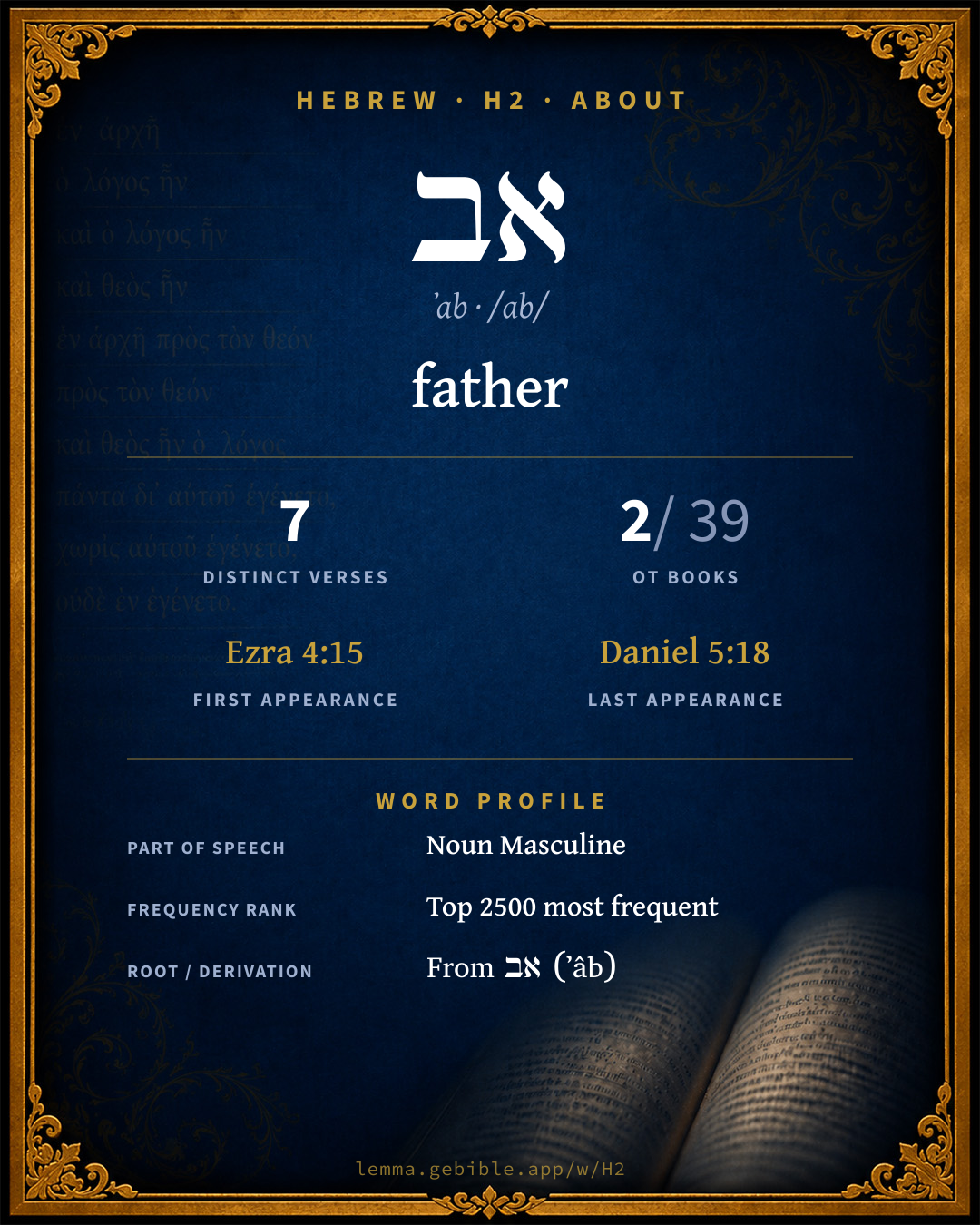
אַב
father
Full lexicon entry — Brown-Driver-Briggs (BDB)
From Brown-Driver-Briggs (BDB)
Where this word appears
Grammar key — what these labels mean
Part of speech
- Noun
- A naming word — a person, place, thing, or idea.
Noun type
- Common
- A common noun — a general class of person, place, or thing (“king,” “city,” “water”), not a specific name.
State
- Construct
- A noun bound to a following noun in a possessive / “of” relationship (the construct chain).
Gender
- Masculine
- Grammatically masculine.
Number
- Singular
- One.
- Plural
- More than one (in Hebrew, generally three or more).
Grammatical forms
- Noun, Common, Masculine, Singular, Construct 6 times (67%)
- Noun, Common, Masculine, Plural, Construct 3 times (33%)
Parsed forms decoded from the imported morphology (morphhb / Westminster Leningrad Codex — WLC text public domain, morphhb tagging CC BY 4.0), counted across 9 parsed occurrences — not distinct verses.
Every verse where H2 appears — 7 distinct verses across 2 books. Click any verse to open its interlinear word-by-word view. Verse text shown in the World English Bible for context — . Each verse’s Hebrew form is shown with its reference; the English is not keyword-highlighted, since the data carries no word-level English alignment. Use “Compare translations” on any verse to read it across multiple English versions. This concordance covers the Hebrew Bible; Septuagint (Greek Old Testament) occurrences are not indexed here.
Ezra 2 verses
- Ezra 4:15 אֲבָהָתָ֗/ךְ n c mp cs + sfx pers 2ms that search may be made in the book of the records of your fathers: so shall you find in the book of the records, and know that this city is a rebellious city, and hurtful to kings and provinces, and that they have moved sedition within the same of old time; for which cause was this city laid waste.
- Ezra 5:12 אֲבָהֳתַ֨/נָא֙ n c mp cs + sfx pers 1cp But after that our fathers had provoked the God of heaven to wrath, he gave them into the hand of Nebuchadnezzar king of Babylon, the Chaldean, who destroyed this house, and carried the people away into Babylon.
Daniel 5 verses
- Daniel 2:23 אֲבָהָתִ֗/י n c mp cs + sfx pers 1cs I thank you, and praise you, you God of my fathers, who have given me wisdom and might, and have now made known to me what we desired of you; for you have made known to us the king's matter.
- Daniel 5:2 אֲב֔/וּהִי n c ms cs + sfx pers 3ms Belshazzar, while he tasted the wine, commanded to bring the golden and silver vessels which Nebuchadnezzar his father had taken out of the temple which was in Jerusalem; that the king and his lords, his wives and his concubines, might drink from it.
- Daniel 5:11 אֲב֗/וּךְ אֲב֔/וּךְ אֲב֥/וּךְ n c ms cs + sfx pers 2ms n c ms cs + sfx pers 2ms n c ms cs + sfx pers 2ms There is a man in your kingdom, in whom is the spirit of the holy gods; and in the days of your father light and understanding and wisdom, like the wisdom of the gods, were found in him; and the king Nebuchadnezzar your father, the king, [I say], your father, made him master of the magicians, enchanters, Chaldeans, and soothsayers;
- Daniel 5:13 אַ֖בִ/י n c ms cs + sfx pers 1cs Then was Daniel brought in before the king. The king spoke and said to Daniel, Are you that Daniel, who are of the children of the captivity of Judah, whom the king my father brought out of Judah?
- Daniel 5:18 אֲבֽ/וּךְ n c ms cs + sfx pers 2ms You king, the Most High God gave Nebuchadnezzar your father the kingdom, and greatness, and glory, and majesty:
About this entry
At a glance — auto-summarized from this page’s data, not written by a person. Every figure links to its source below. This summary describes the numbers; it doesn’t interpret them.
“father” is the headline sense of the Hebrew noun אב (ʼab). More than two-thirds of its appearances fall in Daniel. It appears 7 verses across 2 books of the Hebrew Bible, among its uncommon vocabulary. Scripture first uses it in Ezra 4:15. It shares a root with אב, אוב and Αββα. The sections below give every sense, occurrence, and version rendering.
Gloss history
Strong's 1890 vs modern scholarship
About this word
Strong's H2 catalogs a Hebrew word from the Hebrew Old Testament.
These counts are not copied from any lexicon or concordance. They are computed here, from the morphology-tagged Hebrew Old Testament. What Lemma adds →
- 7
- distinct verses
- The word appears in 7 distinct verses.
- 2 / 39
- OT books
- The word appears in 2 of 39 Old Testament books.
- #2,481
- by frequency
- Top 2500 most frequent Hebrew words (rank 2,481 of 8,640 Hebrew words by occurrence).
View all 7 occurrences in the concordance →
By traditional corpus
Conventional, traditional groupings — biblical authorship is debated, so this is a traditional corpus grouping, not an authorship claim. Each share is this word’s portion of its verses in that division of the Hebrew canon. Each figure is a share of the word’s 7 distinct verses.
- Writings (Ketuvim) 7 verses · 100%
How translations render this word
Counts come from each version’s own published word-to-Strong’s tagging or interlinear alignment — an approximate guide to how each version renders this word, not a word-level alignment the data otherwise carries. Because each total is that version’s own tagged count, the per-version totals vary from one another and need not match the appearance or distinct-verse counts above. These counts may also differ from a printed concordance because Lemma counts each distinctly tagged rendering and does not collapse phrase taggings into a single head-word total. This is a fixed set of word-tagged versions (KJV, ASV, BSB, ULT) and does not change with the reading translation you choose elsewhere. Each version’s license is shown beside its name below (and on Sources).
- King James Version: Father 5×, Fathers 3×
- American Standard Version: Father 5×, Fathers 2×
- Berean Standard Bible: Father 5×, Fathers 3×
- unfoldingWord Literal Text: Father 6×, Fathers 3×
King James Version Public Domain
Renders H2 across 9 tagged occurrences — most commonly:
Plus 1 rendering that appears only once — usually multi-word phrases or single function words the recovered tagging swept in, not distinct renderings.
American Standard Version Public Domain
Renders H2 across 9 tagged occurrences — most commonly:
Plus 2 renderings that appear only once — usually multi-word phrases or single function words the recovered tagging swept in, not distinct renderings.
Berean Standard Bible Public Domain
Renders H2 across 9 tagged occurrences — most commonly:
Plus 1 rendering that appears only once — usually multi-word phrases or single function words the recovered tagging swept in, not distinct renderings.
unfoldingWord Literal Text CC BY-SA 4.0
Renders H2 across 9 tagged occurrences — most commonly:
Senses in BDB
The 1 sense BDB distinguishes for this word, in lexicon order (not ranked by frequency or importance). The full entry — with sub-senses — is in the Lexicon Entry tab.
- father
Word origin
Derived from אב (ʼâb) (H1) — father.
Jastrow Dictionary
A second Hebrew/Aramaic lexicon for comparison, covering Aramaic and post-biblical (Talmudic, Targumic, Midrashic) usage that the biblical-Hebrew BDB does not. Matched by lemma rather than by Strong’s number, so a lemma may carry more than one Jastrow headword (shown separately below), and the entries cover usage well beyond the Bible.
אַב־
- a prefix of words of Greek origin answering to αὐ-, au-, e.g. אבטומטוס = αὐτόματος; or to εὐ, e.g. אבגינוס = εὐγενής.
אָב I
- (Assyr. A-bu, Schr. K. A. T., p. 247) Ab, the fifth month of the Jewish calendar (of thirty days) beginning between the eighth of July and the seventh of August, and ending between the sixth of August and the fifth of September. R. Hash. I, 3, על אב וכ׳ for announcing the beginning of Ab messengers are sent out, for the sake of the fast. Ib. 18ᵇ ט׳ באב the ninth of Ab, anniversary of Temple destruction. Taan. IV, 6 משנכנס אב with the beginning of Ab. Ib. 29ᵇ לישתמיט מיניה באב let him try to be relieved of (the law-suit) in Ab. Meg. 5ᵇ; a. e.
אָב II
- , const. אֲבִי, אַב [embracer], father, ancestor, progenitor; teacher; chief, leader; author, originator. Ex. R. s. 46 end המגדל אב the educator is the real father. Lev. R. s. 1 אבי החכמה וכ׳, the father of all wisdom, … the father of prophets. Y. Ned. V, 39ᵇ; a. fr.—אַב בית דין (abbr. אב"ד) president of the Court (Great Sanhedrin), next in dignity to the Nassi. Taan. II, 1; a. fr.—Metaph. origin, cause. Num. R. s. 10 (play on אֲבוֹי, Prov. XXIII, 29) א׳ אוי the cause of woe (sin).—אב מלאכה (for which also עיקר) one of the chief labors forbidden on the Sabbath, opp. תולדה a labor the prohibition of which is based on the ground of its being a species of the former, or derived from the former. Sabb. VII, 1 sq.; a. fr.—[Y. Sabb. II, 5ᵃ, אב שלה, sub. מלאכה.]—אב הטומאה one of the original or direct causes of levitical uncleanness, opp. ולד (child) secondary cause. Toh. I, 5; a. fr.—א׳ הנזק v. Pl.—בנין א׳ creation of a class, i.e. a conclusion, by analogy, from a case explicitly stated in the bibl. law on all similar cases not specified in detail. Sifra introd.—Ib. K’doshim, end, ch. 11 (ref. to Lev. XX, 27) זה ב׳ א׳ לכל דמיהם בם this forms the rule for all cases in which the Bible uses the word d’mēhem bam (that the penalty is stoning to death); a. fr.; v. also בֵּית אב.—Pl. אָבוֹת־, const. אֲבוֹת, e.g. Proverbs 23:29
- 1. fathers, ancestors, patriarchs &c. Ber. 26ᵇ prayers א׳ תקנום have been instituted by the Patriarchs; a. fr.—אבות בתי דינין, v. supra. Ḥag. II, 2.—בת א׳ a woman of noble descent. Num. R. s. 1; a. e.—Metaph. principal, chief א׳ מלאכות, v. supra. א׳ הטומא׳ Kel. I, 1; v. supra.—א׳ נזיקין (sing. אב הנזק) the chief actionable injuries or damages, from which the subordinate are deduced (תולדות). B. Kam. I, 1; a. e.
- 2. Aboth, the first section of the Prayer of Benedictions (v. תְּפִלָּה), so called because it alludes to the Patriarchs. R. Hash. IV, 5; a. fr.
- 3. Aboth, name of a treatise of the Mishnah, containing sayings of Talmudic authorities and belonging to the fourth section, נזיקין, of the Mishnah collection (משניות); also styled פִּרְקֵי א׳ a. מְסֶכֶת א׳. A similar collection of a later date is contained in Talmud Babli editions, named א׳ דרבי נתן Aboth d’Rabbi Nathan. [Y. Yoma VIII, 44ᵈ top אב בית נפש v. אֲבֵידָה.]
אָב II ²
- ch., v. אַבָּא
אֵב
- swelling, spreading, whence
- 1. the young shoots of a tree, opp. to the branches growing directly from the trunk. B. Kam. 81ᵃ אִיבּוֹ של אילן ed. (Ar. a. Ms. חובו, v. חוֹב II, cmp. Rashi a. l.). [Y. Erub. III, 21ᵃ top איבו; Y. Succ. II, 53ᵃ צידו.]
- 2. pl. אִבִּין, אִיבִּין state of growth, development. Ḥull. 58ᵃ cascuta which became wormy באִבֶּיהָ during its growth. Ib. 127ᵇ figs which shrunk באִבֵּיהֶן during development. Y. Sabb. VII, 10ᶜ bot. he who presses olives מאִבֵּיהֶן from where they grow (before they are ripe to be taken off). [Tosef. Maasr. I, 4 איבין אדומים, Var. אובין, read אוּגִין, v. אוֹג.] Ib. 5 they differ על האיבין concerning the plants in their growing state (between ripening [גמר] and blossoming [הנץ]; Var. אוֹנין incorr.); cmp. יָבַן. Ch. v. אִיבָּא I.
A Dictionary of the Targumim, the Talmud Babli and Yerushalmi, and the Midrashic Literature (Marcus Jastrow; London, Luzac, 1903) — Public Domain. Digitized via Sefaria. Digitized via Sefaria. Full attribution on Sources.
Forms in the corpus
The 9 distinct written forms H2 takes in the Hebrew Bible, most frequent first — each parse links to that state’s occurrences in the concordance. Hebrew forms include their vowel points and cantillation, so a single lemma takes many written forms.
| Form | Parsing | Example | Uses |
|---|---|---|---|
| אֲב֔/וּהִי | Noun, Common, Masculine, Singular, Construct | Daniel 5:2 | 1 |
| אֲב֔/וּךְ | Noun, Common, Masculine, Singular, Construct | Daniel 5:11 | 1 |
| אֲב֗/וּךְ | Noun, Common, Masculine, Singular, Construct | Daniel 5:11 | 1 |
| אֲב֥/וּךְ | Noun, Common, Masculine, Singular, Construct | Daniel 5:11 | 1 |
| אֲבָהֳתַ֨/נָא֙ | Noun, Common, Masculine, Plural, Construct | Ezra 5:12 | 1 |
| אֲבָהָתִ֗/י | Noun, Common, Masculine, Plural, Construct | Daniel 2:23 | 1 |
| אֲבָהָתָ֗/ךְ | Noun, Common, Masculine, Plural, Construct | Ezra 4:15 | 1 |
| אֲבֽ/וּךְ | Noun, Common, Masculine, Singular, Construct | Daniel 5:18 | 1 |
| אַ֖בִ/י | Noun, Common, Masculine, Singular, Construct | Daniel 5:13 | 1 |
Same root — word family
Other BDB entries built from the same root as H2, grouped by Strong’s listed origin. These share a root / origin per the lexicon — not necessarily a shared meaning. Each links to that word’s own entry.
Derives from
Shares the same root
Derived from this word
Proper names from this root
People and places named from this root — a name, not an additional meaning of the word.
- אבי ʼĂbîy H21 Abi
- אביאל ʼĂbîyʼêl H22 Abiel
- אביאסף ʼĂbîyʼâçâph H23 Abiasaph
- אבי גבעון ʼĂbîy Gibʻôwn H25 father of Gibeon
- אביגיל ʼĂbîygayil H26 Abigail
- אבידן ʼĂbîydân H27 Abidan
- אבידע ʼĂbîydâʻ H28 Abida
- אביה ʼĂbîyâh H29 Abijah
- אביהוא ʼĂbîyhûwʼ H30 Abihu
- אביהוד ʼĂbîyhûwd H31 Ahihud
- אביהיל ʼĂbîyhayil H32 Abihail
- אביטוב ʼĂbîyṭûwb H36 Abitub
- אביטל ʼĂbîyṭâl H37 Abital
- אבים ʼĂbîyâm H38 Abijam
- אבימאל ʼĂbîymâʼêl H39 Abimael
- אבימלך ʼĂbîymelek H40 Abimelech
- אבינדב ʼĂbîynâdâb H41 Abinadab
- אבינעם ʼĂbîynôʻam H42 Abinoam
- אביעזר ʼĂbîyʻezer H44 Abiezer
- אביעלבון ʼĂbîy-ʻalbôwn H45 Abialbon
- אבירם ʼĂbîyrâm H48 Abiram
- אבישג ʼĂbîyshag H49 Abishag
- אבישוע ʼĂbîyshûwaʻ H50 Abishua
- אבישור ʼĂbîyshûwr H51 Abishur
- בנעא Binʻâʼ H1150 Binea
+7 more proper names from this root (not shown).
Compare all same-root words → Showing 4 of 36 — not the complete family. 32 of the same-root words are proper names (people or places). They share a root, not necessarily a meaning.
Septuagint verse parallels
This word appears in 7 verses that also exist in the Greek Old Testament (Septuagint), out of the 7 Hebrew verses it occurs in. You can read those verses in Greek by switching the Old Testament edition to the Septuagint.
Read these verses in the Septuagint
This is a verse-level parallel only — the same verses exist in both the Hebrew and Greek Old Testaments. No word-level Hebrew↔Greek correspondence is claimed: the data carries no such alignment, so no Greek word is shown as this Hebrew word’s translation. Coverage is not total — the Septuagint omits the deuterocanon and renumbers the Psalms, so some Hebrew verses have no direct Greek parallel.