Leviticus 19:3

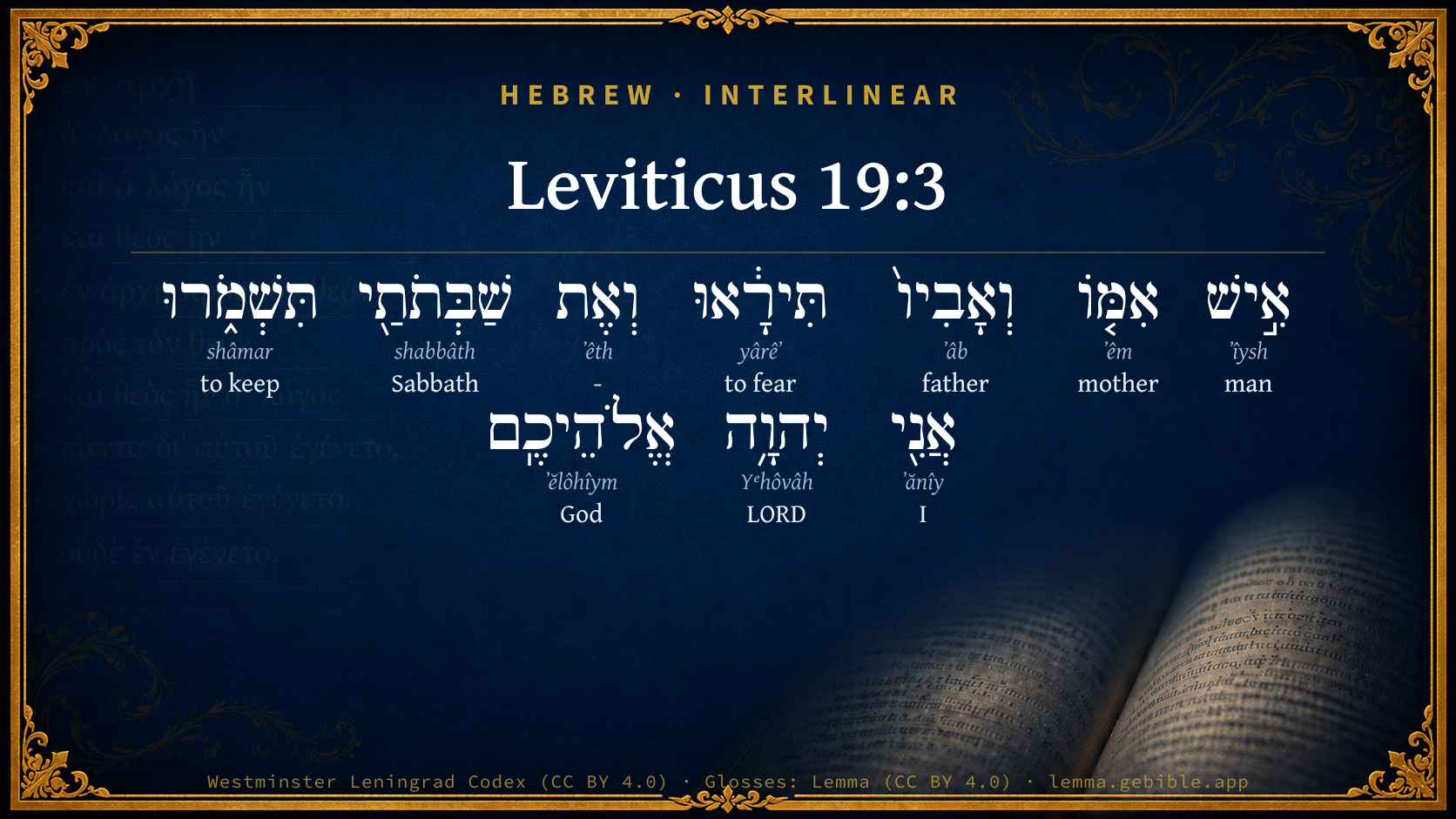
Hebrew (Westminster Leningrad Codex) Leviticus 19:3 appears in the Hebrew Old Testament. The text above is from the Westminster Leningrad Codex. Each word links to its Strong’s number, a concise gloss, and parsing drawn from the Open Scriptures Hebrew Bible morphology. Click any word for its full Brown-Driver-Briggs (BDB) entry.
Download image
Cite this verse

Leviticus 19:3 (World English Bible). Public Domain. Lemma interlinear Bible study tool, https://lemma.gebible.app/v/leviticus/19/3.

Show BibTeX & RIS
BibTeX
RIS
English Translation
"'Each one of you shall respect his mother and his father. You shall keep my Sabbaths. I am Yahweh your God.
World English Bible · Public Domain
Download a study sheet

One document with this verse’s original text, its word-by-word gloss line, the meaning frame, cross-references with their text, attributed commentary, and full source and license credits — printable, and it pastes into notes with its structure intact.

This verse Autodidact and up

Study sheet (.html) Plain text (.txt)

A passage Seminary Student

Up to 50 verses in one chapter. A passage sheet keeps up to 6 commentary sources and 12 cross-references per verse, in the order this page ranks them, and says so on the sheet whenever that leaves anything out. Ask for a single verse and you get the Autodidact verse sheet above.

Everything on this page stays free to read, with no account — the sheet is a download of what is already on screen, not access to it.

Want to remove ads? Support Godless Engineer
Compare translations 3

The same verse in 3 English versions, stacked beneath the original-language interlinear above. Click any original word for its lexicon entry.

Each is an independent rendering of the whole verse — the interlinear is not word-aligned to these translations.

Highlighted words mark where these versions differ — a whole-verse word diff, not a word-by-word alignment.

  • World English Bible Public Domain
    "'Each one of you shall respect his mother and his father. You shall keep my Sabbaths. I am Yahweh your God.
  • King James Version Public Domain
    Ye shall fear every man his mother, and his father, and keep my sabbaths: I am the LORD your God.
  • unfoldingWord Literal Text CC BY-SA 4.0
    A man, his mother and his father, you shall fear, and my sabbaths you shall keep. I Yahweh your God.

unfoldingWord Literal Text — © unfoldingWord, licensed CC BY-SA 4.0. Word-aligned USFM3 via Door43 (git.door43.org/unfoldingWord/en_ult).

Versions to compare (up to 4)

3 of 4 selected

Show all 18 translations

Every available English version of this verse, each an independent rendering of the whole verse.

  • World English Bible Public Domain
    "'Each one of you shall respect his mother and his father. You shall keep my Sabbaths. I am Yahweh your God.
  • Berean Standard Bible Public Domain
    Each of you must respect his mother and father, and you must keep My Sabbaths. I am the LORD your God.
  • Majority Standard Bible Public Domain
    Each of you must respect his mother and father, and you must keep My Sabbaths. I am the LORD your God.
  • King James Version Public Domain
    Ye shall fear every man his mother, and his father, and keep my sabbaths: I am the LORD your God.
  • American Standard Version (1901) Public Domain
    Ye shall fear every man his mother, and his father; and ye shall keep my sabbaths: I am Jehovah your God.
  • Revised Version (1885) Public Domain
    Ye shall fear every man his mother, and his father, and ye shall keep my sabbaths: I am the LORD your God.
  • Geneva Bible (1599) Public Domain
    Yee shall feare euery man his mother and his father, and shall keepe my Sabbaths: for I am the Lord your God.
  • Douay-Rheims (1899) Public Domain
    Let every one fear his father, and his mother. Keep my sabbaths. I am the Lord your God.
  • Young's Literal Translation Public Domain
    `Each his mother and his father ye do fear, and My sabbaths ye do keep; I `am' Jehovah your God.
  • Literal Standard Version CC BY-SA 4.0
    You each fear his mother and his father, and you keep My Sabbaths; I [am] your God YHWH.
  • Unlocked Literal Bible CC BY-SA 4.0
    Everyone must respect his mother and his father, and you must keep my Sabbaths. I am Yahweh your God.
  • unfoldingWord Literal Text CC BY-SA 4.0
    A man, his mother and his father, you shall fear, and my sabbaths you shall keep. I Yahweh your God.
  • Darby Bible Public Domain
    Ye shall reverence every man his mother, and his father, and my sabbaths shall ye keep: I am Jehovah your God.
  • World Messianic Bible Public Domain
    “‘Each one of you shall respect his mother and his father. You shall keep my Sabbaths. I am the LORD your God.
  • Webster's Bible Public Domain
    Ye shall fear every man his mother and his father, and keep my sabbaths: I am the LORD your God.
  • Free Bible Version CC BY-SA 4.0
    Show respect for your mother and father, and keep my Sabbaths. I am the Lord your God.
  • Bible in Basic English Public Domain
    Let every man give honour to his mother and to his father and keep my Sabbaths: I am the Lord your God.
  • JPS Tanakh (1917) Public Domain
    Ye shall fear every man his mother, and his father, and ye shall keep My sabbaths: I am the LORD your God.

Literal Standard Version (2020), Covenant Press — licensed CC BY-SA 4.0. Text via the HelloAO Bible API (eBible.org). Unlocked Literal Bible (unfoldingWord) — licensed CC BY-SA 4.0. Text via the HelloAO Bible API (eBible.org). unfoldingWord Literal Text — © unfoldingWord, licensed CC BY-SA 4.0. Word-aligned USFM3 via Door43 (git.door43.org/unfoldingWord/en_ult). Free Bible Version, Dr. Jonathan Gallagher — licensed CC BY-SA 4.0. Text via the HelloAO Bible API (eBible.org).

Word by word

More ways to search: Search by grammar → Find every occurrence → Compare this word →

Practice this passage: Drill this verse → Learn its vocabulary →

שַׁבְּתֹתַ֖י
shabbâth
H7676
“Sabbaths · my”
Noun, Common, Both, Plural, Construct + Suffix, Personal, 1st Person, Common, Singular
Part of Speech
Noun
Type
Common
Gender
Both
Number
Plural
State
Construct
Full BDB Definition

Origin: intensive from H7673

TWOT: 2323b

Sabbath - sabbath - day of atonement - sabbath year - week - produce (in sabbath year)
  1. אִ֣ישׁ ʼîysh H376 “man” Noun, Common, Masculine, Singular, Absolute
  2. אִמּ֤וֹ ʼêm H517 “mother · his” Noun, Common, Feminine, Singular, Construct + Suffix, Personal, 3rd Person, Masculine, Singular
  3. וְאָבִיו֙ ʼâb H1 “and · father · his” Conjunction + Noun, Common, Masculine, Singular, Construct + Suffix, Personal, 3rd Person, Masculine, Singular
  4. תִּירָ֔אוּ yârêʼ H3372 “to fear” Verb, Qal, Imperfect, 2nd Person, Masculine, Plural
  5. וְאֶת ʼêth H853 “and · -” Conjunction + Particle, Direct Object
  6. תִּשְׁמֹ֑רוּ shâmar H8104 “to keep” Verb, Qal, Imperfect, 2nd Person, Masculine, Plural
  7. אֲנִ֖י ʼănîy H589 “I” Pronoun, Personal, 1st Person, Common, Singular
  8. יְהוָ֥ה Yᵉhôvâh H3068 “LORD” Noun, Proper
  9. אֱלֹהֵיכֶֽם ʼĕlôhîym H430 “God(s) · your” Noun, Common, Masculine, Plural, Construct + Suffix, Personal, 2nd Person, Masculine, Plural

About this verse

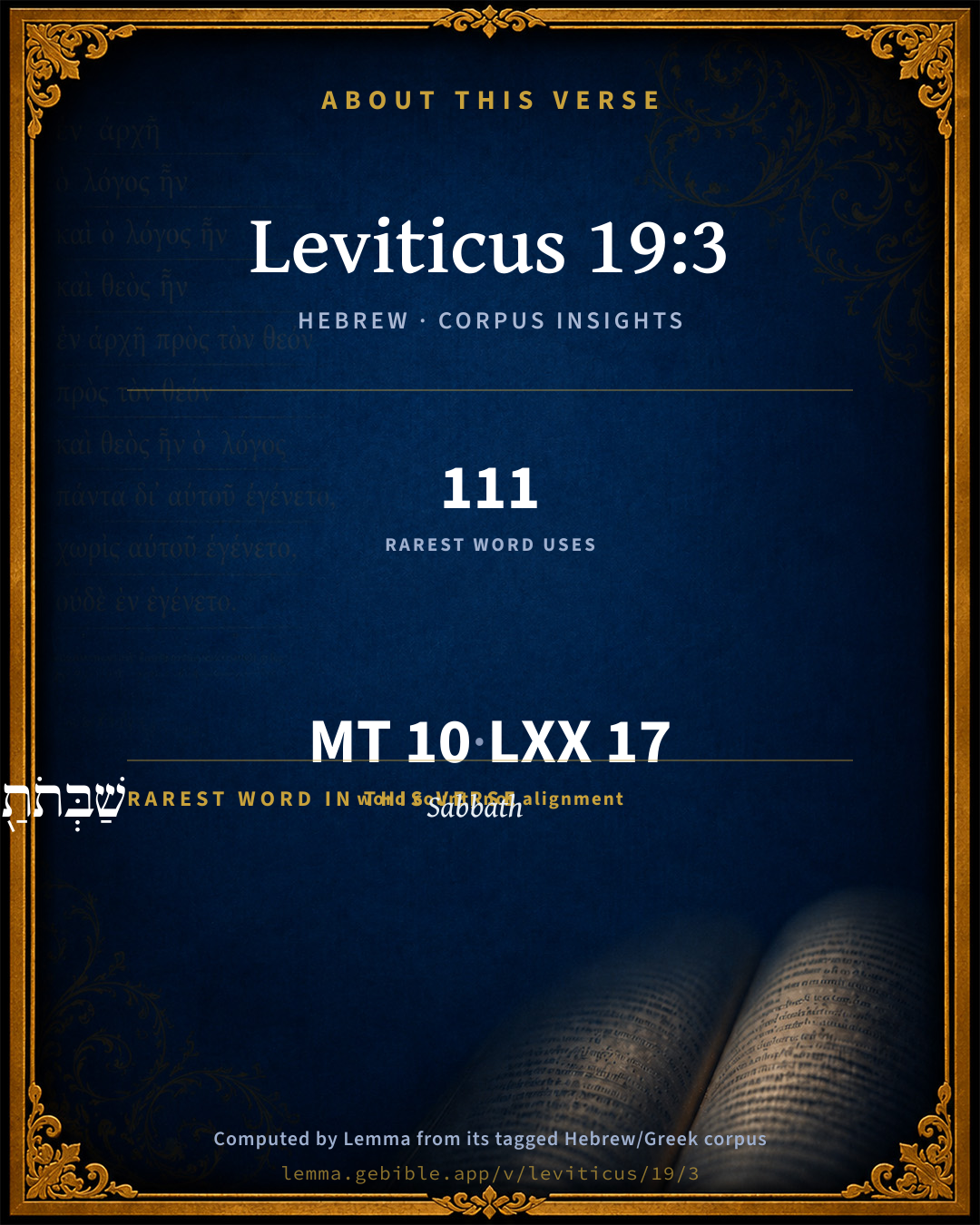
These counts appear in no published source. They are computed here, from the morphology-tagged text and Lemma’s own curated glosses. What Lemma adds →

10
words
10
distinct lemmas
Pentateuch
section

Grammatical profile

  • 2 verbs
  • 6 nouns
  • 1 pronoun
  • 1 particle

Verb forms

  • תִּירָ֔אוּ Qal · Imperfect
  • תִּשְׁמֹ֑רוּ Qal · Imperfect

Hebrew & Septuagint length

In English translation the verse runs 21 words from the Hebrew and 23 from the Septuagint (LXX English) — closely comparable.

A rough comparison of the two English renderings, which tokenize alike — not a word-level alignment.

Word counts can differ between the Hebrew and the Greek without any difference in meaning — e.g. the Hebrew direct-object marker אֵת has no separate Greek word, and Greek often adds the article ὁ.

In the original languages it is 10 Hebrew tokens and 17 Greek tokens — but the two are counted differently (Hebrew bundles its prefixes and suffixes into one token; the Greek is in lemma form), so that isn’t a like-for-like length.

Cross-references

23

Topical passages linked to Leviticus 19:3 in the Treasury of Scripture Knowledge — connected by theme and wording, ordered by reader-vote popularity; previews shown in the World English Bible.

  • Exodus 20:12 "Honor your father and your mother, that your days may be long in the land which Yahweh your God gives you.
  • Exodus 20:8 "Remember the Sabbath day, to keep it holy.
  • Ephesians 6:1–3 Children, obey your parents in the Lord, for this is right.
  • Hebrews 12:9 Furthermore, we had the fathers of our flesh to chasten us, and we paid them respect. Shall we not much rather be in subjection to the Father of spirits, and live?
  • Ezekiel 22:7–8 In you have they set light by father and mother; in the midst of you have they dealt by oppression with the foreigner; in you have they wronged the fatherless and the widow.
  • Leviticus 11:44 For I am Yahweh your God. Sanctify yourselves therefore, and be holy; for I am holy: neither shall you defile yourselves with any kind of creeping thing that moves on the earth.
  • Proverbs 30:17 The eye that mocks at his father, And scorns obedience to his mother: The ravens of the valley shall pick it out, The young eagles shall eat it.
  • Exodus 16:29 Behold, because Yahweh has given you the Sabbath, therefore he gives you on the sixth day the bread of two days. Everyone stay in his place. Let no one go out of his place on the seventh day."
  • Exodus 21:15 "Anyone who attacks his father or his mother shall be surely put to death.
  • Exodus 21:17 "Anyone who curses his father or his mother shall surely be put to death.
  • Exodus 31:13–17 "Speak also to the children of Israel, saying, 'Most assuredly you shall keep my Sabbaths: for it is a sign between me and you throughout your generations; that you may know that I am Yahweh who sanctifies you.
  • Deuteronomy 21:18–21 If a man have a stubborn and rebellious son, who will not obey the voice of his father, or the voice of his mother, and, though they chasten him, will not listen to them;
  • Deuteronomy 27:16 Cursed be he who sets light by his father or his mother. All the people shall say, Amen.
  • Proverbs 23:22 Listen to your father who gave you life, And don't despise your mother when she is old.
  • Proverbs 30:11 There is a generation that curses their father, And doesn't bless their mother.
  • Isaiah 58:13 If you turn away your foot from the Sabbath, from doing your pleasure on my holy day; and call the Sabbath a delight, [and] the holy of Yahweh honorable; and shall honor it, not doing your own ways, nor finding your own pleasure, nor speaking [your own] words:
  • Matthew 15:4–6 For God commanded, 'Honor your father and your mother,' and, 'He who speaks evil of father or mother, let him be put to death.'
  • Leviticus 26:2 "'You shall keep my Sabbaths, and have reverence for my sanctuary. I am Yahweh.
  • Proverbs 6:20–21 My son, keep your father's commandment, And don't forsake your mother's teaching.
  • Isaiah 56:4–6 For thus says Yahweh of the eunuchs who keep my Sabbaths, and choose the things that please me, and hold fast my covenant:
  • Ezekiel 20:12 Moreover also I gave them my Sabbaths, to be a sign between me and them, that they might know that I am Yahweh who sanctifies them.
  • Malachi 1:6 "A son honors his father, and a servant his master. If I am a father, then where is my honor? And if I am a master, where is the respect due me? Says Yahweh of Hosts to you, priests, who despise my name. You say, 'How have we despised your name?'
  • Proverbs 1:8 My son, listen to your father's instruction, And don't forsake your mother's teaching:

Cross-references courtesy of OpenBible.info (CC BY 4.0).

Hebrew and Greek witnesses Masoretic Hebrew ↔ Greek Septuagint

The same verse in the two great witnesses to the Old Testament, shown verse-for-verse.

These are two independent witnesses, not word-aligned to each other, and the Septuagint is shown in lemma (dictionary) form.

Hebrew Leviticus 19:3 Masoretic · Westminster Leningrad Codex

אִ֣ישׁ אִמּ֤וֹ וְאָבִיו֙ תִּירָ֔אוּ וְאֶת שַׁבְּתֹתַ֖י תִּשְׁמֹ֑רוּ אֲנִ֖י יְהוָ֥ה אֱלֹהֵיכֶֽם

"'Each one of you shall respect his mother and his father. You shall keep my Sabbaths. I am Yahweh your God.

World English Bible · Public Domain

Greek LXX Leviticus 19:3 Septuagint · lemma form

ἕκαστος πατήρ αὐτός καί μήτηρ αὐτός φοβέω καί ὁ σάββατον ἐγώ φυλάσσω ἐγώ κύριος ὁ θεός σύ

Let every one of you reverence his father and his mother; and you⌃ shall keep my sabbaths: I am the Lord your God.

LXX2012 (modern English Septuagint) · Public Domain

Hebrew: Westminster Leningrad Codex (CC BY 4.0). Greek: Septuagint (public domain); English from LXX2012 (modern English Septuagint) (Public Domain). How the Septuagint differs from the Hebrew →

Targum (Aramaic paraphrase)

2

The Targum is the ancient Jewish Aramaic paraphrase of the Hebrew Scriptures — an interpretive translation, not the Hebrew text itself. Onkelos (literal) and Pseudo-Jonathan (expansive) render the Torah, and Jonathan the Prophets. Coverage is partial: where no permissively-licensed English translation exists for a verse, only the Aramaic is shown. This is verse-level text, not a word-by-word alignment to the Hebrew.

  1. Targum Onkelos Torah (Genesis–Deuteronomy)
    גְבַר מִן אִמֵהּ וּמִן אֲבוּהִי תְּהוֹן דָחֲלִין וְיָת יוֹמֵי שַׁבַּיָא דִילִי תִּטְרוּן אֲנָא יְיָ אֱלָהָכוֹן

    (no public-domain English translation for this verse)

    Targum Onkelos — Aramaic: “Onkelos Genesis” (public domain); “Onkelos Exodus” (public domain); “Onkelos Leviticus” (public domain); “Onkelos Numbers” (public domain); “Onkelos Deuteronomy” (public domain). English: “Sefaria Community Translation” (CC0 1.0 (public-domain dedication)); “J.W. Etheridge. The Targums of Onkelos and Jonathan Ben Uzziel on the Pentateuch. London: Longmans, Green, 1862” (public domain). Text via Sefaria.

  2. Targum Pseudo-Jonathan Torah (Genesis–Deuteronomy)
    גְבַר מִן אִימֵיהּ וּמִן אָבוֹי תֶּהֱווֹן דַחֲלִין וְיַת יוֹמֵי שַׁבַּיָא דִילִי תִנְטְרוּן אֲנָא יְיָ אֳלָהָכוֹן

    Let every man revere his mother and his father, and keep the days of My Sabbaths: I am the Lord your God.

    Targum Pseudo-Jonathan — Aramaic: “Targum Jonathan on Genesis” (public domain); “Targum Jonathan on Exodus” (public domain); “Targum Jonathan on Leviticus” (public domain); “Targum Jonathan on Numbers” (public domain); “Targum Jonathan on Deuteronomy” (public domain). English: “The Targum of Jonathan ben Uzziel, trans. J. W. Etheridge, London, 1862” (public domain). Text via Sefaria.

Commentary

Notes on Leviticus 19:3 from classic Christian and Jewish commentators (each source and its license shown beneath its notes). The classic Christian expositions comment on the surrounding passage and are grouped to its opening verse, so a note may address several verses; the Jewish commentaries on the Tanakh (Rashi and others) are per-verse, so they appear only where the commentator wrote on this verse.

Lemma curates 59 commentaries, every one of them public domain or Creative Commons licensed, each selected and text-cleaned for this edition rather than reprinted as found. About our sources →

Ellicott's Commentary for English Readers

(3) Ye shall fear every man his mother, and his father.—The first means to attain to the holiness which is to make the Israelite reflect the holiness of God, is uniformly to reverence his parents. Thus the group of precepts contained in this chapter opens with the fifth commandment in the Decalogue (Exo_20:12), or, as the Apostle calls it, the first commandment with promise (Eph_6:2). During the second Temple, already the spiritual authorities called attention to the singular fact that this is one of the three instances in the Scriptures where, contrary to the usual practice, the mother is mentioned before the father; the other two being Gen_44:20 and Lev_21:2. As children ordinarily fear the father and love the mother, hence they say precedence is here given to the mother in order to inculcate the duty of fearing them both alike. The expression “fear,” however, they take to include the following :—(1) Not to stand or sit in the place set apart for the parents; (2) not to carp at or oppose their statements; and (3) not to call them by their proper names, but either to call them father or mother, or my master, my lady. Whilst the expression “honour,” which is used in the parallel passage in Exo_20:12, they understand to include (1) to provide them with food and raiment, and (2) to escort them. The parents, they urge, are God’s representatives upon earth; hence as God is both to be “honoured” with our substance (Pro_3:9), and as He is to be “feared” (Deu_6:13), so our parents are both to be “honoured” (Exo_20:12) and “feared” (Lev_19:3); and as he who blasphemes the name of God is stoned (Lev_24:16), so he who curses his father or mother is stoned (Lev_20:9).

And keep my sabbaths.—Joined with this fifth commandment is the fourth of the Decalogue. The education of the children, which at the early stages of the Hebrew commonwealth devolved upon the parents, was more especially carried on by them on Sabbath days. In these leisure hours, when the Israelites were strictly forbidden to engage in any secular work, they found it a pleasant task and a welcome occupation to instruct their children in the many symbols, rites, and ceremonies which formed part of the service of the Sabbaths. Hence the observance of the day implied the instruction of the people in the fear and admonition of the Lord, and in acquiring the holiness which is the keynote of this chapter. Hence, too, the violation of the sanctity of the Sabbath is denounced as the greatest sin which the Israelites committed (Eze_20:12; Eze_22:8; Eze_23:38, &c.). It is probably for this reason that the administrators of the law during the second Temple say that the commandment about the Sabbath has here been selected to limit the duty of filial obedience. Its combination with the fifth commandment is to show that though children are admonished to obey their parents, yet if they should order the profanation of this holy day, the children must not obey. (See Lev_23:3.)

A Bible Commentary for English Readers, edited by Charles John Ellicott (1878–1897) — public domain. Text from a community e-Sword module.

Trapp's Complete Commentary

John Trapp

Lev 19:3 Ye shall fear every man his mother, and his father, and keep my sabbaths: I [am] the LORD your God.

Ver. 3. Ye shall fear every man his mother.] The mother is set first, because usually most slighted. The days of mourning for my father are at hand, then will I slay my brother Jacob, said that profane profligate. {Gen 27:41} As for his mother, he makes no reckoning of her, he cared not to grieve her.

And keep my Sabbaths.] To the which the honouring of good governors, who are to see the Sabbath sanctified by all under their roof, doth very much conduce.

John Trapp, A Commentary or Exposition upon All the Books of the Old and New Testament (1647–1656) — public domain. Text from a community e-Sword module.

The Biblical Illustrator

Joseph S. Exell

Lev_19:3

Ye shall fear . . . mother . . . father.

Maternal rule

This is a remarkable command, given by God to Moses. Not for the matter of it, for it is the same in substance with the fifth in the Decalogue. But as differing from that and other parallel passages, it is remarkable on two accounts. In those the father is always put first. It is, Honour thy father and thy mother. He that smiteth his father and his mother, shall surely be put to death. My son, hear the instruction of thy father, and forsake not the law of thy mother. Hearken unto thy father that begat thee, and despise not thy mother when she is old. Honour thy father and thy mother, which is the first commandment with promise. But here, mother is put first--Ye shall fear every man his mother and his father. Then again, the word fear--Thou shalt fear thy mother and thy father, occurs in no other passage. There must be a meaning, both in the word fear, and the singular collocation of the sentence. And what is it? Fathers are in general wont to govern their children more by authority, and mothers by love. Hence they are more afraid of offending their fathers than their mothers. This is especially the case with boys, about the time when they enter their teens. For three or four years they are more impatient of restraint than ever before or after. They are then apt to think they know much more than their mothers, and are quite capable of governing themselves. To guard against this undervaluing of their mothers authority seems to have been the special design of the command in question. Ye shall fear every man his mother--detracting nothing from the fathers authority; hut putting the mothers in the foreground, because there is danger of its being despised or overlooked. The word fear, in this case, is not quite synonymous with honour, in the fifth commandment. It has rather more intensity of meaning, if it is not more imperative. There is more of awe in fear, if not more of reverence. God intended to put both parents on the same level. Both are to be feared alike. And this purity of governmental control carries along with it corresponding obligations. Mothers must not shrink from exercising the authority with which God has clothed them, to train Up their children in the way in which they should go, however crossing it may sometimes be to their parental yearning. Let them rule by love as much as they can. The more the better. But restraint, by coercion, where nothing else will do, is one of the highest forms in which parental love is manifested. It would be wrong, it would be cruel to withhold it from the wayward child. Thousands upon thousands have been greatly wronged, if not ruined, by overweening motherly indulgence. The surest way ultimately to win that undying filial love, which casteth out fear, is to restrain and govern the boy just at the age when he is most restive under parental control. Woe to the child that breaks away from the authority which God has ordained. Evil is as surely before him as the going down of the sun (Pro_30:17). (Dr. Humphrey.)

Ungrateful children rebuked by birds

The birds can teach ungrateful children their duty towards aged parents. It is an old tradition with regard to storks, says Mr. Morris in his British Birds, that they take care of and nourish their parents when they are too old to take care of themselves, from whence the Greek word pelargicos, signifying the duty of children to take care of their parents; and pelargicoi nomoi, signifying the laws relating to that duty, both derived from the Greek word for a stork; Pelargos, from pelas, black; and argos, white, alluding to the prevailing colours of the stork. (Scientific Illustrations.)

A sons devotion to his mother

I remember just now a young man whom the Lord has blessed on account of the love he has shown his mother. Many years ago when her husband died, she was walking the streets of Glasgow in sore distress, her heart being, as it were, in the grave with her husband. She was utterly heedless of the great crowd, and almost forgetful of the kindly little boy, then only three and a half years old, who was walking by her side. He reminded her that he was there by pulling her hand earnestly, and when she looked down to him, he said, Mother, dont cry!--for he saw the tears were stealing down her cheeks--I will be the father, and the whole soul of the child was in his face. As he spoke those words the warmth of summer and the life of the spring-time of joy came again into the mothers heart. God spared him to fulfil his promise, and to receive the blessing that is annexed to the fifth commandment, and I am glad he is living to-day a prosperous and honourable merchant. It is some years-since I joined him in laying his mothers honoured head in the grave. Shortly before she died she was able, beautifully and lovingly, to testify that her son had amply redeemed the promise of his childhood, that what his father would have been, had he been spared, her son had successfully tried to be to her. (J. G. Cunningham.)

Respect for a mother

Men who have risen from humble life to wealth and high social rank have often been ashamed of their parents, and shown them little attention or respect. Such treatment indicates a vulgar mind. True nobility follows a different method. Richard Hurd, an eminent bishop of the Church of England at the close of the last century, was a man of courtly manners, of great learning, who moved with distinction in the best society in the kingdom. George III. pronounced him the most naturally polite man he had ever known. He, however, never failed to show the utmost respect for his mother, a farmers wife, of no education, but of sterling character. When he entertained large companies at the Episcopal Palace, he led her with a stately courtesy to the head of the table, and paid her the greatest deference. The high-born families who sat at his table reverenced his conduct, so becoming to a son and a gentleman. (New Orleans Democrat.)

Sacred to the memory of a mother

I want, said the late Emperor of Germany, the last but one, the great William, I want a lamp such as Such-and-so has, naming some distinguished member of the Court. The lamp was provided according to the very pattern, but his Majesty complained, on returning to his study after withdrawment, that he could not bear the savour of the room; the lamp was emitting smoke, and it was altogether intolerable, One of the secondary servants knew the reason, but dare not name it to his Majesty. One of the higher servants learned the cause and brought it under his Majestys attention. It is because your Majesty turns down the light when you leave the study that occasions the emission of smoke and vapours, and if you will cease to do that all will be well. Ah, said the sweet old patriarch of his nation, I know how that is. I learned that in the days of our poverty. After the battle of Jena we were very poor, and my mother never allowed us to leave the room at night without turning down the light, and I continue to turn down the light in memory of my mother. A beautiful example, a tender domestic story that. Here is a man who could have had a thousand lamps, yet in memory of the days of his poverty, when his mother taught him the uses of money, he kept turning down the light, saying, Sacred to the memory of my mother. (J. Parker, D. D.)

And keep My Sabbaths.--

The Sabbath kept

During the latter part of his life General Jackson was in the habit of coming down to New Orleans to see his old friends and comrades in arms and participate in the celebration of the glorious 8th of January. It happened on one of these visits that the 8th occurred on Sunday. General Plauche called upon the old hero and requested him to accompany the military to the battle-ground on the anniversary of the great day. I am going to church to-morrow, mildly observed the General. The military preparations for the celebration went on, and on Sunday morning at ten oclock General Plauche called at the St. Charles and informed General Jackson that the military and civic processions were ready to accompany him to the scene of his glory. General Plauche, responded old Hickory, turning upon him the glance of his kindling eye, I told you I was going to church to-day. General Plauche withdrew, muttering to himself, I might have known better. The celebration was postponed till the next day.

The Biblical Illustrator, edited by Joseph S. Exell (c. 1880s–1900s) — public domain. Text from a community e-Sword module.

Joseph Benson's Commentary

Lev 19:3. His mother — The mother is put first, partly because the practice of this duty begins there, mothers, by perpetual converse, being sooner known to their children than their fathers; and partly because this duty is commonly neglected to the mother, upon whom children have not so much dependance as they have upon their father. And this fear includes the two great duties of reverence and obedience. And keep my sabbaths — This is added, to show that, whereas it is enjoined to parents that they should take care the sabbath be observed both by themselves and their children, it is the duty of children to fear and obey their parents in this matter. But that, if parents should neglect their duty therein, or by their command, counsel, or example, draw them to pollute the sabbath, the children in that case must keep the sabbath, and prefer the command of God, before the command of their parents.

Joseph Benson's Commentary on the Old and New Testaments (1811–1818) — public domain. Text from a community e-Sword module.

Tyndale Open Study Notes

Tyndale Open Resources

19:3 I am the Lord (see 18:2): These words break ch 19 into terse, staccato sections (19:3, 4, 10, 12, 14, 16, 18, 25, 28, 30, 31, 34, 36, 37). Each use served to remind Israel why they were to obey God’s regulations.

Tyndale Open Study Notes — © Tyndale Open Resources, licensed CC BY-SA 4.0. Text via the HelloAO Bible API.

Jamieson, Fausset & Brown

Robert Jamieson, A. R. Fausset & David Brown

Ye shall fear every man his mother, and his father, and keep my sabbaths--The duty of obedience to parents is placed in connection with the proper observance of the Sabbaths, both of them lying at the foundation of practical religion.

Jamieson, Fausset & Brown — Commentary Critical and Explanatory on the Whole Bible (1871) — public domain (CC PDM 1.0). Text via the HelloAO Bible API.

Adam Clarke's Commentary

Verse 3. Ye shall fear every man his mother, c.] Ye shall have the profoundest reverence and respect for them. See Clarke on Ge 48:12 "Ex 20:8"; and "Ex 20:12".

Adam Clarke's Commentary on the Bible (1810–1826) — public domain. Text from a community e-Sword/MySword module.

The Cambridge Bible for Schools and Colleges

gen. ed. J. J. S. Perowne

3. his mother, and his father] The command in the Decalogue is to ‘honour,’ here to ‘fear,’ or act reverently towards parents. The mother is put first, as in Lev_21:2. This order probably indicates diversity of origin. But Rashi, on the authority of the Midrashic commentary, Mechilta, on Exodus 20, accounts for this order on the ground that the child by nature fears the father more than the mother.

ye shall keep my sabbaths] Repeated in Lev_19:30. For the sabbath law cp. Lev_26:2; Exo_31:13. It has been remarked that the two injunctions associated together in this v. are the only two positive commands in the Decalogue.

The Cambridge Bible for Schools and Colleges (gen. ed. J. J. S. Perowne; Cambridge University Press, 1878–1918) — public domain. Text from a community e-Sword module.

John Gill's Exposition

Ye shall fear every man his mother and his father,.... This has respect to the fifth command, which is the first with promise, and is here referred to first, because a man has his beginning in the world from his parents, and by them he is trained up in the observance of all the other laws of God, equally to be respected; and the fear of them is not servile, but filial, joined with love and affection to them, and includes an inward esteem and reverence of them, an outward respect unto them, a readiness to obey their commands, and giving due and equal honour unto them; See Gill on Exo 20:12; Pythagoras, Phocylides, and other Heathens, next to honouring God, exhort to the honour and reverence of parents:

and keep my sabbaths; this is expressed in the plural number, because there were various sabbaths. The seventh day sabbath, and the seventh year sabbath, and the jubilee, which was once in seven times seven years; the seventh day sabbath is chiefly meant: this follows upon the other, because it lay upon parents to teach their children the observance of the sabbath, and to train them up in it; and indeed the fear of them greatly depends on it, for children that are sabbath breakers have seldom much respect to their parents; and besides this suggests, that though children are to honour, reverence, and obey their parents, yet not in anything that is contrary to the laws of God; and, particularly should they suggest to them that sabbaths were not to be observed, they should not hearken to them:

I am the Lord your God; that gave them their being, parents being but instruments, and who had a right to enjoin them what laws he pleased; and among the rest had ordered them to observe the sabbath, and which in gratitude they were obliged unto, as well as in point of duty.

John Gill's Exposition of the Whole Bible (1746–1763) — public domain (CC PDM 1.0). Text via the HelloAO Bible API.

Albert Barnes' Notes on the Bible

Compare Exo 20:8, Exo 20:12; Exo 31:13-14. The two laws repeated here are the only laws in the Decalogue which assume a positive shape, all the others being introduced by the formula, “Thou shalt not.” These express two great central points, the first belonging to natural law and the second to positive law, in the maintenance of the well-being of the social body of which Yahweh was the acknowledged king.

Albert Barnes' Notes on the Bible (1834–1885) — public domain. Text from a community e-Sword/MySword module.

Haydock's Catholic Bible Commentary

Sabbaths. Both those which occur every week, and extraordinary ones, ver. 30.

George Leo Haydock (1774–1849), Haydock's Catholic Family Bible and Commentary, 1859 edition — public domain. Excludes Psalms (Douay-Rheims chapter numbering differs from Protestant) and Deuterocanonical books (Catholic canon only).

Matthew Poole's English Annotations

The mother is put first, partly because the practice of this duty begins there, mothers, by perpetual converse, being more and sooner known to their children than their fathers; and partly because this duty is most commonly neglected to the mother, upon whom children have not so much dependence as they have upon their father. And this

fear includes the two great duties of reverence and obedience.

And keep my sabbaths: this is here added, to show, that whereas it is enjoined to parents that they should take care that the sabbath be observed both by themselves and by their children, it is the duty of children to fear and obey their parents in this matter; and moreover, that if parents should neglect their duty herein, or by their command, counsel, or example draw them to pollute the sabbath, yet the children in that case must keep the sabbath, and in all such cases prefer the command of God before the commands of their parents or superiors.

Matthew Poole's English Annotations on the Holy Bible (1683–1685) — public domain. Text from a community e-Sword/MySword module.

Whedon's Commentary on the Bible

Daniel D. Whedon

3. Ye shall fear — Reverence or honour, and not slavish fear, is here enjoined. See Exo_20:12, note.

Keep my sabbaths — Exo_20:8-11, notes.

Daniel D. Whedon (gen. ed.), Commentary on the Old and New Testaments (1874–1909) — public domain. Text from a community e-Sword module.

The Pulpit Commentary

Ye shall fear every man his mother, and his father. The words fear and reverence are in this connection interchangeable. So Eph_5:33, "Let the wife see that she reverence her husband," where the word "reverence" would be more exactly translated by "fear." St. Paul points out that the importance of the fifth commandment is indicated in the Decalogue by its being" the first commandment with promise," that is, with a promise attached to it. (Eph_6:2) The family life is built upon reverence to parents, and on the family is built society. Obedience to parents is a duty flowing out of one of the first two laws instituted by God the law of marriage. (Gen_2:24) The second law instituted at the same time was that of the sabbath, (Gen_2:3) and in the verse before us observance of the sabbatical law is likewise inculcated, in the words that immediately follow ye shall keep my sabbaths.

The laws of submission

(1) to human authority and

(2) to sacred ordinances, for the Lord"s sake, are enjoined in this verse.

1. The family is an institution of God"s appointment. (Gen_1:28 Gen_2:24) The command to children to honour their father and mother is distinguished in the Decalogue by a blessing attached to it; (Exo_20:12 Eph_6:2) and a special blessing is bestowed on the house of the Rechabites for obeying it. (Jer_35:18) St. Paul enjoins the observance of the duty, both as an act right in itself and as positively commanded in God"s Law. (Eph_6:1, Eph_6:2) The father"s duty is "nurture and admonition of the Lord", (Eph_6:4) including guidance, remonstrance, reproof. (1Sa_2:23) By means of this institution the character of every member of the commonwealth is formed, at the moment when alone it is plastic, by the influence best adapted for turning it to good. Contrast the system adopted by Rousseau for dealing with his children, and the probable results on parents, children, and the State. Cf. the Form of Solemnization of Matrimony: "Marriage was ordained for the procreation of children, to be brought up in the fear and nurture of the Lord, and to the praise of his holy Name.

An analogous position to that of the parent is afterwards held by the civil magistrate in respect to the subject, and by the pastor in respect to a member of his flock. Therefore, in order to carry out the commandment, a man has not only "to love, honour, and succour his father and mother," but also "to honour and obey the queen, and all that are put in authority under her: to submit himself to all his governors, teachers, spiritual pastors and masters: to order himself lowly and reverently to all his betters" (Church Catechism). On the other hand, the authorities in the State and in the Church have their duties also, not now the same as those of the parent towards the child, on account of the changed position of him who was once a child, but nevertheless analogous to them. So in other cases, wherever men stand in a relation to each other similar to that of parent and child, obligations similar to those which bind parents and children arise.

2. Sabbatical observance appears, at first sight, a small thing to place on a level, as here, with the fifth commandment, or, as in the Decalogue, with the first, second, and third commandments; but when we examine into it closely, we find that this disproportion does not exist.

I ITS INSTITUTION. It shares with the ordinance of marriage alone the characteristic of having been instituted at the creation of the world. "And God blessed the seventh day, and sanctified it: because that in it he had rested from all his work which God created and made". (Gen_2:3) Being coeval with creation, the sabbatical law, like the marriage law, is of universal obligation on all mankind.

II ITS JEWISH FORM. The sabbatical law was observed during the period preceding the Mosaic Law. (Exo_16:22-30) For the Jews it took the form given it in the fourth commandment (Exo_20:8-11 Deu_5:12-15) and other Mosaic injunctions. (Exo_31:13, 14 35:2, 3 Num_15:32-36) To them it commemorated the rest after the Creation and the rest after the toils of Egypt, while it looked forward to the rest of Canaan while they wandered in the wilderness, (Psa_95:11) and, after they had entered Canaan, to the still further rest of the Messianic kingdom; (Heb_4:8) and it was to be kept with such severity that no work at all was to be done upon it, even to the extent of gathering sticks or lighting a fire.

III ENDS SERVED BY THE JEWISH FORM.

1. It formed a very noticeable distinction between the Jews and the neighbouring nations, and so it was a preservative from idolatry.

2. It served, like circumcision, as a symbol constantly reminding them that they were God"s people, and should live in accordance with their profession. "Moreover also I gave them my sabbaths, to be a sign between me and them, that they might know that I am the Lord that sanctify them". (Eze_20:12)

IV THE CHRISTIAN FORM. Christ declared his lordship over the sabbath day, (Mat_12:8) but he did not exercise that lordship for the purpose of destroying it as an institution, but merely of adapting the primary law of the sabbath to altered circumstances. The Jewish sabbath, as such (that is, in its peculiarities), ceased to be binding, but the obligation of sabbatical law continued, and the ordinance took a changed form. By apostolic authority, as proved by apostolic practice, the Christian sabbath was kept on the first day of the week the anniversary of Christ"s resurrection and the severity of its character was abrogated. As God had rested on the seventh day after his labour of creation, so Christ had rested in the grave on the seventh day after his labour of redemption. Why should the seventh day be any longer kept? "The Jewish sabbath died out in the course of the first generation of Christians, as circumcision died out, as the temple, as the Law itself died out The Lord"s day was a Divine and more immortal shoot from the same stock. It was rooted in the primitive law of the Creation. It recognized and adopted the old weekly division of time, that perpetual and ever-recurring acknowledgment, wherever it was celebrated in all the world, of the Divine blessing and promises. It had the Divine sanction of the tables of stone those tables, written by God"s own finger, and therefore greatly superior in sanctity and enduring weight to the temporary enactments of the ceremonial law. It took up the old series of commemorations and sacred anticipations. It bade the true Israel of God record with gratitude and keep in mind, by the weekly institution and its recurring festival of rest and praise, the creation of mankind, the deliverance from Egypt, the entrance of the people into the promised land, the return from captivity, the coming of the Messiah; and to look forward under the dispensation of the Holy Ghost to the crowning and final mercy of the long scheme of Providence, the eternal rest in heaven which yet remaineth for the people of God" (Bishop Moberly, "The Law of the Love of God").

V THE ENDS OF THE SABBATICAL INSTITUTION.

1. To reserve a certain sufficient part of time free for spiritual interests.

2. To teach the lesson of obedience to positive precept in religious things. The appointment of one-seventh of our time for this purpose is wholly arbitrary. There is no account to be given of it except that it is God"s will There is no other account to be given of weeks. Months and years have their reasons in physical nature; not so weeks. God has commanded, and because he has commanded, the weekly rest is observed by those who love God; and not only is the weekly rest observed, but a loving obedience is paid to all religious institutions and ordinances established by lawful authority.

VI EFFECT ON THE INDIVIDUAL CHRISTIAN"S LIFE. "The Christian man, desirous of loving God with all the affection of his heart, with all the rational intelligence of his mind, with all the devotion of his life, with all the energy of his strength, in the love taught him under the fourth law, will yield himself up gratefully and religiously to obey all duly ordered positive laws of the Church of God. The Sunday and its sacred observance will be to him the center, and furnish, so to speak, the form of his own way of life, and that of all his family and dependents. He will regard it every time it returns as God"s holy day of rest, the weekly commemoration of the primeval rest of God and of all the signal mercies of the elder covenant. Knowing himself to be of the true Israel of God, he will not forget the blessings connected by God himself with the sabbatical institution, vouchsafed to his fathers in the faith. He will celebrate it weekly as the feast of the Lord"s resurrection, and all the blessings of that resurrection; as the feast of the Holy Ghost the Giver of peace and rest in the Church, as the weekly antepast of that glorious and unending rest in the presence of God which still remaineth for the people of God. It will be to him a day of rest, peace, prayer, praise, and holy joy; no mournful and austere time, but on the contrary, a thankful happy time. He will remember his Lord"s injunction not to forbid or refuse works of necessity or mercy on that day. He will gratefully shut up the records of the cares, the interests, and the occupations of the week, and give that holy day to God; not discharging himself of his duties of worship by an attendance in God"s house or holding himself at liberty to make his own convenience or inclination the rule of obedience; but faithfully, dutifully, and completely sanctifying that day to rest, worship, and the thought of God and heaven. And the other days, the train of Sunday, will borrow of its light; each having its own sacred, special commemoration belonging to it, and each reflecting some of the brightness of the Sunday just preceding and catching more and more from that which follows (Moberly, "The Law of the Love of God").

VII RESULTS OF ITS NEGLECT.

1. To the individual:

(1) an unloving spirit arising from a consciousness of disobedience to a command;

(2) a habit of refusing to submit to positive injunctions, and, growing out of that, a habit of choosing which of God"s commandments he will obey;

(3) a loss of religious opportunities, and consequently a gradual falling away from the habit of public worship, and therefore from the spiritual life;

(4) a sense of being overwhelmed by the business and worries of life which continue without cessation, and thence a want of calm peacefulness and cheerfulness.

2. To a nation:

(1) growth of ungodliness and irreligion;

(2) increase of self-indulgence and mere amusement-seeking;

(3) growing oppression of the poor, who are made to serve the amusements or requirements of the rich instead of enjoying their weekly rest and refreshment of body and mind and soul;

(4) the displeasure of God, whose primeval law is disobeyed.

Vers. 3, 32. "Honour to whom honor.

It is uncertain whether we shall receive the honour which is due to us. Possibly we may be denied some to which we are entitled; probably we have experienced this wrong already, in larger or smaller measure, and know the pain of heart which attends it. Let us, therefore, resolve that we will give that which is due to others. The two passages connected in the text remind us that we should pay deference to

I THOSE WHO CARRY THE WEIGHT OF YEARS. "Thou shalt rise up before the hoary head, and honour the face of the old man." "Respect the burden, madam," said Napoleon, inviting a lady to move out of the way of one who was carrying a heavy weight. Those who have traveled far on the rough road of life, and are worn with many and sad experiences, on whom the privations of age are resting, these carry a heavy weight, a burden we should respect. They are as wounded soldiers on whom the battle of life has left its scars, and these are marks of honour that demand the tribute of youth.

II THOSE WHO HAVE ATTAINED TO WISDOM. The young are apt to think that they can reach the heights of wisdom without laboriously climbing the steeps of experience. They find that they are wrong. Time proves to each generation of men that wisdom, whether it be that of earth or of heaven, is only gained by the discipline of life. There are men who pass through human life and learn nothing in the passage; the folly of youth cleaves to them still. Such men must be comparatively unhonoured, receiving only the respect which is due to old age as such. But when men have gathered the fruits of a long and large experience and especially when men of intelligence and piety have stored up the truth which God has been teaching them as he has led them along all the path of life they are worthy to receive our sincerest honour, and we must know how to "rise up before the hoary head" in their case. With all and more than all the respect we pay to the learned, we should receive men whom God has been long teaching in his school those who have learnt much of Jesus Christ.

III THOSE WHO HAVE LAID US UNDER SPECIAL OBLIGATION.

1. Aged men who have lived a faithful life have done this. For they have lived, not only for themselves, but for their kind. They have wrought, struggled, suffered in order that they might help us and others to walk in the light, to enter the kingdom, to enjoy the favour of God; and they have earned our gratitude by their faithful service.

2. Our parents have done this also. "Ye shall fear every man his mother, and his father." What benefits our parents have conferred on us, what kindnesses they have rendered us, what sacrifices they have made for us, what anxious thought and earnest prayer they have cherished and offered on our behalf, who of us shall reckon? The debt we owe to them for all they have done for us is the heaviest of all, next to that supreme indebtedness under which we stand to God. But it is not only the obligation we have thus incurred which demands our filial reverence; it is the fact that our parents arc

IV THOSE WHO STAND IN A SPECIAL RELATIONSHIP TO US.

1. We should remember that fatherhood is the human relationship which most closely resembles and most fully reveals that in which God himself stands to us all. Christ came to reveal the Father unto man as the Father of souls. Therefore it is to be highly honoured.

2. Fatherhood (parenthood, for the mother is not to be left out of our thought) in the best state of human society has received the largest share of honour. We may gather from this fact that it is a divinely implanted instinct, only absent when the race has miserably degenerated under sin.

3. Honour given to parents as such is imperatively required by God. It was a patriarchal and Jewish, as it is now a Christian, virtue. After the injunction stand these significant words, "I am the Lord." "Children, obey your parents in the Lord". (Eph_6:1) Filial disobedience and unkindness are grievous sins in his sight. Filial love, honour, and considerateness are well-pleasing unto the Lord. C.

Vers. 3-37. The holy Law in the holy life.

I REVERENCE FOR PARENTS. True religion is seen in common, everyday life. If we love God, we love man. Family peace and order is best preserved by appeal to deep, religious motives. Natural affection is not sufficient against fallen human nature. "God says, Thou shalt, must be the support of natural feeling.

II SABBATH KEEPING. Not as a Jewish regulation, but as both the demand of physical nature and the gracious provision of God for us. "The Son of man is Lord of the sabbath;" therefore, while preserving it from abuse to the oppression of human liberty, sanctifying it for the higher place it occupies in the Christian scheme.

III ABSOLUTE SEPARATION FROM IDOLATRY and all heathenism. Holy religion.

IV WILLINGHOOD IN RELIGION. Verse 5, "At your own will," or "that you may be accepted," i.e., do it as unto God, by his Word, for his glory, in dependence on his grace, with hearty resignation of self to him.

V PHILANTHROPY AND COMPASSION FOR THE POOR. The true charity is a practical remembrance of the needy and suffering, beginning at home, from our own personal possessions. God is the Lord of all. All are brethren.

VI HONESTY OF DEALING is only to be maintained by religion. Mere social considerations and political economy will never purify trade and sanctify men"s intercourse with one another. Truth is safe in no keeping but that of the sanctuary.

VII PROFANITY in speech and in act is an evil to be cured by positive religion.

VIII THE JUSTICE OF THE LIPS is the justice of the heart in expression. The law that is kept sacred within will be honoured without respect of persons, and not by mere negation, but in active benevolence.

IX REAL NEIGHBOURLINESS IS LOVE OF MAN PROCEEDING FROM LOVE OF GOD. No injury must be done either by word or deed, either by neglect of another"s interests or unholy wrath against another or encouraging him to sin by withholding due rebuke. All summed up in the positive precept, "Love thy neighbour as thyself." All the various prescriptions of the Jewish law, both negative and positive, regard the pure and holy development both of individual and national life. Religion is the root, social morality is the blossom or the plant, national prosperity is the precious fruit, of which, if we would preserve the seed and perpetuate the blessing, we must see to it that we find the very inmost center and kernel, which is the love of God as the Father of all, and the love of men as the brethren of the same Divine family. R.

The Pulpit Commentary (1880–1919), ed. H.D.M. Spence-Jones & Joseph S. Exell — public domain. Text from a community e-Sword module.

John Wesley's Explanatory Notes

His mother - The mother is put first, partly because the practice of this duty begins there, mothers, by perpetual converse, being sooner known to their children than their fathers; and partly because this duty is commonly neglected to the mother, upon whom children have not so much dependence as they have upon their father. And this fear includes the two great duties of reverence and obedience. And keep my sabbaths - This is added, to shew, that, whereas it is enjoined to parents that they should take care the sabbath be observed both by themselves and their children, it is the duty of children to fear and obey their parents in this matter. But that, if parents should neglect their duty herein, or by their command, counsel, or example, draw them to pollute the sabbath, the children in that case must keep the sabbath, and prefer the command of God before the commands of their parents.

John Wesley, Explanatory Notes Upon the Whole Bible (1754–1765) — public domain. Text via the GEBible commentary corpus.

Rashi

Rabbi Shlomo Yitzchaki (Rashi)

איש אמו ואביו תראו means, EVERYONE OF YOU SHALL FEAR HIS MOTHER AND HIS FATHER; this is the literal sense. The Halachic explanation of the verse, however, is as follows: Since Scripture says איש I have here only the law that a man must fear his father and his mother, whence do I know that this applies also to a woman? Because Scripture states תיראו (in the plural), it is evident therefore that it speaks here of two (man and woman). But if this be so (that Scripture means to include a woman also) why does it use the term איש, a man? Because it is the man who has the means to do it, whilst the woman is under the control of others (what she does is dependent upon her husband’s consent)(Sifra, Kedoshim, Section 1 3; Kiddushin 30b).

אמו ואביו תיראו EVERYBODY OF YOU SHALL FEAR HIS MOTHER AND HIS FATHER — Here Scripture mentions the mother before the father because it is manifest to Him that the child fears the father more than the mother and therefore by mentioning the mother first Scripture stresses the duty of fearing her. In the case of honoring one's parents, however, Scripture mentions the father before the mother because it is manifest to Him that the child honors the mother more than the father because she endeavors to win him over by kindly words. Therefore by mentioning the father first Scripture emphasizes the duty of honoring him (Kiddushin 30b - Kiddushin 31a).

ואת שבתתי תשמרו AND MY SABBATHS SHALL YE KEEP — Scripture places the commandment of observing the Sabbath immediately after that of fearing one’s father in order to suggest the following: “Although I admonish you regarding the fear due to your father, yet if he bids you: "Desecrate the Sabbath", do not listen to him” — and the same is the case with any of the other commandments. This, it is evident, is the meaning since Scripture adds —

אני ה' אלהיכם “I am the Lord your God" (the plural) — both you and your father are equally bound to honour Me! Do not therefore obey him if it results in making My words of no effect (Sifra, Kedoshim, Section 1 10; Bava Metzia 32a). — What is implied in the term מורא? That one should not sit in his (the father's) seat, nor speak in his stead (i. e. when he is expected to speak), nor contradict his words. And what is implied in the term כבוד? That the child gives the parents to eat and to drink, provides them with clothes and shoes, leads them into the room and out if they are infirm (Kiddushin 31b).

Rashi on the Tanakh — English translations: “The Judaica Press complete Tanach with Rashi, translated by A. J. Rosenberg” (CC BY 4.0); “Pentateuch with Rashi's commentary by M. Rosenbaum and A.M. Silbermann, 1929-1934” (public domain); “The Metsudah Tanach series, Lakewood, N.J” (CC BY 4.0); and “The Book of Joshua, Metsudah Publications, 1997” (CC BY 4.0). Text via Sefaria.

Sforno

Rabbi Ovadia Sforno

A man — you shall fear his mother and father. It begins to explain honoring one’s father and mother and says, “A man — you shall fear his mother and father,” to teach that honoring them should not ever be done through coarse behavior, even though one honors them with food, drink, and clothing, as mentioned by our Sages (Kiddushin 31a-b): “There is one who feeds his father pheasant and he loses his world …” Instead, our honor of our parents should be like one who honors those he fears due to their higher level.

Sforno on the Tanakh — English translation: “Yalkut, Sifsei Chachomim Chumash, Metsudah Publications, 2009” (CC BY 4.0). Text via Sefaria.

Lesson kit

Teaching starters — assembled from the data on this page, not authored interpretation. Every prompt links to the verse data it draws on. Edit before teaching.

Leviticus, in the Pentateuch, opens this verse with 10 words (10 distinct Hebrew lemmas). Its most distinctive word is shabbâth (“Sabbath”). A historical commentator’s framing appears above. Read the whole chapter for the surrounding context.

Discussion questions

  1. The word shabbâth carries the sense “Sabbath.” How does it shape the verse?
  2. How does Exodus 20:12, which shares this passage’s theme, read alongside this verse?
  3. These translations render this verse differently; the difference is in the English rendering, not the original. What questions does that raise?
  4. «תִּירָ֔אוּ» is a Qal Imperfect verb. How does that grammatical form shape the action described?
  5. Compare how Ellicott's Commentary for English Readers and Trapp's Complete Commentary read this verse. Where do they agree or differ?

Things to notice

Reading settings

Reading text

Shown beneath each verse's original-language words.

Old Testament
Old Testament edition

Read the OT as the Masoretic Hebrew (MT) or the Greek Septuagint (LXX).

English shown for the Greek Septuagint (in the Hebrew ↔ Greek comparison).

Comparing translations? Open the Compare panel on any verse page to stack up to four side by side.