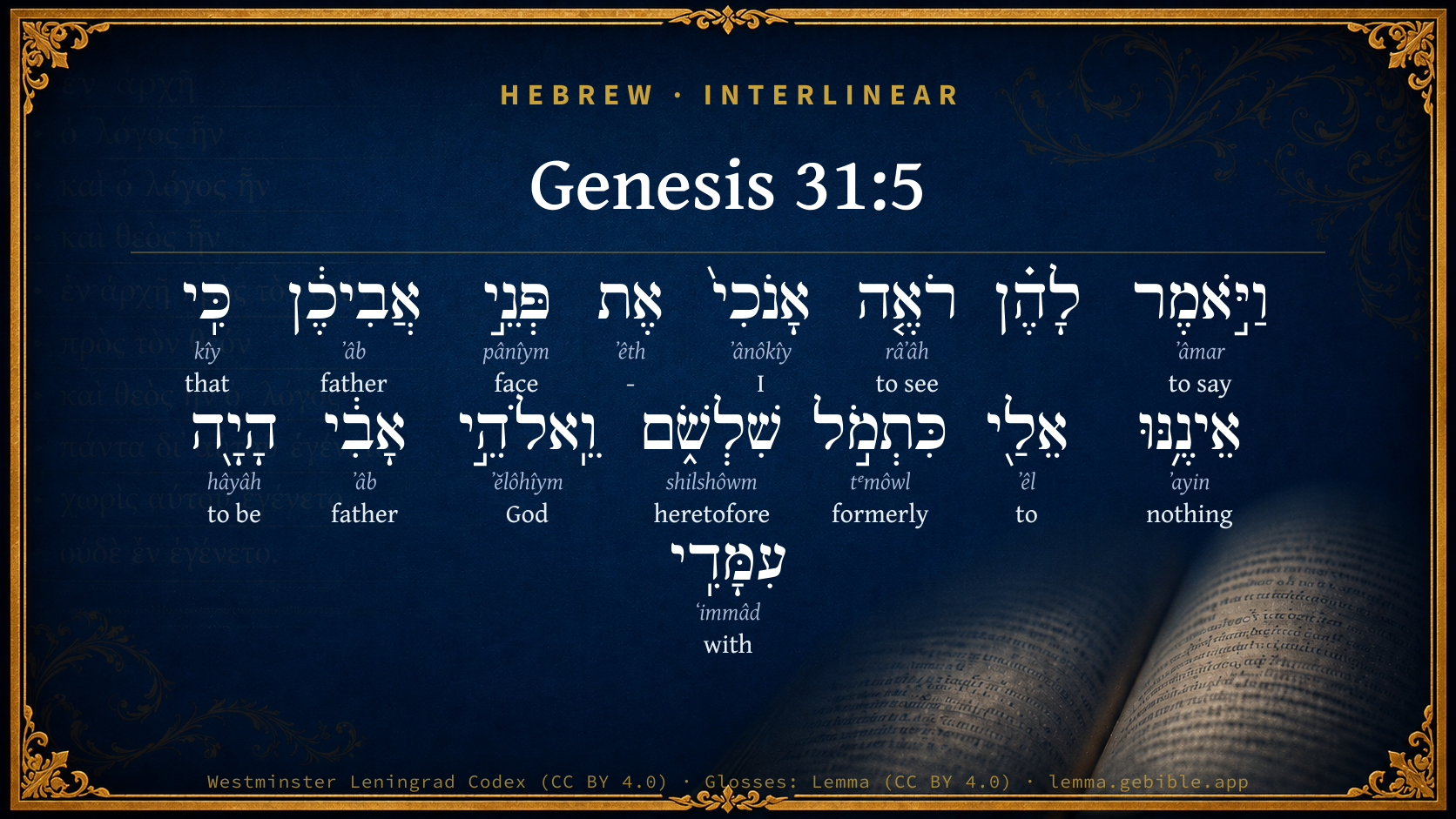
Genesis 31:5

Hebrew (Westminster Leningrad Codex) Genesis 31:5 appears in the Hebrew Old Testament. The text above is from the Westminster Leningrad Codex. Each word links to its Strong’s number, a concise gloss, and parsing drawn from the Open Scriptures Hebrew Bible morphology. Click any word for its full Brown-Driver-Briggs (BDB) entry.
Download image
Cite this verse

Genesis 31:5 (World English Bible). Public Domain. Lemma interlinear Bible study tool, https://lemma.gebible.app/v/genesis/31/5.

Show BibTeX & RIS
BibTeX
RIS
English Translation
and said to them, "I see the expression on your father's face, that it is not toward me as before; but the God of my father has been with me.
World English Bible · Public Domain
Download a study sheet

One document with this verse’s original text, its word-by-word gloss line, the meaning frame, cross-references with their text, attributed commentary, and full source and license credits — printable, and it pastes into notes with its structure intact.

This verse Autodidact and up

Study sheet (.html) Plain text (.txt)

A passage Seminary Student

Up to 50 verses in one chapter. A passage sheet keeps up to 6 commentary sources and 12 cross-references per verse, in the order this page ranks them, and says so on the sheet whenever that leaves anything out. Ask for a single verse and you get the Autodidact verse sheet above.

Everything on this page stays free to read, with no account — the sheet is a download of what is already on screen, not access to it.

Want to remove ads? Support Godless Engineer
Compare translations 3

The same verse in 3 English versions, stacked beneath the original-language interlinear above. Click any original word for its lexicon entry.

Each is an independent rendering of the whole verse — the interlinear is not word-aligned to these translations.

Highlighted words mark where these versions differ — a whole-verse word diff, not a word-by-word alignment.

  • World English Bible Public Domain
    and said to them, "I see the expression on your father's face, that it is not toward me as before; but the God of my father has been with me.
  • King James Version Public Domain
    And said unto them, I see your father's countenance, that it is not toward me as before; but the God of my father hath been with me.
  • unfoldingWord Literal Text CC BY-SA 4.0
    Then he said to them, “I have seen the face of your father, that he is not toward me as yesterday three days ago, but the God of my father has been with me.

unfoldingWord Literal Text — © unfoldingWord, licensed CC BY-SA 4.0. Word-aligned USFM3 via Door43 (git.door43.org/unfoldingWord/en_ult).

Versions to compare (up to 4)

3 of 4 selected

Show all 18 translations

Every available English version of this verse, each an independent rendering of the whole verse.

  • World English Bible Public Domain
    and said to them, "I see the expression on your father's face, that it is not toward me as before; but the God of my father has been with me.
  • Berean Standard Bible Public Domain
    and he told them, “I can see from your father’s countenance that his attitude toward me has changed; but the God of my father has been with me.
  • Majority Standard Bible Public Domain
    and he told them, “I can see from your father’s countenance that his attitude toward me has changed; but the God of my father has been with me.
  • King James Version Public Domain
    And said unto them, I see your father's countenance, that it is not toward me as before; but the God of my father hath been with me.
  • American Standard Version (1901) Public Domain
    and said unto them, I see your father's countenance, that it is not toward me as beforetime; but the God of my father hath been with me.
  • Revised Version (1885) Public Domain
    and said unto them, I see your father’s countenance, that it is not toward me as beforetime; but the God of my father hath been with me.
  • Geneva Bible (1599) Public Domain
    Then sayde hee vnto them, I see your fathers countenance, that it is not towardes me as it was wont, and the God of my father hath bene with me.
  • Douay-Rheims (1899) Public Domain
    And said to them: I see your father's countenance is not towards me as yesterday and the other day: but the God of my father hath been with me.
  • Young's Literal Translation Public Domain
    and saith to them, `I am beholding your father's face -- that it is not towards me as heretofore, and the God of my father hath been with me,
  • Literal Standard Version CC BY-SA 4.0
    and says to them, “I am beholding your father’s face—that it is not toward me as before, and the God of my father has been with me,
  • Unlocked Literal Bible CC BY-SA 4.0
    and said to them, “I see your father's attitude toward me has changed, but the God of my father has been with me.
  • unfoldingWord Literal Text CC BY-SA 4.0
    Then he said to them, “I have seen the face of your father, that he is not toward me as yesterday three days ago, but the God of my father has been with me.
  • Darby Bible Public Domain
    and said to them, I see your father's countenance, that it is not toward me as previously; but the God of my father has been with me.
  • World Messianic Bible Public Domain
    and said to them, “I see the expression on your father’s face, that it is not toward me as before; but the God of my father has been with me.
  • Webster's Bible Public Domain
    And said to them, I see your father's countenance, that it is not towards me as before: but the God of my father hath been with me.
  • Free Bible Version CC BY-SA 4.0
    “I've noticed that your father is treating me differently to the way he did before,” he told them. “But the God of my father will be with me.
  • Bible in Basic English Public Domain
    And he said to them, It is clear to me that your father's feeling is no longer what it was to me; but the God of my father has been with me
  • JPS Tanakh (1917) Public Domain
    and said unto them: 'I see your father's countenance, that it is not toward me as beforetime; but the God of my father hath been with me.

Literal Standard Version (2020), Covenant Press — licensed CC BY-SA 4.0. Text via the HelloAO Bible API (eBible.org). Unlocked Literal Bible (unfoldingWord) — licensed CC BY-SA 4.0. Text via the HelloAO Bible API (eBible.org). unfoldingWord Literal Text — © unfoldingWord, licensed CC BY-SA 4.0. Word-aligned USFM3 via Door43 (git.door43.org/unfoldingWord/en_ult). Free Bible Version, Dr. Jonathan Gallagher — licensed CC BY-SA 4.0. Text via the HelloAO Bible API (eBible.org).

Word by word

More ways to search: Search by grammar → Find every occurrence → Compare this word →

Practice this passage: Drill this verse → Learn its vocabulary →

כִּתְמֹ֣ל
tᵉmôwl
H8543
“like/as · formerly”
Preposition + Adverb
Part of Speech
Preposition + Adverb
Full BDB Definition

Origin: probably for H865

TWOT: 2521

before, before that time, beforetime, heretofore, of late, of old, these days, time(s) past, yesterday, day before yesterday, recently, formerly - yesterday - recently, formerly (usual usage) (figuratively) - as formerly, so more recently - from yesterday, already
  1. וַיֹּ֣אמֶר ʼâmar H559 “and · to say” Conjunction + Verb, Qal, Sequential Imperfect, 3rd Person, Masculine, Singular
  2. רֹאֶ֤ה râʼâh H7200 “seeing” Verb, Qal, Participle Active, Masculine, Singular, Absolute
  3. אָנֹכִי֙ ʼânôkîy H595 “I” Pronoun, Personal, 1st Person, Common, Singular
  4. אֶת ʼêth H853 “-” Particle, Direct Object
  5. פְּנֵ֣י pânîym H6440 “face(s) of” Noun, Common, Both, Plural, Construct
  6. אֲבִיכֶ֔ן ʼâb H1 “father · your” Noun, Common, Masculine, Singular, Construct + Suffix, Personal, 2nd Person, Feminine, Plural
  7. כִּֽי kîy H3588 “that” Conjunction
  8. אֵינֶ֥נּוּ ʼayin H369 “nothing · him” Particle, Negative + Suffix, Personal, 3rd Person, Masculine, Singular
  9. אֵלַ֖י ʼêl H413 “to · me” Preposition + Suffix, Personal, 1st Person, Common, Singular
  10. שִׁלְשֹׁ֑ם shilshôwm H8032 “heretofore” Noun, Common, Masculine, Singular, Absolute
  11. וֵֽאלֹהֵ֣י ʼĕlôhîym H430 “and · God(s) of” Conjunction + Noun, Common, Masculine, Plural, Construct
  12. אָבִ֔י ʼâb H1 “father · my” Noun, Common, Masculine, Singular, Construct + Suffix, Personal, 1st Person, Common, Singular
  13. הָיָ֖ה hâyâh H1961 “to be” Verb, Qal, Perfect, 3rd Person, Masculine, Singular
  14. עִמָּדִֽי ʻimmâd H5978 “with · me” Preposition + Suffix, Personal, 1st Person, Common, Singular

About this verse

These counts appear in no published source. They are computed here, from the morphology-tagged text and Lemma’s own curated glosses. What Lemma adds →

16
words
14
distinct lemmas
Pentateuch
section

Notable vocabulary

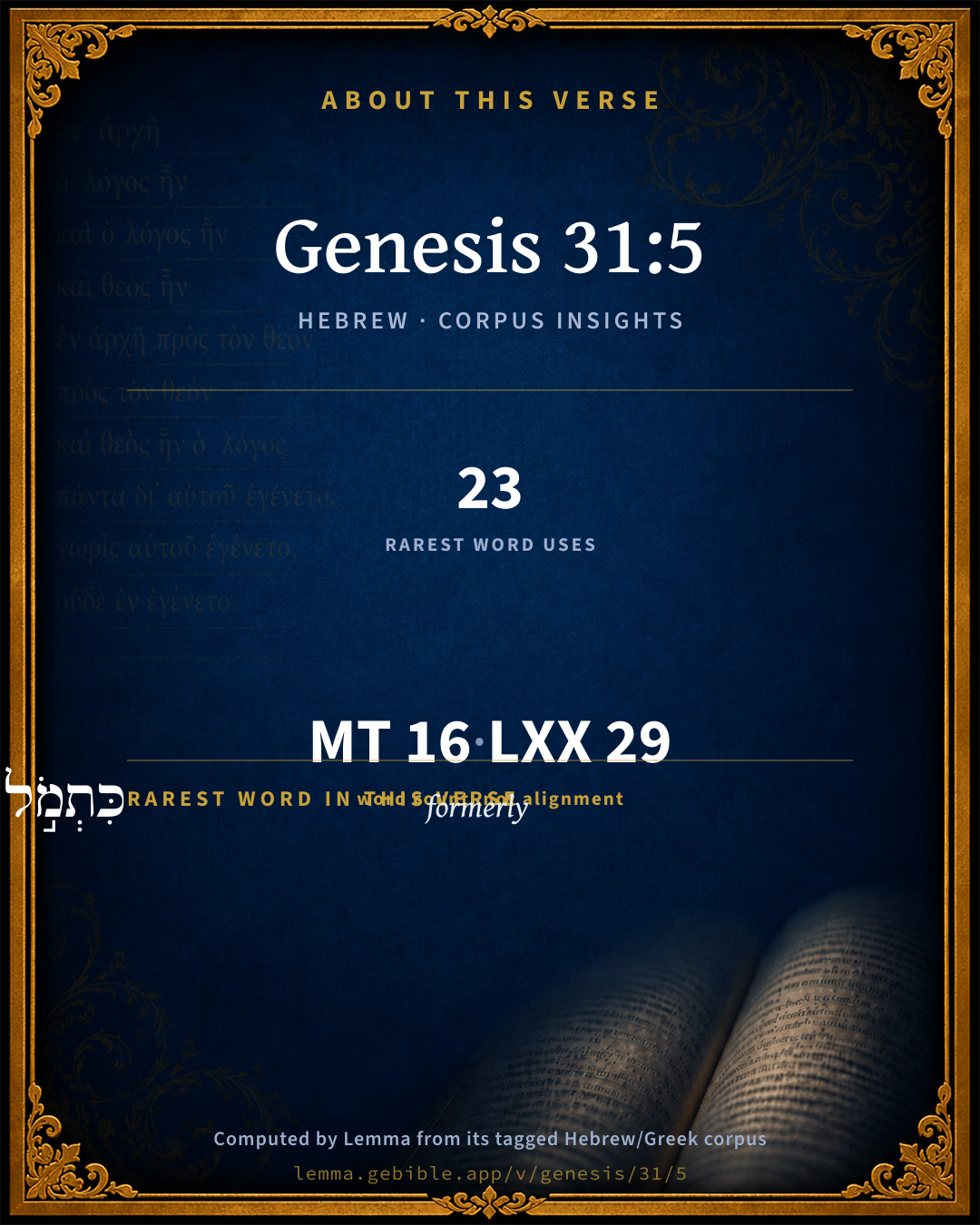
The rarest word here is כִּתְמֹ֣ל formerly H8543 — appearing just 23 times in the whole Hebrew Bible.

Shared distinctive vocabulary

כִּתְמֹ֣ל formerly H8543 occurs in 22 verses of the Hebrew Bible. Also found in:

Grammatical profile

  • 3 verbs
  • 5 nouns
  • 1 pronoun
  • 3 prepositions
  • 1 conjunction
  • 1 adverb
  • 2 particles

Verb forms

  • וַיֹּ֣אמֶר Qal · Sequential Imperfect
  • רֹאֶ֤ה Qal · Participle Active
  • הָיָ֖ה Qal · Perfect

Repetition

A word recurs within this verse — often emphatic in Hebrew:

  • אֲבִיכֶ֔ן father H1 ×2

Hebrew & Septuagint length

In English translation the verse runs 30 words from the Hebrew and 29 from the Septuagint (LXX English) — closely comparable.

A rough comparison of the two English renderings, which tokenize alike — not a word-level alignment.

Word counts can differ between the Hebrew and the Greek without any difference in meaning — e.g. the Hebrew direct-object marker אֵת has no separate Greek word, and Greek often adds the article ὁ.

In the original languages it is 16 Hebrew tokens and 29 Greek tokens — but the two are counted differently (Hebrew bundles its prefixes and suffixes into one token; the Greek is in lemma form), so that isn’t a like-for-like length.

Cross-references

8

Topical passages linked to Genesis 31:5 in the Treasury of Scripture Knowledge — connected by theme and wording, ordered by reader-vote popularity; previews shown in the World English Bible.

  • Genesis 31:2–3 Jacob saw the expression on Laban's face, and, behold, it was not toward him as before.
  • Genesis 31:42 Unless the God of my father, the God of Abraham, and the fear of Isaac, had been with me, surely now you would have sent me away empty. God has seen my affliction and the labor of my hands, and rebuked you last night."
  • Genesis 31:53 The God of Abraham, and the God of Nahor, the God of their father, judge between us." Then Jacob swore by the fear of his father, Isaac.
  • Genesis 48:15 He blessed Joseph, and said, "The God before whom my fathers Abraham and Isaac did walk, the God who has fed me all my life long to this day,
  • Genesis 32:9 Jacob said, "God of my father Abraham, and God of my father Isaac, Yahweh, who said to me, 'Return to your country, and to your relatives, and I will do you good.'
  • Genesis 50:17 "So you shall tell Joseph, 'Now please forgive the disobedience of your brothers, and their sin, because they did evil to you.' Now, please forgive the disobedience of the servants of the God of your father." Joseph wept when they spoke to him.
  • Genesis 21:22 It happened at that time, that Abimelech and Phicol the captain of his host spoke to Abraham, saying, "God is with you in all that you do.
  • Genesis 31:13 I am the God of Bethel, where you anointed a pillar, where you vowed a vow to me. Now arise, get out from this land, and return to the land of your birth."

Cross-references courtesy of OpenBible.info (CC BY 4.0).

Hebrew and Greek witnesses Masoretic Hebrew ↔ Greek Septuagint

The same verse in the two great witnesses to the Old Testament, shown verse-for-verse.

These are two independent witnesses, not word-aligned to each other, and the Septuagint is shown in lemma (dictionary) form.

Hebrew Genesis 31:5 Masoretic · Westminster Leningrad Codex

וַיֹּ֣אמֶר לָהֶ֗ן רֹאֶ֤ה אָנֹכִי֙ אֶת פְּנֵ֣י אֲבִיכֶ֔ן כִּֽי אֵינֶ֥נּוּ אֵלַ֖י כִּתְמֹ֣ל שִׁלְשֹׁ֑ם וֵֽאלֹהֵ֣י אָבִ֔י הָיָ֖ה עִמָּדִֽי

and said to them, "I see the expression on your father's face, that it is not toward me as before; but the God of my father has been with me.

World English Bible · Public Domain

Greek LXX Genesis 31:5 Septuagint · lemma form

καί εἶπον αὐτός ὁράω ἐγώ ὁ πρόσωπον ὁ πατήρ σύ ὅτι οὐ εἰμί πρός ἐγώ ὡς χθές καί τρίτος ἡμέρα ὁ δέ θεός ὁ πατήρ ἐγώ εἰμί μετά ἐγώ

And he said to them, I see the face of your father, that it is not toward me as before, but the God of my father was with me.

LXX2012 (modern English Septuagint) · Public Domain

Hebrew: Westminster Leningrad Codex (CC BY 4.0). Greek: Septuagint (public domain); English from LXX2012 (modern English Septuagint) (Public Domain). How the Septuagint differs from the Hebrew →

Targum (Aramaic paraphrase)

2

The Targum is the ancient Jewish Aramaic paraphrase of the Hebrew Scriptures — an interpretive translation, not the Hebrew text itself. Onkelos (literal) and Pseudo-Jonathan (expansive) render the Torah, and Jonathan the Prophets. Coverage is partial: where no permissively-licensed English translation exists for a verse, only the Aramaic is shown. This is verse-level text, not a word-by-word alignment to the Hebrew.

  1. Targum Onkelos Torah (Genesis–Deuteronomy)
    וַאֲמַר לְהֵן חָזֵי אֲנָא יָת סְבַר אַפֵּי אֲבוּכֶן אֲרֵי לֵיתוֹהִי עִמִּי כְּמֵאִתְמַלִּי וּמִדְּקַמֹּהִי וֵאלָהֵהּ דְּאַבָּא הֲוָה בְּסַעְדִּי

    (no public-domain English translation for this verse)

    Targum Onkelos — Aramaic: “Onkelos Genesis” (public domain); “Onkelos Exodus” (public domain); “Onkelos Leviticus” (public domain); “Onkelos Numbers” (public domain); “Onkelos Deuteronomy” (public domain). English: “Sefaria Community Translation” (CC0 1.0 (public-domain dedication)); “J.W. Etheridge. The Targums of Onkelos and Jonathan Ben Uzziel on the Pentateuch. London: Longmans, Green, 1862” (public domain). Text via Sefaria.

  2. Targum Pseudo-Jonathan Torah (Genesis–Deuteronomy)
    וַאֲמַר לְהֵין חָמֵי אָנָא יַת סְבַר אַפֵּי אֲבוּכוֹן וְהָא לֵיתְנוּן שַׁפְיַן עִמִי הֵי כִּדְאִיתְמְלִי וְהֵי כִּדְקָדְמוֹי וֵאלָהָא דְאַבָּא הֲוָה מֵימְרֵיהּ בְּסַעֲדִי

    And he said to them, I consider the looks of your father, and, behold, they are not peaceful with me as yesterday and as before it; but the God of my father hath been to my aid.

    Targum Pseudo-Jonathan — Aramaic: “Targum Jonathan on Genesis” (public domain); “Targum Jonathan on Exodus” (public domain); “Targum Jonathan on Leviticus” (public domain); “Targum Jonathan on Numbers” (public domain); “Targum Jonathan on Deuteronomy” (public domain). English: “The Targum of Jonathan ben Uzziel, trans. J. W. Etheridge, London, 1862” (public domain). Text via Sefaria.

Commentary

Notes on Genesis 31:5 from classic Christian and Jewish commentators (each source and its license shown beneath its notes). The classic Christian expositions comment on the surrounding passage and are grouped to its opening verse, so a note may address several verses; the Jewish commentaries on the Tanakh (Rashi and others) are per-verse, so they appear only where the commentator wrote on this verse.

Lemma curates 59 commentaries, every one of them public domain or Creative Commons licensed, each selected and text-cleaned for this edition rather than reprinted as found. About our sources →

Trapp's Complete Commentary

John Trapp

Gen 31:5 And said unto them, I see your father’s countenance, that it [is] not toward me as before; but the God of my father hath been with me.

Ver. 5. I see your father’s countenance, &c.] This is the world’s wages. All Jacob’s good service is now forgotten. Do an unthankful person nineteen kindnesses, unless you add the twentieth, all is lost {a} Perraro grati homines reperiuntur , saith Cicero. {b} Nemo beneficium in Calendarium scribit , saith Seneca. And the poet Ausonius not unfitly -

“Sunt homines humeris quos siquis gestat ad urbem

Ausoniam, domiti quae caput orbis erat:

Nec tamen ad portam placide deponat eosdem,

Gratia praeteriti nulla laboris erit”

{a} Pαλαια μεν ευδει χαρις αμνημονες δε βροτοι. - Pindar.

{b} Orat. pro Planc.

John Trapp, A Commentary or Exposition upon All the Books of the Old and New Testament (1647–1656) — public domain. Text from a community e-Sword module.

Geneva Bible (1599)

Geneva Bible translators

Hebrew, as yesterday and before yesterday.

The God whom my father worshipped.

Geneva Bible (1599) marginal notes — public domain. Text via Bolls.life.

John Calvin's Commentaries

5. I see your father’s countenance. This address consists of two parts. For first, he speaks of his own integrity, and expostulates concerning the perfidy of his father-in-law. He next testifies that God is the author of his prosperity, in order that Rachel and Leah may the more willingly accompany him. And whereas he had become very rich in a short space of time, he purges himself from all suspicion; and even appeals to them as witnesses of his diligence. And though Moses does not minutely relate everything; yet there is no doubt that the honesty of their husband had been made clear to them by many proofs, and that, on the other hand, the injuries, frauds, and rapacity of their father, were well known. When he complains that his wages had been changed ten times, it is probable that the number ten is simply put for many times. Nevertheless it may be, that within six years Laban might thus frequently have broken his agreements; since there would be twice as many seasons of breeding lambs, namely, at spring and autumn, as we have said. But this narration of the dream, although it follows in a subsequent part of the history, shows that holy Jacob had undertaken nothing but by the Divine command. Moses had before related the transaction simply, saying nothing respecting the counsel from which it had proceeded; but now, in the person of Jacob himself, he removes all doubt respecting it; for he does not intimate that Jacob was lying, in order, by this artifice, to deceive his wives; but he introduces the holy servant of God, avowing truly, and without pretense, the case as it really was. For otherwise he would have abused the name of God, not without abominable impiety, by connecting this vision with that former one, in which we see that the gate of heaven was opened unto him.

John Calvin's Commentaries (1540-1563) — public domain. Text from the Calvin Translation Society English edition (1840s-50s) via the Christian Classics Ethereal Library (ccel.org). Calvin's coverage is partial (roughly two-thirds of the Bible); uncommented books and verses are honest gaps, never fabricated. The 19th-century editor's footnotes and remarks are omitted so the notes are faithfully Calvin's own voice.

John Gill's Exposition

And said unto them, I see your father's countenance, that it is not towards me as before,.... See Gill on Gen 31:2; no notice is taken of what their brethren, the sons of Laban, had said:

but the God of my father hath been with me; not only by affording him his gracious presence with him, which supported him under all his troubles; but by his good providence prospering and succeeding him in his outward affairs, as well as he had lately appeared to him, and encouraged him to return to his own country.

John Gill's Exposition of the Whole Bible (1746–1763) — public domain (CC PDM 1.0). Text via the HelloAO Bible API.

Matthew Poole's English Annotations

Either,

1. Hath blessed me; hath stood constantly by me, when your father hath failed and deceived me. Or,

2. Hath appeared unto me, as Gen 31:13.

Matthew Poole's English Annotations on the Holy Bible (1683–1685) — public domain. Text from a community e-Sword/MySword module.

The Pulpit Commentary

And said unto them, I see your father"s countenance, that it is not toward me as before (vide supra); but the God of my father literally, and the Elohim of my father, the term Elohim employed by Jacob not being due to the vagueness of the religious knowledge" possessed by his wives (Hengstenberg), but to a desire on his own part either to distinguish the God of his father from the gods of the nations, or the idols which Laban worshipped ("Speaker s Commentary"), or perhaps, while using an expression exactly equivalent to Jehovah, to bring out a contrast between the Divine favor and that of Laban (Quarry)hath been with me literally, was with me; not the night before simply, but during the past six years, as he explains in ver. 7.

The Pulpit Commentary (1880–1919), ed. H.D.M. Spence-Jones & Joseph S. Exell — public domain. Text from a community e-Sword module.

Radak

Rabbi David Kimhi (Radak)

ואלוקי אבי היה עמדי, he, Lavan, hates me on account of my having become wealthier than he is. This is not because I aimed to be so wealthy but because the G’d of my father was with me and made me so successful in my endeavours.

Radak on the Tanakh — English translations: “Sefaria Community Translation” (CC0 1.0 (public-domain dedication)); “Eliyahu Munk, HaChut Hameshulash” (CC BY 4.0); “Rabbi Mike Feuer, Jerusalem Anthology” (CC BY 4.0); and “R. David Kimhi on the first book of Psalms, Translated by R.G. Finch, London, 1919” (public domain). Text via Sefaria.

Lesson kit

Teaching starters — assembled from the data on this page, not authored interpretation. Every prompt links to the verse data it draws on. Edit before teaching.

Genesis, in the Pentateuch, opens this verse with 16 words (14 distinct Hebrew lemmas). Its most distinctive word is tᵉmôwl (“formerly”). A historical commentator’s framing appears above. Read the whole chapter for the surrounding context.

Discussion questions

  1. What does “formerly” (tᵉmôwl) contribute to the verse as a whole?
  2. How does Genesis 31:2, which shares the word «formerly», read alongside this verse?
  3. What does the repetition of “father” (2× in this one verse) do in this verse?
  4. The translations on this page render this verse differently — a whole-verse word diff, not a word-by-word alignment. What might account for the different wordings?
  5. «וַיֹּ֣אמֶר» is a Qal Sequential Imperfect verb. How does that grammatical form shape the action described?
  6. Compare how Trapp's Complete Commentary and Geneva Bible (1599) read this verse. Where do they agree or differ?

Things to notice

Reading settings

Reading text

Shown beneath each verse's original-language words.

Old Testament
Old Testament edition

Read the OT as the Masoretic Hebrew (MT) or the Greek Septuagint (LXX).

English shown for the Greek Septuagint (in the Hebrew ↔ Greek comparison).

Comparing translations? Open the Compare panel on any verse page to stack up to four side by side.