Deuteronomy 24:16

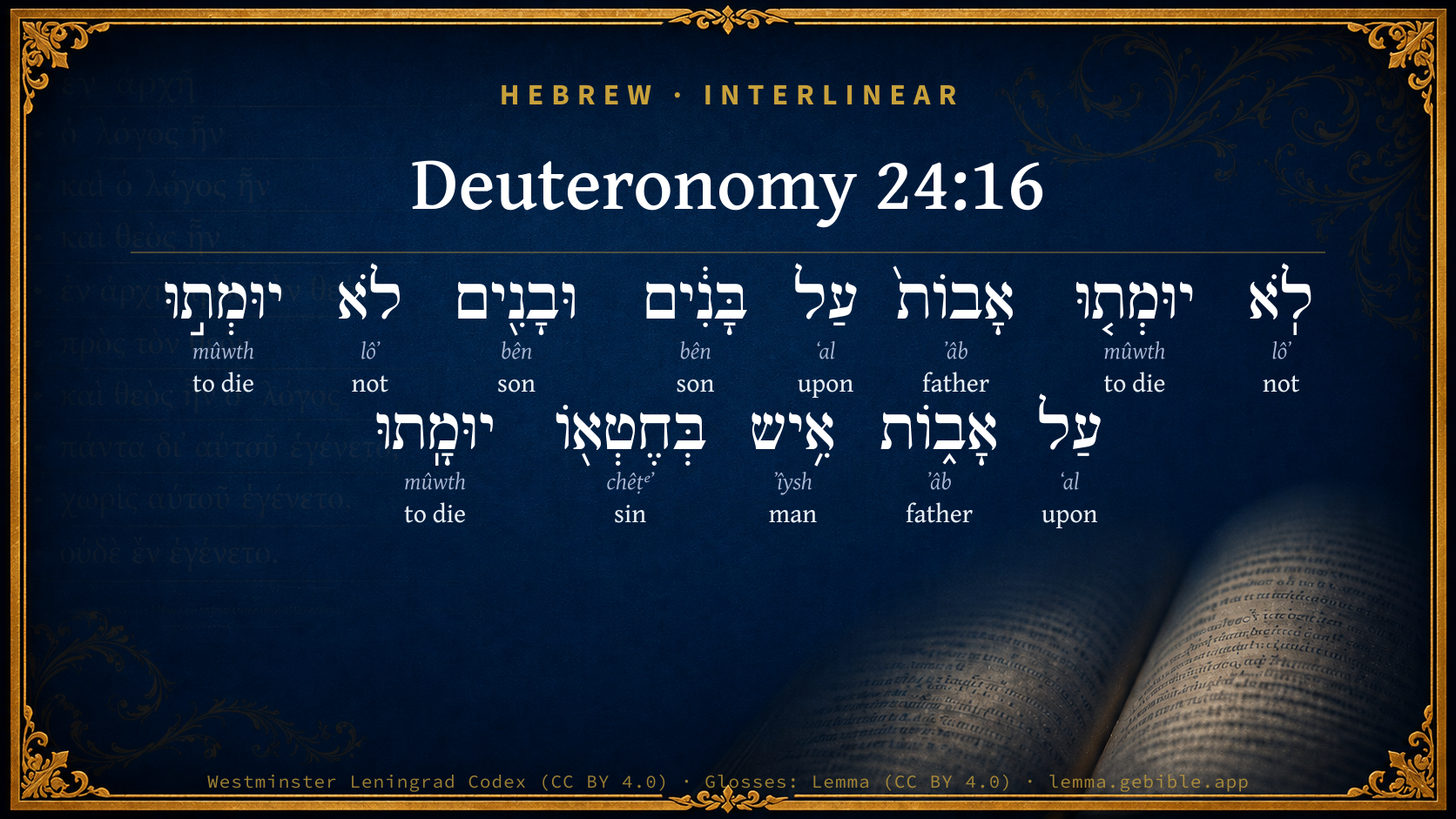
Hebrew (Westminster Leningrad Codex) Deuteronomy 24:16 appears in the Hebrew Old Testament. The text above is from the Westminster Leningrad Codex. Each word links to its Strong’s number, a concise gloss, and parsing drawn from the Open Scriptures Hebrew Bible morphology. Click any word for its full Brown-Driver-Briggs (BDB) entry.
Download image
Cite this verse

Deuteronomy 24:16 (World English Bible). Public Domain. Lemma interlinear Bible study tool, https://lemma.gebible.app/v/deuteronomy/24/16.

Show BibTeX & RIS
BibTeX
RIS
English Translation
The fathers shall not be put to death for the children, neither shall the children be put to death for the fathers: every man shall be put to death for his own sin.
World English Bible · Public Domain
Download a study sheet

One document with this verse’s original text, its word-by-word gloss line, the meaning frame, cross-references with their text, attributed commentary, and full source and license credits — printable, and it pastes into notes with its structure intact.

This verse Autodidact and up

Study sheet (.html) Plain text (.txt)

A passage Seminary Student

Up to 50 verses in one chapter. A passage sheet keeps up to 6 commentary sources and 12 cross-references per verse, in the order this page ranks them, and says so on the sheet whenever that leaves anything out. Ask for a single verse and you get the Autodidact verse sheet above.

Everything on this page stays free to read, with no account — the sheet is a download of what is already on screen, not access to it.

Want to remove ads? Support Godless Engineer
Compare translations 3

The same verse in 3 English versions, stacked beneath the original-language interlinear above. Click any original word for its lexicon entry.

Each is an independent rendering of the whole verse — the interlinear is not word-aligned to these translations.

Highlighted words mark where these versions differ — a whole-verse word diff, not a word-by-word alignment.

  • World English Bible Public Domain
    The fathers shall not be put to death for the children, neither shall the children be put to death for the fathers: every man shall be put to death for his own sin.
  • King James Version Public Domain
    The fathers shall not be put to death for the children, neither shall the children be put to death for the fathers: every man shall be put to death for his own sin.
  • unfoldingWord Literal Text CC BY-SA 4.0
    Fathers shall not be put to death on account of sons, and sons shall not be put to death on account of fathers. A man shall be put to death for his sin.

unfoldingWord Literal Text — © unfoldingWord, licensed CC BY-SA 4.0. Word-aligned USFM3 via Door43 (git.door43.org/unfoldingWord/en_ult).

Versions to compare (up to 4)

3 of 4 selected

Show all 18 translations

Every available English version of this verse, each an independent rendering of the whole verse.

  • World English Bible Public Domain
    The fathers shall not be put to death for the children, neither shall the children be put to death for the fathers: every man shall be put to death for his own sin.
  • Berean Standard Bible Public Domain
    Fathers shall not be put to death for their children, nor children for their fathers; each is to die for his own sin.
  • Majority Standard Bible Public Domain
    Fathers shall not be put to death for their children, nor children for their fathers; each is to die for his own sin.
  • King James Version Public Domain
    The fathers shall not be put to death for the children, neither shall the children be put to death for the fathers: every man shall be put to death for his own sin.
  • American Standard Version (1901) Public Domain
    The fathers shall not be put to death for the children, neither shall the children be put to death for the fathers: every man shall be put to death for his own sin.
  • Revised Version (1885) Public Domain
    The fathers shall not be put to death for the children, neither shall the children be put to death for the fathers: every man shall be put to death for his own sin.
  • Geneva Bible (1599) Public Domain
    The fathers shall not be put to death for the children, nor the children put to death for the fathers, but euery man shalbe put to death for his owne sinne.
  • Douay-Rheims (1899) Public Domain
    The fathers shall not be put to death for the children, nor the children for the fathers, but every one shall die for his own sin.
  • Young's Literal Translation Public Domain
    `Fathers are not put to death for sons, and sons are not put to death for fathers -- each for his own sin, they are put to death.
  • Literal Standard Version CC BY-SA 4.0
    Fathers are not put to death for sons, and sons are not put to death for fathers—they are each put to death for his own sin.
  • Unlocked Literal Bible CC BY-SA 4.0
    The parents must not be put to death for their children, neither must the children be put to death for their parents. Instead, everyone must be put to death for his own sin.
  • unfoldingWord Literal Text CC BY-SA 4.0
    Fathers shall not be put to death on account of sons, and sons shall not be put to death on account of fathers. A man shall be put to death for his sin.
  • Darby Bible Public Domain
    The fathers shall not be put to death for the sons, neither shall the sons be put to death for the fathers: every man shall be put to death for his own sin.
  • World Messianic Bible Public Domain
    The fathers shall not be put to death for the children, neither shall the children be put to death for the fathers. Every man shall be put to death for his own sin.
  • Webster's Bible Public Domain
    The fathers shall not be put to death for the children, neither shall the children be put to death for the fathers: every man shall be put to death for his own sin.
  • Free Bible Version CC BY-SA 4.0
    Fathers are not to be executed because of their children, and children are not to be executed because of their fathers. Each person is to be executed because of their own sin.
  • Bible in Basic English Public Domain
    Fathers are not to be put to death for their children or children for their fathers: every man is to be put to death for the sin which he himself has done.
  • JPS Tanakh (1917) Public Domain
    The fathers shall not be put to death for the children, neither shall the children be put to death for the fathers; every man shall be put to death for his own sin.

Literal Standard Version (2020), Covenant Press — licensed CC BY-SA 4.0. Text via the HelloAO Bible API (eBible.org). Unlocked Literal Bible (unfoldingWord) — licensed CC BY-SA 4.0. Text via the HelloAO Bible API (eBible.org). unfoldingWord Literal Text — © unfoldingWord, licensed CC BY-SA 4.0. Word-aligned USFM3 via Door43 (git.door43.org/unfoldingWord/en_ult). Free Bible Version, Dr. Jonathan Gallagher — licensed CC BY-SA 4.0. Text via the HelloAO Bible API (eBible.org).

Word by word

More ways to search: Search by grammar → Find every occurrence → Compare this word →

Practice this passage: Drill this verse → Learn its vocabulary →

בְּחֶטְא֖וֹ
chêṭᵉʼ
H2399
“in/at · sin · his”
Preposition + Noun, Common, Masculine, Singular, Construct + Suffix, Personal, 3rd Person, Masculine, Singular
Part of Speech
Preposition + Noun
Type
Common
Gender
Masculine
Number
Singular
State
Construct
Full BDB Definition

Origin: from H2398

TWOT: 638a

sin - sin - guilt for sin - punishment for sin
  1. לֹֽא lôʼ H3808 “not” Particle, Negative
  2. יוּמְת֤וּ mûwth H4191 “to die” Verb, Hophal, Imperfect, 3rd Person, Masculine, Plural
  3. אָבוֹת֙ ʼâb H1 “fathers” Noun, Common, Masculine, Plural, Absolute
  4. עַל ʻal H5921 “upon” Preposition
  5. בָּנִ֔ים bên H1121 “sons” Noun, Common, Masculine, Plural, Absolute
  6. וּבָנִ֖ים bên H1121 “and · sons” Conjunction + Noun, Common, Masculine, Plural, Absolute
  7. לֹא lôʼ H3808 “not” Particle, Negative
  8. יוּמְת֣וּ mûwth H4191 “to die” Verb, Hophal, Imperfect, 3rd Person, Masculine, Plural
  9. עַל ʻal H5921 “upon” Preposition
  10. אָב֑וֹת ʼâb H1 “fathers” Noun, Common, Masculine, Plural, Absolute
  11. אִ֥יש ʼîysh H376 “man” Noun, Common, Masculine, Singular, Absolute
  12. יוּמָֽתוּ mûwth H4191 “to die” Verb, Hophal, Imperfect, 3rd Person, Masculine, Plural

About this verse

These counts appear in no published source. They are computed here, from the morphology-tagged text and Lemma’s own curated glosses. What Lemma adds →

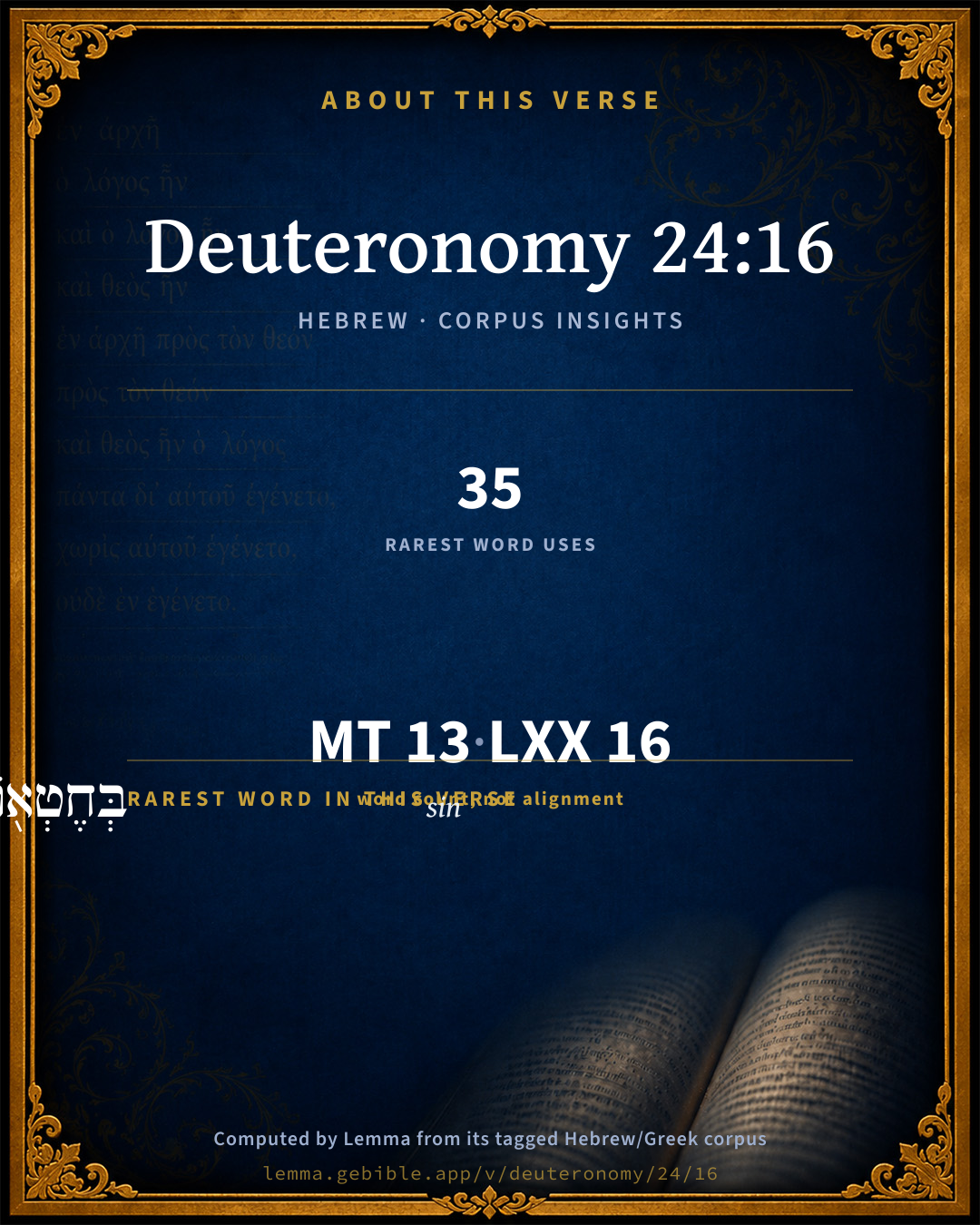
13
words
7
distinct lemmas
Pentateuch
section

Shared distinctive vocabulary

בְּחֶטְא֖וֹ sin H2399 occurs in 34 verses of the Hebrew Bible. Also found in:

Grammatical profile

  • 3 verbs
  • 6 nouns
  • 2 prepositions
  • 2 particles

Verb forms

  • יוּמְת֤וּ Hophal · Imperfect
  • יוּמְת֣וּ Hophal · Imperfect
  • יוּמָֽתוּ Hophal · Imperfect

Repetition

Words recur within this verse — often emphatic in Hebrew:

  • יוּמְת֤וּ to die H4191 ×3
  • אָבוֹת֙ father H1 ×2
  • עַל upon H5921 ×2
  • בָּנִ֔ים son H1121 ×2
  • לֹֽא not H3808 ×2

Hebrew & Septuagint length

In English translation the verse runs 33 words from the Hebrew and 24 from the Septuagint (LXX English) — closely comparable.

A rough comparison of the two English renderings, which tokenize alike — not a word-level alignment.

Word counts can differ between the Hebrew and the Greek without any difference in meaning — e.g. the Hebrew direct-object marker אֵת has no separate Greek word, and Greek often adds the article ὁ.

In the original languages it is 13 Hebrew tokens and 16 Greek tokens — but the two are counted differently (Hebrew bundles its prefixes and suffixes into one token; the Greek is in lemma form), so that isn’t a like-for-like length.

Cross-references

4

Topical passages linked to Deuteronomy 24:16 in the Treasury of Scripture Knowledge — connected by theme and wording, ordered by reader-vote popularity; previews shown in the World English Bible.

  • Ezekiel 18:20 The soul who sins, he shall die: the son shall not bear the iniquity of the father, neither shall the father bear the iniquity of the son; the righteousness of the righteous shall be on him, and the wickedness of the wicked shall be on him.
  • 2 Chronicles 25:4 But he didn't put their children to death, but did according to that which is written in the law in the book of Moses, as Yahweh commanded, saying, The fathers shall not die for the children, neither shall the children die for the fathers; but every man shall die for his own sin.
  • Jeremiah 31:29–30 In those days they shall say no more, The fathers have eaten sour grapes, and the children's teeth are set on edge.
  • 2 Kings 14:5–6 It happened, as soon as the kingdom was established in his hand, that he killed his servants who had slain the king his father:

Cross-references courtesy of OpenBible.info (CC BY 4.0).

Hebrew and Greek witnesses Masoretic Hebrew ↔ Greek Septuagint

The same verse in the two great witnesses to the Old Testament, shown verse-for-verse.

These are two independent witnesses, not word-aligned to each other, and the Septuagint is shown in lemma (dictionary) form.

Hebrew Deuteronomy 24:16 Masoretic · Westminster Leningrad Codex

לֹֽא יוּמְת֤וּ אָבוֹת֙ עַל בָּנִ֔ים וּבָנִ֖ים לֹא יוּמְת֣וּ עַל אָב֑וֹת אִ֥יש בְּחֶטְא֖וֹ יוּמָֽתוּ

The fathers shall not be put to death for the children, neither shall the children be put to death for the fathers: every man shall be put to death for his own sin.

World English Bible · Public Domain

Greek LXX Deuteronomy 24:16 Septuagint · lemma form

οὐ ἀποθνήσκω πατήρ ὑπέρ τέκνον καί υἱός οὐ ἀποθνήσκω ὑπέρ πατήρ ἕκαστος ὁ ἑαυτοῦ ἁμαρτία ἀποθνήσκω

You shall not unjustly withhold the wages of the poor and needy of your brethren, or of the strangers who are in your cities.

LXX2012 (modern English Septuagint) · Public Domain

Hebrew: Westminster Leningrad Codex (CC BY 4.0). Greek: Septuagint (public domain); English from LXX2012 (modern English Septuagint) (Public Domain). How the Septuagint differs from the Hebrew →

Targum (Aramaic paraphrase)

2

The Targum is the ancient Jewish Aramaic paraphrase of the Hebrew Scriptures — an interpretive translation, not the Hebrew text itself. Onkelos (literal) and Pseudo-Jonathan (expansive) render the Torah, and Jonathan the Prophets. Coverage is partial: where no permissively-licensed English translation exists for a verse, only the Aramaic is shown. This is verse-level text, not a word-by-word alignment to the Hebrew.

  1. Targum Onkelos Torah (Genesis–Deuteronomy)
    לָא יְמוּתוּן אֲבָהָן עַל פּוּם בְּנִין וּבְנִין לָא יְמוּתוּן עַל פּוּם אֲבָהָן אֱנַשׁ בְּחוֹבֵהּ יְמוּתוּן

    (no public-domain English translation for this verse)

    Targum Onkelos — Aramaic: “Onkelos Genesis” (public domain); “Onkelos Exodus” (public domain); “Onkelos Leviticus” (public domain); “Onkelos Numbers” (public domain); “Onkelos Deuteronomy” (public domain). English: “Sefaria Community Translation” (CC0 1.0 (public-domain dedication)); “J.W. Etheridge. The Targums of Onkelos and Jonathan Ben Uzziel on the Pentateuch. London: Longmans, Green, 1862” (public domain). Text via Sefaria.

  2. Targum Pseudo-Jonathan Torah (Genesis–Deuteronomy)
    לָא יִתְקַטְלוּן אַבְהָן לָא בְּסַהֲדוּת וְלָא בְחוֹבֵי בְּנִין וּבְנִין לָא יִתְקַטְלוּן לָא בְסַהֲדוּת וְלָא בְחוֹבֵי אַבְהָן אִישׁ בְּחוֹבֵי עַל סַהֲדִין כְּשֵׁירִין יִתְקַטְלוּן

    Fathers shall not die either by the testimony or for the sin of the children, and children shall not die either by the testimony or for the sin of the fathers: every one shall die, by proper witnesses, for his own sin.

    Targum Pseudo-Jonathan — Aramaic: “Targum Jonathan on Genesis” (public domain); “Targum Jonathan on Exodus” (public domain); “Targum Jonathan on Leviticus” (public domain); “Targum Jonathan on Numbers” (public domain); “Targum Jonathan on Deuteronomy” (public domain). English: “The Targum of Jonathan ben Uzziel, trans. J. W. Etheridge, London, 1862” (public domain). Text via Sefaria.

Commentary

Notes on Deuteronomy 24:16 from classic Christian and Jewish commentators (each source and its license shown beneath its notes). The classic Christian expositions comment on the surrounding passage and are grouped to its opening verse, so a note may address several verses; the Jewish commentaries on the Tanakh (Rashi and others) are per-verse, so they appear only where the commentator wrote on this verse.

Lemma curates 59 commentaries, every one of them public domain or Creative Commons licensed, each selected and text-cleaned for this edition rather than reprinted as found. About our sources →

Joseph Benson's Commentary

Deu 24:16. Not be put to death — If the one be free from the guilt of the other’s sin, except in those cases where the sovereign Lord of life and death, before whom none is innocent, hath commanded it, as Deu 13:15; Jos 7:24. For though God do visit the father’s sins upon the children, (Exodus 20.,) yet he will not suffer men to do so.

Joseph Benson's Commentary on the Old and New Testaments (1811–1818) — public domain. Text from a community e-Sword module.

Keil & Delitzsch

C. F. Keil & F. Delitzsch

Warning against Injustice. - Deu 24:16. Fathers were not to be put to death upon (along with) their sons, nor sons upon (along with) their fathers, i.e., they were not to suffer the punishment of death with them for crimes in which they had no share; but every one was to be punished simply for his own sin. This command was important, to prevent an unwarrantable and abusive application of the law which is manifest in the movements of divine justice to the criminal jurisprudence of the lane (Exo 20:5), since it was a common thing among the heathen nations - e.g., the Persians, Macedonians, and others - for the children and families of criminals to be also put to death (cf. Est 9:13-14; Herod. iii. 19; Ammian Marcell. xxiii. 6; Curtius, vi. 11, 20, etc.). An example of the carrying out of this law is to be found in Kg2 14:6; Ch2 25:4. In Deu 24:17, Deu 24:18, the law against perverting the right of strangers, orphans, and widows, is repeated from Exo 22:20-21, and Exo 23:9; and an addition is made, namely, that they were not to take a widow's raiment in pledge (cf. Lev 19:33-34).

Keil & Delitzsch — Biblical Commentary on the Old Testament (1861–1891) — public domain (CC PDM 1.0). Text via the HelloAO Bible API. (Old Testament only.)

Jamieson, Fausset & Brown

Robert Jamieson, A. R. Fausset & David Brown

The fathers shall not be put to death for the children--The rule was addressed for the guidance of magistrates, and it established the equitable principle that none should be responsible for the crimes of others.

Jamieson, Fausset & Brown — Commentary Critical and Explanatory on the Whole Bible (1871) — public domain (CC PDM 1.0). Text via the HelloAO Bible API.

Adam Clarke's Commentary

Verse 16. The fathers shall not be put to death for the children, &c.] This law is explained and illustrated in sufficient detail, Eze 18:1-9 &c.

Adam Clarke's Commentary on the Bible (1810–1826) — public domain. Text from a community e-Sword/MySword module.

Ellicott's Commentary for English Readers

(16) The fathers shall not be put to death for the children, neither shall the children be put to death for the fathers.—A special note of the observance of this precept by Amaziah son of Joash is noticed both in Kings and Chronicles. See marginal references. It was not observed by the Persians in the case of Daniel’s accusers (Dan_6:24).

The case of Achan, who “perished not alone in his iniquity,” falls under a different head. See Notes on Joshua 7.

A Bible Commentary for English Readers, edited by Charles John Ellicott (1878–1897) — public domain. Text from a community e-Sword module.

The Cambridge Bible for Schools and Colleges

gen. ed. J. J. S. Perowne

16. Responsibility for Crime is Individual. The opposition of this principle to that which prevailed in many ancient nations (Herod. iii. 119, Est_9:13 f., Dan_6:24 (25)), and which seems to have prevailed in Israel (JE, Jos_7:24, 2Ki_9:26, cp. Deu_14:6), when the family was regarded as a moral unit, and the children were put to death with their father in expiation of his crime, is very striking, and the more so that the ethical solidarity of the nation is so constantly assumed by D. It has therefore been doubted whether the law belonged originally to D. Some take it as dependent on Jer_31:29, or Ezekiel 18 on the ground that the principle of individual responsibility is there proclaimed as if for the first time, in opposition to the older ideas. But 2Ki_14:6 records that Amaziah when putting to death the assassins of his father did not also slay their children—apparently an innovation on the usual practice. The deuteronomic editor of Kings quotes D’s law as the King’s authority for his clemency. But general laws so often rose from individual cases that it is possible that this law (which is not found in any other code) was the result of Amaziah’s innovating example, and is, therefore, one of the several incorporated by D from earlier sources. Note that it is not in the direct form of address nor otherwise deuteronomic in its phrasing. See further Jerus. ii. 113 ff.

The Cambridge Bible for Schools and Colleges (gen. ed. J. J. S. Perowne; Cambridge University Press, 1878–1918) — public domain. Text from a community e-Sword module.

John Gill's Exposition

The fathers shall not be put to death for the children,.... By the civil magistrates, for sins committed by them of a capital nature, and which are worthy of death:

neither shall the children be put to death for the fathers; for sins committed by them that deserve it:

every man shall be put to death for his own sin: which is but just and reasonable; see Eze 18:4; which is no contradiction to Exo 20:5; that respects what God himself would do, this what Israel, or the civil magistrates in it, should do; this is a command on Israel, as Aben Ezra observes; that the declaration of the sovereign Being, who is not bound by any law. Jarchi interprets these words differently, as that the one should not be put to death by the testimony of the other; and it is a rule with the Jews,"that an oath of witness is taken of men, and not of women; of those that are not akin, and not of those that are nearly related (p):''on which one of the commentators observes (q) that such that are near akin are not fit to bear testimony, because it is written, "the father shall not be put to death for the children"; that is, for the testimony of the children. Jarchi indeed mentions the other sense, for the sins of the children, which has been given, and is undoubtedly the true sense of the text. The Targum of Jonathan gives both;"fathers should not be put to death, neither by the testimony, nor for the sins of the children; and children shall not be put to death, neither by the testimony, nor for the sins of fathers; but every man shall be put to death for his own sin by proper witnesses.''

(p) Misn. Shebuot, c. 4. sect. 1. (q) Bartenora in ib.

John Gill's Exposition of the Whole Bible (1746–1763) — public domain (CC PDM 1.0). Text via the HelloAO Bible API.

Albert Barnes' Notes on the Bible

A caution addressed to earthly judges. Among other Oriental nations the family of a criminal was commonly involved in his punishment (compare Est 9:13-14). In Israel it was not to be so; compare marginal references.

Albert Barnes' Notes on the Bible (1834–1885) — public domain. Text from a community e-Sword/MySword module.

Haydock's Catholic Bible Commentary

Sin. Judges have no right to punish any but those who have transgressed. (Calmet) --- God may for reasons known to himself, which cannot be unjust, visit the sins of the fathers upon their children; (Exodus xx. 5) and hence, (Josue vii.) he ordered the family of Achan to be involved in his punishment. Temporal sufferings, or death itself, are not however always a misfortune. They frequently prove a source of inconceivable blessings, Romans v. 3. (Haydock) --- The Rabbins understand, that fathers and children are not to be received as witnesses against each other, (Onkelos) which seems foreign to the sense of the present law. (Calmet)

George Leo Haydock (1774–1849), Haydock's Catholic Family Bible and Commentary, 1859 edition — public domain. Excludes Psalms (Douay-Rheims chapter numbering differs from Protestant) and Deuterocanonical books (Catholic canon only).

Matthew Poole's English Annotations

Understand it thus, if the one be free from the guilt of the other’s sin, and except in those cases where the sovereign Lord of life and death, before whom none is innocent, hath commanded it, as Deu 13; Jos 7:24. For this law is given to men, not to God; and though God do visit the father’s sins upon the children, Exo 20, yet he will not suffer men to do so.

For his own sin, understand only, and not for any other man’s sin.

Matthew Poole's English Annotations on the Holy Bible (1683–1685) — public domain. Text from a community e-Sword/MySword module.

Whedon's Commentary on the Bible

Daniel D. Whedon

16. The fathers shall not be put to death for the children — Among the Eastern nations the family of the guilty criminal was frequently made to suffer, the innocent with the guilty. Comp. Est_9:13-14.

Daniel D. Whedon (gen. ed.), Commentary on the Old and New Testaments (1874–1909) — public domain. Text from a community e-Sword module.

The Pulpit Commentary

Among heathen nations it was common for a whole family to be involved in the penalty incurred by the head of the family, and to be put to death along with him. (cf. Est_9:13, Est_9:14; Herod., 3:118, 119; Ammian. Marcell., 23. 6; Curtius, 6:11, 20; Claudian, "In Eutrop.," 2:478; Cicero, "Epist. ad Brut.," 12, 15) Such severity of retribution is here prohibited in the penal code of the Israelites. Though God, in the exercise of his absolute sovereignty, might visit the sins of the parent upon the children, (Exo_20:5) earthly judges were not to assume this power. Only the transgressor himself was to bear the penalty of his sin. (cf. 2Ki_14:6)

Vers. 16-22. Doing justice and loving mercy.

I EACH SOUL IS TO BEAR ITS OWN SIN. (Ver. 16.) This verse lays down the rule of human jurisprudence. Loss and suffering to the innocent, as a result of the course of justice inflicting punishment on the guilty, cannot always be avoided. But this is an incidental, not a designed result. With those wider movements of Divine justice, which seem to turn on the federal constitution of the race, and involve different principles, human justice has nothing to do. The rule for us is that the punishment of crime, with loss and suffering resulting therefrom, is to be confined as much as possible to the guilty person.

II JUSTICE IS TO BE DONE TO THE WEAKEST. (Vers. 17, 18.) The stranger and fatherless and widow are again taken under the Law"s protection. Their right is not to be perverted. The widow"s raiment is not to be taken in pledge. There should need no inducement to do what is right, but Moses reminds the Israelites of their own past condition as bondmen. Oppression is doubly disgraceful when those guilty of it are persons who have themselves tasted its bitterness, or who have themselves been mercifully dealt with. (Mat_18:23-35) We cannot sufficiently admire the combined justice and tenderness of these Mosaic precepts.

III PROVISION IS TO BE LEFT FOR THE NEEDY. (Vers. 19-22.) These are beautiful rules. The Jews were under the Law, but it was a Law the fulfilling of which was "love." The variety of ways in which the Law seeks to instill love into the hearts of the chosen people would form a study eminently suitable for the pulpit. The poor we have always with us, and they should be often in our thoughts. (Southey"s poem, "The Complaints of the Poor.") In the cornfield, among the olives, in the vineyard, they were to be remembered. When the wealthy are gathering in their abundance, then is the time for remembering the needy. Thus will the heart be kept warm, covetousness checked, our own happiness best secured, the wants of the poor supplied, their blessing obtained, a treasure laid up in heaven. "There is that scattereth, and yet increaseth". J.O. (Pro_11:24)

Responsibility not to be transferred according to human caprice.

We desire to notice this interesting direction. It is a contrast to the second commandment. There, God represents himself as "visiting the iniquity of the fathers upon the children." We see it also in the law of heredity operating in nature. But it is a weapon which God retains in his own hand. We may for wise purposes treat men in the lump, and blend in common consequences the innocent and guilty. But man in his judgments must be particular to execute only the guilty.

I HUMAN JUDGMENTS MUST BE FINAL IN THIS WORLD SO FAR AS THE JUDGING IS CONCERNED. Men do not get the chance of setting matters right in another world. They judge once for all, and if they execute the innocent, they have no reparation in their power.

II GOD"S IMPERFECT JUSTICE IN THE PRESENT WORLD IS THE CLEAREST INDICATION TO CONSCIENCE THAT THERE WILL BE A JUDGMENT IN THE OTHER WORLD. Were his justice here perfect, or were there no judgment at all, men would say there is nothing to arrange in another world. But now there is enough to show God reigns, and enough left over to indicate a judgment to come.

III GOD"S PREROGATIVE OF TRANSFERRING RESPONSIBILITY IS THE SECRET OF OUR SALVATION. For he has laid on Jesus, the Innocent One, the iniquity of us all. He has visited the iniquity of the children upon him who is called our "Everlasting Father." The consequence is we are saved, and in salvation there is ample compensation for all who have to all appearance suffered unjustly here. R.M.E.

Vers. 16-18. Public justice to be pure.

Unseen principles of justice lie at the foundation of human society, and if rottenness and decay appear in these foundations, the social structure will soon topple and fall. Visible prosperity is built upon invisible justice. In the absence of justice, property becomes untenable, commerce vanishes, peace spreads her wings for flight. "If the foundations be destroyed, what can the righteous do?

I THE MAGISTRATE"S TEMPTATION. Human nature, at its best, is accessible by temptation; and it is well that from the eyes of the nation a fierce light beats upon the judicial bench. If only the ear of the judge be open to the fascinating voice of self-advantage, if his hand be open to a bribe, wickedness will put on the most ravishing charms to deflect him from his duty. Because he occupies a seat so conspicuous, temptation selects him as a special target for her poisoned arrows. Yet even for temptation he may rejoice, for according to his trials should be his moral triumphs. Avarice may tempt him. Love of ease may tempt him. His own tastes and predilections may tempt. The praise of the powerful may tempt. He will become either the stronger or the weaker for the discipline, will grow in moral courage or in cowardice.

II THE MAGISTRATE"S QUALIFICATION. The qualification for the judicial throne is ardent love of justice. As only a wise man can be a teacher, so only a just man can be a true judge. No matter what may be the nationality of the litigants, no matter what their color, social rank, or sex, every one has an inherent claim on public justice. To pervert judgment is to arouse all the elements of wrath in heaven and earth. The judge is the visible exponent of justice; he wears the garb of justice, and if in him there dwells not the soul of justice, he is a sham and a pretence. Heart devotion to public justice is the only anchor that can hold him fast amid those currents and whirlpools of evil influences which ever surge around him. Things unseen are the most potent.

III THE MAGISTRATE"S RULE OF ACTION. This is clearly made known to him by God, viz. that punishment is to be personal, not corporate. The child is not to die for the father. Where there is corporate guilt there must be corporate punishment. But this is no contravention of the rule. The inducement is often great to release oneself from the pains of unraveling a complicated suit; or, if relatives of the accused seem to be accessories to an evil deed, a judge is often tempted to embrace all the suspected family in one punishment. The light of truth is to be his only guide; love of justice his compass; the revealed will of God his chart. To him human life is to be held a sacred thing; not one life is to be needlessly sacrificed. It is a sad fact that judges have been amongst the greatest criminals; they have slain many innocent men.

IV THE MAGISTRATE"S INSPIRING MOTIVE. Many motives may wisely influence him. He, too, must appear before a higher tribunal, and submit his whole life to judicial light. But the motive here pressed upon him is gratitude derived from past experience. The history of his nation is to mold his character and to teach him the value of human justice. He is expected to sympathize with the oppressed, to enter into their griefs, because he is a part of a nation that has felt the sharp scourge of oppression. He has learnt by national experience that, when justice by man is denied, God appears in court and champions the cause of the oppressed. He is the representative of a nation that has been redeemed. He himself is a ransomed one, and is under peculiar obligation to serve his Deliverer. His time, his capacity, his legal knowledge, his influence are not his own; he is redeemed, and belongs to another. Past deliverances are not to be lost upon us, or we are lost. To forget the lessons of the past is self-injury, yea, is heinous sin. In every station and office fidelity is demanded. D.

The Pulpit Commentary (1880–1919), ed. H.D.M. Spence-Jones & Joseph S. Exell — public domain. Text from a community e-Sword module.

John Wesley's Explanatory Notes

Not put to death - If the one be free from the guilt of the others sin, except in those cases where the sovereign Lord of life and death, before whom none is innocent, hath commanded it, as chap. xiii, 1-18 Josh. vii, 24. For though God do visit the father's sins upon the children, Exod. xx, 5, yet he will not suffer men to do so.

John Wesley, Explanatory Notes Upon the Whole Bible (1754–1765) — public domain. Text via the GEBible commentary corpus.

unfoldingWord translationNotes

Door43 World Missions Community

The parents must not be put to death for their children

This can be stated in active form. AT: "You must not execute the parents because of something bad that one of their children did" (See: Active or Passive)

neither must the children be put to death for their parents

This can be stated in active form, AT: "and you must not execute the children because of something bad that their parents did" (See: Active or Passive)

everyone must be put to death for his own sin

This can be stated in active form. AT: "you should only execute a person because of something bad that he did himself" (See: Active or Passive)

translationWords

die

children

sin

unfoldingWord translationNotes — © Distant Shores Media and the Door43 World Missions Community, licensed CC BY-SA 4.0. Source: git.door43.org/Door43/en_tn.

Rashi

Rabbi Shlomo Yitzchaki (Rashi)

לא יומתו אבות על בנים FATHERS SHALL NOT BE PUT TO DEATH על בנים — i.e. by the evidence of their children. But if you say it means “for the sin of their children”, then it would be redundant for it goes on to state “every man shall be put to death for his own sin” (Sifrei Devarim 280:1; Sanhedrin 27b).

איש בחטאו יומתו EVERY MAN SHALL BE PUT TO DEATH FOR HIS OWN SIN — This suggests: but one who is not yet an איש, a man, does sometimes die on account of his father’s sins: little children sometimes die at the hands of Heaven because of their parents’ sins (Sifrei Devarim 280:3).

Rashi on the Tanakh — English translations: “The Judaica Press complete Tanach with Rashi, translated by A. J. Rosenberg” (CC BY 4.0); “Pentateuch with Rashi's commentary by M. Rosenbaum and A.M. Silbermann, 1929-1934” (public domain); “The Metsudah Tanach series, Lakewood, N.J” (CC BY 4.0); and “The Book of Joshua, Metsudah Publications, 1997” (CC BY 4.0). Text via Sefaria.

Lesson kit

Teaching starters — assembled from the data on this page, not authored interpretation. Every prompt links to the verse data it draws on. Edit before teaching.

Deuteronomy, in the Pentateuch, opens this verse with 13 words (7 distinct Hebrew lemmas). Its most distinctive word is chêṭᵉʼ (“sin”). A historical commentator’s framing appears above. Read the whole chapter for the surrounding context.

Discussion questions

  1. The word chêṭᵉʼ carries the sense “sin.” How does it shape the verse?
  2. Genesis 41:9 shares the word «sin» with this verse. How do the two illuminate each other?
  3. “to die” occurs 3× in this one verse. What is the effect of the repetition?
  4. These translations render this verse differently; the difference is in the English rendering, not the original. What questions does that raise?
  5. The verb «יוּמְת֤וּ» is Hophal Imperfect. How does its form color the action?
  6. Reading how Joseph Benson's Commentary and Keil & Delitzsch read this verse, where do the two commentators agree and where do they part?

Things to notice

Reading settings

Reading text

Shown beneath each verse's original-language words.

Old Testament
Old Testament edition

Read the OT as the Masoretic Hebrew (MT) or the Greek Septuagint (LXX).

English shown for the Greek Septuagint (in the Hebrew ↔ Greek comparison).

Comparing translations? Open the Compare panel on any verse page to stack up to four side by side.