Deuteronomy 22:15

Hebrew (Westminster Leningrad Codex) Deuteronomy 22:15 appears in the Hebrew Old Testament. The text above is from the Westminster Leningrad Codex. Each word links to its Strong’s number, a concise gloss, and parsing drawn from the Open Scriptures Hebrew Bible morphology. Click any word for its full Brown-Driver-Briggs (BDB) entry.
Download image
Cite this verse

Deuteronomy 22:15 (World English Bible). Public Domain. Lemma interlinear Bible study tool, https://lemma.gebible.app/v/deuteronomy/22/15.

Show BibTeX & RIS
BibTeX
RIS
English Translation
then shall the father of the young lady, and her mother, take and bring forth the tokens of the young lady's virginity to the elders of the city in the gate;
World English Bible · Public Domain
Download a study sheet

One document with this verse’s original text, its word-by-word gloss line, the meaning frame, cross-references with their text, attributed commentary, and full source and license credits — printable, and it pastes into notes with its structure intact.

This verse Autodidact and up

Study sheet (.html) Plain text (.txt)

A passage Seminary Student

Up to 50 verses in one chapter. A passage sheet keeps up to 6 commentary sources and 12 cross-references per verse, in the order this page ranks them, and says so on the sheet whenever that leaves anything out. Ask for a single verse and you get the Autodidact verse sheet above.

Everything on this page stays free to read, with no account — the sheet is a download of what is already on screen, not access to it.

Want to remove ads? Support Godless Engineer
Compare translations 3

The same verse in 3 English versions, stacked beneath the original-language interlinear above. Click any original word for its lexicon entry.

Each is an independent rendering of the whole verse — the interlinear is not word-aligned to these translations.

Highlighted words mark where these versions differ — a whole-verse word diff, not a word-by-word alignment.

  • World English Bible Public Domain
    then shall the father of the young lady, and her mother, take and bring forth the tokens of the young lady's virginity to the elders of the city in the gate;
  • King James Version Public Domain
    Then shall the father of the damsel, and her mother, take and bring forth the tokens of the damsel's virginity unto the elders of the city in the gate:
  • unfoldingWord Literal Text CC BY-SA 4.0
    then the father of the girl and the mother shall take and bring the virginity of the girl to the elders the city gate.

unfoldingWord Literal Text — © unfoldingWord, licensed CC BY-SA 4.0. Word-aligned USFM3 via Door43 (git.door43.org/unfoldingWord/en_ult).

Versions to compare (up to 4)

3 of 4 selected

Show all 18 translations

Every available English version of this verse, each an independent rendering of the whole verse.

  • World English Bible Public Domain
    then shall the father of the young lady, and her mother, take and bring forth the tokens of the young lady's virginity to the elders of the city in the gate;
  • Berean Standard Bible Public Domain
    Then the young woman’s father and mother shall bring the proof of her virginity to the city elders at the gate
  • Majority Standard Bible Public Domain
    Then the young woman’s father and mother shall bring the proof of her virginity to the city elders at the gate
  • King James Version Public Domain
    Then shall the father of the damsel, and her mother, take and bring forth the tokens of the damsel's virginity unto the elders of the city in the gate:
  • American Standard Version (1901) Public Domain
    then shall the father of the damsel, and her mother, take and bring forth the tokens of the damsel's virginity unto the elders of the city in the gate;
  • Revised Version (1885) Public Domain
    then shall the father of the damsel, and her mother, take and bring forth the tokens of the damsel’s virginity unto the elders of the city in the gate:
  • Geneva Bible (1599) Public Domain
    Then shall the father of the mayde and her mother take and bring the signes of the maydes virginitie vnto the Elders of the citie to the gate.
  • Douay-Rheims (1899) Public Domain
    Her father and mother shall take her, and shall bring with them the tokens of her virginity to the ancients of the city that are in the gate:
  • Young's Literal Translation Public Domain
    `Then hath the father of the damsel -- and her mother -- taken and brought out the tokens of virginity of the damsel unto the elders of the city in the gate,
  • Literal Standard Version CC BY-SA 4.0
    then the father of the girl, and her mother, have taken and brought out the girl’s proofs of virginity to [the] elderly of the city in the gate,
  • Unlocked Literal Bible CC BY-SA 4.0
    Then the father and mother of the girl must take proof of her virginity to the elders at the city gate.
  • unfoldingWord Literal Text CC BY-SA 4.0
    then the father of the girl and the mother shall take and bring the virginity of the girl to the elders the city gate.
  • Darby Bible Public Domain
    then shall the father of the damsel, and her mother, take and bring forth the tokens of the damsel's virginity unto the elders of the city in the gate;
  • World Messianic Bible Public Domain
    then the young lady’s father and mother shall take and bring the tokens of the young lady’s virginity to the elders of the city in the gate.
  • Webster's Bible Public Domain
    Then shall the father of the damsel, and her mother, take and bring forth the tokens of the damsel's virginity to the elders of the city in the gate:
  • Free Bible Version CC BY-SA 4.0
    The woman's parents are to bring the proof of her virginity to the elders at the town gate,
  • Bible in Basic English Public Domain
    Then let the girl's father and mother put before the responsible men of the town, in the public place, signs that the girl was a virgin:
  • JPS Tanakh (1917) Public Domain
    then shall the father of the damsel, and her mother, take and bring forth the tokens of the damsel's virginity unto the elders of the city in the gate.

Literal Standard Version (2020), Covenant Press — licensed CC BY-SA 4.0. Text via the HelloAO Bible API (eBible.org). Unlocked Literal Bible (unfoldingWord) — licensed CC BY-SA 4.0. Text via the HelloAO Bible API (eBible.org). unfoldingWord Literal Text — © unfoldingWord, licensed CC BY-SA 4.0. Word-aligned USFM3 via Door43 (git.door43.org/unfoldingWord/en_ult). Free Bible Version, Dr. Jonathan Gallagher — licensed CC BY-SA 4.0. Text via the HelloAO Bible API (eBible.org).

Word by word

More ways to search: Search by grammar → Find every occurrence → Compare this word →

Practice this passage: Drill this verse → Learn its vocabulary →

בְּתוּלֵ֧י
bᵉthûwlîym
H1331
“virginity of”
Noun, Common, Both, Plural, Construct
Part of Speech
Noun
Type
Common
Gender
Both
Number
Plural
State
Construct
Full BDB Definition

Origin: masculine plural of the same as H1330

TWOT: 295b

virginity
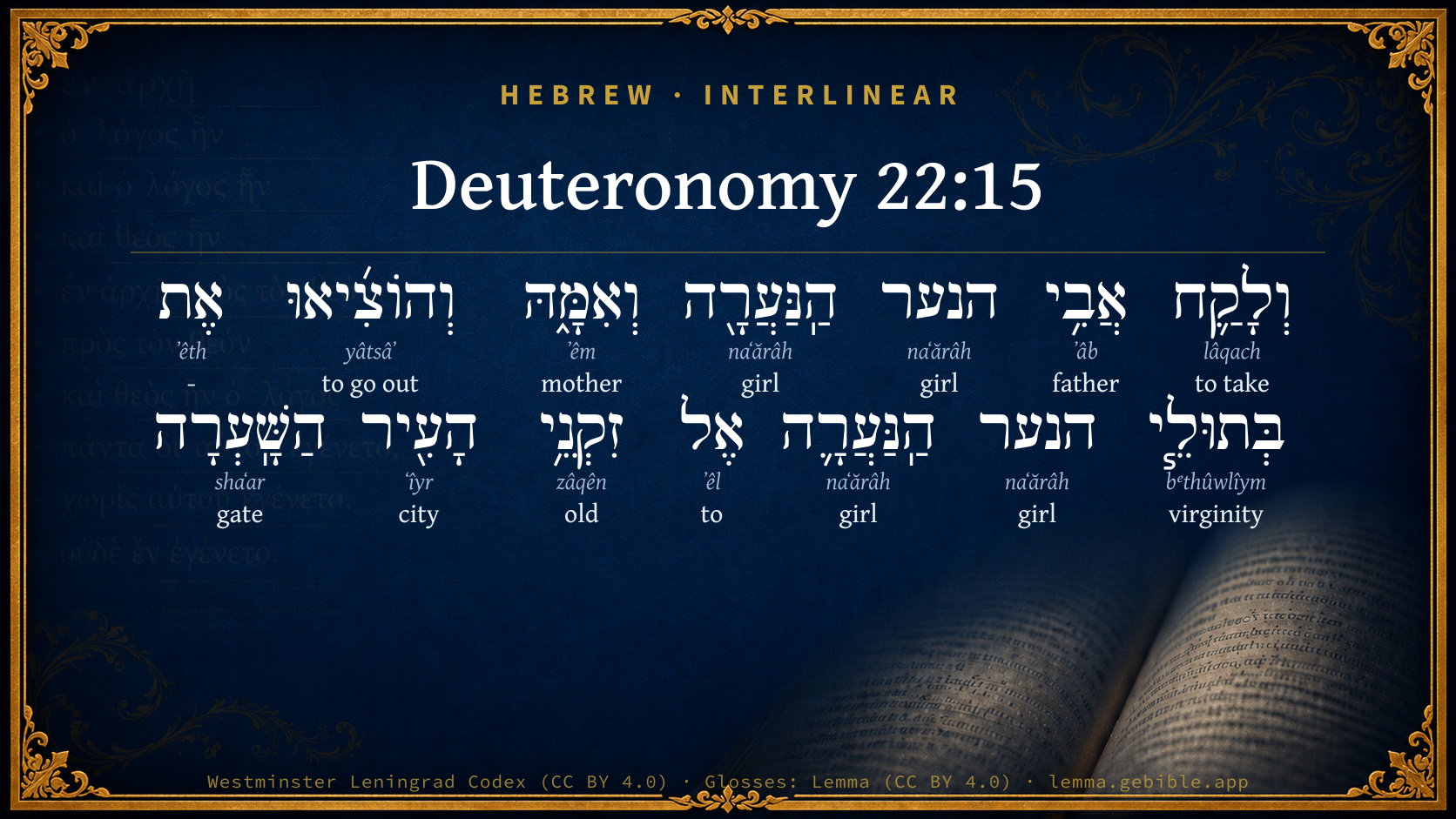
  1. וְלָקַ֛ח lâqach H3947 “and · to take” Conjunction + Verb, Qal, Sequential Perfect, 3rd Person, Masculine, Singular
  2. אֲבִ֥י ʼâb H1 “father of” Noun, Common, Masculine, Singular, Construct
  3. הנער naʻărâh H5291 “the · girl” Particle, Definite Article + Noun, Common, Feminine, Singular, Absolute
  4. הַֽנַּעֲרָ֖ה naʻărâh H5291 “the · girl” Particle, Definite Article + Noun, Common, Feminine, Singular, Absolute
  5. וְאִמָּ֑הּ ʼêm H517 “and · mother · her” Conjunction + Noun, Common, Feminine, Singular, Construct + Suffix, Personal, 3rd Person, Feminine, Singular
  6. וְהוֹצִ֜יאוּ yâtsâʼ H3318 “and · to go out” Conjunction + Verb, Hiphil, Sequential Perfect, 3rd Person, Common, Plural
  7. אֶת ʼêth H853 “-” Particle, Direct Object
  8. הנער naʻărâh H5291 “the · girl” Particle, Definite Article + Noun, Common, Feminine, Singular, Absolute
  9. הַֽנַּעֲרָ֛ה naʻărâh H5291 “the · girl” Particle, Definite Article + Noun, Common, Feminine, Singular, Absolute
  10. אֶל ʼêl H413 “to” Preposition
  11. זִקְנֵ֥י zâqên H2205 “old of” Adjective, Adjective, Masculine, Plural, Construct
  12. הָעִ֖יר ʻîyr H5892 “the · city” Particle, Definite Article + Noun, Common, Feminine, Singular, Absolute
  13. הַשָּֽׁעְרָה shaʻar H8179 “the · gate · toward” Particle, Definite Article + Noun, Common, Masculine, Singular, Absolute + Suffix, Demonstrative

About this verse

These counts appear in no published source. They are computed here, from the morphology-tagged text and Lemma’s own curated glosses. What Lemma adds →

14
words
11
distinct lemmas
Pentateuch
section

Notable vocabulary

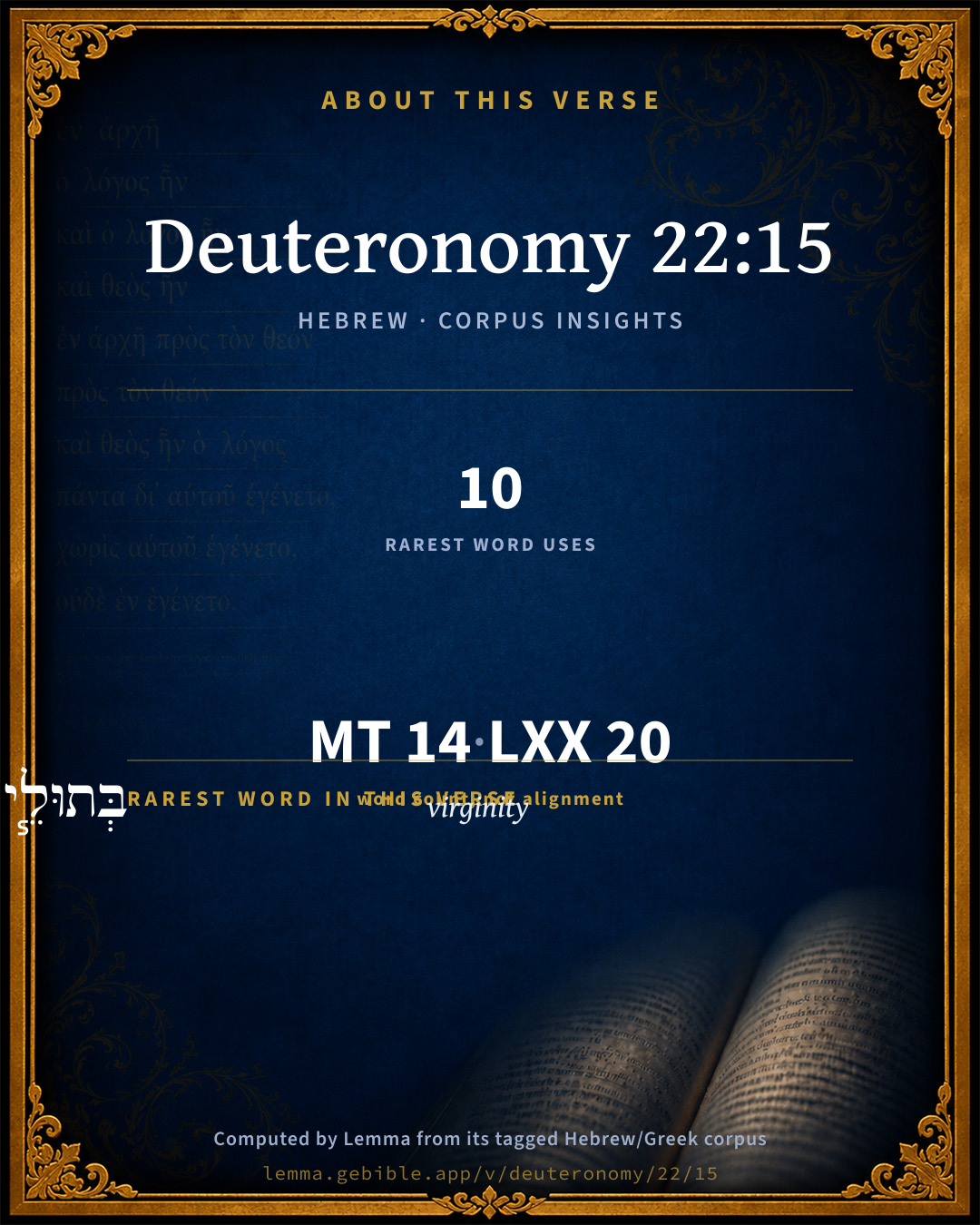
The rarest word here is בְּתוּלֵ֧י virginity H1331 — appearing just 10 times in the whole Hebrew Bible.

Shared distinctive vocabulary

בְּתוּלֵ֧י virginity H1331 occurs in 9 verses of the Hebrew Bible. Also found in:

Grammatical profile

  • 2 verbs
  • 9 nouns
  • 1 adjective
  • 1 preposition
  • 1 particle

Verb forms

  • וְלָקַ֛ח Qal · Sequential Perfect
  • וְהוֹצִ֜יאוּ Hiphil · Sequential Perfect

Repetition

A word recurs within this verse — often emphatic in Hebrew:

  • הנער girl H5291 ×4

Hebrew & Septuagint length

In English translation the verse runs 31 words from the Hebrew and 28 from the Septuagint (LXX English) — closely comparable.

A rough comparison of the two English renderings, which tokenize alike — not a word-level alignment.

Word counts can differ between the Hebrew and the Greek without any difference in meaning — e.g. the Hebrew direct-object marker אֵת has no separate Greek word, and Greek often adds the article ὁ.

In the original languages it is 14 Hebrew tokens and 20 Greek tokens — but the two are counted differently (Hebrew bundles its prefixes and suffixes into one token; the Greek is in lemma form), so that isn’t a like-for-like length.

Hebrew and Greek witnesses Masoretic Hebrew ↔ Greek Septuagint

The same verse in the two great witnesses to the Old Testament, shown verse-for-verse.

These are two independent witnesses, not word-aligned to each other, and the Septuagint is shown in lemma (dictionary) form.

Hebrew Deuteronomy 22:15 Masoretic · Westminster Leningrad Codex

וְלָקַ֛ח אֲבִ֥י הנער הַֽנַּעֲרָ֖ה וְאִמָּ֑הּ וְהוֹצִ֜יאוּ אֶת בְּתוּלֵ֧י הנער הַֽנַּעֲרָ֛ה אֶל זִקְנֵ֥י הָעִ֖יר הַשָּֽׁעְרָה

then shall the father of the young lady, and her mother, take and bring forth the tokens of the young lady's virginity to the elders of the city in the gate;

World English Bible · Public Domain

Greek LXX Deuteronomy 22:15 Septuagint · lemma form

καί λαμβάνω ὁ πατήρ ὁ παῖς καί ὁ μήτηρ ἐκφέρω ὁ παρθένεια ὁ παῖς πρός ὁ γερουσία ἐπί ὁ πύλη

then the father and the mother of the damsel shall take and bring out the damsel's tokens of virginity to the elders of the city to the gate.

LXX2012 (modern English Septuagint) · Public Domain

Hebrew: Westminster Leningrad Codex (CC BY 4.0). Greek: Septuagint (public domain); English from LXX2012 (modern English Septuagint) (Public Domain). How the Septuagint differs from the Hebrew →

Targum (Aramaic paraphrase)

2

The Targum is the ancient Jewish Aramaic paraphrase of the Hebrew Scriptures — an interpretive translation, not the Hebrew text itself. Onkelos (literal) and Pseudo-Jonathan (expansive) render the Torah, and Jonathan the Prophets. Coverage is partial: where no permissively-licensed English translation exists for a verse, only the Aramaic is shown. This is verse-level text, not a word-by-word alignment to the Hebrew.

  1. Targum Onkelos Torah (Genesis–Deuteronomy)
    וְיִסַב אֲבוּהָא (נ''א אֲבוּהִי) דְעוּלֶמְתָּא וְאִמַהּ וְיַפְּקוּן יָת בְּתוּלֵי עוּלֶמְתָּא לָקֳדָם סָבֵי קַרְתָּא לִתְרַע בֵּית דִין אַתְרָא

    (no public-domain English translation for this verse)

    Targum Onkelos — Aramaic: “Onkelos Genesis” (public domain); “Onkelos Exodus” (public domain); “Onkelos Leviticus” (public domain); “Onkelos Numbers” (public domain); “Onkelos Deuteronomy” (public domain). English: “Sefaria Community Translation” (CC0 1.0 (public-domain dedication)); “J.W. Etheridge. The Targums of Onkelos and Jonathan Ben Uzziel on the Pentateuch. London: Longmans, Green, 1862” (public domain). Text via Sefaria.

  2. Targum Pseudo-Jonathan Torah (Genesis–Deuteronomy)
    וְיִסְבוּן אֲבוּהָא דְעוּלֵימְתָּא וְאִמָּהּ רְשׁוּ מִבֵּי דִינָא וְיִפְקוּן יַת שׁוֹשִׁיפָא בַּהֲדֵי סְהִידַווֹן דְּעוּלֵימְתָּא לְוַת חַכִּימֵי קַרְתָּא לִתְרַע בֵּי דִינָא

    then the father and mother of the damsel may have licence from the court of judgment to produce the linen with the witnesses of her virginity, before the sages of the city, at the door of the beth din.

    Targum Pseudo-Jonathan — Aramaic: “Targum Jonathan on Genesis” (public domain); “Targum Jonathan on Exodus” (public domain); “Targum Jonathan on Leviticus” (public domain); “Targum Jonathan on Numbers” (public domain); “Targum Jonathan on Deuteronomy” (public domain). English: “The Targum of Jonathan ben Uzziel, trans. J. W. Etheridge, London, 1862” (public domain). Text via Sefaria.

Commentary

Notes on Deuteronomy 22:15 from classic Christian and Jewish commentators (each source and its license shown beneath its notes). The classic Christian expositions comment on the surrounding passage and are grouped to its opening verse, so a note may address several verses; the Jewish commentaries on the Tanakh (Rashi and others) are per-verse, so they appear only where the commentator wrote on this verse.

Lemma curates 59 commentaries, every one of them public domain or Creative Commons licensed, each selected and text-cleaned for this edition rather than reprinted as found. About our sources →

Trapp's Complete Commentary

John Trapp

Deu 22:15 Then shall the father of the damsel, and her mother, take and bring forth [the tokens of] the damsel’s virginity unto the elders of the city in the gate:

Ver. 15. Then shall the father of the damsel.] Whose house hereby was dishonested, and by whom his daughter’s honour was to be defended, especially since children’s miscarriages reflect upon the parents, and the daughters sin is the father’s shame.

John Trapp, A Commentary or Exposition upon All the Books of the Old and New Testament (1647–1656) — public domain. Text from a community e-Sword module.

Tyndale Open Study Notes

Tyndale Open Resources

22:15 proof of her virginity: A blood-stained cloth would indicate that the woman’s hymen was ruptured by her first act of intercourse with her husband.

Tyndale Open Study Notes — © Tyndale Open Resources, licensed CC BY-SA 4.0. Text via the HelloAO Bible API.

Adam Clarke's Commentary

Verse 15. Tokens of the damsel's virginity] This was a perfectly possible case in all places where girls were married at ten, twelve, and fourteen years of age, which is frequent in the East. I have known several instances of persons having had two or three children at separate births before they were fourteen years of age. Such tokens, therefore, as the text speaks of, must be infallibly exhibited by females so very young on the consummation of their marriage.

Adam Clarke's Commentary on the Bible (1810–1826) — public domain. Text from a community e-Sword/MySword module.

The Cambridge Bible for Schools and Colleges

gen. ed. J. J. S. Perowne

15. father of the damsel, and her mother] Together as in Deu_21:18 ff. Damsel, Heb. na‘ar, the masc. form used in the Pent, for the fem. 21 times, 13 of which are here (but fem. form in Deu_22:19) and the rest in Genesis 24, 34; cp. Rth_2:6; Rth_4:12.

elders of the city in the gate] Deu_21:19.

The Cambridge Bible for Schools and Colleges (gen. ed. J. J. S. Perowne; Cambridge University Press, 1878–1918) — public domain. Text from a community e-Sword module.

John Gill's Exposition

And the damsel's father shall say unto the elders,.... Not her mother; hence we learn, says Jarchi, that a woman has not power (or is not allowed) to speak before men; that is, in public see Co1 14:34 and it was most proper for a father to appear in court for her, and defend her; and if she had no parents living then, those that brought her up, her guardians, that had the education of her, and placing her out in marriage, were to undertake her cause; or, as Josephus (r) says, those that were next akin to her; or, as, Aben Ezra, one appointed by the court:

I gave my daughter unto this man to wife; and, by the Jewish canons (s), a man might give his daughter in marriage, but a woman might not:

and he hateth her; has taken a dislike to her, and wants to be rid of her, and therefore has brought this infamous action against her.

(r) Antiqu. l. 4. c. 8. sect. 23. (s) Misn. Sotah, c. 3. sect. 8.

John Gill's Exposition of the Whole Bible (1746–1763) — public domain (CC PDM 1.0). Text via the HelloAO Bible API.

Haydock's Catholic Bible Commentary

Her. It does not appear that the woman was present at the trial: she remained at her father’s, or rather at her husband’s house, till sentence was passed. (Calmet) --- Hebrew, "then shall the father of the damsel and her mother take and produce the damsel’s virginity," or the tokens of it.

George Leo Haydock (1774–1849), Haydock's Catholic Family Bible and Commentary, 1859 edition — public domain. Excludes Psalms (Douay-Rheims chapter numbering differs from Protestant) and Deuterocanonical books (Catholic canon only).

Matthew Poole's English Annotations

i.e. The linen cloth or sheet, as is expressed, Deu 22:17, which in the first congress was infected with blood, as is natural and usual. But because this is not now constant, the enemies of Scripture take occasion to quarrel with this law, as unreasonable and unjust, and such as might oppress the innocent, and hence take occasion to reject the Holy Scriptures. It were much more reasonable for these men either to expound this place metaphorically, of producing those proofs and testimonies of her virginity which should be as satisfactory as if that cloth were produced, as some of the Jews understand it; or modestly to acknowledge their own ignorance in this, as they are forced to do in many other things, and not impudently to conclude it is insoluble, because they cannot resolve it. But there is no need of such general answers, many things may be particularly said for the vindication of this law.

1. That it was necessary for that people, because of their hard-heartedness towards their wives, and their levity and desire of change of wives.

2. That either this trial, or at least the proof of her virginity, was to be taken presently after the day of marriage, and that proof was to be admitted afterwards upon occasion.

3. That this law was seldom or never put in execution, as the Jews note, and seems to be made for terror and caution to husbands and wives, as really other laws have been in like cases.

4. That that God who gave this law did by his providence govern all affairs, and rule the tongues and hearts of men, and therefore would doubtless take care so to order matters that the innocent should not suffer by this means, which he could prevent many ways.

5. That there is a great difference in times and climates. Who knows not that there are many things now by our moderns thought uncertain or false, by which by the ancient physicians were thought and affirmed to be true, and certain in their times and countries, and that many signs of diseases and other things do generally hold true in those more southerly and warmer parts of the world, which are many times deceitful in our northern and colder climates?

6. That this very way of trial of virginity hath been used not only by the Jews, but also by the Arabians and Egyptians, as is affirmed by divers learned writers, among whom yet it was more doubtful and hazardous than among the Jews, who might promise to themselves that God would guide the execution of his own law to a just and good issue.

7. That this sign, if it were uncertain in persons of riper years, yet it may be reasonably thought certain and constant in virgins of young and tender age, and that the Jews did ordinarily marry their daughters when they were about twelve or thirteen years old, as is confessed; as making haste to roll away that reproach which they thought to be in an unmarried state.

Matthew Poole's English Annotations on the Holy Bible (1683–1685) — public domain. Text from a community e-Sword/MySword module.

Keil & Delitzsch

C. F. Keil & F. Delitzsch

In such a case the parents of the young woman (הנּער for הנּערה, as in Gen 24:14, Gen 24:28, according to the earliest usage of the books of Moses, a virgin, then also a young woman, e.g., Rut 2:6; Rut 4:12) were to bring the matter before the elders of the town into the gate (the judicial forum; see Deu 21:19), and establish the chastity and innocence of their daughter by spreading the bed-clothes before them. It was not necessary to this end that the parents should have taken possession of the spotted bed-clothes directly after the marriage night, as in customarily done by the Bedouins and the lower classes of the Moslem in Egypt and Syria (cf. Niebuhr, Beschr. v. Arab. pp. 35ff.; Arvieux, merkw. Nachr. iii. p. 258; Burckhardt, Beduinen, p. 214, etc.). It was sufficient that the cloth should be kept, in case such a proof might be required.

Keil & Delitzsch — Biblical Commentary on the Old Testament (1861–1891) — public domain (CC PDM 1.0). Text via the HelloAO Bible API. (Old Testament only.)

unfoldingWord translationNotes

Door43 World Missions Community

General Information:

Moses is still speaking to the people of Israel.

must take proof of her virginity

The abstract nouns "proof" and "virginity" can be translated with verbal phrases. AT: "must take something that proves that she has never had sexual relations" (See: Abstract Nouns)

translationWords

virgin

elder

gate

unfoldingWord translationNotes — © Distant Shores Media and the Door43 World Missions Community, licensed CC BY-SA 4.0. Source: git.door43.org/Door43/en_tn.

Rashi

Rabbi Shlomo Yitzchaki (Rashi)

אבי הנערה ואמה [THEN SHALL] THE FATHER OF THE DAMSEL, AND HER MOTHER [TAKE AND BRING FORTH etc.] — Let those who have reared this depraved child (lit., “evil plant”) be exposed to contempt because of her (Sifrei Devarim 235:9).

Rashi on the Tanakh — English translations: “The Judaica Press complete Tanach with Rashi, translated by A. J. Rosenberg” (CC BY 4.0); “Pentateuch with Rashi's commentary by M. Rosenbaum and A.M. Silbermann, 1929-1934” (public domain); “The Metsudah Tanach series, Lakewood, N.J” (CC BY 4.0); and “The Book of Joshua, Metsudah Publications, 1997” (CC BY 4.0). Text via Sefaria.

Lesson kit

Teaching starters — assembled from the data on this page, not authored interpretation. Every prompt links to the verse data it draws on. Edit before teaching.

Deuteronomy, in the Pentateuch, opens this verse with 14 words (11 distinct Hebrew lemmas). Its most distinctive word is bᵉthûwlîym (“virginity”). A historical commentator’s framing appears above. Read the whole chapter for the surrounding context.

Discussion questions

  1. What does “virginity” (bᵉthûwlîym) contribute to the verse as a whole?
  2. How does Leviticus 21:13, which shares the word «virginity», read alongside this verse?
  3. What does the repetition of “girl” (4× in this one verse) do in this verse?
  4. These translations render this verse differently. What is at stake in choosing one wording over another?
  5. «וְלָקַ֛ח» is a Qal Sequential Perfect verb. How does that grammatical form shape the action described?
  6. Compare how Trapp's Complete Commentary and Tyndale Open Study Notes read this verse. Where do they agree or differ?

Things to notice

Reading settings

Reading text

Shown beneath each verse's original-language words.

Old Testament
Old Testament edition

Read the OT as the Masoretic Hebrew (MT) or the Greek Septuagint (LXX).

English shown for the Greek Septuagint (in the Hebrew ↔ Greek comparison).

Comparing translations? Open the Compare panel on any verse page to stack up to four side by side.