Genesis 31:30

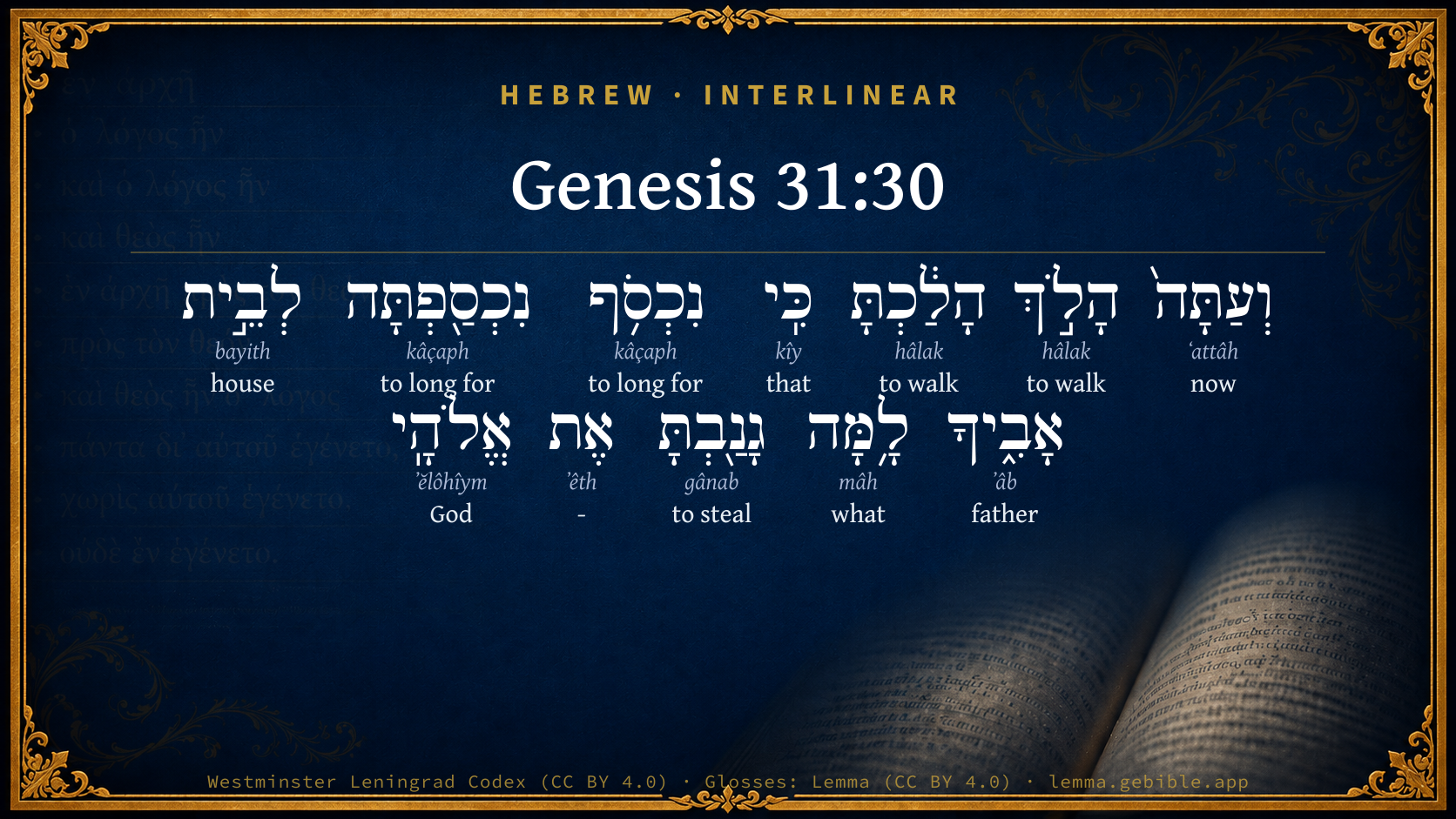
Hebrew (Westminster Leningrad Codex) Genesis 31:30 appears in the Hebrew Old Testament. The text above is from the Westminster Leningrad Codex. Each word links to its Strong’s number, a concise gloss, and parsing drawn from the Open Scriptures Hebrew Bible morphology. Click any word for its full Brown-Driver-Briggs (BDB) entry.
Download image
Cite this verse

Genesis 31:30 (World English Bible). Public Domain. Lemma interlinear Bible study tool, https://lemma.gebible.app/v/genesis/31/30.

Show BibTeX & RIS
BibTeX
RIS
English Translation
Now, you want to be gone, because you sore longed after your father's house, but why have you stolen my gods?"
World English Bible · Public Domain
Highlights
  • 1 first appearance in the Hebrew Bible
Full analysis ↓
Download a study sheet

One document with this verse’s original text, its word-by-word gloss line, the meaning frame, cross-references with their text, attributed commentary, and full source and license credits — printable, and it pastes into notes with its structure intact.

This verse Autodidact and up

Study sheet (.html) Plain text (.txt)

A passage Seminary Student

Up to 50 verses in one chapter. A passage sheet keeps up to 6 commentary sources and 12 cross-references per verse, in the order this page ranks them, and says so on the sheet whenever that leaves anything out. Ask for a single verse and you get the Autodidact verse sheet above.

Everything on this page stays free to read, with no account — the sheet is a download of what is already on screen, not access to it.

Want to remove ads? Support Godless Engineer
Compare translations 3

The same verse in 3 English versions, stacked beneath the original-language interlinear above. Click any original word for its lexicon entry.

Each is an independent rendering of the whole verse — the interlinear is not word-aligned to these translations.

Highlighted words mark where these versions differ — a whole-verse word diff, not a word-by-word alignment.

  • World English Bible Public Domain
    Now, you want to be gone, because you sore longed after your father's house, but why have you stolen my gods?"
  • King James Version Public Domain
    And now, though thou wouldest needs be gone, because thou sore longedst after thy father's house, yet wherefore hast thou stolen my gods?
  • unfoldingWord Literal Text CC BY-SA 4.0
    So now, you have surely gone because you greatly long for the house of your father. Why did you steal my gods?”

unfoldingWord Literal Text — © unfoldingWord, licensed CC BY-SA 4.0. Word-aligned USFM3 via Door43 (git.door43.org/unfoldingWord/en_ult).

Versions to compare (up to 4)

3 of 4 selected

Show all 18 translations

Every available English version of this verse, each an independent rendering of the whole verse.

  • World English Bible Public Domain
    Now, you want to be gone, because you sore longed after your father's house, but why have you stolen my gods?"
  • Berean Standard Bible Public Domain
    Now you have gone off because you long for your father’s house. But why have you stolen my gods?”
  • Majority Standard Bible Public Domain
    Now you have gone off because you long for your father’s house. But why have you stolen my gods?”
  • King James Version Public Domain
    And now, though thou wouldest needs be gone, because thou sore longedst after thy father's house, yet wherefore hast thou stolen my gods?
  • American Standard Version (1901) Public Domain
    And now, `though' thou wouldest needs be gone, because thou sore longedst after thy father's house, `yet' wherefore hast thou stolen my gods?
  • Revised Version (1885) Public Domain
    And now, though thou wouldest needs be gone, because thou sore longedst after thy father’s house, yet wherefore hast thou stolen my gods?
  • Geneva Bible (1599) Public Domain
    Nowe though thou wentest thy way, because thou greatly longedst after thy fathers house, yet wherefore hast thou stollen my gods?
  • Douay-Rheims (1899) Public Domain
    Suppose thou didst desire to go to thy friends, and hadst a longing after thy father's house: why hast thou stolen away my gods?
  • Young's Literal Translation Public Domain
    `And now, thou hast certainly gone, because thou hast been very desirous for the house of thy father; why hast thou stolen my gods?'
  • Literal Standard Version CC BY-SA 4.0
    And now, you have certainly gone, because you have been very desirous for the house of your father; why have you stolen my gods?”
  • Unlocked Literal Bible CC BY-SA 4.0
    Now you have gone away because you longed to return to your father's house. But why did you steal my gods?”
  • unfoldingWord Literal Text CC BY-SA 4.0
    So now, you have surely gone because you greatly long for the house of your father. Why did you steal my gods?”
  • Darby Bible Public Domain
    And now that thou must needs be gone, because thou greatly longedst after thy father's house, why hast thou stolen my gods?
  • World Messianic Bible Public Domain
    Now, you want to be gone, because you greatly longed for your father’s house, but why have you stolen my gods?”
  • Webster's Bible Public Domain
    And now, though thou wouldest needs be gone, because thou didst earnestly long after thy father's house; yet why hast thou stolen my gods?
  • Free Bible Version CC BY-SA 4.0
    Clearly you wanted to leave and go back to your family home, but why did you have to steal my idols?”
  • Bible in Basic English Public Domain
    And now, it seems, you are going because your heart's desire is for your father's house; but why have you taken my gods?
  • JPS Tanakh (1917) Public Domain
    And now that thou art surely gone, because thou sore longest after thy father's house, wherefore hast thou stolen my gods?'

Literal Standard Version (2020), Covenant Press — licensed CC BY-SA 4.0. Text via the HelloAO Bible API (eBible.org). Unlocked Literal Bible (unfoldingWord) — licensed CC BY-SA 4.0. Text via the HelloAO Bible API (eBible.org). unfoldingWord Literal Text — © unfoldingWord, licensed CC BY-SA 4.0. Word-aligned USFM3 via Door43 (git.door43.org/unfoldingWord/en_ult). Free Bible Version, Dr. Jonathan Gallagher — licensed CC BY-SA 4.0. Text via the HelloAO Bible API (eBible.org).

Word by word

More ways to search: Search by grammar → Find every occurrence → Compare this word →

Practice this passage: Drill this verse → Learn its vocabulary →

נִכְסֹ֥ף
kâçaph
H3700
“to long for”
Verb, Niphal, Infinitive Absolute
Part of Speech
Verb
Stem
Niphal
Form
Infinitive Absolute
Full BDB Definition

Origin: a primitive root

TWOT: 1015

to long for, yearn for, long after - (Qal) to long for - (Niphal) - to long for (deeply) - being longed for (participle)
  1. וְעַתָּה֙ ʻattâh H6258 “and · now” Conjunction + Adverb
  2. הָלֹ֣ךְ hâlak H1980 “to walk” Verb, Qal, Infinitive Absolute
  3. הָלַ֔כְתָּ hâlak H1980 “to walk” Verb, Qal, Perfect, 2nd Person, Masculine, Singular
  4. כִּֽי kîy H3588 “that” Conjunction
  5. נִכְסַ֖פְתָּה kâçaph H3700 “to long for” Verb, Niphal, Perfect, 2nd Person, Masculine, Singular
  6. לְבֵ֣ית bayith H1004 “to/for · house of” Preposition + Noun, Common, Masculine, Singular, Construct
  7. אָבִ֑יךָ ʼâb H1 “father · your” Noun, Common, Masculine, Singular, Construct + Suffix, Personal, 2nd Person, Masculine, Singular
  8. לָ֥מָּה mâh H4100 “to/for · what” Preposition + Particle, Interrogative
  9. גָנַ֖בְתָּ gânab H1589 “to steal” Verb, Qal, Perfect, 2nd Person, Masculine, Singular
  10. אֶת ʼêth H853 “-” Particle, Direct Object
  11. אֱלֹהָֽי ʼĕlôhîym H430 “God(s) · my” Noun, Common, Masculine, Plural, Construct + Suffix, Personal, 1st Person, Common, Singular

About this verse

These counts appear in no published source. They are computed here, from the morphology-tagged text and Lemma’s own curated glosses. What Lemma adds →

12
words
10
distinct lemmas
Pentateuch
section

Notable vocabulary

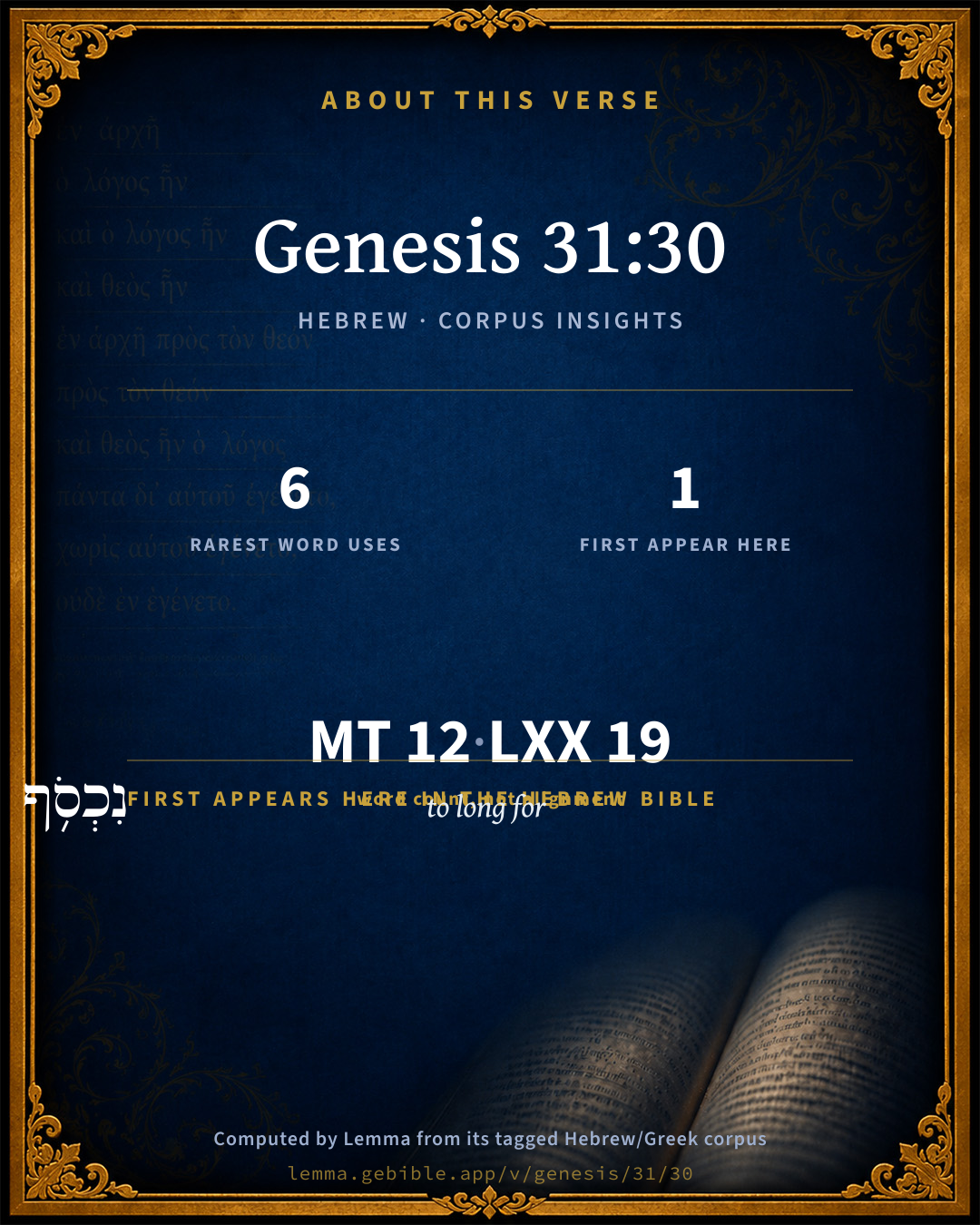
The rarest word here is נִכְסֹ֥ף to long for H3700 — appearing just 6 times in the whole Hebrew Bible.

First appearance in Scripture

This word makes its first canonical appearance in the Hebrew Bible here:

  • נִכְסֹ֥ף to long for H3700

Shared distinctive vocabulary

נִכְסֹ֥ף to long for H3700 occurs in 5 verses of the Hebrew Bible. Also found in:

Grammatical profile

  • 5 verbs
  • 3 nouns
  • 1 conjunction
  • 1 adverb
  • 2 particles

Verb forms

  • הָלֹ֣ךְ Qal · Infinitive Absolute
  • הָלַ֔כְתָּ Qal · Perfect
  • נִכְסֹ֥ף Niphal · Infinitive Absolute
  • נִכְסַ֖פְתָּה Niphal · Perfect
  • גָנַ֖בְתָּ Qal · Perfect

Repetition

Words recur within this verse — often emphatic in Hebrew:

  • הָלֹ֣ךְ to walk H1980 ×2
  • נִכְסֹ֥ף to long for H3700 ×2

Hebrew & Septuagint length

In English translation the verse runs 21 words from the Hebrew and 25 from the Septuagint (LXX English) — closely comparable.

A rough comparison of the two English renderings, which tokenize alike — not a word-level alignment.

Word counts can differ between the Hebrew and the Greek without any difference in meaning — e.g. the Hebrew direct-object marker אֵת has no separate Greek word, and Greek often adds the article ὁ.

In the original languages it is 12 Hebrew tokens and 19 Greek tokens — but the two are counted differently (Hebrew bundles its prefixes and suffixes into one token; the Greek is in lemma form), so that isn’t a like-for-like length.

Cross-references

11

Topical passages linked to Genesis 31:30 in the Treasury of Scripture Knowledge — connected by theme and wording, ordered by reader-vote popularity; previews shown in the World English Bible.

  • Jeremiah 10:11 Thus shall you say to them, The gods that have not made the heavens and the earth, these shall perish from the earth, and from under the heavens.
  • Genesis 31:19 Now Laban had gone to shear his sheep: and Rachel stole the teraphim that were her father's.
  • Judges 18:24 He said, you have taken away my gods which I made, and the priest, and are gone away, and what have I more? and how then say you to me, What ails you?
  • Exodus 12:12 For I will go through the land of Egypt in that night, and will strike all the firstborn in the land of Egypt, both man and animal. Against all the gods of Egypt I will execute judgments: I am Yahweh.
  • Numbers 33:4 while the Egyptians were burying all their firstborn, whom Yahweh had struck among them: on their gods also Yahweh executed judgments.
  • Judges 6:31 Joash said to all who stood against him, Will you contend for Baal? Or will you save him? he who will contend for him, let him be put to death while [it is yet] morning: if he be a god, let him contend for himself, because one has broken down his altar.
  • 1 Samuel 5:2–6 The Philistines took the ark of God, and brought it into the house of Dagon, and set it by Dagon.
  • 2 Samuel 5:21 They left their images there; and David and his men took them away.
  • Isaiah 37:19 and have cast their gods into the fire: for they were no gods, but the work of men's hands, wood and stone; therefore they have destroyed them.
  • Isaiah 46:1–2 Bel bows down, Nebo stoops; their idols are on the animals, and on the cattle: the things that you carried about are made a load, a burden to the weary [animal].
  • Jeremiah 43:12 I will kindle a fire in the houses of the gods of Egypt; and he shall burn them, and carry them away captive: and he shall array himself with the land of Egypt, as a shepherd puts on his garment; and he shall go forth from there in peace.

Cross-references courtesy of OpenBible.info (CC BY 4.0).

Hebrew and Greek witnesses Masoretic Hebrew ↔ Greek Septuagint

The same verse in the two great witnesses to the Old Testament, shown verse-for-verse.

These are two independent witnesses, not word-aligned to each other, and the Septuagint is shown in lemma (dictionary) form.

Hebrew Genesis 31:30 Masoretic · Westminster Leningrad Codex

וְעַתָּה֙ הָלֹ֣ךְ הָלַ֔כְתָּ כִּֽי נִכְסֹ֥ף נִכְסַ֖פְתָּה לְבֵ֣ית אָבִ֑יךָ לָ֥מָּה גָנַ֖בְתָּ אֶת אֱלֹהָֽי

Now, you want to be gone, because you sore longed after your father's house, but why have you stolen my gods?"

World English Bible · Public Domain

Greek LXX Genesis 31:30 Septuagint · lemma form

νῦν οὖν πορεύομαι ἐπιθυμία γάρ ἐπιθυμέω ἀποἔρχομαι εἰς ὁ οἶκος ὁ πατήρ σύ ἵνα τίς κλέπτω ὁ θεός ἐγώ

Now then go on your way, for you have earnestly desired to depart to the house of your father; therefore have you stolen my gods?

LXX2012 (modern English Septuagint) · Public Domain

Hebrew: Westminster Leningrad Codex (CC BY 4.0). Greek: Septuagint (public domain); English from LXX2012 (modern English Septuagint) (Public Domain). How the Septuagint differs from the Hebrew →

Targum (Aramaic paraphrase)

2

The Targum is the ancient Jewish Aramaic paraphrase of the Hebrew Scriptures — an interpretive translation, not the Hebrew text itself. Onkelos (literal) and Pseudo-Jonathan (expansive) render the Torah, and Jonathan the Prophets. Coverage is partial: where no permissively-licensed English translation exists for a verse, only the Aramaic is shown. This is verse-level text, not a word-by-word alignment to the Hebrew.

  1. Targum Onkelos Torah (Genesis–Deuteronomy)
    וּכְעַן מֵיזַל אֲזַלְתָּ אֲרֵי חַמָּדָא חַמֵדְתָּא לְבֵית אָבוּךְ לְמָה נְסִבְתָּא יָת דַּחַלְתִּי

    (no public-domain English translation for this verse)

    Targum Onkelos — Aramaic: “Onkelos Genesis” (public domain); “Onkelos Exodus” (public domain); “Onkelos Leviticus” (public domain); “Onkelos Numbers” (public domain); “Onkelos Deuteronomy” (public domain). English: “Sefaria Community Translation” (CC0 1.0 (public-domain dedication)); “J.W. Etheridge. The Targums of Onkelos and Jonathan Ben Uzziel on the Pentateuch. London: Longmans, Green, 1862” (public domain). Text via Sefaria.

  2. Targum Pseudo-Jonathan Torah (Genesis–Deuteronomy)
    וּכְדוֹן מֵיזַל אָזֵילְתָּא אֲרוּם מִתְחַמְדָא חֲמֵידְתָא לְבֵיתֵיהּ דְאָבוּךְ לְמָא גְנַבְתָּ יַת צִילְמֵי טַעֲוָותִי

    now going thou wilt go; because desiring thou hast desired the house of thy father: (but) why hast thou stolen the images of my idols?

    Targum Pseudo-Jonathan — Aramaic: “Targum Jonathan on Genesis” (public domain); “Targum Jonathan on Exodus” (public domain); “Targum Jonathan on Leviticus” (public domain); “Targum Jonathan on Numbers” (public domain); “Targum Jonathan on Deuteronomy” (public domain). English: “The Targum of Jonathan ben Uzziel, trans. J. W. Etheridge, London, 1862” (public domain). Text via Sefaria.

Commentary

Notes on Genesis 31:30 from classic Christian and Jewish commentators (each source and its license shown beneath its notes). The classic Christian expositions comment on the surrounding passage and are grouped to its opening verse, so a note may address several verses; the Jewish commentaries on the Tanakh (Rashi and others) are per-verse, so they appear only where the commentator wrote on this verse.

Lemma curates 59 commentaries, every one of them public domain or Creative Commons licensed, each selected and text-cleaned for this edition rather than reprinted as found. About our sources →

Trapp's Complete Commentary

John Trapp

Gen 31:30 And now, [though] thou wouldest needs be gone, because thou sore longedst after thy father’s house, [yet] wherefore hast thou stolen my gods?

Ver. 30. Why hast thou stolen my gods?] Goodly gods that could not save themselves from the thief! See Jer 10:5; Jer 10:11; Jer 10:15. But Jacob, a just man, is here made a thief of. The best must look to be blasted; "as deceivers, and yet true". {2Co 6:8} Wicked men’s "throats are open sepulchres," {Psa 5:9} wherein the good names of God’s innocent ones too oft lie buried: their breath, as fire, shall devour them, saith the prophet. {Isa 33:11} Joseph suffered as a dishonest person; Elisha, as a troubler of the state; Jeremiah, as a traitor; Luther, as the trumpet of rebellion. {a} Nay, in one of his Epistles to Spalatinus, Prorsus Satan est Lutherus, saith he; sed Christus vivit et regnat, Amen. He adds his Amen to it; so little was he moved at it. He had learned, and so must we, to pass through "good and evil report," with Paul. {2Co 6:8} Epiphanius saith, somewhere, that the Jews give out that St Paul turned Christian for spite, because he could not obtain the high priest’s daughter in marriage. We are made "the filth of the world, the sweepings of all things," {περιψηματα; 1Co 4:13} saith St Paul of himself and his companions; who yet were the very "glory of Jesus Christ". {2Co 8:23} Phagius reports the story of an Egyptian who said, The Christians were a company of most filthy lecherous people. And for the keeping of the Sabbath, he saith, they had a disease upon them, and were therefore fain to rest the seventh day.

{a} Tuba rebellionis.

John Trapp, A Commentary or Exposition upon All the Books of the Old and New Testament (1647–1656) — public domain. Text from a community e-Sword module.

Joseph Benson's Commentary

Gen 31:30. Wherefore hast thou stolen my gods? — Foolish man! to call those his gods that could be stolen! Could he expect protection from them that could neither resist nor discover their invaders? Happy are they who have the Lord for their God. Enemies may steal our goods, but not our God.

Joseph Benson's Commentary on the Old and New Testaments (1811–1818) — public domain. Text from a community e-Sword module.

John Calvin's Commentaries

30. Wherefore hast thou stolen my gods? The second head of accusation which is alleged against Jacob is, that he had not departed through love to his country, nor for any just and probable cause; but that, in fact, he was implicated in an act of robbery. Heavy and disgraceful charge, of which Jacob was far from being guilty! But we learn hence, that no one can live so innocently in the world, but he must sometimes bear undeserved reproach and marks of infamy. Whenever this may happen to us, let that precious promise sustain us, that the Lord, in his own time, will bring forth our innocence as the morning light. (Psalm 37:6.) For by this artifice Satan attempts to seduce us from the practice of well-doing, when, without any fault of ours, we are traduced by false calumnies. And since the world is ungrateful, it often makes the very worst return for acts of kindness. Some, indeed, are found, who, with heroic magnanimity, despise unfavourable reports, because they esteem the testimony of a good conscience more highly than depraved popular opinion. But it behoves the faithful to look to God, that their conscience may never fail them. We see that Laban calls his gods תרפים(teraphim,) not because he thought the Deity was enclosed within them; but because he worshipped these images in honor of the gods. Or rather, because, when he was about to pay homage to God, he turned himself to those images. At this day, by the sole difference of a word, the Papists think they skilfully effect their escape, because they do not attribute to idols the name of gods. But the subterfuge is frivolous, since in reality they are altogether alike; for they pour forth before pictures or statues whatever honor they acknowledge to be due to the one God. To the ancient idolaters the pretext was not wanting, that by a metonymy they styled those images gods, which were formed for the sake of representing God.

John Calvin's Commentaries (1540-1563) — public domain. Text from the Calvin Translation Society English edition (1840s-50s) via the Christian Classics Ethereal Library (ccel.org). Calvin's coverage is partial (roughly two-thirds of the Bible); uncommented books and verses are honest gaps, never fabricated. The 19th-century editor's footnotes and remarks are omitted so the notes are faithfully Calvin's own voice.

The Cambridge Bible for Schools and Colleges

gen. ed. J. J. S. Perowne

30. though thou wouldest needs be gone] Lit. “thou art actually gone.”

my gods] “My Elohim, or god,” here in the sense of the figures of the household gods, as in Jdg_18:24, and possibly in Exo_21:6; Exo_22:7-8; Exo_32:1.

The Cambridge Bible for Schools and Colleges (gen. ed. J. J. S. Perowne; Cambridge University Press, 1878–1918) — public domain. Text from a community e-Sword module.

John Gill's Exposition

With whomsoever thou findest thy gods, let him not live,.... This is the answer to his last question, as what goes before is to his first: Jacob knew nothing of their being taken away by any, and thought himself safe in saying what he did, being confident that no one with him could ever take them; but it was too rashly spoken by him, giving leave to Laban to put to death the person with whom they should be found, or imprecating death on him by the hand of God; "may he not live", but die, die immediately or before his time, as the Targum of Jonathan: hence the Jewish writers (m) observe, that Rachel died in giving birth in consequence of this imprecation, but without any foundation:

before our brethren discern thou what is thine with me, and take it to thee: not only his gods, but any of his goods or cattle, whatsoever he could find in his tents, or in his flocks, that were his property, he was welcome to take; and this he declared before the men that Laban brought with him, whom he also calls his brethren, being his kinsfolks and neighbours; and these he appeals to as witnesses of his honesty, integrity, and fair dealing; being conscious to himself that he had took nothing but what was his own:

for Jacob knew not that Rachel had stolen them; the images or gods; or he would have been more careful of his expression, in love and tenderness to his most beloved wife.

(m) Jarchi in loc. Pirke Eliezer, c. 36.

John Gill's Exposition of the Whole Bible (1746–1763) — public domain (CC PDM 1.0). Text via the HelloAO Bible API.

Matthew Poole's English Annotations

Laban could not be so senseless as to take those for true gods which could be stolen away; but he called them gods, because they were the means or representations whereby he worshipped his gods.

Matthew Poole's English Annotations on the Holy Bible (1683–1685) — public domain. Text from a community e-Sword/MySword module.

Whedon's Commentary on the Bible

Daniel D. Whedon

30. My gods — This theft he finally charges as the most aggravating thing of all.

Daniel D. Whedon (gen. ed.), Commentary on the Old and New Testaments (1874–1909) — public domain. Text from a community e-Sword module.

John Wesley's Explanatory Notes

Wherefore hast thou stolen my gods? - Foolish man! to call those his gods that could be stolen! Could he expect protection from them that could neither resist nor discover their invaders? Happy are they who have the Lord for their God. Enemies may steal our goods, but not our God.

John Wesley, Explanatory Notes Upon the Whole Bible (1754–1765) — public domain. Text via the GEBible commentary corpus.

Keil & Delitzsch

C. F. Keil & F. Delitzsch

"And now thou art gone (for, if thou art gone), because thou longedst after thy father's house, why hast thou stolen my gods?" The meaning is this: even if thy secret departure can be explained, thy stealing of my gods cannot.

Keil & Delitzsch — Biblical Commentary on the Old Testament (1861–1891) — public domain (CC PDM 1.0). Text via the HelloAO Bible API. (Old Testament only.)

Rashi

Rabbi Shlomo Yitzchaki (Rashi)

נכספתה means THOU DIDST LONG—It occurs many times in Scripture: (Psalms 89:3) “My soul yearneth (נכספה) yea, pineth”; (Job 14:15) “Thou wouldst have a desire (תכסוף) to the work of hands”.

Rashi on the Tanakh — English translations: “The Judaica Press complete Tanach with Rashi, translated by A. J. Rosenberg” (CC BY 4.0); “Pentateuch with Rashi's commentary by M. Rosenbaum and A.M. Silbermann, 1929-1934” (public domain); “The Metsudah Tanach series, Lakewood, N.J” (CC BY 4.0); and “The Book of Joshua, Metsudah Publications, 1997” (CC BY 4.0). Text via Sefaria.

Sforno

Rabbi Ovadia Sforno

Now you have gone. You must have run off in this manner because you so yearned for your father’s house.

But why did you steal. Your yearning for your father’s house was no justification for stealing my gods.

Sforno on the Tanakh — English translation: “Yalkut, Sifsei Chachomim Chumash, Metsudah Publications, 2009” (CC BY 4.0). Text via Sefaria.

Radak

Rabbi David Kimhi (Radak)

ועתה...נכסף נכספתה, as per Onkelos, i.e. “even if you felt an overwhelming urge.” The word נכסוף with the vowel cholem is an infinitive mode in the passive conjugation, similar to Samuel I 20,21 נשאול נשאל.

אלוהי, he called his Teraphim “my gods,” as he and his kind of people relied on them just as we rely on the true G’d.

Radak on the Tanakh — English translations: “Sefaria Community Translation” (CC0 1.0 (public-domain dedication)); “Eliyahu Munk, HaChut Hameshulash” (CC BY 4.0); “Rabbi Mike Feuer, Jerusalem Anthology” (CC BY 4.0); and “R. David Kimhi on the first book of Psalms, Translated by R.G. Finch, London, 1919” (public domain). Text via Sefaria.

Lesson kit

Teaching starters — assembled from the data on this page, not authored interpretation. Every prompt links to the verse data it draws on. Edit before teaching.

Genesis, in the Pentateuch, opens this verse with 12 words (10 distinct Hebrew lemmas). Its most distinctive word is kâçaph (“to long for”). A historical commentator’s framing appears above. Read the whole chapter for the surrounding context.

Discussion questions

  1. What does “to long for” (kâçaph) contribute to the verse as a whole?
  2. This is the first place “to long for” appears in Scripture (first appears here). What does its debut here establish?
  3. How does Job 14:15, which shares the word «to long for», read alongside this verse?
  4. What does the repetition of “to walk” (2× in this one verse) do in this verse?
  5. The translations on this page render this verse differently — a whole-verse word diff, not a word-by-word alignment. What might account for the different wordings?
  6. «הָלֹ֣ךְ» is a Qal Infinitive Absolute verb. How does that grammatical form shape the action described?
  7. Compare how Trapp's Complete Commentary and Joseph Benson's Commentary read this verse. Where do they agree or differ?

Things to notice

Reading settings

Reading text

Shown beneath each verse's original-language words.

Old Testament
Old Testament edition

Read the OT as the Masoretic Hebrew (MT) or the Greek Septuagint (LXX).

English shown for the Greek Septuagint (in the Hebrew ↔ Greek comparison).

Comparing translations? Open the Compare panel on any verse page to stack up to four side by side.