Deuteronomy 32:6

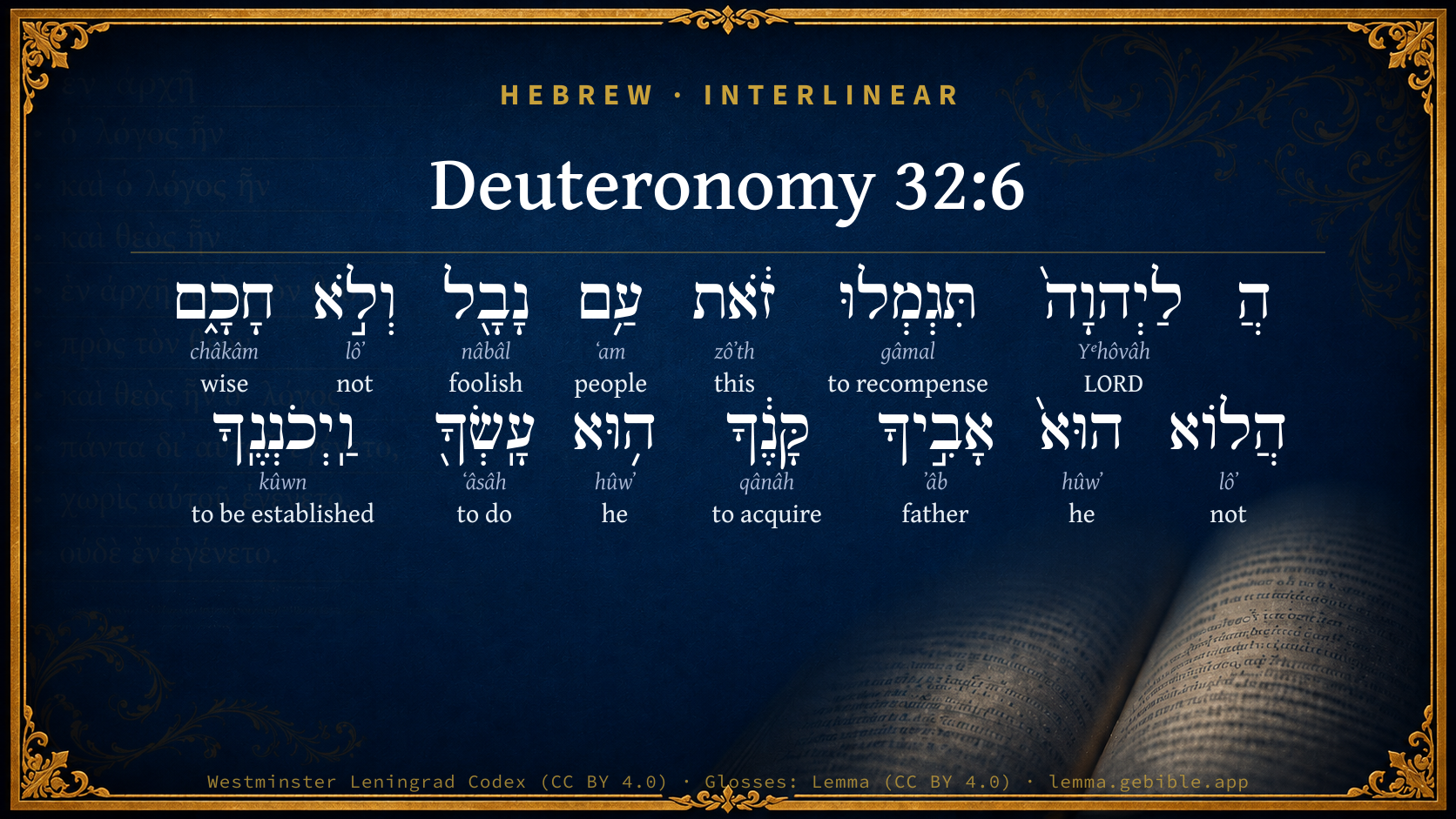
Hebrew (Westminster Leningrad Codex) Deuteronomy 32:6 appears in the Hebrew Old Testament. The text above is from the Westminster Leningrad Codex. Each word links to its Strong’s number, a concise gloss, and parsing drawn from the Open Scriptures Hebrew Bible morphology. Click any word for its full Brown-Driver-Briggs (BDB) entry.
Download image
Cite this verse

Deuteronomy 32:6 (World English Bible). Public Domain. Lemma interlinear Bible study tool, https://lemma.gebible.app/v/deuteronomy/32/6.

Show BibTeX & RIS
BibTeX
RIS
English Translation
Do you thus requite Yahweh, Foolish people and unwise? Isn't he your father who has bought you? He has made you, and established you.
World English Bible · Public Domain
Highlights
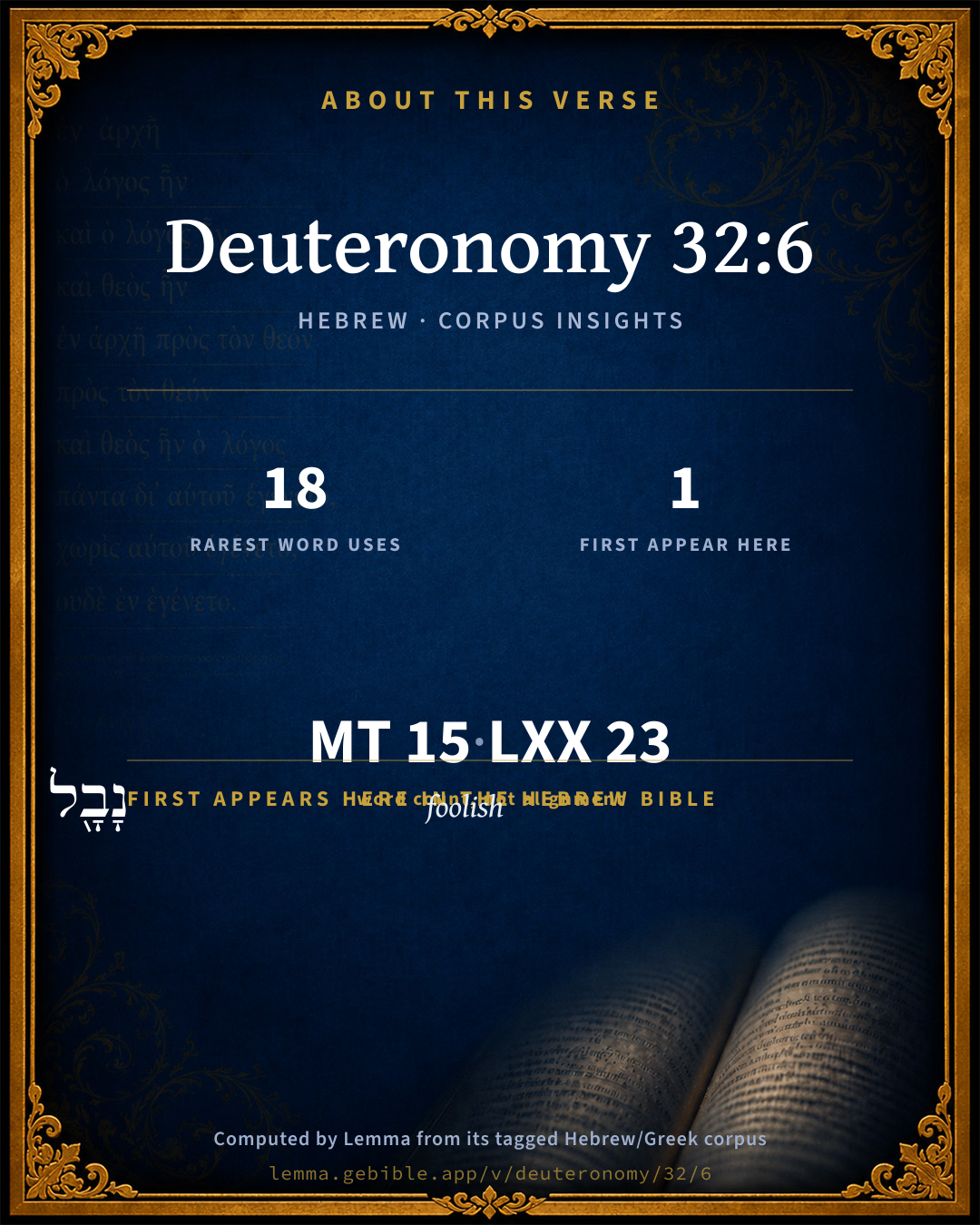
  • 1 first appearance in the Hebrew Bible
Full analysis ↓
Download a study sheet

One document with this verse’s original text, its word-by-word gloss line, the meaning frame, cross-references with their text, attributed commentary, and full source and license credits — printable, and it pastes into notes with its structure intact.

This verse Autodidact and up

Study sheet (.html) Plain text (.txt)

A passage Seminary Student

Up to 50 verses in one chapter. A passage sheet keeps up to 6 commentary sources and 12 cross-references per verse, in the order this page ranks them, and says so on the sheet whenever that leaves anything out. Ask for a single verse and you get the Autodidact verse sheet above.

Everything on this page stays free to read, with no account — the sheet is a download of what is already on screen, not access to it.

Want to remove ads? Support Godless Engineer
Compare translations 3

The same verse in 3 English versions, stacked beneath the original-language interlinear above. Click any original word for its lexicon entry.

Each is an independent rendering of the whole verse — the interlinear is not word-aligned to these translations.

Highlighted words mark where these versions differ — a whole-verse word diff, not a word-by-word alignment.

  • World English Bible Public Domain
    Do you thus requite Yahweh, Foolish people and unwise? Isn't he your father who has bought you? He has made you, and established you.
  • King James Version Public Domain
    Do ye thus requite the LORD, O foolish people and unwise? is not he thy father that hath bought thee? hath he not made thee, and established thee?
  • unfoldingWord Literal Text CC BY-SA 4.0
    this how you reward Yahweh, people foolish and without wisdom? he not your father, your shaper? He made you and established you. ts\*

unfoldingWord Literal Text — © unfoldingWord, licensed CC BY-SA 4.0. Word-aligned USFM3 via Door43 (git.door43.org/unfoldingWord/en_ult).

Versions to compare (up to 4)

3 of 4 selected

Show all 18 translations

Every available English version of this verse, each an independent rendering of the whole verse.

  • World English Bible Public Domain
    Do you thus requite Yahweh, Foolish people and unwise? Isn't he your father who has bought you? He has made you, and established you.
  • Berean Standard Bible Public Domain
    Is this how you repay the LORD, O foolish and senseless people? Is He not your Father and Creator? Has He not made you and established you?
  • Majority Standard Bible Public Domain
    Is this how you repay the LORD, O foolish and senseless people? Is He not your Father and Creator? Has He not made you and established you?
  • King James Version Public Domain
    Do ye thus requite the LORD, O foolish people and unwise? is not he thy father that hath bought thee? hath he not made thee, and established thee?
  • American Standard Version (1901) Public Domain
    Do ye thus requite Jehovah, O foolish people and unwise? Is not he thy father that hath bought thee? He hath made thee, and established thee.
  • Revised Version (1885) Public Domain
    Do ye thus requite the LORD, O foolish people and unwise? Is not he thy father that hath bought thee? He hath made thee, and established thee.
  • Geneva Bible (1599) Public Domain
    Doe ye so rewarde the Lord, O foolish people and vnwise? is not he thy father, that hath bought thee? he hath made thee, and proportioned thee.
  • Douay-Rheims (1899) Public Domain
    Is this the return thou makest to the Lord, O foolish and senseless people? Is not he thy father, that hath possessed thee, and made thee, and created thee?
  • Young's Literal Translation Public Domain
    To Jehovah do ye act thus, O people foolish and not wise? Is not He thy father -- thy possessor? He made thee, and doth establish thee.
  • Literal Standard Version CC BY-SA 4.0
    Do you act thus to YHWH, || O people foolish and not wise? Is He not your Father—He who bought you? He made you, and establishes you.
  • Unlocked Literal Bible CC BY-SA 4.0
    Do you reward Yahweh in this way, you foolish and senseless people? Is he not your father, the one who has created you? He made you and established you.
  • unfoldingWord Literal Text CC BY-SA 4.0
    this how you reward Yahweh, people foolish and without wisdom? he not your father, your shaper? He made you and established you. ts\*
  • Darby Bible Public Domain
    Do ye thus requite Jehovah, Foolish and unwise people? Is not he thy father that hath bought thee? Hath he not made thee and established thee?
  • World Messianic Bible Public Domain
    Is this the way you repay the LORD, foolish and unwise people? Isn’t he your father who has bought you? He has made you and established you.
  • Webster's Bible Public Domain
    Do ye thus requite the LORD, O foolish people and unwise? is not he thy father that hath bought thee? hath he not made thee, and established thee?
  • Free Bible Version CC BY-SA 4.0
    Is this any way to repay the Lord, you foolish, stupid people? Isn't he your Father who created you? Isn't he the one who turned you into a nation and made you strong?
  • Bible in Basic English Public Domain
    Is this your answer to the Lord, O foolish people and unwise? Is he not your father who has given you life? He has made you and given you your place.
  • JPS Tanakh (1917) Public Domain
    Do ye thus requite the LORD, O foolish people and unwise? is not He thy father that hath gotten thee? hath He not made thee, and established thee?

Literal Standard Version (2020), Covenant Press — licensed CC BY-SA 4.0. Text via the HelloAO Bible API (eBible.org). Unlocked Literal Bible (unfoldingWord) — licensed CC BY-SA 4.0. Text via the HelloAO Bible API (eBible.org). unfoldingWord Literal Text — © unfoldingWord, licensed CC BY-SA 4.0. Word-aligned USFM3 via Door43 (git.door43.org/unfoldingWord/en_ult). Free Bible Version, Dr. Jonathan Gallagher — licensed CC BY-SA 4.0. Text via the HelloAO Bible API (eBible.org).

Word by word

More ways to search: Search by grammar → Find every occurrence → Compare this word →

Practice this passage: Drill this verse → Learn its vocabulary →

נָבָ֖ל
nâbâl
H5036
“foolish”
Adjective, Adjective, Masculine, Singular, Absolute
Part of Speech
Adjective
Type
Adjective
Gender
Masculine
Number
Singular
State
Absolute
Full BDB Definition

Origin: from H5034

TWOT: 1285a

foolish, senseless, fool
  1. לַיְהוָה֙ Yᵉhôvâh H3068 “to/for · LORD” Preposition + Noun, Proper
  2. תִּגְמְלוּ gâmal H1580 “to recompense” Verb, Qal, Imperfect, 2nd Person, Masculine, Plural
  3. זֹ֔את zôʼth H2063 “this” Pronoun, Demonstrative, Feminine, Singular
  4. עַ֥ם ʻam H5971 “people” Noun, Common, Masculine, Singular, Absolute
  5. וְלֹ֣א lôʼ H3808 “and · not” Conjunction + Particle, Negative
  6. חָכָ֑ם châkâm H2450 “wise” Adjective, Adjective, Masculine, Singular, Absolute
  7. הֲלוֹא lôʼ H3808 “not” Particle, Interrogative + Particle, Negative
  8. הוּא֙ hûwʼ H1931 “he” Pronoun, Personal, 3rd Person, Masculine, Singular
  9. אָבִ֣יךָ ʼâb H1 “father · your” Noun, Common, Masculine, Singular, Construct + Suffix, Personal, 2nd Person, Masculine, Singular
  10. קָּנֶ֔ךָ qânâh H7069 “to acquire · you” Verb, Qal, Perfect, 3rd Person, Masculine, Singular + Suffix, Personal, 2nd Person, Masculine, Singular
  11. ה֥וּא hûwʼ H1931 “he” Pronoun, Personal, 3rd Person, Masculine, Singular
  12. עָֽשְׂךָ֖ ʻâsâh H6213 “to do · you” Verb, Qal, Perfect, 3rd Person, Masculine, Singular + Suffix, Personal, 2nd Person, Masculine, Singular
  13. וַֽיְכֹנְנֶֽךָ kûwn H3559 “and · to be established · you” Conjunction + Verb, Polel, Sequential Imperfect, 3rd Person, Masculine, Singular + Suffix, Personal, 2nd Person, Masculine, Singular

About this verse

These counts appear in no published source. They are computed here, from the morphology-tagged text and Lemma’s own curated glosses. What Lemma adds →

15
words
12
distinct lemmas
Pentateuch
section

Notable vocabulary

The rarest word here is נָבָ֖ל foolish H5036 — appearing just 18 times in the whole Hebrew Bible.

First appearance in Scripture

This word makes its first canonical appearance in the Hebrew Bible here:

  • נָבָ֖ל foolish H5036

Shared distinctive vocabulary

נָבָ֖ל foolish H5036 occurs in 18 verses of the Hebrew Bible. Also found in:

Grammatical profile

  • 4 verbs
  • 3 nouns
  • 2 adjectives
  • 3 pronouns
  • 3 particles

Verb forms

  • תִּגְמְלוּ Qal · Imperfect
  • קָּנֶ֔ךָ Qal · Perfect
  • עָֽשְׂךָ֖ Qal · Perfect
  • וַֽיְכֹנְנֶֽךָ Polel · Sequential Imperfect

Repetition

Words recur within this verse — often emphatic in Hebrew:

  • וְלֹ֣א not H3808 ×2
  • הוּא֙ he H1931 ×2

Hebrew & Septuagint length

In English translation the verse runs 24 words from the Hebrew and 27 from the Septuagint (LXX English) — closely comparable.

A rough comparison of the two English renderings, which tokenize alike — not a word-level alignment.

Word counts can differ between the Hebrew and the Greek without any difference in meaning — e.g. the Hebrew direct-object marker אֵת has no separate Greek word, and Greek often adds the article ὁ.

In the original languages it is 15 Hebrew tokens and 23 Greek tokens — but the two are counted differently (Hebrew bundles its prefixes and suffixes into one token; the Greek is in lemma form), so that isn’t a like-for-like length.

Cross-references

33

Topical passages linked to Deuteronomy 32:6 in the Treasury of Scripture Knowledge — connected by theme and wording, ordered by reader-vote popularity; previews shown in the World English Bible.

  • Isaiah 63:16 For you are our Father, though Abraham doesn't know us, and Israel does not acknowledge us: you, Yahweh, are our Father; our Redeemer from everlasting is your name.
  • 1 John 3:1 Behold, how great a love the Father has bestowed on us, that we should be called children of God! For this cause the world doesn't know us, because it didn't know him.
  • Psalms 74:2 Remember your congregation, which you purchased of old, Which you have redeemed to be the tribe of your inheritance; Mount Zion, in which you have lived.
  • Isaiah 44:2 Thus says Yahweh who made you, and formed you from the womb, who will help you: Don't be afraid, Jacob my servant; and you, Jeshurun, whom I have chosen.
  • Isaiah 64:8 But now, Yahweh, you are our Father; we are the clay, and you our potter; and we all are the work of your hand.
  • Deuteronomy 1:31 and in the wilderness, where you have seen how that Yahweh your God bore you, as a man does bear his son, in all the way that you went, until you came to this place.
  • Deuteronomy 32:15 But Jeshurun grew fat, and kicked: You have grown fat, you are grown thick, you are become sleek; Then he forsook God who made him, Lightly esteemed the Rock of his salvation.
  • Deuteronomy 32:18 Of the Rock that became your father, you are unmindful, Have forgotten God who gave you birth.
  • Psalms 74:18 Remember this, that the enemy has mocked you, Yahweh. Foolish people have blasphemed your name.
  • Psalms 100:3 Know that Yahweh, he is God. It is he who has made us, and we are his. We are his people, and the sheep of his pasture.
  • Psalms 149:2 Let Israel rejoice in him who made them. Let the children of Zion be joyful in their King.
  • Isaiah 1:2 Hear, heavens, And listen, earth; for Yahweh has spoken: I have nourished and brought up children, And they have rebelled against me.
  • Isaiah 27:11 When the boughs of it are withered, they shall be broken off; the women shall come, and set them on fire; for it is a people of no understanding: therefore he who made them will not have compassion on them, and he who formed them will show them no favor.
  • Isaiah 43:7 everyone who is called by my name, and whom I have created for my glory, whom I have formed, yes, whom I have made.
  • Jeremiah 4:22 For my people are foolish, they don't know me; they are foolish children, and they have no understanding; they are wise to do evil, but to do good they have no knowledge.
  • Jeremiah 5:21 Hear now this, foolish people, and without understanding; who have eyes, and don't see; who have ears, and don't hear:
  • John 8:41 You do the works of your father." They said to him, "We were not born of sexual immorality. We have one Father, God."
  • Acts 20:28 Take heed, therefore, to yourselves, and to all the flock, in which the Holy Spirit has made you overseers, to shepherd the assembly of the Lord and God which he purchased with his own blood.
  • Romans 8:15 For you didn't receive the spirit of bondage again to fear, but you received the Spirit of adoption, by whom we cry, "Abba! Father!"
  • 1 Corinthians 6:20 for you were bought with a price. Therefore glorify God in your body and in your spirit, which are God's.
  • Galatians 3:26 For you are all children of God, through faith in Christ Jesus.
  • Galatians 4:6 And because you are children, God sent out the Spirit of his Son into your hearts, crying, "Abba, Father!"
  • 2 Peter 2:1 But there also arose false prophets among the people, as among you also there will be false teachers, who will secretly bring in destructive heresies, denying even the Master who bought them, bringing on themselves swift destruction.
  • Exodus 4:22 You shall tell Pharaoh, 'Thus says Yahweh, Israel is my son, my firstborn,
  • Exodus 15:16 Terror and dread falls on them. By the greatness of your arm they are as still as a stone; Until your people pass over, Yahweh, Until the people pass over who you have purchased.
  • Job 10:8 'Your hands have framed me and fashioned me altogether; Yet you destroy me.
  • Psalms 95:6 Oh come, let's worship and bow down. Let's kneel before Yahweh, our Maker,
  • Psalms 116:12 What will I give to Yahweh for all his benefits toward me?
  • Isaiah 43:3–4 For I am Yahweh your God, the Holy One of Israel, your Savior; I have given Egypt as your ransom, Ethiopia and Seba in your place.
  • Luke 15:18–20 I will get up and go to my father, and will tell him, "Father, I have sinned against heaven, and in your sight.
  • 2 Corinthians 5:14–15 For the love of Christ constrains us; because we judge thus, that one died for all, therefore all died.
  • Galatians 3:1–3 Foolish Galatians, who has bewitched you not to obey the truth, before whose eyes Jesus Christ was openly set forth among you as crucified?
  • Titus 2:11–14 For the grace of God has appeared, bringing salvation to all men,

Cross-references courtesy of OpenBible.info (CC BY 4.0).

Hebrew and Greek witnesses Masoretic Hebrew ↔ Greek Septuagint

The same verse in the two great witnesses to the Old Testament, shown verse-for-verse.

These are two independent witnesses, not word-aligned to each other, and the Septuagint is shown in lemma (dictionary) form.

Hebrew Deuteronomy 32:6 Masoretic · Westminster Leningrad Codex

הֲ לַיְהוָה֙ תִּגְמְלוּ זֹ֔את עַ֥ם נָבָ֖ל וְלֹ֣א חָכָ֑ם הֲלוֹא הוּא֙ אָבִ֣יךָ קָּנֶ֔ךָ ה֥וּא עָֽשְׂךָ֖ וַֽיְכֹנְנֶֽךָ

Do you thus requite Yahweh, Foolish people and unwise? Isn't he your father who has bought you? He has made you, and established you.

World English Bible · Public Domain

Greek LXX Deuteronomy 32:6 Septuagint · lemma form

οὗτος κύριος ἀντι ἀποδίδωμι οὕτως λαός μωρός καί οὐ σοφός οὐ αὐτός οὗτος σύ πατήρ κτάομαι σύ καί ποιέω σύ καί κτίζω σύ

Do you⌃ thus recompense the Lord? is the people thus foolish and unwise? did not he himself your father purchase you, and make you, and form you?

LXX2012 (modern English Septuagint) · Public Domain

On this verse, Haydock's Catholic Bible Commentary discusses the Septuagint’s reading. Read the note in Commentary ↓

Hebrew: Westminster Leningrad Codex (CC BY 4.0). Greek: Septuagint (public domain); English from LXX2012 (modern English Septuagint) (Public Domain). How the Septuagint differs from the Hebrew →

Targum (Aramaic paraphrase)

2

The Targum is the ancient Jewish Aramaic paraphrase of the Hebrew Scriptures — an interpretive translation, not the Hebrew text itself. Onkelos (literal) and Pseudo-Jonathan (expansive) render the Torah, and Jonathan the Prophets. Coverage is partial: where no permissively-licensed English translation exists for a verse, only the Aramaic is shown. This is verse-level text, not a word-by-word alignment to the Hebrew.

  1. Targum Onkelos Torah (Genesis–Deuteronomy)
    הָא קֳדָם יְיָ אַתּוּן גָמְלִין דָא עַמָא דְקַבִּילוּ אוֹרַיְתָא וְלָא חַכִּימוּ הֲלָא הוּא אֲבוּךְ וְאַתְּ דִי לֵהּ הוּא עָבְדָךְ וְאַתְקְנָךְ

    (no public-domain English translation for this verse)

    Targum Onkelos — Aramaic: “Onkelos Genesis” (public domain); “Onkelos Exodus” (public domain); “Onkelos Leviticus” (public domain); “Onkelos Numbers” (public domain); “Onkelos Deuteronomy” (public domain). English: “Sefaria Community Translation” (CC0 1.0 (public-domain dedication)); “J.W. Etheridge. The Targums of Onkelos and Jonathan Ben Uzziel on the Pentateuch. London: Longmans, Green, 1862” (public domain). Text via Sefaria.

  2. Targum Pseudo-Jonathan Torah (Genesis–Deuteronomy)
    הַאֶפְשַׁר דִלְשׁוּם מֵימְרָא דַיְיָ אַתּוּן גָמְלִין דָא עַמָא דְהַווֹן טִפְּשִׁין וְקַבִּילוּ אוֹרַיְיתָא וְלָא חַכִּימוּ הֲלָא הוּא אֲבוּכוֹן דִי קְנָא יַתְכוֹן הוּא בְּרָא יַתְכוֹן וְשַׁכְלֵיל יַתְכוֹן

    Can you indeed so requite the Name of the Word of the Lord, O foolish people, and receive the law, yet not be made wise? Is He not your Father who bought you, who created you and established you?

    Targum Pseudo-Jonathan — Aramaic: “Targum Jonathan on Genesis” (public domain); “Targum Jonathan on Exodus” (public domain); “Targum Jonathan on Leviticus” (public domain); “Targum Jonathan on Numbers” (public domain); “Targum Jonathan on Deuteronomy” (public domain). English: “The Targum of Jonathan ben Uzziel, trans. J. W. Etheridge, London, 1862” (public domain). Text via Sefaria.

Commentary

Notes on Deuteronomy 32:6 from classic Christian and Jewish commentators (each source and its license shown beneath its notes). The classic Christian expositions comment on the surrounding passage and are grouped to its opening verse, so a note may address several verses; the Jewish commentaries on the Tanakh (Rashi and others) are per-verse, so they appear only where the commentator wrote on this verse.

Lemma curates 59 commentaries, every one of them public domain or Creative Commons licensed, each selected and text-cleaned for this edition rather than reprinted as found. About our sources →

Trapp's Complete Commentary

John Trapp

Deu 32:6 Do ye thus requite the LORD, O foolish people and unwise? [is] not he thy father [that] hath bought thee? hath he not made thee, and established thee?

Ver. 6. Do ye thus requite the Lord?] Good turns aggravate unkindnesses, and our guilt is increased by our obligations. Solomon’s idolatry was far worse than that of his wives; he had been better bred, and God had appeared to him twice. It is the ingratitude that makes the godly man’s sin so heinous, which otherwise would be far less than other men’s, since his temptations are stronger, and his resistance greater. Hebricians observe, that in Halaihovah there is in the text one ä greater than ordinary; to show that the wonder was the greater, that they should so evil requite such a Lord, Father, Redeemer, Maker, and Governor, by being so corrupt, perverse, crooked, foolish, and unwise; five opposed to five; ä being used for the number of five. {Hebrew Text Note}

John Trapp, A Commentary or Exposition upon All the Books of the Old and New Testament (1647–1656) — public domain. Text from a community e-Sword module.

The Biblical Illustrator

Joseph S. Exell

Deu_32:6

Do ye thus requite the Lord.

Magnitude of the Divine favours

I. What God has done for us. Everything. We are indebted to Him for our being, and our well-being; for all our present comforts, and future hopes. The goodness of God is a boundless sea, without either bottom or shore. His favours for multitude, diversity, and splendour, resemble the stars of heaven, which the more attentively they are viewed, appear the more numerous, and, were we not so immensely distant from them, would equally astonish us with their magnitude and order.

1. Creation.

2. Preservation.

3. Redemption.

4. The Gospel.

5. The Holy Spirit.

II. How we ought in reason, duty, and interest to requite the Lord for His gifts.

1. If we ourselves are the creatures of Gods power, and have no faculty of soul, no member of body, no endowment of any kind, but what we have received from Him, surely it ill-becomes us to boast of anything that we have, as though we received it not; or to value ourselves on account of what is not our own, but only lent us for a little time, and to be redemanded soon with usury.

2. This leads me to a second inference, that the many mercies of God have laid an indispensable obligation upon us unfeignedly and gratefully to praise Him.

3. But again, may we not infer, from the preceding observations, that it is no less our duty to trust in God than it is humbly to praise Him? The many and wonderful things which He hath done for us leave no room to doubt either of His goodness or power; either of His inclination or ability to help and save us.

4. The loving kindness of the Lord to us-ward, so wonderfully displayed, so incessantly exercised, notwithstanding our ingratitude, certainly demands returns of love, and lays us under an indispensable obligation to serve and glorify Him. (J. Benson.)

An appeal to the conscience

No arrow is so sharp as a well-timed and well-directed question, winged with such precision as this. It goes straight to the conscience; and whatever else religion deals with, it must deal primarily with the conscience. The song proceeds to make appeal to the imagination, the memory, the judgment, the heart, but all with the view of getting, through them, at the conscience. Its grand purpose is to bring the Lord into contact with the peoples conscience; and as there are no more effective grappling hooks with which to seize the conscience and moor it closely alongside of Him than a series of questions, we have them here in a triple array: Do ye thus requite the Lord, O foolish people and unwise? Is not He thy Father that hath bought thee? that is, hath paid for thine emancipation out of Egypt, so that you, might get away scathless and free? Hath not He made and established thee? Made a people and nation of thee, given thee a name and place of unprecedented distinction among surrounding tribes, established law and settled institutions in your midst, advanced you to peculiar privileges, and put you into the condition of an orderly and well-regulated Church and State? It was a fit time to recall the past, to remember their original nothingness, to take a review of what they once were, and what they had even already become. (A. H. Drysdale, M. A.)

Mans ungrateful requital to God

I have sometimes had the misfortune to sit in concerts where persons would chatter and giggle and laugh during the performance of the profoundest passages of the symphonies of the great artists; and I never fail to think, at such times, I ask to know neither you, nor your father and mother, nor your name: I know what you are, by the way you conduct yourself here--by the want of sympathy and appreciation which you evince respecting what is passing around you. We could hardly help striking a man who should stand looking upon Niagara Falls without exhibiting emotions of awe and admiration. If we were to see a man walk through galleries of genius, totally unimpressed by what he saw, we should say to ourselves, Let us be rid of such an unsusceptible creature as that. Now I ask you to pass upon yourselves the same judgment. What do you suppose angels, that have trembled and quivered with ecstatic joy in the presence of God, think when they see how indifferent you are to the Divine love and goodness in which you are perpetually bathed, and by which you are blessed and sustained every moment of your lives? How can they do otherwise than accuse you of monstrous ingratitude and moral insensibility which betokens guilt as well as danger? (H. W. Beecher.)

Is not He thy Father that hath bought thee?--

Gods paternal relation and claim

I. God as the father of His people.

1. He has redeemed them by Christ (1Pe_1:18-19).

2. He is the Author of their spiritual existence (Eph_2:10).

3. He has made paternal provision for them (Php_4:19).

4. He grants parental protection to them (Psa_91:4).

5. He imparts paternal instruction (Isa_54:13).

6. He takes great delight in them (Isa_66:13).

7. He administers fatherly correction (Jer_30:11).

8. He has made paternal provision for them (Psa_31:19).

II. The claims which He has upon His children.

1. He ought to have our highest reverence (Heb_12:28).

2. He ought to have our supreme affection (Deu_6:5).

3. He should possess our unwavering confidence (Isa_12:2).

4. He should have our cheerful obedience (2Co_10:4-6).

5. Our continual gratitude and praise (1Pe_2:9). (T. B. Baker.)

The parental character of God

The term father implies all that is most tender and affectionate. The love of a father is immeasurable. It extends to everything which can affect the welfare of his offspring. Is not God your Father?

1. Did not He create you? Was it not He who, having created you, committed you to the charge of your earthly parents, and disposed their minds to watch with unceasing care over your welfare? Is it not, therefore, in a secondary sense only that we are to ascribe the term of father to our earthly parent, while the primary and full meaning of the word belongs only to our Creator? Let us remember that, in having God for our Father, we possess the highest honour and the noblest privilege which any created beings can enjoy.

2. There is another sense in which the title of Father is justly claimed by God. He is the Father who hath bought us. When I have reflected upon the signal proofs which God has given of His paternal feelings towards us, I have often been surprised that those whose gratitude to their earthly parents is unbounded, should show so little affection to their heavenly Father, and rely so little on His love and mercy.

The reasons of this inconsistency appear to me to be the following.

1. The undue attachment which we are apt to place on objects of sense. We see and converse with an earthly parent, but our bodily senses do not inform us of the presence of God. Yet the proofs of His presence are actually more strong and numerous than those which attest the existence of any material object.

2. Through the weakness of the human understanding we continually entertain an undue estimation of second causes. We do not feel the extent of our obligations to our heavenly Father, because many of the blessings which He bestows are communicated to us by some instrument appointed for that end. It will probably, however, be generally acknowledged, that the character of God is good and gracious. It is in the practical use of such knowledge that we are chiefly apt to fail.

This is, therefore, the end to which I now shall direct your attention.

1. You ought to entertain the highest reverence for His laws. Read the Bible constantly as containing the will of your heavenly Father.

2. This view of the character of God as our Father gives a just idea of the true nature of religion. Religion is the homage which you pay to your heavenly Father. It is the regulation of your lives by His holy Word. It is the enjoyment of the innumerable benefits offered to mankind through His beloved Son. Religion must bear the stamp and character of its Author.

3. Is God our Father? Then we ought to maintain an intercourse with Him by frequent prayer, and to praise Him daily for His innumerable mercies.

4. Is God our Father? Let us then place a generous confidence in Him. (J. Venn, M. A.)

The paternal character of God

I. God as the father of his people.

1. God is the Author of their spiritual existence.

2. He makes paternal provision for His children.

3. He affords parental protection to His children.

4. He imparts paternal instruction.

5. He takes paternal delight in His children.

6. He administers paternal correction to His children.

7. He lays up a paternal provision for His children.

II. The claims which He has upon His children.

1. He ought to receive from us the highest reverence. We should cultivate His fear.

2. He ought to have our supreme affections. Thou shalt love the Lord thy God, etc.

3. He should possess our unwavering confidence. Trust in Him at all times.

4. He should have our cheerful obedience. Be ye followers of God as dear children, etc.

5. He shall receive from us our most exalted praises. (J. Burns, D. D.)

The Biblical Illustrator, edited by Joseph S. Exell (c. 1880s–1900s) — public domain. Text from a community e-Sword module.

Joseph Benson's Commentary

Deu 32:6. O foolish people and unwise! — Fools and double fools! Fools, indeed, to disoblige one on whom you so entirely depend! Who hath bewitched you to forsake your own mercies for lying vanities? Bought thee — That hath redeemed thee from Egyptian bondage. Made thee — Not only in a general, by creation, but in a peculiar manner, by making thee his peculiar people. Established — That is renewed and confirmed his favour to thee, and not taken it away, which thou hast provoked him to do.

Joseph Benson's Commentary on the Old and New Testaments (1811–1818) — public domain. Text from a community e-Sword module.

Geneva Bible (1599)

Geneva Bible translators

Not according to the common creation, but he hath made thee a new creature by his Spirit.

Geneva Bible (1599) marginal notes — public domain. Text via Bolls.life.

Jamieson, Fausset & Brown

Robert Jamieson, A. R. Fausset & David Brown

is not he thy father that hath bought thee--or emancipated thee from Egyptian bondage.

and made thee--advanced the nation to unprecedented and peculiar privileges.

Jamieson, Fausset & Brown — Commentary Critical and Explanatory on the Whole Bible (1871) — public domain (CC PDM 1.0). Text via the HelloAO Bible API.

Ellicott's Commentary for English Readers

(6) “It is Jehovah that ye requite thus!

A people foolish and unwise!

Is not He thy Father that hath gotten thee?

He made thee and establisheth thee.”

The first line is an exclamatory question. A question and an exclamation have the same name in the Rabbinical writings. “Hath gotten” in the third line is the same expression which Eve used (in Gen_4:1) at the birth of Cain, and occurs also in that magnificent saying in the history of Wisdom, Pro_8:22, “The Lord begat me (as) the beginning of his way.”

A Bible Commentary for English Readers, edited by Charles John Ellicott (1878–1897) — public domain. Text from a community e-Sword module.

The Cambridge Bible for Schools and Colleges

gen. ed. J. J. S. Perowne

6. Is it Jehovah ye thus requite] So the emphatic Heb. order.

foolish] See on Deu_22:21 : folly.

bought] Rather begat or produced, Gen_4:1; Gen_14:19; Gen_14:22.

established] Or framed, set up, settled.

The Cambridge Bible for Schools and Colleges (gen. ed. J. J. S. Perowne; Cambridge University Press, 1878–1918) — public domain. Text from a community e-Sword module.

John Gill's Exposition

Do you thus requite the Lord, O foolish people and unwise,.... This is also a proper character of the Jews in the times of Christ, who are often by him called "fools", Mat 23:17; being very ignorant of the Scriptures, and of the prophecies in them respecting him, setting up their own traditions on a level with the word of God, or above it; they were ignorant of the law of God, and the meaning of it; of the righteousness of God, of the righteousness of his nature, and of what the law required, as well as of the righteousness of Christ, and of him as a spiritual Redeemer, and of salvation by him; and a most egregious instance of their folly, and of want of wisdom, was their ingratitude to him, in disesteeming and rejecting him; which is what is here referred to and meant by ill-requiting him, though not expressed till Deu 32:15; and a most sad requital of him it was indeed, that he should come to them, his own, in so kind and gracious a manner, and yet be rejected by them; that he should become man, and yet for that reason be charged with blasphemy, for making himself God; horrid ingratitude, to infer the one from the other! and because he appeared as a servant, disowned him as the Son of God; and because he came in the likeness of sinful flesh to take away sin, they traduced him as a sinner:

is not he thy Father, that hath bought thee? hath he not made thee,

and established thee? Moses, in order to aggravate this their ingratitude, rehearses the various instances of divine goodness to them, from the beginning of them as nation; it was the Lord that was the founder of them as a nation, whose Son, when sent unto them, was rejected by them; it was he that bought them, or redeemed them from Egyptian bondage, that made or formed them into a body politic, or civil commonwealth, that established and settled them in the land of Canaan: this is expressed in general terms; particular instances of the goodness of God to them are after enumerated: or if this is to be understood of Christ himself, who was rejected by them, it is true of some among them, in a spiritual and evangelic sense, and so, by a figure, the whole is put for a part, as sometimes the part is for the whole: Christ, the everlasting Father of the world to come, had many children in the Jewish nation, for whose sake he became incarnate, and whom he came to seek and to save; and whom he "bought" with his precious blood, and whom, by his Spirit and grace, he "made" new creatures, the children of God, kings and priests unto God; and "established" them in the faith of him, and upon him, the sure foundation; or whom he fashioned, beautified, and adorned with his righteousness, and with the graces of his Spirit.

John Gill's Exposition of the Whole Bible (1746–1763) — public domain (CC PDM 1.0). Text via the HelloAO Bible API.

Haydock's Catholic Bible Commentary

Possessed thee, as his peculiar inheritance. (Menochius) --- Hebrew, "has purchased thee, made thee, and established thee." (Calmet) --- The Septuagint render this last word like the Vulgate as they seem to have read, ibnoc. (Calmet)

George Leo Haydock (1774–1849), Haydock's Catholic Family Bible and Commentary, 1859 edition — public domain. Excludes Psalms (Douay-Rheims chapter numbering differs from Protestant) and Deuterocanonical books (Catholic canon only).

Matthew Poole's English Annotations

Hath bought thee; that hath redeemed and rescued thee from Egyptian bondage.

Made thee, i.e. advanced thee, as that word is used, 1Sa 12:6; Est 6:6; Psa 95:6; 149:2; Isa 43:7. Made thee, not only in a general and common way, by creation or production; but in a peculiar manner, by adoption, or making thee his peculiar people and children.

Established thee, i.e. renewed and confirmed his grace and favour to thee, and not taken it away from thee, which thou hast oft provoked him to do.

Matthew Poole's English Annotations on the Holy Bible (1683–1685) — public domain. Text from a community e-Sword/MySword module.

Whedon's Commentary on the Bible

Daniel D. Whedon

6. Is not he thy Father that hath bought thee — The meaning is, that Jehovah is the one whose peculiar possession Israel had become. Jehovah had redeemed them from Egyptian bondage.

Daniel D. Whedon (gen. ed.), Commentary on the Old and New Testaments (1874–1909) — public domain. Text from a community e-Sword module.

The Pulpit Commentary

Vers. 6, 7. Instead of gratefully acknowledging the Divine beneficence, and dutifully obeying the Divine will, Israel had perversely and foolishly requited the Lord for all his benefits, by apostasy from him. Do ye thus requite? The verb here signifies primarily to do to any one either good or evil, whether in return for what he has done or not (cf. Gen_1:15; 1Sa_24:18; Pro_3:30) then, as a secondary meaning, to reward, repay, requite, as here and Psa_18:21. To bring more forcibly to their view the ingratitude and folly of their conduct, Moses dwells upon what God was and had been to the nation: their Father, in that he had, in his love, chosen, them to be his people (cf. Isa_63:16 Isa_64:7; Mal_2:10) their Purchaser, who had acquired possession of them by delivering them out of Egypt; (cf. Psa_74:2) their Maker, who had constituted them a nation; and their Establisher, by whom they had been conducted through the wilderness and settled in Canaan. Days of old; the times of Israel"s deliverance from bondage, and the times during which successive generations had lived and experienced the goodness of the Lord. The form of the word rendered "days" is poetical, and is found only here and in Psa_90:15, which is also ascribed to Moses. The years of many generations; literally, years of generation and generation; "aetatum singularum annos" (Rosenm

The Pulpit Commentary (1880–1919), ed. H.D.M. Spence-Jones & Joseph S. Exell — public domain. Text from a community e-Sword module.

John Wesley's Explanatory Notes

O foolish people and unwise! - Fools and double fools! Fools indeed, to disoblige one, on whom you so entirely depend! Who hath bewitched you! To forsake your own mercies for lying vanities! Bought thee - That hath redeemed thee from Egyptian bondage. Made thee - Not only in a general by creation, but in a peculiar manner by making thee his peculiar people. Established - That is, renewed and confirmed his favour to thee, and not taken it away, which thou hast often provoked him to do.

John Wesley, Explanatory Notes Upon the Whole Bible (1754–1765) — public domain. Text via the GEBible commentary corpus.

Rashi

Rabbi Shlomo Yitzchaki (Rashi)

הלה׳ תגמלו זאת DO YOU THUS REQUITE THE LORD? — This Is an expression of astonishment: Do you mean to grieve Him Who has the power to punish you, and Who has bestowed all these favours upon you?

עם נבל A FOOLISH PEOPLE — i.e., a people that has forgotten all that has been done to them,

ולא חכם AND NOT WISE to consider what will result from their actions, viz., that it is in His power to do them good or evil according to their actions (cf. Siphre).

הלא הוא אביך קנך IS NOT HE THY FATHER קנך? The last word may mean: Who has acquired (קנה) thee, or, Who has placed thee (more lit., made thee nest, קנן) in a nest of rocks and in strong ground, or. Who has fitted you out (תקן) with everything that will benefit you.

הוא עשך HE HATH MADE THEE a nation among the nations of the world,

ויכננך AND HATH ESTABLISHED THEE afterwards on every kind of firm base and foundation (כן) (i.e. made you self-contained): out of your midst come your priests, out of your midst your Levites, and out of your midst your kings — a city in which is everything (Sifrei Devarim 309:7; Chullin 56b).

Rashi on the Tanakh — English translations: “The Judaica Press complete Tanach with Rashi, translated by A. J. Rosenberg” (CC BY 4.0); “Pentateuch with Rashi's commentary by M. Rosenbaum and A.M. Silbermann, 1929-1934” (public domain); “The Metsudah Tanach series, Lakewood, N.J” (CC BY 4.0); and “The Book of Joshua, Metsudah Publications, 1997” (CC BY 4.0). Text via Sefaria.

Ramban (Nachmanides)

Rabbi Moshe ben Nachman (Ramban / Nachmanides)

AM NAVAL’ (A FOOLISH PEOPLE), AND NOT WISE. “A foolish people — that has forgotten [all] the good that He has done for them. And not wise to understand the result [of their actions], that it is in His power to do them good or evil.” This is Rashi’s language. Now, Onkelos rendered [am naval]: “a people that has received the Torah, [and who are not wise],” deriving it from [the expression] navol tibol which he translated milah thilei (“thou wilt surely become weary”). Thus the verse here states: “it is a people weary of the observance of the Torah and they are not wise [enough to realize] that it is for their eternal good.” Similarly Onkelos rendered b’goi naval — “with a foolish people,” apathetic in becoming wise or people of faith. And Rabbi Abraham ibn Ezra interpreted: “Naval (foolish) in deeds, and not wise in heart.”In my opinion he who performs an unrequired act [of goodness or kindness] is called nadiv (generous), while he who repays his benefactor with evil is called naval (a vile person). And so it is stated, ‘L’naval’ (the vile person) will no longer be called ‘nadiv’ (generous), for one is the opposite of the other. Therefore it was said of Nabal the Carmelite, for as his name is, so is he: Nabal is his name, and ‘n’valah’ (vileness) is with him. For David did him a great favor — he guarded all his belongings — and he [Nabal] did not want to pay him any recompense; instead, he shouted at his [David’s] messengers, Verse 14. and disgraced them. And this is the sense of the verse concerning [G-d’s words to] the friends of Job: [And my servant Job shall pray for you; for him alone will I receive favorably,] so as not to do unto you ‘n’valah’ (an unseemly act) [because you have not spoken of Me properly, as My servant Job hath;] if they were to be punished, although they were to be blamed for having spoken certain things which were not right nor true. since they had defended the deed of the glorious and fearful Name, saying it was done justly, and if He were to punish them now, it would appear as n’valah (an unseemly act). if they were to be punished, although they were to be blamed for having spoken certain things which were not right nor true.It is possible that the term naval is used [for a vile person] because he is an inferior type of a human being, just as the expression as an oak whose leaf ‘noveleth’ which means “falls” [because it withered. Thus, the word noveleth (withers), spelled with a beth, is related to nofeleth (falls) spelled with a fei. Similarly, a person who is nofel, “falls” short of acceptable standards of conduct, is referred to as naval.] A dead animal is called n’veilah because “it falls” upon the earth and dies, just as it is said, to see the ‘mapeleth’ (carcass) of the lion. If so, Scripture states here: “Do you thus requite G-d for all the good He has done for you? It is an am naval that repays evil for good, and unwise not to know that they have wrought this evil unto themselves,” and not to G-d. It is similar to what is stated, If thou hast sinned, what doest thou against Him? And if thy transgressions be multiplied, what doest thou unto Him? If thou be righteous, what givest thou Him? or what receiveth He of thy hand? For G-d is thy Father, Who brought you forth and raised you; and He is ‘konecha,’ Who made you a kinyan (a possession), for He brought you forth from nothingness and you became a being, and every tangible reality can be acquired as a possession. [Therefore, the word koneh is used interchangeably to mean “make” or “create” and “acquire” as shown in the following examples.] It is similar to what is said, The Eternal ‘kanani’ (made) me as the beginning of His way; likewise, ‘Koneih’ (Maker) of heaven and earth, as I have explained., (Vol. I, pp. 190-191). And He created you, made thee, and established thee, similar to the expression, and One fashioned us in the womb.

Ramban (Nachmanides) on the Tanakh — English translation: “Commentary on the Torah by Ramban (Nachmanides). Translated and annotated by Charles B. Chavel. New York, Shilo Pub. House, 1971-1976” (CC BY 4.0). Text via Sefaria.

Lesson kit

Teaching starters — assembled from the data on this page, not authored interpretation. Every prompt links to the verse data it draws on. Edit before teaching.

Deuteronomy, in the Pentateuch, opens this verse with 15 words (12 distinct Hebrew lemmas). Its most distinctive word is nâbâl (“foolish”). A historical commentator’s framing appears above. Read the whole chapter for the surrounding context.

Discussion questions

  1. How does “foolish” (nâbâl) shape what this verse is saying?
  2. The word “foolish” first appears here in Scripture. What is being introduced at this debut?
  3. Deuteronomy 32:21 shares the word «foolish» with this verse. How do the two illuminate each other?
  4. “not” occurs 2× in this one verse. What is the effect of the repetition?
  5. The translations on this page render this verse differently — a whole-verse word diff, not a word-by-word alignment. What might account for the different wordings?
  6. The verb «תִּגְמְלוּ» is Qal Imperfect. How does its form color the action?
  7. Reading how Trapp's Complete Commentary and The Biblical Illustrator read this verse, where do the two commentators agree and where do they part?

Things to notice

Reading settings

Reading text

Shown beneath each verse's original-language words.

Old Testament
Old Testament edition

Read the OT as the Masoretic Hebrew (MT) or the Greek Septuagint (LXX).

English shown for the Greek Septuagint (in the Hebrew ↔ Greek comparison).

Comparing translations? Open the Compare panel on any verse page to stack up to four side by side.