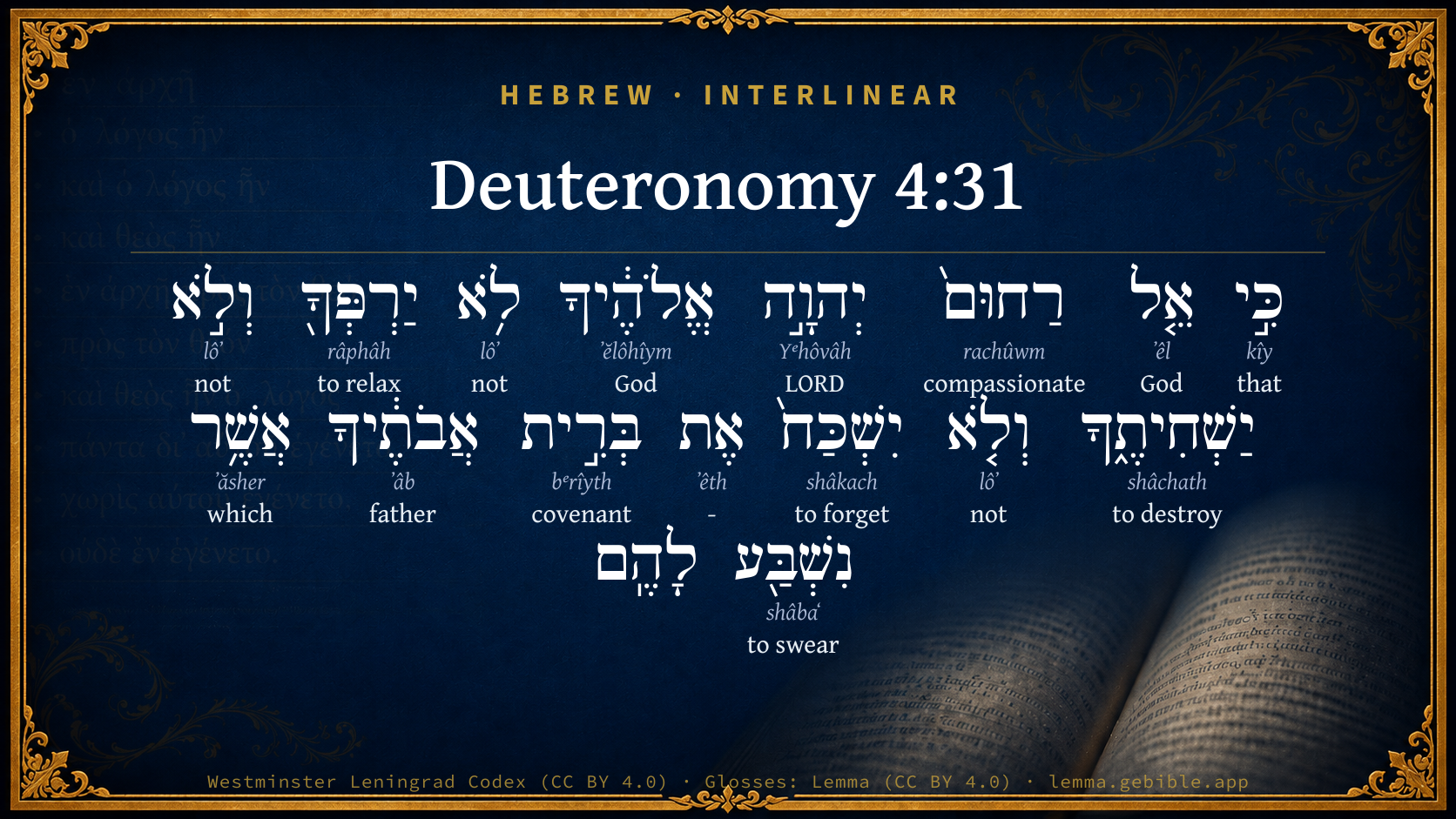
Deuteronomy 4:31

Hebrew (Westminster Leningrad Codex) Deuteronomy 4:31 appears in the Hebrew Old Testament. The text above is from the Westminster Leningrad Codex. Each word links to its Strong’s number, a concise gloss, and parsing drawn from the Open Scriptures Hebrew Bible morphology. Click any word for its full Brown-Driver-Briggs (BDB) entry.
Download image
Cite this verse

Deuteronomy 4:31 (World English Bible). Public Domain. Lemma interlinear Bible study tool, https://lemma.gebible.app/v/deuteronomy/4/31.

Show BibTeX & RIS
BibTeX
RIS
English Translation
for Yahweh your God is a merciful God; he will not fail you, neither destroy you, nor forget the covenant of your fathers which he swore to them.
World English Bible · Public Domain
Download a study sheet

One document with this verse’s original text, its word-by-word gloss line, the meaning frame, cross-references with their text, attributed commentary, and full source and license credits — printable, and it pastes into notes with its structure intact.

This verse Autodidact and up

Study sheet (.html) Plain text (.txt)

A passage Seminary Student

Up to 50 verses in one chapter. A passage sheet keeps up to 6 commentary sources and 12 cross-references per verse, in the order this page ranks them, and says so on the sheet whenever that leaves anything out. Ask for a single verse and you get the Autodidact verse sheet above.

Everything on this page stays free to read, with no account — the sheet is a download of what is already on screen, not access to it.

Want to remove ads? Support Godless Engineer
Compare translations 3

The same verse in 3 English versions, stacked beneath the original-language interlinear above. Click any original word for its lexicon entry.

Each is an independent rendering of the whole verse — the interlinear is not word-aligned to these translations.

Highlighted words mark where these versions differ — a whole-verse word diff, not a word-by-word alignment.

  • World English Bible Public Domain
    for Yahweh your God is a merciful God; he will not fail you, neither destroy you, nor forget the covenant of your fathers which he swore to them.
  • King James Version Public Domain
    (For the LORD thy God is a merciful God;) he will not forsake thee, neither destroy thee, nor forget the covenant of thy fathers which he sware unto them.
  • unfoldingWord Literal Text CC BY-SA 4.0
    For Yahweh your God a merciful God; he will not fail you, and he will not destroy you, and he will not forget the covenant of your fathers that he swore to them.

unfoldingWord Literal Text — © unfoldingWord, licensed CC BY-SA 4.0. Word-aligned USFM3 via Door43 (git.door43.org/unfoldingWord/en_ult).

Versions to compare (up to 4)

3 of 4 selected

Show all 18 translations

Every available English version of this verse, each an independent rendering of the whole verse.

  • World English Bible Public Domain
    for Yahweh your God is a merciful God; he will not fail you, neither destroy you, nor forget the covenant of your fathers which he swore to them.
  • Berean Standard Bible Public Domain
    For the LORD your God is a merciful God; He will not abandon you or destroy you or forget the covenant with your fathers, which He swore to them by oath.
  • Majority Standard Bible Public Domain
    For the LORD your God is a merciful God; He will not abandon you or destroy you or forget the covenant with your fathers, which He swore to them by oath.
  • King James Version Public Domain
    (For the LORD thy God is a merciful God;) he will not forsake thee, neither destroy thee, nor forget the covenant of thy fathers which he sware unto them.
  • American Standard Version (1901) Public Domain
    for Jehovah thy God is a merciful God; he will not fail thee, neither destroy thee, nor forget the covenant of thy fathers which he sware unto them.
  • Revised Version (1885) Public Domain
    for the LORD thy God is a merciful God; he will not fail thee, neither destroy thee, nor forget the covenant of thy fathers which he sware unto them.
  • Geneva Bible (1599) Public Domain
    (For the Lord thy God is a mercifull God) he will not forsake thee, neither destroy thee, nor forget the couenant of thy fathers, which hee sware vnto them.
  • Douay-Rheims (1899) Public Domain
    Because the Lord thy God is a merciful God: he will not leave thee, nor altogether destroy thee, nor forget the covenant, by which he swore to thy fathers.
  • Young's Literal Translation Public Domain
    for a merciful God `is' Jehovah thy God; He doth not fail thee, nor destroy thee, nor forget the covenant of thy fathers, which He hath sworn to them.
  • Literal Standard Version CC BY-SA 4.0
    for your God YHWH [is] a merciful God—He does not fail you, nor destroy you, nor forget the covenant of your fathers which He has sworn to them.
  • Unlocked Literal Bible CC BY-SA 4.0
    For Yahweh your God is a merciful God; he will not fail you nor destroy you, nor forget the covenant of your fathers that he swore to them.
  • unfoldingWord Literal Text CC BY-SA 4.0
    For Yahweh your God a merciful God; he will not fail you, and he will not destroy you, and he will not forget the covenant of your fathers that he swore to them.
  • Darby Bible Public Domain
    -- for Jehovah thy God is a merciful ùGod, -- he will not forsake thee, neither destroy thee, nor forget the covenant of thy fathers which he swore unto them.
  • World Messianic Bible Public Domain
    For the LORD your God is a merciful God. He will not fail you nor destroy you, nor forget the covenant of your fathers which he swore to them.
  • Webster's Bible Public Domain
    (For the LORD thy God is a merciful God;) he will not forsake thee, neither destroy thee, nor forget the covenant of thy fathers, which he swore to them.
  • Free Bible Version CC BY-SA 4.0
    The Lord your God is a merciful God. He won't abandon you or destroy you or forget the agreement he made with your forefathers, confirmed by a solemn promise.
  • Bible in Basic English Public Domain
    Because the Lord your God is a God of mercy, he will not take away his help from you or let destruction overtake you, or be false to the agreement which he made by an oath with your fathers.
  • JPS Tanakh (1917) Public Domain
    for the LORD thy God is a merciful God; He will not fail thee, neither destroy thee, nor forget the covenant of thy fathers which He swore unto them.

Literal Standard Version (2020), Covenant Press — licensed CC BY-SA 4.0. Text via the HelloAO Bible API (eBible.org). Unlocked Literal Bible (unfoldingWord) — licensed CC BY-SA 4.0. Text via the HelloAO Bible API (eBible.org). unfoldingWord Literal Text — © unfoldingWord, licensed CC BY-SA 4.0. Word-aligned USFM3 via Door43 (git.door43.org/unfoldingWord/en_ult). Free Bible Version, Dr. Jonathan Gallagher — licensed CC BY-SA 4.0. Text via the HelloAO Bible API (eBible.org).

Word by word

More ways to search: Search by grammar → Find every occurrence → Compare this word →

Practice this passage: Drill this verse → Learn its vocabulary →

רַחוּם֙
rachûwm
H7349
“compassionate”
Adjective, Adjective, Masculine, Singular, Absolute
Part of Speech
Adjective
Type
Adjective
Gender
Masculine
Number
Singular
State
Absolute
Full BDB Definition

Origin: from H7355

TWOT: 2146c

compassionate - always of God with one possible exception
  1. כִּ֣י kîy H3588 “that” Conjunction
  2. אֵ֤ל ʼêl H410 “God” Noun, Common, Masculine, Singular, Absolute
  3. יְהוָ֣ה Yᵉhôvâh H3068 “LORD” Noun, Proper
  4. אֱלֹהֶ֔יךָ ʼĕlôhîym H430 “God(s) · your” Noun, Common, Masculine, Plural, Construct + Suffix, Personal, 2nd Person, Masculine, Singular
  5. לֹ֥א lôʼ H3808 “not” Particle, Negative
  6. יַרְפְּךָ֖ râphâh H7503 “to relax · you” Verb, Hiphil, Imperfect, 3rd Person, Masculine, Singular + Suffix, Personal, 2nd Person, Masculine, Singular
  7. וְלֹ֣א lôʼ H3808 “and · not” Conjunction + Particle, Negative
  8. יַשְׁחִיתֶ֑ךָ shâchath H7843 “to destroy · you” Verb, Hiphil, Imperfect, 3rd Person, Masculine, Singular + Suffix, Personal, 2nd Person, Masculine, Singular
  9. וְלֹ֤א lôʼ H3808 “and · not” Conjunction + Particle, Negative
  10. יִשְׁכַּח֙ shâkach H7911 “to forget” Verb, Qal, Imperfect, 3rd Person, Masculine, Singular
  11. אֶת ʼêth H853 “-” Particle, Direct Object
  12. בְּרִ֣ית bᵉrîyth H1285 “covenant of” Noun, Common, Feminine, Singular, Construct
  13. אֲבֹתֶ֔יךָ ʼâb H1 “fathers · your” Noun, Common, Masculine, Plural, Construct + Suffix, Personal, 2nd Person, Masculine, Singular
  14. אֲשֶׁ֥ר ʼăsher H834 “which” Particle, Relative
  15. נִשְׁבַּ֖ע shâbaʻ H7650 “to swear” Verb, Niphal, Perfect, 3rd Person, Masculine, Singular

About this verse

These counts appear in no published source. They are computed here, from the morphology-tagged text and Lemma’s own curated glosses. What Lemma adds →

17
words
14
distinct lemmas
Pentateuch
section

Notable vocabulary

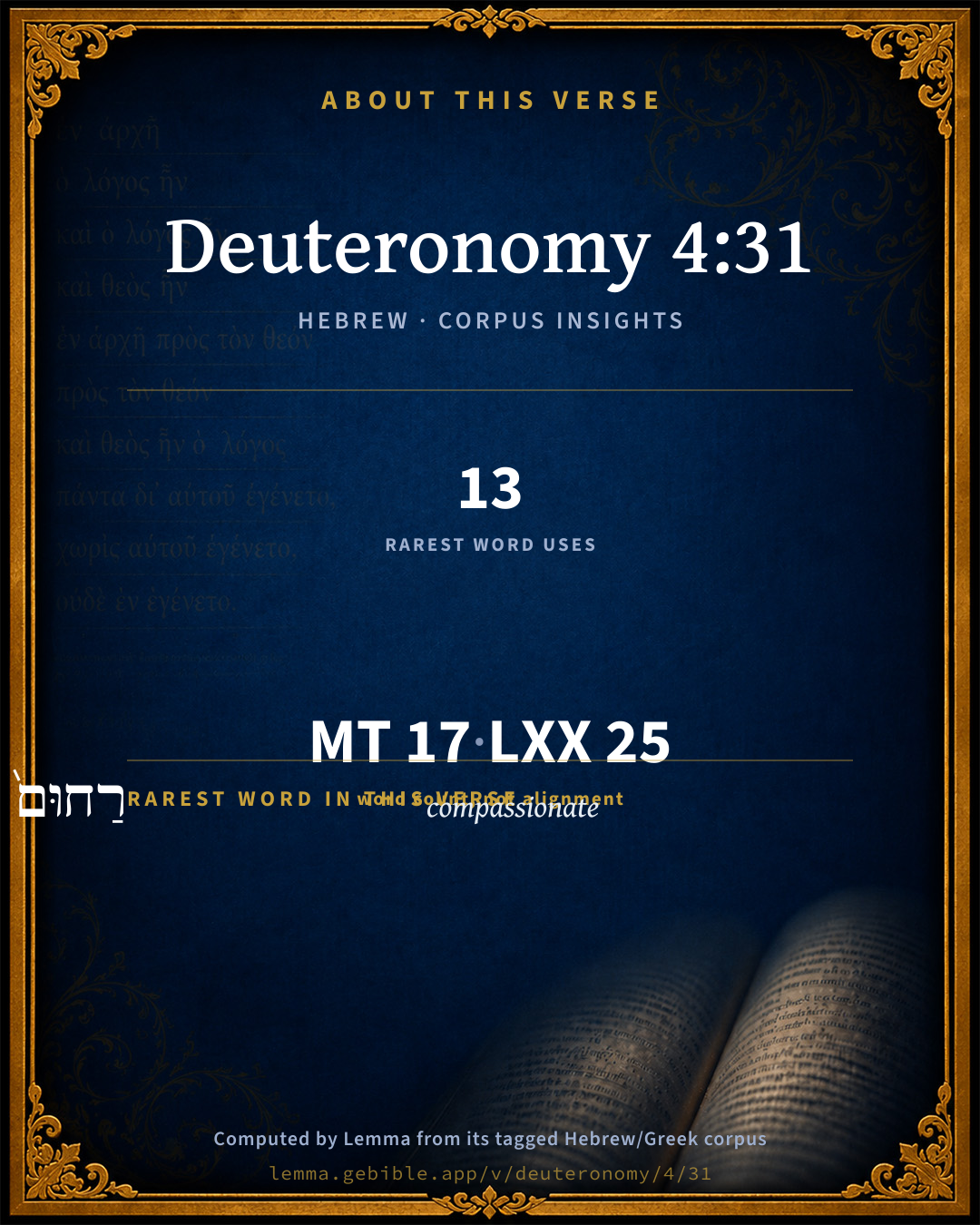
The rarest word here is רַחוּם֙ compassionate H7349 — appearing just 13 times in the whole Hebrew Bible.

Shared distinctive vocabulary

רַחוּם֙ compassionate H7349 occurs in 13 verses of the Hebrew Bible. Also found in:

Grammatical profile

  • 4 verbs
  • 5 nouns
  • 1 adjective
  • 1 preposition
  • 1 conjunction
  • 5 particles

Verb forms

  • יַרְפְּךָ֖ Hiphil · Imperfect
  • יַשְׁחִיתֶ֑ךָ Hiphil · Imperfect
  • יִשְׁכַּח֙ Qal · Imperfect
  • נִשְׁבַּ֖ע Niphal · Perfect

Repetition

A word recurs within this verse — often emphatic in Hebrew:

Hebrew & Septuagint length

In English translation the verse runs 28 words from the Hebrew and 33 from the Septuagint (LXX English) — closely comparable.

A rough comparison of the two English renderings, which tokenize alike — not a word-level alignment.

Word counts can differ between the Hebrew and the Greek without any difference in meaning — e.g. the Hebrew direct-object marker אֵת has no separate Greek word, and Greek often adds the article ὁ.

In the original languages it is 17 Hebrew tokens and 25 Greek tokens — but the two are counted differently (Hebrew bundles its prefixes and suffixes into one token; the Greek is in lemma form), so that isn’t a like-for-like length.

Cross-references

22

Topical passages linked to Deuteronomy 4:31 in the Treasury of Scripture Knowledge — connected by theme and wording, ordered by reader-vote popularity; previews shown in the World English Bible.

  • Deuteronomy 31:8 Yahweh, he it is who does go before you; he will be with you, he will not fail you, neither forsake you: don't be afraid, neither be dismayed.
  • Psalms 116:5 Gracious is Yahweh, and righteous; Yes, our God is merciful.
  • Nehemiah 9:31 Nevertheless in your manifold mercies you did not make a full end of them, nor forsake them; for you are a gracious and merciful God.
  • Jonah 4:2 He prayed to Yahweh, and said, "Please, Yahweh, wasn't this what I said when I was still in my own country? Therefore I hurried to flee to Tarshish, for I knew that you are a gracious God, and merciful, slow to anger, and abundant in loving kindness, and you repent of the evil.
  • Exodus 34:6–7 Yahweh passed by before him, and proclaimed, "Yahweh! Yahweh, a merciful and gracious God, slow to anger, and abundant in loving kindness and truth,
  • Leviticus 26:42 then I will remember my covenant with Jacob; and also my covenant with Isaac, and also my covenant with Abraham; and I will remember the land.
  • 2 Chronicles 30:9 For if you turn again to Yahweh, your brothers and your children shall find compassion before those who led them captive, and shall come again into this land: for Yahweh your God is gracious and merciful, and will not turn away his face from you, if you return to him.
  • Deuteronomy 31:6 Be strong and of good courage, don't be afraid, nor be scared of them: for Yahweh your God, he it is who does go with you; he will not fail you, nor forsake you.
  • Psalms 145:8–9 Yahweh is gracious, merciful, Slow to anger, and of great loving kindness.
  • Leviticus 26:45 but I will for their sake remember the covenant of their ancestors, whom I brought forth out of the land of Egypt in the sight of the nations, that I might be their God. I am Yahweh.'"
  • Numbers 14:18 Yahweh is slow to anger, and abundant in loving kindness, forgiving iniquity and disobedience; and that will by no means clear [the guilty], visiting the iniquity of the fathers on the children, on the third and on the fourth generation.
  • Joshua 1:5 There shall not any man be able to stand before you all the days of your life. As I was with Moses, so I will be with you; I will not fail you, nor forsake you.
  • Psalms 111:5 He has given food to those who fear him. He always remembers his covenant.
  • Psalms 111:9 He has sent redemption to his people. He has ordained his covenant forever. His name is holy and awesome!
  • Jeremiah 14:21 Do not abhor [us], for your name's sake; do not disgrace the throne of your glory: remember, don't break your covenant with us.
  • Luke 1:72 To show mercy towards our fathers, To remember his holy covenant,
  • Nehemiah 1:5 and said, I beg you, Yahweh, the God of heaven, the great and awesome God, who keeps covenant and loving kindness with those who love him and keep his commandments:
  • 1 Chronicles 28:20 David said to Solomon his son, Be strong and of good courage, and do it: don't be afraid, nor be dismayed; for Yahweh God, even my God, is with you; he will not fail you, nor forsake you, until all the work for the service of the house of Yahweh is finished.
  • Psalms 86:5 For you, Lord, are good, and ready to forgive; Abundant in loving kindness to all those who call on you.
  • Psalms 86:15 But you, Lord, are a merciful and gracious God, Slow to anger, and abundant in loving kindness and truth.
  • Psalms 105:8 He has remembered his covenant forever, The word which he commanded to a thousand generations,
  • Micah 7:18 Who is a God like you, who pardons iniquity, And passes over the disobedience of the remnant of his heritage? He doesn't retain his anger forever, Because he delights in loving kindness.

Cross-references courtesy of OpenBible.info (CC BY 4.0).

Hebrew and Greek witnesses Masoretic Hebrew ↔ Greek Septuagint

The same verse in the two great witnesses to the Old Testament, shown verse-for-verse.

These are two independent witnesses, not word-aligned to each other, and the Septuagint is shown in lemma (dictionary) form.

Hebrew Deuteronomy 4:31 Masoretic · Westminster Leningrad Codex

כִּ֣י אֵ֤ל רַחוּם֙ יְהוָ֣ה אֱלֹהֶ֔יךָ לֹ֥א יַרְפְּךָ֖ וְלֹ֣א יַשְׁחִיתֶ֑ךָ וְלֹ֤א יִשְׁכַּח֙ אֶת בְּרִ֣ית אֲבֹתֶ֔יךָ אֲשֶׁ֥ר נִשְׁבַּ֖ע לָהֶֽם

for Yahweh your God is a merciful God; he will not fail you, neither destroy you, nor forget the covenant of your fathers which he swore to them.

World English Bible · Public Domain

Greek LXX Deuteronomy 4:31 Septuagint · lemma form

ὅτι θεός οἰκτίρμων κύριος ὁ θεός σύ οὐ ἐν καταλείπω σύ οὐδέ μή ἐκτρίβω σύ οὐ ἐπιλανθάνω ὁ διαθήκη ὁ πατήρ σύ ὅς ὄμνυμι αὐτός

Because the Lord your God is a God of pity: he will not forsake you, nor destroy you; he will not forget the covenant of your fathers, which the Lord swore to them.

LXX2012 (modern English Septuagint) · Public Domain

Hebrew: Westminster Leningrad Codex (CC BY 4.0). Greek: Septuagint (public domain); English from LXX2012 (modern English Septuagint) (Public Domain). How the Septuagint differs from the Hebrew →

Targum (Aramaic paraphrase)

2

The Targum is the ancient Jewish Aramaic paraphrase of the Hebrew Scriptures — an interpretive translation, not the Hebrew text itself. Onkelos (literal) and Pseudo-Jonathan (expansive) render the Torah, and Jonathan the Prophets. Coverage is partial: where no permissively-licensed English translation exists for a verse, only the Aramaic is shown. This is verse-level text, not a word-by-word alignment to the Hebrew.

  1. Targum Onkelos Torah (Genesis–Deuteronomy)
    אֲרֵי אֱלָהָא רַחֲמָנָא יְיָ אֱלָהָךְ לָא יִשְׁבְּקִנָךְ וְלָא יְחַבְּלִנָךְ וְלָא יִתִּנְשֵׁי יָת קְיָמָא דַאֲבָהָתָךְ דִי קַיִים לְהוֹן

    (no public-domain English translation for this verse)

    Targum Onkelos — Aramaic: “Onkelos Genesis” (public domain); “Onkelos Exodus” (public domain); “Onkelos Leviticus” (public domain); “Onkelos Numbers” (public domain); “Onkelos Deuteronomy” (public domain). English: “Sefaria Community Translation” (CC0 1.0 (public-domain dedication)); “J.W. Etheridge. The Targums of Onkelos and Jonathan Ben Uzziel on the Pentateuch. London: Longmans, Green, 1862” (public domain). Text via Sefaria.

  2. Targum Pseudo-Jonathan Torah (Genesis–Deuteronomy)
    אֲרוּם אֱלָהָא רַחֲמָנָא יְיָ אֱלָהָכוֹן לָא יִשְׁבְּקִנְכוֹן וְלָא יִחְבַּלְכוֹן וְלָא יִתְנְשֵׁי יַת קְיָימָא דְאַבָהַתְכוֹן דְּקַיַּים לְהוֹן

    for the Lord our God is a merciful God; He will not forsake you, nor destroy you, nor forget the covenant of your fathers which He sware unto them.

    Targum Pseudo-Jonathan — Aramaic: “Targum Jonathan on Genesis” (public domain); “Targum Jonathan on Exodus” (public domain); “Targum Jonathan on Leviticus” (public domain); “Targum Jonathan on Numbers” (public domain); “Targum Jonathan on Deuteronomy” (public domain). English: “The Targum of Jonathan ben Uzziel, trans. J. W. Etheridge, London, 1862” (public domain). Text via Sefaria.

Commentary

Notes on Deuteronomy 4:31 from classic Christian and Jewish commentators (each source and its license shown beneath its notes). The classic Christian expositions comment on the surrounding passage and are grouped to its opening verse, so a note may address several verses; the Jewish commentaries on the Tanakh (Rashi and others) are per-verse, so they appear only where the commentator wrote on this verse.

Lemma curates 59 commentaries, every one of them public domain or Creative Commons licensed, each selected and text-cleaned for this edition rather than reprinted as found. About our sources →

Geneva Bible (1599)

Geneva Bible translators

To certify them the more of the assurance of their salvation.

Geneva Bible (1599) marginal notes — public domain. Text via Bolls.life.

The Cambridge Bible for Schools and Colleges

gen. ed. J. J. S. Perowne

31. a merciful God] Cp. JE, Exo_34:6.

he will not fail thee] Rather, will not let thee drop (Driver); will hold thee fast. Cp. Deu_31:6; Deu_31:8; Jos_1:5.

nor forget the covenant] See on Deu_4:13.

The Cambridge Bible for Schools and Colleges (gen. ed. J. J. S. Perowne; Cambridge University Press, 1878–1918) — public domain. Text from a community e-Sword module.

John Gill's Exposition

For the Lord thy God is a merciful God,.... In Christ, in whom he has proclaimed his name as such, of which Moses had a comfortable view, Exo 34:6 and therefore could attest it from his own knowledge and experience:

he will not forsake thee; though in a strange country, but bring them from thence into their own land again, and favour them with his gracious presence in his house and ordinances:

neither destroy thee; from being a people; and in a very wonderful manner are they preserved among the nations of the earth to this day:

nor forget the covenant of thy fathers, which he sware unto them; that a Saviour should come and turn away ungodliness from them, and take away their sins; see Rom 11:26.

John Gill's Exposition of the Whole Bible (1746–1763) — public domain (CC PDM 1.0). Text via the HelloAO Bible API.

Matthew Poole's English Annotations

i.e. Made with thy fathers, including their posterity, as Gen 17:7.

Matthew Poole's English Annotations on the Holy Bible (1683–1685) — public domain. Text from a community e-Sword/MySword module.

The Pulpit Commentary

Will not forsake thee; literally, will not let thee loose, will not lose hold of thee, will not cast thee off (cf. Rom_11:1, etc.) "Israel will return and find God, because he loses not hold of it" (Herxheimer). "The sinner will incline to seek God only when he apprehends him as gracious and ready to hear" (Calvin).

The Pulpit Commentary (1880–1919), ed. H.D.M. Spence-Jones & Joseph S. Exell — public domain. Text from a community e-Sword module.

Rashi

Rabbi Shlomo Yitzchaki (Rashi)

לא ירפך means, He will not let loose of thee so as not to hold thee fast by His hands. The expression לא ירפך is an expression signifying: He will not cause something (our Hiphil) — He will not give thee any looseness, i.e. He will not separate you from Him. Similar is (Song 3:4) “I hold him fast, and I will not let him loose (אַרְפֶּנוּ )”, which is not vowelled אֶרְפֶּנוּ (which is Kal and an impossible form of the root רפה “to be loose”). Always the expression “letting slack (רפה)” in the Hiphil refers to one who causes looseness to others or to one who causes it to himself. For example (2 Kings 4:2) הרפה לה means, “give her looseness”; (Deuteronomy 9:14) הרף ממני means, “Give looseness to thyself from off me”.

Rashi on the Tanakh — English translations: “The Judaica Press complete Tanach with Rashi, translated by A. J. Rosenberg” (CC BY 4.0); “Pentateuch with Rashi's commentary by M. Rosenbaum and A.M. Silbermann, 1929-1934” (public domain); “The Metsudah Tanach series, Lakewood, N.J” (CC BY 4.0); and “The Book of Joshua, Metsudah Publications, 1997” (CC BY 4.0). Text via Sefaria.

Lesson kit

Teaching starters — assembled from the data on this page, not authored interpretation. Every prompt links to the verse data it draws on. Edit before teaching.

Deuteronomy, in the Pentateuch, opens this verse with 17 words (14 distinct Hebrew lemmas). Its most distinctive word is rachûwm (“compassionate”). A historical commentator’s framing appears above. Read the whole chapter for the surrounding context.

Discussion questions

  1. How does “compassionate” (rachûwm) shape what this verse is saying?
  2. How does Exodus 34:6, which shares the word «compassionate», read alongside this verse?
  3. What does the repetition of “not” (3× in this one verse) do in this verse?
  4. These translations render this verse differently; the difference is in the English rendering, not the original. What questions does that raise?
  5. «יַרְפְּךָ֖» is a Hiphil Imperfect verb. How does that grammatical form shape the action described?
  6. Compare how Geneva Bible (1599) and The Cambridge Bible for Schools and Colleges read this verse. Where do they agree or differ?

Things to notice

Reading settings

Reading text

Shown beneath each verse's original-language words.

Old Testament
Old Testament edition

Read the OT as the Masoretic Hebrew (MT) or the Greek Septuagint (LXX).

English shown for the Greek Septuagint (in the Hebrew ↔ Greek comparison).

Comparing translations? Open the Compare panel on any verse page to stack up to four side by side.