
Genesis 50:16

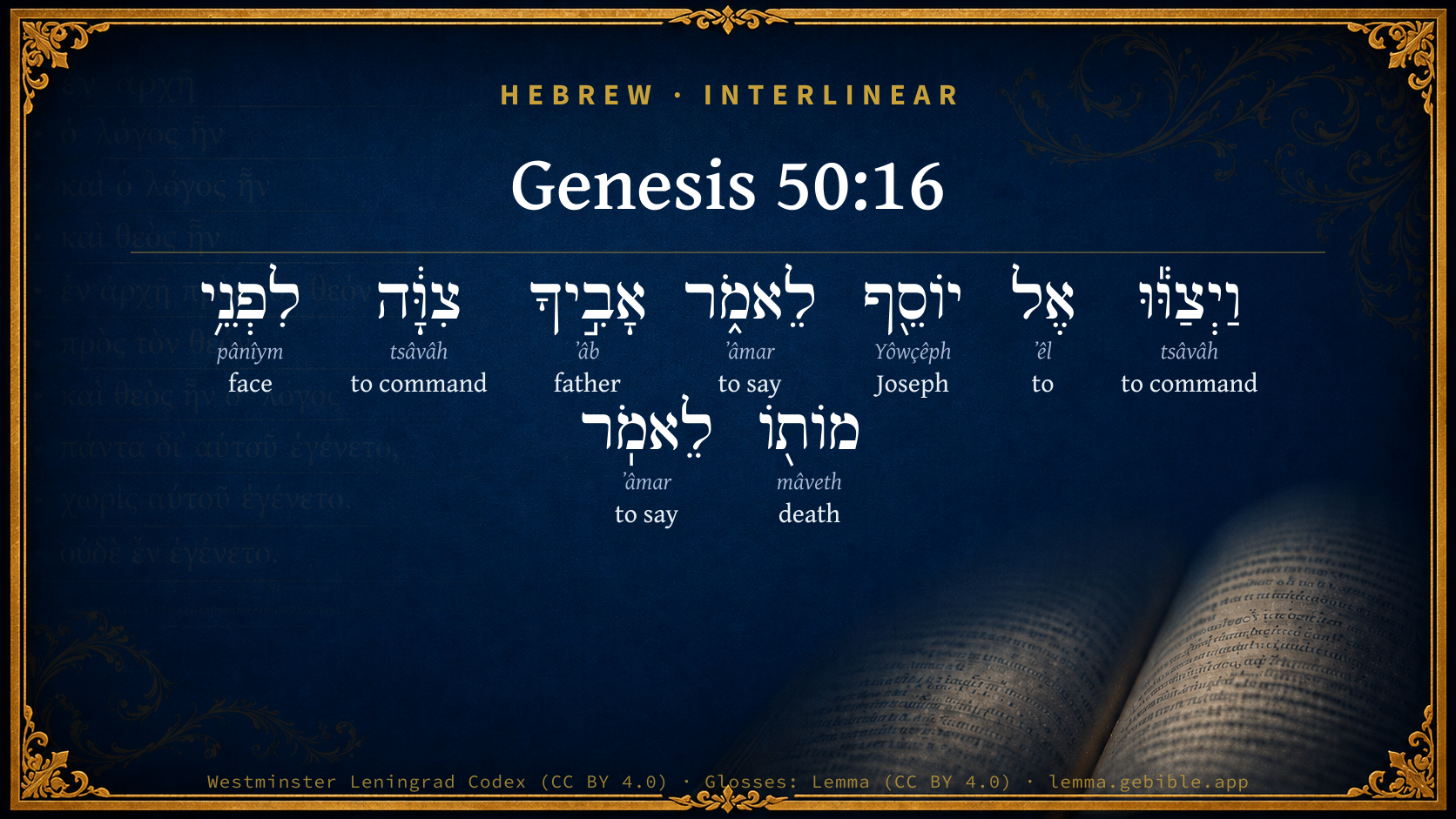
Hebrew (Westminster Leningrad Codex) Genesis 50:16 appears in the Hebrew Old Testament. The text above is from the Westminster Leningrad Codex. Each word links to its Strong’s number, a concise gloss, and parsing drawn from the Open Scriptures Hebrew Bible morphology. Click any word for its full Brown-Driver-Briggs (BDB) entry.
Download image
Cite this verse

Genesis 50:16 (World English Bible). Public Domain. Lemma interlinear Bible study tool, https://lemma.gebible.app/v/genesis/50/16.

Show BibTeX & RIS
BibTeX
RIS
English Translation
They sent a message to Joseph, saying, "Your father commanded before he died, saying,
World English Bible · Public Domain
Download a study sheet

One document with this verse’s original text, its word-by-word gloss line, the meaning frame, cross-references with their text, attributed commentary, and full source and license credits — printable, and it pastes into notes with its structure intact.

This verse Autodidact and up

Study sheet (.html) Plain text (.txt)

A passage Seminary Student

Up to 50 verses in one chapter. A passage sheet keeps up to 6 commentary sources and 12 cross-references per verse, in the order this page ranks them, and says so on the sheet whenever that leaves anything out. Ask for a single verse and you get the Autodidact verse sheet above.

Everything on this page stays free to read, with no account — the sheet is a download of what is already on screen, not access to it.

Want to remove ads? Support Godless Engineer
Compare translations 3

The same verse in 3 English versions, stacked beneath the original-language interlinear above. Click any original word for its lexicon entry.

Each is an independent rendering of the whole verse — the interlinear is not word-aligned to these translations.

Highlighted words mark where these versions differ — a whole-verse word diff, not a word-by-word alignment.

  • World English Bible Public Domain
    They sent a message to Joseph, saying, "Your father commanded before he died, saying,
  • King James Version Public Domain
    And they sent a messenger unto Joseph, saying, Thy father did command before he died, saying,
  • unfoldingWord Literal Text CC BY-SA 4.0
    Then they ordered to Joseph, saying, “Your father commanded before his death, saying,

unfoldingWord Literal Text — © unfoldingWord, licensed CC BY-SA 4.0. Word-aligned USFM3 via Door43 (git.door43.org/unfoldingWord/en_ult).

Versions to compare (up to 4)

3 of 4 selected

Show all 18 translations

Every available English version of this verse, each an independent rendering of the whole verse.

  • World English Bible Public Domain
    They sent a message to Joseph, saying, "Your father commanded before he died, saying,
  • Berean Standard Bible Public Domain
    So they sent word to Joseph, saying, “Before he died, your father commanded,
  • Majority Standard Bible Public Domain
    So they sent word to Joseph, saying, “Before he died, your father commanded,
  • King James Version Public Domain
    And they sent a messenger unto Joseph, saying, Thy father did command before he died, saying,
  • American Standard Version (1901) Public Domain
    And they sent a message unto Joseph, saying, Thy father did command before he died, saying,
  • Revised Version (1885) Public Domain
    And they sent a message unto Joseph, saying, Thy father did command before he died, saying,
  • Geneva Bible (1599) Public Domain
    Therefore they sent vnto Ioseph, saying, Thy father commanded before his death, saying,
  • Douay-Rheims (1899) Public Domain
    And they sent a message to him, saying: Thy father commanded us before he died,
  • Young's Literal Translation Public Domain
    And they give a charge for Joseph, saying, `Thy father commanded before his death, saying,
  • Literal Standard Version CC BY-SA 4.0
    And they give a charge for Joseph, saying, “Your father commanded before his death, saying,
  • Unlocked Literal Bible CC BY-SA 4.0
    So they commanded the presence of Joseph, saying, “Your father gave instructions before he died, saying,
  • unfoldingWord Literal Text CC BY-SA 4.0
    Then they ordered to Joseph, saying, “Your father commanded before his death, saying,
  • Darby Bible Public Domain
    And they sent a messenger to Joseph, saying, Thy father commanded before he died, saying,
  • World Messianic Bible Public Domain
    They sent a message to Joseph, saying, “Your father commanded before he died, saying,
  • Webster's Bible Public Domain
    And they sent messengers to Joseph, saying, Thy father commanded before he died, saying,
  • Free Bible Version CC BY-SA 4.0
    So they sent a message to Joseph to tell him, “Before your father died, he gave this order:
  • Bible in Basic English Public Domain
    So they sent word to Joseph, saying, Your father, before his death, gave us orders, saying,
  • JPS Tanakh (1917) Public Domain
    And they sent a message unto Joseph, saying: 'Thy father did command before he died, saying:

Literal Standard Version (2020), Covenant Press — licensed CC BY-SA 4.0. Text via the HelloAO Bible API (eBible.org). Unlocked Literal Bible (unfoldingWord) — licensed CC BY-SA 4.0. Text via the HelloAO Bible API (eBible.org). unfoldingWord Literal Text — © unfoldingWord, licensed CC BY-SA 4.0. Word-aligned USFM3 via Door43 (git.door43.org/unfoldingWord/en_ult). Free Bible Version, Dr. Jonathan Gallagher — licensed CC BY-SA 4.0. Text via the HelloAO Bible API (eBible.org).

Word by word

More ways to search: Search by grammar → Find every occurrence → Compare this word →

Practice this passage: Drill this verse → Learn its vocabulary →

מוֹת֖וֹ
mâveth
H4194
“death · his”
Noun, Common, Masculine, Singular, Construct + Suffix, Personal, 3rd Person, Masculine, Singular
Part of Speech
Noun
Type
Common
Gender
Masculine
Number
Singular
State
Construct
Full BDB Definition

Origin: from H4191

TWOT: 1169a

death, dying, Death (personified), realm of the dead - death - death by violence (as a penalty) - state of death, place of death
  1. וַיְצַוּ֕וּ tsâvâh H6680 “and · to command” Conjunction + Verb, Piel, Sequential Imperfect, 3rd Person, Masculine, Plural
  2. אֶל ʼêl H413 “to” Preposition
  3. יוֹסֵ֖ף Yôwçêph H3130 “Joseph” Noun, Proper
  4. לֵאמֹ֑ר ʼâmar H559 “to say” Preposition + Verb, Qal, Infinitive Construct
  5. אָבִ֣יךָ ʼâb H1 “father · your” Noun, Common, Masculine, Singular, Construct + Suffix, Personal, 2nd Person, Masculine, Singular
  6. צִוָּ֔ה tsâvâh H6680 “to command” Verb, Piel, Perfect, 3rd Person, Masculine, Singular
  7. לִפְנֵ֥י pânîym H6440 “to/for · face(s) of” Preposition + Noun, Common, Both, Plural, Construct
  8. לֵאמֹֽר ʼâmar H559 “to say” Preposition + Verb, Qal, Infinitive Construct

About this verse

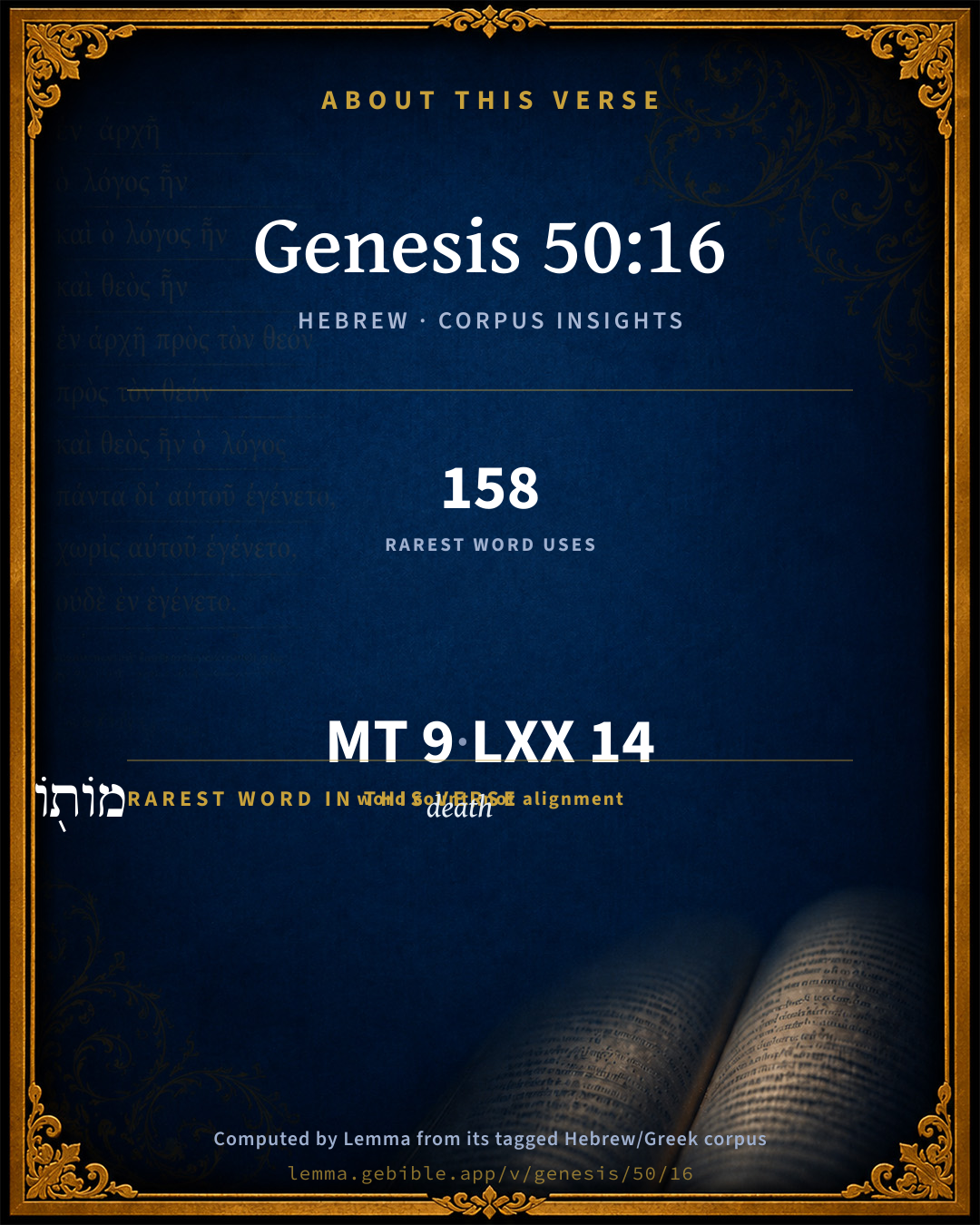
These counts appear in no published source. They are computed here, from the morphology-tagged text and Lemma’s own curated glosses. What Lemma adds →

9
words
7
distinct lemmas
Pentateuch
section

Grammatical profile

  • 4 verbs
  • 4 nouns
  • 1 preposition

Verb forms

  • וַיְצַוּ֕וּ Piel · Sequential Imperfect
  • לֵאמֹ֑ר Qal · Infinitive Construct
  • צִוָּ֔ה Piel · Perfect
  • לֵאמֹֽר Qal · Infinitive Construct

Repetition

Words recur within this verse — often emphatic in Hebrew:

  • וַיְצַוּ֕וּ to command H6680 ×2
  • לֵאמֹ֑ר to say H559 ×2

Hebrew & Septuagint length

In English translation the verse runs 14 words from the Hebrew and 15 from the Septuagint (LXX English) — closely comparable.

A rough comparison of the two English renderings, which tokenize alike — not a word-level alignment.

Word counts can differ between the Hebrew and the Greek without any difference in meaning — e.g. the Hebrew direct-object marker אֵת has no separate Greek word, and Greek often adds the article ὁ.

In the original languages it is 9 Hebrew tokens and 14 Greek tokens — but the two are counted differently (Hebrew bundles its prefixes and suffixes into one token; the Greek is in lemma form), so that isn’t a like-for-like length.

Cross-references

1

Topical passages linked to Genesis 50:16 in the Treasury of Scripture Knowledge — connected by theme and wording, ordered by reader-vote popularity; previews shown in the World English Bible.

  • Proverbs 29:25 The fear of man proves to be a snare, But whoever puts his trust in Yahweh is kept safe.

Cross-references courtesy of OpenBible.info (CC BY 4.0).

Hebrew and Greek witnesses Masoretic Hebrew ↔ Greek Septuagint

The same verse in the two great witnesses to the Old Testament, shown verse-for-verse.

These are two independent witnesses, not word-aligned to each other, and the Septuagint is shown in lemma (dictionary) form.

Hebrew Genesis 50:16 Masoretic · Westminster Leningrad Codex

וַיְצַוּ֕וּ אֶל יוֹסֵ֖ף לֵאמֹ֑ר אָבִ֣יךָ צִוָּ֔ה לִפְנֵ֥י מוֹת֖וֹ לֵאמֹֽר

They sent a message to Joseph, saying, "Your father commanded before he died, saying,

World English Bible · Public Domain

Greek LXX Genesis 50:16 Septuagint · lemma form

καί παραγίγνομαι πρός ιωσηφ λέγω ὁ πατήρ σύ ὁρκίζω πρό ὁ τελευτάω αὐτός λέγω

And they came to Joseph, and said, Your father adjured us before his death, saying,

LXX2012 (modern English Septuagint) · Public Domain

On this verse, The Cambridge Bible for Schools and Colleges discusses the Septuagint’s reading. Read the note in Commentary ↓

Hebrew: Westminster Leningrad Codex (CC BY 4.0). Greek: Septuagint (public domain); English from LXX2012 (modern English Septuagint) (Public Domain). How the Septuagint differs from the Hebrew →

Targum (Aramaic paraphrase)

2

The Targum is the ancient Jewish Aramaic paraphrase of the Hebrew Scriptures — an interpretive translation, not the Hebrew text itself. Onkelos (literal) and Pseudo-Jonathan (expansive) render the Torah, and Jonathan the Prophets. Coverage is partial: where no permissively-licensed English translation exists for a verse, only the Aramaic is shown. This is verse-level text, not a word-by-word alignment to the Hebrew.

  1. Targum Onkelos Torah (Genesis–Deuteronomy)
    וּפַקִידוּ לְוַת יוֹסֵף לְמֵימָר אָבוּךְ פַּקֵּד קֳדָם מוֹתֵהּ לְמֵימָר

    (no public-domain English translation for this verse)

    Targum Onkelos — Aramaic: “Onkelos Genesis” (public domain); “Onkelos Exodus” (public domain); “Onkelos Leviticus” (public domain); “Onkelos Numbers” (public domain); “Onkelos Deuteronomy” (public domain). English: “Sefaria Community Translation” (CC0 1.0 (public-domain dedication)); “J.W. Etheridge. The Targums of Onkelos and Jonathan Ben Uzziel on the Pentateuch. London: Longmans, Green, 1862” (public domain). Text via Sefaria.

  2. Targum Pseudo-Jonathan Torah (Genesis–Deuteronomy)
    וּפַקִידוּ יַת בִּלְהָה לְמֵימַר לְיוֹסֵף אָבוּךְ פַּקֵיד קֳדָם מוֹתֵיהּ לְמֵימָר לָךְ

    And they instructed Bilhah to say to Joseph, Thy father commanded before his death to speak to thee,

    Targum Pseudo-Jonathan — Aramaic: “Targum Jonathan on Genesis” (public domain); “Targum Jonathan on Exodus” (public domain); “Targum Jonathan on Leviticus” (public domain); “Targum Jonathan on Numbers” (public domain); “Targum Jonathan on Deuteronomy” (public domain). English: “The Targum of Jonathan ben Uzziel, trans. J. W. Etheridge, London, 1862” (public domain). Text via Sefaria.

Commentary

Notes on Genesis 50:16 from classic Christian and Jewish commentators (each source and its license shown beneath its notes). The classic Christian expositions comment on the surrounding passage and are grouped to its opening verse, so a note may address several verses; the Jewish commentaries on the Tanakh (Rashi and others) are per-verse, so they appear only where the commentator wrote on this verse.

Lemma curates 59 commentaries, every one of them public domain or Creative Commons licensed, each selected and text-cleaned for this edition rather than reprinted as found. About our sources →

Trapp's Complete Commentary

John Trapp

Gen 50:16 And they sent a messenger unto Joseph, saying, Thy father did command before he died, saying,

Ver. 16. Thy father did command, &c.] It is a just question, whether there were ever a true word of all this. For Jacob, probably, never knew how ill they had used Joseph, as is above said. But if this had been his command howsoever, as they pretend, would not Jacob have spoken himself for them to Joseph before he died? "Fear of man" causeth lying, {Zep 3:13} and so "brings a snare to the soul." {Pro 29:25}

John Trapp, A Commentary or Exposition upon All the Books of the Old and New Testament (1647–1656) — public domain. Text from a community e-Sword module.

Adam Clarke's Commentary

Verse 16. Thy father did command] Whether he did or not we cannot tell. Some think they had feigned this story, but that is not so likely. Jacob might have had suspicions too, and might have thought that the best way to prevent evil was to humble themselves before their brother, and get a fresh assurance of his forgiveness.

Adam Clarke's Commentary on the Bible (1810–1826) — public domain. Text from a community e-Sword/MySword module.

John Calvin's Commentaries

16. And they sent a messenger. Because they are ashamed themselves to speak, they engage messengers of peace, in whom Joseph might have greater confidence. But here also we perceive that they who have an accusing conscience are destitute of counsel and of reason. For if Jacob had been solicitous on this point, why did he not effect reconciliation between the son who was so obedient unto himself, and his brethren? Besides, for what reason should they attempt to do that through mediators, which they could do so much better in their own persons? The Lord, therefore, suffers them to act like children; that we, being instructed by their example, may look for no advantage from the use of frivolous inventions. But it may be asked, where the sons of Jacob found men to whom they could venture to commit such a message; for it was no light thing to make known their execrable crime to strangers? And it would have been folly to subject themselves to this infamy among the Egyptians. The most probable conjecture is, that some domestic witnesses were chosen from the number of their own servants; for though Moses makes no mention of such, when he relates that Jacob departed into Egypt; yet that some were brought with him, may easily be gathered from certain considerations.

John Calvin's Commentaries (1540-1563) — public domain. Text from the Calvin Translation Society English edition (1840s-50s) via the Christian Classics Ethereal Library (ccel.org). Calvin's coverage is partial (roughly two-thirds of the Bible); uncommented books and verses are honest gaps, never fabricated. The 19th-century editor's footnotes and remarks are omitted so the notes are faithfully Calvin's own voice.

Ellicott's Commentary for English Readers

(16, 17) Thy father did command . . . —Many Jewish expositors consider that this was untrue, and that Jacob was never made aware of the fact that his brethren had sold Joseph into slavery. It is, however, probable, from Gen_49:6, that Jacob not only knew of it, but saw in Simeon and Levi the chief offenders. But besides the father’s authority the message brings a twofold influence to bear upon Joseph: for first it reminds him that they were his brethren, and next, that they shared the same religious faith—no slight band of union in a country where the religion was so unlike their own.

A Bible Commentary for English Readers, edited by Charles John Ellicott (1878–1897) — public domain. Text from a community e-Sword module.

The Cambridge Bible for Schools and Colleges

gen. ed. J. J. S. Perowne

16. sent a message] Lit. “charged” (Lat. mandaverunt), the same word as in Gen_49:29, in the sense of “commissioned,” persons to go to Joseph. LXX παρεγένοντο and Syr. Pesh. follow a different reading, “they drew near unto.” Perhaps the original text contained the delegation of two or three brothers to go unto Joseph.

Thy father did command] An unrecorded dying charge.

The Cambridge Bible for Schools and Colleges (gen. ed. J. J. S. Perowne; Cambridge University Press, 1878–1918) — public domain. Text from a community e-Sword module.

John Gill's Exposition

So shall ye say unto Joseph, forgive, I pray thee now, the trespass of thy brethren, and their sin,.... Their very great sin, and therefore more words than one are used to express it: unless this repetition should be intended, and signifies that their crime was a trespass against God, and a sin against their brother; and however they are directed to ask forgiveness for it, and urge the relation they stood in to Joseph, in order to obtain it, which they were ready to acknowledge as a very great evil, and of which they repented:

and now, we pray thee, forgive the trespass of the servants of the God of thy father; they urge not only the common relation they stood in to Jacob, but what they stood in to the God of Jacob, being his servants, his worshippers, as Joseph also was; and therefore, being his brethren not only in nature but in religion and grace, they hoped he would forgive their trespass:

and Joseph wept when they spake unto him; by their messenger; being troubled that they should be in such anxiety and distress of mind, which he had a fellow feeling with, and that they should have no better opinion of him, but entertain such distrust of him, notwithstanding all the kindness he had shown them, as to imagine that he should ever deal hardly with them for their former ill usage of him, which was forgiven and forgotten by him long ago.

John Gill's Exposition of the Whole Bible (1746–1763) — public domain (CC PDM 1.0). Text via the HelloAO Bible API.

Haydock's Catholic Bible Commentary

A message; perhaps by Benjamin. (Menochius) --- They hope thus to obtain pardon for the sake of their deceased father, and for the sake of their common God.

George Leo Haydock (1774–1849), Haydock's Catholic Family Bible and Commentary, 1859 edition — public domain. Excludes Psalms (Douay-Rheims chapter numbering differs from Protestant) and Deuterocanonical books (Catholic canon only).

Matthew Poole's English Annotations

This looks like a lie; for Jacob either did not know this fact, or rather, was so well assured of Joseph’s clemency and goodness, that he never feared his revenge. But guilt doth so awaken fear, that it makes a man never to think himself secure.

Matthew Poole's English Annotations on the Holy Bible (1683–1685) — public domain. Text from a community e-Sword/MySword module.

Whedon's Commentary on the Bible

Daniel D. Whedon

16. They sent a messenger — Literally, they commanded, or gave a charge to Joseph. “They charged Joseph, in their father’s name, probably by an embassy sent from Goshen to Memphis, the seat of government, although the text says nothing about messengers. Perhaps Benjamin first pleaded for them, and then they all came into his presence. Gen_50:18. Whether Jacob actually left this message for Joseph is doubtful. If he really had such fears, he would have been likely to entreat Joseph personally, as he freely charged him concerning other things which pertained to the family welfare. It was, of course, Jacob’s wish that there should be perfect and perpetual reconciliation among his children, which often may have been expressed; but the precise form of this petition to Joseph was probably suggested by the guilty fears of the brethren, who could not fully understand the generosity and magnanimity of Joseph. They knew that Joseph would sacredly heed his father’s charge and so offered their petition in his name.” — Newhall.

Daniel D. Whedon (gen. ed.), Commentary on the Old and New Testaments (1874–1909) — public domain. Text from a community e-Sword module.

The Pulpit Commentary

Vers. 16, 17. And (under these erroneous though not unnatural apprehensions) they sent a messenger unto Joseph, literally, they charged Joseph, i.e. they deputed one of their number (possibly Benjamin) to carry their desires to Josephsaying, Thy father did command before he died, saying (though not recorded, the circumstance here mentioned may have been historically true), So shall ye say unto Joseph, Forgive, I pray thee now, the trespass of thy brethren, and their sin; for they did unto thee evil (nothing is more inherently probable than that the good man on his death-bed did request his sons to beg their brother"s pardon): and now, we pray thee, forgive the trespass of the servants of the God of thy father. Joseph"s brethren in these words at once evince the depth of their humility, the sincerity of their repentance, and the genuineness of their religion. They were God"s true servants, and they wished to be forgiven by their much-offended brother, who, however, had long since embraced them in the arms of his affection. And Joseph wept when they spake unto him pained that they should for a single moment have enter-rained such suspicions against his love.

The Pulpit Commentary (1880–1919), ed. H.D.M. Spence-Jones & Joseph S. Exell — public domain. Text from a community e-Sword module.

John Wesley's Explanatory Notes

Thy father did command - Thus in humbling ourselves to Christ by faith and repentance, we may plead that it is the command of his father and our father we should do so.

John Wesley, Explanatory Notes Upon the Whole Bible (1754–1765) — public domain. Text via the GEBible commentary corpus.

Rashi

Rabbi Shlomo Yitzchaki (Rashi)

ויצוו אל יוסף AND THEY COMMANDED SOME TO GO TO JOSEPH — The words ויצוו אל have the same meaning as in (Exodus 6:13) “and He gave them a charge unto (ויצום אל) the children of Israel”, which signifies, “He commanded Moses and Aaron to act as messengers to the children of Israel”, and this verse, too, means they charged the man whom they sent that he should act as their messenger to Joseph to speak to him as follows (the words לומר לו כן correspond to לאמר in the Bible text here). And who was it that they so charged? The sons of Bilhah who had been accustomed to associate with him, as it is said (Genesis 37:12) “When a lad he used to be with the sons of Bilhah” (Tanchuma Yashan 2:1:2).

אביך צוה THY FATHER DID COMMAND — They altered the facts (they stated something that was false) for the sake of peace, for Jacob had given them no such command because Joseph was not suspect in his sight (Yevamot 65b)).

Rashi on the Tanakh — English translations: “The Judaica Press complete Tanach with Rashi, translated by A. J. Rosenberg” (CC BY 4.0); “Pentateuch with Rashi's commentary by M. Rosenbaum and A.M. Silbermann, 1929-1934” (public domain); “The Metsudah Tanach series, Lakewood, N.J” (CC BY 4.0); and “The Book of Joshua, Metsudah Publications, 1997” (CC BY 4.0). Text via Sefaria.

Lesson kit

Teaching starters — assembled from the data on this page, not authored interpretation. Every prompt links to the verse data it draws on. Edit before teaching.

Genesis, in the Pentateuch, opens this verse with 9 words (7 distinct Hebrew lemmas). Its most distinctive word is mâveth (“death”). A historical commentator’s framing appears above. Read the whole chapter for the surrounding context.

Discussion questions

  1. The word mâveth carries the sense “death.” How does it shape the verse?
  2. Proverbs 29:25 shares this passage’s theme. How do the two illuminate each other?
  3. “to command” occurs 2× in this one verse. What is the effect of the repetition?
  4. These translations render this verse differently. What is at stake in choosing one wording over another?
  5. The verb «וַיְצַוּ֕וּ» is Piel Sequential Imperfect. How does its form color the action?
  6. Reading how Trapp's Complete Commentary and Adam Clarke's Commentary read this verse, where do the two commentators agree and where do they part?

Things to notice

Reading settings

Reading text

Shown beneath each verse's original-language words.

Old Testament
Old Testament edition

Read the OT as the Masoretic Hebrew (MT) or the Greek Septuagint (LXX).

English shown for the Greek Septuagint (in the Hebrew ↔ Greek comparison).

Comparing translations? Open the Compare panel on any verse page to stack up to four side by side.