
Genesis 37:22

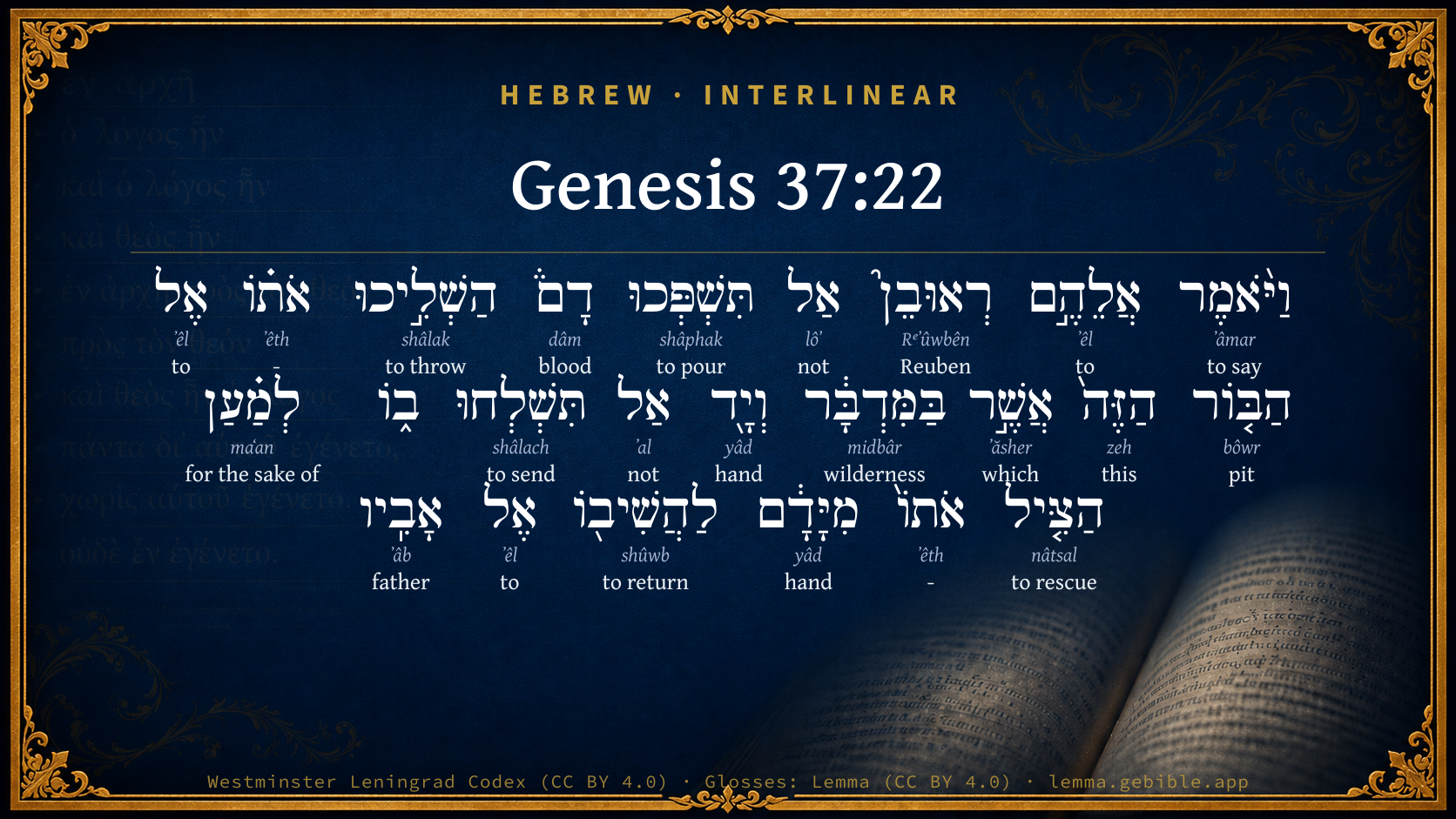
Hebrew (Westminster Leningrad Codex) Genesis 37:22 appears in the Hebrew Old Testament. The text above is from the Westminster Leningrad Codex. Each word links to its Strong’s number, a concise gloss, and parsing drawn from the Open Scriptures Hebrew Bible morphology. Click any word for its full Brown-Driver-Briggs (BDB) entry.
Download image
Cite this verse

Genesis 37:22 (World English Bible). Public Domain. Lemma interlinear Bible study tool, https://lemma.gebible.app/v/genesis/37/22.

Show BibTeX & RIS
BibTeX
RIS
English Translation
Reuben said to them, "Shed no blood. Throw him into this pit that is in the wilderness, but lay no hand on him"-- that he might deliver him out of their hand, to restore him to his father.
World English Bible · Public Domain
Download a study sheet

One document with this verse’s original text, its word-by-word gloss line, the meaning frame, cross-references with their text, attributed commentary, and full source and license credits — printable, and it pastes into notes with its structure intact.

This verse Autodidact and up

Study sheet (.html) Plain text (.txt)

A passage Seminary Student

Up to 50 verses in one chapter. A passage sheet keeps up to 6 commentary sources and 12 cross-references per verse, in the order this page ranks them, and says so on the sheet whenever that leaves anything out. Ask for a single verse and you get the Autodidact verse sheet above.

Everything on this page stays free to read, with no account — the sheet is a download of what is already on screen, not access to it.

Want to remove ads? Support Godless Engineer
Compare translations 3

The same verse in 3 English versions, stacked beneath the original-language interlinear above. Click any original word for its lexicon entry.

Each is an independent rendering of the whole verse — the interlinear is not word-aligned to these translations.

Highlighted words mark where these versions differ — a whole-verse word diff, not a word-by-word alignment.

  • World English Bible Public Domain
    Reuben said to them, "Shed no blood. Throw him into this pit that is in the wilderness, but lay no hand on him"-- that he might deliver him out of their hand, to restore him to his father.
  • King James Version Public Domain
    And Reuben said unto them, Shed no blood, but cast him into this pit that is in the wilderness, and lay no hand upon him; that he might rid him out of their hands, to deliver him to his father again.
  • unfoldingWord Literal Text CC BY-SA 4.0
    And Reuben said to them, “Do not shed blood. Throw him into this cistern which in the wilderness, but do not lay a hand on him,” in order to rescue him from their hand, to return him to his father.

unfoldingWord Literal Text — © unfoldingWord, licensed CC BY-SA 4.0. Word-aligned USFM3 via Door43 (git.door43.org/unfoldingWord/en_ult).

Versions to compare (up to 4)

3 of 4 selected

Show all 18 translations

Every available English version of this verse, each an independent rendering of the whole verse.

  • World English Bible Public Domain
    Reuben said to them, "Shed no blood. Throw him into this pit that is in the wilderness, but lay no hand on him"-- that he might deliver him out of their hand, to restore him to his father.
  • Berean Standard Bible Public Domain
    “Do not shed his blood. Throw him into this pit in the wilderness, but do not lay a hand on him.” Reuben said this so that he could rescue Joseph from their hands and return him to his father.
  • Majority Standard Bible Public Domain
    “Do not shed his blood. Throw him into this pit in the wilderness, but do not lay a hand on him.” Reuben said this so that he could rescue Joseph from their hands and return him to his father.
  • King James Version Public Domain
    And Reuben said unto them, Shed no blood, but cast him into this pit that is in the wilderness, and lay no hand upon him; that he might rid him out of their hands, to deliver him to his father again.
  • American Standard Version (1901) Public Domain
    And Reuben said unto them, Shed no blood; cast him into this pit that is in the wilderness, but lay no hand upon him: that he might deliver him out of their hand, to restore him to his father.
  • Revised Version (1885) Public Domain
    And Reuben said unto them, Shed no blood; cast him into this pit that is in the wilderness, but lay no hand upon him: that he might deliver him out of their hand, to restore him to his father.
  • Geneva Bible (1599) Public Domain
    Also Reuben saide vnto them, Shed not blood, but cast him into this pitte that is in the wildernesse, and lay no hande vpon him. Thus he said, that he might deliuer him out of their hand, and restore him to his father againe.
  • Douay-Rheims (1899) Public Domain
    Do not take away his life, nor shed his blood: but cast him into this pit, that is in the wilderness, and keep your hands harmless: now he said this, being desirous to deliver him out of their hands and to restore him to his father.
  • Young's Literal Translation Public Domain
    and Reuben saith unto them, `Shed no blood; cast him into this pit which `is' in the wilderness, and put not forth a hand upon him,' -- in order to deliver him out of their hand, to bring him back unto his father.
  • Literal Standard Version CC BY-SA 4.0
    and Reuben says to them, “Shed no blood; cast him into this pit which [is] in the wilderness, and do not put forth a hand on him,” in order to deliver him out of their hand, to bring him back to his father.
  • Unlocked Literal Bible CC BY-SA 4.0
    Reuben said to them, “Shed no blood. Throw him into this pit that is in the wilderness, but lay no hand upon him”—that he might rescue him out of their hand to bring him back to his father.
  • unfoldingWord Literal Text CC BY-SA 4.0
    And Reuben said to them, “Do not shed blood. Throw him into this cistern which in the wilderness, but do not lay a hand on him,” in order to rescue him from their hand, to return him to his father.
  • Darby Bible Public Domain
    And Reuben said to them, Shed no blood: cast him into this pit which is in the wilderness; but lay no hand upon him -- in order that he might deliver him out of their hand, to bring him to his father again.
  • World Messianic Bible Public Domain
    Reuben said to them, “Shed no blood. Throw him into this pit that is in the wilderness, but lay no hand on him”—that he might deliver him out of their hand, to restore him to his father.
  • Webster's Bible Public Domain
    And Reuben said to them, Shed no blood; cast him into this pit that is in the wilderness, and lay no hand upon him; that he might deliver him from their hands, to bring him back to his father.
  • Free Bible Version CC BY-SA 4.0
    “Let's not attack and kill him,” he suggested. “Don't murder him, just throw him into this pit here in the desert. You don't need to be guilty of violence.” Reuben said this so that he could come back later and rescue Joseph from them and take him home to his father.
  • Bible in Basic English Public Domain
    Do not put him to a violent death, but let him be placed in one of the holes; this he said to keep him safe from their hands, with the purpose of taking him back to his father again.
  • JPS Tanakh (1917) Public Domain
    And Reuben said unto them: 'Shed no blood; cast him into this pit that is in the wilderness, but lay no hand upon him' — that he might deliver him out of their hand, to restore him to his father.

Literal Standard Version (2020), Covenant Press — licensed CC BY-SA 4.0. Text via the HelloAO Bible API (eBible.org). Unlocked Literal Bible (unfoldingWord) — licensed CC BY-SA 4.0. Text via the HelloAO Bible API (eBible.org). unfoldingWord Literal Text — © unfoldingWord, licensed CC BY-SA 4.0. Word-aligned USFM3 via Door43 (git.door43.org/unfoldingWord/en_ult). Free Bible Version, Dr. Jonathan Gallagher — licensed CC BY-SA 4.0. Text via the HelloAO Bible API (eBible.org).

Word by word

More ways to search: Search by grammar → Find every occurrence → Compare this word →

Practice this passage: Drill this verse → Learn its vocabulary →

הַבּ֤וֹר
bôwr
H953
“the · pit”
Particle, Definite Article + Noun, Common, Masculine, Singular, Absolute
Part of Speech
Particle + Noun
Type
Common
Gender
Masculine
Number
Singular
State
Absolute
Full BDB Definition

Origin: from H952 (in the sense of H877 )

TWOT: 194e

pit, well, cistern
  1. וַיֹּ֨אמֶר ʼâmar H559 “and · to say” Conjunction + Verb, Qal, Sequential Imperfect, 3rd Person, Masculine, Singular
  2. אֲלֵהֶ֣ם ʼêl H413 “to · them” Preposition + Suffix, Personal, 3rd Person, Masculine, Plural
  3. רְאוּבֵן֮ Rᵉʼûwbên H7205 “Reuben” Noun, Proper
  4. אַל lôʼ H3808 “not” Particle, Negative
  5. תִּשְׁפְּכוּ shâphak H8210 “to pour” Verb, Qal, Imperfect, 2nd Person, Masculine, Plural
  6. דָם֒ dâm H1818 “blood” Noun, Common, Masculine, Singular, Absolute
  7. הַשְׁלִ֣יכוּ shâlak H7993 “throw” Verb, Hiphil, Imperative, 2nd Person, Masculine, Plural
  8. אֹת֗וֹ ʼêth H853 “- · him” Particle, Direct Object + Suffix, Personal, 3rd Person, Masculine, Singular
  9. אֶל ʼêl H413 “to” Preposition
  10. הַזֶּה֙ zeh H2088 “the · this” Particle, Definite Article + Pronoun, Demonstrative, Masculine, Singular
  11. אֲשֶׁ֣ר ʼăsher H834 “which” Particle, Relative
  12. בַּמִּדְבָּ֔ר midbâr H4057 “in/at the · wilderness” Preposition, Determined + Noun, Common, Masculine, Singular, Absolute
  13. וְיָ֖ד yâd H3027 “and · hand” Conjunction + Noun, Common, Both, Singular, Absolute
  14. אַל ʼal H408 “not” Particle, Negative
  15. תִּשְׁלְחוּ shâlach H7971 “to send” Verb, Qal, Jussive, 2nd Person, Masculine, Plural
  16. לְמַ֗עַן maʻan H4616 “for the sake of” Preposition
  17. הַצִּ֤יל nâtsal H5337 “to rescue” Verb, Hiphil, Infinitive Construct
  18. אֹתוֹ֙ ʼêth H853 “- · him” Particle, Direct Object + Suffix, Personal, 3rd Person, Masculine, Singular
  19. מִיָּדָ֔ם yâd H3027 “from · hand · their” Preposition + Noun, Common, Both, Singular, Construct + Suffix, Personal, 3rd Person, Masculine, Plural
  20. לַהֲשִׁיב֖וֹ shûwb H7725 “to return · him” Preposition + Verb, Hiphil, Infinitive Construct + Suffix, Personal, 3rd Person, Masculine, Singular
  21. אֶל ʼêl H413 “to” Preposition
  22. אָבִֽיו ʼâb H1 “father · his” Noun, Common, Masculine, Singular, Construct + Suffix, Personal, 3rd Person, Masculine, Singular

About this verse

These counts appear in no published source. They are computed here, from the morphology-tagged text and Lemma’s own curated glosses. What Lemma adds →

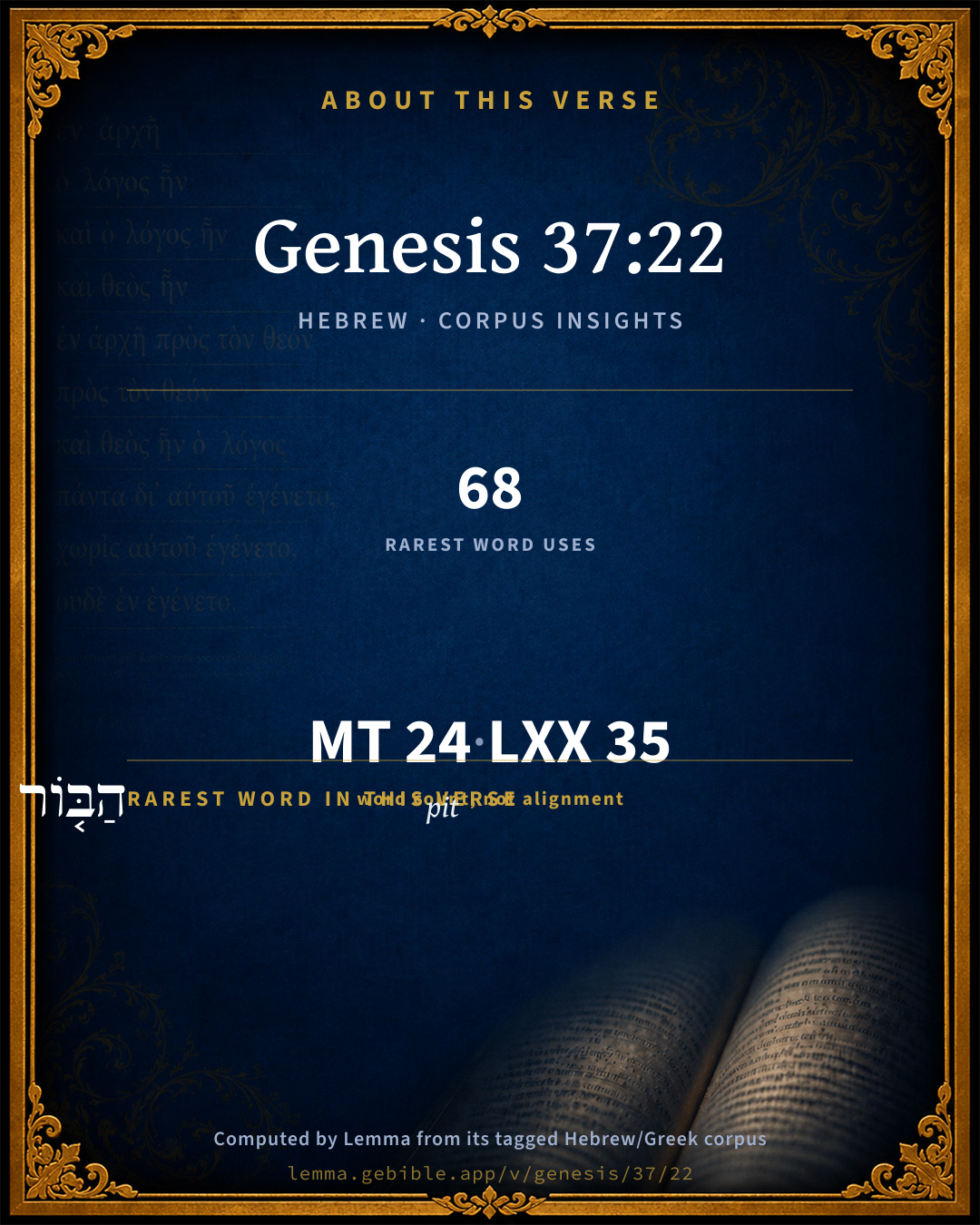
24
words
19
distinct lemmas
Pentateuch
section

Grammatical profile

  • 6 verbs
  • 7 nouns
  • 1 pronoun
  • 5 prepositions
  • 5 particles

Verb forms

  • וַיֹּ֨אמֶר Qal · Sequential Imperfect
  • תִּשְׁפְּכוּ Qal · Imperfect
  • הַשְׁלִ֣יכוּ Hiphil · Imperative
  • תִּשְׁלְחוּ Qal · Jussive
  • הַצִּ֤יל Hiphil · Infinitive Construct
  • לַהֲשִׁיב֖וֹ Hiphil · Infinitive Construct

Repetition

Words recur within this verse — often emphatic in Hebrew:

  • וְיָ֖ד hand H3027 ×2
  • אֲלֵהֶ֣ם to H413 ×3

Hebrew & Septuagint length

In English translation the verse runs 38 words from the Hebrew and 41 from the Septuagint (LXX English) — closely comparable.

A rough comparison of the two English renderings, which tokenize alike — not a word-level alignment.

Word counts can differ between the Hebrew and the Greek without any difference in meaning — e.g. the Hebrew direct-object marker אֵת has no separate Greek word, and Greek often adds the article ὁ.

In the original languages it is 24 Hebrew tokens and 35 Greek tokens — but the two are counted differently (Hebrew bundles its prefixes and suffixes into one token; the Greek is in lemma form), so that isn’t a like-for-like length.

Cross-references

6

Topical passages linked to Genesis 37:22 in the Treasury of Scripture Knowledge — connected by theme and wording, ordered by reader-vote popularity; previews shown in the World English Bible.

  • Genesis 22:12 He said, "Don't lay your hand on the boy, neither do anything to him. For now I know that you fear God, seeing you have not withheld your son, your only son, from me."
  • Genesis 42:22 Reuben answered them, saying, "Didn't I tell you, saying, 'Don't sin against the child,' and you wouldn't listen? Therefore also, behold, his blood is required."
  • Exodus 24:11 He didn't lay his hand on the nobles of the children of Israel. They saw God, and ate and drank.
  • Deuteronomy 13:9 but you shall surely kill him; your hand shall be first on him to put him to death, and afterwards the hand of all the people.
  • Matthew 27:24 So when Pilate saw that nothing was being gained, but rather that a disturbance was starting, he took water, and washed his hands before the multitude, saying, "I am innocent of the blood of this righteous person. You see to it."
  • Acts 12:1 Now about that time, Herod the king stretched out his hands to oppress some of the assembly.

Cross-references courtesy of OpenBible.info (CC BY 4.0).

Hebrew and Greek witnesses Masoretic Hebrew ↔ Greek Septuagint

The same verse in the two great witnesses to the Old Testament, shown verse-for-verse.

These are two independent witnesses, not word-aligned to each other, and the Septuagint is shown in lemma (dictionary) form.

Hebrew Genesis 37:22 Masoretic · Westminster Leningrad Codex

וַיֹּ֨אמֶר אֲלֵהֶ֣ם רְאוּבֵן֮ אַל תִּשְׁפְּכוּ דָם֒ הַשְׁלִ֣יכוּ אֹת֗וֹ אֶל הַבּ֤וֹר הַזֶּה֙ אֲשֶׁ֣ר בַּמִּדְבָּ֔ר וְיָ֖ד אַל תִּשְׁלְחוּ ב֑וֹ לְמַ֗עַן הַצִּ֤יל אֹתוֹ֙ מִיָּדָ֔ם לַהֲשִׁיב֖וֹ אֶל אָבִֽיו

Reuben said to them, "Shed no blood. Throw him into this pit that is in the wilderness, but lay no hand on him"-- that he might deliver him out of their hand, to restore him to his father.

World English Bible · Public Domain

Greek LXX Genesis 37:22 Septuagint · lemma form

εἶπον δέ αὐτός ρουβην μή ἐκχέω αἷμα ἐνβάλλω αὐτός εἰς ὁ λάκκος οὗτος ὁ ἐν ὁ ἔρημος χείρ δέ μή ἐπιφέρω αὐτός ὅπως ἐκαἱρέω αὐτός ἐκ ὁ χείρ αὐτός καί ἀποδίδωμι αὐτός ὁ πατήρ αὐτός

And Ruben said to them, Shed not blood; cast him into one of these pits in the wilderness, but do not lay your hands upon him; that he might rescue him out of their hands, and restore him to his father.

LXX2012 (modern English Septuagint) · Public Domain

Hebrew: Westminster Leningrad Codex (CC BY 4.0). Greek: Septuagint (public domain); English from LXX2012 (modern English Septuagint) (Public Domain). How the Septuagint differs from the Hebrew →

Targum (Aramaic paraphrase)

2

The Targum is the ancient Jewish Aramaic paraphrase of the Hebrew Scriptures — an interpretive translation, not the Hebrew text itself. Onkelos (literal) and Pseudo-Jonathan (expansive) render the Torah, and Jonathan the Prophets. Coverage is partial: where no permissively-licensed English translation exists for a verse, only the Aramaic is shown. This is verse-level text, not a word-by-word alignment to the Hebrew.

  1. Targum Onkelos Torah (Genesis–Deuteronomy)
    וַאֲמַר לְהוֹן רְאוּבֵן לָא תוֹשְׁדוּן דְּמָא רְמוֹ יָתֵהּ לְגֻבָּא הָדֵין דִּי בְּמַדְבְּרָא וִידָא לָא תוֹשְׁטוּן בֵּהּ בְּדִיל לְשֵׁיזָבָא יָתֵהּ מִידֵיהוֹן לַאֲתָבוּתֵהּ לְוַת אֲבוּהִי

    (no public-domain English translation for this verse)

    Targum Onkelos — Aramaic: “Onkelos Genesis” (public domain); “Onkelos Exodus” (public domain); “Onkelos Leviticus” (public domain); “Onkelos Numbers” (public domain); “Onkelos Deuteronomy” (public domain). English: “Sefaria Community Translation” (CC0 1.0 (public-domain dedication)); “J.W. Etheridge. The Targums of Onkelos and Jonathan Ben Uzziel on the Pentateuch. London: Longmans, Green, 1862” (public domain). Text via Sefaria.

  2. Targum Pseudo-Jonathan Torah (Genesis–Deuteronomy)
    וַאֲמַר לְהוֹם רְאוּבֵן לָא תֵשְׁדוּן אֲדַם זַכְּאַי טְלוּקוּ יָתֵיהּ לְגוּבָא הָדֵין דִבְמַדְבְּרָא וְיַד דִקְטוּלִין לָא תוֹשְׁטוּן בֵּיהּ בְּגִין לְשֵׁיזְבָא יָתֵיהּ מִידֵיהוֹן לַאֲתָבוּתֵיהּ לְוַת אָבוֹי

    And Reuben said, Let us not shed innocent blood. Throw him into this pit in the wilderness, but the hand of the slayer stretch not forth against him; because he would deliver him from their hand, and restore him to his father.

    Targum Pseudo-Jonathan — Aramaic: “Targum Jonathan on Genesis” (public domain); “Targum Jonathan on Exodus” (public domain); “Targum Jonathan on Leviticus” (public domain); “Targum Jonathan on Numbers” (public domain); “Targum Jonathan on Deuteronomy” (public domain). English: “The Targum of Jonathan ben Uzziel, trans. J. W. Etheridge, London, 1862” (public domain). Text via Sefaria.

Commentary

Notes on Genesis 37:22 from classic Christian and Jewish commentators (each source and its license shown beneath its notes). The classic Christian expositions comment on the surrounding passage and are grouped to its opening verse, so a note may address several verses; the Jewish commentaries on the Tanakh (Rashi and others) are per-verse, so they appear only where the commentator wrote on this verse.

Lemma curates 59 commentaries, every one of them public domain or Creative Commons licensed, each selected and text-cleaned for this edition rather than reprinted as found. About our sources →

Trapp's Complete Commentary

John Trapp

Gen 37:22 And Reuben said unto them, Shed no blood, [but] cast him into this pit that [is] in the wilderness, and lay no hand upon him; that he might rid him out of their hands, to deliver him to his father again.

Ver. 22. Shed no blood.] Every drop of it hath a tongue to cry for vengeance. Well might King James say, that if God did allow him to kill a man, he would think God did not love him. David, God’s darling, falling into that crimson sin, carried the bruise of that fall with him to his grave. Woe to those Italians that blaspheme oftener than swear; and murder more than revile or slander! {a}

{a} Sandys’s Relation of West. Relig., sec. 13.

John Trapp, A Commentary or Exposition upon All the Books of the Old and New Testament (1647–1656) — public domain. Text from a community e-Sword module.

John Calvin's Commentaries

22. Cast him into this pit. The pious fallacy to which Reuben descended, sufficiently proves with what vehemence the rage of his brethren was burning. For he neither dares openly to oppose them, nor to dissuade them from their crime; because he saw that no reasons would avail to soften them. Nor does it extenuate their cruelty, that they consent to his proposal, as if they were disposed to clemency; for if either one course or the other were necessary, it would have been better for him immediately to die by their hands, than to perish by slow hunger in the pit, which is the most cruel kind of punishment. Their gross hypocrisy is rather to be noticed; because they think that they shall be free from crime, if only they do not stain their hands with their brother’s blood. As if, indeed, it made any difference, whether they ran their brother through with a sword, or put him to death by suffocation. For the Lord, when he accuses the Jews by Isaiah, of having hands full of blood, does not mean that they were assassins, but he calls them bloody, because they did not spare their suffering brethren. Therefore, the sons of Jacob are nothing better, in casting their brother alive under ground, that, as one buried, he might in vain contend with death, and perish after protracted torments; and in choosing a pit in the desert, from which no mortal could hear his dying cry, though his sighing would ascend even to heaven. It was a barbarous thought, that they should not touch his life, if they did not imbrue their hands in his blood; since it was a kind of death, not less violent, which they wished to inflict by hunger. Reuben, however, accommodating his language to their brutal conceptions, deemed it sufficient to repress, by any kind of artifice, their impetuosity for the present.

John Calvin's Commentaries (1540-1563) — public domain. Text from the Calvin Translation Society English edition (1840s-50s) via the Christian Classics Ethereal Library (ccel.org). Calvin's coverage is partial (roughly two-thirds of the Bible); uncommented books and verses are honest gaps, never fabricated. The 19th-century editor's footnotes and remarks are omitted so the notes are faithfully Calvin's own voice.

Ellicott's Commentary for English Readers

(22) Into this pit that is in the wilderness.—Reuben apparently pointed to some cistern in the desolate region which girds the little valley of Dothan around. We learn from Gen_42:21 that Joseph begged hard for mercy, and to be spared so painful a death, but that his brothers would not hear.

Though never represented in the Scriptures as a type of Christ, yet the whole of the Old Testament is so full of events and histories, which reappear in the Gospel narrative, that the Fathers have never hesitated in regarding Joseph, the innocent delivered to death, but raised thence to glory, as especially typifying to us our Lord. Pascal (Pensées, 2:9. 2) sums up the points of resemblance—in his father’s love for him, his being sent to see after the peace of his brethren, their conspiring against him, his being sold for twenty pieces of silver, his rising from his humiliation to be the lord and saviour of those who had wronged him; and with them the saviour also of the world. As too, he was in prison with two malefactors, so was our Lord crucified between two thieves and as one of these was saved and one left to his condemnation, so Joseph gave deliverance to the chief butler, but to the chief baker punishment. It would be easy to point out other resemblances, but, leaving these, it is important also to notice that Joseph’s history is likewise a vindication of God’s providential dealings with men. He is innocent, and pure in life, but wronged again and again; yet every wrong was but a step in the pathway of his exaltation. And like the histories of all great lives, Joseph’s adventures do not begin and end in himself. Upon him depended a great future. Noble minds care little for personal suffering, if from their pain springs amelioration for the world. Now Joseph’s descent into Egypt was: not only for the good and preservation of the people there, but was also an essential condition for the formation of the Jewish Church. In Egypt alone could Israel have multiplied into a nation fit to be the depositaries of God’s law, and to grow into a church of prophets.

A Bible Commentary for English Readers, edited by Charles John Ellicott (1878–1897) — public domain. Text from a community e-Sword module.

The Cambridge Bible for Schools and Colleges

gen. ed. J. J. S. Perowne

22. And Reuben said] This and the next two verses are from E. Reuben, the eldest, interposes to save his brother’s life; cf. Gen_42:37.

Shed no blood] Reuben’s warning is that there should be no bloodshed, as if murder without bloodshed would be a less evil. His proposal is that Joseph should be thrown into a cistern or tank, which they knew of hard by, and that he should be left there to perish, Reuben intending himself to deliver him. Reuben is not brave enough to oppose his brothers; but hopes to outwit them. He appeals to the horror of bloodshed. Blood cries out against the murderer: see note on Gen_4:11.

The Cambridge Bible for Schools and Colleges (gen. ed. J. J. S. Perowne; Cambridge University Press, 1878–1918) — public domain. Text from a community e-Sword module.

John Gill's Exposition

And it came to pass, when Joseph was come unto his brethren,.... To the very place where they were, and had, in a kind and obliging manner, asked of their welfare, and related their father's concern for them, who had sent him on this errand:

that they stripped, Joseph out of his coat; his coat of many colours, that was on him; according to Jarchi and Aben Ezra, this was not one and the same coat, but divers, and that the sense is, that with his coat of many colours, and besides that, they stripped him of his lower garment, which was next to his skin, his shirt; so that he was quite naked when they cast him into the pit, and this they did as soon as he came up to them, so cruel and hardhearted were they.

John Gill's Exposition of the Whole Bible (1746–1763) — public domain (CC PDM 1.0). Text via the HelloAO Bible API.

Haydock's Catholic Bible Commentary

His father. Ruben wished to regain his father’s favour, chap. xxxv. 22.

George Leo Haydock (1774–1849), Haydock's Catholic Family Bible and Commentary, 1859 edition — public domain. Excludes Psalms (Douay-Rheims chapter numbering differs from Protestant) and Deuterocanonical books (Catholic canon only).

Whedon's Commentary on the Bible

Daniel D. Whedon

22. This pit that is in the wilderness — By the wilderness here we are to understand the open, unsettled country in which they were pasturing their flocks. “The country abounded, and still abounds, in pits or cisterns dug in the ground, or soft limestone, to preserve water through the dry season, and also to store grain. They were made large at the bottom, with a small mouth at the top, sometimes tapering upwards, like a huge demijohn. (Thomson.) The top was covered with a flat stone, over which sand or earth was often spread for concealment. When dry there was generally mud at the bottom. They were often used as dungeons for criminals. See Jer_38:6. Perhaps they put him into the pit, deliberately intending to leave him there to perish; but it seems more likely that they did this as a temporary imprisonment, without having definitely determined what final disposition to make of Joseph. Reuben succeeds in effecting a stay of the murderous proceedings of his brethren. Judah’s proposition in Gen_37:26, shows that his fate was under discussion as they ‘sat down to eat bread.’” — Newhall.

Daniel D. Whedon (gen. ed.), Commentary on the Old and New Testaments (1874–1909) — public domain. Text from a community e-Sword module.

Rashi

Rabbi Shlomo Yitzchaki (Rashi)

למען הציל אתו THAT HE MIGHT DELIVER HIM [OUT OF THEIR HAND] — The Holy Spirit (Scripture) bears witness for Reuben that he said this only for the purpose of saving his brother — that he would come afterwards and draw him up from there. He thought, “I am the first-born and the chief among them, and blame will attach to no one but myself” (Genesis Rabbah 84:15).

Rashi on the Tanakh — English translations: “The Judaica Press complete Tanach with Rashi, translated by A. J. Rosenberg” (CC BY 4.0); “Pentateuch with Rashi's commentary by M. Rosenbaum and A.M. Silbermann, 1929-1934” (public domain); “The Metsudah Tanach series, Lakewood, N.J” (CC BY 4.0); and “The Book of Joshua, Metsudah Publications, 1997” (CC BY 4.0). Text via Sefaria.

Ramban (Nachmanides)

Rabbi Moshe ben Nachman (Ramban / Nachmanides)

SHED NO BLOOD. Reuben said to them: “I would have been tolerant of you when you thought to kill him by your subtle intrigues, for I too hated him and desired that he be killed by others. But do not spill blood with your hands. Far it be from you!” And Reuben’s intent in all this was to rescue him and restore him to his father. Now Scripture relates that which Reuben told them when they paid heed to him. However, originally he told them other things which they did not accept, as he said to them afterwards, Spoke I not unto you, saying: Do not sin against the child and you would not hear? Now when he saw that they would not listen to the extent of releasing him, he said to them, “If so, shed no blood with your own hands.”Now Reuben did not say, “Shed not his blood,” [but instead, he said, “Shed no blood,”] in order to make it appear that he is not saying it because he loves him, but in order that they should not spill blood. Thus he taught them that the punishment of he who indirectly causes death is not as great as that of he who personally spills blood.The meaning of the expression, This pit that is in the wilderness, is that this pit is deep and he will not be able to get out of it, and it is in the desert, and if he cries for help there is no one to rescue him as no one passes by there.Now Scripture relates that the pit was empty and did not contain water. Had there been water in it they would not have drowned him as they had already avoided spilling his blood. Now Rashi writes: “Since it states that the pit was empty, do I not know that there was no water in it? Why then does it say that there was no water in it? It means to state that water indeed was not in it, however it did contain serpents and scorpions.” This is Rashi’s language quoting from the words of our Rabbis. If so, the serpents and scorpions must have been in the cracks of the pit, or it was deep and they did not know about them. Had they seen them and known that they did not harm Joseph, it would have become clear to them that a great miracle had been done to him, and that he was indeed a perfectly righteous man. They would then have known that his merits would save him from all evil, and how would they touch the anointed one of G-d in whom He delights and whom He saves, even as it says, My G-d hath sent His angel, and hath shut the lions’ mouths, and they have not hurt me; for as much as before Him innocency was found in me. But, we must therefore conclude, they did not know anything about it.In line with the simple meaning of the verse, it states that the pit was empty and completely devoid of water, for even if there were a little water in it, it would still be called “empty.” to indicate that there was no water at all in it. Similarly, For thou shalt die and not live, which means “not live at all, under any circumstances.” Such redundancies are all for the purpose of clarification and emphasis.

Ramban (Nachmanides) on the Tanakh — English translation: “Commentary on the Torah by Ramban (Nachmanides). Translated and annotated by Charles B. Chavel. New York, Shilo Pub. House, 1971-1976” (CC BY 4.0). Text via Sefaria.

Radak

Rabbi David Kimhi (Radak)

אל תשפכו דם, his blood is innocent, i.e. he is not guilty of a capital crime. But throw him into this pit if you are so angry about his dreams and the way he presents them. You may repay him by making him feel pain such as yours, but do not touch him in a way that will lead to his death. When Reuven said: “throw him into this pit,” he did so in order to know where to find him later and to bring him back safely to his father after rescuing him from the pit. He did not mean for Joseph to be harmed in any way.

Radak on the Tanakh — English translations: “Sefaria Community Translation” (CC0 1.0 (public-domain dedication)); “Eliyahu Munk, HaChut Hameshulash” (CC BY 4.0); “Rabbi Mike Feuer, Jerusalem Anthology” (CC BY 4.0); and “R. David Kimhi on the first book of Psalms, Translated by R.G. Finch, London, 1919” (public domain). Text via Sefaria.

Lesson kit

Teaching starters — assembled from the data on this page, not authored interpretation. Every prompt links to the verse data it draws on. Edit before teaching.

Genesis, in the Pentateuch, opens this verse with 24 words (19 distinct Hebrew lemmas). Its most distinctive word is bôwr (“pit”). A historical commentator’s framing appears above. Read the whole chapter for the surrounding context.

Discussion questions

  1. The word bôwr carries the sense “pit.” How does it shape the verse?
  2. Genesis 22:12 shares this passage’s theme. How do the two illuminate each other?
  3. “hand” occurs 2× in this one verse. What is the effect of the repetition?
  4. These translations render this verse differently. What is at stake in choosing one wording over another?
  5. The verb «וַיֹּ֨אמֶר» is Qal Sequential Imperfect. How does its form color the action?
  6. Reading how Trapp's Complete Commentary and John Calvin's Commentaries read this verse, where do the two commentators agree and where do they part?

Things to notice

Reading settings

Reading text

Shown beneath each verse's original-language words.

Old Testament
Old Testament edition

Read the OT as the Masoretic Hebrew (MT) or the Greek Septuagint (LXX).

English shown for the Greek Septuagint (in the Hebrew ↔ Greek comparison).

Comparing translations? Open the Compare panel on any verse page to stack up to four side by side.