
Genesis 27:41

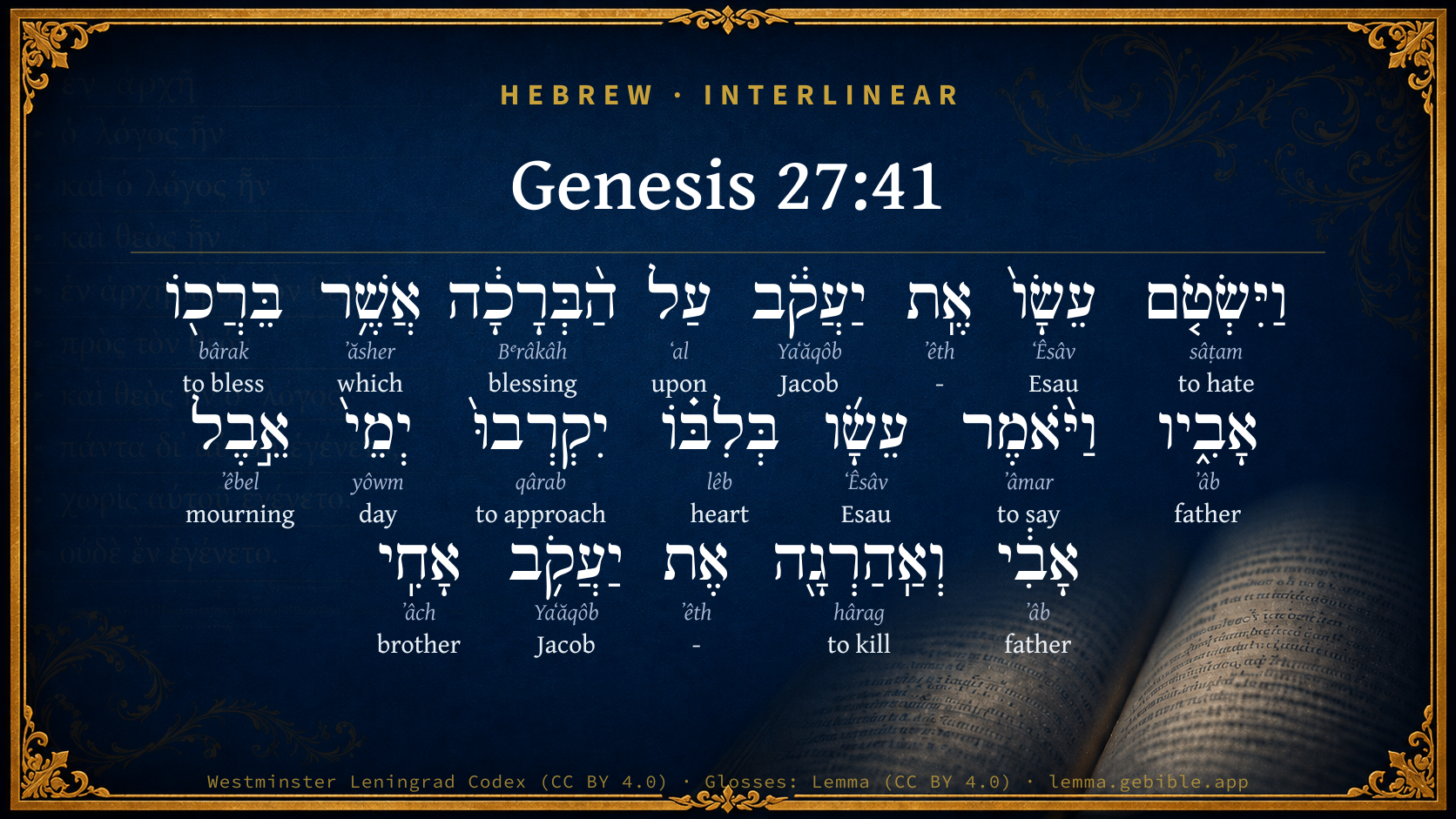
Hebrew (Westminster Leningrad Codex) Genesis 27:41 appears in the Hebrew Old Testament. The text above is from the Westminster Leningrad Codex. Each word links to its Strong’s number, a concise gloss, and parsing drawn from the Open Scriptures Hebrew Bible morphology. Click any word for its full Brown-Driver-Briggs (BDB) entry.
Download image
Cite this verse

Genesis 27:41 (World English Bible). Public Domain. Lemma interlinear Bible study tool, https://lemma.gebible.app/v/genesis/27/41.

Show BibTeX & RIS
BibTeX
RIS
English Translation
Esau hated Jacob because of the blessing with which his father blessed him. Esau said in his heart, "The days of mourning for my father are at hand. Then I will kill my brother Jacob."
World English Bible · Public Domain
Highlights
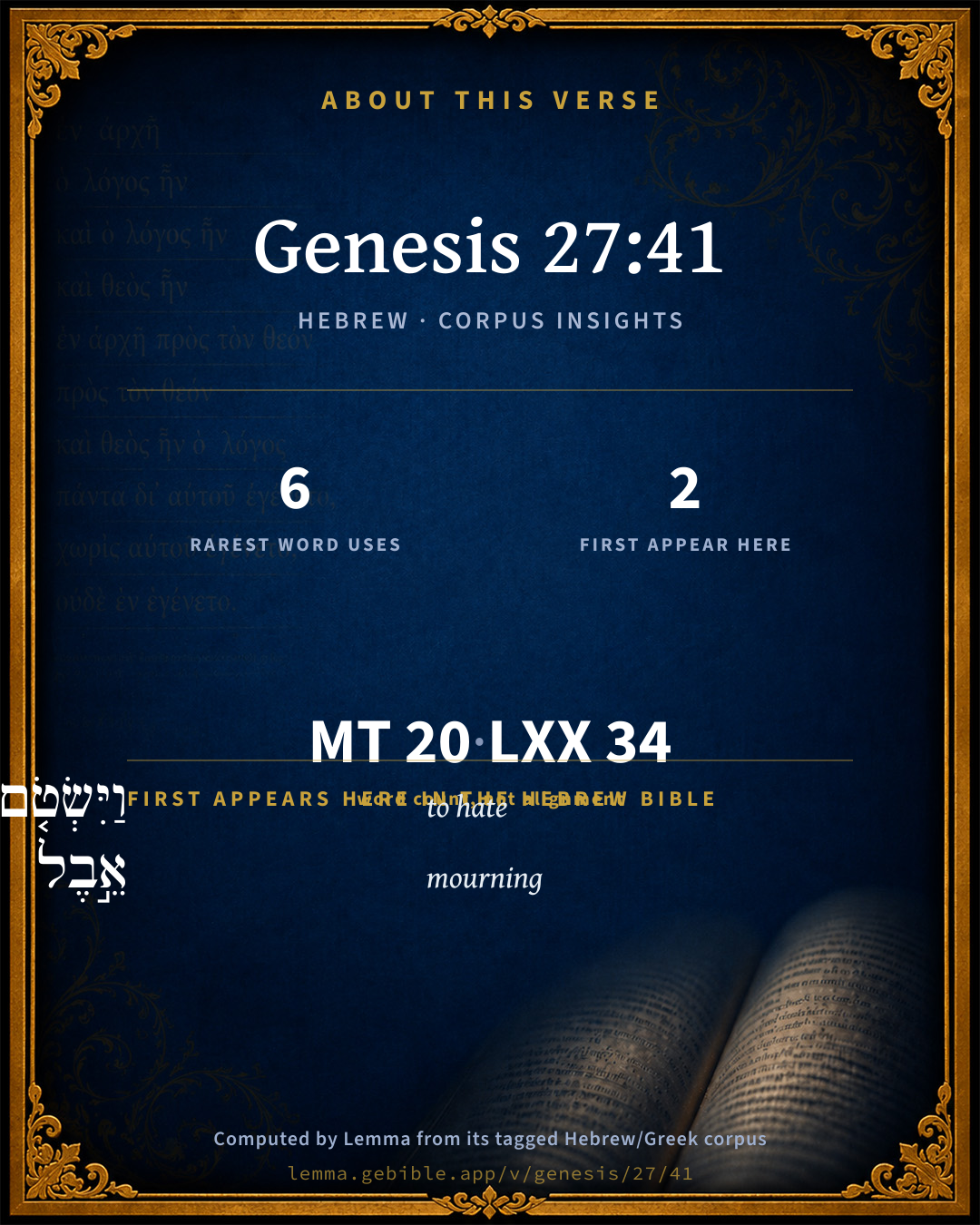
  • 2 first appearances in the Hebrew Bible
Full analysis ↓
Download a study sheet

One document with this verse’s original text, its word-by-word gloss line, the meaning frame, cross-references with their text, attributed commentary, and full source and license credits — printable, and it pastes into notes with its structure intact.

This verse Autodidact and up

Study sheet (.html) Plain text (.txt)

A passage Seminary Student

Up to 50 verses in one chapter. A passage sheet keeps up to 6 commentary sources and 12 cross-references per verse, in the order this page ranks them, and says so on the sheet whenever that leaves anything out. Ask for a single verse and you get the Autodidact verse sheet above.

Everything on this page stays free to read, with no account — the sheet is a download of what is already on screen, not access to it.

Want to remove ads? Support Godless Engineer
Compare translations 3

The same verse in 3 English versions, stacked beneath the original-language interlinear above. Click any original word for its lexicon entry.

Each is an independent rendering of the whole verse — the interlinear is not word-aligned to these translations.

Highlighted words mark where these versions differ — a whole-verse word diff, not a word-by-word alignment.

  • World English Bible Public Domain
    Esau hated Jacob because of the blessing with which his father blessed him. Esau said in his heart, "The days of mourning for my father are at hand. Then I will kill my brother Jacob."
  • King James Version Public Domain
    And Esau hated Jacob because of the blessing wherewith his father blessed him: and Esau said in his heart, The days of mourning for my father are at hand; then will I slay my brother Jacob.
  • unfoldingWord Literal Text CC BY-SA 4.0
    Then Esau hated Jacob because of the blessing that his father had blessed him with, and Esau said in his heart, “The days of the mourning of my father are near; then I will kill Jacob my brother.”

unfoldingWord Literal Text — © unfoldingWord, licensed CC BY-SA 4.0. Word-aligned USFM3 via Door43 (git.door43.org/unfoldingWord/en_ult).

Versions to compare (up to 4)

3 of 4 selected

Show all 18 translations

Every available English version of this verse, each an independent rendering of the whole verse.

  • World English Bible Public Domain
    Esau hated Jacob because of the blessing with which his father blessed him. Esau said in his heart, "The days of mourning for my father are at hand. Then I will kill my brother Jacob."
  • Berean Standard Bible Public Domain
    Esau held a grudge against Jacob because of the blessing his father had given him. And Esau said in his heart, “The days of mourning for my father are at hand; then I will kill my brother Jacob.”
  • Majority Standard Bible Public Domain
    Esau held a grudge against Jacob because of the blessing his father had given him. And Esau said in his heart, “The days of mourning for my father are at hand; then I will kill my brother Jacob.”
  • King James Version Public Domain
    And Esau hated Jacob because of the blessing wherewith his father blessed him: and Esau said in his heart, The days of mourning for my father are at hand; then will I slay my brother Jacob.
  • American Standard Version (1901) Public Domain
    And Esau hated Jacob because of the blessing wherewith his father blessed him. And Esau said in his heart, The days of mourning for my father are at hand. Then will I slay my brother Jacob.
  • Revised Version (1885) Public Domain
    And Esau hated Jacob because of the blessing wherewith his father blessed him: and Esau said in his heart, The days of mourning for my father are at hand; then will I slay my brother Jacob.
  • Geneva Bible (1599) Public Domain
    Therefore Esau hated Iaakob, because of the blessing, wherewith his father blessed him. And Esau thought in his minde, The dayes of mourning for my father will come shortly, then I will slay may brother Iaakob.
  • Douay-Rheims (1899) Public Domain
    Esau therefore always hated Jacob for the blessing wherewith his father had blessed him: and he said in his heart: The days will come of the mourning of my father, and I will kill my brother Jacob.
  • Young's Literal Translation Public Domain
    And Esau hateth Jacob, because of the blessing with which his father blessed him, and Esau saith in his heart, `The days of mourning `for' my father draw near, and I slay Jacob my brother.'
  • Literal Standard Version CC BY-SA 4.0
    And Esau hates Jacob, because of the blessing with which his father blessed him, and Esau says in his heart, “The days of mourning [for] my father draw near, and I slay my brother Jacob.”
  • Unlocked Literal Bible CC BY-SA 4.0
    Esau hated Jacob because of the blessing that his father had given him. Esau said in his heart, “The days of mourning for my father are near; after that I will kill my brother Jacob.”
  • unfoldingWord Literal Text CC BY-SA 4.0
    Then Esau hated Jacob because of the blessing that his father had blessed him with, and Esau said in his heart, “The days of the mourning of my father are near; then I will kill Jacob my brother.”
  • Darby Bible Public Domain
    And Esau hated Jacob because of the blessing with which his father had blessed him. And Esau said in his heart, The days of mourning for my father are at hand, and I will slay my brother Jacob.
  • World Messianic Bible Public Domain
    Esau hated Jacob because of the blessing with which his father blessed him. Esau said in his heart, “The days of mourning for my father are at hand. Then I will kill my brother Jacob.”
  • Webster's Bible Public Domain
    And Esau hated Jacob, because of the blessing with which his father blessed him: and Esau said in his heart, The days of mourning for my father are at hand; then will I slay my brother Jacob.
  • Free Bible Version CC BY-SA 4.0
    From then on Esau hated Jacob because of his father's blessing. Esau said to himself, “Soon the time will come when I'll mourn my father's death. Then I'll kill my brother Jacob!”
  • Bible in Basic English Public Domain
    So Esau was full of hate for Jacob because of his father's blessing; and he said in his heart, The days of weeping for my father are near; then I will put my brother Jacob to death.
  • JPS Tanakh (1917) Public Domain
    And Esau hated Jacob because of the blessing wherewith his father blessed him. And Esau said in his heart: 'Let the days of mourning for my father be at hand; then will I slay my brother Jacob.'

Literal Standard Version (2020), Covenant Press — licensed CC BY-SA 4.0. Text via the HelloAO Bible API (eBible.org). Unlocked Literal Bible (unfoldingWord) — licensed CC BY-SA 4.0. Text via the HelloAO Bible API (eBible.org). unfoldingWord Literal Text — © unfoldingWord, licensed CC BY-SA 4.0. Word-aligned USFM3 via Door43 (git.door43.org/unfoldingWord/en_ult). Free Bible Version, Dr. Jonathan Gallagher — licensed CC BY-SA 4.0. Text via the HelloAO Bible API (eBible.org).

Word by word

More ways to search: Search by grammar → Find every occurrence → Compare this word →

Practice this passage: Drill this verse → Learn its vocabulary →

וַיִּשְׂטֹ֤ם
sâṭam
H7852
“and · to hate”
Conjunction + Verb, Qal, Sequential Imperfect, 3rd Person, Masculine, Singular
Part of Speech
Conjunction + Verb
Stem
Qal
Form
Sequential Imperfect
Person
3rd Person
Gender
Masculine
Number
Singular
Full BDB Definition

Origin: a primitive root

TWOT: 2251

to hate, oppose oneself to, bear a grudge, retain animosity against, cherish animosity against - (Qal) to cherish animosity against
  1. עֵשָׂו֙ ʻÊsâv H6215 “Esau” Noun, Proper
  2. אֶֽת ʼêth H853 “-” Particle, Direct Object
  3. יַעֲקֹ֔ב Yaʻăqôb H3290 “Jacob” Noun, Proper
  4. עַל ʻal H5921 “upon” Preposition
  5. הַ֨בְּרָכָ֔ה Bᵉrâkâh H1293 “the · blessing” Particle, Definite Article + Noun, Common, Feminine, Singular, Absolute
  6. אֲשֶׁ֥ר ʼăsher H834 “which” Particle, Relative
  7. בֵּרֲכ֖וֹ bârak H1288 “to bless · him” Verb, Piel, Perfect, 3rd Person, Masculine, Singular + Suffix, Personal, 3rd Person, Masculine, Singular
  8. אָבִ֑יו ʼâb H1 “father · his” Noun, Common, Masculine, Singular, Construct + Suffix, Personal, 3rd Person, Masculine, Singular
  9. וַיֹּ֨אמֶר ʼâmar H559 “and · to say” Conjunction + Verb, Qal, Sequential Imperfect, 3rd Person, Masculine, Singular
  10. עֵשָׂ֜ו ʻÊsâv H6215 “Esau” Noun, Proper
  11. בְּלִבּ֗וֹ lêb H3820 “in/at · heart · his” Preposition + Noun, Common, Masculine, Singular, Construct + Suffix, Personal, 3rd Person, Masculine, Singular
  12. יִקְרְבוּ֙ qârab H7126 “to approach” Verb, Qal, Imperfect, 3rd Person, Masculine, Plural
  13. יְמֵי֙ yôwm H3117 “days of” Noun, Common, Masculine, Plural, Construct
  14. אֵ֣בֶל ʼêbel H60 “mourning of” Noun, Common, Masculine, Singular, Construct
  15. אָבִ֔י ʼâb H1 “father · my” Noun, Common, Masculine, Singular, Construct + Suffix, Personal, 1st Person, Common, Singular
  16. וְאַֽהַרְגָ֖ה hârag H2026 “and · to kill” Conjunction + Verb, Qal, Cohortative, 1st Person, Common, Singular
  17. אֶת ʼêth H853 “-” Particle, Direct Object
  18. יַעֲקֹ֥ב Yaʻăqôb H3290 “Jacob” Noun, Proper
  19. אָחִֽי ʼâch H251 “brother · my” Noun, Common, Masculine, Singular, Construct + Suffix, Personal, 1st Person, Common, Singular

About this verse

These counts appear in no published source. They are computed here, from the morphology-tagged text and Lemma’s own curated glosses. What Lemma adds →

20
words
16
distinct lemmas
Pentateuch
section

Notable vocabulary

The rarest word here is וַיִּשְׂטֹ֤ם to hate H7852 — appearing just 6 times in the whole Hebrew Bible.

First appearance in Scripture

These words make their first canonical appearance in the Hebrew Bible here:

  • וַיִּשְׂטֹ֤ם to hate H7852
  • אֵ֣בֶל mourning H60

Shared distinctive vocabulary

וַיִּשְׂטֹ֤ם to hate H7852 occurs in 6 verses of the Hebrew Bible. Also found in:

Grammatical profile

  • 5 verbs
  • 11 nouns
  • 1 preposition
  • 3 particles

Verb forms

  • וַיִּשְׂטֹ֤ם Qal · Sequential Imperfect
  • בֵּרֲכ֖וֹ Piel · Perfect
  • וַיֹּ֨אמֶר Qal · Sequential Imperfect
  • יִקְרְבוּ֙ Qal · Imperfect
  • וְאַֽהַרְגָ֖ה Qal · Cohortative

Repetition

Words recur within this verse — often emphatic in Hebrew:

  • עֵשָׂו֙ Esau H6215 ×2
  • יַעֲקֹ֔ב Jacob H3290 ×2
  • אָבִ֑יו father H1 ×2

Hebrew & Septuagint length

In English translation the verse runs 35 words from the Hebrew and 38 from the Septuagint (LXX English) — closely comparable.

A rough comparison of the two English renderings, which tokenize alike — not a word-level alignment.

Word counts can differ between the Hebrew and the Greek without any difference in meaning — e.g. the Hebrew direct-object marker אֵת has no separate Greek word, and Greek often adds the article ὁ.

In the original languages it is 20 Hebrew tokens and 34 Greek tokens — but the two are counted differently (Hebrew bundles its prefixes and suffixes into one token; the Greek is in lemma form), so that isn’t a like-for-like length.

Cross-references

28

Topical passages linked to Genesis 27:41 in the Treasury of Scripture Knowledge — connected by theme and wording, ordered by reader-vote popularity; previews shown in the World English Bible.

  • 1 John 3:12–15 unlike Cain, who was of the evil one, and killed his brother. Why did he kill him? Because his works were evil, and his brother's righteous.
  • Genesis 37:4 His brothers saw that their father loved him more than all his brothers, and they hated him, and couldn't speak peaceably to him.
  • Genesis 50:3–4 Forty days were fulfilled for him, for that is how many the days it takes to embalm. The Egyptians wept for him for seventy days.
  • Genesis 32:6 The messengers returned to Jacob, saying, "We came to your brother Esau. Not only that, but he comes to meet you, and four hundred men with him."
  • Genesis 37:8 His brothers said to him, "Will you indeed reign over us? Or will you indeed have dominion over us?" They hated him all the more for his dreams and for his words.
  • Proverbs 6:14 In whose heart is perverseness, Who devises evil continually, Who always sows discord.
  • Ecclesiastes 7:9 Don't be hasty in your spirit to be angry, for anger rests in the bosom of fools.
  • Ezekiel 25:12–15 Thus says the Lord Yahweh: Because Edom has dealt against the house of Judah by taking vengeance, and has greatly offended, and revenged himself on them;
  • Obadiah 1:10–14 For the violence done to your brother Jacob, shame will cover you, and you will be cut off forever.
  • Ephesians 4:26–27 "Be angry, and don't sin." Don't let the sun go down on your wrath,
  • Genesis 4:2–8 Again she gave birth, to Cain's brother Abel. Abel was a keeper of sheep, but Cain was a tiller of the ground.
  • Genesis 32:11 Please deliver me from the hand of my brother, from the hand of Esau: for I fear him, lest he come and strike me, and the mothers with the children.
  • Genesis 35:29 Isaac gave up the spirit, and died, and was gathered to his people, old and full of days. Esau and Jacob, his sons, buried him.
  • Genesis 50:10–11 They came to the threshing floor of Atad, which is beyond the Jordan, and there they lamented with a very great and sore lamentation. He mourned for his father seven days.
  • Deuteronomy 34:8 The children of Israel wept for Moses in the plains of Moab thirty days: so the days of weeping in the mourning for Moses were ended.
  • 2 Samuel 13:28–29 Absalom commanded his servants, saying, Mark you now, when Amnon's heart is merry with wine; and when I tell you, Smite Amnon, then kill him; don't be afraid; haven't I commanded you? be courageous, and be valiant.
  • 2 Chronicles 35:24 So his servants took him out of the chariot, and put him in the second chariot that he had, and brought him to Jerusalem; and he died, and was buried in the tombs of his fathers. All Judah and Jerusalem mourned for Josiah.
  • Psalms 35:14 I behaved myself as though it had been my friend or my brother. I bowed down mourning, as one who mourns his mother.
  • Psalms 37:12–13 The wicked plots against the just, And gnashes at him with his teeth.
  • Psalms 37:16 Better is a little that the righteous has, Than the abundance of many wicked.
  • Psalms 140:4–5 Yahweh, keep me from the hands of the wicked. Preserve me from the violent men who have determined to trip my feet.
  • Psalms 142:3 When my spirit was overwhelmed within me, You knew my path. In the way in which I walk, They have hidden a snare for me.
  • Proverbs 1:12–13 Let's swallow them up alive like Sheol, And whole, like those who go down into the pit.
  • Proverbs 1:16 For their feet run to evil. They hurry to shed blood.
  • Ezekiel 35:5 Because you have had a perpetual enmity, and have given over the children of Israel to the power of the sword in the time of their calamity, in the time of the iniquity of the end;
  • Amos 1:11–12 Thus says Yahweh: "For three transgressions of Edom, yes, for four, I will not turn away its punishment; Because he pursued his brother with the sword, And cast off all pity, And his anger raged continually, And he kept his wrath forever;
  • Titus 1:15–16 To the pure, all things are pure; but to those who are defiled and unbelieving, nothing is pure; but both their mind and their conscience are defiled.
  • Titus 3:3 For we were also once foolish, disobedient, deceived, serving various lusts and pleasures, living in malice and envy, hateful, and hating one another.

Cross-references courtesy of OpenBible.info (CC BY 4.0).

Hebrew and Greek witnesses Masoretic Hebrew ↔ Greek Septuagint

The same verse in the two great witnesses to the Old Testament, shown verse-for-verse.

These are two independent witnesses, not word-aligned to each other, and the Septuagint is shown in lemma (dictionary) form.

Hebrew Genesis 27:41 Masoretic · Westminster Leningrad Codex

וַיִּשְׂטֹ֤ם עֵשָׂו֙ אֶֽת יַעֲקֹ֔ב עַל הַ֨בְּרָכָ֔ה אֲשֶׁ֥ר בֵּרֲכ֖וֹ אָבִ֑יו וַיֹּ֨אמֶר עֵשָׂ֜ו בְּלִבּ֗וֹ יִקְרְבוּ֙ יְמֵי֙ אֵ֣בֶל אָבִ֔י וְאַֽהַרְגָ֖ה אֶת יַעֲקֹ֥ב אָחִֽי

Esau hated Jacob because of the blessing with which his father blessed him. Esau said in his heart, "The days of mourning for my father are at hand. Then I will kill my brother Jacob."

World English Bible · Public Domain

Greek LXX Genesis 27:41 Septuagint · lemma form

καί ἐνκοτέω ησαυ ὁ ἰακώβ περί ὁ εὐλογία ὅς εὐλογέω αὐτός ὁ πατήρ αὐτός εἶπον δέ ησαυ ἐν ὁ διάνοια ἐγγίζω ὁ ἡμέρα ὁ πένθος ὁ πατήρ ἐγώ ἵνα ἀποκτείνω ἰακώβ ὁ ἀδελφός ἐγώ

And Esau was angry with Jacob because of the blessing, with which his father blessed him; and Esau said in his mind, Let the days of my father's mourning draw near, that I may kill my brother Jacob.

LXX2012 (modern English Septuagint) · Public Domain

On this verse, The Pulpit Commentary discusses the Septuagint’s reading. Read the note in Commentary ↓

Hebrew: Westminster Leningrad Codex (CC BY 4.0). Greek: Septuagint (public domain); English from LXX2012 (modern English Septuagint) (Public Domain). How the Septuagint differs from the Hebrew →

Targum (Aramaic paraphrase)

2

The Targum is the ancient Jewish Aramaic paraphrase of the Hebrew Scriptures — an interpretive translation, not the Hebrew text itself. Onkelos (literal) and Pseudo-Jonathan (expansive) render the Torah, and Jonathan the Prophets. Coverage is partial: where no permissively-licensed English translation exists for a verse, only the Aramaic is shown. This is verse-level text, not a word-by-word alignment to the Hebrew.

  1. Targum Onkelos Torah (Genesis–Deuteronomy)
    וּנְטַר עֵשָׂו דְּבָבוּ לְיַעֲקֹב עַל בִּרְכְּתָא דִּי בָרְכֵהּ אֲבוּהִי וַאֲמַר עֵשָׂו בְּלִבֵּהּ יִקְרְבוּן יוֹמֵי אֶבְלֵי דְאַבָּא וְאֶקְטוֹל יָת יַעֲקֹב אָחִי

    (no public-domain English translation for this verse)

    Targum Onkelos — Aramaic: “Onkelos Genesis” (public domain); “Onkelos Exodus” (public domain); “Onkelos Leviticus” (public domain); “Onkelos Numbers” (public domain); “Onkelos Deuteronomy” (public domain). English: “Sefaria Community Translation” (CC0 1.0 (public-domain dedication)); “J.W. Etheridge. The Targums of Onkelos and Jonathan Ben Uzziel on the Pentateuch. London: Longmans, Green, 1862” (public domain). Text via Sefaria.

  2. Targum Pseudo-Jonathan Torah (Genesis–Deuteronomy)
    וְנָטַר עֵשָו שְנָא בְּלִבֵּיהּ עַל יַעֲקב אָחוּי עַל סֵדֶר בִּרְכָתָא דִי בָּרְכֵיהּ אָבוֹי וַאֲמַר עֵשָו בְּלִבֵּיהּ לֵית אֲנָא עָבִיד הֵיכְמָא דְעָבַד קַיִן דְקָטַל יַת הֶבֶל בְּחַיֵי אָבוּי וְהָדָר אָבוּי וְאוֹלִיד יַת שֵׁת בְּרַם מִתְעַכֵּב אֲנָא עַד זְמַן דְיִמְטוּן יוֹמֵי אֶבְלָא דְמִיתַת אַבָּא וּבְכֵן אֲנָא קָטִיל יַת יַעֲקב אָחִי וַאֲנָא מִשְׁתַּכַּח קָטִיל וְיָרִית

    And Esau kept hatred in his heart against Jakob his brother, on account of the order of blessing with which his father had blessed him. And Esau said in his heart, I will not do as Kain did, who slew Habel in the life (time) of his father, for which his father begat Sheth, but will wait till the time when the days of mourning for the death of my father come, and then will I kill Jakob my brother, and will be found the killer and the heir.

    Targum Pseudo-Jonathan — Aramaic: “Targum Jonathan on Genesis” (public domain); “Targum Jonathan on Exodus” (public domain); “Targum Jonathan on Leviticus” (public domain); “Targum Jonathan on Numbers” (public domain); “Targum Jonathan on Deuteronomy” (public domain). English: “The Targum of Jonathan ben Uzziel, trans. J. W. Etheridge, London, 1862” (public domain). Text via Sefaria.

Commentary

Notes on Genesis 27:41 from classic Christian and Jewish commentators (each source and its license shown beneath its notes). The classic Christian expositions comment on the surrounding passage and are grouped to its opening verse, so a note may address several verses; the Jewish commentaries on the Tanakh (Rashi and others) are per-verse, so they appear only where the commentator wrote on this verse.

Lemma curates 59 commentaries, every one of them public domain or Creative Commons licensed, each selected and text-cleaned for this edition rather than reprinted as found. About our sources →

Matthew Henry's Commentary

Here is, I. The malice Esau bore to Jacob upon account of the blessing which he had obtained, Gen 27:41. Thus he went in the way of Cain, who slew his brother because he had gained that acceptance with God of which he had rendered himself unworthy. Esau's hatred of Jacob was, 1. A causeless hatred. He hated him for no other reason but because his father blessed him and God loved him. Note, The happiness of saints is the envy of sinners. Whom Heaven blesses, hell curses. 2. It was a cruel hatred. Nothing less would satisfy him than to slay his brother. It is the blood of the saints that persecutors thirst after: I will slay my brother. How could he say that word without horror? How could he call him brother, and yet vow his death? Note, The rage of persecutors will not be tied up by any bonds, no, not the strongest and most sacred. 3. It was a politic hatred. He expected his father would soon die, and then titles must be tried and interests contested between the brothers, which would give him a fair opportunity for revenge. He thinks it not enough to live by his sword himself (Gen 27:40), unless his brother die by it. He is loth to grieve his father while he lives, and therefore puts off the intended murder till his death, not caring how much he then grieved his surviving mother. Note, (1.) Those are bad children to whom their good parents are a burden, and who, upon any account, long for the days of mourning for them. (2.) Bad men are long held in by external restraints from doing the mischief they would do, and so their wicked purposes come to nought. (3.) Those who think to defeat God's purposes will undoubtedly be disappointed themselves. Esau aimed to prevent Jacob, or his seed, from having the dominion, by taking away his life before he was married; but who can disannul what God has spoken? Men may fret at God's counsels, but cannot change them.

II. The method Rebekah took to prevent the mischief.

1. She gave Jacob warning of his danger, and advised him to withdraw for a while, and shift for his own safety. She tells him what she heard of Esau's design, that he comforted himself with the hope of an opportunity to kill his brother, Gen 27:42. Would one think that such a bloody barbarous thought as this could be a comfort to a man? If Esau could have kept his design to himself his mother would not have suspected it; but men's impudence in sin is often their infatuation; and they cannot accomplish their wickedness because their rage is too violent to be concealed, and a bird of the air carries the voice. Observe here, (1.) What Rebekah feared - lest she should be deprived of them both in one day (Gen 27:45), deprived, not only of the murdered, but of the murderer, who either by the magistrate, or by the immediate hand of God, would by sacrificed to justice, which she herself must acquiesce in, and not obstruct: or, if not so, yet thenceforward she would be deprived of all joy and comfort in him. Those that are lost to virtue are in a manner lost to all their friends. With what pleasure can a child be looked upon that can be looked upon as no other than a child of the devil? (2.) What Rebekah hoped - that, if Jacob for a while kept out of sight, the affront which his brother resented so fiercely would by degrees go out of mind. The strength of passions is weakened and taken off by the distances both of time and place. She promised herself that his brother's anger would turn away. Note, Yielding pacifies great offences; and even those that have a good cause, and God on their side, must yet use this with other prudent expedients for their own preservation.

2. She impressed Isaac with an apprehension of the necessity of Jacob's going among her relations upon another account, which was to take a wife, Gen 27:46. She would not tell him of Esau's wicked design against the life of Jacob, lest it should trouble him; but prudently took another way to gain her point. Isaac saw as uneasy as he was to Esau's being unequally yoked with Hittites; and therefore, with a very good colour of reason, she moves to have Jacob married to one that was better principled. Note, One miscarriage should serve as a warning to prevent another; those are careless indeed that stumble twice at the same stone. Yet Rebekah seems to have expressed herself somewhat too warmly in the matter, when she said, What good will my life do me if Jacob marry a Canaanite? Thanks be to God, all our comfort is not lodged in one hand; we may do the work of life, and enjoy the comforts of life, though every thing do not fall out to our mind, and though our relations be not in all respects agreeable to us. Perhaps Rebekah spoke with this concern because she saw it necessary, for the quickening of Isaac, to give speedy orders in this matter. Observe, Though Jacob was himself very towardly, and well fixed in his religion, yet he had need to be put out of the way of temptation. Even he was in danger both of following the bad example of his brother and of being drawn into a snare by it. We must not presume too far upon the wisdom and resolution, no, not of those children that are most hopeful and promising; but care must be taken to keep them out of harm's way.

Matthew Henry's Commentary on the Whole Bible (1708–1710) — public domain (CC PDM 1.0). Text via the HelloAO Bible API.

Trapp's Complete Commentary

John Trapp

Gen 27:41 And Esau hated Jacob because of the blessing wherewith his father blessed him: and Esau said in his heart, The days of mourning for my father are at hand; then will I slay my brother Jacob.

Ver. 41. And Esau hated Jacob, &c.] Because God said, "Jacob have I loved." And, as all hatred is bloody, he resolves to be his death. "The righteous is abomination to the wicked," saith Solomon. {Pro 29:27} Moab was irked because of Israel, or, did fret and vex at them, {Num 22:3-4} who yet passed by them in peace. But the old Serpent had set his limbs in them, transfused his venom into them: hence that deadly hatred that is and will be betwixt the godly and the wicked. Pliny speaks of the scorpion, that there is not one minute wherein he doth not put forth the sting: so doth that serpentine seed, acted by Satan. The panther so hates man, that he flies upon the very picture of a man, and tears it to pieces. So doth Satan and his imps upon the image of God, in whomsoever they find it. They "satanically hate me," saith David {Psa 35:19} of his enemies. And seest thou thy persecutor full of rage? saith Bernard; know thou, that he is spurred on by the devil that rides him, {a} that acts and agitates him. {Eph 2:2}

And Esau said in his heart.] Effutiverat etiam minaces voces; he had also bolted out some suspicious speeches, as our gunpowder traitors did whereby he was prevented.

The days of mourning for my father.] No matter for his mother: yet God saith, "Ye shall fear every man his mother and his father". {Lev 19:3} The mother is first mentioned, because usually most slighted. Luther thinks, he threateneth his father also, in these words; as if he should say, I will be avenged, by being the death of my brother, though it be to the breaking of my father’s heart. {b} A bloody speech of a vindictive spirit, whom nothing would satisfy, but to be a double parricide.

I will slay my brother.] But threatened men live long: for even Isaac, who died soonest, lived above forty years beyond this. "My times are in thy hand," saith David. {Psa 31:15}

{a} Scito quia ab ascensore suo daemone perurgetur. - Bern.

{b} Vindicabo me afferendo Patri luctum caede fratris. - Luth.

John Trapp, A Commentary or Exposition upon All the Books of the Old and New Testament (1647–1656) — public domain. Text from a community e-Sword module.

The Biblical Illustrator

Joseph S. Exell

Gen_27:41-45

Esau hated Jacob because of the blessing.

--

Esaus resentment

I. IT WAS CARNAL.

II. IT WAS OVER-RULED FOR GOOD. (T. H. Leale.)

Lessons

1. Esaus wicked hypocrites hate always bitterly those whom God loves dearly.

2. Gods blessing on His own is the cause why the wicked do so much hate and curse them.

3. The hearts of the wicked are meditating mischief, and their tongues belching it out against the righteous.

4. Pretended mourning for the dead is the hypocrites cloak for the death of the living.

5. Mischievous hypocrites in the Church, stick not to hasten the death of parents when they hinder from their ends.

6. Resolutions of the wicked are for the slaughter of the righteous and blessed, were it in their hands. (G. Hughes, B. D.)

Lessons

1. Providence ordereth the counsels of the wicked to be revealed that they may be prevented.

2. God maketh sometimes the instruments of their straits to be instruments of deliverance to His. So Rebekah was to Jacob.

3. It is but meet that such who bring into danger should be solicitous to prevent it.

4. Timely advice for safety should be taken with greatest heed, as given with greatest care.

5. The murder of the innocent is the comfort of the cruel and wicked man. Revenge comforts the hypocrite, when no harm is done to him (Gen_27:22).

6. The mothers voice must be heard when it tends to the good of children.

7. Flight from danger into exile is many times the lot of persecuted saints.

8. God can make the wickeds habitations sometimes shelters to His people (Gen_27:43.)

9. Gracious parents and children would part but for a little time if it might be.

10. Time wears out anger and memory of all pretended injuries in the wicked (Gen_27:44).

11. Tender mothers long to preserve the lives of children, evil and good.

12. To be childless, or bereft of all, is an evil deprecated by the saints (verse Jer_31:15). (G. Hughes, B. D.)

The Biblical Illustrator, edited by Joseph S. Exell (c. 1880s–1900s) — public domain. Text from a community e-Sword module.

Joseph Benson's Commentary

Gen 27:41-42. Esau said in his heart — What he afterward uttered in words, The days of mourning for my father are at hand — According to the course of nature. Isaac, however, lived forty-four years after this. Thy brother doth comfort himself — With thoughts of revenge, (which is sweet to all enraged mind,) and with hopes of recovering his birthright.

Joseph Benson's Commentary on the Old and New Testaments (1811–1818) — public domain. Text from a community e-Sword module.

Whedon's Commentary on the Bible

Daniel D. Whedon

JACOB’S DEPARTURE TO HARAN, Gen_27:41-45.

41. Esau said — Esau was one of those ingenuous, open natures, which show themselves out spontaneously. He could not keep his dark purpose a secret.

Mourning for my father — He loved his father and would not grieve his heart; so he purposes to defer his vengeance until after his father is dead. He seems to have no such care about grieving his mother, the partial friend of Jacob.

Daniel D. Whedon (gen. ed.), Commentary on the Old and New Testaments (1874–1909) — public domain. Text from a community e-Sword module.

The Pulpit Commentary

CHAPTER 27:41-46

And Esau hated Jacob a proof that he was not penitent, however disappointed and remorseful (cf. Oba_1:10, Oba_1:11; 1Jn_3:12, 1Jn_3:15) because of the blessing wherewith his father blessed him: not withstanding the fact that he too had received an appropriatebenediction; a display of envy as well as wrath, another proof of his ungracious character (Gal_5:21; Jam_4:5) and Esau said in his heart, i.e. secretly resolved, though afterwards he must have communicated his intention (vide ver. 42)The days of mourning for my father are at hand. The LXX interpret as a wish on the part of Esau that Isaac might speedily die, in order that the fratricidal act he contemplated might not pain the old man"s heart; another rendering (Kalisch) understands him to say that days of grief were in store for his father, as he meant to slay his brother; but the ordinary translation seems preferable (Rosenm Keil, Murphy, et alii), that Esan only deferred the execution of his unholy purpose because of the near approach, as he imagined, of his father"s death. Isaac, however, lived upwards of forty years after this. Then will I slay my brother Jacob. That which reconciled Isaac and Ishmael, (Gen_25:9) the death of a father, is here mentioned as the event which would decisively and finally part Esau and Jacob. Esau"s murderous intention Calvin regards as a clear proof of the non-reality of his repentance for his sin, the insincerity of his sorrow for his father, and the intense malignity of his hate against his brother.

Vers. 41-46.

The stolen blessing: a domestic drama.

4. Rebekah and Esau, or fratricide frustrated.

I THE MURDEROUS DESIGN OF ESAU.

1. The ostensible reason. "Because of the blessing wherewith his father had blessed Jacob." No argument can justify willful and deliberate homicide; least of all an excuse so lame and feeble as that of Esau. The blessing Jacob had obtained was one which he himself had formerly despised and practically sold; If Jacob had been guilty of stealing it from him, as he imagined, it was only what he had been attempting to do with reference to Jacob. Besides, in so far as the blessing was an object of desire to Esau, viz., for its material advantages, he had himself received a blessing not greatly dissimilar. There was therefore no sufficient cause for Esau"s hostility towards his brother.

2. The impelling motive. "Hate the essential spirit of murder (Mat_5:22; 1Jn_3:15) Esau"s causeless hatred of Jacob was typical of the world"s enmity against the Church: in its ground, the Church"s enjoyment of the blessing; in its spirit, bitter and implacable; in its manifestation, persecution and oppression. (1Jn_3:13)

1. The decorous restraint. "The days of mourning for my father are at hand; then will I slay my brother." Wicked men who resist all the influences of piety are not always able to surmount the barriers of public opinion. Though Esau had no scruples on the score of conscience as to killing Jacob, he had some scruples on the ground of decency as to doing it while his father lived. Persons who have no religion not infrequently do homage to the appearance of religion.

2. The providential discovery. Though Esau originally resolved on Jacob s murder in secret, he appears to have inadvertently disclosed his purpose to another, who forthwith communicated his intention to Rebekah. Those who have secrets to keep should tell them to no one; but Divine providence has wisely and mercifully arranged that guilty secrets should be ill to keep. "Murder will out.

3. The inglorious defeat. The information brought to Rebekah enabled her to counterwork Esau"s design, and thus a second time was Esau outwitted by a woman. It is obvious that some sons are not so clever as their mothers.

II THE PRUDENT COUNSEL OF REBEKAH.

1. Hastily formed. The shrewd sagacity of Isaac"s wife at once perceived an outlet from the snare. The woman"s wit that had cheated Isaac was not likely to be baffled with blustering Esau. Calling Jacob from the herds, she told him of his brother"s murderous design, and detailed her own scheme for his protection.

2. Clearly explained. He should immediately betake himself to Haran, and seek shelter for a season beside his uncle Laban and his cousins. Though Rebekah does not mention the propriety of looking for a wife, it is apparent that the possibility of Jacob"s finding one was present to her thoughts.

3. Skillfully urged. Arguments were not long in coming to Rebekah"s aid.

(1) His brother"s anger would soon burn out.

(2) His absence accordingly would not require to be long.

(3) If he did not go he was certain to be killed, in which ease Esau would fall a victim to judicial retribution, and she, a heart-broken mother, would be deprived of both her sons in one day.

(4) She was his mother, and her advice should be received with filial reverence and submission.

4. Adroitly carried through. Securing her son"s compliance, there was still the difficulty how to obtain the assent of Isaac. This she does by leading Isaac himself to suggest the propriety of Jacob"s going north to Padanaram in search of a wife; and to this she turns the thoughts of Isaac by expressing the hope that Jacob will not imitate his brother by marrying daughters of the land, a calamity, she informs her husband, which would render her already miserable life scarcely worth retaining. It was prudent in Rebekah to direct the mind of Isaac to the propriety of getting Jacob married, but there is not wanting a trace of that craftiness which was Rebekah"s peculiar infirmity.

Learn

1. That the world"s hostility to the Church is wholly unreasonable and unjustifiable.

2. That wicked devices against God"s people are sure eventually to be overturned.

3. That bad men sometimes wear a semblance of religion.

4. That good mothers grieve for the wickedness of bad, and work for the safety of good, sons.

5. That while wicked matches in their children are a burden to gracious parents, it should be a parent"s aim to secure pious wives for their sons, and Christian husbands for their daughters.

The Pulpit Commentary (1880–1919), ed. H.D.M. Spence-Jones & Joseph S. Exell — public domain. Text from a community e-Sword module.

The Preacher's Complete Homiletical Commentary

Joseph S. Exell (gen. ed.)

CRITICAL NOTES.—

Gen_27:45. Why should I be deprived also of you both in one day? If Esau killed Jacob, she must lose them both, for the avenger of blood would punish Esau with death.

MAIN HOMILETICS OF THE PARAGRAPH.—Gen_27:41-46

ESAU’S RESENTMENT

I. It was carnal. There is a proper resentment which comes of righteous indignation against evil and wrong. It is a noble sentiment in us when we stand up for truth and the law of God, as against the errors and oppositions of unrighteous men. But Esau did not rise to this moral nobility. He only regarded his own personal interests. It was something done against himself that he resented, and not something done against the interests of God’s righteous rule in the world. Yet there was much apparent justice on Esau’s side of this conflict. He was the acknowledged firstborn; he had obeyed the last request of his father. Now there was a bold and heartless attempt to deprive him of his proper rights, against common usage and natural law. His right was unquestionable, and we may well suppose that any jury of his fellow men would support him in the assertion of it. He had his father’s real intention on his side, which might be supposed to cancel any foolish deed he had done in a moment of temptation. Why then should he patiently endure the opposition of his brother? But his conduct was altogether selfish. He had no large and generous views, no regard for the interests of God’s kingdom in the world. He was not seeking true repentance, for then he would have humbled himself for his sin. He would have humbly tried to know what the will of the Lord was, and have been willing to accept a share in the covenant blessing on any terms. The Old Testament regards all human conduct as having relation to the will and pleasure of God, and to be hereby estimated. In this light Esau’s conduct must be considered as carnal, and not spiritual.

II. It was overruled for good. Esau’s enmity against his brother had the effect of promoting the further separation between the church and the world. Jacob is preserved from alliance by marriage with the ungodly. He is put in the way of contracting a better marriage than Esau, such as would ensure the purity and nobility of the chosen race. Rebekah contrives not only to save Jacob from his brother’s anger, but also to save him from falling into the same sin of an ungodly marriage. Thus human passions, and the conflict of private and selfish interests are made to work out the designs of God.

SUGGESTIVE COMMENTS ON THE VERSES

Gen_27:41. Whatever feeling of commiseration or sympathy we may hitherto have cherished for Esau in seeing him supplanted by the subtlety of Jacob, it is all banished from our bosoms when we behold him inwardly cherishing the most malignant passions, and cooly anticipating the time when he can imbue his hands in the blood of his brother. His guilt in this assumes an awfully atrocious character. His hatred was of the same nature as that of Cain towards Abel, and of Saul towards David, being directed against him, principally on account of his having been a special object of the Divine favour. Under these circumstances, the attempt to take Jacob’s life was virtually waging war with the high purposes of heaven, and an attempt to frustrate the decree of God by a stroke of his sword. The same spirit of hatred seems to have been perpetuated in his posterity against the seed of Jacob. As nothing but the death of Jacob could comfort Esau, so nothing could satisfy his descendants but to see Jerusalem “razed to its foundations.”—(Bush.)

He who cannot feel indignant at some kinds of wrong has not the mind of Christ. Remember the words with which He blighted Pharasaism, words not spoken for effect, but syllables of downright, genuine anger. Very different from this was Esau’s resentment. Anger in him had passed into malice; private wrong had been brooded on till it had become revenge, deliberate and planned vindictiveness. Turn once more to the life of the Redeemer; you find scarcely a trace of resentment for injury done merely to himself. Wrong and injustice he felt; but that it was done to Him added nothing to His feeling.—(Robertson.)

Jacob was held back by respect for his father, but he had no consideration for the grief of his mother.

Gen_27:42. The unhappy mother begins to reap according as she had sown. The safety of her favourite can only be secured at the price of his banishment. We see from this that though their imposition succeeded, yet it was a success that embittered the whole life both of Jacob and his parents. Rebekah, the contriver of the fraud, was deprived of her favourite son, probably for the rest of her days. Instead of the elder serving the younger, Jacob was now a banished stranger, a wandering fugitive, in continual terror of his enraged brother. The retributive justice of Heaven is seen pursuing him at every step.

1. He who had imposed upon his father is himself imposed upon by his uncle in the circumstances of his marriage.

2. The continual jealousies and hatred between his wives must have reminded him of his own want of paternal affection.

3. Continual feuds prevailed among his own children.

4. He was himself the dupe of an imposture more successful even than that by which he had deceived his father. Joseph, his beloved son, was sold by his brethren, and stated to have been slain. The rest of the life of Jacob was signalised by scenes of domestic trouble and vexation, which had their origin in the unhappy step we are now considering.—(Bush.)

Gen_27:43-44. These “few days” proved to be a period of twenty years. How little we can do towards the disposal of the times and events of our life!

Gen_27:45. Rebekah’s repentance is changed into an atonement by the heroic valour of her faith.—(Lange.)

But why does Rebekah fear a twofold bereavement? It is indeed possible that she may have apprehended that a murderous attack from Esau upon his brother might arouse him in self-defence, so that it should be only at the expense of the aggressor’s life that he should lose his own. But a more probable explanation is the following:—If Esau had killed Jacob, he would have been liable either to have been punished with death, according to the law (Gen_9:6), or to have been driven into exile like Cain, where he would have been virtually lost to her for ever.—(Bush.)

And he forgets what thou hast done to him. With this she both acknowledges Jacob’s guilt, and betrays a precise knowledge of Esau’s character. Let us not despair too soon of men. Are there not twelve hours during the day? The great fury and fiery indignation pass away with time.—(Luther.)

Gen_27:46. It would appear that Rebekah was here framing an excuse for Jacob’s departure, and concealing the true cause. It was expedient before Jacob’s departure to obtain his father’s concurrence. But in order to do this, she passes over the true reason of the proposed journey in silence, knowing that he, as well as herself, had been grieved by Esau’s wives, she now pretends to fear that Jacob may form a similar connection, and makes this the ostensible reason why he should go immediately to Padanaram—viz., that he might take a wife from among their relations in that country. She does not propose it directly, but merely in the form of a bitter complaint of the conduct of Esau’s wives. But this policy completely answered its end, as is clear from the next chapter.—(Bush.)

How sagacious this pious woman: she conceals to her husband the great misfortune and affliction existing in the house, so as not to bring sorrow upon Isaac in his old age.—(Luther.)

IMPORTANT REFLECTIONS SUGGESTED BY THE FOREGOING NARRATIVE

I. The history furnishes an admonitory lesson to parents. Parents complain of their children when, perhaps, the fault is to be traced mainly to themselves. They have indulged an early partiality, founded upon no just reasons, which has been productive on both sides of the worst effects. Let them guard with anxious vigilance against the symptoms of a week favouritism towards their children. A wise Providence often points out the sin in the punishment, and teaches parents discretion in the discharge of their duties by setting before their eyes the bad effects which flow from the want of it.

II. We may learn from this history not to make the supposed designs of God the rule of our conduct. We say, “supposed designs,” because as to us they can be only supposed. It may please God to foretell future events, but it is not, therefore our duty by crooked means to bring them to pass. God does not give prophecy for a rule of action. He will accomplish His own purposes in His own way. We are to follow what is fair and just, and honourable, and leave the consequences to God.

III. We are reminded that the way to success and to prosperity in our undertakings is often not that which appears the shortest, or even the surest. Jacob was, indeed, for the time being, successful in his fraudulent device; but what fruits had he of his triumph? He sowed the wind, and reaped the whirlwind. Soon was he forced to fly from his brother’s wrath, and years of trouble followed his departure from the parental mansion. Had he permitted God to accomplish His declaration in His own way; had his conduct towards his brother been kind and affectionate, and free from guile, we cannot doubt that his history would have been far different. The true source of prosperity is the blessing of God, and this cannot be counted upon except in strict adherence to the principles of rectitude. A man is exposed to temptation; some great advantage offers itself; a little art or deceit in supplanting another is thought indispensable; excuses are not wanting to justify the act. But what, in general, is the result? Either his arts recoil against himself, and he is utterly disappointed of his aim; or if he apparently succeeds, his success is rather a curse than a blessing. Our highest wisdom and our surest safety lie in the course of plain, simple, undeviating integrity.

IV. We are taught that regret is often unavailing to restore an offender to the privileges of innocence. Esau, having sold the birthright and lost the blessing, discovered his error too late. The blessing once gone was gone for ever; and tears, and prayers, and exclamations were in vain employed to recover it. Let us learn, then, that however momentous the consequences depending upon a single wrong step, they may be irretrievable. Regret, however bitter; entreaty, however urgent, may come too late. In vain shall we look for our former peace of mind, the sweets of conscious innocence, and the fruits of pleasing hope. We may seek for them with tears, but they will not be found. Let us not by yielding to temptation, cast away our confidence, which hath great recompence of reward.—(Bush.)

The Preacher's Complete Homiletical Commentary (gen. ed. Joseph S. Exell; Funk & Wagnalls, c. 1892) — public domain (pre-1929). A full-Bible homiletical/sermon-outline anthology covering 65 of 66 books (2 John is absent from the source module). Text from a community e-Sword module.

Tyndale Open Study Notes

Tyndale Open Resources

27:41-45 Rebekah and Jacob got the blessing but reaped hatred from Esau and separation from one another; there is no indication that Rebekah and Jacob ever saw each other again. They gained nothing that God was not already going to give them, and their methods were costly. Jacob fled from home to escape Esau’s vengeance.

Tyndale Open Study Notes — © Tyndale Open Resources, licensed CC BY-SA 4.0. Text via the HelloAO Bible API.

Geneva Bible (1599)

Geneva Bible translators

Hypocrites only abstain from doing evil for fear of men.

Geneva Bible (1599) marginal notes — public domain. Text via Bolls.life.

Jamieson, Fausset & Brown

Robert Jamieson, A. R. Fausset & David Brown

Esau hated Jacob--It is scarcely to be wondered at that Esau resented the conduct of Jacob and vowed revenge.

The days of mourning for my father are at hand--a common Oriental phrase for the death of a parent.

Jamieson, Fausset & Brown — Commentary Critical and Explanatory on the Whole Bible (1871) — public domain (CC PDM 1.0). Text via the HelloAO Bible API.

Adam Clarke's Commentary

Verse 41. The days of mourning for my father are at hand] Such was the state of Isaac's health at that time, though he lived more than forty years afterwards, that his death was expected by all; and Esau thought that would be a favourable time for him to avenge himself on his brother Jacob, as, according to the custom of the times, the sons were always present at the burial of the father. Ishmael came from his own country to assist Isaac to bury Abraham; and both Jacob and Esau assisted in burying their father Isaac, but the enmity between them had happily subsided long before that time.

Adam Clarke's Commentary on the Bible (1810–1826) — public domain. Text from a community e-Sword/MySword module.

John Calvin's Commentaries

41. And Esau hated Jacob. It hence appears more clearly, that the tears of Esau were so far from being the effect of true repentance, that they were rather evidences of furious anger. For he is not content with secretly cherishing enmity against his brother, but openly breaks out in wicked threats. And it is evident how deeply malice had struck its roots, when he could indulge himself in the desperate purpose of murdering his brother. Even a profane and sacrilegious contumacy betrays itself in him, seeing that he prepares himself to abolish the decree of God by the sword. I will take care, he says, that Jacob shall not enjoy the inheritance promised to him. What is this but to annihilate the force of the benediction, of which he knew that his father was the herald and the minister? Moreover, a lively picture of a hypocrite is here set before us. He pretends that the death of his father would be to him a mournful event: and doubtless it is a religious duty to mourn over a deceased father. But it was a mere pretense on his part, to speak of the day of mourning, when in his haste to execute the impious murder of his brother, the death of his father seemed to come too slowly, and he rejoiced at the prospect of its approach. With what face could he ever pretend to any human affection, when he gasps for his brother’s death, and at the same time attempts to subvert all the laws of nature? It is even possible, that an impulse of nature itself, extorted from him the avowal, by which he would the more grievously condemn himself; as God often censures the wicked out of their own mouth, and renders them more inexcusable. But if a sense of shame alone restrains a cruel mind, this is not to be deemed worthy of great praise; nay, it even betrays a stupid and brutal contempt of God. Sometimes, indeed, the fear of man influences even the pious, as we have seen, in the preceding chapter, Genesis 26:1, respecting Jacob: but they soon rise above it, so that with them the fear of God predominates; while forgetfulness of God so pervades the hearts of the wicked, that they rest their hopes in men alone. Therefore, he who abstains from wickedness merely through the fear of man, and from a sense of shame, has hitherto made but little progress. Yet the confession of the Papists is chiefly honored by them with this praise, that it deters many from sin, through the fear lest they should be compelled to proclaim their own disgrace. But the rule of piety is altogether different, since it teaches our conscience to set God before us as our witness and our judge.

John Calvin's Commentaries (1540-1563) — public domain. Text from the Calvin Translation Society English edition (1840s-50s) via the Christian Classics Ethereal Library (ccel.org). Calvin's coverage is partial (roughly two-thirds of the Bible); uncommented books and verses are honest gaps, never fabricated. The 19th-century editor's footnotes and remarks are omitted so the notes are faithfully Calvin's own voice.

Ellicott's Commentary for English Readers

JACOB IS SENT AWAY BY HIS FATHER AND MOTHER TO HARAN.

(41) The days of mourning for my father are at hand.—Esau evidently expected that his father’s death was near, and such also was Isaac’s own expectation (Gen_27:2); but he recovered, and lived for more than half a century. Perhaps on this account another translation has been suggested, namely, “Days of mourning for my father are at hand: for I will slay Jacob.” But there is no support for this in the Hebrew, and it represents Esau as utterly inhuman; whereas, with all his faults, he had a warm, loving heart. Genesis 28 ought to have begun here, as the break at the end of Gen_27:46 is very injurious to the meaning.

A Bible Commentary for English Readers, edited by Charles John Ellicott (1878–1897) — public domain. Text from a community e-Sword module.

The Cambridge Bible for Schools and Colleges

gen. ed. J. J. S. Perowne

41. The days of mourning, &c.] Cf. Gen_50:3-4; Gen_50:10. The meaning is obvious. Esau says in his heart, “Isaac my father is on the point of death: no sooner shall he die, than I will take revenge. Even while the customary mourning is going on, I will slay Jacob.” Before seven days have elapsed (cf. Gen_50:3) he will have had his revenge. For “say in one’s heart,” cf. Gen_8:21, Gen_24:45 (J).

Very improbable is the interpretation which makes “the days of mourning, &c.” mean “the days of mourning by my father,” i.e. “for the death of Jacob.”

then will I slay] The word “then” is simply “and” in the original. The clause is consecutive. There is no adverb defining the point of time. But the idiom emphasizes the dependence of the second clause upon the first.

The Cambridge Bible for Schools and Colleges (gen. ed. J. J. S. Perowne; Cambridge University Press, 1878–1918) — public domain. Text from a community e-Sword module.

John Gill's Exposition

And Esau hated Jacob because of the blessing wherewith his father blessed him,.... It being a better blessing than his; giving him a better country, and greater plenty of good things, a larger dominion, and even dominion over him and his seed; for as for the promise of the Messiah, and spiritual blessings, he seems to have no concern about them, only temporal ones:

and Esau said in his heart; within himself, but he did not long keep it there, but told somebody of it; or otherwise, how should Rebekah be informed of it, as afterwards related? what he said follows:

the days of mourning for my father are at hand, then will I slay my brother Jacob: that is, the time of his father's death was drawing nigh, when there would be a mourning for him for some days; at which time, or at the end of it, he proposed to pick a quarrel with Jacob about his title to his father's substance, and in the quarrel kill him, and so regain the birthright and the blessing; and Jacob dying unmarried, and without issue, would defeat both the oracle of God, and the prophetic benediction of his father; but he failed in all, the time of his father's death was not so near as he imagined, for he lived forty three years after this; and this design of his being discovered, was the occasion of Jacob's going to Haran, where he married two sisters, and by them and their maids had a numerous offspring, whereby both the oracle and the blessing had their accomplishment. Esau seems to have retained some affection for his father, and therefore put off the execution of this wicked design until his death, being unwilling to grieve him, but had no regard for his mother, who he knew loved Jacob better than he, and was assisting to him in getting the blessing from him. Schmidt gives a sense of this passage different from all interpreters, and renders the words, "the days of my father's mourning will draw nigh"; not in which his father would be mourned for, being dead, but in which his father, being alive, would himself mourn for his son Jacob, being slain by Esau; and accordingly he renders the next clause, "for I will slay my brother Jacob"; and that will make him mourn, and perhaps die of his grief; and so he shows an ill will to his father because he confirmed the blessing to Jacob, as well as to Jacob because he had it.

John Gill's Exposition of the Whole Bible (1746–1763) — public domain (CC PDM 1.0). Text via the HelloAO Bible API.

Haydock's Catholic Bible Commentary

My father. He has no regard for this mother. (Menochius) --- Her love for Jacob filled him with greater indignation; and he resolved to murder him, in order, perhaps, to revenge himself on both. Though this cruel resolution was taken in his heart, with full deliberation, he was not so careful to conceal his intentions; but his watchful mother discovered it, and by her prudence, preserved him from committing the external sin: and Jacob from falling a prey to this second Cain.

George Leo Haydock (1774–1849), Haydock's Catholic Family Bible and Commentary, 1859 edition — public domain. Excludes Psalms (Douay-Rheims chapter numbering differs from Protestant) and Deuterocanonical books (Catholic canon only).

Matthew Poole's English Annotations

Esau hated Jacob; and this hatred was hereditary, extending to their posterity also. See Eze 35:5; Amo 1:11; Oba 1:10.

Esau said in his heart, within himself; although he could not contain it there, but declared his intentions to some of his confidants, by which means it came to Rebekah’s ear.

Matthew Poole's English Annotations on the Holy Bible (1683–1685) — public domain. Text from a community e-Sword/MySword module.

Keil & Delitzsch

C. F. Keil & F. Delitzsch

Esau's complaining and weeping were now changed into mortal hatred of his brother. "The days of mourning," he said to himself, "for my father are at hand, and I will kill my brother Jacob." אבי אבל: genit. obj. as in Amo 8:10; Jer 6:26. He would put off his intended fratricide that he might not hurt his father's mind.

Gen 27:42-46

When Rebekah was informed by some one of Esau's intention, she advised Jacob to protect himself from his revenge (התנחם to procure comfort by retaliation, equivalent to "avenge himself," התנקּם, Isa 1:24),

(Note: This reference is incorrect; the Niphal is used in Isa 1:24, the Hithpael in Jer 5:9-29. Tr.)

by fleeing to her brother Laban in Haran, and remaining there "some days," as she mildly puts it, until his brother's wrath was subdued. "For why should I lose you both in one day?" viz., Jacob through Esau's vengeance, and Esau as a murderer by the avenger of blood (Gen 9:6, cf. Sa2 14:6-7). In order to obtain Isaac's consent to this plan, without hurting his feelings by telling him of Esau's murderous intentions, she spoke to him of her troubles on account of the Hittite wives of Esau, and the weariness of life that she should feel if Jacob also were to marry one of the daughters of the land, and so introduced the idea of sending Jacob to her relations in Mesopotamia, with a view to his marriage there.

Keil & Delitzsch — Biblical Commentary on the Old Testament (1861–1891) — public domain (CC PDM 1.0). Text via the HelloAO Bible API. (Old Testament only.)

Kretzmann's Popular Commentary

Paul E. Kretzmann

Esau’s Hatred of Jacob

v. 41. And Esau hated Jacob because of the blessing wherewith his father blessed him; and Esau said in his heart, the days of mourning for my father are at hand; then will I slay my brother Jacob. Having failed in his attempt to change his father’s mind in the matter of the patriarchal blessing, the hatred of Esau turned against Jacob, and he planned to revenge himself by murdering his brother. During the lifetime of his father he did not want to execute this threat, in order not to grieve Isaac. But after the death of Isaac, which seemed to be near, and after the days of mourning for his father, he would have no more scruples in carrying out his design.

v. 42. And these words of Esau, her elder son, were told to Rebekah; and she sent and called Jacob, her younger son, and said unto him, Behold, thy brother Esau, as touching thee, doth comfort himself, purposing to kill thee. So Esau, in carrying out his purpose of revenge, planned to get satisfaction for himself; he thought he would feel better after having murdered his brother.

v. 43. Now, therefore, my son, obey my voice; and arise, flee thou to Laban, my brother, to Haran;

v. 44. and tarry with him a few days, until thy brother’s fury turn away;

v. 45. until thy brother’s anger turn away from thee, and he forget that which thou hast done to him; then I will send, and fetch thee from thence. Rebekah tries to encourage Jacob and to comfort herself by intimating that it would be a matter of only a few days, of a very short time, until the wrath and anger of Esau would die down and be forgotten. Why should I be deprived also of you both in one day? If Jacob should be murdered, the avenger of blood would be set on Esau’s tracks, and he also would thus be lost to his mother. Cf Gen 9:6; 2Sa 14:6.

v. 46. And Rebekah said to Isaac, I am weary of my life because of the daughters of Heth; if Jacob take a wife of the daughters of Heth such as these which are of the daughters of the land, what good shall my life do me? The wives of Esau were a bitterness of spirit not only to Rebekah, but also to Isaac, Gen 26:35, and therefore the mention of this unbearable condition at this time was intended to pave the way for her plan of having Jacob sent to Mesopotamia, out of harm’s way. That the children of God are persecuted by the children of the world is a common experience, but God holds His sheltering and protecting hand over those that are his.

Paul E. Kretzmann, Popular Commentary of the Bible (1921–1924) — public domain. Text from a community e-Sword module.

unfoldingWord translationNotes

Door43 World Missions Community

Esau said in his heart

Here "heart" stands for Esau himself. AT: "Esau said to himself" (See: Synecdoche)

days of mourning for my father are near

This refers to a number of days a person grieves when a family member dies.

The words of Esau her older son were told to Rebekah

This can be stated in active form. AT: "Someone told Rebekah about Esau's plan" (See: Active or Passive)

See

"Look" or "Listen" or "Pay attention to what I am about to tell you"

is consoling himself

"is making himself feel better"

translationWords

Esau

Jacob

bless

heart

Rebekah

unfoldingWord translationNotes — © Distant Shores Media and the Door43 World Missions Community, licensed CC BY-SA 4.0. Source: git.door43.org/Door43/en_tn.

Rashi

Rabbi Shlomo Yitzchaki (Rashi)

יקרבו ימי אבל אבי THE DAYS OF MOURNING FOR MY FATHER APPROACH — Explain it according to the evident meaning of the words — (I will wait to kill him until my father is dead), that I may not cause grief to my father. There are Midrashic explanations of various kinds.

Rashi on the Tanakh — English translations: “The Judaica Press complete Tanach with Rashi, translated by A. J. Rosenberg” (CC BY 4.0); “Pentateuch with Rashi's commentary by M. Rosenbaum and A.M. Silbermann, 1929-1934” (public domain); “The Metsudah Tanach series, Lakewood, N.J” (CC BY 4.0); and “The Book of Joshua, Metsudah Publications, 1997” (CC BY 4.0). Text via Sefaria.

Ramban (Nachmanides)

Rabbi Moshe ben Nachman (Ramban / Nachmanides)

AND ESAU SAID IN HIS HEART. Rabbi Abraham ibn Ezra said, “It is possible that he revealed his secret to one of his friends.” But this is not necessarily so for any decision which a person reaches after deliberation is referred to in Hebrew as “speaking with the heart,” even when it also includes speech with the lips. A similar case is found in the verse, And with a double heart do they speak, for the will is synonymous with the heart. And all Israel were of one heart to make David king, meaning that they had all arrived at the same decision and were talking of it. Similarly, And Jeroboam said in his heart., (Verse 28). Here also there was speech which Scripture had referred to as being said in his heart. Similarly did Eliezer say, And before I had finished speaking in my heart, whereas the prayer there was with his lips, as Scripture states, And he said, O Eternal G-d of my lord Abraham., Verse 12. However it is possible that the expression, before I had finished speaking in my heart, means “before I had concluded the thought in my mind.”Now here the verse states that when the great hatred of Jacob permeated Esau’s soul because of the blessing, he conceived the idea of murdering his brother, and with this he comforted himself from his depressed state. This explains the verse, And the words of Esau were told to Rebekah. This is why she said to Jacob, Thy brother Esau comforts himself to slay thee. Now Rashi comments, “She was told, through Ruach Hakodesh, what Esau was thinking in his heart.” And so it is found in Bereshith Rabbah. If so, Esau’s words and thoughts were only in his heart, just as in the verse, I spoke with my own heart. The reason that Esau said, Let the days of mourning for my father be at hand then will I slay my brother is because he would not bring grief to his father during his lifetime. Perhaps it was due to his fear lest his father curse him, and his blessing would then turn into a curse. Rebekah, [who nevertheless advised Jacob to flee], feared that perhaps the elderly one would die suddenly, and Esau would then kill Jacob, or perhaps he might find occasion to kill him even during Isaac’s lifetime.

Ramban (Nachmanides) on the Tanakh — English translation: “Commentary on the Torah by Ramban (Nachmanides). Translated and annotated by Charles B. Chavel. New York, Shilo Pub. House, 1971-1976” (CC BY 4.0). Text via Sefaria.

Radak

Rabbi David Kimhi (Radak)

וישטום...יקרבו ימי אבל אבי, he wished fervently for the day of his father’s death which was expected soon as else why did he already bless his sons? He planned to kill Yaakov after the mourning period after his father would have passed. He did not ant to kill Yaakov while their father was still alive, so as not to be responsible for Yitzchok dying as a result of grief over having lost his son.

Radak on the Tanakh — English translations: “Sefaria Community Translation” (CC0 1.0 (public-domain dedication)); “Eliyahu Munk, HaChut Hameshulash” (CC BY 4.0); “Rabbi Mike Feuer, Jerusalem Anthology” (CC BY 4.0); and “R. David Kimhi on the first book of Psalms, Translated by R.G. Finch, London, 1919” (public domain). Text via Sefaria.

Lesson kit

Teaching starters — assembled from the data on this page, not authored interpretation. Every prompt links to the verse data it draws on. Edit before teaching.

Genesis, in the Pentateuch, opens this verse with 20 words (16 distinct Hebrew lemmas). Its most distinctive word is sâṭam (“to hate”). A historical commentator’s framing appears above. Read the whole chapter for the surrounding context.

Discussion questions

  1. What does “to hate” (sâṭam) contribute to the verse as a whole?
  2. 2 words here appear for the first time in Scripture. What is being introduced at this debut?
  3. Genesis 49:23 shares the word «to hate» with this verse. How do the two illuminate each other?
  4. “Esau” occurs 2× in this one verse. What is the effect of the repetition?
  5. The translations on this page render this verse differently — a whole-verse word diff, not a word-by-word alignment. What might account for the different wordings?
  6. The verb «וַיִּשְׂטֹ֤ם» is Qal Sequential Imperfect. How does its form color the action?
  7. Reading how Matthew Henry's Commentary and Trapp's Complete Commentary read this verse, where do the two commentators agree and where do they part?

Things to notice

Reading settings

Reading text

Shown beneath each verse's original-language words.

Old Testament
Old Testament edition

Read the OT as the Masoretic Hebrew (MT) or the Greek Septuagint (LXX).

English shown for the Greek Septuagint (in the Hebrew ↔ Greek comparison).

Comparing translations? Open the Compare panel on any verse page to stack up to four side by side.