Genesis 47:30

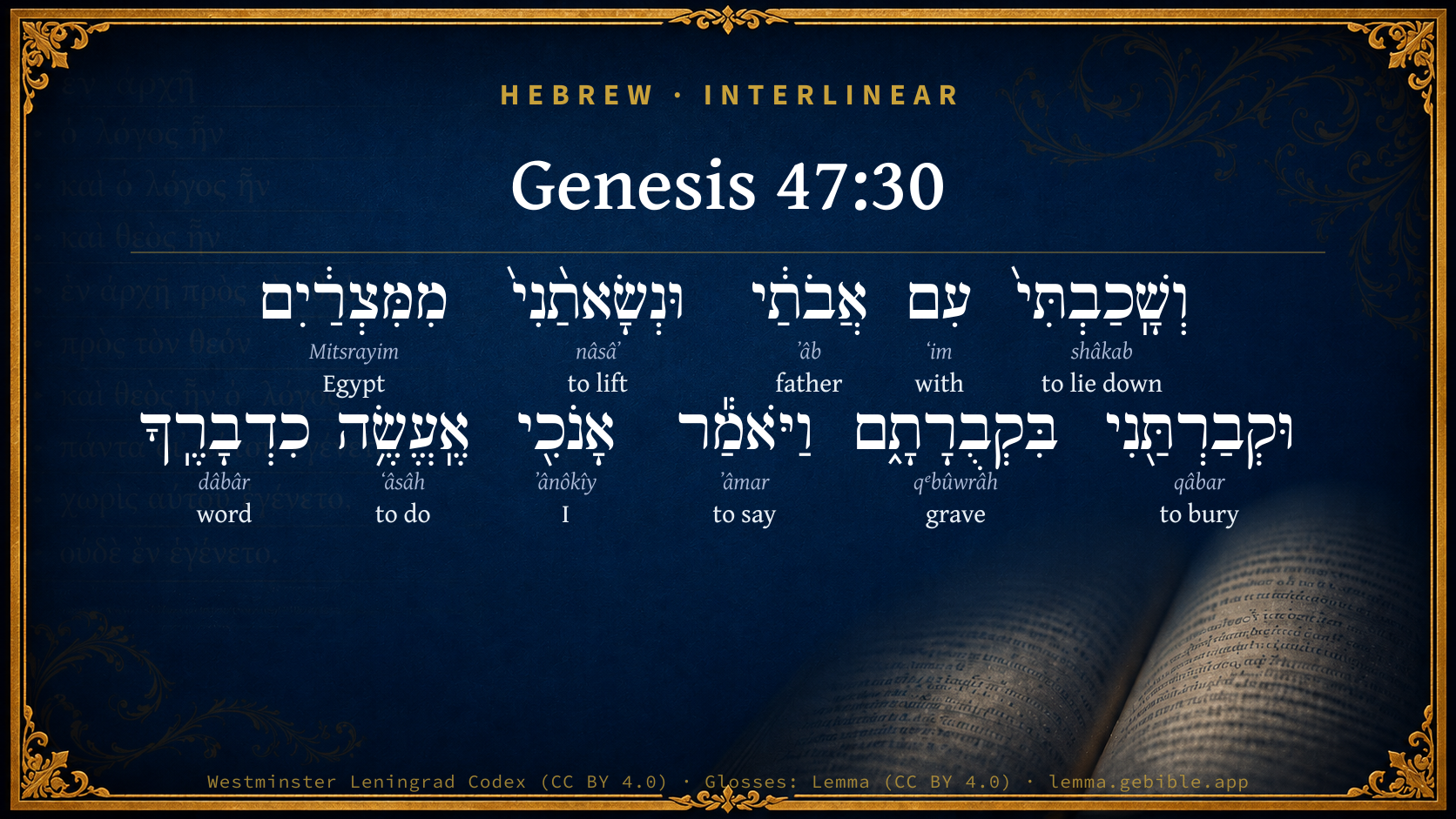
Hebrew (Westminster Leningrad Codex) Genesis 47:30 appears in the Hebrew Old Testament. The text above is from the Westminster Leningrad Codex. Each word links to its Strong’s number, a concise gloss, and parsing drawn from the Open Scriptures Hebrew Bible morphology. Click any word for its full Brown-Driver-Briggs (BDB) entry.
Download image
Cite this verse

Genesis 47:30 (World English Bible). Public Domain. Lemma interlinear Bible study tool, https://lemma.gebible.app/v/genesis/47/30.

Show BibTeX & RIS
BibTeX
RIS
English Translation
but when I sleep with my fathers, you shall carry me out of Egypt, and bury me in their burying place." He said, "I will do as you have said."
World English Bible · Public Domain
Download a study sheet

One document with this verse’s original text, its word-by-word gloss line, the meaning frame, cross-references with their text, attributed commentary, and full source and license credits — printable, and it pastes into notes with its structure intact.

This verse Autodidact and up

Study sheet (.html) Plain text (.txt)

A passage Seminary Student

Up to 50 verses in one chapter. A passage sheet keeps up to 6 commentary sources and 12 cross-references per verse, in the order this page ranks them, and says so on the sheet whenever that leaves anything out. Ask for a single verse and you get the Autodidact verse sheet above.

Everything on this page stays free to read, with no account — the sheet is a download of what is already on screen, not access to it.

Want to remove ads? Support Godless Engineer
Compare translations 3

The same verse in 3 English versions, stacked beneath the original-language interlinear above. Click any original word for its lexicon entry.

Each is an independent rendering of the whole verse — the interlinear is not word-aligned to these translations.

Highlighted words mark where these versions differ — a whole-verse word diff, not a word-by-word alignment.

  • World English Bible Public Domain
    but when I sleep with my fathers, you shall carry me out of Egypt, and bury me in their burying place." He said, "I will do as you have said."
  • King James Version Public Domain
    But I will lie with my fathers, and thou shalt carry me out of Egypt, and bury me in their buryingplace. And he said, I will do as thou hast said.
  • unfoldingWord Literal Text CC BY-SA 4.0
    And I lie down with my fathers, then carry me out of Egypt and bury me in their tomb.” And he said, “I will do according to your word.”

unfoldingWord Literal Text — © unfoldingWord, licensed CC BY-SA 4.0. Word-aligned USFM3 via Door43 (git.door43.org/unfoldingWord/en_ult).

Versions to compare (up to 4)

3 of 4 selected

Show all 18 translations

Every available English version of this verse, each an independent rendering of the whole verse.

  • World English Bible Public Domain
    but when I sleep with my fathers, you shall carry me out of Egypt, and bury me in their burying place." He said, "I will do as you have said."
  • Berean Standard Bible Public Domain
    but when I lie down with my fathers, carry me out of Egypt and bury me with them.” Joseph answered, “I will do as you have requested.”
  • Majority Standard Bible Public Domain
    but when I lie down with my fathers, carry me out of Egypt and bury me with them.” Joseph answered, “I will do as you have requested.”
  • King James Version Public Domain
    But I will lie with my fathers, and thou shalt carry me out of Egypt, and bury me in their buryingplace. And he said, I will do as thou hast said.
  • American Standard Version (1901) Public Domain
    but when I sleep with my fathers, thou shalt carry me out of Egypt, and bury me in their burying-place. And he said, I will do as thou hast said.
  • Revised Version (1885) Public Domain
    but when I sleep with my fathers, thou shalt carry me out of Egypt, and bury me in their buryingplace. And he said, I will do as thou hast said.
  • Geneva Bible (1599) Public Domain
    But when I shall sleepe with my fathers, thou shalt carry me out of Egypt, and bury mee in their buryall. And he answered, I will doe as thou hast sayde.
  • Douay-Rheims (1899) Public Domain
    But I will sleep with my fathers, end thou shalt take me away out of this land, and bury me in the burying place of my ancestors. And Joseph answered him: I will do what thou hast commanded.
  • Young's Literal Translation Public Domain
    and I have lain with my fathers, and thou hast borne me out of Egypt, and buried me in their burying-place.' And he saith, `I -- I do according to thy word;'
  • Literal Standard Version CC BY-SA 4.0
    and I have lain with my fathers, and you have carried me out of Egypt, and buried me in their burying-place.” And he says, “I do according to your word”;
  • Unlocked Literal Bible CC BY-SA 4.0
    When I sleep with my fathers, you will carry me out of Egypt and bury me in my forefathers' burial place.” Joseph said, “I will do as you have said.”
  • unfoldingWord Literal Text CC BY-SA 4.0
    And I lie down with my fathers, then carry me out of Egypt and bury me in their tomb.” And he said, “I will do according to your word.”
  • Darby Bible Public Domain
    but when I shall lie with my fathers, thou shalt carry me out of Egypt, and bury me in their sepulchre. And he said, I will do according to thy word.
  • World Messianic Bible Public Domain
    but when I sleep with my fathers, you shall carry me out of Egypt, and bury me in their burying place.” Joseph said, “I will do as you have said.”
  • Webster's Bible Public Domain
    But I will lie with my fathers, and thou shalt carry me out of Egypt, and bury me in their burying-place. And he said, I will do as thou hast said.
  • Free Bible Version CC BY-SA 4.0
    When I die, bury me with my forefathers. You must take my body from Egypt to the family tomb and bury me with them.” “I will do as you say,” Joseph promised.
  • Bible in Basic English Public Domain
    But when I go to my fathers, you are to take me out of Egypt and put me to rest in their last resting-place. And he said, I will do so.
  • JPS Tanakh (1917) Public Domain
    But when I sleep with my fathers, thou shalt carry me out of Egypt, and bury me in their burying-place.' And he said: 'I will do as thou hast said.'

Literal Standard Version (2020), Covenant Press — licensed CC BY-SA 4.0. Text via the HelloAO Bible API (eBible.org). Unlocked Literal Bible (unfoldingWord) — licensed CC BY-SA 4.0. Text via the HelloAO Bible API (eBible.org). unfoldingWord Literal Text — © unfoldingWord, licensed CC BY-SA 4.0. Word-aligned USFM3 via Door43 (git.door43.org/unfoldingWord/en_ult). Free Bible Version, Dr. Jonathan Gallagher — licensed CC BY-SA 4.0. Text via the HelloAO Bible API (eBible.org).

Word by word

More ways to search: Search by grammar → Find every occurrence → Compare this word →

Practice this passage: Drill this verse → Learn its vocabulary →

בִּקְבֻרָתָ֑ם
qᵉbûwrâh
H6900
“in/at · grave · their”
Preposition + Noun, Common, Feminine, Singular, Construct + Suffix, Personal, 3rd Person, Masculine, Plural
Part of Speech
Preposition + Noun
Type
Common
Gender
Feminine
Number
Singular
State
Construct
Full BDB Definition

Origin: pass part of H6912

TWOT: 1984b

grave, burial, burial site - grave - burial
  1. וְשָֽׁכַבְתִּי֙ shâkab H7901 “and · to lie down” Conjunction + Verb, Qal, Sequential Perfect, 1st Person, Common, Singular
  2. עִם ʻim H5973 “with” Preposition
  3. אֲבֹתַ֔י ʼâb H1 “fathers · my” Noun, Common, Masculine, Plural, Construct + Suffix, Personal, 1st Person, Common, Singular
  4. וּנְשָׂאתַ֨נִי֙ nâsâʼ H5375 “and · to lift · me” Conjunction + Verb, Qal, Sequential Perfect, 2nd Person, Masculine, Singular + Suffix, Personal, 1st Person, Common, Singular
  5. מִמִּצְרַ֔יִם Mitsrayim H4714 “from · Egypt” Preposition + Noun, Proper
  6. וּקְבַרְתַּ֖נִי qâbar H6912 “and · to bury · me” Conjunction + Verb, Qal, Sequential Perfect, 2nd Person, Masculine, Singular + Suffix, Personal, 1st Person, Common, Singular
  7. וַיֹּאמַ֕ר ʼâmar H559 “and · to say” Conjunction + Verb, Qal, Sequential Imperfect, 3rd Person, Masculine, Singular
  8. אָנֹכִ֖י ʼânôkîy H595 “I” Pronoun, Personal, 1st Person, Common, Singular
  9. אֶֽעֱשֶׂ֥ה ʻâsâh H6213 “to do” Verb, Qal, Imperfect, 1st Person, Common, Singular
  10. כִדְבָרֶֽךָ dâbâr H1697 “like/as · word · your” Preposition + Noun, Common, Masculine, Singular, Construct + Suffix, Personal, 2nd Person, Masculine, Singular

About this verse

These counts appear in no published source. They are computed here, from the morphology-tagged text and Lemma’s own curated glosses. What Lemma adds →

11
words
11
distinct lemmas
Pentateuch
section

Notable vocabulary

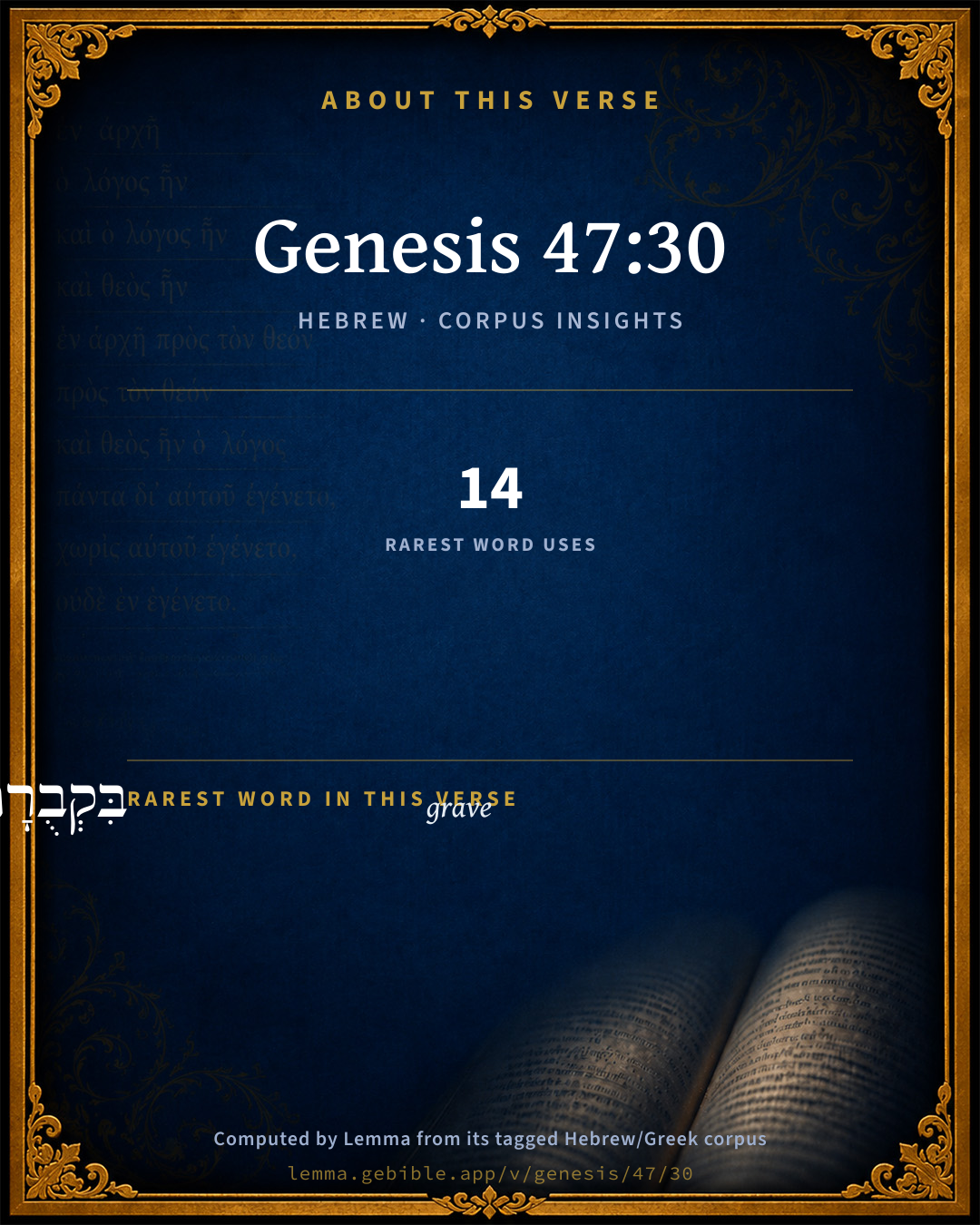
The rarest word here is בִּקְבֻרָתָ֑ם grave H6900 — appearing just 14 times in the whole Hebrew Bible.

Shared distinctive vocabulary

בִּקְבֻרָתָ֑ם grave H6900 occurs in 13 verses of the Hebrew Bible. Also found in:

Grammatical profile

  • 5 verbs
  • 4 nouns
  • 1 pronoun
  • 1 preposition

Verb forms

  • וְשָֽׁכַבְתִּי֙ Qal · Sequential Perfect
  • וּנְשָׂאתַ֨נִי֙ Qal · Sequential Perfect
  • וּקְבַרְתַּ֖נִי Qal · Sequential Perfect
  • וַיֹּאמַ֕ר Qal · Sequential Imperfect
  • אֶֽעֱשֶׂ֥ה Qal · Imperfect

Hebrew & Septuagint length

In English translation the verse runs 30 words from the Hebrew and 32 from the Septuagint (LXX English) — closely comparable.

A rough comparison of the two English renderings, which tokenize alike — not a word-level alignment.

Word counts can differ between the Hebrew and the Greek without any difference in meaning — e.g. the Hebrew direct-object marker אֵת has no separate Greek word, and Greek often adds the article ὁ.

Cross-references

10

Topical passages linked to Genesis 47:30 in the Treasury of Scripture Knowledge — connected by theme and wording, ordered by reader-vote popularity; previews shown in the World English Bible.

  • Genesis 49:29–32 He charged them, and said to them, "I am to be gathered to my people. Bury me with my fathers in the cave that is in the field of Ephron the Hittite,
  • Genesis 23:19 After this, Abraham buried Sarah his wife in the cave of the field of Machpelah before Mamre (the same is Hebron), in the land of Canaan.
  • Genesis 25:9 Isaac and Ishmael, his sons, buried him in the cave of Machpelah, in the field of Ephron, the son of Zohar the Hittite, which is before Mamre,
  • Genesis 50:5–14 'My father made me swear, saying, "Behold, I am dying. Bury me in my grave which I have dug for myself in the land of Canaan." Now therefore, please let me go up and bury my father, and I will come again.'"
  • Genesis 50:25 Joseph took an oath of the children of Israel, saying, "God will surely visit you, and you shall carry up my bones from here."
  • 2 Samuel 19:37 Please let your servant turn back again, that I may die in my own city, by the grave of my father and my mother. But behold, your servant Chimham; let him go over with my lord the king; and do to him what shall seem good to you.
  • 1 Kings 13:22 but came back, and have eaten bread and drunk water in the place of which he said to you, Eat no bread, and drink no water; your body shall not come to the tomb of your fathers.
  • Nehemiah 2:3 I said to the king, Let the king live forever: why should not my face be sad, when the city, the place of my fathers' tombs, lies waste, and the gates of it are consumed with fire?
  • Nehemiah 2:5 I said to the king, If it please the king, and if your servant have found favor in your sight, that you would send me to Judah, to the city of my fathers' tombs, that I may build it.
  • Acts 7:15–16 Jacob went down into Egypt, and he died, himself and our fathers,

Cross-references courtesy of OpenBible.info (CC BY 4.0).

Hebrew and Greek witnesses Masoretic Hebrew ↔ Greek Septuagint

The same verse in the two great witnesses to the Old Testament, shown verse-for-verse.

These are two independent witnesses, not word-aligned to each other, and the Septuagint is shown in lemma (dictionary) form.

Hebrew Genesis 47:30 Masoretic · Westminster Leningrad Codex

וְשָֽׁכַבְתִּי֙ עִם אֲבֹתַ֔י וּנְשָׂאתַ֨נִי֙ מִמִּצְרַ֔יִם וּקְבַרְתַּ֖נִי בִּקְבֻרָתָ֑ם וַיֹּאמַ֕ר אָנֹכִ֖י אֶֽעֱשֶׂ֥ה כִדְבָרֶֽךָ

but when I sleep with my fathers, you shall carry me out of Egypt, and bury me in their burying place." He said, "I will do as you have said."

World English Bible · Public Domain

Greek LXX Genesis 47:30 Septuagint · lemma form

ἀλλά κοιμάω μετά ὁ πατήρ ἐγώ καί αἴρω ἐγώ ἐκ αἴγυπτος καί θάπτω ἐγώ ἐν ὁ τάφος αὐτός ὁ δέ εἶπον ἐγώ ποιέω κατά ὁ ῥῆμα σύ

But I will sleep with my fathers, and you shall carry me up out of Egypt, and bury me in their sepulchre. And he said, I will do according to your word.

LXX2012 (modern English Septuagint) · Public Domain

Hebrew: Westminster Leningrad Codex (CC BY 4.0). Greek: Septuagint (public domain); English from LXX2012 (modern English Septuagint) (Public Domain). How the Septuagint differs from the Hebrew →

Targum (Aramaic paraphrase)

2

The Targum is the ancient Jewish Aramaic paraphrase of the Hebrew Scriptures — an interpretive translation, not the Hebrew text itself. Onkelos (literal) and Pseudo-Jonathan (expansive) render the Torah, and Jonathan the Prophets. Coverage is partial: where no permissively-licensed English translation exists for a verse, only the Aramaic is shown. This is verse-level text, not a word-by-word alignment to the Hebrew.

  1. Targum Onkelos Torah (Genesis–Deuteronomy)
    וְאִשְׁכּוּב עִם אֲבָהָתַי וְתִטְּלִנַנִּי מִמִּצְרַיִם וְתִקְבְּרִנַנִּי בִּקְבֻרְתְּהוֹן וַאֲמַר אֲנָא אֶעְבַּד כְּפִתְגָּמָךְ

    (no public-domain English translation for this verse)

    Targum Onkelos — Aramaic: “Onkelos Genesis” (public domain); “Onkelos Exodus” (public domain); “Onkelos Leviticus” (public domain); “Onkelos Numbers” (public domain); “Onkelos Deuteronomy” (public domain). English: “Sefaria Community Translation” (CC0 1.0 (public-domain dedication)); “J.W. Etheridge. The Targums of Onkelos and Jonathan Ben Uzziel on the Pentateuch. London: Longmans, Green, 1862” (public domain). Text via Sefaria.

  2. Targum Pseudo-Jonathan Torah (Genesis–Deuteronomy)
    וְאֶשְׁכּוֹב עִם אַבְהָתַי וְתִטְלִינַנִי מִמִצְרַיִם וְתִקְבְּרִינַנִי בִּקְבוּרְתְּהוֹן וּמִן בִּגְלַל דְהוּא בְּרֵיהּ לָא שַׁוִי יְדֵיהּ אֱלָהֵן אָמַר אֲנָא אַעְבֵיד כְּפִתְגָמָךְ

    that I may sleep with my fathers, and thou mayest carry me from Mizraim, and bury me in their sepulchre. But because he was his son he did not (so) put his hand; but said, I will do according to thy word.

    Targum Pseudo-Jonathan — Aramaic: “Targum Jonathan on Genesis” (public domain); “Targum Jonathan on Exodus” (public domain); “Targum Jonathan on Leviticus” (public domain); “Targum Jonathan on Numbers” (public domain); “Targum Jonathan on Deuteronomy” (public domain). English: “The Targum of Jonathan ben Uzziel, trans. J. W. Etheridge, London, 1862” (public domain). Text via Sefaria.

Commentary

Notes on Genesis 47:30 from classic Christian and Jewish commentators (each source and its license shown beneath its notes). The classic Christian expositions comment on the surrounding passage and are grouped to its opening verse, so a note may address several verses; the Jewish commentaries on the Tanakh (Rashi and others) are per-verse, so they appear only where the commentator wrote on this verse.

Lemma curates 59 commentaries, every one of them public domain or Creative Commons licensed, each selected and text-cleaned for this edition rather than reprinted as found. About our sources →

Trapp's Complete Commentary

John Trapp

Gen 47:30 But I will lie with my fathers, and thou shalt carry me out of Egypt, and bury me in their buryingplace. And he said, I will do as thou hast said.

Ver. 30. Bury me in their burying place.] That he might keep possession, at least by his dead body, of the Promised Land. There they would be buried, not pompously, but reverently, that they might rise again with Christ. Some of the fathers think that these patriarchs were those that rose corporally with him. {Mat 27:53}

John Trapp, A Commentary or Exposition upon All the Books of the Old and New Testament (1647–1656) — public domain. Text from a community e-Sword module.

Geneva Bible (1599)

Geneva Bible translators

Hereby he protested that he died in the faith of his fathers, teaching his children to hope for the promised land.

Geneva Bible (1599) marginal notes — public domain. Text via Bolls.life.

Adam Clarke's Commentary

Verse 30. I will lie with my fathers] As God had promised the land of Canaan to Abraham and his posterity, Jacob considered it as a consecrated place, under the particular superintendence and blessing of God: and as Sarah, Abraham, and Isaac were interred near to Hebron, he in all probability wished to lie, not only in the same place, but in the same grave; and it is not likely that he would have been solicitous about this, had he not considered that promised land as being a type of the rest that remains for the people of God, and a pledge of the inheritance among the saints in light.

Adam Clarke's Commentary on the Bible (1810–1826) — public domain. Text from a community e-Sword/MySword module.

John Calvin's Commentaries

30. But I will lie with my fathers It appears from this passage, that the word “sleep,” whenever it is put for “die,” does not refer to the soul, but to the body. For, what did it concern him, to be buried with his fathers in the double cave, unless to testify that he was associated with them after death? And by what bond were he and they joined together, except this, that not even death itself could extinguish the power of their faith; which would seem to utter this voice from the same sepulcher, Now also we have a common inheritance.

John Calvin's Commentaries (1540-1563) — public domain. Text from the Calvin Translation Society English edition (1840s-50s) via the Christian Classics Ethereal Library (ccel.org). Calvin's coverage is partial (roughly two-thirds of the Bible); uncommented books and verses are honest gaps, never fabricated. The 19th-century editor's footnotes and remarks are omitted so the notes are faithfully Calvin's own voice.

The Cambridge Bible for Schools and Colleges

gen. ed. J. J. S. Perowne

30. when I sleep with my fathers] See note on Gen_25:8. When his spirit is in Sheôl, his body is to rest at Machpelah.

bury me in their buryingplace] This charge of Jacob that he should be carried out of Egypt and buried in the burying-place of his fathers, viz. in the cave of Machpelah, is repeated in Gen_49:29-30 (P). See for its execution Gen_50:13 (P). For the burial of Isaac, see Gen_35:29 (P); and of Abraham, Gen_25:9 (P).

In Gen_50:5 Jacob speaks of the grave he had digged for himself: see note.

The Cambridge Bible for Schools and Colleges (gen. ed. J. J. S. Perowne; Cambridge University Press, 1878–1918) — public domain. Text from a community e-Sword module.

John Gill's Exposition

And he said, swear unto me,.... This he required, not from any distrust of Joseph, but to show his own eagerness, and the intenseness of his mind about this thing, how much he was set upon it, and what an important thing it was with him; as also, that if he should have any objections made to it, or arguments used with him to divert him from it, by Pharaoh or his court, he would be able to say his father had bound him by an oath to do it, which would at once stop their mouths, and be judged a sufficient reason for what he did, see Gen 50:5,

and he sware unto him; not only gave his promise, but confirmed it with an oath:

and Israel bowed himself upon the bed's head: not in a way of civil respect to Joseph, giving him thanks for the assurance he had given him, that he would bury him, not in Egypt, but in Canaan; but in a religious way to God, giving thanks to him that he had lived to see his son Joseph, who, according to the promise, would close his eyes, and that he had inclined his heart to fulfil his request; though some think that no more is meant, than that after Jacob had spent himself in discoursing with Joseph, he sunk down and reclined on his pillow at his bed's head, to take some rest; for as for what the apostle says in Heb 11:21; that refers to another thing at another time; See Gill on Heb 11:21.

Next: Genesis Chapter 48

John Gill's Exposition of the Whole Bible (1746–1763) — public domain (CC PDM 1.0). Text via the HelloAO Bible API.

Haydock's Catholic Bible Commentary

Place. Hebron, where Sara, Abraham, and Isaac reposed. (Calmet) --- Thus he manifested his belief in a future resurrection with his Saviour, who should be born in that land; and he admonished his descendants never to lose sight of it, nor forfeit the promises by their wicked conduct, chap. xxiii. 17. (Menochius) --- He teaches us likewise, to be solicitous to obtain Christian burial. (Worthington)

George Leo Haydock (1774–1849), Haydock's Catholic Family Bible and Commentary, 1859 edition — public domain. Excludes Psalms (Douay-Rheims chapter numbering differs from Protestant) and Deuterocanonical books (Catholic canon only).

Matthew Poole's English Annotations

I will lie with my fathers, Abraham and Isaac, in Canaan. See Gen 23:19; 25:9; 35:29. Which he desired not so much for himself, as knowing that wherever he was buried he should rise to glory; as for his children, to show his own, and confirm their faith in God’s promise of Canaan; to discover his high valuation of that land, not only for itself, but as it was a type and pledge of the heavenly inheritance; to keep his children’s minds and hearts loose from Egypt, a place of so much sin and danger, and fixed upon Canaan, that they might be more willing to go thither when God called them, by virtue of that inclination which is in most persons to be buried with their fathers; and in the mean time to declare his detestation of idolaters, with whom he would have no communion either in life, as far as he could avoid it, or in the place of burial; and on the contrary, to profess his communion with his godly ancestors, by his desire to be joined with them in burial. And for the same reasons Joseph desired the translation of his bones thither, Gen 50:25.

Matthew Poole's English Annotations on the Holy Bible (1683–1685) — public domain. Text from a community e-Sword/MySword module.

Whedon's Commentary on the Bible

Daniel D. Whedon

30. I will lie with my fathers — Egypt will do to live in for a time, but Jacob would have his dust repose with that of Abraham and Isaac in the land of Canaan. Compare the touching words of Gen_49:29-32. Such a dying request none would refuse.

Daniel D. Whedon (gen. ed.), Commentary on the Old and New Testaments (1874–1909) — public domain. Text from a community e-Sword module.

The Pulpit Commentary

But I will lie with my fathers, and thou shalt carry me out of Egypt, and bury me in their burying-place. The request of the venerable patriarch, while due in some respect to the deeply-seated instinct of human nature which makes men, almost universally, long to be buried in ancestral graves, was inspired by the clear faith that Canaan was the true inheritance of Israel, and that, though now obtaining a temporary refuge in Egypt, his descendants would eventually return to the land of promise as their permanent abode. And he (i.e. Joseph) said, I will do as thou hast said literally, according to thy word.

The Pulpit Commentary (1880–1919), ed. H.D.M. Spence-Jones & Joseph S. Exell — public domain. Text from a community e-Sword module.

Rashi

Rabbi Shlomo Yitzchaki (Rashi)

ושכבתי עם אבתי BUT I WILL LIE WITH MY FATHERS — This ו of ושכבתי is the connecting link with the beginning of the verse above: Put thy hand beneath my thigh and swear unto me that you will not bury me in Egypt. For I must ultimately lie with my fathers (i.e. die as all my fathers have died) and you shall carry me out of Egypt. One cannot say that “I will lie with my fathers” means “make me lie with my fathers in the cave” (i.e. bury me), for immediately after this it is written “And thou shalt carry me out of Egypt and bury me in their burying place”. Further we find that wherever the term “lying with one’s fathers” is used it denotes dying and not burial. For instance, (1 Kings 2:10) “and David lay with his fathers”, and afterwards it states “and he was buried in the city of David”.

Rashi on the Tanakh — English translations: “The Judaica Press complete Tanach with Rashi, translated by A. J. Rosenberg” (CC BY 4.0); “Pentateuch with Rashi's commentary by M. Rosenbaum and A.M. Silbermann, 1929-1934” (public domain); “The Metsudah Tanach series, Lakewood, N.J” (CC BY 4.0); and “The Book of Joshua, Metsudah Publications, 1997” (CC BY 4.0). Text via Sefaria.

Lesson kit

Teaching starters — assembled from the data on this page, not authored interpretation. Every prompt links to the verse data it draws on. Edit before teaching.

Genesis, in the Pentateuch, opens this verse with 11 words (11 distinct Hebrew lemmas). Its most distinctive word is qᵉbûwrâh (“grave”). A historical commentator’s framing appears above. Read the whole chapter for the surrounding context.

Discussion questions

  1. The word qᵉbûwrâh carries the sense “grave.” How does it shape the verse?
  2. Genesis 35:20 shares the word «grave» with this verse. How do the two illuminate each other?
  3. These translations render this verse differently. What is at stake in choosing one wording over another?
  4. The verb «וְשָֽׁכַבְתִּי֙» is Qal Sequential Perfect. How does its form color the action?
  5. Reading how Trapp's Complete Commentary and Geneva Bible (1599) read this verse, where do the two commentators agree and where do they part?

Things to notice

Reading settings

Reading text

Shown beneath each verse's original-language words.

Old Testament
Old Testament edition

Read the OT as the Masoretic Hebrew (MT) or the Greek Septuagint (LXX).

English shown for the Greek Septuagint (in the Hebrew ↔ Greek comparison).

Comparing translations? Open the Compare panel on any verse page to stack up to four side by side.