
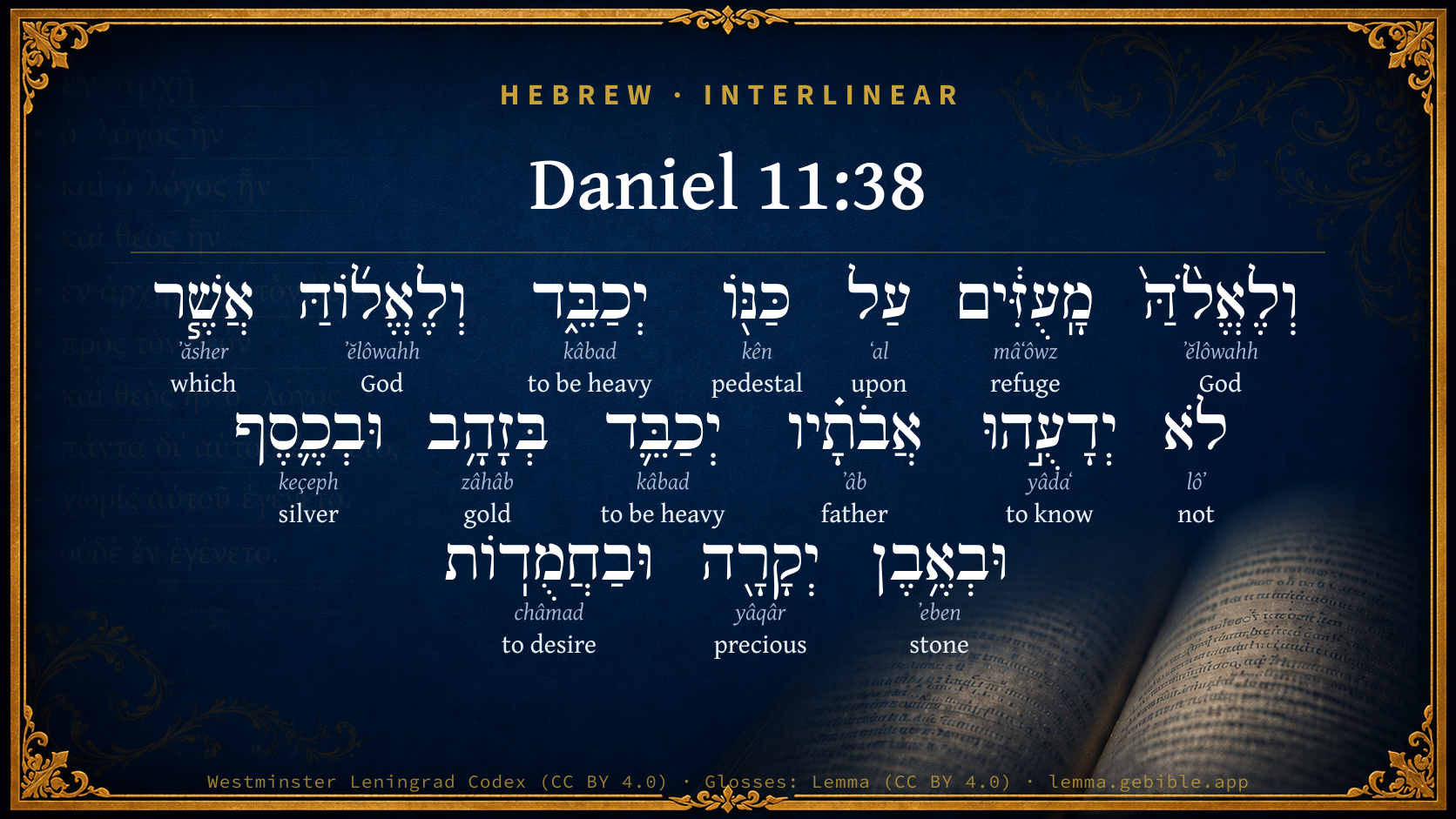
Daniel 11:38

Hebrew (Westminster Leningrad Codex) Daniel 11:38 appears in the Hebrew Old Testament. The text above is from the Westminster Leningrad Codex. Each word links to its Strong’s number, a concise gloss, and parsing drawn from the Open Scriptures Hebrew Bible morphology. Click any word for its full Brown-Driver-Briggs (BDB) entry.
Download image
Cite this verse

Daniel 11:38 (World English Bible). Public Domain. Lemma interlinear Bible study tool, https://lemma.gebible.app/v/daniel/11/38.

Show BibTeX & RIS
BibTeX
RIS
English Translation
But in his place shall he honor the god of fortresses; and a god whom his fathers didn't know shall he honor with gold, and silver, and with precious stones, and pleasant things.
World English Bible · Public Domain
Download a study sheet

One document with this verse’s original text, its word-by-word gloss line, the meaning frame, cross-references with their text, attributed commentary, and full source and license credits — printable, and it pastes into notes with its structure intact.

This verse Autodidact and up

Study sheet (.html) Plain text (.txt)

A passage Seminary Student

Up to 50 verses in one chapter. A passage sheet keeps up to 6 commentary sources and 12 cross-references per verse, in the order this page ranks them, and says so on the sheet whenever that leaves anything out. Ask for a single verse and you get the Autodidact verse sheet above.

Everything on this page stays free to read, with no account — the sheet is a download of what is already on screen, not access to it.

Want to remove ads? Support Godless Engineer
Compare translations 3

The same verse in 3 English versions, stacked beneath the original-language interlinear above. Click any original word for its lexicon entry.

Each is an independent rendering of the whole verse — the interlinear is not word-aligned to these translations.

Highlighted words mark where these versions differ — a whole-verse word diff, not a word-by-word alignment.

  • World English Bible Public Domain
    But in his place shall he honor the god of fortresses; and a god whom his fathers didn't know shall he honor with gold, and silver, and with precious stones, and pleasant things.
  • King James Version Public Domain
    But in his estate shall he honour the God of forces: and a god whom his fathers knew not shall he honour with gold, and silver, and with precious stones, and pleasant things.
  • unfoldingWord Literal Text CC BY-SA 4.0
    He will honor the god of fortresses instead of these. A god whom his fathers did not know, he will honor with gold and silver, with precious stones and treasures.

unfoldingWord Literal Text — © unfoldingWord, licensed CC BY-SA 4.0. Word-aligned USFM3 via Door43 (git.door43.org/unfoldingWord/en_ult).

Versions to compare (up to 4)

3 of 4 selected

Show all 18 translations

Every available English version of this verse, each an independent rendering of the whole verse.

  • World English Bible Public Domain
    But in his place shall he honor the god of fortresses; and a god whom his fathers didn't know shall he honor with gold, and silver, and with precious stones, and pleasant things.
  • Berean Standard Bible Public Domain
    And in their place, he will honor a god of fortresses—a god his fathers did not know—with gold, silver, precious stones, and riches.
  • Majority Standard Bible Public Domain
    And in their place, he will honor a god of fortresses—a god his fathers did not know—with gold, silver, precious stones, and riches.
  • King James Version Public Domain
    But in his estate shall he honour the God of forces: and a god whom his fathers knew not shall he honour with gold, and silver, and with precious stones, and pleasant things.
  • American Standard Version (1901) Public Domain
    But in his place shall he honor the god of fortresses; and a god whom his fathers knew not shall he honor with gold, and silver, and with precious stones, and pleasant things.
  • Revised Version (1885) Public Domain
    But in his place shall he honour the god of fortresses: and a god whom his fathers knew not shall he honour with gold, and silver, and with precious stones, and pleasant things.
  • Geneva Bible (1599) Public Domain
    But in his place shall he honour the god Mauzzim, and the god whom his fathers knewe not, shall he honour with golde and with siluer, and with precious stones, and pleasant things.
  • Douay-Rheims (1899) Public Domain
    But he shall worship the god Maozim in his place: and a god whom his fathers knew not, he shall worship with gold, and silver, and precious stones, and things of great price.
  • Young's Literal Translation Public Domain
    And to the god of strongholds, on his station, he giveth honour; yea, to a god whom his fathers knew not he giveth honour, with gold, and with silver, and with precious stone, and with desirable things.
  • Literal Standard Version CC BY-SA 4.0
    And to the god of strongholds, on his station, he gives honor; indeed, to a god whom his fathers did not know he gives honor, with gold, and with silver, and with precious stone, and with desirable things.
  • Unlocked Literal Bible CC BY-SA 4.0
    He will honor the god of fortresses instead of these. It is a god whom his fathers did not acknowledge that he will honor with gold and silver, with precious stones and valuable gifts.
  • unfoldingWord Literal Text CC BY-SA 4.0
    He will honor the god of fortresses instead of these. A god whom his fathers did not know, he will honor with gold and silver, with precious stones and treasures.
  • Darby Bible Public Domain
    And in his place will he honour the +god of fortresses; and a +god whom his fathers knew not will he honour with gold and silver, and with precious stones and pleasant things.
  • World Messianic Bible Public Domain
    But in their place, he will honor the god of fortresses. He will honor a god whom his fathers didn’t know with gold, silver, and with precious stones and pleasant things.
  • Webster's Bible Public Domain
    But in his estate shall he honor the God of forces: and a god whom his fathers knew not shall he honor with gold, and silver, and with precious stones, and pleasant things.
  • Free Bible Version CC BY-SA 4.0
    Instead he will honor the god of fortresses—a god unknown to his forefathers—giving him offerings of gold and silver and precious stones and expensive gifts.
  • Bible in Basic English Public Domain
    But in place of this he will give honour to the god of armed places, and to a god of whom his fathers had no knowledge he will give honour with gold and silver and jewels and things to be desired.
  • JPS Tanakh (1917) Public Domain
    But in his place shall he honour the god of strongholds; and a god whom his fathers knew not shall he honour with gold, and silver, and with precious stones, and costly things.

Literal Standard Version (2020), Covenant Press — licensed CC BY-SA 4.0. Text via the HelloAO Bible API (eBible.org). Unlocked Literal Bible (unfoldingWord) — licensed CC BY-SA 4.0. Text via the HelloAO Bible API (eBible.org). unfoldingWord Literal Text — © unfoldingWord, licensed CC BY-SA 4.0. Word-aligned USFM3 via Door43 (git.door43.org/unfoldingWord/en_ult). Free Bible Version, Dr. Jonathan Gallagher — licensed CC BY-SA 4.0. Text via the HelloAO Bible API (eBible.org).

Word by word

More ways to search: Search by grammar → Find every occurrence → Compare this word →

Practice this passage: Drill this verse → Learn its vocabulary →

כַּנּ֖וֹ
kên
H3653
“pedestal · his”
Noun, Common, Masculine, Singular, Construct + Suffix, Personal, 3rd Person, Masculine, Singular
Part of Speech
Noun
Type
Common
Gender
Masculine
Number
Singular
State
Construct
Full BDB Definition

Origin: the same as H3651 , used as a noun

TWOT: 998a

base, stand, pedestal, office, foot, place, estate - base, pedestal - office, place
  1. וְלֶאֱלֹ֨הַּ֙ ʼĕlôwahh H433 “and · to/for · God of” Conjunction + Preposition + Noun, Common, Masculine, Singular, Construct
  2. מָֽעֻזִּ֔ים mâʻôwz H4581 “refuges” Noun, Common, Masculine, Plural, Absolute
  3. עַל ʻal H5921 “upon” Preposition
  4. יְכַבֵּ֑ד kâbad H3513 “to be heavy” Verb, Piel, Imperfect, 3rd Person, Masculine, Singular
  5. וְלֶאֱל֜וֹהַּ ʼĕlôwahh H433 “and · to/for · God” Conjunction + Preposition + Noun, Common, Masculine, Singular, Absolute
  6. אֲשֶׁ֧ר ʼăsher H834 “which” Particle, Relative
  7. לֹא lôʼ H3808 “not” Particle, Negative
  8. יְדָעֻ֣הוּ yâdaʻ H3045 “to know · him” Verb, Qal, Perfect, 3rd Person, Common, Plural + Suffix, Personal, 3rd Person, Masculine, Singular
  9. אֲבֹתָ֗יו ʼâb H1 “fathers · his” Noun, Common, Masculine, Plural, Construct + Suffix, Personal, 3rd Person, Masculine, Singular
  10. יְכַבֵּ֛ד kâbad H3513 “to be heavy” Verb, Piel, Imperfect, 3rd Person, Masculine, Singular
  11. בְּזָהָ֥ב zâhâb H2091 “in/at · gold” Preposition + Noun, Common, Masculine, Singular, Absolute
  12. וּבְכֶ֛סֶף keçeph H3701 “and · in/at · silver” Conjunction + Preposition + Noun, Common, Masculine, Singular, Absolute
  13. וּבְאֶ֥בֶן ʼeben H68 “and · in/at · stone” Conjunction + Preposition + Noun, Common, Feminine, Singular, Absolute
  14. יְקָרָ֖ה yâqâr H3368 “precious” Adjective, Adjective, Feminine, Singular, Absolute
  15. וּבַחֲמֻדֽוֹת châmad H2530 “and · in/at · desirable things” Conjunction + Preposition + Noun, Common, Feminine, Plural, Absolute

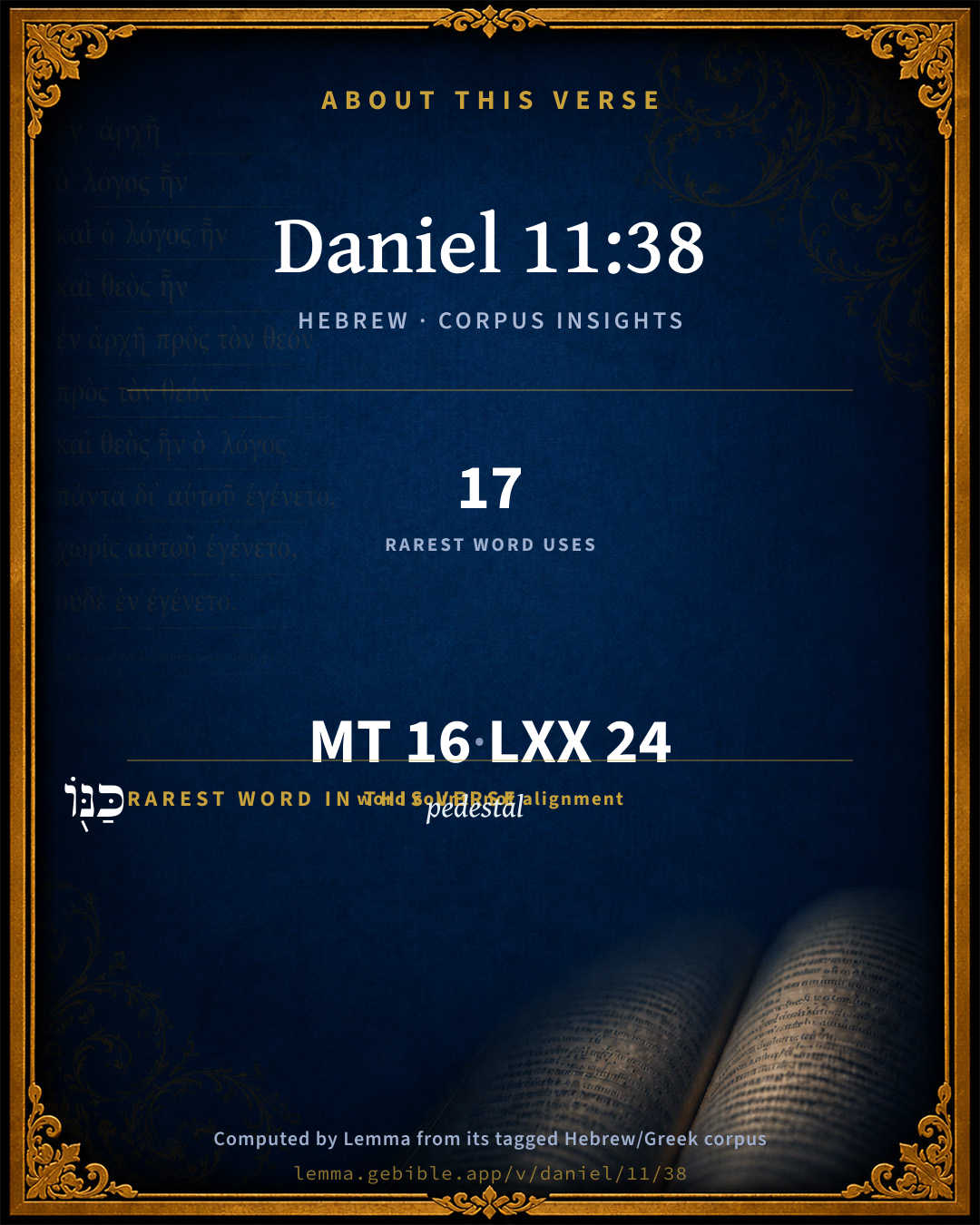
About this verse

These counts appear in no published source. They are computed here, from the morphology-tagged text and Lemma’s own curated glosses. What Lemma adds →

16
words
14
distinct lemmas
Prophets
section

Notable vocabulary

The rarest word here is כַּנּ֖וֹ pedestal H3653 — appearing just 17 times in the whole Hebrew Bible.

Shared distinctive vocabulary

כַּנּ֖וֹ pedestal H3653 occurs in 17 verses of the Hebrew Bible. Also found in:

Grammatical profile

  • 3 verbs
  • 9 nouns
  • 1 adjective
  • 1 preposition
  • 2 particles

Verb forms

  • יְכַבֵּ֑ד Piel · Imperfect
  • יְדָעֻ֣הוּ Qal · Perfect
  • יְכַבֵּ֛ד Piel · Imperfect

Repetition

Words recur within this verse — often emphatic in Hebrew:

  • וְלֶאֱלֹ֨הַּ֙ God H433 ×2
  • יְכַבֵּ֑ד to be heavy H3513 ×2

Hebrew & Septuagint length

In English translation the verse runs 33 words from the Hebrew and 32 from the Septuagint (LXX English) — closely comparable.

A rough comparison of the two English renderings, which tokenize alike — not a word-level alignment.

Word counts can differ between the Hebrew and the Greek without any difference in meaning — e.g. the Hebrew direct-object marker אֵת has no separate Greek word, and Greek often adds the article ὁ.

In the original languages it is 16 Hebrew tokens and 24 Greek tokens — but the two are counted differently (Hebrew bundles its prefixes and suffixes into one token; the Greek is in lemma form), so that isn’t a like-for-like length.

Cross-references

5

Topical passages linked to Daniel 11:38 in the Treasury of Scripture Knowledge — connected by theme and wording, ordered by reader-vote popularity; previews shown in the World English Bible.

  • Isaiah 44:9 Those who fashion an engraved image are all of them vanity; and the things that they delight in shall not profit; and their own witnesses don't see, nor know: that they may be disappointed.
  • 1 Timothy 4:1 But the Spirit says expressly that in later times some will fall away from the faith, paying attention to seducing spirits and doctrines of demons,
  • Revelation 13:12–17 He exercises all the authority of the first beast in his presence. He makes the earth and those who dwell in it to worship the first beast, whose fatal wound was healed.
  • Revelation 17:1–5 One of the seven angels who had the seven bowls came and spoke with me, saying, "Come here. I will show you the judgment of the great prostitute who sits on many waters,
  • Revelation 18:12 merchandise of gold, silver, precious stones, pearls, fine linen, purple, silk, scarlet, all expensive wood, every vessel of ivory, every vessel made of most precious wood, and of brass, and iron, and marble;

Cross-references courtesy of OpenBible.info (CC BY 4.0).

Hebrew and Greek witnesses Masoretic Hebrew ↔ Greek Septuagint

The same verse in the two great witnesses to the Old Testament, shown verse-for-verse.

These are two independent witnesses, not word-aligned to each other, and the Septuagint is shown in lemma (dictionary) form.

Hebrew Daniel 11:38 Masoretic · Westminster Leningrad Codex

וְלֶאֱלֹ֨הַּ֙ מָֽעֻזִּ֔ים עַל כַּנּ֖וֹ יְכַבֵּ֑ד וְלֶאֱל֜וֹהַּ אֲשֶׁ֧ר לֹא יְדָעֻ֣הוּ אֲבֹתָ֗יו יְכַבֵּ֛ד בְּזָהָ֥ב וּבְכֶ֛סֶף וּבְאֶ֥בֶן יְקָרָ֖ה וּבַחֲמֻדֽוֹת

But in his place shall he honor the god of fortresses; and a god whom his fathers didn't know shall he honor with gold, and silver, and with precious stones, and pleasant things.

World English Bible · Public Domain

Greek LXX Daniel 11:38 Septuagint · lemma form

ἐπί ὁ τόπος αὐτός κινέω καί θεός ὅς οὐ γιγνώσκω ὁ πατήρ αὐτός τιμάω ἐν χρυσίον καί ἀργύριον καί λίθος πολυτελής καί ἐν ἐπιθύμημα

And he shall honor the god of forces on his place: and a god whom his fathers knew not he shall honor with gold, and silver, and precious stones, and desirable things.

LXX2012 (modern English Septuagint) · Public Domain

On this verse, Joseph Benson's Commentary discusses the Septuagint’s reading. Read the note in Commentary ↓

Hebrew: Westminster Leningrad Codex (CC BY 4.0). Greek: Septuagint (public domain); English from LXX2012 (modern English Septuagint) (Public Domain). How the Septuagint differs from the Hebrew →

Commentary

Notes on Daniel 11:38 from classic Christian and Jewish commentators (each source and its license shown beneath its notes). The classic Christian expositions comment on the surrounding passage and are grouped to its opening verse, so a note may address several verses; the Jewish commentaries on the Tanakh (Rashi and others) are per-verse, so they appear only where the commentator wrote on this verse.

Lemma curates 59 commentaries, every one of them public domain or Creative Commons licensed, each selected and text-cleaned for this edition rather than reprinted as found. About our sources →

Trapp's Complete Commentary

John Trapp

Dan 11:38 But in his estate shall he honour the God of forces: and a god whom his fathers knew not shall he honour with gold, and silver, and with precious stones, and pleasant things.

Ver. 38. But in his estate shall he honour the God of forces.] Or, As for the Almighty God, in his seat he shall honour, yea, he shall honour a god whom his fathers knew not, &c.; that is, in God’s holy temple at Jerusalem Antiochus shall set up Jupiter Olympius, who was none of the dii Syri; for the Syrians worshipped Apollo, Diana, Atargatis, as Strabo {a} testifieth. See 2Ma 6:2.

Shall he honour.] This doubling of the word seemeth to show the angel’s indignation at the indignity of the fact. See the like Gen 49:4.

{a} Geog., lib. xvi.

John Trapp, A Commentary or Exposition upon All the Books of the Old and New Testament (1647–1656) — public domain. Text from a community e-Sword module.

Joseph Benson's Commentary

Dan 11:38. But in his estate — Or jurisdiction. The LXX. render it, επι τοπου αυτου, in his place shall he honour the god of forces — Literally, the god Mahuzzim. This seems to be either Jupiter Olympus, never introduced among the Syrians till Antiochus did it, or, as others rather suppose, Mars, the god of war, whom Antiochus ordered to be worshipped in his dominions: which latter opinion seems the more likely, as Antiochus was almost always engaged in some war or other, and appears to have depended most upon his sword for raising himself to power and dignity. The Greek version, the Vulgate, and several other translations, retain the original word, without interpreting it. The word imports protection, or a protector, and is often rendered by the LXX., υπερασπιστης, a defender, or champion. A god whom his fathers knew not — Nor worshipped; because he wished to be thought to excel his fathers in wisdom; shall he honour with gold, and silver, and pleasant things — The word חמדות, rendered pleasant things, is used by the Prophet Isaiah (Isa 44:9) to signify the costly ornaments with which the heathen decked their idols; and of such ornaments it is to be understood here. And the god spoken of here, as honoured and ornamented by Antiochus, seems to have been Baal- Semon, the chief god of the Phenicians, who is with propriety said to be a god whom Antiochus’s father knew not; because there was no god of such name, nor supposed with the same power and attributes, among the Greeks, till (probably by Antiochus’s means) they followed the example of the Phenicians in worshipping such a god.

Joseph Benson's Commentary on the Old and New Testaments (1811–1818) — public domain. Text from a community e-Sword module.

Geneva Bible (1599)

Geneva Bible translators

That is, the god of power and riches: they shall esteem their own power above all their gods and worship it.

Under pretence of worshipping the gods, they shall enrich their city with the most precious jewels of all the world, because that hereby all men should have them in admiration for their power and riches.

Geneva Bible (1599) marginal notes — public domain. Text via Bolls.life.

Jamieson, Fausset & Brown

Robert Jamieson, A. R. Fausset & David Brown

God of forces--probably Jupiter Capitolinus, to whom Antiochus began to erect a temple at Antioch [LIVY, 41.20]. Translate, "He shall honor the god of fortresses on his basis," that is, the base of the statue. NEWTON translates, "And the god 'Mahuzzim' (guardians, that is, saints adored as 'protectors' in the Greek and Roman churches) shall he honor."

honour with gold, &c.--Compare Rev 17:4 as to Antiochus' antitype, Antichrist.

Jamieson, Fausset & Brown — Commentary Critical and Explanatory on the Whole Bible (1871) — public domain (CC PDM 1.0). Text via the HelloAO Bible API.

Adam Clarke's Commentary

Verse 38. Shall he honour the god of forces] מעזים mauzzim, or gods protectors, as in the margin; worshipping saints and angels as guardians, and protectors, and mediators; leaving out, in general, the true God, and the only Mediator, JESUS CHRIST.

And a god whom his fathers knew not] For these gods guardians, the Virgin Mary, saints, and angels, were utterly unknown as mediators and invocable guardians in the primitive apostolic Church.

Shall he honour with gold, and silver, and with precious stones] How literally does this apply to the Church of Rome! See the house of our lady at Loretto; the shrines of saints; the decorated images, costly apparel, gold, jewels, c., profusely used about images of saints, angels, and the blessed virgin, in different popish churches. This superstition began to prevail in the fourth century, and was established in 787, by the seventh general council for in that the worship of images was enacted.

Adam Clarke's Commentary on the Bible (1810–1826) — public domain. Text from a community e-Sword/MySword module.

John Calvin's Commentaries

As I have already hinted, at the first glance these statements seem opposed to each other; the king of whom we are now treating shall despise all deities, and yet shall worship a certain god in no ordinary way. This agrees very well with the Romans, if we study their dispositions and manners. As they treated the worship of their deities simply as a matter of business, they were evidently destitute of any perception of the divinity, and were only pretenders to religion. Although other profane nations groped their way in darkness, yet they offered a superstitious worship to some divinities. The Romans, however, were not subject to either error or ignorance, but they manifested a gross contempt of God, while they maintained the appearance of piety. We gather this opinion from a review of their whole conduct. For although they fetched many deities from every quarter of the world, and worshipped in common with other nations Minerva, Apollo, Mercury, and others, yet we observe how they treated all other rites as worthless. They considered Jupiter as the supreme deity. But what was Jupiter to them in his own country? Did they value him a single farthing, or the Olympian deity? Nay, they derided both his worshippers and himself. What then really was their supreme god? why the glow of the Capitol; without the additional title of Lord of the Capitol, he was nobody at all. That title distinguished him as specially bound to themselves. For This reason the Prophet calls This Roman Jupiter a god of bulwarks, or of powers. The Romans could never be persuaded that any other Jupiter or Juno were worthy of worship; they relied upon their own inherent strength, considered themselves of more importance than the gods, and claimed Jupiter as theirs alone. Because his seat was in their capital, he was more to them than a hundred heavenly rulers, for their pride had centered the whole power of the deity in their own capital. They thought themselves beyond the reach of all changes of fortune, and such was their audacity, that every one fashioned new deities according to his pleasure. There was a temple dedicated to fortune on horseback; for this gratified the vanity of the general who had made good use of it is cavalry, and obtained a victory by their means; and in building a temple to equestrian fortune, he wished the multitude to esteem himself as a deity. Then Jupiter Stator was a god, and why? because this pleased somebody else; and thus Rome became full of temples. One erected an image of fortune, another of virtue, a third of prudence, and a fourth of any other divinity, and every one dared to set up his own idols according to his fancy, till Rome was completely filled with them. In this way Romulus was deified; and what claim had he to this honor? If any one object here — other nations did the same — we admit it, but we also know in what a foolish, brutal, and barbarous state of antiquity they continued. But; the Romans, as I have already intimated, were not instigated to this manufacture of idols by either error or superstition, but by an arrogant vanity which elevated themselves to the first rank among mankind, and claimed superiority over all deities. For instance, they allowed a temple to be erected to themselves in Asia, and sacrifices to be offered, and the name of deity to be applied to them. What pride is here! Is this a proof of belief in the existence of either one god or many? Rome is surely the only deity, — and she must be reverently worshipped before all others!

We observe then how the expression of this verse is very applicable to the Romans; they worshipped the god of bulwarks, meaning, they claimed a divine power as their own, and only granted to their gods what they thought useful for their own purposes. With the view of claiming certain virtues as their own, they invented all kinds of deities according to their taste. I omit the testimony of Plutarch as not quite applicable to the present subject. He says in his problems, it was unlawful to utter the name of any deity under whose protection and guardianship the Roman State was placed. He tells us how Valerius Soranus was carried off for foolishly uttering that deity’s name, whether male or female. These are his very words. And he adds as the reason, their practice of using magical incantations in worshipping their unknown divinity. Again, we know in what remarkable honor they esteemed “the good goddess.” The male sex were entirely ignorant of her nature, and none but females entered the house of the high priest, and there celebrated her orgies. And for what purpose? What was that “good goddess?” Surely there always existed this god of bulwarks, since the Romans acknowledged no deity but their own selves. They erected altars to themselves, and sacrificed all kinds of victims to their own success and good fortune; and in this way they reduced all deities within their own sway, while they offered them only the specious and deceptive picture of reverence. There is nothing forced in the expression of the angel, — he will pay no attention to the gods of his fathers; meaning, he will not follow the usual custom of all nations in retaining superstitious ceremonies with error and ignorance. For although the Greeks were very acute, yet they did not dare to make any movement, or propose any discussions on religious matters. One thing we know to be fixed among them, to worship the gods which had been handed down by their fathers. But the Romans dared to insult all religious with freedom and petulance, and to promote atheism as far as they possibly could. Therefore the angel says, he should pay attention to the god of his fathers And why? They will have regard to themselves, and acknowledge no deity except their own confidence in their peculiar fortitude. I interpret the phrase, the desire of women, as denoting by that figure of speech which puts apart for the whole, the barbarity of their manners. The love of women is a scriptural phrase for very peculiar affection; and God has instilled this mutual affection into the sexes to cause them to remain united together as long as they retain any spark of humanity. Thus David is said to have loved Jonathan beyond or surpassing the love of women. (2 Samuel 1:26.) No fault is there found with this agreement, otherwise the love of David towards Jonathan would be marked with disgrace. We know how sacred his feelings were towards him, but “the love of women” is here used par excellence, implying the exceeding strength of this affection. As therefore God has appointed this very stringent bond of affection between the sexes as a natural bond of union throughout the human race, it is not surprising if all the duties of humanity are comprehended under this word by a figure of speech. It is just as if the angel had said; this king of whom he prophesies should be impious and sacrilegious, in thus daring to despise all deities; then he should be so evil, as to be utterly devoid of every feeling of charity. We observe then how completely the Romans were without natural affection, loving neither their wives nor the female sex. I need not refer to even a few examples by which this assertion may be proved. But throughout the whole nation such extreme barbarity existed, that it ought really to fill us with horror. None can obtain an adequate idea of this, without becoming thoroughly versed in their histories; but whoever will study their exploits, will behold as in a mirror the angel’s meaning. This king, then, should cultivate neither piety nor humanity.

And he shall not pay attention to other gods, because he shall magnify himself against them all. The cause is here assigned why this king should be a gross despiser of all deities, and fierce and barbarous against all mortals, because he should magnify himself above them all That pride so blinded the Romans, as to cause them to forget both piety and humanity; and so this intolerable self-confidence of theirs was the reason why they paid no honor to any deity, and trampled all mortals under foot. Humility is certainly the beginning of all true piety; and this seed of religion is implanted in the heart of man, causing them whether they will or not to acknowledge some deity. But the Romans were so puffed up by self-consequence, as to exalt themselves above every object of adoration, and to treat all religions with contemptuous scorn; and in thus despising all celestial beings, they necessarily looked down on all mankind, which was literally and notoriously the fact. Now, the second clause is opposed to this, He shall worship or honor the god of fortitude’s He had previously used this word of the Temple, but this explanation does not seem suitable here, because the angel had before expressed the unity of God, while he now enumerates many gods. But the angel uses the word “fortitude’s,” or “munitions,” for that perverse confidence by which the Romans were puffed up, and were induced to treat both God and men as nothing hi comparison to themselves. How then did these two points agree — the contempt of all deities among the Romans, and yet the existence of some worship? First, they despised all tradition respecting the gods, but afterwards they raised themselves above every celestial object, and becoming ashamed of their barbarous impiety, they pretended to honor their deities. But where did they seek those deities, as Jupiter for instance, to whom all the tribe of them were subject? why, in their own capitol. Their deities were the offspring of their own imaginations, and nothing was esteemed divine but what pleased themselves. Hence it is said, He shall honor him in his own place. Here the angel removes all doubt, by mentioning the place in which this god of fortitude’s should be honored. The Romans venerated other deities wherever they met with them, but this was mere outward pretense. Without doubt they limited Jupiter to his own capitol and city; and whatever they professed respecting other divinities, there was no true religion in them, because they adored themselves in preference to those fictitious beings. Hence he shall worship the god of ramparts in his place, and shall honor a strange god whom his fathers knew not

Again, He shall honor him in gold, and silver, and precious stones, and all desirable things; meaning, he shall worship his own deity magnificently and with remarkable pomp. And we know how the riches of the whole world were heaped together to ornament their temples. For as soon as any one purposed to erect any temple, he was compelled to seize all things in every direction, and so to spoil all provinces to enrich their own temples. Rome, too, did not originate this splendor for the sake of superstition, but only to raise itself and to become the admiration of all nations; and thus we observe how well this prophecy is explained by the course of subsequent events. Some nations, in truth, were superstitious in the worship of their idols, but the Romans were superior to all the rest. When first they became masters of Sicily, we know what an amount of wealth they abstracted from a single city. For if ever any temples were adorned with great and copious splendor and much riches, surely they would confess the extreme excellence of those of Sicily. But Marcellus stripped almost all temples to enrich Rome and to ornament the shrines of their false deities. And why so? Was it because Jupiter, and Juno, and Apollo, and Mercury, were better at Rome than elsewhere? By no means; but because he wished to enrich the city, and to turn all sorts of deities into a laughingstock, and to lead them in triumph, to shew that there was no other deity or excellence except at Rome, the mistress of the world. He afterwards adds, He shall perform Here, again, the angel seems to speak of prosperity. Without doubt he would here supply courage to the pious, who would otherwise vacillate and become backsliders when they observed such continued and incredible success, in a nation so impious and sacrilegious, and remarkable for such barbarous cruelty. Hence he states how the Romans should obtain their ends in whatever they attempted, if their fortitude should prevail, as if it were their deity. Although they should despise all deities, and only fabricate a god for themselves through a spirit of ambition; yet even this should bring them success. This is now called a foreign deity. Scripture uses this word to distinguish between fictitious idols and the one true God. The angel seems to say nothing which applies especially to the Romans. For the Athenians and Spartans, the Persians and the Asiatics, as well as all other nations, worshipped strange gods. What, then, is the meaning of the name? for clearly the angel did not speak after the ordinary manner. He calls him strange, as he was not handed down from one to another; for while they boasted vainly in their veneration of the idols received from their ancestors, together with all their sacred institutions and their inviolable rites, yet they inwardly derided them, and did not esteem them worth a straw, but only wished to retain some fallacious form of religion through a sense of shame. We remember the saying of Cato concerning the augurs, “I wonder when one meets another how he can refrain from laughing!” thus shewing how he ridiculed them. If any one had asked Cato either in the senate or privately, What think you of the augurs and all our religion? he would reply, “Ah! let the whole world perish before the augurs; for these constitute the very safety of the people and of the whole republic: we received them from our ancestors, therefore let us keep them for ever!” Thus that crafty fellow would have spoken, and thus also would all others. But while they prated thus to each other, they were not ashamed to deny the existence of a Deity, and so to ridicule whatever had been believed from the very beginning, as entirely to reduce to nothing the traditions received from their forefathers. It does not surprise us to find the angel speaking of a strange god which was worshipped at Rome, not, as I have said, through superstition or mistake, but only to prevent their barbarity from becoming abominable throughout the world. That God, says he, whom he had acknowledged: great weight is attached to this word. The angel means, that the whole divinity rested on the opinion and will of the sovereign people, because it was agreeable to its inclination, and promoted its private interest. As the plan of worshipping any gods would be approved, and they would pride themselves in their own pleasure, they should boast with great confidence, that there could be no piety but at Rome. But why so? Because they acknowledge strange gods, and determine and decree the form of worship which was to be preserved. The angel thus places the whole of the religion of Rome in lust, and shews them to be impure despisers of God.

John Calvin's Commentaries (1540-1563) — public domain. Text from the Calvin Translation Society English edition (1840s-50s) via the Christian Classics Ethereal Library (ccel.org). Calvin's coverage is partial (roughly two-thirds of the Bible); uncommented books and verses are honest gaps, never fabricated. The 19th-century editor's footnotes and remarks are omitted so the notes are faithfully Calvin's own voice.

The Cambridge Bible for Schools and Colleges

gen. ed. J. J. S. Perowne

38. But in his place he will honour the god of strongholds] it is not certain who is meant by the ‘god of strongholds’: possibly the reference is to some deity (? Mars) of whose worship by Antiochus we have no other notice; more probably, however, the name is simply an alternative designation of Jupiter Capitolinus.

and a god whom, &c.] No doubt, Zeus or Jupiter (cf. on Dan_11:37). It is true, the first three Seleucidae, as their coins testify, recognized Zeus Olympios,—not, as Behrmann (misunderstanding a sentence of G. Hoffmann, Einige Phön. Inschr., p. 29) states, Zeus Polieus,—as their patron; but Zeus was not, of course, a native Syrian deity.

pleasant things] better, costly things: lit. things desired. Cf. on Dan_11:8 (‘precious’ cannot be used here; as the word is needed for yìḳârâh, in ‘precious stones’).

The Cambridge Bible for Schools and Colleges (gen. ed. J. J. S. Perowne; Cambridge University Press, 1878–1918) — public domain. Text from a community e-Sword module.

John Gill's Exposition

But in his estate shall he honour the god of forces,.... Or god Mahuzzim (q); departed saints and their images, whom the Papists make their protectors, defenders, and guardians: the word signifies towers, strong holds, fortresses; and by these titles the martyrs, saints departed, are called by the ancient fathers, who first introduced the worship of them: So Basil (r), speaking of the forty martyrs, says,

"these are they, who obtaining our country, like certain towers, afford us a refuge against the incursion of enemies:''

and a little after thus addresses them,

"O ye common keepers of mankind, the best companions of our cares, the suffragans of our prayers and wishes, "most powerful" ambassadors with God, &c.:''

and elsewhere (s) he prays,

"that God would keep the church unmoved, and fortified with the great towers of the martyrs;''

so Chrysostom (t) calls them patrons and protectors. Or, "with God he shall honour" (u); these along with him, or besides him; these shall be the objects of religious worship and honour, as they are: and that "in his estate"; or in his room and stead, that is, of the true God, our Lord Jesus Christ, the only Mediator between God and man; and yet angels and departed saints are set up as mediators in his stead:

and a god whom his fathers knew not shall he honour; the host, the wafer, the breaden god, made a god by the words of a muttering priest; this is such a god as the apostles, and Peter particularly, from whom the popes of Rome pretend to, derive their succession, never knew, nor once dreamed of; and yet this is received as a god, bowed unto, and worshipped, and honoured:

with gold, silver, and with precious stones, and pleasant things; with rich and costly ornaments, with which the pyxis or box, in which it is carried in procession, is adorned.

(q) "deum Mahuzim", V. L. Pagninus, Montanus. (r) Homil. in 40. Martyr. p. 151. (s) Homil. de Martyr. Mamant. p. 167. (t) Sermo in Berenice, Homil. l. in 1 Thess. See Mede's Works, B. 3. p. 673, 674. (u) "Ad, vel juxta deum Mahuzzimos in sede ejus honorabit", Medus, p. 667, 671.

John Gill's Exposition of the Whole Bible (1746–1763) — public domain (CC PDM 1.0). Text via the HelloAO Bible API.

Albert Barnes' Notes on the Bible

But in his estate - The marginal reading here is, “As for the Almighty God, in his seat he shall honor, yea, he shall honor a god,” etc. The more correct rendering, however, is that in the text, and the reference is to some god which he would honor, or for which he would show respect. The rendering proposed by Lengerke is the true rendering, “But the god of forces (firm places, fastnesses - der Vesten) he shall honor in their foundation” (auf seinem Gestelle). The Vulgate renders this, “But the god Maozim shall he honor in his place.” So also the Greek. The phrase “in his estate” - על־כנו 'al-kanô - means, properly, “upon his base,” or foundation. It occurs in Dan 11:20-21, where it is applied to a monarch who would succeed another - occupying the same place, or the same seat or throne. See the notes at Dan 11:2. Here it seems to mean that he would honor the god referred to in the place which he occupied, or, as it were, on his own throne, or in his own temple. The margin is, “or stead;” but the idea is not that he would honor this god instead of another, but that he would do it in his own place. If, however, as Gesenius and De Wette suppose, the sense is, “in his place, or stead,” the correct interpretation is, that he would honor this “god of forces,” in the stead of honoring the god of his fathers, or any other god. The general idea is clear, that he would show disrespect or contempt for all other gods, and pay his devotions to this god alone.

Shall he honor - Pay respect to; worship; obey. This would be his god. He would show no respect to the god of his fathers, nor to any of the idols usually worshipped, but would honor this god exclusively.

The God of forces - Margin, Mauzzim, or gods protectors; or, munitions. Hebrew, מעזים mâ‛uzym; Latin Vulgate, Maozim; Greek, Μαωξεὶμ Maōxeim; Syriac, “the strong God;” Luther, Mausim; Lengerke, der Vesten - fastnesses, fortresses. The Hebrew word מעוז mâ‛ôz means, properly, a strong or fortified place, a fortress; and Gesenius (Lexicon) supposes that the reference here is to “the god of fortresses, a deity of the Syrians obtruded upon the Jews, perhaps Mars.” So also Grotius, C. B. Michaelis, Staudlin, Bertholdt, and Winer. Dereser, Havernick, and Lengerke explain it as referring to the Jupiter Capitolinus that Antiochus had learned to worship by his long residence in Rome, and whose worship he transferred to his own country. There has been no little speculation as to the meaning of this passage, and as to the god here referred to; but it would seem that the general idea is plain.

It is, that the only god which he would acknowledge would be force, or power, or dominion. He would set at nought the worship of the god of his fathers, and all the usual obligations and restraints of religion; he would discard and despise all the pleadings of humanity and kindness, as if they were the weaknesses of women, and he would depend solely on force. He would, as it were, adore only the “god of force,” and carry his purposes, not by right, or by the claims of religion, but by arms. The meaning is not, I apprehend, that he would formally set up this “god of forces,” and adore him, but that this would be, in fact, the only god that he would practically acknowledge. In selecting such a god as would properly represent his feelings he would choose such an one as would denote force or dominion. Such a god would be the god of war, or the Roman Jupiter, who, as being supreme, and ruling the world by his mere power, would be a fit representative of the prevailing purpose of the monarch.

The general sentiment is, that all obligations of religion, and justice, and compassion, would be disregarded, and he would carry his purposes by mere power, with the idea, perhaps, included, as seems to be implied in the remainder of the verse, that he would set up and adore such a foreign god as would be a suitable representation of this purpose. It is hardly necessary to say that this was eminently true of Antiochus Epiphanes; and it may be equally said to be true of all the great heroes and conquerors of the world. Mars, the god of war, was thus adored openly in ancient times, and the devotion of heroes and conquerors to that idol god, though less open and formal, has not been less real by the heroes and conquerors of modern times; and, as we say now of an avaricious or covetous man that he is a worshipper of mammon, though he in fact formally worships no god, and has no altar, so it might be affirmed of Antiochus, and may be of heroes and conquerors in general, that the only god that is honored is the god of war, of power, of force; and that setting at nought all the obligations of religion, and of worship of the true God, they pay their devotions to this god alone.

Next to mammon, the god that is most adored in this world is the “god of force” - this Mauzzim that Antiochus so faithfully served. In illustration of the fact that seems here to be implied, that he would introduce such a god as would be a fit representative of this purpose of his life, it may be remarked that, when in Rome, where Antiochus spent his early years, he had learned to worship the Jupiter of the Capitol, and that he endeavored to introduce the worship of that foreign god into Syria. Of this fact there can be no doubt. It was one of the characteristics of Antiochus that he imitated the manners and customs of the Romans to a ridiculous extent (Diod. Sic. Frag, xxvi. 65); and it was a fact that he sent rich gifts to Rome in honor of the Jupiter worshipped there (Livy, lxii. 6), and that he purposed to erect a magnificent temple in honor of Jupiter Capitolinus in Antioch - Livy, xli. 20.

This temple, however, was not completed. It will be remembered, also, that he caused an altar to Jupiter to be erected over the altar of burnt-sacrifice in Jerusalem. It should be added, that they who apply this to Anti-christ, or the Pope, refer it to idol or image worship. Elliott (Apocalypse, iv. 153) supposes that it relates to the homage paid to the saints and martyrs under the Papacy, and says that an appellation answering to the word Mahuzzim was actually given to the departed martyrs and saints under the Papal apostasy. Thus he remarks: “As to what is said of the willful king’s honoring the god Mahuzzim (a god whom his fathers knew not) in place of his ancestors’ god, and the true God, it seems to me to have been well and consistently explained, by a reference to those saints, and their relics and images, which the apostasy from its first development regarded and worshipped as the Mahuzzim, or fortresses of the places where they were deposited.” - Apoc. iv. 157. But all this appears forced and unnatural; and if it be not supposed that it was designed to refer to Antichrist or the Papacy, no application of the language can be found so obvious and appropriate as that which supposes that it refers to Antiochus, and to his reliance on force rather than on justice and right.

And a god whom his fathers knew not - This foreign god, Jupiter, whom he had learned to worship at Rome.

Shall he honor with gold, and silver, and with precious stones ... - That is, he shall lavish these things on building a temple for him, or on his image. This accords with the account which Livy gives (xli. 20) of the temple which he commenced at Antioch in honor of Jupiter. Livy says that, although in his conduct he was profligate, and although in many things it was supposed that he was deranged - “Quidam hand dubie insanire aiebunt” - yet that in two respects he was distinguished for having a noble mind - for his worship of the gods, and for his favor toward cities in adorning them: “In duabus tamen magnis honestisque rebus vere regius erat animus, in urbium donis, et deorum cultu.” He then adds, in words that are all the commentary which we need on the passage before us: “Magnificentiae vero in deos vel Jovis Olympii ternplum Athenis, unum in terris inchoatum pro magnitudine dei, potest testis esse. Sed et Delon aris insignibus statuarumque copia exornavit; et Antiochiae Joyis capitolini magnificum templum, non laqueatum auro tantum, sed parietibus totis lamina inauratum, et alia multa in aliis locis pollicita, quia perbreve tempus regni ejus fuit, non perfecited.”

And pleasant things - Margin, “things desired.” That is, with ornaments, or statuary, or perhaps pictures. Compare the notes at Isa 2:16. e meant that the temple should be beautified and adorned in the highest degree. This temple, Livy says, he did not live to finish.

Albert Barnes' Notes on the Bible (1834–1885) — public domain. Text from a community e-Sword/MySword module.

Haydock's Catholic Bible Commentary

The god Maozim. That is, the god of forces or strong holds. (Challoner) --- Mahuzzim denotes "strong ones," (Haydock) guardians, &c. Dr. Newton (Diss.) explains, the king (ver. 36) of the Roman state; and supposes that here the guardian saints and angels are meant, whose worship he shews "began in the Roman empire, very soon after it became Christian. This exposition seems far preferable to that which interprets" Jupiter or the heavens, and understands the idol set up by Epiphanes. See Univ. Hist. x. Parkhurst. --- If these authors speak of the inferior veneration shewn to saints and angels in the Catholic Church, it had a much earlier commencement, being coeval with religion itself. But only the blindest prejudice can represent this as idolatrous, and of course this system must fall to the ground. (Haydock) --- Others suppose that Mars, Hercules, Azizus, or Jupiter, may be designated. Hebrew: "He will rise up against all, (38) and against the strong God (of Israel. ver. 31. Chap. viii.. 10. (Calmet)) he will, in his place, worship a strange god, " &c. (Jun.) --- None of the ancestors of Epiphanes had ever adored Jupiter on the altar of holocausts. (Calmet) --- He and antichrist adore either the great Jupiter or their own strength. (Worthington)

George Leo Haydock (1774–1849), Haydock's Catholic Family Bible and Commentary, 1859 edition — public domain. Excludes Psalms (Douay-Rheims chapter numbering differs from Protestant) and Deuterocanonical books (Catholic canon only).

Matthew Poole's English Annotations

He shall honour the god of forces; Mauzzim, of strengths or strong holds. The Phoenicians worshipped Mars the God of wars, which Antiochus did worship; but we are come to the Romans; and though many have conjectured several senses of this מענים translated god of forces, yet none comes nearer than Mr. Mede, who interprets it of demons, or tutelar gods, which the Romans should worship with Christ, supposing them to be angels or saints. This is not to be thought a novel opinion, for many of the fathers say that this Mauzzim is the idol that antichrist should worship. So the meaning is, that in Christ’s seat, or place, the temple, they should worship saints and angels with Christ, as the preposition imports, together with Christ; which it is notorious they do. That which, made this place obscure was, that men generally took this strange god for an idol, which indeed the Jews call the Gentiles’ gods, and so doth the Old Testament often, because foreign to the true God, which was their God; but the true God was foreign and strange to the Romans, because their gods were idols. Therefore the philosophers called Christ Ξενον daimonion, a strange god. This god they should

honour with gold, and silver, and precious stones. The Vulgate translates Mauzzim, protector, and we know too well how the Romanists adorn the churches and shrines of these their patrons and tutelar saints, Psa 27:1; 28:8; 31:3. And the fathers sometimes fatally hit upon this expression at the first setting and honouring of martyrs, calling them strong holds, and strong towers of defence; but the Council Of Constantinople called them the devil’s strong holds; thus they called their images also.

Matthew Poole's English Annotations on the Holy Bible (1683–1685) — public domain. Text from a community e-Sword/MySword module.

Whedon's Commentary on the Bible

Daniel D. Whedon

38. The God of forces — Rather, the God of fortresses. Perhaps this means that he worshiped from policy, and only gave gifts and honors to such deities as had strong fortresses to defend them, the strongholds being his gods; but more likely there was some special deity of war to whom Antiochus gave real honor. Whether this was Jupiter Capitolinus (whose temple was itself a fort, and of whose warlike character everyone knows, to which god also he built a costly sanctuary at Antioch), or whether it was some little-known foreign fetich or deity cannot now be told. The latter is very possible, as superstition generally accompanies irreligiousness.

Whom his fathers knew not — This shows that it was not Zeus Polieus, or any other deity whom the Seleucidae worshiped.

Daniel D. Whedon (gen. ed.), Commentary on the Old and New Testaments (1874–1909) — public domain. Text from a community e-Sword module.

The Pulpit Commentary

But in his estate shall he honour the God of forces: and a god whom his fathers knew not shall he honour with gold, and silver, and with precious stores, and pleasant things. As we have said above, the last clause of the preceding verse according to the LXX really belongs to this, "Strong nations shall be subject to him," reading instead of Hla"l,. There is h in the Massoretic, where y has been in the reading followed by the Septuagint. After this clause the Septuagint proceeds, "And to his place he shall move, and a god whom his fathers knew not he shall honour with gold, and silver, and precious stones." It is possible that ddn (nadad)," to flee or move," was read instead of dbk ( kabad)," to honour;" for though kinew is usually active and transitive, there is no object here. Theodotion has, "And the God of Maozeim he shall honour in his place, and a god whom his father knew not he shall honour with gold, silver, and precious stones, and with offerings." The Peshitta rendering is freer, "The mighty god he shall honour in his possession, and a god whom his fathers have not known shall he honour with gold and with silver, with precious gems and desirable things." The Vulgate adopts the transliteration Maozim. In his estate shall he honour the god of forces. There are a number of questions here. To whom does the prenominal suffix refer? The English translators have arranged the words so that we cannot escape the view that "the estate" is the king"s, but the natural meaning of the Hebrew order is that it is "on the place" or "pedestal" of the god. The word translated "estate" is used in Gen_40:13 for "office." It is used of the "base" of the "laver." It may mean "place." The next point What Deity is meant by "the god of strong holds"? There is absolutely nothing to guide us in the matter. Some have supposed that the reference is to Jupiter Olympius, whose statue Antiochus is reported to have set np in the temple. Others, that the reference is to Jupiter Capitolinus. Were there any evidences that Antiochus worshipped the genius of Rome, something might be urged for this; but we have no evidence of this. In the absence of anything to fix a definite meaning on this word, we feel inclined to suggest that Jehovah is meant by the slosh mauzzeem. Repeatedly in the Psalms is God declared to be the Strength of the saint; e.g. Psa_27:1 Psa_43:2 Of Jehovah it might be said that the ancestors of Antiochus Greek and Syrian knew him not. Honour with gold, etc. The repeated defeats of the armies of Antiochus and the spoiling of their camps by the followers of Jehovah, was giving honour to Jehovah, however unwittingly and unwillingly it was done. God "gat him honour upon Pharaoh," and so now he was honoured upon Epiphanes.

The Pulpit Commentary (1880–1919), ed. H.D.M. Spence-Jones & Joseph S. Exell — public domain. Text from a community e-Sword module.

John Wesley's Explanatory Notes

But in his estate - In the room of his father's God. The God of forces - This seems to be Jupiter Olympius, never introduced among the Syrians, 'till Antiochus did it.

John Wesley, Explanatory Notes Upon the Whole Bible (1754–1765) — public domain. Text via the GEBible commentary corpus.

Keil & Delitzsch

C. F. Keil & F. Delitzsch

On the other hand, he will honour the god of fortresses. That מעזּים is not, with Theodotion, the Vulgate, Luther, and others, to be regarded as the proper name of a god, is now generally acknowledge. But as to which god is to be understood by the "god of fortresses," there is very great diversity of opinion. Grotius, C. B. Michaelis, Gesenius, and others think on Mars, the god of war, as the one intended; Hvernick, v. Lengerke, Maurer, and Ewald regard Jupiter Capitolinus, to whom Antiochus purposed to erect a temple in Antioch (Livy, xli. 20); others, Jupiter Olympius; while Hitzig, by changing מעזּים into ים מעז, fortress of the sea, thinks that Melkart, or the Phoenician Hercules, is referred to. But according to the following passage, this god was not known to his fathers. That could not be said either of Mars, or Jupiter, or Melkart. Add to this, "that if the statement here refers to the honouring of Hercules, or Mars, or Zeus, or Jupiter, then therewith all would be denied that was previously said of the king's being destitute of all religion" (Klief.). The words thus in no respect agree with Antiochus, and do not permit us to think on any definite heathen deity. כּנּו על does not signify on his foundation, pedestal (Hv., v. Leng., Maurer, Hitzig, Ewald), because the remark that he honoured God on his pedestal would be quite inappropriate, unless it had been also said that he had erected a statue to him. כּנּו על has here the same meaning as in Dan 11:7, Dan 11:20, Dan 11:21 : "in his place or stead" (Gesenius, de Wette, Kliefoth, and others). But the suffix is not, with Klief., to be referred to כּל על: in the place of all that, which he did not regard, but it refers to כּל־אלוהּ: in the place of every god; which is not overthrown by the objection that in that case the suffix should have been plur., because the suffix is connected with the singular אלוה. The "god of fortresses" is the personification of war, and the thought is this: he will regard no other god, but only war; the taking of fortresses he will make his god; and he will worship this god above all as the means of his gaining the world-power. Of this god, war as the object of deification, it might be said that his fathers knew nothing, because no other king had made war his religion, his god to whom he offered up in sacrifice all, gold, silver, precious stones, jewels.

Keil & Delitzsch — Biblical Commentary on the Old Testament (1861–1891) — public domain (CC PDM 1.0). Text via the HelloAO Bible API. (Old Testament only.)

unfoldingWord translationNotes

Door43 World Missions Community

the god of fortresses

The king probably believed that this false god would help him to attack other people's fortresses and keep his own. AT: "the god that controls fortresses"

instead of these

The word "these" refers to the gods mentioned in Daniel 11:37.

he will divide up the land as a reward

Possible meanings are 1) "he will give the land to his followers as a reward" or 2) "he will sell land to his followers"

translationWords

honor

stronghold

false god

gold

silver

precious

acknowledge

rule

unfoldingWord translationNotes — © Distant Shores Media and the Door43 World Missions Community, licensed CC BY-SA 4.0. Source: git.door43.org/Door43/en_tn.

Rashi

Rabbi Shlomo Yitzchaki (Rashi)

But the god of the strongholds the god of the cherubim who will make a treaty with him.

on its base he will honor for he will flatter the nations to be subservient to him.

Rashi on the Tanakh — English translations: “The Judaica Press complete Tanach with Rashi, translated by A. J. Rosenberg” (CC BY 4.0); “Pentateuch with Rashi's commentary by M. Rosenbaum and A.M. Silbermann, 1929-1934” (public domain); “The Metsudah Tanach series, Lakewood, N.J” (CC BY 4.0); and “The Book of Joshua, Metsudah Publications, 1997” (CC BY 4.0). Text via Sefaria.

Lesson kit

Teaching starters — assembled from the data on this page, not authored interpretation. Every prompt links to the verse data it draws on. Edit before teaching.

Daniel, in the Prophets, opens this verse with 16 words (14 distinct Hebrew lemmas). Its most distinctive word is kên (“pedestal”). A historical commentator’s framing appears above. Read the whole chapter for the surrounding context.

Discussion questions

  1. The word kên carries the sense “pedestal.” How does it shape the verse?
  2. Genesis 40:13 shares the word «pedestal» with this verse. How do the two illuminate each other?
  3. “God” occurs 2× in this one verse. What is the effect of the repetition?
  4. These translations render this verse differently; the difference is in the English rendering, not the original. What questions does that raise?
  5. The verb «יְכַבֵּ֑ד» is Piel Imperfect. How does its form color the action?
  6. Reading how Trapp's Complete Commentary and Joseph Benson's Commentary read this verse, where do the two commentators agree and where do they part?

Things to notice

Reading settings

Reading text

Shown beneath each verse's original-language words.

Old Testament
Old Testament edition

Read the OT as the Masoretic Hebrew (MT) or the Greek Septuagint (LXX).

English shown for the Greek Septuagint (in the Hebrew ↔ Greek comparison).

Comparing translations? Open the Compare panel on any verse page to stack up to four side by side.