Genesis 27:6

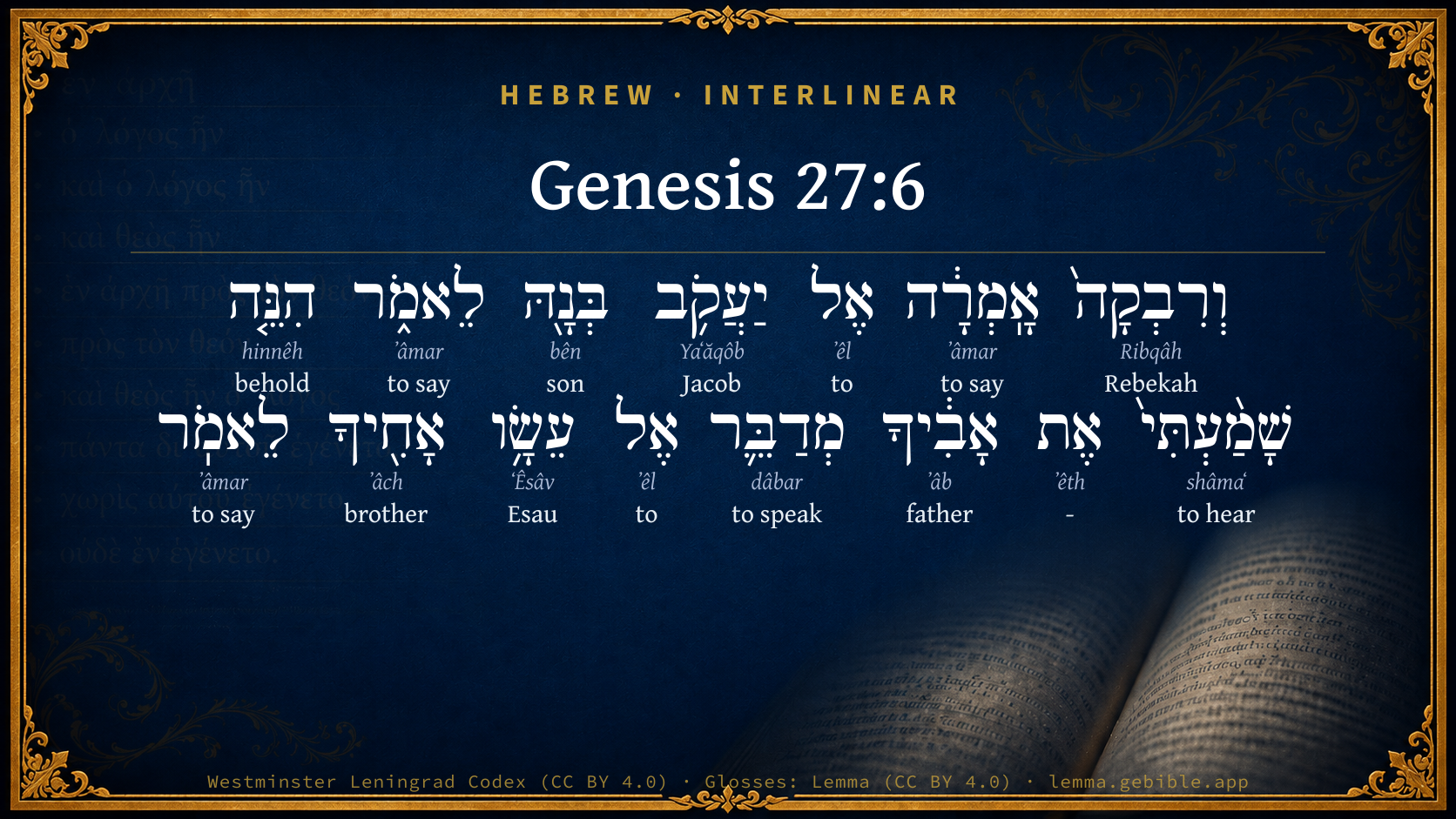
Hebrew (Westminster Leningrad Codex) Genesis 27:6 appears in the Hebrew Old Testament. The text above is from the Westminster Leningrad Codex. Each word links to its Strong’s number, a concise gloss, and parsing drawn from the Open Scriptures Hebrew Bible morphology. Click any word for its full Brown-Driver-Briggs (BDB) entry.
Download image
Cite this verse

Genesis 27:6 (World English Bible). Public Domain. Lemma interlinear Bible study tool, https://lemma.gebible.app/v/genesis/27/6.

Show BibTeX & RIS
BibTeX
RIS
English Translation
Rebekah spoke to Jacob her son, saying, "Behold, I heard your father speak to Esau your brother, saying,
World English Bible · Public Domain
Download a study sheet

One document with this verse’s original text, its word-by-word gloss line, the meaning frame, cross-references with their text, attributed commentary, and full source and license credits — printable, and it pastes into notes with its structure intact.

This verse Autodidact and up

Study sheet (.html) Plain text (.txt)

A passage Seminary Student

Up to 50 verses in one chapter. A passage sheet keeps up to 6 commentary sources and 12 cross-references per verse, in the order this page ranks them, and says so on the sheet whenever that leaves anything out. Ask for a single verse and you get the Autodidact verse sheet above.

Everything on this page stays free to read, with no account — the sheet is a download of what is already on screen, not access to it.

Want to remove ads? Support Godless Engineer
Compare translations 3

The same verse in 3 English versions, stacked beneath the original-language interlinear above. Click any original word for its lexicon entry.

Each is an independent rendering of the whole verse — the interlinear is not word-aligned to these translations.

Highlighted words mark where these versions differ — a whole-verse word diff, not a word-by-word alignment.

  • World English Bible Public Domain
    Rebekah spoke to Jacob her son, saying, "Behold, I heard your father speak to Esau your brother, saying,
  • King James Version Public Domain
    And Rebekah spake unto Jacob her son, saying, Behold, I heard thy father speak unto Esau thy brother, saying,
  • unfoldingWord Literal Text CC BY-SA 4.0
    Then Rebekah said to Jacob her son, saying, “Behold, I heard your father speaking to Esau your brother, saying,

unfoldingWord Literal Text — © unfoldingWord, licensed CC BY-SA 4.0. Word-aligned USFM3 via Door43 (git.door43.org/unfoldingWord/en_ult).

Versions to compare (up to 4)

3 of 4 selected

Show all 18 translations

Every available English version of this verse, each an independent rendering of the whole verse.

  • World English Bible Public Domain
    Rebekah spoke to Jacob her son, saying, "Behold, I heard your father speak to Esau your brother, saying,
  • Berean Standard Bible Public Domain
    Rebekah said to her son Jacob, “Behold, I overheard your father saying to your brother Esau,
  • Majority Standard Bible Public Domain
    Rebekah said to her son Jacob, “Behold, I overheard your father saying to your brother Esau,
  • King James Version Public Domain
    And Rebekah spake unto Jacob her son, saying, Behold, I heard thy father speak unto Esau thy brother, saying,
  • American Standard Version (1901) Public Domain
    And Rebekah spake unto Jacob her son, saying, Behold, I heard thy father speak unto Esau thy brother, saying,
  • Revised Version (1885) Public Domain
    And Rebekah spake unto Jacob her son, saying, Behold, I heard thy father speak unto Esau thy brother, saying,
  • Geneva Bible (1599) Public Domain
    Then Rebekah spake vnto Iaakob her sonne, saying, Beholde, I haue heard thy father talking with Esau thy brother, saying,
  • Douay-Rheims (1899) Public Domain
    She said to her son Jacob: I heard thy father talking with Esau thy brother, and saying to him:
  • Young's Literal Translation Public Domain
    and Rebekah hath spoken unto Jacob her son, saying, `Lo, I have heard thy father speaking unto Esau thy brother, saying,
  • Literal Standard Version CC BY-SA 4.0
    and Rebekah has spoken to her son Jacob, saying, “Behold, I have heard your father speaking to your brother Esau, saying,
  • Unlocked Literal Bible CC BY-SA 4.0
    Rebekah spoke to Jacob her son and said, “See here, I heard your father speak to Esau your brother. He said,
  • unfoldingWord Literal Text CC BY-SA 4.0
    Then Rebekah said to Jacob her son, saying, “Behold, I heard your father speaking to Esau your brother, saying,
  • Darby Bible Public Domain
    And Rebecca spoke to Jacob her son, saying, Behold, I heard thy father speak to Esau thy brother, saying,
  • World Messianic Bible Public Domain
    Rebekah spoke to Jacob her son, saying, “Behold, I heard your father speak to Esau your brother, saying,
  • Webster's Bible Public Domain
    And Rebekah spoke to Jacob her son, saying, Behold, I heard thy father speak to Esau thy brother, saying,
  • Free Bible Version CC BY-SA 4.0
    Rebekah told her son Jacob, “Listen! I heard your father tell your brother,
  • Bible in Basic English Public Domain
    And Rebekah said to Jacob, her son, Your father said to your brother Esau in my hearing,
  • JPS Tanakh (1917) Public Domain
    And Rebekah spoke unto Jacob her son, saying: 'Behold, I heard thy father speak unto Esau thy brother, saying:

Literal Standard Version (2020), Covenant Press — licensed CC BY-SA 4.0. Text via the HelloAO Bible API (eBible.org). Unlocked Literal Bible (unfoldingWord) — licensed CC BY-SA 4.0. Text via the HelloAO Bible API (eBible.org). unfoldingWord Literal Text — © unfoldingWord, licensed CC BY-SA 4.0. Word-aligned USFM3 via Door43 (git.door43.org/unfoldingWord/en_ult). Free Bible Version, Dr. Jonathan Gallagher — licensed CC BY-SA 4.0. Text via the HelloAO Bible API (eBible.org).

Word by word

More ways to search: Search by grammar → Find every occurrence → Compare this word →

Practice this passage: Drill this verse → Learn its vocabulary →

וְרִבְקָה֙
Ribqâh
H7259
“and · Rebekah”
Conjunction + Noun, Proper
Part of Speech
Conjunction + Noun
Type
Proper
Full BDB Definition

Origin: from an unused root probably meaning to clog by tying up the fetlock

TWOT: None

Rebekah = "ensnarer" - daughter of Bethuel, sister of Laban, wife of Isaac, and mother of Esau and Jacob
  1. אָֽמְרָ֔ה ʼâmar H559 “to say” Verb, Qal, Perfect, 3rd Person, Feminine, Singular
  2. אֶל ʼêl H413 “to” Preposition
  3. יַעֲקֹ֥ב Yaʻăqôb H3290 “Jacob” Noun, Proper
  4. בְּנָ֖הּ bên H1121 “son · her” Noun, Common, Masculine, Singular, Construct + Suffix, Personal, 3rd Person, Feminine, Singular
  5. לֵאמֹ֑ר ʼâmar H559 “to say” Preposition + Verb, Qal, Infinitive Construct
  6. הִנֵּ֤ה hinnêh H2009 “behold” Particle, Demonstrative
  7. שָׁמַ֨עְתִּי֙ shâmaʻ H8085 “to hear” Verb, Qal, Perfect, 1st Person, Common, Singular
  8. אֶת ʼêth H853 “-” Particle, Direct Object
  9. אָבִ֔יךָ ʼâb H1 “father · your” Noun, Common, Masculine, Singular, Construct + Suffix, Personal, 2nd Person, Masculine, Singular
  10. מְדַבֵּ֛ר dâbar H1696 “speaking” Verb, Piel, Participle Active, Masculine, Singular, Absolute
  11. אֶל ʼêl H413 “to” Preposition
  12. עֵשָׂ֥ו ʻÊsâv H6215 “Esau” Noun, Proper
  13. אָחִ֖יךָ ʼâch H251 “brother · your” Noun, Common, Masculine, Singular, Construct + Suffix, Personal, 2nd Person, Masculine, Singular
  14. לֵאמֹֽר ʼâmar H559 “to say” Preposition + Verb, Qal, Infinitive Construct

About this verse

These counts appear in no published source. They are computed here, from the morphology-tagged text and Lemma’s own curated glosses. What Lemma adds →

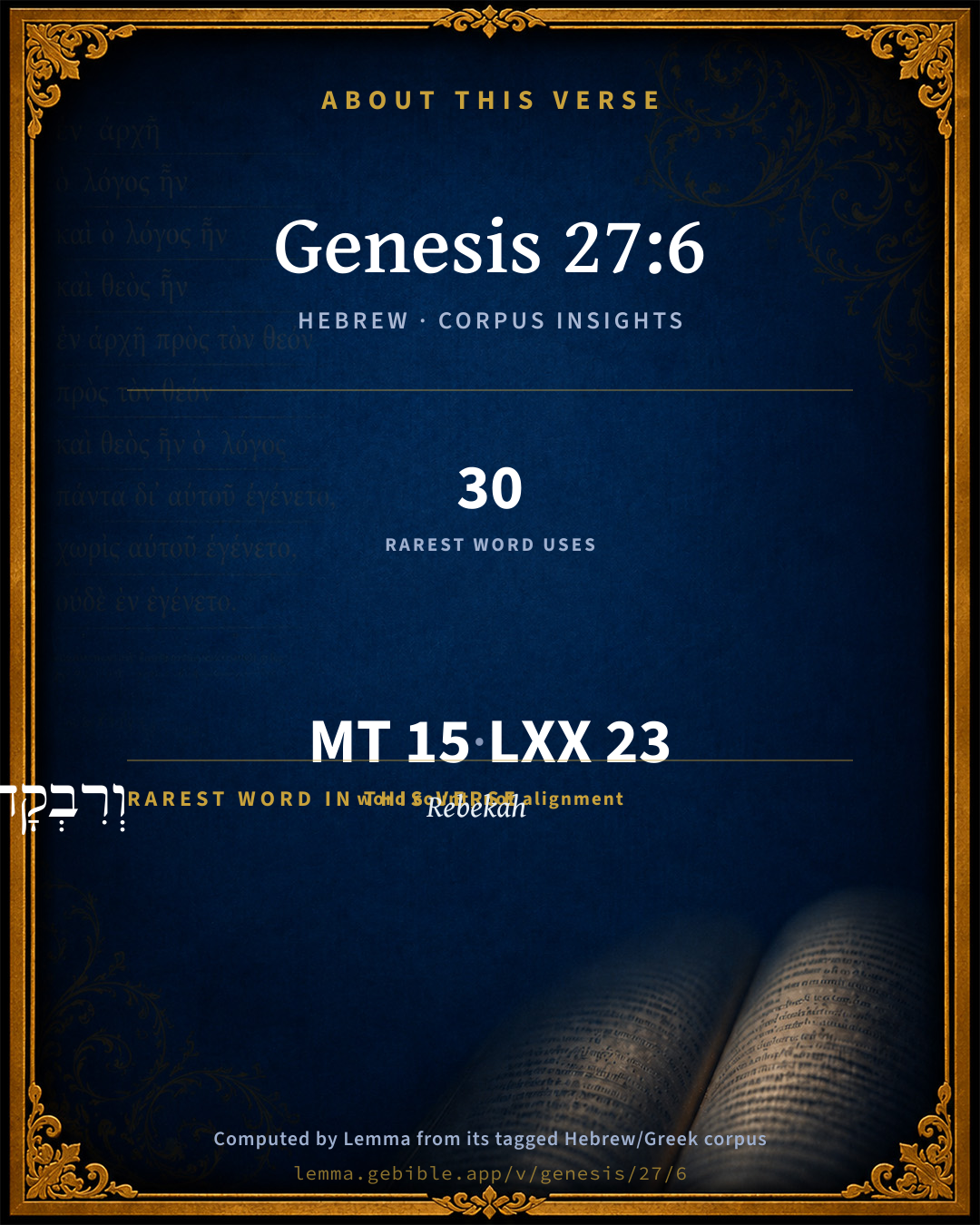
15
words
12
distinct lemmas
Pentateuch
section

Shared distinctive vocabulary

וְרִבְקָה֙ Rebekah H7259 occurs in 29 verses of the Hebrew Bible. Also found in:

Grammatical profile

  • 5 verbs
  • 6 nouns
  • 2 prepositions
  • 2 particles

Verb forms

  • אָֽמְרָ֔ה Qal · Perfect
  • לֵאמֹ֑ר Qal · Infinitive Construct
  • שָׁמַ֨עְתִּי֙ Qal · Perfect
  • מְדַבֵּ֛ר Piel · Participle Active
  • לֵאמֹֽר Qal · Infinitive Construct

Repetition

Words recur within this verse — often emphatic in Hebrew:

  • אָֽמְרָ֔ה to say H559 ×3
  • אֶל to H413 ×2

Hebrew & Septuagint length

In English translation the verse runs 18 words from the Hebrew and 19 from the Septuagint (LXX English) — closely comparable.

A rough comparison of the two English renderings, which tokenize alike — not a word-level alignment.

Word counts can differ between the Hebrew and the Greek without any difference in meaning — e.g. the Hebrew direct-object marker אֵת has no separate Greek word, and Greek often adds the article ὁ.

In the original languages it is 15 Hebrew tokens and 23 Greek tokens — but the two are counted differently (Hebrew bundles its prefixes and suffixes into one token; the Greek is in lemma form), so that isn’t a like-for-like length.

Cross-references

1

Topical passages linked to Genesis 27:6 in the Treasury of Scripture Knowledge — connected by theme and wording, ordered by reader-vote popularity; previews shown in the World English Bible.

  • Genesis 25:28 Now Isaac loved Esau, because he ate his venison. Rebekah loved Jacob.

Cross-references courtesy of OpenBible.info (CC BY 4.0).

Hebrew and Greek witnesses Masoretic Hebrew ↔ Greek Septuagint

The same verse in the two great witnesses to the Old Testament, shown verse-for-verse.

These are two independent witnesses, not word-aligned to each other, and the Septuagint is shown in lemma (dictionary) form.

Hebrew Genesis 27:6 Masoretic · Westminster Leningrad Codex

וְרִבְקָה֙ אָֽמְרָ֔ה אֶל יַעֲקֹ֥ב בְּנָ֖הּ לֵאמֹ֑ר הִנֵּ֤ה שָׁמַ֨עְתִּי֙ אֶת אָבִ֔יךָ מְדַבֵּ֛ר אֶל עֵשָׂ֥ו אָחִ֖יךָ לֵאמֹֽר

Rebekah spoke to Jacob her son, saying, "Behold, I heard your father speak to Esau your brother, saying,

World English Bible · Public Domain

Greek LXX Genesis 27:6 Septuagint · lemma form

ρεβεκκα δέ εἶπον πρός ἰακώβ ὁ υἱός αὐτός ὁ ἐλαχύς ὁράω ἐγώ ἀκούω ὁ πατήρ σύ λαλέω πρός ησαυ ὁ ἀδελφός σύ λέγω

And Rebecca said to Jacob her younger son, Behold, I heard your father speaking to Esau your brother, saying,

LXX2012 (modern English Septuagint) · Public Domain

Hebrew: Westminster Leningrad Codex (CC BY 4.0). Greek: Septuagint (public domain); English from LXX2012 (modern English Septuagint) (Public Domain). How the Septuagint differs from the Hebrew →

Targum (Aramaic paraphrase)

2

The Targum is the ancient Jewish Aramaic paraphrase of the Hebrew Scriptures — an interpretive translation, not the Hebrew text itself. Onkelos (literal) and Pseudo-Jonathan (expansive) render the Torah, and Jonathan the Prophets. Coverage is partial: where no permissively-licensed English translation exists for a verse, only the Aramaic is shown. This is verse-level text, not a word-by-word alignment to the Hebrew.

  1. Targum Onkelos Torah (Genesis–Deuteronomy)
    וְרִבְקָה אֲמָרַת לְוַת יַעֲקֹב בְּרַהּ לְמֵימָר הָא שְׁמָעִית יַת אֲבוּךְ מְמַלֵּל עִם עֵשָׂו אַחוּךְ לְמֵימָר

    (no public-domain English translation for this verse)

    Targum Onkelos — Aramaic: “Onkelos Genesis” (public domain); “Onkelos Exodus” (public domain); “Onkelos Leviticus” (public domain); “Onkelos Numbers” (public domain); “Onkelos Deuteronomy” (public domain). English: “Sefaria Community Translation” (CC0 1.0 (public-domain dedication)); “J.W. Etheridge. The Targums of Onkelos and Jonathan Ben Uzziel on the Pentateuch. London: Longmans, Green, 1862” (public domain). Text via Sefaria.

  2. Targum Pseudo-Jonathan Torah (Genesis–Deuteronomy)
    וְרִבְקָה אָמְרַת לְיַעֲקב בְּרָהּ לְמֵימָר הָא לֵילְיָא הָדֵין עִלָאֵי מְשַׁבְּחִין לְמָרֵי עַלְמָא וְאוֹצְרֵי טַלִין מִתְפַּתְּחִין בֵּיהּ וְשַׁמְעִית יַת אָבוּךְ מְמַלֵיל עִם עֵשָו אָחוּךְ לְמֵימָר

    And Rivekah spake to Jakob her son, saying, Behold, this night those on high praise the Lord of the world, and the treasures of the dew are opened in it; and I have heard thy father speaking with Esau thy brother, saying,

    Targum Pseudo-Jonathan — Aramaic: “Targum Jonathan on Genesis” (public domain); “Targum Jonathan on Exodus” (public domain); “Targum Jonathan on Leviticus” (public domain); “Targum Jonathan on Numbers” (public domain); “Targum Jonathan on Deuteronomy” (public domain). English: “The Targum of Jonathan ben Uzziel, trans. J. W. Etheridge, London, 1862” (public domain). Text via Sefaria.

Commentary

Notes on Genesis 27:6 from classic Christian and Jewish commentators (each source and its license shown beneath its notes). The classic Christian expositions comment on the surrounding passage and are grouped to its opening verse, so a note may address several verses; the Jewish commentaries on the Tanakh (Rashi and others) are per-verse, so they appear only where the commentator wrote on this verse.

Lemma curates 59 commentaries, every one of them public domain or Creative Commons licensed, each selected and text-cleaned for this edition rather than reprinted as found. About our sources →

Trapp's Complete Commentary

John Trapp

Gen 27:6 And Rebekah spake unto Jacob her son, saying, Behold, I heard thy father speak unto Esau thy brother, saying,

Ver. 6. I heard thy father.] She overheard what Isaac spake secretly. Women will be listening; as Sarah behind the door, when she laughed, and little thought to be questioned for it.

John Trapp, A Commentary or Exposition upon All the Books of the Old and New Testament (1647–1656) — public domain. Text from a community e-Sword module.

The Biblical Illustrator

Joseph S. Exell

Gen_27:6-10

Go now to the flock, and fetch me from thence two good kids of the goats; and I will make them savoury meat for thy father, such as he loveth

Rebekahs cunning plot in favour of Jacob

I.

THE HUMAN ELEMENT IN IT.

1. The partiality of a fond mother.

2. Ambition.

II. THE RELIGIOUS ELEMENT IN IT.

1. It seemed as if the oracle of God was likely to become void.

2. The crisis was urgent. (T. H. Leale.)

Crooked measures to obtain a worthy object

This is a mysterious affair. It was just that Esau should lose the blessing, for by selling his birthright he had despised it. It was Gods design, too, that Jacob should have it. Rebekah also knowing of this design, from it having been revealed to her that the elder should serve the younger, appears to have acted from a good motive. But the scheme which she formed to correct the error of her husband was far from being justifiable. It was one of those crooked measures which have too often been adopted to accomplish the Divine promises; as if the end would justify, or at least excuse the means. Thus Sarah acted in giving Hagar to Abraham; and thus many others have acted under the idea of being useful in promoting the cause of Christ. The answer to all such things is that which God addressed to Abraham: I am God Almighty; walk before Me, and be thou perfect. The deception practised on Isaac was cruel. If he be in the wrong, endeavour to convince him; or commit it to God, who could turn his mind, as he afterwards did that of Jacob when blessing Ephraim and Manasseh; but do not avail yourself of his loss of sight to deceive him. Such would have been the counsel of wisdom and rectitude; but Rebekah follows her own. (A. Fuller.)

Use of unscrupulous meals by religious persons

To this day the method of Rebekah and Jacob is largely adopted by religious persons. It is notorious that persons whose ends are good frequently become thoroughly unscrupulous about the means they use to accomplish them. They dare not say in so many words that they may do evil that good may come, nor do they think it a tenable position in morals that the end sanctifies the means; and yet their consciousness of a justifiable and desirable end undoubtedly does blunt their sensitiveness regarding the legitimacy of the means they employ. For example, Protestant controversialists, persuaded that vehement opposition to Popery is good, and filled with the idea of accomplishing its downfall, are often guilty of gross misrepresentation, because they do not sufficiently inform themselves of the actual tenets and practices of the Church of Rome. In all controversy, religious and political, it is the same. It is always dishonest to circulate reports that you have no means of authenticating; yet how freely are such reports circulated to blacken the character of an opponent, and to prove his opinions to be dangerous. It is always dishonest to condemn opinions we have not inquired into, merely because of some fancied consequence which these opinions carry in them; yet how freely are opinions condemned by men who have never been at the trouble carefully to inquire into their truth. They do not feel the dishonesty of their position, because they have a general consciousness that they are on the side of religion, and of what has generally passed for truth. All keeping back of facts which are supposed to have an unsettling effect is but a repetition of this sin. There is no sin more hateful. Under the appearance of serving God, and maintaining His cause in the world, it insults Him by assuming that, if the whole bare, undisguised truth were spoken, His cause would suffer. The fate of all such attempts to manage Gods matters by keeping things dark, and misrepresenting fact, is written for all who care to understand in the results of this scheme of Rebekahs and Jacobs. They gained nothing, and they lost a great deal, by their wicked interference. They gained nothing; for God had promised that the birthright would be Jacobs, and would have given it him in some way redounding to his credit and not to his shame. And they lost a great deal. The mother lost her son; Jacob had to flee for his life, and, for all we know, Rebekah never saw him more. And Jacob lost all the comforts of home, and all those possessions his father had accumulated. He had to flee with nothing but his staff, an outcast to begin the world for himself. From this first false step onwards to his death, he was pursued by misfortune, until his own verdict on his life was, Few and evil have been the days of the years of my life. (M. Dods, D. D.)

Ahead of Providence

Luther was very importunate at the throne of grace to know the mind of God in a certain matter; and it seemed to him as if he heard God speak to his heart thus: I am not to be traced. One adds, If He is not to be traced, He may be trusted; and that religion is of little value which will not enable a man to trust God where he can neither trace nor see Him. But there is a time for everything beneath the sun; and the Almighty has His times and seasons. It has been frequently with my hopes and desires, in regard to Providence, as with my watch and the sun. My watch has often been ahead of true time; I have gone faster than Providence, and have been forced to stand still and wait, or I have been set back painfully. Flavel says, Some providences, like Hebrew letters, must be read backwards. (J. G. Wilson.)

God will not have His kingdom maintained by carnal policy

We must walk in simplicity, sine plicis, for though the serpent can shrink up into his folds, and appear what he is not, yet it doth not become the saint to shuffle either with God or men. Jacob got the blessing by a wile, but he might have got it cheaper by plain dealing. (W. Gurnall.)

A lie not permitted to man

The minister of the seminary at Clermont, France, having been seized at Autun by the populace, the mayor, who wished to save him, advised him not to take the oath, but to allow him to tell the people that he had taken it. I would myself make known your falsehood to the people, replied the clergyman; it is not permitted me to ransom my life by a lie. The God who prohibits my taking the oath will not allow me to make it believed that I have taken it. The mayor was silent, and the minister was martyred.

The Biblical Illustrator, edited by Joseph S. Exell (c. 1880s–1900s) — public domain. Text from a community e-Sword module.

Joseph Benson's Commentary

Gen 27:6. Rebekah spake unto Jacob — Rebekah is here contriving to procure the blessing for Jacob, which was designed for Esau. If the end were good, the means were bad, and no way justifiable. If it were not a wrong to Esau to deprive him of the blessing, he himself having forfeited it by selling the birthright, yet it was a wrong to Isaac to take advantage of his infirmity to impose upon him: it was a wrong to Jacob, whom she taught to deceive by putting a lie in his mouth. If Rebekah, when she heard Isaac promise the blessing to Esau, had gone to him, and with humility and seriousness put him in remembrance of that which God had said concerning their sons; if she had further showed him how Esau had forfeited the blessing, both by selling his birthright, and by marrying of strange wives; it is probable Isaac would have been prevailed with to confer the blessing upon Jacob, and needed not thus to have been cheated into it. This had been honourable and laudable, and would have looked well in history; but God left her to herself to take this indirect course, that he might have the glory of bringing good out of evil.

Joseph Benson's Commentary on the Old and New Testaments (1811–1818) — public domain. Text from a community e-Sword module.

The Preacher's Complete Homiletical Commentary

Joseph S. Exell (gen. ed.)

MAIN HOMILETICS OF THE PARAGRAPH.—Gen_27:6-10

REBEKAH’S CUNNING PLOT IN FAVOUR OF JACOB

I. The human element in it.

1. The partiality of a fond mother. She tenderly loved this son, and was ready to sacrifice herself to promote his welfare and distinction.

2. Ambition. She wanted to see her favourite son raised to the highest honour. Yet her ambition was devoid of selfishness, for she asked nothing for herself, but only for Jacob. “But here is a trait of female character: it is a woman’s ambition, not a man’s, doing wrong, not for her own advantage, but for the sake of one she loved. It is a touch of womanhood.”—(Robertson.)

II. The religions element in it. We must remember that we are dealing here with the history of the Church of God. These persons are mentioned, and their acts related because they have to do with this history. We justly blame Rebekah, but we have to consider her conduct in the light of her circumstances and character. Her faith in God was placed in circumstances of great trial.

1. It seemed as if the oracle of God was likely to become void. The purpose of Isaac was known, and it was against God’s revealed purpose. The stubbornness of an old man forbade the thought that he would listen to argument, or set aside the claims of a long-cherished affection. The known will of God and the known will of her husband were at variance. It is a difficult matter to trust in God alone, and to forsake all leaning upon ourselves.

2. The crisis was urgent. Isaac had taken steps to carry out his intention. He supposes himself to be on his deathbed and, therefore, makes up his mind to impart the blessing, which when once bestowed was irrevocable. What in this emergency is the believing wife to do? It was of no use to try mild measures, for the mind of the old man was weak and his purpose too deeply seated. She ought to have left the matter with God, and to be content to be still, to trust, and to wait. But it is a hard trial to allow a great evil to happen when we have the means of preventing it. To work and scheme is more easy than to be silent. When we see the declared will of God likely to be thwarted, it seems as if any device of ours to prevent it becomes a justifiable, and even a pious necessity. The sin of Rebekah was of a complex nature. Hence how difficult it is to estimate human conduct if we only regard it from the outside. “We label sins as by a catalogue. We judge of man by their acts; but it is far truer to say that we can only judge the acts by the man. You must understand the man before you can appreciate his deed. The same deed, done by two different persons, ceases to be the same. Abraham laughed, and so did Sarah: one was the laugh of scepticism, the other the result of that reaction in our nature by which the most solemn thoughts are balanced by a sense of strangeness, or even ludicrousness. The Pharisees asked a sign in unbelief; many of the Old Testament saints, in faith. A fine discrimination is therefore needed to understand the simplest deed. A very delicate analysis of character is necessary to comprehend such acts as these and rightly apportion their turpitude and their palliations.”—(Robertson.)

SUGGESTIVE COMMENTS ON THE VERSES

Gen_27:6. She overheard what Isaac spoke secretly. Women will be listening; as Sarah behind the door, when she laughed, and little thought to be questioned for it.—(Trapp.)

Gen_27:7-10. The sin of deceiving a man into what is right differs little from deceiving him into what is wrong. The effect of the sin may, indeed, be different; but its moral character in the eyes of Omniscience is substantially the same. The slightest deviation from the straightforward principles of integrity and honesty is contrary to the very genius and actings of a true faith; and though the event was overruled to good, yet this was no justification of the parties concerned. Evil ceases not to be evil because God makes it redound to His glory.—(Bush.)

God inclines the love of the mother to the younger, against the custom of nature, because the father loves the elder, against the promise. The affections of parents are divided; that the promise might be fulfilled, Rebekah’s craft shall answer Isaac’s partiality. Isaac would unjustly turn Esau into Jacob, Rebekah doth as cunningly turn Jacob into Esau: her desire was good; her means were unlawful. God doth oft-times effect His just will by our weaknesses; yet neither thereby justifying our infirmities, nor blemishing His own actions.—(Bp. Hall.)

The Preacher's Complete Homiletical Commentary (gen. ed. Joseph S. Exell; Funk & Wagnalls, c. 1892) — public domain (pre-1929). A full-Bible homiletical/sermon-outline anthology covering 65 of 66 books (2 John is absent from the source module). Text from a community e-Sword module.

Matthew Henry's Commentary

Rebekah is here contriving to procure for Jacob the blessing which was designed for Esau; and here,

I. The end was good, for she was directed in this intention by the oracle of God, by which she had been governed in dispensing her affections. God had said it should be so, that the elder should serve the younger; and therefore Rebekah resolves it shall be so, and cannot bear to see her husband designing to thwart the oracle of God. But,

II. The means were bad, and no way justifiable. If it was not a wrong to Esau to deprive him of the blessing (he himself having forfeited it by selling the birthright), yet it was a wrong to Isaac, taking advantage of his infirmity, to impose upon him; it was a wrong to Jacob too, whom she taught to deceive, by putting a lie into his mouth, or at least by putting one into his right hand. It would likewise expose him to endless scruples about the blessing, if he should obtain it thus fraudulently, whether it would stand him or his in any stead, especially if his father should revoke it, upon the discovery of the cheat, and plead, as he might, that it was nulled by an error personae - a mistake of the person. He himself also was aware of the danger, lest (Gen 27:12), if he should miss of the blessing, as he might probably have done, he should bring upon himself his father's curse, which he dreaded above any thing; besides, he laid himself open to that divine curse which is pronounced upon him that causeth the blind to wander out of the way, Deu 27:18. If Rebekah, when she heard Isaac promise the blessing to Esau, had gone, at his return from hunting, to Isaac, and, with humility and seriousness, put him in remembrance of that which God had said concerning their sons, - if she further had shown him how Esau had forfeited the blessing both by selling his birthright and by marrying strange wives, it is probable that Isaac would have been prevailed upon knowingly and wittingly to confer the blessing upon Jacob, and needed not thus to have been cheated into it. This would have been honourable and laudable, and would have looked well in the history; but God left her to herself, to take this indirect course, that he might have the glory of bringing good out of evil, and of serving his own purposes by the sins and follies of men, and that we might have the satisfaction of knowing that, though there is so much wickedness and deceit in the world, God governs it according to his will, to his own praise. See Job 12:16, With him are strength and wisdom, the deceived and the deceiver are his. Isaac had lost the sense of seeing, which, in this case, could not have been imposed upon, Providence having so admirably well ordered the difference of features that no two faces are exactly alike: conversation and commerce could scarcely be maintained if there were not such a variety. Therefore she endeavours to deceive, 1. His sense of tasting, by dressing some choice pieces of kid, seasoning them, serving them up, so as to make him believe they were venison: this it was no hard matter to do. See the folly of those that are nice and curious in their appetite, and take a pride in humouring it. It is easy to impose upon them with that which they pretend to despise and dislike, so little perhaps does it differ from that to which they give a decided preference. Solomon tells us that dainties are deceitful meat; for it is possible for us to be deceived by them in more ways than one, Pro 23:32. 2. His sense of feeling and smelling. She put Esau's clothes upon Jacob, his best clothes, which, it might be supposed, Esau would put on, in token of joy and respect to his father, when he was to receive the blessing. Isaac knew these, by the stuff, shape, and smell, to be Esau's. If we would obtain a blessing from our heavenly Father, we must come for it in the garments of our elder brother, clothed with his righteousness, who is the first-born among many brethren. Lest the smoothness and softness of Jacob's hands and neck should betray him, she covered them, and probably part of his face, with the skins of the kids that were newly killed, Gen 27:16. Esau was rough indeed when nothing less than these would serve to make Jacob like him. Those that affect to seem rough and rugged in their carriage put the beast upon the man, and really shame themselves, by thus disguising themselves. And, lastly, it was a very rash word which Rebekah spoke, when Jacob objected the danger of a curse: Upon me be thy curse, my son, Gen 27:13. Christ indeed, who is mighty to save, because mighty to bear, has said, Upon me be the curse, only obey my voice; he has borne the burden of the curse, the curse of the law, for all those that will take upon them the yoke of the command, the command of the gospel. But it is too daring for any creature to say, Upon me be the curse, unless it be that curse causeless which we are sure shall not come, Pro 26:2.

Matthew Henry's Commentary on the Whole Bible (1708–1710) — public domain (CC PDM 1.0). Text via the HelloAO Bible API.

Jamieson, Fausset & Brown

Robert Jamieson, A. R. Fausset & David Brown

Rebekah spake unto Jacob--She prized the blessing as invaluable; she knew that God intended it for the younger son [Gen 25:23]; and in her anxiety to secure its being conferred on the right object--on one who cared for religion--she acted in the sincerity of faith; but in crooked policy--with unenlightened zeal; on the false principle that the end would sanctify the means.

Jamieson, Fausset & Brown — Commentary Critical and Explanatory on the Whole Bible (1871) — public domain (CC PDM 1.0). Text via the HelloAO Bible API.

John Gill's Exposition

And Rebekah spake unto Jacob her son,.... Who was in the tent with her, and for whom she had the strongest affection:

saying, behold, I heard thy father speak unto Esau thy brother; heard the conversation that passed between them, and particularly what Isaac had given in charge to Esau:

saying, as follows:

John Gill's Exposition of the Whole Bible (1746–1763) — public domain (CC PDM 1.0). Text via the HelloAO Bible API.

The Pulpit Commentary

Vers. 6, 7. And Rebekah (having already formed a plan for diverting the patriarchal blessing from Esau, whose habit of life and utterly unspiritual character may perhaps have recalled to her mind and confirmed the declaration of the oracle concerning Jacob"s precedence) spake unto Jacob her son, i.e. her favorite, in contrast to Esau, Isaac s son (ver. 5) saying, Behold, I heard thy father speak unto Esau thy brother, saying, Bring me venison ( vide on ver. 3), and make me savory meat, that I may eat (literally, and I shall eat), and bless thee the lengthened form of the future in this and the preceding verb (cf. hlkeaow in ver. 4) is expressive of Isaac"s self-excitement and emphatic determinationbefore the Lord. The word Jehovah, by modern criticism regarded as a sign of divided authorship, is satisfactorily explained by remembering that Rebekah is speaking not of the blessing of God"s general pro vide nce, but of the higher benediction of the covenant (Hengstenberg). The phrase, though not included in Isaac"s address to Esau, need not be regarded as due to Rebekah"s invention. She may have understood it to be implied in her husband"s language, though it was not expressed (cf. Gen_14:20) That it was designedly omitted by Isaac in consequence of the worldly character of Esau appears as little likely as that it was deliberately inserted by Rebekah to whet her favorite"s ambition (Kalisch). As to meaning, the sense may be that this patriarchal benediction was to be bestowed sincerely (Menochius), in presence and by the authority of God (Ainsworth, Bush, Clericus); but the use of the term Jehovah rather points to the idea that Rebekah regarded Isaac simply "as the instrument of the living and personal God, who directed the concerns of the chosen race (Hengstenberg). Before my death. Since Rebekah makes no remark as to the groundlessness of Isaac s fear, it is not improbable that she too shared in her bed-ridden husband"s expectations that already he was "in the presence of" his end.

The Pulpit Commentary (1880–1919), ed. H.D.M. Spence-Jones & Joseph S. Exell — public domain. Text from a community e-Sword module.

John Wesley's Explanatory Notes

Rebekah is here contriving to procure the blessing for Jacob, which was designed for Esau. If the end was good, the means were bad, and no way justifiable. If it were not a wrong to Esau to deprive him of the blessing, he himself having forfeited it by selling the birth right, yet it was a wrong to Isaac, taking advantage of his infirmity, to impose upon him: it was a wrong to Jacob, whom she taught to deceive, by putting a lie in his mouth. If Rebekah, when she heard Isaac promise the blessing to Esau, had gone to him, and with humility and seriousness put him in remembrance of that which God had said concerning their sons; if she had farther shewed him how Esau had forfeited the blessing, both by selling his birth-right, and by marrying of strange wives; 'tis probable Isaac would have been prevailed with to confer the blessing upon Jacob, and needed not thus to have been cheated into it. This had been honourable and laudable, and would have looked well in history; but God left her to herself to take this indirect course, that he might have the glory of bringing good out of evil.

John Wesley, Explanatory Notes Upon the Whole Bible (1754–1765) — public domain. Text via the GEBible commentary corpus.

Radak

Rabbi David Kimhi (Radak)

ורבקה..לאמר, she had a conversation with her son Yaakov, at the end of which she told him that his father had sent out Esau to bring him venison as a prelude to receiving the blessing.

Radak on the Tanakh — English translations: “Sefaria Community Translation” (CC0 1.0 (public-domain dedication)); “Eliyahu Munk, HaChut Hameshulash” (CC BY 4.0); “Rabbi Mike Feuer, Jerusalem Anthology” (CC BY 4.0); and “R. David Kimhi on the first book of Psalms, Translated by R.G. Finch, London, 1919” (public domain). Text via Sefaria.

Lesson kit

Teaching starters — assembled from the data on this page, not authored interpretation. Every prompt links to the verse data it draws on. Edit before teaching.

Genesis, in the Pentateuch, opens this verse with 15 words (12 distinct Hebrew lemmas). Its most distinctive word is Ribqâh (“Rebekah”). A historical commentator’s framing appears above. Read the whole chapter for the surrounding context.

Discussion questions

  1. How does “Rebekah” (Ribqâh) shape what this verse is saying?
  2. How does Genesis 22:23, which shares the word «Rebekah», read alongside this verse?
  3. What does the repetition of “to say” (3× in this one verse) do in this verse?
  4. These translations render this verse differently; the difference is in the English rendering, not the original. What questions does that raise?
  5. «אָֽמְרָ֔ה» is a Qal Perfect verb. How does that grammatical form shape the action described?
  6. Compare how Trapp's Complete Commentary and The Biblical Illustrator read this verse. Where do they agree or differ?

Things to notice

Reading settings

Reading text

Shown beneath each verse's original-language words.

Old Testament
Old Testament edition

Read the OT as the Masoretic Hebrew (MT) or the Greek Septuagint (LXX).

English shown for the Greek Septuagint (in the Hebrew ↔ Greek comparison).

Comparing translations? Open the Compare panel on any verse page to stack up to four side by side.