Genesis 34:19

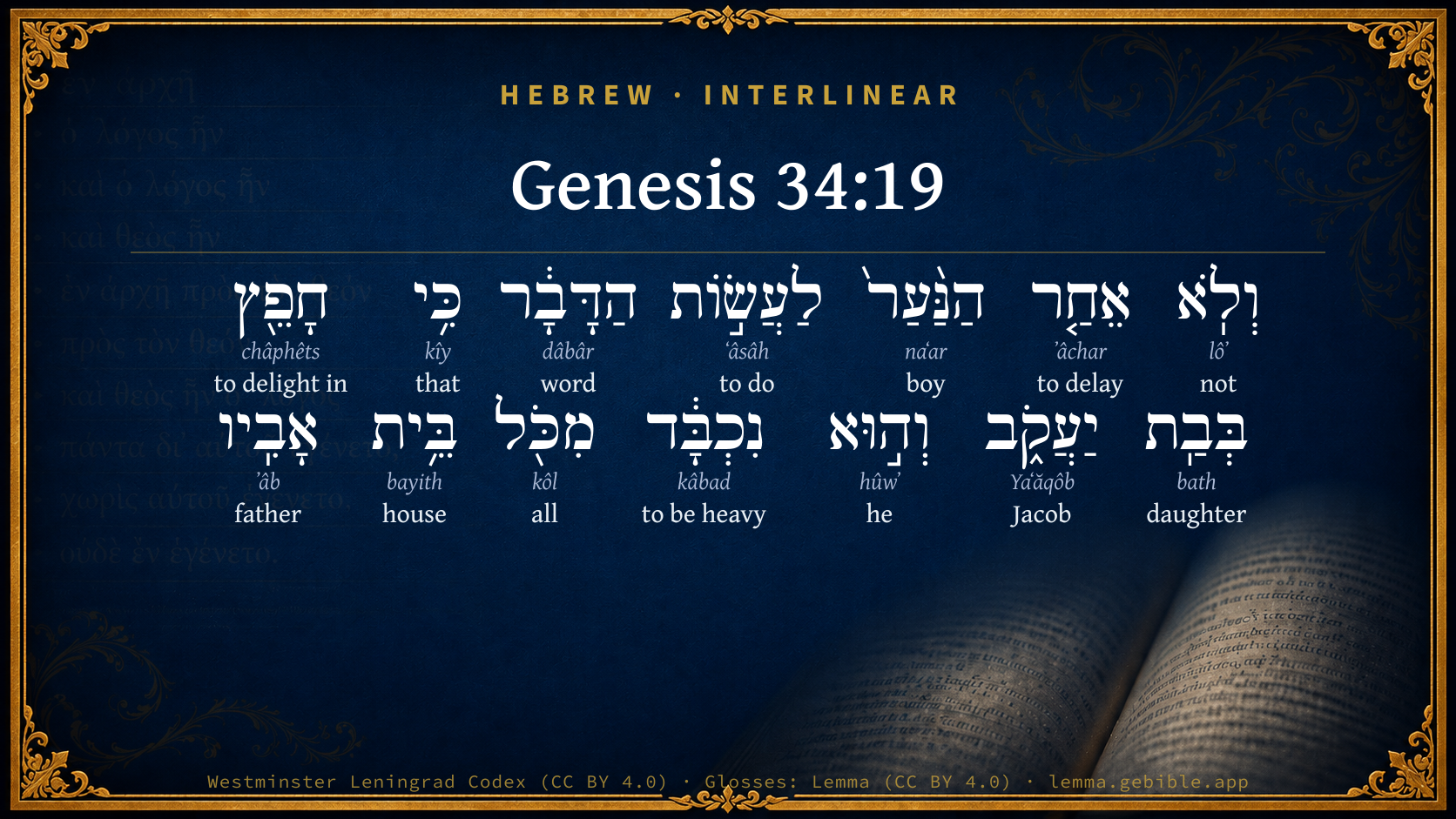
Hebrew (Westminster Leningrad Codex) Genesis 34:19 appears in the Hebrew Old Testament. The text above is from the Westminster Leningrad Codex. Each word links to its Strong’s number, a concise gloss, and parsing drawn from the Open Scriptures Hebrew Bible morphology. Click any word for its full Brown-Driver-Briggs (BDB) entry.
Download image
Cite this verse

Genesis 34:19 (World English Bible). Public Domain. Lemma interlinear Bible study tool, https://lemma.gebible.app/v/genesis/34/19.

Show BibTeX & RIS
BibTeX
RIS
English Translation
The young man didn't wait to do this thing, because he had delight in Jacob's daughter, and he was honored above all the house of his father.
World English Bible · Public Domain
Highlights
  • 1 first appearance in the Hebrew Bible
Full analysis ↓
Download a study sheet

One document with this verse’s original text, its word-by-word gloss line, the meaning frame, cross-references with their text, attributed commentary, and full source and license credits — printable, and it pastes into notes with its structure intact.

This verse Autodidact and up

Study sheet (.html) Plain text (.txt)

A passage Seminary Student

Up to 50 verses in one chapter. A passage sheet keeps up to 6 commentary sources and 12 cross-references per verse, in the order this page ranks them, and says so on the sheet whenever that leaves anything out. Ask for a single verse and you get the Autodidact verse sheet above.

Everything on this page stays free to read, with no account — the sheet is a download of what is already on screen, not access to it.

Want to remove ads? Support Godless Engineer
Compare translations 3

The same verse in 3 English versions, stacked beneath the original-language interlinear above. Click any original word for its lexicon entry.

Each is an independent rendering of the whole verse — the interlinear is not word-aligned to these translations.

Highlighted words mark where these versions differ — a whole-verse word diff, not a word-by-word alignment.

  • World English Bible Public Domain
    The young man didn't wait to do this thing, because he had delight in Jacob's daughter, and he was honored above all the house of his father.
  • King James Version Public Domain
    And the young man deferred not to do the thing, because he had delight in Jacob's daughter: and he was more honorable than all the house of his father.
  • unfoldingWord Literal Text CC BY-SA 4.0
    So the young man did not delay to do the thing, because he was delighted with the daughter of Jacob, and he was honored more than all of the house of his father.

unfoldingWord Literal Text — © unfoldingWord, licensed CC BY-SA 4.0. Word-aligned USFM3 via Door43 (git.door43.org/unfoldingWord/en_ult).

Versions to compare (up to 4)

3 of 4 selected

Show all 18 translations

Every available English version of this verse, each an independent rendering of the whole verse.

  • World English Bible Public Domain
    The young man didn't wait to do this thing, because he had delight in Jacob's daughter, and he was honored above all the house of his father.
  • Berean Standard Bible Public Domain
    The young man, who was the most respected of all his father’s household, did not hesitate to fulfill this request, because he was delighted with Jacob’s daughter.
  • Majority Standard Bible Public Domain
    The young man, who was the most respected of all his father’s household, did not hesitate to fulfill this request, because he was delighted with Jacob’s daughter.
  • King James Version Public Domain
    And the young man deferred not to do the thing, because he had delight in Jacob's daughter: and he was more honorable than all the house of his father.
  • American Standard Version (1901) Public Domain
    And the young man deferred not to do the thing, because he had delight in Jacob's daughter: and he was honored above all the house of his father.
  • Revised Version (1885) Public Domain
    And the young man deferred not to do the thing, because he had delight in Jacob’s daughter: and he was honoured above all the house of his father.
  • Geneva Bible (1599) Public Domain
    And the yong man deferd not to doe the thing because he loued Iaakobs daughter: he was also the most set by of all his fathers house.
  • Douay-Rheims (1899) Public Domain
    And the young man made no delay, but forthwith fulfilled what was required, for he loved the damsel exceedingly, and he was the greatest man in all his father's house.
  • Young's Literal Translation Public Domain
    and the young man delayed not to do the thing, for he had delight in Jacob's daughter, and he is honourable above all the house of his father.
  • Literal Standard Version CC BY-SA 4.0
    and the young man did not delay to do the thing, for he had delight in Jacob’s daughter, and he is honorable above all the house of his father.
  • Unlocked Literal Bible CC BY-SA 4.0
    The young man did not delay to do what they said, because he delighted in Jacob's daughter, and because he was the most honored person in all his father's household.
  • unfoldingWord Literal Text CC BY-SA 4.0
    So the young man did not delay to do the thing, because he was delighted with the daughter of Jacob, and he was honored more than all of the house of his father.
  • Darby Bible Public Domain
    And the youth did not delay to do this, because he had delight in Jacob's daughter. And he was honourable above all in the house of his father.
  • World Messianic Bible Public Domain
    The young man didn’t wait to do this thing, because he had delight in Jacob’s daughter, and he was honored above all the house of his father.
  • Webster's Bible Public Domain
    And the young man deferred not to do the thing, because he had delight in Jacob's daughter: and he was more honorable than all the house of his father.
  • Free Bible Version CC BY-SA 4.0
    The young man Shechem didn't waste any time in arranging this because he was infatuated with Jacob's daughter, and he was viewed as the most important person in his father's family.
  • Bible in Basic English Public Domain
    And without loss of time the young man did as they said, because he had delight in Jacob's daughter, and he was the noblest of his father's house.
  • JPS Tanakh (1917) Public Domain
    And the young man deferred not to do the thing, because he had delight in Jacob's daughter. And he was honoured above all the house of his father.

Literal Standard Version (2020), Covenant Press — licensed CC BY-SA 4.0. Text via the HelloAO Bible API (eBible.org). Unlocked Literal Bible (unfoldingWord) — licensed CC BY-SA 4.0. Text via the HelloAO Bible API (eBible.org). unfoldingWord Literal Text — © unfoldingWord, licensed CC BY-SA 4.0. Word-aligned USFM3 via Door43 (git.door43.org/unfoldingWord/en_ult). Free Bible Version, Dr. Jonathan Gallagher — licensed CC BY-SA 4.0. Text via the HelloAO Bible API (eBible.org).

Word by word

More ways to search: Search by grammar → Find every occurrence → Compare this word →

Practice this passage: Drill this verse → Learn its vocabulary →

אֵחַ֤ר
ʼâchar
H309
“to delay”
Verb, Piel, Perfect, 3rd Person, Masculine, Singular
Part of Speech
Verb
Stem
Piel
Form
Perfect
Person
3rd Person
Gender
Masculine
Number
Singular
Full BDB Definition

Origin: a primitive root

TWOT: 68

to delay, hesitate, tarry, defer, remain behind - (Qal) - to delay, tarry (intensive) - to cause one to delay, hinder, keep back - (Piel) to delay, wait, stay behind (but not in hope)
  1. וְלֹֽא lôʼ H3808 “and · not” Conjunction + Particle, Negative
  2. הַנַּ֨עַר֙ naʻar H5288 “the · boy” Particle, Definite Article + Noun, Common, Masculine, Singular, Absolute
  3. לַעֲשׂ֣וֹת ʻâsâh H6213 “to do” Preposition + Verb, Qal, Infinitive Construct
  4. הַדָּבָ֔ר dâbâr H1697 “the · word” Particle, Definite Article + Noun, Common, Masculine, Singular, Absolute
  5. כִּ֥י kîy H3588 “that” Conjunction
  6. חָפֵ֖ץ châphêts H2654 “to delight in” Verb, Qal, Perfect, 3rd Person, Masculine, Singular
  7. בְּבַֽת bath H1323 “in/at · daughter of” Preposition + Noun, Common, Feminine, Singular, Construct
  8. יַעֲקֹ֑ב Yaʻăqôb H3290 “Jacob” Noun, Proper
  9. וְה֣וּא hûwʼ H1931 “and · he” Conjunction + Pronoun, Personal, 3rd Person, Masculine, Singular
  10. נִכְבָּ֔ד kâbad H3513 “being heavy” Verb, Niphal, Participle Active, Masculine, Singular, Absolute
  11. מִכֹּ֖ל kôl H3605 “from · all of” Preposition + Noun, Common, Masculine, Singular, Construct
  12. בֵּ֥ית bayith H1004 “house of” Noun, Common, Masculine, Singular, Construct
  13. אָבִֽיו ʼâb H1 “father · his” Noun, Common, Masculine, Singular, Construct + Suffix, Personal, 3rd Person, Masculine, Singular

About this verse

These counts appear in no published source. They are computed here, from the morphology-tagged text and Lemma’s own curated glosses. What Lemma adds →

14
words
14
distinct lemmas
Pentateuch
section

Notable vocabulary

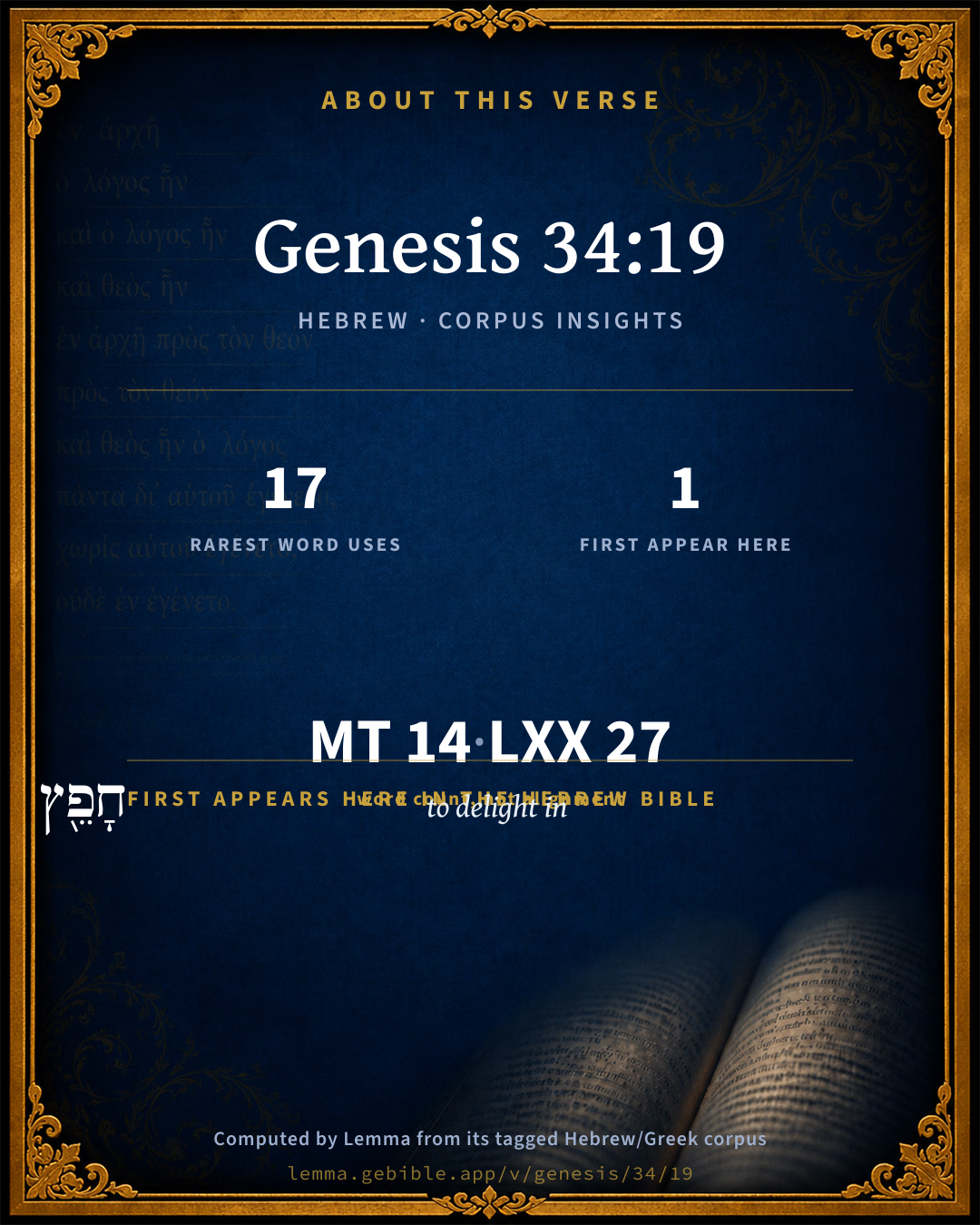
The rarest word here is אֵחַ֤ר to delay H309 — appearing just 17 times in the whole Hebrew Bible.

First appearance in Scripture

This word makes its first canonical appearance in the Hebrew Bible here:

  • חָפֵ֖ץ to delight in H2654

Shared distinctive vocabulary

אֵחַ֤ר to delay H309 occurs in 17 verses of the Hebrew Bible. Also found in:

Grammatical profile

  • 4 verbs
  • 7 nouns
  • 1 pronoun
  • 1 conjunction
  • 1 particle

Verb forms

  • אֵחַ֤ר Piel · Perfect
  • לַעֲשׂ֣וֹת Qal · Infinitive Construct
  • חָפֵ֖ץ Qal · Perfect
  • נִכְבָּ֔ד Niphal · Participle Active

Hebrew & Septuagint length

In English translation the verse runs 27 words from the Hebrew and 30 from the Septuagint (LXX English) — closely comparable.

A rough comparison of the two English renderings, which tokenize alike — not a word-level alignment.

Word counts can differ between the Hebrew and the Greek without any difference in meaning — e.g. the Hebrew direct-object marker אֵת has no separate Greek word, and Greek often adds the article ὁ.

In the original languages it is 14 Hebrew tokens and 27 Greek tokens — but the two are counted differently (Hebrew bundles its prefixes and suffixes into one token; the Greek is in lemma form), so that isn’t a like-for-like length.

Cross-references

13

Topical passages linked to Genesis 34:19 in the Treasury of Scripture Knowledge — connected by theme and wording, ordered by reader-vote popularity; previews shown in the World English Bible.

  • Genesis 29:20 Jacob served seven years for Rachel. They seemed to him but a few days, for the love he had for her.
  • Genesis 41:20 The lean and ill-favored cattle ate up the first seven fat cattle,
  • Numbers 22:15 Balak sent yet again princes, more, and more honorable than they.
  • 1 Samuel 22:14 Then Ahimelech answered the king, and said, Who among all your servants is so faithful as David, who is the king's son-in-law, and is taken into your council, and is honorable in your house?
  • 2 Kings 5:1 Now Naaman, captain of the host of the king of Syria, was a great man with his master, and honorable, because by him Yahweh had given victory to Syria: he was also a mighty man of valor, [but he was] a leper.
  • 1 Chronicles 4:9 Jabez was more honorable than his brothers: and his mother named him Jabez, saying, Because I bore him with sorrow.
  • Song of Solomon 8:6 Set me as a seal on your heart, As a seal on your arm; For love is strong as death. Jealousy is as cruel as Sheol; Its flashes are flashes of fire, A very flame of Yahweh.
  • Isaiah 3:3–5 The captain of fifty, The honorable man, The counselor, The skilled craftsman, And the clever enchanter.
  • Isaiah 5:13 Therefore my people go into captivity for lack of knowledge; Their honorable men are famished, And their multitudes are parched with thirst.
  • Isaiah 23:8–9 Who has purposed this against Tyre, the giver of crowns, whose merchants are princes, whose traffickers are the honorable of the earth?
  • Isaiah 62:4 You shall no more be termed Forsaken; neither shall your land any more be termed Desolate: but you shall be called Hephzibah, and your land Beulah; for Yahweh delights in you, and your land shall be married.
  • Acts 13:50 But the Jews stirred up the devout and prominent women and the chief men of the city, and stirred up a persecution against Paul and Barnabas, and threw them out of their borders.
  • Acts 17:12 Many of them therefore believed; also of the prominent Greek women, and not a few men.

Cross-references courtesy of OpenBible.info (CC BY 4.0).

Hebrew and Greek witnesses Masoretic Hebrew ↔ Greek Septuagint

The same verse in the two great witnesses to the Old Testament, shown verse-for-verse.

These are two independent witnesses, not word-aligned to each other, and the Septuagint is shown in lemma (dictionary) form.

Hebrew Genesis 34:19 Masoretic · Westminster Leningrad Codex

וְלֹֽא אֵחַ֤ר הַנַּ֨עַר֙ לַעֲשׂ֣וֹת הַדָּבָ֔ר כִּ֥י חָפֵ֖ץ בְּבַֽת יַעֲקֹ֑ב וְה֣וּא נִכְבָּ֔ד מִכֹּ֖ל בֵּ֥ית אָבִֽיו

The young man didn't wait to do this thing, because he had delight in Jacob's daughter, and he was honored above all the house of his father.

World English Bible · Public Domain

Greek LXX Genesis 34:19 Septuagint · lemma form

καί οὐ χρονίζω ὁ νεανίσκος ὁ ποιέω ὁ ῥῆμα οὗτος ἐνκεῖμαι γάρ ὁ θυγάτηρ ἰακώβ αὐτός δέ εἰμί ἔνδοξος πᾶς ὁ ἐν ὁ οἶκος ὁ πατήρ αὐτός

And the young man delayed not to do this thing, for he was much attached to Jacob's daughter, and he was the most honorable of all in his father's house.

LXX2012 (modern English Septuagint) · Public Domain

Hebrew: Westminster Leningrad Codex (CC BY 4.0). Greek: Septuagint (public domain); English from LXX2012 (modern English Septuagint) (Public Domain). How the Septuagint differs from the Hebrew →

Targum (Aramaic paraphrase)

2

The Targum is the ancient Jewish Aramaic paraphrase of the Hebrew Scriptures — an interpretive translation, not the Hebrew text itself. Onkelos (literal) and Pseudo-Jonathan (expansive) render the Torah, and Jonathan the Prophets. Coverage is partial: where no permissively-licensed English translation exists for a verse, only the Aramaic is shown. This is verse-level text, not a word-by-word alignment to the Hebrew.

  1. Targum Onkelos Torah (Genesis–Deuteronomy)
    וְלָא אוֹחַר עוּלֵימָא לְמֶעְבַּד פִּתְגָּמָא אֲרֵי אִתְרְעִי בְּבַת יַעֲקֹב וְהוּא יַקִּיר מִכֹּל בֵּית אֲבוּהִי

    (no public-domain English translation for this verse)

    Targum Onkelos — Aramaic: “Onkelos Genesis” (public domain); “Onkelos Exodus” (public domain); “Onkelos Leviticus” (public domain); “Onkelos Numbers” (public domain); “Onkelos Deuteronomy” (public domain). English: “Sefaria Community Translation” (CC0 1.0 (public-domain dedication)); “J.W. Etheridge. The Targums of Onkelos and Jonathan Ben Uzziel on the Pentateuch. London: Longmans, Green, 1862” (public domain). Text via Sefaria.

  2. Targum Pseudo-Jonathan Torah (Genesis–Deuteronomy)
    וְלָא אִתְעַכֵּב רַבְיָא לְמֶעֱבַד פִּתְגָמָא אֲרוּם צָבִי בִּבְרַת יַעֲקב וְהוּא יַקִיר מִכּל בֵּיתָא דְאָבוֹי

    And the young man delayed not to do the thing; because he wished for the daughter of Jakob; and he was more honourable than all his father's house.

    Targum Pseudo-Jonathan — Aramaic: “Targum Jonathan on Genesis” (public domain); “Targum Jonathan on Exodus” (public domain); “Targum Jonathan on Leviticus” (public domain); “Targum Jonathan on Numbers” (public domain); “Targum Jonathan on Deuteronomy” (public domain). English: “The Targum of Jonathan ben Uzziel, trans. J. W. Etheridge, London, 1862” (public domain). Text via Sefaria.

Commentary

Notes on Genesis 34:19 from classic Christian and Jewish commentators (each source and its license shown beneath its notes). The classic Christian expositions comment on the surrounding passage and are grouped to its opening verse, so a note may address several verses; the Jewish commentaries on the Tanakh (Rashi and others) are per-verse, so they appear only where the commentator wrote on this verse.

Lemma curates 59 commentaries, every one of them public domain or Creative Commons licensed, each selected and text-cleaned for this edition rather than reprinted as found. About our sources →

Trapp's Complete Commentary

John Trapp

Gen 34:19 And the young man deferred not to do the thing, because he had delight in Jacob’s daughter: and he [was] more honourable than all the house of his father.

Ver. 19. And the young man deferred not, &c.] Heb., Neque distulit puer; The lad deferred not. He is called a lad or a child, that is, a fool; because he was carried, not by right reason, but blind affection, "walking in the ways of his heart and sight of his eyes". {Ecc 11:9} And the word {a} used to signify "youth," {Ecc 11:10} signifieth darkness; to note, that youth is the dark age, hot, and headlong, indeliberate and slippery, such as had need to "cleanse their ways, by cleaving to the Word," saith David; {Psa 119:9} where the word for "cleansing," properly signifies the cleansing of glass, which, as it is slick and slippery, so, though it be very clean, yet it will gather filth, even in the sunbeams, and of itself: which noteth the great corruption of this age.

{a} Hτθεος, of αιθω. Aτζηος, of ζεω.

John Trapp, A Commentary or Exposition upon All the Books of the Old and New Testament (1647–1656) — public domain. Text from a community e-Sword module.

Geneva Bible (1599)

Geneva Bible translators

Or, most honorable.

Geneva Bible (1599) marginal notes — public domain. Text via Bolls.life.

The Cambridge Bible for Schools and Colleges

gen. ed. J. J. S. Perowne

19. to do the thing] This verse describes Shechem’s eagerness to fulfil some condition required by Jacob. We cannot say for certain, whether this personal requirement was the same as that contained above, i.e. the obligation of circumcision (Gen_34:15-17).

honoured above all] These words must have had some reference to the terms, presumably of a humiliating nature, to which he had consented. He was the most distinguished personage in the city. If he was willing, no one else in the community need object.

The Cambridge Bible for Schools and Colleges (gen. ed. J. J. S. Perowne; Cambridge University Press, 1878–1918) — public domain. Text from a community e-Sword module.

John Gill's Exposition

And Hamor and Shechem his son went unto the gate of their city,.... Where courts of judicature were held, and all public affairs respecting the common interest of the city were transacted: here, no doubt, Hamor their prince summoned them to come, by the usual method in which the citizens were convened on certain occasions:

and communed with the men of their city; upon the subject of entering into an alliance with Jacob's family, of admitting them to be fellow citizens with them, and of their being incorporated among them, and becoming one people with them, taking no notice of the true reason of this motion:

saying, as follows.

John Gill's Exposition of the Whole Bible (1746–1763) — public domain (CC PDM 1.0). Text via the HelloAO Bible API.

Haydock's Catholic Bible Commentary

The greatest man, (inclytus) perhaps associated to his father in the government of the town. Yet he is willing to submit to this painful operation. (Haydock)

George Leo Haydock (1774–1849), Haydock's Catholic Family Bible and Commentary, 1859 edition — public domain. Excludes Psalms (Douay-Rheims chapter numbering differs from Protestant) and Deuterocanonical books (Catholic canon only).

Whedon's Commentary on the Bible

Daniel D. Whedon

19. He was more honourable — That is, Shechem was the most honourable and distinguished person of the royal house of Hamor the Hivite.

Daniel D. Whedon (gen. ed.), Commentary on the Old and New Testaments (1874–1909) — public domain. Text from a community e-Sword module.

Radak

Rabbi David Kimhi (Radak)

ולא...לעשות הדבר, to gather together the men of his town and to speak with them.

והוא נכבד, seeing that he was highly esteemed. he was able to persuade the citizens of his town to circumcise themselves for his and their sake.

Radak on the Tanakh — English translations: “Sefaria Community Translation” (CC0 1.0 (public-domain dedication)); “Eliyahu Munk, HaChut Hameshulash” (CC BY 4.0); “Rabbi Mike Feuer, Jerusalem Anthology” (CC BY 4.0); and “R. David Kimhi on the first book of Psalms, Translated by R.G. Finch, London, 1919” (public domain). Text via Sefaria.

Lesson kit

Teaching starters — assembled from the data on this page, not authored interpretation. Every prompt links to the verse data it draws on. Edit before teaching.

Genesis, in the Pentateuch, opens this verse with 14 words (14 distinct Hebrew lemmas). Its most distinctive word is ʼâchar (“to delay”). A historical commentator’s framing appears above. Read the whole chapter for the surrounding context.

Discussion questions

  1. What does “to delay” (ʼâchar) contribute to the verse as a whole?
  2. This is the first place “to delight in” appears in Scripture (first appears here). What does its debut here establish?
  3. How does Genesis 24:56, which shares the word «to delay», read alongside this verse?
  4. The translations on this page render this verse differently — a whole-verse word diff, not a word-by-word alignment. What might account for the different wordings?
  5. «אֵחַ֤ר» is a Piel Perfect verb. How does that grammatical form shape the action described?
  6. Compare how Trapp's Complete Commentary and Geneva Bible (1599) read this verse. Where do they agree or differ?

Things to notice

Reading settings

Reading text

Shown beneath each verse's original-language words.

Old Testament
Old Testament edition

Read the OT as the Masoretic Hebrew (MT) or the Greek Septuagint (LXX).

English shown for the Greek Septuagint (in the Hebrew ↔ Greek comparison).

Comparing translations? Open the Compare panel on any verse page to stack up to four side by side.