
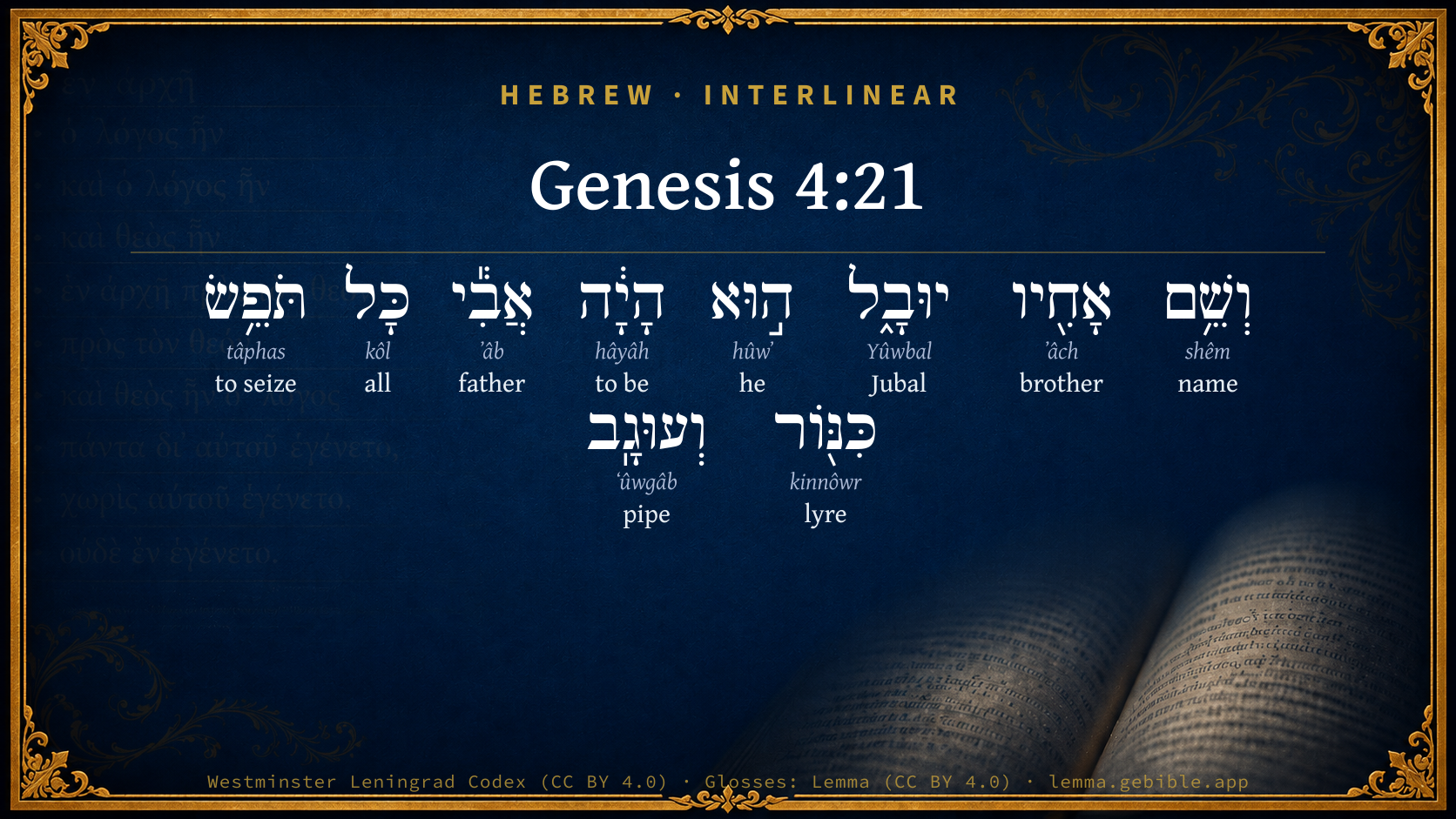
Genesis 4:21

Hebrew (Westminster Leningrad Codex) Genesis 4:21 appears in the Hebrew Old Testament. The text above is from the Westminster Leningrad Codex. Each word links to its Strong’s number, a concise gloss, and parsing drawn from the Open Scriptures Hebrew Bible morphology. Click any word for its full Brown-Driver-Briggs (BDB) entry.
Download image
Cite this verse

Genesis 4:21 (World English Bible). Public Domain. Lemma interlinear Bible study tool, https://lemma.gebible.app/v/genesis/4/21.

Show BibTeX & RIS
BibTeX
RIS
English Translation
His brother's name was Jubal, who was the father of all who handle the harp and pipe.
World English Bible · Public Domain
Highlights
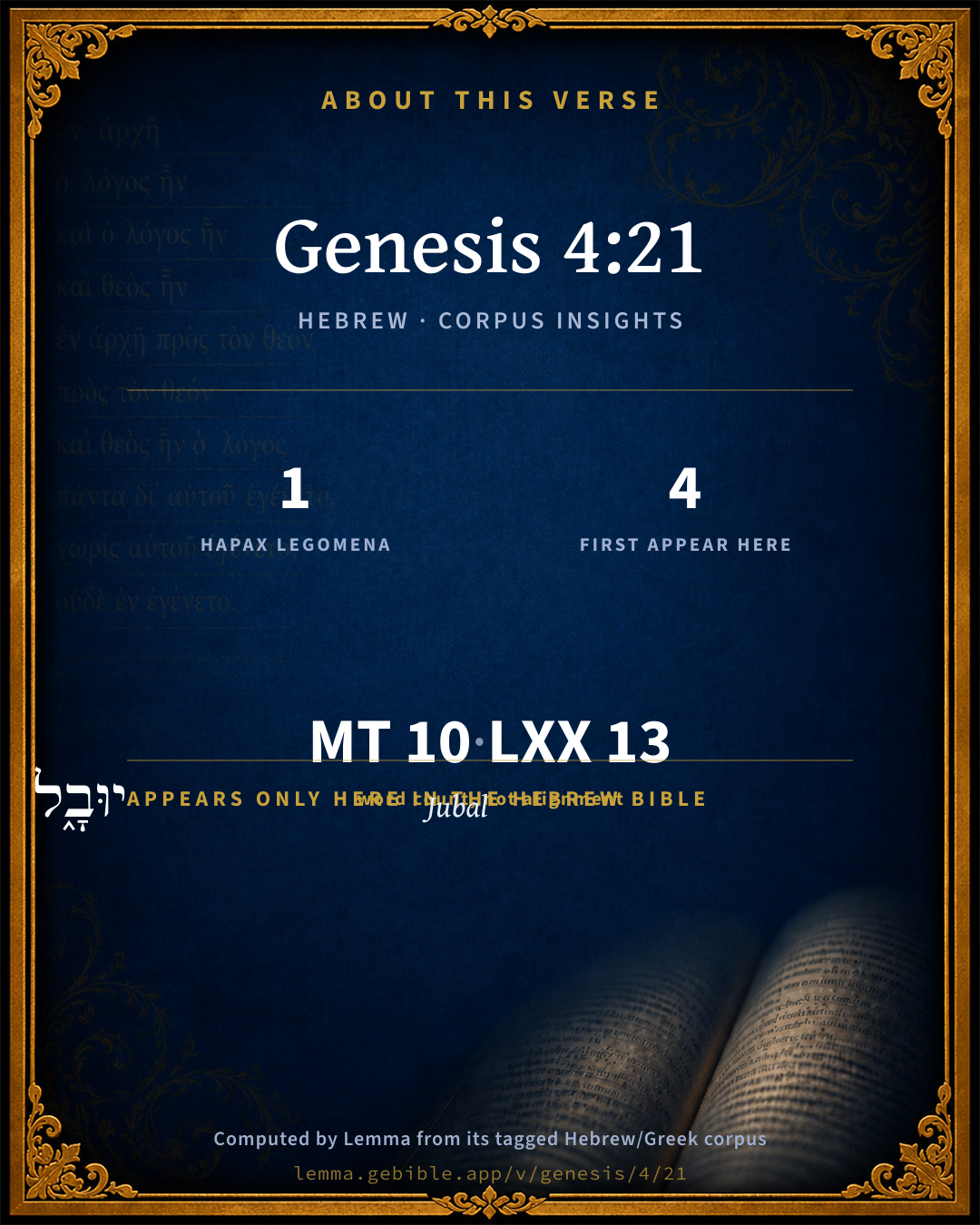
  • 1 hapax legomenon — only here in the Hebrew Bible
  • 4 first appearances in the Hebrew Bible
Full analysis ↓
Download a study sheet

One document with this verse’s original text, its word-by-word gloss line, the meaning frame, cross-references with their text, attributed commentary, and full source and license credits — printable, and it pastes into notes with its structure intact.

This verse Autodidact and up

Study sheet (.html) Plain text (.txt)

A passage Seminary Student

Up to 50 verses in one chapter. A passage sheet keeps up to 6 commentary sources and 12 cross-references per verse, in the order this page ranks them, and says so on the sheet whenever that leaves anything out. Ask for a single verse and you get the Autodidact verse sheet above.

Everything on this page stays free to read, with no account — the sheet is a download of what is already on screen, not access to it.

Want to remove ads? Support Godless Engineer
Compare translations 3

The same verse in 3 English versions, stacked beneath the original-language interlinear above. Click any original word for its lexicon entry.

Each is an independent rendering of the whole verse — the interlinear is not word-aligned to these translations.

Highlighted words mark where these versions differ — a whole-verse word diff, not a word-by-word alignment.

  • World English Bible Public Domain
    His brother's name was Jubal, who was the father of all who handle the harp and pipe.
  • King James Version Public Domain
    And his brother's name was Jubal: he was the father of all such as handle the harp and organ.
  • unfoldingWord Literal Text CC BY-SA 4.0
    And the name of his brother Jubal. He was the father of all who play harps and flutes.

unfoldingWord Literal Text — © unfoldingWord, licensed CC BY-SA 4.0. Word-aligned USFM3 via Door43 (git.door43.org/unfoldingWord/en_ult).

Versions to compare (up to 4)

3 of 4 selected

Show all 18 translations

Every available English version of this verse, each an independent rendering of the whole verse.

  • World English Bible Public Domain
    His brother's name was Jubal, who was the father of all who handle the harp and pipe.
  • Berean Standard Bible Public Domain
    And his brother’s name was Jubal; he was the father of all who play the harp and flute.
  • Majority Standard Bible Public Domain
    And his brother’s name was Jubal; he was the father of all who play the harp and flute.
  • King James Version Public Domain
    And his brother's name was Jubal: he was the father of all such as handle the harp and organ.
  • American Standard Version (1901) Public Domain
    And his brother's name was Jubal: he was the father of all such as handle the harp and pipe.
  • Revised Version (1885) Public Domain
    And his brother’s name was Jubal: he was the father of all such as handle the harp and pipe.
  • Geneva Bible (1599) Public Domain
    And his brothers name was Iubal, who was the father of all that play on the harpe and organes.
  • Douay-Rheims (1899) Public Domain
    And his brother's name was Jubal; he was the father of them that play upon the harp and the organs.
  • Young's Literal Translation Public Domain
    and the name of his brother `is' Jubal, he hath been father of every one handling harp and organ.
  • Literal Standard Version CC BY-SA 4.0
    and the name of his brother [is] Jubal, he has been father of everyone handling harp and pipe.
  • Unlocked Literal Bible CC BY-SA 4.0
    His brother's name was Jubal. He was the father of those who play the harp and pipe.
  • unfoldingWord Literal Text CC BY-SA 4.0
    And the name of his brother Jubal. He was the father of all who play harps and flutes.
  • Darby Bible Public Domain
    And his brother's name was Jubal: he was the father of those who handle the harp and pipe.
  • World Messianic Bible Public Domain
    His brother’s name was Jubal, who was the father of all who handle the harp and pipe.
  • Webster's Bible Public Domain
    And his brother's name was Jubal: he was the father of all such as handle the harp and organ.
  • Free Bible Version CC BY-SA 4.0
    He had a brother named Jubal; he was the father of all those who play stringed and wind instruments.
  • Bible in Basic English Public Domain
    And his brother's name was Jubal: he was the father of all players on instruments of music.
  • JPS Tanakh (1917) Public Domain
    And his brother's name was Jubal; he was the father of all such as handle the harp and pipe.

Literal Standard Version (2020), Covenant Press — licensed CC BY-SA 4.0. Text via the HelloAO Bible API (eBible.org). Unlocked Literal Bible (unfoldingWord) — licensed CC BY-SA 4.0. Text via the HelloAO Bible API (eBible.org). unfoldingWord Literal Text — © unfoldingWord, licensed CC BY-SA 4.0. Word-aligned USFM3 via Door43 (git.door43.org/unfoldingWord/en_ult). Free Bible Version, Dr. Jonathan Gallagher — licensed CC BY-SA 4.0. Text via the HelloAO Bible API (eBible.org).

Word by word

More ways to search: Search by grammar → Find every occurrence → Compare this word →

Practice this passage: Drill this verse → Learn its vocabulary →

About this verse

These counts appear in no published source. They are computed here, from the morphology-tagged text and Lemma’s own curated glosses. What Lemma adds →

10
words
10
distinct lemmas
Pentateuch
section

Notable vocabulary

1 hapax legomenon — a word that appears only here in the entire Hebrew Bible:

  • יוּבָ֑ל Jubal H3106

First appearance in Scripture

These words make their first canonical appearance in the Hebrew Bible here:

  • יוּבָ֑ל Jubal H3106
  • תֹּפֵ֥שׂ to seize H8610
  • כִּנּ֖וֹר lyre H3658
  • וְעוּגָֽב pipe H5748

Shared distinctive vocabulary

וְעוּגָֽב pipe H5748 occurs in 4 verses of the Hebrew Bible. Also found in:

Grammatical profile

  • 2 verbs
  • 7 nouns
  • 1 pronoun

Verb forms

  • הָיָ֔ה Qal · Perfect
  • תֹּפֵ֥שׂ Qal · Participle Active

Hebrew & Septuagint length

In English translation the verse runs 17 words from the Hebrew and 17 from the Septuagint (LXX English) — the same length.

A rough comparison of the two English renderings, which tokenize alike — not a word-level alignment.

Word counts can differ between the Hebrew and the Greek without any difference in meaning — e.g. the Hebrew direct-object marker אֵת has no separate Greek word, and Greek often adds the article ὁ.

In the original languages it is 10 Hebrew tokens and 13 Greek tokens — but the two are counted differently (Hebrew bundles its prefixes and suffixes into one token; the Greek is in lemma form), so that isn’t a like-for-like length.

Cross-references

5

Topical passages linked to Genesis 4:21 in the Treasury of Scripture Knowledge — connected by theme and wording, ordered by reader-vote popularity; previews shown in the World English Bible.

  • Genesis 31:27 Why did you flee secretly, and deceive me, and didn't tell me, that I might have sent you away with mirth and with songs, with tambourine and with harp;
  • Job 21:12 They sing to the tambourine and harp, And rejoice at the sound of the pipe.
  • Isaiah 5:12 The harp, lyre, tambourine, and flute, with wine, are at their feasts; But they don't regard the work of Yahweh, Neither have they considered the operation of his hands.
  • Amos 6:5 Who strum on the strings of a harp; Who invent for themselves instruments of music, like David;
  • Romans 4:11–12 He received the sign of circumcision, a seal of the righteousness of the faith which he had while he was in uncircumcision, that he might be the father of all those who believe, though they be in uncircumcision, that righteousness might also be accounted to them.

Cross-references courtesy of OpenBible.info (CC BY 4.0).

Hebrew and Greek witnesses Masoretic Hebrew ↔ Greek Septuagint

The same verse in the two great witnesses to the Old Testament, shown verse-for-verse.

These are two independent witnesses, not word-aligned to each other, and the Septuagint is shown in lemma (dictionary) form.

Hebrew Genesis 4:21 Masoretic · Westminster Leningrad Codex

וְשֵׁ֥ם אָחִ֖יו יוּבָ֑ל ה֣וּא הָיָ֔ה אֲבִ֕י כָּל תֹּפֵ֥שׂ כִּנּ֖וֹר וְעוּגָֽב

His brother's name was Jubal, who was the father of all who handle the harp and pipe.

World English Bible · Public Domain

Greek LXX Genesis 4:21 Septuagint · lemma form

καί ὄνομα ὁ ἀδελφός αὐτός ιουβαλ οὗτος εἰμί ὁ καταδεικνύω ψαλτήριον καί κιθάρα

And the name of his brother was Jubal; he it was who invented the lute and harp.

LXX2012 (modern English Septuagint) · Public Domain

On this verse, The Cambridge Bible for Schools and Colleges discusses the Septuagint’s reading. Read the note in Commentary ↓

Hebrew: Westminster Leningrad Codex (CC BY 4.0). Greek: Septuagint (public domain); English from LXX2012 (modern English Septuagint) (Public Domain). How the Septuagint differs from the Hebrew →

Targum (Aramaic paraphrase)

2

The Targum is the ancient Jewish Aramaic paraphrase of the Hebrew Scriptures — an interpretive translation, not the Hebrew text itself. Onkelos (literal) and Pseudo-Jonathan (expansive) render the Torah, and Jonathan the Prophets. Coverage is partial: where no permissively-licensed English translation exists for a verse, only the Aramaic is shown. This is verse-level text, not a word-by-word alignment to the Hebrew.

  1. Targum Onkelos Torah (Genesis–Deuteronomy)
    וְשׁוּם אֲחוֹהִי יוּבָל הוּא הֲוָה רַבְּהוֹן דְּכָל דִּמְנַגֵּן עַל פּוּם נִבְלָא יָדְעֵי זְמַר כִּנּוֹרָא וְאַבּוּבָא

    (no public-domain English translation for this verse)

    Targum Onkelos — Aramaic: “Onkelos Genesis” (public domain); “Onkelos Exodus” (public domain); “Onkelos Leviticus” (public domain); “Onkelos Numbers” (public domain); “Onkelos Deuteronomy” (public domain). English: “Sefaria Community Translation” (CC0 1.0 (public-domain dedication)); “J.W. Etheridge. The Targums of Onkelos and Jonathan Ben Uzziel on the Pentateuch. London: Longmans, Green, 1862” (public domain). Text via Sefaria.

  2. Targum Pseudo-Jonathan Torah (Genesis–Deuteronomy)
    וְשׁוּם אַחוֹהִי יוּבָל הוּא הֲוָה רַב בְּהוֹן דְכָל דִמְמַנִין לְזִמְרָא בְּכִנוֹרָא וַאֲבוּבָא

    And the name of his brother (was) Juval: he was chief (rab) of all those who take part in song with the lyre and the pipe.

    Targum Pseudo-Jonathan — Aramaic: “Targum Jonathan on Genesis” (public domain); “Targum Jonathan on Exodus” (public domain); “Targum Jonathan on Leviticus” (public domain); “Targum Jonathan on Numbers” (public domain); “Targum Jonathan on Deuteronomy” (public domain). English: “The Targum of Jonathan ben Uzziel, trans. J. W. Etheridge, London, 1862” (public domain). Text via Sefaria.

Commentary

Notes on Genesis 4:21 from classic Christian and Jewish commentators (each source and its license shown beneath its notes). The classic Christian expositions comment on the surrounding passage and are grouped to its opening verse, so a note may address several verses; the Jewish commentaries on the Tanakh (Rashi and others) are per-verse, so they appear only where the commentator wrote on this verse.

Lemma curates 59 commentaries, every one of them public domain or Creative Commons licensed, each selected and text-cleaned for this edition rather than reprinted as found. About our sources →

Trapp's Complete Commentary

John Trapp

Gen 4:21 And his brother’s name [was] Jubal: he was the father of all such as handle the harp and organ.

Ver. 21. As handle the harp and organ.] He invented Musicam, mentis medicinam maestae . The word here rendered organ is in the Chaldee Paraphrast, a pipe. It imports loveliness and delight: for men do naturally love and delight in music. Ezekiel’s hearers seemed to be much taken with his pulpit music, {Eze 33:32} but proved at length like the Jassians in Strabo, who, delighted with the music of an excellent harper, ran all away as soon as the market bell rang, save only one deaf old man. These antediluvians likely were set all upon the merry mode, and not unlike the inhabitants of Tombutum in Africa, who are said to spend their whole time in piping and dancing.

John Trapp, A Commentary or Exposition upon All the Books of the Old and New Testament (1647–1656) — public domain. Text from a community e-Sword module.

Joseph Benson's Commentary

Gen 4:21. The harp and organ — The word rendered organ here means a lovely instrument; but what kind of an instrument this was, the Jews themselves do not know. This Jubal was the inventor of such musical instruments, and of music itself.

Gen 4:23-24. This passage is extremely obscure. We have no information whom he slew, or on what occasion, neither what ground he had to be so confident of the divine protection. The original words indeed may be rendered, Have I slain a man to my wounding? &c. — And perhaps the best key to their meaning may be to suppose that his wives were convinced he had sinned in marrying them both, and introducing polygamy, and were afraid that the judgments of God would fall upon him for that crime, and upon themselves, for his sake. And he might say these words with a view to comfort them. As if he had said, Why should I fear, or you fear for me? Have I slain a man to my wounding? &c. That is, that I should deserve a wound or death to be inflicted on me? You have no cause to fear for me, or for yourselves on my account. For if Cain shall be avenged seven-fold — If God engaged to protect him, although he murdered his innocent brother, he will much more defend me, who have committed no such wickedness.

Joseph Benson's Commentary on the Old and New Testaments (1811–1818) — public domain. Text from a community e-Sword module.

Geneva Bible (1599)

Geneva Bible translators

Or, flutes, and pipes.

Geneva Bible (1599) marginal notes — public domain. Text via Bolls.life.

Adam Clarke's Commentary

Verse 21. Jubal - the father] i.e. The inventor of musical instruments, such as the כנור kinnor, which we translate harp, and the עוגב ugab, which we render organ; it is very likely that both words are generic, the former including under it all stringed instruments, and the latter, all wind instruments.

Adam Clarke's Commentary on the Bible (1810–1826) — public domain. Text from a community e-Sword/MySword module.

The Cambridge Bible for Schools and Colleges

gen. ed. J. J. S. Perowne

21. Jubal] The originator of musical instruments. Music is thus regarded as the most ancient art. For the name, compare the word “Jubilee”; yôbêl is “the ram’s horn.”

harp and pipe] i.e. the simplest of stringed and wind instruments used by shepherds. LXX ψαλτήριον καὶ κιθάραν: Lat. cithara et organo.

The Cambridge Bible for Schools and Colleges (gen. ed. J. J. S. Perowne; Cambridge University Press, 1878–1918) — public domain. Text from a community e-Sword module.

John Gill's Exposition

And Zillah, she also bare Tubalcain,.... Thought by many to be the same with Vulcan, his name and business agreeing; for the names are near in sound, Tubalcain may easily pass into Vulcan; and who, with the Heathens, was the god of the smiths, and the maker of Jupiter's thunderbolts, as this was an artificer in iron and brass, as follows: his name is compounded of two words, the latter of which was no doubt put into his name in memory of Cain his great ancestor; the former Josephus (u) reads Thobel, and says of him, that he exceeded all in strength, and had great skill in military affairs:

an instructor of every artificer in brass and iron; he taught men the way of melting metals, and of making armour and weapons of war, and other instruments, for various uses, out of them; and he seems to be the same with the Chrysor of Sanchoniatho; for he says (w) of them (Agreus and Halieus) were begotten two brothers, the inventors of iron, and of working of it: one of these, called Chrysor, is said to be Hephaestus or Vulcan; and Chrysor, as Bochartus (x) seems rightly to conjecture, is "Choresh-Ur, a worker in fire"; that, by means of fire, melted metals, and cast them into different forms, and for different uses; and one of these words is used in the text of Tubalcain; and so, according to Diodorus Siculus (y), Vulcan signifies fire, and was not only the inventor of fire, but he says he was the inventor of all works in iron, brass, gold, and silver, and of all other things wrought by fire, and of all other uses of fire, both by artificers and all other men, and therefore he was called by all "fire". Clemens of Alexandria (z) ascribes the invention of brass and iron to the Idaeans or priests of Cybele in Cyprus; and so Sophocles in Strabo (a):

and the sister of Tubalcain was Naamah; whose name signifies "pleasant", fair and beautiful; and is thought by some to be the Venus of the Heathens; the Arabic writers (b) say she was a most beautiful woman, and found out colours and painting; and by others Minerva; and Josephus (c) says she excelled in the knowledge of divine things; and Minerva is by the Greeks called Nemanoum (d). The Jews say (e) she was the wife of Noah; and some of them say (f) she was the wife of one Shimron, and the mother of the evil spirit Asmodeus, mentioned in Tobit, and of whom other demons were begotten: the Targuru of Jonathan adds,"she was the mistress of lamentation and songs;''but our Bishop Cumberland (g) conjectures, that she was the wife of Ham, was with him in the ark, and after the flood was the means of leading him into idolatry: what led him to this conjecture was, that he observed in Plutarch, that the wife of Cronus, the same with Ham, is by some called Nemaus, which brought Naamah to his mind. Josephus (h) makes the number of children Lamech had by his two wives to be seventy seven.

(u) Antiqu. l. 1. c. 2. sect. 2. (w) Ut supra. (Apud Euseb. Praepar. Evangel. l. 1. p. 35.) (x) Canaan, l. 2. c. 2. col. 706. (y) Bibliothec. l. 1. p. 11, 13. & l. 5. p. 341. (z) Stromat. l. 1. p. 307. Vid. Plin. Nat. Hist. l. 34. c. 1, 2. (a) Geograph. l. 10. p. 326. (b) Elmacinus, p. 8. apud Hottinger. Smegma Oriental. l. 1. C. 8. p. 232. (c) Antiqu. l. 1. c. 2. sect. 2. (d) Plutarch. de Jide. (e) Bereshit Rabba, sect. 23. fol. 20. 3. Jarchi in loc. Shalshalet Hakabala, fol. 1. 2. (f) R. Elias Levita in Tishbi, fol. 19, 21. (g) History of Sanchoniatho, p. 107. (h) Antiqu. l. 1. c. 2. sect. 2.

John Gill's Exposition of the Whole Bible (1746–1763) — public domain (CC PDM 1.0). Text via the HelloAO Bible API.

Matthew Poole's English Annotations

Or, the lovely instrument; but what kind of instrument this was, even the Jews do not understand. The meaning is, he was the inventor of music and musical instruments.

Matthew Poole's English Annotations on the Holy Bible (1683–1685) — public domain. Text from a community e-Sword/MySword module.

Whedon's Commentary on the Bible

Daniel D. Whedon

21. Harp and organ — Here used as general names of stringed and wind instruments of music. “That the inventor of musical instruments should be the brother of him who introduced the nomad life is strictly in accordance with the experience of the world. The connexion between music and the pastoral life is indicated in the traditions of the Greeks, which ascribed the invention of the pipe to Pan and of the lyre to Apollo, each of them also being devoted to pastoral pursuits.” — SMITH’S Dictionary of the Bible.

Daniel D. Whedon (gen. ed.), Commentary on the Old and New Testaments (1874–1909) — public domain. Text from a community e-Sword module.

The Pulpit Commentary

And his brother"s name was Jubal. Player on an instrument, the musician. Cf. jobel, an onomatopoetic word signifying jubilum, a joyful sound. Cf. Greek, ojloluzein ajlalazein; Latin, ululare; Swedish, iolen; Dutch, ioelen; German, juchen (Geseuius). He was the father of all such as handle the harp. The kinnor, a stringed instrument, played on by the plectrum according to Josephus ("Ant.," 7, 12, 3), but in David"s time by the hand, (1Sa_16:23 1Sa_18:10 1Sa_19:9) corresponding to the modern lyre. Cf. kinura kinnura, cithara; German, knarren; so named either from its tremulous, stridulous sound (Gesenius), or from its bent, arched form (Furst). And the organ. Ugabh, from a root signifying to breathe or blow (Gesenius), or to make a lovely sound (Furst); hence generally a wind instrument tibia, ftstula, syrinx; the shepherd"s reed or bagpipe (Keil); the pipe or flute (Onkelos); the organon, i.e. an instrument composed of many pipes (Jerome). Kalisch discovers a fitness in the invention of musical instruments by the brother of a nomadic herdsman, as it is in the happy leisure of this occupation that music is generally first exercised and appreciated." Murphy sees an indication of the easy circumstances of the line of Cain; Candlish, "an instance of the high cultivation which a people may often possess who are altogether irreligious and ungodly;" Bonar, a token of their deepening depravity is to shut God out that these Cainites devise the harp and the organ."

The Pulpit Commentary (1880–1919), ed. H.D.M. Spence-Jones & Joseph S. Exell — public domain. Text from a community e-Sword module.

Radak

Rabbi David Kimhi (Radak)

ושם אחיו...אבי כל תפש כנור ועוגב, he was the first man to invent music and musical instruments. The reason why the Torah uses the term תפש, “holding in one’s hand,” is probably because the instruments such as guitars and violins have elongated parts which are held by hand.

Radak on the Tanakh — English translations: “Sefaria Community Translation” (CC0 1.0 (public-domain dedication)); “Eliyahu Munk, HaChut Hameshulash” (CC BY 4.0); “Rabbi Mike Feuer, Jerusalem Anthology” (CC BY 4.0); and “R. David Kimhi on the first book of Psalms, Translated by R.G. Finch, London, 1919” (public domain). Text via Sefaria.

Lesson kit

Teaching starters — assembled from the data on this page, not authored interpretation. Every prompt links to the verse data it draws on. Edit before teaching.

Genesis, in the Pentateuch, opens this verse with 10 words (10 distinct Hebrew lemmas). Its most distinctive word is Yûwbal (“Jubal”). A historical commentator’s framing appears above. Read the whole chapter for the surrounding context.

Discussion questions

  1. How does “Jubal” (Yûwbal) shape what this verse is saying?
  2. 1 word here appears nowhere else in the Hebrew Bible. Why might the author reach for such rare wording?
  3. 4 words make their first appearance in Scripture here. What does this debut establish?
  4. How does Job 21:12, which shares the word «pipe», read alongside this verse?
  5. These translations render this verse differently; the difference is in the English rendering, not the original. What questions does that raise?
  6. «הָיָ֔ה» is a Qal Perfect verb. How does that grammatical form shape the action described?
  7. Compare how Trapp's Complete Commentary and Joseph Benson's Commentary read this verse. Where do they agree or differ?

Things to notice

Reading settings

Reading text

Shown beneath each verse's original-language words.

Old Testament
Old Testament edition

Read the OT as the Masoretic Hebrew (MT) or the Greek Septuagint (LXX).

English shown for the Greek Septuagint (in the Hebrew ↔ Greek comparison).

Comparing translations? Open the Compare panel on any verse page to stack up to four side by side.