Genesis 42:32

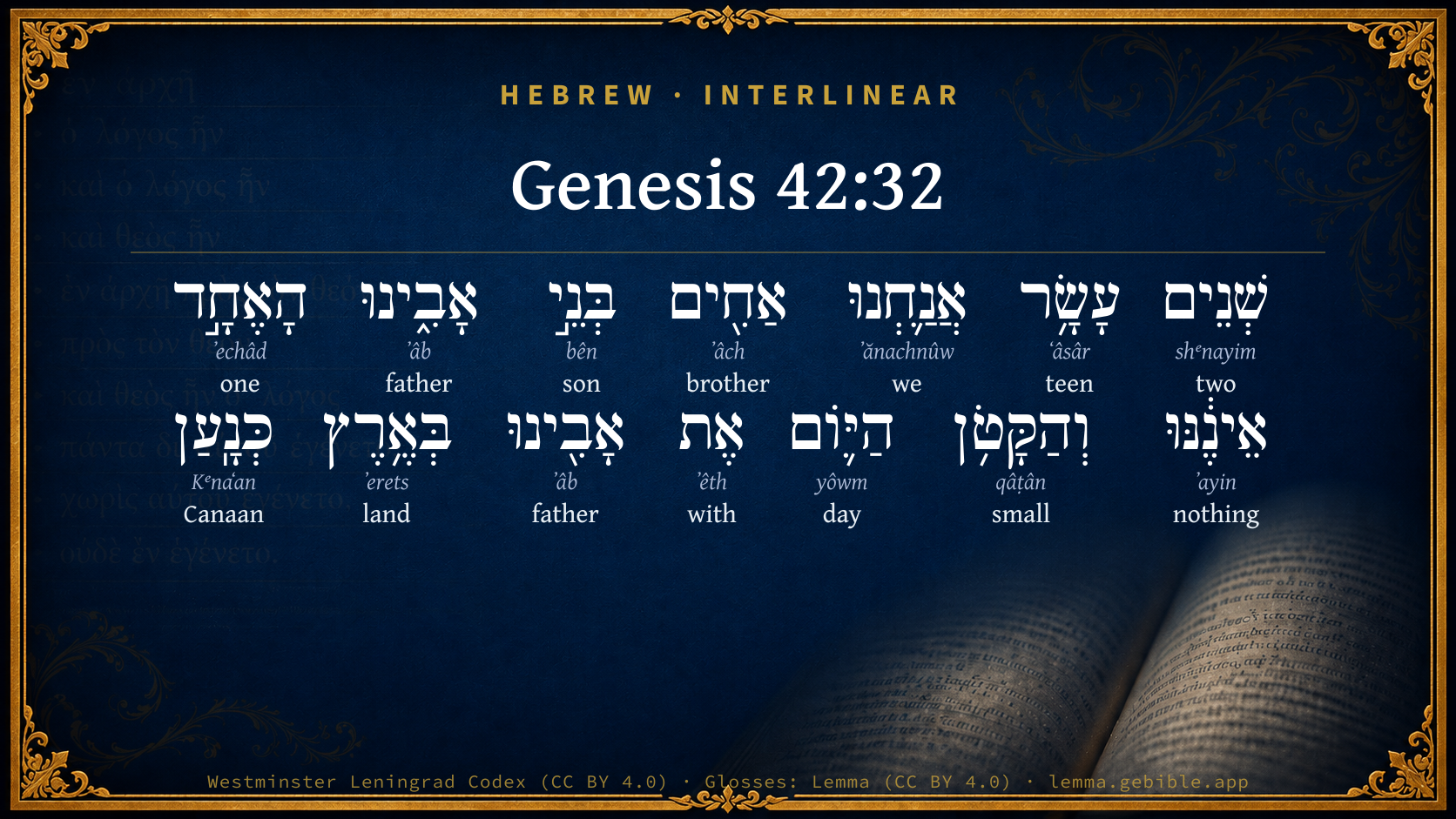
Hebrew (Westminster Leningrad Codex) Genesis 42:32 appears in the Hebrew Old Testament. The text above is from the Westminster Leningrad Codex. Each word links to its Strong’s number, a concise gloss, and parsing drawn from the Open Scriptures Hebrew Bible morphology. Click any word for its full Brown-Driver-Briggs (BDB) entry.
Download image
Cite this verse

Genesis 42:32 (World English Bible). Public Domain. Lemma interlinear Bible study tool, https://lemma.gebible.app/v/genesis/42/32.

Show BibTeX & RIS
BibTeX
RIS
English Translation
We are twelve brothers, sons of our father; one is no more, and the youngest is this day with our father in the land of Canaan.'
World English Bible · Public Domain
Download a study sheet

One document with this verse’s original text, its word-by-word gloss line, the meaning frame, cross-references with their text, attributed commentary, and full source and license credits — printable, and it pastes into notes with its structure intact.

This verse Autodidact and up

Study sheet (.html) Plain text (.txt)

A passage Seminary Student

Up to 50 verses in one chapter. A passage sheet keeps up to 6 commentary sources and 12 cross-references per verse, in the order this page ranks them, and says so on the sheet whenever that leaves anything out. Ask for a single verse and you get the Autodidact verse sheet above.

Everything on this page stays free to read, with no account — the sheet is a download of what is already on screen, not access to it.

Want to remove ads? Support Godless Engineer
Compare translations 3

The same verse in 3 English versions, stacked beneath the original-language interlinear above. Click any original word for its lexicon entry.

Each is an independent rendering of the whole verse — the interlinear is not word-aligned to these translations.

Highlighted words mark where these versions differ — a whole-verse word diff, not a word-by-word alignment.

  • World English Bible Public Domain
    We are twelve brothers, sons of our father; one is no more, and the youngest is this day with our father in the land of Canaan.'
  • King James Version Public Domain
    We be twelve brethren, sons of our father; one is not, and the youngest is this day with our father in the land of Canaan.
  • unfoldingWord Literal Text CC BY-SA 4.0
    We twelve brothers, the sons of our father. The one is not, and the youngest with our father today in the land of Canaan.’

unfoldingWord Literal Text — © unfoldingWord, licensed CC BY-SA 4.0. Word-aligned USFM3 via Door43 (git.door43.org/unfoldingWord/en_ult).

Versions to compare (up to 4)

3 of 4 selected

Show all 18 translations

Every available English version of this verse, each an independent rendering of the whole verse.

  • World English Bible Public Domain
    We are twelve brothers, sons of our father; one is no more, and the youngest is this day with our father in the land of Canaan.'
  • Berean Standard Bible Public Domain
    We are twelve brothers, sons of one father. One is no more, and the youngest is now with our father in the land of Canaan.’
  • Majority Standard Bible Public Domain
    We are twelve brothers, sons of one father. One is no more, and the youngest is now with our father in the land of Canaan.’
  • King James Version Public Domain
    We be twelve brethren, sons of our father; one is not, and the youngest is this day with our father in the land of Canaan.
  • American Standard Version (1901) Public Domain
    we are twelve brethren, sons of our father; one is not, and the youngest is this day with our father in the land of Canaan.
  • Revised Version (1885) Public Domain
    we be twelve brethren, sons of our father; one is not, and the youngest is this day with our father in the land of Canaan.
  • Geneva Bible (1599) Public Domain
    We be twelue brethren, sonnes of our father: one is not, and the yongest is this day with our father in the land of Canaan.
  • Douay-Rheims (1899) Public Domain
    We are twelve brethren born of one father: one is not living, the youngest is with our father in the land of Chanaan.
  • Young's Literal Translation Public Domain
    we `are' twelve brethren, sons of our father, the one is not, and the young one `is' to-day with our father in the land of Canaan.
  • Literal Standard Version CC BY-SA 4.0
    we [are] twelve brothers, sons of our father, one is not, and the young one [is] today with our father in the land of Canaan.
  • Unlocked Literal Bible CC BY-SA 4.0
    We are twelve brothers, sons of our father. One is no longer alive, and the youngest is this day with our father in the land of Canaan.'
  • unfoldingWord Literal Text CC BY-SA 4.0
    We twelve brothers, the sons of our father. The one is not, and the youngest with our father today in the land of Canaan.’
  • Darby Bible Public Domain
    we are twelve brethren, sons of our father; one is not, and the youngest is this day with our father in the land of Canaan.
  • World Messianic Bible Public Domain
    We are twelve brothers, sons of our father; one is no more, and the youngest is today with our father in the land of Canaan.’
  • Webster's Bible Public Domain
    We are twelve brethren, sons of our father: one is not, and the youngest is this day with our father in the land of Canaan.
  • Free Bible Version CC BY-SA 4.0
    We are twelve brothers, the sons of one father. One has passed away and the youngest is right now with our father in the country of Canaan.’
  • Bible in Basic English Public Domain
    We are twelve brothers, sons of our father; one is dead, and the youngest is now with our father in the land of Canaan.
  • JPS Tanakh (1917) Public Domain
    We are twelve brethren, sons of our father; one is not, and the youngest is this day with our father in the land of Canaan.

Literal Standard Version (2020), Covenant Press — licensed CC BY-SA 4.0. Text via the HelloAO Bible API (eBible.org). Unlocked Literal Bible (unfoldingWord) — licensed CC BY-SA 4.0. Text via the HelloAO Bible API (eBible.org). unfoldingWord Literal Text — © unfoldingWord, licensed CC BY-SA 4.0. Word-aligned USFM3 via Door43 (git.door43.org/unfoldingWord/en_ult). Free Bible Version, Dr. Jonathan Gallagher — licensed CC BY-SA 4.0. Text via the HelloAO Bible API (eBible.org).

Word by word

More ways to search: Search by grammar → Find every occurrence → Compare this word →

Practice this passage: Drill this verse → Learn its vocabulary →

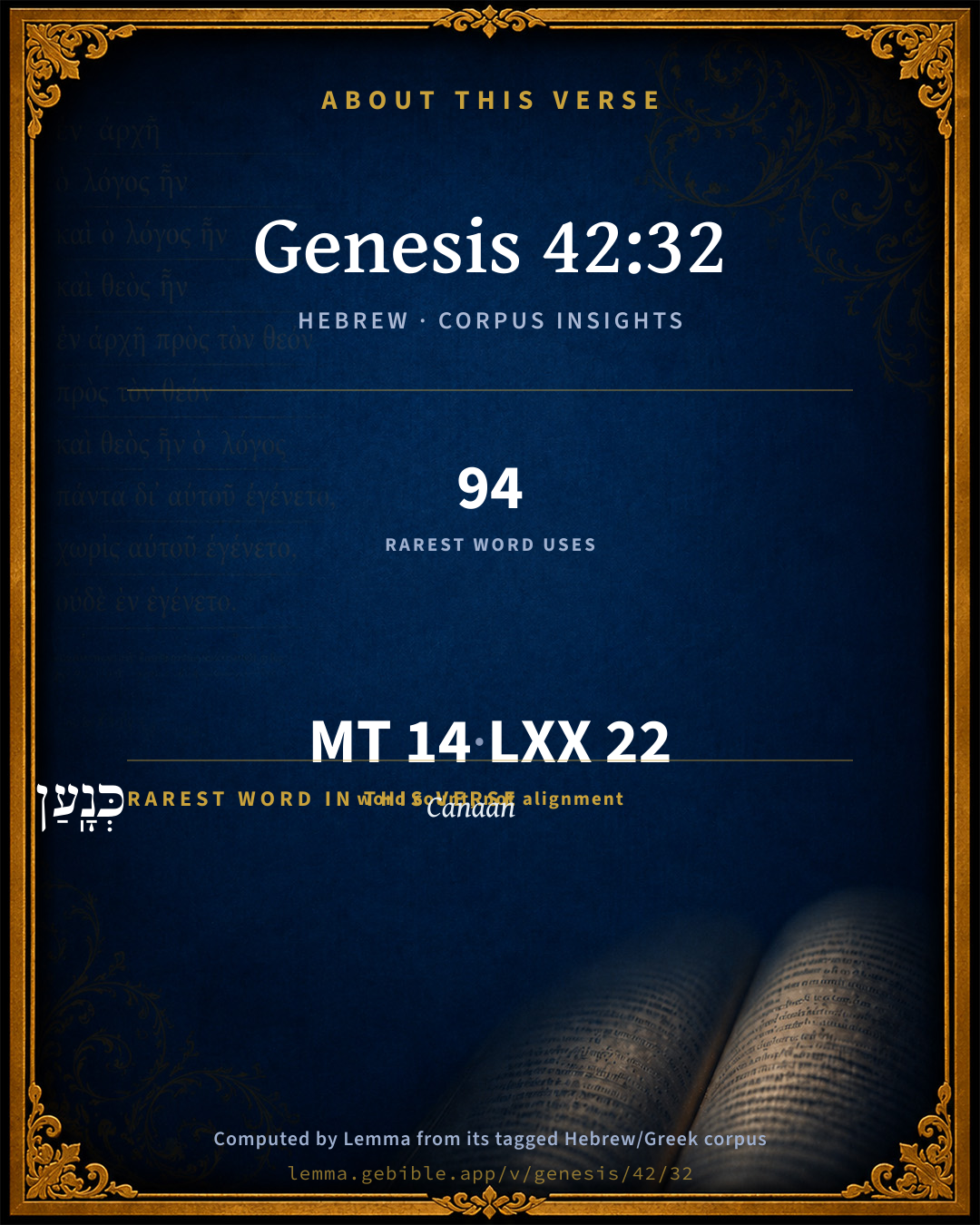
כְּנָֽעַן
Kᵉnaʻan
H3667
“Canaan”
Noun, Proper
Part of Speech
Noun
Type
Proper
Full BDB Definition

Origin: from H3665

TWOT: 1002 , 1002b

Canaan = "lowland" - the 4th son of Ham and the progenitor of the Phoenicians and of the various nations who peopled the seacoast of Palestine (noun proper masculine) - the land west of the Jordan peopled by the descendants of Canaan and subsequently conquered by the Israelites under Joshua (noun proper locative) - merchant, trader (noun masculine)
  1. שְׁנֵים shᵉnayim H8147 “two” Adjective, Cardinal number, Masculine, Dual, Absolute
  2. עָשָׂ֥ר ʻâsâr H6240 “teen” Adjective, Cardinal number, Masculine, Singular, Absolute
  3. אֲנַ֛חְנוּ ʼănachnûw H587 “we” Pronoun, Personal, 1st Person, Common, Plural
  4. אַחִ֖ים ʼâch H251 “brothers” Noun, Common, Masculine, Plural, Absolute
  5. בְּנֵ֣י bên H1121 “sons of” Noun, Common, Masculine, Plural, Construct
  6. אָבִ֑ינוּ ʼâb H1 “father · our” Noun, Common, Masculine, Singular, Construct + Suffix, Personal, 1st Person, Common, Plural
  7. הָאֶחָ֣ד ʼechâd H259 “the · one” Particle, Definite Article + Adjective, Cardinal number, Masculine, Singular, Absolute
  8. אֵינֶ֔נּוּ ʼayin H369 “nothing · him” Particle, Negative + Suffix, Personal, 3rd Person, Masculine, Singular
  9. וְהַקָּטֹ֥ן qâṭân H6996 “and · the · small” Conjunction + Particle, Definite Article + Adjective, Adjective, Masculine, Singular, Absolute
  10. הַיּ֛וֹם yôwm H3117 “the · day” Particle, Definite Article + Noun, Common, Masculine, Singular, Absolute
  11. אֶת ʼêth H854 “with” Preposition
  12. אָבִ֖ינוּ ʼâb H1 “father · our” Noun, Common, Masculine, Singular, Construct + Suffix, Personal, 1st Person, Common, Plural
  13. בְּאֶ֥רֶץ ʼerets H776 “in/at · land of” Preposition + Noun, Common, Both, Singular, Construct

About this verse

These counts appear in no published source. They are computed here, from the morphology-tagged text and Lemma’s own curated glosses. What Lemma adds →

14
words
13
distinct lemmas
Pentateuch
section

Grammatical profile

  • 7 nouns
  • 4 adjectives
  • 1 pronoun
  • 1 preposition
  • 1 particle

Repetition

A word recurs within this verse — often emphatic in Hebrew:

  • אָבִ֑ינוּ father H1 ×2

Hebrew & Septuagint length

In English translation the verse runs 26 words from the Hebrew and 24 from the Septuagint (LXX English) — closely comparable.

A rough comparison of the two English renderings, which tokenize alike — not a word-level alignment.

Word counts can differ between the Hebrew and the Greek without any difference in meaning — e.g. the Hebrew direct-object marker אֵת has no separate Greek word, and Greek often adds the article ὁ.

In the original languages it is 14 Hebrew tokens and 22 Greek tokens — but the two are counted differently (Hebrew bundles its prefixes and suffixes into one token; the Greek is in lemma form), so that isn’t a like-for-like length.

Hebrew and Greek witnesses Masoretic Hebrew ↔ Greek Septuagint

The same verse in the two great witnesses to the Old Testament, shown verse-for-verse.

These are two independent witnesses, not word-aligned to each other, and the Septuagint is shown in lemma (dictionary) form.

Hebrew Genesis 42:32 Masoretic · Westminster Leningrad Codex

שְׁנֵים עָשָׂ֥ר אֲנַ֛חְנוּ אַחִ֖ים בְּנֵ֣י אָבִ֑ינוּ הָאֶחָ֣ד אֵינֶ֔נּוּ וְהַקָּטֹ֥ן הַיּ֛וֹם אֶת אָבִ֖ינוּ בְּאֶ֥רֶץ כְּנָֽעַן

We are twelve brothers, sons of our father; one is no more, and the youngest is this day with our father in the land of Canaan.'

World English Bible · Public Domain

Greek LXX Genesis 42:32 Septuagint · lemma form

δώδεκα ἀδελφός εἰμί υἱός ὁ πατήρ ἐγώ ὁ εἷς οὐ ὑποἄρχω ὁ δέ μικρός μετά ὁ πατήρ ἐγώ σήμερον ἐν γῆ χανααν

We are twelve brethren, sons of our father; one is not, and the youngest is with his father today in the land of Chanaan.

LXX2012 (modern English Septuagint) · Public Domain

Hebrew: Westminster Leningrad Codex (CC BY 4.0). Greek: Septuagint (public domain); English from LXX2012 (modern English Septuagint) (Public Domain). How the Septuagint differs from the Hebrew →

Targum (Aramaic paraphrase)

2

The Targum is the ancient Jewish Aramaic paraphrase of the Hebrew Scriptures — an interpretive translation, not the Hebrew text itself. Onkelos (literal) and Pseudo-Jonathan (expansive) render the Torah, and Jonathan the Prophets. Coverage is partial: where no permissively-licensed English translation exists for a verse, only the Aramaic is shown. This is verse-level text, not a word-by-word alignment to the Hebrew.

  1. Targum Onkelos Torah (Genesis–Deuteronomy)
    תְּרֵין עֲסַר אֲנַחְנָא אַחִין בְּנֵי אָבוּנָא חַד לֵיתוֹהִי וּזְעֵירָא יוֹמָא דֵּין עִם אָבוּנָא בְּאַרְעָא דִּכְנָעַן

    (no public-domain English translation for this verse)

    Targum Onkelos — Aramaic: “Onkelos Genesis” (public domain); “Onkelos Exodus” (public domain); “Onkelos Leviticus” (public domain); “Onkelos Numbers” (public domain); “Onkelos Deuteronomy” (public domain). English: “Sefaria Community Translation” (CC0 1.0 (public-domain dedication)); “J.W. Etheridge. The Targums of Onkelos and Jonathan Ben Uzziel on the Pentateuch. London: Longmans, Green, 1862” (public domain). Text via Sefaria.

  2. Targum Pseudo-Jonathan Torah (Genesis–Deuteronomy)
    תְּרֵיסַר אֲנַחְנָא אַחִין בְּנֵי אָבוּנָא חַד לֵית אֲנָן יָדְעִין מַה הֲוָה בְּסוֹפֵיהּ וְקַלִילָא יוֹמָא דֵין עִם אָבוּנָא בְּאַרְעָא דִכְנָעַן

    We are twelve brothers, sons of our father; of one, we know not what was his end, and the youngest is tojday with our father in the land of Kenaan.

    Targum Pseudo-Jonathan — Aramaic: “Targum Jonathan on Genesis” (public domain); “Targum Jonathan on Exodus” (public domain); “Targum Jonathan on Leviticus” (public domain); “Targum Jonathan on Numbers” (public domain); “Targum Jonathan on Deuteronomy” (public domain). English: “The Targum of Jonathan ben Uzziel, trans. J. W. Etheridge, London, 1862” (public domain). Text via Sefaria.

Commentary

Notes on Genesis 42:32 from classic Christian and Jewish commentators (each source and its license shown beneath its notes). The classic Christian expositions comment on the surrounding passage and are grouped to its opening verse, so a note may address several verses; the Jewish commentaries on the Tanakh (Rashi and others) are per-verse, so they appear only where the commentator wrote on this verse.

Lemma curates 59 commentaries, every one of them public domain or Creative Commons licensed, each selected and text-cleaned for this edition rather than reprinted as found. About our sources →

Trapp's Complete Commentary

John Trapp

Gen 42:32 We [be] twelve brethren, sons of our father; one [is] not, and the youngest [is] this day with our father in the land of Canaan.

Ver. 32. See Gen 42:9; Gen 42:11; Gen 42:13; Gen 42:19, &c

John Trapp, A Commentary or Exposition upon All the Books of the Old and New Testament (1647–1656) — public domain. Text from a community e-Sword module.

Geneva Bible (1599)

Geneva Bible translators

Or, cannot be found.

Geneva Bible (1599) marginal notes — public domain. Text via Bolls.life.

John Gill's Exposition

And Jacob their father said unto them, me have ye bereaved of my children,.... Which looks as if Jacob suspected that they had either sold or slain Joseph, and had done one or the other by Simeon:

Joseph is not, and Simeon is not: neither of them were with him, and both were given up by him as dead, or, as the Targum of Jonathan paraphrases it,"of Joseph ye have said an evil beast hath devoured him; and Simeon, ye say, the king of the country hath bound him;''as for Joseph he knew not but he was dead, he feared he was; and as for Simeon, he being in the hands of so rough a man as they had represented the lord of the land to be, and especially as his release depended upon sending Benjamin, which he was determined at present not to do; he was reckoned by him as a lost or dead man:

and ye will take Benjamin away; they were desirous of it, and what their design was he could not tell; he seems to have a strong suspicion that it was not good:

all these things are against me; against his will, his peace, and comfort, and happiness, though they were all working and would work as they did for his good, and for the good of his family, for the preservation of it during the seven years of famine; or are "upon me" (f), as heavy burdens, too heavy for him to bear, ready to sink him down to the earth.

(f) "super me", Montanus, Schmidt; "vel. in me", V. L. Vatablus.

John Gill's Exposition of the Whole Bible (1746–1763) — public domain (CC PDM 1.0). Text via the HelloAO Bible API.

Lesson kit

Teaching starters — assembled from the data on this page, not authored interpretation. Every prompt links to the verse data it draws on. Edit before teaching.

Genesis, in the Pentateuch, opens this verse with 14 words (13 distinct Hebrew lemmas). Its most distinctive word is Kᵉnaʻan (“Canaan”). A historical commentator’s framing appears above. Read the whole chapter for the surrounding context.

Discussion questions

  1. What does “Canaan” (Kᵉnaʻan) contribute to the verse as a whole?
  2. What does the repetition of “father” (2× in this one verse) do in this verse?
  3. These translations render this verse differently. What is at stake in choosing one wording over another?
  4. Compare how Trapp's Complete Commentary and Geneva Bible (1599) read this verse. Where do they agree or differ?

Things to notice

Reading settings

Reading text

Shown beneath each verse's original-language words.

Old Testament
Old Testament edition

Read the OT as the Masoretic Hebrew (MT) or the Greek Septuagint (LXX).

English shown for the Greek Septuagint (in the Hebrew ↔ Greek comparison).

Comparing translations? Open the Compare panel on any verse page to stack up to four side by side.