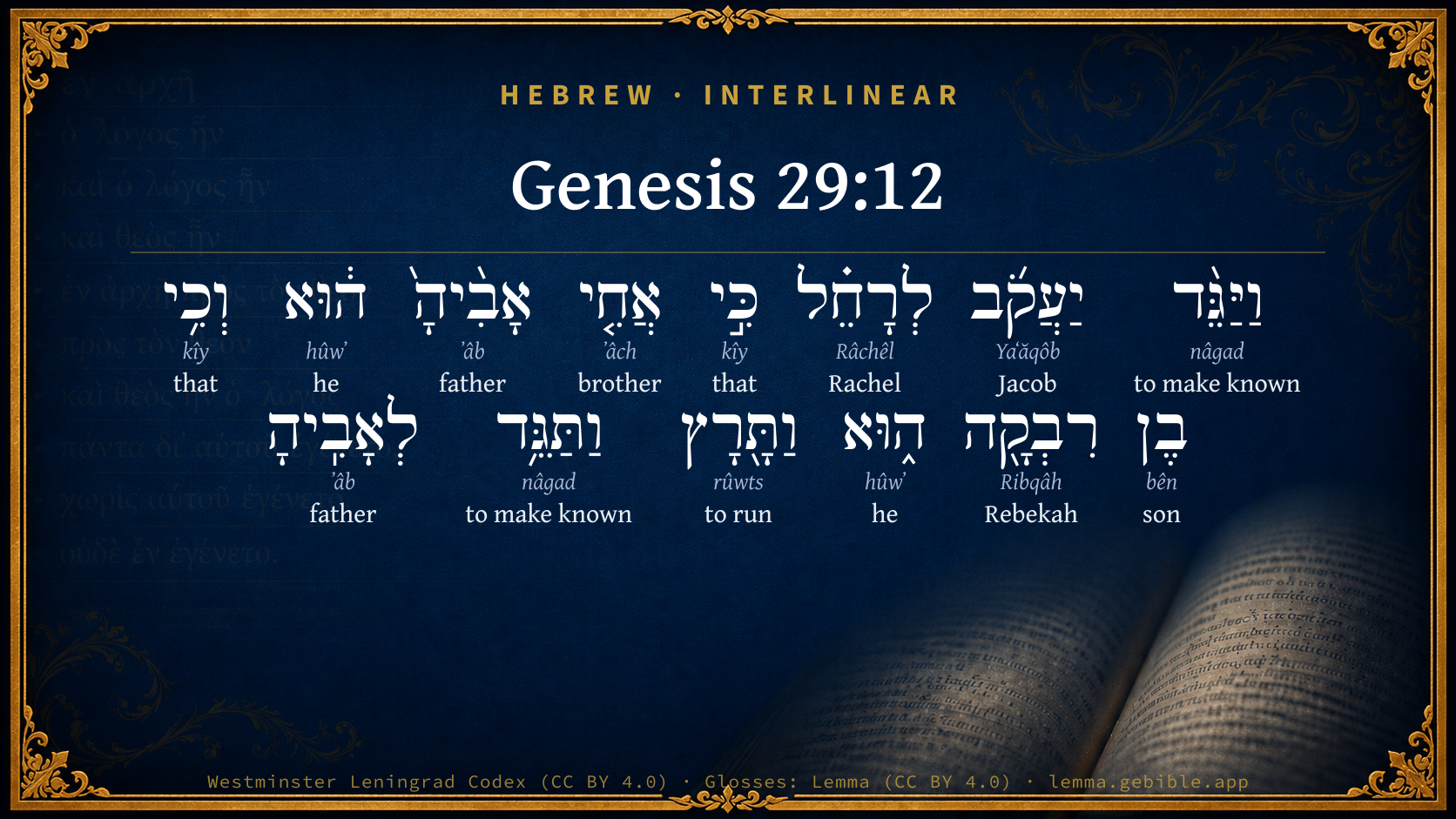
Genesis 29:12

Hebrew (Westminster Leningrad Codex) Genesis 29:12 appears in the Hebrew Old Testament. The text above is from the Westminster Leningrad Codex. Each word links to its Strong’s number, a concise gloss, and parsing drawn from the Open Scriptures Hebrew Bible morphology. Click any word for its full Brown-Driver-Briggs (BDB) entry.
Download image
Cite this verse

Genesis 29:12 (World English Bible). Public Domain. Lemma interlinear Bible study tool, https://lemma.gebible.app/v/genesis/29/12.

Show BibTeX & RIS
BibTeX
RIS
English Translation
Jacob told Rachel that he was her father's brother, and that he was Rebekah's son. She ran and told her father.
World English Bible · Public Domain
Download a study sheet

One document with this verse’s original text, its word-by-word gloss line, the meaning frame, cross-references with their text, attributed commentary, and full source and license credits — printable, and it pastes into notes with its structure intact.

This verse Autodidact and up

Study sheet (.html) Plain text (.txt)

A passage Seminary Student

Up to 50 verses in one chapter. A passage sheet keeps up to 6 commentary sources and 12 cross-references per verse, in the order this page ranks them, and says so on the sheet whenever that leaves anything out. Ask for a single verse and you get the Autodidact verse sheet above.

Everything on this page stays free to read, with no account — the sheet is a download of what is already on screen, not access to it.

Want to remove ads? Support Godless Engineer
Compare translations 3

The same verse in 3 English versions, stacked beneath the original-language interlinear above. Click any original word for its lexicon entry.

Each is an independent rendering of the whole verse — the interlinear is not word-aligned to these translations.

Highlighted words mark where these versions differ — a whole-verse word diff, not a word-by-word alignment.

  • World English Bible Public Domain
    Jacob told Rachel that he was her father's brother, and that he was Rebekah's son. She ran and told her father.
  • King James Version Public Domain
    And Jacob told Rachel that he was her father's brother, and that he was Rebekah's son: and she ran and told her father.
  • unfoldingWord Literal Text CC BY-SA 4.0
    Then Jacob told Rachel that he a relative of her father and that he a son of Rebekah. Then she ran and told her father.

unfoldingWord Literal Text — © unfoldingWord, licensed CC BY-SA 4.0. Word-aligned USFM3 via Door43 (git.door43.org/unfoldingWord/en_ult).

Versions to compare (up to 4)

3 of 4 selected

Show all 18 translations

Every available English version of this verse, each an independent rendering of the whole verse.

  • World English Bible Public Domain
    Jacob told Rachel that he was her father's brother, and that he was Rebekah's son. She ran and told her father.
  • Berean Standard Bible Public Domain
    He told Rachel that he was Rebekah’s son, a relative of her father, and she ran and told her father.
  • Majority Standard Bible Public Domain
    He told Rachel that he was Rebekah’s son, a relative of her father, and she ran and told her father.
  • King James Version Public Domain
    And Jacob told Rachel that he was her father's brother, and that he was Rebekah's son: and she ran and told her father.
  • American Standard Version (1901) Public Domain
    And Jacob told Rachel that he was her father's brother, and that he was Rebekah's son. And she ran and told her father.
  • Revised Version (1885) Public Domain
    And Jacob told Rachel that he was her father’s brother, and that he was Rebekah’s son: and she ran and told her father.
  • Geneva Bible (1599) Public Domain
    (For Iaakob tolde Rahel, that he was her fathers brother, and that he was Rebekahs sonne) then she ranne and tolde her father.
  • Douay-Rheims (1899) Public Domain
    And he told her that he was her father's brother, and the son of Rebecca: but she went in haste and told her father.
  • Young's Literal Translation Public Domain
    and Jacob declareth to Rachel that he `is' her father's brother, and that he `is' Rebekah's son, and she runneth and declareth to her father.
  • Literal Standard Version CC BY-SA 4.0
    and Jacob declares to Rachel that he [is] her father’s brother, and that he [is] Rebekah’s son, and she runs and declares [it] to her father.
  • Unlocked Literal Bible CC BY-SA 4.0
    Jacob told Rachel that he was her father's relative, and that he was Rebekah's son. Then she ran and told her father.
  • unfoldingWord Literal Text CC BY-SA 4.0
    Then Jacob told Rachel that he a relative of her father and that he a son of Rebekah. Then she ran and told her father.
  • Darby Bible Public Domain
    And Jacob told Rachel that he was a brother of her father, and that he was Rebecca's son; and she ran and told her father.
  • World Messianic Bible Public Domain
    Jacob told Rachel that he was her father’s relative, and that he was Rebekah’s son. She ran and told her father.
  • Webster's Bible Public Domain
    And Jacob told Rachel that he was her father's brother, and that he was Rebekah's son; and she ran and told her father.
  • Free Bible Version CC BY-SA 4.0
    (He had told her that he was a relative of her father, Rebekah's son.) She ran and told her father what had happened.
  • Bible in Basic English Public Domain
    And Rachel, hearing from Jacob that he was her father's relation and that he was the son of Rebekah, went running to give her father news of it.
  • JPS Tanakh (1917) Public Domain
    And Jacob told Rachel that he was her father's brother, and that he was Rebekah's son; and she ran and told her father.

Literal Standard Version (2020), Covenant Press — licensed CC BY-SA 4.0. Text via the HelloAO Bible API (eBible.org). Unlocked Literal Bible (unfoldingWord) — licensed CC BY-SA 4.0. Text via the HelloAO Bible API (eBible.org). unfoldingWord Literal Text — © unfoldingWord, licensed CC BY-SA 4.0. Word-aligned USFM3 via Door43 (git.door43.org/unfoldingWord/en_ult). Free Bible Version, Dr. Jonathan Gallagher — licensed CC BY-SA 4.0. Text via the HelloAO Bible API (eBible.org).

Word by word

More ways to search: Search by grammar → Find every occurrence → Compare this word →

Practice this passage: Drill this verse → Learn its vocabulary →

רִבְקָ֖ה
Ribqâh
H7259
“Rebekah”
Noun, Proper
Part of Speech
Noun
Type
Proper
Full BDB Definition

Origin: from an unused root probably meaning to clog by tying up the fetlock

TWOT: None

Rebekah = "ensnarer" - daughter of Bethuel, sister of Laban, wife of Isaac, and mother of Esau and Jacob
  1. וַיַּגֵּ֨ד nâgad H5046 “and · to make known” Conjunction + Verb, Hiphil, Sequential Imperfect, 3rd Person, Masculine, Singular
  2. יַעֲקֹ֜ב Yaʻăqôb H3290 “Jacob” Noun, Proper
  3. לְרָחֵ֗ל Râchêl H7354 “to/for · Rachel” Preposition + Noun, Proper
  4. כִּ֣י kîy H3588 “that” Conjunction
  5. אֲחִ֤י ʼâch H251 “brother of” Noun, Common, Masculine, Singular, Construct
  6. אָבִ֨יהָ֙ ʼâb H1 “father · her” Noun, Common, Masculine, Singular, Construct + Suffix, Personal, 3rd Person, Feminine, Singular
  7. ה֔וּא hûwʼ H1931 “he” Pronoun, Personal, 3rd Person, Masculine, Singular
  8. וְכִ֥י kîy H3588 “and · that” Conjunction + Conjunction
  9. בֶן bên H1121 “son of” Noun, Common, Masculine, Singular, Construct
  10. ה֑וּא hûwʼ H1931 “he” Pronoun, Personal, 3rd Person, Masculine, Singular
  11. וַתָּ֖רָץ rûwts H7323 “and · to run” Conjunction + Verb, Qal, Sequential Imperfect, 3rd Person, Feminine, Singular
  12. וַתַּגֵּ֥ד nâgad H5046 “and · to make known” Conjunction + Verb, Hiphil, Sequential Imperfect, 3rd Person, Feminine, Singular
  13. לְאָבִֽיהָ ʼâb H1 “to/for · father · her” Preposition + Noun, Common, Masculine, Singular, Construct + Suffix, Personal, 3rd Person, Feminine, Singular

About this verse

These counts appear in no published source. They are computed here, from the morphology-tagged text and Lemma’s own curated glosses. What Lemma adds →

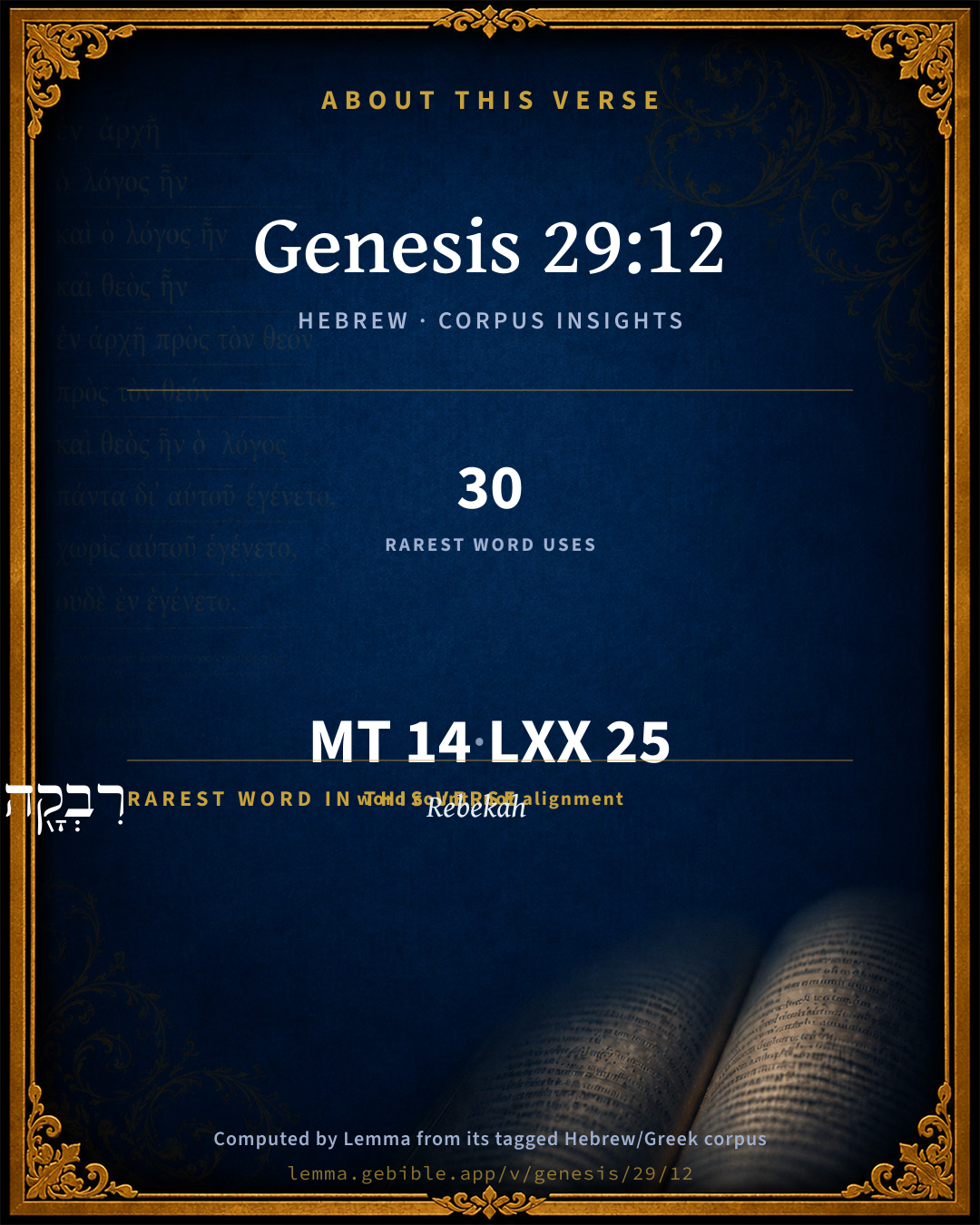
14
words
10
distinct lemmas
Pentateuch
section

Shared distinctive vocabulary

רִבְקָ֖ה Rebekah H7259 occurs in 29 verses of the Hebrew Bible. Also found in:

Grammatical profile

  • 3 verbs
  • 7 nouns
  • 2 pronouns
  • 2 conjunctions

Verb forms

  • וַיַּגֵּ֨ד Hiphil · Sequential Imperfect
  • וַתָּ֖רָץ Qal · Sequential Imperfect
  • וַתַּגֵּ֥ד Hiphil · Sequential Imperfect

Repetition

Words recur within this verse — often emphatic in Hebrew:

  • וַיַּגֵּ֨ד to make known H5046 ×2
  • אָבִ֨יהָ֙ father H1 ×2
  • כִּ֣י that H3588 ×2
  • ה֔וּא he H1931 ×2

Hebrew & Septuagint length

In English translation the verse runs 21 words from the Hebrew and 30 from the Septuagint (LXX English) — the Septuagint runs noticeably longer here. See the side-by-side →

A rough comparison of the two English renderings, which tokenize alike — not a word-level alignment.

Word counts can differ between the Hebrew and the Greek without any difference in meaning — e.g. the Hebrew direct-object marker אֵת has no separate Greek word, and Greek often adds the article ὁ.

In the original languages it is 14 Hebrew tokens and 25 Greek tokens — but the two are counted differently (Hebrew bundles its prefixes and suffixes into one token; the Greek is in lemma form), so that isn’t a like-for-like length.

Cross-references

3

Topical passages linked to Genesis 29:12 in the Treasury of Scripture Knowledge — connected by theme and wording, ordered by reader-vote popularity; previews shown in the World English Bible.

  • Genesis 24:28 The young lady ran, and told her mother's house about these words.
  • Genesis 13:8 Abram said to Lot, "Please, let there be no strife between me and you, and between my herdsmen and your herdsmen; for we are relatives.
  • Genesis 14:14–16 When Abram heard that his relative was taken captive, he led forth his trained men, born in his house, three hundred and eighteen, and pursued as far as Dan.

Cross-references courtesy of OpenBible.info (CC BY 4.0).

Hebrew and Greek witnesses Masoretic Hebrew ↔ Greek Septuagint

The same verse in the two great witnesses to the Old Testament, shown verse-for-verse.

Here the Septuagint runs noticeably longer than the Hebrew — LXX2012 (modern English Septuagint) 30 words vs World English Bible 21. A rough length comparison of the two English translations, not a word-level alignment — read both below.

These are two independent witnesses, not word-aligned to each other, and the Septuagint is shown in lemma (dictionary) form.

Hebrew Genesis 29:12 Masoretic · Westminster Leningrad Codex

וַיַּגֵּ֨ד יַעֲקֹ֜ב לְרָחֵ֗ל כִּ֣י אֲחִ֤י אָבִ֨יהָ֙ ה֔וּא וְכִ֥י בֶן רִבְקָ֖ה ה֑וּא וַתָּ֖רָץ וַתַּגֵּ֥ד לְאָבִֽיהָ

Jacob told Rachel that he was her father's brother, and that he was Rebekah's son. She ran and told her father.

World English Bible · Public Domain

Greek LXX Genesis 29:12 Septuagint · lemma form

καί ἀναἀγγέλλω ὁ ραχηλ ὅτι ἀδελφός ὁ πατήρ αὐτός εἰμί καί ὅτι υἱός ρεβεκκα εἰμί καί τρέχω ἀποἀγγέλλω ὁ πατήρ αὐτός κατά ὁ ῥῆμα οὗτος

And he told Rachel that he was the near relative of her father, and the son of Rebecca; and she ran and reported to her father according to these words.

LXX2012 (modern English Septuagint) · Public Domain

Hebrew: Westminster Leningrad Codex (CC BY 4.0). Greek: Septuagint (public domain); English from LXX2012 (modern English Septuagint) (Public Domain). How the Septuagint differs from the Hebrew →

Targum (Aramaic paraphrase)

2

The Targum is the ancient Jewish Aramaic paraphrase of the Hebrew Scriptures — an interpretive translation, not the Hebrew text itself. Onkelos (literal) and Pseudo-Jonathan (expansive) render the Torah, and Jonathan the Prophets. Coverage is partial: where no permissively-licensed English translation exists for a verse, only the Aramaic is shown. This is verse-level text, not a word-by-word alignment to the Hebrew.

  1. Targum Onkelos Torah (Genesis–Deuteronomy)
    וְחַוִּי יַעֲקֹב לְרָחֵל אֲרֵי בַר אֲחַת אָבוּהָא הוּא וַאֲרֵי בַר רִבְקָה הוּא וּרְהָטַת וְחַוִּיאַת לְאָבוּהָא

    (no public-domain English translation for this verse)

    Targum Onkelos — Aramaic: “Onkelos Genesis” (public domain); “Onkelos Exodus” (public domain); “Onkelos Leviticus” (public domain); “Onkelos Numbers” (public domain); “Onkelos Deuteronomy” (public domain). English: “Sefaria Community Translation” (CC0 1.0 (public-domain dedication)); “J.W. Etheridge. The Targums of Onkelos and Jonathan Ben Uzziel on the Pentateuch. London: Longmans, Green, 1862” (public domain). Text via Sefaria.

  2. Targum Pseudo-Jonathan Torah (Genesis–Deuteronomy)
    וְתַנִי יַעֲקב לְרָחֵל אֲרוּם לְאִיתְקַרְבָא עִם אָבוּהָא אָתָא וּלְמֵיסַב חָדָא מִן בְּרַתּוֹי עָנְתָה רָחֵל וַאֲמָרַת לֵית אֶפְשַר לָךְ לְמֵיתַב עִמֵיהּ אֲרוּם גְבַר רַמְאַי הוּא אָמַר לָהּ יַעֲקב אֲנָא רַמְאַי וְחַכִּים יַתִּיר מִנֵיהּ וְלֵית לֵיהּ רְשׁוּ לְאַבְאָשָׁא לִי אֲרוּם מֵימְרָא דַיְיָ בְּסַעֲדִי וּכְדִי יָדְעַת אֲרוּם בַּר רִבְקָה הוּא וּרְהָטַת וְתַנִיאַת לְאָבוּהָא

    And Jakob told unto Rahel, that he was come to be with her father to take one of his daughters. And Rahel answered him Thou canst not dwell with him, for he is a man of cunning. And Jakob said to her, I am more cunning and wiser than he; nor can he do me evil, because the Word of the Lord is my Helper. And when she knew that he was the son of Rivekah, she ran and made it known to her father.

    Targum Pseudo-Jonathan — Aramaic: “Targum Jonathan on Genesis” (public domain); “Targum Jonathan on Exodus” (public domain); “Targum Jonathan on Leviticus” (public domain); “Targum Jonathan on Numbers” (public domain); “Targum Jonathan on Deuteronomy” (public domain). English: “The Targum of Jonathan ben Uzziel, trans. J. W. Etheridge, London, 1862” (public domain). Text via Sefaria.

Commentary

Notes on Genesis 29:12 from classic Christian and Jewish commentators (each source and its license shown beneath its notes). The classic Christian expositions comment on the surrounding passage and are grouped to its opening verse, so a note may address several verses; the Jewish commentaries on the Tanakh (Rashi and others) are per-verse, so they appear only where the commentator wrote on this verse.

Lemma curates 59 commentaries, every one of them public domain or Creative Commons licensed, each selected and text-cleaned for this edition rather than reprinted as found. About our sources →

Trapp's Complete Commentary

John Trapp

Gen 29:12 And Jacob told Rachel that he [was] her father’s brother, and that he [was] Rebekah’s son: and she ran and told her father.

Ver. 12. That he was her father’s brother.] And therefore made so bold with her, upon no further acquaintance. His kisses were not unchaste, but modest; such as were common among kindred. And yet here care must be taken that Satan corrupt not our courtesy, or more intimate acquaintance, with never so near an alliance. Flies may settle upon the sweetest perfumes, and putrify them. St Paul saw cause to exhort Timothy (that mortified young man) to exhort the younger women, "as sisters with all purity"; {1Ti 5:2} because, through the subtilty of Satan, and the deceit of his own heart, even whilst he was exhorting them to chastity, some unchaste motions might steal upon him. A great deal of caution doth no hurt. {a}

{a} Abuadans cautela non nocet .

John Trapp, A Commentary or Exposition upon All the Books of the Old and New Testament (1647–1656) — public domain. Text from a community e-Sword module.

Geneva Bible (1599)

Geneva Bible translators

Or, nephew.

Geneva Bible (1599) marginal notes — public domain. Text via Bolls.life.

Jamieson, Fausset & Brown

Robert Jamieson, A. R. Fausset & David Brown

Jacob told Rachel, &c.--According to the practice of the East, the term "brother" is extended to remote degrees of relationship, as uncle, cousin, or nephew.

Jamieson, Fausset & Brown — Commentary Critical and Explanatory on the Whole Bible (1871) — public domain (CC PDM 1.0). Text via the HelloAO Bible API.

Ellicott's Commentary for English Readers

(12) Her father’s brother.—Really his nephew; but terms of relationship are used in a very indefinite way in Hebrew. (Comp. Gen_29:5; Gen_29:15, Gen_13:8, &c.)

A Bible Commentary for English Readers, edited by Charles John Ellicott (1878–1897) — public domain. Text from a community e-Sword module.

The Cambridge Bible for Schools and Colleges

gen. ed. J. J. S. Perowne

12. her father’s brother] In the sense of “relative”; strictly speaking, her father’s sister’s son. Cf. Gen_29:15 and Gen_13:8.

ran and told] We are reminded of Rebekah’s action in Gen_24:28-29.

The Cambridge Bible for Schools and Colleges (gen. ed. J. J. S. Perowne; Cambridge University Press, 1878–1918) — public domain. Text from a community e-Sword module.

John Gill's Exposition

And Jacob told Rachel,.... Or "had told" (i) her; before he kissed her, and lift up his voice and wept, as Aben Ezra observes:

that he was her father's brother; his nephew by his sister, for such were sometimes called brethren, as Lot, Abraham's brother's son, is called his brother, Gen 14:12,

and that he was Rebekah's son; sister to her father, and aunt to her, and whose name and relation she doubtless knew full well:

and she ran and told her father; leaving the care of her flock with Jacob; Rebekah, in a like case, ran and told her mother, Gen 24:28, which is most usual for daughters to do; but here Rachel runs and tells her father, her mother very probably being dead, as say the Jewish writers (k).

(i) "et puntiaverat", Pagninus, Montanus; "renuntiaverat", Vatablus. (k) Bereshit Rabba, sect. 70. fol. 62. 4. Jarchi in loc.

John Gill's Exposition of the Whole Bible (1746–1763) — public domain (CC PDM 1.0). Text via the HelloAO Bible API.

Haydock's Catholic Bible Commentary

Brother, or nephew. The name of brother, in Scripture, almost corresponds with the Consanguineus of the Latins, or our relation.

George Leo Haydock (1774–1849), Haydock's Catholic Family Bible and Commentary, 1859 edition — public domain. Excludes Psalms (Douay-Rheims chapter numbering differs from Protestant) and Deuterocanonical books (Catholic canon only).

Matthew Poole's English Annotations

Her father’s brother; his near kinsman; as that word is frequently used, as Ge 13:8; 24:27.

Matthew Poole's English Annotations on the Holy Bible (1683–1685) — public domain. Text from a community e-Sword/MySword module.

Whedon's Commentary on the Bible

Daniel D. Whedon

12. Told her father — Unlike Rebekah, who ran and told her mother.

Gen_24:28.

Daniel D. Whedon (gen. ed.), Commentary on the Old and New Testaments (1874–1909) — public domain. Text from a community e-Sword module.

The Pulpit Commentary

And Jacob told (or, had told, ut supra) Rachel that he was her father"s brother, as Lot is called Abraham"s brother, though in reality his nephew (Gen_13:8 Gen_14:14, Gen_14:16) and that he was Rebekah"s son (this clause would explain the meaning of the term "brother in the former): and she ran and told her father. Like Rebekah, believing the stranger"s words and running to report them, though, unlike Rebekah, first relating them to her father (cf. Gen_14:2-8)

The Pulpit Commentary (1880–1919), ed. H.D.M. Spence-Jones & Joseph S. Exell — public domain. Text from a community e-Sword module.

Rashi

Rabbi Shlomo Yitzchaki (Rashi)

כי אחי אביה הוא HE WAS HER FATHER’S BROTHER — near kin to her father, as (Genesis 13:8) “for we are men, brothers (אחים)” (i. e. near kin). A Midrashic explanation is that he meant: if he (Laban) intends to practice deceit upon me then I am his brother (a match for him) in deception; if, however, he is an honest man then I, too, am the son of his sister, the pious Rebekah (Genesis Rabbah 70:13).

ותגד לאביה AND SHE TOLD HER FATHER, because her mother was dead and she had no one to tell except him (Bereishit Rabbah 70:13).

Rashi on the Tanakh — English translations: “The Judaica Press complete Tanach with Rashi, translated by A. J. Rosenberg” (CC BY 4.0); “Pentateuch with Rashi's commentary by M. Rosenbaum and A.M. Silbermann, 1929-1934” (public domain); “The Metsudah Tanach series, Lakewood, N.J” (CC BY 4.0); and “The Book of Joshua, Metsudah Publications, 1997” (CC BY 4.0). Text via Sefaria.

Ramban (Nachmanides)

Rabbi Moshe ben Nachman (Ramban / Nachmanides)

AND SHE TOLD HER FATHER. Rashi comments: “Her mother was dead.” And so it is stated in Bereshith Rabbah. But according to the plain meaning of Scripture, Rachel related it to her father in order to inform him of the arrival of his relative and so that he should go forth to meet him and honor him. For, as regards her mother, what was Jacob to her and what could she do for him? However, Rebekah did show her mother the jewels which Eliezer gave her, as is the custom of maidens.

Ramban (Nachmanides) on the Tanakh — English translation: “Commentary on the Torah by Ramban (Nachmanides). Translated and annotated by Charles B. Chavel. New York, Shilo Pub. House, 1971-1976” (CC BY 4.0). Text via Sefaria.

Radak

Rabbi David Kimhi (Radak)

כי אחי אביה הוא, i.e. a son of her father’s sister, a son of Rivkah, who was known to all the people of Charan to have become married to Yitzchok.

Radak on the Tanakh — English translations: “Sefaria Community Translation” (CC0 1.0 (public-domain dedication)); “Eliyahu Munk, HaChut Hameshulash” (CC BY 4.0); “Rabbi Mike Feuer, Jerusalem Anthology” (CC BY 4.0); and “R. David Kimhi on the first book of Psalms, Translated by R.G. Finch, London, 1919” (public domain). Text via Sefaria.

Lesson kit

Teaching starters — assembled from the data on this page, not authored interpretation. Every prompt links to the verse data it draws on. Edit before teaching.

Genesis, in the Pentateuch, opens this verse with 14 words (10 distinct Hebrew lemmas). Its most distinctive word is Ribqâh (“Rebekah”). The Greek Septuagint runs longer here. A historical commentator’s framing appears above. Read the whole chapter for the surrounding context.

Discussion questions

  1. What does “Rebekah” (Ribqâh) contribute to the verse as a whole?
  2. Genesis 22:23 shares the word «Rebekah» with this verse. How do the two illuminate each other?
  3. “to make known” occurs 2× in this one verse. What is the effect of the repetition?
  4. Compared with the Hebrew, the Septuagint runs longer here. What questions does that raise?
  5. The translations on this page render this verse differently — a whole-verse word diff, not a word-by-word alignment. What might account for the different wordings?
  6. The verb «וַיַּגֵּ֨ד» is Hiphil Sequential Imperfect. How does its form color the action?
  7. Reading how Trapp's Complete Commentary and Geneva Bible (1599) read this verse, where do the two commentators agree and where do they part?

Things to notice

Reading settings

Reading text

Shown beneath each verse's original-language words.

Old Testament
Old Testament edition

Read the OT as the Masoretic Hebrew (MT) or the Greek Septuagint (LXX).

English shown for the Greek Septuagint (in the Hebrew ↔ Greek comparison).

Comparing translations? Open the Compare panel on any verse page to stack up to four side by side.