
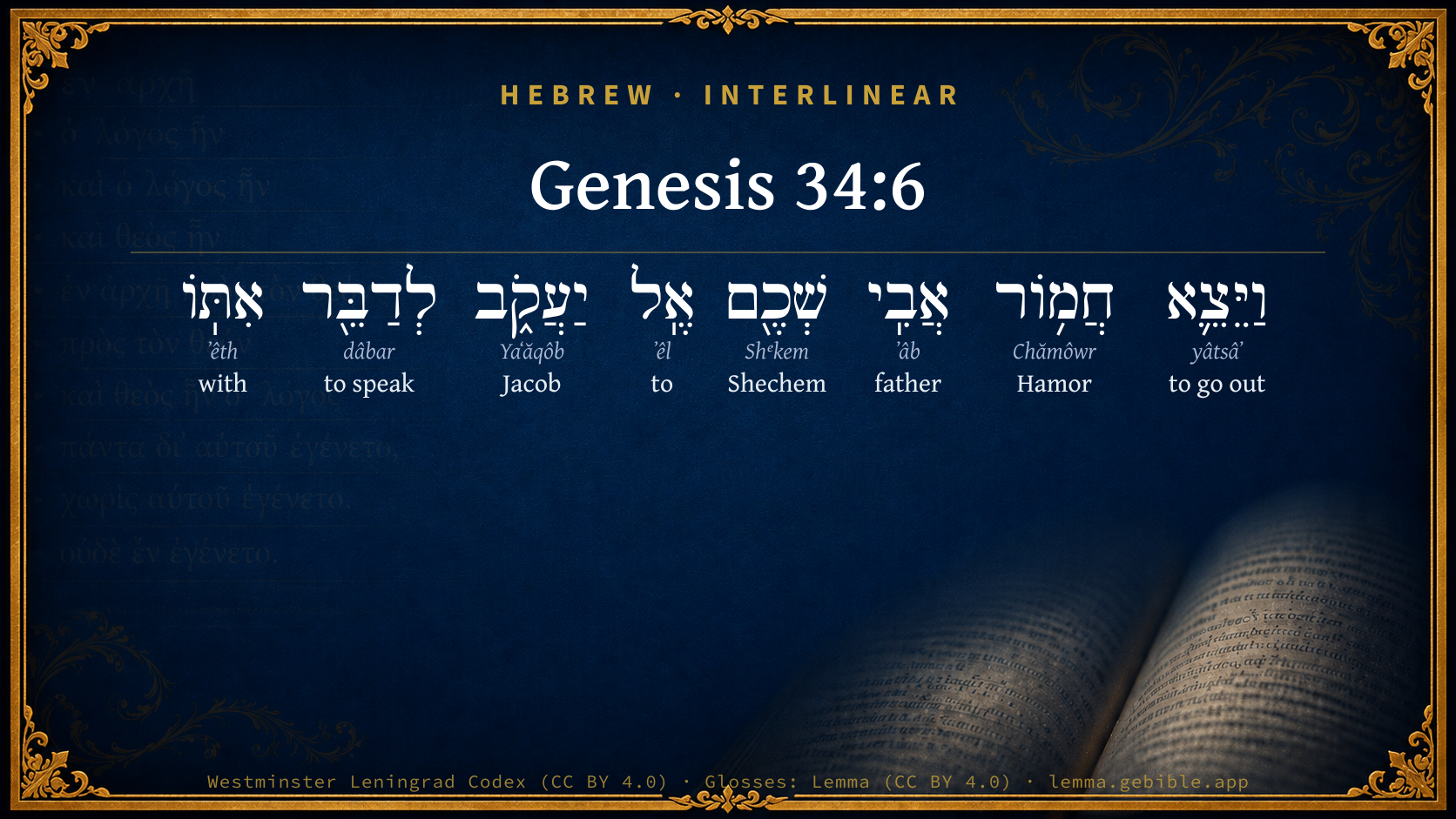
Genesis 34:6

Hebrew (Westminster Leningrad Codex) Genesis 34:6 appears in the Hebrew Old Testament. The text above is from the Westminster Leningrad Codex. Each word links to its Strong’s number, a concise gloss, and parsing drawn from the Open Scriptures Hebrew Bible morphology. Click any word for its full Brown-Driver-Briggs (BDB) entry.
Download image
Cite this verse

Genesis 34:6 (World English Bible). Public Domain. Lemma interlinear Bible study tool, https://lemma.gebible.app/v/genesis/34/6.

Show BibTeX & RIS
BibTeX
RIS
English Translation
Hamor the father of Shechem went out to Jacob to talk with him.
World English Bible · Public Domain
Download a study sheet

One document with this verse’s original text, its word-by-word gloss line, the meaning frame, cross-references with their text, attributed commentary, and full source and license credits — printable, and it pastes into notes with its structure intact.

This verse Autodidact and up

Study sheet (.html) Plain text (.txt)

A passage Seminary Student

Up to 50 verses in one chapter. A passage sheet keeps up to 6 commentary sources and 12 cross-references per verse, in the order this page ranks them, and says so on the sheet whenever that leaves anything out. Ask for a single verse and you get the Autodidact verse sheet above.

Everything on this page stays free to read, with no account — the sheet is a download of what is already on screen, not access to it.

Want to remove ads? Support Godless Engineer
Compare translations 3

The same verse in 3 English versions, stacked beneath the original-language interlinear above. Click any original word for its lexicon entry.

Each is an independent rendering of the whole verse — the interlinear is not word-aligned to these translations.

Highlighted words mark where these versions differ — a whole-verse word diff, not a word-by-word alignment.

  • World English Bible Public Domain
    Hamor the father of Shechem went out to Jacob to talk with him.
  • King James Version Public Domain
    And Hamor the father of Shechem went out unto Jacob to commune with him.
  • unfoldingWord Literal Text CC BY-SA 4.0
    And Hamor the father of Shechem came out to Jacob to talk with him.

unfoldingWord Literal Text — © unfoldingWord, licensed CC BY-SA 4.0. Word-aligned USFM3 via Door43 (git.door43.org/unfoldingWord/en_ult).

Versions to compare (up to 4)

3 of 4 selected

Show all 18 translations

Every available English version of this verse, each an independent rendering of the whole verse.

  • World English Bible Public Domain
    Hamor the father of Shechem went out to Jacob to talk with him.
  • Berean Standard Bible Public Domain
    Meanwhile, Shechem’s father Hamor came to speak with Jacob.
  • Majority Standard Bible Public Domain
    Meanwhile, Shechem’s father Hamor came to speak with Jacob.
  • King James Version Public Domain
    And Hamor the father of Shechem went out unto Jacob to commune with him.
  • American Standard Version (1901) Public Domain
    And Hamor the father of Shechem went out unto Jacob to commune with him.
  • Revised Version (1885) Public Domain
    And Hamor the father of Shechem went out unto Jacob to commune with him.
  • Geneva Bible (1599) Public Domain
    Then Hamor the father of Shechem went out vnto Iaakob to commune with him.
  • Douay-Rheims (1899) Public Domain
    And when Hemor the father of Sichem was come out to speak to Jacob,
  • Young's Literal Translation Public Domain
    And Hamor, father of Shechem, goeth out unto Jacob to speak with him;
  • Literal Standard Version CC BY-SA 4.0
    And Hamor, father of Shechem, goes out to Jacob to speak with him;
  • Unlocked Literal Bible CC BY-SA 4.0
    Hamor the father of Shechem went out to Jacob to speak with him.
  • unfoldingWord Literal Text CC BY-SA 4.0
    And Hamor the father of Shechem came out to Jacob to talk with him.
  • Darby Bible Public Domain
    And Hamor the father of Shechem came out to Jacob, to speak to him.
  • World Messianic Bible Public Domain
    Hamor the father of Shechem went out to Jacob to talk with him.
  • Webster's Bible Public Domain
    And Hamor the father of Shechem went out to Jacob to commune with him.
  • Free Bible Version CC BY-SA 4.0
    In the meantime Hamor, Shechem's father, arrived to talk with Jacob.
  • Bible in Basic English Public Domain
    Then Hamor, the father of Shechem, came out to have a talk with Jacob.
  • JPS Tanakh (1917) Public Domain
    And Hamor the father of Shechem went out unto Jacob to speak with him.

Literal Standard Version (2020), Covenant Press — licensed CC BY-SA 4.0. Text via the HelloAO Bible API (eBible.org). Unlocked Literal Bible (unfoldingWord) — licensed CC BY-SA 4.0. Text via the HelloAO Bible API (eBible.org). unfoldingWord Literal Text — © unfoldingWord, licensed CC BY-SA 4.0. Word-aligned USFM3 via Door43 (git.door43.org/unfoldingWord/en_ult). Free Bible Version, Dr. Jonathan Gallagher — licensed CC BY-SA 4.0. Text via the HelloAO Bible API (eBible.org).

Word by word

More ways to search: Search by grammar → Find every occurrence → Compare this word →

Practice this passage: Drill this verse → Learn its vocabulary →

About this verse

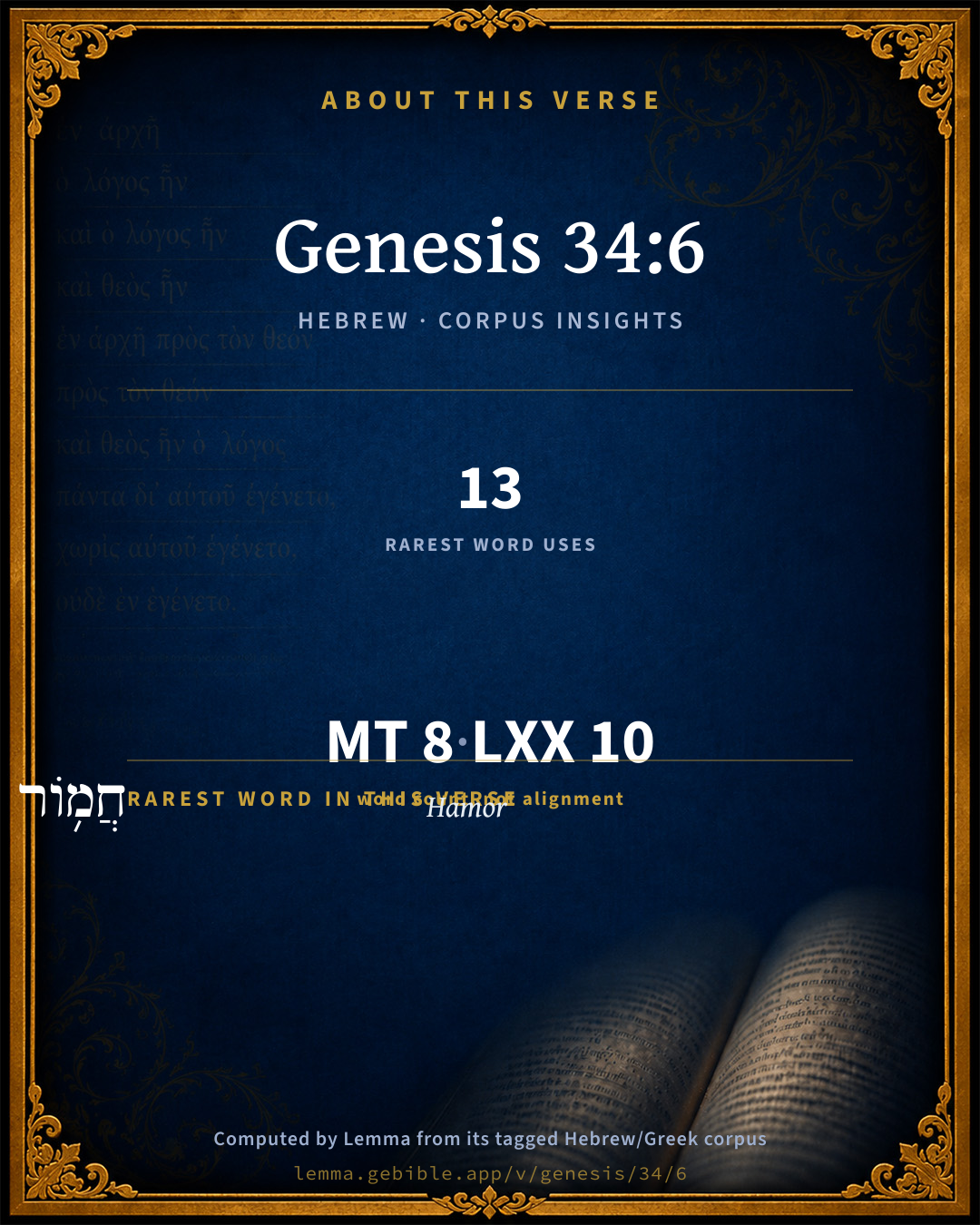
These counts appear in no published source. They are computed here, from the morphology-tagged text and Lemma’s own curated glosses. What Lemma adds →

8
words
8
distinct lemmas
Pentateuch
section

Notable vocabulary

The rarest word here is חֲמ֥וֹר Hamor H2544 — appearing just 13 times in the whole Hebrew Bible.

Shared distinctive vocabulary

חֲמ֥וֹר Hamor H2544 occurs in 12 verses of the Hebrew Bible. Also found in:

Grammatical profile

  • 2 verbs
  • 4 nouns
  • 2 prepositions

Verb forms

  • וַיֵּצֵ֛א Qal · Sequential Imperfect
  • לְדַבֵּ֖ר Piel · Infinitive Construct

Hebrew & Septuagint length

In English translation the verse runs 13 words from the Hebrew and 14 from the Septuagint (LXX English) — closely comparable.

A rough comparison of the two English renderings, which tokenize alike — not a word-level alignment.

Word counts can differ between the Hebrew and the Greek without any difference in meaning — e.g. the Hebrew direct-object marker אֵת has no separate Greek word, and Greek often adds the article ὁ.

In the original languages it is 8 Hebrew tokens and 10 Greek tokens — but the two are counted differently (Hebrew bundles its prefixes and suffixes into one token; the Greek is in lemma form), so that isn’t a like-for-like length.

Hebrew and Greek witnesses Masoretic Hebrew ↔ Greek Septuagint

The same verse in the two great witnesses to the Old Testament, shown verse-for-verse.

These are two independent witnesses, not word-aligned to each other, and the Septuagint is shown in lemma (dictionary) form.

Hebrew Genesis 34:6 Masoretic · Westminster Leningrad Codex

וַיֵּצֵ֛א חֲמ֥וֹר אֲבִֽי שְׁכֶ֖ם אֶֽל יַעֲקֹ֑ב לְדַבֵּ֖ר אִתּֽוֹ

Hamor the father of Shechem went out to Jacob to talk with him.

World English Bible · Public Domain

Greek LXX Genesis 34:6 Septuagint · lemma form

ἐκἔρχομαι δέ εμμωρ ὁ πατήρ συχεμ πρός ἰακώβ λαλέω αὐτός

And Emmor the father of Sychem went forth to Jacob, to speak to him.

LXX2012 (modern English Septuagint) · Public Domain

Hebrew: Westminster Leningrad Codex (CC BY 4.0). Greek: Septuagint (public domain); English from LXX2012 (modern English Septuagint) (Public Domain). How the Septuagint differs from the Hebrew →

Targum (Aramaic paraphrase)

2

The Targum is the ancient Jewish Aramaic paraphrase of the Hebrew Scriptures — an interpretive translation, not the Hebrew text itself. Onkelos (literal) and Pseudo-Jonathan (expansive) render the Torah, and Jonathan the Prophets. Coverage is partial: where no permissively-licensed English translation exists for a verse, only the Aramaic is shown. This is verse-level text, not a word-by-word alignment to the Hebrew.

  1. Targum Onkelos Torah (Genesis–Deuteronomy)
    וּנְפַק חֲמוֹר אֲבוּהִי דִּשְׁכֶם לְוַת יַעֲקֹב לְמַלָּלָא עִמֵּהּ

    (no public-domain English translation for this verse)

    Targum Onkelos — Aramaic: “Onkelos Genesis” (public domain); “Onkelos Exodus” (public domain); “Onkelos Leviticus” (public domain); “Onkelos Numbers” (public domain); “Onkelos Deuteronomy” (public domain). English: “Sefaria Community Translation” (CC0 1.0 (public-domain dedication)); “J.W. Etheridge. The Targums of Onkelos and Jonathan Ben Uzziel on the Pentateuch. London: Longmans, Green, 1862” (public domain). Text via Sefaria.

  2. Targum Pseudo-Jonathan Torah (Genesis–Deuteronomy)
    וּנְפַק חֲמוֹר אָבוֹי דִשְׁכֶם לְוַת יַעֲקב לְמַלָלָא עִמֵיהּ

    And Hamor the father of Shekem came forth to Jakob to speak with him.

    Targum Pseudo-Jonathan — Aramaic: “Targum Jonathan on Genesis” (public domain); “Targum Jonathan on Exodus” (public domain); “Targum Jonathan on Leviticus” (public domain); “Targum Jonathan on Numbers” (public domain); “Targum Jonathan on Deuteronomy” (public domain). English: “The Targum of Jonathan ben Uzziel, trans. J. W. Etheridge, London, 1862” (public domain). Text via Sefaria.

Commentary

Notes on Genesis 34:6 from classic Christian and Jewish commentators (each source and its license shown beneath its notes). The classic Christian expositions comment on the surrounding passage and are grouped to its opening verse, so a note may address several verses; the Jewish commentaries on the Tanakh (Rashi and others) are per-verse, so they appear only where the commentator wrote on this verse.

Lemma curates 59 commentaries, every one of them public domain or Creative Commons licensed, each selected and text-cleaned for this edition rather than reprinted as found. About our sources →

Trapp's Complete Commentary

John Trapp

Gen 34:6 And Hamor the father of Shechem went out unto Jacob to commune with him.

Ver. 6. And Hamor the father of Shechem,] Unruly youth put their aged parents, many times, to much travail and trouble; as Samson, Shechem, Paris, &c. Green wood is ever shrinking and warping; whereas the well-seasoned holds a constant firmness.

John Trapp, A Commentary or Exposition upon All the Books of the Old and New Testament (1647–1656) — public domain. Text from a community e-Sword module.

The Biblical Illustrator

Joseph S. Exell

Gen_34:6-31

They slew Hamor and Shechem his son with the edge of the sword, and took Dinah out of Shechems house

The punishment of Dinahs dishonour

I.

IT WAS PROMPTED BY A FEELING OF VENGEANCE AGAINST THE DOER OF A GROSS MORAL WRONG.

II. IT WAS A GRIEVOUS SIN.

1. Unjust and cruel. The punishment was far in excess of the fault, and the innocent were made to suffer with the guilty.

2. IT was committed under the hypocritical pretence of religion.

3. It was perilous to the true interests of the kingdom of God (Gen_34:30). (T. H.Leale.)

Sinful policy

The execution of this project was marked--

1. By the vilest hypocrisy. They pretended to have scruples of conscience about connecting themselves with persons who were uncircumcised.

2. By the grossest profaneness. They knew that if the Shechemites were persuaded to submit to circumcision it would be a mere form, leaving them as to their relation to God just where they were before. They propose that the males should receive the seal of Gods holy covenant, not in order to obtain any spiritual benefit, but solely with a view to carnal gratification.

3. It was conceived in the spirit of the most savage cruelty. What amazing depravity does it argue, first to form such a horrid purpose, and then to cover it with the cloak of religion. (W. Bush.)

Sin begets sin

Alas, how one sin leads to another, and like flames of fire, spreads desolation in every direction! Dissipation leads to seduction; seduction produces wrath; wrath thirsts for revenge; the thirst of revenge has recourse to treachery; treachery issues in murder; and murder is followed by lawless depredation! Were we to trace the history of illicit commerce between the sexes, we should find it, more perhaps than any other sin, terminating in blood. We may read this warning truth not only in the life of David and his family, but in what is constantly occurring in our own times. The murder of the innocent offspring by the hand of the mother, or of the mother by the hand of the seducer; or of the seducer by the hand of a brother, or a supplanted rival--are events which too frequently fail under our notice. Nor is this all, even in the present world. Murder seldom escapes detection: a public execution therefore may be expected to close the tragical process! (A. Fuller.)

Lessons

1. Sad news of misery on relations calling for help may take men off from their employments.

2. Grief is a duty for evil done to, or by, any of our relations.

3. Anger against sin committed is but due, if it be expressed orderly.

4. Men, though in the Church, are apt to be transported in wrath beyond bounds.

5. Uncleanness acted is the greatest folly that can be expressed Pro_7:22).

6. Pollution of any members in the Church of God is an aggravated folly.

7. Jacobs daughter to be defiled; it is a sad and grievous reproach.

8. The law of God expressly forbids such unclean actings. Therefore are they exceeding sinful in the Church (verse 7). (G. Hughes, B. D.)

Lessons

1. Sinful indulgent parents cover the foul enormities of rebellious children with fair pretences.

2. Wicked offenders love to be silent as to the confession of their villanies.

3. Lustful love is given out with the very soul, and may continue after violence done, the object abiding.

4. Injurious, violent men may entreat compliance with the afflicted and oppressed ones.

5. Marriage may be desired by wicked adulterers to hide their uncleanness (Gen_34:8).

6. General overtures of kindness may be made by wicked men of power for their special ends.

7. The world have desired affinity with the Church of God upon design (Gen_34:9).

8. Worldly powers may court the pilgrim Church to sit down with them for their own advantage.

9. Territories of princes are opened to the sons of the Church to engage them to evil.

10. Free trade, commerce, and possessions, are the baits wherewith worldly powers allure Gods servants unto their lusts.

11. Kingdoms and all will lust, part with all, to enjoy its pleasure (Gen_34:10). So Herod (Mar_6:22-23). (G. Hughes, B. D.)

Lessons

1. Lustful men may crouch to such as they have offended to get favour from them.

2. Lust is willing to buy out favour where it hath provoked (Gen_34:11).

3. Lust maketh men profuse and prodigal to have their pleasure, though to their own undoing.

4. Lustful creatures would buy out their offences, though not confess or bemoan them.

5. Lust agreeth to give men their demands that it may enjoy its own.

6. Lust acquiesceth only in the enjoyment of its desired evil (Gen_34:12). (G. Hughes, B. D.)

Lessons

1. Overflowing sorrows may cause wise and good fathers to entrust young children too much with great affairs.

2. Management of such great affairs wants good success usually, because acted by such hands.

3. Brethren under fathers may have a right as to disposing their sisters, wherein they may give counsel.

4. The sons of Jacob may be guileful, though he be plain.

5. Corruption and thoughts of revenge may move the sons of the Church to deal deceitfully (Gen_34:13).

6. The children of the Church cannot do justly what God forbids them.

7. It is unlawful for Church members to mingle themselves in marriages with Gods enemies (1Co_7:39).

8. It is a reproach unto the Church to act contrary to Gods ordinances.

9. The sons of the Church may urge Gods truths to wicked purposes (Gen_34:14).

10. Visible professors in the Church may wickedly offer Gods sacraments to be vilified by men.

11. Church-members may possibly err in annexing Gods seals to mens covenants.

12. Hypocrisy makes religion a cloak to iniquity.

13. Foolish men may consent to what God forbids for their wicked ends (Gen_34:15).

14. Marriages between the Church and Gods enemies hypocrites may admit upon design.

15. Wickedness may persuade men of the Church to become one people with the world (Gen_34:16).

16. Hypocrisy seems resolute to take its course where its conditions are refused.

17. Subtilty suggests mens denials and departure to make adversaries follow after them (Gen_34:17). (G. Hughes, B. D.)

Lessons

1. Sinful lust maketh like father like son.

2. Lust is pleased with the hardest terms for self-enjoyment.

3. Lust makes men yield to their own ruin without deliberation. The greatest evil seemeth good (Gen_34:18). (G. Hughes, B. D.)

Lessons

1. Childish fools hasten to the stocks and slaughter, and consider it not.

2. Lust needs no spurs, but hastes all it may to enjoy its pleasure.

3. Lust made honourable in persons, becomes most exemplary to lead others into the snare (Gen_34:19). (G. Hughes, B. D.)

Lessons

1. Lustful rulers bring all under them into evils with themselves.

2. Judicatures, or gates of cities, are perverted and seduced by wicked rulers; they are made places to plead for lust.

3. Evil rulers use their tongues and speeches to deceive their people (Gen_34:20).

4. Lust will commend any by whom it may be gratified, though it find the contrary.

5. Self-seeking princes will persuade people to anything for their own ends.

6. Wicked powers pretend lawful affinity to be made when they aim at sinful lust (Gen_34:21).

7. Lustful rulers do not only submit to hard conditions themselves, but press them on their people.

8. Lust is content to symbolize in the hardest duty external of religion, to enjoy its desire.

9. Lust desires to unite with any people who gratify its desires (Gen_34:22).

10. Pretence of gain, and spoil, and advantage, is a fit bait to bring seduced souls to consent to lust.

11. Rulers in sin will never leave until they bring their people to consent with them to evil (Gen_34:23). (G. Hughes, B. D.)

Lessons

1. Wicked people easily yield to wicked rulers to gratify their lusts.

2. It is usual for all to follow the example of rulers to sin.

3. Universal consent in evil is permitted where universal destruction is intended (Gen_34:24). (G. Hughes, B. D.)

Lessons

1. Treachery and cruelty watch their season exactly to effect their designs.

2. Guileful cruelty hath its method first to weaken men and then to kill them.

3. Anger and revenge ordered under Providence may make two prevail against thousands.

4. Corrupt nature meditates revenge to vindicate injury done unto relations.

5. Reverge goeth armed with instruments of cruelty to execute its designs.

6. Cruelty, uncontrolled by God, goeth out with security and confidence to ruin cities.

7. Bloody revenge spareth none that either have provoked, or may resist it.

8. God sometimes suffers ruin to befall subjects when they comply with rulers sins (Gen_34:25).

9. Exemplary destruction for rapes God orders upon father and son, sometimes even by wicked hands.

10. Ordinances of God abused to mens base ends, are made means to their own destruction.

11. Revenge is not quiet until it obtain its mark and carry back its desire (Gen_34:26).

12. A few revengeful spirits are apt to gather many unto them.

13. Bloody minds are covetous as cruel, set upon spoil.

14. Injury and provocation is usually urged by oppressing spoilers as just ground for their actings (Gen_34:27).

15. Rapine of goods God sometimes orders to avenge ravishing of innocents.

16. Unsatiable is covetous revenge when it comes to spoil at its will (Gen_34:28).

17. Revenge spareth neither sex nor age under its power.

18. Wealth within doors, as without the sword, takes up when it hath commission (Gen_34:29). (G. Hughes, B. D.)

Lessons

1. Gracious parents are justly angry with the sins of ungracious children, and should express it.

2. The chiefest leaders into sin should chiefly be set upon in angry reproof.

3. Sins of wicked children cannot but trouble and vex the spirits of gracious parents.

4. Horrid enormities of sons may bring all vexation and trouble upon parents.

5. Sin, wherever it is, makes an ill savour, a filthy stink.

6. Childrens sins often make their parents stink in the nostrils of men.

7. Notorious crimes in the members of the Church make the best of men stink in the world.

8. Guilt in persons, families, and Church, giveth just cause to fear dangers from Gods hand.

9. Little strength in the arm of flesh is an occasion of fear to saints in respect of great enemies.

10. The combination of the wicked against the Church, provoked by its members, is a just ground for fear.

11. The strokes of the wicked unto death may be terrible unto Gods servants.

12. Destruction, usually sought by the wicked to the whole Church, may terrify the members of it.

13. Fear of danger may arise, under the promise of Gods protection, when souls obey not God (Gen_34:30).

14. Outrageous spirits, though sons, regard not the honour of parents or God in their returns and replies to them.

15. Revenge seeks to justify outrage by pretence of sin, though men are not called to it.

16. Stupration of innocents hath exemplary returns of judgment from God.

17. Crimes of Church members are recorded for the Churchs instruction (Gen_34:31). (G. Hughes, B. D.)

The second mischief and miscarriage in Jacobs house was the massacre made upon the city Shechem, wherein Dinah had been deflowered, by his two sons, Simeon and Levi. This followed the first mischief, as the effect doth the cause, and as the thread doth the needle. This punishment is--

1. Projected.

2. Prosecuted.

3. Executed.

(1) For this intolerable affront done to this honourable family, wherein are considerable

(2) The inducement to; and

(3) the opportunity for some revenge.

(a) The inducement was twofold.

(b) Jacobs silence (Gen_34:5). (C. Ness.)

Marrying unbelievers

The Rev. S. Kilpin, of Exeter, had witnessed the awful consequences produced in the Church of Christ, and in families from those who professed to be the disciples of Jesus, forming marriages contrary to the command--Be not unequally yoked with unbelievers, only in the Lord, &c. As he never shunned to declare the whole counsel of God, this subject was presented to his congregation. The next day, a gentleman, whose name or residence he never knew, called to thank him for the discourse, adding that his state of mind, when he entered Exeter, was most distressing, as he was on the very point of complying with a dreadful temptation which would have embittered his future life. He had been a disciple of Christ, was anxious to consecrate his life to the service of his adorable Muster, and had sought a helpmate to strengthen his hands in serving God. A lady, whom he deemed pious, had accepted his addresses; but, when every customary arrangement was made, she had dishonourably discarded him. His mind was so exceedingly wounded and disgusted, that he had determined to choose a wife who made no profession of religion, and had fixed on another object for his addresses, with every prospect of success, although he had not as yet mentioned his intention to her. He added, But the providence of God led me, an entire stranger in this city, to your meeting-house. You may suppose that your subject arrested my attention. You appeared to be acquainted with every feeling of my soul. I saw my danger, and perceived the temptation, and the certain ruin of my peace, if the dreadful snare had not been broken. You, sir, under God, have been my deliverer. By the next Sabbath I should have been bound in honour to an enemy of that Jesus whom I adore; for although she is moral and externally correct, yet she knows the Saviour only in name. I could not leave the city in peace until I had sought to make this communication. They unitedly addressed Him who can deliver, and does deliver His people. Thus, while part of his congregation thought it an unfit subject for the pulpit, at least one person received it as a message from God, by whom it was no doubt sent. (Moral and Religious Anecdotes.)

.

The Biblical Illustrator, edited by Joseph S. Exell (c. 1880s–1900s) — public domain. Text from a community e-Sword module.

Joseph Benson's Commentary

Gen 34:6. Hamor went to commune with Jacob — It seems that Jacob would have acted wisely if he had followed his own judgment in this affair, instead of consulting his sons, who were young, rash, and violent. But it is evident that they had gained a considerable degree of influence with him: and on this occasion they plunged him into great trouble, and his whole family into great disgrace and danger.

Joseph Benson's Commentary on the Old and New Testaments (1811–1818) — public domain. Text from a community e-Sword module.

The Preacher's Complete Homiletical Commentary

Joseph S. Exell (gen. ed.)

CRITICAL NOTES.—

Gen_34:6. Hamor, the father of Shechem, went out unto Jacob to commune with him.] In Oriental countries the fathers arrange the marriages of their children.

Gen_34:7. Wrought folly in Israel.] “This was a standing phrase from this time forth for crimes against the honour and vocation of Israel as the covenant people, especially for gross sins of the flesh.” (Deu_22:21; Jdg_20:10; 2Sa_13:2.) “Fool” and “folly” are terms used of impiety and iniquity.” (See Proverbs.) (Jacobus). “The expression manifestly belongs to a later time, and betrays the hand of a subsequent editor. It could hardly have been found in any document dating previously to the constitution of a community known by the name of Israel.” (Alford.)

Gen_34:12. Dowry and gift.] Dowry to the bride, gifts to her family.

Gen_34:26. With the edge of the sword.] Heb. “By the mouth of the sword.” Whence the sword is said to “devour.”

MAIN HOMILETICS OF THE PARAGRAPH.—Gen_34:6-31

THE PUNISHMENT OF DINAH’S DISHONOUR

I. It was prompted by a feeling of vengeance against the doer of a gross moral wrong. The sons of Jacob were not satisfied with the offer of Shechem to repair the evil, to redeem the wrongs he had brought upon their house. They considered it so grievous as to be beyond repair. “He had wrought folly in Israel, in lying with Jacob’s daughter.” (Gen_34:17.) They regarded his act as a sin against the chosen of God—against the Church. A stricter morality, and a stronger sense of the evil of sin, enters with this name of Israel. All who were called by that name lived in a different moral atmosphere from the surrounding nations. The sons of Jacob looked upon the deed in itself as not to be wiped away by any amendments of the future. It was wrong, and must be visited for its own sake as well as for its consequences. It “ought not to be done.” (Gen_34:17.)

II. It was a grievous sin.

1. It was unjust and cruel. The punishment was far in excess of the fault, and the innocent were made to suffer with the guilty. In the moral government of God men do suffer for the sins of others, but to inflict those sufferings ourselves, of set purpose, is a sin against justice. It was cruel to take advantage of men whom they had first rendered helpless. (Gen_34:25.)

2. It was committed under the hypocritical pretence of religion. (Gen_34:15-18). Here was hypocrisy in hiding this crafty cruelty under the name of religion. A sacrament is prostrated to the vilest purposes—used for murder. This conduct has all the characteristics of religious fanaticism; which clings to religion, not as a healthy, but as a monstrous and diseased growth. It was a right feeling which led the sons of Jacob to defend the purity and honour of their family, but it was wrong to secure even this high purpose by the prostitution of the offices of religion.

3. It was perilous to the true interests of the kingdom of God. “Ye have troubled me,” said Jacob, to make me to stink among the inhabitants of the land,” etc. (Gen_34:30.) Jacob was the Israel of God, and he felt that his sons by this foul deed had made him offensive to the heathen. They had endangered the existence of the Church. And such are always the results of fanaticism. They throw discredit upon Christianity. Abraham and Isaac had been peaceable in their days, and had won the respect of the surrounding heathen. Jacob now felt as if the ancient renown of his house were laid in the dust.

SUGGESTIVE COMMENTS ON THE VERSES

Gen_34:6-7. Their resentment was faulty in assuming the character of a bloody vindictiveness. It was proper that they should be grieved, it was not unnatural that they should be wroth; and it was much to their honour that they were disposed to brand the violator of chastity with infamy. But was it for the sin committed against God, or only for the shame visited upon the family, that they were engaged? Here, alas, they failed.—(Gen_49:7.—(Bush).

Unruly youths put their aged parents, many times, to much travail and trouble; as Samson, Shechem, etc. Green wood is ever shrinking and warping; whereas the well-seasoned holds a constant firmness.—(Trapp).

Gen_34:8-12.—Many fine things were said, both by the father as a politician, in favour of intermarriages between the families in general, and by the son as a lover, in order to gain the damsel.—(Fuller).

Their uninstructed minds could not enter into the reasons of such an exclusive policy in this respect as the Israelites felt constrained to adopt. In the true spirit of an unbelieving world they endeavoured to break down what they would deem the narrow spirit of caste, by holding out to them those inducements of gainful traffic which they are sensible they could not themselves withstand in similar circumstances, and which, alas, are usually but too potent in overcoming the scruples of the professed people of God.—(Bush).

Gen_34:13-17. The execution of this project was marked—

1. By the vilest hypocrisy. They pretended to have scruples of conscience about connecting themselves with persons who were uncircumcised.

2. By the grossest profaneness. They knew that if the Shechemites were persuaded to submit to circumcision it would be a mere form, leaving them as to their relation to God just where they were before. They propose that the males should receive the seal of God’s holy covenant, not in order to obtain any spiritual benefit, but solely with a view to carnal gratification.

3. It was conceived in the spirit of the most savage cruelty. What amazing depravity does it argue, first to form such a horrid purpose, and then to cover it with the cloak of religion.—(Bush).

In Oriental countries it is held that the brothers are more deeply disgraced by the seduction of their sister than the husband is by the fall of his wife; for the wife can be divorced but not the sister.—(Jacobus).

Gen_34:18-19. This high character is given to him, perhaps referring only to his social standing. But he was a heathen, and the covenant family of Jacob must have known that no mere outward ceremonial act could incorporate them with the chosen family so as to make them sharers in the future glory of Israel. Nor could the sacrament itself make this wrong-doer a true Israelite. He took a mere worldly view of the matter, and was willing to take the sacrament for gain.—(Jacobus).

Gen_34:20-23. These great men easily persuaded and prevailed with the people to have what they would. When Crispus believed, who was the chief ruler of the synagogue, many Corinthians believed also. (Act_18:8.) Paul was loath to lose the deputy, because his conversion would draw on many others. As, on the contrary, Jereboam caused Israel to sin; and generally, as the kings were good or evil, so were the people.—(Trapp.)

No little art is discoverable in the arguments employed. The principal prominence is given to those considerations which were merely secondary, while the main point, the circumcision, comes in as a little by-clause, a slight condition, to which they could not reasonably object. This was approaching worldly men through the most effectual avenue. Appeals to their interest usually succeed where their principles are addressed in vain.—(Bush.)

It is the worldly policy of rulers to pretend the public good.

Profit persuades mightily with the multitude. They all look to their own way. (Isa_56:11.)—(Trapp.)

Gen_34:24. Many have lost their blood, and suffered much trouble for their lusts, as, had it been for religion, they had been martyrs. But the cause, and not the punishment, makes the martyr.—(Trapp.)

Nations do not readily change their gods. (Jer_2:10-11.) The ready submission of this people to the rites of a new religion is one of the most singular facts of all history.

Gen_34:25-29. We have here a fresh proof of the veracity of Moses. Himself a Levite, he does not spare the character of his progenitor. In all the simplicity of truth he gives an unvarnished statement of atrocities which have reflected everlasting disgrace upon the memory of the founder of his line. Would an imposter have done this?—(Bush.)

One sin leads on to another, and, like flames of fire, spreads desolation on every side. Dissipation leads to seduction; seduction produces wrath; wrath thirsts for revenge; the thirst for revenge has recourse to treachery; treachery issues in murder; and murder is followed by lawless depredation.—(Bush).

This history, like that of David and others, shows that sins against social purity tend, more than any other, to produce all the evils of hatred, revenge, and murder.

Gen_34:30. He does not now make mention of their crime against God, but only of the immediate consequences to him and to his house. He mentions this peril to arouse the compunction of his sons. They might care for this common danger, if not for their sin.—(Jacobus).

Gen_34:31. Instead of regretting that they had acted so treacherous and cruel a part, they vindicate themselves without hesitation, and even tacitly condemn their father as manifesting less concern for his daughter than they had shown for their sister. Daily experience shows us that when once the conscience is seared, there is no iniquity too gross to be palliated or justified.—(Bush.)

The Preacher's Complete Homiletical Commentary (gen. ed. Joseph S. Exell; Funk & Wagnalls, c. 1892) — public domain (pre-1929). A full-Bible homiletical/sermon-outline anthology covering 65 of 66 books (2 John is absent from the source module). Text from a community e-Sword module.

Matthew Henry's Commentary

Jacob's sons, when they heard of the injury done to Dinah, showed a very great resentment of it, influenced perhaps rather by jealousy for the honour of their family than by a sense of virtue. Many are concerned at the shamefulness of sin that never lay to heart the sinfulness of it. It is here called folly in Israel (Gen 34:7), according to the language of after-times; for Israel was not yet a people, but a family only. Note, 1. Uncleanness is folly; for it sacrifices the favour of God, peace of conscience, and all the soul can pretend to that is sacred and honourable, to a base and brutish lust. 2. This folly is most shameful in Israel, in a family of Israel, where God is known and worshipped, as he was in Jacob's tents, by the name of the God of Israel. Folly in Israel is scandalous indeed. 3. It is a good thing to have sin stamped with a bad name: uncleanness is here proverbially called folly in Israel, Sa2 13:12. Dinah is here called Jacob's daughter, for warning to all the daughters of Israel, that they betray not themselves to this folly.

Hamor came to treat with Jacob himself, but he turns him over to his sons; and here we have a particular account of the treaty, in which, it is a shame to say, the Canaanites were more honest than the Israelites.

I. Hamor and Shechem fairly propose this match, in order to a coalition in trade. Shechem is deeply in love with Dinah; he will have her upon any terms, Gen 34:11, Gen 34:12. His father not only consents, but solicits for him, and gravely insists upon the advantages that would follow from the union of the families, Gen 34:9, Gen 34:10. He shows no jealousy of Jacob, though he was a stranger, but rather an earnest desire to settle a correspondence with him and his family, making him that generous offer, The land shall be before you, trade you therein.

II. Jacob's sons basely pretend to insist upon a coalition in religion, when really they designed nothing less. If Jacob had taken the management of this affair into his own hands, it is probable that he and Hamor would soon have concluded it; but Jacob's sons meditate only revenge, and a strange project they have for the compassing of it - the Shechemites must be circumcised; not to make them holy (they never intended that), but to make them sore, that they might become an easier prey to their sword. 1. The pretence was specious. "It is the honour of Jacob's family that they carry about with them the token of God's covenant with them; and it will be a reproach to those that are thus dignified and distinguished to enter into such a strict alliance with those that are uncircumcised (Gen 34:14); and therefore, if you will be circumcised, then we will become one people with you," Gen 34:15, Gen 34:16. Had they been sincere herein their proposal of these terms would have had in it something commendable; for Israelites should not intermarry with Canaanites, professors with profane; it is a great sin, or at least the cause and inlet of a great deal, and has often been of pernicious consequence. The interest we have in any persons, and the hold we have of them, should be wisely improved by us, to bring them to the love and practice of religion (He that winneth souls is wise); but then we must not, like Jacob's sons, think it enough to persuade them to submit to the external rites of religion, but must endeavour to convince them of its reasonableness, and to bring them acquainted with the power of it. 2. The intention was malicious, as appears by the sequel of the story; all they aimed at was to prepare them for the day of slaughter. Note, Bloody designs have often been covered, and carried on, with a pretence of religion; thus they have been accomplished most plausibly and most securely: but this dissembled piety is, doubtless, double iniquity. Religion is never more injured, nor are God's sacraments more profaned, than when they are thus used for a cloak of maliciousness. Nay, if Jacob's sons had not had this bloody design, I do not see how they could justify their offering the sacred sign of circumcision, the seal of God's covenant, to these devoted Canaanites, who had no part nor lot in the matter. Those had no right to the seal that had no right to the promise. It is not meet to take the children's bread, and cast it to dogs: but Jacob's sons valued not this, while they could make it serve their turn.

Matthew Henry's Commentary on the Whole Bible (1708–1710) — public domain (CC PDM 1.0). Text via the HelloAO Bible API.

Jamieson, Fausset & Brown

Robert Jamieson, A. R. Fausset & David Brown

Hamor--that is, "ass"; and it is a striking proof of the very different ideas which, in the East, are associated with that animal, which there appears sprightly, well proportioned, and of great activity. This chief is called Emmor (Act 7:16).

Jamieson, Fausset & Brown — Commentary Critical and Explanatory on the Whole Bible (1871) — public domain (CC PDM 1.0). Text via the HelloAO Bible API.

The Cambridge Bible for Schools and Colleges

gen. ed. J. J. S. Perowne

6. And Hamor] This verse continues Gen_34:4. The intervening Gen_34:5 is continued in Gen_34:7.

The Cambridge Bible for Schools and Colleges (gen. ed. J. J. S. Perowne; Cambridge University Press, 1878–1918) — public domain. Text from a community e-Sword module.

John Gill's Exposition

And Hamor, the father of Shechem, went out unto Jacob,.... Unto the tent of Jacob without the city:

to commune with him; to talk with him about the affair of Dinah, to pacify him, and endeavour to gain his consent, that his son might marry her, and to settle the, terms and conditions of the marriage.

John Gill's Exposition of the Whole Bible (1746–1763) — public domain (CC PDM 1.0). Text via the HelloAO Bible API.

The Pulpit Commentary

And (meantime) Hamor the father of Shechem went out accompanied by Shechem (ver. 11)unto Jacob who was encamped in the outskirts of the city (Gen_33:18) to commune with him concerning Dinah"s marriage with his son.

The Pulpit Commentary (1880–1919), ed. H.D.M. Spence-Jones & Joseph S. Exell — public domain. Text from a community e-Sword module.

Kretzmann's Popular Commentary

Paul E. Kretzmann

Hamor’s Proposal

v. 6. And Hamor, the father of Shechem, went out unto Jacob to commune with him. He left the city and went out to the camp of Jacob, to anticipate the indignation of Jacob’s sons and to straighten out the matter peacefully.

v. 7. And the sons of Jacob came out of the field when they heard it. The bad news reached them also before the usual hour for returning from the field, and they acted with the impetuosity of youth. And the men were grieved, and they were very wroth, because he had wrought folly in Israel in lying with Jacob’s daughter; which thing ought not to be done. Even in those days, when the family of Jacob was still small, the act of Shechem was considered an insult to the entire tribe. The more the sons of Jacob therefore thought about it, the higher their anger mounted. The dignity of the entire posterity of Israel had been besmirched, and they felt that they could not bear the disgrace.

v. 8. And Hamor communed with them, saying, the soul of my son Shechem longeth for your daughter; I pray you give her him to wife. Hamor seems to have felt that he was representing a very weak case, for his proposal impresses the reader as being made in great hesitation and embarrassment. He pleads the deep and serious attachment of his son for Dinah.

v. 9. And make ye marriages with us, and give your daughters unto us, and take our daughters unto you.

v. 10. And ye shall dwell with us; and the land shall be before you; dwell and trade ye therein, and get you possessions therein. Hamor thus offered to Jacob and his sons the freedom of his little country, with the full rights of citizenship. They might do business anywhere and select any part of the country for their herds.

v. 11. And Shechem said unto her father and unto her brethren, Let me find grace in your eyes and what ye shall say unto me I will give.

v. 12. Ask me never so much dowry and gift, and I will give according as ye shall say unto me; but give me the damsel to wife. Thus Shechem added his personal plea to the proposal of his father, begging to be received into the family with favor and urging them to set their own price for the bride and to ask whatever bridal gifts they might choose. He may have been sincere enough according to his own lights, not realizing the fact that the family of the patriarch was the Lord’s chosen people. A folly is easily committed, but its removal will often tax the efforts of a lifetime.

Paul E. Kretzmann, Popular Commentary of the Bible (1921–1924) — public domain. Text from a community e-Sword module.

unfoldingWord translationNotes

Door43 World Missions Community

Hamor ... went out to Jacob

"Hamor ... went to meet Jacob"

The men were offended

"The men were very insulted" or "They were shocked"

he had disgraced Israel

Here the word "Israel" refers to every member of Jacob's family. Israel as a people group was disgraced. AT: "he had humiliated the family of Israel" or "he had brought shame on the people of Israel" (See: Metonymy)

forcing himself on Jacob's daughter

"assaulting Jacob's daughter"

for such a thing should not have been done

This can be stated in active form. AT: "for he should not have done such a terrible thing" (See: Active or Passive)

translationWords

Hamor

Shechem

Jacob

disgrace

Israel

unfoldingWord translationNotes — © Distant Shores Media and the Door43 World Missions Community, licensed CC BY-SA 4.0. Source: git.door43.org/Door43/en_tn.

Lesson kit

Teaching starters — assembled from the data on this page, not authored interpretation. Every prompt links to the verse data it draws on. Edit before teaching.

Genesis, in the Pentateuch, opens this verse with 8 words (8 distinct Hebrew lemmas). Its most distinctive word is Chămôwr (“Hamor”). A historical commentator’s framing appears above. Read the whole chapter for the surrounding context.

Discussion questions

  1. How does “Hamor” (Chămôwr) shape what this verse is saying?
  2. How does Genesis 33:19, which shares the word «Hamor», read alongside this verse?
  3. These translations render this verse differently. What is at stake in choosing one wording over another?
  4. «וַיֵּצֵ֛א» is a Qal Sequential Imperfect verb. How does that grammatical form shape the action described?
  5. Compare how Trapp's Complete Commentary and The Biblical Illustrator read this verse. Where do they agree or differ?

Things to notice

Reading settings

Reading text

Shown beneath each verse's original-language words.

Old Testament
Old Testament edition

Read the OT as the Masoretic Hebrew (MT) or the Greek Septuagint (LXX).

English shown for the Greek Septuagint (in the Hebrew ↔ Greek comparison).

Comparing translations? Open the Compare panel on any verse page to stack up to four side by side.