Genesis 41:51

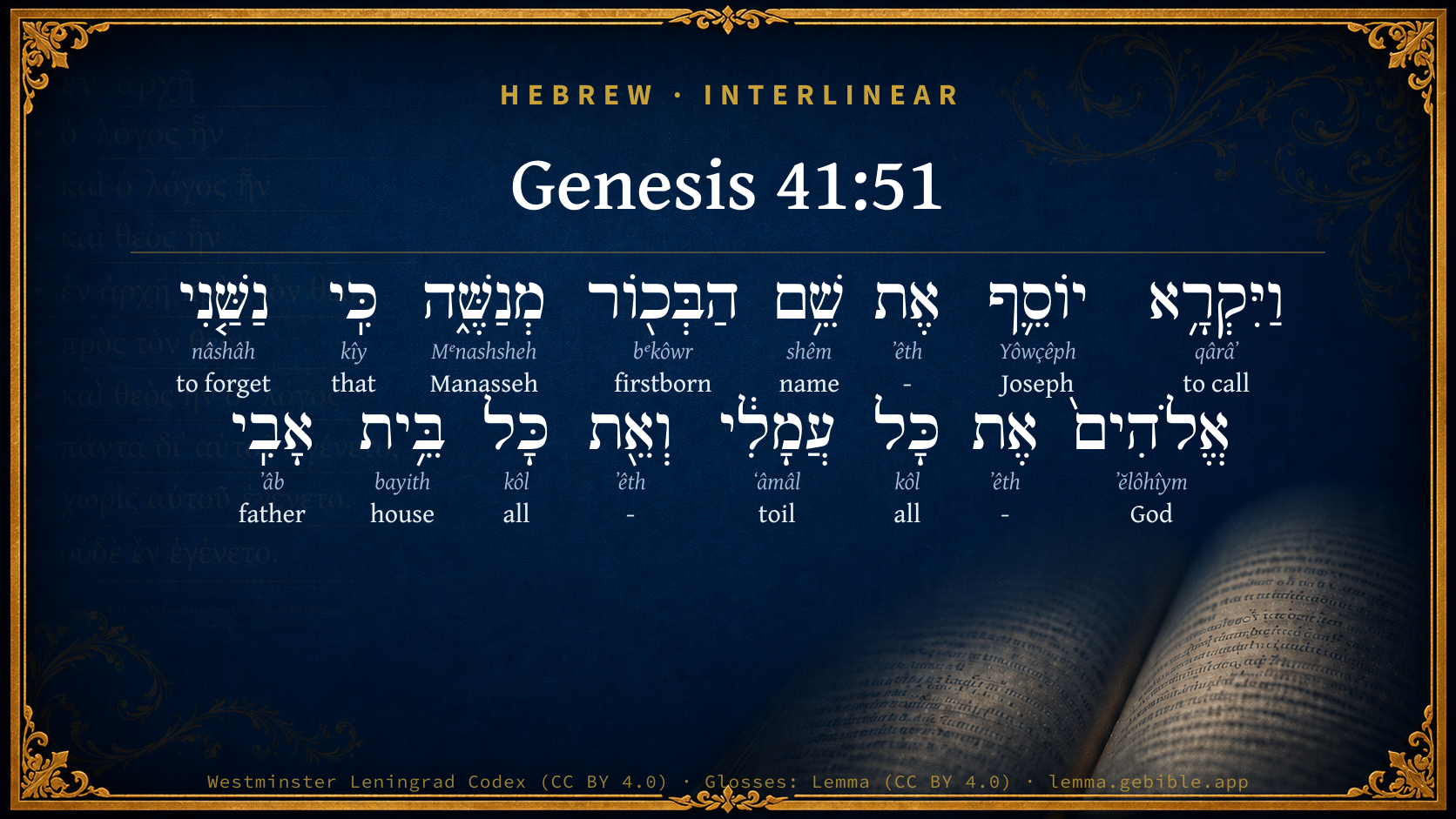
Hebrew (Westminster Leningrad Codex) Genesis 41:51 appears in the Hebrew Old Testament. The text above is from the Westminster Leningrad Codex. Each word links to its Strong’s number, a concise gloss, and parsing drawn from the Open Scriptures Hebrew Bible morphology. Click any word for its full Brown-Driver-Briggs (BDB) entry.
Download image
Cite this verse

Genesis 41:51 (World English Bible). Public Domain. Lemma interlinear Bible study tool, https://lemma.gebible.app/v/genesis/41/51.

Show BibTeX & RIS
BibTeX
RIS
English Translation
Joseph called the name of the firstborn Manasseh, "For," he said, "God has made me forget all my toil, and all my father's house."
World English Bible · Public Domain
Highlights
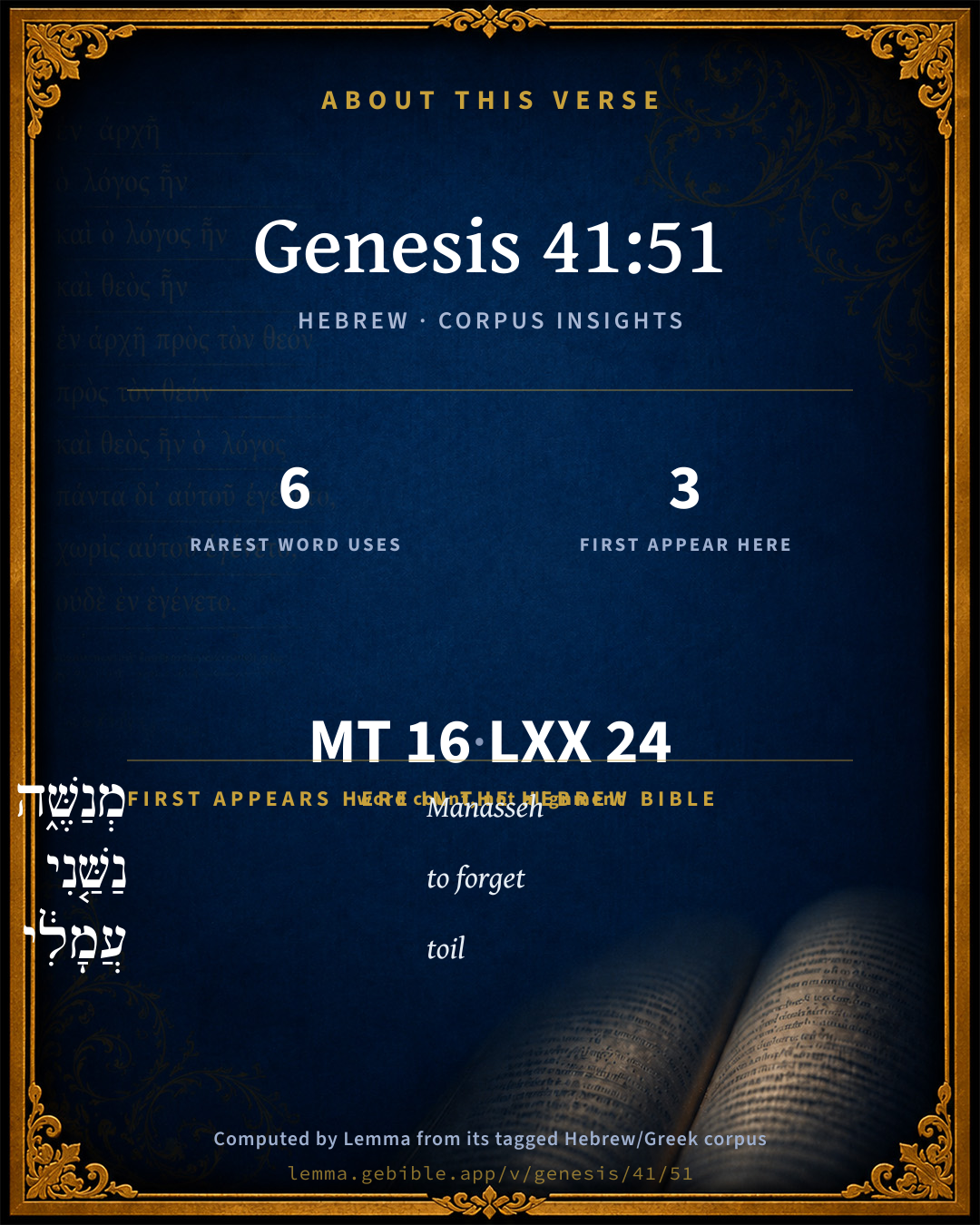
  • 3 first appearances in the Hebrew Bible
Full analysis ↓
Download a study sheet

One document with this verse’s original text, its word-by-word gloss line, the meaning frame, cross-references with their text, attributed commentary, and full source and license credits — printable, and it pastes into notes with its structure intact.

This verse Autodidact and up

Study sheet (.html) Plain text (.txt)

A passage Seminary Student

Up to 50 verses in one chapter. A passage sheet keeps up to 6 commentary sources and 12 cross-references per verse, in the order this page ranks them, and says so on the sheet whenever that leaves anything out. Ask for a single verse and you get the Autodidact verse sheet above.

Everything on this page stays free to read, with no account — the sheet is a download of what is already on screen, not access to it.

Want to remove ads? Support Godless Engineer
Compare translations 3

The same verse in 3 English versions, stacked beneath the original-language interlinear above. Click any original word for its lexicon entry.

Each is an independent rendering of the whole verse — the interlinear is not word-aligned to these translations.

Highlighted words mark where these versions differ — a whole-verse word diff, not a word-by-word alignment.

  • World English Bible Public Domain
    Joseph called the name of the firstborn Manasseh, "For," he said, "God has made me forget all my toil, and all my father's house."
  • King James Version Public Domain
    And Joseph called the name of the firstborn Manasseh: For God, said he, hath made me forget all my toil, and all my father's house.
  • unfoldingWord Literal Text CC BY-SA 4.0
    And Joseph called the name of the firstborn Manasseh, because, “God has made me forget all my toil and all of my father’s house.”

unfoldingWord Literal Text — © unfoldingWord, licensed CC BY-SA 4.0. Word-aligned USFM3 via Door43 (git.door43.org/unfoldingWord/en_ult).

Versions to compare (up to 4)

3 of 4 selected

Show all 18 translations

Every available English version of this verse, each an independent rendering of the whole verse.

  • World English Bible Public Domain
    Joseph called the name of the firstborn Manasseh, "For," he said, "God has made me forget all my toil, and all my father's house."
  • Berean Standard Bible Public Domain
    Joseph named the firstborn Manasseh, saying, “God has made me forget all my hardship and all my father’s household.”
  • Majority Standard Bible Public Domain
    Joseph named the firstborn Manasseh, saying, “God has made me forget all my hardship and all my father’s household.”
  • King James Version Public Domain
    And Joseph called the name of the firstborn Manasseh: For God, said he, hath made me forget all my toil, and all my father's house.
  • American Standard Version (1901) Public Domain
    And Joseph called the name of the first-born Manasseh: For, `said he', God hath made me forget all my toil, and all my father's house.
  • Revised Version (1885) Public Domain
    And Joseph called the name of the firstborn Manasseh: For, said he, God hath made me forget all my toil, and all my father’s house.
  • Geneva Bible (1599) Public Domain
    And Ioseph called the name of the first borne Manasseh: for God, said he, hath made me forget all my labour and al my fathers houshold.
  • Douay-Rheims (1899) Public Domain
    And there was so great abundance of wheat, that it was equal to the sand of the sea, and the plenty exceeded measure.
  • Young's Literal Translation Public Domain
    and Joseph calleth the name of the first-born Manasseh: `for, God hath made me to forget all my labour, and all the house of my father;'
  • Literal Standard Version CC BY-SA 4.0
    and Joseph calls the name of the firstborn Manasseh: “For God has made me to forget all my labor, and all the house of my father”;
  • Unlocked Literal Bible CC BY-SA 4.0
    Joseph called the name of his firstborn Manasseh, for he said, “God has made me forget all my trouble and all my father's household.”
  • unfoldingWord Literal Text CC BY-SA 4.0
    And Joseph called the name of the firstborn Manasseh, because, “God has made me forget all my toil and all of my father’s house.”
  • Darby Bible Public Domain
    And Joseph called the name of the firstborn Manasseh -- For God has made me forget all my toil, and all my father's house.
  • World Messianic Bible Public Domain
    Joseph called the name of the firstborn Manasseh, “For”, he said, “God has made me forget all my toil, and all my father’s house.”
  • Webster's Bible Public Domain
    And Joseph called the name of the first-born Manasseh: For God, said he, hath made me forget all my toil, and all my father's house.
  • Free Bible Version CC BY-SA 4.0
    Joseph named his firstborn Manasseh, because he said, “The Lord has made me forget all my troubles and all my father's family.”
  • Bible in Basic English Public Domain
    And to the first he gave the name Manasseh, for he said, God has taken away from me all memory of my hard life and of my father's house.
  • JPS Tanakh (1917) Public Domain
    And Joseph called the name of the first-born Manasseh: 'for God hath made me forget all my toil, and all my father's house.'

Literal Standard Version (2020), Covenant Press — licensed CC BY-SA 4.0. Text via the HelloAO Bible API (eBible.org). Unlocked Literal Bible (unfoldingWord) — licensed CC BY-SA 4.0. Text via the HelloAO Bible API (eBible.org). unfoldingWord Literal Text — © unfoldingWord, licensed CC BY-SA 4.0. Word-aligned USFM3 via Door43 (git.door43.org/unfoldingWord/en_ult). Free Bible Version, Dr. Jonathan Gallagher — licensed CC BY-SA 4.0. Text via the HelloAO Bible API (eBible.org).

Word by word

More ways to search: Search by grammar → Find every occurrence → Compare this word →

Practice this passage: Drill this verse → Learn its vocabulary →

נַשַּׁ֤נִי
nâshâh
H5382
“to forget · me”
Verb, Piel, Perfect, 3rd Person, Masculine, Singular + Suffix, Personal, 1st Person, Common, Singular
Part of Speech
Verb
Stem
Piel
Form
Perfect
Person
3rd Person
Gender
Masculine
Number
Singular
Full BDB Definition

Origin: a primitive root

TWOT: 1428

to forget, deprive - (Qal) to forget - (Niphal) to be forgotten - (Piel) to cause to forget - (Hiphil) to cause to forget, allow to be forgotten
  1. וַיִּקְרָ֥א qârâʼ H7121 “and · to call” Conjunction + Verb, Qal, Sequential Imperfect, 3rd Person, Masculine, Singular
  2. יוֹסֵ֛ף Yôwçêph H3130 “Joseph” Noun, Proper
  3. אֶת ʼêth H853 “-” Particle, Direct Object
  4. שֵׁ֥ם shêm H8034 “name of” Noun, Common, Masculine, Singular, Construct
  5. הַבְּכ֖וֹר bᵉkôwr H1060 “the · firstborn” Particle, Definite Article + Noun, Common, Masculine, Singular, Absolute
  6. מְנַשֶּׁ֑ה Mᵉnashsheh H4519 “Manasseh” Noun, Proper
  7. כִּֽי kîy H3588 “that” Conjunction
  8. אֱלֹהִים֙ ʼĕlôhîym H430 “God(s)” Noun, Common, Masculine, Plural, Absolute
  9. אֶת ʼêth H853 “-” Particle, Direct Object
  10. כָּל kôl H3605 “all of” Noun, Common, Masculine, Singular, Construct
  11. עֲמָלִ֔י ʻâmâl H5999 “toil · my” Noun, Common, Both, Singular, Construct + Suffix, Personal, 1st Person, Common, Singular
  12. וְאֵ֖ת ʼêth H853 “and · -” Conjunction + Particle, Direct Object
  13. כָּל kôl H3605 “all of” Noun, Common, Masculine, Singular, Construct
  14. בֵּ֥ית bayith H1004 “house of” Noun, Common, Masculine, Singular, Construct
  15. אָבִֽי ʼâb H1 “father · my” Noun, Common, Masculine, Singular, Construct + Suffix, Personal, 1st Person, Common, Singular

About this verse

These counts appear in no published source. They are computed here, from the morphology-tagged text and Lemma’s own curated glosses. What Lemma adds →

16
words
13
distinct lemmas
Pentateuch
section

Notable vocabulary

The rarest word here is נַשַּׁ֤נִי to forget H5382 — appearing just 6 times in the whole Hebrew Bible.

First appearance in Scripture

These words make their first canonical appearance in the Hebrew Bible here:

  • מְנַשֶּׁ֑ה Manasseh H4519
  • נַשַּׁ֤נִי to forget H5382
  • עֲמָלִ֔י toil H5999

Shared distinctive vocabulary

נַשַּׁ֤נִי to forget H5382 occurs in 6 verses of the Hebrew Bible. Also found in:

Grammatical profile

  • 2 verbs
  • 10 nouns
  • 1 conjunction
  • 3 particles

Verb forms

  • וַיִּקְרָ֥א Qal · Sequential Imperfect
  • נַשַּׁ֤נִי Piel · Perfect

Repetition

A word recurs within this verse — often emphatic in Hebrew:

Hebrew & Septuagint length

In English translation the verse runs 24 words from the Hebrew and 25 from the Septuagint (LXX English) — closely comparable.

A rough comparison of the two English renderings, which tokenize alike — not a word-level alignment.

Word counts can differ between the Hebrew and the Greek without any difference in meaning — e.g. the Hebrew direct-object marker אֵת has no separate Greek word, and Greek often adds the article ὁ.

In the original languages it is 16 Hebrew tokens and 24 Greek tokens — but the two are counted differently (Hebrew bundles its prefixes and suffixes into one token; the Greek is in lemma form), so that isn’t a like-for-like length.

Cross-references

11

Topical passages linked to Genesis 41:51 in the Treasury of Scripture Knowledge — connected by theme and wording, ordered by reader-vote popularity; previews shown in the World English Bible.

  • Psalms 30:5 For his anger is but for a moment; His favor is for a lifetime. Weeping may stay for the night, But joy comes in the morning.
  • Proverbs 31:7 Let him drink, and forget his poverty, And remember his misery no more.
  • Genesis 41:30 There will arise after them seven years of famine, and all the plenty will be forgotten in the land of Egypt. The famine will consume the land,
  • Deuteronomy 33:17 The firstborn of his herd, majesty is his; His horns are the horns of the wild-ox: With them he shall push the peoples all of them, [even] the ends of the earth: They are the ten thousands of Ephraim, They are the thousands of Manasseh.
  • Psalms 30:11 You have turned my mourning into dancing for me. You have removed my sackcloth, and clothed me with gladness,
  • Genesis 48:5 Now your two sons, who were born to you in the land of Egypt before I came to you into Egypt, are mine; Ephraim and Manasseh, even as Reuben and Simeon, will be mine.
  • Genesis 48:13–14 Joseph took them both, Ephraim in his right hand toward Israel's left hand, and Manasseh in his left hand toward Israel's right hand, and brought them near to him.
  • Genesis 48:18–20 Joseph said to his father, "Not so, my father; for this is the firstborn; put your right hand on his head."
  • Psalms 45:10 Listen, daughter, consider, and turn your ear. Forget your own people, and also your father's house.
  • Isaiah 57:16 For I will not contend forever, neither will I be always angry; for the spirit would faint before me, and the souls who I have made.
  • Isaiah 65:16 so that he who blesses himself in the earth shall bless himself in the God of truth; and he who swears in the earth shall swear by the God of truth; because the former troubles are forgotten, and because they are hid from my eyes.

Cross-references courtesy of OpenBible.info (CC BY 4.0).

Hebrew and Greek witnesses Masoretic Hebrew ↔ Greek Septuagint

The same verse in the two great witnesses to the Old Testament, shown verse-for-verse.

These are two independent witnesses, not word-aligned to each other, and the Septuagint is shown in lemma (dictionary) form.

Hebrew Genesis 41:51 Masoretic · Westminster Leningrad Codex

וַיִּקְרָ֥א יוֹסֵ֛ף אֶת שֵׁ֥ם הַבְּכ֖וֹר מְנַשֶּׁ֑ה כִּֽי נַשַּׁ֤נִי אֱלֹהִים֙ אֶת כָּל עֲמָלִ֔י וְאֵ֖ת כָּל בֵּ֥ית אָבִֽי

Joseph called the name of the firstborn Manasseh, "For," he said, "God has made me forget all my toil, and all my father's house."

World English Bible · Public Domain

Greek LXX Genesis 41:51 Septuagint · lemma form

καλέω δέ ιωσηφ ὁ ὄνομα ὁ πρωτότοκος μανασσή ὅτι ἐπιλανθάνω ἐγώ ποιέω ὁ θεός πᾶς ὁ πόνος ἐγώ καί πᾶς ὁ ὁ πατήρ ἐγώ

And Joseph called the name of the firstborn, Manasse; for God, said he, has made me forget all my toils, and all my father's house.

LXX2012 (modern English Septuagint) · Public Domain

Hebrew: Westminster Leningrad Codex (CC BY 4.0). Greek: Septuagint (public domain); English from LXX2012 (modern English Septuagint) (Public Domain). How the Septuagint differs from the Hebrew →

Targum (Aramaic paraphrase)

2

The Targum is the ancient Jewish Aramaic paraphrase of the Hebrew Scriptures — an interpretive translation, not the Hebrew text itself. Onkelos (literal) and Pseudo-Jonathan (expansive) render the Torah, and Jonathan the Prophets. Coverage is partial: where no permissively-licensed English translation exists for a verse, only the Aramaic is shown. This is verse-level text, not a word-by-word alignment to the Hebrew.

  1. Targum Onkelos Torah (Genesis–Deuteronomy)
    וּקְרָא יוֹסֵף יָת שׁוּם בּוּכְרָא מְנַשֶּׁה אֲרֵי אַנְשְׁיַנִי יְיָ יָת כָּל עַמְלִי וְיָת כָּל בֵּית אַבָּא

    (no public-domain English translation for this verse)

    Targum Onkelos — Aramaic: “Onkelos Genesis” (public domain); “Onkelos Exodus” (public domain); “Onkelos Leviticus” (public domain); “Onkelos Numbers” (public domain); “Onkelos Deuteronomy” (public domain). English: “Sefaria Community Translation” (CC0 1.0 (public-domain dedication)); “J.W. Etheridge. The Targums of Onkelos and Jonathan Ben Uzziel on the Pentateuch. London: Longmans, Green, 1862” (public domain). Text via Sefaria.

  2. Targum Pseudo-Jonathan Torah (Genesis–Deuteronomy)
    וּקְרָא יוֹסֵף שׁוּם בּוּכְרָא מְנַשֶׁה אֲרוּם אַנְשְׁיַינִי יְיָ יַת כָּל לֵיאוּתִי וְיַת כָּל בֵּית אַבָּא

    And Joseph called the name of his firstjborn Menasheh; because, the Lord hath made me forget all my weariness and all the house of my father.

    Targum Pseudo-Jonathan — Aramaic: “Targum Jonathan on Genesis” (public domain); “Targum Jonathan on Exodus” (public domain); “Targum Jonathan on Leviticus” (public domain); “Targum Jonathan on Numbers” (public domain); “Targum Jonathan on Deuteronomy” (public domain). English: “The Targum of Jonathan ben Uzziel, trans. J. W. Etheridge, London, 1862” (public domain). Text via Sefaria.

Commentary

Notes on Genesis 41:51 from classic Christian and Jewish commentators (each source and its license shown beneath its notes). The classic Christian expositions comment on the surrounding passage and are grouped to its opening verse, so a note may address several verses; the Jewish commentaries on the Tanakh (Rashi and others) are per-verse, so they appear only where the commentator wrote on this verse.

Lemma curates 59 commentaries, every one of them public domain or Creative Commons licensed, each selected and text-cleaned for this edition rather than reprinted as found. About our sources →

Trapp's Complete Commentary

John Trapp

Gen 41:51 And Joseph called the name of the firstborn Manasseh: For God, [said he], hath made me forget all my toil, and all my father’s house.

Ver. 51. Manasseh: For God, said he, hath, &c.] He writes God’s mercies to himself upon the names of his two children; that might be as so many monitors to thankfulness and obedience. The stork is said to leave one of her young ones where she hatches, as it were, out of some instinct of gratitude. Doves, at every grain they pick, look upward, as giving thanks.

And all my father’s house.] Even that toil and those indignities that were offered me in my father’s house, so Jnnius; the grief whereof his preferment allayed and mitigated.

John Trapp, A Commentary or Exposition upon All the Books of the Old and New Testament (1647–1656) — public domain. Text from a community e-Sword module.

The Biblical Illustrator

Joseph S. Exell

Gen_41:51-52

Manasseh: for God, said he, hath made me forget

Memorial names

I.

GODS KINDNESS TO JOSEPH.

1. A blessed oblivion.

2. A rich fruitfulness (Gen_41:52).

II. JOSEPHS GRATEFUL MEMORIAL OF GODS KINDNESS. (J. Willcox.)

The names of Josephs children

His attitude towards God and his own family was disclosed in the names which he gave to his children. In giving names which had a meaning at all, and not merely a taking sound, he showed that he understood, as well he might, that every human life has a significance and expresses some principle or fact. And in giving names which recorded his acknowledgment of Gods goodness, he showed that prosperity had as little influence as adversity to move him from His allegiance to the God of his fathers. His first son he called Manasseh, Making to forget, for God, said he, hath made me forget all my toil and all my fathers house--not as if he were now so abundantly satisfied in Egypt that the thought of his fathers house was blotted from his mind, but only that in this child the keen longings he had felt for kindred and home were somewhat alleviated. He again found an object for his strong family affection. The void in his heart he had so long felt was filled by the little babe. A new home was begun around him. But this new affection would not weaken, though it would alter the character of his love for his father and brethren. The birth of this child would really be a new tie to the land from which he had been stolen. For, however ready men are to spend their own life in foreign service, you see them wishing that their children should spend their days among the scenes with which their own childhood was familiar. In the naming of his second son Ephraim he recognizes that God hag made him fruitful in the most unlikely way. He does not leave it to us to interpret his life, but records what he himself saw in it. It has been said: To get at the truth of any history is good; but a mans own history--when he reads that truly,. . . and knows what he is about and has beenabout, it is a Bible to him. And now that Joseph, from the height he had reached, could look back on the way by which he had been led to it, he cordially approved of all that God had done. There was no resentment, no murmuring. He would often find himself looking back and thinking, Had I found my brothers where I thought they were, had the pit not been on the caravan-road, had the merchants not come up so opportunely, had I not been sold at all or to some other master, had I not been imprisoned, or had I been put in another ward--had any one of the many slender links in the chain of my career been absent, how different might my present state have been. How plainly I now see that all those sad mishaps that crushed my hopes and tortured my spirit were steps in the only conceivable path to my present position. Many a man has added his signature to this acknowledgment of Josephs, and confessed a Providence guiding his life and working out good for him through injuries and sorrows, as well as through honours, marriages, births. As in the heat of summer it is difficult to recall the sensation of winters bitter cold, so the fruitless and barren periods of a mans life are sometimes quite obliterated from his memory. God has it in His power to raise a man higher above the level of ordinary happiness than ever he has sunk below it; and as winter and springtime, when the seed is sown, are stormy and bleak and gusty, so in human life seed-time is not bright as summer nor cheerful as autumn; and yet it is then, when all the earth lies bare and will yield us nothing, that the precious seed is sown; and when we confidently commit our labour or patience of to-day to God, the land of our affliction, now bare and desolate, will certainly wave for us, as it has waved for others, with rich produce whitened to the harvest. There is no doubt, then, that Joseph had learned to recognize the providence of God as a most important factor in his life. And the man who does so gains for his character all the strength and resolution that come with a capacity for waiting. He saw most legibly written oh his own life that God is never in a hurry. And for the resolute adherence to his seven years policy such a belief was most necessary. (M. Dods, D. D.)

Josephs recognition of God in all things

We too commonly look no farther than the instruments employed by Providence in conferring upon us the benefits which we enjoy, or in inflicting the evils we suffer. But Joseph saw that all his adversities and all his prosperity came from God. He was grateful to Pharaoh, but he was grateful chiefly to God, for the happy change in his condition. God hath made me to forget all my toil, and all my fathers house. It was God that brought him into Egypt. It was by Divine permission that he was for many years confined within the walls of a prison. It was God that brought him out of it, and advanced him to the dignity and power which he now possessed. All things are of God. If we do not refer the happy changes in our condition to His good providence, we lose the benefit and pleasure of them, and cannot be sensible to the duties which our Benefactor requires to testify our gratitude. (G. Lawson, D. D.)

Misery banished

Joseph called his first-born son Manasseh, because God had made him to forget all his toil. He did not mean that the remembrance of his toil was obliterated from his mind. His mention of it when he gave a name to his son was a proof that in one sense he still remembered it. It was his duty to remember it. How could he have retained just impressions of the Divine goodness if he had forgotten the evils from which he was delivered I If we must forget none of Gods benefits, we must forget none of those evils from which we have been relieved by His gracious providence. But Joseph, in another sense, forgot his misery. He remembered it as waters that pass away, and leave no trace behind. There is a bitter remembrance of our affliction and misery, and of the wormwood and the gall of our affliction. This is banished by Divine providence when it saves us from all distresses; but it gives place to pleasant remembrance of them, in a contrast to that happiness by which they are succeeded. (G. Lawson, D. D.)

Josephs faithfulness

He had formerly been like the heath in the desert, but now he was like a tree planted by the rivers of water, which brings forth abundance of fruit, and whose leaf does not wither. This happy change he ascribes to the Divine goodness. When changes and war are against us, we must be dumb, not opening our mouth, for it is God that does it. When changes are in our favour, our mouths ought to be opened to the praises of Him who turns the shadow of death into the morning, and makes the desert to rejoice and blossom as the rose. Joseph was fruitful in comfort, in good works, in children. He had, indeed, at this time only two children, but might expect that a troop was coming; and although that hope was uncertain, he was thankful for what God had already given him. Perhaps it was by a Divine suggestion that the name Ephraim was given to Josephs second son, rather than his first. Joseph, as far as we know, had no more children of his own body: but he was fruitful in his remote progeny, especially by Ephraim. Joseph was a fruitful bough, even a fruitful bough by a well, whose branches run over the wall. Manasseh was great, but truly Ephraim was greater than he; for the horns of Joseph were like the horns of an unicorn, and they were the ten thousands of Ephraim, and they were the thousands of Manasseh. Where was it that Joseph became fruitful? Not in the land of his nativity, but in the land of his affliction. And all his afflictions wrought together under the all-wise providence of God to bring about his exaltation. (G. Lawson, D. D.)

Significance of the names Joseph gave his children

Two sons were born to Joseph during the seven years of plenty. Manasseh: God made him forget his toil and his fathers house. Neither absolutely. He remembered his toils in the very utterance of this sentence. And he tenderly and intensely remembered his fathers house. But he is grateful to God, who builds him a home, with all its soothing joys, even in the land of his exile. His heart again responds to long untasted joys. Fruitful in the land of my affliction. It is still, we perceive, the land of his affliction. By why does no message go from Joseph to his mourning father? For many reasons. First, he does not know the state of things at home. Secondly, he may not wish to open up the dark and bloody treachery of his brothers to his aged parent. But, thirdly, he bears in mind those early dreams of his childhood. All his subsequent experience has confirmed him in the belief that they will one day be fulfilled. But that fulfilment implies the submission, not only of his brothers, but of his father. This is too delicate a matter for him to interfere in. He will leave it entirely to the all-wise providence of his God to bring about that strange issue. Joseph, therefore, is true to his life-long character. He leaves all in the hand of God, and awaits in anxious, but silent hope the days when he will see his father and his brethren. (Prof. J. G. Murphy.)

Use of troubles

"When in Amsterdam, Holland, last summer, says a traveller, I was much interested in a visit we made to a place then famous for polishing diamonds. We saw the men engaged in the work. When a diamond is found it is rough and dark like a common pebble. It takes a long time to polish it, and it is very hard work. It is held by means of a piece of metal close to the surface of a large wheel, which is kept going round. Fine diamond dust is put on this wheel, nothing else being hard enough to polish the diamond. And this work is kept on for months and sometimes several years before it is finished. And if a diamond is intended for a king, then the greater time and trouble are spent upon it. Jesus calls His people His jewels. To fit them for beautifying His crown, they must be polished like diamonds, and He makes use of the troubles He sends to polish His jewels. (Old Testament Anecdotes.)

The Biblical Illustrator, edited by Joseph S. Exell (c. 1880s–1900s) — public domain. Text from a community e-Sword module.

Geneva Bible (1599)

Geneva Bible translators

Notwithstanding that his father’s house was the true Church of God: yet the company of the wicked and prosperity caused him to forget it.

Geneva Bible (1599) marginal notes — public domain. Text via Bolls.life.

Ellicott's Commentary for English Readers

(51) Manasseh.—That is, causing to forget. Joseph has been blamed for forgetting “his father’s house,” but the phrase means that now that he was married and had a child, he ceased to suffer from home sickness, and became contented with his lot. He pined no longer for the open downs of Canaan as he had done in the prison; but his love for his father was as warm as ever.

A Bible Commentary for English Readers, edited by Charles John Ellicott (1878–1897) — public domain. Text from a community e-Sword module.

The Cambridge Bible for Schools and Colleges

gen. ed. J. J. S. Perowne

50–52 (E). Joseph’s Sons

51. Manasseh] That is, Making to forget. There is to be no thought of return to his father’s house. The name makes us ask the question why Joseph, when supreme in Egypt, sent no message to his father, who was living in a region distant only a few days’ journey. That there were continual communications between Egypt and Canaan is conclusively shewn by the Tel-el-Amarna tablets, and by the subsequent events in the present narrative.

The Cambridge Bible for Schools and Colleges (gen. ed. J. J. S. Perowne; Cambridge University Press, 1878–1918) — public domain. Text from a community e-Sword module.

John Gill's Exposition

And the famine was over all the face of the earth,.... Not over the whole world, but the land of Egypt; all the inhabitants of it were pinched with it, rich and poor; it reached all parts and all sorts of men:

and Joseph opened all the storehouses; in the several cities throughout the land where he had laid up corn:

and sold unto the Egyptians; for, as he had bought it with Pharaoh's money, it was no injustice to sell it; and as it could be sold at a moderate price, and yet Pharaoh get enough by it, being bought cheap in a time of plenty, no doubt but Joseph, who was a kind and benevolent man, sold it at such a price:

and the famine waxed sore in the land of Egypt; there being no overflow of the Nile year after year, and nothing left of the old stock but what was in the storehouses.

John Gill's Exposition of the Whole Bible (1746–1763) — public domain (CC PDM 1.0). Text via the HelloAO Bible API.

Haydock's Catholic Bible Commentary

Manasses. That is, oblivion, or forgetting. (Challoner) --- Father’s house, or the injuries received from my brethren. (Haydock)

George Leo Haydock (1774–1849), Haydock's Catholic Family Bible and Commentary, 1859 edition — public domain. Excludes Psalms (Douay-Rheims chapter numbering differs from Protestant) and Deuterocanonical books (Catholic canon only).

Matthew Poole's English Annotations

i.e. Hath expelled all sorrowful remembrance of it by my present comfort and glory.

All my toil, and all my father’s house, i.e. the toil of my father’s house, or the toil and misery which for many years I have endured by means of my father’s family, and my own brethren, who sold me hither; a figure called hendyadis.

Matthew Poole's English Annotations on the Holy Bible (1683–1685) — public domain. Text from a community e-Sword/MySword module.

Whedon's Commentary on the Bible

Daniel D. Whedon

51. Manasseh — We must not construe this name and its signification so as to imply that Joseph allowed himself to forget, or desired to forget, his father’s house. He now came more and more to see how God had a hand in his exile, and was making all his labour and sorrow work for good. This was causing him to forget, that is, to overlook the dark side of his exile. But we should also note, that in giving Ephraim his name (Gen_41:52) he calls Egypt “the land of my affliction,” as if he still felt that Egypt was not his proper home, and his interests were in the land of promise. Ephraim and Manasseh, though born of an Egyptian mother, became the heads of very prominent tribes in Israel.

Daniel D. Whedon (gen. ed.), Commentary on the Old and New Testaments (1874–1909) — public domain. Text from a community e-Sword module.

Radak

Rabbi David Kimhi (Radak)

כי נשני, G’d granted me so much wealth and power that He enabled me to forget את כל עמלי, all the problems and setbacks I had experienced, and He has even made me forget all the members of my father’s household. [not including his father, of course. Ed.]

נשני, the vowel patach under the letter נ substitutes for the vowel chirik which we would normally expect in the transitive conjugation from the root נשה, as then it would have been nishani as in tzivani from the root צוה, “to command.” Some commentators do not accept that this vowel is a variant but claim that it is justified as the root of the word nashani in our verse is נשש. [compare Rash’bam’s comment. Ed.]

Radak on the Tanakh — English translations: “Sefaria Community Translation” (CC0 1.0 (public-domain dedication)); “Eliyahu Munk, HaChut Hameshulash” (CC BY 4.0); “Rabbi Mike Feuer, Jerusalem Anthology” (CC BY 4.0); and “R. David Kimhi on the first book of Psalms, Translated by R.G. Finch, London, 1919” (public domain). Text via Sefaria.

Lesson kit

Teaching starters — assembled from the data on this page, not authored interpretation. Every prompt links to the verse data it draws on. Edit before teaching.

Genesis, in the Pentateuch, opens this verse with 16 words (13 distinct Hebrew lemmas). Its most distinctive word is nâshâh (“to forget”). A historical commentator’s framing appears above. Read the whole chapter for the surrounding context.

Discussion questions

  1. What does “to forget” (nâshâh) contribute to the verse as a whole?
  2. 3 words make their first appearance in Scripture here. What does this debut establish?
  3. How does Job 11:6, which shares the word «to forget», read alongside this verse?
  4. What does the repetition of “all” (2× in this one verse) do in this verse?
  5. These translations render this verse differently; the difference is in the English rendering, not the original. What questions does that raise?
  6. «וַיִּקְרָ֥א» is a Qal Sequential Imperfect verb. How does that grammatical form shape the action described?
  7. Compare how Trapp's Complete Commentary and The Biblical Illustrator read this verse. Where do they agree or differ?

Things to notice

Reading settings

Reading text

Shown beneath each verse's original-language words.

Old Testament
Old Testament edition

Read the OT as the Masoretic Hebrew (MT) or the Greek Septuagint (LXX).

English shown for the Greek Septuagint (in the Hebrew ↔ Greek comparison).

Comparing translations? Open the Compare panel on any verse page to stack up to four side by side.