
Ezekiel 5:10

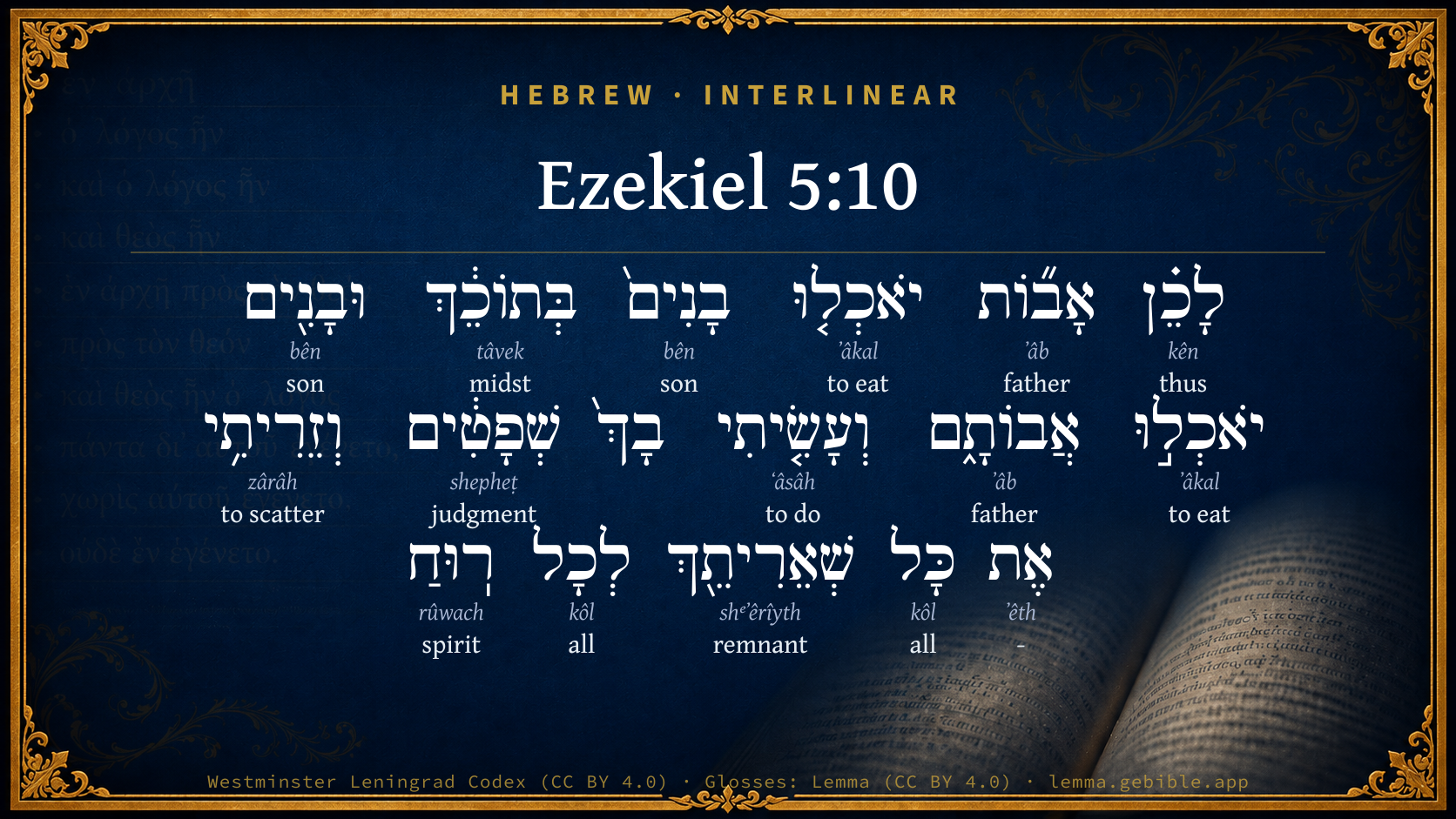
Hebrew (Westminster Leningrad Codex) Ezekiel 5:10 appears in the Hebrew Old Testament. The text above is from the Westminster Leningrad Codex. Each word links to its Strong’s number, a concise gloss, and parsing drawn from the Open Scriptures Hebrew Bible morphology. Click any word for its full Brown-Driver-Briggs (BDB) entry.
Download image
Cite this verse

Ezekiel 5:10 (World English Bible). Public Domain. Lemma interlinear Bible study tool, https://lemma.gebible.app/v/ezekiel/5/10.

Show BibTeX & RIS
BibTeX
RIS
English Translation
Therefore the fathers shall eat the sons in the midst of you, and the sons shall eat their fathers; and I will execute judgments on you; and the whole remnant of you will I scatter to all the winds.
World English Bible · Public Domain
Download a study sheet

One document with this verse’s original text, its word-by-word gloss line, the meaning frame, cross-references with their text, attributed commentary, and full source and license credits — printable, and it pastes into notes with its structure intact.

This verse Autodidact and up

Study sheet (.html) Plain text (.txt)

A passage Seminary Student

Up to 50 verses in one chapter. A passage sheet keeps up to 6 commentary sources and 12 cross-references per verse, in the order this page ranks them, and says so on the sheet whenever that leaves anything out. Ask for a single verse and you get the Autodidact verse sheet above.

Everything on this page stays free to read, with no account — the sheet is a download of what is already on screen, not access to it.

Want to remove ads? Support Godless Engineer
Compare translations 3

The same verse in 3 English versions, stacked beneath the original-language interlinear above. Click any original word for its lexicon entry.

Each is an independent rendering of the whole verse — the interlinear is not word-aligned to these translations.

Highlighted words mark where these versions differ — a whole-verse word diff, not a word-by-word alignment.

  • World English Bible Public Domain
    Therefore the fathers shall eat the sons in the midst of you, and the sons shall eat their fathers; and I will execute judgments on you; and the whole remnant of you will I scatter to all the winds.
  • King James Version Public Domain
    Therefore the fathers shall eat the sons in the midst of thee, and the sons shall eat their fathers; and I will execute judgments in thee, and the whole remnant of thee will I scatter into all the winds.
  • unfoldingWord Literal Text CC BY-SA 4.0
    Therefore fathers will eat the children in your midst, and sons will eat their fathers, since I will execute judgment on you and scatter to every direction all of you who are left.

unfoldingWord Literal Text — © unfoldingWord, licensed CC BY-SA 4.0. Word-aligned USFM3 via Door43 (git.door43.org/unfoldingWord/en_ult).

Versions to compare (up to 4)

3 of 4 selected

Show all 18 translations

Every available English version of this verse, each an independent rendering of the whole verse.

  • World English Bible Public Domain
    Therefore the fathers shall eat the sons in the midst of you, and the sons shall eat their fathers; and I will execute judgments on you; and the whole remnant of you will I scatter to all the winds.
  • Berean Standard Bible Public Domain
    As a result, fathers among you will eat their sons, and sons will eat their fathers. I will execute judgments against you and scatter all your remnant to every wind.’
  • Majority Standard Bible Public Domain
    As a result, fathers among you will eat their sons, and sons will eat their fathers. I will execute judgments against you and scatter all your remnant to every wind.’
  • King James Version Public Domain
    Therefore the fathers shall eat the sons in the midst of thee, and the sons shall eat their fathers; and I will execute judgments in thee, and the whole remnant of thee will I scatter into all the winds.
  • American Standard Version (1901) Public Domain
    Therefore the fathers shall eat the sons in the midst of thee, and the sons shall eat their fathers; and I will execute judgments on thee; and the whole remnant of thee will I scatter unto all the winds.
  • Revised Version (1885) Public Domain
    Therefore the fathers shall eat the sons in the midst of thee, and the sons shall eat their fathers; and I will execute judgments in thee, and the whole remnant of thee will I scatter unto all the winds.
  • Geneva Bible (1599) Public Domain
    For in the middes of thee, the fathers shall eate their sonnes, and the sonnes shall eate their fathers, and I will execute iudgement in thee, and the whole remnant of thee will I scatter into all the windes.
  • Douay-Rheims (1899) Public Domain
    Therefore the fathers shall eat the sons in the midst of thee, and the sons shall eat their fathers: and I will execute judgments in thee, and I will scatter thy whole remnant into every wind.
  • Young's Literal Translation Public Domain
    Therefore fathers do eat sons in thy midst, And sons eat their fathers, And I have done in thee judgments, And have scattered all thy remnant to every wind.
  • Literal Standard Version CC BY-SA 4.0
    Therefore fathers eat sons in your midst, || And sons eat their fathers, || And I have done judgments in you, || And have scattered all your remnant to every wind.
  • Unlocked Literal Bible CC BY-SA 4.0
    Therefore fathers will eat the children in your midst, and sons will eat their fathers, since I will execute judgment on you and scatter to every direction all of you who are left.
  • unfoldingWord Literal Text CC BY-SA 4.0
    Therefore fathers will eat the children in your midst, and sons will eat their fathers, since I will execute judgment on you and scatter to every direction all of you who are left.
  • Darby Bible Public Domain
    Therefore the fathers shall eat the sons in the midst of thee, and the sons shall eat their fathers; and I will execute judgments in thee, and the whole remnant of thee will I scatter to all the winds.
  • World Messianic Bible Public Domain
    Therefore the fathers will eat the sons within you, and the sons will eat their fathers. I will execute judgments on you; and I will scatter the whole remnant of you to all the winds.
  • Webster's Bible Public Domain
    Therefore the fathers shall eat the sons in the midst of thee, and the sons shall eat their fathers; and I will execute judgments in thee, and the whole remnant of thee will I scatter into all the winds.
  • Free Bible Version CC BY-SA 4.0
    In your city parents will eat their own children, and children will eat their parents. I'm going to punish you and scatter in every direction those who are left.
  • Bible in Basic English Public Domain
    For this cause fathers will take their sons for food among you, and sons will make a meal of their fathers; and I will be judge among you, and all the rest of you I will send away to every wind.
  • JPS Tanakh (1917) Public Domain
    Therefore the fathers shall eat the sons in the midst of thee, and the sons shall eat their fathers; and I will execute judgments in thee, and the whole remnant of thee will I scatter unto all the winds.

Literal Standard Version (2020), Covenant Press — licensed CC BY-SA 4.0. Text via the HelloAO Bible API (eBible.org). Unlocked Literal Bible (unfoldingWord) — licensed CC BY-SA 4.0. Text via the HelloAO Bible API (eBible.org). unfoldingWord Literal Text — © unfoldingWord, licensed CC BY-SA 4.0. Word-aligned USFM3 via Door43 (git.door43.org/unfoldingWord/en_ult). Free Bible Version, Dr. Jonathan Gallagher — licensed CC BY-SA 4.0. Text via the HelloAO Bible API (eBible.org).

Word by word

More ways to search: Search by grammar → Find every occurrence → Compare this word →

Practice this passage: Drill this verse → Learn its vocabulary →

שְׁפָטִ֔ים
shepheṭ
H8201
“judgments”
Noun, Common, Masculine, Plural, Absolute
Part of Speech
Noun
Type
Common
Gender
Masculine
Number
Plural
State
Absolute
Full BDB Definition

Origin: from H8199

TWOT: 2443a

judgment, act of judgment
  1. לָכֵ֗ן kên H3651 “to/for · thus” Preposition + Adverb
  2. אָב֞וֹת ʼâb H1 “fathers” Noun, Common, Masculine, Plural, Absolute
  3. יֹאכְל֤וּ ʼâkal H398 “to eat” Verb, Qal, Imperfect, 3rd Person, Masculine, Plural
  4. בָנִים֙ bên H1121 “sons” Noun, Common, Masculine, Plural, Absolute
  5. בְּתוֹכֵ֔ךְ tâvek H8432 “in/at · midst · your” Preposition + Noun, Common, Masculine, Singular, Construct + Suffix, Personal, 2nd Person, Feminine, Singular
  6. וּבָנִ֖ים bên H1121 “and · sons” Conjunction + Noun, Common, Masculine, Plural, Absolute
  7. יֹאכְל֣וּ ʼâkal H398 “to eat” Verb, Qal, Imperfect, 3rd Person, Masculine, Plural
  8. אֲבוֹתָ֑ם ʼâb H1 “fathers · their” Noun, Common, Masculine, Plural, Construct + Suffix, Personal, 3rd Person, Masculine, Plural
  9. וְעָשִׂ֤יתִי ʻâsâh H6213 “and · to do” Conjunction + Verb, Qal, Sequential Perfect, 1st Person, Common, Singular
  10. וְזֵרִיתִ֥י zârâh H2219 “and · to scatter” Conjunction + Verb, Piel, Sequential Perfect, 1st Person, Common, Singular
  11. אֶת ʼêth H853 “-” Particle, Direct Object
  12. כָּל kôl H3605 “all of” Noun, Common, Masculine, Singular, Construct
  13. שְׁאֵרִיתֵ֖ךְ shᵉʼêrîyth H7611 “remnant · your” Noun, Common, Feminine, Singular, Construct + Suffix, Personal, 2nd Person, Feminine, Singular
  14. לְכָל kôl H3605 “to/for · all of” Preposition + Noun, Common, Masculine, Singular, Construct
  15. רֽוּחַ rûwach H7307 “spirit” Noun, Common, Both, Singular, Absolute

About this verse

These counts appear in no published source. They are computed here, from the morphology-tagged text and Lemma’s own curated glosses. What Lemma adds →

17
words
12
distinct lemmas
Prophets
section

Notable vocabulary

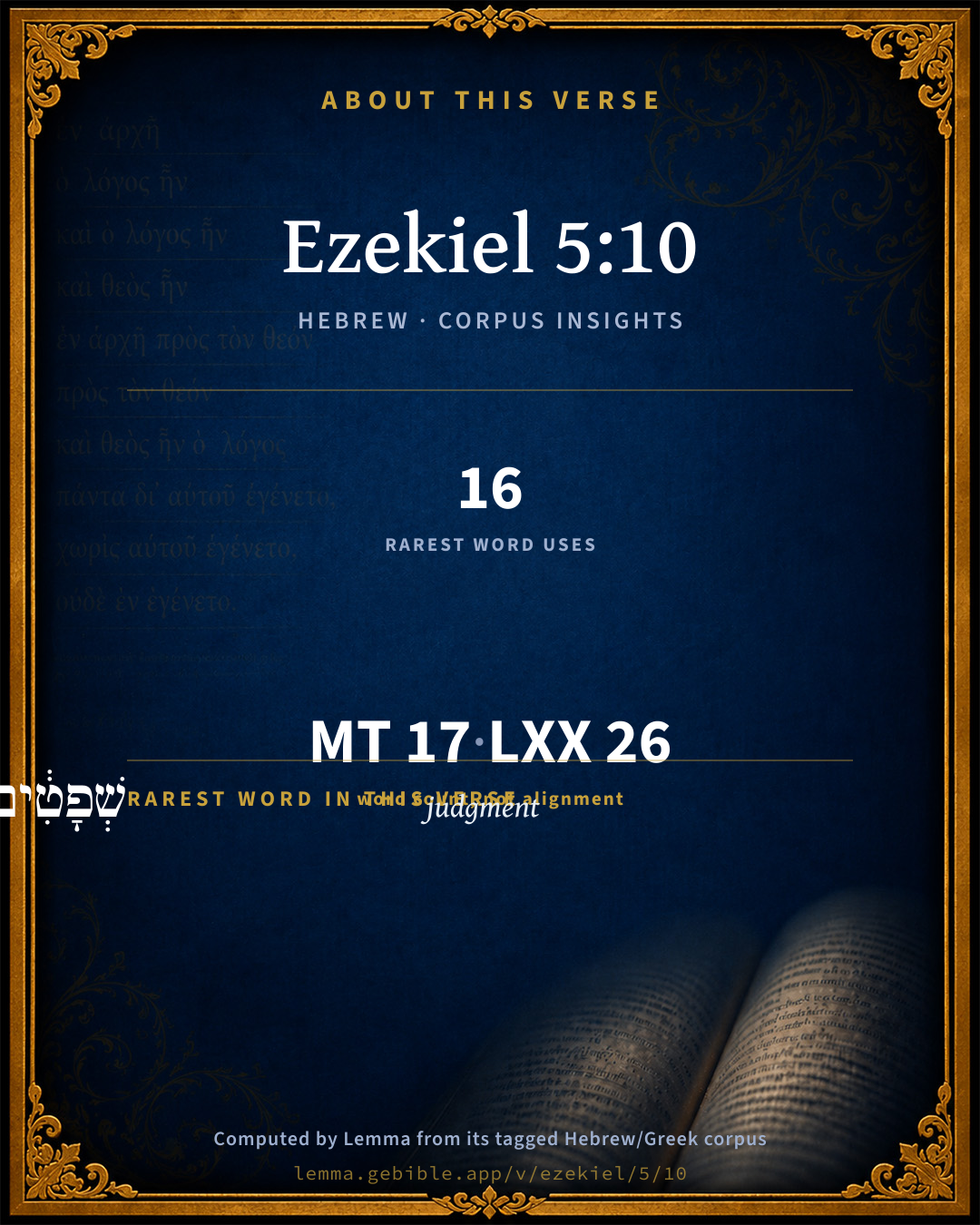
The rarest word here is שְׁפָטִ֔ים judgment H8201 — appearing just 16 times in the whole Hebrew Bible.

Shared distinctive vocabulary

שְׁפָטִ֔ים judgment H8201 occurs in 16 verses of the Hebrew Bible. Also found in:

Grammatical profile

  • 4 verbs
  • 10 nouns
  • 1 preposition
  • 1 adverb
  • 1 particle

Verb forms

  • יֹאכְל֤וּ Qal · Imperfect
  • יֹאכְל֣וּ Qal · Imperfect
  • וְעָשִׂ֤יתִי Qal · Sequential Perfect
  • וְזֵרִיתִ֥י Piel · Sequential Perfect

Repetition

Words recur within this verse — often emphatic in Hebrew:

  • אָב֞וֹת father H1 ×2
  • יֹאכְל֤וּ to eat H398 ×2
  • בָנִים֙ son H1121 ×2
  • כָּל all H3605 ×2

Hebrew & Septuagint length

In English translation the verse runs 39 words from the Hebrew and 38 from the Septuagint (LXX English) — closely comparable.

A rough comparison of the two English renderings, which tokenize alike — not a word-level alignment.

Word counts can differ between the Hebrew and the Greek without any difference in meaning — e.g. the Hebrew direct-object marker אֵת has no separate Greek word, and Greek often adds the article ὁ.

In the original languages it is 17 Hebrew tokens and 26 Greek tokens — but the two are counted differently (Hebrew bundles its prefixes and suffixes into one token; the Greek is in lemma form), so that isn’t a like-for-like length.

Cross-references

28

Topical passages linked to Ezekiel 5:10 in the Treasury of Scripture Knowledge — connected by theme and wording, ordered by reader-vote popularity; previews shown in the World English Bible.

  • Zechariah 2:6 Come! Come! Flee from the land of the north,' says Yahweh; 'for I have spread you abroad as the four winds of the sky,' says Yahweh.
  • Leviticus 26:29 You will eat the flesh of your sons, and you will eat the flesh of your daughters.
  • Deuteronomy 28:64 Yahweh will scatter you among all peoples, from the one end of the earth even to the other end of the earth; and there you shall serve other gods, which you have not known, you nor your fathers, even wood and stone.
  • Jeremiah 19:9 I will cause them to eat the flesh of their sons and the flesh of their daughters; and they shall eat everyone the flesh of his friend, in the siege and in the distress, with which their enemies, and those who seek their life, shall distress them.
  • Ezekiel 12:14 I will scatter toward every wind all who are round about him to help him, and all his bands; and I will draw out the sword after them.
  • Psalms 44:11 You have made us like sheep for food, And have scattered us among the nations.
  • Ezekiel 5:2 A third part shall you burn in the fire in the midst of the city, when the days of the siege are fulfilled; and you shall take a third part, and strike with the sword round about it; and a third part you shall scatter to the wind, and I will draw out a sword after them.
  • Ezekiel 36:19 and I scattered them among the nations, and they were dispersed through the countries: according to their way and according to their doings I judged them.
  • Leviticus 26:33 I will scatter you among the nations, and I will draw out the sword after you: and your land will be a desolation, and your cities shall be a waste.
  • Jeremiah 9:16 I will scatter them also among the nations, whom neither they nor their fathers have known; and I will send the sword after them, until I have consumed them.
  • Lamentations 2:20 Look, Yahweh, and see to whom you have done thus! Shall the women eat their fruit, the children that are dandled in the hands? Shall the priest and the prophet be killed in the sanctuary of the Lord?
  • Lamentations 4:10 The hands of the pitiful women have boiled their own children; They were their food in the destruction of the daughter of my people.
  • Ezekiel 5:12 A third part of you shall die with the pestilence, and with famine shall they be consumed in the midst of you; and a third part shall fall by the sword round about you; and a third part I will scatter to all the winds, and will draw out a sword after them.
  • Ezekiel 6:8 Yet will I leave a remnant, in that you shall have some that escape the sword among the nations, when you shall be scattered through the countries.
  • Ezekiel 22:15 I will scatter you among the nations, and disperse you through the countries; and I will consume your filthiness out of you.
  • Amos 9:9 "For, behold, I will command, and I will sift the house of Israel among all the nations, as grain is sifted in a sieve, yet not the least kernel will fall on the earth.
  • Zechariah 7:14 "but I will scatter them with a whirlwind among all the nations which they have not known. Thus the land was desolate after them, so that no man passed through nor returned: for they made the pleasant land desolate."
  • Deuteronomy 4:27 Yahweh will scatter you among the peoples, and you shall be left few in number among the nations, where Yahweh shall lead you away.
  • Deuteronomy 28:53–57 You shall eat the fruit of your own body, the flesh of your sons and of your daughters, whom Yahweh your God has given you, in the siege and in the distress with which your enemies shall distress you.
  • Deuteronomy 32:26 I said, I would scatter them afar, I would make the memory of them to cease from among men;
  • 2 Kings 6:29 So we boiled my son, and ate him: and I said to her on the next day, Give your son, that we may eat him; and she has hid her son.
  • Nehemiah 1:8 Remember, I beg you, the word that you commanded your servant Moses, saying, If you trespass, I will scatter you abroad among the peoples:
  • Isaiah 9:20 One shall snatch on the right hand, and be hungry; and he shall eat on the left hand, and they shall not be satisfied: they shall eat every man the flesh of his own arm:
  • Isaiah 49:26 I will feed those who oppress you with their own flesh; and they shall be drunken with their own blood, as with sweet wine: and all flesh shall know that I, Yahweh, am your Savior, and your Redeemer, the Mighty One of Jacob.
  • Jeremiah 44:12 I will take the remnant of Judah, that have set their faces to go into the land of Egypt to sojourn there, and they shall all be consumed; in the land of Egypt shall they fall; they shall be consumed by the sword and by the famine; they shall die, from the least even to the greatest, by the sword and by the famine; and they shall be an object of horror, [and] an astonishment, and a curse, and a reproach.
  • Jeremiah 50:17 Israel is a hunted sheep; the lions have driven him away: first, the king of Assyria devoured him; and now at last Nebuchadrezzar king of Babylon has broken his bones.
  • Ezekiel 20:23 Moreover I swore to them in the wilderness, that I would scatter them among the nations, and disperse them through the countries;
  • Luke 21:24 They will fall by the edge of the sword, and will be led captive into all the nations. Jerusalem will be trampled down by the Gentiles, until the times of the Gentiles are fulfilled.

Cross-references courtesy of OpenBible.info (CC BY 4.0).

Hebrew and Greek witnesses Masoretic Hebrew ↔ Greek Septuagint

The same verse in the two great witnesses to the Old Testament, shown verse-for-verse.

These are two independent witnesses, not word-aligned to each other, and the Septuagint is shown in lemma (dictionary) form.

Hebrew Ezekiel 5:10 Masoretic · Westminster Leningrad Codex

לָכֵ֗ן אָב֞וֹת יֹאכְל֤וּ בָנִים֙ בְּתוֹכֵ֔ךְ וּבָנִ֖ים יֹאכְל֣וּ אֲבוֹתָ֑ם וְעָשִׂ֤יתִי בָךְ֙ שְׁפָטִ֔ים וְזֵרִיתִ֥י אֶת כָּל שְׁאֵרִיתֵ֖ךְ לְכָל רֽוּחַ

Therefore the fathers shall eat the sons in the midst of you, and the sons shall eat their fathers; and I will execute judgments on you; and the whole remnant of you will I scatter to all the winds.

World English Bible · Public Domain

Greek LXX Ezekiel 5:10 Septuagint · lemma form

διά οὗτος πατήρ ἐσθίω τέκνον ἐν μέσος σύ καί τέκνον ἐσθίω πατήρ καί ποιέω ἐν σύ κρίμα καί διασκορπίζω πᾶς ὁ κατάλοιπος σύ εἰς πᾶς ἄνεμος

Therefore the fathers shall eat their children in the midst of you, and children shall eat their fathers; and I will execute judgments in you, and I will scatter all that are left of you to every wind.

LXX2012 (modern English Septuagint) · Public Domain

Hebrew: Westminster Leningrad Codex (CC BY 4.0). Greek: Septuagint (public domain); English from LXX2012 (modern English Septuagint) (Public Domain). How the Septuagint differs from the Hebrew →

Targum (Aramaic paraphrase)

1

The Targum is the ancient Jewish Aramaic paraphrase of the Hebrew Scriptures — an interpretive translation, not the Hebrew text itself. Onkelos (literal) and Pseudo-Jonathan (expansive) render the Torah, and Jonathan the Prophets. Coverage is partial: where no permissively-licensed English translation exists for a verse, only the Aramaic is shown. This is verse-level text, not a word-by-word alignment to the Hebrew.

  1. Targum Jonathan Prophets (Joshua–Malachi)
    בְּכֵן אֲבָהָן יֵיכְלוּן בְּסַר בְּנֵיהוֹן בְּגַוִיךְ וּבְנַיָא יֵיכְלוּן בְּסַר אֲבָהָתְהוֹן וְאַעְבֵּיד בִּיךְ פּוּרְעֲנוּת דִינִין וַאֲבַדַר יַת כָּל שְׁאָר עַמִיךְ לְכָל רוּחַ:

    (no public-domain English translation for this verse)

    Targum Jonathan — Aramaic: “Mikraot Gedolot” (public domain). English: “Sefaria Community Translation” (CC0 1.0 (public-domain dedication)); “London "Chaldee Paraphrase," 1871” (public domain). Text via Sefaria.

Commentary

Notes on Ezekiel 5:10 from classic Christian and Jewish commentators (each source and its license shown beneath its notes). The classic Christian expositions comment on the surrounding passage and are grouped to its opening verse, so a note may address several verses; the Jewish commentaries on the Tanakh (Rashi and others) are per-verse, so they appear only where the commentator wrote on this verse.

Lemma curates 59 commentaries, every one of them public domain or Creative Commons licensed, each selected and text-cleaned for this edition rather than reprinted as found. About our sources →

Trapp's Complete Commentary

John Trapp

Eze 5:10 Therefore the fathers shall eat the sons in the midst of thee, and the sons shall eat their fathers; and I will execute judgments in thee, and the whole remnant of thee will I scatter into all the winds.

Ver. 10. Therefore the fathers shall eat the sons.] See this fulfilled in the pitiful mothers; {Lam 4:10} and may it be thought, saith one, that their hungry husbands shared not with them in those viands? Oh, the severity of God. Cavebis, si pavebis.

And the whole remnant of thee will I scatter.] A miserably dejected people the Jews are to this day, banished out of the world, as it were, by a common consent of nations.

John Trapp, A Commentary or Exposition upon All the Books of the Old and New Testament (1647–1656) — public domain. Text from a community e-Sword module.

Joseph Benson's Commentary

Eze 5:10-11. The fathers shall eat the sons, &c. — Fathers eating their children, and children their fathers, expresses the height of misery, and the most grievous famine. We have sufficient proof that such instances happened in the Jewish nation amidst their more than common calamities. Josephus relates some instances of parents eating their children during the siege of Jerusalem by the Romans; and we have further evidence of such horrid acts having been done by them in the extremity of famine, from the texts referred to in the margin. And the whole remnant of them will I scatter, &c. — This is another judgment threatened against them by Moses, and remarkably fulfilled in this their last dispersion, in which they are to be found in every part of the known world, and yet live everywhere like strangers only upon sufferance: see note on Deu 28:64. Because thou hast defiled my sanctuary — Hast profaned my temple by placing idols in it, and worshipping them. With all thy detestable things, and all thine abominations — These are expressions of the same signification, denoting idols. Therefore will I also diminish thee — Will make thee of less account, and take from thee all honours as thou hast from me, as much as lay in thy power: or, as some interpret the clause, I will cut off or destroy, by diminishing, (as the word גרעis used Num 27:4,) without showing any pity or compassion. See the margin.

Joseph Benson's Commentary on the Old and New Testaments (1811–1818) — public domain. Text from a community e-Sword module.

Tyndale Open Study Notes

Tyndale Open Resources

5:10 Parents will eat their own children: This horrific prospect was an anticipated consequence of famine (see 2 Kgs 6:26-30), and one of the curses of disobedience (see Lev 26:29).

Tyndale Open Study Notes — © Tyndale Open Resources, licensed CC BY-SA 4.0. Text via the HelloAO Bible API.

Jamieson, Fausset & Brown

Robert Jamieson, A. R. Fausset & David Brown

fathers . . . eat . . . sons--alluding to Moses words (Lev 26:29; Deu 28:53), with the additional sad feature, that "the sons should eat their fathers" (see Kg2 6:28; Jer 19:9; Lam 2:20; Lam 4:10).

Jamieson, Fausset & Brown — Commentary Critical and Explanatory on the Whole Bible (1871) — public domain (CC PDM 1.0). Text via the HelloAO Bible API.

Adam Clarke's Commentary

Verse 10. The fathers shall eat the sons] Though we have not this fact so particularly stated in history, yet we cannot doubt of it, considering the extremities to which they were reduced during the siege. The same is referred to by Jeremiah, La 4:10. Even the women, who were remarkable for kindness and humanity, boiled their own children, and ate them during the siege.

Will I scatter into all the winds.] Disperse you, by captivity, among all the nations of the earth.

Adam Clarke's Commentary on the Bible (1810–1826) — public domain. Text from a community e-Sword/MySword module.

John Calvin's Commentaries

He says, then, fathers shall eat their sons in the midst of you, and this was certainly fulfilled: for Jeremiah speaks of women, but he comprehends men also. (Lamentations 4:10.) For he says that women are tender-hearted, he does not say mothers merely, but that they were humane beyond others; but we know that maternal affection is more tender. But when mothers and those tender ones devour their children, that was the final portent. Now he adds, I will execute, therefore, (for the copula here ought to be resolved into the expletive particle,) judgments against thee That is, in this manner I will really show myself a judge, and I will scatter all thy remnants unto all winds. He signifies that there should be such dispersion, that no body or name of the people should remain. But that hope might cherish and sustain the Jews, if any name and body of the people had been left. But when God pronounces that they should be offscourings to be scattered to every wind, he takes away all hope of restoration for the present at least. We know that there was a certain number left, but such destruction was necessarily threatened before God gave any hope of his mercy. When he says, to any wind, he signifies in any quarter whatever. For as one or another wind blows so the dust is carried, and the offscourings are dispersed in all directions. It follows —

John Calvin's Commentaries (1540-1563) — public domain. Text from the Calvin Translation Society English edition (1840s-50s) via the Christian Classics Ethereal Library (ccel.org). Calvin's coverage is partial (roughly two-thirds of the Bible); uncommented books and verses are honest gaps, never fabricated. The 19th-century editor's footnotes and remarks are omitted so the notes are faithfully Calvin's own voice.

The Cambridge Bible for Schools and Colleges

gen. ed. J. J. S. Perowne

10. the fathers shall eat the sons] Neither is this, as it might be, a generality merely to suggest severe straitness. Lam_4:10, “The hands of the pitiful women have sodden their own children, they were their meat in the destruction of the daughter of my people.” See the story 2Ki_6:24-29; cf. Lev_26:29; Deu_28:53; Jer_19:9; Lam_2:20.

The Cambridge Bible for Schools and Colleges (gen. ed. J. J. S. Perowne; Cambridge University Press, 1878–1918) — public domain. Text from a community e-Sword module.

John Gill's Exposition

Therefore the fathers shall eat the sons in the midst of thee,.... Which was long ago threatened by the Lord, and prophesied of by Moses, Lev 26:27; and was fulfilled at several times in the people of Israel, as at the siege of Samaria, Kg2 6:28; at the siege of Jerusalem by Nebuchadnezzar, Lam 4:10; and at the siege of the same city by Titus Vespasian, as Josephus (w) relates; for though these instances only show that mothers ate their children, yet no doubt the fathers took part with them; and if mothers, who are naturally more tender, could do this, it is much more reasonable to suppose that fathers did the same:

and the sons shall eat their fathers; this, though nowhere recorded, yet doubtless was done; it being as reasonable to think that a son might eat his father as a father his son, though both monstrously shocking:

and I will execute judgments in thee; punishments, such as pestilence, famine, and sword, after mentioned:

and the whole remnant of thee will I scatter into all the winds; that is, those that remain, and are not cut off, by the above judgments, shall be carried captive into Babylon, or be dispersed in to Egypt, Ammon, Moab, and other places: this had a full accomplishment in the dispersion of the Jews into the several parts of the world, when they were destroyed by the Romans.

(w) De Bello Jud. l. 6. c. 3. sect. 4. Ed. Hudson.

John Gill's Exposition of the Whole Bible (1746–1763) — public domain (CC PDM 1.0). Text via the HelloAO Bible API.

Haydock's Catholic Bible Commentary

Fathers. This is not specified in history. Famine prevailed, 4 Kings xxv. 3.; and we find something similar, Lamentations iv. 10., (Calmet) and Baruch ii. (Worthington) --- It is probable, therefore, that these threats were realized. (Theodoret) (Deuteronomy xxviii. 53.) --- Scatter. Literally, "winnow." (Haydock) --- The Jewish nation was never again all together in the promised land.

George Leo Haydock (1774–1849), Haydock's Catholic Family Bible and Commentary, 1859 edition — public domain. Excludes Psalms (Douay-Rheims chapter numbering differs from Protestant) and Deuterocanonical books (Catholic canon only).

Matthew Poole's English Annotations

And this explains what is above threatened. No history I know of that does mention any thing like this; barbarous Indians sell one another, and some report (as I take it) that children among them unnaturally murder aged parents, but they eat them not.

In the midst of thee; it may intimate their doing this publicly.

The whole remnant will I scatter: this was verified when they were fetched away who were left at the departure of the besiegers, and when the very small remnant with Johanan fled into Egypt.

Matthew Poole's English Annotations on the Holy Bible (1683–1685) — public domain. Text from a community e-Sword/MySword module.

Whedon's Commentary on the Bible

Daniel D. Whedon

10. Fathers shall eat the sons, etc. — This shows the awfulness of the famine during the siege (2Ki_6:24-29; Lam_4:10; Lev_26:29; Jer_19:9).

Daniel D. Whedon (gen. ed.), Commentary on the Old and New Testaments (1874–1909) — public domain. Text from a community e-Sword module.

The Pulpit Commentary

The fathers shall eat their sons, etc. An echo from Lev_26:29 and Deu_28:53. The words of Jer_19:9 and Lam_4:10 imply that horrors such as these occurred during the siege of the city by the Chaldeans, as they had occurred before in the siege of Samaria, (2Ki_6:28, 2Ki_6:29) and were to occur afterwards in that by the Romans (Josephus, "Bell Jud:," 6:4. The whole remnant, etc. (comp. ver. 2).

The Pulpit Commentary (1880–1919), ed. H.D.M. Spence-Jones & Joseph S. Exell — public domain. Text from a community e-Sword module.

John Wesley's Explanatory Notes

Scatter - This was verified when they were fetched away, who were left at the departure of the besiegers, and when the very small remnant with Johanan fled into Egypt.

John Wesley, Explanatory Notes Upon the Whole Bible (1754–1765) — public domain. Text via the GEBible commentary corpus.

Lesson kit

Teaching starters — assembled from the data on this page, not authored interpretation. Every prompt links to the verse data it draws on. Edit before teaching.

Ezekiel, in the Prophets, opens this verse with 17 words (12 distinct Hebrew lemmas). Its most distinctive word is shepheṭ (“judgment”). A historical commentator’s framing appears above. Read the whole chapter for the surrounding context.

Discussion questions

  1. What does “judgment” (shepheṭ) contribute to the verse as a whole?
  2. How does Exodus 6:6, which shares the word «judgment», read alongside this verse?
  3. What does the repetition of “father” (2× in this one verse) do in this verse?
  4. The translations on this page render this verse differently — a whole-verse word diff, not a word-by-word alignment. What might account for the different wordings?
  5. «יֹאכְל֤וּ» is a Qal Imperfect verb. How does that grammatical form shape the action described?
  6. Compare how Trapp's Complete Commentary and Joseph Benson's Commentary read this verse. Where do they agree or differ?

Things to notice

Reading settings

Reading text

Shown beneath each verse's original-language words.

Old Testament
Old Testament edition

Read the OT as the Masoretic Hebrew (MT) or the Greek Septuagint (LXX).

English shown for the Greek Septuagint (in the Hebrew ↔ Greek comparison).

Comparing translations? Open the Compare panel on any verse page to stack up to four side by side.