
Deuteronomy 29:25

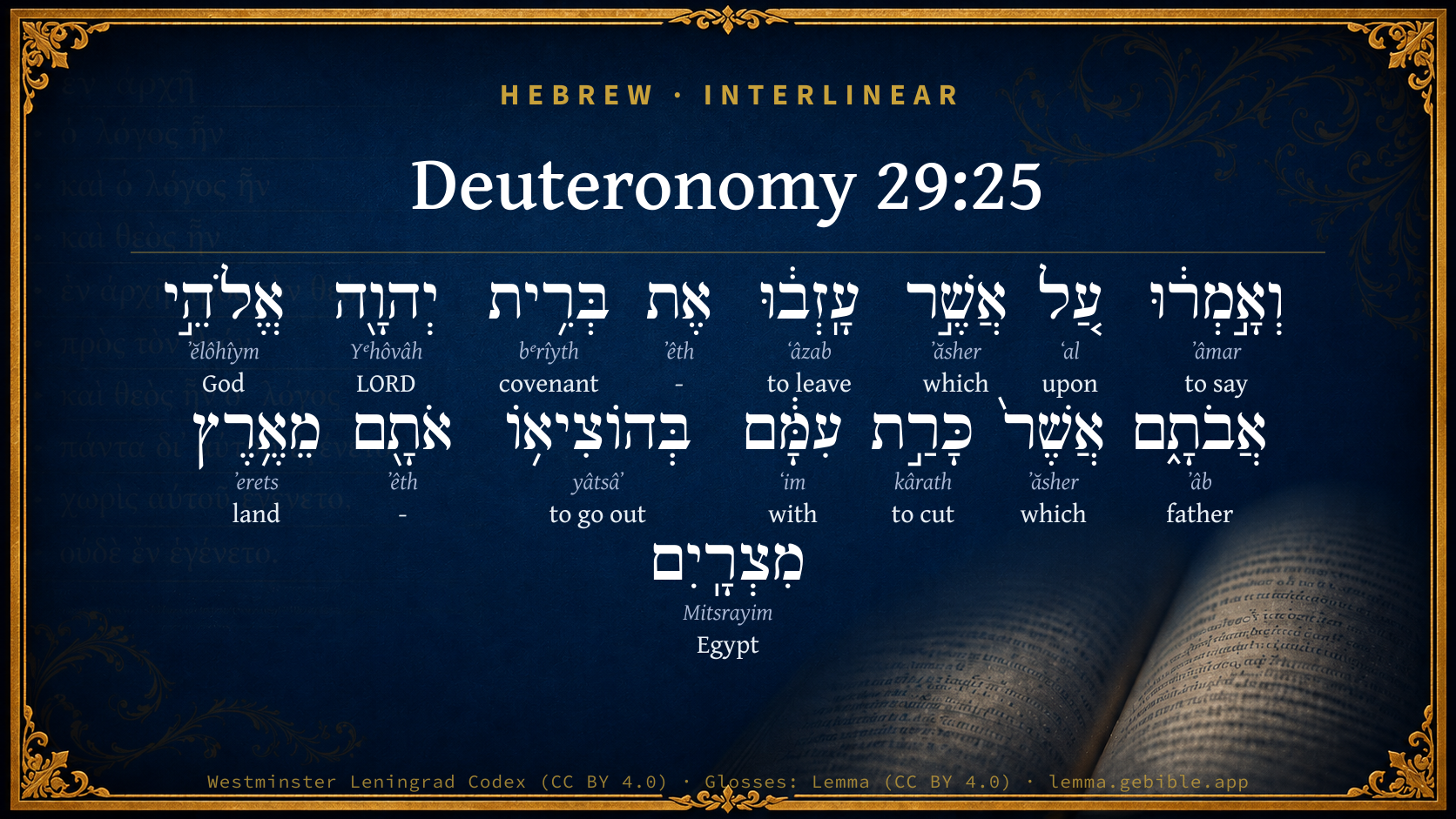
Hebrew (Westminster Leningrad Codex) Deuteronomy 29:25 appears in the Hebrew Old Testament. The text above is from the Westminster Leningrad Codex. Each word links to its Strong’s number, a concise gloss, and parsing drawn from the Open Scriptures Hebrew Bible morphology. Click any word for its full Brown-Driver-Briggs (BDB) entry.
Download image
Cite this verse

Deuteronomy 29:25 (World English Bible). Public Domain. Lemma interlinear Bible study tool, https://lemma.gebible.app/v/deuteronomy/29/25.

Show BibTeX & RIS
BibTeX
RIS
English Translation
Then men shall say, Because they forsook the covenant of Yahweh, the God of their fathers, which he made with them when he brought them forth out of the land of Egypt,
World English Bible · Public Domain
Download a study sheet

One document with this verse’s original text, its word-by-word gloss line, the meaning frame, cross-references with their text, attributed commentary, and full source and license credits — printable, and it pastes into notes with its structure intact.

This verse Autodidact and up

Study sheet (.html) Plain text (.txt)

A passage Seminary Student

Up to 50 verses in one chapter. A passage sheet keeps up to 6 commentary sources and 12 cross-references per verse, in the order this page ranks them, and says so on the sheet whenever that leaves anything out. Ask for a single verse and you get the Autodidact verse sheet above.

Everything on this page stays free to read, with no account — the sheet is a download of what is already on screen, not access to it.

Want to remove ads? Support Godless Engineer
Compare translations 3

The same verse in 3 English versions, stacked beneath the original-language interlinear above. Click any original word for its lexicon entry.

Each is an independent rendering of the whole verse — the interlinear is not word-aligned to these translations.

Highlighted words mark where these versions differ — a whole-verse word diff, not a word-by-word alignment.

  • World English Bible Public Domain
    Then men shall say, Because they forsook the covenant of Yahweh, the God of their fathers, which he made with them when he brought them forth out of the land of Egypt,
  • King James Version Public Domain
    Then men shall say, Because they have forsaken the covenant of the LORD God of their fathers, which he made with them when he brought them forth out of the land of Egypt:
  • unfoldingWord Literal Text CC BY-SA 4.0
    And they will say, ‘Because they abandoned the covenant of Yahweh, the God of their fathers, that he cut with them when he brought them out from the land of Egypt,

unfoldingWord Literal Text — © unfoldingWord, licensed CC BY-SA 4.0. Word-aligned USFM3 via Door43 (git.door43.org/unfoldingWord/en_ult).

Versions to compare (up to 4)

3 of 4 selected

Show all 18 translations

Every available English version of this verse, each an independent rendering of the whole verse.

  • World English Bible Public Domain
    Then men shall say, Because they forsook the covenant of Yahweh, the God of their fathers, which he made with them when he brought them forth out of the land of Egypt,
  • Berean Standard Bible Public Domain
    And the people will answer, ‘It is because they abandoned the covenant of the LORD, the God of their fathers, which He made with them when He brought them out of the land of Egypt.
  • Majority Standard Bible Public Domain
    And the people will answer, ‘It is because they abandoned the covenant of the LORD, the God of their fathers, which He made with them when He brought them out of the land of Egypt.
  • King James Version Public Domain
    Then men shall say, Because they have forsaken the covenant of the LORD God of their fathers, which he made with them when he brought them forth out of the land of Egypt:
  • American Standard Version (1901) Public Domain
    Then men shall say, Because they forsook the covenant of Jehovah, the God of their fathers, which he made with them when he brought them forth out of the land of Egypt,
  • Revised Version (1885) Public Domain
    Then men shall say, Because they forsook the covenant of the LORD, the God of their fathers, which he made with them when he brought them forth out of the land of Egypt;
  • Geneva Bible (1599) Public Domain
    And they shall answere, Because they haue forsaken the couenant of the Lord God of their fathers, which he had made with them, when he brought them out of the land of Egypt,
  • Douay-Rheims (1899) Public Domain
    And they shall answer: Because they forsook the covenant of the Lord, which he made with their fathers, when he brought them out of the land of Egypt:
  • Young's Literal Translation Public Domain
    `And they have said, Because that they have forsaken the covenant of Jehovah, God of their fathers, which He made with them in His bringing them out of the land of Egypt,
  • Literal Standard Version CC BY-SA 4.0
    And they have said, Because that they have forsaken the covenant of YHWH, God of their fathers, which He made with them in His bringing them out of the land of Egypt,
  • Unlocked Literal Bible CC BY-SA 4.0
    Then people will say, 'It is because they abandoned the covenant of Yahweh, the God of their ancestors, that he made with them when he brought them out of the land of Egypt,
  • unfoldingWord Literal Text CC BY-SA 4.0
    And they will say, ‘Because they abandoned the covenant of Yahweh, the God of their fathers, that he cut with them when he brought them out from the land of Egypt,
  • Darby Bible Public Domain
    And men shall say, Because they have forsaken the covenant of Jehovah the God of their fathers, which he had made with them when he brought them forth out of the land of Egypt;
  • World Messianic Bible Public Domain
    Then men will say, “Because they abandoned the covenant of the LORD, the God of their fathers, which he made with them when he brought them out of the land of Egypt,
  • Webster's Bible Public Domain
    Then men shall say, Because they have forsaken the covenant of the LORD God of their fathers, which he made with them when he brought them forth from the land of Egypt:
  • Free Bible Version CC BY-SA 4.0
    The people will answer, “It's because they abandoned the agreement of the Lord, the God of their forefathers, which he made with them when he led them out of Egypt.
  • Bible in Basic English Public Domain
    Then men will say, Because they gave up the agreement of the Lord, the God of their fathers, which he made with them when he took them out of the land of Egypt:
  • JPS Tanakh (1917) Public Domain
    (29-24) then men shall say: 'Because they forsook the covenant of the LORD, the God of their fathers, which He made with them when He brought them forth out of the land of Egypt;

Literal Standard Version (2020), Covenant Press — licensed CC BY-SA 4.0. Text via the HelloAO Bible API (eBible.org). Unlocked Literal Bible (unfoldingWord) — licensed CC BY-SA 4.0. Text via the HelloAO Bible API (eBible.org). unfoldingWord Literal Text — © unfoldingWord, licensed CC BY-SA 4.0. Word-aligned USFM3 via Door43 (git.door43.org/unfoldingWord/en_ult). Free Bible Version, Dr. Jonathan Gallagher — licensed CC BY-SA 4.0. Text via the HelloAO Bible API (eBible.org).

Word by word

More ways to search: Search by grammar → Find every occurrence → Compare this word →

Practice this passage: Drill this verse → Learn its vocabulary →

עָֽזְב֔וּ
ʻâzab
H5800
“to leave”
Verb, Qal, Perfect, 3rd Person, Common, Plural
Part of Speech
Verb
Stem
Qal
Form
Perfect
Person
3rd Person
Gender
Common
Number
Plural
Full BDB Definition

Origin: a primitive root

TWOT: 1594 , 1595

to leave, loose, forsake - (Qal) to leave - to depart from, leave behind, leave, let alone - to leave, abandon, forsake, neglect, apostatise - to let loose, set free, let go, free - (Niphal) - to be left to - to be forsaken - (Pual) to be deserted - to restore, repair - (Qal) to repair
  1. וְאָ֣מְר֔וּ ʼâmar H559 “and · to say” Conjunction + Verb, Qal, Sequential Perfect, 3rd Person, Common, Plural
  2. עַ֚ל ʻal H5921 “upon” Preposition
  3. אֲשֶׁ֣ר ʼăsher H834 “which” Particle, Relative
  4. אֶת ʼêth H853 “-” Particle, Direct Object
  5. בְּרִ֥ית bᵉrîyth H1285 “covenant of” Noun, Common, Feminine, Singular, Construct
  6. יְהוָ֖ה Yᵉhôvâh H3068 “LORD” Noun, Proper
  7. אֱלֹהֵ֣י ʼĕlôhîym H430 “God(s) of” Noun, Common, Masculine, Plural, Construct
  8. אֲבֹתָ֑ם ʼâb H1 “fathers · their” Noun, Common, Masculine, Plural, Construct + Suffix, Personal, 3rd Person, Masculine, Plural
  9. אֲשֶׁר֙ ʼăsher H834 “which” Particle, Relative
  10. כָּרַ֣ת kârath H3772 “to cut” Verb, Qal, Perfect, 3rd Person, Masculine, Singular
  11. עִמָּ֔ם ʻim H5973 “with · them” Preposition + Suffix, Personal, 3rd Person, Masculine, Plural
  12. בְּהוֹצִיא֥וֹ yâtsâʼ H3318 “in/at · to go out · him” Preposition + Verb, Hiphil, Infinitive Construct + Suffix, Personal, 3rd Person, Masculine, Singular
  13. אֹתָ֖ם ʼêth H853 “- · them” Particle, Direct Object + Suffix, Personal, 3rd Person, Masculine, Plural
  14. מֵאֶ֥רֶץ ʼerets H776 “from · land of” Preposition + Noun, Common, Both, Singular, Construct
  15. מִצְרָֽיִם Mitsrayim H4714 “Egypt” Noun, Proper

About this verse

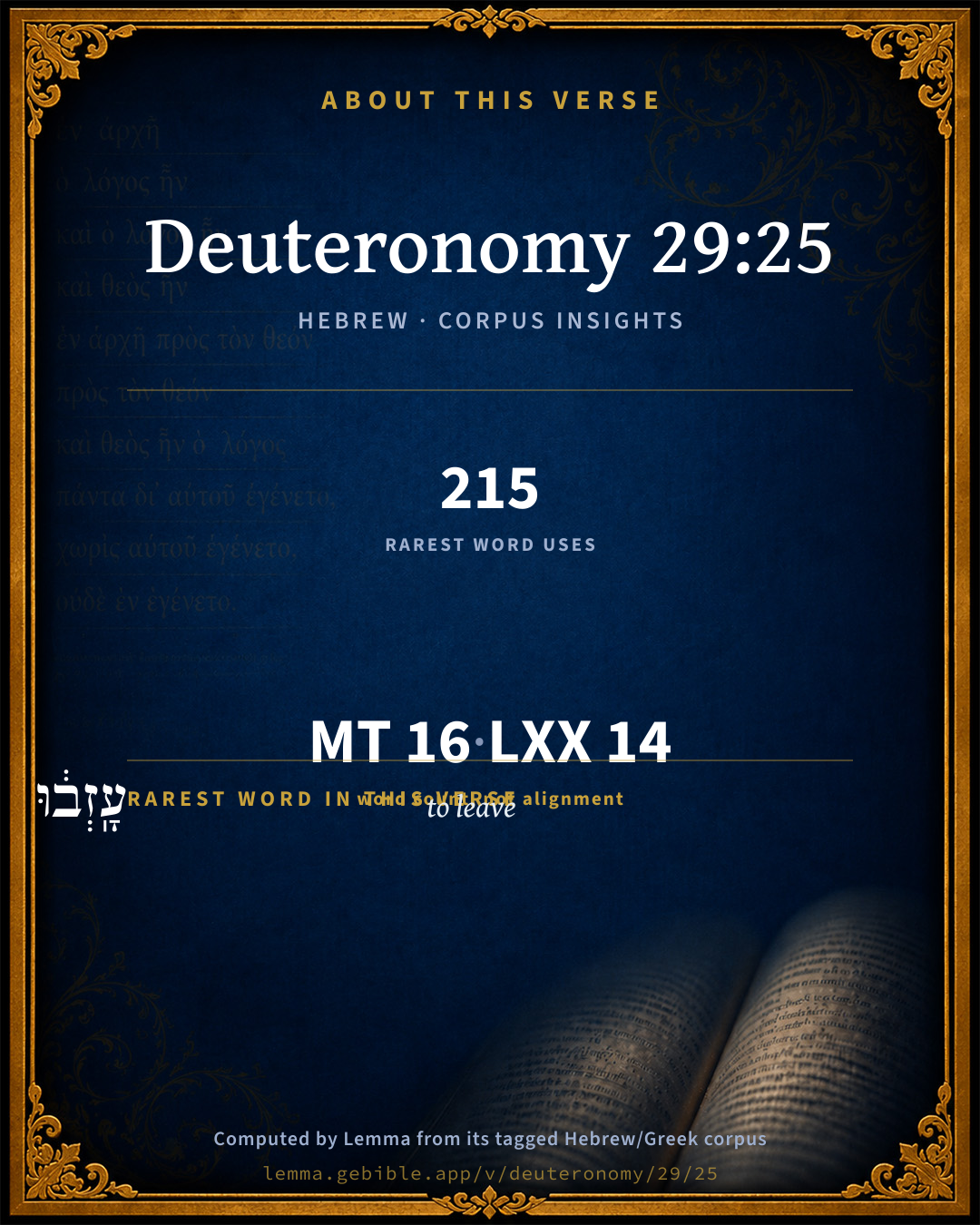
These counts appear in no published source. They are computed here, from the morphology-tagged text and Lemma’s own curated glosses. What Lemma adds →

16
words
14
distinct lemmas
Pentateuch
section

Grammatical profile

  • 4 verbs
  • 6 nouns
  • 2 prepositions
  • 4 particles

Verb forms

  • וְאָ֣מְר֔וּ Qal · Sequential Perfect
  • עָֽזְב֔וּ Qal · Perfect
  • כָּרַ֣ת Qal · Perfect
  • בְּהוֹצִיא֥וֹ Hiphil · Infinitive Construct

Repetition

A word recurs within this verse — often emphatic in Hebrew:

  • אֲשֶׁ֣ר which H834 ×2

Hebrew & Septuagint length

In English translation the verse runs 32 words from the Hebrew and 34 from the Septuagint (LXX English) — closely comparable.

A rough comparison of the two English renderings, which tokenize alike — not a word-level alignment.

Word counts can differ between the Hebrew and the Greek without any difference in meaning — e.g. the Hebrew direct-object marker אֵת has no separate Greek word, and Greek often adds the article ὁ.

In the original languages it is 16 Hebrew tokens and 14 Greek tokens — but the two are counted differently (Hebrew bundles its prefixes and suffixes into one token; the Greek is in lemma form), so that isn’t a like-for-like length.

Cross-references

8

Topical passages linked to Deuteronomy 29:25 in the Treasury of Scripture Knowledge — connected by theme and wording, ordered by reader-vote popularity; previews shown in the World English Bible.

  • Hebrews 8:9 Not according to the covenant that I made with their fathers, In the day that I took them by the hand to lead them out of the land of Egypt; For they didn't continue in my covenant, And I disregarded them," says the Lord.
  • 1 Kings 19:10–14 He said, I have been very jealous for Yahweh, the God of hosts; for the children of Israel have forsaken your covenant, thrown down your altars, and slain your prophets with the sword: and I, even I only, am left; and they seek my life, to take it away.
  • Isaiah 24:1–6 Behold, Yahweh makes the earth empty, and makes it waste, and turns it upside down, and scatters abroad the inhabitants of it.
  • Isaiah 47:6 I was angry with my people, I profaned my inheritance, and gave them into your hand: you did show them no mercy; on the aged have you very heavily laid your yoke.
  • Jeremiah 22:9 Then they shall answer, Because they forsook the covenant of Yahweh their God, and worshiped other gods, and served them.
  • Jeremiah 31:32 not according to the covenant that I made with their fathers in the day that I took them by the hand to bring them out of the land of Egypt; which my covenant they broke, although I was a husband to them, says Yahweh.
  • Jeremiah 40:2–3 The captain of the guard took Jeremiah, and said to him, Yahweh your God pronounced this evil on this place;
  • Jeremiah 50:7 All who found them have devoured them; and their adversaries said, We are not guilty, because they have sinned against Yahweh, the habitation of righteousness, even Yahweh, the hope of their fathers.

Cross-references courtesy of OpenBible.info (CC BY 4.0).

Hebrew and Greek witnesses Masoretic Hebrew ↔ Greek Septuagint

The same verse in the two great witnesses to the Old Testament, shown verse-for-verse.

These are two independent witnesses, not word-aligned to each other, and the Septuagint is shown in lemma (dictionary) form.

Hebrew Deuteronomy 29:25 Masoretic · Westminster Leningrad Codex

וְאָ֣מְר֔וּ עַ֚ל אֲשֶׁ֣ר עָֽזְב֔וּ אֶת בְּרִ֥ית יְהוָ֖ה אֱלֹהֵ֣י אֲבֹתָ֑ם אֲשֶׁר֙ כָּרַ֣ת עִמָּ֔ם בְּהוֹצִיא֥וֹ אֹתָ֖ם מֵאֶ֥רֶץ מִצְרָֽיִם

Then men shall say, Because they forsook the covenant of Yahweh, the God of their fathers, which he made with them when he brought them forth out of the land of Egypt,

World English Bible · Public Domain

Greek LXX Deuteronomy 29:25 Septuagint · lemma form

καί πορεύομαι λατρεύω θεός ἕτερος καί προςκυνέω αὐτός ὅς οὐ ἐπίσταμαι οὐδέ διανέμω αὐτός

And men shall say, Because they forsook the covenant of the Lord God of their fathers, the things which he appointed to their fathers, when he brought them out of the land of Egypt:

LXX2012 (modern English Septuagint) · Public Domain

Hebrew: Westminster Leningrad Codex (CC BY 4.0). Greek: Septuagint (public domain); English from LXX2012 (modern English Septuagint) (Public Domain). How the Septuagint differs from the Hebrew →

Targum (Aramaic paraphrase)

2

The Targum is the ancient Jewish Aramaic paraphrase of the Hebrew Scriptures — an interpretive translation, not the Hebrew text itself. Onkelos (literal) and Pseudo-Jonathan (expansive) render the Torah, and Jonathan the Prophets. Coverage is partial: where no permissively-licensed English translation exists for a verse, only the Aramaic is shown. This is verse-level text, not a word-by-word alignment to the Hebrew.

  1. Targum Onkelos Torah (Genesis–Deuteronomy)
    וַאֲזָלוּ וּפְלָחוּ לְטַעֲוַת עַמְמַיָא וּסְגִידוּ לְהוֹן דַחֲלָן דִי לָא יְדָעֻנוּן וְלָא אוֹטִיבָא לְהוֹן

    (no public-domain English translation for this verse)

    Targum Onkelos — Aramaic: “Onkelos Genesis” (public domain); “Onkelos Exodus” (public domain); “Onkelos Leviticus” (public domain); “Onkelos Numbers” (public domain); “Onkelos Deuteronomy” (public domain). English: “Sefaria Community Translation” (CC0 1.0 (public-domain dedication)); “J.W. Etheridge. The Targums of Onkelos and Jonathan Ben Uzziel on the Pentateuch. London: Longmans, Green, 1862” (public domain). Text via Sefaria.

  2. Targum Pseudo-Jonathan Torah (Genesis–Deuteronomy)
    וַאֲזָלוּ בָּתַר יִצְרָא בִּישָׁא וּפְלָחוּ לְטַעֲוַות עַמְמַיָא וְסַגִידוּ לְהוֹן דַחֲלָן דְלָא יַדְעִינוּן וְלָא אִתְפַלְגוּן לְהוֹן

    But they went after their evil desires, and served the gods of the Gentiles, and worshipped gods which they had not known nor had any part with.

    Targum Pseudo-Jonathan — Aramaic: “Targum Jonathan on Genesis” (public domain); “Targum Jonathan on Exodus” (public domain); “Targum Jonathan on Leviticus” (public domain); “Targum Jonathan on Numbers” (public domain); “Targum Jonathan on Deuteronomy” (public domain). English: “The Targum of Jonathan ben Uzziel, trans. J. W. Etheridge, London, 1862” (public domain). Text via Sefaria.

Commentary

Notes on Deuteronomy 29:25 from classic Christian and Jewish commentators (each source and its license shown beneath its notes). The classic Christian expositions comment on the surrounding passage and are grouped to its opening verse, so a note may address several verses; the Jewish commentaries on the Tanakh (Rashi and others) are per-verse, so they appear only where the commentator wrote on this verse.

Lemma curates 59 commentaries, every one of them public domain or Creative Commons licensed, each selected and text-cleaned for this edition rather than reprinted as found. About our sources →

Tyndale Open Study Notes

Tyndale Open Resources

29:25-28 This explanation anticipates a future when people would look back at Israel’s history of rebellion and easily understand why they were in exile.

Tyndale Open Study Notes — © Tyndale Open Resources, licensed CC BY-SA 4.0. Text via the HelloAO Bible API.

The Cambridge Bible for Schools and Colleges

gen. ed. J. J. S. Perowne

25. Then men shall say, etc.] Similarly Jer_22:8 f. The phrase, forsook the covenant occurs there, 1Ki_19:10; 1Ki_19:14 and Dan_11:30, but not elsewhere in Deut. (forget is used instead); though Deu_28:20 has forsaking me, cp. Deu_31:16, Deu_32:15.

The Cambridge Bible for Schools and Colleges (gen. ed. J. J. S. Perowne; Cambridge University Press, 1878–1918) — public domain. Text from a community e-Sword module.

John Gill's Exposition

For they went and served other gods, and worshipped them,.... As did all Israel, in the times of Solomon, and the ten tribes under Jeroboam, and other succeeding kings of Israel; and the two tribes in the times of Ahaz, and especially of Manasseh, when they worshipped all the host of heaven; see Kg1 11:33,

gods whom they knew not; to whom they, as well as their fathers before them, were strangers and approved not of them; and of whose power and goodness they had no experience, and of which there never were any instances; yet such was their stupidity, as to leave their God, the only true God, of whom they had many proofs in both respects, and worship these idols, which had never been profitable and serviceable to them on any account:

and whom he hath not given unto them; which version seems not to afford a good sense; for to what people soever has God, the true God, given other gods to worship, which this seems to imply, though he had not given or allowed any to them? Onkelos paraphrases it, "did not do them good"; which Jarchi explains, the gods they chose them did not impart to them any inheritance, or any portion; for the word used signifies to divide, or part a portion or inheritance; now the Lord God did divide to Israel the land of Canaan for an inheritance, but these idols had never divided anything to them, and had been in no instance profitable or advantageous to them; and therefore it was madness and folly in them to worship them, as well as great ingratitude to the Lord their God, who had done such great and good things for them; for so the words may be rendered, "and did not impart" or "divide to them" (g) anything; that is, not anyone of them did; for the verb is singular.

(g) "qui nihil impertitus est eis", Pagninus; "et quorum nullus impertitus fuerat eis quidquem", Piscator; "neque partitus est ipsis", Cocceius.

John Gill's Exposition of the Whole Bible (1746–1763) — public domain (CC PDM 1.0). Text via the HelloAO Bible API.

unfoldingWord translationNotes

Door43 World Missions Community

It is because they abandoned the covenant of Yahweh, the God of their ancestors

This is the answer to "Why has Yahweh done this to this land?" (Deuteronomy 29:24). "Yahweh has done this to the land because the Israelites did not follow the promises and the laws of his covenant"

served other gods and bowed down to them

"obeyed other gods and worshiped them"

translationWords

people group

covenant

Yahweh

God

Egypt

worship

false god

bow

know

unfoldingWord translationNotes — © Distant Shores Media and the Door43 World Missions Community, licensed CC BY-SA 4.0. Source: git.door43.org/Door43/en_tn.

Rashi

Rabbi Shlomo Yitzchaki (Rashi)

לא ידעום [FOR THEY … SERVED OTHER GODS] WHOM THEY KNEW NOT — i.e. in whom they had never experienced any Divine power.

ולא חלק להם means, He did not give them (the gods) to be their portion (cf. Rashi on Deuteronomy 4:19). Onkelos, however, renders it by לא אוטיבא להון, i.e. they did not bestow upon them any good. As for the expression לא חלק, Onkelos took it thus, explaining also the singular form of the verb: that god which they have chosen for themselves has never given them any חלק, any inheritance or portion.

Rashi on the Tanakh — English translations: “The Judaica Press complete Tanach with Rashi, translated by A. J. Rosenberg” (CC BY 4.0); “Pentateuch with Rashi's commentary by M. Rosenbaum and A.M. Silbermann, 1929-1934” (public domain); “The Metsudah Tanach series, Lakewood, N.J” (CC BY 4.0); and “The Book of Joshua, Metsudah Publications, 1997” (CC BY 4.0). Text via Sefaria.

Ramban (Nachmanides)

Rabbi Moshe ben Nachman (Ramban / Nachmanides)

GODS THAT THEY KNEW NOT — “gods in whom they had never experienced any Divine power. ‘V’LO CHALAK LAHEM’ (AND THAT HE HATH NOT ALLOTTED UNTO THEM) — He did not give these [gods] to them [Israel] to be their portion. And Onkelos rendered this expression: v’lo otiva l’hon, meaning, ‘they had not done them any good.’ [Onkelos thus explained] the term chalak as meaning, ‘that god which they have chosen for themselves has never chalak (apportioned) them any inheritance or portion.” This is Rashi’s language. The correct interpretation is: “gods that they knew not as gods, that is to say, [they worshipped gods] whom they knew not as having acted with any Divine power inherent to their essence. And the Eternal, the G-d of their fathers did not allot them [these gods] to them, meaning that He did not designate them as lords over Israel as He placed them over the nations.” I have already explained this.

Ramban (Nachmanides) on the Tanakh — English translation: “Commentary on the Torah by Ramban (Nachmanides). Translated and annotated by Charles B. Chavel. New York, Shilo Pub. House, 1971-1976” (CC BY 4.0). Text via Sefaria.

Lesson kit

Teaching starters — assembled from the data on this page, not authored interpretation. Every prompt links to the verse data it draws on. Edit before teaching.

Deuteronomy, in the Pentateuch, opens this verse with 16 words (14 distinct Hebrew lemmas). Its most distinctive word is ʻâzab (“to leave”). A historical commentator’s framing appears above. Read the whole chapter for the surrounding context.

Discussion questions

  1. What does “to leave” (ʻâzab) contribute to the verse as a whole?
  2. How does Hebrews 8:9, which shares this passage’s theme, read alongside this verse?
  3. What does the repetition of “which” (2× in this one verse) do in this verse?
  4. The translations on this page render this verse differently — a whole-verse word diff, not a word-by-word alignment. What might account for the different wordings?
  5. «וְאָ֣מְר֔וּ» is a Qal Sequential Perfect verb. How does that grammatical form shape the action described?
  6. Compare how Tyndale Open Study Notes and The Cambridge Bible for Schools and Colleges read this verse. Where do they agree or differ?

Things to notice

Reading settings

Reading text

Shown beneath each verse's original-language words.

Old Testament
Old Testament edition

Read the OT as the Masoretic Hebrew (MT) or the Greek Septuagint (LXX).

English shown for the Greek Septuagint (in the Hebrew ↔ Greek comparison).

Comparing translations? Open the Compare panel on any verse page to stack up to four side by side.