
Exodus 10:6

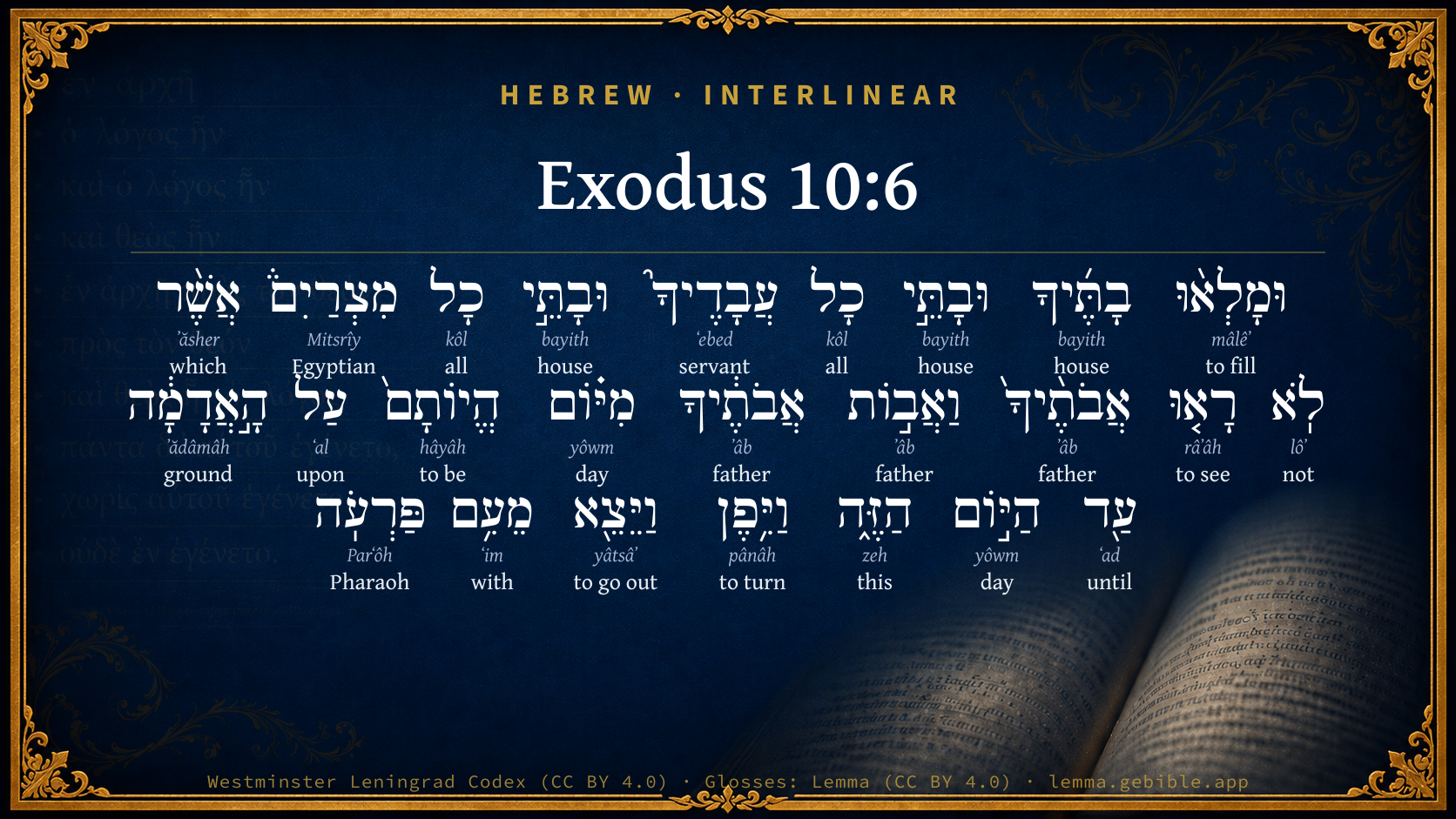
Hebrew (Westminster Leningrad Codex) Exodus 10:6 appears in the Hebrew Old Testament. The text above is from the Westminster Leningrad Codex. Each word links to its Strong’s number, a concise gloss, and parsing drawn from the Open Scriptures Hebrew Bible morphology. Click any word for its full Brown-Driver-Briggs (BDB) entry.
Download image
Cite this verse

Exodus 10:6 (World English Bible). Public Domain. Lemma interlinear Bible study tool, https://lemma.gebible.app/v/exodus/10/6.

Show BibTeX & RIS
BibTeX
RIS
English Translation
Your houses shall be filled, and the houses of all your servants, and the houses of all the Egyptians; as neither your fathers nor your fathers' fathers have seen, since the day that they were on the earth to this day.'" He turned, and went out from Pharaoh.
World English Bible · Public Domain
Download a study sheet

One document with this verse’s original text, its word-by-word gloss line, the meaning frame, cross-references with their text, attributed commentary, and full source and license credits — printable, and it pastes into notes with its structure intact.

This verse Autodidact and up

Study sheet (.html) Plain text (.txt)

A passage Seminary Student

Up to 50 verses in one chapter. A passage sheet keeps up to 6 commentary sources and 12 cross-references per verse, in the order this page ranks them, and says so on the sheet whenever that leaves anything out. Ask for a single verse and you get the Autodidact verse sheet above.

Everything on this page stays free to read, with no account — the sheet is a download of what is already on screen, not access to it.

Want to remove ads? Support Godless Engineer
Compare translations 3

The same verse in 3 English versions, stacked beneath the original-language interlinear above. Click any original word for its lexicon entry.

Each is an independent rendering of the whole verse — the interlinear is not word-aligned to these translations.

Highlighted words mark where these versions differ — a whole-verse word diff, not a word-by-word alignment.

  • World English Bible Public Domain
    Your houses shall be filled, and the houses of all your servants, and the houses of all the Egyptians; as neither your fathers nor your fathers' fathers have seen, since the day that they were on the earth to this day.'" He turned, and went out from Pharaoh.
  • King James Version Public Domain
    And they shall fill thy houses, and the houses of all thy servants, and the houses of all the Egyptians; which neither thy fathers, nor thy fathers' fathers have seen, since the day that they were upon the earth unto this day. And he turned himself, and went out from Pharaoh.
  • unfoldingWord Literal Text CC BY-SA 4.0
    And they will fill your houses and the houses of all your servants and the houses of all the Egyptians, which your fathers had never seen, nor the fathers of your fathers, from the day they came to be on the earth until this day.’” And he turned around and left from being with Pharaoh.

unfoldingWord Literal Text — © unfoldingWord, licensed CC BY-SA 4.0. Word-aligned USFM3 via Door43 (git.door43.org/unfoldingWord/en_ult).

Versions to compare (up to 4)

3 of 4 selected

Show all 18 translations

Every available English version of this verse, each an independent rendering of the whole verse.

  • World English Bible Public Domain
    Your houses shall be filled, and the houses of all your servants, and the houses of all the Egyptians; as neither your fathers nor your fathers' fathers have seen, since the day that they were on the earth to this day.'" He turned, and went out from Pharaoh.
  • Berean Standard Bible Public Domain
    They will fill your houses and the houses of all your officials and every Egyptian—something neither your fathers nor your grandfathers have seen since the day they came into this land.’” Then Moses turned and left Pharaoh’s presence.
  • Majority Standard Bible Public Domain
    They will fill your houses and the houses of all your officials and every Egyptian—something neither your fathers nor your grandfathers have seen since the day they came into this land.’” Then Moses turned and left Pharaoh’s presence.
  • King James Version Public Domain
    And they shall fill thy houses, and the houses of all thy servants, and the houses of all the Egyptians; which neither thy fathers, nor thy fathers' fathers have seen, since the day that they were upon the earth unto this day. And he turned himself, and went out from Pharaoh.
  • American Standard Version (1901) Public Domain
    and thy houses shall be filled, and the houses of all thy servants, and the houses of all the Egyptians; as neither thy fathers nor thy fathers' fathers have seen, since the day that they were upon the earth unto this day. And he turned, and went out from Pharaoh.
  • Revised Version (1885) Public Domain
    and thy houses shall be filled, and the houses of all thy servants, and the houses of all the Egyptians; as neither thy fathers nor thy fathers’ fathers have seen, since the day that they were upon the earth unto this day. And he turned, and went out from Pharaoh.
  • Geneva Bible (1599) Public Domain
    And they shall fil thine houses, and all thy seruants houses, and the houses of all the Egyptians, as neither thy fathers, nor thy fathers fathers haue seene, since the time they were vpon the earth vnto this day. So he returned, and went out from Pharaoh.
  • Douay-Rheims (1899) Public Domain
    And they shall fill thy houses, and the houses of thy servants, and of all the Egyptians: such a number as thy fathers have not seen, nor thy grandfathers, from the time they were first upon the earth, until this present day. And he turned himself away, and went forth from Pharao.
  • Young's Literal Translation Public Domain
    and they have filled thy houses, and the houses of all thy servants, and the houses of all the Egyptians, which neither thy fathers nor thy father's fathers have seen, since the day of their being on the ground unto this day,' -- and he turneth and goeth out from Pharaoh.
  • Literal Standard Version CC BY-SA 4.0
    and they have filled your houses, and the houses of all your servants, and the houses of all the Egyptians, which neither your fathers nor your father’s fathers have seen, since the day of their being on the ground to this day.” And he turns and goes out from Pharaoh.
  • Unlocked Literal Bible CC BY-SA 4.0
    They will fill your houses, those of all your servants, and those of all the Egyptians—something neither your father nor your grandfather ever saw, nothing ever seen since the day that they were on the earth to this present day.'” Then Moses left and went out from Pharaoh.
  • unfoldingWord Literal Text CC BY-SA 4.0
    And they will fill your houses and the houses of all your servants and the houses of all the Egyptians, which your fathers had never seen, nor the fathers of your fathers, from the day they came to be on the earth until this day.’” And he turned around and left from being with Pharaoh.
  • Darby Bible Public Domain
    and they shall fill thy houses, and the houses of all thy bondmen, and the houses of all the Egyptians; which neither thy fathers nor thy fathers' fathers have seen, since the day that they were upon the earth unto this day. And he turned and went out from Pharaoh.
  • World Messianic Bible Public Domain
    Your houses shall be filled, and the houses of all your servants, and the houses of all the Egyptians, as neither your fathers nor your fathers’ fathers have seen, since the day that they were on the earth to this day.’” He turned, and went out from Pharaoh.
  • Webster's Bible Public Domain
    And they shall fill thy houses, and the houses of all thy servants, and the houses of all the Egyptians; which neither thy fathers, nor thy fathers' fathers have seen, since the day that they were upon the earth to this day. And he turned himself, and went out from Pharaoh.
  • Free Bible Version CC BY-SA 4.0
    They will swarm into your houses and into the houses of all your officials—in fact into the houses of every Egyptian. This is something that none of your forefathers ever saw from the time they arrived in this country.’” Then Moses and Aaron turned and left Pharaoh.
  • Bible in Basic English Public Domain
    And your houses will be full of them, and the houses of your servants and of all the Egyptians; it will be worse than anything your fathers have seen or their fathers, from the day when they were living on the earth till this day. And so he went out from Pharaoh.
  • JPS Tanakh (1917) Public Domain
    and thy houses shall be filled, and the houses of all thy servants, and the houses of all the Egyptians; as neither thy fathers nor thy fathers' fathers have seen, since the day that they were upon the earth unto this day.' And he turned, and went out from Pharaoh.

Literal Standard Version (2020), Covenant Press — licensed CC BY-SA 4.0. Text via the HelloAO Bible API (eBible.org). Unlocked Literal Bible (unfoldingWord) — licensed CC BY-SA 4.0. Text via the HelloAO Bible API (eBible.org). unfoldingWord Literal Text — © unfoldingWord, licensed CC BY-SA 4.0. Word-aligned USFM3 via Door43 (git.door43.org/unfoldingWord/en_ult). Free Bible Version, Dr. Jonathan Gallagher — licensed CC BY-SA 4.0. Text via the HelloAO Bible API (eBible.org).

Word by word

More ways to search: Search by grammar → Find every occurrence → Compare this word →

Practice this passage: Drill this verse → Learn its vocabulary →

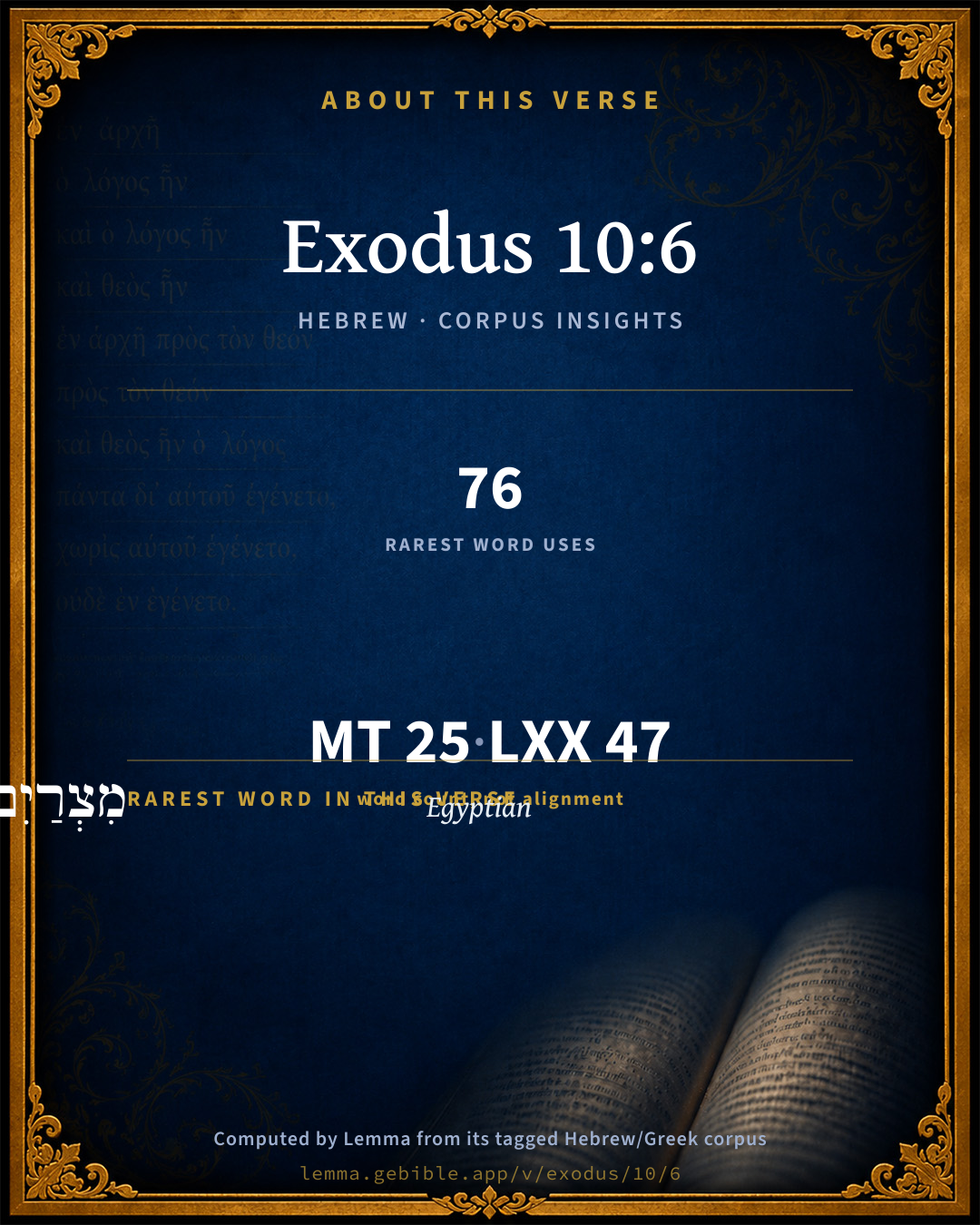
מִצְרַיִם֒
Mitsrîy
H4713
“Egyptian”
Noun, Proper
Part of Speech
Noun
Type
Proper
Full BDB Definition

Origin: from H4714

TWOT: None

Egyptian = see Egypte " double straits" - Egyptian - an inhabitant or citizen of Egypt - an Egyptian - the Egyptian
  1. וּמָלְא֨וּ mâlêʼ H4390 “and · to fill” Conjunction + Verb, Qal, Perfect, 3rd Person, Common, Plural
  2. בָתֶּ֜יךָ bayith H1004 “houses · your” Noun, Common, Masculine, Plural, Construct + Suffix, Personal, 2nd Person, Masculine, Singular
  3. וּבָתֵּ֣י bayith H1004 “and · houses of” Conjunction + Noun, Common, Masculine, Plural, Construct
  4. כָל kôl H3605 “all of” Noun, Common, Masculine, Singular, Construct
  5. עֲבָדֶיךָ֮ ʻebed H5650 “servants · your” Noun, Common, Masculine, Plural, Construct + Suffix, Personal, 2nd Person, Masculine, Singular
  6. וּבָתֵּ֣י bayith H1004 “and · houses of” Conjunction + Noun, Common, Masculine, Plural, Construct
  7. כָל kôl H3605 “all of” Noun, Common, Masculine, Singular, Construct
  8. אֲשֶׁ֨ר ʼăsher H834 “which” Particle, Relative
  9. לֹֽא lôʼ H3808 “not” Particle, Negative
  10. רָא֤וּ râʼâh H7200 “to see” Verb, Qal, Perfect, 3rd Person, Common, Plural
  11. אֲבֹתֶ֨יךָ֙ ʼâb H1 “fathers · your” Noun, Common, Masculine, Plural, Construct + Suffix, Personal, 2nd Person, Masculine, Singular
  12. וַאֲב֣וֹת ʼâb H1 “and · fathers of” Conjunction + Noun, Common, Masculine, Plural, Construct
  13. אֲבֹתֶ֔יךָ ʼâb H1 “fathers · your” Noun, Common, Masculine, Plural, Construct + Suffix, Personal, 2nd Person, Masculine, Singular
  14. מִיּ֗וֹם yôwm H3117 “from · day of” Preposition + Noun, Common, Masculine, Singular, Construct
  15. הֱיוֹתָם֙ hâyâh H1961 “to be · them” Verb, Qal, Infinitive Construct + Suffix, Personal, 3rd Person, Masculine, Plural
  16. עַל ʻal H5921 “upon” Preposition
  17. הָ֣אֲדָמָ֔ה ʼădâmâh H127 “the · ground” Particle, Definite Article + Noun, Common, Feminine, Singular, Absolute
  18. עַ֖ד ʻad H5704 “until” Preposition
  19. הַיּ֣וֹם yôwm H3117 “the · day” Particle, Definite Article + Noun, Common, Masculine, Singular, Absolute
  20. הַזֶּ֑ה zeh H2088 “the · this” Particle, Definite Article + Pronoun, Demonstrative, Masculine, Singular
  21. וַיִּ֥פֶן pânâh H6437 “and · to turn” Conjunction + Verb, Qal, Sequential Imperfect, 3rd Person, Masculine, Singular
  22. וַיֵּצֵ֖א yâtsâʼ H3318 “and · to go out” Conjunction + Verb, Qal, Sequential Imperfect, 3rd Person, Masculine, Singular
  23. מֵעִ֥ם ʻim H5973 “from · with” Preposition + Preposition
  24. פַּרְעֹֽה Parʻôh H6547 “Pharaoh” Noun, Proper

About this verse

These counts appear in no published source. They are computed here, from the morphology-tagged text and Lemma’s own curated glosses. What Lemma adds →

25
words
19
distinct lemmas
Pentateuch
section

Grammatical profile

  • 5 verbs
  • 14 nouns
  • 1 pronoun
  • 3 prepositions
  • 2 particles

Verb forms

  • וּמָלְא֨וּ Qal · Perfect
  • רָא֤וּ Qal · Perfect
  • הֱיוֹתָם֙ Qal · Infinitive Construct
  • וַיִּ֥פֶן Qal · Sequential Imperfect
  • וַיֵּצֵ֖א Qal · Sequential Imperfect

Repetition

Words recur within this verse — often emphatic in Hebrew:

  • בָתֶּ֜יךָ house H1004 ×3
  • אֲבֹתֶ֨יךָ֙ father H1 ×3
  • כָל all H3605 ×2
  • מִיּ֗וֹם day H3117 ×2

Hebrew & Septuagint length

In English translation the verse runs 48 words from the Hebrew and 53 from the Septuagint (LXX English) — closely comparable.

A rough comparison of the two English renderings, which tokenize alike — not a word-level alignment.

Word counts can differ between the Hebrew and the Greek without any difference in meaning — e.g. the Hebrew direct-object marker אֵת has no separate Greek word, and Greek often adds the article ὁ.

In the original languages it is 25 Hebrew tokens and 47 Greek tokens — but the two are counted differently (Hebrew bundles its prefixes and suffixes into one token; the Greek is in lemma form), so that isn’t a like-for-like length.

Cross-references

9

Topical passages linked to Exodus 10:6 in the Treasury of Scripture Knowledge — connected by theme and wording, ordered by reader-vote popularity; previews shown in the World English Bible.

  • Exodus 8:3 and the river shall swarm with frogs, which shall go up and come into your house, and into your bedchamber, and on your bed, and into the house of your servants, and on your people, and into your ovens, and into your kneading-troughs:
  • Exodus 8:21 Else, if you will not let my people go, behold, I will send swarms of flies on you, and on your servants, and on your people, and into your houses: and the houses of the Egyptians shall be full of swarms of flies, and also the ground whereon they are.
  • Exodus 9:24 So there was very severe hail, and lightning mixed with the hail, such as had not been in all the land of Egypt since it became a nation.
  • Exodus 10:11 Not so! Go now you who are men, and serve Yahweh; for that is what you desire!" They were driven out from Pharaoh's presence.
  • Exodus 10:14–15 The locusts went up over all the land of Egypt, and rested in all the borders of Egypt. They were very grievous. Before them there were no such locusts as they, neither after them shall be such.
  • Exodus 11:6 There shall be a great cry throughout all the land of Egypt, such as there has not been, nor shall be any more.
  • Exodus 11:8 All these your servants shall come down to me, and bow down themselves to me, saying, 'Get out, and all the people who follow you; and after that I will go out.'" He went out from Pharaoh in hot anger.
  • Joel 2:2 A day of darkness and gloominess, A day of clouds and thick darkness. As the dawn spreading on the mountains, A great and strong people; There has never been the like, Neither will there be any more after them, Even to the years of many generations.
  • Hebrews 11:27 By faith, he left Egypt, not fearing the wrath of the king; for he endured, as seeing him who is invisible.

Cross-references courtesy of OpenBible.info (CC BY 4.0).

Hebrew and Greek witnesses Masoretic Hebrew ↔ Greek Septuagint

The same verse in the two great witnesses to the Old Testament, shown verse-for-verse.

These are two independent witnesses, not word-aligned to each other, and the Septuagint is shown in lemma (dictionary) form.

Hebrew Exodus 10:6 Masoretic · Westminster Leningrad Codex

וּמָלְא֨וּ בָתֶּ֜יךָ וּבָתֵּ֣י כָל עֲבָדֶיךָ֮ וּבָתֵּ֣י כָל מִצְרַיִם֒ אֲשֶׁ֨ר לֹֽא רָא֤וּ אֲבֹתֶ֨יךָ֙ וַאֲב֣וֹת אֲבֹתֶ֔יךָ מִיּ֗וֹם הֱיוֹתָם֙ עַל הָ֣אֲדָמָ֔ה עַ֖ד הַיּ֣וֹם הַזֶּ֑ה וַיִּ֥פֶן וַיֵּצֵ֖א מֵעִ֥ם פַּרְעֹֽה

Your houses shall be filled, and the houses of all your servants, and the houses of all the Egyptians; as neither your fathers nor your fathers' fathers have seen, since the day that they were on the earth to this day.'" He turned, and went out from Pharaoh.

World English Bible · Public Domain

Greek LXX Exodus 10:6 Septuagint · lemma form

καί πίμπλημι σύ ὁ οἰκία καί ὁ οἰκία ὁ θεράπων σύ καί πᾶς ὁ οἰκία ἐν πᾶς γῆ ὁ αἰγύπτιος ὅς οὐδέποτε ὁράω ὁ πατήρ σύ οὐδέ ὁ πρόπαππος αὐτός ἀπό ὅς ἡμέρα γίγνομαι ἐπί ὁ γῆ ἕως ὁ ἡμέρα οὗτος καί ἐκκλίνω μωυσῆς ἐκἔρχομαι ἀπό φαραώ

And your houses shall be filled, and the houses of your servants, and all the houses in all the land of the Egyptians; things which your fathers have never seen, nor their forefathers, from the day that they were upon the earth until this day. And Moses turned away and departed from Pharao.

LXX2012 (modern English Septuagint) · Public Domain

Hebrew: Westminster Leningrad Codex (CC BY 4.0). Greek: Septuagint (public domain); English from LXX2012 (modern English Septuagint) (Public Domain). How the Septuagint differs from the Hebrew →

Targum (Aramaic paraphrase)

2

The Targum is the ancient Jewish Aramaic paraphrase of the Hebrew Scriptures — an interpretive translation, not the Hebrew text itself. Onkelos (literal) and Pseudo-Jonathan (expansive) render the Torah, and Jonathan the Prophets. Coverage is partial: where no permissively-licensed English translation exists for a verse, only the Aramaic is shown. This is verse-level text, not a word-by-word alignment to the Hebrew.

  1. Targum Onkelos Torah (Genesis–Deuteronomy)
    וְיִמְלוּן בָּתָּיךְ וּבָתֵּי כָל עַבְדָיךְ וּבָתֵּי כָל מִצְרַיִם דִי לָא חֲזוֹ אֲבָהָתָךְ וַאֲבָהַת אֲבָהָתָךְ מִיוֹמָא דְמֶהֱוֵיהוֹן עַל אַרְעָא עַד יוֹמָא הָדֵין וְאִתְפְּנִי וּנְפַק מִן קֳדָם פַּרְעֹה:

    (no public-domain English translation for this verse)

    Targum Onkelos — Aramaic: “Onkelos Genesis” (public domain); “Onkelos Exodus” (public domain); “Onkelos Leviticus” (public domain); “Onkelos Numbers” (public domain); “Onkelos Deuteronomy” (public domain). English: “Sefaria Community Translation” (CC0 1.0 (public-domain dedication)); “J.W. Etheridge. The Targums of Onkelos and Jonathan Ben Uzziel on the Pentateuch. London: Longmans, Green, 1862” (public domain). Text via Sefaria.

  2. Targum Pseudo-Jonathan Torah (Genesis–Deuteronomy)
    וְיִתְמְלוּן בָּתָּךְ וּבָתֵּי כָּל עַבְדָךְ וּבָתֵּי כָל מִצְרָאֵי דְלָא חָמוּן אַבְהָתָךְ וְאַבְהַת אַבְהָתָךְ מִן יוֹם מֶהֱוֵיהוֹן עַל אַרְעָא עַד יוֹמָא הָדֵין וְאִתְפְּנֵי וּנְפַק מִלְוַת פַּרְעה

    And they shall fill thy house, and the houses of all thy servants, and the houses of the Mizraee, (the like of) which neither thy fathers nor thy forefathers have seen since the day that they were upon the earth unto this day. And he turned and went out from Pharoh.

    Targum Pseudo-Jonathan — Aramaic: “Targum Jonathan on Genesis” (public domain); “Targum Jonathan on Exodus” (public domain); “Targum Jonathan on Leviticus” (public domain); “Targum Jonathan on Numbers” (public domain); “Targum Jonathan on Deuteronomy” (public domain). English: “The Targum of Jonathan ben Uzziel, trans. J. W. Etheridge, London, 1862” (public domain). Text via Sefaria.

Commentary

Notes on Exodus 10:6 from classic Christian and Jewish commentators (each source and its license shown beneath its notes). The classic Christian expositions comment on the surrounding passage and are grouped to its opening verse, so a note may address several verses; the Jewish commentaries on the Tanakh (Rashi and others) are per-verse, so they appear only where the commentator wrote on this verse.

Lemma curates 59 commentaries, every one of them public domain or Creative Commons licensed, each selected and text-cleaned for this edition rather than reprinted as found. About our sources →

Trapp's Complete Commentary

John Trapp

Exo 10:6 And they shall fill thy houses, and the houses of all thy servants, and the houses of all the Egyptians; which neither thy fathers, nor thy fathers’ fathers have seen, since the day that they were upon the earth unto this day. And he turned himself, and went out from Pharaoh.

Ver. 6. And he turned himself.] No man may turn himself to go out of the great Turk’s presence, but must go backward till he be out of the room. {a} Dissension falling out between Queen Elizabeth and the Earl of Essex about a fit man for the government of Ireland, he uncivilly turned his back, as it were in contempt with a scornful look: she, waxing impatient, gave him a cuff on the ear, bidding him come again when she sent for him, {b} &c. But Moses may not be imagined to have so turned himself.

{a} Turk. Hist.

{b} Camden’s Elis., fol. 494.

John Trapp, A Commentary or Exposition upon All the Books of the Old and New Testament (1647–1656) — public domain. Text from a community e-Sword module.

Joseph Benson's Commentary

Exo 10:6. They shall fill the houses of all the Egyptians — Dr. Shaw says, the locusts he saw in Barbary, in the year 1724, “climbed, as they marched forward, over every tree or wall that was in their way; they entered into our very houses and bed-chambers, like so many thieves.” — See Encycl. Brit. on the term Gryllus, p. 162, 3d edit.

Joseph Benson's Commentary on the Old and New Testaments (1811–1818) — public domain. Text from a community e-Sword module.

Adam Clarke's Commentary

Verse 6. They shall fill thy houses] Dr. Shaw mentions this circumstance; "they entered," says he, "Into our very houses and bed-chambers, like so many thieves." - Ibid. p. 187.

Adam Clarke's Commentary on the Bible (1810–1826) — public domain. Text from a community e-Sword/MySword module.

Ellicott's Commentary for English Readers

(6) They shall fill thy houses.—“They shall run to and fro in the city,” says the prophet Joel; “they shall run upon the wall, they shall climb up upon the houses; they shall enter in at the windows, like a thief.” Modern travellers bear abundant witness to the same effect; as Burckhardt: “They overwhelm the province of Nedjd sometimes to such a degree that, having destroyed the harvest, they penetrate by thousands into the private dwellings, and devour whatsoever they can find, even the leather of the water vessels” (Notes, vol. ii., p. 90). And Morier: “They entered the inmost recesses of the houses, were found in every corner, stuck to our clothes, and infected our food” (Second Journey, p. 100). Kalisch is quite correct when he says: “Sometimes they penetrate into the houses; they fly into the mouths of the inmates; they throw themselves on the food; they gnaw leather, and even wood” (Commentary, p. 123).

Which neither thy fathers, nor thy fathers’ fathers have seen.—Only one notice of locusts has been found in the native records.

He turned himself, and went out.—It seems to be meant that Moses did not on this occasion wait to see what effect his menace would have on Pharaoh. He “knew that Pharaoh would not yet fear the Lord” (Exo_9:30).

A Bible Commentary for English Readers, edited by Charles John Ellicott (1878–1897) — public domain. Text from a community e-Sword module.

The Cambridge Bible for Schools and Colleges

gen. ed. J. J. S. Perowne

6. thy houses shall be filled, &c.] Cf. Morier, describing an invasion in Persia (ibid. p. 89), ‘They entered the inmost recesses of the houses, were found in every corner, stuck to our clothes, and infested our food.’

And he turned] i.e. Moses, though Aaron also, according to v. 3, had gone in. See the note on vv. 1b, 2, at the end.

The Cambridge Bible for Schools and Colleges (gen. ed. J. J. S. Perowne; Cambridge University Press, 1878–1918) — public domain. Text from a community e-Sword module.

John Gill's Exposition

They shall fill thy houses,.... The king's palace and all the offices of it:

and the houses of thy servants; the palaces of his nobles and courtiers:

and the houses of all the Egyptians; of all the common people, not only in the metropolis, but in all the cities and towns in the kingdom; and so Dr. Shaw (c) says, the locusts he saw in Barbary, in the years 1724 and 1725, climbed as they advanced over every tree or wall that was in their way; nay, they entered into our very houses and bedchambers, he says, like so many thieves:

which neither thy fathers, nor thy fathers' fathers, have seen since the day they were upon the earth unto this day; for size, for numbers, and for the mischief they should do; for though they have sometimes appeared in great numbers, and have covered a large spot of ground where they have settled, and devoured all green things, yet never as to cover a whole country at once, and so large an one as Egypt, and destroy all green things in it; at least, never such a thing had been seen or known in Egypt before since it was a nation, though it was a country sometimes visited by locusts; for Pliny (d) says, that in the country of Cyreniaca, which was near Egypt, see Act 2:10 there was a law made for the diminishing of them, and keeping them under, to be observed three times a year, first by breaking their eggs, then destroying their young, and when they were grown up:

and he turned himself, and went out from Pharaoh; as soon as Moses had delivered his message, perceiving anger in Pharaoh's countenance, and concluding from hence and some gestures of his that he should not succeed, and perhaps might be bid to go away, though it is not recorded; or "he looked and went out from him" (e), in honour to the king, as R. Jeshuah observes, he went backward with his face to the king; he did not turn his back upon him, but went out with his face to him; and which as it was and is the manner in the eastern countries, so it is with us at this day, to go from the presence of the king, not with the back, but with the face turned toward him, so long as he is to be seen.

(c) Travels, p. 187, Edit. 2. (d) Ut supra. (Nat. Hist. 11. c. 29.) (e) "et respexit", Pagninus, "et respiciens exivit", &c. Tigurine version.

John Gill's Exposition of the Whole Bible (1746–1763) — public domain (CC PDM 1.0). Text via the HelloAO Bible API.

Albert Barnes' Notes on the Bible

Fill thy houses - The terraces, courts, and even the inner apartments are said to be filled in a moment by a locust storm. Compare Joe 2:9.

Albert Barnes' Notes on the Bible (1834–1885) — public domain. Text from a community e-Sword/MySword module.

Matthew Poole's English Annotations

Such for number, or shape, or mischievous effects, as were never seen before.

Matthew Poole's English Annotations on the Holy Bible (1683–1685) — public domain. Text from a community e-Sword/MySword module.

The Pulpit Commentary

They shall fill thy houses. Compare Joe_2:9. The witnessof modern travellers is to the same effect. Morier says "They entered the inmost recesses of the houses, were found in every corner, stuck to our clothes, and infested our food" (Second Journey, p. 100). Burckhardt observes overwhelm the province of Nedjd sometimes to such a degree that, having destroyed the harvest, they penetrate by thousands into the private dwellings, and devour whatsoever they can find, even the leather of the water vessels" (Notes, vol. 2. p. 90). An older traveller, Beauplan, writes as follows: June 1646, at Novgorod, it was prodigious to behold them, because they were hatched there that spring, and being as yet scarce able to fly, the ground was all covered, and the air so full of them that I could not eat in my chamber without a candle, all the houses being full of them, even the stables, barns, chambers, garrets, and cellars. I caused cannon-powder and sulphur to be burnt to expel them, but all to no purpose; for when the door Was opened, an infinite number came in, and the others went fluttering about; and it was a troublesome thing, when a man went abroad, to be hit on the face by those creatures, on the nose, eyes, or cheeks, so that there was no opening one"s mouth but some would get in. Yet all this was nothing; for when we were to eat they gave us no respite; and when we went to cut a piece of meat, we cut a locust with it, and when a man opened his mouth to put in a morsel, he was sure to chew one of them." Oriental houses, it is to be borne in mind, have no better protection than lattice-work in the windows, so that locusts have free access to the apartments, even when the doers are shut. Which neither thy fathers, nor thy fathers" fathers have seen. Inroads of locusts are not common in Egypt. Only one reference has been found to them in the native records. When they occur, they are as destructive as elsewhere. Denon witnessed one in the early part of the present century. Two others were witnessed by Carsten Niebuhr and Forskal in 1761 and 1762 (Description de l"Arabie, p. 148); and another by Tisehendorf comparatively recently. The meaning in the text is probably that no such visitation as that now sent had been seen previously, not that Egypt had been hitherto free from the scourge. He turned himself and went out. Moses did not wait to learn what effect his announcement would have. He knew "that Pharaoh would not fear the Lord. (see Exo_9:30)

The Pulpit Commentary (1880–1919), ed. H.D.M. Spence-Jones & Joseph S. Exell — public domain. Text from a community e-Sword module.

Ramban (Nachmanides)

Rabbi Moshe ben Nachman (Ramban / Nachmanides)

AND HE TURNED AND WENT OUT FROM PHARAOH. Due to the fact that the Egyptians were in a state of trepidation during the plague of hail, Moses thought that now too they would fear lest they die from famine if they lose the residue of that which is escaped, which remained to them. Therefore he went out without the king’s permission before they accepted or rejected his request, so that they might take counsel on the matter. This was indeed correct, for so the servants did and said to Pharaoh, Knowest thou not yet that Egypt is destroyed? In the words of our Rabbis: “Moses saw the servants turning to each other, believing in his words, so he went out from there in order that they may take counsel to do repentance.”The correct interpretation appears to me to be that Moses did so every time he came to Pharaoh’s palace; he warned him and went out. Scripture found it necessary to mention it only here because of the sequel: And Moses and Aaron were brought again unto Pharaoh.

Ramban (Nachmanides) on the Tanakh — English translation: “Commentary on the Torah by Ramban (Nachmanides). Translated and annotated by Charles B. Chavel. New York, Shilo Pub. House, 1971-1976” (CC BY 4.0). Text via Sefaria.

Lesson kit

Teaching starters — assembled from the data on this page, not authored interpretation. Every prompt links to the verse data it draws on. Edit before teaching.

Exodus, in the Pentateuch, opens this verse with 25 words (19 distinct Hebrew lemmas). Its most distinctive word is Mitsrîy (“Egyptian”). A historical commentator’s framing appears above. Read the whole chapter for the surrounding context.

Discussion questions

  1. The word Mitsrîy carries the sense “Egyptian.” How does it shape the verse?
  2. How does Exodus 8:3, which shares this passage’s theme, read alongside this verse?
  3. What does the repetition of “house” (3× in this one verse) do in this verse?
  4. The translations on this page render this verse differently — a whole-verse word diff, not a word-by-word alignment. What might account for the different wordings?
  5. «וּמָלְא֨וּ» is a Qal Perfect verb. How does that grammatical form shape the action described?
  6. Compare how Trapp's Complete Commentary and Joseph Benson's Commentary read this verse. Where do they agree or differ?

Things to notice

Reading settings

Reading text

Shown beneath each verse's original-language words.

Old Testament
Old Testament edition

Read the OT as the Masoretic Hebrew (MT) or the Greek Septuagint (LXX).

English shown for the Greek Septuagint (in the Hebrew ↔ Greek comparison).

Comparing translations? Open the Compare panel on any verse page to stack up to four side by side.