
Exodus 40:15

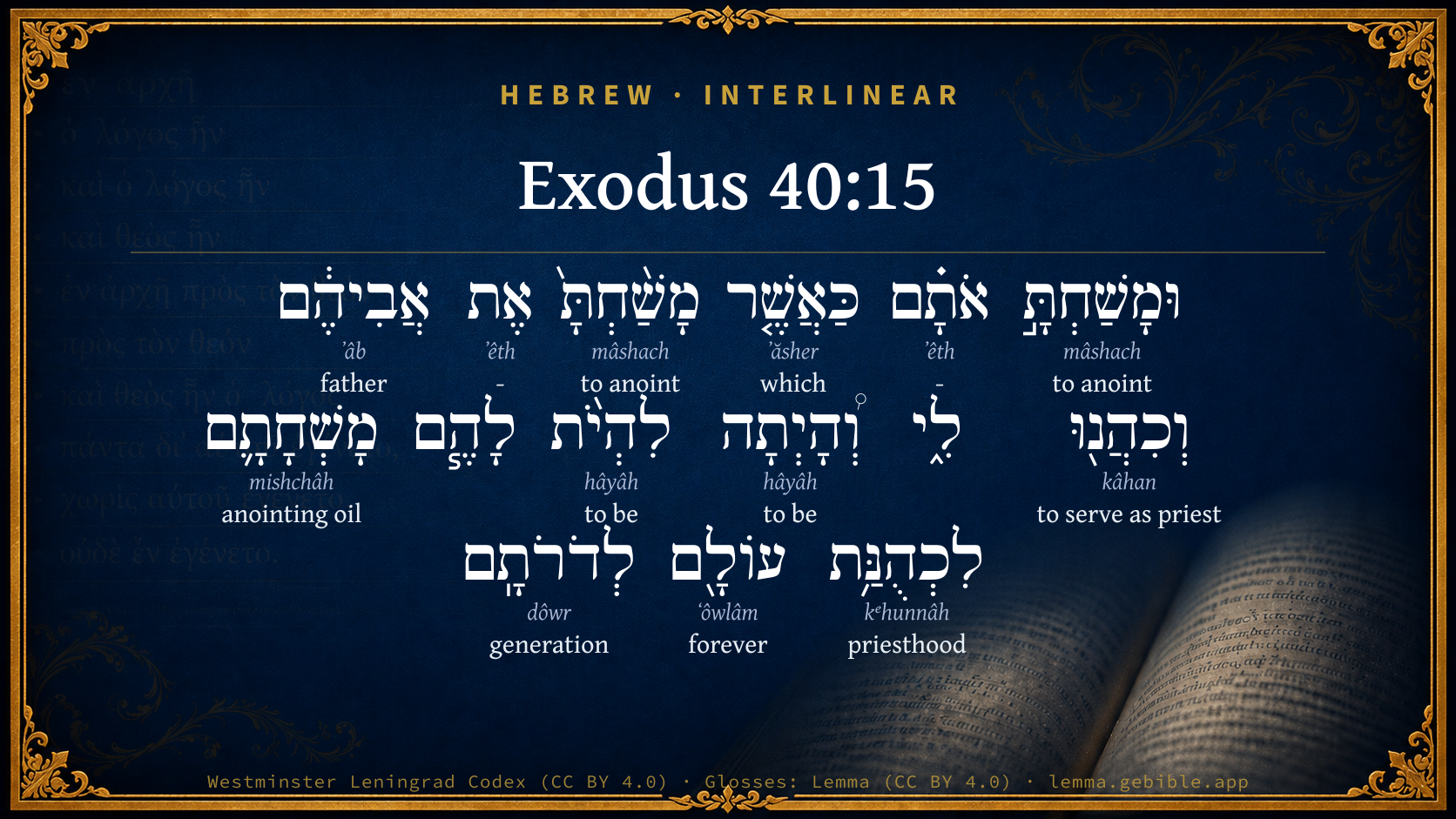
Hebrew (Westminster Leningrad Codex) Exodus 40:15 appears in the Hebrew Old Testament. The text above is from the Westminster Leningrad Codex. Each word links to its Strong’s number, a concise gloss, and parsing drawn from the Open Scriptures Hebrew Bible morphology. Click any word for its full Brown-Driver-Briggs (BDB) entry.
Download image
Cite this verse

Exodus 40:15 (World English Bible). Public Domain. Lemma interlinear Bible study tool, https://lemma.gebible.app/v/exodus/40/15.

Show BibTeX & RIS
BibTeX
RIS
English Translation
You shall anoint them, as you anointed their father, that they may minister to me in the priest's office. Their anointing shall be to them for an everlasting priesthood throughout their generations.
World English Bible · Public Domain
Download a study sheet

One document with this verse’s original text, its word-by-word gloss line, the meaning frame, cross-references with their text, attributed commentary, and full source and license credits — printable, and it pastes into notes with its structure intact.

This verse Autodidact and up

Study sheet (.html) Plain text (.txt)

A passage Seminary Student

Up to 50 verses in one chapter. A passage sheet keeps up to 6 commentary sources and 12 cross-references per verse, in the order this page ranks them, and says so on the sheet whenever that leaves anything out. Ask for a single verse and you get the Autodidact verse sheet above.

Everything on this page stays free to read, with no account — the sheet is a download of what is already on screen, not access to it.

Want to remove ads? Support Godless Engineer
Compare translations 3

The same verse in 3 English versions, stacked beneath the original-language interlinear above. Click any original word for its lexicon entry.

Each is an independent rendering of the whole verse — the interlinear is not word-aligned to these translations.

Highlighted words mark where these versions differ — a whole-verse word diff, not a word-by-word alignment.

  • World English Bible Public Domain
    You shall anoint them, as you anointed their father, that they may minister to me in the priest's office. Their anointing shall be to them for an everlasting priesthood throughout their generations.
  • King James Version Public Domain
    And thou shalt anoint them, as thou didst anoint their father, that they may minister unto me in the priest's office: for their anointing shall surely be an everlasting priesthood throughout their generations.
  • unfoldingWord Literal Text CC BY-SA 4.0
    And you shall anoint them just as you anointed their father, and they will serve as priests to me. And their anointing will cause them to be a priesthood forever throughout their generations.”

unfoldingWord Literal Text — © unfoldingWord, licensed CC BY-SA 4.0. Word-aligned USFM3 via Door43 (git.door43.org/unfoldingWord/en_ult).

Versions to compare (up to 4)

3 of 4 selected

Show all 18 translations

Every available English version of this verse, each an independent rendering of the whole verse.

  • World English Bible Public Domain
    You shall anoint them, as you anointed their father, that they may minister to me in the priest's office. Their anointing shall be to them for an everlasting priesthood throughout their generations.
  • Berean Standard Bible Public Domain
    Anoint them just as you anointed their father, so that they may also serve Me as priests. Their anointing will qualify them for a permanent priesthood throughout their generations.”
  • Majority Standard Bible Public Domain
    Anoint them just as you anointed their father, so that they may also serve Me as priests. Their anointing will qualify them for a permanent priesthood throughout their generations.”
  • King James Version Public Domain
    And thou shalt anoint them, as thou didst anoint their father, that they may minister unto me in the priest's office: for their anointing shall surely be an everlasting priesthood throughout their generations.
  • American Standard Version (1901) Public Domain
    and thou shalt anoint them, as thou didst anoint their father, that they may minister unto me in the priest's office: and their anointing shall be to them for an everlasting priesthood throughout their generations.
  • Revised Version (1885) Public Domain
    and thou shalt anoint them, as thou didst anoint their father, that they may minister unto me in the priest’s office: and their anointing shall be to them for an everlasting priesthood throughout their generations.
  • Geneva Bible (1599) Public Domain
    And shalt anoynt them as thou diddest anoynt their father, that they may minister vnto mee in the Priestes office: for their anoynting shall be a signe, that the Priesthood shall be euerlasting vnto them throughout their generations.
  • Douay-Rheims (1899) Public Domain
    So in the first month of the second year, the first day of the month, the tabernacle was set up.
  • Young's Literal Translation Public Domain
    and anointed them as thou hast anointed their father, and they have acted as priests to Me, and their anointing hath been to be to them for a priesthood age-during, to their generations.'
  • Literal Standard Version CC BY-SA 4.0
    and anointed them as you have anointed their father, and they have acted as priests to Me, and their anointing has been to them for a continuous priesthood throughout their generations.”
  • Unlocked Literal Bible CC BY-SA 4.0
    You must anoint them as you anointed their father so that they may serve me as priests. Their anointing will make for them a permanent priesthood throughout their people's generations.”
  • unfoldingWord Literal Text CC BY-SA 4.0
    And you shall anoint them just as you anointed their father, and they will serve as priests to me. And their anointing will cause them to be a priesthood forever throughout their generations.”
  • Darby Bible Public Domain
    And thou shalt anoint them, as thou didst anoint their father, that they may serve me as priests. And their anointing shall be to them an everlasting priesthood throughout their generations.
  • World Messianic Bible Public Domain
    You shall anoint them, as you anointed their father, that they may minister to me in the priest’s office. Their anointing shall be to them for an everlasting priesthood throughout their generations.”
  • Webster's Bible Public Domain
    And thou shalt anoint them, as thou didst anoint their father, that they may minister to me in the priest's office: for their anointing shall surely be an everlasting priesthood throughout their generations.
  • Free Bible Version CC BY-SA 4.0
    Anoint them in the same way as you anointed their father, so that they can also serve me as priests. Their anointing makes their line priests forever, for generations to come.”
  • Bible in Basic English Public Domain
    And put oil on them as you did on their father, so that they may be my priests: the putting on of oil will make them priests for ever, from generation to generation.
  • JPS Tanakh (1917) Public Domain
    And thou shalt anoint them, as thou didst anoint their father, that they may minister unto Me in the priest's office; and their anointing shall be to them for an everlasting priesthood throughout their generations.'

Literal Standard Version (2020), Covenant Press — licensed CC BY-SA 4.0. Text via the HelloAO Bible API (eBible.org). Unlocked Literal Bible (unfoldingWord) — licensed CC BY-SA 4.0. Text via the HelloAO Bible API (eBible.org). unfoldingWord Literal Text — © unfoldingWord, licensed CC BY-SA 4.0. Word-aligned USFM3 via Door43 (git.door43.org/unfoldingWord/en_ult). Free Bible Version, Dr. Jonathan Gallagher — licensed CC BY-SA 4.0. Text via the HelloAO Bible API (eBible.org).

Word by word

More ways to search: Search by grammar → Find every occurrence → Compare this word →

Practice this passage: Drill this verse → Learn its vocabulary →

לִכְהֻנַּ֥ת
kᵉhunnâh
H3550
“to/for · priesthood of”
Preposition + Noun, Common, Feminine, Singular, Construct
Part of Speech
Preposition + Noun
Type
Common
Gender
Feminine
Number
Singular
State
Construct
Full BDB Definition

Origin: from H3547

TWOT: 959b

priesthood
  1. וּמָשַׁחְתָּ֣ mâshach H4886 “and · to anoint” Conjunction + Verb, Qal, Sequential Perfect, 2nd Person, Masculine, Singular
  2. אֹתָ֗ם ʼêth H853 “- · them” Particle, Direct Object + Suffix, Personal, 3rd Person, Masculine, Plural
  3. כַּאֲשֶׁ֤ר ʼăsher H834 “like/as · which” Preposition + Particle, Relative
  4. מָשַׁ֨חְתָּ֙ mâshach H4886 “to anoint” Verb, Qal, Perfect, 2nd Person, Masculine, Singular
  5. אֶת ʼêth H853 “-” Particle, Direct Object
  6. אֲבִיהֶ֔ם ʼâb H1 “father · their” Noun, Common, Masculine, Singular, Construct + Suffix, Personal, 3rd Person, Masculine, Plural
  7. וְכִהֲנ֖וּ kâhan H3547 “and · to serve as priest” Conjunction + Verb, Piel, Sequential Perfect, 3rd Person, Common, Plural
  8. וְ֠הָיְתָה hâyâh H1961 “and · to be” Conjunction + Verb, Qal, Sequential Perfect, 3rd Person, Feminine, Singular
  9. לִהְיֹ֨ת hâyâh H1961 “to be” Preposition + Verb, Qal, Infinitive Construct
  10. מָשְׁחָתָ֛ם mishchâh H4888 “anointing oil · their” Noun, Common, Feminine, Singular, Construct + Suffix, Personal, 3rd Person, Masculine, Plural
  11. עוֹלָ֖ם ʻôwlâm H5769 “forever” Noun, Common, Masculine, Singular, Absolute
  12. לְדֹרֹתָֽם dôwr H1755 “to/for · generations · their” Preposition + Noun, Common, Masculine, Plural, Construct + Suffix, Personal, 3rd Person, Masculine, Plural

About this verse

These counts appear in no published source. They are computed here, from the morphology-tagged text and Lemma’s own curated glosses. What Lemma adds →

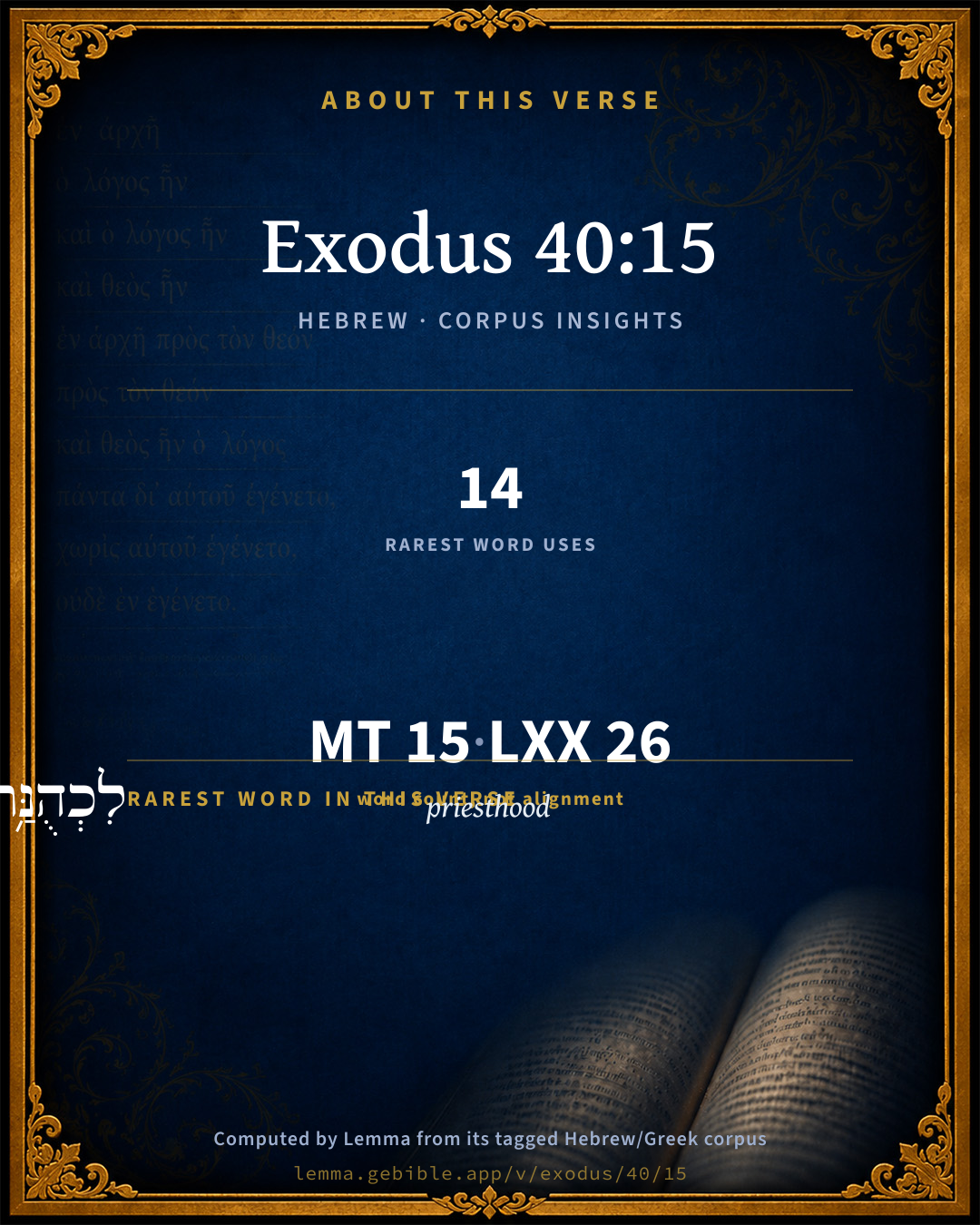
15
words
10
distinct lemmas
Pentateuch
section

Notable vocabulary

The rarest word here is לִכְהֻנַּ֥ת priesthood H3550 — appearing just 14 times in the whole Hebrew Bible.

Shared distinctive vocabulary

לִכְהֻנַּ֥ת priesthood H3550 occurs in 12 verses of the Hebrew Bible. Also found in:

Grammatical profile

  • 5 verbs
  • 5 nouns
  • 2 prepositions
  • 3 particles

Verb forms

  • וּמָשַׁחְתָּ֣ Qal · Sequential Perfect
  • מָשַׁ֨חְתָּ֙ Qal · Perfect
  • וְכִהֲנ֖וּ Piel · Sequential Perfect
  • וְ֠הָיְתָה Qal · Sequential Perfect
  • לִהְיֹ֨ת Qal · Infinitive Construct

Repetition

Words recur within this verse — often emphatic in Hebrew:

  • וּמָשַׁחְתָּ֣ to anoint H4886 ×2
  • וְ֠הָיְתָה to be H1961 ×2

Hebrew & Septuagint length

In English translation the verse runs 32 words from the Hebrew and 35 from the Septuagint (LXX English) — closely comparable.

A rough comparison of the two English renderings, which tokenize alike — not a word-level alignment.

Word counts can differ between the Hebrew and the Greek without any difference in meaning — e.g. the Hebrew direct-object marker אֵת has no separate Greek word, and Greek often adds the article ὁ.

In the original languages it is 15 Hebrew tokens and 26 Greek tokens — but the two are counted differently (Hebrew bundles its prefixes and suffixes into one token; the Greek is in lemma form), so that isn’t a like-for-like length.

Cross-references

11

Topical passages linked to Exodus 40:15 in the Treasury of Scripture Knowledge — connected by theme and wording, ordered by reader-vote popularity; previews shown in the World English Bible.

  • Numbers 25:13 and it shall be to him, and to his seed after him, the covenant of an everlasting priesthood; because he was jealous for his God, and made atonement for the children of Israel.
  • Psalms 110:4 Yahweh has sworn, and will not change his mind: "You are a priest forever in the order of Melchizedek."
  • Hebrews 5:1–14 For every high priest, being taken from among men, is appointed for men in things pertaining to God, that he may offer both gifts and sacrifices for sins.
  • Hebrews 7:17–24 for it is testified, "You are a priest forever, According to the order of Melchizedek."
  • Hebrews 8:1–10 Now in the things which we are saying, the main point is this. We have such a high priest, who sat down on the right hand of the throne of the Majesty in the heavens,
  • Exodus 12:14 This day shall be to you for a memorial, and you shall keep it a feast to Yahweh: throughout your generations you shall keep it a feast by an ordinance forever.
  • Exodus 29:9 You shall dress them with belts, Aaron and his sons, and bind headbands on them: and they shall have the priesthood by a perpetual statute: and you shall consecrate Aaron and his sons.
  • Exodus 30:31 You shall speak to the children of Israel, saying, 'This shall be a holy anointing oil to me throughout your generations.
  • Exodus 30:33 Whoever compounds any like it, or whoever puts any of it on a stranger, he shall be cut off from his people.'"
  • Hebrews 7:3 without father, without mother, without genealogy, having neither beginning of days nor end of life, but made like the Son of God), remains a priest continually.
  • Hebrews 7:7 But without any dispute the less is blessed by the better.

Cross-references courtesy of OpenBible.info (CC BY 4.0).

Hebrew and Greek witnesses Masoretic Hebrew ↔ Greek Septuagint

The same verse in the two great witnesses to the Old Testament, shown verse-for-verse.

These are two independent witnesses, not word-aligned to each other, and the Septuagint is shown in lemma (dictionary) form.

Hebrew Exodus 40:15 Masoretic · Westminster Leningrad Codex

וּמָשַׁחְתָּ֣ אֹתָ֗ם כַּאֲשֶׁ֤ר מָשַׁ֨חְתָּ֙ אֶת אֲבִיהֶ֔ם וְכִהֲנ֖וּ לִ֑י וְ֠הָיְתָה לִהְיֹ֨ת לָהֶ֧ם מָשְׁחָתָ֛ם לִכְהֻנַּ֥ת עוֹלָ֖ם לְדֹרֹתָֽם

You shall anoint them, as you anointed their father, that they may minister to me in the priest's office. Their anointing shall be to them for an everlasting priesthood throughout their generations.

World English Bible · Public Domain

Greek LXX Exodus 40:15 Septuagint · lemma form

καί ἀλείφω αὐτός ὅς τρόπος ἀλείφω ὁ πατήρ αὐτός καί ἱερατεύω ἐγώ καί εἰμί ὥστε εἰμί αὐτός χρῖσμα ἱερατεία εἰς ὁ αἰών εἰς ὁ γενεά αὐτός

And you shall anoint them as you did anoint their father, and they shall minister to me as priests; and it shall be that they shall have an everlasting anointing of priesthood, throughout their generations.

LXX2012 (modern English Septuagint) · Public Domain

Hebrew: Westminster Leningrad Codex (CC BY 4.0). Greek: Septuagint (public domain); English from LXX2012 (modern English Septuagint) (Public Domain). How the Septuagint differs from the Hebrew →

Targum (Aramaic paraphrase)

2

The Targum is the ancient Jewish Aramaic paraphrase of the Hebrew Scriptures — an interpretive translation, not the Hebrew text itself. Onkelos (literal) and Pseudo-Jonathan (expansive) render the Torah, and Jonathan the Prophets. Coverage is partial: where no permissively-licensed English translation exists for a verse, only the Aramaic is shown. This is verse-level text, not a word-by-word alignment to the Hebrew.

  1. Targum Onkelos Torah (Genesis–Deuteronomy)
    וּתְרַבִּי יָתְהוֹן כְּמָא דִי רַבִּיתָא יָת אֲבוּהוֹן וִישַׁמְשׁוּן קֳדָמָי וּתְהֵי לְמֶהֱוֵי לְּהוֹן רְבוּתְהוֹן לְכַהֲנוּת עֲלָם לְדָרֵיהוֹן:

    (no public-domain English translation for this verse)

    Targum Onkelos — Aramaic: “Onkelos Genesis” (public domain); “Onkelos Exodus” (public domain); “Onkelos Leviticus” (public domain); “Onkelos Numbers” (public domain); “Onkelos Deuteronomy” (public domain). English: “Sefaria Community Translation” (CC0 1.0 (public-domain dedication)); “J.W. Etheridge. The Targums of Onkelos and Jonathan Ben Uzziel on the Pentateuch. London: Longmans, Green, 1862” (public domain). Text via Sefaria.

  2. Targum Pseudo-Jonathan Torah (Genesis–Deuteronomy)
    וּתְרַבֵּי יַתְהוֹן הֵיכְמָא דְרָבִית יַת אֲבוּהוֹן וִישַׁמְשׁוּן קֳדָמַי וּתְהֵי לְמֶהֱוֵי לְהוֹן רְבוּתְהוֹן לִכְהוּנַת עֲלָם לְדָרֵיהוֹן

    and anoint them, as thou didst anoint their father, that they may minister before Me; and their consecration shall be for a perpetual priesthood in their generations.

    Targum Pseudo-Jonathan — Aramaic: “Targum Jonathan on Genesis” (public domain); “Targum Jonathan on Exodus” (public domain); “Targum Jonathan on Leviticus” (public domain); “Targum Jonathan on Numbers” (public domain); “Targum Jonathan on Deuteronomy” (public domain). English: “The Targum of Jonathan ben Uzziel, trans. J. W. Etheridge, London, 1862” (public domain). Text via Sefaria.

Commentary

Notes on Exodus 40:15 from classic Christian and Jewish commentators (each source and its license shown beneath its notes). The classic Christian expositions comment on the surrounding passage and are grouped to its opening verse, so a note may address several verses; the Jewish commentaries on the Tanakh (Rashi and others) are per-verse, so they appear only where the commentator wrote on this verse.

Lemma curates 59 commentaries, every one of them public domain or Creative Commons licensed, each selected and text-cleaned for this edition rather than reprinted as found. About our sources →

Joseph Benson's Commentary

Exo 40:15. Their anointing shall be an everlasting priesthood — A seal that their priesthood shall continue as long as the Jewish polity lasts. He signifies that this unction should be sufficient for all succeeding priests. None were afterward anointed but the high-priests.

Joseph Benson's Commentary on the Old and New Testaments (1811–1818) — public domain. Text from a community e-Sword module.

Geneva Bible (1599)

Geneva Bible translators

Till both the Priesthood and the ceremonies should end, which was at Christ’s coming.

Geneva Bible (1599) marginal notes — public domain. Text via Bolls.life.

Jamieson, Fausset & Brown

Robert Jamieson, A. R. Fausset & David Brown

anoint them, as thou didst anoint their fathers--The sacred oil was used, but it does not appear that the ceremony was performed exactly in the same manner; for although the anointing oil was sprinkled over the garments both of Aaron and his sons (Exo 29:21; Lev 8:30), it was not poured over the heads of the latter. This distinction was reserved for the high priest (Exo 29:7; Lev 8:12; Psa 133:2).

Jamieson, Fausset & Brown — Commentary Critical and Explanatory on the Whole Bible (1871) — public domain (CC PDM 1.0). Text via the HelloAO Bible API.

Adam Clarke's Commentary

Verse 15. For their anointing shall surely be an everlasting priesthood] By this anointing a right was given to Aaron and his family to be high priests among the Jews for ever; so that all who should be born of this family should have a right to the priesthood without the repetition of this unction, as they should enjoy this honour in their father's right, who had it by a particular grant from God. But it appears that the high priest, on his consecration, did receive the holy unction; see Le 4:3; Le 6:22; Le 21:10. And this continued till the destruction of the first temple, and the Babylonish captivity; and according to Eusebius, Cyril of Jerusalem, and others, this custom continued among the Jews to the advent of our Lord, after which there is no evidence it was ever practised. See Calmet's note on chap. xxix. 7. See Clarke on Ex 29:7. The Jewish high priest was a type of Him who is called the high priest over the house of God, Heb 10:21; and when he came, the functions of the other necessarily ceased. This case is worthy of observation. The Jewish sacrifices were never resumed after the destruction of their city and temple, for they hold it unlawful to sacrifice anywhere out of Jerusalem; and the unction of their high priest ceased from that period also: and why? Because the true priest and the true sacrifice were come, and the types of course were no longer necessary after the manifestation of the antitype.

Adam Clarke's Commentary on the Bible (1810–1826) — public domain. Text from a community e-Sword/MySword module.

Ellicott's Commentary for English Readers

(15) Thou shalt anoint them, as thou didst anoint their father.—By the narrative of Leviticus 8, it would seem that Aaron’s sons were not anointed in the same way as himself. He had the oil poured over his head (Lev_8:12; Psa_133:2). They were merely sprinkled with a mixture of oil and blood (Lev_8:30). The difference implied a lower degree of official holiness.

Their anointing shall surely be an everlasting priesthood.—The Jewish commentators maintain that the one anointing of the sons of Aaron sufficed for all time, and was not repeated in the case of any subsequent priests, who became fully possessed of the sacerdotal office without it. Each high priest was, on the contrary, inducted into his office by anointing, whence the high priest came to be spoken of as “the anointed priest (Lev_4:3; Lev_4:5; Lev_4:16; Lev_21:12, &c.).

A Bible Commentary for English Readers, edited by Charles John Ellicott (1878–1897) — public domain. Text from a community e-Sword module.

The Cambridge Bible for Schools and Colleges

gen. ed. J. J. S. Perowne

15a. For the common priests being anointed exactly as the high-priest (not prescribed in ch. 29), see Exo_28:41; and cf. on Exo_30:30.

15b. an everlasting priesthood] It is to be for ever hereditary in Aaron’s family. A perpetual priesthood is also promised to Aaron’s ‘sons’ in Exo_29:9 : but it is not, as here, based upon their being anointed; in fact, no anointing is there prescribed for them at all. The Rabbis, understanding the pron. in ‘their anointing’ to refer to Aaron’s sons alone, inferred that the anointing of Aaron’s actual sons sufficed for the ordinary priests in all future ages, and that in the case of the ordinary priests the ceremony was never afterwards repeated (cf. Di., and Kalisch, Leviticus, pp. 666–8). But this is a forced and artificial interpretation: their and to them refer naturally to Aaron and his sons together (Di.).

The Cambridge Bible for Schools and Colleges (gen. ed. J. J. S. Perowne; Cambridge University Press, 1878–1918) — public domain. Text from a community e-Sword module.

John Gill's Exposition

And it came to pass in the first month, in the second year,.... Of the departure of the children of Israel out of Egypt:

on the first day of the month, that the tabernacle was reared up; so that this was in the spring of the year, about the vernal equinox, on a new year's day, that this was done, which was beginning the year well: it was within a fortnight of a year after their coming out of Egypt, and when they had been about five months and a half in building the tabernacle; for such a time it seems they were in doing that, and which, considering the many things to be done, and in the winter season, it shows great dispatch. Where was the place, in which the tabernacle was reared up, is not said: it is (d) observed, that near the southwest corner of that part of Mount Sinai, which is called Mount Episteme, there is a little hill called Araone by the Arabs, and by the Greeks the tabernacle of the testimony, where they say Aaron was consecrated, and first performed the offices of the priesthood: probably, says a learned man (e), on this hill was placed the tabernacle of the congregation, which Moses was ordered to place without the camp afar off; but he seems to mistake the tent of Moses, or however the little tabernacle erected before the grand one was made, for this tabernacle in Exo 33:7 which he seems to refer to; it is more probable that it was now reared up in the midst of the camp of Israel, see Num 2:2.

(d) Pocock's Travels, p. 147. (e) Clayton's Chronology of the Hebrew Bible, p. 350.

John Gill's Exposition of the Whole Bible (1746–1763) — public domain (CC PDM 1.0). Text via the HelloAO Bible API.

Matthew Poole's English Annotations

i.e. A sign or seal that their priesthood shall continue as long as their polity lasts, till the coming of Messias. He signifies that this unction should be sufficient for all succeeding priests; they should not need to be anointed again, except the successive high priests. See Exo 29:7,29; Le 4:3; 16:32; 21:10

Matthew Poole's English Annotations on the Holy Bible (1683–1685) — public domain. Text from a community e-Sword/MySword module.

The Pulpit Commentary

Thou shalt anoint them as thou didst anoint their father. The mode of anointing does not seem to have been identical in the two cases. The oil was first poured upon Aaron"s head (Lev_8:12; Psa_133:2) and afterwards sprinkled upon him. (Lev_8:30) It was, apparently, only sprinkled upon the priests (ib,). This was a lower form of anointing; and hence the high priest was sometimes called the anointed priest". (Lev_4:5, 16 6:22 16:32, etc.) Their anointing shall surely be an everlasting priesthood. The Rabbinical commentators maintain that these words apply to the ordinary priests only, and on the strength of them establish a difference between the ordinary priests and the high priests. The latter were in every ease to be anointed to their office. A single anointing sainted for the former. It is scarcely necessary to say that there is no Scriptural ground for this distinction. The natural sense of the words is, rather, that as long as the anointing continued, the priesthood should continue.

The Pulpit Commentary (1880–1919), ed. H.D.M. Spence-Jones & Joseph S. Exell — public domain. Text from a community e-Sword module.

John Wesley's Explanatory Notes

Their anointing shall be an everlasting priesthood - A seal that their priesthood shall continue as long as the Jewish polity lasts. He signifies that this unction should be sufficient for all succeeding priests. None were afterwards anointed but the high- priests.

John Wesley, Explanatory Notes Upon the Whole Bible (1754–1765) — public domain. Text via the GEBible commentary corpus.

Lesson kit

Teaching starters — assembled from the data on this page, not authored interpretation. Every prompt links to the verse data it draws on. Edit before teaching.

Exodus, in the Pentateuch, opens this verse with 15 words (10 distinct Hebrew lemmas). Its most distinctive word is kᵉhunnâh (“priesthood”). A historical commentator’s framing appears above. Read the whole chapter for the surrounding context.

Discussion questions

  1. How does “priesthood” (kᵉhunnâh) shape what this verse is saying?
  2. Exodus 29:9 shares the word «priesthood» with this verse. How do the two illuminate each other?
  3. “to anoint” occurs 2× in this one verse. What is the effect of the repetition?
  4. The translations on this page render this verse differently — a whole-verse word diff, not a word-by-word alignment. What might account for the different wordings?
  5. The verb «וּמָשַׁחְתָּ֣» is Qal Sequential Perfect. How does its form color the action?
  6. Reading how Joseph Benson's Commentary and Geneva Bible (1599) read this verse, where do the two commentators agree and where do they part?

Things to notice

Reading settings

Reading text

Shown beneath each verse's original-language words.

Old Testament
Old Testament edition

Read the OT as the Masoretic Hebrew (MT) or the Greek Septuagint (LXX).

English shown for the Greek Septuagint (in the Hebrew ↔ Greek comparison).

Comparing translations? Open the Compare panel on any verse page to stack up to four side by side.