
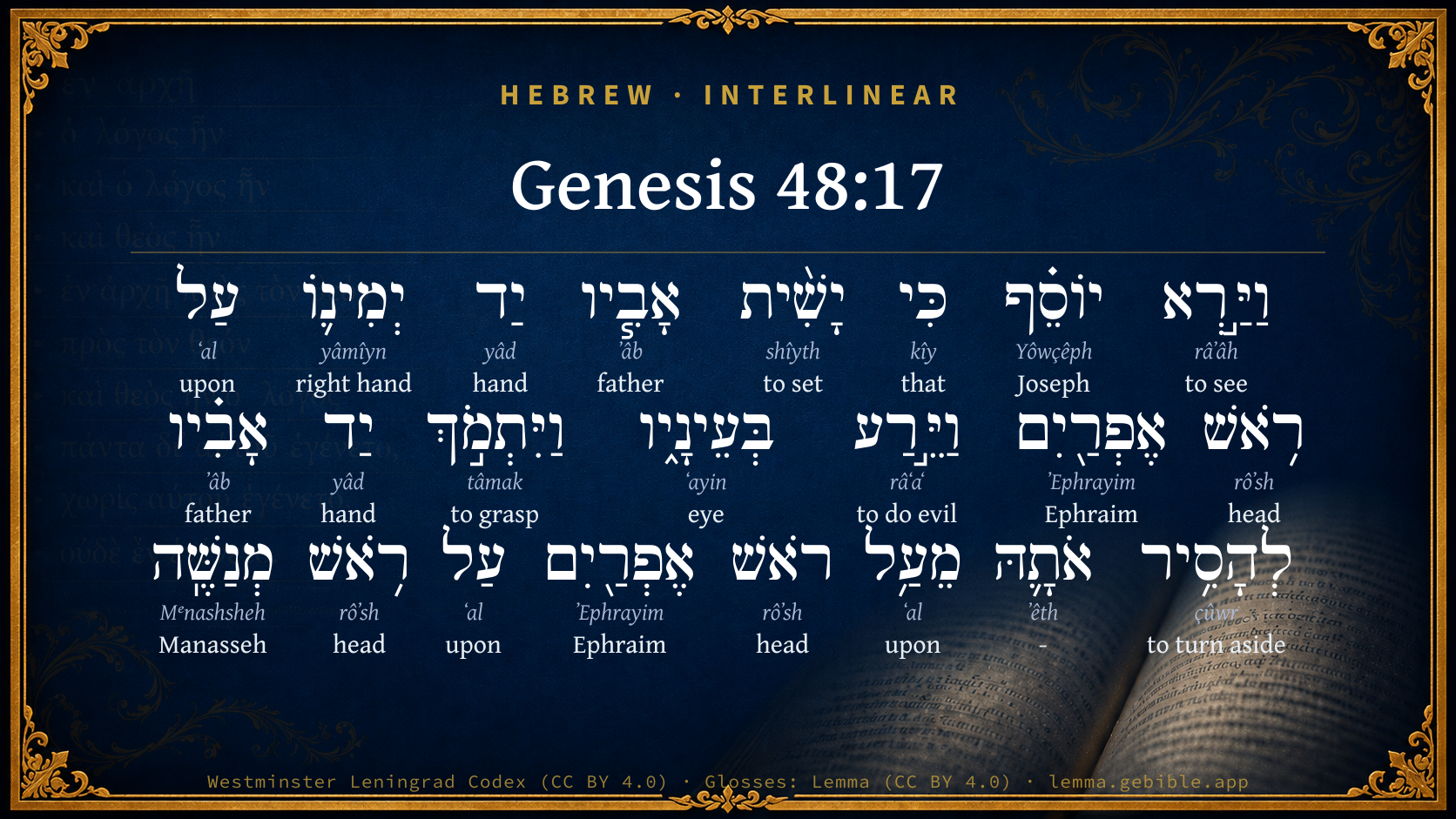
Genesis 48:17

Hebrew (Westminster Leningrad Codex) Genesis 48:17 appears in the Hebrew Old Testament. The text above is from the Westminster Leningrad Codex. Each word links to its Strong’s number, a concise gloss, and parsing drawn from the Open Scriptures Hebrew Bible morphology. Click any word for its full Brown-Driver-Briggs (BDB) entry.
Download image
Cite this verse

Genesis 48:17 (World English Bible). Public Domain. Lemma interlinear Bible study tool, https://lemma.gebible.app/v/genesis/48/17.

Show BibTeX & RIS
BibTeX
RIS
English Translation
When Joseph saw that his father laid his right hand on the head of Ephraim, it displeased him. He held up his father's hand, to remove it from Ephraim's head to Manasseh's head.
World English Bible · Public Domain
Highlights
  • 1 first appearance in the Hebrew Bible
Full analysis ↓
Download a study sheet

One document with this verse’s original text, its word-by-word gloss line, the meaning frame, cross-references with their text, attributed commentary, and full source and license credits — printable, and it pastes into notes with its structure intact.

This verse Autodidact and up

Study sheet (.html) Plain text (.txt)

A passage Seminary Student

Up to 50 verses in one chapter. A passage sheet keeps up to 6 commentary sources and 12 cross-references per verse, in the order this page ranks them, and says so on the sheet whenever that leaves anything out. Ask for a single verse and you get the Autodidact verse sheet above.

Everything on this page stays free to read, with no account — the sheet is a download of what is already on screen, not access to it.

Want to remove ads? Support Godless Engineer
Compare translations 3

The same verse in 3 English versions, stacked beneath the original-language interlinear above. Click any original word for its lexicon entry.

Each is an independent rendering of the whole verse — the interlinear is not word-aligned to these translations.

Highlighted words mark where these versions differ — a whole-verse word diff, not a word-by-word alignment.

  • World English Bible Public Domain
    When Joseph saw that his father laid his right hand on the head of Ephraim, it displeased him. He held up his father's hand, to remove it from Ephraim's head to Manasseh's head.
  • King James Version Public Domain
    And when Joseph saw that his father laid his right hand upon the head of Ephraim, it displeased him: and he held up his father's hand, to remove it from Ephraim's head unto Manasseh's head.
  • unfoldingWord Literal Text CC BY-SA 4.0
    And Joseph saw that his father had placed his right hand on the head of Ephraim, and it was displeasing in his eyes, so he took hold of the hand of his father to move it from the head of Ephraim to the head of Manasseh.

unfoldingWord Literal Text — © unfoldingWord, licensed CC BY-SA 4.0. Word-aligned USFM3 via Door43 (git.door43.org/unfoldingWord/en_ult).

Versions to compare (up to 4)

3 of 4 selected

Show all 18 translations

Every available English version of this verse, each an independent rendering of the whole verse.

  • World English Bible Public Domain
    When Joseph saw that his father laid his right hand on the head of Ephraim, it displeased him. He held up his father's hand, to remove it from Ephraim's head to Manasseh's head.
  • Berean Standard Bible Public Domain
    When Joseph saw that his father had placed his right hand on Ephraim’s head, he was displeased and took his father’s hand to move it from Ephraim’s head to Manasseh’s.
  • Majority Standard Bible Public Domain
    When Joseph saw that his father had placed his right hand on Ephraim’s head, he was displeased and took his father’s hand to move it from Ephraim’s head to Manasseh’s.
  • King James Version Public Domain
    And when Joseph saw that his father laid his right hand upon the head of Ephraim, it displeased him: and he held up his father's hand, to remove it from Ephraim's head unto Manasseh's head.
  • American Standard Version (1901) Public Domain
    And when Joseph saw that his father laid his right hand upon the head of Ephraim, it displeased him: and he held up his father's hand, to remove it from Ephraim's head unto Manasseh's head.
  • Revised Version (1885) Public Domain
    And when Joseph saw that his father laid his right hand upon the head of Ephraim, it displeased him: and he held up his father’s hand, to remove it from Ephraim’s head unto Manasseh’s head.
  • Geneva Bible (1599) Public Domain
    But when Ioseph sawe that his father layde his right hande vpon the head of Ephraim, it displeased him: and he stayed his fathers hand to remooue it from Ephraims head to Manassehs head.
  • Douay-Rheims (1899) Public Domain
    And Joseph seeing that his father had put his right hand upon the head of Ephraim, was much displeased: and taking his father's hand he tried to lift it from Ephraims head, and to remove it to the head of Manasses.
  • Young's Literal Translation Public Domain
    And Joseph seeth that his father setteth his right hand on the head of Ephraim, and it is wrong in his eyes, and he supporteth the hand of his father to turn it aside from off the head of Ephraim to the head of Manasseh;
  • Literal Standard Version CC BY-SA 4.0
    And Joseph sees that his father sets his right hand on the head of Ephraim, and it is wrong in his eyes, and he supports the hand of his father to turn it aside from off the head of Ephraim to the head of Manasseh;
  • Unlocked Literal Bible CC BY-SA 4.0
    When Joseph saw his father place his right hand upon the head of Ephraim, it displeased him. He took his father's hand to move it from Ephraim's head to Manasseh's head.
  • unfoldingWord Literal Text CC BY-SA 4.0
    And Joseph saw that his father had placed his right hand on the head of Ephraim, and it was displeasing in his eyes, so he took hold of the hand of his father to move it from the head of Ephraim to the head of Manasseh.
  • Darby Bible Public Domain
    When Joseph saw that his father laid his right hand on the head of Ephraim, it was evil in his eyes; and he took hold of his father's hand to remove it from Ephraim's head to Manasseh's head.
  • World Messianic Bible Public Domain
    When Joseph saw that his father laid his right hand on the head of Ephraim, it displeased him. He held up his father’s hand, to remove it from Ephraim’s head to Manasseh’s head.
  • Webster's Bible Public Domain
    And when Joseph saw that his father laid his right hand upon the head of Ephraim, it displeased him: and he lifted his father's hand, to remove it from Ephraim's head to Manasseh's head.
  • Free Bible Version CC BY-SA 4.0
    Joseph was unhappy when he saw his father had put his right hand on Ephraim, so he took his father's hand to try and move it from Ephraim's head to Manasseh's head.
  • Bible in Basic English Public Domain
    Now when Joseph saw that his father had put his right hand on the head of Ephraim, it did not seem right to him; and lifting his father's hand he would have put it on the head of Manasseh.
  • JPS Tanakh (1917) Public Domain
    And when Joseph saw that his father was laying his right hand upon the head of Ephraim, it displeased him, and he held up his father's hand, to remove it from Ephraim's head unto Manasseh's head.

Literal Standard Version (2020), Covenant Press — licensed CC BY-SA 4.0. Text via the HelloAO Bible API (eBible.org). Unlocked Literal Bible (unfoldingWord) — licensed CC BY-SA 4.0. Text via the HelloAO Bible API (eBible.org). unfoldingWord Literal Text — © unfoldingWord, licensed CC BY-SA 4.0. Word-aligned USFM3 via Door43 (git.door43.org/unfoldingWord/en_ult). Free Bible Version, Dr. Jonathan Gallagher — licensed CC BY-SA 4.0. Text via the HelloAO Bible API (eBible.org).

Word by word

More ways to search: Search by grammar → Find every occurrence → Compare this word →

Practice this passage: Drill this verse → Learn its vocabulary →

וַיִּתְמֹ֣ךְ
tâmak
H8551
“and · to grasp”
Conjunction + Verb, Qal, Sequential Imperfect, 3rd Person, Masculine, Singular
Part of Speech
Conjunction + Verb
Stem
Qal
Form
Sequential Imperfect
Person
3rd Person
Gender
Masculine
Number
Singular
Full BDB Definition

Origin: a primitive root

TWOT: 2520

to grasp, hold, support, attain, lay hold of, hold fast - (Qal) - to grasp, lay hold of, attain - to hold up, support - to hold, keep - to take hold of each other - (Niphal) to be seized, be held
  1. וַיַּ֣רְא râʼâh H7200 “and · to see” Conjunction + Verb, Qal, Sequential Imperfect, 3rd Person, Masculine, Singular
  2. יוֹסֵ֗ף Yôwçêph H3130 “Joseph” Noun, Proper
  3. כִּי kîy H3588 “that” Conjunction
  4. יָשִׁ֨ית shîyth H7896 “to set” Verb, Qal, Imperfect, 3rd Person, Masculine, Singular
  5. אָבִ֧יו ʼâb H1 “father · his” Noun, Common, Masculine, Singular, Construct + Suffix, Personal, 3rd Person, Masculine, Singular
  6. יַד yâd H3027 “hand of” Noun, Common, Both, Singular, Construct
  7. יְמִינ֛וֹ yâmîyn H3225 “right hand · his” Noun, Common, Feminine, Singular, Construct + Suffix, Personal, 3rd Person, Masculine, Singular
  8. עַל ʻal H5921 “upon” Preposition
  9. רֹ֥אשׁ rôʼsh H7218 “head of” Noun, Common, Masculine, Singular, Construct
  10. אֶפְרַ֖יִם ʼEphrayim H669 “Ephraim” Noun, Proper
  11. וַיֵּ֣רַע râʻaʻ H7489 “and · to do evil” Conjunction + Verb, Qal, Sequential Imperfect, 3rd Person, Masculine, Singular
  12. בְּעֵינָ֑יו ʻayin H5869 “in/at · eyes · his” Preposition + Noun, Common, Both, Dual, Construct + Suffix, Personal, 3rd Person, Masculine, Singular
  13. יַד yâd H3027 “hand of” Noun, Common, Both, Singular, Construct
  14. אָבִ֗יו ʼâb H1 “father · his” Noun, Common, Masculine, Singular, Construct + Suffix, Personal, 3rd Person, Masculine, Singular
  15. לְהָסִ֥יר çûwr H5493 “to turn aside” Preposition + Verb, Hiphil, Infinitive Construct
  16. אֹתָ֛הּ ʼêth H853 “- · her” Particle, Direct Object + Suffix, Personal, 3rd Person, Feminine, Singular
  17. מֵעַ֥ל ʻal H5921 “from · upon” Preposition + Preposition
  18. רֹאשׁ rôʼsh H7218 “head of” Noun, Common, Masculine, Singular, Construct
  19. אֶפְרַ֖יִם ʼEphrayim H669 “Ephraim” Noun, Proper
  20. עַל ʻal H5921 “upon” Preposition
  21. רֹ֥אשׁ rôʼsh H7218 “head of” Noun, Common, Masculine, Singular, Construct
  22. מְנַשֶּֽׁה Mᵉnashsheh H4519 “Manasseh” Noun, Proper

About this verse

These counts appear in no published source. They are computed here, from the morphology-tagged text and Lemma’s own curated glosses. What Lemma adds →

23
words
16
distinct lemmas
Pentateuch
section

Notable vocabulary

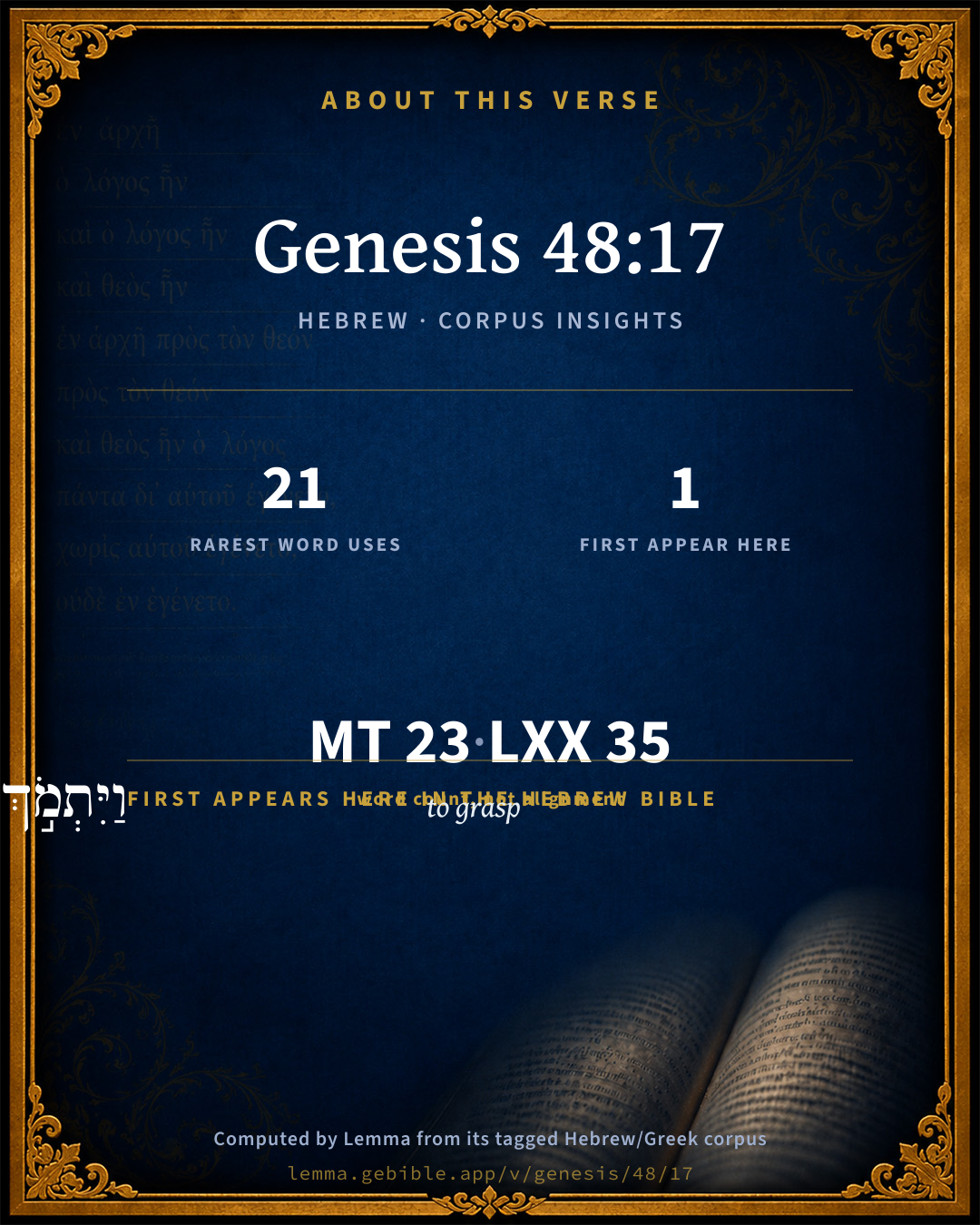
The rarest word here is וַיִּתְמֹ֣ךְ to grasp H8551 — appearing just 21 times in the whole Hebrew Bible.

First appearance in Scripture

This word makes its first canonical appearance in the Hebrew Bible here:

  • וַיִּתְמֹ֣ךְ to grasp H8551

Shared distinctive vocabulary

וַיִּתְמֹ֣ךְ to grasp H8551 occurs in 20 verses of the Hebrew Bible. Also found in:

Grammatical profile

  • 5 verbs
  • 13 nouns
  • 3 prepositions
  • 1 conjunction
  • 1 particle

Verb forms

  • וַיַּ֣רְא Qal · Sequential Imperfect
  • יָשִׁ֨ית Qal · Imperfect
  • וַיֵּ֣רַע Qal · Sequential Imperfect
  • וַיִּתְמֹ֣ךְ Qal · Sequential Imperfect
  • לְהָסִ֥יר Hiphil · Infinitive Construct

Repetition

Words recur within this verse — often emphatic in Hebrew:

  • עַל upon H5921 ×3
  • רֹ֥אשׁ head H7218 ×3
  • אָבִ֧יו father H1 ×2
  • יַד hand H3027 ×2
  • אֶפְרַ֖יִם Ephraim H669 ×2

Hebrew & Septuagint length

In English translation the verse runs 33 words from the Hebrew and 43 from the Septuagint (LXX English) — closely comparable.

A rough comparison of the two English renderings, which tokenize alike — not a word-level alignment.

Word counts can differ between the Hebrew and the Greek without any difference in meaning — e.g. the Hebrew direct-object marker אֵת has no separate Greek word, and Greek often adds the article ὁ.

In the original languages it is 23 Hebrew tokens and 35 Greek tokens — but the two are counted differently (Hebrew bundles its prefixes and suffixes into one token; the Greek is in lemma form), so that isn’t a like-for-like length.

Cross-references

11

Topical passages linked to Genesis 48:17 in the Treasury of Scripture Knowledge — connected by theme and wording, ordered by reader-vote popularity; previews shown in the World English Bible.

  • Genesis 48:14 Israel stretched out his right hand, and laid it on Ephraim's head, who was the younger, and his left hand on Manasseh's head, guiding his hands knowingly, for Manasseh was the firstborn.
  • Romans 9:7–8 Neither, because they are Abraham's seed, are they all children. But, "In Isaac will your seed be called."
  • Genesis 28:8 Esau saw that the daughters of Canaan didn't please Isaac, his father.
  • Genesis 38:10 The thing which he did was evil in the sight of Yahweh, and he killed him also.
  • Numbers 11:1 The people were as murmurers, [speaking] evil in the ears of Yahweh: and when Yahweh heard it, his anger was kindled; and the fire of Yahweh burnt among them, and devoured in the uttermost part of the camp.
  • 1 Samuel 16:7 But Yahweh said to Samuel, "Don't look on his face, or on the height of his stature; because I have rejected him: for [Yahweh sees] not as man sees; for man looks at the outward appearance, but Yahweh looks at the heart."
  • 1 Kings 16:25 Omri did that which was evil in the sight of Yahweh, and dealt wickedly above all who were before him.
  • 1 Chronicles 21:7 God was displeased with this thing; therefore he struck Israel.
  • Proverbs 24:18 Lest Yahweh see it, and it displease him, And he turn away his wrath from him.
  • Romans 9:11 For being not yet born, neither having done anything good or bad, that the purpose of God according to election might stand, not of works, but of him who calls,
  • Numbers 22:34 Balaam said to the angel of Yahweh, I have sinned; for I didn't know that you stood in the way against me: now therefore, if it displease you, I will get me back again.

Cross-references courtesy of OpenBible.info (CC BY 4.0).

Hebrew and Greek witnesses Masoretic Hebrew ↔ Greek Septuagint

The same verse in the two great witnesses to the Old Testament, shown verse-for-verse.

These are two independent witnesses, not word-aligned to each other, and the Septuagint is shown in lemma (dictionary) form.

Hebrew Genesis 48:17 Masoretic · Westminster Leningrad Codex

וַיַּ֣רְא יוֹסֵ֗ף כִּי יָשִׁ֨ית אָבִ֧יו יַד יְמִינ֛וֹ עַל רֹ֥אשׁ אֶפְרַ֖יִם וַיֵּ֣רַע בְּעֵינָ֑יו וַיִּתְמֹ֣ךְ יַד אָבִ֗יו לְהָסִ֥יר אֹתָ֛הּ מֵעַ֥ל רֹאשׁ אֶפְרַ֖יִם עַל רֹ֥אשׁ מְנַשֶּֽׁה

When Joseph saw that his father laid his right hand on the head of Ephraim, it displeased him. He held up his father's hand, to remove it from Ephraim's head to Manasseh's head.

World English Bible · Public Domain

Greek LXX Genesis 48:17 Septuagint · lemma form

ὁράω δέ ιωσηφ ὅτι ἐπιβάλλω ὁ πατήρ ὁ δεξιός αὐτός ἐπί ὁ κεφαλή ἐφράιμ βαρύς αὐτός καταφαίνω καί ἀντιλαμβάνω ιωσηφ ὁ χείρ ὁ πατήρ αὐτός ἀποαἱρέω αὐτός ἀπό ὁ κεφαλή ἐφράιμ ἐπί ὁ κεφαλή μανασσή

And Joseph having seen that his father put his right hand on the head of Ephraim—it seemed grievous to him; and Joseph took hold of the hand of his father, to remove it from the head of Ephraim to the head of Manasse.

LXX2012 (modern English Septuagint) · Public Domain

Hebrew: Westminster Leningrad Codex (CC BY 4.0). Greek: Septuagint (public domain); English from LXX2012 (modern English Septuagint) (Public Domain). How the Septuagint differs from the Hebrew →

Targum (Aramaic paraphrase)

2

The Targum is the ancient Jewish Aramaic paraphrase of the Hebrew Scriptures — an interpretive translation, not the Hebrew text itself. Onkelos (literal) and Pseudo-Jonathan (expansive) render the Torah, and Jonathan the Prophets. Coverage is partial: where no permissively-licensed English translation exists for a verse, only the Aramaic is shown. This is verse-level text, not a word-by-word alignment to the Hebrew.

  1. Targum Onkelos Torah (Genesis–Deuteronomy)
    וַחֲזָא יוֹסֵף אֲרֵי שַׁוִּי אָבוּהִי יַד יְמִינֵהּ עַל רֵישָׁא דְאֶפְרַיִם וּבְאֵישׁ בְּעֵינוֹהִי וְסָעֵד יְדָא דְאָבוּהִי לְאַעֲדָאָה יָתַהּ מֵעַל רֵישָׁא דְאֶפְרַיִם לְאַנָחוּתַהּ עַל רֵישָׁא דִמְנַשֶּׁה

    (no public-domain English translation for this verse)

    Targum Onkelos — Aramaic: “Onkelos Genesis” (public domain); “Onkelos Exodus” (public domain); “Onkelos Leviticus” (public domain); “Onkelos Numbers” (public domain); “Onkelos Deuteronomy” (public domain). English: “Sefaria Community Translation” (CC0 1.0 (public-domain dedication)); “J.W. Etheridge. The Targums of Onkelos and Jonathan Ben Uzziel on the Pentateuch. London: Longmans, Green, 1862” (public domain). Text via Sefaria.

  2. Targum Pseudo-Jonathan Torah (Genesis–Deuteronomy)
    וַחֲמָא יוֹסֵף אֲרוּם מְשַׁוִי אָבוּי יַת יַד יְמִינֵיהּ עַל רֵישָׁא דְאֶפְרָיִם וּבְאִישׁ קֳדָמוֹי וְסַעֲדָא לְיָדָא דְאָבוּי לְאַעְדָאָה יָתָהּ מֵעַל רֵישָׁא דְאֶפְרָיִם לְאַנְחוּתֵיהּ עַל רֵישָׁא דִמְנַשֶׁה

    And Joseph saw that his father placed his right hand upon Ephraim's head; and it was evil before him, and he uplifted his father's hand to remove it from off the head of Ephraim, that it might rest on the head of Menasheh.

    Targum Pseudo-Jonathan — Aramaic: “Targum Jonathan on Genesis” (public domain); “Targum Jonathan on Exodus” (public domain); “Targum Jonathan on Leviticus” (public domain); “Targum Jonathan on Numbers” (public domain); “Targum Jonathan on Deuteronomy” (public domain). English: “The Targum of Jonathan ben Uzziel, trans. J. W. Etheridge, London, 1862” (public domain). Text via Sefaria.

Commentary

Notes on Genesis 48:17 from classic Christian and Jewish commentators (each source and its license shown beneath its notes). The classic Christian expositions comment on the surrounding passage and are grouped to its opening verse, so a note may address several verses; the Jewish commentaries on the Tanakh (Rashi and others) are per-verse, so they appear only where the commentator wrote on this verse.

Lemma curates 59 commentaries, every one of them public domain or Creative Commons licensed, each selected and text-cleaned for this edition rather than reprinted as found. About our sources →

Trapp's Complete Commentary

John Trapp

Gen 48:17 And when Joseph saw that his father laid his right hand upon the head of Ephraim, it displeased him: and he held up his father’s hand, to remove it from Ephraim’s head unto Manasseh’s head.

Ver. 17. And when Joseph saw that, &c.] So great a prophet and diviner as Joseph was, in this was out in his judgment. He seeth not that man’s dignity is "not by works," or nature, but grace and "election." {Rom 9:7-8; Rom 9:11-12}

John Trapp, A Commentary or Exposition upon All the Books of the Old and New Testament (1647–1656) — public domain. Text from a community e-Sword module.

Joseph Benson's Commentary

Gen 48:17. It displeased him — Joseph had placed his children so as that Jacob’s right hand should be put on the head of Manasseh the eldest, Gen 48:12-13; but Jacob would put it on the head of Ephraim the youngest, Gen 48:14. This displeased Joseph, who was willing to support the reputation of his firstborn, and would therefore have removed his father’s hands, (Gen 48:17-18,) but Jacob gave him to understand that he knew what he did, and that he did it neither by mistake nor in a humour, nor from a partial affection to one more than the other, but from a spirit of prophecy.

Joseph Benson's Commentary on the Old and New Testaments (1811–1818) — public domain. Text from a community e-Sword module.

Tyndale Open Study Notes

Tyndale Open Resources

48:17-19 Joseph was upset: He expected God to act according to convention, but faith recognizes that God’s ways are not man’s ways, and God’s thoughts are not man’s thoughts. It took Jacob a lifetime to learn this lesson, but he did learn it, and here he acted on it.

Tyndale Open Study Notes — © Tyndale Open Resources, licensed CC BY-SA 4.0. Text via the HelloAO Bible API.

Geneva Bible (1599)

Geneva Bible translators

Joseph faileth in binding God’s grace to the order of nature.

Geneva Bible (1599) marginal notes — public domain. Text via Bolls.life.

John Calvin's Commentaries

17. And when Joseph saw. Because by crossing his arms, Jacob had so placed his hands as to put his left hand upon the head of the first-born, Joseph wished to correct this proceeding, as if it had been a mistake. He thought that the error arose from dimness of vision; but his father followed the Spirit of God as his secret guide, in order that he might transfer the title of honor, which nature had conferred upon the elder to the younger. For, as he did not rashly assume to himself the office of conveying the blessing; so was it not lawful for him to attempt anything according to his own will. And at length it was evident by the event, that whatever he had done had been dictated to him from heaven. Whereas Joseph took it amiss, that Manasseh, who by the right of nature was first, should be cast down to the second place, this feeling arose from faith and from holy reverence for the prophetic office. For he would easily have borne to see him make a mistake in the order of embracing the youths; if he had not known that his father; as a minister of divine grace, so far from acting a futile part, was but pronouncing on earth what God would ratify in heaven. Yet he errs in binding the grace of God to the accustomed order of nature: as if the Lord did not often purposely change the law of nature, to teach us that what he freely confers upon us, is entirely the result of his own will. If God were rendering to every one his due, a certain rule might properly be applied to the distribution of his favors; but since he owes no one anything, he is free to confer gifts at his own pleasure. More especially, lest any one should glory in the flesh, he designedly illustrates his own free mercy, in choosing those who had no worthiness of their own. What shall we say was the cause, why he raised Ephraim above his own brother, to whom, according to usage, he was inferior? If any one should suppose that Ephraim had some hidden seed of excellence, he not only vainly trifles, but impiously perverts the counsel of God. For since God derives from himself and from his own liberality, the cause, why he prefers one of the two to the other: he confers the honor upon the younger, for the purpose of showing that he is bound by no claims of human merit; but that he distributes his gifts freely, as it seems good unto him. And while this liberty of God is extended to every kind of good, it yet shines the most clearly in the first adoption, whereby he predestinates to himself, those whom he sees fit, out of the ruined mass. Wherefore, be it our part to leave to God his whole power untouched, and if at any time, our carnal sense rebels, let us know that none are more truly wise than they who are willing to account themselves blind, when contemplating the wonderful dealings of God, in order that they may trace the cause of any difference he makes, to himself alone. We have seen above, that the eyes of Jacob were dim: but in crossing his arms, with apparent negligence, in order to comply with God’s purpose of election, he is more clear-sighted than his son Joseph, who, according to the sense of the flesh, inquires with too much acuteness. They who insanely imagine that this judgment was formed from a view of their works, sufficiently declare, by this one thing, that they do not hold the first rudiments of faith. For either the adoption common both to Manasseh and to Ephraim, was a free gift, or a reward of debt. Concerning this second supposition all ambiguity is removed, by many passages of Scripture, in which the Lord makes known his goodness, in having freely loved and chosen his people. Now no one is so ignorant; as not to perceive that the first place is not assigned to one or the other, according to merit; but is given gratuitously, since it so pleases the Lord. With regard to the posture of the hands, the subtlety of certain persons, who conjecture that the mystery of the cross was included in it, is absurd; for the Lord intended nothing more than that the crossing of the right hand and the left should indicate a change in the accustomed order of nature.

John Calvin's Commentaries (1540-1563) — public domain. Text from the Calvin Translation Society English edition (1840s-50s) via the Christian Classics Ethereal Library (ccel.org). Calvin's coverage is partial (roughly two-thirds of the Bible); uncommented books and verses are honest gaps, never fabricated. The 19th-century editor's footnotes and remarks are omitted so the notes are faithfully Calvin's own voice.

John Gill's Exposition

And when Joseph saw that his father laid his right hand upon the head of Ephraim, it displeased him,.... To see the younger preferred to the elder; parents, generally speaking, having the greatest regard to the firstborn with respect to honour and estate, and to them, in those times, the patriarchal blessing particularly was thought to belong; but it did not always go to them, but to the younger, as in Jacob's own case:

and he held up his father's hand, to remove it from Ephraim's head unto Manasseh's head; he took him by the right hand, and lifted it up from the head of Ephraim, and held it in order that he might put it by his direction on the head of Manasseh.

John Gill's Exposition of the Whole Bible (1746–1763) — public domain (CC PDM 1.0). Text via the HelloAO Bible API.

Haydock's Catholic Bible Commentary

Displeased; (graviter accepit,) was grieved to see the elder son neglected; and, thinking it might possibly proceed from a mistake, as his father’s eyes were so dim that he did not know them, (ver. 8,) he ventured to suggest his sentiments to his father; but acquiesced in his decision. (Haydock) --- The greatest prophets are not always under actual inspiration. (Calmet)

George Leo Haydock (1774–1849), Haydock's Catholic Family Bible and Commentary, 1859 edition — public domain. Excludes Psalms (Douay-Rheims chapter numbering differs from Protestant) and Deuterocanonical books (Catholic canon only).

Matthew Poole's English Annotations

It displeased him, because of that affection which parents generally have for their first-born. See Gen 21:11.

Matthew Poole's English Annotations on the Holy Bible (1683–1685) — public domain. Text from a community e-Sword/MySword module.

Whedon's Commentary on the Bible

Daniel D. Whedon

17. It displeased him — Hebrews, it was evil in his eyes. He looked upon it as an evil omen, and interfered to correct what he regarded a mistake of his father. Nor was he the first or the last fond father who has been displeased with the order of divine providence touching his sons.

Daniel D. Whedon (gen. ed.), Commentary on the Old and New Testaments (1874–1909) — public domain. Text from a community e-Sword module.

The Pulpit Commentary

And when (literally, and) Joseph saw that his father laid (or was laying) his right hand upon the head of Ephraim, it displeased him: literally, and it was evil in his eyes (cf. Gen_28:8) and (supposing his father had made a mistake) he held up (or took hold of) his father"s hand, to remove it from Ephraim"s head unto Manasseh"s head.

The Pulpit Commentary (1880–1919), ed. H.D.M. Spence-Jones & Joseph S. Exell — public domain. Text from a community e-Sword module.

Keil & Delitzsch

C. F. Keil & F. Delitzsch

When Joseph observed his father placing his right hand upon the head of Ephraim, the younger son, he laid hold of it to put it upon Manasseh's head, telling his father at the same time that he was the first-born; but Jacob replied, "I know, my son, I know: he also (Manasseh) will become a nation, and will become great, yet (ואוּלם as in Gen 28:19) his younger brother will become greater than he, and his seed will become the fulness of nations." This blessing began to be fulfilled from the time of the Judges, when the tribe of Ephraim so increased in extent and power, that it took the lead of the northern tribes and became the head of the ten tribes, and its name acquired equal importance with the name Israel, whereas under Moses, Manasseh had numbered 20,000 more than Ephraim (Num 26:34 and Num 26:37). As a result of the promises received from God, the blessing was not merely a pious wish, but the actual bestowal of a blessing of prophetic significance and force. - In Gen 48:20 the writer sums up the entire act of blessing in the words of the patriarch: "In thee (i.e., Joseph) will Israel (as a nation) bless, saying: God make thee as Ephraim and Manasseh" (i.e., Joseph shall be so blessed in his two sons, that their blessing will become a standing form of benediction in Israel); "and thus he placed Ephraim before Manasseh," viz., in the position of his hands and the terms of the blessing. Lastly, (Gen 48:21) Israel expressed to Joseph his firm faith in the promise, that God would bring back his descendants after his death into the land of their fathers (Canaan), and assigned to him a double portion in the promised land, the conquest of which passed before his prophetic glance as already accomplished, in order to insure for the future the inheritance of the adopted sons of Joseph. "I give thee one ridge of land above thy brethren" (i.e., above what thy brethren receive, each as a single tribe), "which I take from the hand of the Amorites with my sword and bow" (i.e., by force of arms). As the perfect is used prophetically, transposing the future to the present as being already accomplished, so the words לקחתּי אשׁר must also be understood prophetically, as denoting that Jacob would wrest the land from the Amorites, not in his own person, but in that of his posterity.

(Note: There is no force in Kurtz's objection, that this gift did not apply to Joseph as the father of Ephraim and Manasseh, but to Joseph personally; for it rests upon the erroneous assumption, that Jacob separated Joseph from his sons by their adoption. But there is not a word to that effect in Gen 48:6, and the very opposite in Gen 48:15, viz., that Jacob blessed Joseph in Ephraim and Manasseh. Heim's conjecture, which Kurtz approves, that by the land given to Joseph we are to understand the high land of Gilead, which Jacob had conquered from the Amorites, needs no refutation, for it is purely imaginary.)

The words cannot refer to the purchase of the piece of ground at Shechem (Gen 33:19), for a purchase could not possibly be called a conquest by sword and bow; and still less to the crime committed by the sons of Jacob against the inhabitants of Shechem, when they plundered the town (Gen 34:25.), for Jacob could not possibly have attributed to himself a deed for which he had pronounced a curse upon Simeon and Levi (Gen 49:6-7), not to mention the fact, that the plundering of Shechem was not followed in this instance by the possession of the city, but by the removal of Jacob from the neighbourhood. "Moreover, any conquest of territory would have been entirely at variance with the character of the patriarchal history, which consisted in the renunciation of all reliance upon human power, and a believing, devoted trust in the God of the promises" (Delitzsch). The land, which the patriarchs desired to obtain in Canaan, they procured not by force of arms, but by legal purchase (cf. Gen 24 and Gen 33:19). It was to be very different in the future, when the iniquity of the Amorites was full (Gen 15:16). But Jacob called the inheritance, which Joseph was to have in excess of his brethren, שׁכם (lit., shoulder, or more properly nape, neck; here figuratively a ridge, or tract of land), as a play upon the word Shechem, because he regarded the piece of land purchased at Shechem as a pledge of the future possession of the whole land. In the piece purchased there, the bones of Joseph were buried, after the conquest of Canaan (Jos 24:32); and this was understood in future times, as though Jacob had presented the piece of ground to Joseph (vid., Joh 4:5).

Keil & Delitzsch — Biblical Commentary on the Old Testament (1861–1891) — public domain (CC PDM 1.0). Text via the HelloAO Bible API. (Old Testament only.)

unfoldingWord translationNotes

Door43 World Missions Community

Put your right hand upon his head

The right hand was the sign of the greater blessing which the oldest son was supposed to receive. (See: Symbolic Action)

translationWords

Joseph (OT)

right hand

Ephraim

Manasseh

firstborn

unfoldingWord translationNotes — © Distant Shores Media and the Door43 World Missions Community, licensed CC BY-SA 4.0. Source: git.door43.org/Door43/en_tn.

Rashi

Rabbi Shlomo Yitzchaki (Rashi)

ויתמך יד אביו; HE HELD UP HIS FATHER’S HAND — He lifted it up from his son’s head and upheld it in his hand to remove it etc.

Rashi on the Tanakh — English translations: “The Judaica Press complete Tanach with Rashi, translated by A. J. Rosenberg” (CC BY 4.0); “Pentateuch with Rashi's commentary by M. Rosenbaum and A.M. Silbermann, 1929-1934” (public domain); “The Metsudah Tanach series, Lakewood, N.J” (CC BY 4.0); and “The Book of Joshua, Metsudah Publications, 1997” (CC BY 4.0). Text via Sefaria.

Ramban (Nachmanides)

Rabbi Moshe ben Nachman (Ramban / Nachmanides)

IT DISPLEASED HIM. Perhaps Joseph loved Menasheh more on account of his being the first-born. Hence it displeased him. The correct interpretation in my opinion is that he thought that his father had made a mistake concerning them, and if his blessing will be without true knowledge it will never be fulfilled upon them as it will not have been done with the proper Ruach Hakodesh (holy spirit). But when his father told him, I know it, my son, I know it, he was reconciled.

Ramban (Nachmanides) on the Tanakh — English translation: “Commentary on the Torah by Ramban (Nachmanides). Translated and annotated by Charles B. Chavel. New York, Shilo Pub. House, 1971-1976” (CC BY 4.0). Text via Sefaria.

Radak

Rabbi David Kimhi (Radak)

וירא, it is possible that Yaakov made this comment even before he began the formal blessing, or that after he commenced blessing them that this was the first part of the blessing.

Radak on the Tanakh — English translations: “Sefaria Community Translation” (CC0 1.0 (public-domain dedication)); “Eliyahu Munk, HaChut Hameshulash” (CC BY 4.0); “Rabbi Mike Feuer, Jerusalem Anthology” (CC BY 4.0); and “R. David Kimhi on the first book of Psalms, Translated by R.G. Finch, London, 1919” (public domain). Text via Sefaria.

Lesson kit

Teaching starters — assembled from the data on this page, not authored interpretation. Every prompt links to the verse data it draws on. Edit before teaching.

Genesis, in the Pentateuch, opens this verse with 23 words (16 distinct Hebrew lemmas). Its most distinctive word is tâmak (“to grasp”). A historical commentator’s framing appears above. Read the whole chapter for the surrounding context.

Discussion questions

  1. The word tâmak carries the sense “to grasp.” How does it shape the verse?
  2. The word “to grasp” first appears here in Scripture. What is being introduced at this debut?
  3. Exodus 17:12 shares the word «to grasp» with this verse. How do the two illuminate each other?
  4. “upon” occurs 3× in this one verse. What is the effect of the repetition?
  5. These translations render this verse differently. What is at stake in choosing one wording over another?
  6. The verb «וַיַּ֣רְא» is Qal Sequential Imperfect. How does its form color the action?
  7. Reading how Trapp's Complete Commentary and Joseph Benson's Commentary read this verse, where do the two commentators agree and where do they part?

Things to notice

Reading settings

Reading text

Shown beneath each verse's original-language words.

Old Testament
Old Testament edition

Read the OT as the Masoretic Hebrew (MT) or the Greek Septuagint (LXX).

English shown for the Greek Septuagint (in the Hebrew ↔ Greek comparison).

Comparing translations? Open the Compare panel on any verse page to stack up to four side by side.