
Exodus 20:5

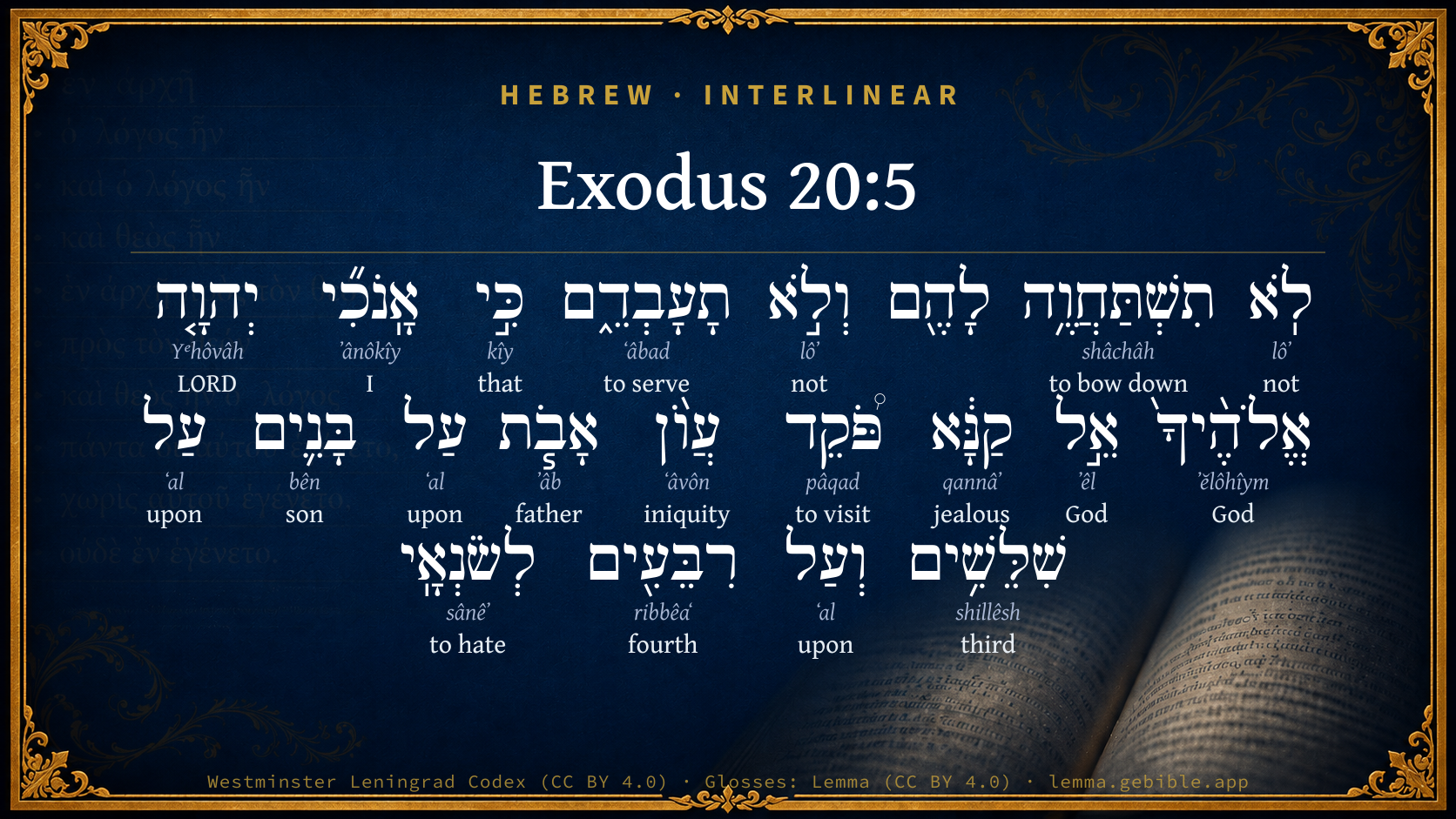
Hebrew (Westminster Leningrad Codex) Exodus 20:5 appears in the Hebrew Old Testament. The text above is from the Westminster Leningrad Codex. Each word links to its Strong’s number, a concise gloss, and parsing drawn from the Open Scriptures Hebrew Bible morphology. Click any word for its full Brown-Driver-Briggs (BDB) entry.
Download image
Cite this verse

Exodus 20:5 (World English Bible). Public Domain. Lemma interlinear Bible study tool, https://lemma.gebible.app/v/exodus/20/5.

Show BibTeX & RIS
BibTeX
RIS
English Translation
you shall not bow yourself down to them, nor serve them, for I, Yahweh your God, am a jealous God, visiting the iniquity of the fathers on the children, on the third and on the fourth generation of those who hate me,
World English Bible · Public Domain
Highlights
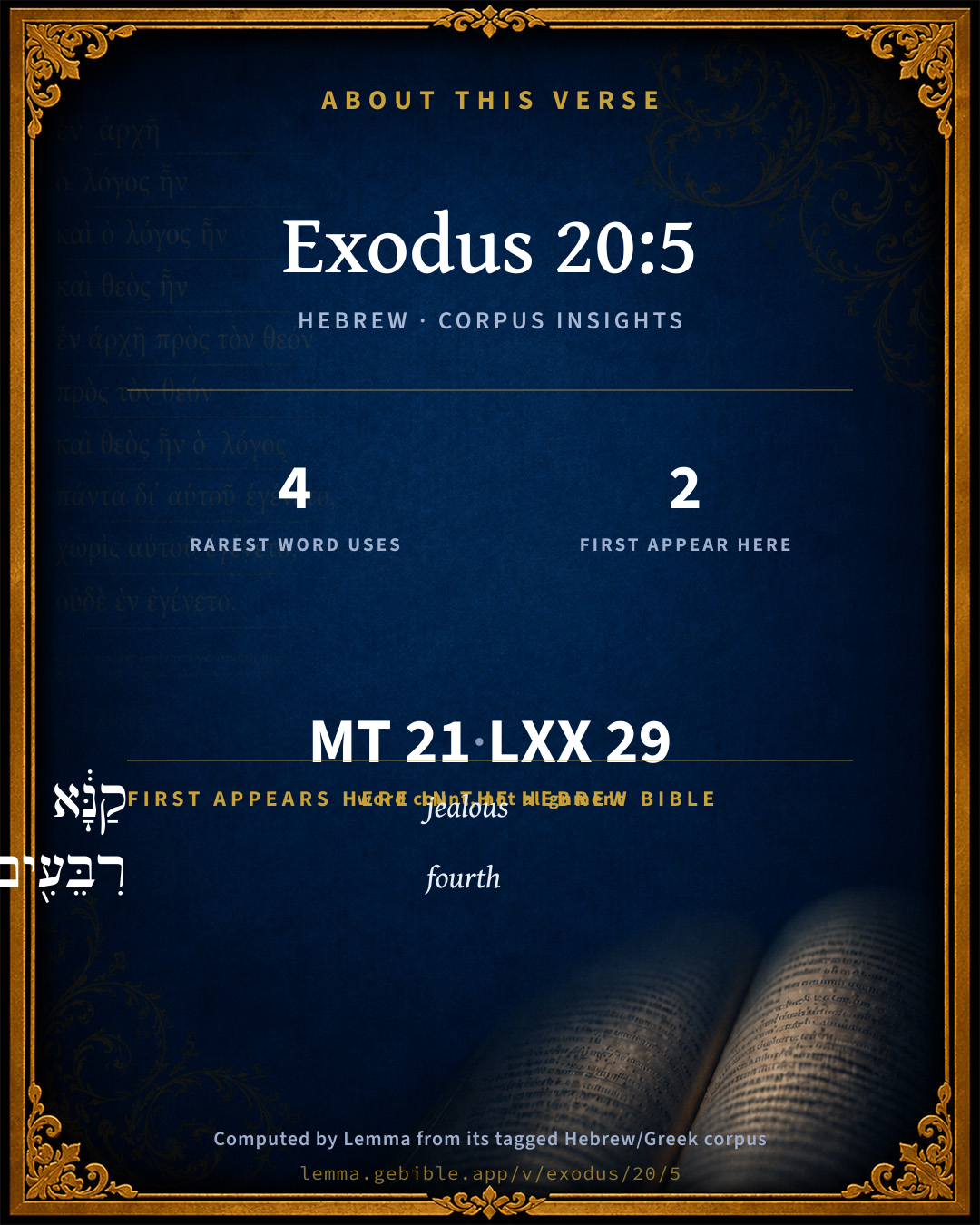
  • 2 first appearances in the Hebrew Bible
Full analysis ↓
Download a study sheet

One document with this verse’s original text, its word-by-word gloss line, the meaning frame, cross-references with their text, attributed commentary, and full source and license credits — printable, and it pastes into notes with its structure intact.

This verse Autodidact and up

Study sheet (.html) Plain text (.txt)

A passage Seminary Student

Up to 50 verses in one chapter. A passage sheet keeps up to 6 commentary sources and 12 cross-references per verse, in the order this page ranks them, and says so on the sheet whenever that leaves anything out. Ask for a single verse and you get the Autodidact verse sheet above.

Everything on this page stays free to read, with no account — the sheet is a download of what is already on screen, not access to it.

Want to remove ads? Support Godless Engineer
Compare translations 3

The same verse in 3 English versions, stacked beneath the original-language interlinear above. Click any original word for its lexicon entry.

Each is an independent rendering of the whole verse — the interlinear is not word-aligned to these translations.

Highlighted words mark where these versions differ — a whole-verse word diff, not a word-by-word alignment.

  • World English Bible Public Domain
    you shall not bow yourself down to them, nor serve them, for I, Yahweh your God, am a jealous God, visiting the iniquity of the fathers on the children, on the third and on the fourth generation of those who hate me,
  • King James Version Public Domain
    Thou shalt not bow down thyself to them, nor serve them: for I the LORD thy God am a jealous God, visiting the iniquity of the fathers upon the children unto the third and fourth generation of them that hate me;
  • unfoldingWord Literal Text CC BY-SA 4.0
    You shall not bow down to them and you shall not serve them, for I, Yahweh your God, am a jealous God. I visit the iniquity of the fathers on the sons on the third and on the fourth of the haters of me.

unfoldingWord Literal Text — © unfoldingWord, licensed CC BY-SA 4.0. Word-aligned USFM3 via Door43 (git.door43.org/unfoldingWord/en_ult).

Versions to compare (up to 4)

3 of 4 selected

Show all 18 translations

Every available English version of this verse, each an independent rendering of the whole verse.

  • World English Bible Public Domain
    you shall not bow yourself down to them, nor serve them, for I, Yahweh your God, am a jealous God, visiting the iniquity of the fathers on the children, on the third and on the fourth generation of those who hate me,
  • Berean Standard Bible Public Domain
    You shall not bow down to them or worship them; for I, the LORD your God, am a jealous God, visiting the iniquity of the fathers on their children to the third and fourth generations of those who hate Me,
  • Majority Standard Bible Public Domain
    You shall not bow down to them or worship them; for I, the LORD your God, am a jealous God, visiting the iniquity of the fathers on their children to the third and fourth generations of those who hate Me,
  • King James Version Public Domain
    Thou shalt not bow down thyself to them, nor serve them: for I the LORD thy God am a jealous God, visiting the iniquity of the fathers upon the children unto the third and fourth generation of them that hate me;
  • American Standard Version (1901) Public Domain
    Thou shalt not bow down thyself unto them, nor serve them, for I Jehovah thy God am a jealous God, visiting the iniquity of the fathers upon the children, upon the third and upon the fourth generation of them that hate me,
  • Revised Version (1885) Public Domain
    thou shalt not bow down thyself unto them, nor serve them: for I the LORD thy God am a jealous God, visiting the iniquity of the fathers upon the children, upon the third and upon the fourth generation of them that hate me;
  • Geneva Bible (1599) Public Domain
    Thou shalt not bowe downe to them, neither serue them: for I am the Lord thy God, a ielous God, visiting the iniquitie of the fathers vpon the children, vpon the third generation and vpon the fourth of them that hate me:
  • Douay-Rheims (1899) Public Domain
    Thou shalt not adore them, nor serve them: I am the Lord thy God, mighty, jealous, visiting the iniquity of the fathers upon the children, unto the third and fourth generation of them that hate me:
  • Young's Literal Translation Public Domain
    Thou dost not bow thyself to them, nor serve them: for I, Jehovah thy God, `am' a zealous God, charging iniquity of fathers on sons, on the third `generation', and on the fourth, of those hating Me,
  • Literal Standard Version CC BY-SA 4.0
    You do not bow yourself to them, nor serve them: for I, your God YHWH, [am] a zealous God, charging iniquity of fathers on sons, on a third and on a fourth [generation] of those hating Me,
  • Unlocked Literal Bible CC BY-SA 4.0
    You must not bow down to them or worship them, for I, Yahweh your God, am a jealous God. I punish the ancestors' wickedness by bringing punishment on the descendants, to the third and the fourth generation of those who hate me.
  • unfoldingWord Literal Text CC BY-SA 4.0
    You shall not bow down to them and you shall not serve them, for I, Yahweh your God, am a jealous God. I visit the iniquity of the fathers on the sons on the third and on the fourth of the haters of me.
  • Darby Bible Public Domain
    thou shalt not bow down thyself to them, nor serve them; for I, Jehovah thy God, am a jealous ùGod, visiting the iniquity of the fathers upon the sons to the third and to the fourth [generation] of them that hate me,
  • World Messianic Bible Public Domain
    you shall not bow yourself down to them, nor serve them, for I, the LORD your God, am a jealous God, visiting the iniquity of the fathers on the children, on the third and on the fourth generation of those who hate me,
  • Webster's Bible Public Domain
    Thou shalt not bow down thyself to them, nor serve them: for I the LORD thy God am a jealous God, visiting the iniquity of the fathers upon the children to the third and fourth generation of them that hate me;
  • Free Bible Version CC BY-SA 4.0
    You must not bow down before them or worship them; for I am the Lord your God and I am passionately exclusive. I lay the consequences of the sin of those who hate me on their sons, grandsons, and great-grandsons;
  • Bible in Basic English Public Domain
    You may not go down on your faces before them or give them worship: for I, the Lord your God, am a God who will not give his honour to another; and I will send punishment on the children for the wrongdoing of their fathers, to the third and fourth generation of my haters;
  • JPS Tanakh (1917) Public Domain
    thou shalt not bow down unto them, nor serve them; for I the LORD thy God am a jealous God, visiting the iniquity of the fathers upon the children unto the third and fourth generation of them that hate Me;

Literal Standard Version (2020), Covenant Press — licensed CC BY-SA 4.0. Text via the HelloAO Bible API (eBible.org). Unlocked Literal Bible (unfoldingWord) — licensed CC BY-SA 4.0. Text via the HelloAO Bible API (eBible.org). unfoldingWord Literal Text — © unfoldingWord, licensed CC BY-SA 4.0. Word-aligned USFM3 via Door43 (git.door43.org/unfoldingWord/en_ult). Free Bible Version, Dr. Jonathan Gallagher — licensed CC BY-SA 4.0. Text via the HelloAO Bible API (eBible.org).

Word by word

More ways to search: Search by grammar → Find every occurrence → Compare this word →

Practice this passage: Drill this verse → Learn its vocabulary →

רִבֵּעִ֖ים
ribbêaʻ
H7256
“fourth generation”
Noun, Common, Masculine, Plural, Absolute
Part of Speech
Noun
Type
Common
Gender
Masculine
Number
Plural
State
Absolute
Full BDB Definition

Origin: from H7251

TWOT: 2107d

pertaining to the fourth
  1. לֹֽא lôʼ H3808 “not” Particle, Negative
  2. תִשְׁתַּחֲוֶ֥ה shâchâh H7812 “to bow down” Verb, Hishtaphel, Imperfect, 2nd Person, Masculine, Singular
  3. וְלֹ֣א lôʼ H3808 “and · not” Conjunction + Particle, Negative
  4. תָעָבְדֵ֑ם ʻâbad H5647 “to serve · them” Verb, Hophal, Imperfect, 2nd Person, Masculine, Singular + Suffix, Personal, 3rd Person, Masculine, Plural
  5. כִּ֣י kîy H3588 “that” Conjunction
  6. אָֽנֹכִ֞י ʼânôkîy H595 “I” Pronoun, Personal, 1st Person, Common, Singular
  7. יְהוָ֤ה Yᵉhôvâh H3068 “LORD” Noun, Proper
  8. אֱלֹהֶ֨יךָ֙ ʼĕlôhîym H430 “God(s) · your” Noun, Common, Masculine, Plural, Construct + Suffix, Personal, 2nd Person, Masculine, Singular
  9. אֵ֣ל ʼêl H410 “God” Noun, Common, Masculine, Singular, Absolute
  10. קַנָּ֔א qannâʼ H7067 “jealous” Adjective, Adjective, Masculine, Singular, Absolute
  11. פֹּ֠קֵד pâqad H6485 “visiting” Verb, Qal, Participle Active, Masculine, Singular, Absolute
  12. עֲוֺ֨ן ʻâvôn H5771 “iniquity of” Noun, Common, Both, Singular, Construct
  13. אָבֹ֧ת ʼâb H1 “fathers” Noun, Common, Masculine, Plural, Absolute
  14. עַל ʻal H5921 “upon” Preposition
  15. בָּנִ֛ים bên H1121 “sons” Noun, Common, Masculine, Plural, Absolute
  16. עַל ʻal H5921 “upon” Preposition
  17. שִׁלֵּשִׁ֥ים shillêsh H8029 “third generation” Noun, Common, Masculine, Plural, Absolute
  18. וְעַל ʻal H5921 “and · upon” Conjunction + Preposition
  19. לְשֹׂנְאָֽי sânêʼ H8130 “to/for · hating · me” Preposition + Verb, Qal, Participle Active, Masculine, Plural, Construct + Suffix, Personal, 1st Person, Common, Singular

About this verse

These counts appear in no published source. They are computed here, from the morphology-tagged text and Lemma’s own curated glosses. What Lemma adds →

21
words
17
distinct lemmas
Pentateuch
section

Notable vocabulary

The rarest word here is רִבֵּעִ֖ים fourth H7256 — appearing just 4 times in the whole Hebrew Bible.

First appearance in Scripture

These words make their first canonical appearance in the Hebrew Bible here:

  • קַנָּ֔א jealous H7067
  • רִבֵּעִ֖ים fourth H7256

Shared distinctive vocabulary

רִבֵּעִ֖ים fourth H7256 occurs in 4 verses of the Hebrew Bible. Also found in:

Grammatical profile

  • 4 verbs
  • 8 nouns
  • 1 adjective
  • 1 pronoun
  • 4 prepositions
  • 1 conjunction
  • 2 particles

Verb forms

  • תִשְׁתַּחֲוֶ֥ה Hishtaphel · Imperfect
  • תָעָבְדֵ֑ם Hophal · Imperfect
  • פֹּ֠קֵד Qal · Participle Active
  • לְשֹׂנְאָֽי Qal · Participle Active

Repetition

Words recur within this verse — often emphatic in Hebrew:

Hebrew & Septuagint length

In English translation the verse runs 42 words from the Hebrew and 40 from the Septuagint (LXX English) — closely comparable.

A rough comparison of the two English renderings, which tokenize alike — not a word-level alignment.

Word counts can differ between the Hebrew and the Greek without any difference in meaning — e.g. the Hebrew direct-object marker אֵת has no separate Greek word, and Greek often adds the article ὁ.

In the original languages it is 21 Hebrew tokens and 29 Greek tokens — but the two are counted differently (Hebrew bundles its prefixes and suffixes into one token; the Greek is in lemma form), so that isn’t a like-for-like length.

Cross-references

53

Topical passages linked to Exodus 20:5 in the Treasury of Scripture Knowledge — connected by theme and wording, ordered by reader-vote popularity; previews shown in the World English Bible.

  • Deuteronomy 5:9 you shall not bow down yourself to them, nor serve them; for I, Yahweh, your God, am a jealous God, visiting the iniquity of the fathers on the children, and on the third and on the fourth generation of those who hate me;
  • Numbers 14:18 Yahweh is slow to anger, and abundant in loving kindness, forgiving iniquity and disobedience; and that will by no means clear [the guilty], visiting the iniquity of the fathers on the children, on the third and on the fourth generation.
  • Deuteronomy 4:24 For Yahweh your God is a devouring fire, a jealous God.
  • Exodus 34:14 for you shall worship no other god: for Yahweh, whose name is Jealous, is a jealous God.
  • Joshua 24:19 Joshua said to the people, You can't serve Yahweh; for he is a holy God; he is a jealous God; he will not forgive your disobedience nor your sins.
  • Exodus 34:6–7 Yahweh passed by before him, and proclaimed, "Yahweh! Yahweh, a merciful and gracious God, slow to anger, and abundant in loving kindness and truth,
  • Deuteronomy 6:15 for Yahweh your God in the midst of you is a jealous God; lest the anger of Yahweh your God be kindled against you, and he destroy you from off the face of the earth.
  • Joshua 23:7 that you not come among these nations, these that remain among you; neither make mention of the name of their gods, nor cause to swear [by them], neither serve them, nor bow down yourselves to them;
  • Psalms 109:14 Let the iniquity of his fathers be remembered by Yahweh. Don't let the sin of his mother be blotted out.
  • Isaiah 65:6–7 Behold, it is written before me: I will not keep silence, but will recompense, yes, I will recompense into their bosom,
  • Jeremiah 32:18 who show loving kindness to thousands, and recompense the iniquity of the fathers into the bosom of their children after them; the great, the mighty God, Yahweh of Hosts is his name;
  • Nahum 1:2 Yahweh is a jealous God and avenges. Yahweh avenges and is full of wrath. Yahweh takes vengeance on his adversaries, and he maintains wrath against his enemies.
  • Exodus 23:24 You shall not bow down to their gods, nor serve them, nor follow their practices, but you shall utterly overthrow them and demolish their pillars.
  • Numbers 14:33 Your children shall be wanderers in the wilderness forty years, and shall bear your prostitution, until your dead bodies be consumed in the wilderness.
  • Psalms 79:8 Don't hold the iniquities of our forefathers against us. Let your tender mercies speedily meet us, For we are in desperate need.
  • Jeremiah 2:9 Therefore I will yet contend with you, says Yahweh, and with your children's children will I contend.
  • Matthew 23:34–36 Therefore, behold, I send to you prophets, wise men, and scribes. Some of them you will kill and crucify; and some of them you will scourge in your synagogues, and persecute from city to city;
  • Leviticus 26:39–40 Those of you who are left will pine away in their iniquity in your enemies' lands; and also in the iniquities of their fathers shall they pine away with them.
  • Job 5:4 His children are far from safety, They are crushed in the gate. Neither is there any to deliver them,
  • Isaiah 14:20–21 You shall not be joined with them in burial, because you have destroyed your land, you have killed your people; the seed of evil-doers shall not be named forever.
  • Romans 8:7 because the mind of the flesh is hostile towards God; for it is not subject to God's law, neither indeed can it be.
  • James 4:4 You adulterers and adulteresses, don't you know that friendship with the world is enmity with God? Whoever therefore wants to be a friend of the world makes himself an enemy of God.
  • Leviticus 20:5 then I will set my face against that man, and against his family, and will cut him off, and all who play the prostitute after him, to play the prostitute with Molech, from among their people.
  • Leviticus 26:1 "'You shall make for yourselves no idols, neither shall you raise up an engraved image or a pillar, neither shall you place any figured stone in your land, to bow down to it: for I am Yahweh your God.
  • Leviticus 26:29 You will eat the flesh of your sons, and you will eat the flesh of your daughters.
  • Deuteronomy 7:10 and repays those who hate him to their face, to destroy them: he will not be slack to him who hates him, he will repay him to his face.
  • Deuteronomy 32:21 They have moved me to jealousy with that which is not God; They have provoked me to anger with their vanities: I will move them to jealousy with those who are not a people; I will provoke them to anger with a foolish nation.
  • Joshua 23:16 When you disobey the covenant of Yahweh your God, which he commanded you, and go and serve other gods, and bow down yourselves to them; then will the anger of Yahweh be kindled against you, and you shall perish quickly from off the good land which he has given to you.
  • Judges 2:19 But it happened, when the judge was dead, that they turned back, and dealt more corruptly than their fathers, in following other gods to serve them, and to bow down to them; they didn't cease from their doings, nor from their stubborn way.
  • 1 Samuel 15:2–3 Thus says Yahweh of Hosts, I have marked that which Amalek did to Israel, how he set himself against him in the way, when he came up out of Egypt.
  • 2 Samuel 21:1 There was a famine in the days of David three years, year after year; and David sought the face of Yahweh. Yahweh said, It is for Saul, and for his bloody house, because he put to death the Gibeonites.
  • 2 Samuel 21:6 let seven men of his sons be delivered to us, and we will hang them up to Yahweh in Gibeah of Saul, the chosen of Yahweh. The king said, I will give them.
  • 1 Kings 21:29 See you how Ahab humbles himself before me? because he humbles himself before me, I will not bring the evil in his days; but in his son's days will I bring the evil on his house.
  • 2 Kings 17:35 with whom Yahweh had made a covenant, and charged them, saying, You shall not fear other gods, nor bow yourselves to them, nor serve them, nor sacrifice to them:
  • 2 Kings 17:41 So these nations feared Yahweh, and served their engraved images; their children likewise, and their children's children, as did their fathers, so do they to this day.
  • 2 Kings 23:26 Notwithstanding, Yahweh didn't turn from the fierceness of his great wrath, with which his anger was kindled against Judah, because of all the provocation with which Manasseh had provoked him.
  • Job 21:19 You say, 'God lays up his iniquity for his children.' Let him recompense it to himself, that he may know it.
  • Psalms 81:15 The haters of Yahweh would cringe before him, And their punishment would last forever.
  • Proverbs 6:34–35 For jealousy arouses the fury of the husband. He won't spare in the day of vengeance.
  • Isaiah 44:15 Then shall it be for a man to burn; and he takes of it, and warms himself; yes, he kindles it, and bakes bread: yes, he makes a god, and worships it; he makes it an engraved image, and falls down to it.
  • Isaiah 44:19 None calls to mind, neither is there knowledge nor understanding to say, I have burned part of it in the fire; yes, also I have baked bread on the coals of it; I have roasted flesh and eaten it: and shall I make the residue of it an abomination? shall I fall down to the stock of a tree?
  • John 15:23–24 He who hates me, hates my Father also.
  • Romans 1:30 backbiters, hateful to God, insolent, haughty, boastful, inventors of evil things, disobedient to parents,
  • Deuteronomy 32:41 If I whet my glittering sword, My hand take hold on judgment; I will render vengeance to my adversaries, Will recompense those who hate me.
  • 2 Chronicles 25:14 Now it happened, after that Amaziah was come from the slaughter of the Edomites, that he brought the gods of the children of Seir, and set them up to be his gods, and bowed down himself before them, and burned incense to them.
  • Psalms 78:58 For they provoked him to anger with their high places, And moved him to jealousy with their engraved images.
  • Proverbs 8:36 But he who sins against me wrongs his own soul. All those who hate me love death."
  • Ezekiel 8:3 He put forth the form of a hand, and took me by a lock of my head; and the Spirit lifted me up between earth and the sky, and brought me in the visions of God to Jerusalem, to the door of the gate of the inner [court] that looks toward the north; where was the seat of the image of jealousy, which provokes to jealousy.
  • Daniel 1:2 The Lord gave Jehoiakim king of Judah into his hand, with part of the vessels of the house of God; and he carried them into the land of Shinar to the house of his god: and he brought the vessels into the treasure-house of his god.
  • Matthew 4:9 He said to him, "I will give you all of these things, if you will fall down and worship me."
  • John 7:7 The world can't hate you, but it hates me, because I testify about it, that its works are evil.
  • John 15:18 If the world hates you, you know that it has hated me before it hated you.
  • 1 Corinthians 10:22 Or do we provoke the Lord to jealousy? Are we stronger than he?

Cross-references courtesy of OpenBible.info (CC BY 4.0).

Hebrew and Greek witnesses Masoretic Hebrew ↔ Greek Septuagint

The same verse in the two great witnesses to the Old Testament, shown verse-for-verse.

These are two independent witnesses, not word-aligned to each other, and the Septuagint is shown in lemma (dictionary) form.

Hebrew Exodus 20:5 Masoretic · Westminster Leningrad Codex

לֹֽא תִשְׁתַּחֲוֶ֥ה לָהֶ֖ם וְלֹ֣א תָעָבְדֵ֑ם כִּ֣י אָֽנֹכִ֞י יְהוָ֤ה אֱלֹהֶ֨יךָ֙ אֵ֣ל קַנָּ֔א פֹּ֠קֵד עֲוֺ֨ן אָבֹ֧ת עַל בָּנִ֛ים עַל שִׁלֵּשִׁ֥ים וְעַל רִבֵּעִ֖ים לְשֹׂנְאָֽי

you shall not bow yourself down to them, nor serve them, for I, Yahweh your God, am a jealous God, visiting the iniquity of the fathers on the children, on the third and on the fourth generation of those who hate me,

World English Bible · Public Domain

Greek LXX Exodus 20:5 Septuagint · lemma form

οὐ προςκυνέω αὐτός οὐδέ μή λατρεύω αὐτός ἐγώ γάρ εἰμί κύριος ὁ θεός σύ θεός ζηλωτής ἀποδίδωμι ἁμαρτία πατήρ ἐπί τέκνον ἕως τρίτος καί τέταρτος γενεά ὁ μισέω ἐγώ

You shall not bow down to them, nor serve them; for I am the Lord your God, a jealous God, recompensing the sins of the fathers upon the children, to the third and fourth generation to them that hate me,

LXX2012 (modern English Septuagint) · Public Domain

Hebrew: Westminster Leningrad Codex (CC BY 4.0). Greek: Septuagint (public domain); English from LXX2012 (modern English Septuagint) (Public Domain). How the Septuagint differs from the Hebrew →

Targum (Aramaic paraphrase)

2

The Targum is the ancient Jewish Aramaic paraphrase of the Hebrew Scriptures — an interpretive translation, not the Hebrew text itself. Onkelos (literal) and Pseudo-Jonathan (expansive) render the Torah, and Jonathan the Prophets. Coverage is partial: where no permissively-licensed English translation exists for a verse, only the Aramaic is shown. This is verse-level text, not a word-by-word alignment to the Hebrew.

  1. Targum Onkelos Torah (Genesis–Deuteronomy)
    לָא תִסְגֻד לְהוֹן וְלָא תִפְלְחִנוּן אֲרֵי אֲנָא יְיָ אֱלָהָךְ אֵל קַנָא מַסְעַר חוֹבֵי אֲבָהָן עַל בְּנִין מָרָדִין עַל דַר תְּלִיתַי וְעַל דַר רְבִיעַי לְשָׂנְאָי כַּד מְשַׁלְמִין בְּנַיָא לְמֶחֱטֵי בָּתַר אֲבָהָתְהוֹן:

    (no public-domain English translation for this verse)

    Targum Onkelos — Aramaic: “Onkelos Genesis” (public domain); “Onkelos Exodus” (public domain); “Onkelos Leviticus” (public domain); “Onkelos Numbers” (public domain); “Onkelos Deuteronomy” (public domain). English: “Sefaria Community Translation” (CC0 1.0 (public-domain dedication)); “J.W. Etheridge. The Targums of Onkelos and Jonathan Ben Uzziel on the Pentateuch. London: Longmans, Green, 1862” (public domain). Text via Sefaria.

  2. Targum Pseudo-Jonathan Torah (Genesis–Deuteronomy)
    לָא תִסְגְּדוּן לְהוֹן וְלָא תִפְלְחוּן קֳדָמֵיהוֹן אֲרוּם אֲנָא יְיָ אֱלָהָכוֹן אֱלָהּ קַנָאַן וּפוּרְעַן וּמִתְפְּרַע בְּקִינָאָה מַדְכַּר חוֹבֵי אַבְהַת רַשִׁיעַן עַל בְּנִין מְרָדִין עַל דַּר תְּלִיתָאֵי וְעַל דַּר רְבִיעָאֵי לְשׁוֹנְאָי

    You shall not bow down to them, or worship before them; for I the Lord your God am a jealous God and an avenger, punishing with vengeance, recording the guilt of wicked fathers upon rebellious children unto the third and unto the fourth generation of them who hate Me;

    Targum Pseudo-Jonathan — Aramaic: “Targum Jonathan on Genesis” (public domain); “Targum Jonathan on Exodus” (public domain); “Targum Jonathan on Leviticus” (public domain); “Targum Jonathan on Numbers” (public domain); “Targum Jonathan on Deuteronomy” (public domain). English: “The Targum of Jonathan ben Uzziel, trans. J. W. Etheridge, London, 1862” (public domain). Text via Sefaria.

Commentary

Notes on Exodus 20:5 from classic Christian and Jewish commentators (each source and its license shown beneath its notes). The classic Christian expositions comment on the surrounding passage and are grouped to its opening verse, so a note may address several verses; the Jewish commentaries on the Tanakh (Rashi and others) are per-verse, so they appear only where the commentator wrote on this verse.

Lemma curates 59 commentaries, every one of them public domain or Creative Commons licensed, each selected and text-cleaned for this edition rather than reprinted as found. About our sources →

Trapp's Complete Commentary

John Trapp

Exo 20:5 Thou shalt not bow down thyself to them, nor serve them: for I the LORD thy God [am] a jealous God, visiting the iniquity of the fathers upon the children unto the third and fourth [generation] of them that hate me;

Ver. 5. Thou shalt not bow down.] Images came first from Babylon. For Ninus having made an image of his father Belus, all that came to see it were pardoned for their former offences: whence in time that image came to be worshipped, through the instigation of the devil, who is, saith Synesius, ειδωλοχαρης; one that rejoiceth in images.

Am a jealous God.] Be the gods of the heathens good fellows, saith one: the true God is a jealous God, and will not share his glory with another, nor be served by any but in his own way. They that wit-wanton it with God, may look to case worse than that citizen in King Edward IV’s days did; who was executed in Cheapside as a traitor, for saying he would make his son heir of the crown: though he only meant his own house, having a crown for the sign. {a}

Visiting the iniquity.] This second commandment is the first with punishment: because men do commonly punish such as worship God in spirit and in truth. As therefore one fire, so one fear should drive out another i the fear of God, the fear of men. {See Trapp (for summary of Law) on "Exo 20:17"}

{a} Speed’s Chro.

John Trapp, A Commentary or Exposition upon All the Books of the Old and New Testament (1647–1656) — public domain. Text from a community e-Sword module.

Tyndale Open Study Notes

Tyndale Open Resources

20:5-6 jealous God: God is passionately opposed to our prostituting ourselves with false gods (see Josh 24:19-20). • in the third and fourth generations . . . for a thousand generations: It is important to keep both sides of this equation together. God does not punish children for their parents’ sins. Rather, he is saying that our sins affect future generations of descendants. But he is also restricting the natural effects of those sins to three or four generations, while graciously extending the effects of obedience to a thousand generations (see also 34:6-7; Deut 7:9). • reject (literally hate): The Hebrew words commonly translated “love” (Exod 20:6) and “hate” are difficult to translate into English because they include an act of the will as well as the emotional element we are familiar with. In biblical thinking, to “love” is to choose something and to act consistently in accord with that choice. To “hate” is to reject something and to act in ways consistent with that choice. The choice is connected to emotion: Feeling expresses itself in choices, and our choices show how we really feel.

Tyndale Open Study Notes — © Tyndale Open Resources, licensed CC BY-SA 4.0. Text via the HelloAO Bible API.

Geneva Bible (1599)

Geneva Bible translators

And will be revenged on the contemners of mine honor.

By this outward gesture, all kinds of service and worship to idols is forbidden.

Geneva Bible (1599) marginal notes — public domain. Text via Bolls.life.

Adam Clarke's Commentary

Verse 5. Jealous God] This shows in a most expressive manner the love of God to this people. He felt for them as the most affectionate husband could do for his spouse; and was jealous for their fidelity, because he willed their invariable happiness.

Visiting the iniquity of the fathers upon the children] This necessarily implies - IF the children walk in the steps of their fathers; for no man can be condemned by Divine justice for a crime of which he was never guilty; see Eze 13:1-9. Idolatry is however particularly intended, and visiting sins of this kind refers principally to national judgments. By withdrawing the Divine protection the idolatrous Israelites were delivered up into the hands of their enemies, from whom the gods in whom they had trusted could not deliver them. This God did to the third and fourth generations, i.e., successively; as may be seen in every part of the Jewish history, and particularly in the book of Judges. And this, at last, became the grand and the only effectual and lasting means in his hand of their final deliverance from idolatry; for it is well known that after the Babylonish captivity the Israelites were so completely saved from idolatry, as never more to have disgraced themselves by it as they had formerly done. These national judgments, thus continued from generation to generation, appear to be what are designed by the words in the text, Visiting the sins of the fathers upon the children, &c.

Adam Clarke's Commentary on the Bible (1810–1826) — public domain. Text from a community e-Sword/MySword module.

Ellicott's Commentary for English Readers

(5) Nor serve them.—The idolatry of the ancient world was, practically, not a mere worship of celestial beings through material representations of them, but an actual culture of the images themselves, which were regarded as possessed of miraculous powers. “I myself,” says Arnobius, “not so very long ago, worshipped gods just taken out of the furnace, fresh from the anvil of the smith, ivory, paintings, stumps of trees swathed in bandages; and if I happened to cast my eyes on a polished stone smeared with olive oil, I made reverence to it, as if a power were present therein, and addressed myself in supplication for blessings to the senseless block” (Advers. Gentes, i. 29). “People pray,” says Seneca, “to the images of the gods, implore them on bended knees, sit or stand long days before them, throw them money, and sacrifice beasts to them, so treating them with deep respect” (Ap. Lactant., ii. 2).

A jealous God.—Not in the sense in which He was regarded as “jealous” by some of the Greeks, who supposed that success or eminence of any kind provoked Him (Herod. iii. 40, 125), but jealous of His own honour, one who will not see “His glory given to another” (Isa_42:8; Isa_48:11), or allow rivals to dispute His sole and absolute sovereignty. (Comp. Exo_34:14; Deu_4:24; Deu_5:9; Deu_6:15; Jos_24:19.)

Visiting the iniquity of the fathers upon the children.—It is a fact that, under God’s natural government of the world, the iniquity of fathers is visited upon their children. Diseases caused by vicious courses are transmitted. The parents’ extravagance leaves their children beggars. To be the son of a felon is to be heavily handicapped in the race of life. That this should be so is perhaps involved in “the nature of things”—at any rate, it is part of the scheme of Divine government by which the world is ordered. We all inherit countless disadvantages on account of our first parents’ sin. We each individually inherit special tendencies to this or that form of evil from the misconduct of our several progenitors. The knowledge that their sins will put their children at a disadvantage is calculated to check men in their evil courses more than almost anything else; and this check could not be removed without a sensible diminution of the restraints which withhold men from vice. Still, the penalty upon the children is not final or irreversible. Under whatever disadvantages they are born, they may struggle against them, and lead good lives, and place themselves, even in this world, on a level with those who were born under every favourable circumstance. It is needless to say that, as respects another world, their parents’ iniquities will not be visited on them. “Each man will bear his own burthen.” The soul that sinneth, it shall die. “The son shall not bear the iniquity of the father, neither shall the father bear the iniquity of the son; the righteousness of the righteous shall be upon him, and the wickedness of the wicked shall be upon him” (Eze_18:20).

A Bible Commentary for English Readers, edited by Charles John Ellicott (1878–1897) — public domain. Text from a community e-Sword module.

The Cambridge Bible for Schools and Colleges

gen. ed. J. J. S. Perowne

5. The command of v. 4 developed and emphasized.

bow down … serve] The same combination, Deu_4:19; Deu_8:19; Deu_11:16; Deu_17:3; Deu_29:26; Deu_30:17, Jdg_2:19 (D2[176]); and several times in Jer. [‘worship’ in these passages is in the Heb. bow down, as here].

[176] Deuteronomic passages in Josh., Jud., Kings.

a jealous God] who will not tolerate that the reverence due to Him, should be given to another,—whether to another god (Exo_34:14), or, as here, to an image worshipped, or, if an image of Himself, likely to be worshipped, as Divine,—and whose jealousy is described elsewhere burning like fire against those who thus dishonour Him. Occurring, as it does here, in a comment on the original command (see p. 192), the expression is derived probably from Exo_34:14. It recurs Deu_4:24 (with ‘a devouring fire’), Exo_6:15, Jos_24:19 (E), each time in a similar connexion: cf. the verb in Deu_32:16; Deu_32:21 (the Song; hence Psa_78:58). Jehovah’s honour is, however, intimately connected with that of His people: so his ‘jealousy’ may also be exerted, if circumstances permit it, on His people’s behalf, as Isa_9:7; Isa_42:13; cf. Joe_2:18, Nah_1:2, Zec_1:14, with the writer’s notes.

5. of them that hate me] The term is a strong one, and denotes those who persistently and defiantly oppose themselves to God.

5, 6. visiting …, and doing …] a further definition of Jehovah’s ethical character, as displayed in His attitude towards sin and goodness, respectively. The definition is based (Di.) upon Exo_34:7 (cf. Num_14:18, Jer_32:18), only with the two clauses transposed, so as to give the warning the first place, as the context here demands.

The Cambridge Bible for Schools and Colleges (gen. ed. J. J. S. Perowne; Cambridge University Press, 1878–1918) — public domain. Text from a community e-Sword module.

John Gill's Exposition

Thou shall not bow down thyself to them,.... Perform any worship to them, show any reverence of them by any gesture of the body; one being mentioned, bowing the body, and put for all others, as prostration of it to the earth, bending the knee, kissing the hand, lifting up of hands or eyes to them, or by any outward action expressing a religious esteem of them, as if there was divinity in them:

nor serve them; in a religious manner, internally or externally, by offering sacrifice and burning incense to them; by praying to, or praising of them; by expressing love to them, faith and trust in them, hope and expectation of good things from them, and the like. The reason of this second command, relating to the making and worshipping of images, next follows:

for I the Lord thy God am a jealous God; jealous of his own honour and glory, and will not give it to another; even to graven images, nor suffer it to be given to them without resenting it; and jealousy is fierce and cruel, and breaks forth into great wrath, and issues in dreadful scenes oftentimes among men; as a man that has reason to be jealous of his wife, and especially if he takes her and the adulterer in the fact, it often costs them both their lives, being so enraged at such an insult upon him, and such a violation of the marriage bed; and thus the great Jehovah, the God of Israel, their head and husband, is represented, in order to deter from idolatry, or spiritual adultery, than which nothing could be more provoking to him:

visiting the iniquity of the fathers upon the children; meaning chiefly, if not solely, the iniquity of idolatry; which being such an insult on his honour, "crimen laesae majestatis", is treated by him as high treason is among men; not only he punishes the authors and perpetrators of it in their own persons, which is meant by "visiting", but upon their children also, which are parts of themselves; and whatsoever is inflicted on them is the same as on themselves, and is an addition to, and a sensible aggravation of their punishment; and especially these are visited in such a manner, when they tread in their father's steps, and fill up the measure of their iniquity. So the Targum of Jonathan,"visiting the iniquity of ungodly fathers on rebellious children:

unto the third and fourth generation of them that hate me; as all idolaters must be thought to do, whatsoever love and affection they may pretend to God, by worshipping idols before him, besides him, along with him, or him in them: "the third and fourth generation" are mentioned, because sometimes parents lived to see these, and so with their eyes beheld the punishment inflicted upon their posterity for their sins, which must be distressing to them; or, however, these being but small removes from them, might impress their minds and affect them, to think what their sins would bring upon their descendants, who would quickly come after them, and share in the sad effects of their iniquities, and so be a means to deter them from them.

John Gill's Exposition of the Whole Bible (1746–1763) — public domain (CC PDM 1.0). Text via the HelloAO Bible API.

Haydock's Catholic Bible Commentary

Adore. Protestants translate again, with the same view, as in the preceding verse, "thou shalt not bow down thyself to them," in condemnation of Catholics, who kneel before the cross. But do not they kneel, when they receive their sacramental bread, or when they ask for their parents’ blessing? Did not St. John, and other saints, bow down out of respect to angels? And were these all idolaters! We are forbidden, therefore, to shew any respect to strange gods. But we must honour the true God in his saints, referring all the glory to him. (Haydock) --- Hate me. Those who do not imitate their wicked ancestors, need not fear being involved in their punishment. (Menochius) (St. Augustine, q. 42; St. Gregory, mor. 15. 22; St. Jerome in Ezechiel xviii.) --- Sometimes, indeed, God takes away the lives of children and of subjects, to punish the sins of parents and of kings; but this may be no real detriment to the deceased. (Haydock) --- Grotius thinks, that this menace is directed against idolaters. Others believe, it may be placed at the conclusion of each of the commandments. (Calmet)

George Leo Haydock (1774–1849), Haydock's Catholic Family Bible and Commentary, 1859 edition — public domain. Excludes Psalms (Douay-Rheims chapter numbering differs from Protestant) and Deuterocanonical books (Catholic canon only).

Matthew Poole's English Annotations

Not only inward reverence is forbidden, but also all outward gestures that naturally or customarily express reverence, whether bowing down the body, as here; or bending the knee, as 1Ki 19:18; or kissing the idol, or one’s hand towards it, as Job 31:27; Hos 13:2; one gesture being by a synecdoche named for all. To them, nor before them; for to bow to them, and to bow before them, are expressions in Scripture of the same extent and use, as appears by comparing this place with Lev 26:1 2Ch 25:14; and 2Sa 7:22, with 1Ch 17:25; and Mat 4:9, with Luk 4:7. Nor serve them; or, worship them, either inwardly in thy mind, or outwardly by any sensible mean or sign of worship given to them, as incense or sacrifice, vowing to them, or swearing by them, or the like. A jealous God, i.e. impatient of any partner in thy love and worship, and full of wrath against them that give my glory to images, Isa 42:8; as jealousy is the rage of a man Pro 6:34 against the defiler of his marriage-bed. God is pleased to call and account himself the Husband of his church and people, Jer 2:2 Hos 2:19; and therefore idolatry is called adultery, Deu 31:16; Jer 3:3,10; and God’s anger against idolaters’ jealousy. The word el properly signifies the strong God, and shows God’s ability to avenge himself, as the word jealous notes his readiness and resolution to do it. Visiting, i.e. remembering, inquiring into, or punishing, (as that word is commonly used, as hath been noted before,)

the iniquity of the fathers upon the children.

Quest. How can this be just?

Answ. 1. All are born sinners, and are children of wrath, and therefore justly punishable for their own sins.

Answ. 2. He speaks not here of eternal damnation, but of temporal punishments, in which there is no shadow of injustice; as appears,

1. Because the sins of parents are oft punished in their children, even in human courts, as is manifest in traitors, which practice being acknowledged to be just, it cannot with any sense be accounted unjust in God.

2. Because such external punishments have more good than evil in them, and are in many, and may be so in others, if themselves do not hinder it, instruments of the greatest good, exercises of their virtues and graces, and means of their eternal happiness.

3. Because children are a part and the possession of their parents, and therefore it is not unjust if they suffer with them, and for them.

Answ. 3. This is to be understood with an exception of repentance, and penitent children, as appears from Eze 18 And if any such be temporally punished for their fathers’ sins, God will abundantly recompense it to them some other way. But if children tread in their fathers’ sinful steps, it is but just that they should partake of their plagues.

Unto the third and fourth generation; and further too, as appears in the ten tribes, and afterwards in the two tribes, upon whom the iniquity of their fathers hath been visited now for many generations. But he mentions them in particular, partly, because a parent may live so long, and see the dreadful effects of his sin in his children’s children; partly, because so far the memory of a father may extend, and be matter of imitation to his children; and partly, to show the difference between his exercise of justice and mercy, as appears by comparing the next verse.

Them that hate me. This word is opposed to the conceit that idolaters, at least many of them, have of themselves, that they love God more than others do, because they love, and honour, and worship the creatures for his sake, and for those excellencies that he hath wrought in them; but this will no more excuse their idolatry, than it will excuse him that commits adultery with his friend’s wife, that he did it for his friend’s sake, and from the love he had to his friend, and for his relations.

Matthew Poole's English Annotations on the Holy Bible (1683–1685) — public domain. Text from a community e-Sword/MySword module.

Whedon's Commentary on the Bible

Daniel D. Whedon

5. Thou shalt not bow down thyself to them — This confirms the view expressed in the last verse, that idolatrous images are contemplated, not any and all productions of art. Images of Deity, whether under the form of man, or beast, or bird, or the luminaries of the sky, have ever proven a temptation and snare; and for a people just delivered from Egypt, where almost every object in nature was thus deified, such a most emphatic and particular prohibition was demanded. Jehovah therefore proclaims himself a jealous God, and only the shallow sentimentalist will find fault with such a designation of the God of Israel. In the nature of things he cannot undeify himself by giving his glory to another, and his praise to graven images. Isa_42:8. This would be as impossible as it is for God to lie. Here are closely brought together three divine names, JEHOVAH, ELOHIM, and EL. The Almighty and Eternal Being who bears these titles cannot allow his place and name to be taken by another any more than the faithful husband can allow adultery in his wife. This imagery is frequent in the Old Testament, and all idolatry is regarded as spiritual adultery.

Visiting the iniquity of the fathers upon the children — Here is testimony to a law of heredity stamped upon the human race. Mankind are constituted a living, self-perpetuating organism, and one may, by hateful opposition to God, bequeath a curse upon his posterity which will extend unto the third and fourth generation. The word עון, iniquity, means the inherent badness of a perverted moral nature. This is the characterizing quality of them that hate the God of holy revelation. As an idol is a deceptive nothing, (1Co_8:4,) so all who make and worship idolatrous images are virtually the same as those who love and make a lie, (Rev_22:15;) and history shows how the iniquity of idolatry has been wont to propagate itself through many generations. Nor is idolatry the only mortal curse that is wont to be thus entailed. But this Scripture is not to be construed, contrary to Eze_18:20, to mean that children will be punished for their parents’ sins. Guilt cannot be entailed. The child may, physically and mentally, suffer evil consequences because of a parent’s sins, but no guilt of theirs is or can be justly imputed to him who had no part in the sin. The following table, by Lummis, of distinctions between natural consequences and punishment puts the subject in a clear light, and furnishes in itself a valuable study.

Distinctions to be made between Natural Consequences and Punishment.

1. All proper punishment must be deserved.Natural consequences may not be deserved.2. Punishment follows intentional wrong doing only.Consequences follow both intentional and unintentional wrong doing.3. Punishment follows wrong doing after judgment pronounced.Consequences may follow immediately after the wrong act. 4. Punishment is suspended the moment pardon has been declared.Consequences may follow indefinitely after pardon has been granted5. Punishment ceases when the penalty inflicted has been fully borne.Consequences follow as really after the penalty has been suffered as at any time after the wrong doing6. Punishment is visited only on the guilty.Consequences extend equally to the Innocent.7. Punishment is limited by justice.Justice is not applicable to consequences.8. Punishment comes directly from the will of the ruler.Consequences result directly from the constitution of things.9. Punishment is retributive.Consequences are admonitory10. Punishment can only belong where guilt or remorse has been felt.Consequences may exist where remorse is impossible — for example, upon dumb animals.

Daniel D. Whedon (gen. ed.), Commentary on the Old and New Testaments (1874–1909) — public domain. Text from a community e-Sword module.

The Pulpit Commentary

Thou shalt not bow down thyself to them. Every outward sign of honour was shown to images in the ancient world. They were not regarded as emblems, but as actual embodiments of deity. There was a special rite in Greece (Theopoea) by means of which the gods were inducted into their statues, and made to take up their abodes in them. Seneca says of the Romans of his own day pray to these images of the gods, implore them on bended knee, sit or stand long days before them, throw them money, and sacrifice beasts to them, so treating them with deep respect, though they despise the man who made them" (Ap. Lam_2:2). I, the Lord thy God am a jealous God. God "will not give his glory to another", (Isa_42:8 Isa_48:11) will not suffer a rival near his throne. He is not "jealous." as the Greeks thought (Heb_7:10, of mere success, or greatness; but he is very jealous of his own honour, and will not have the respect and reverence, which is his due, bestowed on other beings or on inanimate objects. Compare with the present passage. (Exo_34:14; Deu_4:24 Deu_5:9 Deu_6:15; Jos_24:19; etc.) Visiting the iniquity of the fathers upon the children. Exception has been taken to the plain meaning of this passage by a multitude of writers, who dread the reproach of the sceptic, that the God of the Old Testament is a God careless of justice and bent upon revenge. But neither does society, nor does civil justice itself, regard the visiting of parents" sins upon their children as in all cases unjust. Society by its scorn punishes for their parents" transgressions the illegitimate, the children of criminals, the children especially the daughters of adulteresses. Civil justice condemns to forfeiture of their titles and their estates, the innocent children of those executed for treason. God again manifestly does by the laws which obtain in his moral universe, entail on children many consequences of their parents" ill-doing as the diseases which arise from profligacy or intemperance, the poverty which is the result of idleness or extravagance, the ignorance and evil habits which are the fruit of a neglected education. It is this sort of visitation which is intended here. The children and grandchildren of idolaters would start in life under disadvantages. The vicious lives of their parents would have sown in them the seeds both of physical and moral evil. They would commonly be brought up in wrong courses, have their moral sense early perverted, and so suffer for their parents" faults. It would be difficult for them to rise out of their unhappy condition. Still, "each would bear his own iniquity." Each would "be judged by that he had, not by that he bad not." An all-wise God would, in the final award, make allowance for the disadvantages of birth and inherited disposition, and would assign to each that position to which his own conduct his struggles, efforts, endeavours after right entitled him.

To say that the threat "applies only to such children as follow the sins of their fathers" Kalisch) is to empty the passage of all force. It applies to all; but the visitation intended consists in temporal disadvantages, not in the final award of happiness or misery.

The Pulpit Commentary (1880–1919), ed. H.D.M. Spence-Jones & Joseph S. Exell — public domain. Text from a community e-Sword module.

Rashi

Rabbi Shlomo Yitzchaki (Rashi)

אל קנא A JEALOUS GOD — He is jealous to exact punishment, and does not pass over His rights by pardoning idolatry (Mekhilta). Wherever: the expression קנא occurs it signifies in old French emportement, English zeal, — determining to exact punishment.

לשנאי OF THEM THAT HATE ME — This must be explained in the same sense as the Targum takes it: when they retain in their hands (follow the example of) the evil doings of their ancestors (Sanhedrin 27b);

Rashi on the Tanakh — English translations: “The Judaica Press complete Tanach with Rashi, translated by A. J. Rosenberg” (CC BY 4.0); “Pentateuch with Rashi's commentary by M. Rosenbaum and A.M. Silbermann, 1929-1934” (public domain); “The Metsudah Tanach series, Lakewood, N.J” (CC BY 4.0); and “The Book of Joshua, Metsudah Publications, 1997” (CC BY 4.0). Text via Sefaria.

Ramban (Nachmanides)

Rabbi Moshe ben Nachman (Ramban / Nachmanides)

POKEID’ (VISITING) THE INIQUITY OF THE FATHERS UPON THE CHILDREN UNTO THE THIRD AND FOURTH GENERATION OF THEM THAT HATE ME. Rabbi Abraham ibn Ezra said that the meaning of the term p’kidah is similar to that of z’chirah (remembrance), just as in the verse, And the Eternal ‘pakad’ Sarah, which is like: “and the Eternal remembered her.” The purport [of the verse here, according to Ibn Ezra], is that G-d will postpone [punishment] of the wicked person because perhaps he will repent and beget a righteous son. But if the son walks in his father’s ways, as also the third and fourth generations, their memories will be destroyed, for G-d will ‘remember’ [to visit punishment upon them for] what the parents have done, and He will no longer postpone their punishment. All the commentators have similarly interpreted [the above Scriptural expression]. But if this be so, the sins of the fathers will not be visited upon their children nor upon the third generation, but only on the fourth. It would have been proper then for Scripture to say that He will visit the iniquity of the fathers and their sons and of the third generation upon the fourth generation! Perhaps these commentators will say that the sense of the verse is that He remembers the iniquity of the fathers upon their sons, saying [to them], “You and your fathers have sinned.” He does thus with the third and fourth generations, and then takes vengeance upon them, and never again does He visit it upon them, for He destroys them all in their iniquity.But their explanation is not correct. Scripture mentions G-d’s remembrance of all of them equally, and it does not specify that the vengeance is exacted [only] in the end, i.e., on the fourth generation. Besides, the term p’kidah in conjunction with the word al — [as it occurs here: ‘pokeid’ avon avoth ‘al’ banim] — is not used in connection with remembrance, but rather signifies vengeance [or punishment]. Thus: And on the day ‘pokdi upakad’ti’ (that I do punish, I will punish) them for their sin; In that day ‘yiphkod hashem’ (the Eternal will punish) with his sore and great and strong sword leviathan the slant serpent, and leviathan the tortuous serpent, and He will slay the dragon that is in the sea; ‘yiphkod hashem’ (the Eternal will punish) the host of the high heaven on high., 24:21. All of these are expression of vengeance and punishment.The correct interpretation thus appears to me to be that Scripture is stating that He visits the iniquity, which the father perpetrated, upon his children, and excises them on account of the iniquity of their father, something like it is said, Prepare ye slaughter for his children for the iniquity of their fathers., 14:21. Similarly, He visits it upon the third generation if the sin of the two generations is not yet full, something like [it is said], for the iniquity of the Amorite is not yet full. Sometimes He visits the iniquity of all three generations upon the fourth one when their measure [of iniquity] is filled and then he excises them. But in the fifth generation, no one is punished for the iniquity of his ancestor in the first generation. Now in the Book of Deuteronomy, [where the Ten Commandments are restated], He added a vav [to the expression ‘al shileishim’ (unto the third generation), thus making it] ‘v’al’ shileishim v’al ribei’im l’sonai. But the meaning of the vav [there is not the usual “and”] but “or” — [” ‘or’ unto the third generation ‘or’ unto the fourth generation of them that hate me” — as explained above].Now Rabbi Abraham ibn Ezra wrote that children’s children are called “children.” This is why He used the briefer term. and ribei’im to signify the third and fourth generations, why does it not say shni’im for the second generation instead of using the term banim (children)? For this reason, Ibn Ezra interpreted banim as meaning “children and children’s children,” for they are both called banim. Hence, Scripture could not use the term shni’im, for that would have meant only the second generation after the sinner, who is the first generation. However, in fact the second and third generations also need to be included here. For this reason, Scripture used banim, which includes the children’s children as well, i.e., the third generation after the sinner. Accordingly, in Ibn Ezra’s opinion, shileishim will mean the children of the third generation, who are the fourth generation after the sinner, and ribei’im will mean the children of the fourth generation, who constitute the fifth generation. Ramban will differ with this entire interpretation. You can understand this from the terms shileishim (the third generation) and ribei’im (the fourth generation). and ribei’im, this question will occur: Why does Scripture not use the term shni’im instead of banim? You must then conclude as explained in the preceding note. But this is not so. Shileishim means the third generation in that sin. [Hence, it includes only the father, his children, and his children’s children.] Likewise, ribei’im means the fourth generation in that sin, totalling four sinners. And the verse stated in connection with the thirteen attributes of G-d, visiting the iniquity of the fathers upon the children, and upon the children’s children, unto the third generation and unto the fourth generation, is to be explained (upon the children’s children) is the shileishim (the third generation) and ribei’im (the fourth generation).” In other words, al b’nei banim is in apposition to al shileishim v’al ribei’im. as “the children’s children, who are the third and fourth generations.” It is for this reason that Moses, [when invoking the thirteen attributes] in the case of the spies, turned back [to this specific attribute as expressed here in the Ten Commandments] and said, visiting the iniquity of the fathers upon the children, upon the third and upon the fourth generation. He did not mention “children’s children,” for it is all one, [i.e., “children’s children” is the same as shileishim].Now Scripture states [that this attribute of punishment applies only to] those that hate Me. That is, if the children hate G-d. If the sinner begot a righteous son, he does not bear the iniquity of the father, as [the prophet] Ezekiel has explained. From the words of our Rabbis, there appears a proof to the explanation I have presented above, [i.e., that ‘pokeid’ the sins of the fathers, etc., is to be understood in the sense of “visiting” or “punishing”]. From here, they have derived the principle that the [Divine] measure of good is greater than the measure of punishment, for the measure of punishment is for four generations [while that of reward is for thousands]. But if it were as the first explanation has it, [namely, that of Ibn Ezra, that pokeid means “remembers,” thus signifying that He postpones the punishment of the sinner until the fourth generation in the hope that perhaps he will beget a righteous son], then “the measure of good” would have been greater if He postponed punishment even to the tenth generation! — for pokeid means “punishing,” and the verse declares that the effects of the punishment are felt up to and including the fourth generation — that question cannot be asked. If punishment were extended to the tenth generation, it would no longer represent “a measure of good.” On the contrary, it would be a harsher judgment.It is possible that this strict measure [of punishment that is imposed on a sinner and which is felt up to the fourth generation] applies only to idolatry, for it is with regard to this prohibition that He is warning here. However, in the rest of the commandments, [the rule applies that] every one shall die of his iniquity. You will find the hidden secret of visiting the iniquity of the fathers upon the children in the Book of Ecclesiastes. (Ecclesiastes 1:4), upon which the Sefer Habahir commented: “that hath come already.” This means that the generation that passes away had come into the sins of the father “that had come already” in a previous generation, and the sins of the father are now visited upon the son, etc. (Ma’or V’shamesh). The mystic doctrine of the transmigration of souls is thus alluded to here. I have already written concerning it.

Ramban (Nachmanides) on the Tanakh — English translation: “Commentary on the Torah by Ramban (Nachmanides). Translated and annotated by Charles B. Chavel. New York, Shilo Pub. House, 1971-1976” (CC BY 4.0). Text via Sefaria.

Lesson kit

Teaching starters — assembled from the data on this page, not authored interpretation. Every prompt links to the verse data it draws on. Edit before teaching.

Exodus, in the Pentateuch, opens this verse with 21 words (17 distinct Hebrew lemmas). Its most distinctive word is ribbêaʻ (“fourth”). A historical commentator’s framing appears above. Read the whole chapter for the surrounding context.

Discussion questions

  1. The word ribbêaʻ carries the sense “fourth.” How does it shape the verse?
  2. 2 words make their first appearance in Scripture here. What does this debut establish?
  3. How does Exodus 34:7, which shares the word «fourth», read alongside this verse?
  4. What does the repetition of “upon” (3× in this one verse) do in this verse?
  5. The translations on this page render this verse differently — a whole-verse word diff, not a word-by-word alignment. What might account for the different wordings?
  6. «תִשְׁתַּחֲוֶ֥ה» is a Hishtaphel Imperfect verb. How does that grammatical form shape the action described?
  7. Compare how Trapp's Complete Commentary and Tyndale Open Study Notes read this verse. Where do they agree or differ?

Things to notice

Reading settings

Reading text

Shown beneath each verse's original-language words.

Old Testament
Old Testament edition

Read the OT as the Masoretic Hebrew (MT) or the Greek Septuagint (LXX).

English shown for the Greek Septuagint (in the Hebrew ↔ Greek comparison).

Comparing translations? Open the Compare panel on any verse page to stack up to four side by side.