
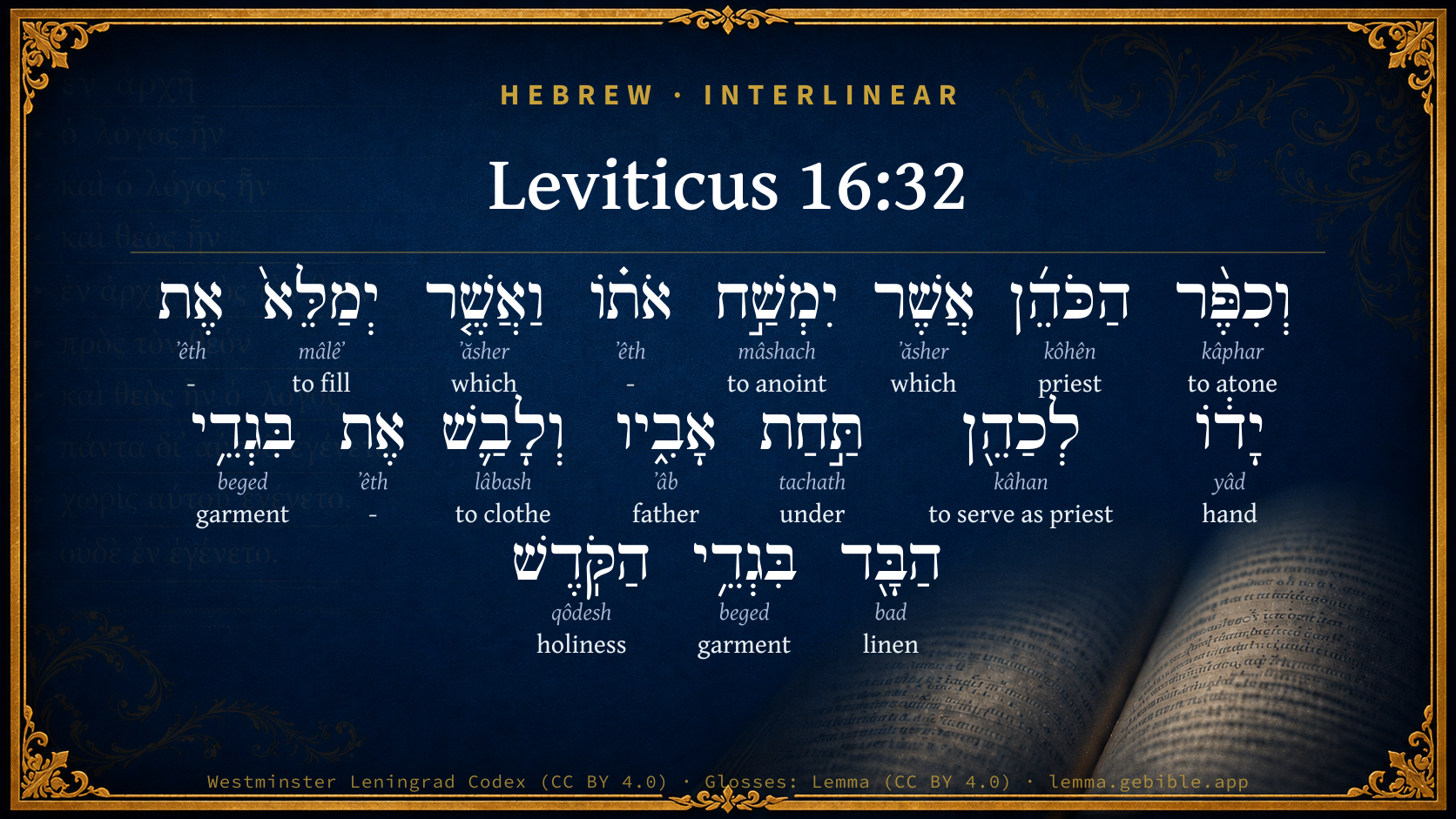
Leviticus 16:32

Hebrew (Westminster Leningrad Codex) Leviticus 16:32 appears in the Hebrew Old Testament. The text above is from the Westminster Leningrad Codex. Each word links to its Strong’s number, a concise gloss, and parsing drawn from the Open Scriptures Hebrew Bible morphology. Click any word for its full Brown-Driver-Briggs (BDB) entry.
Download image
Cite this verse

Leviticus 16:32 (World English Bible). Public Domain. Lemma interlinear Bible study tool, https://lemma.gebible.app/v/leviticus/16/32.

Show BibTeX & RIS
BibTeX
RIS
English Translation
The priest, who is anointed and who is consecrated to be priest in his father's place, shall make the atonement, and shall put on the linen garments, even the holy garments.
World English Bible · Public Domain
Download a study sheet

One document with this verse’s original text, its word-by-word gloss line, the meaning frame, cross-references with their text, attributed commentary, and full source and license credits — printable, and it pastes into notes with its structure intact.

This verse Autodidact and up

Study sheet (.html) Plain text (.txt)

A passage Seminary Student

Up to 50 verses in one chapter. A passage sheet keeps up to 6 commentary sources and 12 cross-references per verse, in the order this page ranks them, and says so on the sheet whenever that leaves anything out. Ask for a single verse and you get the Autodidact verse sheet above.

Everything on this page stays free to read, with no account — the sheet is a download of what is already on screen, not access to it.

Want to remove ads? Support Godless Engineer
Compare translations 3

The same verse in 3 English versions, stacked beneath the original-language interlinear above. Click any original word for its lexicon entry.

Each is an independent rendering of the whole verse — the interlinear is not word-aligned to these translations.

Highlighted words mark where these versions differ — a whole-verse word diff, not a word-by-word alignment.

  • World English Bible Public Domain
    The priest, who is anointed and who is consecrated to be priest in his father's place, shall make the atonement, and shall put on the linen garments, even the holy garments.
  • King James Version Public Domain
    And the priest, whom he shall anoint, and whom he shall consecrate to minister in the priest's office in his father's stead, shall make the atonement, and shall put on the linen clothes, even the holy garments:
  • unfoldingWord Literal Text CC BY-SA 4.0
    And the priest whom he anoints him and whom he fills his hand to be priest under his father shall make atonement. And he shall wear his linen clothes, the clothes of holiness.

unfoldingWord Literal Text — © unfoldingWord, licensed CC BY-SA 4.0. Word-aligned USFM3 via Door43 (git.door43.org/unfoldingWord/en_ult).

Versions to compare (up to 4)

3 of 4 selected

Show all 18 translations

Every available English version of this verse, each an independent rendering of the whole verse.

  • World English Bible Public Domain
    The priest, who is anointed and who is consecrated to be priest in his father's place, shall make the atonement, and shall put on the linen garments, even the holy garments.
  • Berean Standard Bible Public Domain
    The priest who is anointed and ordained to succeed his father as high priest shall make atonement. He will put on the sacred linen garments
  • Majority Standard Bible Public Domain
    The priest who is anointed and ordained to succeed his father as high priest shall make atonement. He will put on the sacred linen garments
  • King James Version Public Domain
    And the priest, whom he shall anoint, and whom he shall consecrate to minister in the priest's office in his father's stead, shall make the atonement, and shall put on the linen clothes, even the holy garments:
  • American Standard Version (1901) Public Domain
    And the priest, who shall be anointed and who shall be consecrated to be priest in his father's stead, shall make the atonement, and shall put on the linen garments, even the holy garments:
  • Revised Version (1885) Public Domain
    And the priest, who shall be anointed and who shall be consecrated to be priest in his father’s stead, shall make the atonement, and shall put on the linen garments, even the holy garments:
  • Geneva Bible (1599) Public Domain
    And the Priest whom he shall anoynt, and whom he shall cosecrate (to minister in his fathers steade) shall make the atonement, and shall put on the linnen clothes and Holy vestments,
  • Douay-Rheims (1899) Public Domain
    And the priest that is anointed, and whose hands are consecrated to do the office of the priesthood in his father's stead, shall make atonement; and he shall be vested with the linen robe and the holy vestments,
  • Young's Literal Translation Public Domain
    `And the priest whom he doth anoint, and whose hand he doth consecrate to act as priest instead of his father, hath made atonement, and hath put on the linen garments, the holy garments;
  • Literal Standard Version CC BY-SA 4.0
    And the priest whom he anoints, and whose hand he consecrates to act as priest instead of his father, has made atonement, and has put on the linen garments, the holy garments;
  • Unlocked Literal Bible CC BY-SA 4.0
    The high priest, the one who will be anointed and ordained to be high priest in his father's place, he must make this atonement and put on the linen garments, that is, the holy garments.
  • unfoldingWord Literal Text CC BY-SA 4.0
    And the priest whom he anoints him and whom he fills his hand to be priest under his father shall make atonement. And he shall wear his linen clothes, the clothes of holiness.
  • Darby Bible Public Domain
    And the priest who hath been anointed, and who hath been consecrated, to exercise the priesthood in his father's stead, shall make atonement; and he shall put on the linen garments, the holy garments.
  • World Messianic Bible Public Domain
    The priest, who is anointed and who is consecrated to be priest in his father’s place, shall make the atonement, and shall put on the linen garments, even the holy garments.
  • Webster's Bible Public Domain
    And the priest whom he shall anoint, and whom he shall consecrate to minister in the priest's office in his father's stead, shall make the atonement, and shall put on the linen clothes, even the holy garments:
  • Free Bible Version CC BY-SA 4.0
    The priest who is anointed and dedicated to succeed his father as high priest shall carry out the ceremony of making things right, and put on the holy linen clothes.
  • Bible in Basic English Public Domain
    And the man on whose head the holy oil has been put, and who has been marked out to be a priest in his father's place, will do what is necessary to take away sin, and will put on the linen clothing, even the holy robes:
  • JPS Tanakh (1917) Public Domain
    And the priest, who shall be anointed and who shall be consecrated to be priest in his father's stead, shall make the atonement, and shall put on the linen garments, even the holy garments.

Literal Standard Version (2020), Covenant Press — licensed CC BY-SA 4.0. Text via the HelloAO Bible API (eBible.org). Unlocked Literal Bible (unfoldingWord) — licensed CC BY-SA 4.0. Text via the HelloAO Bible API (eBible.org). unfoldingWord Literal Text — © unfoldingWord, licensed CC BY-SA 4.0. Word-aligned USFM3 via Door43 (git.door43.org/unfoldingWord/en_ult). Free Bible Version, Dr. Jonathan Gallagher — licensed CC BY-SA 4.0. Text via the HelloAO Bible API (eBible.org).

Word by word

More ways to search: Search by grammar → Find every occurrence → Compare this word →

Practice this passage: Drill this verse → Learn its vocabulary →

לְכַהֵ֖ן
kâhan
H3547
“to serve as priest”
Preposition + Verb, Piel, Infinitive Construct
Part of Speech
Preposition + Verb
Stem
Piel
Form
Infinitive Construct
Full BDB Definition

Origin: a primitive root, apparently meaning to mediate in religious services

TWOT: 959

to act as a priest, minister in a priest's office - (Piel) - to minister as a priest, serve as a priest - to be or become a priest - to play the priest
  1. וְכִפֶּ֨ר kâphar H3722 “and · to atone” Conjunction + Verb, Piel, Sequential Perfect, 3rd Person, Masculine, Singular
  2. הַכֹּהֵ֜ן kôhên H3548 “the · priest” Particle, Definite Article + Noun, Common, Masculine, Singular, Absolute
  3. אֲשֶׁר ʼăsher H834 “which” Particle, Relative
  4. יִמְשַׁ֣ח mâshach H4886 “to anoint” Verb, Qal, Imperfect, 3rd Person, Masculine, Singular
  5. אֹת֗וֹ ʼêth H853 “- · him” Particle, Direct Object + Suffix, Personal, 3rd Person, Masculine, Singular
  6. וַאֲשֶׁ֤ר ʼăsher H834 “and · which” Conjunction + Particle, Relative
  7. יְמַלֵּא֙ mâlêʼ H4390 “to fill” Verb, Piel, Imperfect, 3rd Person, Masculine, Singular
  8. אֶת ʼêth H853 “-” Particle, Direct Object
  9. יָד֔וֹ yâd H3027 “hand · his” Noun, Common, Both, Singular, Construct + Suffix, Personal, 3rd Person, Masculine, Singular
  10. תַּ֣חַת tachath H8478 “under” Preposition
  11. אָבִ֑יו ʼâb H1 “father · his” Noun, Common, Masculine, Singular, Construct + Suffix, Personal, 3rd Person, Masculine, Singular
  12. וְלָבַ֛שׁ lâbash H3847 “and · to clothe” Conjunction + Verb, Qal, Sequential Perfect, 3rd Person, Masculine, Singular
  13. אֶת ʼêth H853 “-” Particle, Direct Object
  14. בִּגְדֵ֥י beged H899 “garments of” Noun, Common, Masculine, Plural, Construct
  15. הַבָּ֖ד bad H906 “the · linen” Particle, Definite Article + Noun, Common, Masculine, Singular, Absolute
  16. בִּגְדֵ֥י beged H899 “garments of” Noun, Common, Masculine, Plural, Construct
  17. הַקֹּֽדֶשׁ qôdesh H6944 “the · holiness” Particle, Definite Article + Noun, Common, Masculine, Singular, Absolute

About this verse

These counts appear in no published source. They are computed here, from the morphology-tagged text and Lemma’s own curated glosses. What Lemma adds →

18
words
14
distinct lemmas
Pentateuch
section

Notable vocabulary

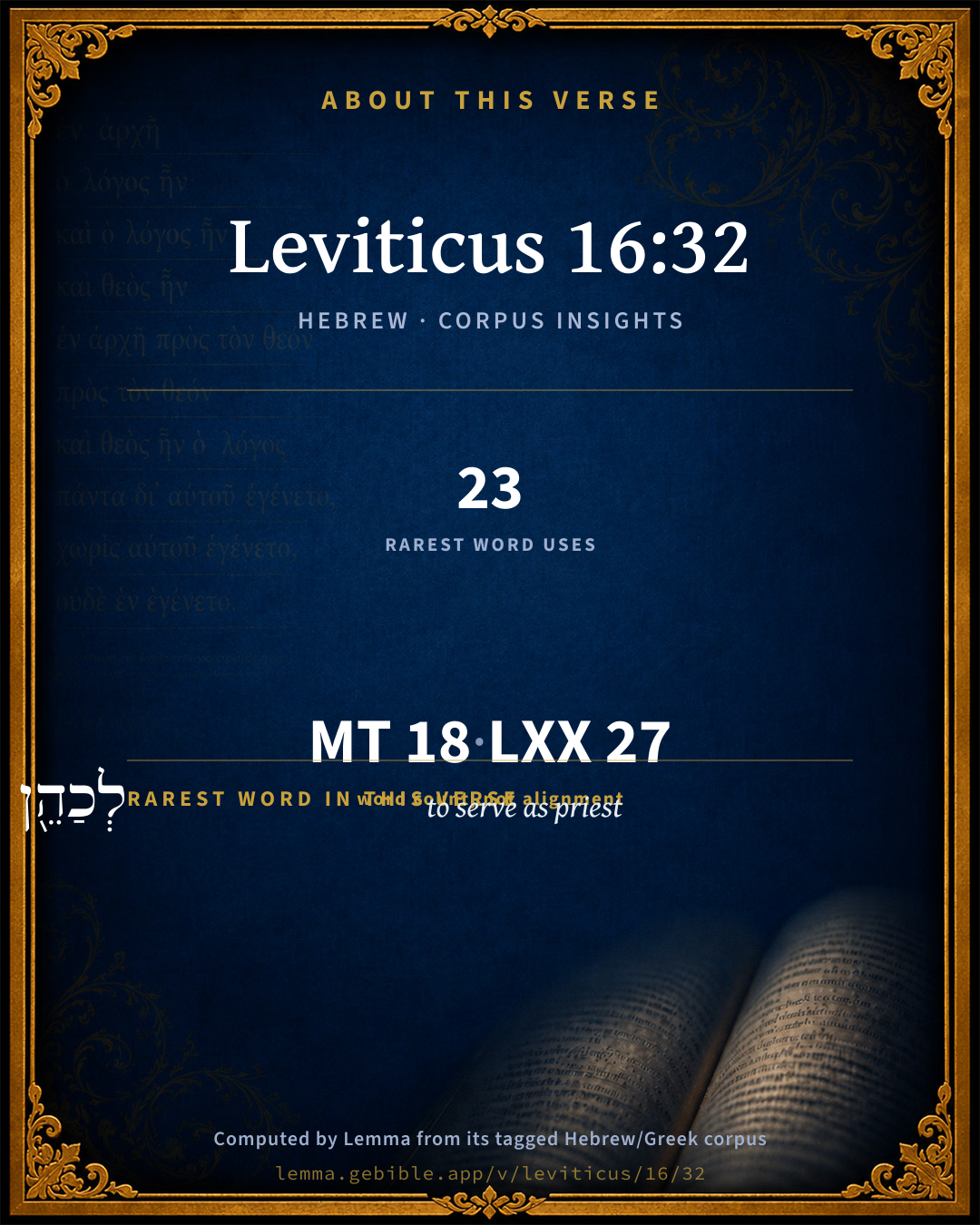
The rarest word here is לְכַהֵ֖ן to serve as priest H3547 — appearing just 23 times in the whole Hebrew Bible.

Shared distinctive vocabulary

לְכַהֵ֖ן to serve as priest H3547 occurs in 23 verses of the Hebrew Bible. Also found in:

Grammatical profile

  • 5 verbs
  • 7 nouns
  • 1 preposition
  • 5 particles

Verb forms

  • וְכִפֶּ֨ר Piel · Sequential Perfect
  • יִמְשַׁ֣ח Qal · Imperfect
  • יְמַלֵּא֙ Piel · Imperfect
  • לְכַהֵ֖ן Piel · Infinitive Construct
  • וְלָבַ֛שׁ Qal · Sequential Perfect

Repetition

Words recur within this verse — often emphatic in Hebrew:

  • בִּגְדֵ֥י garment H899 ×2
  • אֲשֶׁר which H834 ×2

Hebrew & Septuagint length

In English translation the verse runs 31 words from the Hebrew and 33 from the Septuagint (LXX English) — closely comparable.

A rough comparison of the two English renderings, which tokenize alike — not a word-level alignment.

Word counts can differ between the Hebrew and the Greek without any difference in meaning — e.g. the Hebrew direct-object marker אֵת has no separate Greek word, and Greek often adds the article ὁ.

In the original languages it is 18 Hebrew tokens and 27 Greek tokens — but the two are counted differently (Hebrew bundles its prefixes and suffixes into one token; the Greek is in lemma form), so that isn’t a like-for-like length.

Cross-references

7

Topical passages linked to Leviticus 16:32 in the Treasury of Scripture Knowledge — connected by theme and wording, ordered by reader-vote popularity; previews shown in the World English Bible.

  • Exodus 29:29–30 "The holy garments of Aaron shall be for his sons after him, to be anointed in them, and to be consecrated in them.
  • Leviticus 16:4 He shall put on the holy linen coat, and he shall have the linen breeches on his body, and shall put on the linen sash, and he shall be dressed with the linen turban. They are the holy garments. He shall bathe his body in water, and put them on.
  • Exodus 29:9 You shall dress them with belts, Aaron and his sons, and bind headbands on them: and they shall have the priesthood by a perpetual statute: and you shall consecrate Aaron and his sons.
  • Leviticus 4:3 if the anointed priest sins so as to bring guilt on the people, then let him offer for his sin, which he has sinned, a young bull without blemish to Yahweh for a sin offering.
  • Leviticus 4:5 The anointed priest shall take some of the blood of the bull, and bring it to the Tent of Meeting.
  • Leviticus 4:16 The anointed priest shall bring of the blood of the bull to the Tent of Meeting:
  • Numbers 20:26–28 and strip Aaron of his garments, and put them on Eleazar his son: and Aaron shall be gathered [to his people], and shall die there.

Cross-references courtesy of OpenBible.info (CC BY 4.0).

Hebrew and Greek witnesses Masoretic Hebrew ↔ Greek Septuagint

The same verse in the two great witnesses to the Old Testament, shown verse-for-verse.

These are two independent witnesses, not word-aligned to each other, and the Septuagint is shown in lemma (dictionary) form.

Hebrew Leviticus 16:32 Masoretic · Westminster Leningrad Codex

וְכִפֶּ֨ר הַכֹּהֵ֜ן אֲשֶׁר יִמְשַׁ֣ח אֹת֗וֹ וַאֲשֶׁ֤ר יְמַלֵּא֙ אֶת יָד֔וֹ לְכַהֵ֖ן תַּ֣חַת אָבִ֑יו וְלָבַ֛שׁ אֶת בִּגְדֵ֥י הַבָּ֖ד בִּגְדֵ֥י הַקֹּֽדֶשׁ

The priest, who is anointed and who is consecrated to be priest in his father's place, shall make the atonement, and shall put on the linen garments, even the holy garments.

World English Bible · Public Domain

Greek LXX Leviticus 16:32 Septuagint · lemma form

ἐκἱλάσκομαι ὁ ἱερεύς ὅς ἄν χρίω αὐτός καί ὅς ἄν τελειόω ὁ χείρ αὐτός ἱερατεύω μετά ὁ πατήρ αὐτός καί ἐνδύω ὁ στολή ὁ λινοῦς στολή ἅγιος

The priest whoever they shall anoint shall make atonement, and whoever they shall consecrate to exercise the priestly office after his father; and he shall put on the linen robe, the holy garment.

LXX2012 (modern English Septuagint) · Public Domain

Hebrew: Westminster Leningrad Codex (CC BY 4.0). Greek: Septuagint (public domain); English from LXX2012 (modern English Septuagint) (Public Domain). How the Septuagint differs from the Hebrew →

Targum (Aramaic paraphrase)

2

The Targum is the ancient Jewish Aramaic paraphrase of the Hebrew Scriptures — an interpretive translation, not the Hebrew text itself. Onkelos (literal) and Pseudo-Jonathan (expansive) render the Torah, and Jonathan the Prophets. Coverage is partial: where no permissively-licensed English translation exists for a verse, only the Aramaic is shown. This is verse-level text, not a word-by-word alignment to the Hebrew.

  1. Targum Onkelos Torah (Genesis–Deuteronomy)
    וִיכַפֵּר כַּהֲנָא דִי רַבִּי יָתֵהּ וְדִי יְקָרֵב יָת קֻרְבָּנֵהּ לְשַׁמָשָׁא תְּחוֹת אֲבוּהִי וְיִלְבַּשׁ יָת לְבוּשֵׁי בוּצָא לבוּשֵׁי קוּדְשָׁא

    (no public-domain English translation for this verse)

    Targum Onkelos — Aramaic: “Onkelos Genesis” (public domain); “Onkelos Exodus” (public domain); “Onkelos Leviticus” (public domain); “Onkelos Numbers” (public domain); “Onkelos Deuteronomy” (public domain). English: “Sefaria Community Translation” (CC0 1.0 (public-domain dedication)); “J.W. Etheridge. The Targums of Onkelos and Jonathan Ben Uzziel on the Pentateuch. London: Longmans, Green, 1862” (public domain). Text via Sefaria.

  2. Targum Pseudo-Jonathan Torah (Genesis–Deuteronomy)
    וִיכַפֵּר כַּהֲנָא דִי רַבֵּי יָתֵיהּ וְדִי קְרַב קוּרְבָּנֵיהּ לְשַׁמָשָׁא תְּחוֹת אָבוֹי וְיִלְבַּשׁ יַת לְבוּשֵׁי בוּץ מִילַת לְבוּשֵׁי קוּדְשָׁא

    And the priest who is anointed, and who hath offered his oblation to minister instead of his father, shall be clothed in the robes of fine linen, even the consecrated robes.

    Targum Pseudo-Jonathan — Aramaic: “Targum Jonathan on Genesis” (public domain); “Targum Jonathan on Exodus” (public domain); “Targum Jonathan on Leviticus” (public domain); “Targum Jonathan on Numbers” (public domain); “Targum Jonathan on Deuteronomy” (public domain). English: “The Targum of Jonathan ben Uzziel, trans. J. W. Etheridge, London, 1862” (public domain). Text via Sefaria.

Commentary

Notes on Leviticus 16:32 from classic Christian and Jewish commentators (each source and its license shown beneath its notes). The classic Christian expositions comment on the surrounding passage and are grouped to its opening verse, so a note may address several verses; the Jewish commentaries on the Tanakh (Rashi and others) are per-verse, so they appear only where the commentator wrote on this verse.

Lemma curates 59 commentaries, every one of them public domain or Creative Commons licensed, each selected and text-cleaned for this edition rather than reprinted as found. About our sources →

Trapp's Complete Commentary

John Trapp

Lev 16:32 And the priest, whom he shall anoint, and whom he shall consecrate to minister in the priest’s office in his father’s stead, shall make the atonement, and shall put on the linen clothes, [even] the holy garments:

Ver. 32. Whom he shall consecrate,] i.e., God: or the present high priest, the chief God on earth. See on Lev 6:2.

John Trapp, A Commentary or Exposition upon All the Books of the Old and New Testament (1647–1656) — public domain. Text from a community e-Sword module.

Joseph Benson's Commentary

Lev 16:32. The priest whom he shall anoint, and whom he shall consecrate — This ought to be translated, who shall be anointed, and who shall be consecrated, as the Vulgate hath it. For an active verb without a person is frequently in Scripture to be taken passively; the well observing whereof will tend to the removing of many difficulties. For example; those words of Isaiah, quoted Joh 12:39-40, He hath blinded their eyes, and hardened their hearts, import merely, Their eyes were blinded, and their hearts hardened, as it is expressed Act 28:27, and Mat 13:14-15, compared with Isa 6:9. So, he hardened Pharaoh’s heart, is equivalent to, his heart was hardened, Exo 7:22. So, he moved David, 2Sa 24:1, ought to be translated, David was moved, namely, by his own evil heart, or Satan’s instigation, 1Ch 21:1.

Joseph Benson's Commentary on the Old and New Testaments (1811–1818) — public domain. Text from a community e-Sword module.

Geneva Bible (1599)

Geneva Bible translators

Whom the Priest shall anoint by God’s commandment to succeed in his father’s room.

Geneva Bible (1599) marginal notes — public domain. Text via Bolls.life.

Ellicott's Commentary for English Readers

(32) And the priest, whom he shall anoint.—Better, And the priest who shall be anointed. Not only is Aaron to make atonement on this occasion, but, in future, the priest who shall be consecrated by the proper authorities as his successor to the pontificate shall perform this act of expiation on the Day of Atonement.

And whom he shall consecrate.—Better, and who shall be consecrated. According to the canonical interpretation which obtained during the second Temple, this clause makes the hereditary right to the high priesthood conditional. Unlike property, which descends to the heirs unconditionally, the son of the high priest can only succeed his father if he is morally and physically blameless. The decision upon these points was vested in the community, represented by their elders—the Sanhedrin—who pronounced whether the heir apparent was qualified or disqualified to step into the office of pontiff, and who appointed the delegates to anoint and invest the new high priest with the insignia of his functions.

And shall put on the linen clothes.—Better, and shall put on the linen garments, as it is rendered in the Authorised Version in Lev_16:23. This phrase only occurs twice, and in this very section. To render it by two different expressions within so short a space is almost equivalent to depriving it of its identity. Now the priest who has thus been deemed worthy to succeed to this high office is to put on the holy white garments on the Day of Atonement.

A Bible Commentary for English Readers, edited by Charles John Ellicott (1878–1897) — public domain. Text from a community e-Sword module.

The Cambridge Bible for Schools and Colleges

gen. ed. J. J. S. Perowne

32. shall be consecrated] See on Lev_8:33.

The Cambridge Bible for Schools and Colleges (gen. ed. J. J. S. Perowne; Cambridge University Press, 1878–1918) — public domain. Text from a community e-Sword module.

John Gill's Exposition

And he shall make an atonement for the holy sanctuary,.... The holy of holies, just in the same manner as Aaron had done, Lev 16:16,

and he shall make an atonement for the tabernacle of the congregation; the court of the tabernacle, and the holy place, and all in them, as Aaron did, in the places referred

and for the altar; see Lev 16:18,

and he shall make an atonement for the priests; for himself and for his family, and for all the priests, as Aaron did by his bullock of the sin offering, Lev 16:6,

and for all the people of the congregation of Israel; the whole body of the Israelites, and with them the Levites, as Aben Ezra observes, for they are not called priests; indeed every priest was a Levite, but not every Levite a priest; wherefore these were included not among the priests, but in the congregation of Israel. These several atonements, according to Ben Gersom, were separate and distinct, and did not hinder one another, or interfere with one another.

John Gill's Exposition of the Whole Bible (1746–1763) — public domain (CC PDM 1.0). Text via the HelloAO Bible API.

Matthew Poole's English Annotations

Whom he shall anoint; he, i.e. either God, who commanded him to be anointed, as men are oft said to do what others do by their command, or the high priest, who was to anoint his successor. Or, the third person is here put indefinitely or impersonally, for who shall be anointed.

Matthew Poole's English Annotations on the Holy Bible (1683–1685) — public domain. Text from a community e-Sword/MySword module.

Whedon's Commentary on the Bible

Daniel D. Whedon

32. The priest… anoint — The Hebrew pontiff was at first designated as the anointed priest. Afterwards he was styled the great or high priest. See Lev_4:3, note.

Consecrate — See Num_3:3, note.

Daniel D. Whedon (gen. ed.), Commentary on the Old and New Testaments (1874–1909) — public domain. Text from a community e-Sword module.

The Pulpit Commentary

Vers. 32, 33. That there may be no mistake, it is specifically enjoined that not only Aaron, but the priest, whom he shall anoint, and whom he shall consecrate meaning, the high priest that shall be anointed, and shall be consecratedto minister in the priest"s office in his father"s stead that is, to succeed from time to time to the high priesthoodshall make the atonement, and shall put on the linen clothes, even the holy garments . Again it may be noticed that the white robes are termed, not the penitential, but the holy, garments.

The Pulpit Commentary (1880–1919), ed. H.D.M. Spence-Jones & Joseph S. Exell — public domain. Text from a community e-Sword module.

John Wesley's Explanatory Notes

He - The high-priest, who was to anoint his successor.

John Wesley, Explanatory Notes Upon the Whole Bible (1754–1765) — public domain. Text via the GEBible commentary corpus.

Keil & Delitzsch

C. F. Keil & F. Delitzsch

In the future, the priest who was anointed and set apart for the duty of the priesthood in his father's stead, i.e., the existing high priest, was to perform the act of expiation in the manner prescribed, and that "once a year." The yearly repetition of the general atonement showed that the sacrifices of the law were not sufficient to make the servant of God perfect according to this own conscience. And this imperfection of the expiation, made with the blood of bullocks and goats, could not fail to awaken a longing for the perfect sacrifice of the eternal High Priest, who has obtained eternal redemption by entering once, through His own blood, into the holiest of all (Heb 9:7-12). And just as this was effected negatively, so by the fact that the high priest entered on this day into the holiest of all, as the representative of the whole congregation, and there, before the throne of God, completed its reconciliation with Him, was the necessity exhibited in a positive manner for the true reconciliation of man, and his introduction into a perfect and abiding fellowship with Him, and the eventual realization of this by the blood of the Son of God, our eternal High Priest and Mediator, prophetically foreshadowed. The closing words in Lev 16:34, "and he (i.e., Aaron, to whom Moses was to communicate the instructions of God concerning the feast of atonement, Lev 16:2) did as the Lord commanded Moses," are anticipatory in their character, like Exo 12:50. For the law in question could not be carried out till the seventh month of the current year, that is to say, as we find from a comparison of Num 10:11 with Exo 40:17, not till after the departure of Israel from Sinai.

Keil & Delitzsch — Biblical Commentary on the Old Testament (1861–1891) — public domain (CC PDM 1.0). Text via the HelloAO Bible API. (Old Testament only.)

unfoldingWord translationNotes

Door43 World Missions Community

the one who will be anointed and ordained

This can be translated in active form. AT: "the one they will anoint and ordain" (See: Active or Passive)

in his father's place

When the high priest died, one of his sons would replace him.

the holy garments

These are special clothes the high priest must wear when he enters the most holy place.

for all the people of the assembly

"for all the people of Israel"

translationWords

high priest

anoint

ordain

holy place

tent of meeting

altar

priest

assembly

unfoldingWord translationNotes — © Distant Shores Media and the Door43 World Missions Community, licensed CC BY-SA 4.0. Source: git.door43.org/Door43/en_tn.

Rashi

Rabbi Shlomo Yitzchaki (Rashi)

'וכפר הכהן אשר ימשח וגו‎ AND THE PRIEST WHOM THEY SHALL ANOINT … SHALL MAKE EXPIATION etc. — This expiation on the Day of Atonement is valid only if it is effected by the High-Priest. Because in the whole of this section reference is made to Aaron alone, Scripture was compelled to state here (towards the end) that any High-Priest succeeding him shall be like himself (i. e. shall possess the same power of effecting atonement on Yom-Kippur) (Sifra, Acharei Mot, Chapter 8 4).

ואשר ימלא את ידו AND WHOM THEY SHALL CONSECRATE — Since it is stated "whom they anoint" I might say I have here only the law that he who has been anointed with the oil of anointing is capable of effecting expiation; How do I know that this is also the case with a High- Priest who is distinguished from an ordinary priest only by a larger number of official garments though he may not have been anointed? Because Scripture states "and whom they shall consecrate etc." (Sifra, Acharei Mot, Chapter 8 4) — Such (i. e. מרובה בגדים only) were all the High-Priests who held office from Josiah and later, for in his days the flask of anointing oil was concealed (Horayot 12a).

לכהן תחת אביו TO MINISTER AS A PRIEST IN HIS FATHER'S STEAD — The words "in his father's stead” are intended to teach us that if the High-Priest’s son is able to fill his father’s place he has to be given preference to any other man (Sifra, Acharei Mot, Chapter 8 5).

Rashi on the Tanakh — English translations: “The Judaica Press complete Tanach with Rashi, translated by A. J. Rosenberg” (CC BY 4.0); “Pentateuch with Rashi's commentary by M. Rosenbaum and A.M. Silbermann, 1929-1934” (public domain); “The Metsudah Tanach series, Lakewood, N.J” (CC BY 4.0); and “The Book of Joshua, Metsudah Publications, 1997” (CC BY 4.0). Text via Sefaria.

Ramban (Nachmanides)

Rabbi Moshe ben Nachman (Ramban / Nachmanides)

AND THE PRIEST WHO SHALL BE ANOINTED AND WHO SHALL BE CONSECRATED TO BE PRIEST IN HIS FATHER’S STEAD. “I might think that only [the High Priest] who has been anointed with the oil of anointment [may perform the Service on the Day of Atonement]. Whence do I know that a High Priest who is [inducted into office only] by many garments [i.e., the eight garments which distinguish him from all ordinary priests who wear only four garments, that he too may perform the Service on that day]? Scripture therefore says, and who shall be consecrated, by attiring the [eight] garments. Such were all the High Priests who functioned after the days of King Josiah [until the destruction of the Second Temple], for in his days the flask of anointing oil was hidden.” ). This is Rashi’s language. Now the Rabbi did not intend to say that it was only from the days of King Josiah that there were High Priests who were [inducted into office only by means of] many garments, for in the Gemara we find that the Rabbis have said: “Who has precedence over whom [in being redeemed from captivity, etc.], a High Priest anointed with the oil of anointment, or one who was [inducted into office only] by his attiring himself in the many garments?” Again the Rabbis have said: “Does he [that killed a person unwittingly] return from the city of refuge [only] at the death of all of them [i.e., the High Priest anointed with the oil of anointment, and the one that was inducted into office only by his attiring himself in the many garments and one that had passed from his High-priesthood], or does he return at the death of one of them?” [Thus it is clear] that they can all be found at one time. Rather, [Rashi’s intent was that] if at any time [i.e., even when High Priests were still anointed with the oil of anointment], a priest was inducted [into the High-priesthood] by the many garments [worn by the High Priest], he was eligible to perform the Service of the Day of Atonement. For another priest was always prepared [in the High Priest’s stead] for the Day of Atonement, and he was not anointed. Thus if some disqualification occurred to the High Priest [such as by becoming impure etc.], this priest served in his stead, as he was eligible to do so through his induction [to his position] by his attiring himself in the many garments, even if he was not anointed.

Ramban (Nachmanides) on the Tanakh — English translation: “Commentary on the Torah by Ramban (Nachmanides). Translated and annotated by Charles B. Chavel. New York, Shilo Pub. House, 1971-1976” (CC BY 4.0). Text via Sefaria.

Lesson kit

Teaching starters — assembled from the data on this page, not authored interpretation. Every prompt links to the verse data it draws on. Edit before teaching.

Leviticus, in the Pentateuch, opens this verse with 18 words (14 distinct Hebrew lemmas). Its most distinctive word is kâhan (“to serve as priest”). A historical commentator’s framing appears above. Read the whole chapter for the surrounding context.

Discussion questions

  1. What does “to serve as priest” (kâhan) contribute to the verse as a whole?
  2. Exodus 28:1 shares the word «to serve as priest» with this verse. How do the two illuminate each other?
  3. “garment” occurs 2× in this one verse. What is the effect of the repetition?
  4. These translations render this verse differently; the difference is in the English rendering, not the original. What questions does that raise?
  5. The verb «וְכִפֶּ֨ר» is Piel Sequential Perfect. How does its form color the action?
  6. Reading how Trapp's Complete Commentary and Joseph Benson's Commentary read this verse, where do the two commentators agree and where do they part?

Things to notice

Reading settings

Reading text

Shown beneath each verse's original-language words.

Old Testament
Old Testament edition

Read the OT as the Masoretic Hebrew (MT) or the Greek Septuagint (LXX).

English shown for the Greek Septuagint (in the Hebrew ↔ Greek comparison).

Comparing translations? Open the Compare panel on any verse page to stack up to four side by side.