
Genesis 49:25

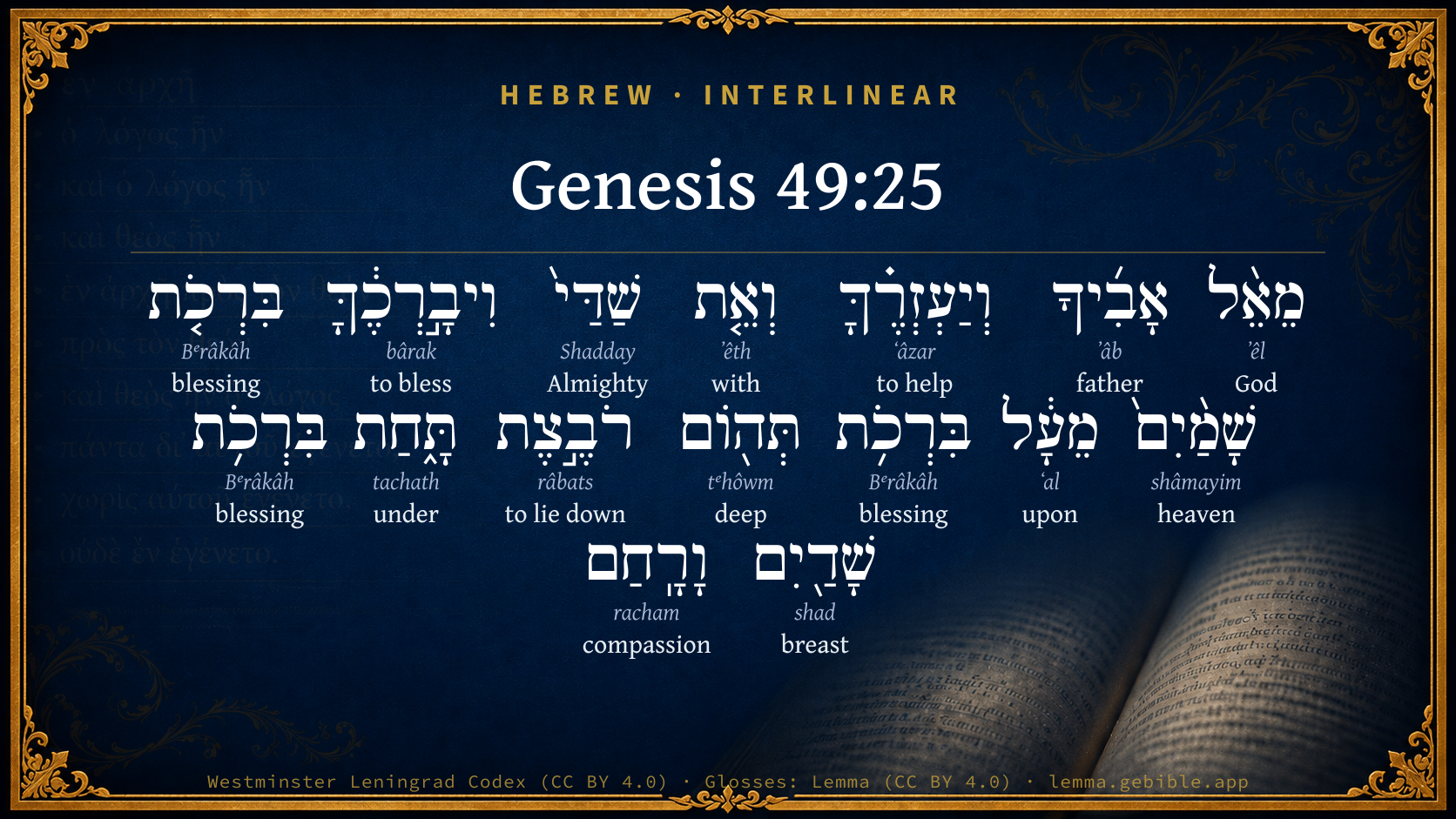
Hebrew (Westminster Leningrad Codex) Genesis 49:25 appears in the Hebrew Old Testament. The text above is from the Westminster Leningrad Codex. Each word links to its Strong’s number, a concise gloss, and parsing drawn from the Open Scriptures Hebrew Bible morphology. Click any word for its full Brown-Driver-Briggs (BDB) entry.
Download image
Cite this verse

Genesis 49:25 (World English Bible). Public Domain. Lemma interlinear Bible study tool, https://lemma.gebible.app/v/genesis/49/25.

Show BibTeX & RIS
BibTeX
RIS
English Translation
Even by the God of your father, who will help you, By the Almighty, who will bless you, With blessings of heaven above, Blessings of the deep that lies below, Blessings of the breasts, and of the womb.
World English Bible · Public Domain
Highlights
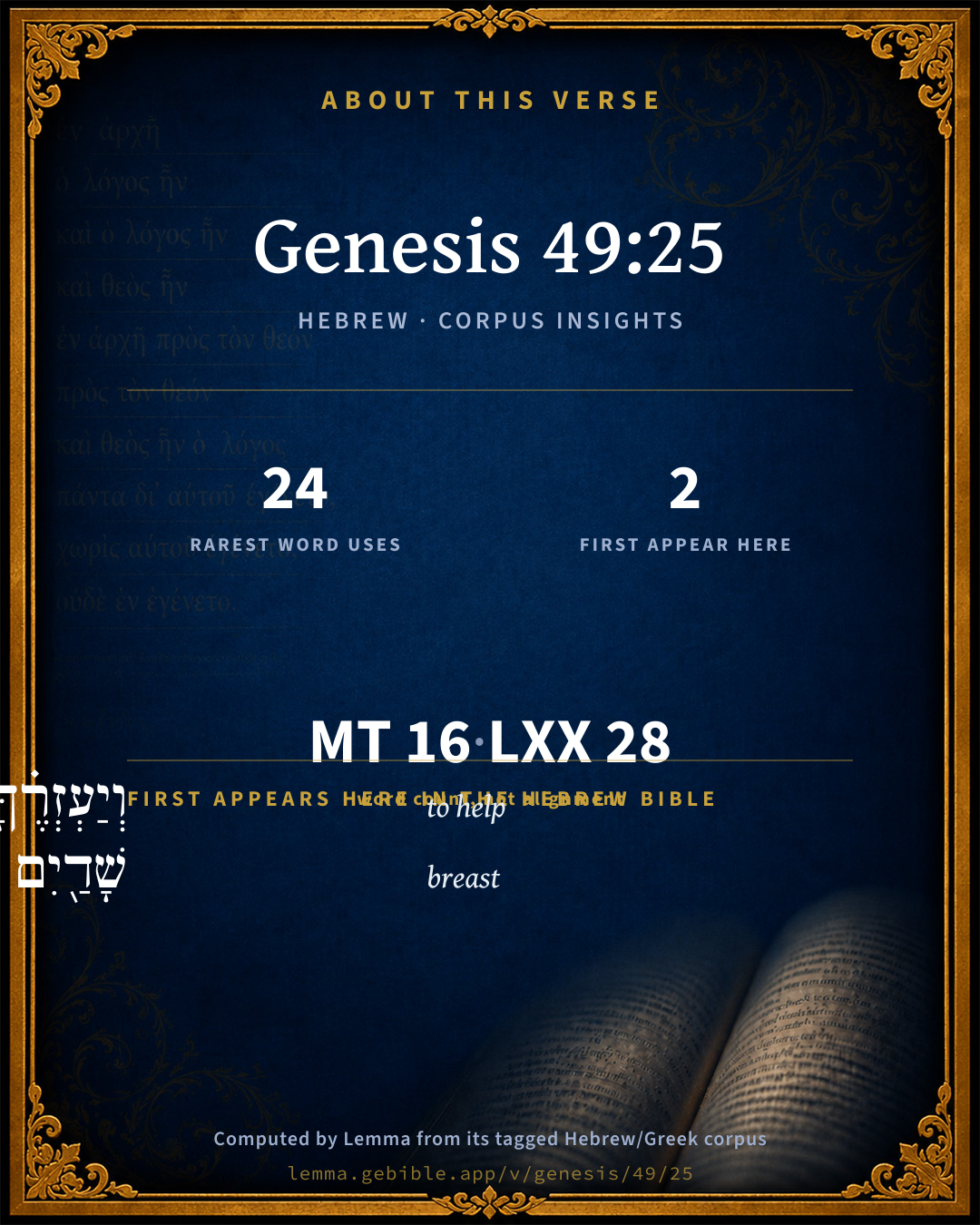
  • 2 first appearances in the Hebrew Bible
Full analysis ↓
Download a study sheet

One document with this verse’s original text, its word-by-word gloss line, the meaning frame, cross-references with their text, attributed commentary, and full source and license credits — printable, and it pastes into notes with its structure intact.

This verse Autodidact and up

Study sheet (.html) Plain text (.txt)

A passage Seminary Student

Up to 50 verses in one chapter. A passage sheet keeps up to 6 commentary sources and 12 cross-references per verse, in the order this page ranks them, and says so on the sheet whenever that leaves anything out. Ask for a single verse and you get the Autodidact verse sheet above.

Everything on this page stays free to read, with no account — the sheet is a download of what is already on screen, not access to it.

Want to remove ads? Support Godless Engineer
Compare translations 3

The same verse in 3 English versions, stacked beneath the original-language interlinear above. Click any original word for its lexicon entry.

Each is an independent rendering of the whole verse — the interlinear is not word-aligned to these translations.

Highlighted words mark where these versions differ — a whole-verse word diff, not a word-by-word alignment.

  • World English Bible Public Domain
    Even by the God of your father, who will help you, By the Almighty, who will bless you, With blessings of heaven above, Blessings of the deep that lies below, Blessings of the breasts, and of the womb.
  • King James Version Public Domain
    Even by the God of thy father, who shall help thee; and by the Almighty, who shall bless thee with blessings of heaven above, blessings of the deep that lieth under, blessings of the breasts, and of the womb:
  • unfoldingWord Literal Text CC BY-SA 4.0
    by the God of your father, and he will help you, and with the Almighty, and he will bless you blessings of the heavens above, blessings of the deep that lies below, blessings of breasts and womb.

unfoldingWord Literal Text — © unfoldingWord, licensed CC BY-SA 4.0. Word-aligned USFM3 via Door43 (git.door43.org/unfoldingWord/en_ult).

Versions to compare (up to 4)

3 of 4 selected

Show all 18 translations

Every available English version of this verse, each an independent rendering of the whole verse.

  • World English Bible Public Domain
    Even by the God of your father, who will help you, By the Almighty, who will bless you, With blessings of heaven above, Blessings of the deep that lies below, Blessings of the breasts, and of the womb.
  • Berean Standard Bible Public Domain
    by the God of your father who helps you, and by the Almighty who blesses you, with blessings of the heavens above, with blessings of the depths below, with blessings of the breasts and womb.
  • Majority Standard Bible Public Domain
    by the God of your father who helps you, and by the Almighty who blesses you, with blessings of the heavens above, with blessings of the depths below, with blessings of the breasts and womb.
  • King James Version Public Domain
    Even by the God of thy father, who shall help thee; and by the Almighty, who shall bless thee with blessings of heaven above, blessings of the deep that lieth under, blessings of the breasts, and of the womb:
  • American Standard Version (1901) Public Domain
    Even by the God of thy father, who shall help thee, And by the Almighty, who shall bless thee, With blessings of heaven above, Blessings of the deep that coucheth beneath, Blessings of the breasts, and of the womb.
  • Revised Version (1885) Public Domain
    Even by the God of thy father, who shall help thee, And by the Almighty, who shall bless thee, With blessings of heaven above, Blessings of the deep that coucheth beneath, Blessings of the breasts, and of the womb.
  • Geneva Bible (1599) Public Domain
    Euen by the God of thy father, who shall helpe thee, and by the almightie, who shall blesse thee with heauenly blessinges from aboue, with blessings of the deepe, that lyeth beneath, with blessings of the brestes, and of the wombe.
  • Douay-Rheims (1899) Public Domain
    But they that held darts provoked him, and quarrelled with him, and envied him.
  • Young's Literal Translation Public Domain
    By the God of thy father who helpeth thee, And the Mighty One who blesseth thee, Blessings of the heavens from above, Blessings of the deep lying under, Blessings of breasts and womb; --
  • Literal Standard Version CC BY-SA 4.0
    By the God of your father who helps you, || And the Mighty One who blesses you, || Blessings of the heavens from above, || Blessings of the deep lying under, || Blessings of breasts and womb—
  • Unlocked Literal Bible CC BY-SA 4.0
    The God of your father will help you and the Almighty God will bless you with blessings of the sky above, blessings of the deep that lies beneath, and blessings of the breasts and womb.
  • unfoldingWord Literal Text CC BY-SA 4.0
    by the God of your father, and he will help you, and with the Almighty, and he will bless you blessings of the heavens above, blessings of the deep that lies below, blessings of breasts and womb.
  • Darby Bible Public Domain
    From the ùGod of thy father, and he will help thee; And from the Almighty, and he will bless thee -- With blessings of heaven from above, With blessings of the deep that lieth under, With blessings of the breast and of the womb.
  • World Messianic Bible Public Domain
    even by the God of your father, who will help you, by the Almighty, who will bless you, with blessings of heaven above, blessings of the deep that lies below, blessings of the breasts, and of the womb.
  • Webster's Bible Public Domain
    Even by the God of thy father, who shall help thee, and by the Almighty, who shall bless thee with blessings of heaven above, blessings of the deep that lieth beneath, blessings of the breasts, and of the womb:
  • Free Bible Version CC BY-SA 4.0
    The God of your father will help you and the Almighty will bless you with blessings from the heavens above, with blessings from the depths below, with blessings for many children.
  • Bible in Basic English Public Domain
    Even by the God of your father, who will be your help, and by the Ruler of all, who will make you full with blessings from heaven on high, blessings of the deep stretched out under the earth, blessings of the breasts and of the fertile body:
  • JPS Tanakh (1917) Public Domain
    Even by the God of thy father, who shall help thee, and by the Almighty, who shall bless thee, with blessings of heaven above, blessings of the deep that coucheth beneath, blessings of the breasts, and of the womb.

Literal Standard Version (2020), Covenant Press — licensed CC BY-SA 4.0. Text via the HelloAO Bible API (eBible.org). Unlocked Literal Bible (unfoldingWord) — licensed CC BY-SA 4.0. Text via the HelloAO Bible API (eBible.org). unfoldingWord Literal Text — © unfoldingWord, licensed CC BY-SA 4.0. Word-aligned USFM3 via Door43 (git.door43.org/unfoldingWord/en_ult). Free Bible Version, Dr. Jonathan Gallagher — licensed CC BY-SA 4.0. Text via the HelloAO Bible API (eBible.org).

Word by word

More ways to search: Search by grammar → Find every occurrence → Compare this word →

Practice this passage: Drill this verse → Learn its vocabulary →

שָׁדַ֖יִם
shad
H7699
“breasts”
Noun, Common, Masculine, Dual, Absolute
Part of Speech
Noun
Type
Common
Gender
Masculine
Number
Dual
State
Absolute
Full BDB Definition

Origin: probably from H7736 (in its original sense) contracted

TWOT: 2332a

breast, bosom, (female) breast - breast (of woman) - breast (of animal) - breast (of both human and animal)
  1. מֵאֵ֨ל ʼêl H410 “from · God of” Preposition + Noun, Common, Masculine, Singular, Construct
  2. אָבִ֜יךָ ʼâb H1 “father · your” Noun, Common, Masculine, Singular, Construct + Suffix, Personal, 2nd Person, Masculine, Singular
  3. וְיַעְזְרֶ֗ךָּ ʻâzar H5826 “and · to help · you” Conjunction + Verb, Qal, Imperfect, 3rd Person, Masculine, Singular + Suffix, Personal, 2nd Person, Masculine, Singular
  4. וְאֵ֤ת ʼêth H854 “and · with” Conjunction + Preposition
  5. שַׁדַּי֙ Shadday H7706 “Almighty” Noun, Proper
  6. וִיבָ֣רְכֶ֔ךָּ bârak H1288 “and · to bless · you” Conjunction + Verb, Piel, Imperfect, 3rd Person, Masculine, Singular + Suffix, Personal, 2nd Person, Masculine, Singular
  7. בִּרְכֹ֤ת Bᵉrâkâh H1293 “blessings of” Noun, Common, Feminine, Plural, Construct
  8. שָׁמַ֨יִם֙ shâmayim H8064 “heaven(s)” Noun, Common, Masculine, Plural, Absolute
  9. מֵעָ֔ל ʻal H5921 “from · upon” Preposition + Noun, Common, Masculine, Singular, Absolute
  10. בִּרְכֹ֥ת Bᵉrâkâh H1293 “blessings of” Noun, Common, Feminine, Plural, Construct
  11. תְּה֖וֹם tᵉhôwm H8415 “deep” Noun, Common, Both, Singular, Absolute
  12. רֹבֶ֣צֶת râbats H7257 “lying down” Verb, Qal, Participle Active, Feminine, Singular, Absolute
  13. תָּ֑חַת tachath H8478 “under” Noun, Common, Masculine, Singular, Absolute
  14. בִּרְכֹ֥ת Bᵉrâkâh H1293 “blessings of” Noun, Common, Feminine, Plural, Construct
  15. וָרָֽחַם racham H7356 “and · compassion” Conjunction + Noun, Common, Both, Singular, Absolute

About this verse

These counts appear in no published source. They are computed here, from the morphology-tagged text and Lemma’s own curated glosses. What Lemma adds →

16
words
14
distinct lemmas
Pentateuch
section

Notable vocabulary

The rarest word here is שָׁדַ֖יִם breast H7699 — appearing just 24 times in the whole Hebrew Bible.

First appearance in Scripture

These words make their first canonical appearance in the Hebrew Bible here:

  • וְיַעְזְרֶ֗ךָּ to help H5826
  • שָׁדַ֖יִם breast H7699

Shared distinctive vocabulary

שָׁדַ֖יִם breast H7699 occurs in 24 verses of the Hebrew Bible. Also found in:

Grammatical profile

  • 3 verbs
  • 12 nouns
  • 1 preposition

Verb forms

  • וְיַעְזְרֶ֗ךָּ Qal · Imperfect
  • וִיבָ֣רְכֶ֔ךָּ Piel · Imperfect
  • רֹבֶ֣צֶת Qal · Participle Active

Repetition

A word recurs within this verse — often emphatic in Hebrew:

  • בִּרְכֹ֤ת blessing H1293 ×3

Hebrew & Septuagint length

In English translation the verse runs 38 words from the Hebrew and 36 from the Septuagint (LXX English) — closely comparable.

A rough comparison of the two English renderings, which tokenize alike — not a word-level alignment.

Word counts can differ between the Hebrew and the Greek without any difference in meaning — e.g. the Hebrew direct-object marker אֵת has no separate Greek word, and Greek often adds the article ὁ.

In the original languages it is 16 Hebrew tokens and 28 Greek tokens — but the two are counted differently (Hebrew bundles its prefixes and suffixes into one token; the Greek is in lemma form), so that isn’t a like-for-like length.

Cross-references

18

Topical passages linked to Genesis 49:25 in the Treasury of Scripture Knowledge — connected by theme and wording, ordered by reader-vote popularity; previews shown in the World English Bible.

  • Genesis 28:13 Behold, Yahweh stood above it, and said, "I am Yahweh, the God of Abraham your father, and the God of Isaac. The land whereon you lie, to you will I give it, and to your seed.
  • Genesis 35:11 God said to him, "I am God Almighty. Be fruitful and multiply. A nation and a company of nations will be from you, and kings will come out of your loins.
  • Philippians 4:19 My God will supply every need of yours according to his riches in glory in Christ Jesus.
  • Genesis 43:23 He said, "Peace be to you. Don't be afraid. Your God, and the God of your father, has given you treasure in your sacks. I received your money." He brought Simeon out to them.
  • Deuteronomy 8:17 and [lest] you say in your heart, My power and the might of my hand has gotten me this wealth.
  • Deuteronomy 33:13–17 Of Joseph he said, Blessed of Yahweh be his land, For the precious things of the heavens, for the dew, For the deep that couches beneath,
  • Genesis 27:28 God give you of the dew of the sky, of the fatness of the earth, and plenty of grain and new wine.
  • Deuteronomy 28:2–12 and all these blessings shall come on you, and overtake you, if you shall listen to the voice of Yahweh your God.
  • Deuteronomy 33:1 This is the blessing, with which Moses the man of God blessed the children of Israel before his death.
  • 1 Timothy 4:8 For bodily exercise has some value, but godliness has value for all things, having the promise of the life which is now, and of that which is to come.
  • Genesis 28:21 so that I come again to my father's house in peace, and Yahweh will be my God,
  • Genesis 35:3 Let us arise, and go up to Bethel. I will make there an altar to God, who answered me in the day of my distress, and was with me in the way which I went."
  • Psalms 85:12 Yes, Yahweh will give that which is good. Our land will yield its increase.
  • 1 Corinthians 3:21–22 Therefore let no one boast in men. For all things are yours,
  • Ephesians 1:3 Blessed be the God and Father of our Lord Jesus Christ, who has blessed us with every spiritual blessing in the heavenly places in Christ;
  • Genesis 17:1 When Abram was ninety-nine years old, Yahweh appeared to Abram, and said to him, "I am God Almighty. Walk before me, and be blameless.
  • Matthew 6:33 But seek first God's Kingdom, and his righteousness; and all these things will be given to you as well.
  • Psalms 84:11 For Yahweh God is a sun and a shield. Yahweh will give grace and glory. He withholds no good thing from those who walk blamelessly.

Cross-references courtesy of OpenBible.info (CC BY 4.0).

Hebrew and Greek witnesses Masoretic Hebrew ↔ Greek Septuagint

The same verse in the two great witnesses to the Old Testament, shown verse-for-verse.

These are two independent witnesses, not word-aligned to each other, and the Septuagint is shown in lemma (dictionary) form.

Hebrew Genesis 49:25 Masoretic · Westminster Leningrad Codex

מֵאֵ֨ל אָבִ֜יךָ וְיַעְזְרֶ֗ךָּ וְאֵ֤ת שַׁדַּי֙ וִיבָ֣רְכֶ֔ךָּ בִּרְכֹ֤ת שָׁמַ֨יִם֙ מֵעָ֔ל בִּרְכֹ֥ת תְּה֖וֹם רֹבֶ֣צֶת תָּ֑חַת בִּרְכֹ֥ת שָׁדַ֖יִם וָרָֽחַם

Even by the God of your father, who will help you, By the Almighty, who will bless you, With blessings of heaven above, Blessings of the deep that lies below, Blessings of the breasts, and of the womb.

World English Bible · Public Domain

Greek LXX Genesis 49:25 Septuagint · lemma form

παρά θεός ὁ πατήρ σύ καί βοηθέω σύ ὁ θεός ὁ ἐμός καί εὐλογέω σύ εὐλογία οὐρανός ἄνωθεν καί εὐλογία γῆ ἔχω πᾶς ἕνεκεν εὐλογία μαστός καί μήτρα

and my God helped you, and he blessed you with the blessing of heaven from above, and the blessing of the earth possessing all things, because of the blessing of the breasts and of the womb,

LXX2012 (modern English Septuagint) · Public Domain

On this verse, Adam Clarke's Commentary discusses the Septuagint’s reading. Read the note in Commentary ↓

Hebrew: Westminster Leningrad Codex (CC BY 4.0). Greek: Septuagint (public domain); English from LXX2012 (modern English Septuagint) (Public Domain). How the Septuagint differs from the Hebrew →

Targum (Aramaic paraphrase)

2

The Targum is the ancient Jewish Aramaic paraphrase of the Hebrew Scriptures — an interpretive translation, not the Hebrew text itself. Onkelos (literal) and Pseudo-Jonathan (expansive) render the Torah, and Jonathan the Prophets. Coverage is partial: where no permissively-licensed English translation exists for a verse, only the Aramaic is shown. This is verse-level text, not a word-by-word alignment to the Hebrew.

  1. Targum Onkelos Torah (Genesis–Deuteronomy)
    מֵימַר אֱלָהָא דְאָבוּךְ יְהֵי בְסַעְדָךְ וְיָת שַׁדַּי וִיבָרְכִנָּךְ בִּרְכַן דְּנַחֲתָן מִטַּלָּא דִשְׁמַיָּא מִלְעֵלָא בִּרְכַן דְנַגְדַן מִמַעֲמַקֵי אַרְעָא מִלְרָע בִּרְכְּתָא דְאָבוּךְ וּדְאִמָּךְ

    (no public-domain English translation for this verse)

    Targum Onkelos — Aramaic: “Onkelos Genesis” (public domain); “Onkelos Exodus” (public domain); “Onkelos Leviticus” (public domain); “Onkelos Numbers” (public domain); “Onkelos Deuteronomy” (public domain). English: “Sefaria Community Translation” (CC0 1.0 (public-domain dedication)); “J.W. Etheridge. The Targums of Onkelos and Jonathan Ben Uzziel on the Pentateuch. London: Longmans, Green, 1862” (public domain). Text via Sefaria.

  2. Targum Pseudo-Jonathan Torah (Genesis–Deuteronomy)
    מִמֵימַר אֱלָהָא דְאָבוּךְ יְהֵי סִיוּעָךְ וּמִן דְמִתְקְרֵי שַׁדַי יְבָרְכִינָךְ בִּרְכַן דְנַחְתַן מִטַלָא דִשְׁמַיָא מִלְעֵילָא וּמִטוֹב בִּרְכַן מַבּוּעֵי תְהוֹמָא דְסַלְקָן וּמְכַסְיַן צָמְחִין מִלְרַע בְּרִיכִין יְהֶוְיַין חַדְיָיא דְיָנַקְתָּא מִנְהֶן וּמֵעַיָיא דִרְבָעַת בְּהוֹן

    From the Word of the Lord shall be thy help; and He who is called the All--Sufficient shall bless thee with the blessings which descend with the dew of heaven from above, and with the good blessing of the fountains of the deep which ascend and clothe the herbage from beneath. The breasts are blessed at which thou wast suckled, and the womb in which thou didst lie.

    Targum Pseudo-Jonathan — Aramaic: “Targum Jonathan on Genesis” (public domain); “Targum Jonathan on Exodus” (public domain); “Targum Jonathan on Leviticus” (public domain); “Targum Jonathan on Numbers” (public domain); “Targum Jonathan on Deuteronomy” (public domain). English: “The Targum of Jonathan ben Uzziel, trans. J. W. Etheridge, London, 1862” (public domain). Text via Sefaria.

Commentary

Notes on Genesis 49:25 from classic Christian and Jewish commentators (each source and its license shown beneath its notes). The classic Christian expositions comment on the surrounding passage and are grouped to its opening verse, so a note may address several verses; the Jewish commentaries on the Tanakh (Rashi and others) are per-verse, so they appear only where the commentator wrote on this verse.

Lemma curates 59 commentaries, every one of them public domain or Creative Commons licensed, each selected and text-cleaned for this edition rather than reprinted as found. About our sources →

Trapp's Complete Commentary

John Trapp

Gen 49:25 [Even] by the God of thy father, who shall help thee; and by the Almighty, who shall bless thee with blessings of heaven above, blessings of the deep that lieth under, blessings of the breasts, and of the womb:

Ver. 25. Who shall help thee.] God hath, God shall, - is an ordinary way of arguing; it is a demonstration of Scripture logic, as Psa 85:1-4 2Co 1:10. Every former favour is a pledge of a future.

With blessings of heaven above, &c.] God "shall hear the heaven, the heaven shall hear the earth; and the earth shall hear the corn, wine, and oil": the genealogy of all which is resolved into God. {Hos 2:21-22}

With blessings of the breasts, and of the womb.] Yet rather than "Ephraim shall bring forth children to the murderer," the prophet prays God to give them, as a blessing, as some think, "a miscarrying womb, and dry breasts." {Hos 9:13-14} And our Saviour saith, "Woe be to such as are with child, and give suck in those days" of war and trouble. {Mat 24:19}

John Trapp, A Commentary or Exposition upon All the Books of the Old and New Testament (1647–1656) — public domain. Text from a community e-Sword module.

Joseph Benson's Commentary

Gen 49:25-26. Even by the God of thy father Jacob, who shall help thee —

Our experiences of God’s power and goodness, in strengthening us hitherto, are encouragements still to hope for help from him. He that has helped us, will. And by the Almighty, who shall bless thee — And he only blesseth indeed. Observe the blessings conferred on Joseph: 1st, Various and abundant blessings. Blessings of heaven above — Rain in its season, and fair weather in its season; blessings of the deep that lies under — This earth, or with subterraneous mines and springs. Blessings of the womb and the breasts are given when children are safely born and comfortably nursed. 2d, Eminent and transcendent blessings, which prevail above the blessings of my progenitors — His father Isaac had but one blessing, and when he had given that to Jacob, he was at a loss for a blessing to bestow upon Esau; but Jacob had a blessing for each of his twelve sons, and now, at the latter end, a copious one for Joseph. 3d, Durable and extensive blessings: unto the utmost bound of the everlasting hills — Including all the products of the most fruitful hills, and lasting as long as they last. Of these blessings it is here said, they shall be — So it is a promise; or, let them be, so it is a prayer, on the head of Joseph — To which let them be a crown to adorn it, and a helmet to protect it.

Joseph Benson's Commentary on the Old and New Testaments (1811–1818) — public domain. Text from a community e-Sword module.

Tyndale Open Study Notes

Tyndale Open Resources

49:25 The blessings of the heavens above meant rain for crops. • The blessings of the watery depths were streams and wells of water. • The blessings of the breasts and womb were abundant offspring.

Tyndale Open Study Notes — © Tyndale Open Resources, licensed CC BY-SA 4.0. Text via the HelloAO Bible API.

Adam Clarke's Commentary

Verse 25. The God of thy father] How frequently God is called the God of Jacob none needs be told who reads the Bible.

God All-sufficient] Instead of את שדי ETH Shaddai, THE Almighty or All-sufficient; I read אל שדי El EL Shaddai, GOD All-sufficient; which is the reading of the Samaritan, Septuagint, Syriac, and Coptic, and of three reputable MSS. In the collections of Kennicott and De Rossi. The copies used by those ancient versions had evidently אל EL, God, and not את eth, THE, a mistake produced in later times. On the word אל שדי El Shaddai, See Clarke on Ge 17:1.

The blessing of the heavens from above] A generally pure, clear, serene sky, frequently dropping down fertilizing showers and dews, so as to make a very fruitful soil and salubrious atmosphere.

Blessings lying in the deep beneath] Whatever riches could be gained from the sea or rivers, from mines and minerals in the bowels of the earth, and from abundant springs in different parts of his inheritance. Our translation of this line is excessively obscure: Blessings of the deep that lieth under. What is it that lies under the deep: By connecting ברכת bircoth, blessings, with רבצת robetseth, lying, all ambiguity is avoided, and the text speaks a plain and consistent sense.

The blessings of the breasts and of the womb.] A numerous offspring, and an abundance of cattle. The progeny of Joseph, by Ephraim and Manasseh, amounted at the first census or enumeration (Num. i.) to 75,900 men, which exceeded the sum of any one tribe; Judah, the greatest of the others, amounting to no more than 74,600. Indeed, Ephraim and Manasseh had multiplied so greatly in the days of Joshua, that a common lot was not sufficient for them. See their complaint, Jos 17:14.

Adam Clarke's Commentary on the Bible (1810–1826) — public domain. Text from a community e-Sword/MySword module.

John Calvin's Commentaries

25. Even by the God of thy father. Again, he more fully affirms that Joseph had been delivered from death, and exalted to such great dignity, not by his own industry, but by the favor of God: and there is not the least doubt that he commends to all the pious, the mere goodness of God, lest they should arrogate anything to themselves, whether they may have escaped from dangers, or whether they may have risen to any rank of honor. By the God of thy father. In designating God by this title, he again traces whatever good Joseph has received, to the covenant, and to the fountain of gratuitous adoption; as if he had said, “Whereas thou hast proved the paternal care of God in helping thee, I desire that thou wouldst ascribe this to the covenant which God has made with me.” Meanwhile, (as we have said before,) he separates from all fictitious idols the God whom he transmits to his descendants to worship.

After he has declared, that Joseph should be blessed in every way, both as it respects his own life, and the number and preservation of his posterity; he affirms that the effect of this benediction is near and almost present, by saying, that he blessed Joseph more efficaciously than he himself had been blessed by his fathers. For although, from the beginning, God had been true to his promises, yet he frequently postponed the effect of them, as if he had been feeding Abraham, Isaac, and Jacob with nothing but words. For, to what extent were the patriarchs multiplied in Egypt? Where was that immense seed which should equal the sands of the seashore and the stars of heaven? Therefore, not without reason, Jacob declares that the full time had arrived in which the result of his benediction, which had lain concealed, should emerge as from the deep. Now, this comparison ought to inspire us with much greater alacrity at the present time; for the abundant riches of the grace of God which have flowed to us in Christ, exceeds a hundredfold, any blessings which Joseph received and felt.

What is added respecting the utmost bounds of the everlasting hills, some wish to refer to distance of place, some to perpetuity of time. Both senses suit very well; either that the felicity of Joseph should diffuse itself far and wide to the farthest mountains of the world; or that it should endure as long as the everlasting hills, which are the firmest portions of the earth, shall stand. The more certain and genuine sense, however, is to be gathered from the other passage, where Moses repeats this benediction; namely, that the fertility of the land would extend to the tops of the mountains; and these mountains are called perpetual, because they are most celebrated. He also declares that this blessing should be upon his head, lest Joseph might think that his good wishes were scattered to the winds; for by this word he intends to show, if I may so speak, that the blessing was substantial. At length he calls Joseph נזיר(nazir) among his brethren, either because he was their crown, on account of the common glory which redounds from him to them all, or because, on account of the dignity by which he excels, he was separated from them all. It may be understood in both senses. Yet we must know that this excellency was temporal, because Joseph, together with the others, was required to take his proper place, and to submit himself to the scepter of Judah.

John Calvin's Commentaries (1540-1563) — public domain. Text from the Calvin Translation Society English edition (1840s-50s) via the Christian Classics Ethereal Library (ccel.org). Calvin's coverage is partial (roughly two-thirds of the Bible); uncommented books and verses are honest gaps, never fabricated. The 19th-century editor's footnotes and remarks are omitted so the notes are faithfully Calvin's own voice.

Ellicott's Commentary for English Readers

(25) Even by the God of thy father.—In the Hebrew this follows directly upon the preceding clause: “from the Shepherd, the Stone of Israel; from the God of thy father, who shall help thee; and from the Almighty,” &c.

Blessings of heaven above are the rains and dew; those of “the deep” beneath are lakes, rivers, and springs; and those of “the breasts and womb” mean an abundant offspring both of men and cattle. (For the opposite curse see Hos_9:14.)

A Bible Commentary for English Readers, edited by Charles John Ellicott (1878–1897) — public domain. Text from a community e-Sword module.

The Cambridge Bible for Schools and Colleges

gen. ed. J. J. S. Perowne

25. Even by the God of thy father] This verse continues the subject of the two previous clauses, the Divine source of help for Joseph. For “the God of thy father,” cf. Gen_31:5, Gen_50:17.

And by the Almighty] Lit. “and with (êth = ‘with the help of,’ see Gen_4:2) the Almighty.” The Hebrew, however, for “by” is most probably due to an error in the transcription of one letter (êth for êl). Read “and God Almighty.” “Êl” was read by LXX, Sam., and Syr. Pesh.

“Almighty,” i.e. Shaddai, see note on Gen_17:1, Gen_35:11.

who shall bless thee] Rather a prayer, = “and may he bless thee.” The next words should be compared with the blessing of Joseph in Deu_33:13, “blessed of the Lord be his land; for the precious things of heaven, for the dew, and for the deep that coucheth beneath, &c.” Here three types of blessing are invoked, those of the sky, the waters, and the human race, as three sources of fruitfulness.

blessings of] Either continuing the sentence, “May he bless thee with blessings,” or beginning a new sentence, “May there be to thee, &c.”

heaven above] The blessings of rain and dew. Cf. Gen_27:28.

the deep that coucheth beneath] Cf. the identical words of Deut. quoted above. For “the deep that coucheth beneath” (Lat. abyssi jacentis deorsum), see note on Gen_1:9. “The deep,” Heb. tehôm (Gen_1:2), the great subterranean reservoir of water from which, according to Israelite ideas, the springs, fountains, and rivers welled up, and gave fertility to the soil.

the breasts] For the converse of this blessing, see Hos_9:14. The fruitfulness of a family was deemed a proof of Divine blessing.

The Cambridge Bible for Schools and Colleges (gen. ed. J. J. S. Perowne; Cambridge University Press, 1878–1918) — public domain. Text from a community e-Sword module.

John Gill's Exposition

All these are the twelve tribes of Israel,.... The twelve sons of Jacob before mentioned were heads of twelve tribes, who were afterwards seated, and had their part in the land of Canaan; there were indeed thirteen tribes, two springing from Joseph; but then the tribe of Levi had no part in the land of Canaan, which was divided into twelve parts; this shows that the above predictions respect not the persons of the patriarchs, but their tribes:

and this is it that their father spake unto them, and blessed them: the above is the sum and substance of what he had delivered in his patriarchal benediction of them, a little before his death; and though some of them, as Reuben, Simeon, and Levi, may seem rather to be cursed than blessed, yet the greater part of them were clearly and manifestly blessed; and what he said by way of correction and rebuke to the others, might be blessed to them for their good; nor is it improbable, that after he had delivered out the above predictions, he might wish for and implore a blessing on them all; and certain it is, that they all had a part in the blessing of Abraham, Isaac, and Jacob, as it related to the land of Canaan:

everyone according to his blessing he blessed them; according to the blessing which was appointed to them of God, and was in later times bestowed on them, Jacob under a spirit of prophecy was directed to bless them with, or to foretell what blessings should come upon them, and which accordingly did.

John Gill's Exposition of the Whole Bible (1746–1763) — public domain (CC PDM 1.0). Text via the HelloAO Bible API.

Haydock's Catholic Bible Commentary

Blessings, &c. 1. Of rain; 2. of springs; 3. of milk, (uberum); and 4. (vulvæ) of children and cattle.

George Leo Haydock (1774–1849), Haydock's Catholic Family Bible and Commentary, 1859 edition — public domain. Excludes Psalms (Douay-Rheims chapter numbering differs from Protestant) and Deuterocanonical books (Catholic canon only).

Matthew Poole's English Annotations

Here he explains and determines that doubtful expression from these, by adding even by (or rather from as this particle mem properly signifies, and was just now used)

the God of thy Father, i.e. who hath chosen and loved they father, and made a league with him, and blessed him with all manner of blessings.

Blessings of heaven above, i.e. the sweet and powerful influences of the heavenly bodies, and the dews and rains which fall from heaven, whereby the fruits of the earth are produced in great plenty. See Lev 26:4; Deu 28:12; 33:14.

blessing of the deep, i.e. of the great sea of waters both above the earth, and in the earth, whence come those springs and rivers by which the earth is moistened and made fruitful. See Gen 1:2 7:11; Deu 8:7.

Blessings of the breasts, and of the womb whereby both men and beasts shall be greatly multiplied, and abundantly supplied with all necessaries.

Matthew Poole's English Annotations on the Holy Bible (1683–1685) — public domain. Text from a community e-Sword/MySword module.

Whedon's Commentary on the Bible

Daniel D. Whedon

25. The Almighty — Hebrews Shaddai, who had appeared so often to Abraham, Isaac, and Jacob. Comp. Gen_17:1; Gen_28:3; Gen_35:11; Gen_43:14; Gen_48:3. The blessings so variously enhanced by the terms of this verse and the following, indicate the glory of the birthright given to Joseph, and his future eminence and prosperity among the tribes.

Daniel D. Whedon (gen. ed.), Commentary on the Old and New Testaments (1874–1909) — public domain. Text from a community e-Sword module.

John Wesley's Explanatory Notes

Even by the God of thy father Jacob, who shall help thee - Our experiences of God's power and goodness in strengthning us hitherto, are encouragements still to hope for help from him. He that has helped us, will. And by the Almighty, who shall bless thee; and he only blesseth indeed. Observe the blessings conferred on Joseph; First, Various and abundant blessings. Blessings of heaven above, rain in its season, and fair weather in its season; blessings of the deep that lies under this earth, or with subterraneous mines and springs. Blessings of the womb and the breasts are given when children are safely born and comfortably nursed. Secondly, Eminent and transcendent blessings, which prevail above the blessings of my progenitors - His father Isaac had but one blessing, and when he had given that to Jacob, he was at a loss for a blessing to bestow upon Esau; but Jacob had a blessing for each of his twelve sons, and now at the latter end, a copious one for Joseph. Thirdly, Durable and extensive blessings: unto the utmost bound of the everlasting hills - Including all the products of the most fruitful hills, and lasting as long as they last. Of these blessings it is here said they shall be, so it is a promise; or, let them be, so it is a prayer, on the head of Joseph, to which let them be as a crown to adorn it, and a helmet to protect it.

John Wesley, Explanatory Notes Upon the Whole Bible (1754–1765) — public domain. Text via the GEBible commentary corpus.

unfoldingWord translationNotes

Door43 World Missions Community

General Information:

Jacob continues to bless Joseph and his descendants. (See: Genesis 49:22-23)

help you ... bless you

Here "you" refers to Joseph who stands for his descendants. AT: "help your descendants ... bless them" (See: Metonymy)

blessings of the sky

Here "sky" stands for the rain that helps the crops to grow. (See: Metonymy)

blessings of the deep that lies beneath

Here "deep" stands for the water underneath the ground that supplies rivers and wells. (See: Metonymy)

blessings of the breasts and womb

Here "breasts and womb" stand for the ability for a mother to have children and feed them milk. (See: Metonymy)

translationWords

God

ancestor

bless

heaven

womb

unfoldingWord translationNotes — © Distant Shores Media and the Door43 World Missions Community, licensed CC BY-SA 4.0. Source: git.door43.org/Door43/en_tn.

Rashi

Rabbi Shlomo Yitzchaki (Rashi)

מאל אביך means FROM THE GOD OF THY FATHER did this happen to you AND HE WILL HELP YOU also in the future (Genesis Rabbah 87:7).

ואת שדי means AND WITH THE ALMIGHTY was your heart when you did not hearken to the words of your mistress AND therefore HE WILL BLESS YOU.

ברכת שדים ורחם Onkelos renders this by: blessings for father(s) and mother(s) i.e. may the men and the women be blessed in that they may not prove sterile and barren.

Rashi on the Tanakh — English translations: “The Judaica Press complete Tanach with Rashi, translated by A. J. Rosenberg” (CC BY 4.0); “Pentateuch with Rashi's commentary by M. Rosenbaum and A.M. Silbermann, 1929-1934” (public domain); “The Metsudah Tanach series, Lakewood, N.J” (CC BY 4.0); and “The Book of Joshua, Metsudah Publications, 1997” (CC BY 4.0). Text via Sefaria.

Radak

Rabbi David Kimhi (Radak)

מאל אביך, your glory stems from the G’d of your father, and He will assist you, ואת שדי, and your blessing will be confirmed by Shaddai. The letter מ in the word מאל also serves as an unwritten preposition for the expression ואת שדי, i.e. it really means ומאת שדי, “and from Shaddai.”

What will Shaddai’s blessing consist of? מברכת שמים מעל, the dew which comes from above and the rain which arrives at its proper time.

ברכות תהום רובצת תחת. The subterranean blessing from below. Moses uses similar words when he blesses the tribe of Joseph in Deuteronomy 33,13 saying: מברכת ה' ארצו ממגד שמים מטל ומתהום רובצת תחת. He only reversed the order in which he recited these blessings. He says of the water which reposes in the belly of the earth that it is perceived as lying down, as if in preparation for the time when it is expected to rise and to irrigate the crops. Alternately, it awaits man to draw it to perform irrigation. A third possibility would be that irrigation will be performed by the rain from heaven. The gist of the blessing is that the soil in the part of the land on which the tribe of Joseph dwells is so amply irrigated from underneath that even if there should be a drought, and no rain would fall, there is enough moisture to support the herbs in the fields.

ברכת שדים ורחם, Onkelos, who understands this as the blessing of father and mother, is familiar to most readers. Other commentators understand these words as referring to blessing emanating both from heaven and earth, although if we were to accept this, Yaakov would have repeated himself. The fact is that he wanted to reinforce the power of the blessing. “The heavens” are a euphemism for the breasts, and the drops of rain they yield are being compared to the drops of milk from the breasts, whereas the earth is a simile for the womb, seeing it produces fruit, as does the womb. My late father of blessed memory explained the word שדים as referring to the wet nurse, (when the mother herself cannot nurse her baby) and the word רחם as referring to the actual mother. Yaakov follows this blessing with the blessing of אביך “your father,” seeing that the baby requires a blessing from three sources. They are: father, mother, and the wet nurse who feeds the baby with her own milk. Personally, I feel that the blessing refers to the children that are being born to the tribe of Joseph, the opposite of a רחם משכיל ושדים צומקות, which we already referred to as a curse (Hoseah 9,14).

Radak on the Tanakh — English translations: “Sefaria Community Translation” (CC0 1.0 (public-domain dedication)); “Eliyahu Munk, HaChut Hameshulash” (CC BY 4.0); “Rabbi Mike Feuer, Jerusalem Anthology” (CC BY 4.0); and “R. David Kimhi on the first book of Psalms, Translated by R.G. Finch, London, 1919” (public domain). Text via Sefaria.

Lesson kit

Teaching starters — assembled from the data on this page, not authored interpretation. Every prompt links to the verse data it draws on. Edit before teaching.

Genesis, in the Pentateuch, opens this verse with 16 words (14 distinct Hebrew lemmas). Its most distinctive word is shad (“breast”). A historical commentator’s framing appears above. Read the whole chapter for the surrounding context.

Discussion questions

  1. How does “breast” (shad) shape what this verse is saying?
  2. 2 words here appear for the first time in Scripture. What is being introduced at this debut?
  3. Job 3:12 shares the word «breast» with this verse. How do the two illuminate each other?
  4. “blessing” occurs 3× in this one verse. What is the effect of the repetition?
  5. These translations render this verse differently. What is at stake in choosing one wording over another?
  6. The verb «וְיַעְזְרֶ֗ךָּ» is Qal Imperfect. How does its form color the action?
  7. Reading how Trapp's Complete Commentary and Joseph Benson's Commentary read this verse, where do the two commentators agree and where do they part?

Things to notice

Reading settings

Reading text

Shown beneath each verse's original-language words.

Old Testament
Old Testament edition

Read the OT as the Masoretic Hebrew (MT) or the Greek Septuagint (LXX).

English shown for the Greek Septuagint (in the Hebrew ↔ Greek comparison).

Comparing translations? Open the Compare panel on any verse page to stack up to four side by side.