
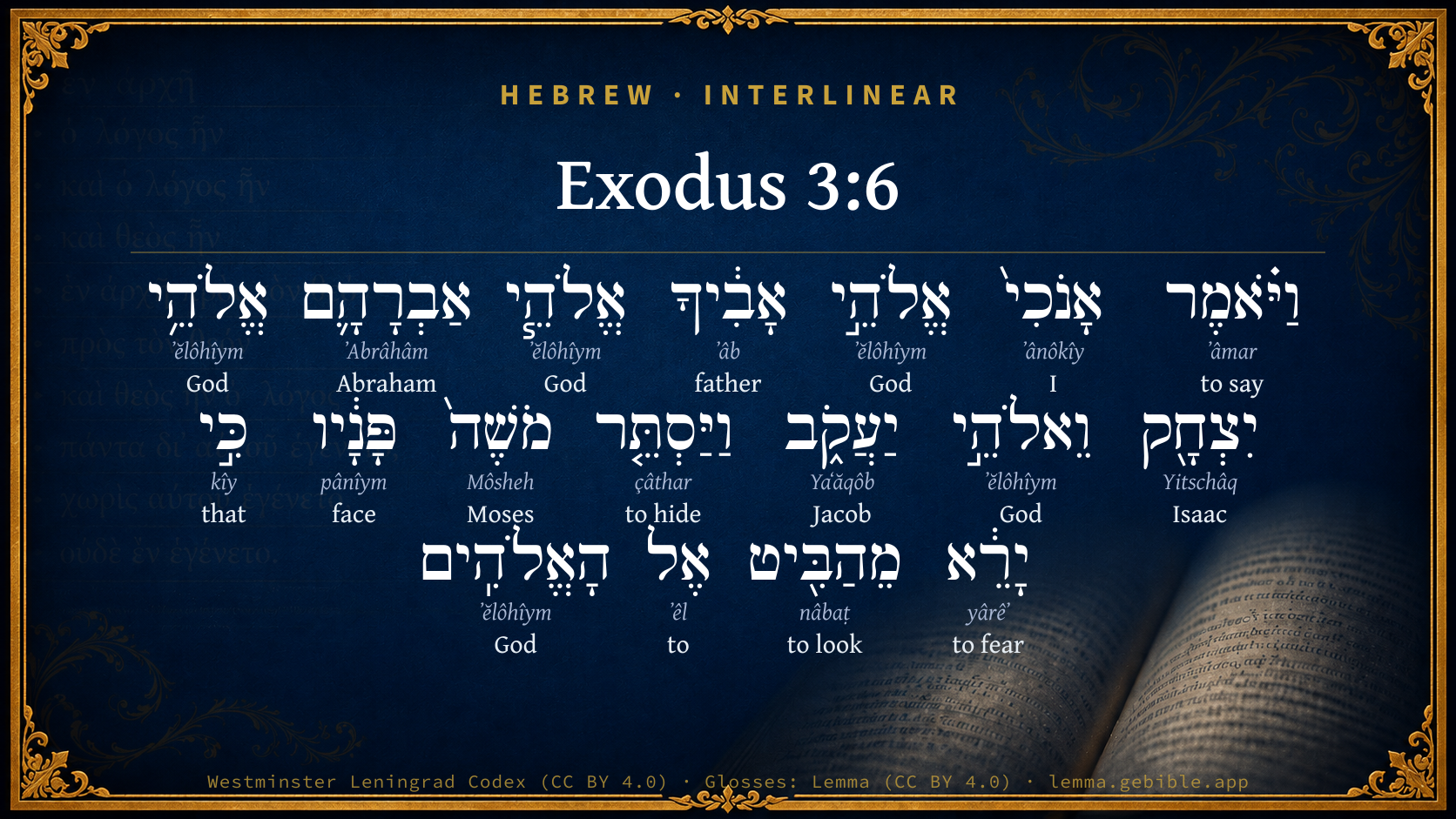
Exodus 3:6

Hebrew (Westminster Leningrad Codex) Exodus 3:6 appears in the Hebrew Old Testament. The text above is from the Westminster Leningrad Codex. Each word links to its Strong’s number, a concise gloss, and parsing drawn from the Open Scriptures Hebrew Bible morphology. Click any word for its full Brown-Driver-Briggs (BDB) entry.
Download image
Cite this verse

Exodus 3:6 (World English Bible). Public Domain. Lemma interlinear Bible study tool, https://lemma.gebible.app/v/exodus/3/6.

Show BibTeX & RIS
BibTeX
RIS
English Translation
Moreover he said, "I am the God of your father, the God of Abraham, the God of Isaac, and the God of Jacob." Moses hid his face; for he was afraid to look at God.
World English Bible · Public Domain
Download a study sheet

One document with this verse’s original text, its word-by-word gloss line, the meaning frame, cross-references with their text, attributed commentary, and full source and license credits — printable, and it pastes into notes with its structure intact.

This verse Autodidact and up

Study sheet (.html) Plain text (.txt)

A passage Seminary Student

Up to 50 verses in one chapter. A passage sheet keeps up to 6 commentary sources and 12 cross-references per verse, in the order this page ranks them, and says so on the sheet whenever that leaves anything out. Ask for a single verse and you get the Autodidact verse sheet above.

Everything on this page stays free to read, with no account — the sheet is a download of what is already on screen, not access to it.

Want to remove ads? Support Godless Engineer
Compare translations 3

The same verse in 3 English versions, stacked beneath the original-language interlinear above. Click any original word for its lexicon entry.

Each is an independent rendering of the whole verse — the interlinear is not word-aligned to these translations.

Highlighted words mark where these versions differ — a whole-verse word diff, not a word-by-word alignment.

  • World English Bible Public Domain
    Moreover he said, "I am the God of your father, the God of Abraham, the God of Isaac, and the God of Jacob." Moses hid his face; for he was afraid to look at God.
  • King James Version Public Domain
    Moreover he said, I am the God of thy father, the God of Abraham, the God of Isaac, and the God of Jacob. And Moses hid his face; for he was afraid to look upon God.
  • unfoldingWord Literal Text CC BY-SA 4.0
    And he said, “I am the God of your father, the God of Abraham, the God of Isaac, and the God of Jacob.” And Moses hid his face, for he was afraid from staring toward God.

unfoldingWord Literal Text — © unfoldingWord, licensed CC BY-SA 4.0. Word-aligned USFM3 via Door43 (git.door43.org/unfoldingWord/en_ult).

Versions to compare (up to 4)

3 of 4 selected

Show all 18 translations

Every available English version of this verse, each an independent rendering of the whole verse.

  • World English Bible Public Domain
    Moreover he said, "I am the God of your father, the God of Abraham, the God of Isaac, and the God of Jacob." Moses hid his face; for he was afraid to look at God.
  • Berean Standard Bible Public Domain
    Then He said, “I am the God of your father, the God of Abraham, the God of Isaac, and the God of Jacob.” At this, Moses hid his face, for he was afraid to look at God.
  • Majority Standard Bible Public Domain
    Then He said, “I am the God of your father, the God of Abraham, the God of Isaac, and the God of Jacob.” At this, Moses hid his face, for he was afraid to look at God.
  • King James Version Public Domain
    Moreover he said, I am the God of thy father, the God of Abraham, the God of Isaac, and the God of Jacob. And Moses hid his face; for he was afraid to look upon God.
  • American Standard Version (1901) Public Domain
    Moreover he said, I am the God of thy father, the God of Abraham, the God of Isaac, and the God of Jacob. And Moses hid his face; for he was afraid to look upon God.
  • Revised Version (1885) Public Domain
    Moreover he said, I am the God of thy father, the God of Abraham, the God of Isaac, and the God of Jacob. And Moses hid his face; for he was afraid to look upon God.
  • Geneva Bible (1599) Public Domain
    Moreouer he saide, I am the God of thy father, the God of Abraham, the God of Izhak, and the God of Iaakob. Then Moses hid his face: for he was afraid to looke vpon God.
  • Douay-Rheims (1899) Public Domain
    And he said: I am the God of thy father, the God of Abraham, the God of Isaac, and the God of Jacob. Moses hid his face: for he durst not look at God.
  • Young's Literal Translation Public Domain
    He saith also, `I `am' the God of thy father, God of Abraham, God of Isaac, and God of Jacob;' and Moses hideth his face, for he is afraid to look towards God.
  • Literal Standard Version CC BY-SA 4.0
    He also says, “I [am] the God of your father, God of Abraham, God of Isaac, and God of Jacob”; and Moses hides his face, for he is afraid to look toward God.
  • Unlocked Literal Bible CC BY-SA 4.0
    He added, “I am the God of your father, the God of Abraham, the God of Isaac, and the God of Jacob.” Then Moses covered his face, for he was afraid to look at God.
  • unfoldingWord Literal Text CC BY-SA 4.0
    And he said, “I am the God of your father, the God of Abraham, the God of Isaac, and the God of Jacob.” And Moses hid his face, for he was afraid from staring toward God.
  • Darby Bible Public Domain
    And he said, I am the God of thy father, the God of Abraham, the God of Isaac, and the God of Jacob. And Moses hid his face; for he was afraid to look at God.
  • World Messianic Bible Public Domain
    Moreover he said, “I am the God of your father, the God of Abraham, the God of Isaac, and the God of Jacob.” Moses hid his face because he was afraid to look at God.
  • Webster's Bible Public Domain
    Moreover he said, I am the God of thy father, the God of Abraham, the God of Isaac, and the God of Jacob. And Moses hid his face: for he was afraid to look upon God.
  • Free Bible Version CC BY-SA 4.0
    Then he said, “I am the God of your father, the God of Abraham, the God of Isaac, and the God of Jacob.” Moses covered his face, because he was afraid to look at God.
  • Bible in Basic English Public Domain
    And he said, I am the God of your fathers, the God of Abraham, the God of Isaac, and the God of Jacob. And Moses kept his face covered for fear of looking on God.
  • JPS Tanakh (1917) Public Domain
    Moreover He said: 'I am the God of thy father, the God of Abraham, the God of Isaac, and the God of Jacob.' And Moses hid his face; for he was afraid to look upon God.

Literal Standard Version (2020), Covenant Press — licensed CC BY-SA 4.0. Text via the HelloAO Bible API (eBible.org). Unlocked Literal Bible (unfoldingWord) — licensed CC BY-SA 4.0. Text via the HelloAO Bible API (eBible.org). unfoldingWord Literal Text — © unfoldingWord, licensed CC BY-SA 4.0. Word-aligned USFM3 via Door43 (git.door43.org/unfoldingWord/en_ult). Free Bible Version, Dr. Jonathan Gallagher — licensed CC BY-SA 4.0. Text via the HelloAO Bible API (eBible.org).

Word by word

More ways to search: Search by grammar → Find every occurrence → Compare this word →

Practice this passage: Drill this verse → Learn its vocabulary →

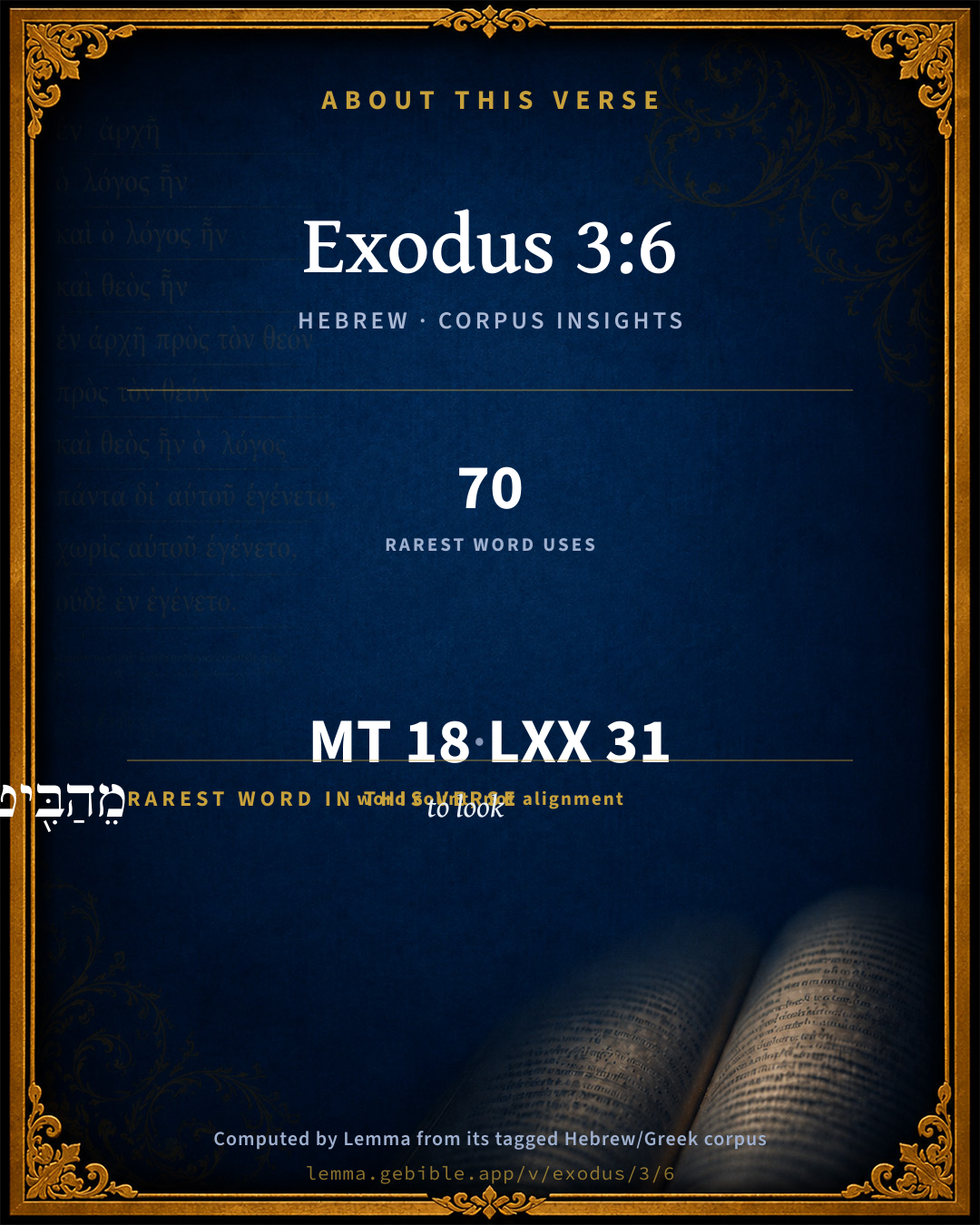
מֵהַבִּ֖יט
nâbaṭ
H5027
“from · to look”
Preposition + Verb, Hiphil, Infinitive Construct
Part of Speech
Preposition + Verb
Stem
Hiphil
Form
Infinitive Construct
Full BDB Definition

TWOT: None

to look, regard - (Piel) to look - (Hiphil) - to look - to regard, show regard to, pay attention to, consider - to look upon, regard, show regard to
  1. וַיֹּ֗אמֶר ʼâmar H559 “and · to say” Conjunction + Verb, Qal, Sequential Imperfect, 3rd Person, Masculine, Singular
  2. אָנֹכִי֙ ʼânôkîy H595 “I” Pronoun, Personal, 1st Person, Common, Singular
  3. אֱלֹהֵ֣י ʼĕlôhîym H430 “God(s) of” Noun, Common, Masculine, Plural, Construct
  4. אָבִ֔יךָ ʼâb H1 “father · your” Noun, Common, Masculine, Singular, Construct + Suffix, Personal, 2nd Person, Masculine, Singular
  5. אֱלֹהֵ֧י ʼĕlôhîym H430 “God(s) of” Noun, Common, Masculine, Plural, Construct
  6. אַבְרָהָ֛ם ʼAbrâhâm H85 “Abraham” Noun, Proper
  7. אֱלֹהֵ֥י ʼĕlôhîym H430 “God(s) of” Noun, Common, Masculine, Plural, Construct
  8. יִצְחָ֖ק Yitschâq H3327 “Isaac” Noun, Proper
  9. וֵאלֹהֵ֣י ʼĕlôhîym H430 “and · God(s) of” Conjunction + Noun, Common, Masculine, Plural, Construct
  10. יַעֲקֹ֑ב Yaʻăqôb H3290 “Jacob” Noun, Proper
  11. וַיַּסְתֵּ֤ר çâthar H5641 “and · to hide” Conjunction + Verb, Hiphil, Sequential Imperfect, 3rd Person, Masculine, Singular
  12. מֹשֶׁה֙ Môsheh H4872 “Moses” Noun, Proper
  13. פָּנָ֔יו pânîym H6440 “face(s) · his” Noun, Common, Both, Plural, Construct + Suffix, Personal, 3rd Person, Masculine, Singular
  14. כִּ֣י kîy H3588 “that” Conjunction
  15. יָרֵ֔א yârêʼ H3372 “to fear” Verb, Qal, Perfect, 3rd Person, Masculine, Singular
  16. אֶל ʼêl H413 “to” Preposition
  17. הָאֱלֹהִֽים ʼĕlôhîym H430 “the · God(s)” Particle, Definite Article + Noun, Common, Masculine, Plural, Absolute

About this verse

These counts appear in no published source. They are computed here, from the morphology-tagged text and Lemma’s own curated glosses. What Lemma adds →

18
words
14
distinct lemmas
Pentateuch
section

Grammatical profile

  • 4 verbs
  • 11 nouns
  • 1 pronoun
  • 1 preposition
  • 1 conjunction

Verb forms

  • וַיֹּ֗אמֶר Qal · Sequential Imperfect
  • וַיַּסְתֵּ֤ר Hiphil · Sequential Imperfect
  • יָרֵ֔א Qal · Perfect
  • מֵהַבִּ֖יט Hiphil · Infinitive Construct

Repetition

A word recurs within this verse — often emphatic in Hebrew:

  • אֱלֹהֵ֣י God H430 ×5

Hebrew & Septuagint length

In English translation the verse runs 35 words from the Hebrew and 38 from the Septuagint (LXX English) — closely comparable.

A rough comparison of the two English renderings, which tokenize alike — not a word-level alignment.

Word counts can differ between the Hebrew and the Greek without any difference in meaning — e.g. the Hebrew direct-object marker אֵת has no separate Greek word, and Greek often adds the article ὁ.

In the original languages it is 18 Hebrew tokens and 31 Greek tokens — but the two are counted differently (Hebrew bundles its prefixes and suffixes into one token; the Greek is in lemma form), so that isn’t a like-for-like length.

Cross-references

35

Topical passages linked to Exodus 3:6 in the Treasury of Scripture Knowledge — connected by theme and wording, ordered by reader-vote popularity; previews shown in the World English Bible.

  • Luke 20:37 But that the dead are raised, even Moses showed at the bush, when he called the Lord 'The God of Abraham, the God of Isaac, and the God of Jacob.'
  • Matthew 22:32 'I am the God of Abraham, and the God of Isaac, and the God of Jacob?' God is not the God of the dead, but of the living."
  • Exodus 4:5 "That they may believe that Yahweh, the God of their fathers, the God of Abraham, the God of Isaac, and the God of Jacob, has appeared to you."
  • Genesis 28:13 Behold, Yahweh stood above it, and said, "I am Yahweh, the God of Abraham your father, and the God of Isaac. The land whereon you lie, to you will I give it, and to your seed.
  • Mark 12:26 But about the dead, that they are raised; haven't you read in the book of Moses, about the Bush, how God spoke to him, saying, 'I am the God of Abraham, the God of Isaac, and the God of Jacob?'
  • Acts 7:32 'I am the God of your fathers, the God of Abraham, the God of Isaac, and the God of Jacob.' Moses trembled, and dared not look.
  • Revelation 1:17 When I saw him, I fell at his feet like a dead man. He laid his right hand on me, saying, "Don't be afraid. I am the first and the last,
  • 1 Kings 18:36 It happened at the time of the offering of the [evening] offering, that Elijah the prophet came near, and said, Yahweh, the God of Abraham, of Isaac, and of Israel, let it be known this day that you are God in Israel, and that I am your servant, and that I have done all these things at your word.
  • Judges 13:22 Manoah said to his wife, We shall surely die, because we have seen God.
  • Isaiah 6:1–5 In the year that king Uzziah died, I saw the Lord sitting on a throne, high and lifted up; and his train filled the temple.
  • Jeremiah 24:7 I will give them a heart to know me, that I am Yahweh: and they shall be my people, and I will be their God; for they shall return to me with their whole heart.
  • Jeremiah 32:38 and they shall be my people, and I will be their God:
  • Genesis 12:1 Now Yahweh said to Abram, "Get out of your country, and from your relatives, and from your father's house, to the land that I will show you.
  • Genesis 12:7 Yahweh appeared to Abram, and said, "I will give this land to your seed." He built an altar there to Yahweh, who appeared to him.
  • Genesis 17:7–8 I will establish my covenant between me and you and your seed after you throughout their generations for an everlasting covenant, to be a God to you and to your seed after you.
  • Genesis 26:24 Yahweh appeared to him the same night, and said, "I am the God of Abraham your father. Don't be afraid, for I am with you, and will bless you, and multiply your seed for my servant Abraham's sake."
  • Genesis 31:42 Unless the God of my father, the God of Abraham, and the fear of Isaac, had been with me, surely now you would have sent me away empty. God has seen my affliction and the labor of my hands, and rebuked you last night."
  • Genesis 32:9 Jacob said, "God of my father Abraham, and God of my father Isaac, Yahweh, who said to me, 'Return to your country, and to your relatives, and I will do you good.'
  • Exodus 3:14–15 God said to Moses, "I AM WHO I AM," and he said, "You shall tell the children of Israel this: "I AM has sent me to you."
  • Exodus 29:45 I will dwell among the children of Israel, and will be their God.
  • 1 Kings 19:13 It was so, when Elijah heard it, that he wrapped his face in his mantle, and went out, and stood in the entrance of the cave. Behold, there came a voice to him, and said, What are you doing here, Elijah?
  • Job 42:5–6 I had heard of you by the hearing of the ear, But now my eye sees you.
  • Psalms 106:44–45 Nevertheless he regarded their distress, When he heard their cry.
  • Psalms 132:2 How he swore to Yahweh, And vowed to the Mighty One of Jacob:
  • Jeremiah 31:33 But this is the covenant that I will make with the house of Israel after those days, says Yahweh: I will put my law in their inward parts, and in their heart will I write it; and I will be their God, and they shall be my people:
  • Genesis 17:3 Abram fell on his face. God talked with him, saying,
  • Nehemiah 9:9 You saw the affliction of our fathers in Egypt, and heard their cry by the Red Sea,
  • Ezekiel 11:20 that they may walk in my statutes, and keep my ordinances, and do them: and they shall be my people, and I will be their God.
  • Daniel 10:7–8 I, Daniel, alone saw the vision; for the men who were with me didn't see the vision; but a great quaking fell on them, and they fled to hide themselves.
  • Zechariah 8:8 and I will bring them, and they will dwell in the midst of Jerusalem; and they will be my people, and I will be their God, in truth and in righteousness."
  • Matthew 17:6 When the disciples heard it, they fell on their faces, and were very afraid.
  • Luke 5:8 But Simon Peter, when he saw it, fell down at Jesus' knees, saying, "Depart from me, for I am a sinful man, Lord."
  • Acts 7:34 I have surely seen the affliction of my people that is in Egypt, and have heard their groaning. I have come down to deliver them. Now come, I will send you into Egypt.'
  • Hebrews 12:21 and so fearful was the appearance, that Moses said, "I am terrified and trembling."
  • Esther 3:4 Now it came to pass, when they spoke daily to him, and he didn't listen to them, that they told Haman, to see whether Mordecai's matters would stand: for he had told those who he was a Jew.

Cross-references courtesy of OpenBible.info (CC BY 4.0).

Hebrew and Greek witnesses Masoretic Hebrew ↔ Greek Septuagint

The same verse in the two great witnesses to the Old Testament, shown verse-for-verse.

These are two independent witnesses, not word-aligned to each other, and the Septuagint is shown in lemma (dictionary) form.

Hebrew Exodus 3:6 Masoretic · Westminster Leningrad Codex

וַיֹּ֗אמֶר אָנֹכִי֙ אֱלֹהֵ֣י אָבִ֔יךָ אֱלֹהֵ֧י אַבְרָהָ֛ם אֱלֹהֵ֥י יִצְחָ֖ק וֵאלֹהֵ֣י יַעֲקֹ֑ב וַיַּסְתֵּ֤ר מֹשֶׁה֙ פָּנָ֔יו כִּ֣י יָרֵ֔א מֵהַבִּ֖יט אֶל הָאֱלֹהִֽים

Moreover he said, "I am the God of your father, the God of Abraham, the God of Isaac, and the God of Jacob." Moses hid his face; for he was afraid to look at God.

World English Bible · Public Domain

Greek LXX Exodus 3:6 Septuagint · lemma form

καί εἶπον αὐτός ἐγώ εἰμί ὁ θεός ὁ πατήρ σύ θεός αβρααμ καί θεός ισαακ καί θεός ἰακώβ ἀποστρέφω δέ μωυσῆς ὁ πρόσωπον αὐτός εὐλαβέομαι γάρ κατα ἐνβλέπω ἐνώπιον ὁ θεός

And he said, I am the God of your father, the God of Abraam, and the God of Isaac, and the God of Jacob; and Moses turned away his face, for he was afraid to gaze at God.

LXX2012 (modern English Septuagint) · Public Domain

Hebrew: Westminster Leningrad Codex (CC BY 4.0). Greek: Septuagint (public domain); English from LXX2012 (modern English Septuagint) (Public Domain). How the Septuagint differs from the Hebrew →

Targum (Aramaic paraphrase)

2

The Targum is the ancient Jewish Aramaic paraphrase of the Hebrew Scriptures — an interpretive translation, not the Hebrew text itself. Onkelos (literal) and Pseudo-Jonathan (expansive) render the Torah, and Jonathan the Prophets. Coverage is partial: where no permissively-licensed English translation exists for a verse, only the Aramaic is shown. This is verse-level text, not a word-by-word alignment to the Hebrew.

  1. Targum Onkelos Torah (Genesis–Deuteronomy)
    וַאֲמַר אֲנָא אֱלָהָא דְאָבוּךְ אֱלָהָא דְאַבְרָהָם אֱלָהָא דְיִצְחָק וֵאלָהָא דְיַעֲקֹב וּכְבֵשִׁנּוּן משֶׁה לְאַפּוֹהִי אֲרֵי דָחִיל מִלְאִסְתַּכָּלָא בְּצֵית יְקָרָא דַיְיָ:

    (no public-domain English translation for this verse)

    Targum Onkelos — Aramaic: “Onkelos Genesis” (public domain); “Onkelos Exodus” (public domain); “Onkelos Leviticus” (public domain); “Onkelos Numbers” (public domain); “Onkelos Deuteronomy” (public domain). English: “Sefaria Community Translation” (CC0 1.0 (public-domain dedication)); “J.W. Etheridge. The Targums of Onkelos and Jonathan Ben Uzziel on the Pentateuch. London: Longmans, Green, 1862” (public domain). Text via Sefaria.

  2. Targum Pseudo-Jonathan Torah (Genesis–Deuteronomy)
    וַאֲמַר אֲנָא הוּא אֱלָהֵיהּ דְאָבוּךְ אֱלָהֵיהּ דְאַבְרָהָם אֱלָהֵיהּ דְיִצְחָק וֵאלָהֵיהּ דְיַעֲקב וּכְבָשִׁינוּן משֶׁה לְאַנְפּוֹי אֲרוּם הֲוָה דָחִיל מִלְמִסְתְּכֵי בְּצֵית אִיקַר שְׁכִינְתָּא דַיְיָ

    And He said, I am the God of thy father, the God of Abraham, the God of Izhak, and the God of Jakob. And Mosheh covered his face; for he was afraid to look upon the height of the glory of the Shekinah of the Lord.

    Targum Pseudo-Jonathan — Aramaic: “Targum Jonathan on Genesis” (public domain); “Targum Jonathan on Exodus” (public domain); “Targum Jonathan on Leviticus” (public domain); “Targum Jonathan on Numbers” (public domain); “Targum Jonathan on Deuteronomy” (public domain). English: “The Targum of Jonathan ben Uzziel, trans. J. W. Etheridge, London, 1862” (public domain). Text via Sefaria.

Commentary

Notes on Exodus 3:6 from classic Christian and Jewish commentators (each source and its license shown beneath its notes). The classic Christian expositions comment on the surrounding passage and are grouped to its opening verse, so a note may address several verses; the Jewish commentaries on the Tanakh (Rashi and others) are per-verse, so they appear only where the commentator wrote on this verse.

Lemma curates 59 commentaries, every one of them public domain or Creative Commons licensed, each selected and text-cleaned for this edition rather than reprinted as found. About our sources →

Trapp's Complete Commentary

John Trapp

Exo 3:6 Moreover he said, I [am] the God of thy father, the God of Abraham, the God of Isaac, and the God of Jacob. And Moses hid his face; for he was afraid to look upon God.

Ver. 6. Hid his face.] So did the seraphims, with a double scarf, as it were. {Isa 6:2} Let a man but see God, and his plumes will soon fall.

For he was afraid.] Yea, he "trembled, and durst not behold." {Act 7:32} This was his first meeting with God: when better acquainted, he grew more bold.

John Trapp, A Commentary or Exposition upon All the Books of the Old and New Testament (1647–1656) — public domain. Text from a community e-Sword module.

The Biblical Illustrator

Joseph S. Exell

Exo_3:6

I am the God of thy father.

The ancestral God our God

This declaration was made in order to assure Moses that even in the present oppressed state of his nation in Egypt, the Most High had not forgotten them, or His relation to them as a God in covenant. This would be an unspeakable consolation to Moses, to find himself addressed by that God of whose appearances and promises to his fathers he had often heard, and to know that His heart was as kindly affected to him as it ever had been to his venerated ancestors. How comforting beyond measure to the Christian, in his more favoured moments, to be assured that the God of all the good who have ever lived is his God, and equally pledged by His covenant faithfulness, to show to him the same loving-kindness that He showed to them! (G. Bush.)

The Divine revelation

The Divine Being here reveals Himself as--

1. The God of individual men.

2. The God of families.

3. The God of the immortal good. (J. S. Exell, M. A.)

The God of Abraham, Isaac, and Jacob

He is thus the God of generations, the God of individuals, and the God of the whole human family. There is something inexpressibly beautiful in the idea that God is the God of the father, and of the son, and of all their descendants; thus the one God makes humanity into one family. (J. Parker, D. D.)

The Biblical Illustrator, edited by Joseph S. Exell (c. 1880s–1900s) — public domain. Text from a community e-Sword module.

Joseph Benson's Commentary

Exo 3:6. I am, &c. — He lets him know it is God that speaks to him, to engage his reverence, faith, and obedience. The God of thy father — Thy pious father Amram, and the God of Abraham, Isaac, and Jacob, thy ancestors: engaged to them by solemn covenant, which I am now come to perform. And Moses hid his face, for he was afraid to look upon God — The more we see of God, the more cause we shall see to worship him with reverence and godly fear. And even the manifestations of God’s grace should increase our humble reverence of him.

Joseph Benson's Commentary on the Old and New Testaments (1811–1818) — public domain. Text from a community e-Sword module.

Tyndale Open Study Notes

Tyndale Open Resources

3:6 This transcendent God had committed himself to Moses’ ancestors in a faithful promise maintained for hundreds of years. Moses was in awe of the one, holy, and transcendent God of Abraham. Jesus quoted this verse when he was sparring with the Sadducees about the concept of resurrection (Matt 22:32; Mark 12:26; Luke 20:37).

Tyndale Open Study Notes — © Tyndale Open Resources, licensed CC BY-SA 4.0. Text via the HelloAO Bible API.

Geneva Bible (1599)

Geneva Bible translators

For sin causeth man to fear God’s justice.

Geneva Bible (1599) marginal notes — public domain. Text via Bolls.life.

Jamieson, Fausset & Brown

Robert Jamieson, A. R. Fausset & David Brown

I am the God . . . come down to deliver--The reverential awe of Moses must have been relieved by the divine Speaker (see Mat 22:32), announcing Himself in His covenant character, and by the welcome intelligence communicated. Moreover, the time, as well as all the circumstances of this miraculous appearance, were such as to give him an illustrious display of God's faithfulness to His promises. The period of Israel's journey and affliction in Egypt had been predicted (Gen 15:13), and it was during the last year of the term which had still to run that the Lord appeared in the burning bush.

Jamieson, Fausset & Brown — Commentary Critical and Explanatory on the Whole Bible (1871) — public domain (CC PDM 1.0). Text via the HelloAO Bible API.

Adam Clarke's Commentary

Verse 6. I am the God of thy father] Though the word אבי abi, father, is here used in the singular, St Stephen, quoting this place, Ac 7:32, uses the plural, Ὁ Θεος των πατερων σου, The God of thy FATHERS; and that this is the meaning the following words prove: The God of Abraham, the God of Isaac, and the God of Jacob. These were the fathers of Moses in a direct line. This reading is confirmed by the Samaritan and by the Coptic. ABRAHAM was the father of the Ishmaelites, and with him was the covenant first made. ISAAC was the father of the Edomites as well as the Israelites, and with him was the covenant renewed. JACOB was the father of the twelve patriarchs, who were founders of the Jewish nation, and to him were the promises particularly confirmed. Hence we see that the Arabs and Turks in general, who are descendants of Ishmael; the Edomites, now absorbed among the Jews, (See Clarke on Ge 25:23,) who are the descendants of Esau; and the Jewish people, wheresoever scattered, who are the descendants of Jacob, are all heirs of the promises included in this primitive covenant; and their gathering in with the fulness of the Gentiles may be confidently expected.

And Moses hid his face] For similar acts, see 1Kg 19:13; Isa 6:1, Isa 6:5; Ne 9:9; Ps 106:44; Ac 7:34. He was afraid to look - he was overawed by God's presence, and dazzled with the splendour of the appearance.

Adam Clarke's Commentary on the Bible (1810–1826) — public domain. Text from a community e-Sword/MySword module.

Ellicott's Commentary for English Readers

(6) The God of thy father.—It is generally agreed that “father” is put collectively here for “forefathers.” (Comp. Gen_31:42.) Hence St. Stephen, quoting the passage, renders it, “I am the God of thy fathers” (Act_7:32).

The God of Abraham.—Primarily, no doubt, the meaning was, the God who was worshipped by Abraham, Isaac, and Jacob; but the form of the expression, “the God of Abraham,” &c., indicated the continued existence of the patriarchs after death, since He can only be the God of existent, and not of nonexistent things. (See Mat_22:32.)

Moses hid his face, with the same feeling which made Jacob exclaim, “How dreadful is this place” (Gen_28:17). Though nothing was to be seen but an appearance as of material fire, the knowledge that God was there rendered the fire awful.

A Bible Commentary for English Readers, edited by Charles John Ellicott (1878–1897) — public domain. Text from a community e-Sword module.

The Cambridge Bible for Schools and Colleges

gen. ed. J. J. S. Perowne

6. Moreover] And (carrying on v. 4b in E).

the God of thy father] Exo_15:2, Exo_18:4 : the God worshipped by thy father, and, it is added afterwards, by thy forefathers, Abraham, Isaac, and Jacob, as well. Moses is not to introduce to his people any previously unknown God, but the God whom their fathers had worshipped, and who, it was believed, had promised to be with, and to defend, their descendants. Comp. Mat_22:32 = Mar_12:26 = Luk_20:37.

hid his face] in reverence and fear: cf. 1Ki_19:13; Isa_6:2.

6–10. God declares His purpose of delivering His people.

The Cambridge Bible for Schools and Colleges (gen. ed. J. J. S. Perowne; Cambridge University Press, 1878–1918) — public domain. Text from a community e-Sword module.

John Gill's Exposition

Moreover he said, I am the God of thy fathers,.... Of every one of his fathers next mentioned:

the God of Abraham, the God of Isaac, and the God of Jacob; with whom the covenant respecting the land of Canaan, and the promise of the blessed seed the Messiah, was made: this again shows that the Angel of the Lord that now appeared was God himself, Jehovah the Son of God. Our Lord makes use of this text to prove the resurrection of the dead against the Sadducees, God being not the God of the dead, but of the living; Mar 12:26.

and Moses hid his face; wrapped it in his mantle or cloak, as Elijah did, Kg1 19:13, because of the glory of the divine Majesty now present, and conscious of his own sinfulness and unworthiness:

for he was afraid to look upon God; even upon this outward appearance and representation of him in a flame of fire; otherwise the essence of God is not to be looked upon and seen at all, God is invisible; but even this external token and symbol of him was terrible to behold; the thought that God was there filled him with fear, considering the greatness and awfulness of his majesty, and what a poor, weak, and sinful creature he was.

John Gill's Exposition of the Whole Bible (1746–1763) — public domain (CC PDM 1.0). Text via the HelloAO Bible API.

Albert Barnes' Notes on the Bible

Our Saviour adduces this passage as a proof that the doctrine of the Resurrection was taught in the Old Testament Mat 22:32, and He calls this book “the Book of Moses” Mar 12:26, two points to be borne in mind by readers of the Pentateuch.

Albert Barnes' Notes on the Bible (1834–1885) — public domain. Text from a community e-Sword/MySword module.

Haydock's Catholic Bible Commentary

Hid, out of respect, and perhaps fearing lest he should die, Genesis xvi. 13. (Calmet) --- God takes the title of these three patriarchs, because he had promised Chanaan to each of them, and because they were eminent for virtue. God is repeated thrice, to insinuate the mystery of the blessed Trinity, and to shew that the Lord watches over each individual, as if that one alone existed. (Menochius)

George Leo Haydock (1774–1849), Haydock's Catholic Family Bible and Commentary, 1859 edition — public domain. Excludes Psalms (Douay-Rheims chapter numbering differs from Protestant) and Deuterocanonical books (Catholic canon only).

Matthew Poole's English Annotations

The God of thy fathers, engaged to them by covenant or promise, which I am now come to perform.

He was afraid to look upon God, as other excellent servants of God have been, through the sense of their own meanness and sinfulness, and of God’s majesty and holiness. See Gen 16:13; 17:3; 1Ki 19:13; Isa 6:2,5, &c.

Matthew Poole's English Annotations on the Holy Bible (1683–1685) — public domain. Text from a community e-Sword/MySword module.

Whedon's Commentary on the Bible

Daniel D. Whedon

6. The God of thy father — Whose name thy father and mother taught thee; and the God of their fathers — of the sacred patriarchal line — who remembers his covenant with them. But Jesus shows us (Mat_22:32, where see note) that the words were deeper still, revealing to Moses not only that He lived, but that they lived as sharers in this everlasting covenant, and were looking for its fulfilment. A covenant with Jehovah implies, connotes, or includes, immortality. Moses had waited long. Now his father’s God speaks to him in a tongue of flame; calls him by his name, yet warns him not to draw nigh; brings before him those waiting fathers — a “cloud of witnesses!” What wonder that he hid his face from the blaze of such a revelation!

Daniel D. Whedon (gen. ed.), Commentary on the Old and New Testaments (1874–1909) — public domain. Text from a community e-Sword module.

The Pulpit Commentary

The God of the fathers.

am the God of thy father, the God of Abraham," etc. In these words

I GOD CONNECTS HIMSELF WITH THE DEAD PATRIARCHS. They imply

1. Continued existence; for God, who says here, not "I was," but "I am, the God of thy father," is, as Christ reminds us, "not the God of the dead, but of the living". (Mat_22:32) The personal relation was not dissolved. The patriarchs still lived to him.

2. The resurrection of the body. This will not appear a far-fetched inference, if we consider the nature of the Bible hope of immortality. The Bible has little or nothing to say of an abstract "immortality of the soul." It nowhere regards the disembodied state as in itself desirable. The immortality it speaks of is the immortality of the "man of man in his whole complex personality of body, soul, and spirit. This implies a resurrection. The life forfeited by sin was a life in the body, and so must be the life restored by Redemption. The covenant-promise could not fall below the hopes of the heathen; and even Egyptian theology held by the notion of a revival of the body, as essential to perfected existence. Hence the practice of embalming, with which compare the care of the body by the patriarchs.

II CONNECTS THIS REVELATION WITH FAST REVELATIONS, AS ONE OF A SERIES. It introduces what is to be said as the fulfilment of what had been already promised.

III CONNECTS HIMSELF WITH THE EXISTING GENERATION. The God of the fathers is, in virtue of the promise, the God of the children. J.O.

The God of Abraham, Isaac, and Jacob.

Having wakened the mind of Moses into full activity, given him a revelation of supernatural power, and brought him altogether into a state of the greatest reverence and awe, God proceeds to a revelation of himself in a particular aspect an aspect which required and repaid the most earnest attention. Notice that, unlike the revelation of the name I AM (ver. 13), it was unsolicited.

I CONSIDER THE SIGNIFICANCE OF THIS NAME TO MOSES AND THE CHILDREN OF ISRAEL.

1. It was a confident reference to the past. Moses might look back on his own career, or that of he people to whom he belonged, with a measure of shame, doubt, humiliation, and disappointment; but God could point back to all his dealings with men as consistent, glorious, and worthy of all remembrance.

2. It provided a certain kind of mediatorship in the knowledge of God. It gave the best way for Moses and Israel to think of God, at that particular time. It was as if God had said to Moses, "You are to gain your chief sense of my nearness to Israel and abiding interest in them by thinking of my actual, repeated, and recorded dealings with Abraham, Isaac, and Jacob." No devout Israelite could become acquainted with that section of Genesis, from the time when God first appeared to Abram down to the death of Jacob, without feeling that the God of these three men was even a more prominent figure in the history than they are themselves. We could as easily leave out the name of Abraham from the narrative, as leave out the name of God. What we are told of Abraham is nothing, save as the effect and expression of the will of God. Abram is as a mere name, till God comes in contact with him. It is not so much a life of Abraham we are reading, as a history of how God"s purposes and power became manifest in his experience.

3. It kept before Moses the connexion of God with the lives of individuals. God made separate appearances to each of these three men, dealing with them according to their Circumstances and their character. He showed his continual and unfailing observation of their lives, by revealing his presence at every critical point.

4. There was a connexion of peculiar importance which God had with some individuals rather than with others. He was the God of Adam, of Enoch, and of Noah; why not have associated himself with these illustrious names? The God of Abraham, Isaac, and Jacob stood towards Israel in the relation of one who had made large promises, allowed himself to become the source of large expectations, and imposed strict requirements. He was not only the God of Abraham, Isaac, and Jacob, taken separately, but Of these three men, bound together in a very peculiar way. Not only did they stand in a lineal succession, Abraham being father to Isaac, and Isaac father to Jacob, but that succession was contrary to natural expectations and customary arrangements. Isaac was the son of Abraham, but also a son born when the resources of nature were exhausted. Jacob was the son of Isaac, but also the younger son, on whom, contrary to custom, the privileges of the firstborn alighted. Thus it became impossible to describe God as the God of Abraham and Ishmael, though in a certain sense he was the God of Ishmael. (Gen_17:20) Nor could he be called the God of Abraham, Isaac, and Esau, though assuredly he was the God of Esau also. The only name which would indicate to Moses all he had to bear in mind, was the name which God here employs.

5. He was the God of these men in spite of great defects of character and great blots on conduct. They were men in whom he found much that was evil, much that indicated a low moral state, but he found in them all, and particularly in the first of them, a spirit of faith which enabled him to begin, as from a certain definite point in history, that work which is to end in all nations of the earth being blessed. Already he had made a great nation out of Abram a persecuted and oppressed nation indeed, but none the less a great one. And had he not spoken to Abram concerning this very bondage in Egypt?. (Gen_15:13, Gen_15:14) Some such revelation as this at Horeb, to some deliverer or other, might now be expected. It must surely have been often a perplexity to Moses, what had become of this God who had done so much for Abraham, Isaac, and Jacob.

II CONSIDER THE SIGNIFICANCE OF THIS NAME TO US, We are not mere spectators of the way in which the God of Abraham, Isaac, and Jacob approved himself as also the God of Moses and the Israelites in Egypt and in the wilderness. To speak of the God of Abraham, Isaac, and Jacob is only another way of speaking of the God of those who really believe in him. Whenever a real believer ponders this name, then it becomes one of precious associations; it leads by the very mention of it, further and further onwards in subjection to the invisible. But after all, this name, so deeply impressed on Moses, is chiefly valuable to us as suggesting a name far richer in meaning and in power. We have a look into the past which Moses had not. He looked backward and saw God"s dealings with Abraham, and found in them everything to inspire faith in God and expectation from him. We look backward and see, not only Abraham, but Christ; not only Isaac, but Christ; not only Jacob, but Christ. When we look back to these men of Genesis, we see faith standing out like an isolated mountain in the midst of a plain; but we see much also that we would rather not see. Whereas, when we look back to Christ we see not only a full believer, but a flawless life. In him there stands the chief of those that walk by faith, the facile princeps of them he who, for the joy that was set before him, endured the cross, despising the shame. His faith was such a full, exalted element of his character, that it needs much effort on our part to grasp the fact that, while here below, Jesus, as much as all the rest of us, needed to walk by faith, and was constantly compelled to struggle with unbelief. The great Jehovah is the God and Father of our Lord Jesus Christ; also the God of Paul and every true apostle. Suppose Moses could have had the spirits of Abraham, Isaac, and Jacob appear to him in Horeb, and assure him that the God of the burning bush was the God who had dealt with them in the days of their flesh; would not this have Been reckoned a most confirming and exhilarating testimony? And we, practically, have a testimony of this sort. We read of Jesus regarding God as his Father, habitually and in the most appropriating way. We have his actual experience for our comfort, our inspiration, and our guide. If an Israelite was asked what God he believed, tried to serve, and had his. highest expectations from, his best answer was, "The God of Abraham, Isaac, and Jacob." So we, if asked a similar question, can give no better answer than "The God of Christ and the God of Paul: the God who has ever been the same through all vicissitudes of his Church; ever loving, faithful, and sustaining, Y.

The Pulpit Commentary (1880–1919), ed. H.D.M. Spence-Jones & Joseph S. Exell — public domain. Text from a community e-Sword module.

John Wesley's Explanatory Notes

I am the God of thy father - He lets him know it is God that speaks to him, to engage his reverence, faith and obedience. Thy father, thy pious father Amram, and the God of Abraham, Isaac, and Jacob, thy ancestors. Engaged to them by solemn covenant, which I am now come to perform. And Moses hid his face, for he was afraid to look upon God - The more we see of God, the more cause we shall see to worship him with reverence and godly fear. And even the manifestations of God's grace should increase our humble reverence of him.

John Wesley, Explanatory Notes Upon the Whole Bible (1754–1765) — public domain. Text via the GEBible commentary corpus.

Keil & Delitzsch

C. F. Keil & F. Delitzsch

Jehovah then made Himself known to Moses as the God of his fathers, Abraham, Isaac, and Jacob, reminding him through that name of the promises made to the patriarchs, which He was about to fulfil to their seed, the children of Israel. In the expression, "thy father," the three patriarchs are classed together as one, just as in Exo 18:4 ("my father"), "because each of them stood out singly in distinction from the nation, as having received the promise of seed directly from God" (Baumgarten). "And Moses hid his face, for he was afraid to look upon God." The sight of the holy God no sinful man can bear (cf. Kg1 19:12).

Keil & Delitzsch — Biblical Commentary on the Old Testament (1861–1891) — public domain (CC PDM 1.0). Text via the HelloAO Bible API. (Old Testament only.)

Ramban (Nachmanides)

Rabbi Moshe ben Nachman (Ramban / Nachmanides)

I AM THE G-D OF THY FATHER. In accordance with the plain meaning of Scripture, this is equivalent to saying, “the G-d of thy fathers.” However, He mentions the singular instead of the plural, for the intent is “the G-d of each one of your ancestors,” since people refer to all ancestors as fathers. Similarly: the G-d of thy father David; this is my G-d, and I will glorify Him; my father’s G-d, and I will exalt Him, meaning “the G-d of my fathers.”Rabbi Abraham ibn Ezra said [that the word “father” in the phrase], the G-d of my father, refers to Abraham since he was the first who began to call upon the name of the Eternal. After that, He mentioned Abraham by name and then joined the rest of the patriarchs to him.. In the opinion of our Rabbis, [“father” in the phrase] The G-d of thy father, means Amram. This is just as if He had said, “I am thy G-d,” [i.e., Moses’ G-d], but He desired to associate His Name with that of a righteous man who had already died - [namely, Amram] - rather than with that of one yet alive, [i.e., Moses]. ” (Job 15:15). As long as a person lives, the evil inclination in him is still present. After that, [He mentioned] the G-d of Abraham, the G-d of Isaac, and the G-d of Jacob, meaning that He is the G-d of all Israel.The reason for His mentioning “the G-d of” with each one [of the patriarchs] instead of saying “the G-d of Abraham, Isaac, and Jacob” is that He referred to His Name and His memorial, [thus alluding to the special attributes by which He was associated with each of the patriarchs], (Deuteronomy 10:17). ‘The great’ alludes to Abraham, as it is said, and of great kindness (Psalms 145:8); ‘the mighty’ to the Fear of Isaac (Genesis 31:42); and ‘the feared’ to Jacob, as it is said, For with Thee there is forgiveness, that Thou mayest be feared” (Psalms 130:4). (Ricanti in his work here on the Torah). blessed and magnified be He. I will explain yet more on this point in the chapter.

Ramban (Nachmanides) on the Tanakh — English translation: “Commentary on the Torah by Ramban (Nachmanides). Translated and annotated by Charles B. Chavel. New York, Shilo Pub. House, 1971-1976” (CC BY 4.0). Text via Sefaria.

Lesson kit

Teaching starters — assembled from the data on this page, not authored interpretation. Every prompt links to the verse data it draws on. Edit before teaching.

Exodus, in the Pentateuch, opens this verse with 18 words (14 distinct Hebrew lemmas). Its most distinctive word is nâbaṭ (“to look”). A historical commentator’s framing appears above. Read the whole chapter for the surrounding context.

Discussion questions

  1. How does “to look” (nâbaṭ) shape what this verse is saying?
  2. How does Luke 20:37, which shares this passage’s theme, read alongside this verse?
  3. What does the repetition of “God” (5× in this one verse) do in this verse?
  4. These translations render this verse differently; the difference is in the English rendering, not the original. What questions does that raise?
  5. «וַיֹּ֗אמֶר» is a Qal Sequential Imperfect verb. How does that grammatical form shape the action described?
  6. Compare how Trapp's Complete Commentary and The Biblical Illustrator read this verse. Where do they agree or differ?

Things to notice

Reading settings

Reading text

Shown beneath each verse's original-language words.

Old Testament
Old Testament edition

Read the OT as the Masoretic Hebrew (MT) or the Greek Septuagint (LXX).

English shown for the Greek Septuagint (in the Hebrew ↔ Greek comparison).

Comparing translations? Open the Compare panel on any verse page to stack up to four side by side.